The Trump administration is elevating AI programs in K-12 education
The human edge in the AI era
Report details uneven AI use among teachers, principals
For more news on AI in education, visit eSN’s Digital Learning hub
A new executive order signed by President Trump takes aim at AI policies in K-12 education by “fostering interest and expertise in artificial intelligence (AI) technology from an early age to maintain America’s global dominance in this technological revolution for future generations.”
More News from eSchool News
A “patchwork of apps” in schools often leads to app fatigue, frustrating parents and educators who have to use multiple apps weekly, or even daily, according to new research from Cornerstone Communications, LTD. and Edsby.
Simply put, AI can do a lot–it can personalize learning, help students expand on ideas for assignments, and reduce time spent on administrative tasks, freeing up educators to spend more time on instruction.
A recent survey found that 88 percent of U.S. parents believe AI is essential to their children’s education, but most aren’t even sure whether the technology is being used in their child’s classroom.
As AI becomes more widespread in education, more than half of high school students (56 percent) polled think it can go a long way in reducing math anxiety, a new global survey shows.
Teachers often seem to have eyes in the back of their heads. They respond to a murmured question in a class full of conversation. They can tell if someone’s skipping class a floor away by reading faces in the room.
While digital literacy has become an aspirational cornerstone of modern education, the exponential growth of data-driven decision-making across industries reveals critical gaps that demand a stronger focus on data literacy.
Teaching K-12 coding without computers may seem like a daunting task, but it can be a powerful way to introduce students to the fundamental concepts of computer science and problem-solving without the distraction of technology.
The most effective way for students to learn career-ready skills in fields such as advanced manufacturing and robotics is by applying these skills in the context of authentic projects and real-world scenarios.
In the Future of Jobs 2025 report, the World Economic Forum predicts that 60 percent of jobs will require upskilling or retraining, or they’ll be threatened. The skills we have today may not keep us secure for long.
Middle and high school counselors juggle overwhelming caseloads, expanded mental health duties, and additional administrative burdens–all of which limit their ability to provide individualized support for students.
This blog post is based on research into the effectiveness of higher education policy, published in Policy Reviews in Higher Education. The article, ‘Effectiveness in higher education: What lessons can be learned after 40 years of neoliberal reform?’, takes a systemic perspective to consider a range of roles needed for HE to function effectively in the more accountable HE environment of today (Kenny, 2025).
It focusses on three key stakeholder groups arguably most pertinent to effectiveness: government policy makers, university corporate leaders and the academic profession, with a particular focus on the academic role, as this is typically overlooked in much of the research into higher education policy, yet we argue critical to the effectiveness of the system.
A systemic approach to HE policy assumes that reform in educational systems is complex and unpredictable. It also accepts that different stakeholders may experience change differently, there needs to be an understanding of the different roles played within the system and how they interact. Of particular concern in this article is how the academic role interacts with other stakeholders, especially the government regulators and university corporate leaders.
For over 40 years, a top-down ‘command and control’ approach to change has been adopted in HE. Typically, when this mind-set drives change, the inherent complexities of systemic change are disregarded, and it is assumed the outcomes of a reform can be pre-determined. It largely ignores the relationships, values and experiences of other stakeholder groups, which systems theory suggests is not appropriate for effective educational reform (Checkland, 2012; OECD, 2017).
By contrast, this article points to research into effective organisations that identified four ‘culture groups’ as present in any organisation: the Academic, the Corporate, the Bureaucratic and the Entrepreneurial. Each of these has a unique values perspective from which it approaches the decision-making process. These ‘competing values’ determine the organisational values, but with the values of the dominant group tending to prevail. The research linked organisational effectiveness (or performance) to a “strong culture” defined as one in which the practices and processes are in alignment with the espoused values position of the organisation (Smart & St John, 1996; Quinn & Rohrbaugh, 1981).
For academic institutions such as universities, HE policy specifically identifies both Corporate and Academic governance as the two most important (Gerber, 2010; MCU, 2020; TEQSA, 2019a; 2019b; 2023). It follows that, in an effective organisation, a “strong culture” would be based on both the corporate and academic values having a more equal influence over decision-making.
Many of the current problems have arisen because, under the neoliberal reform agenda, with government policymakers aligned with corporate values, a corporate culture has dominated for the last 40 years. This has led to a situation in universities where corporate leadership dominates and academic leadership has been diminished (Gerber, 2010; Magney, 2006; Yeatman & Costea (eds), 2018).
The intention of this work is not to demonise any culture group nor argue for a return to a ‘Golden Age’ where academics tended to dominate. It proposes that, in the more accountable HE environment of today, from a systemic perspective the unique nature and purposes of universities as trusted organisation means each of these roles is important. It argues that across the system the government, corporate leaders and Academia, each play an important, but distinct role in ensuring the system, and universities, function effectively. For the HE system and universities to be effective, as opposed to more efficient, we need better understanding of these distinctions and more clarity about the accountabilities that should apply to each group (Bovens, 2007; Kearns, 1998).
This work pays particular attention to understanding the academic role. It argues that, with the domination of a corporate mind-set, which values control, compliance, competitiveness and productivity, academics are seen as “mere employees” (Giroux, 2002; Harman 2003), whose autonomy and academic freedom need to be curtailed (Hanlon, 1999).
This paper argues this situation has been exacerbated by the failure of the academic profession to define their role in this more accountable HE environment. The paper points to research that aims to fill this gap by re-defining academic professionalism in the more accountable HE environment, but in a way that does not sacrifice its essential ethical and autonomous underpinnings.
It further argues these unique characteristics of academic work, which have compelling implications for the overall quality of university education, have come under sustained attack from the rise of political populism (Hiller et al, 2025), increased disinformation and misinformation on social media, and the growing use of Artificial Intelligence (AI).
An extensive review of national and international literature identified four ‘foundational principles’ (Kenny et al, 2025) which present a definition of the academic role involving a holistic combination of academic leadership, shared professional values, and independence in scholarship, underpinned by a “special” employment relationship. The historical, political, legislative, educational and cultural context of any particular HE system, however, requires these ‘foundational principles’ to be translated into a set of ‘enabling principles’ to suit that HE context (Freidson, 1999; Kenny & Cirkony, 2022).
To test this empirically, a set of ‘enabling principles’ were developed for the Australian HE context as a case study. Kenny et al (2024) described how, in the three phases of this action research study already completed, a set of ‘enabling principles’ has been developed and incorporated into a Professional Ethical Framework for Australian Academics (The Framework).
This case study aims to re-define the nature of academic work to re-emphasise its contribution to the effectiveness of HE, both in Australia and around the globe. The Framework represents our current re-definition of the academic profession in the more accountable Australian HE context. However, the universality of the foundational principles suggests this approach might be replicable by researchers in other HE contexts (Kenny et al, 2025).
This work addresses the compelling question of the sustainability of the academic profession by:
Providing greater alignment across the HE system between the broader social purpose of universities and the important role that academics play.
Unifying individual academics as professional scholars through a set of common professional values and a justification for their professional autonomy and academic freedom.
Contributing to the sustainability of the academic profession by enabling individual academics to better navigate the competing tensions within their institutions as they build their professional identity based-on transparent professional standards, adequate resourcing and accountability mechanisms that will minimise exploitative practices currently evident in the system (AUA, 2024).
Providing a common language that enables non-academic stakeholders, including governments, university management, industry, students, etc, to better understand the unique role academics play in ensuring the HE system and universities are effective in meeting their obligations to Society.
Providing foundational principles that can be adapted to other HE contexts and facilitate the creation of a global academic community of practice through which the profession can enhance is voice in shaping the future of HE around the globe.
This work should help to restore a balance of power between the academic and corporate leadership in the governance of universities by facilitating more purposefully designed governance structures and accountability mechanisms that enable academic staff to influence HE policy formation, decision-making and resource allocation, which is especially important against a backdrop of growing political and economic challenges to universities.
Feedback from our national and international academic colleagues is encouraged. Those wishing to find out more are directed to the website of the Australian Association of University Professors (AAUP) at https://professoriate.org, where more information can be found about this research and how you might participate in the further development of The Framework,which has been made available for consultation with and feedback from a broader national and international academic audience.
John Kenny has extensive experience as a teacher and teacher educator and leadership in academic professional issues. His growing concern over the long-standing systemic issues in higher education, loss of independence for universities and loss of prestige for the academic profession led him to take a more systemic perspective and initiate this research looking into the role of academia in the effectiveness of higher education.
This audio is auto-generated. Please let us know if you have feedback.
Almost immediately after taking office, President Donald Trump launched a flurry of executive orders and policy directives that threaten to roll back the civil rights of transgender and nonbinary students and erase their identities. The administration has also targeted colleges that support transgender inclusion.
Despite these moves, legal experts and transgender rights experts say college leaders can protect transgender and nonbinary students and make their campuses welcoming spaces. That type of support can be crucial to recruit those students, as well as improve their mental health and well-being on campus.
But implementing affirming policies for those students can be challenging, as institutions risk losing federal funding or facing Title IX investigations under the policies now in place.
Another executive order, which was blocked by a federal court, withheld federal funding to medical providers that provide gender-affirming care, such as puberty blockers and hormone therapies, to transgender people under the age of 19. An additional order directed federal agencies to end “equity-related” grants “to the maximum extent allowed by law.”
The U.S. Department of Education also issued guidance in late January advising education leaders to follow the previous Trump administration’s Title IX regulations after the Biden-era version of the rules were struck down. The Trump administration’s letter stated the department will enforce Title IX in a way that is consistent with Trump’s executive order mandating the federal government only recognize two sexes that cannot be changed.
This interpretation stands in contrast with the Biden-era version of the Title IX rules, which had prohibited discrimination based on gender identity.The Biden administration also withdrew proposed Title IX rules in December that would have barred blanket bans on transgender students participating on sports teams aligning with their gender identity.
Yet another executive order targeted an extremely small sliver of student athletes nationwide by threatening to withhold federal funding from colleges or K-12 schools that allow transgender girls and women from competing in sports aligning with their gender identity. The NCAA revised its policies to comply with the order.
The new administration has already opened Title IX investigations into San José State University, the University of Pennsylvania, the Massachusetts Interscholastic Athletic Association, and othersthat allow or have allowed transgender women or girls to participate on teams corresponding with their gender identity.
However, the enforceability of the Trump administration’s recent executive orders, which are essentially “ideological policy statements,” has not yet been determined, said Elana Redfield, federal policy director at the University of California, Los Angeles’ Williams Institute.
At the very least, colleges shouldn’t be rushing to implement “harmful and discriminatory policies” before they are legally required to do so, said Jose Abrigo, an attorney and HIV project director for Lambda Legal Defense and Education Fund. The policies could be blocked or modified by the courts and preemptive compliance could “needlessly harm students,” he said.
The executive orders try to suppress speech, erase identities and punish those who affirm the existence of transgender and nonbinary people on college campuses — institutions that are meant to be “bastions of free thought and open discourse,” Abrigo said.
“Academic institutions should be places where truth is explored, not dictated,” Abrigo said, “where students are empowered to live authentically, not forced into silence by discriminatory and unconstitutional edicts from the president.”
How colleges can protect trans students
College leaders have several ways to affirm and protect their transgender and nonbinary students, experts say.
Higher ed institutions are in the business of education, so they should be informing students about what gender-affirming care is available and how they can access it, said Genny Beemyn, director of the Stonewall Center at the University of Massachusetts, Amherst.
They should also educate students about their options for changing their name and gender markers on legal documents and their rights concerning use of locker rooms or restrooms corresponding to their gender identities both nationally and in their own states, they added.
Policies allowing students to easily change their names across campus can be effective, said Sarah Lipson, a public health professor at Boston University. These allow a transgender student to enter a new classroom and avoid a faculty member referring to them by their deadname — a name given to them that they no longer use, she said.
But those policies should be flexible, such as including a transgender student’s deadname in communications to their family if they are not out at home, she said.
Colleges also need to provide support to transgender and nonbinary students through campus counseling centers, Beemyn said. Smaller colleges without counseling centers can refer students to outside therapists that work with transgender or nonbinary people, they said.
Gender-inclusive housing is also critical for transgender students, Lipson said. Placing transgender students in single occupancy dorms to avoid pairing them with another student who shares their gender assigned at birth is “not inclusive,” she said.
“That’s really changing the college environment for the trans student by saying you have to live by yourself in order to be part of this community,” Lipson said.
Public colleges in red states with transgender-affirming restrictions have other options to support or recruit transgender and nonbinary students, Lipson said. For instance, they could limit pronoun use on admission documents, referring instead to students by their names. Colleges could also use plural or gender-neutral pronouns instead of “he or she” or “your son or daughter,” she said.
“It requires combing through a lot of materials, but most importantly the front-facing admissions materials to ensure that those are not unnecessarily reinforcing a gender binary,” Lipson said.
The biggest thing colleges could do now is not erase their transgender and nonbinary students, Abrigo said. Instead, campus officials should recognize their existence, affirm their identities, and ensure they have access to the resources and support they need, he said.
College leaders can simply send messages to students, reminding them that transgender and nonbinary students matter, that they’re part of the campus community and that they’re aware of the threats against them, Lipson said.
“Some of these students that we’ve talked to in red states were really reflecting that,” Lipson said. “‘We feel that people are really looking out for us to the extent that they can.’”
Non-affirming campuses could impact mental health
The mental health impact of the executive orders on students can vary — depending in part on where they are in the process of coming out as transgender or nonbinary, Beemyn said.
Beemyn is working on a study that asks transgender students if the national climate is affecting whether they are willing to be out about their gender identity.
Some students in liberal states or at progressive colleges — especially those with a strong support network — don’t feel the effects of national politics as much, Beemyn said. However, the national discourse has prompted some students to say they are less likely to come out to new people and want to be less visible, they said.
“It would make logical sense that if someone can’t be themselves and has to hide who they are, that’s going to have negative effects on someone’s sense of well-being and sense of belonging, community and self-worth,” Beemyn said.
The prevalence of mental health issues is disproportionately high among higher ed students who are transgender and nonbinary — but those rates can differ from campus to campus, Lipson said.
“It would make logical sense that if someone can’t be themselves and has to hide who they are, that’s going to have negative effects on someone’s sense of well-being and sense of belonging, community and self-worth.”
Genny Beemyn
Director, Stonewall Center at the University of Massachusetts, Amherst
Boston Universityresearchers analyzed national data from more than 11,000 transgender and nonbinary students at about 250 U.S. colleges and universities collected between 2022 and 2024.
Overall, the research showed just 16% of transgender and nonbinary students are “flourishing” on campus. But that rate is much higher at some campuses, reaching 50% at some institutions, said Lipson.
The rate of students experiencing symptoms of depression also fluctuated widely across colleges, from about 33% to upwards of 90% of transgender and nonbinary students, Lipson said. The rate of anxiety varied dramatically as well, ranging between 28% and 82%, she said.
The researchers haven’t yet examined which institutional policies might account for differences in mental health outcomes across campuses, but they plan to explore that next, said Lipson.
Even so, researchers already know access to mental health care varies greatly. At some campuses, as few as 30% of transgender students said they had access to competent mental health care, compared with over 80% at other institutions,Lipson said.
“There is a lot of variation in all of these outcomes — mental health, treatment use, and discrimination as well,” said Lipson. “That suggests that college campuses are playing a role in explaining this variation.”
Complying with the anti-trans laws
Many conservative states have enacted anti-transgender laws, including statutes barring transgender students from participating in athletics or using locker rooms or bathrooms that align with their gender identities. Finding a balance between complying with anti-trans policies while minimizing harm to transgender and nonbinary students can be challenging.
In February, new restroom signs at the University of Cincinnati reading “biological men” and “biological women” sparked student outcry.
The university stated it was following a Ohio law that took effect Feb. 25 requiring schools to designate multi-person student restrooms, locker rooms, changing rooms and showers to be used exclusively by students of the male or female “biological sex only.”The law requires “clear signage” to make those designations.
But on Feb. 26, university administrators apologized in a letter to students and said they would replace the signs,adding that use of the term “biological” on the signs was “an error on our part.”Republican state Rep. Adam Bird, who cosponsored the bill, reportedly said the term “biological” wasn’t needed on the signs to comply with the law.
“Academic institutions should be places where truth is explored, not dictated.”
Jose Abrigo
HIV project director, Lambda Legal Defense and Education Fund
As with state laws, colleges should take Trump’s executive orders as serious threats that merit a response to protect the organization, UCLA’s Redfield said. A loss of federal funding could be consequential, considering higher ed institutions provide a wealth of research and data collection about the experiences of transgender people, she said.
College leaders should likewise understand the threats are motivated not by science, but by ideology and bias against transgender and nonbinary people, Redfield said.
Beemyn echoed those comments. The laws make it “impossible for [transgender and nonbinary students] to live their lives in a way that’s right for them. That’s a real denial of their humanity,” Beemyn said.
The University of Washington said it’s not taking any “preemptive actions” until it receives further guidance on how to comply with the Education Department’s Dear Colleague letter regarding Title IX enforcement.
“We are committed to providing access to excellence and a welcoming environment for all and believe that a breadth of perspectives and experiences make for a richer educational experience for everyone,” the University of Washington said in a Feb. 25 statement to Higher Ed Dive.
If higher education institutions like the University of Washington and others want transgender and nonbinary students at their schools, they need to figure out ways to recognize their existence, said Redfield.
“They have to make it clear that their intention is to create an environment where trans and nonbinary students can thrive,” she said.
A perfect storm of financial pressures, from declining enrollment to escalating economic uncertainty, are pushing K-12 school district budgets to their limits.
To adapt, districts nationwide are embracing innovative strategies to shore up budget stability. From reducing facility operational costs to forging strong community partnerships, school district leaders can learn from these proven examples to safeguard their financial stability and maintain funding for critical student programs.
Securing revenue, and finding new revenue streams
The post-COVID recovery era has been especially challenging for the majority of school districts whose budgets are based on per-pupil enrollment or attendance. Fortunately, there are many examples of school districts that have successfully combatted budget shortfalls through community-driven student engagement, retention and attendance programs. And with shifting populations and school choice schemes on the rise, school districts are also growing more adept at differentiating themselves through strong communications programs and visible investments into modern facilities. These strategies impact budgets by attracting new residents and strengthening student retention.
More districts are also looking to partnerships with local utility companies like utility rebates, net-metering programs, and demand response incentives. These programs reward smart energy management (i.e. energy efficiency upgrades, on-site renewables, and strategic energy usage) by offering direct cash infusions and bill credits that can improve a school’s budget health.
Richland County School District One in South Carolina, for example, was able to take advantage of a net-metering program with their local utility after installing nearly 9MW of rooftop solar across 15 campuses. These solar upgrades will save the district over $29 million in energy costs over the next 20 years, more than funding themselves while creating a new financial cash flow into the district’s budget. This project also enables new STEAM curriculum, engaging students in energy generation and conservation in hands-on learning labs.
Eliminating cost volatility and avoiding unexpected expenses
Most US school districts are grappling with a portfolio of facilities that are decades past their prime. Maintaining those aging facilities often becomes reactive rather than planned—leaving districts vulnerable to costly, disruptive emergencies. This cycle of crisis spending is unsustainable, driving up long-term costs. That’s one reason why, in their 2025 Infrastructure Report Card for America’s Schools, the ASCE calls to, “urge school districts to adopt life-cycle cost analysis principles in planning and design processes to evaluate the total cost of projects and achieve the lowest net present value cost, including life-cycle O&M, in addition to capital construction.”
Outdated HVAC systems, leaky building envelopes and inefficient lighting also strain budgets by consuming massive amounts of energy. With energy price volatility on the rise, inefficient energy usage can present a threat to predictable budgeting, particularly for public schools already navigating tight financial constraints.
School districts like Greene County Schools (GCS) in Tennessee are seeing big budget impacts from taking a proactive approach to facility and energy management. Facing a growing list of deferred maintenance projects, including more than 400 aging HVAC units, GCS turned to Schneider Electric to help design a comprehensive, long-term energy management strategy that allowed the district to reallocate savings toward deferred maintenance.
Support top-line priorities by capturing O&M cost savings
Operations and maintenance (O&M) represent the second-largest expenditure in most school districts, right after personnel. Unlike staffing, however, these costs can be reduced without sacrificing student outcomes. By investing in facility modernizations—like smart building controls, LED lighting, water conserving plumbing, and clean energy technologies—schools can dramatically lower their utility bills and maintenance costs. These savings, when captured strategically, can be diverted back into what matters most: academic programming, staffing, and student engagement.
Gilbert Public Schools (GPS) in Arizona discovered first-hand how energy improvements can be an excellent tool to achieve budget sustainability.GPS started by upgrading to high-efficiency LED lighting across the district’s gymnasiums, allowing them to turn a $257,000 initial investment into more than $1.2 million in lifecycle savings over the life of the project. Next, GPS made modernizations that reduced water usage and lowered maintenance costs, from which the district ultimately realized $12.9M in lifecycle savings.
Finding budget stability in times of uncertainty
Times are uncertain, but as these stories show, budget stability is still within reach. Through smart resource optimization and strong community partnerships, schools can safeguard funding for their top priorities.
Visit Schneider Electric’s K-12 Education Hub for more inspiring success stories and insights into our budget stability solutions tailored for schools.
It’s nearing the end of the academic year at Harvard University, where I teach in the Graduate School of Education. Students are preparing for final exams and finishing up capstone projects. Awards ceremonies are being held and celebrations, formal and informal, have begun. The weather has finally warmed up in Cambridge, and the outdoor tables at restaurants and coffee shops are crowded. The women’s tennis team clinched the Ivy League title.
It all feels normal. Yet it all feels discordant, like a scene in a M. Night Shyamalan movie that infuses the quotidian with a barely detectable feeling of dread.
This discordance is of course especially powerful at Harvard, the current epicenter of a ferocious and lawless attack on higher education that might make Viktor Orbán blush. But it is not unique to Harvard. At colleges and universities across the country, classes continue, clubs meet and Frisbees are being tossed even as the government sows fear and confusion by revoking, then restoring, then warning that it might again revoke the visa statuses of more than 1,800 international students.
Lawyers continue to do what lawyers do, while large firms are essentially signing on to be instruments of the government, individuals are being targeted because the president of the United States holds a grudge, bigly, and court orders are being ignored.
Doctors continue to treat patients while billions of dollars of funding for medical research and experimental trials are being withheld and the secretary of Health and Human Services is declaring that autism is preventable and the measles vaccine is maybe, sort of OK.
We get in our cars or on our bicycles and go off to work while the government is pressing before the courts an argument that would allow it to send anyone, citizen or noncitizen, to a foreign prison without cause or legal recourse.
When many of us think about authoritarian takeovers, we imagine military coups and declarations of martial law. But the truth is that the most powerful tool of the aspiring authoritarian is not shock, but normalcy. How bad can things be if we can still shop at Costco or take our families out for Italian food? How bad can they be if we can still download Maya Angelou onto our Kindles or watch Jimmy Kimmel Live!? How bad can they be if I can still publish a piece like this one, critical of the federal government?
Look around not only at the campuses, but at the streets and bars and hardware stores in any city or town in America and it appears to be the same as it was last year and the year before. The NBA playoffs have begun and there’s a new film starring Michael B. Jordan. Normal.
Except it is not, in ways of which we are vaguely aware but unable or unwilling to fully credit.
For most people—the ones not scooped off the street by men in masks or ousted from their jobs with the federal government without cause or forced to stop their research because of the loss of National Institutes of Health funding—life feels more or less the way it did when we were a reasonably functional democracy. This is the way it works: Keep 99 percent of the lives of 99 percent of the people undisturbed for as long as possible so that they will remain unaware of or indifferent to what is happening at the margins. By the time they recognize that the edges of normalcy have drawn closer, it will be too late to do anything about it because the guardrails will have been destroyed.
Begin with the least sympathetic targets. Who will shed tears for the fate of Venezuelan gang members (real or imagined)? Does anyone really like Big Law? Government employees are the problem, not the solution. Harvard, with its giant endowment and Ivy League arrogance, is rarely anyone’s idea of an underdog. Why should we concern ourselves with any of this on the way to McDonald’s or Starbucks? I work at Harvard and most of the time I find it difficult to take seriously the reality that the federal government is trying to destroy a private university simply to prove that it can and because its appetite for both control and chaos appears to have no limits.
Be sure to cite rules and regulations that few people care to understand. What is 501(c)(3) status anyway? “Indirect costs” seem sort of like a scam. The “Alien Enemies Act” sounds like something pulled from the latest Marvel movie. Then cloak it all in the guise of causes to which it seems difficult to object—fighting antisemitism, because Donald Trump and the party of Marjorie Taylor Greene and the Proud Boys are the first things that come to mind when one thinks about protecting Jews. Or perhaps national security, given the threat to the republic posed by international students co-authoring op-eds for the campus newspaper.
Above all, lie. Constantly, relentlessly, shamelessly lie. Since most people don’t spend a majority of their time lying about a majority of things, they appear to find it difficult to recognize when other people do. It’s hard to question a time-tested strategy.
The fight against our current level of inertia is painfully difficult because the allure of the normal, the desire to believe that things are just fine, is so powerful. A tank in the street is hard to ignore. A steady eroding of legal and ethical norms just beyond the limits of our daily vision is easy to miss.
Our greatest hope might be the tendency of authoritarians and those without any moral compass to overreach. If they can change life by 1 percent without much resistance, why not five or 10 or 20? If they can, through executive actions, free hundreds of convicted felons and strip away environmental protections, why not impose arbitrary and irrational tariffs? What made the reaction to tariffs different and what has, at least for the moment, slowed their progress is the fact that they tore a hole in the illusion of normalcy. Plummeting retirement accounts and worries about the cost of groceries will disrupt the normal in a way that canceling student visas or defunding Harvard will not. It was a mistake, and they will, out of arrogance and stupidity, make more.
The set of demands sent to Harvard, for instance, which Harvard refused to comply with, resulting in headlines around the globe, was apparently sent in error. You could make that up, but no one would believe you.
Meanwhile, I wonder whether we can afford to wait. Is it sufficient to hope that they will make things abnormal enough for a large enough group of people to provoke resistance, or do we have to do the difficult work of wrenching ourselves, somehow, out of the reassuring comforts of familiar routines? David Brooks, hardly a radical, has called for a “comprehensive national civic uprising” to counter the war being waged on our national civic fabric. Do people, organizations and institutions in the United States, so certain for so long about the permanence of its democracy, even have the energy or the will? Can that happen here or is it something that happens in Seoul or Istanbul and is shown on CNN?
Meanwhile, I have laundry to do and a class to teach this week. Maybe I’ll catch something on Netflix. Pretty normal stuff.
Brian Rosenberg is president emeritus of Macalester College, a visiting professor at Harvard Graduate School of Education and author of Whatever It Is, I’m Against It: Resistance to Change in Higher Education (Harvard Education Press, 2023).
College affordability is one of the chief concerns of students, families, taxpayers and lawmakers in the U.S., and it extends beyond tuition prices.
Costly course materials can impede student access and success in the classroom. Over half of college students say the high price of course materials has pushed them to enroll in fewer classes or opt out of a specific course, according to a 2023 survey.
A new report from Tyton Partners, published today, finds that affordable-access programs that provide necessary materials can save students money and improve their outcomes. The report pulls data from surveys of students, administrators and faculty, as well as market research on the topic.
The background: Affordable-access programs, also called inclusive-access programs, bill students directly for their textbooks as part of their tuition and fees. Through negotiations among publishers, institutions and campus bookstores, students pay a below-market rate for their course materials, which are often digital.
This model ensures all students start the term with access to the required textbooks and course materials, allowing them to apply financial aid to textbook costs, which removes out-of-pocket expenses at the start of the term. A 2023 Student Voice survey by Inside Higher Ed found that over half of respondents have avoided buying or renting a book for class due to costs.
The first federal regulations for affordable-access programs were set in 2015 to help cap course material costs and spur utilization of inclusive access on campuses. In 2024, the Biden administration sought to redefine inclusive access by making models opt-in to provide students with greater autonomy, but the plan was ultimately paused. Most colleges have an opt-out model of affordable-access programs, requiring students to elect to be removed, according to Tyton’s report.
Critics of affordable-access programs argue that an across-the-board rate eliminates students’ ability to employ their own cost-saving methods, such as buying books secondhand or using open educational resources. Students often lose access to digital resources at the end of the term, limiting their ability to reuse or reference them.
Findings from Tyton Partners’ research point to the value of day-one course materials for student success, which can be provided through opt-out inclusive-access models.
The report: Affordable-access programs are tied to lower costs for participating students, according to the report. The average digital list price for course materials per class was $91, but the average price for course materials for students in an inclusive-access program was $58 per class. (A 2023 survey found the average student spent about $285 on course materials in the 2022–23 academic year, or roughly $33 per item.)
Opt-out affordable-access models have also placed downward pricing pressure on the market; the compound annual growth rate of course materials declined from 6.1 percent to 0.3 percent since the 2015 ED regulations.
A student survey by Tyton found that 61 percent of respondents favor affordable-access models compared to buying (13 percent), renting (11 percent) or borrowing (10 percent) course materials.
Another Angle
The Tyton Partners report identifies opt-out affordable access as one intervention that can ensure all students have access to course materials on day one, which is tied to better student outcomes.
Among students participating in inclusive access, 84 percent said they felt satisfied or neutral about their user experience, according to a survey by the National Association of College Stores. Students who had a positive view of inclusive access cited the convenience of not shopping for materials (80 percent), day-one access (78 percent) and knowing all their course materials are correct (71 percent) as the top benefits.
Among colleges that do offer inclusive access, those with opt-out models see higher student participation than those with opt-in models (96 percent versus 36 percent, respectively). Administrators report that some students, especially first-year and first-generation students, are less likely to engage in opt-in models and may then struggle because they lack the required materials, which researchers argue enables gaps to persist in student outcomes.
Researchers compared two community colleges and found that students who participated in an opt-out equitable-access program had higher course completion and lower withdrawal rates, compared to their peers who opted in. Learners from underrepresented minority backgrounds, including Black and multiracial students, saw greater gains as well.
While a majority of students indicated a preference for inclusive-access models, it’s still paramount that institutions help students fully understand the benefits of participation and offer them seamless opportunities to opt out, according to Tyton’s report.
After adopting inclusive access, institutions were likely to increase offerings and expand the number of courses within the model. A majority of surveyed faculty members (75 percent) said their institution should maintain or increase affordable-access model usage.
Report authors noted a higher administrative burden in an opt-in model, because costs are applied and resources given to each individual student who opts in, rather than simply removing students who opt out. “Since no technology currently automates the opt-in process, most institutions would need to expand their academic affairs, faculty affairs and information technology teams to handle the increased workload under opt-in models,” according to the report.
Get more content like this directly to your inbox. Subscribe here.
By Dr Paul Vincent Smith, Lecturer in Education; Dr Alex Baratta, Reader in Language & Education; Dr Heather Cockayne, Lecturer in International Education; and Dr Rui He, Lecturer in Education, who are all at the Manchester Institute of Education, University of Manchester.
The HEPI and Uoffer Global reportHow can UK universities improve their strategies for tackling integration challenges among Chinese students?, by Pippa Ebel, provides a series of ideas for supporting Chinese students. This clear and succinct report left us wanting more detail on some of its conclusions. However, we also noted that the report’s focus on integration is one that has been problematised in recent publications. In this response, we suggest some contrasting perspectives on the support of Chinese students for the purposes of further discussion.
Generalising along national lines
The framing of the report along the lines of national identity unavoidably makes for a broad-brush approach. We suspect Ebel would agree with us when we suggest that we cannot assume Chinese students will have uniform ambitions and desires. Although the structural conditions under which students are recruited must be taken into account (see ‘Admissions’ below), there is an increasing recognition of students as independent agents, capable of making their own choices, rather than being passive vessels of their national culture.
Further, there are other student characteristics to bear in mind. For example, we suggest that the distinction between undergraduate and postgraduate student experiences should be reflected in how students are offered support. At the University of Manchester, international students comprise around one-third of the student body; at the taught postgraduate level, it is more than half. Many of these are students from China. When considering educational level alone, then, there are likely to be differences between students who will spend three years in a setting of student diversity, and those who will spend a calendar year in the UK, predominantly among compatriots.
What do students really need universities to do?
The report suggests that ‘Most Chinese students would like more digital support from their institutions’ (p. 41), with the report tending to focus on social media. Yet (p. 27) 60% of Chinese learners are nonetheless described as using Whatsapp and Instagram; they simply have a preference for the continued use of equivalent Chinese platforms.
We infer from the report the idea that Chinese students are missing out by not using ‘our’ platforms. It is suggested (p. 41) that Chinese students could be involved in marketing decisions on whether to use Western or Chinese platforms for social media messaging. This would have the advantage of directly involving Chinese students. It begs the question, though, of whether time is better spent on choosing the best platform for a given purpose, or on establishing a broad social media presence to maximise coverage.
Our experience suggests that students find their domestic digital ecosystem enabling in a UK context. It also suggests that there might be some question of validity when it comes to the report findings. Is this a case of higher education researchers asking: ‘Would you like more support?’, and the students understandably answering ‘yes’?
The use of AI-supported interviews to further test applicants’ spoken English is again thought-provoking, but requires more discussion. This practice seems to be an invitation for universities to spend money on additional admissions arrangements, in order to reduce income by rejecting students who, while they may have otherwise met the formal language criteria for admission, fall foul of new spoken English tests, the requirements of which are in their formative stages.
Institutional responses to proficiency in English
The report takes a particular position on the English proficiency of Chinese students. We agree that universities and their staff must be able to invoke standards of language for purposes including admissions and assessment. As teaching staff, though, we find that there are many steps to traverse before we conclude that any particular student behaviour can be attributed to linguistic proficiency. Have we met the students on their own terms, and found out about them as learners? Before we insist on invoking linguistic standards, are we satisfied that there are no better explanations for (e.g.) classroom silence? The issue of classroom passivity is not one specific to international students, although it seems that the wider issue is being put to one side in favour of a focus on some international students.
Not least among these matters is that of how China English is manifested in student academic writing. In many cases, the language used in student texts is highly systematic and obeys the rules of a fully-fledged language. There is a need to raise awareness of these features. With regard to spoken language, perceived proficiency is not always about the grasp of the language itself, but can also be associated with the spaces students are working in. Lack of confidence (as noted on p. 16 of the report), mental health, sense of belonging, and divisive university-level language policies may all have an impact.
The discussion of IELTS in the report is notable for what it omits. Is it the case that universities are putting IELTS to a purpose it is not fit for; or that universities think of IELTS as a guarantee of proficiency rather than a time-and-space-constrained test result for which universities themselves, along with UKVI, have set the standards for success? We welcome the contribution of the report on this point, and we would be interested to read more on the author’s broader perspective and recommendations on IELTS.
Integrating or including?
Chinese students remain the largest international group on UK campuses, attracting ongoing attention from higher education policy-makers and practitioners. Nonetheless, where we see a focus on a single group, we need to ask how universities can manage their support without falling into the trap of re-hashing existing deficit narratives. Work on internationalisation in universities has suggested that ‘practice[s] with the most demonstrable impact on students’ include embedding internationalisation holistically across the institution, and encouraging inclusion – as opposed to integration, which is not always well-conceptualised. There is a balance to be struck between the economy of generalising according to background, and providing local, co-constructed spaces for students as independent agents to meet their own needs.
I have been pleasantly surprised by the degree and depth of feedback received in response to my report published at the end of last year. It is always better to have engagement of any kind than none at all. Two threads of response have been most striking: the first by management teams of universities and education organisations wanting to better understand the report and how to apply it to their own strategies. Secondly, by Chinese students themselves on platforms like Little Red Book, with whom the report has thankfully resonated and prompted further discussion and exchange. Both are incredibly heartening. Yet as expected, responses have not all been glowing, and I am particularly grateful for the response issued by academics at the University of Manchester which critically addresses several points. It reflects in a nuanced way on my arguments and contributes valuable questions.
I hope to add the following reflections in order to continue the dialogue on the report, as well as acknowledge the time and effort they put into forming a response.
The value of identifying patterns & trends within a single ethnic group
As suggested, I recognise that Chinese students do not have ‘uniform ambitions or desires’. My extensive conversations with Chinese students from a range of backgrounds have shown me how personal and individual every university experience is. However, in a report focusing exclusively on one group – partly chosen for the fact it represents the second largest international student group in the UK – a principle aim is to extract trends and patterns which can be useful in promoting better understanding and empathy. My report does not make statements such as ‘the Chinese student experience is X’ or ‘all Chinese students think…’, instead it focuses on which challenges were most consistent among a diverse group of Chinese respondents. It is important, for instance, for universities to understand that probably their entire Chinese student body uses WeChat, and how this cultural phenomenon might shape their digital behaviour on campus.
A more detailed explanation of divergent social media usage
My report is in fact entirely in agreement with the respondents in finding that China’s own social media platforms – such as Little Red Book – are enabling when transposed to a UK context, providing key information about the locality (for instance, hospital services and banks).
The report does not ask whether Chinese students should continue to use their own software, or switch to a local one. Rather, it investigates the habits and preferences of Chinese students in the UK, in order to raise awareness of differences with other local and international students. How universities choose to engage with this information is an open question, but it raises the point that if universities wish to improve communication channels with Chinese students they must first understand which platforms are being used, and how.
Promoting undersubscribed courses, not institutions
The respondents rightly observed that the preference of UK institutions among Chinese students is the result of an emphasis on rankings, leading to a preference for the top 100 institutions. However, the respondents misunderstood my assertion that agents should promote ‘less well-known courses’ to mean they should promote a broader range of universities. Since agents often work on behalf of universities, this would clearly not be a realistic suggestion, as they would not be incentivised to promote an institution that was not their client.
My suggestion was to help agents promote different courses which are less well-known and undersubscribed among international students. Furthermore, it was to encourage universities to maintain closer dialogue with their agents to better communicate their needs (and gaps), as well as to receive useful information from agents who are in daily conversation with prospective students. During a conversation with a senior faculty member from a UK institution with a meaningful agent network in China, the complaint was raised that the more niche or newer courses in science have surprisingly few Chinese students. Whilst this is a single anecdote, it was consistent with prior findings. Chinese students veer towards courses which are actively promoted, or undertaken by fellow students in their network: Business, Engineering, Marketing… This means that more niche, but perhaps highly suitable courses are overlooked. Do prospective students, for instance, know that Bristol has 16 courses related to Economics, or might they presume quite reasonably that there is just one?
Language challenges, explained
The respondents thoughtfully add to my point on language challenges of Chinese students by highlighting the differences in the education systems of China and the UK. These are indeed pertinent and have been written about at length (one reason why I chose not to focus on this area). My interviews with students indeed reflected surprise with the academic environment at UK institutions, which promoted a form of debate and discussion they were unused to. This aspect, however, doesn’t contradict the argument of Chinese students being underconfident in expressing themselves in English, but adds another dimension in explaining their underconfidence within a classroom setting.
The response asks for further clarity on my assessment of IELTS as a suitable language evaluation tool. As stated, I believe that IELTS is too heavily relied on as a tool for understanding a student’s overall language ability and their suitability to enrol in a course. Whilst IELTS provides an indication of level, it is incomplete and as Manchester points out ‘a time-and-space constrained test’. The report suggests that universities consider additional methods of evaluation, for instance online or pre-recorded interviews, in order to gain a more holistic and accurate perspective. In a world where AI is proving increasingly central to our lives, universities might benefit from investment into AI tools which could elevate and enhance their recruitment processes.
(Hopefully not) a final word
My report does not assume that students should or must integrate. Rather it questions assumptions around the degree to which Chinese students wish to engage with their institution (particularly socially), and highlights distinct facets of the Chinese experience which may be less well known by institutions and non-Chinese students.
I do not personally see the term ‘integration’ as problematic. I interpret it to mean engaging with and understanding a local context, not compromising one’s own unique identity and background to fit in. I commend the respondents’ use of the term ‘inclusion’ and agree we should all be aspiring towards a more inclusive environment on campuses. However, I assert that in order to make an environment more inclusive, it is first necessary to raise awareness and understanding of the individuals we are attempting to include. Without this understanding, how do we know what inclusive looks like?
Awareness of the unique and precise challenges international students face – Chinese or otherwise – is the first step to actually making them feel included. It is not showcasing a range of faces on the front page of a brochure, or hosting Chinese calligraphy workshops on campus. It is creating structural opportunities in which students can give feedback and embedding representative voices of these different groups within the institution at diverse levels, be it the students’ union, alumni office or governing board.
I welcome any additional points, and again reiterate my thanks for a thoughtful response to my original report.
DRESDEN, Tenn. — In early February, seventh grade math teacher Jamie Gallimore tried something new: She watched herself teach class. The idea had come from Ed Baker, district math coach at Tennessee’s Weakley County Schools. Baker set up an iPad on a cabinet in Gallimore’s classroom at Martin Middle School and hit record.
Gallimore watched the videos twice, and she and Baker ran through them together. They dissected the questions she asked during the lesson, looked at how much time she took to work through problems and analyzed how she’d moved around the room. As a veteran teacher, she did a lot right — but the meeting with Baker also made her change a few things.
Instead of throwing out questions to the whole class, now Gallimore more often calls on individuals. When a student answers, she might turn to the other side of the room and ask, “What did they just say?” The tactics, she said, have helped keep her students engaged.
Coaching is one strategy Weakley administrators and teachers credit with boosting middle school math scores after they crashed during the pandemic. Weakley’s third through eighth graders are more than half a grade ahead of where they were at the same time in 2022 and about a third of a grade ahead of 2019, according to a national study of academic recovery released in February. In three of the district’s four middle schools, the percentage of students meeting grade-level expectations on Tennessee’s standardized math test, including among economically disadvantaged students, rose in 2024 above pre-pandemic levels.
Teacher Jamie Gallimore uses a few new tactics in her seventh grade math classroom at Martin Middle School after working with district math coach Ed Baker. Credit: Andrea Morales for The Hechinger Report
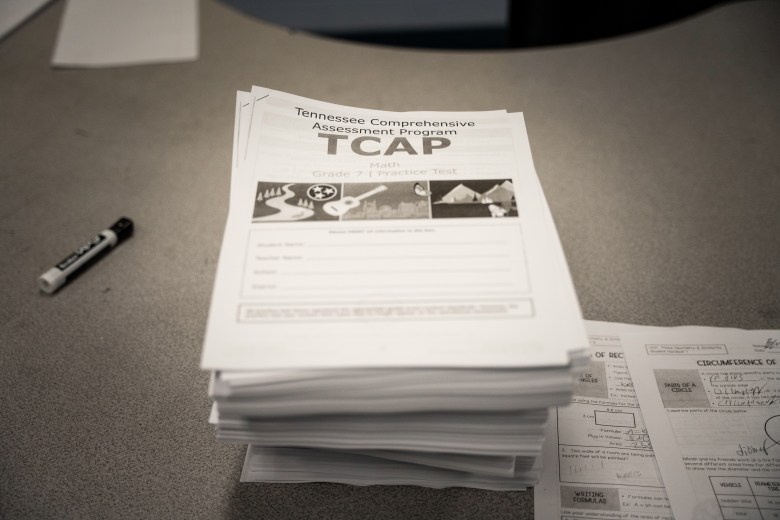
Amid a grim landscape nationwide for middle school math, Tennessee fared better than most states. In two districts in the state that bucked the national trend — Weakley and the Putnam County School District — educators point to instructional coaches, a dramatic increase in class time devoted to math and teachers systematically using student performance data to inform their teaching and push students to improve.
How students do in middle school can predict how they do in life. Higher achievement in eighth grade math is associated with a higher income, more education later and with declines in teen motherhood and incarceration and arrest rates, a 2022 study by Harvard’s Center for Education Policy Research found. In addition, middle school grades and attendance are the best indicators of how a student will do in high school and whether they’re ready for college at the end of high school, a 2014 study found.
Nationally, the news coming in shows trouble ahead: In January, for example, the National Assessment of Educational Progress, known as the Nation’s Report Card, showed that average eighth grade scores in 2024 were below those of 2019 and didn’t budge from 2022, when scores were the lowest in more than 20 years. Worse, the gaps between high and low achievers widened.
Tennessee, though, was one of five jurisdictions where the percentage of eighth graders scoring proficient in math — meaning they were able to handle challenging tasks like calculating square roots, areas and volumes — increased from 2022 to 2024. That reflects a longer-term trend: Since 2011, Tennessee has climbed from the 45th-ranked state to the 19th for average eighth grade math scores.
But researchers have struggled to determine which interventions were most effective in helping students recover. A June 2024 study that looked at different strategies came to no conclusion because the strategies weren’t comparable across districts, said Dan Goldhaber of the nonprofit American Institutes for Research. In March, the Trump administration eliminated nearly all staff at the Department of Education unit that runs the Nation’s Report Card, which educators and researchers worry could make it even harder to compare how students in different states and districts perform and draw lessons about what works.
In the absence of systematic research, attention has turned to states like Tennessee and districts like Weakley and Putnam where kids have climbed out of an academic hole. At Martin Middle School, the percentage of students meeting grade level expectations on the state math exam cratered during the pandemic, falling from 40 percent in 2019 to 24 percent in 2022. But in 2024 that number jumped to 43 percent.
Weakley County sits in the state’s northwest corner, its flat farmland populated with small towns of mostly modest ranch homes. The county is poorer than most in the country, with a median household income under $50,000.
When the first federal Covid relief money arrived in early 2020, the district had to choose what to prioritize. Weakley focused on hiring staff who could help kids recover lost learning — instructional coaches for each school to focus on teaching strategies, plus subject-area coaches like Baker, whose role the district created in 2021. “Bottom line, we decided people over things,” said school system Director Jeff Cupples.
Research indicates that coaching can make a big difference in student outcomes. A 2018 study summarizing the results of 60 prior studies found that coaching accelerated student learning by the equivalent of four to six months, according to Brown University associate professor Matthew Kraft, who led the research team. In a survey of Tennessee school districts last year, 80 of 118 that responded said they employ math coaches.
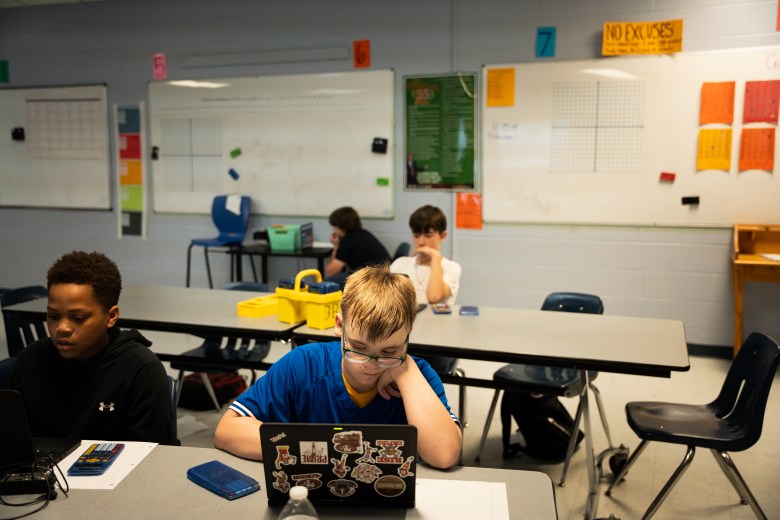
Two Tennessee school districts credit the systematic use of student achievement data for helping their middle schoolers rebound from the pandemic-era slide in middle-school math scores. Credit: Andrea Morales for The Hechinger Report
In 2022, Martin Middle made another big change, nearly doubling the time kids spend in math class. In place of a single 50-minute class are two 45-minute periods that the school calls “core” and “encore,” with the encore session meant to solidify what students get in the first.
On an overcast March day, Becky Mullins, a longtime math and science teacher who’s also assistant principal, helped sixth graders in her encore class calculate area and volume. On a screen at the front of the classroom, she pulled up problems many of them had trouble with in their core class taught by math teacher Drew Love. One asked them to calculate how many cubes of a certain volume would fit inside a larger prism. “What strategy have you learned from Mr. Love on how to solve this problem?” she asked.
When a student in the back named Charlie raised his hand and said he was stuck, Mullins pulled up a chair beside him. They worked through the procedure together, and after a few minutes he solved it. Mullins said helping students individually in class works far better than assigning them homework. “You don’t know what they’re dealing with at home,” she said.
Martin Middle seventh grader Emma Rhodes, 12, said individual help in her sixth grade encore class last year helped her through fractions. Her encore teacher was “very hands on,” said Rhodes. “It helps me most when teachers are one on one.”
Yet studies of double-dose math show mixed results. One in 2013 found a double block of algebra substantially improved the math performance of ninth graders. Another a year later concluded that struggling sixth graders who received a double block of math had higher test scores in the short term but that those gains mostly disappeared when they returned to a single block.
The share of Martin Middle School students meeting grade level expectations on the state math exam was higher in 2024 than before the pandemic. Credit: Andrea Morales for The Hechinger Report
Weakley and Putnam County staff also credit the systematic use of student achievement data for helping their middle schoolers rebound. Tennessee was a pioneer in the use of academic data in the early 1990s, devising a system that compiles fine-grained details on individual student achievement and growth based on state test results. Both Weakley and Putnam teachers use that data to pinpoint which skills they need to review with which students and to keep kids motivated.
A four-hour drive east of Weakley in Putnam County on a day in early March, seventh grade math teacher Brooke Nunn was reviewing problems students had struggled with. Taped to the wall of her classroom was a printout of her students’ scores on each section of a recent test in preparation for the Tennessee state exam in April. One portion of that exam requires students to work without calculators. “This non-calculator portion killed them, so they’re doing it again,” Nunn said of the exercises they’re working on — adding and subtracting negatives and positives, decimals and fractions.
The data on her wall drove the lesson and the choice of which students to have in the room at Prescott South Middle School, where she teaches. Starting about 10 years ago, the district began requiring 90 minutes of math a day, split into two parts. In the second half, teachers pull out students in groups for instruction on specific skills based on where the data shows they need help.
Teachers also share this data with students. In a classroom down the hall, after a review lesson, fellow seventh grade math teacher Sierra Smith has students fill out a colorful graphic showing which questions they got and which they missed on their most recent review ahead of the state test. Since Covid, apathy has been a challenge, district math coach Jessica Childers said. But having kids track their own data has helped. “Kids want to perform,” she said, and many thrive on trying to best their past performance.
The district is laser focused on the state tests. It created Childers’ math coach role in 2019 with district funds and later other instructional coach jobs using federal pandemic relief money. Much of Childers’ job revolves around helping teachers closely align their instruction with the state middle school math standards, she said. “I know that sounds like teaching to the test, but the test tests the standards,” said Childers.
Something in what the district is doing is working. It’s not well off: The share of its families in poverty is 4 percent higher than the national average. But at all six district middle schools, the percentage of students meeting expectations on the state math exam was higher in 2024 than in 2019, and at all six the percentage was above the state average.
Goldhaber, the AIR researcher, speculated that the focus on testing might help explain the rebound in Tennessee. “States have very different orientations around standards, accountability and the degree to which we ought to be focused on test scores,” he said. “I do believe test scores matter.”
The share of Martin Middle School students meeting grade level expectations on the state math exam was higher in 2024 than before the pandemic. Credit: Andrea Morales for The Hechinger Report
If Trump administration layoffs hamstring the ability to compare performance across states, successful strategies like those in the two districts might not spread. Weakley and Putnam have taken steps to ensure the practices they’ve introduced persist regardless of what happens at the federal level. Most of the federal Covid relief dollars that paid for academic coaches in both districts stopped flowing in January, but both have rolled money for coaches into their budgets. They also say double blocks of math will continue.
Cupples, the Weakley superintendent, worries about the effect of any additional federal cuts — without federal funds, the district would lose 90 positions and 10 percent of its budget. It would be “chaos, doom, despair,” he said, laughing. “But one thing I’ve learned about educators — as one myself and working with them — we overcome daily,” he said.
“It’s just what we do.”
Contact editor Caroline Preston at 212-870-8965, via Signal at CarolineP.83 or on email at preston@hechingerreport.org.
The Hechinger Report provides in-depth, fact-based, unbiased reporting on education that is free to all readers. But that doesn’t mean it’s free to produce. Our work keeps educators and the public informed about pressing issues at schools and on campuses throughout the country. We tell the whole story, even when the details are inconvenient. Help us keep doing that.
Creating a sense of belonging is crucial to student success and persistence, especially for nontraditional, working students in online programs. Our professional science master’s (PSM) in biotechnology degree is designed for working professionals, offering primarily online and evening courses that emphasize applied learning and professional development. The degree plan combines basic science courses and lab work in biotechnology with a strong foundation in business and professional skills. A required industry internship ensures graduates enter the biotech workforce with real world experience. The program’s rigorous nature, combined with students’ full-time jobs and family commitments, leaves little time to build peer connections or a sense of community.
With funding from the National Science Foundation’s Scholarships in Science, Technology, Engineering, and Math (NSF S-STEM) program, we provide scholarships and support students with co-curricular activities to enhance their educational experience. While awarding scholarships was straightforward, fostering engagement in these activities and building a strong community proved far more challenging. How do you cultivate connection, retention, and career development among busy, online STEM students? Here, we share five strategies that have helped us successfully create a sense of community in our program.
1. Ask the students what they want
An integral part of community building is having students meet as a group, whether in person or online. To increase the likelihood of student participation, we first invited their input on what types of events they want to attend, and when. Each semester, we ask students to fill out an availability form and use this information to provide both in person and online meeting opportunities each month, which allows us to meet the diverse needs of our busy students. Our experience indicates students are more likely to attend events when they are given a voice in the planning process. We send out a questionnaire asking them for their ideas and preferences for monthly cohort meetings each semester and schedule events with their ideas in mind.
2. Give them what they want
Monthly cohort meetings include a variety of events that address the multifaceted needs of the students: professional, academic, social, creative, and physical/ mental well-being. We use the student feedback to provide impactful activities that are useful and interesting to them. Many students request events that foster connections with their peers, but given the mainly online format of the program, this can be a challenge. While academic or professional topics may be presented either in person or on Zoom, we schedule purely social events, such as a dinner at a local hotspot, as in-person activities only. To feed the creative side of our STEM students, we have also hosted water coloring tutorials and rock painting socials where students are able to simply relax and catch up with each other. To deal with the stresses of graduate school and promote self-care, we hosted group yoga sessions. Many times, this results in lasting friendships or a professional connection. One student commented that the cohort events “allowed me to meet amazing people that I now call friends.”
3. Give them what they don’t know they need
We also provide co-curricular activities that students may not have specifically requested. For example, we invite industry leaders who provide career advice and perspectives on specific areas in biotechnology. Students can learn from their many years of experience and get a view into a day in the life of a particular career choice, helping them to navigate their own career paths. A student may initially start the program thinking they want to establish a career in one area in biotechnology but may complete the program with a completely different career goal in mind. Guest speakers open their eyes to the different possibilities. In addition, leadership skills are an integral part of being successful in any career choice. Thus, we also invite speakers that provide workshops on how to develop effective leadership skills and practical ways to implement them. Since it is important for students to have a broad knowledge of biotechnology, we have also hosted biotechnology-related research talks to keep them abreast of current research in this field. We also provide opportunities to attend conferences and networking events. Initially, students may not grasp the power of networking in career development. Conferences provide many opportunities which not only include networking but also learning about cutting edge research and other potential career paths. To encourage conference attendance, we provide travel support and stipends for attending approved biotechnology or leadership-related conferences of their choice.
4. Develop relationships with the students
Building strong relationships with students fosters a sense of community and belonging. Beyond seeing students in class and at monthly cohort events, regular one-on-one check-ins, whether in person or via Zoom, offer a space for students to discuss both academic and personal matters in an informal setting. These meetings help track progress, provide guidance, and connect students with relevant campus resources. By maintaining continuity in conversations, faculty and advisors build trust and accountability while encouraging student engagement in co-curricular opportunities. Many students express appreciation for the personalized support, noting that it enhances their overall educational experience and sense of connection to the program.
5. Create opportunities for peer mentoring
Facilitating peer mentoring strengthens student connections and fosters a supportive community. In addition to the monthly cohort events, we also hold a yearly retreat where new, current, and past students gather. Current students and alumni provide valuable insights, guidance, and advice to the incoming students. Incorporating interactive activities like icebreakers enhances engagement and encourages meaningful connections. Alumni play a key role by offering insights, career advice, and professional networking opportunities. Maintaining alumni engagement through events and communication channels ensures ongoing mentorship and support for students. Many students credit these interactions with boosting their confidence, leadership skills, and sense of belonging within the program.
After two years, our program has shown promising results, with preliminary pre- and post-survey data indicating growth in leadership, cultural, and academic capital, as well as STEM professional identity. While our approach is rooted in a hybrid model with some events happening on campus, many of these strategies can be adapted to fully online programs through virtual mentorship, networking events, and interactive community-building activities. Creating a sense of belonging is challenging in online education, but with intentional efforts, it is possible to foster meaningful connections that enhance student success and career development. We hope these insights inspire you to build strong, engaged student communities within your own programs.
Antonette Robles, PhD is the Grant Coordinator for Project SCALE (Scholarships and Co-curricular Activities Leading to Excellence in the Biotechnology Workforce) and an Adjunct Professor of Biology Texas Woman’s University.
Stephanie Pierce, PhD is an Assistant Clinical Professor of Biology, Co-investigator for Project SCALE, and Program Director for the Professional Science Master’s program in Biotechnology at Texas Woman’s University.
Juliet V. Spencer, PhD is a Professor of Biology, the Principal Investigator of Project SCALE, and Interim Dean of the College of Arts & Sciences at Texas Woman’s University.
Creating a sense of belonging is crucial to student success and persistence, especially for nontraditional, working students in online programs. Our professional science master’s (PSM) in biotechnology degree is designed for working professionals, offering primarily online and evening courses that emphasize applied learning and professional development. The degree plan combines basic science courses and lab work in biotechnology with a strong foundation in business and professional skills. A required industry internship ensures graduates enter the biotech workforce with real world experience. The program’s rigorous nature, combined with students’ full-time jobs and family commitments, leaves little time to build peer connections or a sense of community.
With funding from the National Science Foundation’s Scholarships in Science, Technology, Engineering, and Math (NSF S-STEM) program, we provide scholarships and support students with co-curricular activities to enhance their educational experience. While awarding scholarships was straightforward, fostering engagement in these activities and building a strong community proved far more challenging. How do you cultivate connection, retention, and career development among busy, online STEM students? Here, we share five strategies that have helped us successfully create a sense of community in our program.
1. Ask the students what they want
An integral part of community building is having students meet as a group, whether in person or online. To increase the likelihood of student participation, we first invited their input on what types of events they want to attend, and when. Each semester, we ask students to fill out an availability form and use this information to provide both in person and online meeting opportunities each month, which allows us to meet the diverse needs of our busy students. Our experience indicates students are more likely to attend events when they are given a voice in the planning process. We send out a questionnaire asking them for their ideas and preferences for monthly cohort meetings each semester and schedule events with their ideas in mind.
2. Give them what they want
Monthly cohort meetings include a variety of events that address the multifaceted needs of the students: professional, academic, social, creative, and physical/ mental well-being. We use the student feedback to provide impactful activities that are useful and interesting to them. Many students request events that foster connections with their peers, but given the mainly online format of the program, this can be a challenge. While academic or professional topics may be presented either in person or on Zoom, we schedule purely social events, such as a dinner at a local hotspot, as in-person activities only. To feed the creative side of our STEM students, we have also hosted water coloring tutorials and rock painting socials where students are able to simply relax and catch up with each other. To deal with the stresses of graduate school and promote self-care, we hosted group yoga sessions. Many times, this results in lasting friendships or a professional connection. One student commented that the cohort events “allowed me to meet amazing people that I now call friends.”
3. Give them what they don’t know they need
We also provide co-curricular activities that students may not have specifically requested. For example, we invite industry leaders who provide career advice and perspectives on specific areas in biotechnology. Students can learn from their many years of experience and get a view into a day in the life of a particular career choice, helping them to navigate their own career paths. A student may initially start the program thinking they want to establish a career in one area in biotechnology but may complete the program with a completely different career goal in mind. Guest speakers open their eyes to the different possibilities. In addition, leadership skills are an integral part of being successful in any career choice. Thus, we also invite speakers that provide workshops on how to develop effective leadership skills and practical ways to implement them. Since it is important for students to have a broad knowledge of biotechnology, we have also hosted biotechnology-related research talks to keep them abreast of current research in this field. We also provide opportunities to attend conferences and networking events. Initially, students may not grasp the power of networking in career development. Conferences provide many opportunities which not only include networking but also learning about cutting edge research and other potential career paths. To encourage conference attendance, we provide travel support and stipends for attending approved biotechnology or leadership-related conferences of their choice.
4. Develop relationships with the students
Building strong relationships with students fosters a sense of community and belonging. Beyond seeing students in class and at monthly cohort events, regular one-on-one check-ins, whether in person or via Zoom, offer a space for students to discuss both academic and personal matters in an informal setting. These meetings help track progress, provide guidance, and connect students with relevant campus resources. By maintaining continuity in conversations, faculty and advisors build trust and accountability while encouraging student engagement in co-curricular opportunities. Many students express appreciation for the personalized support, noting that it enhances their overall educational experience and sense of connection to the program.
5. Create opportunities for peer mentoring
Facilitating peer mentoring strengthens student connections and fosters a supportive community. In addition to the monthly cohort events, we also hold a yearly retreat where new, current, and past students gather. Current students and alumni provide valuable insights, guidance, and advice to the incoming students. Incorporating interactive activities like icebreakers enhances engagement and encourages meaningful connections. Alumni play a key role by offering insights, career advice, and professional networking opportunities. Maintaining alumni engagement through events and communication channels ensures ongoing mentorship and support for students. Many students credit these interactions with boosting their confidence, leadership skills, and sense of belonging within the program.
After two years, our program has shown promising results, with preliminary pre- and post-survey data indicating growth in leadership, cultural, and academic capital, as well as STEM professional identity. While our approach is rooted in a hybrid model with some events happening on campus, many of these strategies can be adapted to fully online programs through virtual mentorship, networking events, and interactive community-building activities. Creating a sense of belonging is challenging in online education, but with intentional efforts, it is possible to foster meaningful connections that enhance student success and career development. We hope these insights inspire you to build strong, engaged student communities within your own programs.
Antonette Robles, PhD is the Grant Coordinator for Project SCALE (Scholarships and Co-curricular Activities Leading to Excellence in the Biotechnology Workforce) and an Adjunct Professor of Biology Texas Woman’s University.
Stephanie Pierce, PhD is an Assistant Clinical Professor of Biology, Co-investigator for Project SCALE, and Program Director for the Professional Science Master’s program in Biotechnology at Texas Woman’s University.
Juliet V. Spencer, PhD is a Professor of Biology, the Principal Investigator of Project SCALE, and Interim Dean of the College of Arts & Sciences at Texas Woman’s University.