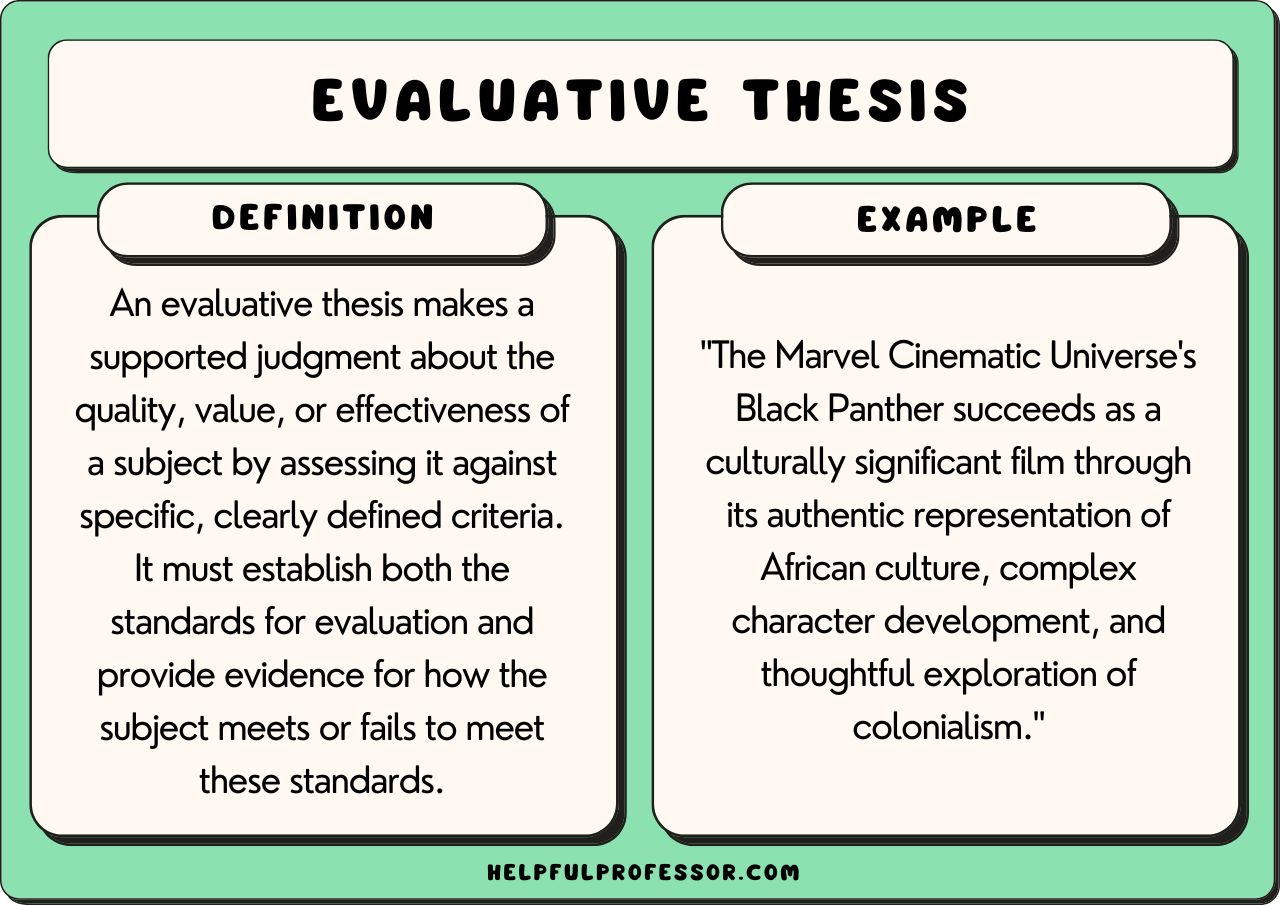
An evaluative thesis makes a judgment about the quality, importance, or effectiveness of something based on specific criteria.
Here’s its structure:
[Subject] + [Judgment based on criteria] + [Criteria/Standards]
And here’s a simple example:
“The Marvel Cinematic Universe’s Black Panther succeeds as a culturally significant film through its authentic representation of African culture, complex character development, and thoughtful exploration of colonialism.”
You’ll notice the necessary elements in that statement that make it specifically an evaluative thesis statement:
It states what is being evaluated (Black Panther)
It makes a value judgment (succeeds)
It provides specific criteria for the evaluation (representation, character development, themes)
Makes sense? Let’s explore some more examples.
Evaluative Thesis Examples
#25. The Finnish Education System
“The Finnish education system stands as the most effective model of public education among developed nations, demonstrated by its student-centered learning approach, high teacher qualification standards, and emphasis on equity over standardized testing.”
“Social media platform Instagram proves particularly detrimental to adolescent mental health due to its emphasis on physical appearance, promotion of social comparison, and algorithmic amplification of unrealistic lifestyle content.”
Subject: Instagram’s impact on adolescent mental health
Judgment: particularly detrimental
Criteria: appearance focus, social comparison, algorithmic amplification
#23. Nordic Welfare State
“The Nordic welfare state model demonstrates superior effectiveness in reducing income inequality through its progressive taxation system, universal social services, and strong labor market protections.”
Subject: Nordic welfare state model
Judgment: superior effectiveness
Criteria: taxation, social services, labor protections
#22. Urban Gentrification
“Contemporary urban gentrification policies in major U.S. cities fail to serve community interests based on their displacement of long-term residents, erosion of cultural heritage, and acceleration of economic segregation.”
Subject: Urban gentrification policies
Judgment: fail to serve community interests
Criteria: displacement, cultural preservation, economic integration
#21. Aging Population
“Japan’s aging population management strategies excel in addressing demographic challenges through their innovative healthcare delivery, intergenerational community programs, and technology integration for elderly care.”
Subject: Japan’s aging population management
Judgment: excel in addressing challenges
Criteria: healthcare delivery, community programs, technology integration
#20. Indigenous Reconciliation
“The Australian reconciliation process with Indigenous peoples remains inadequate due to insufficient land rights recognition, limited political representation, and weak implementation of cultural preservation policies.”
Subject: Australian reconciliation process
Judgment: remains inadequate
Criteria: land rights, political representation, cultural preservation
#19. German Education System
“Germany’s dual vocational education system proves highly successful in youth workforce development through its integration of classroom learning, practical training, and industry partnerships.”
Subject: German dual vocational education
Judgment: highly successful
Criteria: classroom learning, practical training, industry partnerships
#18. Canadian Multiculturalism
“Canada’s multiculturalism policy emerges as an exemplary model for cultural integration based on its legal framework for equality, support for cultural expression, and inclusive citizenship practices.”
Subject: Canadian multiculturalism policy
Judgment: exemplary model
Criteria: legal framework, cultural support, citizenship practices
#17. Mental Health Shortcomings
“South Korea’s mental health services demonstrate critical shortcomings in addressing public needs through their limited accessibility, high stigmatization, and insufficient preventive measures.”
“New Zealand’s environmental conservation strategies show remarkable effectiveness in biodiversity protection through their indigenous knowledge integration, community-based management, and ecosystem-wide approach.”
Subject: NZ environmental conservation strategies
Judgment: remarkable effectiveness
Criteria: indigenous knowledge, community management, ecosystem approach
#15. Refugee Integration
“The European Union’s refugee integration programs demonstrate significant inadequacies based on their inconsistent implementation, limited resource allocation, and poor cultural sensitivity training.”
Subject: EU refugee integration programs
Judgment: significant inadequacies
Criteria: implementation consistency, resources, cultural training
#14. Public Housing System
“Singapore’s public housing system emerges as an exceptional model of urban planning through its racial integration policies, affordable pricing structures, and community-centered design.”
Subject: Singapore’s public housing
Judgment: exceptional model
Criteria: racial integration, affordability, community design
#13. Renewable Energy Transition
“Scotland’s renewable energy transition shows remarkable success in sustainable development through its community ownership schemes, technological innovation, and grid modernization efforts.”
Subject: Scotland’s renewable transition
Judgment: remarkable success
Criteria: community ownership, innovation, grid modernization
#12. Gender Equality Initiatives
“Rwanda’s gender equality initiatives stand out as particularly effective in advancing women’s rights through quota systems, economic empowerment programs, and anti-violence legislation.”
Subject: Rwanda’s gender equality initiatives
Judgment: particularly effective
Criteria: quotas, economic programs, legislation
#11. Digital Democracy
“Taiwan’s digital democracy tools excel in promoting civic engagement through their transparency mechanisms, participatory budgeting platforms, and citizen feedback systems.”
Subject: Taiwan’s digital democracy tools
Judgment: excel in promoting engagement
Criteria: transparency, participation, feedback systems
#10. Bike Infrastructure
“The Netherlands’ bicycle infrastructure proves exemplary in sustainable urban mobility through its comprehensive network design, safety prioritization, and integration with public transit.”
“Costa Rica’s environmental education curriculum demonstrates outstanding effectiveness in fostering ecological awareness through its experiential learning approach, local ecosystem focus, and community involvement.”
Subject: Costa Rica’s environmental education
Judgment: outstanding effectiveness
Criteria: experiential learning, ecosystem focus, community involvement
#8. Elder Care Systems
“Denmark’s elder care system shows superior quality in supporting aging populations through its home care emphasis, social inclusion programs, and preventive health measures.”
Subject: Danish elder care
Judgment: superior quality
Criteria: home care, social inclusion, preventive health
#7. E-Governance
“Estonia’s e-governance platform emerges as a leading model of digital public services through its user-centered design, robust security measures, and comprehensive service integration.”
Subject: Estonian e-governance
Judgment: leading model
Criteria: user design, security, service integration
#6. Rehabilitation in Norway
“Norway’s prison rehabilitation system demonstrates exceptional effectiveness in reducing recidivism through its emphasis on education, psychological support, and gradual reintegration programs.”
“Barcelona’s urban superblock initiative proves highly successful in improving city livability through its pedestrian prioritization, green space expansion, and local business support.”
Subject: Barcelona’s superblock initiative
Judgment: highly successful
Criteria: pedestrian spaces, green areas, business support
#4. Truth and Reconciliation
“South Africa’s Truth and Reconciliation Commission shows mixed effectiveness as a transitional justice mechanism based on its victim testimony process, amnesty provisions, and reparation implementation.”
Subject: SA Truth and Reconciliation Commission
Judgment: mixed effectiveness
Criteria: testimony process, amnesty, reparations
3. Gross National Happiness
“Bhutan’s Gross National Happiness index emerges as an innovative model for measuring societal progress through its cultural preservation metrics, environmental sustainability indicators, and community vitality assessments.”
Subject: Bhutan’s GNH index
Judgment: innovative model
Criteria: cultural metrics, environmental indicators, community vitality
#2. Growth Mindsets
“The widely-adopted ‘growth mindset’ intervention proves ineffective as a universal educational tool due to its oversimplified implementation, lack of cultural context consideration, and overemphasis on individual rather than systemic factors.”
Subject: Growth mindset intervention
Judgment: ineffective as universal tool
Criteria: implementation, cultural context, systemic consideration
#1. Dopamine Detox
“Social media’s ‘dopamine detox’ trend emerges as a problematic self-help approach through its misrepresentation of neuroscience, one-size-fits-all recommendations, and neglect of underlying mental health factors.”
Subject: Dopamine detox trend
Judgment: problematic approach
Criteria: scientific accuracy, universal recommendations, mental health consideration
Dr. Chris Drew is the founder of the Helpful Professor. He holds a PhD in education and has published over 20 articles in scholarly journals. He is the former editor of the Journal of Learning Development in Higher Education. [Image Descriptor: Photo of Chris]
As a school administrator or marketer, you’re likely already familiar with the challenges of traditional admissions processes: manual paperwork, miscommunication, long timelines, and a lack of transparency.
Implementing an online enrollment system can revolutionize your institution’s operations. It can help you create a seamless experience for prospective students while significantly easing administrative burdens.
At Higher Education Marketing, we’ve spent years partnering with institutions to understand their unique needs. Our Student Portal is designed specifically for education providers like you, offering an all-in-one solution to streamline admissions and enhance the student journey.
Let’s explore ten benefits of adopting an online admissions and enrollment system and how HEM’s Student Portal can help you transform your processes. You’ll see how much value you can add to your student experience and how a sophisticated CRM can boost enrollment.
Simplify student management and boost recruitment efficiency!
Transform your student portal experience. Get a FREE HEM-SP demo today.
Understanding Online Enrollment Systems
What does an enrollment system do? An online admissions and enrollment system is a digital platform that streamlines student recruitment, application management, and enrollment. By moving these processes online, institutions can eliminate manual paperwork, reduce processing times, and improve the overall experience for students and staff.
These systems typically include customizable application forms, real-time tracking, automated communication tools, and integration with other institutional systems like CRMs and financial platforms. Now, let’s get to the good part–the many benefits of enrollment system tools.
Want to know what our Student Portal System can do for your school? Let’s connect!
A Brief Overview of the Enrollment Process
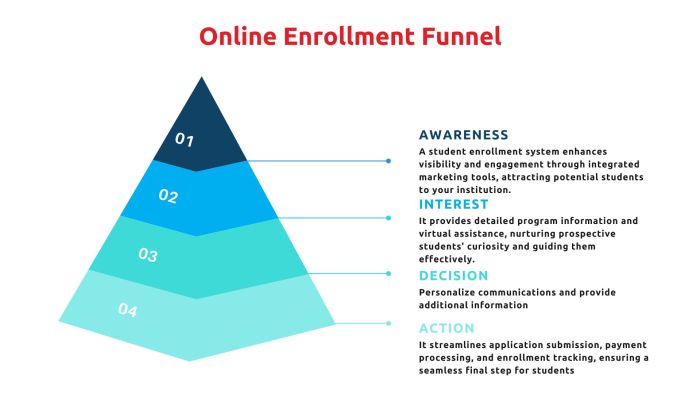
To maximize the benefits of an online admissions and enrollment system, it’s important to understand the enrollment funnel. What is the process for enrollment? It’s a framework that outlines the four key stages prospective students go through when deciding to enroll at your institution. These include awareness, interest, decision, and action.
Awareness is the first stage, where students become familiar with your school through marketing efforts, social media, or word-of-mouth. During this phase, you aim to make a positive impression and highlight what sets your institution apart.
Interest follows as students actively seek more information about your programs and offerings. At this stage, providing detailed program descriptions, virtual tours, and engaging content becomes crucial to capturing their attention.
Decision is the third stage, where students weigh their options and determine if your institution aligns with their goals. Clear application processes, transparent cost estimates, and personalized communication can help sway their decision.
Action is the final stage, where students commit by completing their application and enrollment. An intuitive and efficient online system, like HEM’s Student Portal, ensures this final step is seamless and stress-free, setting the tone for a positive student experience.
Source: HEM
1. Simplifying the Application Process
An online admissions system allows you to simplify and accelerate the application process, providing a smoother experience for prospective students. Instead of requiring students to navigate complex paper forms or disjointed systems, you can offer them a centralized, user-friendly portal where they can complete their applications step-by-step.
HEM’s Student Portal includes a customizable WYSIWYG (what you see is what you get) form builder, allowing you to tailor applications to your institution’s specific requirements. With options for e-signatures, document uploads, and guided prompts, your students can complete their applications quickly and confidently.
For administrators, this streamlined process means less time spent tracking incomplete applications and more time focusing on strategic initiatives. You can view, manage, and update application statuses in real time, ensuring nothing slips through the cracks.
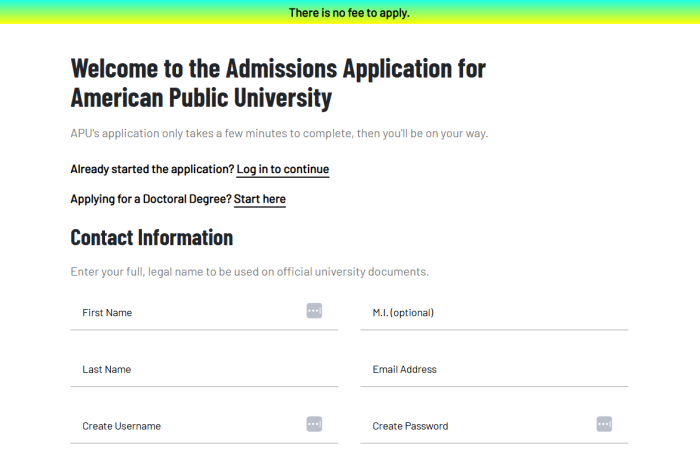
Example: The key benefit of online enrollment systems regarding the student journey is convenience. Here, American Public University is the perfect example.
At the click of a button, students can begin their applications.
They are immediately led to a simple, free application form where they’ll provide vital information needed for the American Public University to determine whether admission into their program will be granted and allow them to track their journey.
Source: American Public University
2. Enhancing Recruitment Efforts
With an online system, you can improve how you engage with prospective students from the beginning of their journey. HEM’s Student Portal integrates powerful marketing automation tools, allowing you to nurture leads with personalized communications at every stage of the admissions funnel. You can keep prospective students engaged and informed by sending timely emails, reminders, and updates, increasing their likelihood of completing enrollment.
Furthermore, the system’s data insights enable you to identify trends in student inquiries, monitor which marketing campaigns are most effective, and adjust your strategies accordingly. This data-driven approach ensures your recruitment efforts are consistently targeted and impactful.
Example: Once a prospect has filled out a contact form or inquired about a program, they should receive a personalized follow-up message that provides program details and prompts them to follow the next steps.
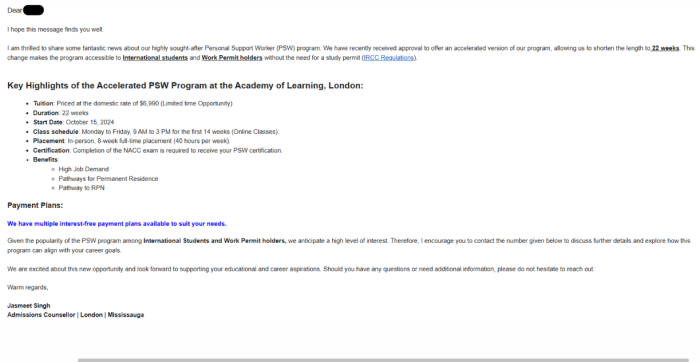
Here, the Academy of Learning sends an automated email about its Accelerated PSW Program to a prospect who recently expressed interest. Our Student Portal integrates email and messaging services to facilitate and automate communication with prospects, a key part of the recruitment process.
Source: Academy of Learning | Gmail
3. Reducing Administrative Burden
One of the most immediate benefits of implementing an online admissions and enrollment system is the reduction in administrative workload. Manual processes can be time-consuming and prone to errors, but with an online platform like HEM’s Student Portal, you can centralize all tasks in one intuitive interface. From managing inquiries to processing payments, every step is organized and automated.
Staff members across departments can collaborate more effectively, ensuring seamless communication and reducing duplication of efforts. The result? A more efficient admissions team with more time to focus on higher-value tasks, such as building relationships with students and refining institutional strategies.
4. Offering Real-Time Insights
Making informed decisions is essential in a competitive education landscape, and real-time insights from your admissions system can give you a critical advantage. HEM’s Student Portal provides robust reporting and tracking tools, giving visibility into key metrics such as completed applications, outstanding payments, and enrollment trends.
Imagine identifying bottlenecks in your process as they happen, enabling you to resolve issues before they escalate. With this level of visibility, you can forecast enrollment numbers more accurately, allocate resources efficiently, and continuously optimize your processes.
Example: The Student Portal allows you to create comprehensive, updated CRM reports to track enrollment data. Find out what kind of requests are being made, what desired action has been taken, and what’s next.
Source: HEM
5. Improving Communication and Transparency
A common frustration for both students and staff in traditional admissions processes is a lack of clarity. With an online system, communication becomes seamless and transparent. Students can log into their portal anytime to check their application status, access important updates, and even chat with a virtual admissions assistant for guidance.
HEM’s Student Portal goes a step further with its integrated communication tools. From automated notifications to direct messaging capabilities, the platform ensures that every student feels supported and informed throughout their journey. This transparency fosters trust and builds a stronger connection between students and your institution.
6. Enhancing the Student Experience
Your admissions process is often the first interaction prospective students have with your institution, making it crucial to leave a positive impression. An online admissions and enrollment system demonstrates that your school values convenience, efficiency, and modern technology, which resonate with today’s tech-savvy students.
HEM’s Student Portal includes features like virtual admissions assistance and a quote builder, which allows students to estimate program costs upfront. These tools empower students with the information they need to make confident decisions, enhancing their overall experience and reinforcing their trust in your institution.
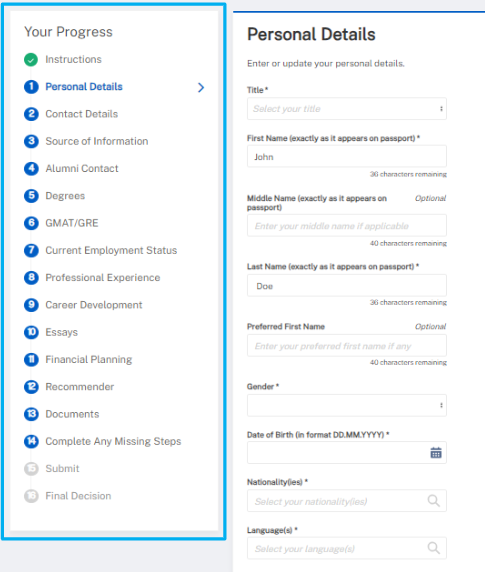
Example: The Student Portal prioritizes a seamless experience for students, guiding them from step to step, making it easy to share important files, and providing a full picture of their enrollment journey.
Source: HEM
7. Facilitating Financial Planning
Financial concerns are one of the most significant barriers prospective students face when considering enrollment. You can address these concerns head-on by incorporating tools like HEM’s quote builder and seamless payment gateway integration. The quote builder provides students and their families with transparent cost estimates for tuition and fees, enabling them to plan their finances effectively.
The payment gateway integration simplifies the payment process, allowing students to make secure transactions directly through the portal. You can also track real-time payment statuses, ensuring that financial records are always current.
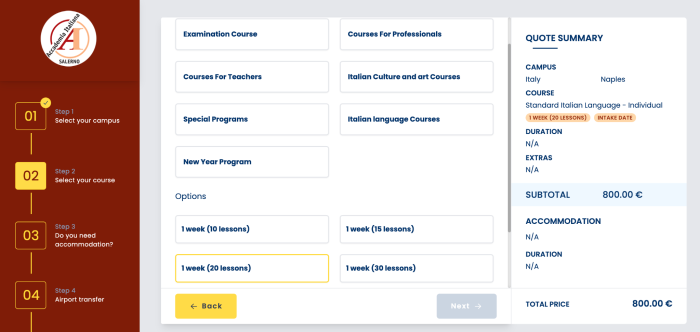
Example: Accademia Italiana Salerno utilizes our Student Portal’s Quote Builder feature, which provides students with a close estimate of their school expenses. Your students will appreciate being able to plan when making a significant investment in their education.
Source: HEM
8. Supporting Institutional Flexibility
Every institution is unique, with its own set of requirements and processes. That’s why customization is essential in any online admissions system. HEM’s Student Portal offers a flexible framework that adapts to your needs, whether you’re managing applications for a university, language school, or K-12 provider.
You can customize application forms, workflows, and communications to align with your institutional goals. This flexibility ensures that the system serves as a seamless extension of your team rather than a one-size-fits-all solution.
9. Boosting Efficiency with Integrated Tools
Efficiency is at the heart of any successful admissions process; integrated tools can make a significant difference. HEM’s Student Portal combines essential functionalities like CRM systems, marketing automation, and data analytics into one centralized platform. This integration eliminates the need for multiple disconnected systems, streamlining your operations and improving collaboration across departments.
For example, marketing teams can use the portal to track campaign effectiveness, admissions staff can manage inquiries and applications, and financial teams can monitor payments—all within the same system. This level of integration enhances productivity and ensures that every team member has access to the information they need.
10. Preparing for the Future
As the education sector evolves, embracing technology is no longer optional but essential! Implementing an online admissions and enrollment system positions your institution as a forward-thinking leader ready to adapt to changing student expectations and market demands.
HEM’s Student Portal is built with the future in mind, incorporating scalable features that grow with your institution. Whether you want to expand your programs, attract international students, or enhance your digital presence, the portal provides the tools you need to succeed.
Why Choose HEM’s Student Portal?
At Higher Education Marketing, we consider ourselves your partners in success. Benefit from the advantages of enrollment system technology, from simplifying application management to enhancing communication and providing real-time insights. Our platform empowers you to transform your admissions process. Request a demo today and discover how HEM’s Student Portal can help you achieve your institutional goals while creating a superior experience for students and staff.
Simplify student management and boost recruitment efficiency!
Transform your student portal experience. Get a FREE HEM-SP demo today.
Frequently Asked Questions
What does an enrollment system do?
An online admissions and enrollment system is a digital platform that streamlines student recruitment, application management, and enrollment.
What is the process for enrollment?
It’s a framework that outlines the four key stages prospective students go through when deciding to enroll at your institution. These include awareness, interest, decision, and action.
FORT WORTH, Feb. 19, 2025 — A trio of civil liberty organizations are speaking up today to demand the Fort Worth Police Department end its unconstitutional censorship and seizure of several pieces of art that were on display at the Modern Art Museum of Fort Worth.
The Foundation for Individual Rights and Expression, National Coalition Against Censorship, and the American Civil Liberties Union of Texas are joining forces to demand the return of several pieces of art by Sally Mann, a renowned photographer with accolades from the National Endowment for the Arts, the National Endowment for the Humanities, and the Guggenheim Foundation.
In November 2024, the Modern Art Museum of Fort Worth began hosting an exhibition called “Diaries from Home,” featuring works that “explore the multilayered concepts of family, community, and home.” Included in the collection were some of the photos from Mann’s 1990 collection “Immediate Family.” Mann’s collection featured an intimate and candid look at her family’s rural life. As she describes it, “I photographed their triumphs, confusion, harmony and isolation, as well as the hardships that tend to befall children — bruises, vomit, bloody noses, wet beds — all of it.”
Of the 65 photos in Mann’s “Immediate Family,” 13 depicted her children in the nude. The selection of nude photos displayed in the Modern reportedly included depictions of Mann’s daughter jumping onto a picnic table in a ballet pose, Mann’s daughter lying in bed with a stain from a nighttime accident, and Mann’s son with a melted popsicle running down his body.
“Anyone who’s ever taken a photo of their child or grandchild taking a bath understands that not all photographs of child nudity are malicious, let alone child abuse,” said FIRE Director of Public Advocacy Aaron Terr. “The seizure of Mann’s works is an egregious abuse of power that dishonestly conflates artistic expression with sexual exploitation.”
The works are not the product of child abuse, and they are neither intended nor designed to excite lust in the viewer. They do what much art does — convey ideas and invite viewers to reflect on the human experience.
Nor do the works meet the legal definition of “obscenity,” an extremely narrow definition that does not apply to all depictions of child nudity. This should be common sense to anyone familiar with the iconic “Napalm Girl” photograph, National Geographic documentaries, or even major Hollywood films like the 1978 version of “Superman.”
“Immediate Family”was controversial even at its debut decades ago, but has been showcased in more than a dozen art galleries across the world, including the National Gallery of Art. But its inclusion in the Fort Worth exhibition reignited the debate when local press and politicians denounced the photos as “child pornography.” Fort Worth police seized the artwork last month ostensibly as part of an investigation into “child abuse,” even though all of Mann’s children, as adults, continued to support the collection and their mother and have never once suggested they were abused.
“Publicity stunts like this one — in which artworks that have been shown and discussed for over 30 years are suddenly the focus of an unfounded ‘investigation’ — do nothing to protect victims of child abuse, and serve only to chill the creative expressions of artists and cultural institutions by subjecting them to the threat of political prosecution and the unconstitutional seizure of artwork,” said Elizabeth Larison, Director of NCAC’s Arts and Culture Advocacy Program.
“It’s shameful that government officials would use the criminal legal process to censor art and expression,” said Adriana Piñon, legal director of the ACLU of Texas. “This is a clear violation of the First Amendment and of the guardrails against abuse of the criminal justice system. Artistic expression should not be subject to the whim and punishment of government officials’ personal taste.”
The Foundation for Individual Rights and Expression (FIRE) is a nonpartisan, nonprofit organization dedicated to defending and sustaining the individual rights of all Americans to free speech and free thought — the most essential qualities of liberty. FIRE educates Americans about the importance of these inalienable rights, promotes a culture of respect for these rights, and provides the means to preserve them.
The ACLU of Texas is a nonpartisan nonprofit organization that works with communities, at the State Capitol, and in the courts to protect and advance civil rights and civil liberties for every Texan, no exceptions.
Since its inception in 1974, the National Coalition Against Censorship (NCAC) has functioned as a first responder in protecting freedom of expression, a fundamental human right and a keystone of democracy. Representing 60 national education, publishing, and arts organizations, NCAC encourages and facilitates dialogue between diverse voices, perspectives, and audiences.
CONTACT:
Alex Griswold, Communications Campaign Manager, FIRE: 215-717-3473; [email protected]
We’d like to recognize the significant contributions of three Black educators who helped shape the future of higher education, breaking down barriers and inspiring generations of learners and educational leaders.
Mary McLeod Bethune
Mary McLeod Bethune is regarded as one of the most significant Black educators and civil rights activists of the 20th century. The daughter of formerly enslaved parents, Bethune believed education was key to opening the doors of opportunity for Black Americans. She founded the Daytona Normal and Industrial Institute for Negro Girls in Daytona, Florida, in 1904, serving as president of the school. The school was eventually combined with the Cookman Institute for Men in 1923 (other sources cite 1929), merging to form the Bethune-Cookman College, Bethune becoming the first Black woman to serve as a college president. The college was one of the few institutions where Black students could seek a college degree. And as of fall 2023, Bethune-Cookman University enrolled 2,415 undergraduate students.
Mary McLeod Bethune, Schomburg Center for Research in Black Culture, Photographs and Prints Division, The New York Public Library. (1940 – 1949).
Kelly Miller
Kelly Miller was a groundbreaking educator, mathematician and writer, becoming the first Black man to attend Johns Hopkins University for post-graduate study. He would go on to eventually join Howard University’s faculty as a mathematics professor, helping found the American Negro Academy in 1897, the first organization for Black scholars and artists.
Miller introduced sociology to Howard’s curriculum in 1895, becoming the first person to teach the subject at the university. Eventually becoming dean of Howard’s College of Arts and Sciences in 1907, he worked to add new natural and social science courses, transforming the curriculum. Due to his tireless recruitment efforts across the south, student enrollment tripled during his first four years in that position.
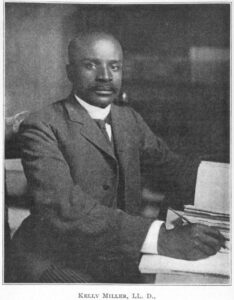
Kelly Miller, LL.D. Schomburg Center for Research in Black Culture, Jean Blackwell Hutson Research and Reference Division, The New York Public Library. (1904).
Mary Jane Patterson
Becoming the first Black woman to receive a bachelor’s degree when she graduated from Oberlin College in 1862, Mary Jane Patterson quickly established herself as trailblazer. She devoted her career to education, teaching at the Institute of Colored Youth, now known as Cheyney University, eventually becoming the school principal at the Preparatory High School for Colored Youth, the first U.S. public high school for Black Americans. The Mary Jane Patterson Scholarship was established in 2019, which aims to support post-baccalaureate students who are interested in teaching in urban classrooms.
Mary Jane Patterson, first Black woman to be granted a bachelor’s degree in the U.S. (Oberlin College, 1862). Photo retrieved from Oberlin College Archives.
During this Black History Month 2025, we celebrate the contributions of these three Black educators whose accomplishments continue to ring out throughout higher education today.
If you’re interested in history content for your course, we encourage you to browse our history catalog.
The wave of new executive orders on DEI, immigration and gender identity has already significantly impacted the higher ed workplace. While the pace of change may feel overwhelming, HR departments are taking a leading role — just as they did during the COVID-19 pandemic — in navigating change and making sure all employees feel valued and supported at work.
As CUPA-HR President and CEO Andy Brantley affirmed in his message about the recent executive orders, higher ed workplaces can still:
Promote equitable work and career pathing opportunities and pay for all employees.
Cultivate inclusive learning and working communities.
Create a workplace culture that embraces respect and civil discourse.
Level the playing field for everyone by working to remove bias, reviewing outdated policies, and creating transparency.
Reinforce institutional values by ensuring that all employees feel connected and supported.
As you strategize your response to changes taking place on your campus, here are some considerations for ensuring that you are providing equal access and opportunity for all.
Conduct an Audit of Your Institution’s DEI Efforts
If you haven’t started already, conducting an audit of programs, policies and procedures can help identify areas of concern. Design a simple spreadsheet to help you organize and track your findings in areas such as training and development, hiring, performance management, communications and website content. For each item, indicate where it falls on the legal spectrum. Does it violate the law? Is it in compliance but in need of adjustments? Is it in compliance and effective as it stands?
When reviewing your programs and processes, the central question to ask is, do they provide equal access and opportunity to all employees without giving special advantages to any one person or group?
Here’s one example. The language of the recent DEI-focused executive orders emphasizes merit. Merit has always been critical to hiring, reviewing performance and making promotion decisions. Do your policies around hiring and promotion reflect that focus on merit? Are hiring and promotion processes fair and transparent? Are hiring and promotion decisions documented, and do they reflect those policies and processes?
Connect with Campus Partners
Your institution’s general counsel can help ensure any changes made to policies and procedures are in compliance with the new executive orders and mitigate risk for your institution.
If you’re undertaking a website audit, consult your chief information officer. Is there AI-enabled software that might help identify noncompliant wording or outdated programs?
Is your institution a federal contractor or subcontractor? If so, you may face additional oversight, including new contract terms certifying that your institution is following federal antidiscrimination laws. If your status is unclear, first check with the office of research.
Consider creating a neutral body of campus stakeholders to help suggest, implement and communicate changes in response to the executive orders, but also expect that employees and administrators will have strong opinions and feelings about these changes.
Reframe Inclusion
As you review policies and communications to ensure compliance, take the opportunity to make your workplace even more welcoming and accessible.
Align with your institution’s values. What are your institution’s core values and mission? It’s likely they involve respecting diversity of thought and perspective, creating a welcoming environment, and providing equal access and opportunity to all regardless of identity. Affirming and communicating these values can be an important way to stay focused on what matters during times of change.
Consider accessibility. When revising programs and processes to be more inclusive, envision accessibility for all. For example, if your goal is to make career development programs accessible to all employees, look for gaps in access across your employee population. Just as holding trainings in non-ADA compliant buildings may limit the ability of some people to participate in career development, so might neglecting the needs of groups like non-exempt employees and working parents and caregivers. Are there more flexible options? Can you support supervisors to make it easier for an employee to take time away from regular duties?
Ensure clarity and transparency. Equity in compensation, hiring and promotion is an effective way to bolster recruitment and retention. For example, hiring and promotion practices that are not transparent, written down, and consistently followed can negatively affect the workforce. Women are less likely than men to be promoted if clear, fair criteria aren’t used. Neurodivergent candidates are disadvantaged when job interviews rely on indirect measures like succeeding at small talk rather than a skills-based assessment. In both of these instances, vague criteria such as “culture” and “fit” may prevent qualified, highly skilled employees from being hired and from moving up the ladder. Finally, be sure that your institution’s job descriptions and job requirements are up to date and are being used as the basis for decisions related to hiring and pay.
Focus on purpose. To avoid misinterpretation, your efforts at creating an inclusive workplace should be characterized in ways that are purpose driven. For example:
Communities of people with varied backgrounds and life experiences create opportunities for community members to grow personally and professionally. When employees thrive, institutions thrive.
Parity and equity, in opportunity and pay, support job satisfaction, recruitment and retention.
A safe and welcoming work environment fosters community and collaboration.
Emphasize outcomes. Lily Zheng, author of the book DEI Deconstructed, encourages those invested in fair and healthy workplaces to strengthen outcomes. Zheng recommends an outcomes-based approach “focusing on measurable results like pay equity, physical and psychological safety, wellness, and promotion rates, rather than … a one-time training, posting on social media, or other behaviors that signal commitment without demonstrating results.”
Take Steps to Educate Employees
Review the ways managers and senior leadership are implementing the policies and processes that are in place. Is additional training required? If you have made changes to policies and processes, how will you communicate those to supervisors and other campus leaders?
Be sure to evaluate anti-harassment and antidiscrimination trainings you have in place. These trainings should continue, although they may need to be adjusted to emphasize even more strongly the importance of opportunity and respect for all.
Know That You’re Not Alone
The higher ed HR community has been through challenging times before, most recently as the pandemic reshaped the workplace. If you have resources or ideas to share with other CUPA-HR members regarding ways that you and your HR colleagues are creating and sustaining an inclusive campus community, please email them to [email protected]. Your submission will be treated as confidential and, if shared, will be described in terms that will not identify your institution.
Resilience in the Workplace — This CUPA-HR webinar, recorded in 2021, was designed to serve as resilience training for attendees, as well as a model that could easily be replicated at your institution for HR teams and other employees.
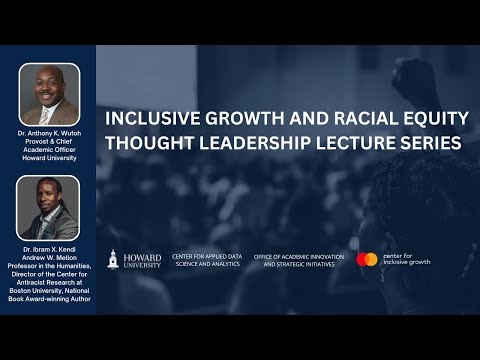
Scheduled for Feb 20, 2025. The Spring 2024 Inclusive Growth and Racial Equity Thought Leadership Lecture Series will feature a fireside chat with Dr. Ibram X. Kendi, Andrew W. Mellon Professor in the Humanities, Professor of History, Director of the BU Center for Antiracist Research, and National Book Award-winning Author.
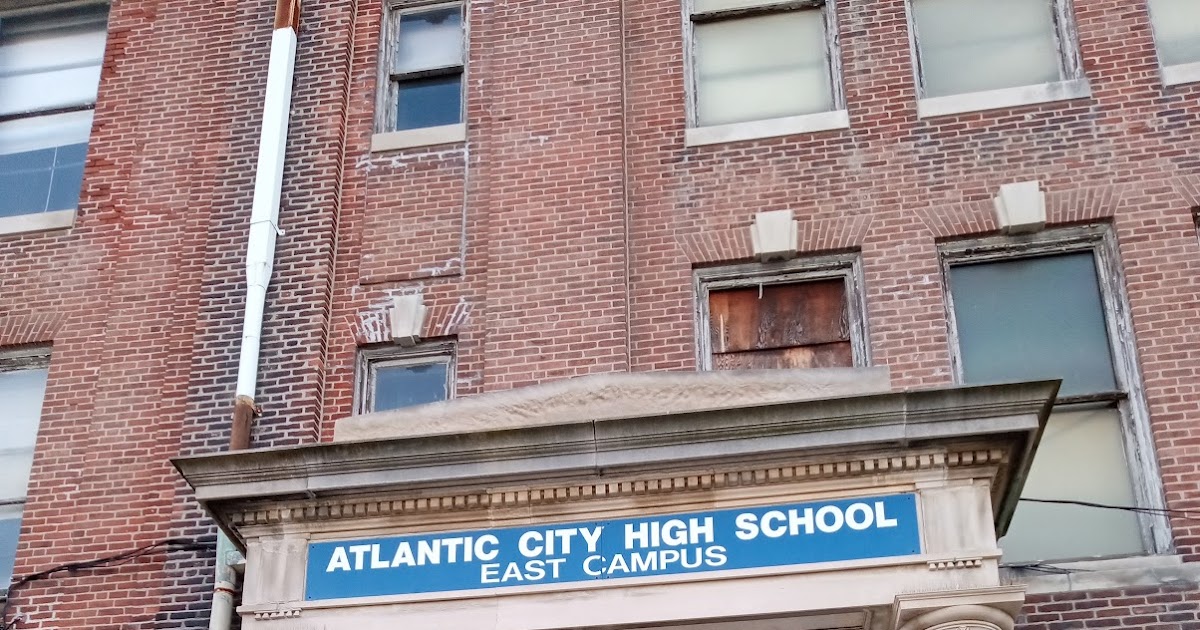
In 2025 the state of American education is more precarious than ever. Many public schools, especially those in underfunded urban and rural areas, are failing their students. The term “failing schools” is often thrown around in political debates, but what does it actually mean? And how did we get here?
The Markers of Failure Failing schools are characterized by a combination of low test scores, declining graduation rates, poor teacher retention, crumbling infrastructure, and high student absenteeism. These institutions often serve marginalized communities where poverty, crime, and systemic neglect create an uphill battle for education.
The Road to Failure The crisis in education did not happen overnight. It is the result of decades of misguided policies, economic shifts, and societal neglect. Below are some of the key factors that have contributed to the decline of many schools:
Chronic Underfunding Public schools rely heavily on local property taxes for funding, which means that schools in wealthy areas flourish while those in impoverished communities struggle to provide basic resources.
Schools in affluent neighborhoods have modern facilities and abundant resources, while schools serving working class students operate in substandard conditions.
Attempts to “reform” through privatization and the push for charter schools have only exacerbated the problem. Instead of addressing root causes, these reforms often drain public schools of resources, leaving them even more vulnerable.
The Era of Standardized Testing
Since the early 2000s, the focus on standardized testing has led to a “teach to the test” culture that stifles creativity, critical thinking, and real learning. Schools that fail to meet test score benchmarks face punitive measures rather than meaningful support.
Teacher Burnout and Shortages Low salaries, lack of respect, increasing workloads, and political interference have driven many talented educators out of the profession. The teacher pipeline is drying up, leaving many schools with underqualified or temporary staff.
Educators are often forced to contend with not only limited resources but also overwhelming emotional and physical demands that contribute to burnout. The constant critique of teachers and their work environment, compounded by insufficient support, drives educators out of the profession, leaving students without the consistent mentorship they need.
Privatization and Charter Expansion The rise of charter schools and school voucher programs has siphoned funds from public schools, leaving them with fewer resources to educate the most vulnerable students, including those with disabilities and language barriers.
The push for privatization is a form of “corporate education reform” that undermines public schooling. Rather than addressing root causes, these reforms often divert funds to entities more interested in profit than equity. Charter schools in some cases have exacerbated the inequalities they were meant to address.
Social and Economic Inequality The challenges students face at home—such as food insecurity, lack of healthcare, and unstable housing—spill into the classroom. Schools cannot solve these problems alone, yet they are often expected to compensate for systemic failures in social services.
Historical inequalities—rooted in race, class, and gender—have been perpetuated through institutions like education, often leaving marginalized communities at a disadvantage. The lack of support for students in poverty is not a new phenomenon but part of a long history of structural neglect.
Immigration Immigration brings both opportunities and challenges to different socioeconomic areas. In affluent neighborhoods, immigrants often contribute to cultural diversity, stimulate local economies, and fill highly skilled labor gaps, which enhances the overall prosperity of these communities.
In working-class neighborhoods, the influx of immigrants can strain resources and services, leading to heightened competition for low-wage jobs and potential wage suppression. While some may thrive, others may experience economic hardship and decreased access to affordable housing and healthcare, creating disparities within these communities.
Violence and Safety Concerns Mass shootings, gang violence, and bullying have made many schools unsafe. Metal detectors and police presence have not necessarily improved learning conditions, and in some cases, they have exacerbated tensions between students and faculty.
Larger social forces at play include the militarization of society and its impact on the way schools are policed and students are treated. The criminalization of students, particularly students of color, has led to an environment where educational spaces are seen as places of fear rather than learning.
Why This Matters Failing schools do not just affect individual students; they have profound implications for the workforce, the economy, and democracy itself. Poor education leads to lower earning potential, increased crime rates, and a disengaged electorate.
If we continue to neglect our schools, we risk deepening inequality and weakening the fabric of our society. The consequences of educational inequity are far-reaching, affecting not only the students directly impacted but also the future of communities, economies, and the nation as a whole.
This is a broader reflection of a society where the interests of the wealthy are prioritized over the needs of the marginalized, reinforcing cycles of poverty and injustice. If educational opportunities remain unequal, democracy itself is at risk, as people from underprivileged backgrounds are denied the tools to engage critically with society and its political structures.
What Other Nations Are Doing: Lessons from Abroad While the United States of America struggles with these deep-rooted issues, other nations have found ways to achieve better outcomes in education by focusing on equality, teacher support, and broadening the definition of success beyond standardized testing.
Finland: A Model of Equity and Teacher Respect Finland has long been held up as a model of educational excellence. One of its core principles is equality. Finnish schools ensure that all students, regardless of background, have access to high-quality education. Teachers in Finland are highly trained (requiring a master’s degree), well-compensated, and respected as professionals. Unlike the U.S., Finland has largely avoided the pitfalls of standardized testing, focusing instead on a holistic approach to education that values critical thinking, creativity, and individual growth. This model shows that when teachers are supported and empowered, students thrive.
South Korea: Education as a National Priority South Korea places a high cultural value on education, with rigorous academic standards and a highly motivated student body. However, unlike the U.S., the country provides significant government investment in education, ensuring that public schools are well-funded and that there are resources available to support students. In addition, after-school programs and tutoring are common, helping to bridge gaps for students who may need extra assistance. This holistic approach to supporting students, both inside and outside of school, contrasts sharply with the U.S. approach of leaving many schools to fend for themselves without sufficient resources.
Japan: Focus on Social Emotional Learning and Collaborative Learning Japan’s education system is grounded in social emotional learning, emphasizing respect, discipline, and collaboration over competition. Schools focus not only on academic achievement but also on developing students’ interpersonal and social skills. Teachers work closely with students to create a supportive learning environment where collaboration is prioritized. This focus on emotional and social development creates a more balanced and well-rounded educational experience. In the U.S., social emotional learning is often sidelined in favor of academics and test scores, but Japan’s success shows that nurturing the whole child leads to better outcomes overall.
Canada: Supportive Communities and Inclusivity Canada’s approach to education is centered on inclusivity, ensuring that marginalized groups—whether they be Indigenous communities, newcomers, or children with disabilities—receive the support they need to succeed. The Canadian model places a heavy emphasis on community involvement in schools, and local governments play a key role in ensuring that educational programs are tailored to meet the unique needs of their populations. This inclusive, community-driven approach contrasts with the U.S. focus on market-driven reforms and privatization, showing that investing in public education for all students pays off in the long run.
The Way Forward Reversing this trend requires a fundamental shift in priorities, which are unlikely to happen in the near term in the United States of America. But it could happen in individual states that value justice and fairness and are willing to lead.
Policymakers must commit to fully funding public education, reforming assessment methods, supporting teachers, and addressing social inequalities that impact learning. Communities must also demand accountability from leaders and support initiatives that uplift students rather than punish them for systemic failures.
Looking beyond our borders, Finland, South Korea, Japan, and Canada offer valuable lessons on how to create equitable, supportive, and high-performing educational systems. These countries demonstrate that with the right priorities—such as teacher respect, equality of opportunity, community involvement, and a broader definition of success—educational systems can overcome even the deepest challenges.
The U.S. Naval Academy’s provost told faculty last week not to use course readings “or other materials that promote” critical race theory, “gender ideology” and other topics targeted by the Trump administration, The Baltimore Banner reported.
The institution pointed to Trump’s multiple executive orders, which include one specifically restricting the curricula of military academies.
Provost Samara Firebaugh told faculty in the email to search materials for “diversity,” “minority” and other words and forbade them from using “materials that can be interpreted to assign blame to generalized groups for enduring social conditions, particularly discrimination or inequality,” the Banner reported. The Naval Academy confirmed the email to Inside Higher Ed but declined to provide a copy, saying it doesn’t share internal emails.
“That was a leak,” a representative from the institution’s public affairs office said.
In an email to Inside Higher Ed, the Naval Academy’s media relations arm said the provost’s message “provided more detailed guidance and clarity to ensure course materials and assignments are in alignment with all executive orders.” Commander Ashley Hockycko, public affairs officer at the Naval Academy, said the provost’s letter wasn’t meant to further restrict curriculum and coursework beyond the presidential executive orders—it’s just meant to provide “amplifying guidance and clarification.”
A Jan. 27 executive order titled “Restoring America’s Fighting Force” said educational institutions operated or controlled by the Defense Department and military “are prohibited from promoting, advancing or otherwise inculcating the following un-American, divisive, discriminatory, radical, extremist and irrational theories.” It then went on to list “gender ideology,” “divisive concepts,” “race or sex stereotyping,” “race or sex scapegoating” and the idea “that America’s founding documents are racist or sexist.”
On Jan. 29, Defense Secretary Pete Hegseth sent a memo saying, “No element within DoD will provide instruction on critical race theory, DEI or gender ideology as part of a curriculum or for purposes of workforce training“ and that military academies “shall teach that America and its founding documents remain the most powerful force for good in human history.”
The U.S. Air Force Academy and the U.S. Military Academy at West Point didn’t respond to requests for comment Tuesday about whether they’ve released similar guidance.
Edward Blum isn’t quite a household name. But at the American Enterprise Institute in Washington, D.C., he’s a minor celebrity.
The conservative think tank has played host to an array of high-profile politicos, pundits, journalists and businesspeople over the years: Bill Gates, Mike Pence, Jordan Peterson, the Dalai Lama. Blum, who took affirmative action to the U.S. Supreme Court in 2023 and won, spoke at the institute earlier this month about his decades of legal activism.
It was something of a homecoming for the president of Students for Fair Admissions, who lives in Florida but has been a visiting fellow at AEI since 2005. It was also, in many ways, a victory lap.
Since the court ruled in his favor in Students for Fair Admissions v. Harvard and the University of North Carolina, Blum’s vision of what he calls a “colorblind covenant in public policy” has been ascendant, and in the new Trump administration, Blum’s zealous opposition to race-conscious programs has become a domineering force driving education policy.
Over the weekend, the Education Department’s Office for Civil Rights issued a letter outlining an expansive interpretation of the SFFA ruling and its plans to enforce a ban on all race-conscious programming in higher ed; colleges that don’t comply in 14 days could lose their federal funding. During her confirmation hearing Thursday, Education Secretary nominee Linda McMahon said ending “race-based programming” would be a priority if she were confirmed.
Blum, who spoke with Inside Higher Ed before the OCR letter was published, believes that affirmative action has long been unpopular—winning the public relations battle, he said, was “the easiest part of my job.” Still, he said the political, legal and cultural backlash against affirmative action and DEI over the past few years was affirming. In Trump’s Washington, Blum, who fought the courts unsuccessfully for decades, feels like an insider at last.
“It’s gratifying for those of us who have labored in this movement to see that now, rather than these policies being whispered about as unfair and illegal, there’s a full-throated cry against them,” he said.
The Trump administration’s adoption of Blum’s views on race in higher ed has also prompted another wave of backlash from Blum’s many critics, who say his work is undoing decades of progress toward racial equality and integration.
During his AEI session, Blum was asked about his own views on racial diversity on college campuses, constitutional law notwithstanding. He rejected the premise outright.
“The question implies that someone’s skin color is going to tell me something very fundamental about who they are as an individual. I don’t believe that’s the case,” Blum said. “Your skin color, the shape of your eyes, the texture of your hair tells me nothing about who you are. For some people, being on a campus with racial diversity is important … There are others that don’t seem to care about that.”
From Outsider to Agenda Setter
Blum has railed against race-conscious admissions for two decades. A former businessman in Houston, Blum, who has no law degree, founded the legal defense fund Project on Fair Representation in the mid-2000s. He challenged Texas’s reinstatement of race-based admissions in the second Fisher v. the University of Texas case; the case went to the Supreme Court but was ultimately defeated in 2016 when justices ruled that the university’s admission practices were constitutional.
Now, he’s not alone. A corps of public interest law groups has sprung up to litigate the SFFA decision in higher ed at prestigious law firms, on Wall Street and beyond. This month, a brand-new public interest legal group filed a lawsuit against the University of California system accusing it of secretly using racial preferences in admissions, citing increases in Black and Hispanic enrollment at its most selective colleges.
Blum said SFFA isn’t passing the buck and is committed to challenging universities on their compliance with the law, but a groundswell of efforts has lightened his load.
“The SFFA decision has energized the public interest law apparatus,” Blum said. He predicted that under Trump, the Education Department will also play a bigger role in investigating institutions for their compliance with the affirmative action ban. That forecast appears to be coming true with Friday’s Dear Colleague letter, though the agency still has to enforce the directive, a complicated prospect considering its broad scope.
Edward Blum (left) at the American Enterprise Institute on Feb. 5, with moderator Frederick Hess.
Blum supports the intensifying attacks on DEI and said that with more state laws forbidding spending on diversity and equity programs, there’s room for legal work to ensure colleges aren’t spending on “DEI by another name.”
But despite the high-profile political implications of his work, he doesn’t see himself as a political actor. In the late 1990s, he ran a failed congressional campaign in Houston, but the thought of running for office now evokes “overwhelming negative emotions.” And he’s careful to draw a line between his legal advocacy work and the anti-DEI crusades of conservative lawmakers.
“There is a 20-foot wall between the political people in the movement and the public interest groups,” he said.
‘A Forever Endeavor’
Blum is not finished suing colleges over affirmative action, or at least those he believes could be flouting the law. He’s particularly interested in selective colleges that reported similar or higher rates of Black and Hispanic enrollment this year, such as Yale, Duke and Princeton—a sure sign, he believes, that they’ve been “cheating.” SFFA has a “vibrant role to play,” he added, in holding them to account.
“So many of us are befuddled and concerned that in the first admissions cycle post-SFFA, schools that said getting rid of affirmative action would cause their minority admissions to plummet didn’t see that happen,” he said.
When asked if recent expansions to financial aid offerings at these universities could account for the change, Blum was circumspect. He’s not opposed to economically progressive admissions initiatives; he calls Rick Kahlenberg, a liberal proponent of “class-based affirmative action,” a like-minded friend. But he said the onus was on colleges to prove that’s the source of their continued racial diversity. He also said that geographic diversity initiatives would be unconstitutional if they only applied to “Harlem and the South Side of Chicago, and not also rural Missouri and northern Maine.”
Since the Supreme Court ruling, experts, college administrators and lawyers have debated whether the SFFA decision applies to race-conscious scholarships, internships and precollege programs as well as admissions. In the months after the ruling, attorneys general in Ohio and Missouri issued orders saying it did, and some colleges have begun to revise racial eligibility requirements on scholarships. At the same time, scholars and lawyers said implementing changes to nonadmissions programs amounted to overreach from state lawmakers and institutions alike.
Blum doesn’t actually believe the decision itself extends to those programs. He does think they’re illegal—there just hasn’t been a successful case challenging them yet.
“I haven’t really made myself clear on this, which is my fault, but the SFFA opinion didn’t change the law for those policies” in internships and scholarships, he said. “But those policies have always been, in my opinion, outside of the scope of our civil rights law and actionable in court.”
He’s still looking for a case that could enshrine his view in the law—two weeks ago McDonald’s settled a lawsuit he filed against their Latino scholarship program, putting that one out of contention. But he said that for the most part, in the wake of the SFFA decision, colleges have proactively altered or ended those programs themselves.
“Even if the ruling didn’t apply directly, it’s had this cascading effect,” he said.
That effect, Blum said, has spread to cultural and corporate institutions as well as higher ed, contributing to a general chilling effect on what he views as unconstitutional racial preferences in American society. It’s a major turnaround, he acknowledged, from the ubiquity of DEI initiatives and racial reckoning just five years ago after the murder of George Floyd.
While he’s relishing in the legal, political and cultural victory of his crusade, he’s not resting on his laurels.
“There are no permanent victories in politics,” Blum said, loosely quoting Winston Churchill. “The same applies to legal advocacy. This is a forever endeavor.”
Having successful career outcomes is important for colleges and also for students, but getting students to engage in career services can feel like an uphill battle.
A May 2024 Student Voice survey by Inside Higher Edfound just about one-third of college students had no experience with or no opinions on their career center staff. Research from the National Association of Colleges and Employers shows a correlation between students who utilize their career center and the number of job offers a student receives.
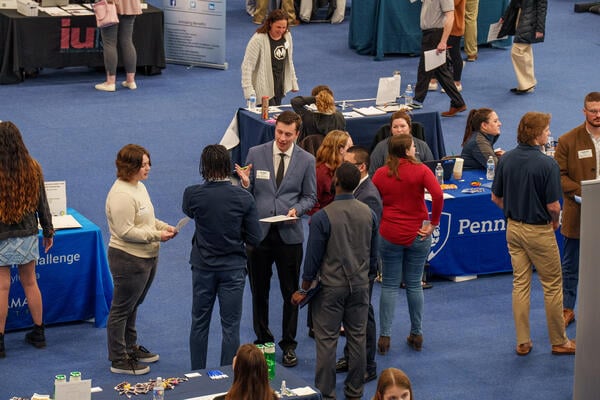
Lebanon Valley College in Pennsylvania decided to bring careers to students with an event called the LVC Success Expo. On the day of the expo, LVC cancels classes so students can engage in an all-day career fair or meet with academic support staff to ensure their success in and after college.
In this episode of Voices of Student Success, host Ashley Mowreader spoke with Tomomi “T” Horning, vice president of college partnerships and strategic initiatives, and Jasmine Bucher, senior director of the Breen Center for Career and Professional Development, to learn more about the event and campus partnerships and how it contributes to a larger institutional mission.
An edited version of the podcast appears below.
Inside Higher Ed: Give me the 30,000-foot view of the Success Expo. Where did this idea come from?
Tomomi “T” Horning, vice president of college partnerships and strategic initiatives
Horning: This is our third year undertaking this initiative, and we’re so pleased at how it’s developed and changed and improved over that time period.
The original genesis was we wanted to make sure that students had dedicated time to develop a success plan, whether it involved academic advising, career and professional development services. So [staff at] the provost office and the Breen Center for Career and Professional Development got our brains together and said, “What if we canceled classes on a day in the spring and really dedicated, marshaled all of our resources together to make this happen?”
This includes a whole variety of programming, events, presentations, interactive workshops, some fun, but mostly on that adulting 101 idea around making sure that our graduates are as optimally prepared to enter the workforce as possible.
Jasmine Bucher, senior director of the Breen Center for Career and Professional Development
Bucher: One of the things that I think is so extraordinary, not only is it that we do have this dedication of truly not having classes that day, and our students know that is worked right into their academic schedule, but also that the career and success expo really reaches beyond just our doors here on campus as well.
Not only inviting our community members, [but] K-12 leaders in those different areas as well as high school students come with those leaders to really see what [college] could be [like]—even the questions to ask when starting your career plan. But also our alumni and our faculty, who are a huge part of this day.
Not only do our faculty come to support our students in their advising and what comes next in their career exploration, but they’re really reminded about the resources that we have, the services we provide and how that weaves in and out of not only the time that students are here at Lebanon Valley College, but also beyond … graduation. We have alumni who are welcome—they come back and they learn so many incredible things, as well as make connections with potential employers.
Inside Higher Ed: A lot of colleges and universities will have career fairs throughout the academic year—I’m thinking about new student orientation, where there’s club fairs and different ways to get plugged in on campus. But I love the timing of this event, and that it’s in the spring term, and maybe when students already have questions, or they’re thinking about internships.
I wonder if you can talk about how the timing is strategic and making sure that all students are captured and those different interests or questions that may be coming up during that point in their academic experience?
Horning: I would say it’s not only strategic in terms of in the calendar year, helping maybe graduating seniors prepare for that entry into the workforce, but as you indicated, preparing for summer internships, which is a very popular time for students to be out in the field.
But also it operationally manages some opportunities we have in the fall and then making sure that those same opportunities are spread out in the spring. So sometimes, based on student schedules, they just can’t get around to it in the fall, and some of our fall events are more dedicated to specific lines of career or specific industries.
This pathways to professions, all-majors career fair—which is part of the larger success expo event itself—gives that opportunity for everyone at the key time that they need to be thinking about these things, to have access to the resources and as well as the employers through specifically the career fair itself. It’s an opportune time for those students to make those connections.
The Success Expo takes place each spring, allowing students to devote a day not to attending classes but to considering their future academic and career plans.
Bucher: And it really helps our students be well prepared for it. They’ve been working throughout the year on résumés, cover letters, even mock interviewing skills and knowing what that is like, having their elevator speeches ready so that they can really speak about the skills that they’re learning, not only in the classroom, but also through our services here in the Breen Center. I really like this time of year. I think it fits well with where the student brain is, but I think it also works really well so that we can help support them in the success of that day.
Inside Higher Ed: Totally. I think about lower-level students who might still be career exploring and trying to understand how their major ties into that first job after college. By the spring, they might have figured it out by March, or at least have an idea of where they’re going, versus that first week of first semester, where it’s like, “What is happening right now?”
Bucher: Or at least have an idea at that point of sort of the fields they would like to continue to explore. It’s not at all about finding the end of a journey. It’s about the next steps on that journey. So this day provides wherever that is—if they’re going off into the employment world, we have information in sessions that help them with decisions around insurance and the next steps of what comes in repayment of loans and all of the things that is that adulting 101 piece.
But also, if it’s students who are just getting into [career thinking], what would it be like to have a meal with future employers? We have an etiquette dinner that day where we can help to teach those skills as well. It’s really hitting up all of wherever they are in their career journey and whatever that is, really trying to make sure that we are thinking about how they’re best prepared to take that as well. Because nothing is worse than when you’re getting all this information thrown at you and you’re not ready for it, right?That’s why we want to be there, making sure they’re well prepared.
Inside Higher Ed: You bring up an interesting point in that sometimes these events can be overwhelming for students. A career fair, I know as a college student, was a very scary experience. You never know how to dress or how to prepare, and obviously your career center is there to guide you in that experience and prep you for that.
But at the success expo, how do you make sure that students know how to navigate these situations? What are some of those forward-looking messages that you’re giving to students to make sure that this is something that they are taking advantage of and are getting the most out of?
Bucher: Absolutely, as someone who spends a great deal of time figuring out how we communicate that to students who are in all different places, and alumni and all of the different pieces—making sure that we have a schedule that can be broken down very well. Making sure our communication is very much around providing those opportunities for wherever you are.
If you’re looking for sessions that help support and prepare you, those are there. If you’re ready to jump in and meet future employers, we have all of these wonderful employers. We make sure that we are communicating to the students who [the employers are] are ahead of time, so they’re not coming in blindly.
We have a robust website that has information on it; our social media campaign will be very robust this year to help with that messaging as well. So that may be, instead of it being overwhelming, because they [feel they] have to incorporate the entire day on all those pieces, but really being able to see where they can make the most of their time.
They’re busy, and even a day without classes, they could be studying, they could be preparing for finals, they could be doing a lot of things, so making sure that they know the choices.
And also making sure we’ve got some fun in there. We’ve got some great speakers. We have Tunji [Adebayo] who’s coming in, talking about picking yourself up from failure. Where you are anywhere on the journey, we all need to know how to be resilient and do that. So some things that aren’t so much about, “this is what you do in the career,” but “this is what you do in life.”
Jack Hubley is coming in and is going to speak not only about what it’s like to work with the birds that he has trained all this time. He’s such a celebrity in this area, people are pretty familiar with he does. But also, how do you do that and stay on brand? If you’re working with live animals and you’re in environments that are not always predictable?
So trying to make sure that we have this clear idea of skills beyond just what you see as career is also an area where we think would help students to not be as overwhelmed and know that we’re there to help them through this process.
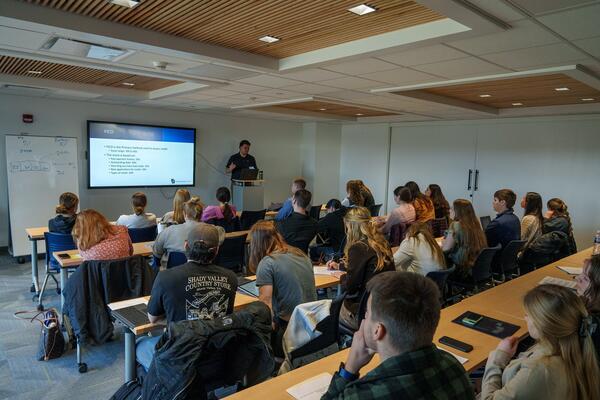
Throughout the Success Expo, students can participate in workshops or informational sessions about topics like resiliency and financial literacy.
Inside Higher Ed: You’re going into year three of this event. When it comes to logistics, or how the event has scaled up, can you talk a little bit about those partners that are involved in this work? We’ve mentioned a few different groups and stakeholders on and off campus, but who’s going to be there in the spring?
Horning: We do extend an invitation to K-12 partners, and mostly it’s going to be high school students who are interested in a field trip opportunity to get to understand what higher ed is like. But also, some of the sessions that Jasmine mentioned, those we purposefully choose to make sure that it’s a broad-reaching topic that any of our K-12 partners would benefit from hearing, not only the educators that bring the students as chaperones, but also the students themselves, right? Picking yourself up from failure is one of those life lessons that anybody can benefit from.
We also try to make sure that the concept of career development is woven into the day as well. Some of our high school students will get exposure to how internships themselves may help direct someone deeper into the trajectory of what they had hoped to achieve upon graduation, and sometimes completely flip it, 180 degrees through an internship experience. They learn those life lessons that, through experiential learning and high-impact opportunities, they may want to readjust what their career outlook is like.
Through the community, we also connect with the Chamber of Commerce to make sure that if there are things like venture capital or even some of the entrepreneurship opportunities. That if there are businesses with young people, or maybe recently just graduated college—maybe the alumni want to start their own business—that they have access to some of these workshops where they can talk to experts or talk to students who want to get into that business, maybe to do some idea sharing, networking.
We all know that professional networking is just one of those great benefits of bringing people together.
The college community, and even within Annville, it’s a small little quaint town here, but we make sure that our employer partners know about our restaurant and eateries that are in town. We make sure that those venues and opportunities of connection [are known] to make sure that we’re pushing business to make our local community thrive as well.
Inside Higher Ed: I don’t want to get too high-level here, because this is obviously focused on a specific event, but it seems like this is really fulfilling a lot of those goals of higher education, right? Helping students navigate their pathways to and through college, helping students thrive while they’re enrolled but also beyond college. But then continuing to invest in your local community with that socioeconomic development and those community partnerships. This is one day, but it seems like it’s connecting a lot of these bigger pieces of the puzzle to the institutional vision, which is really exciting.
Bucher: It’s very true to the Lebanon Valley College mission and method of what has always been very true and practical and hands-on and community-oriented, and so it stays very true to who we are. There are so many incredible initiatives that T has in mind and has been brainstorming for years. Me, as a new person on this staff, I’m incredibly excited for all those things, but we always bring them back to the mission, exactly what you’re saying, which is that they have to be true to the mission, otherwise we would be spinning our wheels in 100 directions that don’t make sense.
Inside Higher Ed: One group that we have alluded to but haven’t talked about a lot is faculty on campus. I wonder if you can talk about their role in this event and how they’re incorporated.
Bucher: We work very closely with our faculty to incorporate curriculum directly into their classroom, and we are as helpful as possible. Several of us on the staff here are educators ourselves; we teach courses.
Some of the specific ways are students who need to come [to the event] and interview specific employers and then provide reflections and pieces like that. So we help to provide the structure to that to faculty members who are very happy to partner with us.
But then we even have exciting things going on, like we are piloting an app this year for wayfinding through [the event]. So we’ve partnered with a marketing professor who is going to have a portion of her class use the app, a portion of the class use nothing and a portion of the class explore other items.
We’ve really taken the opportunity to not just do sort of the traditional, yes, you can come and attend and reflect and do it, which is wonderful, of course, but also to really integrate into the curriculum in meaningful ways and in ways that give the students experience on that day for true, real-life experience. Our faculty are very keen on this. They’re thrilled for the partnership, and so are we. It’s one of the things that a school this size and energy of Lebanon Valley College really allows you to do.
Horning: Something else that I would add, too, is some of our specific academic programs are able to incorporate opportunities to marry not only their academic program, but also employers and create opportunities for the collaboration.
For example, we have the Pennsylvania State Department of Environmental Protection coming, so [the faculty member is] weaving that into environmental sciences, the academic curriculum. Also as an employer, they’re looking to recruit interns and potential future employees. So really connecting all of those dots to make sure that we’re optimizing the program time that we have on this day.
Specifically because classes are canceled, we know that that also puts a hardship on some of the faculty to make sure that they’re covering all of their academic points. So finding creative ways to incorporate that, just like Jasmine said, with marketing, there are definitely ways that faculty are creatively making sure that they’re driving participation also to our events. We’re very appreciative of, just generally, the partnership that happens across campus.
And of course, a lot of the sessions, like I said, are relevant to any audience. So if they wanted to do some sort of professional development, we have something on customer service, and that’s something that we’re rolling out as an institution that could be relevant for any staff person or faculty.
Inside Higher Ed: What kind of feedback have you heard from students over the past few years as you’ve created and led the event, and how has that driven decision-making, if at all?
Horning: Wealways try to keep our surveying or feedback assessment from students to the point: “Would you recommend coming to this event? Why or why not?” Or “Did you have any recommendations for changes? Why are you making those recommendations?”
And I think over all, the feedback has been very positive. Mostly all of the suggestions are logistical in nature, which can be easily addressed. I think students are hungry for it. This is our third year doing it, so I think there is now a knowledge and an understanding of what students can expect. So maybe coming in future years, they’ll have more substantive feedback, like, “I would like a session on fill-in-the-blank,” but we try to hit those high-level adulting 101 topics as best as possible with the input from our student workers.
Some of our student workers will actually go upstairs [on campus] and survey some of the students: “Hey, if it was a choice between this session and this session, what would you prefer?” We try to [work in] real time as we’re developing programming and workshop ideas, make sure that that student voice is incorporated from the get-go.
Inside Higher Ed: When you talk about adulting 101, can you give a few examples of what those subject matters are?
Bucher: Some of the items that we have going on: understanding your student loans and repayments. Pieces like that obviously are in the forefront of our students’ minds. They work hard. Every dollar means something and how that repayment is, and really understanding it afterwards, is not easy.
Some of the other things I mentioned before, discussions around insurance, so in their next stages of life, they’re going to be having to choose [insurance coverage], and I was saying to T this morning, it doesn’t get any easier. I’ve been doing it for 20 years now, and it changes all the time, our choices in insurance, whether that’s health insurance and the other pieces of that. I was just talking about pet insurance yesterday. So there’s so many decisions to be making, and what’s worthwhile and not.
In many ways I think the etiquette dinner really calls into that as well. Once you’re outside of the walls of school, expectations change, and you expect something different of yourself, [but] just having that confidence and knowing what comes next. That has been an event that has been around the college for quite some time, and I really appreciate that it’s been incorporated into this day, remembering that it’s part of the next steps. So sort of from morning to night, it’s woven into all of our many, many events throughout the day.
Horning: I would just add there are other things that, you know, the event happens in April, and so we’re still going through the process of adding some additional workshops.
Some things that we have brought back from year one are things like credit cards, car loans and common-sense investing. So just a primer; we’re not trying to overwhelm students, but present to them what options and what type of decisions they will have to make as an adult.
And along with that, Jasmine mentioned about insurances, and we actually have a senior who is going to go into personal financial planning as a career track; he will be employed by a wealth management firm. And we thought, “Hey, why don’t we pair entrepreneurship with a hands-on workshop?” So he’ll be providing consultations. It helps him practice his skill set becoming an entrepreneur and providing those professional services along with the students, so they get an understanding of, “Gee, when I’m out there, these are the types of questions I will be asked if I have an appointment with a personal financial planner.”
A lot of just realistically making sure that students understand the variety of adulting 101 decisions they will have to make, and then hopefully educating them to be better prepared.
Inside Higher Ed: I love that idea of a peer who can support in those ways, because it’s a little less intimidating than asking somebody you’ve never met before, somebody who’s decades older than you. There’re no silly questions when it’s a classmate.
Bucher: And then they tend to continue that conversation, then with other peers, which is really what we want, right? We want to put this out there in a nonscary way, so that it can infuse out to the student body.
Horning: You really bring up a strong point there. We have recognized that the peer-to-peer learning and education is really important. Whether it’s mentoring, trying to identify peers with common experiences that you can start a conversation with the comfort of knowing, “Oh, you had my professor. You lived in my dorm.” Those types of connections are so invaluable.
Even the program about credit cards and car loans, we specifically tap into one of our corporate sponsors that runs a management trainee program so it’s employment at that particular place of business. And we ask those individuals so they’re like, one to three years out from graduating college, they’re the ones that present on those topics because those are also the decisions they recently made, and now, with the backing of their employer, which is a financial institution, they’re able to speak a little bit more eloquently about what those options might be.
Inside Higher Ed: If you had to give advice to a colleague at a different institution or someone else who wanted to model this on their campus, what’s something that you’ve learned or advice that you would give?
Horning: I think the biggest piece of advice is make sure that the communication and the collaboration across campus is set at the highest levels of leadership. Without the support of the entire community, people are going to wonder what the benefit is or what the return is for their areas. But this truly is a multistakeholder, an entire-campus event, and it has to be treated with that level of engagement. So leadership and just making sure the communication and the coordination, also that everything is moving without a hitch, occurs.
Bucher: I completely agree. This was an initiative started before I worked in this office, and I remember being incredibly impressed knowing that the institution was fully behind it, and that was clear because it was from the top down.
I think really remembering the audiences that it’s serving has also served us really well. I think I would just remind people to really keep in mind who those audiences are, making sure you know that that pairing of young alumni with students, so that they’re not feeling fearful of what’s coming next or intimidated—all of those pieces really lead to success.
Inside Higher Ed: The event is looming; it’s in the next few months. What is something that you’re excited for or something that you would like to tease our audience with as you’re preparing for the event in April?
Bucher: I’m extremely excited for the wide variety of items that are offered here and scheduled, if I could say so, in a really smart manner, so that students can sort of pick and choose throughout the day what creates the best journey for them on that day.
I’m really excited for the communication that’s coming to say, you want to work on your personal brand? Here you go. Looking for an internship? Come and hear how interns have been successful and what has led to that.
I’m just really excited for sort of that audience-speak that really gets to offering to people the really nice variety of pieces that are making up this exciting day.
Horning: Because this is our third year, I’m just excited that it feels like we have found our groove, and people are anticipating this event. People are excited and they want to get in on the action. And I think that is exciting to us in the Breen Center, because we do this because we want it to be of value to the community, and the fact that people are eagerly waiting for this and asking about it, talking about it, just builds the energy, builds the enthusiasm.
I’m looking forward to a great third year and making sure that, again, we’re delivering on the promise of making sure our graduates are really well prepared and that we are behind them 100 percent.