Author: admin

  • Trump threatens Harvard’s ability to host int’l students 

    Trump threatens Harvard’s ability to host int’l students 

    US homeland security secretary Kristi Noem has written a “scathing letter” to Harvard University, demanding it submits records of international students’ “illegal and violent activities” by April 30, or face losing its eligibility to enrol student visa holders.

    In Noem’s April 16 statement, she accused Harvard’s “spineless leadership” of “bending the knee to antisemitism” and “threatening national security”. 

    “Harvard’s position as a top institution of higher learning is a distant memory,” she added, cancelling two department of homeland security (DHS) grants worth USD $2.7 million on the basis that the university was “unfit to be entrusted with taxpayer dollars”.  

    DHS is threatening to strip Harvard of its Exchange Visitor Program (SEVP) certification, which allows colleges and universities to issue forms to admitted international students to use in their US visa applications. 

    The punitive measures are the latest in a dispute between Trump and the country’s oldest university, which saw USD $2.2bn in federal funding frozen after it rebuffed government demands, including reporting on international students and ending DEI policies. 

    What’s more, President Trump threatened on April 15 to revoke Harvard’s tax-exempt status over its “radical ideology”. 

    The University will not surrender its independence or relinquish its constitutional rights

    Alan Garber, Harvard University

    Last year, Harvard hosted 6,793 international students, totalling over 27% of the entire student body.  

    Across the country, more than a million international students attend US colleges every year, contributing $50bn to the economy, as previously reported by The PIE News. 

    The DHS letter – seen by the Harvard Crimson student newspaper – accused Harvard of creating a “hostile learning environment” for Jewish students and reminded the university it was “a privilege to have foreign students attend Harvard University, not a guarantee”.  

    Refusing to submit to the government’s previous demands, Harvard president Alan Garber said the university was committed to tackling antisemitism but maintained it would not “surrender its independence or relinquish its constitutional rights.”  

    “[The administration’s prescription] violates Harvard’s First Amendment rights and exceeds the statutory limits of the government’s authority,” Garber wrote in a message to the community.  

    In light of the recent escalation over SEVP certification, the university has maintained its position that it will not cede to government control, according to the Washington Post.  

    Alongside enhanced scrutiny of teaching, the government is requiring that Harvard reports on international students “supportive of terrorism or antisemitism” and those “hostile to American values”, ban all clubs supporting Palestine, and ban mask-wearing on campus, among other measures.  

    The directives largely stem from two of Trump’s early Executive Orders relating to “protecting the US from terrorism” and “combatting antisemitism”, which have led to over 1,320 international student visa revocations as of April 16, according to Inside Higher Ed.  

    Of this figure, 12 Harvard students and alumni have had their visas cancelled, though the university was not made aware of the rationale behind the revocations.  

    Student visas have been revoked for a variety of reasons, including some minor traffic infractions. Most of the high-profile cases involve students that participated in pro-Palestinian activism.  

    Challenges to the Trump administration have gained traction in recent weeks, with 19 states and 86 institutions supporting a legal challenge against the government’s revocation of student visas, led by the American Association of University Professors (AAUP).  

    Former President Obama, a Harvard alum, expressed his support for the university in a post on X, describing the government’s funding freeze an “unlawful and ham-handed attempt to stifle academic freedom”, urging other institutions to “follow suit”.

    Meanwhile, hundreds of Yale faculty members have published a letter asking its leadership to legally challenge “unlawful demands that threaten academic freedom and university self-governance”.

    Source link

  • FIRE POLL: Only 1/4 of Americans support deporting foreigners for pro-Palestinian views

    FIRE POLL: Only 1/4 of Americans support deporting foreigners for pro-Palestinian views

    PHILADELPHIA, April 17, 2025 — Many Americans are opposed to President Donald Trump’s speech-restrictive policies, a new national survey of free speech attitudes finds, with only a quarter supporting the deportation of legal non-citizens for expressing pro-Palestinian views.

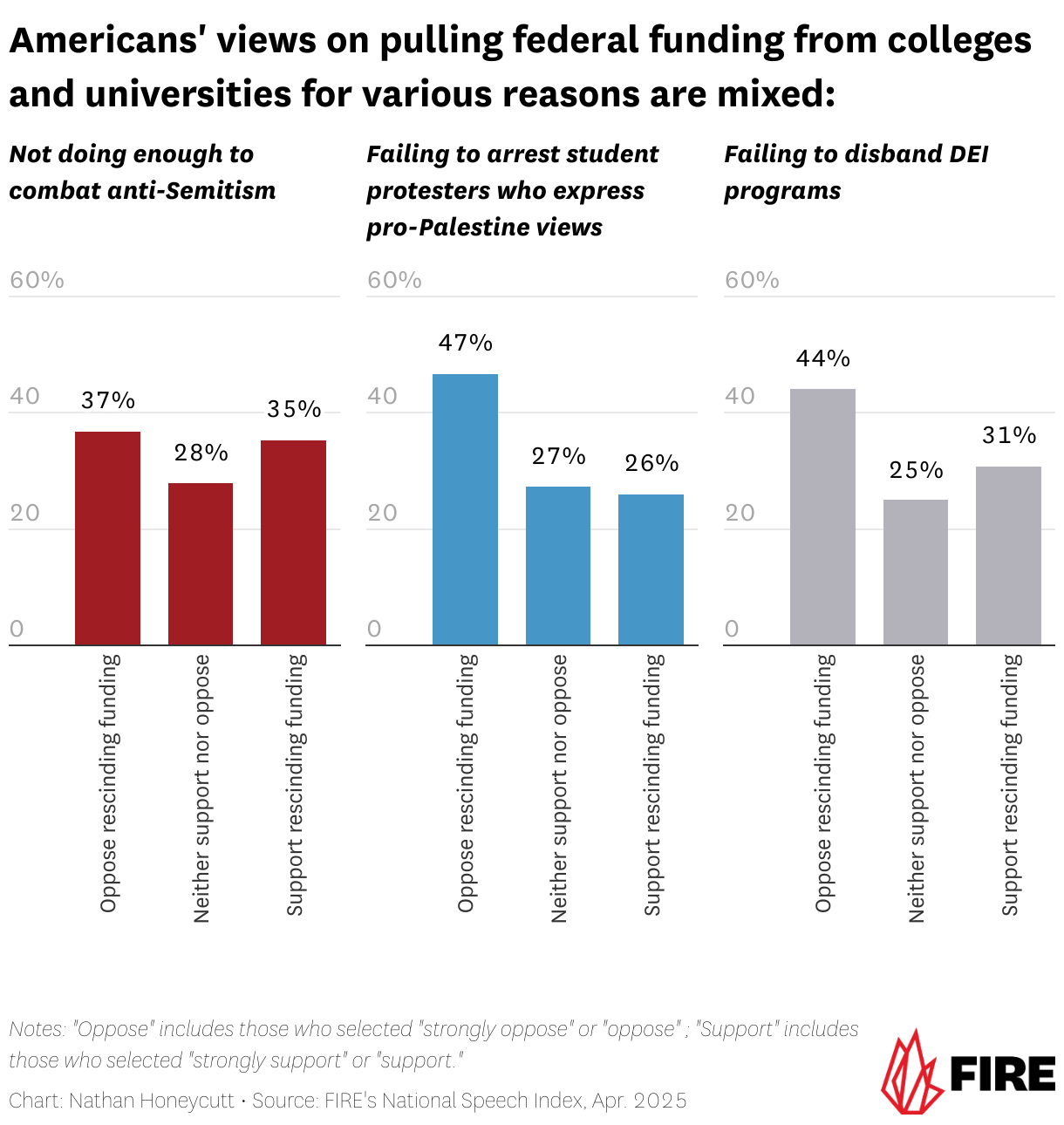
    The National Speech Index, a quarterly survey designed by the Foundation for Individual Rights and Expression, also found substantial opposition to pulling federal funding from colleges and universities that failed to arrest pro-Palestinian protesters, or are “not doing enough” to combat anti-Semitism on campus and those that fail to disband DEI programs.

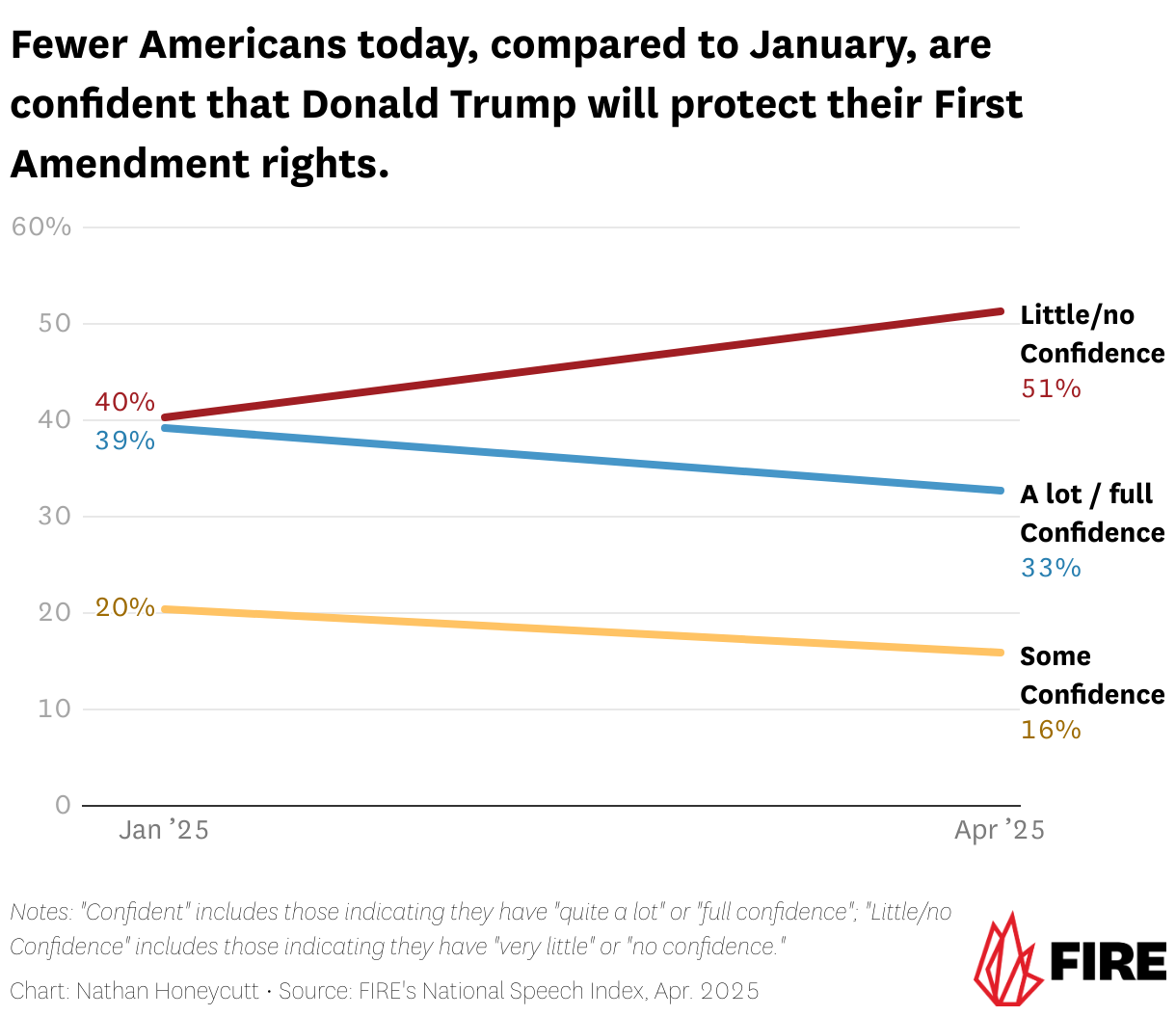
    The survey provides the first detailed national snapshot of Americans’ views towards Trump’s policies through the prism of free speech rights in his second term. It also found that those saying they have “very little” or “no” confidence that Trump will protect First Amendment rights has risen ten points since the survey was last conducted in January.

    Only 26% of Americans said they support or strongly support deporting foreigners legally in the United States on a student visa for expressing pro-Palestinian views, while 52% are opposed or strongly opposed and 22% neither support nor oppose it. As for green card holders being deported for pro-Palestinian views, only 23% are in support, 54% are opposed, and 23% are neither in favor nor against.

    “Deporting someone simply for disagreeing with the government’s foreign policy preferences strikes at the very freedoms the First Amendment was designed to protect,” said FIRE Chief Research Advisor Sean Stevens. “Americans are right to reject this kind of viewpoint-based punishment.”

    The National Speech Index also polled Americans about whether they would support the federal government rescinding federal funding from colleges and universities for a host of reasons. (FIRE’s poll was conducted before the Trump administration announced on Monday that it would freeze $2.2 billion in federal grants to Harvard University as part of a dispute over the administration’s proposed reforms to the institution.)

    Just shy of half of Americans oppose pulling funding from colleges and universities for failing to arrest student protesters who express pro-Palestinian views (47%) or for failing to disband DEI programs (44%), while only 26% and 31% of Americans respectively support pulling funding in those cases.

    When asked about pulling funding from colleges over insufficient efforts to combat antisemitism: 35% of Americans said they would support that measure and 37% would oppose it.


    The latest edition of the NSI also found a notable decline in Americans’ confidence that Trump would protect their First Amendment rights. 51% of Americans now say they have “very little” or “no confidence at all,” compared to 41% who said the same in January.

    “Confidence in Donald Trump’s First Amendment bona fides has returned to pre-inauguration levels,” said Nathan Honeycutt, FIRE manager of polling and analytics. “The partisan differences never really went away, but the honeymoon phase for independents appears to be wearing off.”

    The National Speech Index is a quarterly poll designed by FIRE and conducted by the Dartmouth Polarization Research Lab to capture Americans’ views on freedom of speech and the First Amendment, and to track how Americans’ views change over time. The April 2025 National Speech Index sampled 1,000 Americans and was conducted between April 4 and April 11, 2025. The survey’s margin of error is +/- 3%.


    The Foundation for Individual Rights and Expression (FIRE) is a nonpartisan, nonprofit organization dedicated to defending and sustaining the individual rights of all Americans to free speech and free thought — the most essential qualities of liberty. FIRE educates Americans about the importance of these inalienable rights, promotes a culture of respect for these rights, and provides the means to preserve them.

    The Polarization Research Lab (PRL) is a nonpartisan collaboration between faculty at Dartmouth College, Stanford University and the University of Pennsylvania. Its mission is to monitor and understand the causes and consequences of partisan animosity, support for democratic norm violations, and support for partisan violence in the American Public. With open and transparent data, it provides an objective assessment of the health of American democracy.

    CONTACT:

    Alex Griswold, Communications Campaign Manager, FIRE: 215-717-3473; [email protected]

    Source link

  • Innovation Without Borders: Galileo’s Networked Approach to Better Higher Education System

    Innovation Without Borders: Galileo’s Networked Approach to Better Higher Education System

    One of the biggest, but least remarked upon trends in European higher education in recent years is the growth of private for-profit, higher education. Even in countries where tuition is free, there are hundreds of thousands of students who now prefer to take courses at private for-profit institutions.

    To me, the question is, why? What sort of institutions are these anyway? Interestingly, the answer to that second question is one which might confuse my mostly North American audience. Turns out a lot of these private institutions are relatively small, bespoke institutions with very narrow academic specializations. And yet they’re owned by a few very large international conglomerate universities. That’s very different from North America, where institutions tend to be either small and bespoke, or part of a large corporation, but not both.

    Today my guest is Nicolas Badré. He’s the Chief Operating Officer of the Galileo Group, which operates a number of universities across Europe. I met him a few months ago at an OECD event in Jakarta. When I heard about some of Galileo’s initiatives, I knew I’d have to have him on the show. 

    There are three things which I think are most important about this interview. First is the discussion about Galileo’s business model and how it achieves economies of scale across such different types of institutions. Second, there’s how the network goes about collectively learning across all its various institutions. And third, specifically how it’s choosing to experiment with AI across a number of institutions and apply the lessons more globally. 

    Overall, it’s a fascinating chat. I hope you enjoy it too. But now, let’s turn things over to Nicolas.


    The World of Higher Education Podcast
    Episode 3.27 | Innovation Without Borders: Galileo’s Networked Approach to Better Higher Education System

    Transcript

    Alex Usher (AU): Nicolas, Galileo Global Education has grown significantly over the years. I think the group is, if I’m not mistaken, 13 or 14 years old now. Some of the universities it owns might be a bit older, but can you walk us through the origins of the group? How did you grow to be as big as you are? I think you’ve got dozens of institutions in dozens of countries—how did that growth happen so quickly?

    Nicolas Badré (NB): Thank you, Alex, for the question. It’s an interesting story. And yes, to your point, the group was created 13 and a half years ago, with an investment by Providence Equity Partners into Istituto Marangoni, a fashion school in Italy. That dates back to 2011. Since then, we’ve made 30 acquisitions.

    The growth started primarily in Europe, especially in France and Germany. Then, in 2014, we took our first steps outside of Europe with the acquisition of IEU in Mexico. Significant moves followed in 2018 and 2019, particularly into the online learning space with Studi in France and AKAD in Germany.

    There’s been a very rapid acceleration over the past five years. For context, I joined the group at the end of 2019. At that time, Galileo had 67,000 students across nine countries. Today, we have 300,000 students in 20 countries.

    Back then, the group was primarily focused on arts and creative schools, as well as business and management schools. Now, we’ve expanded into tech and health, and even into some professional training areas—like truck driving, for instance.

    What does this reflect? Two things. First, very strong organic growth from our existing schools and brands. Take ESG in France as an example. It’s been around for 40 years and is a well-known entry-level business school. Over the past five years, it’s diversified considerably creating ESG Luxury, ESG Tourism, you name it. It’s also expanded its physical presence from just a few cities to now being in 15 or 16 cities across France.

    So it’s really been a combination of strong organic growth and selective acquisitions that have helped us more than quadruple our student numbers in just five years.

    AU: It’s interesting— I think a lot of our listeners and viewers might be surprised to hear about such a strong for-profit institution coming out of France. When you think of French higher education, you think of the Grandes Écoles, you think of free education. So why would so many people choose to pay for education when they don’t have to? It’s a pretty strong trend in France now. I think over 26% of all students in France are in some form of private higher education. What do you offer that makes people willing to give up “free”?

    NB: It’s a good question, and you’re right—it’s not just about France. In many places across Europe, including Germany, the Nordics, and others, you see similar dynamics.

    That said, yes, in France in particular, there’s been a growing share of private players in higher education over the past few years. That probably reflects the private sector’s greater ability to adapt to new environments.

    I’d highlight three main factors that help explain why we’ve been successful in this space.

    First, we’re obsessed with employability and skills-based education. And that’s true across all levels and backgrounds. When we worked on our group mission statement, everyone agreed that our mission is to “unleash the potential of everyone for better employability.” 

    Because of that focus, we maintain very strong ties with industry. That gives us the ability to adapt, create, and update our programs very quickly in response to emerging demands. We know competencies become obsolete faster now, so staying aligned with job market needs is critical. That’s probably the strongest unifying driver across all of Galileo.

    Beyond that, we also offer very unique programs. Take Noroff, for example—a tech school in Norway, which is even more tuition-free than France. It’s one of the very few fee-paying institutions in the country. But the program is so strong that students are willing to pay around 15,000 euros a year because they know they’ll get a top-tier, hands-on experience—something that might be slower to evolve in the public system.

    So that’s the first point: employability and unique, high-impact programs.

    Second, we put a strong emphasis on the student experience. How do we transform their education beyond just delivering content? That’s an area we continue to invest in—never enough, but always pushing. We’re focused on hybridizing disciplines, geographies, and pedagogical approaches.

    And we’ve systematized student feedback—not just asking for opinions, but making sure we translate that feedback into tangible improvements in the student experience.

    And third, I’d say there’s a values-based dimension to all of this. We focus heavily on innovation, entrepreneurship, and high standards. Those are the core values that we’re driven by. You could say they’re our obsessions—and I think that kind of vision and energy resonates with our students. Those are the three main things I’d point to.

    AU: I have a question about how you make things work across such a diverse set of institutions. I mean, you’ve got design schools, drama schools, law schools, medical schools. When people think about private education, there’s often an assumption that there’s some kind of economies of scale in terms of curriculum. The idea that you can reuse curriculum across different places. But my impression is that you can’t do that very much. It seems like you’re managing all these different institutions, each of them like their own boutique operation, with their own specific costs. How do you make it work across a system as large and diverse as yours? Where are the economies of scale?

    NB: Well, that’s also a very good point—and you’re absolutely right. We have a very diverse network of schools. We have a culinary arts school in Bordeaux, France, with maybe 400 students, and we have universities with more than 10,000 students, whether in medical or business education.

    So yes, you might wonder: why put these institutions together?

    The answer is that we really built the group’s development around the entrepreneurial DNA of our school directors. They’re responsible for their own development—for their growth, diversification, and how they respond to the job market.

    We’re not obsessed with economies of scale. What we really value is the network itself. What we focus on is shared methodology—in areas like sales and marketing, finance, HR, and student experience.

    There are also some opportunities for synergies in systems. In some cases, for instance, yes—we use a similar CRM across several countries. But I think the real value of the network lies in its ability to share experiences and experiment with innovation throughout, and then scale up those innovations appropriately across the other schools.

    So I’d say it’s more about shared practices than about forcing economies of scale across borders—because that doesn’t always make sense.

    AU: Am I correct in thinking that you don’t necessarily present yourself as a chain of institutions to students? That each institution actually has a pretty strong identity in and of itself—is that right? Is there a fair bit of autonomy and ability to adapt things locally at each of your schools?

    NB: Yes, I think that’s true. In terms of branding, we believe that each of our schools generally has a stronger brand than Galileo itself. And that’s how it should be, because each school has its own experience, its own DNA, its own momentum and development.

    So, we see ourselves more as a platform that supports the development of all these schools, rather than a chain imposing the same standards and practices across the board.

    Of course, we do have certain methodologies—for example, how to run a commercial campaign. We provide guidance, but it’s ultimately up to each school to manage that process and use the methodology in a way that works best for their own development.

    That doesn’t mean there’s no value in having the Galileo name—there is. But the value is in being a platform that supports the schools, rather than overshadowing them.

    AU: Nicolas, I know Galileo is testing a lot of AI-driven approaches across its various institutions. What I found interesting in a discussion we had offline a few weeks ago is that you’re experimenting with AI in different parts of the institution—some of it around curriculum, some around administration, and some around student services. Can you give us an overview? What exactly are you testing, and what are the goals of these experiments?

    NB: I think we first need to frame how we’re using AI, and it’s important to look at our strategy globally. We believe there are three major trends shaping higher education.

    First, student expectations are evolving quickly—they’re demanding more flexibility and personalization. Second, there’s a rapid emergence of new competencies, which challenges our ability to adapt and update programs quickly. And third, we need to go beyond boundaries and be agile in how we approach topics, address new skills, and serve diverse learners. These are the three starting points we see as opportunities for Galileo to differentiate itself. Now, we’re not trying to become a leading AI company. Our goal remains to be a recognized leader in education—improving employability and lives. That’s our benchmark.

    With that in mind, our AI vision is focused on four areas:

    1. How do we deliver a unique experience to our students?
    2. How do we connect educators globally who are trained in and comfortable with AI?
    3. How do we develop content that can be adapted, localized, translated, and personalized?
    4. And how do we improve operational productivity?

    AI is clearly a powerful tool in all four areas. Let me walk through some of the things we’re doing. 

    The first area we call AI for Content. We’re using AI to more quickly identify the competencies required by the job market. We use tools that give us a more immediate connection to the market to understand what skills are in demand. Based on that, we design programs that better align with those needs.

    Then the next step is about course and content creation. Once we’ve defined the competencies, how do we design the courses, the pedagogical materials? How do we make it easier to localize and adapt that content?

    Take Studi, an online university in France with 67,000 students and around 150 different programs. A year ago, it would take them about four months to design a bachelor’s or master’s program. Now, it takes one to two months, depending on the specifics. The cost has been cut in half, and development speed has increased by a factor of two, three, even four in some cases. This also opens up opportunities to make programs more personalized because we can update them much faster. 

    The second area is AI for Experience. How do we use AI to enhance the student experience?

    We’ve embedded AI features in our LMS to personalize quizzes, generate mind maps, and create interactive sessions during classes. We’ve also adapted assessments. For example, in Germany, for the past two years, our online university AKAD has let students choose their own exam dates. That’s based on an AI approach that generates personalized assessments while staying within the requirements of German accreditation bodies. This wouldn’t be possible without AI. The result is higher engagement, faster feedback, and a more personalized learning experience.

    Lastly, beyond content and experience, we’re seeing real gains in AI for Operations. In sales and marketing, for example, we now use bots in Italy and Latin America to re-engage “dead” leads—contacting them again, setting up meetings, and redirecting them through the admissions funnel. It’s proven quite efficient, and we’re looking to expand that approach to other schools.

    We’re also seeing strong results in tutoring. Take Corndel, a large UK-based school focused on apprenticeships. They’re using AI tools extensively to improve student tracking, tutoring, and weekly progress monitoring.

    So, we’re seeing a lot of momentum across all these dimensions—and it’s really picked up speed over the last 18 months.

    AU: So, you’ve got a network of institutions, which gives you a lot of little laboratories to experiment with—to try different things. How do you identify best practices? And then how do you scale them across your network?

    NB: Well, first of all, we have lots of different pilots. As you’ve understood, we’re quite decentralized, so we don’t have a central innovation team of 50 people imposing innovations across all our schools.

    It’s more about scouting and sharing experiences from one school to another. It’s a combination of networks where people share what they’re learning.

    Just to name a few, we have a Digital Learning Community—that’s made up of all the people involved in LMS design across our schools. They exchange a lot of insights and experiences.

    We also hold regular touchpoints to present what’s happening in AI for content, AI for experience, and AI for operations. We’ve created some shared training paths for schools as well. So there are a lot of initiatives aimed at maximizing sharing, rather than imposing anything top-down. Again, as you pointed out, the schools are extremely diverse—in terms of regulations, size, content, and disciplines. So there’s no universal recipe.

    That said, in some cases it’s more about developing a methodology. For example, how do you design and implement a pedagogical chatbot? The experiments we’re running now are very promising for future scale-up, because we’re learning a lot from these developments.

    AU: I know that, in a sense, you’ve institutionalized the notion of innovation within the system. I think you’ve recently launched a new master’s program specifically focused on this question—on how to innovate in education systems. Can you tell us a little bit about that?

    NB: Yeah, I’m super excited to talk about this, because it’s where I’m focusing most of my energy these days.

    We’ve been working on this project for a year with four Galileo institutions. It’s called Copernia, and the name, like Galileo, is intentional—these are people who changed perspectives. That’s exactly what we want to do: change the perspective on education and truly put the student at the center.

    Copernia started the initiative, Galileo confirmed it, and it’s no coincidence we’re focusing on this.

    The first program we’re launching under Copernia is a Master of Innovation and Technology for Education. The idea is to bring together and leverage expertise from several fields: neurocognitive science, tech, AI and data, educational sciences, innovation, design, and management. The goal is to offer students a unique experience where they not only learn about innovation—but also learn to develop and apply it.

    One of the major assets we want to leverage is the Galileo network. With over 120 campuses, we can offer students real, hands-on opportunities to experiment and innovate. So the value proposition is: if you want to design and test educational innovation, we’ll give you the tools, the foundational knowledge, and, most importantly, the chance to apply that in practice—within our network, with our partners, and with other institutions.

    The goal is to help the whole ecosystem benefit—not just from Galileo’s environment, but also from the contributions of tech partners, academic collaborators, and business partners around the world. I’m convinced this will be a major tool to develop, share, and scale practical, applied innovation.

    And importantly, this isn’t meant to be just an internal initiative for Galileo. It’s designed to be open. We want to train people who can help transform education—not only in higher education, but also in K–12 and lifelong learning. Because we believe this kind of cross-disciplinary expertise and hands-on innovation experience is valuable across the entire education sector.

    AU: I’m really impressed with the scale and speed at which you’re able to experiment. But it did make me wonder—why can’t public higher education systems do the same? I mean, if I think about French universities, there are 70 or 80 in the public system—though it’s hard to keep track because they keep merging. But theoretically, they could do this too, couldn’t they? It’s a moderately centralized system, and there’s no reason institutions couldn’t collaborate in ways that let them identify useful innovations—rolling them out at different speeds in different areas, depending on what works. Why can’t the public sector innovate like that?

    NB: First of all, I wouldn’t make a sweeping judgment on this. I think there is innovation happening everywhere—including within public institutions. So I wouldn’t describe it in black-and-white terms.

    That said, it’s true that as a private organization, we face a certain kind of pressure. We need to prove that we operate a sustainable model—and we need to prove that every month. In other words, we rely on ourselves to develop, to test, and to optimize how we grow. 

    The second is that we have an asset in being able to test and learn in very different environments. Take the example I mentioned earlier, about Germany and the anytime online assessments. We were able to implement that model there because it was online and because the regulatory environment allowed it.

    Now, when we approach accreditation bodies in other countries, we can say: “Look, it works. It’s already accepted elsewhere. Why not consider it here?” That ability to move between different contexts—academic and professional, vocational and executive—is really valuable. It allows us to promote solutions that cross traditional boundaries.

    That’s not something all public universities can do—and frankly, not something all universities can do, period. But it’s an advantage we’ve built over the past several years by creating this large field for experimentation.

    AU: Nicolas, thank you so much for being with us today.

    NB: Alex, thank you very much. It’s been a pleasure.

    AU: It just remains for me to thank our excellent producers, Tiffany MacLennan and Sam Pufek, and to thank you—our viewers, listeners, and readers—for joining us. If you have any questions about today’s podcast, please don’t hesitate to get in touch at [email protected]. And don’t forget—never miss an episode of The World of Higher Education Podcast. Head over to YouTube and subscribe to our channel. Join us next week when our guest will be Noel Baldwin, CEO of the Future Skills Centre here in Canada. He’ll be joining us to talk about the Programme for the International Assessment of Adult Competencies. See you then.

    *This podcast transcript was generated using an AI transcription service with limited editing. Please forgive any errors made through this service. Please note, the views and opinions expressed in each episode are those of the individual contributors, and do not necessarily reflect those of the podcast host and team, or our sponsors.

    This episode is sponsored by Studiosity. Student success, at scale – with an evidence-based ROI of 4.4x return for universities and colleges. Because Studiosity is AI for Learning — not corrections – to develop critical thinking, agency, and retention — empowering educators with learning insight. For future-ready graduates — and for future-ready institutions. Learn more at studiosity.com.

    Source link

  • When the government tells you that you cannot pray

    When the government tells you that you cannot pray

    When Abdul Kadeer returned from Saudi Arabia in last month to celebrate the Muslim festival of Eid-ul-Fitr with his family in Meerut, a city northeast of New Delhi in the Indian state of Uttar Pradesh, the 32-year-old found himself gripped by fear. The local administration had announced tough restrictions on Eid-ul-Fitr prayers for Muslims. 

    Eid-ul-Fitr is one of two major holidays celebrated by Muslims and commemorates the end of the holy month of Ramadan, in which Muslims fast daily from before dawn until sunset.

    Because mosques and designated grounds for prayers, known as Eidgahs, have insufficient space to accommodate the large number of worshippers during these holidays people often stop on roadsides to offer prayers. 

    But just days before the festival, Meerut police announced that offering prayers on roads and other public places could lead to passport cancellations. 

    “I came home to celebrate with my family, but now we are living in fear,” Kadeer says. “Why is it that when we pray, it becomes a problem, but during other festivals, roads are blocked and nothing happens?”

    Jamia Masjid Srinagar closed for Eid prayers in Kashmir. (Photo by Sajad Hameed)

    A minority religion

    For Kadeer, losing his passport would cost him his job.

    “I work in Saudi Arabia to support my family here,” he said. “Why are we being targeted for a prayer that lasts barely 20 minutes?”

    The state of Uttar Pradesh has a predominantly Hindu population, with Hindus comprising around 80% of the total population, while Muslims make up approximately 19%.

    Across Meerut, sentiments like Kadeer’s resonate deeply. Many Muslims in the city ask why they face restrictions when Hindu festivals frequently involve processions on public roads without similar consequences.

    “Why is it that only during Eid, roads become a law-and-order issue?” questions a shopkeeper in the city’s old quarter. “During Holi or Diwali, no one is threatened with legal action.”

    Holi and Diwali are major Hindu festivals celebrated with their own distinct rituals rooted in mythology, seasonal change and spiritual themes. Holi celebrates spring with colors, water fights and sweets, symbolizing good over evil. Diwali, the festival of lights, involves lamps, fireworks and sharing food, marking prosperity and the return of the Hindu god Rama.

    When the Indian government restricts public prayer during Muslim festivals like Eid-ul-Fitr it says it does so to maintain public order and prevent communal tensions. Authorities may cite concerns about large gatherings in public spaces causing traffic disruptions, noise pollution or potential clashes, especially in areas with a history of religious friction. 

    Tensions peaked on 31 March, for example, when violence erupted after the Eid prayer in Siwalkhas, a town northeast of New Delhi. According to police, members of two groups clashed, with reports of gunfire. Security forces quickly intervened, dispersing the crowds, but not before more than six Muslims were injured.

    A double standard?

    The restrictions on prayer have sparked national debate. Popular comedian Munawar Faruqui criticised the decision on social media, questioning why a short prayer was being singled out. But Uttar Pradesh Chief Minister Yogi Adityanath defended the measure, citing the Maha Kumbh in Prayagraj as an example of religious discipline. 

    “[Six hundred and sixty million] people attended the Maha Kumbh without any incidents of violence, harassment or disorder. Roads are meant for walking,” he said, suggesting that Muslims should learn from Hindu festival gatherings. 

    Nasir Qureshi, 47, of Bijnor, said that even before Eid, they were warned not to gather in large numbers for prayers. “But when Hindus celebrate their festivals, there are no such restrictions,” he said “Why is there one rule for us and another for them?”

    The directive has drawn criticism not only from opposition parties but also from within the allies of the ruling Bharatiya Janata Party or BJP.

    Iqra Hasan, a member of parliament for the socialist Samajwadi Party, questioned the intent behind the restrictions while Chirag Paswan, a BJP ally, called for a focus on broader issues rather than communal divisions. And Union Minister Chaudhary Jayant Singh compared the crackdown to authoritarian measures described in George Orwell’s book “1984”.

    Opponents to restrictions argue that the Hajj in Mecca, with 2–3 million Muslims praying peacefully, shows that large Muslim gatherings can be managed safely, like the Maha Kumbh’s 400 million Hindus. With proper planning, India could allow Eid prayers fairly, avoiding bias.

    Police and worshippers

    In Meerut, protests took shape in subtle ways. Some worshippers displayed posters stating, “It’s not just Muslims who pray on roads.” The banners listed instances of Hindus and others conducting religious activities on public streets.

    Authorities forcibly removed the posters, leading to further tensions. Among the congregation, expressions of solidarity with Palestine were visible, with worshippers seen holding “Free Palestine” placards and some donning traditional Palestinian attire.

    Mohammed Saeed, 29, a resident of Meerut, said that the police didn’t let them complete their prayers. “They stormed in, shouting at us to leave, and when people protested, they started hitting us,” Saeed said. “Even elderly men were pushed around.”

    Police have registered cases against those raising Palestine-related issues in previous instances, making this a sensitive act of defiance. Beyond Meerut, other decisions have added to the sense of alienation. In Haryana, the state government removed Eid from its list of gazetted holidays, relegating it to a restricted holiday status. This means government offices will remain open on Eid and employees —Hindus or Muslims — must request leave if they wish to observe it.

    Asaduddin Owaisi, an member of parliament from Hyderabad and chief of the right-wing political party All India Majlis-e-Ittehadul Muslimeen, said that these kind of decisions are a direct attack on Muslim minorities in the country. 

    He also said that earlier last year the central government ordered a survey of the Jamia Masjid in Uttar Pradesh, a 500-year-old mosque that is part of a UNESCO World Heritage site. It turned into violence with five people killed and 30 injured. 

    “Hundreds were detained only to deny the survey,” Owaisis said. “These decisions will increase the hate in the communities nothing else.”

    Religious clashes elsewhere

    While India sees frequent communal flashpoints between Hindus and Muslims, other South Asian nations have also witnessed religious tensions manifesting in different ways.

    In Pakistan, religious minorities, particularly Hindus and Christians, have often faced restrictions on their religious practices, though state-imposed bans on mass religious gatherings have been rare.

    In Bangladesh, political conflicts sometimes intertwine with religious identity, leading to incidents of violence during Hindu Durga Puja celebrations. Sri Lanka has seen its own set of religious tensions, with growing restrictions on Muslim practices such as a ban on the niqab — a face veil worn by women — following the 2019 Easter bombings when 269 people were killed in six suicide bombings in churches and hotels. 

    In Kashmir, meanwhile, the state’s approach to religious gatherings has taken a different but equally restrictive form. On 31 March, as Muslims worldwide prepared for Eid-ul-Fitr, authorities in Srinagar locked down the historic Jamia Masjid, preventing worshippers from offering prayers there.

    The region’s chief cleric, Mirwaiz Umar Farooq, was placed under house arrest, a move he strongly condemned.

    “When huge claims of ‘normalcy’ are made every day by the authorities, why are Muslims in Kashmir being kept away from their religious places and practices?” Mirwaiz said in a statement. “What is the agenda? Is the collective identity of Kashmiri Muslims a threat to the rulers?”

    The Jamia Masjid closure follows a pattern seen in recent years, where authorities have restricted access to religious sites on key Islamic occasions, citing security concerns.

    Earlier in March, the mosque was locked for Shab-e-Qadr and Jummat-ul-Vida prayers, triggering strong reactions from opposition parties in Kashmir.

    Darakhshan Andrabi, who is a senior BJP leader and chairs the Jammu and Kashmir Wakf Board, a body that controls the use of religious and charitable properties, justified the decision, stating that Eid prayers could not be held at Eidgah grounds due to ongoing construction work. However, many local residents and religious leaders see such restrictions as politically motivated and part of broader efforts to control religious expression in the region.


    Questions to consider: 

    1. What is Eid-ul-Fitr?

    2. What is a rationale the Indian government has to restrict public prayer during Muslim festivals?

    3. Do you think that the government should be able to regulate religion? Why?


    Source link

  • The power of online courses in our school

    The power of online courses in our school

    Key points:

    • Online courses in schools are especially effective when they have dedicated time and space for online learning
    • Online learning programs increase student access, engagement
    • Online learning in high school helps students explore career pathways
    • For more news on online learning, visit eSN’s Digital Learning hub

    We started working with an online education high school program about 10 years ago and have been expanding our use of online courses ever since. Serving about 1,100 students in grades 6-12, our school has built up its course offerings without having to add headcount. Along the way, we’ve also gained a reputation for having a wide selection of general and advanced courses for our growing student body.

    More News from eSchool News

    HVAC projects to improve indoor air quality. Tutoring programs for struggling students. Tuition support for young people who want to become teachers in their home communities.

    Almost 3 in 5 K-12 educators (55 percent) have positive perceptions about GenAI, despite concerns and perceived risks in its adoption, according to updated data from Cengage Group’s “AI in Education” research series.

    When it comes to visual creativity, AI tools let students design posters, presentations, and digital artwork effortlessly. Students can turn their ideas into professional-quality visuals, sparking creativity and innovation.

    Ensuring that girls feel supported and empowered in STEM from an early age can lead to more balanced workplaces, economic growth, and groundbreaking discoveries.

    In my work with middle school students, I’ve seen how critical that period of development is to students’ future success. One area of focus in a middle schooler’s development is vocabulary acquisition.

    For students, the mid-year stretch is a chance to assess their learning, refine their decision-making skills, and build momentum for the opportunities ahead.

    Middle school marks the transition from late childhood to early adolescence. Developmental psychologist Erik Erikson describes the transition as a shift from the Industry vs. Inferiority stage into the Identity vs. Role Confusion stage.

    Art has a unique power in the ESL classroom–a magic that bridges cultures, ignites imagination, and breathes life into language. For English Language Learners (ELLs), it’s more than an expressive outlet.

    In the year 2025, no one should have to be convinced that protecting data privacy matters. For education institutions, it’s really that simple of a priority–and that complicated.

    Teachers are superheroes. Every day, they rise to the challenge, pouring their hearts into shaping the future. They stay late to grade papers and show up early to tutor struggling students.

    Want to share a great resource? Let us know at [email protected].

    Source link

  • 5 AI tools for classroom creativity

    5 AI tools for classroom creativity

    Key points:

    • AI tools enhance K-12 creativity and innovation through interactive projects
    • A new era for teachers as AI disrupts instruction
    • Report details uneven AI use among teachers, principals
    • For more news on AI and creativity, visit eSN’s Digital Learning hub

    As AI becomes more commonplace in classrooms, it gives students access to creative tools that enhance learning, exploration, and innovation. K-12 students can use AI tools in various ways to boost creativity through art, storytelling, music, coding, and more.

    More News from eSchool News

    HVAC projects to improve indoor air quality. Tutoring programs for struggling students. Tuition support for young people who want to become teachers in their home communities.

    Almost 3 in 5 K-12 educators (55 percent) have positive perceptions about GenAI, despite concerns and perceived risks in its adoption, according to updated data from Cengage Group’s “AI in Education” research series.

    Our school has built up its course offerings without having to add headcount. Along the way, we’ve also gained a reputation for having a wide selection of general and advanced courses for our growing student body.

    Ensuring that girls feel supported and empowered in STEM from an early age can lead to more balanced workplaces, economic growth, and groundbreaking discoveries.

    In my work with middle school students, I’ve seen how critical that period of development is to students’ future success. One area of focus in a middle schooler’s development is vocabulary acquisition.

    For students, the mid-year stretch is a chance to assess their learning, refine their decision-making skills, and build momentum for the opportunities ahead.

    Middle school marks the transition from late childhood to early adolescence. Developmental psychologist Erik Erikson describes the transition as a shift from the Industry vs. Inferiority stage into the Identity vs. Role Confusion stage.

    Art has a unique power in the ESL classroom–a magic that bridges cultures, ignites imagination, and breathes life into language. For English Language Learners (ELLs), it’s more than an expressive outlet.

    In the year 2025, no one should have to be convinced that protecting data privacy matters. For education institutions, it’s really that simple of a priority–and that complicated.

    Teachers are superheroes. Every day, they rise to the challenge, pouring their hearts into shaping the future. They stay late to grade papers and show up early to tutor struggling students.

    Want to share a great resource? Let us know at [email protected].

    Source link

  • Georgia Southern and East Georgia State merger gets green light from system board

    Georgia Southern and East Georgia State merger gets green light from system board

    Dive Brief:

    • Georgia Southern University is poised to absorb East Georgia State College after the University System of Georgia governing board approved a merger plan Tuesday. 
    • The board’s vote follows USG Chancellor Sonny Perdue’s recommendation for the consolidation last week. Tuesday’s action marks “the first step in a careful process that will take more than a year,” the system said. 
    • The new institution will retain the “identity” of East Georgia State, which has struggled with enrollment declines in recent years. At the same time, it will become part of Georgia Southern and will be led by the latter’s president, Kyle Marrero, according to the announcement. The consolidation requires the approval of the institutions’ accreditor. 

    Dive Insight:

    Perdue trumpeted the consolidation of Georgia Southern and East Georgia State as a way to invest in key higher education functions — especially student success and degree accessby saving on administrative costs and reducing academic program overlap.

    “By using public resources as efficiently as possible, we’re making sure every dollar saved is reinvested into those programs that truly empower our students, support our faculty and strengthen our communities for a brighter future,” Perdue said in Tuesday’s announcement.  

    Georgia state Rep. Butch Parrish — who represents Swainsboro, which is home to East Georgia State and 40 miles from Georgia Southern praised the plan. 

    “It’s essential that as the system streamlines and operates more efficiently, we safeguard access to higher education in the local area and keep the EGSC spirit going,” Parrish said in a statement. 

    Now that the board has greenlit the merger, the institutions plan on quickly forming an implementation team with representatives from both colleges to work out details, the system said. That team will also prepare and submit the required paperwork for approval by their accreditor,  the Southern Association of Colleges and Schools Commission on Colleges.

    USG and the institutions plan on holding campus and community listening sessions to seek input on the new institution’s design, with the first one slated for Wednesday on East Georgia State’s campus.  

    Of the two, Georgia Southern is by far the larger institution. As of fall 2023, the university enrolled 26,041 students to East Georgia State’s 1,756, according to federal data. Georgia Southern’s enrollment has been relatively stable, declining 1.4% between 2018 and 2023, while East Georgia State’s fell by 40.3%. 

    The larger university also has a much deeper catalog of programs compared to East Georgia State, which according to its website offers six associate and three bachelor’s degree programs. 

    The planned consolidation is the latest move in an effort going back nearly 15 years to pare down Georgia’s state university system. So far, USG has undertaken 13 consolidations. From these, it has saved $30 million in administrative expenses that it said it has reinvested into student services and faculty and staff hires

    Once the Georgia Southern and East Georgia State combination completes, USG will have 25 institutions, the system said.

    Source link

  • How an early alert system raised one college’s FAFSA completion

    How an early alert system raised one college’s FAFSA completion

    This audio is auto-generated. Please let us know if you have feedback.

    NASHVILLE College leaders understand the value of a completed financial aid application, but they often face hurdles helping students navigate the slog of paperwork.

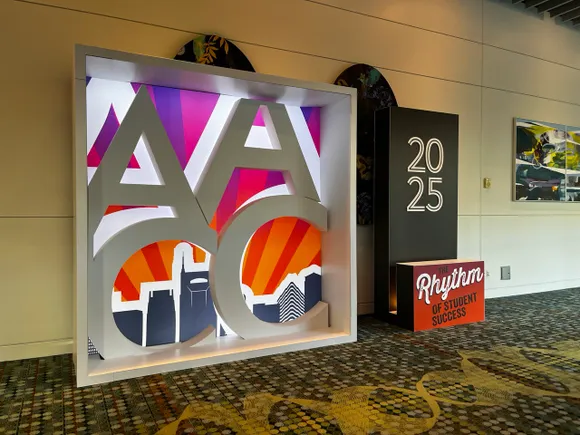
    Holyoke Community College, in Massachusetts, encountered this problem in spring 2023. That semester, 47% of attendees at the college’s new-student orientation had not completed their Free Application for Federal Student Aid, institutional leaders said Monday at the American Association of Community Colleges′ annual conference.

    Along with low levels of FAFSA completion, they also noted that dozens of students who had otherwise completed their financial aid applications were missing one crucial piece of paperwork — which became the deciding factor between the state completely covering their tuition or not.

    Holyoke implemented an early alert system to address challenges among both groups. By proactively reaching out to new students and inviting them to one-on-one advising sessions, officials raised FAFSA completion rates among that cohort by 14% for fall 2023 and got the appropriate state aid to those who were eligible.

    Missing paperwork

    Enrolling some 3,700 credit-bearing students, Holyoke is located in a college-dense area with about 20 other higher education institutions, according to Lauren LeClair, the community college’s associate director of admissions technology and operations.

    “We fight for our students. We wanted to make sure that we were doing right by our students and getting them aid,” she told conference attendees. “New students probably had no idea that they didn’t have paperwork that was needed.”

    Many also didn’t know where to go to learn more about financial aid, said Kim Straceski, Holyoke’s associate director of financial aid compliance and customer service.

    “They’re getting different information from different offices, and not always coming to meet one of the experts in financial aid,” she said.

    In spring 2023, the college lacked a way to alert students or financial aid staff about missing financial aid documents, according to education consultancy EAB. Holyoke employed the group to establish a new customer relationship management system to address these issues. 

    The new system pinged students to alert them about the missing paperwork and prompted them to schedule an advising appointment to fix the error. An adviser also followed up with a more detailed email, highlighting that they could help students hunt down the needed documents.

    “Students do open emails — if it’s important enough,” LeClair said.

    On the back end, the system allowed both financial aid staff and academic advisers to see notifications to students and any progress they made completing their forms. Before, the two offices were disconnected from one another in this process.

    By fall 2023, 67% of students who received early alerts had completed their outstanding aid requirements.

    The early alert system also helped new students learn where to seek help for any potential financial aid issues that arise in the future.

    MassReconnect 

    At Holyoke, almost 600 students are enrolled in MassReconnect, a state-run free community college program for nontraditional students. Since 2023, state residents ages 25 and older who do not have a degree have been eligible to attend community college for free, so long as they complete the FAFSA.

    Early results indicate the program has boosted the number of adult learners enrolled at Massachusetts community colleges, especially those from households earning below the state’s median income.

    But Holyoke identified a problem for about 40 of its MassReconnect students — they were missing one key document.

    “All of these students need to sign an affidavit attesting to the fact that they have not earned a prior degree,” said Straceski

    But for many, that requirement was not made clear in the MassReconnect program’s promotional materials.

    “When students are reading about it on the state’s website and they’re hearing about it in the news — nothing about this affidavit was ever mentioned,” Straceski said.

    Holyoke couldn’t distribute state funding to cover the students’ costs without this documentation. But thanks to the early alert system, Straceski said the college received all 40 affidavits by deadline.

    Source link

  • Governors tout career and technical education in 2025 State of States

    Governors tout career and technical education in 2025 State of States

    Dive Brief:

    • Career and technical education, teacher workforce funding and student achievement are some of the main education policy priorities for governors across the country, according to a report from the Education Commission of the States and the National Governors Association. 
    • The report tracked and analyzed 2025 State of the State addresses so far this year from 49 governors, including the U.S. Virgin Islands and Guam. The State of the State Address is an annual speech given by state governors that provides the opportunity to outline policy priorities and elevate successes. 
    • The top education policy trend this year, the report found, was workforce development opportunities for students. Thirty-three governors discussed career and technical education as an opportunity to prepare students for entering the workforce and bolster the economy.

    Dive Insight:

    The Education Commission of the States has tracked and analyzed trends in education policy accomplishments and proposals featured in governors’ State of the State addresses for the last 20 years. This is the sixth year the commission has partnered with the National Governors Association to create a special report that highlights the top education policy topics mentioned.

    The 33 governors speaking about CTE also discussed internships and apprenticeships as avenues to gain real-world skills that prepare young people for workforce demands. 

    Some states highlighted their current offerings and programs, like Tennessee’s Youth Employment Program and Wyoming’s Innovation Partnership. Others, like Delaware and Oklahoma, highlighted incoming legislative efforts to provide more workforce development opportunities.

    In previous years, K-12 funding has been a consistent priority expressed across most of the state addresses. This year, at least 32 governors addressed funding, and several highlighted historic investments in K-12 funding — like Nevada’s investment of over $2 billion in new funding for students and schools last session, which marked the largest education investment in the state’s history.

    Fiscal certainty for school districts is one of the fundamentals that can improve student success, said Oregon Gov. Tina Kotek in her address. 

    Federal funding for K-12, however, is facing some risks. While the Trump administration has promised to preserve “all statutory programs that fall under the agency’s purview,” such as funding for students with disabilities, the downsizing of the U.S. Department of Education is putting school districts at financial risk, according to Moody’s Ratings.

    Teacher workforce is another common priority among governors. At least 26 mentioned teacher recruitment and retention or teacher compensation, the report states. 

    Some states like Connecticut and Maryland are trying to create workforce programs that bring more diverse teacher demographics, while other states mentioned recent investments into teacher salaries.

    Indiana highlighted legislation that will raise the minimum salary for public school teachers by $5,000 and require that 65% of state school funding support to districts go to teacher compensation. 

    Cuts to the federal Education Department have also impacted the teacher workforce. On April 4, the U.S. Supreme Court granted the Trump administration’s emergency request to maintain a freeze on millions of dollars in federal teacher training grants.

    Additionally, at least 25 governors addressed academic achievement, including commitments to math and reading instruction. Several states created and implemented literacy and proficiency programs that have shown growth and increased scores. 

    For example, Alaska Gov. Mike Dunleavy spoke about early data from the state’s implementation of the Alaska Reads Act. In his address, Dunleavy said that the percentage of Alaskan students who met early literacy benchmarks grew from 41% to 57%. 

    According to the report, governors stressed the importance of early literacy skills for life-long achievement. Science of reading was also highlighted as a major contributor to building early literacy skills.

    Source link