Universities, wonderful as they are, can be very complicated.
The way that we operate can often be confusing for students, not least because some of our expectations and traditions are hidden and unspoken – even more so for students who enter higher education from historically underrepresented backgrounds.
Indeed, revealing the so-called hidden curriculum in higher education is a common means by which we try to eliminate gaps in access and outcome.
But there are also times when, as a sector, we should be more critical of the way we do things, whether those practices are hidden or unhidden.
Here we want to share an example of what happens when you challenge orthodoxy, and why we think we should do this more often.
Assessment penalties
If you spend some time reviewing UK university policies on assessment and examination, you will find that it is almost universally the case that there are penalties associated with late or non-submission.
Typically, this involves a deduction of marks. Sometimes late submissions will be capped at a pass, other times the deduction is linked to the degree of lateness. Similarly, students who fail to submit an assessment or sit an exam will often find that their next attempt at resit will be capped.
Of course, institutions do recognise that there may be lots of good reasons why students cannot meet deadlines, and so alongside these penalties, we also have Extenuating or Mitigating Circumstances processes. In short, if a student tells us the reason they were late or could not submit, then they may be exempted from those penalties if the reasons meet our established criteria.
What is far harder to find is any robust explanation, in written form, of why these penalties exist in the first place. There is much received wisdom (as you would expect, for a sector so steeped in tradition) for why we have these penalties, which – in our experience – typically falls into two categories.
The first justification is about using penalties to disincentivise lateness or non-submission. If students know they will lose marks, that will ensure that most submit on time. The second justification is about fairness. If you submit late, you are getting more time than other students, so you should not receive a higher mark as a result of this presumed advantage. Each of these justifications could be debated endlessly, but we don’t intend to do that here.
Questioning the received wisdom
The reason we began to question the wisdom of capping students who submitted their work late, or who needed to use their resit attempt, was prompted by insights which emerged from work led by our SU. Over the past few years, our SU has been supporting students who needed to complete resits by calling them to ensure that they understood what they needed to get done, and had access to the support they needed. In itself, this initiative has been very impactful, and we are seeing year-on-year improvements in student pass rates.
However, this initiative also gave our students a chance to share their own insights into why they found themselves having to resit assessments. In plain terms, our students were telling us – we are overwhelmed.
Students who did not submit assignments were not being tactical or lazy, or trying to gain an advantage over others. They were simply not able to get all of the work done that we required in the time given – despite substantial efforts we have already made over the last few years to ensure we are not over-assessing.
At the same time, we had been aware for some time that our students were using our Extenuating Circumstances (ECs) process extensively. Thousands of valid claims were made by students each year, which we processed and – for the substantial majority – supported.
This meant that our students who were submitting late or completing resits were not, for the most part, actually being subjected to marking caps. Perhaps we could have stopped there, reflecting that this reflects a system working as it was designed to work: students with valid reasons for late submission should not be capped; we had a system which allowed students to make such claims to avoid penalties; and it seemed the system was well-used.
What we could not shake, however, was a sense that this all seemed quite unnecessary – layers of bureaucracy needing to exist to ensure that students who did not deserve to have an academic penalty applied to their mark, while the very existence of the possibility of this penalty was entirely our own decision. We asked ourselves what would happen if we simply removed marking penalties for late and non-submissions? If students were awarded a mark based solely on the content of their submission? If we created a late submission window for every deadline, and allowed students to manage their own time?
We took this idea to a panel of our students, and were intrigued to hear their views. Overwhelmingly, they felt this would be a good idea. The stress of having to apply for extra time, often close to a deadline if some unexpected problem had arisen which threatened their ability to submit on time, was something students felt would be alleviated by this change. They also reflected that, for the most part, students are inherently motivated to try and meet their deadlines, and aren’t simply trying to game the system and find loopholes.
Yes but
Concerns about this change came from internal and external consultation with colleagues. While in principle wanting to support the idea, it was difficult to shake the concerns that 1) without a penalty for late submission, students would simply treat the last day of the late submission window as their new deadline, and 2) if resits were not penalised with a cap, many students would choose to not submit at the first attempt and defer their submission to a later date.
We also had to consider, if these outcomes came to pass, the impact on staff workloads and marking turnaround times. With these concerns in mind, taking a careful approach to how we communicated changes to students and putting in place contingencies for managing impacts on workloads, we ultimately decided to take the plunge, and at the start of the 24/25 academic year we removed marking caps for late and non-submission. Then we kept a close eye on what happened next.
What happened next is that our students did what we believed and hoped they would.
Across the first semester this year, we have actually seen a small decline in the percentage of late submissions – with only 12.22% of work submitted being submitted within the 5 working day late submission window.
All other work was submitted on or before the main deadline. By comparison, in 23/24 12.32% was submitted late, and 12.41% in 22/23, so it is perhaps more accurate to say that there has been no change in late submissions.
But this was, of course, accompanied by a dramatic reduction in the number of times that students have had to request the option to submit late through our ECs process (and then worry about whether this request would be supported).
These claims have reduced by 154 per cent, thereby also alleviating a huge administrative burden on our colleagues who have to process these claims. In short, students who in previous years needed extra time have been able to access it without having to ask, and removing the threat of a marking penalty has not increased the proportion of students submitting their work late.
The concern that if students were not capped for non-submission then they might defer sitting exams has also proven unfounded. In fact, we have seen a 5 per cent increase in the number of students attempting their exam first time. In numerical terms, we had 370 fewer students failing to attend an exam during our January exam period.
Student success
While it is reassuring to have found that this change in policy has not led to any significant change in students’ engagement with deadlines and assessments, more importantly we also wanted to know whether our students were more likely to succeed.
The data quoted above could have masked another issue, whereby students who did submit work were no more likely to submit past the deadline, but perhaps more students were not submitting at the first attempt and instead were deferring to their resit period.
To explore this issue, we compared first time pass rates for first semester assessments to the previous academic year. This has revealed a 4.3 per cent improvement in pass rates at first attempt, with the biggest improvement of 6 per cent for our first-year undergraduates.
When looked at by student characteristic, we have also seen the greatest degree of improvement for our ABMO students and our male students, who have historically been more likely to not pass assessments at their first attempt.
Statistics aside, in human terms, this change in policy (which sits within a wider context of strategic initiatives we have in place to improve student outcomes for all of our students) is associated with us having 604 more students who have passed at their first attempt this year, than we would have had if pass rates had stayed the same as last year.
With regard to concerns about the impact of this change on staff workloads, having more students passing first time also means a reduction in resit marking later in the academic year.
Complex challenges
For those interested in the practicalities of our new approach, we still have an Extenuating Circumstances procedure, but this is now intended as a mechanism for students to let us know about more complex challenges where a few days extra time would be inadequate to help them successfully engage with their assessments.
We have also made clear to students that late submitted work is still recorded as being late (but with no marking penalty applied), and if students continually submit work late we will – in a supportive manner – reach out to find out if they need more or different support from us.
We will continue to monitor the impact of these changes, in particular to understand whether there is any overall impact on student outcomes over the full year and beyond – particularly outcome gaps for different groups of students. But so far, our experience has been that making a change which initially seemed quite radical has simply served to make life easier for our students when they are already working so hard to access and participate in education.
It is also important to recognise that extra time in itself is not a panacea for improving student outcomes, despite it being the most common form of adjustment offered to disabled students.
By making this change in our approach, we were simply trying to make this very simple accommodation immediately available to any student who needs it, for whatever reason.
This massively reduces a large administrative burden on the university, and frees us up to focus on more personalised forms of support, for students who need more than a few extra days to complete an assignment.
The reason we are keen to share this with the sector is that we think it is a good example of how we can better support our students by challenging our own self-imposed orthodoxy. It is great to think that we have been able to reduce the anxiety associated with missing deadlines, without having to worry that our students will cynically use this change to game the system.
We strongly believe that our students are inherently motivated to engage with their studies and do the best they can, and we think it is our job to make sure we are not getting in the way of them doing that.
If, in the process, we can cut out unnecessary administration and bureaucracy for ourselves, then so much the better.
Can you tell fact from fiction online? In a digital world, few questions are more important or more challenging.
For years, some commentators have called for K-12 teachers to take on fake news, media literacy, or online misinformation by doubling downon critical thinking. This push for schools to do a better job preparing young people to differentiate between low- and high-quality information often focuses on social studies classes.
As an education researcher and former high school history teacher, I know that there’s both good and bad news about combating misinformation in the classroom. History class can cultivate critical thinking – but only if teachers and schools understand what critical thinking really means.
Not just a ‘skill’
First, the bad news.
When people demand that schools teach critical thinking, it’s not always clear what they mean. Some might consider critical thinking a trait or capacity that teachers can encourage, like creativity or grit. They could believe that critical thinking is a mindset: a habit of being curious, skeptical and reflective. Or they might be referring to specific skills – for instance, that students should learn a set of steps to take to assess information online.
Unfortunately, cognitive science research has shown that critical thinking is not an abstract quality or practice that can be developed on its own. Cognitive scientists see critical thinking as a specific kind of reasoning that involves problem-solving and making sound judgments. It can be learned, but it relies on specific content knowledge and does not necessarily transfer between fields.
Early studies on chess playersand physicists in the 1970s and ’80s helped show how the kind of flexible and reflective cognition often called critical thinking is really a product of expertise. Chess masters, for instance, do not start out with innate talent. In most cases, they gain expertise by hours of thoughtfully playing the game. This deliberate practice helps them recognize patterns and think in novel ways about chess. Chess masters’ critical thinking is a product of learning, not a precursor.
Because critical thinking develops in specific contexts, it does not necessarily transfer to other types of problem-solving. For example, chess advocates might hope the game improves players’ intelligence, and studies do suggest learning chess may help elementary students with the kind of pattern recognition they need for early math lessons. However, research has found that being a great chess player does not make people better at other kinds of complex critical thinking.
Historical thinking
Since context is key to critical thinking, learning to analyze information about current events likely requires knowledge about politics and history, as well as practice at scrutinizing sources. Fortunately, that is what social studies classes are for.
Social studies researchers often describe this kind of critical thinking as “historical thinking”: a way to evaluate evidence about the past and assess its reliability. My own research has shown that high school students can make relatively quick progress on some of the surface features of historical thinking, such as learning to check a text’s date and author. But the deep questioning involved in true historical thinking is much harder to learn.
Social studies classrooms can also build what researchers call “civic online reasoning.” Fact-checking is complex work. It is not enough to tell young people that they should be wary online, or to trust sites that end in “.org” instead of “.com.” Rather than learning general principles about online media, civic online reasoning teaches students specific skills for evaluating information about politics and social issues.
Still, learning to think like a historian does not necessarily prepare someone to be a skeptical news consumer. Indeed, a recent study found that professional historians performed worse than professional fact-checkers at identifying online misinformation. The misinformation tasks the historians struggled with focused on issues such as bullying or the minimum wage – areas where they possessed little expertise.
Powerful knowledge
That’s where background knowledge comes in – and the good news is that social studies can build it. All literacy relies on what readers already know. For people wading through political information and news, knowledge about history and civics is like a key in the ignition for their analytical skills.
Readers without much historical knowledge may miss clues that something isn’t right – signs that they need to scrutinize the source more closely. Political misinformation often weaponizes historical falsehoods, such as the debunked and recalled Christian nationalist book claiming that Thomas Jefferson did not believe in a separation of church and state, or claims that the nadir of African American life came during Reconstruction, not slavery. Those claims are extreme, but politicians and policymakers repeat them.
For someone who knows basic facts about American history, those claims won’t sit right. Background knowledge will trigger their skepticism and kick critical thinking into gear.
Past, present, future
For this reason, the best approach to media literacy will come through teaching that fosters concrete skills alongside historical knowledge. In short, the new knowledge crisis points to the importance of the traditional social studies classroom.
But it’s a tenuous moment for history education. The Bush- and Obama-era emphasis on math and English testing resulted in decreased instructional time in history classes, particularly in elementary and middle schools. In one 2005 study, 27% of schools reported reducing social studies time in favor of subjects on state exams.
Attempts to limit students’ knowledge about the past imperil their chances of being able to think critically about new information. These attacks are not just assaults on the history of the country; they are attempts to control its future.
In what legal experts are calling a landmark case for academic freedom, Harvard faculty and the American Association of University Professors (AAUP) have filed a lawsuit against the Trump administration, alleging unconstitutional attempts to control campus speech and governance through threatened funding cuts.
The legal action, filed Friday, seeks to block the administration from withholding $8.7 billion in federal funding for Harvard University and its affiliated hospitals after demands that the university implement specific policy changes and restructure its operations.
According to court documents, the administration’s Joint Task Force to Combat Anti-Semitism issued a demand letter on April 3 outlining “immediate next steps” Harvard must take to maintain its “financial relationship with the United States government.” These demands reportedly extend far beyond addressing antisemitism, including new speech restrictions, elimination of all diversity, equity, and inclusion programs, and mandatory cooperation with the Department of Homeland Security.
“The First Amendment does not permit government officials to use the power of their office to silence critics and suppress speech they don’t like,” said Andrew Manuel Crespo, Morris Wasserstein Professor of Law at Harvard and general counsel of the AAUP-Harvard Faculty Chapter. “Harvard faculty have the constitutional right to speak, teach, and conduct research without fearing that the government will retaliate against their viewpoints by canceling grants.”
The lawsuit comes after the task force chair announced on Fox News in March that “the academic system in this country has been hijacked by the left, has been hijacked by the Marxists,” and threatened to “bankrupt these universities” by removing federal funding.
Harvard professors involved in the lawsuit claim the administration’s threats have already begun to impact academic freedom on campus.
“The research and teaching of Harvard faculty have already been chilled by the Trump administration’s attempt to coerce the university into changing its curriculum and governing structure,” said Dr. Kirsten Weld, professor of History and president of the AAUP-Harvard Faculty Chapter. “If Trump can threaten to withhold billions of dollars from our colleagues unless we stop teaching about diversity and inclusion, he can make the same threat to try and stop us from teaching about science, his critics, or anything else.”
The plaintiffs have requested an immediate temporary restraining order to prevent any funding cuts while the case proceeds.
The AAUP warns that allowing such governmental intrusion at Harvard could set a dangerous precedent for institutions nationwide.
“Our students and faculty members across the nation are terrified,” said Veena Dubal, AAUP General Counsel. “If the administration’s lawless and unconstitutional attempts to control speech and governance at Harvard are allowed to proceed, then any one of our institutions could be next.”
Dr. Todd Wolfson, president of the AAUP, characterized the administration’s actions as “an attack on democracy and economic mobility” with harms that “will be so irreparable that they will last generations.”
At the heart of the case is whether the federal government can legally condition billions in funding on compliance with policy demands that appear to target specific viewpoints and academic content.
Nikolas Bowie, Louis D. Brandeis Professor of Law at Harvard and secretary-treasurer of the AAUP-Harvard Faculty Chapter, argues there is no legal basis for the administration’s actions.
“No law in this country permits President Trump to suspend billions of dollars from universities like Penn, Princeton, or Harvard simply because he doesn’t like their policies on transgender athletes, their research on climate change, or the constitutionally protected speech of their students and faculty.”
Legal experts note that the case could potentially reach the United States Supreme Court, given its significant First Amendment and separation of powers implications.
In March 2024 on International Women’s Day, I launched the Disabled Women in Academia Group.
It is a sub-group of the National Association of Disabled Staff Networks (NADSN) – for those who identify as a woman (or non-binary) at any career stage and from any area working in universities.
The group – set up with the support of Jacquie Nicholson and Hamied Haroon, Vice Chair and Chair of NADSN, aims to provide an inclusive space where all women feel they can join if they wish.
Sessions take place online and each session focuses on a specific topic, or we have a guest speaker.
I set up the group because I felt there was a gap in the market. While we already had schemes like Aurora and the Women in Academia Support Network, there wasn’t a specific space for disabled women to meet. Data from Advance HE (2024) clearly indicates both women and disabled individuals are underrepresented in senior roles at universities.
Given this, it is therefore apparent that disabled women are going to be even more underrepresented in these roles.
Of course, not everyone wishes to hold a senior role in a university, but disabled women deserve the right to thrive as much in the university setting as other groups.
Leadership and aspiration
A second reason I wished to set up the group was to enable disabled women to develop a sense that they could be leaders if that’s what they aspired to be.
There are already leadership schemes like Aurora for women, 100 Black Women Professors NOW by the Women in Higher Education Network, and Calibre, a leadership programme to support disabled staff in higher education and the NHS.
While this is not a formalised leadership programme or scheme, we do have discussions around leadership and career progression within our sessions. We need to be having these discussions as it is often the case that disabled women are perceived by others as less able due to the ableist nature of academia.
Jacinda Arden in her role as New Zealand’s Prime Minister redefined what leadership is for women and demonstrated that leaders could have those traits of compassion, show emotion, and remain effective leaders. Such groups like the Disabled Women in Academia Group create that safe space when we are engaging in that process.
The group has run for a year now and it is one of the things I most enjoy doing. I get to meet lots of different women, and we have built up a real sense of collegiality.
I have learnt a lot about the challenges we face as disabled women and strategies to address those challenges. I have learnt about the importance of leadership and that the higher education sector needs people to be working together to bring about real change to support students and staff (see NADSN’s RIDE Higher which is developing a framework to support disabled staff in higher education institutions).
Having a disability or chronic illness can bring with it uncertainty, especially if symptoms are unpredictable or we are awaiting medical treatment.
During these times we may need to engage in a period of “wintering” – here I am not referring to the actual season of winter – Katherine May uses it as a metaphor and acknowledges we can “winter” anytime, where we focus on ourselves and develop strategies that work for us, replenish our resources and subsequently come out in the spring rejuvenated and ready to face the world again.
For me, the Disabled Women in Academia Group provides a safe space to do this and fuels my hope of a more equitable environment for disabled women going forward.
Acknowledgments: Thanks to Jacquie Nicholson and Dr Hamied Haroon for comments on an earlier version and supporting the work of the Disabled Women in Academia Group.
More than two dozen Chattanooga business owners are condemning a bill to require student immigration background checks in Tennessee’s public schools as “economically reckless.”
The Tennessee Small Business Alliance represents restaurants, real estate firms, retail stores and other local employers operating within the district represented by Sen. Bo Watson.
Watson, a Republican, is cosponsoring the legislation to require proof of legal residence to enroll in public K-12 and charter schools. The bill would also give public schools the option of charging tuition to the families of children unable to prove they legally reside in the United States – or to deny them the right to a public education altogether.
House Leader William Lamberth of Gallatin is a co-sponsor of the bill, which has drawn significant — but not unanimous — support from fellow Tennessee Republicans. Lamberth’s version of the bill differs from Watson’s in that it would make it optional — rather than mandatory — to check students’ immigration status in all of Tennessee’s more than 1700 public schools.
The bill, one of the most controversial being considered during the 2025 Legislative session, has significant momentum as the Legislature winds down for the year even as it has drawn raucous protests at times. The legislation will next be debated on Monday in a House committee.
A statement released by the business alliance described the legislation as a “political stunt that’s cruel, economically reckless, and completely out of step with local values.”
Citing estimates compiled by the nonprofit advocacy organization, American Immigration Council, the statement noted that more than 430,000 immigrants in Tennessee paid $4.4 billion in taxes – more than $10,000 per immigrant.
Watson, in an emailed statement from Chattanooga public relations firm Waterhouse Public Relations, said his bill “raises important questions about the financial responsibility of educating undocumented students in Tennessee—questions that have long gone unaddressed.”
The statement said the Supreme Court’s 1982 decision in Plyler v. Doe, which established the right to a public school education for all children regardless of immigration status, has “never been re-examined in the context of today’s challenges.” The statement said Watson is committed to a “transparent, fact-driven discussion about how Tennessee allocates its educational resources and how federal mandates impact our state’s budget and priorities.”
Watson has previously also said the legislation was prompted, in part, by the rising costs of English-language instruction in the state’s public schools.
Democrats have criticized that argument as based on inaccurate assumptions that English language learners lack legal immigration status.
Kelly Fitzgerald, founder of a Chattanooga co-working business and one of 27 employers that signed onto the statement of condemnation, criticized lawmakers.
“Do our representatives believe that undocumented children — who had no say in their immigration status — should be denied a public education, even though their families already pay taxes that fund our schools?” said Fitzgerald, whose own children attend Hamilton County Public schools
“My children are receiving a great education in our public schools, and I want every child to have the same rights and opportunities as mine do,” she said.
“In my opinion, this is not something our legislators should be spending their resources on when there are much larger issues at hand in the current environment,” she said. “We should leave children out of the conversation.”
Tennessee Lookout is part of States Newsroom, a nonprofit news network supported by grants and a coalition of donors as a 501c(3) public charity. Tennessee Lookout maintains editorial independence. Contact Editor Holly McCall for questions: [email protected].
Nearly 25% of college students in 2020 reported
limited or uncertain access to food. Despite being potentially eligible,
most didn’t receive Supplemental Nutritional Assistance Program (SNAP)
benefits—formerly known as “food stamps”—which could help them pay for
food.
A recent law gave the Department of Education
authority to share students’ Free Application for Federal Student Aid
data with federal and state SNAP agencies to identify and help students
who may be eligible for benefits.
But Education hasn’t made a plan to start sharing this data—nor have states received guidance about this opportunity.
The U.S. Department of Agriculture (USDA) and the Department of
Education have taken some steps to connect college students with
Supplemental Nutrition Assistance Program (SNAP) benefits to help them
pay for food, but gaps in planning and execution remain. Effective July
2024, a new law gave Education authority to share students’ Free
Application for Federal Student Aid (FAFSA) data with USDA and state
SNAP agencies to conduct student outreach and streamline benefit
administration. However, according to officials, Education had not yet
developed a plan to implement these complex data-sharing arrangements.
This risks delays in students getting important information that could
help them access benefits they are eligible for. Following the passage
of this new law, Education began providing a notification about federal
benefit programs for students who may be eligible for them. However, it
has not evaluated its method for identifying potentially eligible
students. According to GAO analysis of 2020 Education data, Education’s
method could miss an estimated 40 percent of potentially SNAP-eligible
students.
USDA encouraged state SNAP agencies to enhance student outreach and
enrollment assistance. However, USDA has not included important
information about the use of SNAP data and other student data in its
guidance to state SNAP agencies. These gaps in guidance have left states
with questions about how to permissibly use and share students’ data to
help connect them with benefits.
Student Food Assistance at a College Basic Needs Center
Officials from the three selected states and seven colleges GAO
contacted described key strategies for communicating with students about
their potential SNAP eligibility. These include using destigmatizing
language, linking students directly to an application or support staff,
and coordinating outreach efforts with SNAP agencies. Officials from the
states and colleges GAO contacted said it is helpful to have staff
available on campus to assist students with the SNAP application. Some
colleges have found it helpful to partner with their respective SNAP
agencies to obtain information on the status of students’ applications.
Why GAO Did This Study
According to a national survey, almost one-quarter of college
students were food insecure in 2020, yet GAO found many who were
potentially eligible for SNAP had not received benefits. The substantial
federal investment in higher education is at risk of not serving its
intended purpose if students drop out because of limited or uncertain
access to food. Studies have found using data to direct outreach to
those potentially eligible can increase benefit uptake.
GAO was asked to review college student food insecurity. This report
addresses (1) the extent to which Education and USDA have supported data
use to help college students access SNAP benefits, and (2) how selected
states and colleges have used student data to help connect students
with SNAP benefits.
GAO reviewed relevant federal laws and agency documents. GAO also
interviewed officials from Education, USDA, and national higher
education and SNAP associations. GAO selected three states and
interviewed officials from state SNAP and higher education agencies and
seven colleges in these states. GAO visited one selected state in person
and interviewed two virtually. States were selected based on actions to
support food insecure students and stakeholder recommendations.
Recommendations
GAO is making five recommendations, including that Education develop a
plan to implement FAFSA data-sharing and assess its benefit
notification approach; and that USDA improve its SNAP agency guidance.
The agencies neither agreed nor disagreed with these recommendations.
The
Secretary of Education should develop a written plan for implementing
provisions in the FAFSA Simplification Act related to sharing FAFSA data
with SNAP administrators, to aid in benefit outreach and enrollment
assistance. (Recommendation 1)
Department of Education
The
Secretary of Education should, in consultation with USDA, evaluate its
approach to identifying and notifying FAFSA applicants who are
potentially eligible for SNAP benefits and adjust its approach as
needed. (Recommendation 2)
Department of Education
The
Secretary of Education should inform colleges and state higher
education agencies that FAFSA notifications are being sent to applicants
who are potentially eligible for SNAP benefits. (Recommendation 3)
Department of Agriculture
The
Administrator of USDA’s Food and Nutrition Service should, in
consultation with Education, issue guidance to state SNAP agencies—such
as in its SNAP outreach priority memo—to clarify permissible uses of
student data, including FAFSA data, for SNAP outreach and enrollment
assistance. (Recommendation 4)
Department of Agriculture
The
Administrator of USDA’s Food and Nutrition Service should issue
guidance to state SNAP agencies—such as in its SNAP outreach priority
memo—to clarify the permissible uses and disclosure of SNAP data to
support SNAP student outreach and enrollment assistance. (Recommendation
5)
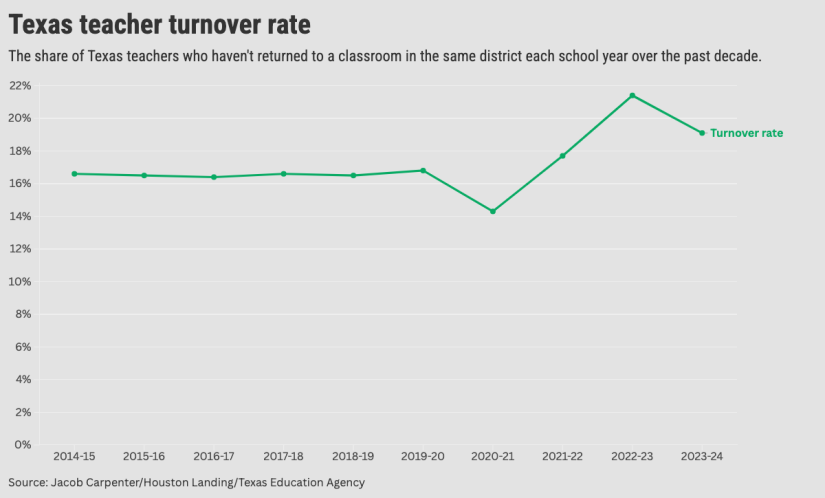
Texas teachers may be increasingly fed up with their job, but they’re still staying in school.
State data shows Texas public school educators continue to return to the classroom at somewhat similar rates as years past, despite multiple surveys showing the large majority of them have contemplated quitting the profession.
While teacher turnover has slightly increased over the past decade, state data show there hasn’t been a large exodus of experienced teachers. In fact, the average years of experience for Texas public school teachers hasn’t notably changed since 2014-15, nor has the share of first-year teachers hired by districts.
The numbers run counter to years of warnings that Texas teachers are primed to bolt en masse out of frustration with the job. At the same time, Texas does still face widespread issues with morale, as well as big challenges in finding certified teachers and filling several types of positions, including special education educators and bilingual teachers.
Steady hands in schools
While much has changed in Texas classrooms over the decade, students continue to be educated by mostly veteran teachers. The average tenure for Texas teachers has held steady during that stretch, ranging from 10.9 to 11.2 years of experience.
The state did see a slight dip in the share of first-year teachers — who, on average, have less positive impact on student achievement than other educators — during the late 2010s, then a slight uptick over the past few years. Still, novice teachers account for fewer than 1-in-10 Texas educators.
A small rise in turnover
Teacher turnover, a measure of how many educators don’t return to teach in the same district each year, has ticked higher since the pandemic. While it once hovered near 16 percent, it’s reached roughly 20 percent over the past two years.
Ultimately, a 4 percentage point difference equates to about 15,000 more teachers who aren’t returning to a classroom in their district. However, state data shows teachers of all experience levels are leaving at similar rates.
Still stressed
Teachers might be sticking with their jobs, but that doesn’t mean they’re happy about it.
A 2024 poll of 1,100 Texas teachers by the Charles Butt Foundation, an Austin-based education advocacy nonprofit, found nearly four-fifths of educators surveyed had seriously considered quitting the profession in the past year. Pay, quality of campus leadership and a sense of feeling valued ranked among the biggest factors in whether teachers had considered quitting.
Texas education leaders also are worried about the state’s ability to retain teachers and hire tough-to-fill positions. A state panel convened by the Texas Education Agency examined the issues and made numerous recommendations in 2023, though few of its proposals have been put into action.
Joseph Morrison-Howe is an undergraduate Economics student at the University of Nottingham. He completed an internship with HEPI during the summer of 2024. In this weekend long read, he discusses the history of marketisation in higher education and considers whether applicants have enough information to make informed judgements about where and what they study.
Executive summary
Study at university can be hugely beneficial for students intellectually, socially and financially. However, degrees that lead to low earnings can make individuals who study in higher education financially worse off and can impose an external cost on the taxpayer. This HEPI Policy Note uses the economic framework of market failure to argue it is likely that too many students are studying degrees that result in low earnings. Applicants should be free to choose a course according to their preferences but, they need to be encouraged to use salary outcome data to help them make an informed decision about what degree to study.
Key findings:
Existing data suggest that one in five graduates would have been financially better off not entering higher education at all. Some 40% of undergraduate students might have chosen a different route, although only 6% would not have entered higher education.
This report argues that reforms announced in 2022 to the repayment terms of student loans, from the old Plan 2 to the new Plan 5 system, will likely make university financially worthwhile for fewer students.
The graduate premium, the difference between the earnings of graduates and non-graduates, is also likely to decrease as the National Living Wage increases the wages of non-graduates.
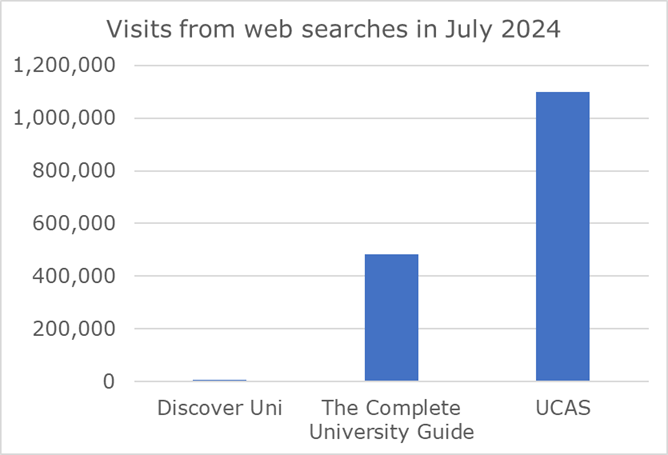
This report proposes imperfect information as a possible cause of market failure. Prospective students should make best use of information about graduate earnings when choosing what, where or whether to study at university. The official website for information about higher education, Discover Uni, had less than 7,000 website visits in July of 2024. In the same month, nearly half a million visited the website of the Complete University Guide, an online university league table.
Policy recommendations:
Discover Uni data about graduate earnings should be displayed on UCAS so that more students use this information when making decisions about university studies.
Satisfied average graduate earnings for each course should be displayed alongside the annual salary for National Living Wage work and the average graduate and non-graduate salaries. This should help students judge if studying individual courses would be financially worthwhile.
Careers advisors should support applicants to be fully informed about the benefits of higher education – including that not everyone is financially better off for attending university.
Market analysis and higher education
Prior to the 1830s, one would be hard-pressed to convincingly describe higher education in England as a competitive market – a place where many buyers choose to buy goods or services from many sellers, who compete to win the choice of these buyers. The Universities of Oxford and Cambridge maintained a duopoly (a market dominated by two sellers) for nearly 500 years.[i] Since the early nineteenth century, changes in government policy, alongside growth in the number of universities and students, have meant higher education in England has taken on more of the characteristics of a market.
The barriers to becoming a university in England have decreased over time and choice for students has broadened. Prior to the Coalition Government of 2010, the following changes happened to the higher education sector which incidentally laid the foundation for marketisation:
Growth in the number of universities, which provided more choice for students;
growth in student numbers; and
the formation of UCAS (originally UCCA, the Universities Central Council on Admissions), providing a ‘single nationwide application process’, creating a sector that resembled a marketplace.[ii]
It was the introduction and gradual increase of tuition fees paid by the student as opposed to funding via grants from the Government that really introduced market incentives to higher education in England.
By the 1990s, with growing demand from students, the government’s ability and willingness to fund the higher education sector came into question; between 1976 and 1996, government funding per student fell by 40%, according to the Dearing Report.[iii] As a result, the greater burden for funding higher education fell on students. Tony Blair’s government introduced ‘top-up’ fees of £1,000 paid upfront by students in 1998 to supplement government funding. In 2004, the fees rose to £3,000, covered by an income-contingent loan.
The Coalition Government’s rise in tuition fees to £9,000 caused the most significant change in the structure of the higher education sector in England. This is because, as David Willetts (then University Minister) wrote, the new higher fees largely
replaced funding via a Government agency providing grants to universities with funding via the fees (funded by loans) which students brought with them.[iv]
Consequently, to attract funding for teaching, universities had to compete to attract students, as the funding came directly from students. The Department for Business, Innovation and Skills (BIS) wanted ‘to ensure that the new student finance regime supports student choice, and that in turn student choice drives competition’.[v] The characteristics of choice and competition that BIS wanted to introduce are the key characteristics of a market.
The new funding model increased competition between universities for students, first because they received funding for each student they taught and secondly, because these policy changes allowed for the removal of student number caps, which had thus far artificially limited the number of places institutions could provide. More places were made available and students were given more meaningful choice about where to study.
The increasing number of universities and the introduction of UCCA were not policies intended to create a market, but there is evidence from the coalition government of purposeful marketisation. The 2011 white paper ‘Students at the Heart of the System’ from BIS showed their clear intention to introduce what they referred to as ‘a more market-based approach’ to higher education with the new funding system.[vi] The Coalition Government’s support for the new funding system was not just as a solution to the instability and underfunding of the grant-based system but because of the market incentives a fee-based funding model would introduce.
Not all aspects of the current higher education sector in England operate like a typical market. Entry requirements mean that students’ ability to choose between universities is contingent on the grades they achieve (but the growth in the number of universities means that for a given set of grades, a student can choose between many universities). Also, students only bear the cost of their studies if they can afford to do so, as student loan repayments are only made above a particular level of earnings. In typical markets, consumers bear the cost upfront. Though important for making university studies accessible, we will see, the fact that payment is not made upfront makes the sector vulnerable to market failure.
Despite these qualities, it is clear the sector has been marketised:
students now have more choice, and
universities now engage in more competition.
There are lots of reasonable critiques of marketisation. Nevertheless, since marketisation has taken place, it can be useful to apply economic analysis to higher education. This report considers the higher education sector as a market and consequently uses economic analysis to assess if the higher education sector works efficiently for both students and wider society. The purpose of this economic analysis is to identify how to improve the higher education sector so it works best for students and wider society.
Markets and market failure in higher education
Marketisation policies introduce characteristics of a market in the hopes that the outcomes of a market will materialise. The prized outcome of markets is efficiency. An efficient market is one where the resources are allocated to give the best outcomes for society; choice allows the allocation of students to the university that best suits them, and competition incentivises the allocation of university funds where they will most improve the institution. If a market is efficient, the allocation of resources cannot be changed to make someone better off without making someone else worse off.
The outcome of markets is not always efficient; markets are prone to fail.
Market failure occurs when resources are not allocated efficiently, to give the best outcomes for the consumer and wider society.
A market failure usually results in:
too much of a good being provided;
too little of a good being provided; or sometimes,
none of a certain good being provided at all.
One example of market failure might be the market for antibiotics. If antibiotics are cheap to buy, people might purchase them even if they are not sure they need them. Over time, the overuse of antibiotics can lead to the development of antibiotic resistance, where antibiotics no longer work for the people who really need them. This is a case where market failure has led to a good being provided in excess and a more efficient outcome would see less of it provided.
This report focuses on the higher education market failing and allocating too many students to degrees that result in low earnings. In this section, I discuss how students studying degrees that lead to low earnings can result in market failure, under certain conditions. In the next section, I will analyse a possible cause of this market failure.
Market failure: degrees that lead to low earnings
For the majority of graduates, studying at university gives them — and the wider economy — good financial returns. However, the market fails and allocates too many students to courses that will lead to low graduate earnings (‘low-earning degrees’). This makes individual graduates financially worse off, compared to if they had not gone to university, and imposes an external cost on the taxpayer.11 In this case the choice of degree (or to study at all) has led to suboptimal outcomes for the individual (the student) and wider society and is therefore a case of market failure.
There is evidence to suggest many students believe they would have been individually better off making a different choice of degree, institution or even entire pathway (such as doing an apprenticeship instead). In the 2024 HEPI / Advance HE Student Academic Experience Survey, four in ten students said they would have been better with a different choice (though only 6% would not have entered higher education).[vii] This suggests these students think there was a more efficient way of allocating (their own) resources even before they know what their lifetime earnings will be.
Not all degrees that result in low earnings are necessarily cases of market failure. There is only a market failure present if there could have been a better allocation of resources, that is, students could have made a different choice that bettered themselves or wider society.
It is likely many students do not just think about earnings when they consider the value of their degree. If the individual valued their Philosophy degree for other reasons – they enjoyed the content, valued the overall university experience, and so on – it may still have been worth it for them even if it did not increase their earnings. In this case, a degree like Philosophy may have been the best option for society if these benefits to the individual student outweigh the lower earnings (and another other costs to both the student and wider society). If so, the allocation would still be efficient and this would not be a case of market failure.
Another situation where a low-earning degree may not be a case of market failure is when the degree has such large social (as opposed to individual) benefits that the choice of any other alternative would lead to a worse outcome for society. For example, if a student studies to be a social worker and this leads to low earnings, the benefits to society that stem from the social work degree will be large enough that any other choice on the student’s behalf would have made society worse off.
The examples of Philosophy and Social Work degrees are not cases of market failure because of the benefits they offer to either the individual or the rest of society. These benefits are not easily quantifiable, so it is difficult to determine which low-earning degrees are examples of market failure and which are not. Below, I will argue that if students are given clear information about the earnings from different degrees, they will be more capable of making that judgement themselves.
The effect of too many students studying low-earning degrees (before reforms to loan repayment terms)
For individual students, there is a financial consequence of choosing to study a degree that will likely result in low earnings. A 2020 report by the Institute for Fiscal Studies (IFS) looked into the impact of undergraduate study on lifetime earnings. The report estimated that ‘one in five undergraduates would have been better off financially had they not gone to university.’[viii]
The IFS compared the lifetime earnings of a cohort of graduates to a counterfactual group that did not attend university, accounting for the difference in income tax, National Insurance and student loan repayments the graduates will have paid over their working life compared to the non-graduates. They then calculated the net lifetime returns for graduates, defined as ‘the lifetime gain or loss in earnings as a result of attending higher education for the individual, after taking into account the effect of the tax and student loans system.’[ix] The IFS found that a fifth of graduates earn less over their lifetimes than if they had not entered higher education.
Not all of the 20% of graduates that would have been better off had they not entered higher education will be cases of market failure. Some may be a Philosophy student that places a high personal value on the knowledge they gained, some may be social workers that provide great value for society, others may have studied a high earning degree and not utilised it. Furthermore, changing the discount rate the IFS use changes the proportion of students that finically benefited from higher education, as David Willetts points out. [x] Though, the IFS results are clear that not everyone entering higher education benefits from it financially.
When students choose to study a low-earning degree, there is also an external cost to the taxpayer. This external cost (a cost to a third party not involved in the transaction) arises because the taxpayer must cover the proportion of a student loan which a graduate has not paid back by the time their loan is written off. Prior to the implementation of reforms in the repayment terms of student loans announced in 2022, only 27% of graduates were estimated to repay their student loan in full.[xi]
The resource allocating and budgeting (RAB) charge is used to estimate the ‘cost to Government of borrowing to support the student finance system’. London Economics, an economics consultancy, estimated that the RAB charge for the 2022/23 cohort of students (who began their studies before the implementation of the 2022 reforms) was 10.2%. That is, the government was expected to cover 10.2% of the total value of the student loans taken out that year.[xii]
These costs, imposed on the student and wider society, might be avoided if students chose different degrees. Future earnings can be altered by a student’s choice of course to study and choice of institution to study at:
Even when comparing students with similar prior attainment and family background, different degrees appear to have a significantly different impact on early career earnings. Studying medicine or economics increases earnings five years after graduation by 25 per cent more than studying English or history. Attending a Russell Group university increases earnings by about 10 per cent more than the average degree.[xiii]
If students who chose to study low-earning degrees had instead chosen to study higher-earning degrees, they would have been less likely to impose an external cost on the taxpayer. Though, as I will explain, reforms to the student loan system mean the external cost to the taxpayer is now very small. Importantly, those students would also be more likely to give themselves positive net lifetime returns to their studies. These outcomes could make society better off. The current allocation of too many students to degrees that result in low earnings is an inefficient one. In the sense defined above, the higher education market is failing.
The impact of the reforms to the repayment terms of student loans (the move from Plan 2 to Plan 5)
The reforms announced in 2022 to the ‘Plan 2’ repayment terms on student loans have shifted the financial burden of low-earning degrees from the taxpayer to the graduate.
Under the new Plan 5 system, the income threshold at which graduates begin to make loan repayments was lowered from £27,295 to £25,000, the repayment period (after which loans are written off) was lengthened from 30 years to 40 years and the interest rate on student loans was reduced from RPI+3% down to just RPI (a measure of inflation).[xiv] These reforms have an uneven effect on graduates across the income distribution.[xv] The reduction in the repayment threshold will mean that lower-earning graduates will pay back more of their debt, and some will begin to pay it back for the first time. The lengthening of the repayment period will mean that low-earning graduates will pay back their loan for longer. The lowering of the interest rate will mean that high-earning graduates (who always would have paid back their loan in full) will now make smaller interest payments.
London Economics estimates that the RAB charge under the new terms of repayment will fall to 4.1% from 10.2%. This means that the reforms have transferred the costs of low-earning degrees from the government, which will now have to write off less debt, to the graduate, who must pay back more of it. As low-earning graduates will now make larger student loan repayments, attending university will not be financially worthwhile for more of them.
A fair assumption is that, since costs are only incurred in the future, prospective students will not be very responsive to these reforms by choosing low-earning degrees in lower numbers. Even after maximum fees were raised from around £3,000 to £9,000 in 2012, there was no significant long-term decrease in the number of applicants.[xvii] If this is the case, a greater proportion of students will now have negative net lifetime returns from their studies. Therefore, for this reform to have a positive outcome on low-earning graduates, these impacts would have to be available and clearly explained to prospective students.
The graduate premium and positive financial returns
The graduate premium is the increase in salary attributed to achieving a degree. To receive positive financial returns from studying, one’s graduate premium must be larger than their loan repayments and increased income tax and National Insurance payments. There is evidence to suggest that the graduate premium has fallen as the higher education sector has grown. Due to increases in the minimum wage, I believe the graduate premium is likely to fall further. This is likely to put a strain on the amount of students experiencing positive financial returns.
As the number of graduates increased throughout the 20th and into the 21st century, it was thought that the graduate premium would decrease. This is, in part, because as the supply of graduates increased their scarcity reduced meaning the premium an employer would pay to hire a graduate over a non-graduate should have fallen. A 2021 study by the Higher Education Statistics Agency (HESA) and a team at the University of Warwick found early evidence of a 7-percentage point decline in the graduate premium.[xviii]
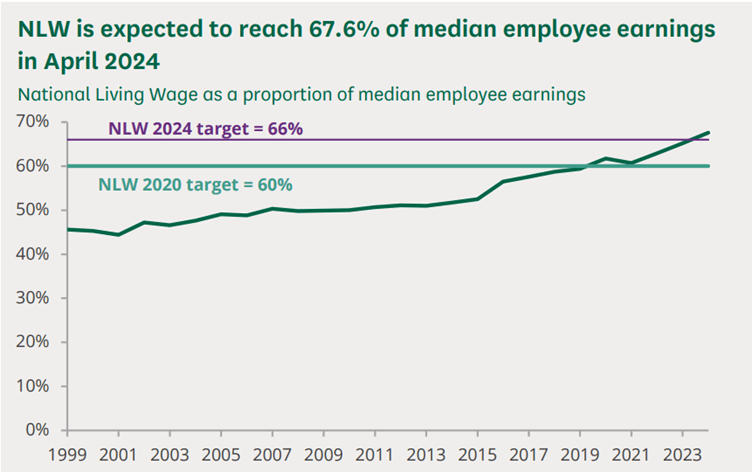
Recent increases in the National Living Wage are likely to further reduce the graduate premium by increasing the average wage of non-graduates. To make the UK a high-wage economy, the Government has been using National Minimum Wage legislation to increase the pay of the lowest paid. In 2020, the Conservative Government asked the Low Pay Commission to ensure the National Living Wage was two-thirds of median earnings by 2024, a target which has now been met.19 Assuming non-graduates are more likely than graduates to earn the National Living Wage. As National Living Wage has increased in relation to median pay, the average wage of non-graduates will have likely increased more than that of graduates. The graduate premium is likely to have further declined. As a result, for more students, it will not have been financially worthwhile to attend university.
Conclusion
In this section, I argue that there is a market failure and too many students are choosing to study degrees that result in low earnings. The reforms to the repayment terms of student loans and a possible decline in the graduate premium are likely to increase the proportion of graduates who are financially worse off for having gone to university. The next section of this Policy Note attempts to explain why this market failure of too many students choosing to study low-earning degrees is taking place.
The causes of market failure in higher education
This section will look at imperfect information as a possible cause of the market failure. There are other possible causes, such as low teaching quality or the fact that an individual student’s decision about whether and where to study also has effects on wider society. The government’s provision of information about graduate salaries is thought to have solved the problem of imperfect information. But this Policy Note focuses on imperfect information because prospective students are not seeing the information about graduate salaries.
Imperfect information occurs when all the parties in a transaction do not have full information about the transaction. If applicants do not know about the career prospects of a low earning degree, they may choose to study it thinking it will enhance their career prospects and then struggle to find a well-paying job after graduation. This could cause an inefficient allocation of students to courses.
People familiar with the higher education sector could likely name the universities that frequently top league tables and which subjects generally lead to high earnings. They may therefore may believe that applicants have roughly enough information to choose the best course for them. This knowledge is not common for all applicants, particularly for applicants who will be the first in their family to attend university (now roughly two-thirds of current undergraduates).[xx] An A-level student who I tutor recently demonstrated that some applicants do not have perfect information about university courses. I asked him out of the universities he wanted to apply to, which he would most like to attend. He wanted to study Management. He said he would like to go to university x “because they have a brand-new building for the business school.” I then showed him that average earnings for Management graduates 5 years after completing university x’s course were over £20,000 less than those of another university he planned to apply to. After this conversation, he chose not to apply to university x. Not all applicants have sufficient knowledge about university courses and this can cause them not to choose the course that would have been best for them.
While introducing marketising reforms since 2010, successive governments have been keen to ensure that applicants do not have imperfect information. A 2016 white paper stated an ambition for ‘more competition and informed choice into higher education’.[xxi]
As a result, prospective students now arguably have access to enough information to make informed choices. The official website for information about higher education, Discover Uni (formally Unistats) provides a wealth of information to prospective students. Discover Uni has information on student satisfaction, the entry grades of past students and information about career prospects for each course at a given university. Data from the Graduate Outcomes Survey and the Longitudinal Educational Outcomes data set are used to provide prospective students with information about the employment rate of past graduates and their earnings 15 months, three years and five years after completing a course. The wealth of information available to prospective students suggests that imperfect information cannot be the reason for too many students choosing courses that will lead to them earning less over a lifetime than if they had not studied at all.
Although prospective students have access to information about employment prospects on the Discover Uni website, few choose to use it. In July 2024, only 6,600 people visited the website.22 In the same month, 481,800 people visited the website of The Complete University Guide, an online university league table, suggesting rankings like these are used more often to make decisions about what and where to study. In the same month, 1,100,000 people visited the UCAS website (the main way to apply for higher education in the UK), which gives an indication of just how many see the information about courses and institutions it provides.
The problem may not be imperfect information, but imperfect knowledge. That is, it is not the lack of availability of information that means too many students study degrees that are not financially worthwhile but instead that applicants are not seeing the information about employment prospects.
Ensuring students see information about graduate salaries will help to correct the market failure of too many students choosing to study low-earning degrees, but it may not fully address information problems. This is because, graduate outcomes data is not a perfect indicator of what a given prospective student will earn. Past data on graduate outcomes cannot tell a prospective student about future labour market changes. However, compared to using no data at all, graduate outcomes give prospective students a good indicator of what they are likely to earn.
Graduate outcomes data may not be currently used because students (and teachers) might not fully understand the implications of the new Plan 5 repayment system. Students may have less incentive to find out the financial returns of a degree if they think a negative return would be covered by the government ‘safety net’. It may therefore be more important than ever to explain that since the 2022 reforms, most students will pay back all or almost all of their loans themselves.
The next section of this report shall propose recommendations to improve the use of the data on Discover Uni.
Policy response
Some students are choosing to study degrees that will likely lead to them having low earnings. When applying to university, students are not using the information about graduate salaries for specific courses, provided on the Discover Uni website. Without the proper use of information about how financially worthwhile degrees are, a fifth of students choose degrees that result in them earning less over their lifetime than if they had not studied at undergraduate level.9
The choice of what and where to study is an individual one; it may depend on what dream job one had as a child, the fact one may have to stay close to home to care for a relative or because one wants to improve their lifetime earnings. Regardless of why one chooses to study a given course, as it is now the student who is most likely to pay for their studies, they should be free to choose what and where to study. However, students should be exposed to the reality that their choice of course may result in them earning less over a lifetime than if they had not studied at university. Students should be encouraged to use information about graduate outcomes and this information should be explained to them. Careers advisors should explain that not all degrees are financially worthwhile and help applicants navigate the available information on graduate salaries.
To prevent students from unknowingly choosing courses that will likely lead to them earning low salaries, information about graduate outcomes should be made more usable. Therefore, the main recommendation from this HEPI Policy Note is that all of the data on Discover Uni (the government website for data which students rarely use) should be integrated into the UCAS pages for individual courses. This includes the salary outcomes for each course, or the lowest level of granularity Discover Uni provides. This makes it more likely that students applying for a course via UCAS will use this information to better inform their decisions.
Discover Uni graduate earnings data should be stratified before it is integrated into UCAS information pages. This involves weighting graduate earnings by social background, reflecting the proportion each social group represents in the wider population. Stratification would ensure that high earnings statistics from a given course do not simply reflect a cohort dominated by already affluent students.
Alongside the average graduate salaries for specific courses, theaverage graduate and non-graduate salaries should be displayed. Prospective students could be shown the current salary for a full-time minimum wage worker of £23,795 to help them judge if going to university would be financially worthwhile.[xxiii]
[vi] Department for Business, Innovation and Skills, Students at the Heart of the System, June 2011, p.73 https://assets.publishing.service.gov.uk/ government/uploads/system/uploads/attachment_data/file/31384/11- 944-higher-education-students-at-heart-of-system.pdf
Autism, a form of neurodivergence, is a naturally occurring neurodevelopmental variation that manifests in differences in how people experience and interact with the world.
The focus is often on communication “deficits” and “repetitive and rigid” behaviour but, quite frankly, this focus and these words say more about how non-autistic (allistic) people interpret our behaviour and their own discomfort with the same.
Our own experiences of being autistic are a lot more expansive and encompass autistic joy and strengths, alongside the significant and often unnoticed challenges we experience day-to-day.
At different points in time, we both made the conscious, and somewhat fraught, decision to share our autism diagnoses in professional contexts. For the most part we were hugely relieved to be met with compassion from colleagues and a desire to support us to make the necessary changes to level the playing field.
Yet, in the background of these positive experiences, there is a near-constant battle with systems, processes and neuronormative expectations that undermine individual attempts to be supportive.
We wanted to share the biggest challenges we’ve faced in sharing our diagnoses and attempting to build afresh work practices and environments that will allow us to thrive.
Attempts to normalise
On more than one occasion after sharing our diagnoses, we’ve both been met with responses along the lines of “we’re all a bit like that though”.
While we assume these comments are intended to “normalise” our experiences and perhaps reassure us that we’re not that different, such comments are somewhat missing the point.
Firstly, autistic people are human too, so our autistic traits are very much part of the human condition. For example, the struggles we face in some social contexts may be experienced by allistic people sometimes.
And our desire to seek refuge in routines is something many people can relate to, particularly in times of great upheaval. What sets our experiences apart is the depth, duration and the degree to which these experiences impact our capacity to thrive.
Secondly, late discovery or diagnosis often comes about after a lifetime of deeply felt misunderstandings and a perpetual sense of being somehow wrong. The challenges autistic people face have very real implications such as significant impact on mental wellbeing alongside higher risks of substance abuse, accidents and offending behaviour as well as lower levels of income and education.
While finally getting answers to a lifetime’s worth of questions is broadly positive, never underestimate how earth-shattering a late discovery or diagnoses can be. It can completely unmoor you from an identity you worked hard to craft and maintain, often over many decades.
To be set adrift whilst trying to carry on “business as usual” can be incredibly disorienting and well-meaning comments intended to find common ground can feel dismissive and leave us, once again, feeling misunderstood.
To receive a diagnosis can be confirmation (or even a revelation) that you have been leaning on masks and performativity this whole time, borrowing bits of behaviour and social styles from others, in order to keep up with fast-paced workplace dynamics.
But if our identity is a mosaic of other people’s characteristics, who exactly are we? We therefore often find that the diagnosis we hoped would answer our questions, instead serves up a hearty existential crisis. Coupled with the need to continue functioning both in personal and professional contexts, whilst running that background process, can be exhausting.
The adjustments minefield
Often a motivating factor in sharing an autism diagnosis is the need to access workplace adjustments, though it should be noted you don’t need a diagnosis to do so.
What many people won’t realise is that identifying the adjustments you need, and getting these put in place, often feels like a full-time job in and of itself. We’ve both experienced scenarios where we’ve been encouraged to share what we need to work at our best, only to find ourselves somewhat stumped.
We’ve defaulted to so many complex and energy-consuming workarounds to overcome the barriers in our environment, that it can be hard to pick apart common workplace challenges from those which come about from being part of a neurominority.
Plus, autistic people aren’t often comfortable around change, so if we’ve established a workaround, it can be difficult to consider an alternative, despite how much more efficient it could be!
This is the nature of having differences that are somewhat invisible – you don’t realise that everyone isn’t quietly battling the same complexities.
What we have both realised is that it’s essential to have the time and space for ongoing conversations around our evolving understanding of our needs. Too often the default is to use prescriptive forms and processes to put adjustments in place, whereas we have both benefitted from ongoing dialogue with managers who are committed to ensuring the barriers we experience are removed, in as much as possible.
Our hope is that more people will start to understand that a diagnosis or discovery, and the sharing of this new understanding, should form the start of a conversation, rather than an outcome to be compensated for.
Neuronormative expectations
The majority of people will be blissfully unaware of what we mean by neuronormative expectations because, if you’re neurotypical, it’s likely that you subscribe to the dominant social norms without much effort.
Most people, for example, assume good eye contact means you’re paying attention, and arriving late, particularly persistently, indicates a lack of commitment and/or interest. If you’re autistic, lack of sustained eye contact can be used to aid concentration, especially when processing auditory information, and lateness can be down to a multitude of reasons from difficulty with transitions to the need to avoid the ‘chit chat’ that often precedes the start of something.
It’s also worth noting that these norms are culturally located and direct eye contact, for example, is considered disrespectful or invasive in some countries. It’s a wonder to both of us then that such subjective meanings and interpretations have become normalised standards that we are somewhat required to adhere to, to be accepted.
It is also worth noting that we may well be thinking about all of the above whilst trying to judge the correct level of eye contact to be making; this is just part of the complex backroom processing and calculations we do on a daily basis!
With all of this in mind we’d encourage colleagues to think about assumptions around what it means, and looks like, to undertake certain activities that most assume shared understanding of.
We can certainly identify a range of areas where our interpretations diverge, such as notions around communicating effectively, networking or being professional.
A good example is the way in which we’ve co-written this piece, which has come about through an initial text based online interaction, followed by asynchronous collaboration. At the time of finalising this piece we have still never “met” online or in person but have engaged in a rich exchange of ideas that have allowed for meaningful collaboration.
If colleagues could be open to alternative interpretations and manifestations of social norms, higher education would be the richer for it.
Allyship is needed
With these challenges in mind there are things that can be done to support late-diagnosed colleagues. Essentially these centre around allyship and actively working to acknowledge discrimination and unconscious bias.
Consider how you respond when someone shares their autism discovery or diagnosis
Can you approach the conversation with curiosity, accepting that the experience of being autistic might, in fact, be very different from your own? Central to this is recognising the limitations of your knowledge and experience.
It is a natural response to want to normalise your experience with the person sharing their diagnosis with you, but that may not be the comfort you expect it to be, and might accidentally undermine the identity they are still coming to terms with.
Rather than saying “I do that too”, or “aren’t we all a little bit like that though?”, create a space where the person sharing their diagnosis with you can take time to form their own words, and be sure to centre them in the words you use with them.
What part do you have to play in removing barriers
For us, everyone has a role to play in removing barriers that prevent us from thriving. Whether directly as a manager supporting autistic colleagues to navigate often overly complicated HR processes, or as a peer becoming aware that your colleagues need to do things in a different way.
You don’t need to know someone’s diagnosis to be an ally, you can simply start by identifying if there are moments you default to your preferred ways of doing things while inadvertently overlooking a colleague’s genuine need to things differently. If you come across resistance that is inexplicable to you, withhold judgement and instead become curious about alternative ways of thinking and being.
Reflect on what norms and expectations you assume
Assumed shared understanding and narrow interpretations of behaviour is the space where most unconscious bias sits. The reality is that the imaginary social contract we have all supposedly signed is just that – a fiction that not all of us have been granted access to.
Can you make space to co-create shared understanding around what it means to “communicate”, for example? Can you become aware of your bias that “good communication” manifests through narrowly defined behaviours? Or can good communication also be non-spoken, asynchronous or graciously feature enthusiastic interruption, or deep dive monologues?
Ultimately, whether you are an individual in whom an autistic colleague quietly confides, a senior manager with the agency to affect positive change, a HR professional implementing processes, or someone involved in developing policy – everyone has a part to play in making higher education a place where autistic people can thrive.
This audio is auto-generated. Please let us know if you have feedback.
SAN DIEGO — The higher education sector is facing an onslaught of challenges, including attacks from the Trump administration, fading public confidence and the demographic cliff. But higher education leaders didn’t shy away from these issues at the annual ASU+GSV Summit, an education and technology conference held this week in San Diego.
“The moment is actually a productive moment for us, because we can and should and will use some of the chaos in order to build new kinds of institutions, new infrastructures, new ways of thinking,” said Ted Mitchell, president of the American Council on Education, during a discussion Wednesday.
Below, we’re rounding up three key takeaways from higher education leaders on where the sector needs to go and how it can be more innovative.
Higher ed needs to refocus on student success
Mitchell pointed to multiple threats converging in the higher education sector, including eroding public confidence in colleges and universities. That forces the sector to grapple with important questions.
“What are we delivering? Is it the right thing? Is it being delivered to the right people? And is it being delivered to the right people in the right way?” Mitchell said. “I think that the answer to all of those is, ‘Not quite,’ and so that’s the existential threat.”
He pointed to the national college completion rate, which measures the share of first-time students at degree-granting institutions who complete their credentials within six years. That rate has risen slightly above 60% in recent years.
“One hundred percent of the people who come to our doors want a degree,” Mitchell said. “But we disappoint 40% of them. And over time, that has accreted into a group of people in America — Americans who are our community — who say it didn’t work.”
But centering student success can reverse that trend, Mitchell suggested. Carnegie Classifications, a popular system for categorizing colleges and universities that’s housed at ACE, is using that focus to bring changes to its framework.
For example, the system plans to release new classifications in the coming weeks based on student access and earnings, with an emphasis on measuring whether colleges have student bodies representative of their regions.
“We’re going to look at institution by institution — are you serving the students in the communities that you serve?” said Timothy Knowles, president of the Carnegie Foundation for the Advancement of Teaching.
A crisis can spur innovation
Fear can be a motivator to embrace innovation, said Kathleen deLaski, founder of the nonprofit Education Design Lab.
“Let’s not waste a good crisis,” deLaski said during a panel Tuesday.
She pointed to enrollment challenges at community colleges. In 2023, The Hechinger Report found that they had shed just over one-third of their students since 2010. However, after years of declines, fall enrollment has been ticking up at public two-year colleges since 2022, according to the National Student Clearinghouse Research Center.
Community college leaders began looking for new educational models amid the enrollment crunch, deLaski said. And recently, interest in short-term credentials have been fueling some of the sector’s enrollment gains.
“It’s in the new kinds of short-term pathways, certificates, even dual enrollment in high school,” deLaski said.
That’s also been a focus at Education Design Lab. Since 2021, the nonprofit has worked with over 100 community colleges to create “micro-pathways” — two or more stackable credentials that can be completed in under a year. The pathways are intended to result in jobs at or above the local region’s median wage and put students on track to earn an associate degree.
Innovation could come from unexpected places
Disruption to higher education is more likely to come from certain areas of the sector than others, Paul LeBlanc said Tuesday. LeBlanc is the co-founder of Matter and Space, an artificial intelligence and education company, and he previously led Southern New Hampshire for two decades.
“Where it is hardest are institutions that are first with sterling reputations and big endowments,” he said. “That’s a huge impediment to innovation.”
Public systems with strong unions may also struggle to be disruptive, LeBlanc said, though he added he was not anti-union.
On the other hand, colleges often seen as innovative don’t typically fall into those buckets.
He gave the example of Southern New Hampshire University, which he described as an “unknown, small, whatever-tier” college before it turned into an online behemoth serving over 160,000 students during his tenure.
LeBlanc also pointed to Arizona State University, the college that helped launch the annual conference. Arizona State’s enrollment has ballooned in the past two decades, reaching over 180,000 in-person and online students in the 2023-24 academic year. The university’s president, Michael Crow, has been largely credited with transforming the university into one with a national brand.
“It was kind of the joke school. It was a safety school, it wasn’t the flagship,” LeBlanc said, adding that Crow had “lots of running room” to reinvent the university.
Other innovators could come from these types of spaces.
“Look for the innovators to be on the boundaries, the unknown, the unencumbered places that have the freedom and the movement to want to sort of reinvent themselves,” LeBlanc said.