Author: admin

  • States sue to recover ESSER extended spending allowances

    States sue to recover ESSER extended spending allowances

    This audio is auto-generated. Please let us know if you have feedback.

    Dive Brief:

    • Sixteen states and the District of Columbia sued the U.S. Department of Education on Thursday for halting previously approved extended spending timelines for emergency pandemic funding, calling the department’s action “tremendously harmful” to states, school districts, private schools and contractors.
    • The lawsuit, filed in U.S. District Court for the Southern District of New York, called the action “arbitrary and capricious” and said it violated the Administrative Procedure Act. The plaintiffs are seeking an order requiring the Education Department to honor the spending extensions.  
    • The policy pivot is causing states and districts to cancel tutoring services, facility improvement projects, reading interventions, after-school programming and more. District and school staff layoffs are likely if the federal government does not make reimbursement payments, the lawsuit said.

    Dive Insight:

    The Education Department’s March 28 letter canceling the extensions, sent at 5:03 p.m. on a Friday, has “already caused substantial confusion” and financial upheaval regarding late liquidation for Elementary and Secondary School Emergency Relief funds, the plaintiffs said. 

    States, districts, private schools and contractors have already created budgets, hired staff, offered services to families and children and developed operating plans based on pre-approved spending extensions, according to their lawsuit.

    In Arizona, for example, a school district on the Navajo reservation will likely need to lay off teachers and staff to cover costs that were supposed to be paid for by American Rescue Plan-ESSER dollars. That money had been pre-approved by the Education Department for a tutoring service for reading and math instruction and to repair aging buildings. After the Education Department rescinded the spending extensions, the tutoring service and infrastructure project were terminated, the lawsuit said. 

    The Education Department’s one-page March 28 letter, signed by U.S. Secretary of Education Linda McMahon, did offer states an opportunity to continue to extend spending by reapplying for Education Department approvals on a per-contract basis. But McMahon’s letter also said the spending extensions were “not consistent with the Department’s priorities” and that states had failed to meet spending deadlines set out in federal regulations.

    While spending deadlines for all three congressionally approved allocations for K-12 COVID-19 recovery have expired, the Education Department under the Biden administration allowed for a longer spending runway, giving states and districts an extra 14 months to spend down the funds.

    For instance, the spending deadline for ARP-ESSER was Jan. 28, but the late liquidation deadline is March 30, 2026. For funds under the Coronavirus Response and Relief Supplemental Appropriations Act, the original spending deadline was Jan. 29, 2024, but the extended spending deadline was March 28. The spending extension for the Coronavirus Aid, Relief, and Economic Security Act was March 28, 2024.

    In late February, the Education Department told K-12 Dive that about $2.5 billion out of a total $121.9 billion in ARP-ESSER funds remained to be spent by districts in the 41 states, Puerto Rico and the District of Columbia that had received extensions. About $433 million was left to be spent by states under ARP’s Emergency Assistance to Non-Public Schools allocation.

    The lawsuit says several states received approvals from the Education Department for ESSER spending extensions after President Donald Trump’s inauguration on Jan. 20. For example, Illinois said the Education Department approved its request on Jan. 22 to extend spending under ARP-ESSER. The state said it still has $77.2 million left to spend in federal COVID funds for education.

    One state — Oregon — said it submitted a request for late liquidation of EANS funds at 5:02 p.m. on March 28, or one minute before the Education Department letter went out. The state has not received a response. 

    Pennsylvania submitted a spending extension request for EANS funds on Feb. 10 but the Education Department has not responded to the state’s “repeated requests,” according to the lawsuit. About a month earlier, on Jan. 8, the department did grant Pennsylvania an extension for ESSER funds targeting supports for homeless children and youth.

    While there was no hard deadline for states to make late liquidation requests, January 2024 guidance from the Education Department recommended submissions be made prior to Dec. 31, 2024, for ARP funds so there would be minimal disruption to accessing funds.

    Democratic lawmakers in Congress are also calling for the Education Department to reverse its cancellation of ESSER spending extensions, saying the department changed the rules abruptly and has no recognition of the lasting impacts of the pandemic on students and schools.

    Maryland’s Attorney General Anthony Brown, in a Thursday statement, said, “The Trump Administration’s decision to cut this funding has thrown Maryland schools into turmoil and uncertainty and threatens valuable programs that help homeless and low-income students recover from the painful effects of the COVID-19 pandemic.” 

    He added, “This is a breathtakingly heartless action that threatens to change children’s futures for the worse, and our Office will not stand for it.”

    Thursday’s lawsuit was filed by Pennsylvania Gov. Josh Shapiro, a Democrat, and the mostly Democratic state attorneys general of Arizona, California, Delaware, the District of Columbia, Hawaii, Illinois, Maryland, Massachusetts, Maine, Michigan, Minnesota, Nevada, New Jersey, New Mexico, New York and Oregon. All the attorneys general are Democratic, except Hawaii’s, whose office is nonpartisan.

    Source link

  • FIRE statement on immigration judge’s ruling that deportation of Mahmoud Khalil can proceed

    FIRE statement on immigration judge’s ruling that deportation of Mahmoud Khalil can proceed

    This afternoon, an immigration judge in Louisiana ruled that Mahmoud Khalil’s deportation could proceed under immigration law. But the fight over the constitutionality of that law continues.

    The Immigration and Nationality Act gives the secretary of state nearly unchecked authority to deport a legal permanent resident on nothing more than his whim if the secretary believes the person poses “serious adverse foreign policy consequences.” 

    Below is FIRE’s statement, attributable to Legal Director Will Creeley:

    Can expressing an opinion that the government doesn’t like justify a green card holder’s arrest, detention, and deportation? That’s what this case comes down to — and it’s a question the courts must answer. The government is holding up a provision of the Immigration and Nationality Act that purports to say “yes.” But the principles enshrined in the First Amendment say “no.”

    Allowing a single government official sweeping and nearly unchecked power to pick and choose individuals to deport based on beliefs alone, without alleging a single crime, crosses a line that should never be crossed in a free society. 

    The only “crime” the government has offered was that Mahmoud Khalil expressed a disfavored political opinion. If that’s a crime in America, every single one of us is guilty.

    Source link

  • Trump administration moves to cut off Maine’s federal K-12 funds

    Trump administration moves to cut off Maine’s federal K-12 funds

    This audio is auto-generated. Please let us know if you have feedback.

    The U.S. Department of Education on Friday moved to terminate federal K-12 funding for the Maine Department of Education, following through on its promise to cut off the state and ultimately others if they do not enforce Title IX so as to keep transgender students from girls’ locker rooms, restrooms and athletic teams. 

    The move marks the first time the Trump administration has officially initiated a cut in federal funding to a state K-12 school system over civil rights violations.

    The department at the same time referred its Title IX investigation of Maine to the U.S. Department of Justice for enforcement — after multiple threats that it would do so if the state did not sign onto a resolution agreement within 10 days of the agency finding Maine in violation of Title IX.  

    “The Department has given Maine every opportunity to come into compliance with Title IX, but the state’s leaders have stubbornly refused to do so, choosing instead to prioritize an extremist ideological agenda over their students’ safety, privacy, and dignity,” said Craig Trainor, acting assistant education secretary for civil rights in an April 11 statement. 

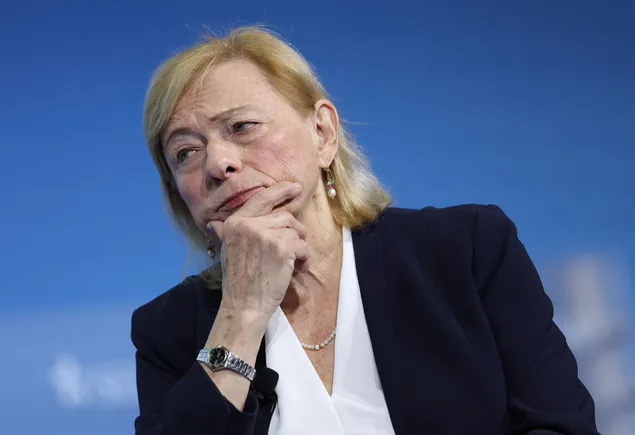
    Gov. Janet Mills “would have done well to adhere to the wisdom embedded in the old idiom — be careful what you wish for,” Trainor said. “Now she will see the Trump Administration in court.” 

    Mills has maintained since the investigation’s launch that the state is not in violation of Title IX. The governor has said the federal investigation is “not just about who can compete on the athletic field,” but rather “about whether a President can force compliance with his will, without regard for the rule of law that governs our nation. I believe he cannot. 

    A swift investigation

    The directed investigation — meaning one initiated without a public complaint — was initiated by the department on Feb. 21 and concluded less than a month later in March. The move was precipitated by a public spat between Mills and Trump in February over the state’s transgender athlete policies, during which Mills threatened to see Trump in court. 

    The day the investigation was launched, alongside a nearly identical one into Maine by the U.S. Department of Health and Human Services also over Title IX, Mills said the outcome was “all but predetermined.” 

    Indeed, the investigation’s directed nature, quick turnaround time, high stakes attached, and referral to the Department of Justice — which traditionally has been reserved for egregious cases — has raised eyebrows in the education civil rights community. 

    The seemingly targeted, quick and aggressive enforcement strategy marks a significant shift from education civil rights enforcement under past administrations. Investigations traditionally took months or years, involved interviews and other investigative tools, and concluded with a negotiation with schools to bring them into compliance with federal law. Resolution agreements often included changes to school district operations like conducting climate surveys or hiring or training staff to ensure all students have access to an equal education. 

    Resolution agreement rebuffed

    In this case, however, the administration gave Maine 10 days to sign a draft resolution agreement that would change state and district policies to define “females” by “a reproductive system with the biological function of producing eggs (ova),” and “males” by having “a reproductive system with the biological function of producing sperm.” “Gender” would be the same as “sex” under the agreement.

    The draft agreement also would have required the state to apologize to each cisgender girl impacted by the state’s transgender female athlete policy “for allowing her educational experience and participation in school sports to be marred by sex discrimination.” 

    After the state refused to sign the agreement, the department warned officials on March 31 that it would send the case to the Department of Justice by April 11. 

    “Under prior administrations, enforcement was an illusory proposition. No more,” said Trainor in a March 31 statement.  “The Trump-McMahon Education Department is moving quickly to ensure that federal funds no longer support patently illegal practices that harm women and girls.” 

    While cutting off states or districts from funds was always within the Education Department’s power, it was a stick that was rarely used in past administrations, and especially not over Title IX, according to the Association of Title IX Administrators. 

    Within three months under this Trump administration, the department has threatened the cancellation of more than $9.5 billion for Ivy League universities over alleged Title VI and Title IX violations related to alleged antisemitism and LGBTQ+ policies, threatened some 60 colleges and a handful of districts with additional loss of funding over allegations of antisemitism, and promised that “this is only the beginning.”  

    Source link

  • Faculty salaries grow but still lag pre-pandemic era

    Faculty salaries grow but still lag pre-pandemic era

    This audio is auto-generated. Please let us know if you have feedback.

    Full-time faculty salaries rose for the second year in a row, even after adjusting for inflation, according to preliminary compensation data from the American Association of University Professors. 

    Fall 2024 salaries rose an average of 3.8% year over year, though inflation brought that growth down to an increase of 0.9%, according to the study.

    Even with two years of gains, faculty compensation has not fully recovered from the pandemic period, which brought a 7.5% effective drop in salaries from 2019 to 2022, AAUP said.

    Faculty’s inflation-adjusted salaries are still climbing out of their pandemic dip

    Year over year growth in nominal and real salaries from academic years 2017-18 to 2024-25.

    During an era of constrained budgets for many institutions — with job and program cuts making headlines — institutions are under a countervailing pressure to invest in their people and infrastructure after years of belt-tightening. Some colleges have given employees raises even as they make budget cuts in other areas.

    Preliminary data from AAUP’s latest faculty study shows salaries making some headway even in an era of slashed budgets. Fall’s salary increases for full-time faculty followed an inflation-adjusted 0.4% increase in 2023. 

    Those of course are averages, and figures varied across rank and job types. Associate professors’ salaries, for example, typically grew at a faster clip in the 2024-25 academic year than professors or assistant professors while lecturers’ salaries rose faster than all of those positions, with growth over 6% at the doctoral and master’s level institutions, according to AAUP’s study. 

    The survey also found continued gender disparities for professor compensation, with men earning nearly $26,000 more than women at doctoral institutions and about $8,000 more at master’s institutions. 

    College and university presidents typically made around four times or more than the average faculty member across most institution types, according to the study. 

    Part-time faculty made an average of $4,093 per class section in the 2023-24 academic year. But their compensation “varied widely” depending on where they worked, AAUP said.

    At private nonprofits, a part-time faculty member could make an average of $1,950 per section teaching at associate-granting institutions compared to $6,481 at bachelor’s-degree colleges. 

    Maximum payments could run into the tens of thousands of dollars across institution types. Meanwhile, some part-time faculty could earn as little as $700 per section teaching at a public university. 

    Just over one-third of colleges, 34.4%, made retirement plan contributions for at least some part-time faculty, and fewer than one-third, 32.5%, contributed to insurance premiums for at least some part-timers.

    The AAUP analysis is based on surveys of more than 800 U.S. institutions, with data on roughly 370,000 full-time and 90,000 part-time faculty members

    CUPA-HR also found annual salary growth across much of the sector in the 2024-25 academic year. 

    After factoring in inflation of 2.7%, salaries went up 1.2% for administrators, 1% for professional staff, 1.1% for general staff and 0.5% for nontenure-track faculty, according to CUPA-HR. Real salaries for tenure-track faculty fell 0.1%.

    As with AAUP, CUPA-HR noted that higher education salaries still fell short of pre-pandemic levels despite growth. The largest gaps are in salaries for tenure-track faculty — paid 10.2% less than in the pre-pandemic era after adjusting for inflation — and non-tenure-track teaching faculty, who are paid 7.6% less.

    Source link

  • FIRE welcomes Allison Hayward to board of directors

    FIRE welcomes Allison Hayward to board of directors

    FIRE is thrilled to announce that professor Allison Hayward has joined our board of directors.

    Allison is the former head of case selection for the Meta Oversight Board, where she played a critical role in shaping the platform’s approach to content moderation. She also previously served as a commissioner on the California Fair Political Practices Commission and co-chaired the Board of the Office of Congressional Ethics.

    “Allison brings an extraordinary depth of experience at the intersection of law, media, policy, and free expression,” said FIRE President and CEO Greg Lukianoff. “At a time when the future of open discourse is being shaped by institutions both public and private, her insight will be invaluable in guiding FIRE’s mission.”

    Additionally, Allison is the former vice president of policy at the Center for Competitive Politics (now the Institute for Free Speech).

    With a robust background in academia, Allison taught constitutional law, election law, ethics, and civil procedure as an assistant law professor at George Mason University School of Law from 2006 to 2010. She also served as counsel to Commissioner Bradley A. Smith at the Federal Election Commission.

    Allison was also an associate at the law firm Wiley, Rein & Fielding in Washington, D.C., and counsel at Bell, McAndrews, and Hiltachk in Sacramento, California.

    Allison has written widely on election law and ethics topics and has been published in a variety of law journals. Before attending law school, she served as staff in the California legislature and managed a state assembly campaign. 

    She earned her bachelor’s degree in political science and economics from Stanford University, and her J.D. from the University of California, Davis. She has clerked for Judge Danny J. Boggs of the U.S. Court of Appeals for the Sixth Circuit and as chair of the Federalist Society’s Free Speech and Election Law Practice Group.

    Allison is a member of the ABA Standing Committee on Election Law and the American Law Institute. She is also an active member of the California bar.

    Apart from law and politics, Allison is passionate about music. She sings, plays fiddle and keyboards, and sits on the board of a fiddle camp and a bluegrass festival.

    She lives in Cambria, California, with her husband Steve, who teaches at the Pepperdine School of Public Policy, and is the proud mother of two adult children.

    “One of the things I most respect about FIRE is its non-partisan mission,” said Allison. “Threats to speech are ultimately nonsectarian and what comes around certainly goes around. FIRE understands that the liberty long-game is critical to freedom and sound governance.”

    Source link

  • Stakeholders call bluff on anti-OPT bill

    Stakeholders call bluff on anti-OPT bill

    Titled H.R. 2315, the Fairness for High-Skilled Americans Act, the bill was reintroduced by Gosar, who argued that OPT “undercuts American workers” and lets “greedy businesses hire inexpensive foreign labour” without providing benefits.

    “Never authorized by Congress, OPT circumvents the H-1B visa cap set by Congress by allowing over 100,000 aliens admitted into our country on student visas to continue working in the United States for another three years after completing their academic studies,” read a statement by Gosar.

    “The OPT program completely abandons young Americans who have spent years and tens of thousands of dollars pursuing careers in science, technology, engineering, and mathematics only to be pushed out of those fields by cheap foreigners.”

    Though the legislation has been referred to the House Committee on the Judiciary, stakeholders have already shut down any possibility of it passing the US House of Representatives in the future. 

    While proposals like this tend to generate headlines, the likelihood of this bill advancing in Congress is extremely low
    John Evans, Catalyst Gem

    “While proposals like this tend to generate headlines, the likelihood of this bill advancing in Congress is extremely low,” John Evans, co-founder and CEO, Catalyst Gem, a US-based software and services company specialising in international student admissions, told The PIE News

    “The last serious attempt to eliminate OPT came in 2020 and failed in the face of overwhelming bipartisan, legal, and economic opposition. Despite significant political pressure, the program remained fully intact, without any modifications, because of its recognised value to the US economy and workforce development.”

    This isn’t Gosar’s first attempt to target the OPT program. In 2019, he introduced similar legislation and urged its termination through an executive order by President Donald Trump, who was serving his first term at the time.

    Following Gosar’s move, WashTech – a union representing STEM workers – also took legal action, suing the US government over its 1992 rule that established the 12-month OPT program and the 2016 regulation which allows eligible STEM graduates to extend OPT by 24 months.

    But the idea that OPT displaces American workers with international graduates is far from the truth, according to Evans. 

    “As of April 2025, the US had 7.6 million job openings, with high-skill sectors such as tech, healthcare, and engineering facing some of the greatest shortages,” he explained.

    “Looking ahead, the US is projected to create 1.1 million new STEM jobs over the next decade and will need a continued pipeline of talent, including OPT, to support this growth. Failure to meet this demand will weaken the US position in the global economy, particularly if the talent is directed elsewhere.”

    Despite efforts by the Trump administration, which pushed to restrict or eliminate OPT under the direction of then senior advisor to the President, Stephen Miller, the proposed changes were ultimately abandoned due to strong opposition from universities, business leaders, and other key groups.

    Since then, OPT has remained a critical part in international appeal for US education and in 2023, the number of international students participating in the program rose to 242,782 – a 22% jump from the year before. 

    This surge played a significant role in pushing the overall international student population in the country to a record 1.1 million, with OPT participants making up a substantial portion of that total.

    “I don’t see this bill going anywhere as the US needs more highly skilled workers – both American and otherwise to fuel an economy that is moving towards doing more highly skilled work in the US,” stated Mark Kopenski, president and CEO, Global Student Recruitment Advisors, a consultancy firm handling international student recruitment and enrolment strategies for educational institutions. 

    “The (Trump) administration has been bullish on creating paths to permanent residence for highly skilled and educated individuals from around the globe. This will take some time as there is a clearing out of many individuals that have come to the US illegally and without skills, financial resources and abilities that the US desires.”

    According to Kopenski, programs like the “Gold Card Visa” are designed to attract highly skilled talent and noted that some international students in the US have already acquired or are planning to acquire these visas.

    Although programs like the H-1B visa, which allows US employers to temporarily hire international workers in specialised fields, have faced scrutiny during Trump’s second term, the former president has voiced support for granting green cards to international college graduates. 

    However, no legislation has materialised to back this proposal, and instead, international graduates are encountering growing restrictions.

    Since Trump’s inauguration in January this year, hundreds of international students have been detained and seen their visas revoked on US college and university campuses, often without any prior warning. 

    As per reports, over 80 US universities have reported visas being revoked for some of their international students. 

    Last month, US Secretary of State Marco Rubio stated that over 300 student visas had been revoked due to activities deemed “against US national interest.” 

    Experts suggest the revocations may be tied to students’ involvement in pro-Palestine protests or minor legal infractions, such as speeding, with some facing deportation or being asked to leave the country.

    The move has led to condemnation from US educators, who have slammed the “alarming” and “deeply disturbing actions” of the Trump administration. 

    The move could possibly contribute to an already declining interest in studying in the US, as highlighted by a recent survey conducted by StudyPortals. 

    Evans commented: “To rebuild confidence, the US must adopt a more consistent, transparent, and student-centred approach to international admissions and immigration, like the streamlined policies seen in Canada, the UK, and Australia. This effort must be reinforced by public messaging and policies that clearly state: ‘You are welcome here, and your contributions matter.’”

    Meanwhile, Kopenski sees this as short-term declining interest, set to “correct itself as the US strengthens its attractiveness as a destination that provides the ultimate springboard to wealth and prosperity”.

    Source link

  • Doing right by the teachers who do right by the world

    Doing right by the teachers who do right by the world

    Key points:

    • Ethical PD is a call to action for all involved in teacher professional development
    • Key questions that unleash powerful PLCs
    • GenAI and cultural competency: New priorities in teacher preparation
    • For more news on teacher PD, visit eSN’s Educational Leadership hub

    Teachers are superheroes. Every day, they rise to the challenge, pouring their hearts into shaping the future. They stay late to grade papers, show up early to tutor struggling students, and spend their weekends planning lessons that inspire young minds. They do this because they believe in their mission–a mission to change lives, ignite passions, and build a better world.

    More News from eSchool News

    We are again in uncertain times. We again find ourselves dealing with sudden changes and uncertainty. We seem to be in a state of constant change and ambiguity.

    In today’s evolving educational landscape, effective student assessment goes beyond multiple-choice tests and letter grades. According to a recent study, over 60 percent of educators believe traditional assessments fail to fully measure student understanding.

    Holden, my 21-month-old, has fallen in love.  His early morning snack and “couch time” includes a dose of “Tiger!”  This is toddler for, “Mom, turn on Daniel Tiger’s Neighborhood.”

    The COVID-19 pandemic left an indelible mark on K-12 education, placing immense pressure on teachers as they adapted, literally overnight, to new methods of instruction.

    Spring brings not only showers and flowers, but it also brings the opportunity to interview for new education positions. Preparing for an interview involves several key steps that can significantly impact the outcome.

    STEM careers are on the rise. According to the U.S. Bureau of Labor Statistics, employment in STEM occupations is expected to grow by 10.4 percent from 2023 to 2033, compared to just 3.6 percent for non-STEM occupations.

    The U.S. Department of Education is giving state education agencies 10 days to certify that their schools do not engage in any practices that the administration believes illegally promote diversity, equity, and inclusion.

    COVID had already killed thousands of people in other countries and was spreading in the United States when a top federal health official said schools should prepare to offer “internet-based teleschooling” in case they had to close for a period of time.

    More than half of educators (62 percent) are already making use of AI at school, with more than one-quarter using it daily for work purposes, according to a Twinkl survey of more than 3,500 U.S. teachers.

    Many math tasks involve reading, writing, speaking, and listening. These language demands can be particularly challenging for students whose primary language is not English.

    Want to share a great resource? Let us know at [email protected].

    Source link