Columbia University was dealt another blow to research funding this week.
DNY59/iStock/Getty Images
The Trump administration has frozen all U.S. National Institutes of Health funding for research grants at Columbia University, Science reported, cutting off the flow of $250 million to the private institution mere weeks after it yielded to sweeping demands related to pro-Palestinian campus protests.
The federal government had already clamped down on $400 million in research funding for Columbia last month. But after the university agreed to enact various reforms the Trump administration demanded to address alleged antisemitism on campus, it appeared a reprieve was in order. Education Secretary Linda McMahon said last month that she believed Columbia was “on the right track” toward final negotiations to unfreeze the research funds.
Instead, the Trump administration has gone in the opposite direction, cutting off even more research funding. According to Science, the NIH froze Columbia’s funding Monday at the direction of the U.S. Department of Health and Human Services. NIH is reportedly not only blocking new funding but also ceasing payments for work on existing projects. In addition, the agency will require prior approval to tap existing disbursements.
“HHS strongly condemns anti-Semitic harassment against Jewish students on college campuses,” a department spokesperson told Inside Higher Ed by email. “In line with President Trump’s mission to combatting discrimination and promoting fairness, HHS is partnering with other federal agencies to conduct a comprehensive review of grants awarded to universities that have failed to protect students from discriminatory behavior. We will not tolerate taxpayer-funded institutions that fail to uphold their duty to safeguard students from harassment.”
Critics assailed the move.
“It’s shocking, but not surprising, as with so many previous developments in this matter,” said Michael Thaddeus, a Columbia math professor and vice president of the institution’s American Association of University Professors chapter. “And it shows that the Trump administration just has an animus against American universities.”
Thaddeus called the actions “so patently unlawful” that litigation against the Trump administration would have a strong chance of success—yet Columbia hasn’t sued. The AAUP and the American Federation of Teachers union, with which the AAUP is affiliated, have filed a lawsuit over the prior $400 million cut.
“If what you’re dealing with is threats from an extortionist, then capitulating to the threats of an extortionist is not a wise move,” Thaddeus said. “What’s happening is not an enforcement action, it’s a political vendetta.”
Reinhold Martin, president of the Columbia AAUP chapter and an architecture professor, said “the defunding of science” reflects a structural pattern: “the movement of public funding out of the nonprofit sector into, eventually, we can fully expect, the for-profit sector. So that’s what this is about.”
A Columbia spokesperson told Inside Higher Ed the university has not yet been notified of the freeze. “At this time, Columbia has not received notice from the NIH about additional cancellations,” the spokesperson said via email. “The University remains in active dialogue with the Federal Government to restore its critical research funding.”
Columbia would not be the first university to learn about the loss of federal funding indirectly. The Trump administration also froze $790 million in federal research funding at Northwestern University earlier this week, which officials learned about via media reports. Cornell University was also dealt a $1 billion blow to its federal funding this week.
Elsewhere in the Ivy League, the Trump administration has frozen $510 million at Brown University, $175 million at the University of Pennsylvania and $210 million at Princeton University. The funding freezes mainly come in response to allegations of antisemitism related to pro-Palestinian campus protests, though federal investigations into the claims are ongoing.
Outside of Columbia, scholars noted that even though the university gave in to Trump’s demands, the administration still seemed unsatisfied.
“The NIH just froze ALL grant funding owed to Columbia University, meaning that the university’s concessions to the Trump administration clearly didn’t go far enough to satisfy the federal government,” Robert Kelchen, a professor of education and head of the Department of Educational Leadership and Policy Studies at the University of Tennessee at Knoxville, wrote in a BlueSky post.
On April 9, the U.S. Citizenship and Immigration Services (USCIS) announced that it will begin considering “aliens’ antisemitic activity on social media and the physical harassment of Jewish individuals as grounds for denying immigration benefit requests.” According to the announcement, the guidance is effective immediately and impacts individuals applying for lawful permanent resident status, foreign students, and “aliens affiliated with educational institutions” linked to antisemitic activity.
Under the new guidance, USCIS will look at social media content that indicates a requestor “endorsing, espousing, promoting, or supporting antisemitic terrorism, antisemitic terrorist organizations, or other antisemitic activity as a negative factor in any USCIS discretionary analysis when adjudicating immigration benefit requests.” The announcement states that DHS and USCIS aim to enforce all relevant immigration laws to the maximum degree, consistent with President Trump’s executive orders on combatting antisemitism and national security controls to protect against foreign terrorists.
In early March, USCIS published a proposal to collect social media information on applications for immigration-related benefits. USCIS claimed that such collection of information was necessary to comply with Trump’s national security executive order discussed above. The comment period for this information collection proposal is still open. The comment period closes May 5.
CUPA-HR continues to monitor for updates on immigration policy changes that could potentially impact student and nonimmigrant work visas used by the higher education community.
Today’s schools need to get creative to promote their programs in a way that resonates with prospects. To spur action from your audience, you need to build trust, create engagement, and foster an emotional connection. How do you do that with so many other schools competing for the spotlight? One of the most effective strategies for making a strong impression on your audience is combining user-generated contentand authentic storytelling.
These methods allow your institution to showcase real experiences, highlight student voices, and differentiate itself from competitors in an increasingly crowded educational landscape. Keep reading to discover the unique advantages of these effective education marketing tactics, get actionable insights into how to use them to reinvent your marketing plan, and examine real examples for inspiration.
Struggling with enrollment?
Our expert digital marketing services can help you attract and enroll more students!
What Is User-Generated Content (UGC)?
User-generated content refers to any content, such as testimonials, social media posts, blogs, and videos, created by students, alumni, faculty, or other stakeholders rather than your institution itself. By leveraging UGC, you can present an unfiltered, genuine representation of student life and success. This makes your marketing feel more authentic and increases engagement and reach across digital platforms.
Why is user-generated content important in marketing? UGC is created by your students and alumni; it is perceived as more trustworthy than traditional promotional materials. Prospective students are more likely to trust and engage with content created by their peers rather than content crafted solely by an institution. This credibility makes UGC a powerful tool for increasing enrollment and engagement.
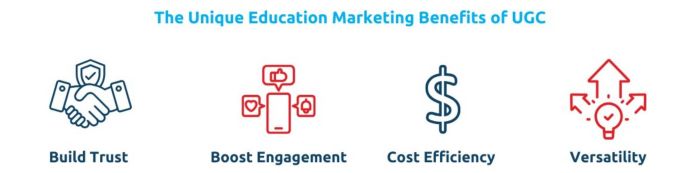
The Unique Advantages of User-Generated Content in Education Marketing
A key user-generated content advantage is its ability to build trust. When prospective students see real stories from current students or alumni, they develop a connection to your institution. This sense of authenticity makes them more likely to inquire about programs and ultimately enroll.
Another advantage is the ability to foster engagement across digital platforms. Content created by students, such as Instagram stories, TikTok videos, or blog posts, generates far higher engagement than traditional ads. People love sharing their experiences, and prospective students love seeing real perspectives from peers who have been in their shoes.
A major user-generated content advantage is cost-effectiveness. Instead of investing heavily in producing marketing materials, you can encourage students and alumni to share their stories organically. This reduces costs and enhances your reach, as UGC spreads naturally through networks.
Another reason why user-generated content is important in marketing is its adaptability across multiple platforms. UGC can be repurposed into social media campaigns, website testimonials, video promotions, and email marketing efforts. This versatility allows you to maintain a steady stream of fresh, compelling content.
Source: HEM
What Is Authentic Storytelling in an Educational Marketing Context?
Authentic storytelling goes beyond traditional marketing materials to craft compelling narratives highlighting real student and faculty experiences. Instead of relying solely on promotional messages, this approach uses emotion, relatability, and personal journeys to engage prospective students.
What is the power of storytelling in education? Authentic storytelling is powerful because it transforms abstract institutional values into relatable, real-world experiences. It allows prospective students to see themselves in your stories, making their decision-making process more personal and impactful. This approach humanizes your institution and strengthens your brand identity.
One of the best ways to incorporate authentic storytelling into your marketing strategy is by featuring in-depth student and alumni stories. A compelling blog could follow the experiences of an international student adjusting to life in a new country while studying at your institution. A video series could showcase students discussing their educational journey, including their challenges and triumphs. By doing this, you create content that is informative and emotionally engaging.
The Advantages of Authentic Storytelling in Education Marketing
Unlike traditional promotional content, authentic storytelling builds emotional connections that influence student decision-making. By sharing real experiences from your students and faculty, you provide prospects insight into your institution’s culture, values, and impact.
One of the greatest advantages of authentic storytelling is its ability to make your institution’s messaging more relatable. Instead of generic promotional materials, prospective students see real-life success stories, challenges, and personal growth journeys, helping them visualize their own future at your school.
Another unique benefit is the ability to enhance brand trust and credibility. People connect with stories, not advertisements. By showcasing genuine experiences through student interviews, alumni journeys, and behind-the-scenes campus life, your school appears more transparent and welcoming. This approach fosters a deeper connection with your audience, making them more likely to engage with your institution.
Authentic storytelling also strengthens retention and alumni relations. When students feel emotionally connected to your institution through compelling narratives, they are more likely to remain engaged throughout their education and beyond. Alumni who feel valued through storytelling initiatives often become ambassadors for your school, further enhancing your brand reach.
How Your School Can Leverage User-Generated Content and Authentic Storytelling
Building a marketing strategy around user-generated content and authentic storytelling requires a proactive approach. Instead of simply encouraging students to share their experiences, you need to create opportunities for engagement, provide platforms for their voices, and consistently highlight their stories. By doing so, you ensure that the content generated aligns with your school’s brand and messaging while maintaining the authenticity that makes it so powerful.
Encourage Student-Generated Social Media Content
One of the best ways to integrate UGC into your marketing strategy is by motivating students to share their experiences on social media. Encourage them to document campus life, extracurricular activities, and classroom experiences.
For example, your university might launch an Instagram challenge where students post their favorite campus spots with a branded hashtag. Similarly, a career college could create a TikTok trend showcasing student projects or daily routines in their training programs.
Example: This video, posted by a UCLA student, is a free promotion for the school’s dining hall. She is making a relatable joke about the proverbial ‘freshman fifteen,’ an expression for the weight gain that tends to occur in the first year of college. The creator credits the delicious food at UCLA for her freshman fifteen, and this is not the only video of its kind on her page. Satisfied students eager to share their experiences are invaluable for generating compelling UGC. Encourage students to use specific hashtags for their UGC as this creator did (#ucla #dininghall, etc).
Prospective students value hearing from those who have already walked the path they are considering. Featuring student and alumni testimonials on your website, in promotional videos, and on social media channels provides relatable insights into your programs.
An example of effective testimonial use is a nursing college that records short video interviews with recent graduates discussing their experiences and career outcomes. These testimonials provide compelling, relatable stories that reinforce the value of your school’s programs.
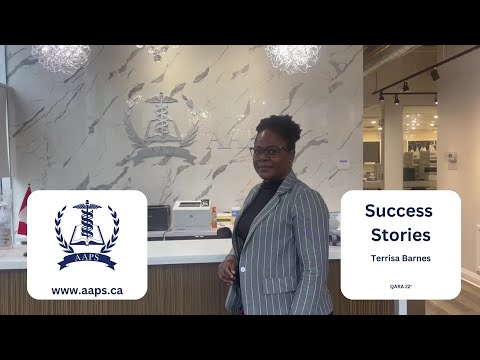
Example: AAPS regularly posts alumni video testimonials highlighting each graduate’s unique background, career goals, and how the institution supported the attainment of their objectives. Here, Teresa Barnes describes how the Quality Assurance and Regulatory Affairs program at AAPS helped her to find success as a Medical Writer. Your alumni community is probably full of careerists who are proud of their achievements and are excited to talk about their journey. This is an excellent opportunity for effective brand storytelling.
Source: Academy of Applied Pharmaceutical Sciences | YouTube
Develop Long-Form Content With Authentic Storytelling
Creating blog posts or video documentaries featuring students’ journeys can be a powerful way to engage prospects. A compelling blog could follow a student during an internship and how the experience shaped their career aspirations. This approach showcases your school’s opportunities while telling a relatable story that resonates with other students considering similar paths.
Additionally, long-form content allows for in-depth storytelling that goes beyond surface-level promotions. A well-written blog post could feature a student reflecting on their academic journey, describing their challenges, the mentors who guided them, and the personal growth they experienced. Similarly, a video series might document a student’s transition from their first day on campus to their graduation, providing prospective students with a complete picture of what they can expect.
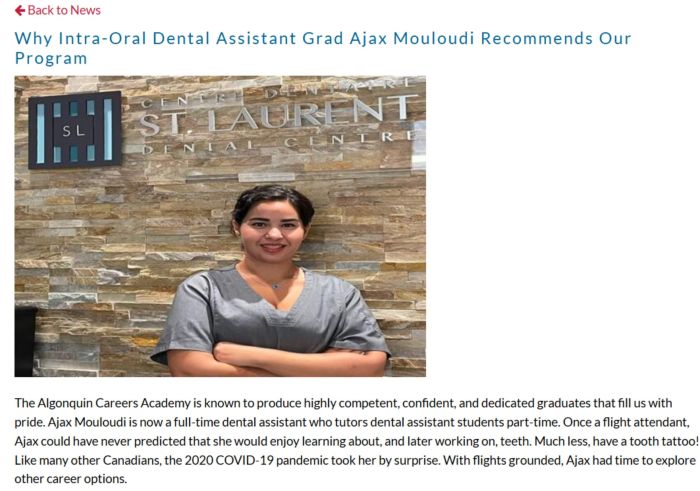
Example: Blogs remain a relevant way to tell your school’s story and give your student body a voice. Here, Algonquin Careers Academy tells the story of one of their dental assistant graduates. By publishing a blog post that features a student interview, the message is personable, inspirational, and authentic. Try to infuse personality into your long-form content whether you choose to blog, post videos, create a newsletter, or all three.
Source: Algonquin Careers Academy
Highlight Behind-The-Scenes Content
Showcasing the day-to-day experiences of students, faculty, and staff makes your institution feel more welcoming and accessible. A behind-the-scenes video series might follow a day in the life of a student in a culinary arts program, walk viewers through a school event, and showcase hands-on learning experiences and interactions with industry professionals.
An effective example comes from business schools that share faculty-led discussions, giving students an inside look at the classroom environment before they apply. This storytelling adds authenticity and provides a window into your school’s culture and academic strengths.
Example: Here, the American Musical and Dramatic Academy showcases its open house event, building anticipation for prospects and providing useful information about what they can expect from the event. Behind-the-scenes videos are easy to film, effective for humanizing your brand, and excellent ways to inform your audience in an engaging, easy-to-digest format.
To increase engagement, your school can launch user-generated content campaigns that incentivize participation. This could include video challenges, photo competitions, or student-run social media takeovers. For instance, a digital marketing diploma program might host a competition where students submit real-world marketing campaign ideas, with the winner featured on your school’s website and social media pages. This not only showcases student talent but also strengthens your brand’s credibility.
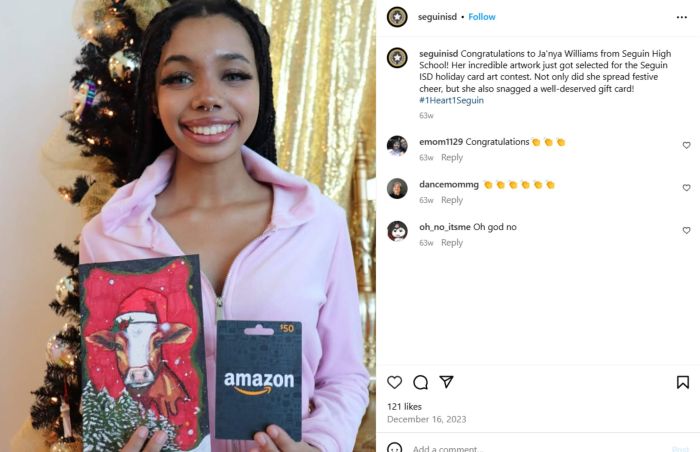
Example: Seguin High School showcases the artistic talent of one of their students who had won an art contest. Not only is this an excellent way to instill well-deserved pride and support in your students, but it is also a great way to humanize your school brand and display your strong community.
Source: Seguin High School | Instagram
Get Support as You Elevate Your Education Marketing Strategy
In today’s highly competitive and interconnected world, attracting qualified student prospects online is essential to a successful recruitment strategy. Schools and universities must implement innovative and authentic marketing techniques, leveraging user-generated content and authentic storytelling to connect with their audiences on a deeper level. Working with a marketing agency specializing in education marketing can be a game changer for your results.
For over 15 years, Higher Education Marketing has crafted successful digital marketing strategies for schools worldwide. Our deep understanding of education marketing allows us to design multichannel campaigns that drive engagement and enrollment. We provide tailored services, including:
Content Marketing
Search Engine Optimization (SEO)
Social Media Marketing
Paid Advertising Campaigns
Partner with us to harness the power of storytelling in education and leverage the benefits of user-generated content to drive real engagement. Contact us today to explore how our expert digital marketing solutions can transform your student recruitment efforts and enhance your institution’s online presence.
Struggling with enrollment?
Our expert digital marketing services can help you attract and enroll more students!
Frequently Asked Questions
Question: Why is user-generated content important in marketing?
Answer: UGC is created by your students and alumni; it is perceived as more trustworthy than traditional promotional materials. Prospective students are more likely to trust and engage with content created by their peers rather than content crafted solely by an institution.
Question: What is the power of storytelling in education?
Answer: Authentic storytelling is powerful because it transforms abstract institutional values into relatable, real-world experiences. It allows prospective students to see themselves in your stories, making their decision-making process more personal and impactful. This approach humanizes your institution and strengthens your brand identity.
Strategies for Each Stage of the Enrollment Journey
Higher education institutions face many challenges in their efforts to engage with potential students and keep them motivated while they navigate the enrollment process. In a 2024 Lumina Foundation/Gallup survey on the state of higher education, prospective adult students cited cost, work conflicts, emotional stress, and lack of remote learning opportunities as their top barriers to enrolling in a college program.
Institutions and enrollment teams have the unique opportunity to support students on their journey through each stage of the enrollment funnel — awareness, interest, consideration, intent, application, and enrollment — to help them achieve their goals.
In the first stage of the enrollment funnel, prospective students search for colleges and universities and find out about the different programs they offer. The challenge that universities face during this stage is: How do we reach as many potential students as possible?
Prospective students learn about institutions in the following ways:
College and university websites
Emails from schools
Videos
Printed brochures
Financial aid and scholarship calculators
Marketing campaigns
According to a recent survey of prospective students, 83% find videos from colleges and universities helpful, 79% find virtual tours helpful, and 63% have clicked on a college’s digital ad.
Universities can use the following strategies to reach potential students:
Use a mix of digital and traditional marketing. Digital tactics include social media ads, blog content, and search engine optimization (SEO), while traditional methods include college fairs, in-person events, direct mail, and phone calls.
Personalize your tactics. Recent high school graduates may prefer text messages and emails, while adult students may prefer phone calls.
Stage 2: Interest
In the next stage, also known as the familiarity stage, students narrow their focus and move closer to deciding which program is right for them. Universities face this challenge during the interest stage: How do we stand out among the competition and promote our institution’s brand?
Strategies to stand out include the following:
Promote your brand. Use strategic marketing strategies to emphasize the unique value propositions (UVPs) and benefits of earning a degree at your institution.
Provide informative content. Anticipate your audience’s questions by describing how a degree can benefit their life and help them reach their career goals. Tactics include career-focused blog articles, informational webinars, and customized emails.
Stage 3: Consideration
At this stage, students have several options and may now take the time to reach out to the institutions they’re interested in to get more information before they make their decision. By engaging directly with students, colleges and enrollment teams can build relationships with them and establish trust.
Universities at this stage wonder: How do we build trust and encourage prospective students to enroll?
To build trust with prospective students, universities should employ tactics such as the following:
Maintain one-on-one communication. Admissions counselors can contact students directly via emails, phone calls, or video meetings to answer their specific questions and address any issues they may have on topics such as financial aid opportunities, program lengths and delivery formats, and support services. Adult students may prefer adult-specific messaging that relates to their lives, such as information about work-life-school balance, family-centered goals, and increased earning potential.
Connect students with faculty and alumni. Virtual Q&A sessions give students an opportunity to meet professors and faculty face-to-face and hear about the real experiences of current and former students.
Provide materials and resources. Be prepared to answer questions about credit hours and course descriptions, and to provide any other information that can help them make their decision.
Stage 4: Intent
In this stage, sometimes known as the choice stage, prospective students are very close to making a decision. Enrollment teams need to be ready and available to help them take the necessary steps to enroll.
These teams have the following challenge questions to solve: How do we continue to keep students engaged? What other information and encouragement can we provide?
Over 14,000 prospective adult students who responded to the 2024 Lumina/Gallup survey ranked their reasons for not enrolling in a college program. The following challenges were flagged as very important or moderately important:
Cost: 85%
Work conflicts: 77%
Emotional stress: 72%
Program length (too long): 72%
Favorable job market: 71%
Lack of remote learning: 68%
Personal mental health reasons: 64%
Degree/credential not needed for job: 62%
Unprepared academically: 58%
Getting accepted: 56%
Personal physical health reasons: 55%
Lack of value in further education: 52%
Child care/adult family care: 47%
Degree doesn’t fit with personal beliefs: 47%
Universities can employ strategies such as the following:
Continue personal engagement. As students come closer to making a decision, they may have more detailed concerns about costs, financial aid, and program specifics, so it’s important to check in and be available to answer any new questions.
Create urgency. Remind students about upcoming deadlines for enrollment and financial aid applications.
Provide incentives. Offer application fee waivers and other benefits for early application.
Stage 5: Application
At this stage, students have made their decision and are ready to apply to the institution. This is a big step for students who may need help submitting documents and fulfilling admission requirements.
The challenge universities face involves this question: What can we do to ease the application process?
Schools can employ strategies such as the following:
Check in regularly. Streamline the application process, and provide reminders of important dates and deadlines.
Create a help desk. Provide resources, application checklists, and video guides to students, and help them locate any missing or remaining information.
Encourage and motivate. Send positive messages to students letting them know they’re near the finish line.
Stage 6: Enrollment
In the last stage, students complete their registration and begin the orientation process. Admissions advisors at this stage must keep students engaged and set them up for success. Students will choose classes, buy books, and meet teachers and other students, while also making decisions about how to manage their other life obligations while they are in school.
The challenge question for universities: How can we provide support and promote retention?
These schools can benefit from strategies such as the following:
Provide guidance and resources. Support students through the registration process, help them create manageable course loads, prepare them with the resources they need to succeed, and help them create long-term plans with the goal of graduating.
Analyze and evaluate enrollment process successes. Gather feedback from students and parents, analyze data, and make improvements to each stage of the enrollment process.
Create Enrollment Strategies to Support the Student Journey
Enrollment teams not only help students choose the best program to reach their goals, they also support them throughout the enrollment and admissions process to ensure their success through graduation.
This week on the podcast it’s our Easter special – and we’re diving into the highlights from The Secret Life of Students, our event that looked at a new vision for the student experience.
We hear from student officers, sector experts, and campaigners on everything from the myth of the full-time model, to the pressures of placements, to the problems faced by international students. There’s testimony from nursing students, fire from SU officers challenging tokenistic consultation, and reflections on race, identity, and institutional indifference. Plus we zoom out to explore commuter challenges, disabled students, student cities and the global call for student solidarity. Hosted by Jim Dickinson, Associate Editor at Wonkhe.
Enjoy listening to the podcast? Donate to FIRE today and
get exclusive content like member webinars, special episodes, and
more. If you became a FIRE Member
through a donation to FIRE at thefire.org and would like access to
Substack’s paid subscriber podcast feed, please email [email protected].
Given the Trump administration’s continued and varied assaults on the First Amendment, it is vital to monitor those attacks and then realize the gravity of the “sweeping and draconian sanctions” imposed by unconstitutional executive fiat. Vigilance is especially important, as New York Times investigative reporter Michael S. Schmidt has noted, because “Mr. Trump has employed tactics including lawsuits, executive orders, regulations, dismissals from government jobs, withdrawal of security details and public intimidation to take on a wide range of individuals and institutions he views as having unfairly pursued him or sought to block his agenda.”
Mindful of such matters, this installment of “Executive Watch” by professor Timothy Zick provides the most comprehensive and informed account of the current threats facing us up to now.
Of course, yet more posts are forthcoming. Meanwhile, it is worth heeding the sound advice recently offered by Dean Erwin Chemerinsky: “despite the risks of speaking out, silence itself comes at enormous cost.”
— rklc
My introductory post, which was published a little more than a month after Donald Trump took office for the second time, identified various areas in which his administration’s actions threatened First Amendment rights. At this point, even before the first 100 days of the second Trump administration have elapsed, we now have a much fuller picture of the nature and scope of the threat — and it’s even worse than we thought.
Media stories and commentary have covered a range of Trump administration policies and actions that threaten speech and press rights. Commentators have examined the attacks on media, law firms, government employees, and universities, among others. My last post discussed Trump’s abuse of the civil lawsuit to punish the media and others.
Considered in isolation, these actions raise troubling First Amendment concerns. But the whole threat to the First Amendment is far greater than the sum of its damaging parts. Combined, the administration’s actions represent a whole-of-government and whole-of-society effort to control whether and how Americans talk about certain ideas.
Trump 1.0 and the First Amendment
As it concerns the First Amendment, the fundamental difference between Trump 1.0 and Trump 2.0 is the extraordinary use of the levers of governmental power to suppress, dictate, and coerce viewpoints the president disfavors.
During the first administration, the threat to the First Amendment emanated primarily from the president’s own statements and threatened actions. Trump talked about “opening up” the libel laws to make it easier to sue media defendants. He waged a constant war on the press, which he referred to as “the enemy of the people.” He demanded loyalty, attacked those who disagreed with his views on patriotism and dissent, and threatened to punish media outlets by revoking their licenses. He also threatened to shut down social media platforms that fact-checked him.
Prof. Timothy Zick
During the 2016 presidential election, Trump called for de-naturalizing and jailing protesters who burned the U.S. flag. As president, he routinely denigrated protesters. During the Black Lives Matter demonstrations, Trump considered invoking the Insurrection Act to call up U.S. military personnel to quell protest-related civil unrest. He sent federal agents to Portland and other cities to police and quell protests. At one point during the demonstrations, Trump reportedly asked his then-secretary of defense why protesters couldn’t be shot. And, of course, after he lost the 2020 election he used his own speech to incite the Capitol insurrection on Jan. 6, 2021.
It was clear during his first term that Trump had little or no tolerance for dissent, and a strong desire to impose his will on the media and other institutions. However, for the most part, he either didn’t or couldn’t effectuate that agenda. Perhaps this was because members of his administration talked him out of it, or perhaps because he was not yet familiar with the levers of power.
Trump 2.0 and executive orders
Trump 2.0 has been a vastly different story. Past presidents, including Trump, have used executive orders to exercise or augment their executive powers. They have set important agendas for the executive branch of government. However, no president has ever used executive orders to attempt to control what Americans can discuss, or how they speak about concepts regarding diversity, patriotism, anti-Semitism, gender, and other matters of public concern. And no president has been as successful at extending such an agenda across not just the federal bureaucracy but nearly every aspect of society.
Thus far, President Trump has issued eighteent Executive Orders, plus several accompanying “Fact Sheets,” that implicate First Amendment rights. Although some of the Orders are vague and/or thin on specifics, many target expression based on its viewpoint – a quintessential violation of the First Amendment.
Five of the Executive Orders target law firms based on their representation of clients and advocacy for causes the President disfavors.
Three Orders prohibit universities, companies, and others receiving federal funds from maintaining “Diversity, Equity, and Inclusion” (DEI) policies and practices – including training, teaching, and supporting those ideas.
Trump’s Orders also target “anti-Semitic” speech by federal grantees and encourage universities to monitor “pro-jihadist protests” and campus “radicalism.”
An Executive Order requires that K-12 schools adopt “patriotic” curricula and further vows to withhold funding from any schools that teach that the United States is “fundamentally racist, sexist or otherwise discriminatory.”
Other Orders provide that resident aliens who express “hatred for America” or “bear hostile attitudes toward [American] citizens, culture, government, institutions, or founding principles” are subject to deportation.
Two of Trump’s Executive Orders single out transgender individuals, banning them from military service and imposing restrictions on the genders they can use on U.S. passports. These Orders raise important equal protection concerns, but also bar individuals from communicating about their own gender identity.
Finally, the Administration’s cost-cutting and desire to control the flow of information have deeply affected the availability and distribution of information in the United States. Trump has ordered the disbanding of Voice of America and Radio Free Europe, important outlets for furthering American interests abroad. Trump’s spending cuts have also decimated libraries, which are critical distributors of information. Trump recently issued an Executive Order that purports to remove “anti-American ideology” from the Smithsonian Museum.
TRUMP’S FIRST 80 DAYS Executive orders affecting free speech and press: 18 Federal agencies involved in enforcement: 20 Lawsuits raising First Amendment challenges: 30
The whole-of-government campaign
Standing alone, Trump’s executive orders represent a serious threat to the First Amendment. But the orders are backed by agency enforcement powers that drastically expand the danger.
Think of the executive orders as a general blueprint for an ideological and retributive campaign aimed at punishing enemies for speech, imposing governmental orthodoxy regarding race, gender, and other matters, and controlling the distribution of information. That blueprint is being enforced by all federal agencies under the president’s command. So far, that includes some twenty separate agencies, including:
Agencies across government are involved in enforcing Trump’s executive orders in areas ranging from private business to immigration. Ironically, the president’s ability to control and punish expression is due, in large part, to the size of the federal government he has targeted for downsizing or eradication.
The whole-of-society impact of the executive orders
Trump’s executive orders bind all federal agencies under his command. Agencies across regulatory areas have moved swiftly to scrub websites of offensive DEI language. Their efforts to comply with Trump’s directive have at times been comical. The Defense Department apparently removed material about the Enola Gay, the aircraft that dropped the atomic bomb on Hiroshima, because of its name. Agencies have also removed information about Jackie Robinson and other material that celebrates the accomplishments of black people and women. Taking a “chainsaw” approach to language in public-facing websites, agencies have removed information that does not comport with the president’s preferred terms and viewpoints.
“In a pre-election poll, respondents ranked ‘free speech’ among the top issues that were ‘very important’ in influencing their vote for president.”
FIRE/NORC poll of 1,022 Americans conducted Oct. 11-14, 2024
The federal government is an important source of information for issues relating to public health, the armed forces, employment, and other matters. Governments can determine what messages they want to communicate, including on websites they control, but those efforts can have harmful effects on the distribution of information to the public.
Trump’s orders have also limited the availability of information, both at home and abroad. They have silenced the nation’s voice in international spheres, cut off aid to libraries, and even demanded that museums change exhibits that convey “anti-American ideology.” Again, no president has ever used executive orders to so comprehensively control what can be seen, heard, or viewed.
Trump’s executive orders have also affected millions of individuals, entities, and institutions beyond federal agencies. Indeed, it is hard to overstate the breadth and depth of the activities covered by the existing executive orders — and they continue to be issued almost daily. The orders have already extended into every boardroom, classroom, breakroom, and laboratory in the United States. Businesses have shut down activities recognizing the value of a diverse workforce. Universities have scrubbed websites and materials of any references to the values of diversity in education. Legal counsel at some hospitals have even warned staff not to use “triggering” words like “vulnerable” or “diverse” to describe patients.
How Trump has expanded his power over expression
Four things account for the extraordinary scope and effect of the Trump administration’s campaign to control what Americans see, hear, and say regarding gender, race, and American history.
First, in contrast to Trump 1.0, the president has relied more extensively on executive orders as a means of governing. Trump’s more than 100 executive orders cover everything from the types of straws that can be used in federal buildings, the legitimate causes law firms can pursue, and the content of displays at the Smithsonian Museum.
“There . . . can be no question that the demands the administration is making of Harvard are intended to suppress protected expression, of various kinds. To avoid the loss of federal funds, Harvard will have to refrain from advocating for, or empowering others to advocate for, the viewpoint that diversity, equality, and inclusion are important educational and social values. It will have to change how it oversees faculty research and teaching, and what kinds of scholarly viewpoints it hires and promotes. And it will have to suppress student speech and association, including core political expression, more severely than it has chosen to do so far—or at least it will have to promise to do so.”
Second, the orders use the threat of lost federal funding as an enforcement mechanism. Federal funding touches nearly every aspect of American life. That includes education at all levels, health care, immigration, the practice of law, scientific research, and even farming.
Third, because the executive orders lack any meaningful specificity about concepts and ideas it targets, including “DEI” and “anti-Semitism,” no federal grantee can be sure which words, phrases, or ideas will result in a denial of critical funding. This lack of clarity has produced significant uncertainty at universities, hospitals, businesses, and other funding recipients. And that uncertainty has led to anticipatory compliance on a scale that federal anti-discrimination and other laws do not require.
Fourth, the administration has not provided the process required by federal law to deny or remove federal funding. This enhances the chill of agency enforcement by speeding up the denial of funds, leaving grantees with little recourse to contest allegations or charges prior to loss of funding.
Fifth, for many of the above reasons, the Orders have engendered a repressive fear in federal fund recipients — a fear, as Ronald Collins points out, that is “born of direct or veiled demands for loyalty” and the specter of punishment for dissent. Thus, words and phrases must be removed, lectures canceled, and “deals” inked that trade away law firms’ First Amendment rights for relief from facially retributive and unconstitutional Executive Orders.
To be sure, some will challenge these executive orders on First Amendment grounds. Indeed, nearly 30 lawsuits raising First Amendment claims have already been filed. But many more grantees will decide, as Columbia University and the Paul Weiss law firm recently have, to negotiate a settlement or comply with unlawful orders. Many others will comply in advance, lest they remain targets of the president’s ire and risk their funding and livelihoods.
This underscores just how widespread the effects on First Amendment rights and principles will turn out to be. By virtue of their breadth, vagueness, and procedural violations, Trump’s executive orders and threats of agency enforcement will produce far more suppression of speech than normal agency action — which is limited by, among other things, resource considerations and legal process requirements. Although lawsuits are an important check, the chilling and suppressive effects of the Trump administration’s campaign are much broader and deeper than courts alone can address or resolve.
The daily chaos of Trump 2.0 can readily distract us from the fuller picture in terms of threats to free speech. As Professor Stephen Vladeck has correctly observed, “it seems that chaos and disruption are themselves central to President Trump’s objective.” However courts ultimately rule after tiresome and delayed litigation, much damage will already be done, some of it even irreversible.
Make no mistake: What we have seen in the early days of Trump 2.0 is an unprecedented government-wide and society-wide broadside against fundamental First Amendment commitments. And there is no indication that the Trump administration’s campaign is going to end any time soon.
2024-2025 SCOTUS term: Free expression and related cases
Cases decided
Villarreal v. Alaniz(Petition granted. Judgment vacated and case remanded for further consideration in light of Gonzalez v. Trevino, 602 U. S. ___ (2024) (per curiam))
Murphy v. Schmitt (“The petition for a writ of certiorari is granted. The judgment is vacated, and the case is remanded to the United States Court of Appeals for the Eighth Circuit for further consideration in light of Gonzalez v. Trevino, 602 U. S. ___ (2024) (per curiam).”)
TikTok Inc. and ByteDance Ltd v. Garland (The challenged provisions of the Protecting Americans from Foreign Adversary Controlled Applications Act do not violate petitioners’ First Amendment rights.)
Review granted
Pending petitions
Petitions denied
Free speech related
Thompson v. United States (decided: 3-21-25/ 9-0 with special concurrences by Alito and Jackson) (interpretation of 18 U. S. C. §1014 re “false statements”)
This article is part of First Amendment News, an editorially independent publication edited by Ronald K. L. Collins and hosted by FIRE as part of our mission to educate the public about First Amendment issues. The opinions expressed are those of the article’s author(s) and may not reflect the opinions of FIRE or Mr. Collins.
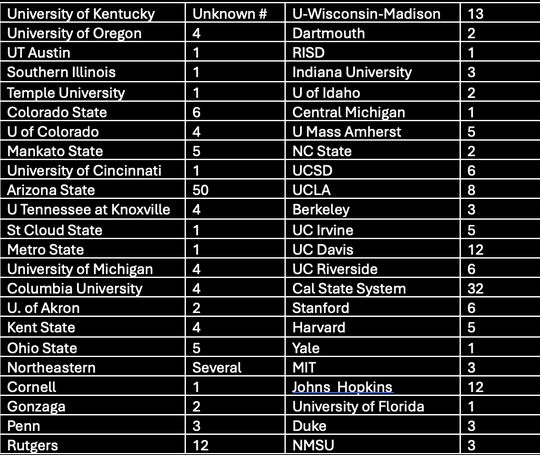
According to WeAreHigherEd.org, there are now 46 schools where student visas have been revoked. Arizona State tops the list at 50, followed by the University of Wisconsin-Madision (13), UC Davis (12), Rutgers (12), and Johns Hopkins (12) . The website includes profiles of a number of those students who have been detained. If you know of someone who has been abducted, you can report it here.
“The Russian invasion of Ukraine has put an end to the globalization we have experienced over the last three decades,” according to Larry Fink, the boss of BlackRock, the world’s largest asset manager.
If Fink means an end to the cross-border movement of goods, services, money and data, he is almost surely wrong. Economies are too intertwined to make economic self-sufficiency an option; the advances in computing that underpin global manufacturing, logistics and markets cannot be “uninvented.”
But if he means the war could turn out to be the high-water mark for globalization, Fink is on firmer ground.
The shockwaves Moscow’s war has touched off are likely to prompt firms to re-examine their supply chains and bring more business closer to home, even if that means lower profits.
The trend towards greater economic self-reliance will have far-reaching consequences. Shifting production away from emerging economies will be costly, boosting inflation.
But it will also create well-paid manufacturing jobs, reducing income inequality. Overall growth will suffer as efficiency is sacrificed for economic security, but neglected post-industrial regions could get a new lease on life.
Russia’s invasion of Ukraine will accelerate trends.
Signs that globalization is past its peak were mounting before the West curtailed economic links with Russia.
Notably, COVID-19 highlighted the drawbacks of outsourcing manufacturing to the other side of the world; the West relied heavily during the pandemic on China for medical kit and basic personal protective equipment such as face masks.
Likewise, as economies have bounced back from the pandemic, factories in Asia have struggled to meet red-hot demand, clogging up global supply chains for everything from building materials to bicycle parts.
Policymakers have been especially shocked to learn just how badly the West depends on Asia, principally Taiwan, for computer chips.
The upshot is a push by governments to encourage companies to build factories at home (“reshoring”), in neighbouring countries (“nearshoring”) or in countries that are political allies (“friendshoring,” US Treasury Secretary Janet Yellen’s neologism.)
Thus, Intel is investing $36 billion to boost chip-making in Europe, including a pair of factories in Germany, and another $20 billion on two new plants in Ohio, while Apple has started manufacturing iPhones in India, reducing its dependence on China.
The invasion of Ukraine can only magnify these trends.
Sanctions on Russia form part of a trend.
Europe, in particular, has been made painfully aware that it counts on Russia for about a quarter of its oil imports and 40% of its natural gas imports.
Similarly, countries in North Africa, the Middle East and South Asia are perilously dependent on grain supplies from Russia (and Ukraine). Governments are scrambling to diversify supplies and find ways to hold down fast-rising prices.
Sanctions on Russia speak for themselves, given Moscow’s naked aggression. But they form part of a pattern.
Western governments have been increasingly willing to use trade and investment policies to try to get recalcitrant countries to change their ways. China has been the main target, and globalization has been the casualty.
Exhibit A is the tariffs imposed on imports from China by former U.S. President Donald Trump and maintained by his successor, Joe Biden, aimed at persuading Beijing to end subsidies and intellectual property abuses that, in Washington’s eyes, give Chinese companies an unfair advantage.
But Washington wants a lot more than a level playing field for trade.
It regards China as a growing threat to America’s military, economic and geopolitical dominance and wants to slow its rise. Hence a slew of restrictions on technology exports to companies deemed to have links to the Chinese military, as well as steps to deter Americans from investing in China and vice versa. European policy is moving in the same direction.
At the same time, Chinese leader Xi Jinping has proclaimed a policy of “dual circulation” that boils down to China relying more on its domestic market for growth and less on export demand. Foreign companies in China report a distinctly chillier business environment.
No wonder, then, that some are scaling back in China, especially as labour costs are rising.
The heyday of globalization may be over.
Moving production to countries like Vietnam can be seen as an extension of globalization, not the end of it.
But China remains the key link in global supply chains thanks to its unrivalled manufacturing scale. So any weakening of this link supports the case that the heyday of globalization — if defined as the quest for maximum production efficiency — is over.
Many analysts go further and conclude that the U.S. and Chinese economies are decoupling and could end up forming, and dominating, their own economic blocs with separate trade alliances and digital standards.
If China’s tacit support for Russia’s invasion of Ukraine leads to closer trade, energy and political ties between Beijing and Moscow, the splintering of the global economy will only get worse. Other countries could be forced to take sides.
“Much like the pandemic, the invasion of Ukraine will deepen the global rift between U.S.-led rules-based economies and their authoritarian adversaries,” according to Diana Choyleva, chief economist at Enodo Economics in London.
A tell-tale sign that decoupling is for real will be if China makes progress in its long-standing aim to reduce its dependence on the U.S. dollar and persuades global investors and central banks to make more use of its own currency, the renminbi, in trade, investment and financial markets.
For now, the dollar shows no sign of losing its lustre. But until recently few were predicting the retreat of globalization. Russian President Vladimir Putin has piloted the world economy and political order into uncharted waters.
Three questions to consider:
1. Has globalization been good for the man in the street in rich countries and in developing economies? 2. Why doesn’t Apple make iPhones in the United States or in Europe? 3. Are Western consumers willing to take the economic pain that a ban on importing Russian oil and gas would involve?
The Education Reporting Collaborative, a coalition of eight newsrooms, is investigating the unintended consequences of AI-powered surveillance at schools. Members of the Collaborative are AL.com, The Associated Press, The Christian Science Monitor, The Dallas Morning News, The Hechinger Report, Idaho Education News, The Post and Courier in South Carolina, and The Seattle Times.
RIGBY, Idaho — Four years ago, a sixth grader in Rigby, Idaho, shot and injured two peers and a custodian at a middle school. The tragedy prompted school officials to reimagine what threat prevention looks like in the approximately 6,500-student district.
Now, student-run Hope Squads in Rigby schools uplift peers with homemade cards and assemblies. Volunteer fathers patrol hallways as part of Dads on Duty. A team of district staff, counselors, social workers and probation officers gathers to discuss and support struggling students. Thanks to a new cellphone ban, students are off screens and talking to each other. The positive results of these combined efforts have been measurable.
“We’ve helped change … lives,”said Brianna Vasquez, a senior at Rigby Highand member of her school’s Hope Squad. “I’ve had friends who have been pulled out of the hole of depression and suicidal thoughts because of [the Hope Squad].”
School shootings like Rigby’s have driven America’s educatorstotry to prevent similar harm. Many districts in the U.S. have turned to technology — especially digital surveillance — as the antidote. Not everyone is sold on that approach, as there can be issues, including with privacy and security.Without broad agreement on which strategies do work best, some districts are trying a braided approach — using a combination of technology, on-the-ground threat assessment teams, and other mental health supports.
“If you’re sitting in the shoes of a district leader, taking a multi-pronged approach is probably very sensible,” said Jennifer DePaoli, a senior researcher at the Learning Policy Institute, who has studied school safety.
In Rigby, educators lean toward human interaction. Artificial intelligence and digital surveillance systems are perhapsless likely to identify who is eating alone at lunch or withdrawing from friends.
“It’s all about culture,” said Chad Martin, the superintendent of Jefferson County School District in Rigby. “It starts with that — just having a friend, having a group of friends, having a connection somewhere.”
Rigby school leaders use technology to detect threats, including an app, STOPit, which allows students to anonymously report safety concerns, and surveillance software that monitors students’ keystrokes and looks out for troubling terms. Martin said those are helpful, but must be used in concert with human-led initiatives.
The district’s version of a threat assessment team, which meets monthly, has been one of the most useful tools, Martin said. In those group conversations, school staff may realize that a student who’s been missing class has a parent who was recently arrested, for example.
“Everybody has a little piece of information,” Martin said. “So the goal is to put those people in the same room and be able to paint a picture that can help us support kids.”
Chad Martin, superintendent of Jefferson County School District, said student relationships remain the most powerful tool in keeping school safe. Credit: John Roark
A leading model,used by thousands of school districts, is the Comprehensive School Threat Assessment Guidelines (CSTAG). These were developed by forensic clinical psychologist Dewey Cornell after he spent years studying homicides committed by children or teens, including school shootings. He said digital surveillance technology can offer school districts “an illusion of safety and security.”
With CSTAG, school-based teams use a five-step process when threats emerge. The team includes a school administrator, a counselor or psychologist, a social worker, a staff member focused on special education, and a school resource officer. In serious situations, the group might suspend or move a student elsewhere while conducting mental health screenings,a law enforcement investigation, and development of a safety plan. Ultimately, that plan would be put into effect.
If implemented correctly, Cornell says, this type of approach is less punitive and more rooted in intervention. Instead of relying only on technology, Cornell and his threat assessment guidelines recommend adding humans who can make decisions with schools as situations emerge. He points to a recent study in Florida, one of the states where threat assessment teams are mandatory. Threats investigated by those teams “resulted in low rates of school removal and very low rates of law enforcement actions,” according to the report authored by Cornell and fellow University of Virginia researchers.
“If you’re a school counselor and you can work with a troubled kid and help get them on the right track, you’re not just preventing a school shooting, but you’re more likely to be preventing a shooting that would occur somewhere else and maybe years in the future,” he said.
Threat assessment teams — whether using the CSTAG model or another form — haven’t been immune from scrutiny. Complaints have emerged about them operating without student or parent knowledge, or without staff members to represent children with special needs. Criticism has also included concern about discrimination against Black and Hispanic students.
DePaoli, from the Learning Policy Institute, says more research is needed to determine whether they successfully identify threats and provide students with appropriate support. She suspects it boils down to implementation.
“If you are being required to do these, you need to be doing them with so much training and so much support,” she said.
The Jordan School District in Utah uses the CSTAG model. Travis Hamblin, director of student services, credits the “human connection” with strengthening the district’s approach to handling threats and, as a result, boosting student safety and well-being.
Earlier this school year, the district received an alert through Bark, a digital monitoring tool that scans students’ school-issued Google suite accounts. It flagged a middle schooler’s account, which contained a hand drawn picture of a gun that had been uploaded.
The notification mobilized the school’s threat assessment team. By using the CSTAG decision-making process, the team determined the student did not intend any harm, Hamblin says.
Rigby High’s Hope Squad — and those like it nationwide — aim to foster connection and reduce the risk of suicide. Credit: John Roark
The school leaders didn’t unnecessarily escalate the situation, he says. After their assessment, they chalked it up to middle school immaturity and asked the student to avoid such drawings in the future.
“When you say, ‘Why did you do that?’ And they say, ‘I don’t know.’ That’s the truth, right? That’s the gospel truth,” Hamblin said.
He shares this example to illustrate how the district marries technology-related monitoring with human-led threat assessment. The district employs someone — a former school administrator and counselor — to field the Bark alerts and communicate with school staff. And administrators from every school in the district have undergone threat assessment training, along with select members of their staff.
“A digital tool for us is a tool. It’s not the solution,” Hamblin said. “We believe that people are the solution.”
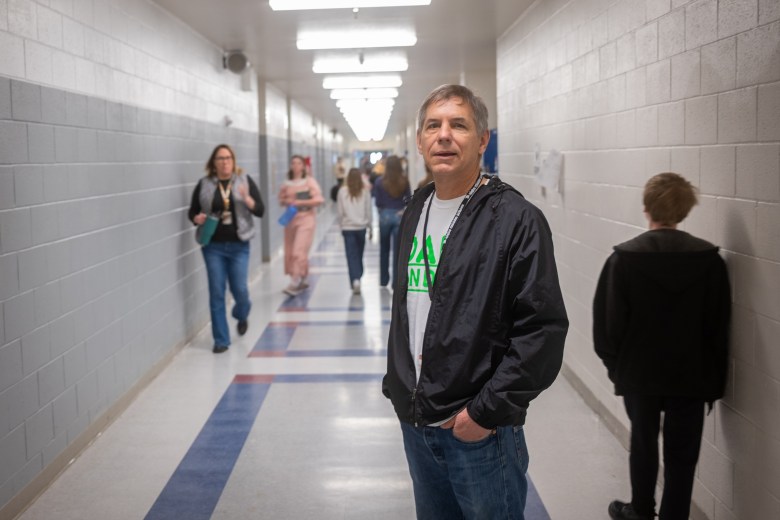
In Rigby, one of those solution people is Ernie Chavez, whose height makes him stick out in a hallway streaming with middle schoolers. He’s part of Dads on Duty, a program that brings in parents to help monitor and interact with students during passing periods and lunch.
Throughout the school, students reach out to Chavez for high-fives. On one February afternoon, he was greeted with applause and cheers. “I don’t know what that was about,” he said with a smile.
Similarly, the district’s Hope Squads, in place since 2021, have become an active presence inside the school.
The student-led coalitions aim to foster connection and reduce the risk of suicide. Thousands of schools across the United States and in Canada have implemented Hope Squads, but in Rigby, the mission of violence prevention has become personal.
Ernie Chavez monitors the hallways at Rigby Middle School on Feb. 5 for the Dads on Duty program. Credit: John Roark
“We refer … students every year to counselors, and those students go from some of the worst moments in their life (to getting help),” Vasquez said. “We build the connection between adults and faculty to the student.”
Members of the Hope Squad notice peers who seem down or isolated and reach out with a greeting, or sometimes a handmade card.
“We just reach out and let them know that people in the community are there for them, just to show them that we care and they’re not alone,” said Dallas Waldron, a Rigby High senior and Hope Squad member.
The groups also plan assemblies and special events, including, for example, a week of activities themed around mental health awareness.
Emilie Raymond, a sophomore at Rigby High, said the shooting made it clear “that people need to feel included and they need to find that hope.”
Another change at Rigby schools is a cell phone ban that was put in place this school year.
Before the ban,students were “sitting in the corners, isolated, staring at a screen,” said Ryan Erikson, Principal at Rigby Middle School. Now, “they’re playing games, they’re goofing off … they’re actually conversing.”
While Jefferson County School District’s approach to stemming violence is robust, “it’s not perfect,” Martin, the superintendent, said. “It’s still life. That’s just the reality of it, we’re still going to have things come up that we haven’t prepared for or weren’t on our radar. But we address them and just try to do whatever we can to support kids.”
Carly Flandro is a reporter with Idaho Education News. Jackie Valley is a reporter with The Christian Science Monitor.
Contact Hechinger managing editor Caroline Preston at 212-870-8965, on Signal at CarolineP.83 or via email at [email protected].
This story about school threat assessments was produced by the Education Reporting Collaborative, a coalition of eight newsrooms that includes AL.com, The Associated Press, The Christian Science Monitor, The Dallas Morning News, The Hechinger Report, Idaho Education News, The Post and Courier in South Carolina, and The Seattle Times.
The Hechinger Report provides in-depth, fact-based, unbiased reporting on education that is free to all readers. But that doesn’t mean it’s free to produce. Our work keeps educators and the public informed about pressing issues at schools and on campuses throughout the country. We tell the whole story, even when the details are inconvenient. Help us keep doing that.