Author: admin

  • Mid-Semester Course Corrections: Using the MSF Model to Engage Students and Improve Courses – Faculty Focus

    Mid-Semester Course Corrections: Using the MSF Model to Engage Students and Improve Courses – Faculty Focus

    Source link

  • Mid-Semester Course Corrections: Using the MSF Model to Engage Students and Improve Courses – Faculty Focus

    Mid-Semester Course Corrections: Using the MSF Model to Engage Students and Improve Courses – Faculty Focus

    Source link

  • Is our North Star already outdated? – Campus Review

    Is our North Star already outdated? – Campus Review

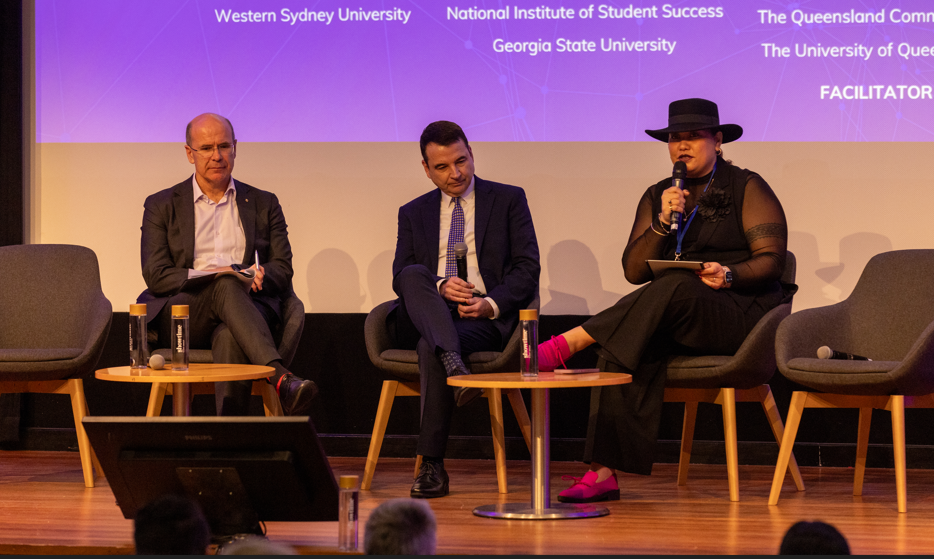
    Two prominent student-success-driven university leaders have urged immediate action to improve student success, warning against waiting for government green-lights like the Australian Universities Accord.

    Please login below to view content or subscribe now.

    Membership Login

    Source link

  • Coalition announces harsher international student caps – Campus Review

    Coalition announces harsher international student caps – Campus Review

    The Coalition has said it would cap international students at 240,000 and triple the visa application fee to $5,000 for those applying to Group of Eight universities to free up room in the rental market.

    Please login below to view content or subscribe now.

    Membership Login

    Source link

  • Concern Dutton will push American-style crackdown on “woke” universities – Campus Review

    Concern Dutton will push American-style crackdown on “woke” universities – Campus Review

    The Coalition has warned it would use university regulator levers to review university degree course content to check for “woke” teaching if elected, leading Labor to draw parallels between Peter Dutton and Donald Trump.

    Please login below to view content or subscribe now.

    Membership Login

    Source link

  • An end to sticking plaster politics? Why the government needs to use its upcoming white paper to take a different approach to immigration

    An end to sticking plaster politics? Why the government needs to use its upcoming white paper to take a different approach to immigration

    The Labour Party was elected to government last year on a promise to reduce net migration. Their victory in the 2024 General Election followed a period in which net migration to the UK peaked at 906,000 and public concerns over migration began to rise again for the first time since the Brexit referendum.

    Unsurprisingly, Number 10 views progress on this issue as central to their re-election prospects. Precisely how the government will look to do this is still unclear, yet recent weeks have seen growing speculation over an immigration white paper which is expected to land pretty soon.

    White paper

    A new approach to immigration is needed. Too often, immigration policy has been dictated by the release of the latest migration figures and so the development of a white paper on immigration in and of itself is no bad thing. Moreover, it provides the government with an opportunity to take a more strategic approach to migration policy.

    Prior to the election, the Labour Party committed to a different style of governing which would end ‘sticking plaster’ politics. But how to apply this longer-term view to immigration policy? To be judged as successful, any new approach to immigration would need to see net migration reduced given their manifesto commitment. As such, tough choices need to be made about where further reforms could be made to reduce the overall number of people coming to the UK.

    This creates some obvious risks for UK universities given the importance of international students to the financial sustainability of our sector. Universities UK (UUK) has been clear that, over the long-term, international recruitment should not be the answer to the financial sustainability of higher education institutions. Instead, we need to work with government on a long-term plan, secure increased investment, and explore new approaches to efficiency and transformation in the sector.

    In the absence of a long-term plan to address the underfunding of the higher education sector, any new approach to immigration would, at the very least, need to enable universities to continue to attract international students to study in the UK to prevent current financial challenges from deteriorating further.

    Three tests

    This is no easy task, but it is possible. So, what could a different course of action on migration policy actually look like? I think there are three clear things we need:

    1. A joined up, coordinated approach.

    2. Look forward not back, (as the Labour Party once encouraged us to do).

    3. Draw a line between temporary and permanent migration.


    The left-hand ought to know what the right-hand is doing

    The starting point of any new immigration policy ought to be based on having a joined-up and co-ordinated approach. This may seem obvious but would be a welcome change.

    The key opportunity for the new government is to use their immigration white paper to finally align migration policy with wider government objectives. Based on what the Home Secretary has outlined, at least part of this would be to create much greater join-up between the UK’s visas and skills systems so that immigration is not used as an alternative to training or tackling workforce problems, thereby reducing overall net migration. This is a good start, but the white paper offers an opportunity to go further.

    Under previous administrations, there was a distinct lack of coordination and coherence in policy and strategy. This can be seen most clearly in the development of an International Education Strategy – which set an explicit aim of government policy to grow the number of international students coming to the UK, but which then came up against a Home Office who had been instructed to curb the growth in international students.

    Don’t use the rear-view mirror

    With a clear joined-up strategy, the government should then look to shift the focus of immigration policy away from retrospective net migration trends, towards focussing on future forecasts, thereby creating a more realistic timeframe to achieve their strategy.

    It is quite clear that reducing net migration is going to continue to be the focus of government policy. Yet as we have seen, annual net migration focuses too much on short-term migration trends – be it the increase of people coming from Ukraine, or Hong Kong – and doesn’t focus enough on the anticipated impact of recent policy – such as changes to dependant’s which has led a dramatic reduction in the UK’s attractiveness as a study destination in certain countries.

    By shifting towards long-term projections (measured over a rolling 5-year average), the government could then create the political space to actually achieve their wider objectives. For example, providing a longer-term timeframe to work with employers to implement skills and training initiatives to support those roles where recruitment is primarily met through immigration.

    Any future forecast would, inevitably, be subject to changes and revisions but it would represent a far better metric than basing government policy on retrospective and highly volatile net migration trends from the previous year.

    Separate the temporary from the permanent

    A final welcome change would be for the government to distinguish more between ‘temporary’ and ‘permanent’ migration. After all, while many migrants do settle in the UK, many others do not and have little intention of doing so.

    This applies to many international students. They may stay for a few years after their studies, but very few end up remaining in the UK for the long-term and get settlement. Rather than taking students out of net migration – which would only serve to highlight the contribution which international students do make to net migration while ignoring the impact which students do have on housing and local services – the government should look to place greater focus on different types of visas being granted to those coming to the UK.

    There are lots of ways this could be done, but focussing more on those visa routes which lead to settlement (or ‘indefinite leave to remain’) would help improve public understanding of migration and better reflect the fact that many migrants included in the net migration stats do not contribute significantly to the long-term population of the UK.

    Concerns about immigration are unlikely to go away anytime soon, but the opportunity for a better approach is there for the taking.

    Many parts of the world – particularly across the Anglosphere – are currently seeing higher levels of net migration, and how countries respond is an issue facing many governments.

    With aging societies, slowing rates of economic growth, not to mention an increasing number of people displaced due to climate change, conflict, and natural disasters, immigration will continue to be high on the political agenda.

    Through their immigration white paper, the new UK government has a clear opportunity to address this challenge head on and take a different approach to previous administrations and, in doing so, demonstrate that well-managed immigration can be – and indeed is – a force for good.

    In developing a more joined-up approach, while focussing on future projections – rather than retrospective trends – and which makes a clearer distinction between temporary and permanent migration, the UK government could go a long way to developing a more sensible approach to immigration policy.

    The opportunity is there, the question is whether the government will take it.

    Source link

  • R&D spending brings the era of strategic ambiguity to an end

    R&D spending brings the era of strategic ambiguity to an end

    I was working with a university on how they communicate their research work.

    An academic remarked to me that they simply couldn’t understand why the university didn’t talk more about the leading work they were doing in defence research.

    At the time, I thought talking about research into the things that kill people would be an obvious and enormous error. I now think I may be wrong.

    Missiles have a PR problem. They are not the soft embrace of a civic university which wraps its arms around their places. They are not the technician helping to solve the pandemics and global disasters of our time. And they are not the lofty ideals of pushing forward the shared understanding of the human experience.

    Conducting research into defence is to acknowledge that universities are part of the unsavoury end of geo-politics too.

    Universities have generally followed the lead of the government on the international research front. This is to say universities work with people, even where they may disagree with them, if it furthers a common cause of research. In an era of sharpening geo-political divides, increased defence spending, and pressure on the moral mission of universities highlighted by what they choose or choose not to cut, this feels untenable.

    Strategic ambiguity is possible where the strategy is clear and the policy is not. The government has now made its spending policy for defence clear.

    Defence and its detractors

    There are plenty who have made the moral case against UK universities being involved in research into lethal weapons. Open Democracy carried out work in 2023 where they drew the line between weapons manufacturers, university research, and global conflicts, to make the case that

    “Responding to Freedom of Information requests, 44 universities told openDemocracy they had taken a combined total of at least £100m in funding and donations from eight of the biggest UK and US defence firms: RTX, Lockheed Martin, Boeing, Northrop Grumman, General Dynamics, BAE Systems and Rolls-Royce.

    All are listed in the top 100 arms and military services in the world, according to the Stockholm International Peace Research Institute.”

    And there are a constellation of left-wing blogs that have sought to make the same arguments. Novara Media, for example, have sought to bring to attention the links between university weapons research and the ongoing conflict in the Middle East. It is not that universities are undertaking research directly for difficult and despotic regimes and demagogues directly. It is that they are undertaking research with companies where their technologies may either be used directly, or through their dual applications, in the defence of nations and by extension the killing of people all over the world.

    This attention is likely only to grow as the government increases investment into defence technologies. The 2020 Spending Review committed to an extra £6bn of defence R&D over four years. In 2024, then Prime Minister Rishi Sunak promised a further uplift in defence spending with a significant proportion dedicated to R&D. Keir Starmer has now promised that defence spending will reach 2.5 per cent of GDP, with an ambition to reach 3 per cent, and further increases to R&D in defence.

    This includes a further £2.9bn of spending in the coming financial year compared to 2024–25. This is a big increase but in context BAE systems alone spent £1.45bn on R&D in 2022 as a combination of their own and government money.

    This presents a challenge for universities. The flows of R&D spending are increasingly toward defence but they have, collectively, not found the language which sets out the moral case for doing the work.

    Re-arm for Britain

    Today’s piece from Jess Lister makes it clear that a plurality of citizens in the UK are in favour of increased defence spending. A majority of the public also agree it would be better to invest in R&D in new defensive technologies. Of course, this presumes there is always a clear and practical difference between the use of weaponry for defensive and offensive purposes, and the reasons for research are as important as the actual mechanism through which research is deployed.

    There are the universities that undertake research which makes the country safer but isn’t directly involved in the business of lethality. The examples of universities building partnerships, engagements, projecting the UK across the world, making the UK a better place to live, are numerous. In an era of constrained funding and increasing concerns about defence spending, the ability for universities to talk about national safety, the tolerability of living in the UK, and national security, the freedom to live free from the threat of harm or death from a foreign power, may end up moving closer together. The decision to cut Oversees Development Assistance, funding used to promote social, economic, and welfare capacity, to fund defence spending is in this regard an absurd political decision in making the UK less safe on the one hand while making it, potentially, more secure on the other.

    And there is the business of the production of the UK’s defensive capabilities. There are a range of regulations which cover this work. In particular, the rules on dual use technologies which place extra restrictions on the exports of research that could have both civilian and military applications. There are specific cases which have come under scrutiny particularly under the use of technologies which could be used for drones. As a minimum, if universities are going to increasingly grow their R&D and defence budget they will need the internal capacity to navigate what has been a difficult and changing world.

    Narrative interventions

    Aside from the regulation there is a real narrative problem on defence research. There are generally three explanations used when a university is asked about defence research. The first is that we follow all of the rules. The second is that we work directly with companies and what companies choose to do beyond our due diligence isn’t within our control. And the third is that even where projects are within the rules we continually monitor them. The problem with all of these responses is that they are the minimum of procedural compliance not explanation of work.

    In his acceptance speech newly appointed Chancellor of the University of Oxford and once foreign secretary William Hague stated that

    We do not need to agree on everything, indeed we should not. I am pleased to say we do not need a foreign policy: we are not a country. Nor do we need a view on every daily occurrence: we are not a newspaper. The concern of a university is that opinions are reached on the basis of truth, reason and knowledge, which in turn requires thinking and speaking with freedom.

    This is the same William Hague who suggested in 2015 that

    In the 21st Century, foreign policy is no longer the preserve of governments speaking behind closed doors. It’s also about that web of connections between individuals, groups, companies and all kinds of organisations, on social media and international travel.

    The William Hague of 2015 is correct and the William Hague of 2024 is mostly wrong. The frustration with university work into defence isn’t because the public believe what they are doing is illegal – in fact the public support what they are doing. It is that universities are trying to pursue an amoral approach to defence (as in, without a moral position, as opposed to immoral or evil), which leaves them open to charges of hypocrisy.

    The reason for this is a refusal to commit to bright red lines. It would be totally legitimate for universities to state there are certain partners, certain countries, and certain contexts in which they will not work. It also would be totally legitimate for universities to say they work with anyone regardless of their politics, but universities have done neither.

    The one unilateral intervention in refusing to work with Russia was the morally correct step, and has of course opened up the charge of hypocrisy. The line seems to be that universities will work with foreign partners irrespective of what they do unless they are legally barred from doing so and/or said foreign partners undertake a full scale invasion of a neighbour.

    The age of strategic ambiguity is over because ambiguity cannot be funded, supported, or made consistent to a public who don’t always appreciate the value of universities. Universities are not a country but they are a global network that allows for the movement of people, ideas, and technologies. The basis on which these things are allowed to move is the moral mission of our era for universities.

    Source link

  • Supreme Court maintains freeze on teacher training grants

    Supreme Court maintains freeze on teacher training grants

    In a 5-4 split, the U.S. Supreme Court on Friday granted the Trump administration’s emergency request to maintain a freeze on millions of dollars in federal teacher training grants.

    The administration’s emergency application, filed on March 26, asked the justices to vacate a district court judge’s order requiring the U.S. Department of Education to reinstate some of Trump’s $600 million in slashed funding. The justices granted Acting Solicitor General Sarah Harris’ call for an immediate administrative stay, which pauses the March 10 order by Judge Myong Joun of the U.S. District Court for the District of Massachusetts while the case continues.

    In an unsigned opinion, the Supreme Court majority wrote that the recipient programs wouldn’t suffer permanent damages if the funds were withheld while the case moves through the lower courts. The “respondents have not refuted the Government’s representation that it is unlikely to recover the grant funds once they are disbursed,” the opinion said.

    The opinion also suggested the lower court may not have had the authority to issue its order. 

    In a dissenting opinion, Justice Ketanji Brown Jackson, joined by Justice Sonia Sotomayor, wrote that the notion that some grant recipients may seek to draw down funds that the Trump administration seeks to terminate was the “only hint of urgency that the Government offers to justify its unusual request for our intervention.”

    “If true, that would be unfortunate, but worse things have happened,” Jackson wrote.

    In a separate dissent, Justice Elena Kagan characterized the majority’s decision as a “mistake” that followed a “barebones briefing,” no argument and little time for reflection. Chief Justice John Roberts did not join either dissent but disagreed with the majority.

    The move is the first time the Supreme Court has considered any challenges to President Donald Trump’s efforts to significantly scale back federal education programs — and ultimately dismantle the Education Department

    In the administration’s March 26 emergency request, Harris said the case is an example of a broader question the Supreme Court needs to answer: “‘Does a single district-court judge who likely lacks jurisdiction have the unchecked power to compel the Government of the United States to pay out (and probably lose forever)’ millions in taxpayer dollars?”

    “Unless and until this Court addresses that question, federal district courts will continue exceeding their jurisdiction by ordering the Executive Branch to restore lawfully terminated grants across the government, keep paying for programs that the Executive Branch views as inconsistent with the interests of the United States, and send out the door taxpayer money that may never be clawed back,” Harris wrote. 

    The case in question concerns the Education Department’s February cancellation of over $600 million in what it called “divisive” federal teacher training grants funds. The canceled grants had been made under the Teacher Quality Partnership Program and the Supporting Effective Educator Development program. 

    In March, eight Democratic attorneys general sued the Trump administration to restore the awarded funds. In response, Joun granted a temporary restraining order for the department to reinstate those funds to the eight plaintiff states: California, Colorado, Illinois, Maryland, Massachusetts, New Jersey, New York and Wisconsin.

    If the Supreme Court were to order the Trump administration to reinstate the grants to those eight states, the acting solicitor general said, the department would have to disburse up to $65 million in remaining funds.

    On March 28, the eight states urged in a 44-page filing that the Supreme Court leave Joun’s order in place. The states said the Trump administration’s “real concern” appears to involve other cases “where courts are grappling with a raft of legal disputes arising out of recent actions by the Executive Branch.”

    Source link

  • Supreme Court maintains freeze on teacher training grants

    Supreme Court maintains freeze on teacher training grants

    This audio is auto-generated. Please let us know if you have feedback.

    In a 5-4 split, the U.S. Supreme Court on Friday granted the Trump administration’s emergency request to maintain a freeze on millions of dollars in federal teacher training grants.

    The administration’s emergency application, filed on March 26, asked the justices to vacate a district court judge’s order requiring the U.S. Department of Education to reinstate some of Trump’s $600 million in slashed funding. The justices granted Acting Solicitor General Sarah Harris’ call for an immediate administrative stay, which pauses the March 10 order by Judge Myong Joun of the U.S. District Court for the District of Massachusetts while the case continues.

    In an unsigned opinion, the Supreme Court majority wrote that the recipient programs wouldn’t suffer permanent damages if the funds were withheld while the case moves through the lower courts. The “respondents have not refuted the Government’s representation that it is unlikely to recover the grant funds once they are disbursed,” the opinion said.

    The opinion also suggested the lower court may not have had the authority to issue its order. 

    In a dissenting opinion, Justice Ketanji Brown Jackson, joined by Justice Sonia Sotomayor, wrote that the notion that some grant recipients may seek to draw down funds that the Trump administration seeks to terminate was the “only hint of urgency that the Government offers to justify its unusual request for our intervention.”

    “If true, that would be unfortunate, but worse things have happened,” Jackson wrote.

    In a separate dissent, Justice Elena Kagan characterized the majority’s decision as a “mistake” that followed a “barebones briefing,” no argument and little time for reflection. Chief Justice John Roberts did not join either dissent but disagreed with the majority.

    The move is the first time the Supreme Court has considered any challenges to President Donald Trump’s efforts to significantly scale back federal education programs — and ultimately dismantle the Education Department

    In the administration’s March 26 emergency request, Harris said the case is an example of a broader question the Supreme Court needs to answer: “‘Does a single district-court judge who likely lacks jurisdiction have the unchecked power to compel the Government of the United States to pay out (and probably lose forever)’ millions in taxpayer dollars?”

    “Unless and until this Court addresses that question, federal district courts will continue exceeding their jurisdiction by ordering the Executive Branch to restore lawfully terminated grants across the government, keep paying for programs that the Executive Branch views as inconsistent with the interests of the United States, and send out the door taxpayer money that may never be clawed back,” Harris wrote. 

    The case in question concerns the Education Department’s February cancellation of over $600 million in what it called “divisive” federal teacher training grants funds. The canceled grants had been made under the Teacher Quality Partnership Program and the Supporting Effective Educator Development program. 

    In March, eight Democratic attorneys general sued the Trump administration to restore the awarded funds. In response, Joun granted a temporary restraining order for the department to reinstate those funds to the eight plaintiff states: California, Colorado, Illinois, Maryland, Massachusetts, New Jersey, New York and Wisconsin.

    If the Supreme Court were to order the Trump administration to reinstate the grants to those eight states, the acting solicitor general said, the department would have to disburse up to $65 million in remaining funds.

    On March 28, the eight states urged in a 44-page filing that the Supreme Court leave Joun’s order in place. The states said the Trump administration’s “real concern” appears to involve other cases “where courts are grappling with a raft of legal disputes arising out of recent actions by the Executive Branch.”

    Source link

  • Young people from deprived areas can’t afford to consider university

    Young people from deprived areas can’t afford to consider university

    Should the economic fortunes area you grew up in have an impact on your chances of attending university?

    There has always been a stubborn connection between 18 year old participation rates and your (UK) region of residence.

    Currently UCAS data tells us that 18 year olds living in London are more likely than not to go on to attend university, whereas in the North East just 29.9 per cent will get there.

    Can’t get there from here

    And in many parts of the UK the proportion of 18 year olds getting to university has stagnated (or even dropped over recent years), as the population of 18 year olds has expanded.

    [Full screen]

    If you are concerned about left-behind parts of the UK, this is something that should concern you. It’s widely acknowledged that graduates are key to levelling up a region, and a surprisingly large number of graduates return to their home area (at least in the short term) after graduation.

    Costs not culture?

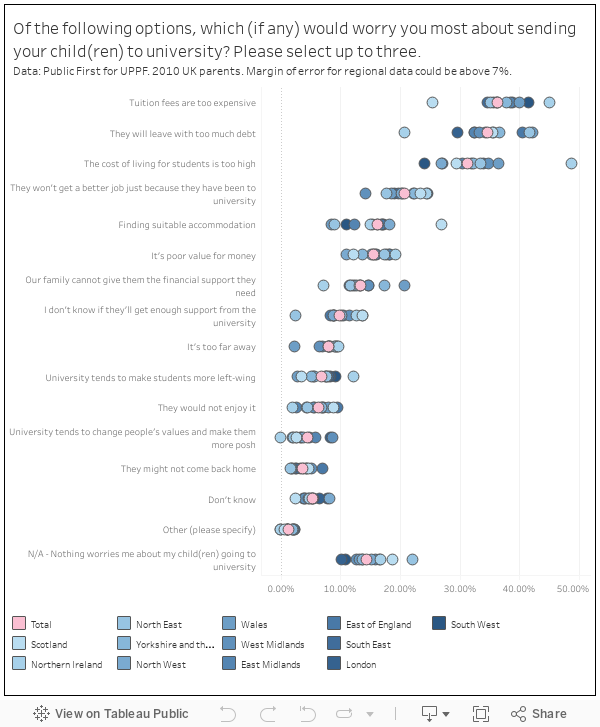
    The counter argument to that is very often cultural – the idea that going to university changes a person, and dilutes the essence of what makes (frankly) a deprived area a deprived area. Polling from Public First for the UPP Foundation (which is kicking off an inquiry into the state of widening participation in higher education) happily suggests that this is not an attitude prevalent among UK parents.

    [Full screen]

    What does worry parents is the sheer cost of study – both in terms of tuition fees (36 per cent cite this as a top three reason to be concerned about their children attending university) and living costs (31 per cent). The overall level of debt on graduation is the other big one (35 per cent).

    But that’s not to say that there are not other reasons – number four in the list is the idea that “they won’t get a better job just because they have been to university” (particularly prevalent in London), number six is “poor value for money” (an East Midlands, North East, and Northern Ireland prevalence). The size of the sample makes the regional splits difficult to draw accurate conclusions from, but the trends are interesting.

    What teachers said

    Teachers are a primary source of information about higher education – happily UPPF also commissioned Public First to look at what teachers felt were the barriers to participation, and there are (some) regional splits.

    [Full screen]

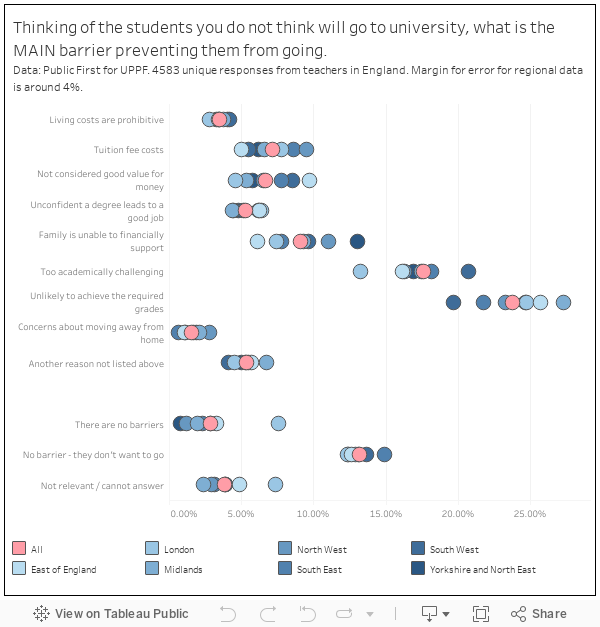
    The question here focuses on why teachers don’t expect some pupils to go to university – we are looking across all types of schools at the top of secondary education. Here we see that the big barriers are academic – teachers tend to feel that students are unlikely to get the required grades (24 per cent) or to rise to the academic challenge (18 per cent). And this is true across all English regions.

    Notably prevalent in the North East and Yorkshire (combining two standard, ILTS1, regions) is the idea that the family will be unable to support a student. In that region this was cited by 13 per cent of teachers – enough to feel concerning, but similar to the proportion that simply don’t want to go to university (again note that the margin of error will be high with small subsamples).

    Your chances are variable

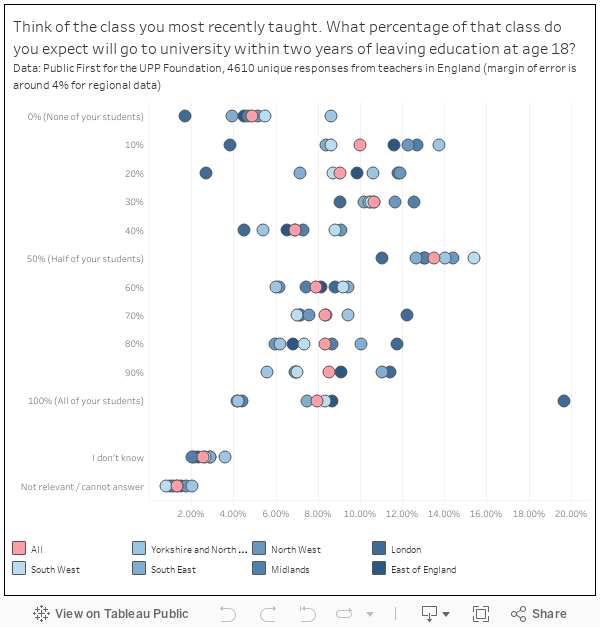
    Twenty per cent of teachers in London feel like all of the last class they taught will go on to university – just four per cent of teachers in the North West, North East, and Yorkshire had similar confidence. Indeed 14 per cent of teachers in the North East and Yorkshire felt that only 10 per cent of their class would go on to university. As you might expect, the modal answer for most regions was “about half” of pupils – the North East and Yorkshire is the only exception.

    [Full screen]

    This, then, is what access and participation in the north is up against. Attainment and capacity is an issue everywhere, and one that the access and participation regime in England attempts to address via collaboration between universities and schools – something that also contributes to aspiration.

    But aspiration and attainment count for little when parents and teachers are agreeing that for many in the UK’s most deprived areas university study simply is not affordable. And though participation among disadvantaged groups is improving – disadvantaged areas continue to struggle.

    Source link