Author: admin

  • Adapting TNE to student needs key, say stakeholders

    Adapting TNE to student needs key, say stakeholders

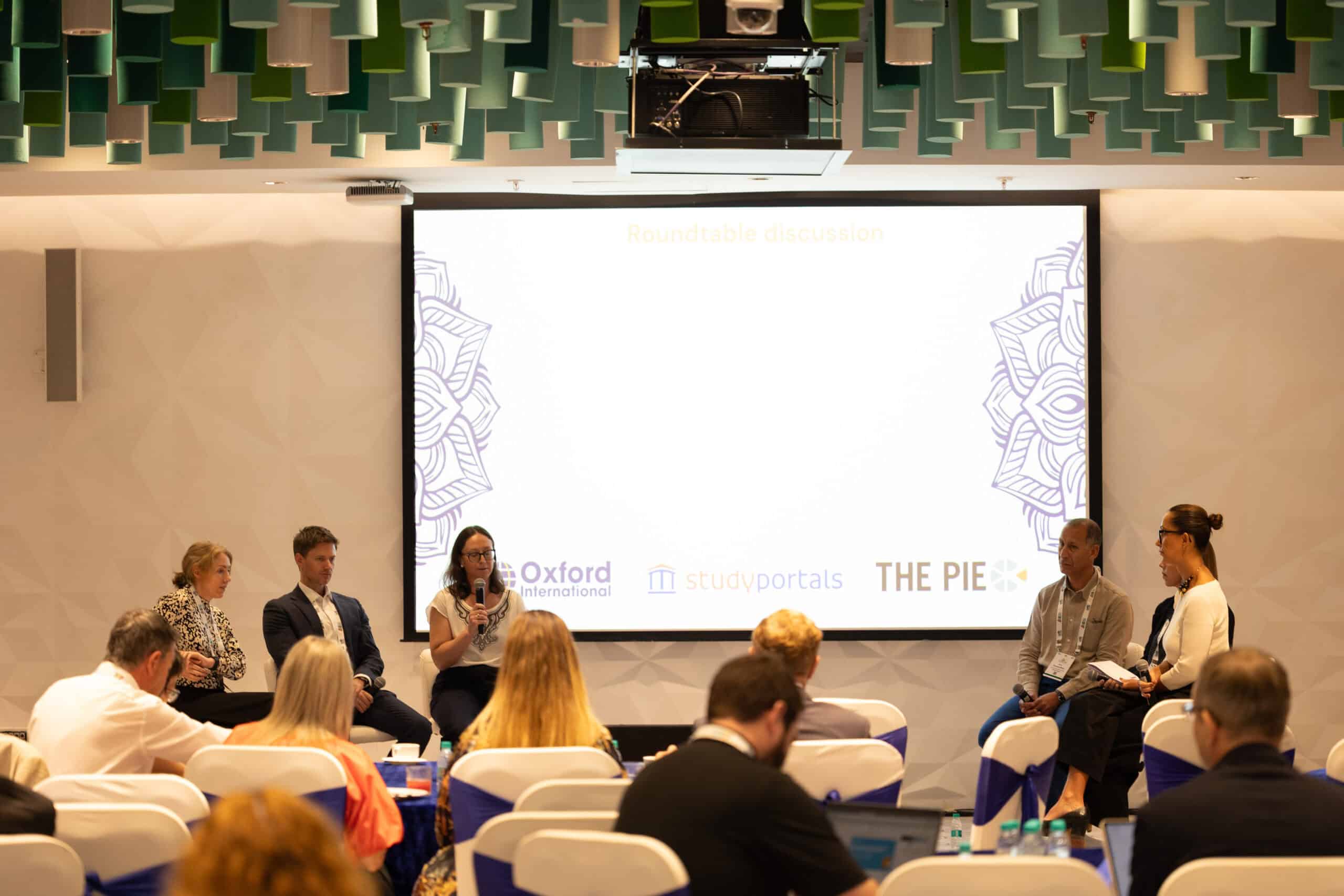
    The PIE News, in partnership with Oxford International Education Group (OIEG) and Studyportals, hosted a briefing where panelists explored university strategies, government collaboration, and financial sustainability for a successful TNE model.

    As international universities compete to establish TNE partnerships in India, the University of Southampton stands out, with its Delhi branch campus set to open in August 2025.

    Kasia Cakala, director of education pathways development at OIEG, which is collaborating with Southampton on the project, noted how education providers must continuously adapt to evolving expectations of the TNE model.

    “Not only do universities have to be mindful of the models they take in this very challenging market, but private providers like us also need to pivot, change, and adapt to support universities in their urgent needs,” stated Cakala at the briefing.

    “With Southampton, the key was defining a proposition that was not only sustainable but also aligned with government priorities and the domestic student ecosystem.”

    Cakala emphasised that as students from countries like India become more savvy, knowing what they need and expecting more from institutions, universities must adopt a “sophisticated market research strategy” to define their proposition, particularly when presenting expansion plans to government bodies.

    Private providers like us need to pivot, change, and adapt to support universities in their urgent needs
    Kasia Cakala, OIEG

    In light of the changing expectations, Carlie Sage, associate director, partnerships, APAC, Studyportals, underscored the importance of understanding student behaviour and market trends in shaping international education strategies.

    “A lot of universities still make decisions without really understanding the environment they’re operating in,” stated Sage. 

     “There’s amazing data out there that can help institutions navigate shifts, understand demand, identify gaps, and see what’s happening in real time.”

    According to Aziz Boussofiane, director, Cormack Consultancy Group, while TNE models need to be financially sustainable, they also need to be beneficial for both the university and the host country in the long run. 

    “For host countries, success (in TNE) means increasing capacity with quality provision – and for universities, it must align with their mission and strategic objectives,” stated Boussofiane, while addressing the audience. 

    “There are different drivers and processes depending on the market, whether it’s India or Nigeria, [and] it’s often about increasing in-country capacity and improving the quality of local providers.”

    While TNE is widely embraced by leading universities in major study destinations, challenges persist in building scalable models due to varying international perceptions of quality and value, which impact recognition, as previously reported by The PIE. 

    According to Daniel Cragg, director of Nous, while TNE is just another challenge for institutions, which are already dealing with academic workforce stress, new pressures from AI, and evolving student needs, the appetite for partnerships has only been rising. 

    “The appetite for collaboration is growing – universities want to share risk, balance success, and be more in-market experts,” said Cragg.

    “In international education, it feels like there’s a black swan event every three to four years. But universities constantly adapt, innovate, and thrive.”

    While universities in the UK and Australia have pushed through major TNE expansions in recent years, institutions in countries like New Zealand, though interested, prioritise strengthening their reputation and research over physical expansion.

    “New Zealand is a small player in TNE, but our partnerships focus on reputation and research rather than bricks-and-mortar expansion overseas,” stated Meredith Smart, international director, Auckland University of Technology

    “There’s a strong connection between our ranking strategy and our partnership strategy – reputation matters.”

    As the New Zealand government aims to boost international recruitment from emerging markets while strengthening educational partnerships in countries like India and Vietnam, institutions like AUT see an opportunity, while also learning from the missteps of their peers.

    “We are in a strong growth focus. The government wants us to grow. They’re desperate to win the next election, and I think they feel that international education can boost the economy,” stated Smart. 

    “New Zealanders love international students, but that could change as numbers rise. We must actively demonstrate the value of internationalisation to our economy, industries, and diplomatic relations.”

    This point was further reiterated by Cragg, who highlighted how working with governments in policymaking is essential. 

    “Working with governments to shape future visa policies is essential to ensuring sustainable international student growth,” he said. 

    “The value of international education extends across different areas of government, not just within universities.”

    Source link

  • Why you need to triple check your facts

    Why you need to triple check your facts

    There it was. A seemingly well-sourced, carefully crafted and copy-edited article about a new brand of young, vibrant, national leader, with astonishing levels of commitment, courage, creativity and compassion. All ready to be self-published online.

    The only trouble was that my draft article was based on wrong information and it needed to be spiked. That’s a journalism term for sending it to the trash.

    Now, I could moan and blame social media and disinformation for this near mistake. Or I could reflect on how close I came to disseminating gross misinformation and share the concrete learnings that I am taking from this quasi-failure.

    Be open to new story ideas.

    I recently read a WhatsApp post from a trusted Southeast Asian colleague of mine in the United States. He shared an opinion piece from his home country about a relatively new leader in another country in the Global South.

    The opinion writer said that this leader recently told public officials: “I don’t want my photographs in your offices because I am not a god or an icon, but a servant of the nation.” He urged them to hang pictures of their children instead.

    The writer added that this leader then delivered a ‘devastating moral punch’. “Whenever the spirit of theft visits you,” he said, “take a good look at your family’s picture and ask yourself if they deserve to be the family of a thief who has destroyed the nation.”

    It seemed like a great story and when I researched this new leader online, I found posts and articles that corroborated this particularly striking example of a new leader’s bold move against corruption.

    And I found other praiseworthy stories about his economic pragmatism and post-colonial idealism.

    Trust your gut and triple-check the facts.

    As a conscientious former reporter for the Reuters international news service, something troubled me. I thought about something my dearly departed father would say: “If something seems too good to be true, it probably is.”

    So right before publication, I decided to verify some of the facts one last time with two in-country sources I knew in Kigali, Rwanda.

    In no uncertain terms, one of them challenged most of the core aspects of my article and firmly declared that the particularly praiseworthy, anti-corruption initiative that was the centerpiece of my article was actually not true at all.

    She was right. On further investigation, the other stories of this leader’s supposed initiative and success all turned out to be skewed or exaggerated.

    And so the article was sadly consigned to the dustbin of fake news.

    Find the original sources and quote them directly.

    But I was not done. On further investigation, I managed to find a slightly different quotation that the opinion piece was probably based on:

    “We will build the country of other opportunities — the one where all are equal before the law and where all the rules are honest and transparent, the same for everyone. And for that, we need people in power who will serve the people. This is why I really do not want my pictures in your offices, for the president is not an icon, an idol or a portrait. Hang your kids’ photos instead and look at them each time you are making a decision.”

    And I discovered that the person who said this was none other than Ukrainian President Volodymyr Zelenskyy during his inaugural address on 20 May 2019.

    His statement does not talk about a “thief who has destroyed the nation” but it is still deeply impactful, particularly in light of his country’s devastating challenges over the last three years.

    Be willing to do things differently in future.

    I have been a journalist for a long time but here are some key reminders for me of what I need to do going forward:

    → Balance enthusiasm and engagement with integrity and plain hard work;

    → Recognize that in these difficult times, we all yearn for an inspirational story but even with the best of intentions, emotions can get in the way of good judgment;

    → Always take the extra time necessary to track down original and reliable sources;

    → Do this extra work whether you are sharing something with thousands of people on News Decoder or with only one other person in private;

    → If in doubt, cut it out or don’t share it and start again;

    → Have the courage to admit when you are wrong, apologize and make amends as appropriate and learn from that humbling experience.

    And just in case you are wondering, my father never claimed that his beloved saying was his.

    The original source is unknown but Dictionary.com points out that the term was part of the title of Thomas Lupton’s Sivquila; Too Good to be True, which dates back to the 1580s.

    The search for the original source continues as I recall the cynical words of a former official with the title “Minister for the Quality of Life” who counseled journalists to always write “lively and interesting” stories that correspond “where possible” with the truth.

    In future, I promise to always try to write truthful stories that are, where possible, lively and interesting.


    Questions to consider:

    1. Have you ever written or said something that you thought that was true but turned out to be false? If so, what did you do?

    2. If not, what would you do if this happens in future?

    3. And what will you do from now on to make sure this doesn’t happen?


    Source link

  • 5 Ways to Turn College Startups Into a Recurring Revenue Machine

    5 Ways to Turn College Startups Into a Recurring Revenue Machine

    Starting a college project is fascinating; nevertheless, maintaining profitability is quite another matter. Many college businesses find it difficult to maintain revenue growth between increasing running expenses, administrative inefficiencies, and erratic cash flow. Actually, cash flow issues cause 82% of small firms to fail; education startups are not an exception.

    The fix? smarter, data-based ideas for college recurrent income. Supported by actual data, let’s explore five tested strategies to make your college startup a revenue-generating machine.


    Five Data-Based Strategies for College Recurring Revenue to Increase Profits


    1. Automate Fee Collection: Save Up to 30% of Costs

    Unbelievably, mistakes in manual fee processing could cost organizations up to 25% of their whole income. Automating your fee collecting guarantees faster payments, less billing errors, and simplifies the process. Studies reveal that companies implementing automation cut their running expenses by thirty percent; consider what that could mean for the financial situation of your college.

    Using a cloud-based fee management solution can help you to automatically handle receipts, cut manual invoicing, and send quick payment reminders.


    2. Strengthener student relationships – boost enrollment by eighteen percent

    Automate Fee Collection: Save Up to 30% of Costs

    Unbelievably, mistakes in manual fee processing could cost organizations up to 25% of their whole income. Automating your fee collecting guarantees faster payments, less billing errors, and simplifies the process. Studies reveal that companies implementing automation cut their running expenses by thirty percent; consider what that could mean for the financial situation of your college.

    Using a cloud-based fee management solution can help you to automatically handle receipts, cut manual invoicing, and send quick payment reminders.


    3. Smart Reminders & Communication — 45% Less Late Payments

    Weary of hunting payments? When institutions deliver timely SMS, email, and push notifications, a shockingly 45% of late fees are paid within a week. Automated reminders guarantee parents and students never miss a deadline, therefore reducing late payments and improving cash flow.

    To expedite collections and save administrative expense, schedule automated reminders for due dates, past-due penalties, and payment acknowledgements.


    4. Control Your Spending Track About sixty percent of operational expenses

    Unchecked expenses cause colleges to bleed money; but, systematic expense tracking helps to control 60% of operational costs. Institutions can recognize early overspending, maximize resource allocation, and increase profitability by real-time cost capture and manual expenditure entry elimination.

    Use cost control tools to oversee vendor payments, check program budgets, and guarantee every dollar counts.


    5. Improve Real-Time Data Insights to Increase Revenue 20%

    Think about predicting financial constraints. Data analytics boosts revenue by 20% for institutions tracking revenue, costs, and student performance. Late payments, course profitability, and untapped income potential are visible in real time dashboards.

    With a real-time performance metrics dashboard, track cash flow, find income trends, and improve financial agility.


    Ready to Turn Your College Startup into a Revenue Powerhouse?

    The path to a sustainable, recurring revenue model isn’t about working harder — it’s about working smarter. By embracing automation, student relationship management, expense control, and data-driven decision-making, your college startup can maximize revenue, minimize costs, and scale faster than ever.

    Ready to future-proof your revenue strategy? Let Creatrix Campus help you build a smarter, more profitable institution — starting today.

    Source link

  • What next for int’l education after South Korea’s political crisis?

    What next for int’l education after South Korea’s political crisis?

    On April 4, 2025, South Korea’s Constitutional Court upheld the impeachment of President Yoon Suk Yeol, marking a historic conclusion to 122 days of political turmoil triggered by his failed declaration of martial law on December 3, 2024.

    However, the damage sustained during the transitionary period proved irreversible. Massive public protests, legal battles, sharply divided public opinion, and a temporary presidential suspension culminated in Yoon’s permanent removal from office.

    This article examines how the political crisis has disrupted international higher education in South Korea, focusing on five key areas: reputational damage, impact on students from Asia and the Global South, rising xenophobia, heightened student anxiety, and the sidelining of education policy.

    A blow to Korea’s brand

    Before the political crisis of late 2024, Korea had successfully positioned itself as one of Asia’s most attractive destinations for international students, combining strong government support, cultural appeal through the Korea’s soft power, and a reputation for safety and modernity.

    The country’s international student population had surged to over 200,000 by mid-2024, driven by initiatives like the Study Korea 300K strategy and bolstered by perceptions of national stability.

    However, Yoon’s abrupt declaration of martial law and the ensuing constitutional crisis shattered this image. International media coverage of soldiers surrounding parliament and global expressions of concern drew unsettling comparisons to authoritarian eras, eroding the confidence that had fuelled South Korea’s internationalisation drive. While little direct harm came to students, the perception of fragility alone risks deterring future enrolments.

    Disruptions for the global south

    The political crisis affected international students from Asia and the Global South, who make up the vast majority of the country’s foreign enrolment.

    With countries like China, Vietnam, Mongolia, and Uzbekistan sending thousands annually, students were drawn by proximity, affordability, and opportunity – but instead found themselves facing uncertainty, confusion, and fear.

    The brief but shocking declaration of martial law raised urgent concerns about campus safety, academic continuity, and visa stability, prompting embassies and international offices to issue advisories and support measures.

    Although campuses largely remained operational, the prolonged instability created bureaucratic delays, disrupted programs, and heightened anxiety, especially for students from politically sensitive backgrounds. The overall experience tested students’ faith in Korea as a stable destination.

    Polarisation and the rise of xenophobia

    The political crisis intensified domestic polarisation and spilled over into rising xenophobia, particularly targeting Chinese nationals. Fueled by conspiracy theories and nationalist rhetoric, Yoon’s supporters alleged foreign interference in South Korean politics, echoing fringe narratives prevalent among far-right media.

    These claims, amplified by partisan outlets and street rallies, created an atmosphere of suspicion and scapegoating against a narrowly profiled demographic. While many South Koreans rejected these xenophobic narratives, the episode revealed how quickly foreign students can become collateral damage in domestic political conflicts.

    Heightened anxiety and mental health concerns

    Over the past four months, international students in South Korea have faced heightened anxiety as political turmoil compounded the usual challenges of studying abroad. The situation introduced fears ranging from immediate safety during protests to long-term worries about academic continuity, visa stability, and career prospects.

    International students in South Korea have faced heightened anxiety as political turmoil compounded the usual challenges of studying abroad

    Many students, especially those unfamiliar with Korea’s political system or fluent only in limited Korean language, struggled to interpret rapidly unfolding events, and some even began contingency planning in case of campus closures or evacuation.

    Mental health stressors were exacerbated by long-distance concerns from worried families, unfamiliar political polarisation, and rising xenophobia.

    Higher education policy and discourse sidelined

    Most importantly, national discourse on higher education was effectively sidelined as government attention and public debate fixated on the impeachment process.

    While some initiatives, like the IEQAS certification and the Glocal Project, quietly moved forward, they received minimal coverage or engagement. The leadership vacuum and political paralysis delayed or derailed potential reforms, only resulting in many schools’ collective move to raise tuition fees after a 16-year freeze.

    Within universities, students and faculty who might normally advocate for education policy were drawn into the political fray, and civil discourse on educational development disappeared from the national agenda.

    International education standpoint

    From an international education perspective, the crisis tarnishes South Korea’s branding as a rising study destination.

    The martial law incident and subsequent impeachment chaos created precisely the kind of uncertainty that can give students and parents pause. For example, Hong Kong experienced a notable challenge in international student interest after the protest upheavals of 2019/20, as safety and political issues became a concern.

    No expert in this field would overlook the fact that one of the most powerful drivers of human migration is the political and social compatibility between home and host countries. This helps explain why Korea and Japan have become two of the most attractive destinations for international students in Asia.

    Looking ahead: time for rebuilding

    With the Constitutional Court having issued its ruling, the path to restoring its global reputation hinges on reaffirming its commitment to inclusion, transparency, and predictability. The crisis has illuminated how deeply political instability can affect international education and serves as a cautionary example for emerging study destinations: preserving democratic norms and open societies is essential to sustaining trust and long-term progress in the global arena.

    Rebuilding Korea’s global education brand will require more than a return to stability; it will necessitate deliberate reassurances of democratic resilience, institutional integrity, and a sustained commitment to providing a safe, welcoming environment for international students.

    On the bright side, the decision, grounded in constitutional procedure, stands as a testament to the resilience and maturity of Korea’s democratic institutions

    On the bright side, the decision, grounded in constitutional procedure, stands as a testament to the resilience and maturity of Korea’s democratic institutions. Despite the turbulence, the peaceful and lawful resolution of the crisis reaffirms the country’s enduring commitment to the rule of law, institutional checks and balances, and civic accountability.

    For international observers and students alike, this outcome offers a renewed sense of confidence that Korea’s democratic foundations remain robust. As such, it opens the door for a more transparent and inclusive national recovery, one where education, international engagement, and democratic integrity can move forward together.

    All in all, on the heels of the impeachment, restoring confidence in the national system and reviving the momentum of internationalisation and higher education reform must become a central national priority.

    Source link

  • “Am I Sure?” — A Mindful Question to Reduce Stress & Gain Perspective (Dr. Ryan Niemiec, VIA Strengths)

    “Am I Sure?” — A Mindful Question to Reduce Stress & Gain Perspective (Dr. Ryan Niemiec, VIA Strengths)

    How often do we let our assumptions add to our stress—without even realizing it? In this short video, Dr. Ryan Niemiec invites us to pause and ask one simple, powerful question: “Am I sure?” By gently challenging our perceptions, we create space for clarity, balance, and authenticity. Learn how mindfulness and the character strength of Perspective can help reduce stress and bring you back to what truly matters.

    Source link

  • Mind the policy gaps: regulating quality and ethics in digitalised and privatised crossborder education

    Mind the policy gaps: regulating quality and ethics in digitalised and privatised crossborder education

    by Hans de Wit, Tessa DeLaquil, Ellen Hazelkorn and Hamish Coates

    Hans de Wit, Ellen Hazelkorn and Hamish Coates are editors and Tessa DeLaquil is associate editor of Policy Reviews in Higher Education. This blog is based on their editorial for issue 1, 2025.

    Transnational education (TNE), also referred to as crossborder education, is growing and morphing in all kinds of interesting ways which, while exciting for innovators, surface important policy, regulatory, quality and ethical concerns. It is therefore vital that these developments do not slip around or through policy gaps. This is especially true for on-line TNE which is less visible than traditional campus-based higher education. Thus, it is vital that governments take the necessary actions to regulate and quality assure such education and training expansion and to inform the sector and broader public. Correspondingly, there is a pressing need for more policy research into the massive transformations shaking global higher education.

    TNE and its online variants have been part of international higher education for a few decades. As Coates, Xie, and Hong (2020) foreshadowed, it has seen a rapid increase after the Covid-19 pandemic. In recent years, TNE operations have grown and diversified substantially. Wilkins and Huisman (2025) identify eleven types of TNE providers and propose the following definition to help handle this diversity: ‘Transnational education is a form of education that borrows or transfers elements of one country’s higher education, as well as that country’s culture and values, to another country.’

    International collaboration and networking have never been more important than at this time of geopolitical and geoeconomic disruption and a decline in multilateral mechanisms. But TNE’s expansion is matched by growing risks.

    International student mobility at risk

    International degree student mobility (when students pursue a bachelor, master and/or doctoral degree abroad) continues to be dominant, with over six million students studying abroad, double the number of 10 years ago. It is anticipated that this number will further increase in the coming decade to over 8 million, but its growth is decreasing, and its geographical path from the ‘global south’ to the ‘global north’ is shifting towards a more diverse direction. Geopolitical and nationalist forces as well as concerns about adequate academic services (accommodation in particular) in high-income countries in the global north are recent factors in the slowing down of the growth in student mobility to Australia, North America and Europe, the leading destinations. The increased availability and quality of higher education, primarily at the undergraduate level, in middle-income countries in Asia, Latin America and parts of the Middle East, also shape the decrease in student mobility towards the global north.

    Several ‘sending countries’, for instance, China, South Korea and Turkey, are also becoming receiving countries. Countries like Kazakhstan, Uzbekistan, Ukraine (until the Russian invasion), Egypt and some of the Caribbean countries have also become study destinations for students from neighbouring low-income countries. These countries provide them with higher education and other forms of postsecondary education sometimes in their public sector but mostly in private institutions and by foreign providers.

    An alternative TNE model?

    Given the increased competition for international students and the resulting risks of falling numbers and related financial security for universities, TNE has emerged as an alternative source of revenue. According to Ilieva and Tsiligiris (2023), United Kingdom TNE topped more than 530,000 students in 2021. In the same year, its higher education institutions attracted approximately 680,000 international students. It is likely that TNE will surpass inward student mobility.

     As the United Kingdom case makes clear, TNE originally was primarily a ‘north-south’ phenomenon, in which universities from high-income and mostly Anglophone countries, offered degree programmes through branch campuses, franchise operations and articulation programmes. Asia was the recipient region of most TNE arrangements, followed by the Middle East. As in student mobility, TNE is more diverse globally both in provision and in reception.

    The big trend in TNE is the shift to online education with limited in-person teaching. A (2024) report of Studyportals found over 15,000 English-taught online programmes globally. And although 92 per cent of these programmes are supplied by the four big Anglophone countries – the United Kingdom, United States, Canada and Australia – the number of programmes offered outside those four doubled since 2019 from 623–1212, primarily in Business and Management, Computer Sciences and IT.

    Private higher education institutions

    This global growth in online delivery of education goes hand in hand with the growth in various forms of private higher education. Over 50% of the institutions of higher education and over one-third of global enrolment are in private institutions, many of which are commercial in nature. Private higher education has become the dominant growth area in higher education, as a result of the lack of funding for public higher education as well as traditional HE’s sluggish response to diverse learner needs. Although most private higher education, in particular for-profit, is taking place in the global south, it is also present in high-income countries, and one can see a rise in private higher education recently in Western Europe, for instance, Germany and France.

    TNE is often a commercial activity. It is increasingly a way for public universities to support international and other operations as public funding wanes. Most for-profit private higher education targets particular fields and education services and tends to be more online than in person. There is an array of ownership and institutional structures, involving a range of players.

    Establishing regulations and standards

    TNE, especially online TNE, is likely to become the major form of international delivery of education for local and international students especially where growing demand cannot be met domestically. Growth is also increasingly motivated by an institution’s or country’s financial challenges or strategic priorities – situations that are likely to intensify. This shift could help overcome some of the inequities associated with mobility and address concerns associated with climate change but online TNE is significantly more difficult to regulate.

    A concerning feature of the global TNE market is how learners and countries can easily become victims. Fraud is associated with the exponential rise in the number of fake colleges and accreditors, and document falsification. This is partly due to different conceptions and regulatory approaches to accreditation/QA of TNE and the absence of trustworthy information. Indeed, the deficiency in comprehensive and accessible information is partly responsible for on-going interest in and use of global rankings as a proxy for quality.

    A need for clearer and stronger TNE and online quality assurance

    The trend in growth of private for-profit higher education, TNE and online delivery is clear and given its growing presence requires more policy attention by national, regional and global agencies. As mentioned, public universities are increasingly active in TNE and online education targeting countries and learners underserved in their home countries whilst  looking for other sources of income as a result of decreasing public support and other factors.

    The Global Convention on the Recognition of Qualifications makes clear the importance of ensuring there are no differences in quality or standards between learners in the home or host country regardless of whether the delivery of education programmes and learning activities is undertaken in a formal, non-formal or informal setting, in face-to-face, virtual or hybrid formats, traditional or non-traditional modes. Accordingly, there are growing concerns about insufficient regulation and the multilateral framework covering international education, and especially online TNE.

    In response, there is a need for clearer and stronger accreditation/quality assurance and standards by national regulators, regional networks and organisations such as UNESCO, INQAAHE, the International Association of Universities (IAU) with regards to public and private involvement in TNE, and online education. This is an emerging frontier for tertiary education, and much more research is required on this growing phenomenon.

    Professor Ellen Hazelkorn is Joint Managing Partner, BH Associates. She is Professor Emeritus, Technological University Dublin.

    Hamish Coates is professor of public policy, director of the Higher Education Futures Lab, and global tertiary education expert.

    Hans de Wit is Professor Emeritus and Distinguished Fellow of the Boston College Center for International Higher Education, Senior Fellow of the international Association of Universities.

    Tessa DeLaquil is postdoctoral research fellow at the School of Education at University College Dublin.

    Author: SRHE News Blog

    An international learned society, concerned with supporting research and researchers into Higher Education

    Source link

  • 6 ways to make math more accessible for multilingual learners

    6 ways to make math more accessible for multilingual learners

    Key points:

    Math isn’t just about numbers. It’s about language, too.

    Many math tasks involve reading, writing, speaking, and listening. These language demands can be particularly challenging for students whose primary language is not English.

    There are many ways teachers can bridge language barriers for multilingual learners (MLs) while also making math more accessible and engaging for all learners. Here are a few:

    1. Introduce and reinforce academic language

    Like many disciplines, math has its own language. It has specialized terms–such as numerator, divisor, polynomial, and coefficient–that students may not encounter outside of class. Math also includes everyday words with multiple meanings, such as product, plane, odd, even, square, degree, and mean.

    One way to help students build the vocabulary needed for each lesson is to identify and highlight key terms that might be new to them. Write the terms on a whiteboard. Post the terms on math walls. Ask students to record them in math vocabulary notebooks they can reference throughout the year. Conduct a hands-on activity that provides a context for the vocabulary students are learning. Reinforce the terms by asking students to draw pictures of them in their notebooks or use them in conversations during group work.

    Helping students learn to speak math proficiently today will pay dividends (another word with multiple meanings!) for years to come.

    2. Incorporate visual aids

    Visuals and multimedia improve MLs’ English language acquisition and engagement. Picture cards, for example, are a helpful tool for building students’ vocabulary skills in group, paired, or independent work. Many digital platforms include ready-made online cards as well as resources for creating picture cards and worksheets.

    Visual aids also help MLs comprehend and remember content. Aids such as photographs, videos, animations, drawings, diagrams, charts, and graphs help make abstract ideas concrete. They connect concepts to the everyday world and students’ experiences and prior knowledge, which helps foster understanding.

    Even physical actions such as hand gestures, modeling the use of a tool, or displaying work samples alongside verbal explanations and instructions can give students the clarity needed to tackle math tasks.

    3. Utilize digital tools

    A key benefit of digital math tools is that they make math feel approachable. Many MLs may feel more comfortable with digital math platforms because they can practice independently without worrying about taking extra time or giving the wrong answer in front of their peers.

    Digital platforms also offer embedded language supports and accessibility features for diverse learners. Features like text-to-speech, adjustable speaking rates, digital glossaries, and closed captioning improve math comprehension and strengthen literacy skills.

    4. Encourage hands-on learning

    Hands-on learning makes math come alive. Math manipulatives allow MLs to “touch” math, deepening their understanding. Both physical and digital manipulatives–such as pattern blocks, dice, spinners, base ten blocks, and algebra tiles–enable students to explore and interact with mathematical ideas and discover the wonders of math in the world around them.

    Many lesson models, inquiry-based investigations, hands-on explorations and activities, and simulations also help students connect abstract concepts and real-life scenarios.

    PhET sims, for example, create a game-like environment where students learn math through exploration and discovery. In addition to addressing math concepts and applications, these free simulations offer language translations and inclusive features such as voicing and interactive descriptions.

    Whether students do math by manipulating materials in their hands or on their devices, hands-on explorations encourage students to experiment, make predictions, and find solutions through trial and error. This not only fosters critical thinking but also helps build confidence and perseverance.

    5. Use students’ home language as a support

    Research suggests that students’ home languages can also be educational resources

    In U.S. public schools, Spanish is the most commonly reported home language of students learning English. More than 75 percent of English learners speak Spanish at home. To help schools incorporate students’ home language in the classroom, some digital platforms offer curriculum content and supports in both English and Spanish. Some even provide the option to toggle from English to Spanish with the click of a button.

    In addition, artificial intelligence and online translation tools can translate lesson materials into multiple languages.

    6. Create verbal scaffolds

    To respond to math questions, MLs have to figure out the answers and how to phrase their responses in English. Verbal scaffolds such as sentence frames and sentence stems can lighten the cognitive load by giving students a starting point for answering questions or expressing their ideas. This way, students can focus on the lesson content rather than having to spend extra mental energy figuring out how to word their answers.

    Sentence frames are often helpful for students with a beginning level of English proficiency.

    • A square has            sides.  
    • An isosceles triangle has at least             equal angles.

    Sentence stems (a.k.a. sentence starters) help students get their thoughts going so they can give an answer or participate in a discussion. 

    • The pattern I noticed was                               .               
    • My answer is                               . I figured it out by                               .

    Whether online or on paper, these fill-in-the-blank phrases and sentences help students explain their thinking orally or in writing. These scaffolds also support academic language development by showing key terms in context and providing opportunities to use new vocabulary words.

    Making math welcoming for all

    All students are math language learners. Regardless of their home language, every student should feel like their math classroom is a place to learn, participate, contribute, and grow. With the right strategies and tools, teachers can effectively support MLs while maintaining the rigor of grade-level content and making math more accessible and engaging for all.

    Source link

  • The Fifteen, April 4, 2025

    The Fifteen, April 4, 2025

    The latest edition of The Fifteen highlights stories on workforce readiness and labour productivity (Hong Kong, the UK) and the expansion and regulation of private higher education (Spain, Tunisia).  But we’re also covering such issues as access problems in Finland, faculty issues in Iran and admissions reform in Vietnam, as well as, inevitably, the latest policy atrocities in the United States. Enjoy!

    1. The most recent controversy in the American higher-ed landscape is the Trump administration’s rapidly increasing use of a little-used power to revoke academic and student VISAs. Is It That Easy for Trump to Revoke Visas? (The Chronicle) Well, it’s either that or the Trump administration’s ‘review’ of several billion worth of funding to Harvard. Trump Administration Targets Harvard With Review of $9 Billion in Federal Funding. (Wall Street Journal)
    2. The European Commission is pushing research funding towards a competitiveness-focused fund that focuses more on industry applications. The European Parliament and Council, along with universities and research leaders, support preserving the current framework (F10) that prioritizes long-term, more academic research. Is the sun setting on blue-sky EU research funding? (Times Higher Education)
    3. Many in Higher Education see mergers as an important and potentially necessary part of the sector’s future. However, getting these agreements off the ground is much easier said than done, even when funding incentives exist. Supporting Partnerships for Student Success and Institutional Viability. (Transformational Partnerships Fund)
    4. Free tuition does not guarantee access, part MCXXIV.  In Finland, there are about three times as many students applying than there are spots in universities, leading some students to spend thousands on preparatory courses in a bid to get in. Over 93,000 applicants left without a place at university. (Helsinki Times)
    5. Long known for cutting-edge research universities, Hong Kong is piloting a government-backed program to open universities offering applied programming to fill the labour market demand for advanced technical skills. Applied sciences universities are set to diversify HE sector. (University World News)
    6. A report from India shows that tech graduates’ employment struggles are not unique to North America. Many students fail to land jobs after graduating, even with in-demand skills, highlighting the challenge young graduates face getting from campus into the workforce. 60% of premier engineering students lack job offers, highlighting gaps in campus. (The Economic Times)
    7. Staying in India, a new report says that 51 students died in ragging (i.e. hazing) incidents at their universities over the past three years; medical universities were singled out as particular hotspots.  Medical colleges emerge as ragging hotspots with 51 deaths in 3 years, reveals study. (The Times of India)
    8. We missed this a few weeks back, but better late than never. A Chinese entrepreneur set up a new university and endowed it with $10 billion. Chinese boss in American Factory film approved to launch university to rival Stanford. (SCMP) Now, it’s going after top international faculty. Chinese entrepreneurs’ philanthropy helps lure world-class scholars. (SCMP)
    9. China has long put a big emphasis on Engineering education. Some think this is now paying serious dividends. How does China’s ‘engineer dividend’ propel rapid growth of its high-tech industries? (Global Times)
    10. Spain Is in the midst of a private higher education boom, with over 20% of that country’s students now enrolled in the sector. Las universidades públicas pierden estudiantes frente a la gran oferta de las universidades privadas. (infobae) But quality concerns exist. El cuádruple fracaso de Sánchez antes de su ofensiva a las universidades privadas: notas infladas, falta de plazas, peor empleo y regulación fallida. (El Mundo) And now the government is setting out a new set of rules for privates to maintain university status. El Gobierno va a endurecer los criterios para crear nuevas universidades: un mínimo de 4.500 estudiantes y un sistema de validación. (infobae)
    11. Across the Mediterranean, Tunisia is also figuring out how to regulate booming private universities and a new law is in front of Parliament. Réforme de l’enseignement supérieur privé en Tunisie : un amendement pour renforcer le recrutement d’enseignants permanents. (Business News)
    12. Iran’s universities are seeing a huge exodus of medical personnel due mainly to poor pay and working conditions. Wave of Faculty Exodus Reaches Iran’s Major Universities. (Iran Focus)
    13. In a rare piece of positive news on international education, New Zealand is reporting an increase in foreign student applications. New Zealand witnessed a 27% increase in international student applications this year. (Education Times) and predict much larger increases in numbers from India as those students look away from North America. Indian Student Enrolment In New Zealand Set To Nearly Double By 2030, Predicts 95% Growth: Report. (Free Press Journal)
    14. An interesting piece from the Moscow Times about anti-war resistance in Russian universities. In Russia’s Universities, Anti-War Voices Are Silenced. But Resistance Remains. (The Moscow Times)
    15. And finally, from Vietnam, which might currently be the world’s most ambitious country when it comes to higher education reform, comes an attempt to re-work university admissions.  Currently, there are no fewer than 20 different adjudication methods for university admissions, which is silly. Vietnam plans nearly 20 university admission methods in 2025. (Vietnam Global). But better standardization and an end to early admissions are on the way. Vietnam abolishes early university admission starting 2025. (Vietnam Global)

    That’s our quick global roundup in higher education—from privatization, access and employment outcomes to ambitious reforms and the rapidly shifting international markets. Plenty to think about—and plenty more to come. Catch you in the next edition!

    Source link

  • How Being a Mother and Academic Helped Me Fix Higher Education’s Transfer Crisis

    How Being a Mother and Academic Helped Me Fix Higher Education’s Transfer Crisis

    Dr. Alicia M. AlveroWhen my daughter transferred to Queens College in Spring 2019, I could not have been more excited. As associate provost at the college, I’ll admit I was biased but even two decades of experience in higher education couldn’t fully prepare me for her struggle to transfer credits. 

    Queens College is one of The City University of New York’s 25 colleges. My daughter transferred from another school within the system yet despite mastering course material, she was told to take what was basically the same course all over again. 

    Fortunately, I understood the appeals process and was able to point her in the right direction. As a result, she obtained credit for the course, which counted toward her major. At the same time, reality struck: A student should not need to have an associate provost as a parent to transfer college credits. Frankly, they shouldn’t even need to appeal credits within the same system. 

    Nationally, the transfer system has been set up to let students fail for decades. On average, students lose a fifth of their credits when transferring to a four-year college, according to the U.S. Government Accountability Office. This leads to wasted tuition dollars and makes it more challenging to earn a bachelor’s degree. A 2023 report by the Community College Research Center found that only 16% of community college students earned a bachelor’s program within six years and just 10% of low-income students did

    As the largest public urban university system in the nation, CUNY had a real opportunity to make a change. In 2023, CUNY’s Board of Trustees charged the University’s leadership – including myself – to fix the transfer system. 

    CUNY has long been dedicated to eliminating the obstacles that result when a student transfers. In fact, the expectation that CUNY should provide a seamless ability to transfer between its constituent colleges dates to its formation as a centralized system in the 1960s. 

    Enshrined in New York state education law is the mandate for CUNY to “maintain its close articulation between senior and community college units.” Each year, up to 15,000 CUNY students – like my daughter – transfer between campuses, most commonly from a community college to a four-year college. 

    The purpose of an integrated university system is to offer an array of options for students which transfer seamlessly across all colleges. And over the years there have been efforts to achieve that at CUNY.  

    In 2013, the University implemented the Pathways initiative which established the seamless transfer of general education courses across its undergraduate colleges.  There are also many individual articulation agreements between colleges. But such agreements, between a singular CUNY community college’s program and a corresponding bachelor’s level program at another college, could only go so far in addressing a systemic problem and sometimes result in credits transferring as blanket elective, which does not help a student make progress in their major. Truly universal transferability would require faculty buy-in and better digital tools. 

    And so, one of the first things I knew I needed to do was engage our University Faculty Senate, both out of respect for their role in our decision-making process as part of shared governance and to leverage their expertise. This would come to be one of the most important steps in making this effort successful. 

    As we engaged faculty in discussions about transfer, we shifted the focus from simply identifying equivalent courses to defining the essential competencies students must master in the first half of their major. Faculty across institutions readily reached consensus on the core knowledge and skills students needed to succeed in the second half of their program.

    This competency-based approach then led to productive conversations about how specific courses developed these critical skills. Initially, the goal was to group courses into equivalent “blocks,” ensuring students could transfer seamlessly. In some cases, this process led faculty to align their individual courses more closely; others maintained course groupings but ensured consistency across institutions. Both approaches resulted in universal transfer pathways, guaranteeing students full credit toward their major at any receiving college. 

    At the same time, faculty helped us navigate practical roadblocks. For instance, we recognized that a universal approach could not always apply to programs leading to licensing exams— such as the CPA exam— where external accrediting bodies impose strict curricular requirements. While this nuance was clear to accounting faculty, it underscored for others the importance of discipline-specific constraints in shaping transfer policy. 

    Ultimately, this collaborative process ensured that transfer credit advances students’ progress toward degree completion rather than being lost as elective credit. Through collaboration, more than 300 courses, or blocks of courses, are now universally equivalent to each other across all colleges. 

    Starting in fall 2025, for over 75% of students transferring anywhere within the system, they will carry over most credits in their major. The University tackled the six most common transfer majors first – accounting, computer science, biology, math, psychology and sociology – ensuring credits transfer retroactively. We will work to align 100% of majors next. 

    The new system creates consistency on what students across CUNY campuses need to learn in the first half of their major and is expected to save students an average of $1,220 in wasted credits. 

    The CUNY Transfer Initiative extends beyond curricular alignment; it also involves evaluating the tools, policies, and practices that affect transfer student success. By reviewing policies, we identified gaps where new policies were needed and determined where existing policies required adjustments to better achieve their intended outcomes. We enhanced the CUNY Transfer Explorer (T-Rex), a tool that shows students how their credits transfer across the system, by adding leaderboards with key transfer metrics for each college and a feature that estimates how much of a degree would be completed at any CUNY school. 

    On January 21, the University automated a critical process in its student information system, known as CUNYfirst, ensuring admitted transfer students can immediately see how their credits apply at their new college. Previously, this was a manual, campus-specific process that required student advocacy and often caused delays. On its first day, the automation benefited 18,850 students, reducing stress and supporting informed academic decisions. 

    Fixing the transfer crisis will take continued effort. 

    To make sure that this system does not break again, we will be working with faculty to  adjust how we develop the curriculum for new courses. This means we will now proactively consider how a potential new course will transfer across the CUNY system before it even exists. As the initiative grows, we will have 100% of credits in the first half of a major count towards a degree when students transfer from one of CUNY’s associate programs to the same major in a CUNY bachelor’s degree program.

    The conversation is also continuing across the country. In 2023, the United States Department of Education hosted a summit of 200 higher education leaders on improving the transfer process. Then-U.S. Secretary of Education Dr. Miguel Cardona acknowledged that the current state of the college transfer system is broken, saying that it, “stacks the deck against community college students who aspire to earn four-year degrees.” 

    As part of my research when starting this effort, I reached out to my colleagues from colleges across the country to see what I could learn about what may work in improving outcomes for our transfer students. The collective response? “If you find a solution, please let us know.” 

    Everyone sees that the current state of our higher education system does a great disservice to students who transfer, presenting logistical and financial challenges that derail students who are otherwise dedicated to enhancing their education. While there is still work to be done, I am proud to say that we’ve truly begun to dismantle those barriers in an effort that I hope other public institutions of higher education will take inspiration from. 

    Dr. Alicia M. Alvero is the interim executive vice chancellor and university provost at The City University of New York. A professor of organizational behavior management for nearly two decades at CUNY’s Queens College, she also served as the college’s associate provost for academic and faculty affairs.   

    Source link

  • How CTE supports college and career readiness

    How CTE supports college and career readiness

    This post on CTE and career readiness originally appeared on iCEV’s blog, and is republished here with permission.

    For students to be truly prepared for their futures, they need academic knowledge, technical expertise, and workforce skills that translate directly into the workplace. As a career and technical education (CTE) instructor, I see firsthand how career-focused education provides students with the tools to transition smoothly from high school to college and careers.

    More News from eSchool News

    Many math tasks involve reading, writing, speaking, and listening. These language demands can be particularly challenging for students whose primary language is not English.

    In recent years, the rise of AI technologies and the increasing pressures placed on students have made academic dishonesty a growing concern. Students, especially in the middle and high school years, have more opportunities than ever to cheat using AI tools.

    As technology trainers, we support teachers’ and administrators’ technology platform needs, training, and support in our district. We do in-class demos and share as much as we can with them, and we also send out a weekly newsletter.

    Math is a fundamental part of K-12 education, but students often face significant challenges in mastering increasingly challenging math concepts.

    Throughout my education, I have always been frustrated by busy work–the kind of homework that felt like an obligatory exercise rather than a meaningful learning experience.

    During the pandemic, thousands of school systems used emergency relief aid to buy laptops, Chromebooks, and other digital devices for students to use in remote learning.

    Education today looks dramatically different from classrooms of just a decade ago. Interactive technologies and multimedia tools now replace traditional textbooks and lectures, creating more dynamic and engaging learning environments.

    There is significant evidence of the connection between physical movement and learning.  Some colleges and universities encourage using standing or treadmill desks while studying, as well as taking breaks to exercise.

    This story was originally published by Chalkbeat. Sign up for their newsletters at ckbe.at/newsletters. In recent weeks, we’ve seen federal and state governments issue stop-work orders, withdraw contracts, and terminate…

    English/language arts and science teachers were almost twice as likely to say they use AI tools compared to math teachers or elementary teachers of all subjects, according to a February 2025 survey from the RAND Corporation.

    Want to share a great resource? Let us know at [email protected].

    Source link