Author: admin

  • Here’s how Missouri’s largest district rallied its community to boost attendance

    Here’s how Missouri’s largest district rallied its community to boost attendance

    NEW ORLEANS — Between 2020 and 2024, student attendance in Missouri’s Springfield Public Schools dipped from 94.73% to 90.63%. 

    Like many other school districts nationwide, Springfield’s attendance rates took a hit from the COVID-19 pandemic. 

    Data from the American Institutes for Research shows fall 2020 attendance rates nationwide for elementary school at 92%, middle school at 90%, and high school at 89% — down from pre-pandemic averages of 95% for elementary and 92% for middle and high school.

    And because of the global health crisis, the state kept Springfield at its 2019-20 attendance numbers for funding purposes, Superintendent Grenita Lathan told attendees in March at the annual conference of AASA, The School Superintendents Association, in New Orleans.

    But with the state’s hold harmless order on attendance about to sunset, Lathan said, officials in the 24,500-student district knew that they needed to boost attendance during the 2023-24 school year. So they set a goal: By the end of that school year, they would raise attendance to 92%.


    “When it comes to school attendance, 90% is not an A.”

    Springfield Public Schools’ messaging on attendance


    Announcing that charge during her annual state of the schools address in August 2023, Lathan said chamber of commerce members and the community at large needed to understand the impact that a 2 percentage-point attendance increase would have. 

    “That would bring in anywhere from $3 [million] to $4 million in funding that would help us with different programs,” Lathan said.

    Lathan and other district officials laid out a districtwide strategic plan that included a communication timeline, monthly updates to 300 local business leaders, and a promise that Lathan would let herself be publicly doused in Powerade if the district reached its goal. Here are the keys to how officials rallied the community to work toward the attendance goal.  

    Keep it simple and be bold

    “It was important that we had buy-in from everyone in the district so that the messaging would resonate with everyone in the community,” said Stephen Hall, the district’s chief communications officer.

    To that end, the district prioritized making its messaging simple, direct and bold in presentation. This was reflected not only in the attendance campaign’s slogan — “Attend today, succeed forever” — but also in messaging on social media and on signage around the city. 

    In their car pickup lines, each of Springfield Public Schools’ 50 elementary, middle and high school buildings displayed five 18-inch by 24-inch yard signs heralding the directive “Attend daily. On time. All day.” 

    Additionally, the district used digital billboards at three major intersections to get its message out. For only $500, Hall said, the district was able to get more than 250,000 ad placements on the billboards over 20 days. 

    The attendance initiative became an easy, noncontroversial message for media and business partners to get behind. District leaders asked businesses to be creative in incorporating the campaign into their own messaging and also to sponsor PSAs on local TV stations. 

    Furthermore, the district sent monthly news releases to local media showing the district’s progress. One local reporter even made it his mission to try to calculate the progress on his own, because he wanted to beat the competition on getting the story out once the district hit its goal, Hall said.

    On social media, the district boldly declared, “When it comes to school attendance, 90% is not an A.” The school system supplemented these posts with graphics that simplified attendance data. Visuals, for instance, demonstrated how much of an impact each successive absence could have on a student’s performance, as defined using their GPA: Where a student with four absences might average a 3.63 GPA, a student with 35 absences might have a 2.29.
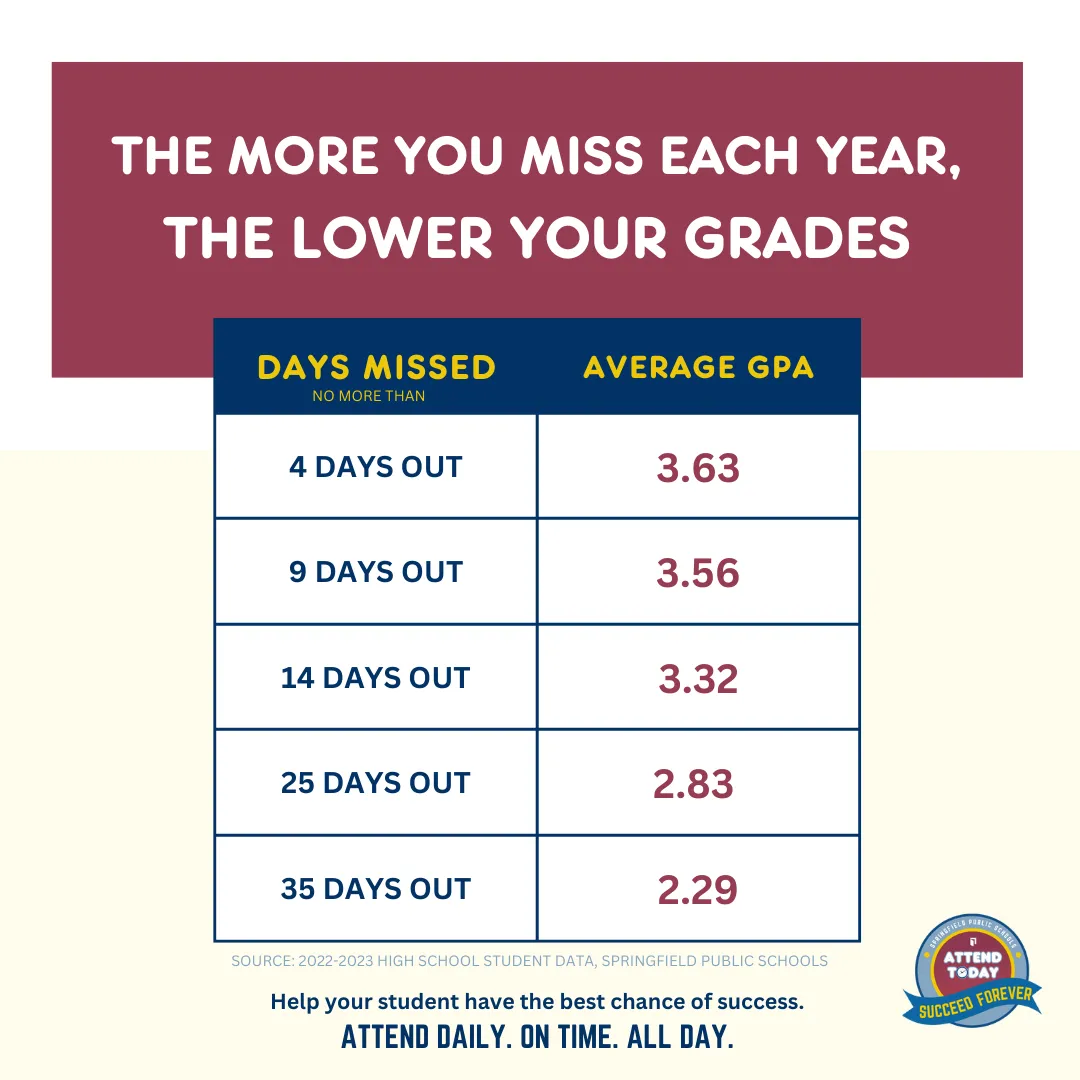
    A graphic shows how prolonged absences correlate to potential impacts on student GPAs.

    A social media graphic from Springfield Public Schools shows how prolonged absences correlate to potential impacts on student GPAs.

    Permission granted by Springfield Public Schools


    Don’t sweat the pushback

    Shifting a community’s mindset isn’t without its hiccups, however. If your messaging is working, you should expect to receive pushback, the Springfield officials told AASA conference attendees.

    “Because it was consistent, because it was bold, and because we were holding people accountable, we heard quite a bit of feedback,” Hall said.

    Source link

  • This week in 5 numbers: Harvard comes under scrutiny of Trump administration

    This week in 5 numbers: Harvard comes under scrutiny of Trump administration

    We’re rounding up recent stories, from one Ivy League university facing a multibillion-dollar federal review to another losing its president in under a year.

    Source link

  • Education Department plans to propose regulatory changes to student aid programs

    Education Department plans to propose regulatory changes to student aid programs

    This audio is auto-generated. Please let us know if you have feedback.

    The U.S. Department of Education plans to propose changes to student aid regulations, including those governing the Public Service Loan Forgiveness Program and two income-driven repayment plans, it announced Thursday. 

    Under a process called negotiated rulemaking, the Education Department intends to bring together representatives from different factions of the higher education sector to hash out the details of new regulations

    If the representatives reach consensus on new policies, the negotiated rulemaking process requires the Education Department to adopt their regulatory language in its proposal, except in limited circumstances. If negotiators don’t reach agreement, however, the agency is free to write its own rules. 

    Before that process begins, the Education Department said it will seek public feedback on “deregulatory ideas” for Title IV student aid programs. 

    This process will focus on how the Department can rightsize Title IV regulations that have driven up the cost of college and hindered innovation,” Acting Under Secretary James Bergeron said in a statement. “Not only will this rulemaking serve as an opportunity to identify and cut unnecessary red tape, but it will allow key stakeholders to offer suggestions to streamline and improve federal student aid programs.”

    Part of the negotiated rulemaking process will focus on the Public Service Loan Forgiveness program. PSLF, enacted in 2007 by President George W. Bush, forgives the student loan balances of borrowers who make 10 years of payments and hold public service jobs, such as working for the government or a nonprofit. 

    The program has come under fire from President Donald Trump, who signed an executive order last month aiming to limit who is eligible. 

    The order alleges that the PSLF program has “misdirected tax dollars into activist organizations” and tells U.S. Education Secretary Linda McMahon to propose program revisions barring borrowers from receiving forgiveness if they work for organizations that “have a substantial illegal purpose.” 

    The directive also accused the program of providing premature debt relief to borrowers. The Biden administration temporarily relaxed PSLF rules to make it easier for borrowers to receive debt relief through the program, which had extremely high denial rates due to confusing eligibility requirements and chronic loan servicer issues

    Some groups have pushed back on the executive order, arguing that it’s an attempt to revoke student loan forgiveness eligibility for borrowers working for nonprofits with missions that the Trump administration doesn’t support. 

    In a statement, Mike Pierce, executive director of Student Borrower Protection Center, called the order “blatantly illegal and an all-out weaponization of debt intended to silence speech that does not align with President Trump’s MAGA agenda.” 

    The Education Department is also planning to review regulations for two income-driven repayment plans: Pay as You Earn and Income-Contingent Repayment. 

    The agency restored the ability for borrowers to enroll in these programs late last month after previously taking down the online application forms. The freeze on the programs came in response to an appeals court ruling blocking a Biden-era income-driven repayment plan — Saving on a Valuable Education. 

    The suspension of the plans drew a legal challenge from the American Federation of Teachers. The Education Department restored access to them less than a day after the union petitioned a judge for emergency intervention, according to a news release. 

    Plans for negotiated rulemaking come amid the Trump administration’s move to dismantle the Education Department and move its responsibilities to other agencies.

    For example, Trump said he plans to move the department’s student loan portfolio to the newly-downsized Small Business Administration. Both conservatives and liberals have expressed concern that the SBA won’t have the staff or expertise to perform the job. 

    Fully eliminating the Education Department would require congressional approval.

    Source link

  • Test yourself on this week’s K-12 news

    Test yourself on this week’s K-12 news

    This audio is auto-generated. Please let us know if you have feedback.

    How well did you keep up with this week’s developments in K-12 education? To find out, take our five-question quiz below. Then, share your score by tagging us on social media with #K12DivePopQuiz.

    Source link

  • Florida Atlantic Police Seek Immigration Enforcement Powers

    Florida Atlantic Police Seek Immigration Enforcement Powers

    Florida Atlantic University reportedly has a pending agreement with the federal government to allow its campus police department to question and detain individuals who are suspected of being in the U.S. without legal authorization, The Florida Phoenix reported.

    The public university located in Boca Raton is a Hispanic-serving institution.

    If FAU police acquire immigration enforcement authority, the university would seemingly be the first in the nation to deputize campus cops as federal enforcement agents, the Phoenix noted.

    However, it appears that all other Florida institutions with sworn police departments will follow FAU’s lead to comply with a February directive from Gov. Ron DeSantis requiring state law enforcement agencies to enter into an agreement “to execute functions of immigration enforcement within the state” so “deportations can be carried out more efficiently.”

    “All state law enforcement agencies are expected to follow the governor’s Feb. 19 directive on working U.S. Immigration and Customs Enforcement,” FAU spokesperson Joshua Glanzer wrote to Inside Higher Ed. “This includes FAUPD and other state university police departments.”

    The move comes after Florida Atlantic hired former GOP lawmaker Adam Hasner to be president in February. Hasner, who once boasted of being “the most partisan Republican in Tallahassee,” served in the Florida House of Representatives from 2002 to 2010. Prior to taking the top job at FAU, Hasner was an executive at the GEO Group, a for-profit prison company. 

    The GEO Group currently runs more than a dozen U.S. Immigration and Customs Enforcement detention centers in California, Florida, Texas and various other states, according to its website.

    Hasner’s history with the GEO Group was a matter of contention for students and others during the hiring process; some raised objections during public forums about his for-profit prison past. Other critics expressed concerns about his lack of administrative experience in higher education.

    Source link

  • Don’t Give Trump Student, Faculty Names, Nationalities

    Don’t Give Trump Student, Faculty Names, Nationalities

    The American Association of University Professors is warning college and university lawyers not to provide the U.S. Education Department’s Office for Civil Rights the names and nationalities of students or faculty involved in alleged Title VI violations.

    The AAUP’s letter comes after The Washington Post reported last week that Education Department higher-ups directed OCR attorneys investigating universities’ responses to reports of antisemitism to “collect the names and nationalities of students who might have harassed Jewish students or faculty.” The department didn’t respond to Inside Higher Ed’s requests for comment Thursday.

    In a 13-page Wednesday letter to college and university general counsels’ offices, four law professors serving as AAUP counsel wrote that higher education institutions “are under no legal compulsion to comply.” The AAUP counsel further urged them “not to comply, given the serious risks and harms of doing so”—noting that the Trump administration is revoking visas and detaining noncitizens over “students’ and faculty members’ speech and expressive activities.” The administration has targeted international students and other scholars suspected of participating in pro-Palestinian advocacy.

    Title VI of the federal Civil Rights Act of 1964 prohibits discrimination based on, among other things, shared ancestry, which includes antisemitism. But the AAUP counsel wrote that “Title VI does not require higher education institutions to provide the personally identifiable information of individual students or faculty members so that the administration can carry out further deportations.”

    And Title VI investigations, they wrote, “are not intended to determine whether the students and faculty who attend these schools have violated any civil rights laws, let alone discipline or punish students or faculty.” They wrote that investigations are instead “intended to determine whether the institution itself has discriminated.”

    Providing this information to the federal government may violate the First Amendment rights of those targeted, plus the Family Educational Rights and Privacy Act and state laws, they wrote, adding that this information shouldn’t be turned over without “clear justification for the release of specific information related to a legitimate purpose in the context of a particular active investigation.”

    Source link

  • L.A. Community Colleges, CSUs Partner on Nursing Initiative

    L.A. Community Colleges, CSUs Partner on Nursing Initiative

    After tussling over proposed legislation to allow community colleges to offer a bachelor’s of nursing degree, Los Angeles County’s 19 community colleges and the California State University system are working together to tackle local nursing shortages. The partnership, spearheaded by Compton College, may signal a new phase of cooperation between the two systems.

    The Nursing 2035 Initiative aims to foster collaboration between community colleges, the CSU system and other stakeholders; conduct research; and devise strategies to graduate more registered nurses in the region over the next decade. The project also includes the Los Angeles Economic Development Corporation, the Department of Economic Opportunity with the County of Los Angeles and California Competes, an organization focused on higher ed and workforce development in the state.

    Keith Curry, president of Compton College, said the need for more nurses in the region is dire. Lightcast, a labor market analytics firm, projected 6,454 job openings for registered nurses in Los Angeles County annually through 2035, but degree-completion data from 2023 shows local colleges only produced 5,363 graduates with relevant degrees that year.

    Curry described a nearby medical clinic’s emergency room as “flooded” with patients at the same time aspiring nurses face barriers to entering the profession, such as vying for limited spots in nursing programs. Programs, meanwhile, struggle to grow because of challenges with retaining nursing faculty, who can find better wages working in hospitals, and competition for scarce clinical placements.

    The goal is “really trying to address health disparities in the community I’m from, and nursing is just another one of those issues that we have to address,” Curry said.

    Teamwork After Tensions

    The move comes after Gov. Gavin Newsom encouraged more CSU–community college partnerships on nursing last year after he vetoed two bills that would have allowed some community colleges to offer B.S.N. programs as part of a pilot program.

    At the time, community college leaders argued that expanding their nursing offerings beyond associate degrees would make nursing education more affordable and combat nurse shortages in the state. But CSU leaders opposed the legislation, countering that the new programs would be duplicative and force the CSU’s existing programs to compete for resources, like clinical placements. (The two systems have also cyclically battled over community college baccalaureate degrees since the state allowed them a decade ago.)

    Newsom came down on the CSUs’ side.

    “All segments of higher education should continue to focus on building these programs together,” he wrote in one of his veto messages, “and I am concerned this bill could inadvertently undermine that collaboration.”

    The initiative is an attempt to do just that, Curry said.

    “It’s not us versus them,” he said. “It’s about how can we partner together to solve a problem. So, I felt that CSU has to be the table.”

    Jose Fierro, president of Cerritos College and co-chair of the Los Angeles Regional Consortium, a coalition of L.A. County’s 19 colleges, said he and other community college leaders were “disappointed” by Newsom’s rejection of community college B.S.N. degrees because he felt like they would help his place-bound students. He said his campus is nine miles on average from local universities.

    Students “may not be within driving distance because they would have to uproot their families, or because of the high cost of housing, they wouldn’t be able to move to a different city to be able to access these programs,” he said.

    At the same time, he believes the collaborative approach will benefit students.

    “We are bringing county representatives, hospital representatives, state officials, California State and community colleges to look at our programs and our shortage of nurses in a comprehensive manner,” to think about “how can we work together to meet the needs of the community?”

    An Example for Others

    Some nursing partnerships between community colleges and CSUs already exist. For example, California State University, Northridge, has an A.D.N.-B.S.N. Community College Collaborative Program, which allows students earning nursing associate degrees at partnering community colleges to earn a B.S.N. on an accelerated timeline. A program at Cal State Long Beach also allows nursing associate degree students to take B.S.N. classes while in community college.

    Nathan Evans, deputy vice chancellor for academic and student affairs and chief academic officer at the CSU Office of the Chancellor, believes the Nursing 2035 Initiative can serve as an example of how community college and CSU leaders can strategically confront local nursing shortages together.

    “The boundaries of our institutions don’t have to be what they were in the past,” he said. “Our hope is that this is a model of what collaboration looks like between our segments and there’s a lot less friction in terms of the student experience, that there are clear road maps for students, particularly in the nursing field.”

    As a first step, the group plans to research the region’s nursing education and workforce and release a report in the fall with policy and budget recommendations on how to expand nursing programs in the area. The goal is to work on the recommendations through 2035.

    Evans said the initiative is “using data to really drive a needs assessment and then allow that to lead us to, what are the ways we collectively can respond?”

    The hope is that process leads to new, innovative partnerships, said Fierro. For example, he can imagine CSUs offering B.S.N. programs on community college campuses, or partnering with community colleges on collaborative programs, so that students who struggle to commute to universities because of work or family obligations have more options.

    “To me, the main objective is to ensure that we bring that value to the local communities,” he said, “regardless of whose name is issuing the diploma.”

    Source link

  • Trade War Squeezes Science Out of Canadian Election Campaign

    Trade War Squeezes Science Out of Canadian Election Campaign

    Mark Carney’s whirlwind start as Canadian prime minister has seen his party surge in the polls against the backdrop of Donald Trump’s threats but has provided little time to flesh out the newcomer’s policies on higher education and science.

    When Justin Trudeau announced his resignation in January, the Liberal Party was trailing the Conservatives by more than 20 percentage points and was only narrowly ahead of the New Democratic Party.

    But since Trump started a trade war with what he has belittled as his “51st state,” the Liberals have rebounded remarkably in the polls and are now favorites to retain power in the snap election on April 28.

    Although the federal government is the primary player when it comes to investments in research and innovation in Canada, higher education has seldom been a major issue in national elections, said Glen Jones, professor of higher education at the University of Toronto.

    “Not surprisingly, the entire election is focusing on the trade war that has been initiated by President Trump,” he said.

    “The Carney platform, at least to date, has largely been about providing support and stability to individuals and industries that will be directly impacted by tariffs.”

    Carney has been focusing primarily on positioning himself as the leader best able to respond to the new, evolving relationship with the U.S.—a strategy that seems to be working, added Jones.

    Conservative leader Pierre Poilievre’s echoes of Trump—and his promises to “defund wokeism and fight antisemitism” in universities—have been a disaster for his party since the start of the year, particularly when contrasted with Carney’s “elbows up” mantra.

    Sarah Laframboise, executive director of Evidence for Democracy, a science policy nonprofit organization, said Carney’s background—as a former United Nations special envoy for climate action—suggests that he will remain committed to his views on climate policy, and that his pro-economic growth platform could translate into targeting investments in research, innovation and artificial intelligence.

    “We will also likely see an increased focus on defense-related research, particularly around Arctic security and collaborative defense technologies. However, it remains unclear if this will extend to basic research,” said Laframboise.

    “Additionally, his restrictive stance on international student admissions could have significant consequences for Canada’s higher education sector.”

    It remained to be seen what impact accusations of plagiarism aimed at Carney dating from his time at the University of Oxford will have on the race.

    Carney, who has never previously held elected office, earned a master’s degree and a doctorate in the U.K. before later going on to become governor of the Bank of England from 2013 to 2020.

    Marc Johnson, professor of biology at Toronto’s Mississauga campus, said Trudeau made important investments in science funding during the last federal budget, but it was only a “partial investment that stanched the bleeding” from previous mistakes.

    “The investment fell short of reinvigorating funding for science, tech and the innovation sector,” he said.

    “If the Carney Liberals are elected to power, I think we can expect the previous government’s investment to stay … but will they double down on that investment?”

    Having examined Carney’s website—which mentions artificial intelligence 11 times, innovation once and science not at all—Johnson said the prime minister’s priorities in future funding seemed fairly clear.

    With either Carney or Poilievre in charge, he said the next government will have an “amazing opportunity” to invest in science, technology and innovation.

    “Given the USA’s deep cuts to science funding, Canada has the opportunity to leap forward as a global leader in strategic areas, but only if we increase our investment in science, training, technology and mobilization of the innovations that come from these activities.”

    Source link

  • Education Department Plans to Review Rules for PSLF, IDR

    Education Department Plans to Review Rules for PSLF, IDR

    The Education Department will kick off the lengthy rule-making process later this month with a pair of hearings. 

    The department is planning to consider regulatory changes to the Public Service Loan Forgiveness program, income-driven repayment plans and “other topics that would streamline current federal student financial assistance programs,” according to a Federal Register notice.

    Hearings are just the first step in negotiated rule making, which also includes convening an advisory committee to weigh in on regulatory changes over a series of meetings, proposing draft regulations and then a public comment period. Historically, the whole process takes at least a year.

    The Federal Register notice doesn’t say what specific changes the department is seeking to make aside from “redefining definitions of a qualifying employer.” The department also is planning to revise the regulations for Pay as You Earn and income-contingent repayment plans.

    In early March, President Donald Trump directed the Education Department to change which employers or companies are eligible for the Public Service Loan Forgiveness program. Under the executive order, activities that would disqualify a nonprofit could include aiding or abetting violations of federal immigration laws or what the government considers illegal discrimination. Advocates and Democrats decried the order as “un-American” and argued that it would disrupt borrowers’ lives.

    The department will hold an in-person hearing April 29 and a virtual hearing May 1. More information is available here.

    “This process will focus on how the Department can rightsize Title IV regulations that have driven up the cost of college and hindered innovation,” said Acting Under Secretary James Bergeron in a news release. Bergeron is also leading the Office of Federal Student Aid. (Title IV of the Higher Education Act authorizes federal financial aid programs.)

    He added that “not only will this rulemaking serve as an opportunity to identify and cut unnecessary red tape, but it will allow key stakeholders to offer suggestions to streamline and improve federal student aid programs.”

    Source link

  • UVM, JMU, N.C. State, UW-Milwaukee and More

    UVM, JMU, N.C. State, UW-Milwaukee and More

    Shantay Bolton, executive vice president of administration and finance and chief business officer at Georgia Tech, has been named president of Columbia College Chicago, effective July 1.

    Laura Crawley, vice president of mission, engagement and innovation at Lenoir-Rhyne University in North Carolina, will become president of Bethany College in Kansas, effective May 1.

    Farouk Dey, vice provost for integrative learning and life design at Johns Hopkins University, has been appointed president of Palo Alto University, effective July 1.

    William Downs, president of Gardner-Webb University in North Carolina, has been named president of Campbell University, also in North Carolina, beginning July 1.

    Charles Edmonds, currently executive vice president of Lycoming College, will become president of the Pennsylvania-based institution on July 1.

    Louise Fincher, currently the interim president of Emory & Henry University in Virginia, has been named president of the institution.

    Thomas Gibson, chancellor of the University of Wisconsin–Stevens Point, has been named the next chancellor of the University of Wisconsin–Milwaukee, beginning on or around July 1.

    Michael Hill, president of Chautauqua Institution in New York, has been appointed president of Virginia’s Randolph-Macon College, effective Aug. 1.

    Kevin Howell, chief external affairs officer at University of North Carolina Health and the UNC School of Medicine, has been named chancellor of North Carolina State University, effective May 5.

    Mark Johnson, director of the doctor of ministry program at New Orleans Baptist Theological Seminary, has been elected president of Louisiana Christian University.

    Michael Kotlikoff, interim president of Cornell University since last July, has been named the institution’s president, effective immediately.

    Dean Pribbenow, vice president for academic affairs and dean of the faculty at Elmhurst University in Illinois, has been appointed president of Millikin University, also in Illinois, effective July 1.

    Sean Ryan, senior vice president of administration, strategic initiatives and trustee affairs at Bellarmine University in Kentucky, will become president of Anna Maria College in Massachusetts, effective July 1.

    James Schmidt, chancellor of the University of Wisconsin–Eau Claire, has been named president of James Madison University in Virginia, effective July 1.

    Claire Shipman, co-chair of the Columbia University Board of Trustees, has been named acting president of the university, effective immediately.

    Marlene Tromp, president of Boise State University in Idaho, will become president of the University of Vermont, effective this summer.

    Source link