Author: admin

  • Education Department Plans to Review Rules for PSLF, IDR

    Education Department Plans to Review Rules for PSLF, IDR

    The Education Department will kick off the lengthy rule-making process later this month with a pair of hearings. 

    The department is planning to consider regulatory changes to the Public Service Loan Forgiveness program, income-driven repayment plans and “other topics that would streamline current federal student financial assistance programs,” according to a Federal Register notice.

    Hearings are just the first step in negotiated rule making, which also includes convening an advisory committee to weigh in on regulatory changes over a series of meetings, proposing draft regulations and then a public comment period. Historically, the whole process takes at least a year.

    The Federal Register notice doesn’t say what specific changes the department is seeking to make aside from “redefining definitions of a qualifying employer.” The department also is planning to revise the regulations for Pay as You Earn and income-contingent repayment plans.

    In early March, President Donald Trump directed the Education Department to change which employers or companies are eligible for the Public Service Loan Forgiveness program. Under the executive order, activities that would disqualify a nonprofit could include aiding or abetting violations of federal immigration laws or what the government considers illegal discrimination. Advocates and Democrats decried the order as “un-American” and argued that it would disrupt borrowers’ lives.

    The department will hold an in-person hearing April 29 and a virtual hearing May 1. More information is available here.

    “This process will focus on how the Department can rightsize Title IV regulations that have driven up the cost of college and hindered innovation,” said Acting Under Secretary James Bergeron in a news release. Bergeron is also leading the Office of Federal Student Aid. (Title IV of the Higher Education Act authorizes federal financial aid programs.)

    He added that “not only will this rulemaking serve as an opportunity to identify and cut unnecessary red tape, but it will allow key stakeholders to offer suggestions to streamline and improve federal student aid programs.”

    Source link

  • UVM, JMU, N.C. State, UW-Milwaukee and More

    UVM, JMU, N.C. State, UW-Milwaukee and More

    Shantay Bolton, executive vice president of administration and finance and chief business officer at Georgia Tech, has been named president of Columbia College Chicago, effective July 1.

    Laura Crawley, vice president of mission, engagement and innovation at Lenoir-Rhyne University in North Carolina, will become president of Bethany College in Kansas, effective May 1.

    Farouk Dey, vice provost for integrative learning and life design at Johns Hopkins University, has been appointed president of Palo Alto University, effective July 1.

    William Downs, president of Gardner-Webb University in North Carolina, has been named president of Campbell University, also in North Carolina, beginning July 1.

    Charles Edmonds, currently executive vice president of Lycoming College, will become president of the Pennsylvania-based institution on July 1.

    Louise Fincher, currently the interim president of Emory & Henry University in Virginia, has been named president of the institution.

    Thomas Gibson, chancellor of the University of Wisconsin–Stevens Point, has been named the next chancellor of the University of Wisconsin–Milwaukee, beginning on or around July 1.

    Michael Hill, president of Chautauqua Institution in New York, has been appointed president of Virginia’s Randolph-Macon College, effective Aug. 1.

    Kevin Howell, chief external affairs officer at University of North Carolina Health and the UNC School of Medicine, has been named chancellor of North Carolina State University, effective May 5.

    Mark Johnson, director of the doctor of ministry program at New Orleans Baptist Theological Seminary, has been elected president of Louisiana Christian University.

    Michael Kotlikoff, interim president of Cornell University since last July, has been named the institution’s president, effective immediately.

    Dean Pribbenow, vice president for academic affairs and dean of the faculty at Elmhurst University in Illinois, has been appointed president of Millikin University, also in Illinois, effective July 1.

    Sean Ryan, senior vice president of administration, strategic initiatives and trustee affairs at Bellarmine University in Kentucky, will become president of Anna Maria College in Massachusetts, effective July 1.

    James Schmidt, chancellor of the University of Wisconsin–Eau Claire, has been named president of James Madison University in Virginia, effective July 1.

    Claire Shipman, co-chair of the Columbia University Board of Trustees, has been named acting president of the university, effective immediately.

    Marlene Tromp, president of Boise State University in Idaho, will become president of the University of Vermont, effective this summer.

    Source link

  • Trump Administration to Block Brown’s Federal Grants

    Trump Administration to Block Brown’s Federal Grants

    The Trump administration plans to block $510 million in federal contracts and grants for Brown University in retaliation for the university’s alleged failure to address antisemitism on campus, The New York Times reported.

    That makes Brown the fifth university to face such consequences, after Columbia, Penn, Harvard and Princeton.

    The Daily Caller first reported the news, writing that “an administration official” said Brown’s grants “would be paused” while the government conducts a review of the university’s response to claims of antisemitism.

    Brown provost Frank Doyle sent an email to campus leaders Thursday, acknowledging “troubling rumors emerging about federal action on Brown research grants,” but noting that they had received “no information to substantiate any of these rumors,” the Times reported.

    Brown was among the 60 higher ed institutions to receive a letter last month from the Office for Civil Rights warning of “potential enforcement actions” if they failed to comply with federal antidiscrimination law.

    After Columbia became the first institution to have its grants frozen, Brown president Christina Paxson issued a statement reiterating the university’s commitment to upholding both federal law and academic freedom. She noted that if Brown were prevented from performing “essential academic and operational functions, we would be compelled to vigorously exercise our legal rights to defend these freedoms, and true to our values, we would do so with integrity and respect.”

    On Thursday night, leaders of the Brown Corporation and of Brown’s Jewish community, released a statement praising Brown’s commitment to Jewish students.

    “Brown University is home to a vibrant Jewish community that continues to flourish with the steadfast support of the administration,” it read. “Amidst broader concerns about antisemitism on college campuses, Brown stands out as an inclusive environment where Jewish life is deeply integrated into campus culture.”

    Source link

  • Three-quarters of global study decisions determined by cost

    Three-quarters of global study decisions determined by cost

    International students are increasingly looking for affordable destinations and alternative programs rather than give up on study abroad due to increasing costs, a new ApplyBoard survey has shown.  

    While 77% of surveyed students ranked affordable tuition fees as the most important factor shaping study decisions, only 9% said they planned to defer their studies based on these concerns, according to a recent student survey from ApplyBoard edtech firm.  

    “Students weren’t planning to wait for things to change,” said ApplyBoard senior communications manager Brooke Kelly: “They’re considering new destinations, adjusting which programs they apply to, and accepting that they have to balance work with study, but they’re still planning to study abroad,” she maintained.  

    Just over one in four students said they were considering different study destinations than originally planned, with Denmark, Finland, Nigeria and Italy the most popular emerging destinations.  

    Additionally, 55% of students said they would have to work part-time to afford their study abroad program.  

    After affordability, came employability (57%), career readiness (49%), high-quality teaching (47%), and program reputation (45%), as factors shaping student decision-making.  

    With students increasingly thinking about work opportunities, software and civil engineering topped students’ career choices, with nursing as the second most popular field. Tech fields including IT, cybersecurity, and data analysis also showed strong interest. 

    What’s more, interest in PhD programs saw a 4% rise on the previous year, while over half of students were considering master’s degrees, indicating that students are increasingly prioritising credentials and post-study work opportunities.  

    [Students are] considering new destinations, adjusting which programs they apply to, and accepting that they have to balance work with study, but they’re still planning to study abroad

    Brooke Kelly, ApplyBoard

    The study surveyed over 3,500 students from 84 countries, with the most represented countries being Nigeria, Ghana, Canada, Pakistan, Bangladesh and India.  

    Given its share of international students, it should be noted that China is absent from the top 10 most represented countries.  

    As students’ priorities shift and currencies fluctuate, “diversity will be key to mitigate against increased volatility and to ensure campuses remain vibrant with students from all around the world,” said Kelly.  

    Meanwhile, institutions should increase communication about scholarships and financial aid, offer more hybrid learning experiences and highlight programs on different timelines such as accelerated degrees, she advised.  

    While alternative markets are on the rise, 65% of respondents said they were only interested in studying in one of the six major destinations, with Canada followed by the US, UK, Australia, Germany and Ireland, in order of popularity.  

    Despite Canada’s international student caps, the largest proportion of students said they were ‘extremely’, ‘very’ or ‘moderately’ interested in the study destination, highlighting its enduring appeal among young people.  

    While stricter controls on post study work were implemented in Canada last year, in a rare easing of policies, the IRCC recently said that all college graduates would once again be eligible for post study work.  

    This change, combined with the fact that international students can still be accompanied by their dependants while studying in Canada, is likely to have contributed to it maintaining its attractiveness, according to Kelly.  

    Source link

  • Building Bridges: Enhancing employability through practically-based higher education

    Building Bridges: Enhancing employability through practically-based higher education

    In the last few weeks we have heard the worrying news that the number of young people aged 16 to 24 not in education, employment or training (NEET) in the UK is close to one million. This is almost 300,000 higher than the same period in 2021 when the UK was contending with the scarred job market after Covid-19.

    The reasons for this trend are multi-faceted, including factors such as mental health issues and insecure and poor employment opportunities. However, in the face of a difficult and competitive job market, universities have their role to play in bridging this divide between higher education and the workplace.

    The need for innovative approaches to bridge this divide by enhancing graduate employability and addressing employer demands for work-ready graduates has never been more pressing. Recent research by the Edge Foundation, in collaboration with UCL’s Institute of Education, sheds light on the transformative potential of practically-based higher education models.

    The research took a case study approach using qualitative methods, looking at two post-92 higher education institutions in England, which included collecting empirical data using semi-structured interviews with a range of stakeholders from the two universities, including members of the senior leadership teams, teaching staff, other professionals and students. In this blog, I will go on to discuss some of the key findings from this research, including some of the challenges and opportunities for universities.

    Supporting employability through collaboration

    The creation of new staff roles has been pivotal in driving the employability agenda. These roles focus on developing opportunities such as placements, mentorships, and employer engagement, while traditional academic roles are evolving to integrate practical, work-focused elements. This holistic approach ensures that curricula are not only theoretical but also aligned with real-world applications.

    Industry partnerships play a crucial role in this effort. By involving industry advisors in curriculum design and creating spaces for students to engage directly with professionals through projects and networking, universities are building a meaningful ecosystem that bridges theory and practice. These collaborations enhance students’ employability and foster sustainable partnerships between education and industry.

    Creating effective learning spaces

    Diversifying learning spaces, both formal and informal, is important to ensure that students are not only taught subject-specific expertise but also equipped with the skills to effectively apply such knowledge in real-world contexts. From practical lab work and virtual simulations to client-facing projects and digital tools, these approaches provide students with hands-on, career-relevant skills. Broader assessment methods – like portfolio work, project-based evaluations, and even film development – align better with employer expectations, allowing students to showcase critical thinking, creativity and applied knowledge.

    Students highlighted how these methods built their confidence – often cited as a key attribute for career success. Exposure to professionals through guest lectures, career fairs and mentorship programmes was particularly impactful in empowering students to navigate the complexities of their future careers.

    In the case study universities, confidence building and the development of transferable skills were further integrated into the curriculum through interpreting and tailoring practice to the sector that is relevant to individual students. Therefore, all courses were developed and updated in line with students’ ‘pathway to professionalism’.

    Yet this is manifested differently for different disciplines to ensure it is relevant and closely links the theory to practice. For example, in the business school at one of the case study universities, students establish a LinkedIn profile and begin to form professional networks through it whilst at university.

    By contrast, the professional landscape exists very differently in arts and media, with professional networks being established in different ways. Students in arts are taught the skill of networking in person and conversational skills. Activities in this discipline have included practice dinner parties with the aim to collect others’ business cards. The activities in these two examples are vastly different, but both help build the social capital of the student, which has the most currency for their industry.

    The challenges and opportunities ahead

    While we witnessed in our case study universities a promising shift towards a practical and collaborative model, challenges remain. Employer engagement, for example, can be fragmented when universities rely on individual academic links without coordinated efforts. Listening to employers as equal partners and ensuring mutual benefit is critical for sustained collaboration.

    Universities must also balance top-down initiatives with bottom-up innovation, ensuring that work placements and experiences are meaningful and adaptable. Structured dialogue and collaboration between all stakeholders—students, educators and industry partners—are vital to refining these opportunities.

    A vision for the future

    As the job market evolves, the traditional academic model must adapt to meet the demands of employers and the aspirations of students. Practically-based HE models offer a pathway to achieving this balance, ensuring that graduates are not only knowledgeable but also work-ready. In today’s dynamic and rapidly changing workplace, employability is no longer confined to the domain of careers service teams. Instead, it has become a strategic priority embedded across all disciplines and interwoven into teaching and learning. The findings shed light on how universities are reimagining employability as a broader part of their agenda, through fostering collaborations and creating innovative pathways between academia and the workplace.

    Furthermore, this research explores how universities can integrate theory and practice to better prepare graduates for the workforce. By fostering collaboration between academia and industry, these models not only enhance employability but also empower students with the confidence and skills needed to thrive in a dynamic job market. As students pursue diverse goals through their education, universities are tasked with striking a balance between career-focused preparation and academic enrichment. By embedding employability throughout the curriculum and fostering collaboration across industries, higher education institutions can empower students with the skills, confidence, and connections they need to succeed.

    Source link

  • Can We Teach Talent? How Mindsets Can Foster Entrepreneurial Success – Faculty Focus

    Can We Teach Talent? How Mindsets Can Foster Entrepreneurial Success – Faculty Focus

    Source link

  • Can We Teach Talent? How Mindsets Can Foster Entrepreneurial Success – Faculty Focus

    Can We Teach Talent? How Mindsets Can Foster Entrepreneurial Success – Faculty Focus

    Source link

  • Building a public transport agenda for commuter students

    Building a public transport agenda for commuter students

    If you have been to Greater Manchester in the last few years, you will have noticed that more and more yellow buses have started to appear.

    The Bee Network fully launched across the region on the 5th January 2025 – the yellow bus takeover is now complete.

    When all buses in the region became a part of the Bee Network – the integrated transport network for Greater Manchester – this was a significant moment for the city’s devolution journey. It became the first place in England, outside of London, to have buses back under public control.

    One of the Greater Manchester Student Partnership’s (GMSP) priorities is to improve students’ experience of transport across the region, the launch of the Bee Network is a key opportunity to make that happen.

    Institutions often define commuters differently and in Greater Manchester we already have a large proportion of students “traditionally” commuting. However traditional residential students are living further away from campus due to rising costs and are more reliant on public transport to get to classes.

    The GMSP has been thinking about how we can use the Greater Manchester Combined Authorities’ powers to support commuter students in their widest of definitions.

    A backdrop of devolution

    Since the coalition government of the early 2010s, devolution has been growing and Greater Manchester and the West Midlands have been the guinea pigs of the plan.

    Putting buses back under public control was a large part of the devolution deals and settlements, with the Bus Service Act 2017 being introduced so regions can take back control of buses.

    For context, in the 1980s bus travel in the UK was deregulated – anyone with a licence and a bus could run any bus service they wanted. The act allows Metro Mayors and in the future local authorities to franchise bus services. In doing so they can set up routes, tickets and costs for bus operators to bid for.

    Andy Burnham, the mayor of Greater Manchester, got the ball rolling on this quickly.

    In the 2024 general election, Labour had promised more devolved powers for regional mayors that have already been elected. In December, the government announced the Better Buses Bill which will give more powers to local authorities to own their own bus companies.

    Students use buses to get around their city but commuter students are not just reliant on buses, they are also reliant on trams and trains and other forms of transport.

    Building a student city

    The new bus fare cap rising will be a further strain on student cost of living and inevitably impact on student engagement on campus – for traditional commuters and residential students. The benefits of a mayor and devolved transport powers mean that isn’t the case here, fares are staying put at £2.

    As of last month, if you “tap in” on the tram and the bus with your contactless card, it all falls under the same ticket.

    This again is welcomed by GMSP, but this does not reduce the price of students who have to travel on both modes of public transport.

    This improves accessibility but not necessarily affordability.

    If they take multiple journeys a week on both a tram and a bus, it will cost £41. There is currently no student rate on trams or on the “tap in” system that is about to be introduced.

    From December 2026 until December 2028, the Bee Network will gain control of eight major commuter train lines. Greater Manchester could then become the best city for student public transport in the country, but only if Transport for Greater Manchester (TfGM), universities and student unions work together.

    Busy making promises

    The GMSP has been advocating for cheaper, more reliable transport with the mayor and TfGM.

    In 2022, officers from GMSP wrote to the mayor asking for a £1.50 bus single for all students. The mayor responded by saying that although he wanted to do something like this, until he had full control on the Bee Network, that would not be possible.

    In the mayor’s 2024 mayoral election manifesto, he announced at a mayoral hustings for students that he was to introduce a 18-21 monthly half price bus pass, bringing down the cost from £80 to £40.

    This was welcomed by GMSP to an extent, but we recognised that a lot of students, especially commuter students, do not fall into this category. And termly student tickets that are already on offer would work out cheaper for most students anyway.

    Since the Bee Network fully launched, we have seen no sign of this offer appearing.

    Student transport agenda

    The big question is, how can the universities, student unions and transport authorities work together to make life better for commuter students?

    Whilst we’re lucky in Greater Manchester to have a forum to meet with and discuss things like patronage, pricing and safety, getting all partners into the room is not as easy.

    We have big plans to make Greater Manchester the best place to be a student, and to do that we need to think big with things like creating a student living and staying strategy for the city region.

    This would bring together all these partners to create a long-term strategy for students in the city region, with one of themes being transport. Having these three partners working together is key for the success of any long-term transport strategy in the region.

    TfGM holds a lot of the power, including data on patronage and which routes students are using the most. Universities hold influence and potential financial influence, which could be beneficial for introducing new routes and discounting prices for students.

    Universities have a lot of data about students, especially on where they live, and that information could be used to target key routes for commuter students. And student unions are important as the voice of students.

    One of the mayor’s key aims for students in Greater Manchester is retaining talent. An element of this is making the Greater Manchester universities more attractive for potential students from Greater Manchester. If you want to make local universities more desirable for commuter students, improving the reliability, access and price of transport would go a very long way.

    Whilst Greater Manchester has a unique opportunity to improve the commuter student experience, more devolution is on its way. In the meantime, the more connections and collaborations that exist between local authorities, universities, student unions and transport providers, the better.

    Collaboration is key to making these ideas a reality and in building transport strategies in university towns and cities, commuter students need to be at the heart of decision making.


    This blog is part of our series on commuter students. Click here to see the other articles in the series.

    Source link

  • HESA has published full student data for 2023–24

    HESA has published full student data for 2023–24

    The 2023-24 HESA student data release was delayed by three rather than six months this year.

    We’re clearly getting better at dealing with the output (and the associated errors) of data collected through the HESA Data Platform. While there are not as many identified issues as in last year’s cycle the list is long and occasionally unnerving.

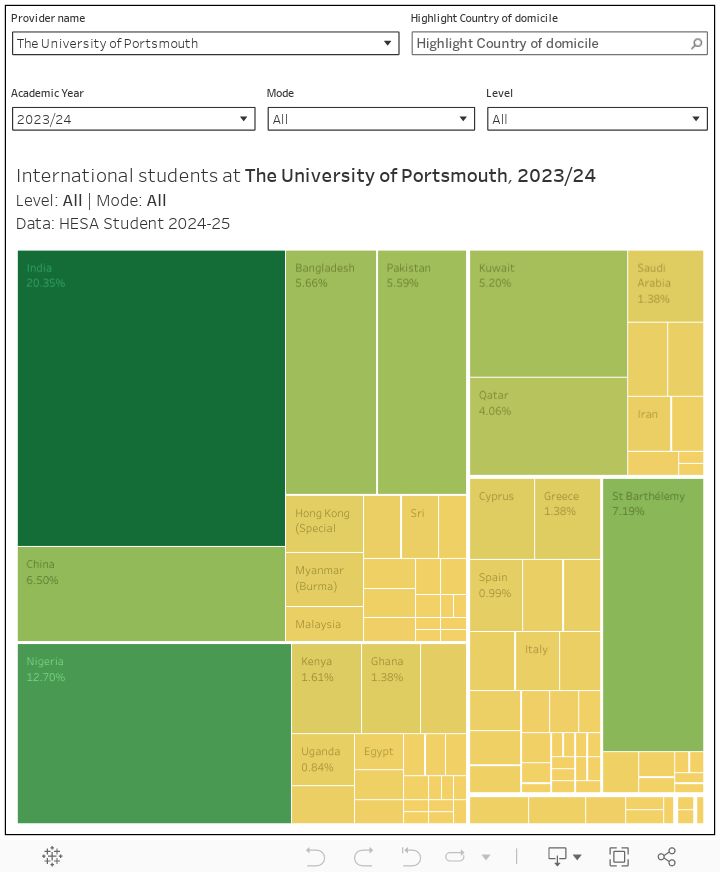
    Some represent a winding back from last year’s errors (we found 665 distance learning students at the University of Buckingham that should have been there last year), some are surprisingly big (the University of East London should have marked an extra 2,550 students as active), and some are just perplexing: the University of South Wales apparently doesn’t know where 1,570 students came from , the University of Portsmouth doesn’t actually have 470 students from the tiny Caribbean island of St Barthélemy.

    Access and participation

    It is surprising how little access and participation data, in the traditional sense, that HESA now publishes. We get an overview at sector level (the steady growth of undergraduate enrollments from the most deprived parts of England is notable and welcome), but there is nothing by provider level.

    [Full screen]

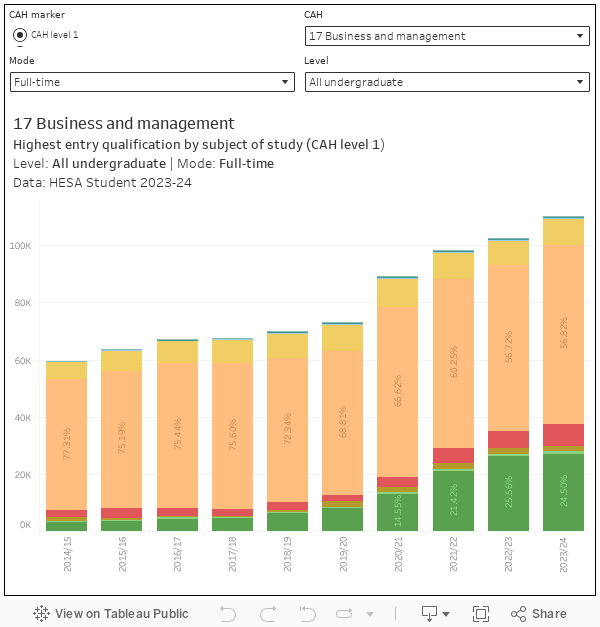
    One useful proxy for non-traditional students is entry qualifications. We get these by subject area – we learn that in 2025 a quarter of full time undergraduate business students do not have any formal qualifications at all.

    [Full screen]

    With the UK’s four regulators far from agreement as to what should be monitored to ensure that participation reflects potential rather than privilege, it’s not really worth HESA publishing a separate set of UK wide statistics. The closest we get is SEISA, which is now official statistics. I look forward to seeing SEISA applied to UK-domiciled students at individual providers, and published by HESA.

    Student characteristics

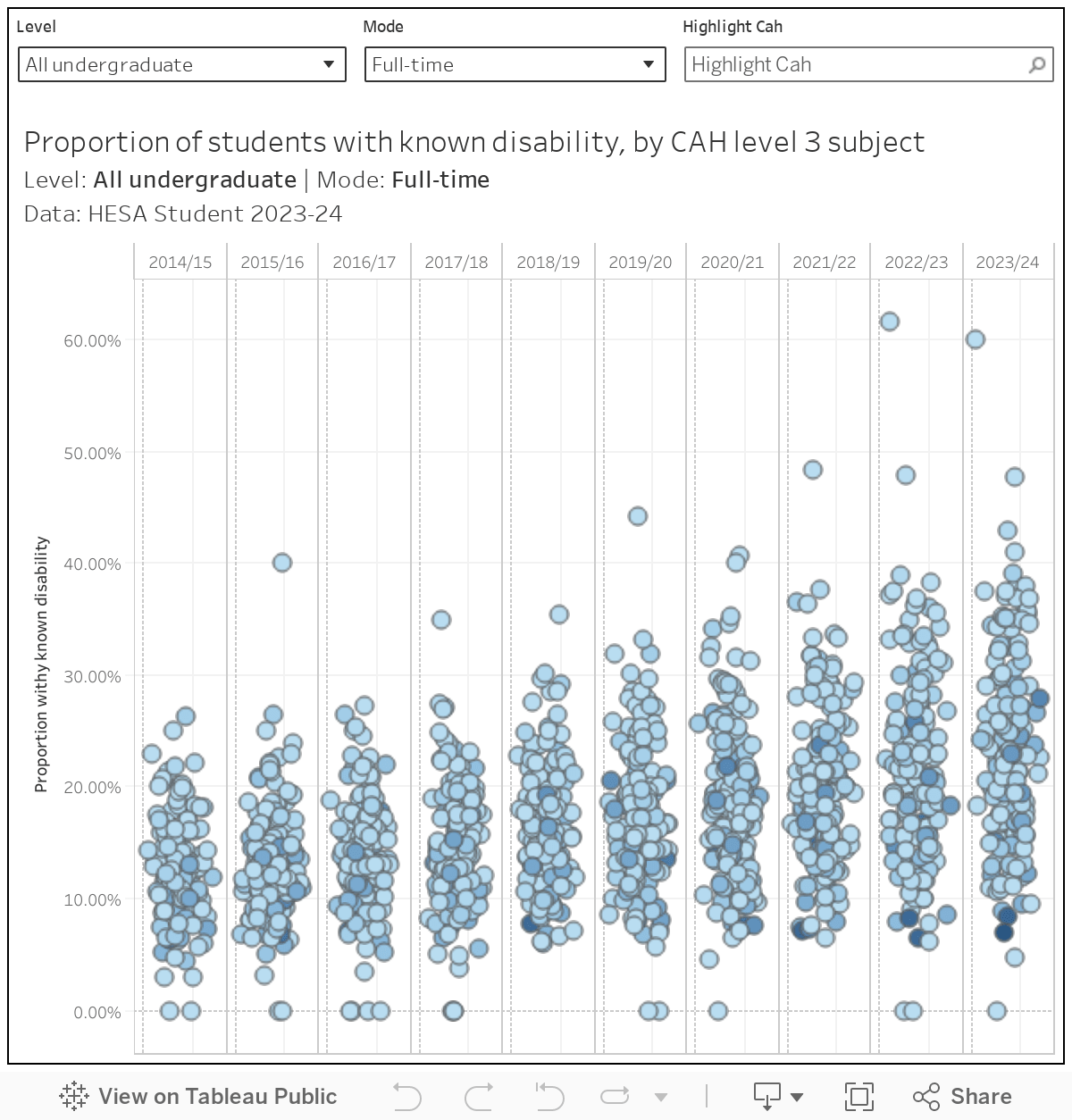
    We get by subject area data on disability (at a very general, “marker” – known disability – level) which I have plotted on a by year basis. The axis here is the proportion of students with a known disability – the colours show the total number of students. For me the story here is that creative subjects appear to attract students who disclose disabilities – art and creative writing in particular.

    [Full screen]

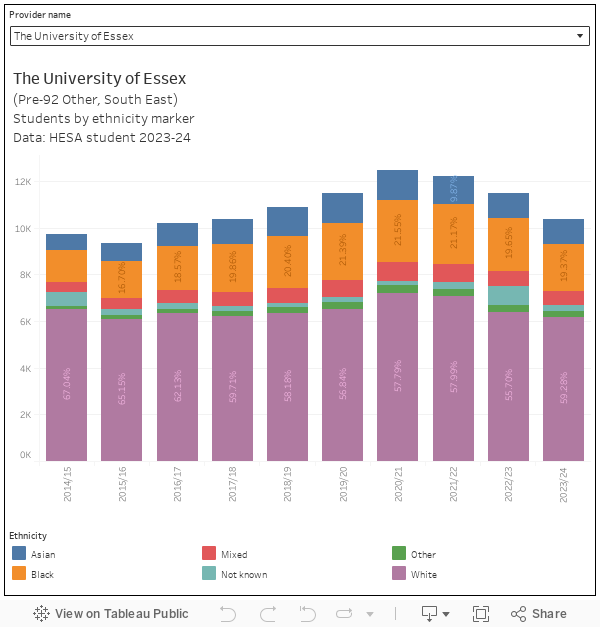
    I’ve also plotted ethnicity by provider, allowing you to see the ways in which the ethnic make up of providers has changed over time.

    [Full screen]

    Student domicile (UK)

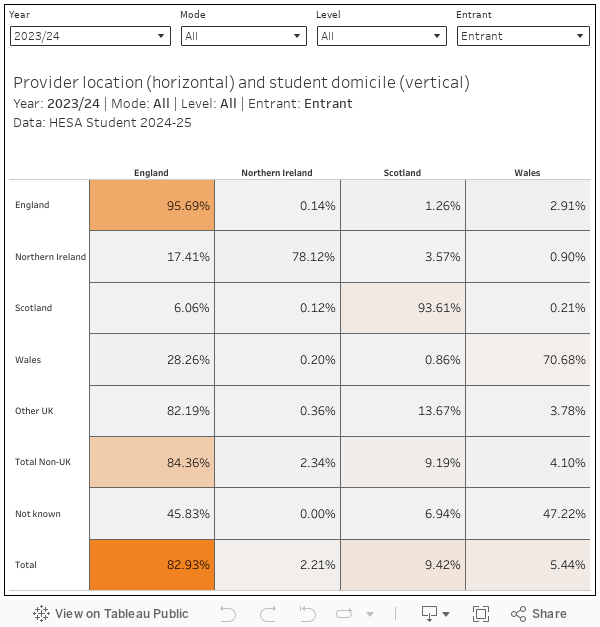
    UK higher education includes four regulated systems – one in each of the four nations. Although in the main students domiciled in a given nation study at providers based in that same nation, there is a small amount of cross-border recruitment.

    [Full screen]

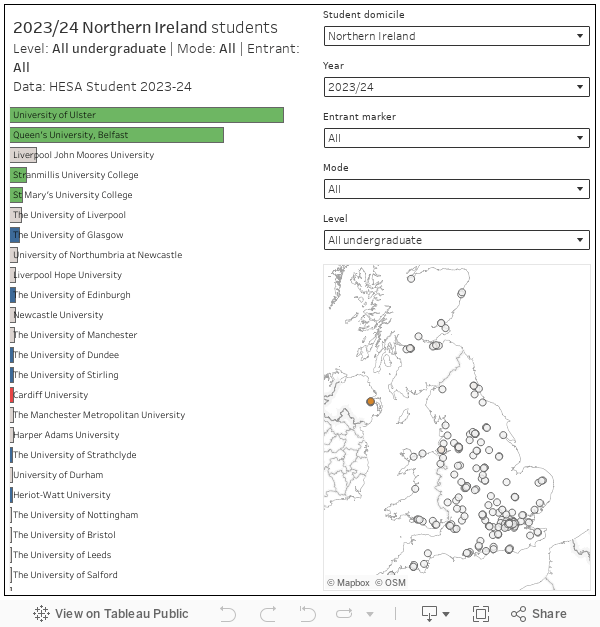
    Notably nearly three in ten Welsh students study at English providers, including more than a third of Welsh postgraduates. And two in ten Northern Irish students study in England. The concern is that if you move to study, you are less likely to move home – so governments in Wales and Northern Ireland (where there are student number controls) will be thinking carefully about the attractiveness and capacity of their respective systems to avoid a “brain drain”.

    Within these trends, particular providers have proven particularly efficient in cross-border recruitment. If you are a Northern Irish student studying in England chances are you are at Liverpool John Moores University, Liverpool, or Northumbria. If you are Welsh and studying in England your destination may well be UWE, Bristol, Chester – or again, Liverpool John Moores.

    There is a proximity effect – where students are crossing the border, they are likely to stay close to it – but also (if we look at Northern Ireland domiciled students looking at Glasgow or Newcastle) evidence of wider historic cultural links.

    [Full screen]

    Student domicile (international)

    Thinking about providers recruiting from Northern Ireland made me wonder about students from the Republic of Ireland – do we see similar links? As you might expect, the two larger providers in Northern Ireland recruit a significant share, but other winners include the University of Edinburgh and St Margaret’s. UCL has the biggest population among English providers.

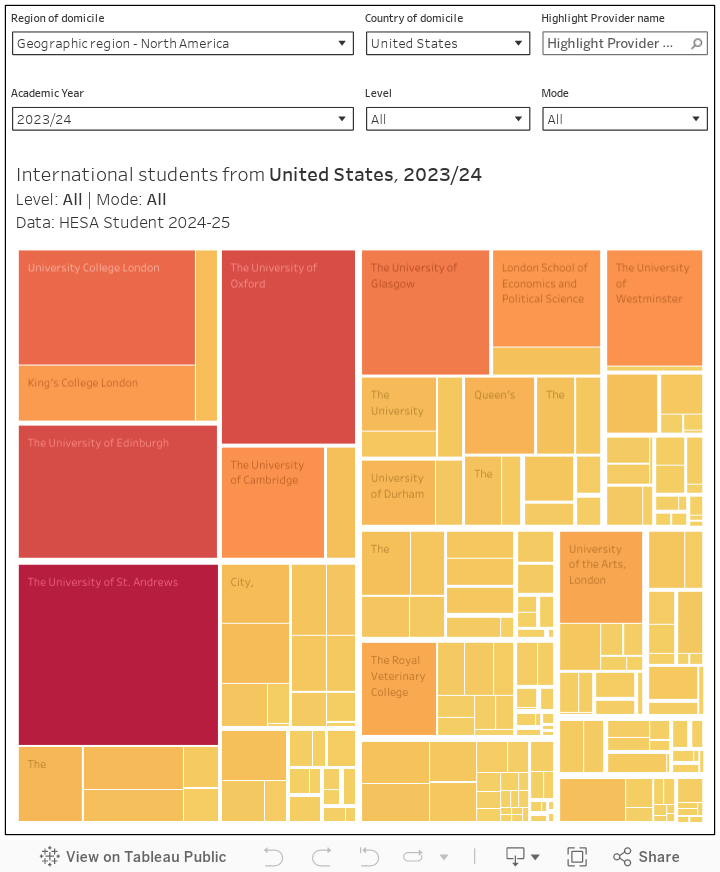
    You can use this chart to look at where students from any country in the world end up when they study in the UK (I do insist you look at those St Barthélemy students – literally all at the University of Portsmouth apparently).

    [Full screen]

    An alternate view lets you look at the international population of your institution – the established pattern (China in the Russell Group, India elsewhere) still holds up.

    [Full screen]

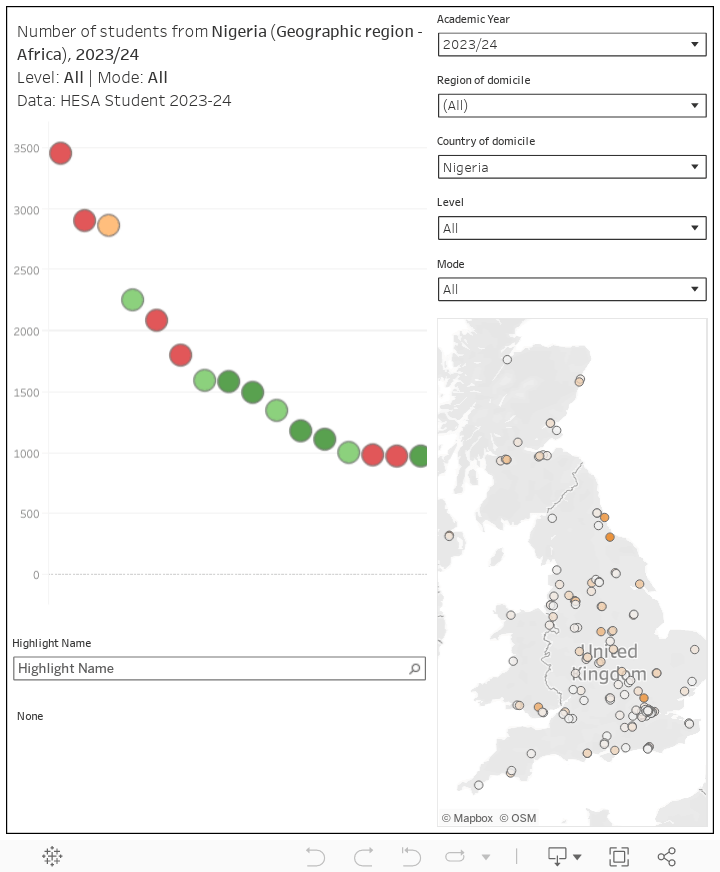
    What’s of interest to nervous institutional managers is the way international recruitment is changing over time. This is a more complicated dashboard that helps you see trends at individual providers for a given country, seen along with how your recruitment sits within the sector (mouse over an institution to activate the time series at the bottom.

    [Full screen]

    Source link

  • Podcast: Regret, ABA, provider collapse

    Podcast: Regret, ABA, provider collapse

    This week on the podcast we discuss new research on student regret, as a report from the University of Bristol reveals that while two-thirds of current undergraduates are happy with their choice of degree, it drops to less than half among recent graduates. Are improved advice and guidance really the answer?

    Plus we look at the collapse of the Advanced Business Academy (ABA) and its aftermath, as an Office for Students (OfS) investigation uncovers serious concerns about student placements and course delivery. And we examine new research on widening participation “cold spots” and the stark disparities in teachers’ expectations for students based on geography and school ratings.

    With Mary Curnock Cook, non-executive in education and edtech, Pete Quinn, inclusion consultant, Mack Marshall, Community and Policy Officer at Wonkhe and presented by Jim Dickinson, Associate Editor at Wonkhe.

    XXXXX

    Hindsight is a wonderful thing – but foresight is better

    When tuition fee payments are suspended, what happens to students left behind?

    25 unanswered questions about the collapse of ABA

    The UPP Foundation is launching a new inquiry into widening participation to support the government’s opportunity mission

    Students can make a real difference to educational opportunity in their regions through tutoring

    Source link