Author: admin

  • Five regulatory process points you may have missed from the University of Sussex decision

    Five regulatory process points you may have missed from the University of Sussex decision

    We’ve covered elsewhere the implications for policy related to academic freedom and freedom of speech stemming from the Office for Students’ decision to fine the University of Sussex for breaches of ongoing registration conditions E1 and E2.

    The publication of a detailed regulatory report also allows us insight into the way in which OfS is likely to respond to future breaches of registration conditions. It is, effectively, case law on the way OfS deals with concerns about higher education providers in England – and while parts of your university will be digesting what the findings mean for academic freedom policies, others will be thinking more widely about the implications for regulation.

    The University of Sussex, perhaps unsurprisingly, wishes to challenge the findings. It is able to challenge both the regulatory decisions and the amount of the fines at a first tier tribunal.

    As always, appeals are supposed to be process based rather than just a general complaint, so the university would have to demonstrate that the application of the registration conditions was incorrect, or the calculation of the fine was incorrect, or both. As above, there is no meaningful defence of the way the fines were calculated or discounted within the judgement so that would feel like the most immediately fertile ground for argument.

    Here’s some of the points that stood out:

    How and why was the decision to investigate made?

    We are told that, on 7 October 2021, the OfS identified reports about an incident at the University of Sussex. This followed the launch of a student campaign at the University of Sussex the previous day – which involved a poster campaign, a masked demonstrator holding a sign, and a hashtag on social media – calling for Kathleen Stock (a professor in the philosophy department) to lose her job.

    This was widely covered in the media at the time, and sparked commentary from interest groups including the Safe Schools Alliance UK and the Free Speech Union. The OfS subsequently contacted the university seeking further information, before starting a full investigation on 22 October 2021. However, despite significant public interest, the decision to start an investigation was not made public until a statement by an education minister in the House of Lords on 16 November (when we were told that the Department for Education was notified on 11 November).

    Kathleen Stock resigned from her role at the university on 28 October – six days after the start of the investigation, and substantially before the public announcement. She noted that “the leadership’s approach more recently had been admirable and decent”, while the university claimed to have “vigorously and unequivocally defended Prof Kathleen Stock’s right to exercise her academic freedom and lawful freedom of speech, free from bullying and harassment of any kind”.

    What’s not clear from this timeline is the nature of the notification on which the Office for Students was acting: the regulatory framework in place at the time suggested OfS would take action on the basis of lead indicators, reportable events, and other intelligence and sources of information. There are no metrics involved in this decision, and we are told the provider did not notify the OfS so there was no reportable event notification.

    We are left with the understanding that “other sources of information” were used – these could be “volunteered by providers and others, including whistleblowers”. Perhaps it was the same “source of information” that caused then Minister Michelle Donelan to shift from backing the university response on 8 October to calling for action on 10 October?

    We also know that – despite OfS’ insistence that it “does not currently have a role to act on behalf of any individual” – it appears that the only person to submit a “witness statement” to OfS was Stock. If OfS was concerned generally about the potential for a chilling effect on academic speech, would it not want to speak to multiple academics to confirm these suspicions? Doesn’t speaking to just one affected individual feel a little like acting “on behalf” of that individual?

    Finally – sorry to bang on – we don’t know who at OfS made the decision to conduct an investigation or on what basis. Can, say, the director of regulation just decide (based on a story in the press, or general vibes) to investigate a university – or is there a process involving sign-off by other senior staff, ideally involving some kind of assessment of the likelihood of a problem being identified within a reasonable period of time? If I were an internal auditor I would also want to be very clear that the decision was made using due process and free from political or ideological influence (for instance I’d be alarmed that someone was content for then-chair James Wharton to posit an absolutist definition of free speech in the Telegraph) shortly after the investigation started.

    Why did it take so long to investigate and make a decision?

    The only clue we are given in the regulatory report is that this is a “complex area”. OfS requested a substantial amount of documentation from Sussex – it even used a “compliance order” to make sure that no evidence was destroyed. However, it does not appear that OfS ever visited the provider to speak to staff and students – in other regulatory investigation reports, OfS has been assiduous in logging each visit and contact. There is none of that here – we don’t know how many interactions OfS had with Sussex, or on how many occasions information was requested. Indeed, OfS appears not to have visited Sussex at all. Arif Ahmed told us:

    “There may have been occasions where the university wanted to meet in person and communication was done in writing instead

    Various points of law are referred to in the regulatory report : it is notable that none of this is new law requiring additional interpretation or investigation (the new Higher Education (Freedom of Speech) Act had not even left the House of Commons committee stage at this point). It shouldn’t really take a competent lawyer that knows the sector more than a few weeks to summarise the law as it then stood and present options for action.

    The investigation into the University of Sussex was mentioned in the Chief Executive’s report from the 2 December 2021 Board meeting, and it turned up (often just as an indication that the investigation was ongoing)

    If OfS was able to fine a university for a breach of an ongoing registration relating to academic freedom, why do we need the Higher Education (Freedom of Speech) Act?

    Well, quite. On our reckoning, the Act would have made no difference to the entire affair, save potentially for a slight chilling effect on students being empowered to exercise their own freedom of speech, and a requirement for both providers and OfS to promote free speech. The ability of the OfS to reach the conclusion it reached, and to instigate regulatory consequences, suggests that further powers were not necessary to uphold freedom of speech on campus – despite the arguments made by many at the time. There is nothing OfS could have done better, or quicker, or more effectively had the Act been in force. Sussex, in fact, had a freedom of speech policy at the time, something that the regulatory report fails to mention or take account of.

    It is curious that the announcement of the investigation came at the start of a long pause in parliamentary activity on the Higher Education (Freedom of Speech) Act – at that time we were keenly anticipating a report from the House of Commons committee stage, but we got no action at all on the bill until it was carried forward into the next session of parliament.

    How was the amount of the fine arrived at?

    There is a detailed account of the process by which it was decided to fine Sussex £360,000 for a breach of registration condition E1, and £225,000 for a breach of registration condition E2. It appears thorough and convincing, right until the point that you read it.

    OfS appears to be using a sliding scale (0.9 per cent of qualifying income for “failing to uphold the freedom of speech and academic freedom governance principle”, 0.5 per cent of qualifying income for “a failure to have adequate and effective management and governance arrangements in place”, an additional 0.2 per cent for not reporting the breach, a 0.2 per cent reduction for taking mitigating action…) and although Regulatory Notice 19 takes us through the process in broad terms we don’t get any rationale for why those proportions apply to those things.

    It’s all a bit “vibes based regulation” in truth.

    It is to be welcomed that OfS reduced its initial calculation of a £3.7m (1.6 per cent of qualifying income) fine to a more manageable £585,000 – but why reduce to that amount (by a hair under 85 per cent) purely because it is the first fine ever issued for this particular offence? What reduction will be applied to the next fines issued under registration conditions E1 and E2? If none, why not – surely “sufficient deterrence” is possible at that amount so why go higher?

    The documentation covers none of this – it is very hard to shake the impression that OfS is pulling numbers out of the air. When you compare the £57,000 (0.1 per cent) fine issued to the University of Buckingham for not providing audited accounts for two years (something which would have yielded something altogether nastier from Companies House you do have to ask whether the Sussex infractions were 1.5 percentage points more severe at the initial reckoning?

    Are the wider implications as the regulator intends?

    There are so many questions raised that will now be hurriedly posed at universities and higher education all over England – and my colleague Jim Dickinson has raised many of them elsewhere on the site. He’s had enough material for four pieces and I’m sure there will be many more questions that could be explored. Why – for example – should the regulator have a problem with “prohibiting the harmful use of stereotypes”? Is there a plausible situation where we would want to encourage the harmful use of stereotypes?

    It would also be worth noting the many changes to the policy that appears to have caused the initial concern (the Trans and Non-Binary Equality Policy Statement) between 2018 and 2024. Perhaps these changes demonstrated the university dealing with a rapidly shifting public debate (conducted, in part, by people with the political power to influence culture more generally) as seemed appropriate at each point? So why is OfS not able to sign off on the current iteration of this policy? Why is it hanging a hefty fine on a single iteration on what is clearly a living document?

    There’s also a burden issue.Is it the position of the regulator that every policy of each university needs to be signed off by the academic council or governing bodies? Or are there any examples of policies where decisions can be delegated to a competent body or individual? A list would be helpful, if only to avoid a burdensome “gold plating” of provider-level decision making.

    Beyond the freedom of speech arguments

    There are 24 ongoing conditions of registration currently in force at the Office for Students – a regulatory report and a fine (or other sanctions) could come about through an inadvertent breach of any one of them. Many of these conditions don’t just apply to students studying on your campus – they have an applicability for students involved in franchised (and in some cases validated) provision around the world.

    We should be in a position where the sector can be competently and reliably regulated, where providers can understand the basis, process, and outcomes of any investigation, and that these are communicated promptly and clearly to the wider public. On the evidence of this report, we are a long way off.

    Source link

  • Feds Investigate Stanford, UC Campuses’ Admissions Offices

    Feds Investigate Stanford, UC Campuses’ Admissions Offices

    The Department of Justice launched investigations into admissions practices at four California universities on Thursday night, accusing them of flouting the Supreme Court’s ruling banning affirmative action in Students for Fair Admissions v. Harvard and University of North Carolina at Chapel Hill. 

    The “compliance reviews,” as the department called them, will target Stanford University and three University of California campuses: Berkeley, Los Angeles and Irvine.

    In a statement announcing the investigations, the Justice Department wrote that the investigations are “just the beginning” of their efforts to “eliminate DEI” in college admissions.

    “President Trump and I are dedicated to ending illegal discrimination and restoring merit-based opportunity across the country,” U.S. attorney general Pam Bondi wrote in the statement.

    It’s unclear what prompted the investigations or what evidence the department has to support its suspicions of illegal racial preferences in admissions at the targeted institutions. Some affirmative action opponents have suggested that institutions that enrolled higher numbers of minority students last fall, the first class admitted after the Supreme Court decision, may have done so illegally.

    Berkeley, UCLA and Irvine all reported upticks in the number of Black and Hispanic students enrolled in the Class of 2028 last fall: 45 percent of students who enrolled at a UC system campus this fall were underrepresented students of color, a 1.2 percent increase from 2023 and a record for the system.

    Just hours before the DOJ announced its probe, the Department of Health and Human Services launched its own investigation into admissions practices at UCLA’s medical school, accusing it of illegally considering applicants’ race.

    The UC system has been banned from considering race in admissions since 1996, when the state passed a referendum making the practice illegal at public institutions. That hasn’t stopped anti–affirmative action watchdogs from accusing the system of doing so secretly.

    Last month, the newly formed public interest group Students Against Racial Discrimination filed a lawsuit accusing the system of practicing affirmative action behind closed doors, citing increases in Black and Hispanic enrollment at its most selective campuses, namely UCLA and Berkeley, and labeling recent admissions policies—like the decision in 2020 not to consider standardized test scores—proxies for affirmative action.

    “Since Proposition 209 banned California’s public institutions from considering race in admissions, UC has implemented admissions practices to comply with it,” a UC spokesperson wrote in an email to Inside Higher Ed. “The UC undergraduate admissions application collects students’ race and ethnicity for statistical purposes only. This information is not shared with application reviewers and is not used for admissions.”

    Stanford, unlike the UC schools, reported a marked decline in first-year underrepresented students last year, according to the university’s Common Data Set, released last month. Black enrollment at the university fell by nearly 50 percent, and Hispanic enrollment by 14.4 percent; meanwhile, white and Asian enrollment rose by 14.5 percent and 10 percent, respectively.

    Luisa Rapport, Stanford’s director of media relations, said the university has not flouted the affirmative action ban, and that following the SFFA ruling, it “immediately engaged in a comprehensive and rigorous review to ensure compliance in our admissions processes.”

    “We continue to be committed to fulfilling our obligations under the law, and we will respond to the department’s questions as it conducts this process,” she wrote in an email to Inside Higher Ed.

    ‘Just the Beginning’

    Angel Pérez, president of the National Association for College Admission Counseling, said he’s heard “extraordinary concern” from admissions officers and deans in recent weeks that investigations could spread to their institutions. They don’t know how to prepare because “we have no idea what these compliance reviews even entail.”

    What they do know, he said, is that investigations could throw their offices into chaos during the height of admissions season.

    “These kinds of reviews are extremely disruptive. They’re also extremely expensive,” Pérez said. “There are some institutions that, you know, may not survive a compliance review given the legal costs.”

    In an interview with Inside Higher Ed last month, Edward Blum, president of SFFA and the architect of the nationwide affirmative action ban, said he expected schools that reported higher enrollment of racial minorities in the fall to invoke legal scrutiny, both from the courts and the Trump administration. He said he believed a number of institutions could be “cheating” the SFFA ruling, including some that were not included in this first round of investigations: Yale, Duke and Princeton.

    “So many of us are befuddled and concerned that in the first admissions cycle post-SFFA, schools that said getting rid of affirmative action would cause their minority admissions to plummet didn’t see that happen,” he said.

    Some colleges are withholding demographic information about their incoming classes altogether. On Thursday, hours after the Justice Department probes were launched, Harvard admitted its Class of 2029 but did not release any information—including demographics, acceptance and yield rates, and geographic data—for the first time in more than 70 years.

    In response to multiple questions from Inside Higher Ed about what the compliance reviews would entail or how the department plans to pursue its investigations into admissions offices, a Justice Department spokesperson referred to the initial statement announcing the investigations.

    “No further comment,” he wrote via email.

    There are some hints, though, as to what form a federal admissions investigation could take. In a December op-ed in The Washington Examiner outlining a plan that has reflected the Trump administration’s higher education agenda so far with uncanny accuracy, American Enterprise Institute fellow Max Eden suggested Bondi initiate “a never-ending compliance review” targeting Harvard University and others to enforce the SFFA ruling.

    “She should assign Office of Civil Rights employees to the Harvard admissions office and direct the university to hold no admissions meeting without their physical presence,” Eden wrote. “The Office of Civil Rights should be copied on every email correspondence, and Harvard should be forced to provide a written rationale for every admissions decision to ensure nondiscrimination.”

    For the four universities at the center of the investigations, this disruption could be especially pronounced right now, as colleges begin sending out acceptance letters and enter the busiest season for building their incoming classes.

    “This could not come at a worse time. It is April; this is enrollment management season,” Pérez said. “For institutions to take the time, energy and resources to [respond to compliance reviews] means that they’re going to have a harder time enrolling their classes.”

    ‘Absurd’ Accusations

    The Department of Justice is alleging that in the year and a half since the SFFA ruling, colleges have skirted the law by continuing to consider race in the admissions process. Those grounds make its targets particularly confusing, given that the University of California system hasn’t used affirmative action in admissions for nearly three decades.

    In 1996, California voters passed Proposition 209, banning the practice at public colleges. In the application cycles immediately after, Black and Hispanic enrollment fell precipitously. Pérez said it took many years of experimenting with race-neutral admissions, financial aid and recruitment policies for UC campuses to bring Black and Hispanic enrollment back to their prior rates.

    In the months following the SFFA decision, Pérez said college admissions professionals turned to California for lessons in how to maintain diversity without running afoul of the new law.

    “Officials and admission professionals [at UC] have been helping other institutions across the United States comply with the Supreme Court decision,” he said. “They have actually served as leaders in this space. To accuse them of violating any law is absurd.”

    Source link

  • AI is new — the laws that govern it don’t have to be

    AI is new — the laws that govern it don’t have to be

    On Monday, Virginia Governor Glenn Youngkin vetoed House Bill 2094, the High-Risk Artificial Intelligence Developer and Deployer Act. The bill would have set up a broad legal framework for AI, adding restrictions to its development and its expressive outputs that, if enacted, would have put the bill on a direct collision course with the First Amendment.

    This veto is the latest in a number of setbacks to a movement across many states to regulate AI development that originated with a working group put together last year. In February, that group broke down — further indicating upheaval in a once ascendant regulatory push.

    While existing laws may or may not be applied prudently, the emerging trend away from hasty lawmaking and toward more deliberation bodes well for the intertwined future of AI and free speech.

    At the same time, another movement has gained steam. A number of states are turning to old laws, including those prohibiting fraud, forgery, discrimination, and defamation, which have long managed the same purported harms stemming from AI in the context of older technology.

    Gov. Youngkin’s HB 2094 veto statement echoed the notion that existing laws may suffice, stating, “There are many laws currently in place that protect consumers and place responsibilities on companies relating to discriminatory practices, privacy, data use, libel, and more.” FIRE has pointed to these abilities of current law in previous statements, part of a number of AI-related interventions we’ve made as the technology has come to dominate state legislative agendas, including in states like Virginia

    The simple idea that current laws may be sufficient to deal with AI initially eluded the thinking of many lawmakers but now is quickly becoming common sense in a growing number of states. While existing laws may be applied in ways prudent and not, the emerging trend away from hasty lawmaking and toward more deliberation bodes well for the intertwined future of AI and free speech.

    The regulatory landscape

    AI offers the promise of a new era of knowledge generation and expression, and these developments come at a critical juncture as AI development continues to advance towards that vision. Companies are updating their models at a breakneck pace, epitomized by OpenAI’s popular new image generation tool

    Public and political interest, fueled by fascination and fear, may thus continue to intensify over the next two years — a period during which AI, still emerging from its nascent stage, will remain acutely vulnerable to threats of new regulation. Mercatus Center Research Fellow and leading AI policy analyst Dean W. Ball has hypothesized that 2025 and 2026 could represent the last two years to enact the laws that will be in place before AI systems with “qualitatively transformative capabilities” are released.

    With AI’s rapid development and deployment as the backdrop, states have rushed to propose new legal frameworks, hoping to align AI’s coming takeoff with state policy objectives. Last year saw the introduction of around 700 bills related to AI, covering everything from “deepfakes” to the use of AI in elections. This year, that number is already approaching 900-plus.

    Texas’s TRAIGA, the Texas Responsible Artificial Intelligence Governance Act, has been the highest-profile example from this year’s wave of restrictive AI bills. Sponsored by Republican State Rep. Giovanni Capriglione, TRAIGA has been one of several “algorithmic discrimination” bills that would impose liability on developers, deployers, and often distributors of AI systems that may introduce a risk of “algorithmic discrimination.” 

    Other examples include the recently vetoed HB 2094 in Virginia, Assembly Bill A768 in New York, and Legislative Bill 642 in Nebraska. While the bills have several problems, most concerning are their inclusion of a “reasonable care” negligence standard that would hold AI developers and users liable if there is a greater than 50% chance they could have “reasonably” prevented discrimination. 

    Such liability provisions incentivize AI developers to handicap their models to avoid any possibility of offering recommendations that some might deem discriminatory or simply offensive — even if doing so curtails the models’ usefulness or capabilities. The “chill” of these kinds of provisions threatens a broad array of important applications. 

    In Connecticut, for instance, Children’s Hospitals have warned how the vagueness and breadth of such regulations could limit health care providers’ ability to use AI to improve cancer screenings. These bills also compel regular risk reports on the models’ expressive outputs, similar to requirements that were held as unconstitutional under the First Amendment in other contexts by a federal court last year.

    So far, only Colorado has enacted such a law. Its implementation, spearheaded by the statutorily authorized Colorado Artificial Intelligence Impact Task Force, won’t assuage any skeptics. Even Gov. Jared Polis, who conceived the task force and signed the bill, has said it deviates from standard anti-discrimination laws “by regulating the results of AI system use, regardless of intent,” and has encouraged the legislature to “reexamine the concept” as the law is finalized.

    With a mandate to resolve this and other points of tension, the task force has come up almost empty-handed. In its report last month, it reached consensus on only “minor … changes,” while remaining deadlocked on substantive areas such as the law’s equivalent language to TRAIGA on reasonable care.

    The sponsors of TRAIGA reached a similar impasse as it came under intense political scrutiny. Rep. Capriglione responded earlier this month by dropping TRAIGA in favor of a new bill, HB 149. Among HB-149’s provisions, many of which run headlong into protected expression, is a proposed statute that holds “an artificial intelligence system shall not be developed or deployed in a manner that intentionally results in political viewpoint discrimination” or that “intentionally infringes upon a person’s freedom of association or ability to freely express the person’s beliefs or opinions.” 

    But this new language overlooks a landmark Supreme Court ruling just last year that laws in Texas and Florida with similar prohibitions on political discrimination for social media raised significant First Amendment concerns. 

    A more modest alternative

    An approach different from that taken in Colorado and Texas appears to be taking root in Connecticut. Last year, Gov. Ned Lamont signaled he would veto Connecticut Senate Bill 2, a bill similar to the law Colorado passed. In reflecting on his reservations, he noted, “You got to know what you’re regulating and be very strict about it. If it’s, ‘I don’t like algorithms that create biased responses,’ that can go any of a million different ways.” 

    At a press conference at the time of the bill’s consideration, his office suggested existing Connecticut anti-discrimination laws could already apply to AI use in relevant areas like housing, employment, and banking.

    Attempting to solve all theoretical problems of AI, before the contours of its problems become clear, is not only impractical but risks stifling innovation and expression in ways that may be difficult to reverse.

    Scholars Jeffrey Sonnenfeld and co-author Stephen Henriques of Yale’s School of Management expanded on the idea, noting Connecticut’s Unfair Trade Practices Act would seem to cover major AI developers and small “deployers” alike. They argue that a preferable route to new legislation would be for the state attorney general to clarify how existing laws can remedy the harms to consumers that sparked Senate Bill 2 in the first place.

    Connecticut isn’t alone. In California, which often sets the standard for tech law in the United States, two bills — AB 2930, focusing on liability for algorithmic discrimination in the same manner as the Colorado and Texas bills, and SB 1047, focusing on liability for “hazardous capabilities” — both failed. Gov. Gavin Newsom, echoing Lamont, stressed in his veto statement for SB 1047, “Adaptability is critical as we race to regulate a technology still in its infancy.”

    Newsom’s attorney general followed up by issuing extensive guidance on how existing California laws — such as the Unruh Civil Rights Act, California Fair Employment and Housing Act, and California Consumer Credit Reporting Agencies Act — already provide consumer protections for issues that many worry AI will exacerbate, such as consumer deception and unlawful discrimination. 

    New JerseyOregon, and Massachusetts have offered similar guidance, with Massachusetts Attorney General Andrea Joy Campbell noting, “Existing state laws and regulations apply to this emerging technology to the same extent as they apply to any other product or application.” And in Texas, where HB 149 still sits in the legislature, Attorney General Ken Paxton is currently reaching settlements in cases about the misuse of AI products in violation of existing consumer protection law. 

    Addressing problems

    The application of existing laws, to be sure, must comport with the First Amendment’s broad protections. Accordingly, not all conceivable applications will be constitutional. But the core principle remains: states that are hitting the brakes and reflecting on the tools already available give AI developers and users the benefit of operating within established, predictable legal frameworks. 

    And if enforcement of existing laws runs afoul of the First Amendment, there is an ample body of legal precedent to provide guidance. Some might argue that AI poses different questions from prior technology covered by existing laws, but it departs in neither essence or purpose. Properly understood, AI is a communicative tool used to convey ideas, like the typewriter and the computer before it. 

    If there are perceived gaps in existing laws as AI and its uses evolve, legislatures may try targeted fixes. Last year, for example, Utah passed a statute clarifying that generative AI cannot serve as a defense to violations of state tort law — for example, a party cannot claim immunity from liability simply because an AI system “made the violative statement” or “undertook the violative act.” 

    Rather than introducing entirely new layers of liability, this provision clarifies accountability under existing statutes. 

    Other ideas floated include “regulatory sandboxes,” a voluntary way for private firms to test applications of AI technology in collaboration with the state in exchange for certain regulatory mitigation, the aim being to offer a learning environment for policymakers to study how law and AI interact over time, with emerging issues addressed by a regulatory scalpel rather than a hatchet. 

    This reflects an important point. The trajectory of AI is largely unknowable, as is how rules imposed now will affect this early-stage technology down the line. Well-meaning laws to prevent discrimination this year could preclude broad swathes of significant expressive activity in coming years.

    FIRE does not endorse any particular course of action, but this is perhaps the most compelling reason lawmakers should consider the more restrained approach outlined above. Attempting to solve all theoretical problems of AI before the contours of problems become clear is not only impractical, but risks stifling innovation and expression in ways that may be difficult to reverse. History also teaches that many of the initial worries will never materialize

    As President Calvin Coolidge observed, “If you see 10 troubles coming down the road, you can be sure that nine will run into the ditch before they reach you and you have to battle with only one of them.” We can address those that do materialize in a targeted manner as the full scope of the problems become clear.

    The wisest course of action may be patience. Let existing laws do their job and avoid premature restrictions. Like weary parents, lawmakers should take a breath — and maybe a vacation — while giving AI time to grow up a little.

    Source link

  • What do the massive Education Department layoffs look like? See for yourself.

    What do the massive Education Department layoffs look like? See for yourself.

    President Donald Trump’s promise to dismantle the U.S. Department of Education was long heralded. Dating back to his first term, the vow was loudly and oft-repeated by candidate Trump on the campaign trail in 2024.

    But while the plan went nowhere during his first time in the White House, it has come to fruition through a slew of executive actions since his inauguration in January.

    What began with abruptly canceled education grants in February escalated with the confirmation of U.S. Education Secretary Linda McMahon on March 3 and her promise of “our department’s final mission” that same day. The culmination came in massive layoffs on March 11 and a Trump executive order a week later instructing McMahon to close the department “to the maximum extent appropriate and permitted by law.”

    A handful of the Trump administration’s actions — including last week’s order — have already been challenged in court. But in the meantime, their impacts are tangible in everything from students’ civil rights protections to funding for teacher grants. 

    K-12 Dive obtained an organizational chart from the Education Department detailing the offices impacted by the March 11 layoffs, as well as a list of about 970 union employees out of 1,300 employees who were let go, which offices they had been employed in and their positions. While the list of employees isn’t comprehensive, it gives a general idea of where cuts were concentrated — and what that might mean for education in the long run. 

    Based on those documents, here are eight visuals to help understand Trump’s multiphased gutting of the Education Department and its widespread impact: 

    By the numbers


    $600 million

    Cut to “divisive” teacher training grants


    $900 million

    Cut to multiyear research contracts

    The March 11 layoffs were preceded by cuts to over $1 billion in grant funding. Research grants housed in the National Center for Education Statistics were on the chopping block, as were teacher training grants that the administration called “divisive.” 

    The teacher grants impacted include the Supporting Effective Educator Development Grant Program, the Teacher Quality Partnership Program, and the Teacher and School Leader Incentive Program. These cuts would later be successfully challenged through at least two lawsuits. This week, Trump filed an emergency application with the U.S. Supreme Court challenging the lower court ruling and seeking the immediate cancellation of $65 million in teacher training grants it says advances diversity, equity and inclusion initiatives. 

    Former National Center for Education Statistics employees also confirmed to K-12 Dive that research grants related to student assessments were cut — a move that will likely result in a “barebones” approach to congressionally mandated tests like the Nation’s Report Card.

    By the numbers


    4,133

    number of employees prior to department’s gutting


    600

    number of employees that take buyouts prior to layoffs


    1,300

    number of staff fired on March 11


    2,200

    approximate number of employees following layoffs

    After the initial cuts to grants — and on the night of McMahon’s March 3 confirmation — employees were given an 11:59 p.m. ET deadline to voluntarily accept a $25,000 separation agreement in an effort to downsize the agency’s workforce. According to a later announcement by the department, about 600 employees took that offer leading up to the March 11 layoffs. 

    The layoffs would bring the total number of employees impacted by the reduction in force — part of McMahon’s “final mission” for the Education Department — to 1,900, or nearly half of its 4,133 count.

    FSA, OCR, and IES hit hard in March 11 layoff

    The data represents the 970 union workers laid off on March 11, 2025, and excludes non-union workers.

    On March 11, the administration laid off nearly 1,300 employees across various offices within the Education Department. Among offices losing the most people were Federal Student Aid, which students depend on to determine their eligibility for federal grants and loans for college. The move is the opposite of a recommendation made by the Government Accountability Office last year — following a botched FAFSA rollout — to “plan for and ensure hiring of sufficient staff to increase capacity” in the FSA office.

    The Institute for Education Sciences, home to the National Center for Education Statistics and oversight for the Nation’s Report Card, was cut down by over a hundred staff and left NCES with a skeletal staff of a handful.

    And the English Language Acquisition office was completely decimated, with all of its some dozen unionized employees laid off, according to the Education Department’s organizational chart. That move came less than two weeks after Trump signed an order making English the official language of the United States.

    Another Education Department arm significantly impacted was the Office for Civil Rights, which enforces laws that protect students’ civil rights. The reduction there comes after the Biden administration pleaded to Congress for an increase in funding and staff to address a case backlog, escalated by Title VI complaints based on shared ancestry or ethnicity in light of the Israel-Hamas war. The Trump administration has acknowledged the backlog but halved the office’s headcount rather than increasing staff.

    7 OCR regional offices closed, affecting half the nation

    The civil rights arm also lost seven of its dozen regional office

    OCR is responsible for keeping schools in compliance with civil rights laws and handles investigations that in the past often took months or even years to complete. Those investigations, among other things, ensure equal access to education for sexual assault survivors, students with disabilities and students from all races and ethnicities.

    Attorneys and equal opportunity employees were most common positions cut

    The data represents the 970 union workers laid off on March 11, 2025, and excludes non-union workers.

    Out of hundreds of OCR employees fired, a significant number were civil rights attorneys and equal opportunity employees, leaving the office with a skeletal crew to oversee more than 12,000 currently open investigations. At least 200 employees in total were let go. 

    These attorneys carried out the majority of OCR’s work, including determining case outcomes and sometimes helping to develop policy guidance. 

    Source link

  • Defending free speech: FIRE and Substack partner to protect writers in America

    Defending free speech: FIRE and Substack partner to protect writers in America

    In his farewell address to the nation, President Ronald Reagan remarked that “America is freedom,” and it’s this freedom that makes the country “a magnet” for those from around the world.

    In recent weeks, America has sent a very different message to foreigners residing in America lawfully: You can stay here — but only if you give up your freedom of speech.

    Earlier this week, federal immigration officials arrested a Tufts University student off the street, allegedly for an op-ed she wrote in a student newspaper calling for the university to divest from Israel. If true, this represents a chilling escalation in the government’s effort to target critics of American foreign policy.

    Since our founding, America has long welcomed writers and thinkers from across the globe who come to this country and contribute to the richness of our political and cultural life. Christopher Hitchens was one of President Bill Clinton’s sharpest critics, Alexander Cockburn punched in all directions, and Ayn Rand minced no words in her condemnation of socialism.

    To preserve America’s tradition as a home for fearless writing, the Foundation for Individual Rights and Expression and Substack are partnering to support writers residing lawfully in this country targeted by the government for the content of their writing — those who, as Hitchens once put it, “committed no crime except that of thought in writing.” If you fit this category, whether or not you publish on Substack, we urge you to get in touch immediately at thefire.org/alarm or pages.substack.com/defender.

    President Reagan recognized that freedom is “fragile, it needs protection” — and that’s exactly what FIRE and Substack intend to provide.

    Source link

  • University of New Orleans should rejoin LSU system, state board says

    University of New Orleans should rejoin LSU system, state board says

    This audio is auto-generated. Please let us know if you have feedback.

    Dive Brief:

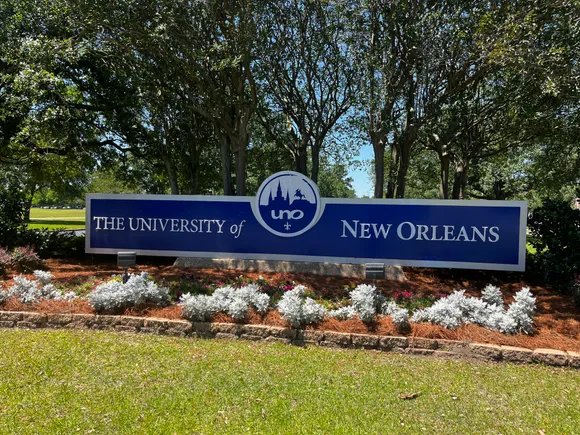
    • The struggling University of New Orleans should return to the Louisiana State University system, the state’s higher education board has recommended. 
    • UNO, founded in 1956 as part of the LSU system, transferred to the University of Louisiana system in 2011 amid enrollment declines stemming from Hurricane Katrina damage.
    • Transferring the institution back to the LSU system would require state legislation, which Louisiana’s board of regents voted unanimously to recommend at a meeting on Wednesday. 

    Dive Insight:

    UNO’s enrollment has never fully recovered from the disaster of Katrina nearly two decades ago. The university even grew its student body slightly after the hurricane but has since lost those gains. For the 2023-24 academic year, full-time equivalent enrollment stood at 5,114 students — just over a third of what it was in 2004-05. 

    Accompanying those declines has been financial instability. Between fiscal years 2015 and 2024, UNO’s tuition and fee revenue fell about 20% to $65 million.

    State fiscal support has also collapsed. Louisiana has gone through “one of the largest higher education disinvestments in the nation,” according to a March feasibility study from the regents on returning UNO to the university system. For UNO, state funding has fallen by just under 45% from two decades ago. 

    In addition to cost increases felt throughout higher education, UNO also faces contractual debt obligations such as for bookstore and dining services and a deferred maintenance backlog exceeding $2 billion. 

    The report also laid blame with the university, stating that “UNO’s lack of aggressive action to address these issues immediately as they arose has resulted in a deep budget deficit that must be strategically repaired.”

    Amid all its many revenue and expense challenges — and despite job cuts and other budget efforts — UNO’s budget gap has reached $30 million, according to the study. 

    All of those problems indicate failed thinking behind the university’s transfer into the UL system, according to the regents’ report. Moving UNO into UL’s fold came with an “expectation that new governance would assist in reversing declining enrollment and graduation rates to yield a stronger and more vibrant UNO,” it noted. 

    But things did not turn out as planned. “Instead, the institution’s fiscal condition has deteriorated to its current dire state, challenging UNO’s ability to meet its academic, research and community service missions,” the report said

    Yet the university “plays a significant role in advancing the intellectual and economic development of the City of New Orleans,” the study argued, pointing to well-regarded programs in jazz studies, naval architecture and marine engineering, hospitality and cybersecurity

    While the regents voted to recommend the university’s transfer to the LSU system, some board members expressed concern that doing so would just make UNO’s financial troubles a systemwide problem. 

    I just worry that, when you look at the shortfall, you’re taking the shortfall from one area and transferring it to the other,” Regent Dallas Hixson said at Wednesday’s meeting. 

    The point of transferring the university to the LSU system would be to “unlock the full potential of UNO, fostering regional prosperity while ensuring a smooth and efficient transfer of governance and leadership,” the feasibility study stated. It offered few details, however, for how that would occur. 

    To ensure a smooth transfer, the regents recommended setting up a transition team that would engage the system and UNO leadership. It also called for an in-depth third-party forensic financial audit, as well as program and facilities assessments, to help enumerate and address UNO’s challenges.

    Source link

  • Russia May Arrest Harvard Med Researcher if Deported

    Russia May Arrest Harvard Med Researcher if Deported

    Immigration and Customs Enforcement is detaining a Harvard Medical School research associate who’s a Russian native. One of Kseniia Petrova’s lawyers says the government is trying to deport her to Russia, where she faces possible arrest due to her “prior political activism and outspoken opposition to Russia’s invasion of Ukraine.”

    Gregory Romanovsky, the lawyer, said in a statement that Petrova was trying to re-enter the U.S. on Feb. 16 at Boston’s Logan International Airport when a Customs and Border Protection officer discovered she “had not completed the required customs paperwork for a non-hazardous scientific sample she was bringing from an affiliated laboratory in France.”

    “CBP was authorized to seize the item and issue a fine,” Romanovsky wrote. “Instead, they chose to cancel Ms. Petrova’s visa and detain her.”

    Petrova remains in ICE custody in Louisiana. The Boston Globe reported earlier on her detention.

    Romanovsky wrote that “CBP improperly invoked their extensive immigration authority to impose a punishment grossly disproportionate to the situation. This overreach reflects broader concerns about the treatment of international scholars by U.S. immigration authorities.”

    A spokesperson for the Department of Homeland Security, which includes ICE, told Inside Higher Ed in an email that Petrova was “detained after lying to federal officers about carrying biological substances into the country. A subsequent K9 inspection uncovered undeclared petri dishes, containers of unknown substances, and loose vials of embryonic frog cells, all without proper permits. Messages found on her phone revealed she planned to smuggle the materials through customs without declaring them. She knowingly broke the law and took deliberate steps to evade it.”

    Harvard spokespeople didn’t provide an interview Friday about the situation or answer multiple emailed questions. In a brief email, the medical school’s media relations arm said, “We are monitoring this situation.”

    Romanovsky has sued to restore Petrova’s visa.

    “Ms. Petrova’s 1.5-month-long detention has caused significant disruption to both her professional and personal life,” Romanovsky said in his statement. “As a dedicated and highly respected researcher, her work is critical to scientific progress. We strongly urge ICE to release Ms. Petrova while her legal proceedings are ongoing.”

    Source link

  • University of Michigan scraps multimillion dollar DEI investment

    University of Michigan scraps multimillion dollar DEI investment

    This audio is auto-generated. Please let us know if you have feedback.

       Dive Brief:

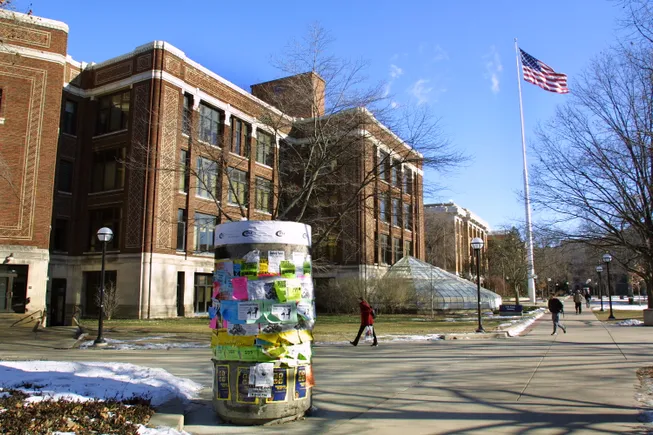
    • The University of Michigan has scrapped its multimillion dollar university-wide strategic plan to promote diversity, equity and inclusion amid increasing pressure from the Trump administration on the sector. 
    • With the move, the public flagship shuttered two equity-focused offices — its Office of Diversity, Equity and Inclusion and Office for Health Equity and Inclusion — and ended all DEI programming and spending, according to the Thursday announcement. 
    • The student services provided by the DEI office will be housed under different unnamed departments. And employees who led DEI efforts will “refocus their full effort on their core responsibilities,” university leadership said. They did not say if the restructuring would result in layoffs.

    Dive Insight:

    In Thursday’s announcement, President Santa Ono and other university leaders cited President Donald Trump’s flurry of executive orders attacking DEI efforts and the U.S. Department of Education’s resulting Dear Colleague letter.

    Many universities across the country have already caved under the Trump administration’s pressure. But the University of Michigan’s compliance represents a significant victory for the White House.

    In fall 2023, the public flagship launched its DEI 2.0 Strategic Plan, a five-year blueprint even longer in the making.

    “The university’s DEI efforts are a perpetual work in progress, and we are committed to this ongoing journey and one where we never reach our destination,” the plan’s webpage said. It describes the plan as a “campuswide effort engaging all levels of the university”

    In total, the university spent some $250 million dollars on diversity efforts, according to Regent Jordan Acker.

    But Acker and other critics have argued that the investment did not result in the desired outcome. 

    “The population of minority students at UM has grown little — and much of the resources we’ve devoted to these efforts has gone into administrative overhead, not outreach to students,” he said in a Thursday statement on social media.

    Before the launch of the university’s first DEI strategic plan, it faced a years-long struggle boosting Black enrollment, to the dissatisfaction of students and administration alike.

    In 2023, 14.1% of Michigan residents were Black, according to federal data. That fall, just 4.6% of the university’s students were Black.

    Acker described the elimination of the university’s DEI efforts as a means of focusing resources on programs of “real impact,” such as the university’s Go Blue Guarantee, which offers free and reduced tuition to qualifying Michigan residents.

    In its announcement this week, the university spotlighted Go Blue and its Wolverine Pathways program — which works with K-12 students in under-resourced communities — when touting its student successes.

    Among undergraduates, first-generation students have increased 46% and Pell Grant recipients by about 32% since 2016, university leaders said Thursday, attributing the growth to those two programs.

    The University of Michigan also said Thursday it will expand another student success program designed for undergraduates who are former foster care youths or are “navigating their educational journey without the support of their parents or guardians.”

    Because those initiatives do not explicitly mention diversity or race, they are set to survive the university’s purge of programs.

    Not all will be so lucky.

    Among its many DEI programs, the University of Michigan oversees the National Center for Institutional Diversity, the Diversity Scholars Network, and a public safety task force dedicated to addressing structural racism in policing.

    The university’s general counsel will be conducting an “expedited review” of all institutional policies, programs and practices to ensure compliance with the Trump administrations’ orders, according to Thursday’s announcement.

    Additionally, all departments are expected to ensure their webpages are in compliance and “reflect the status of current programmatic directions” at the university.

    “These decisions have not been made lightly,” Ono said Thursday. “We recognize the changes are significant and will be challenging for many of us, especially those whose lives and careers have been enriched by and dedicated to programs that are now pivoting.”

    Additionally, the university’s Alumni Association this month ended LEAD Scholars, a 16-year-old merit scholarship for admitted students who exemplify “leadership, excellence, achievement, and diversity.” The group cited the same federal pressures as university leaders.

    In an email Thursday, the head of the university’s faculty senate called the move to dismantle DEI infrastructure an “assault on the democratic values of public education and attacks on marginalized students, staff, and faculty.”

    Senate Chair Rebekah Modrak lambasted the Trump Administration as using “the power of the government to engineer a sweeping culture change towards white supremacy.”

    “Unfortunately, University of Michigan leaders seem determined to comply and to collaborate in our own destruction,” she said. “There are legal recourses that the university and university associations can and must take.”

    The faculty senate held a closed emergency meeting Friday for university employees and students to discuss next steps.

    This isn’t the first move against DEI the university has taken.

    In December, the University of Michigan eliminated the use of diversity statements from the hiring, promotion or tenure processes. A faculty working group recommended the change, but it also advised the university to ask instructors to incorporate information about their DEI efforts into their teaching, research and service statements.

    Michigan’s administration did not enact the second recommendation at the time, and such actions are now banned following Thursday’s announcement.

    Sarah Hubbard, a regent on the University of Michigan’s board and a consistent opponent of DEI efforts, praised the cancellations.

    “Ending DEI programs will also allow us to better expand diversity of thought and free speech on our campus. The end of litmus test hiring and curtailment of speech stops now,” Hubbard said in a Thursday social media post.   

    Source link

  • Higher Education Inquirer Asks State Department for List of Student Visa Revocations

    Higher Education Inquirer Asks State Department for List of Student Visa Revocations

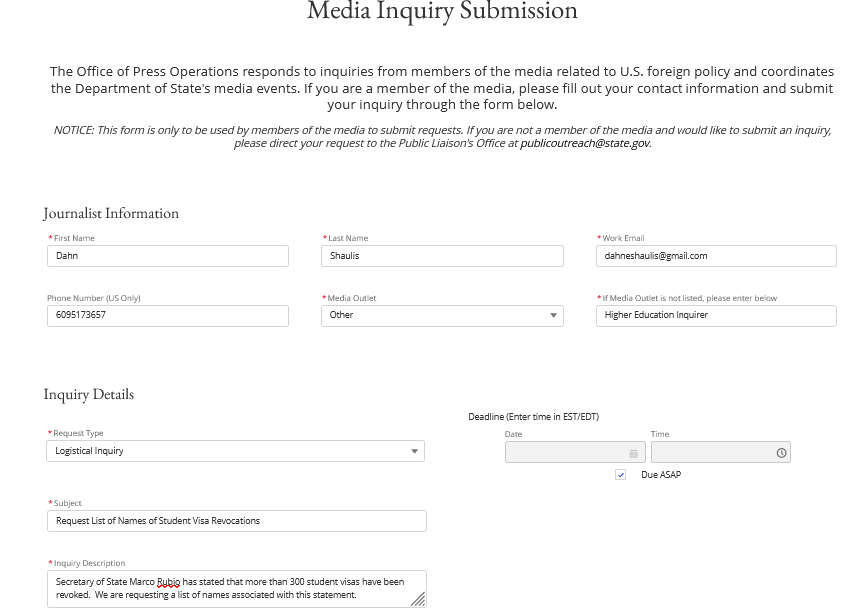
    The Higher Education Inquirer (HEI) has requested a list of more than 300 students who have had their visas revoked.  The State Department has acknowledged receipt.  We hope other media outlets will follow suit.  At this point, we only know of a handful of these cases.  We will keep the public informed as this story develops. 


    Source link

  • Democratic senators call for probe of Trump Education Department cuts

    Democratic senators call for probe of Trump Education Department cuts

    This audio is auto-generated. Please let us know if you have feedback.

    Democrat efforts to challenge President Donald Trump’s dismantling of the U.S. Department of Education mounted Thursday, as 11 senators asked the agency’s acting inspector general, René Rocque, to investigate the push. 

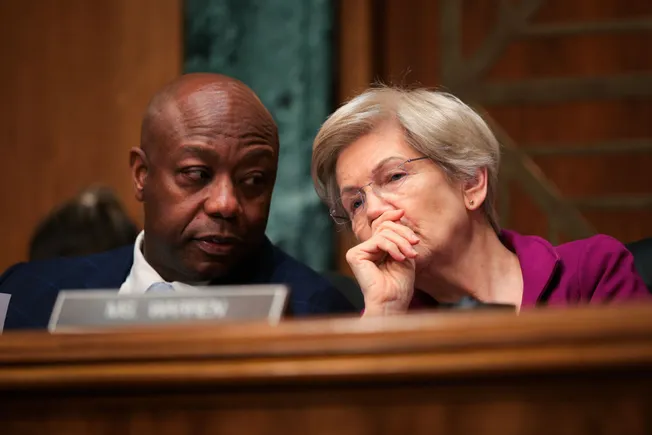
    Sen. Elizabeth Warren and senate Minority Leader Chuck Schumer were among those requesting an evaluation of whether the administration is undermining the Education Department’s ability to provide students with equal access to education and to help state and local governments’ education systems

    “Decimating the Department of Education’s abilities to administer financial aid, investigate civil rights violations, conduct research on educational outcomes, and oversee the use of federal education grants threatens to have disastrous consequences for American students, teachers and families,” they wrote in a March 27 letter to Rocque. 

    “The Trump Administration’s further attempts to close the Department entirely and transfer its responsibilities over to other agencies will likely interrupt and degrade education programs and services, causing additional pain for the 62 million students across the country that the Department serves.” 

    The administration’s gutting of the Education Department not only impacted nearly half of the department’s workforce, but also left civil rights investigation and enforcement offices at half their previous capacity, cut the Federal Student Aid office by over 450 employees, and slashed 90% of the Institute of Education Sciences staff. 

    These decisions would likely impede key functions of the department, including ensuring all students’ civil rights are protected, administering federal loans and overseeing lenders and FAFSA, and tracking students’ educational outcomes and the condition of education in the nation, the Democratic senators told Rocque.

    Rocque, who joined the Education Department’s Office of Inspector General as deputy inspector general in December 2023, became acting director in January.

    As with many other issues dividing lawmakers today, Democrats and Republicans have been starkly divided over the Trump administration’s efforts to eliminate the department altogether. This makes attaining a Senate supermajority of 60 votes — which is required to officially shut the department — unlikely. 

    House Democrats introduced a resolution on March 21 calling for transparency and information from the administration, including unredacted copies of all federal documents referring to the department’s closure and information on workforce reduction decisions.

    About a week after the massive reduction in force on March 11, Democrat lawmakers from both the House and Senate wrote the department demanding information on the layoffs, saying that halving its workforce could impact the agency’s ability to perform vital functions required by law.

    Meanwhile, Republicans in some states have taken the opportunity to ask the administration for more leeway in their education spending. 

    On March 25, for example, Oklahoma State Superintendent Ryan Walters sent a letter to the Education Department requesting a waiver to receive a block grant for all funds allocated to his state under the Every Student Succeeds Act. Such a consolidated block grant would “significantly enhance local flexibility” so “schools will be able to address their unique needs and priorities,” Walters wrote.

    The block grant would be used to “expand educational choices,” including attendance at private schools, and would loosen federal oversight of education spending requirements.

    Source link