Author: admin

  • Report details uneven AI use among teachers, principals

    Report details uneven AI use among teachers, principals

    Key points:

    English/language arts and science teachers were almost twice as likely to say they use AI tools compared to math teachers or elementary teachers of all subjects, according to a February 2025 survey from the RAND Corporation that delves into uneven AI adoption in schools.

    “As AI tools and products for educational purposes become more prevalent, studies should track their use among educators. Researchers could identify the particular needs AI is addressing in schools and–potentially–guide the development of AI products that better meet those needs. In addition, data on educator use of AI could help policymakers and practitioners consider disparities in that use and implications for equitable, high-quality instruction across the United States,” note authors Julia H. KaufmanAshley WooJoshua EaganSabrina Lee, and Emma B. Kassan.

    One-quarter of ELA, math, and science teachers used AI tools for instructional planning or teaching in the 2023–2024 school year. Nearly 60 percent of surveyed principals also reported using AI tools for their work in 2023-2024.

    Among the one-quarter of teachers nationally who reported using AI tools, 64 percent said that they used them for instructional planning only, whether for their ELA, math, or science instruction; only 11 percent said that they introduced them to students but did not do instructional planning with them; and 25 percent said that they did both.

    Although one-quarter of teachers overall reported using AI tools, the report’s authors observed differences in AI use by subject taught and some school characteristics. For instance, close to 40 percent of ELA or science teachers said they use AI, compared to 20 percent of general elementary education or math teachers. Teachers and principals in higher-poverty schools were less likely to report using AI tools relative to those in lower-poverty schools.

    Eighteen percent of principals reported that their schools or districts provided guidance on the use of AI by staff, teachers, or students. Yet, principals in the highest-poverty schools were about half as likely as principals in the lowest-poverty schools to report that guidance was provided (13 percent and 25 percent, respectively).

    Principals cited a lack of professional development for using AI tools or products (72 percent), concerns about data privacy (70 percent) and uncertainty about how AI can be used for their jobs (70 percent) as factors having a major or minor influence on their AI use.

    The report also offers recommendations for education stakeholders:

    1. All districts and schools should craft intentional strategies to support teachers’ AI use in ways that will most improve the quality of instruction and student learning.

    2. AI developers and decision-makers should consider what useful AI applications have the greatest potential to improve teaching and learning and how to make those applications available in high-poverty contexts.

    3. Researchers should work hand-in-hand with AI developers to study use cases and develop a body of evidence on effective AI applications for school leadership, teaching, and learning.

    Laura Ascione
    Latest posts by Laura Ascione (see all)

    Source link

  • No Safe State: Former DEI Employee Says to Look for the Red Flags

    No Safe State: Former DEI Employee Says to Look for the Red Flags

    Dr. Nicole DelMastro-Jeffery, former executive director for the DEI and Belonging office and Title IX coordinator at Richland Community College.On January 21, one day after his inauguration, President Donald J. Trump signed an executive order he called “Ending Illegal Discrimination and Restoring Merit-Based Opportunity,” instructing federal agencies to end diversity, equity, and inclusion (DEI) practices and programs.

    The very next day, Dr. Nicole DelMastro-Jeffery, executive director for the DEI and Belonging office and Title IX coordinator at Richland Community College in Decatur, Illinois, was let go from her non-federal position.

    In a sense, DelMastro-Jeffery’s story is familiar. State legislatures across the country have introduced and passed laws curbing DEI at educational institutions, even before Trump issued his order. Since then, a growing number of DEI offices have either shuttered or reorganized, and DEI-focused employees have been dismissed or had their roles changed.

    But Illinois has no anti-DEI laws established, despite some competing bills introduced on the House and Senate floor. On February 7, State Sen. Andrew S. Chesney introduced SB2288, calling for the abolishment of DEI programs in departments of the state government. Conversely, on January 29, State Rep. Sonya M. Harper filed HR0077, a bill to affirm DEI programs in local, state, federal, educational and other institutions.

    According to DelMastro-Jeffery, in early 2024 when the Biden-Harris administration issued a new Dear Colleague letter which expanded Title IX for the further protection of women and transgender individuals, Richland moved toward implementing those changes. However, by December 2024, she said that Richland “quickly rolled back to the 2020 legislation.”

    “Ultimately,” she said, “Going back to 2020 legislative measures decreased protections, not only for transgender community members but women as well.”

    For DelMastro-Jeffery, the institutional waffling between Title IX regulations was a red flag, one that should be heeded by other DEI professionals and institutions working to preserve their DEI programs.

    “We have rarely considered the legal ramifications of separate laws and how their implementation and adjustments may in fact serve as awareness flags of next moves, like that of chess match players,” she said. “It is my belief that this federal injunction or swift rollback of expanded 2024 Title IX protections should have served as an immediate wakeup call to our DEI community.”

    DelMastro-Jeffery arrived at Richland fresh off an internship with the Biden-Harris administration. She said she was thrilled at the chance to apply all she had learned to a rural college environment. Her dismissal, she said, “felt like a triple backlash to both my former public service work, status as a woman of color in higher education, and DEI executive leader.”

    Paulette Granberry Russell, CEO and president of the National Association of Diversity Officers in Higher Education (NADOHE), said the attacks on DEI, including Trump’s order, have continued to demonize it, stripping all meaning from the acronym. She intentionally uses the words “diversity, equity, and inclusion,” instead of DEI.

    Paulette Granberry Russell, CEO and president of NADOHE.Paulette Granberry Russell, CEO and president of NADOHE.Granberry Russell said she is “disappointed by the failure of institutions that over-complied to the threats to diversity, equity, and inclusion efforts, rather than taking a stand to say these efforts are not divisive.”

    The misinformation disseminated through anti-DEI laws and orders have produced significant misunderstanding in the public sphere, “that somehow efforts associated with advancing diversity, equity, and inclusion is unlawful. That is not the case,” said Granberry Russell.

    “We’re seeing what I often refer to as a ‘chilling effect,’ where institutions are preemptively scaling back diversity, equity, and inclusion efforts due to political pressure or fear of litigation,” said Granberry Russell.

    NADOHE is the lead plaintiff in a federal lawsuit filed by Democracy Forward, a national legal organization of litigators, policy makers, regulators and public educators working to advance democracy. The suit was filed against the Trump Administration in early February calling Trump’s attack on DEI unconstitutional.

    Granberry Russell acknowledged that, since the legislation and executive order, many DEI officers and employees have lost their roles. But she does not know how many, as there is no national database tracking these changes.

    DelMastro-Jeffery said “this experience has illuminated, for me, the intersection between gender, leadership values, and the importance of pressing on.”

    She continued, “Amid the growing dismissal of DEI programming, now diluted to words on a website, we would be negligent to forget the value of diversity and how the world, including systems of education, thrives on it.”

    Richland leadership did not respond to requests for comment. Their website still hosts a page for Diversity, Equity, Inclusion, Belonging and Accessibility, which affirms these as a “core institutional value.”

    Source link

  • Does Your SIS for Student Recruitment Support These 11 Strategies?

    Does Your SIS for Student Recruitment Support These 11 Strategies?

    Running a large-scale institution calls for knowledge of the typical difficulties throughout the hiring process. The list is extensive; established student recruitment tactics assist in reaching enrollment targets, keeping up with the worldwide competition and international market, attracting and recruiting the proper mix of students, and so on.

    This blog from us seeks to RETHINK the way your admissions and recruiting process is now run. We have tried to specifically describe the student recruitment techniques that a Student Information System SIS is supposed to have, which will help your whole admissions and recruitment committee. Let us assist you with a better analysis.


    How to improve student recruitment using an SIS. 11 powerful student recruitment strategies for your institution

    Your Student Information System (SIS) shouldn’t just store data — it should actively help you attract, engage, and convert students. From personalized outreach to faster application processing, the right SIS transforms recruitment from a numbers game into a smarter, student-first strategy.

    Student recruitment is evolving, and so are the strategies that drive success. A poll by The Guardian surveyed 70 UK university marketing teams and found that,

    57% of university marketing teams found open days to be their top recruitment tool.

    72% relied on external digital advertising.

    98% favored social media advertising.


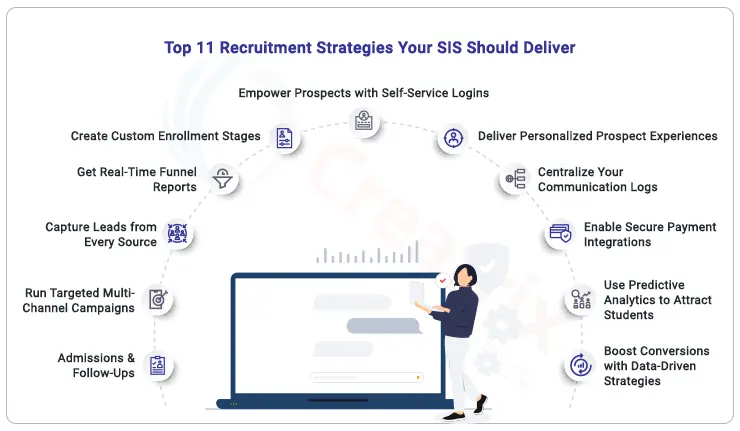
    It’s clear — a one-size-fits-all approach won’t cut it anymore. To stay competitive, institutions need a well-rounded, data-driven recruitment strategy. Here’s a breakdown of 11 powerful SIS-supported strategies to help your institution attract, engage, and enroll more students.


    1. Try automating admissions & follow-ups for higher conversions with an integrated CRM
     

    How to Boost Your SIS for Student Recruitment with Smart Strategies


    CRM integrated into Admissions can be the first savior. We promise they have a suite of tools that are specifically tailored to the needs of your educational institute. An SIS integrated with CRM offers a targeted approach to your mundane admissions process. 

    At Creatrix Campus, we have a CRM in place that can likely enable institutions of all sizes to thrive in the competitive market while ensuring data is formed, tracked, processed, and analyzed to deliver a rich personal experience to students and other stakeholders alike.

    There are ways to nurture relationships with seamless lead generation and marketing capabilities. We are cloud-native and accessible across many devices.


    2. Run targeted, multi-channel campaigns

    Make sure your SIS supports digital, social media, institution, API, and other source lead capture. For quicker follow-up, all leads should direct themselves to one system and path to the correct counselors. Integration of a CRM helps to simplify this procedure.

    Potential update: To be competitive, think of mentioning automated campaigns driven by artificial intelligence.


    3. Capture leads from every channel — perfectly

    Options to capture student inquiries through multichannel including digital, social, institutions, APIs, and much more. Direct all these inquiries to a single place and direct them to the right lead owners or counselors for a timely connection. Trust us; a CRM can help you with this.


    4. Get funnel reports in real-time

    Your SIS should create funnel reports tracking leads at all levels, therefore enabling you to spot areas of congestion and make quick strategic changes. Comprehensive analytics make sure organizations may maximize their hiring plans for the next inflow.

    Potential update: Including predictive analytics or artificial intelligence advice here could improve this approach.


    5. Create custom enrollment stages 

    Every institution is different; your SIS should enable you to construct custom enrollment phases to suit your particular procedure. This guarantees that prospects pass the funnel without incident and helps to keep your pipeline orderly.

    Potential update: Could underline dynamic systems that change depending on student behavior or profile data.


    6. Use self-service logins to empower prospects

    Through one safe platform, let prospects build profiles, follow their application status, submit documentation, speak with counselors, and pay costs. It cuts administrative overhead and keeps them interested.


    7. Deliver personalized prospect experiences  

    Personalized interactions build relationships, and your SIS should support this. From inquiry to enrollment, ensure tailored messages, program recommendations, and helpful content reach the right prospect at the right time.

    Potential update: AI-driven personalization or behavioral tracking could elevate this further.


    8. Keep a centralized communication log 

    Automatic generation of offer letters with in-built templates, intimation of fee payment, request sent for missing documents, program orientation, etc.

    The tool you are using should generate, capture, and nurture leads across platforms, both online and in-person. At Creatrix Campus, you could set up personalised emails and communications to your prospects based on the inquiry made.


    9. Turn on Safe Payment Integration

    Make sure your SIS has integrated safe payment gates. Prospects can easily complete their applications and pay fees online; this helps to lower dropout rates and guarantees faster conversion.

    Potential update: Talk about adherence to PCI DSS and other worldwide payment standards for further confidence.


    10.  How predictive analytics helps universities attract students

    Want to stay one step ahead in student recruitment? Predictive analytics helps universities do just that — analyzing trends, student behaviours, and historical data to spot who’s most likely to enroll. It’s like having a crystal ball but smarter, helping you focus efforts on the right students at the right time.


    11. Data-driven enrollment strategies for better conversions 

    Why guess when data can lead the way? With advanced analytics, universities can track engagement, demographics, and even application patterns, fine-tuning their enrollment strategies to attract the right students and boost conversions effortlessly. 


    Know about Creatrix student recruitment strategies to adapt and grow

    Creatrix Campus’s Student Recruitment Software has opened new doors for several universities across the globe and added value to their recruiting efforts. If you wish to know the secret of how we do it, contact our team now.


    Source link

  • Sensors help building operators detect vaping

    Sensors help building operators detect vaping

    This audio is auto-generated. Please let us know if you have feedback.

    Facilities managers can use air quality sensors to detect vaping in restrooms and other areas in which video cameras can’t be used, says a video systems company that has released a sensor product. 

    “Sensors are ideal for monitoring sensitive areas … such as restrooms, locker rooms, health care facilities and secure storage areas,” Eagle Eye Networks says in an announcement

    The company touts the sensors as especially suitable for schools, where vaping isn’t allowed. 

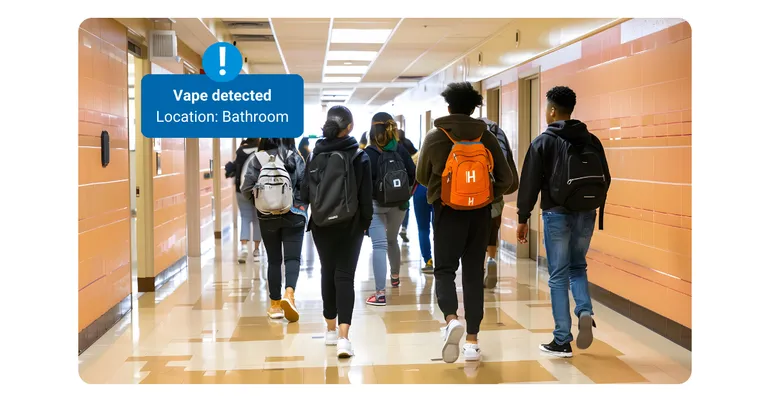
    The “sensors help school officials address vaping by detecting, alerting and providing … information about incidents while maintaining privacy,” the company says.

    The sensors integrate with the company’s flagship product, a cloud-based video management system. By combining the information provided by the sensors with information provided by video cameras outside of sensitive areas, officials can gain a more complete picture of unauthorized activity to determine if action is necessary, the company says. 

    air sensors

    The Eagle Eye Sensor, shown here, is capable of detecting vaping, noise, temperature and humidity in sensitive area like locker rooms and bathrooms, the company says.

    Courtesy of Eagle Eye Networks


    If a “sensor detects vape smoke in a school locker room, the system automatically triggers an alert,” the company says. “School authorities verify the event and gain additional information from security cameras located in hallways or outside of the locker room.”

    The sensors can be used in other contexts, the company says. They can track noise, temperature, humidity, and other factors that can impact indoor air quality, like volatile organic compounds, carbon monoxide, carbon dioxide and smoke. Other types of sensors can detect the presence of water, which can aid in detecting leaks, and whether doors are being left open. Alerting managers to open doors can help reduce energy use, especially in climate controlled locations like server rooms. 

    Mike Intag, managing partner at Gardient, a systems integration company, says he’s introducing the sensors to schools to help them control vaping, a “longstanding challenge in K-12 settings.” The sensors will also be used to monitor temperature, humidity and door use. “This advances our offering [to school clients] beyond security,” he said.

    Source link

  • Trump Administration Revokes 300 Student Visas, More to Come

    Trump Administration Revokes 300 Student Visas, More to Come

    The Trump administration has revoked more than 300 international students’ visas in the past three weeks, according to reporting from Axios

    Yesterday two Ph.D. students with revoked visas were detained by immigration agents and now await deportation: an Iranian student at the University of Alabama and a Turkish student at Tufts University in Massachusetts. 

    The Tufts student, Rumesya Ozturk, was abducted by plainclothes ICE agents on the street. At a press conference Thursday, U.S. secretary of state Marco Rubio said that any international student whose visa was revoked could be forcefully deported in such a manner. 

    “Once you’ve lost your visa, you’re no longer legally in the United States,” he said. “If you come to the U.S. as a visitor and create a ruckus for us, we don’t want it.”

    Axios also reported that the administration has discussed using a small arm of the Immigration and Customs Enforcement office to strip colleges they deem to be “pro-Hamas” of their ability to enroll international students.

    “You can have so many bad apples in one place that it leads to decertification of the school,” an unnamed White House official told Axios. “I don’t think we’re at that point yet. But it is not an empty threat.”

    The Student and Exchange Visitor Program normally investigates student visa fraud and international student recruiting practices, sometimes withdrawing colleges’ certification to enroll foreign students if there’s evidence that students are primarily enrolling as a pretext to reside and work in the U.S. instead of earn a degree. 

    Now, the SEVP may be tasked with a very different mandate: punishing colleges that have been the site of large pro-Palestine protests. 

    “What you’re going to see in the not-too-distant future is the universities … not doing anything to stop these demonstrations in support of Hamas … we can stop approving student visas for them,” a senior Justice Department official told Axios. “That’s one of their biggest cash cows, foreign students. That’s a meaningful source of revenue.” 

    Source link

  • Duke Criticizes the Use of Its Brand on “The White Lotus”

    Duke Criticizes the Use of Its Brand on “The White Lotus”

    Duke University is unhappy with The White Lotus, the hit HBO television show, for using its logo repeatedly in its third season—particularly in a scene where one character is on the verge of suicide, holding a gun to his head, all while wearing a Duke T-shirt.

    A spokesperson for institution told Bloomberg and other media outlets this week that Duke hadn’t approved of the use of its logo on the show. “The White Lotus not only uses our brand without permission, but in our view uses it on imagery that is troubling, does not reflect our values or who we are, and simply goes too far,” the spokesperson said.

    A copyright attorney told Bloomberg that the show’s use of the logo is most likely protected by the First Amendment.

    Source link

  • CUNY Revises Palestinian Scholar Job After Controversy

    CUNY Revises Palestinian Scholar Job After Controversy

    The City University of New York’s Hunter College reposted a job listing for Palestinian studies scholars earlier this week, one month after New York governor Kathy Hochul ordered the system to remove an earlier listing that she called antisemitic.

    The new job description does not include some of the phrases that initially angered pro-Israel activist groups who lobbied for the original posting’s removal. 

    The old posting said Hunter sought “a historically grounded scholar who takes a critical lens to issues pertaining to Palestine including but not limited to: settler colonialism, genocide, human rights, apartheid, migration, climate and infrastructure devastation, health, race, gender, and sexuality.” The revised version excised that entire list of issues.

    Free speech advocates and Hunter staff told Inside Higher Ed last month that CUNY’s decision to pull the initial job posting and revise it in response to the governor’s order was an unprecedented breach of the institution’s academic autonomy in faculty hiring, an area normally sequestered from political influence. 

    The new posting comes as colleges face federal investigations, funding cuts and student harassment as a result of pro-Palestinian campus activity.

    Correction: an earlier version of this story reported that the posting had removed a description of Hunter as a “vibrant and dynamic community within a highly diverse urban setting.” That language is still in the revised post.

    Source link

  • Recruiting U.S. Scholars Can Protect “Threatened Research”

    Recruiting U.S. Scholars Can Protect “Threatened Research”

    Universities should look to recruit researchers fleeing the U.S. amid dramatic funding cuts by the Trump administration because it could help protect vital scientific expertise from being lost, according to the rector of a leading Belgian university.

    Vrije Universiteit Brussel (VUB) has announced a host of new postdoctoral positions for international academics, stating that the institution “particularly welcomes excellent researchers currently working in the U.S. which see their line of research threatened.”

    VUB and its sister university Université Libre de Bruxelles are offering a total of 36 grants to researchers with a maximum of eight years of postdoctoral experience, funded by the European Union’s Marie Skłodowska-Curie Actions. The positions are not exclusively designed for U.S.-based researchers, VUB rector Jan Danckaert stressed, but are “open to all incoming researchers, whatever their nationality or their working place at the moment outside of Belgium.”

    VUB chose to advertise the positions to scholars in the U.S., Danckaert explained, in the wake of drastic funding cuts by the Trump administration, with research fields under particular threat including climate, public health and any areas considered to be related to diversity.

    “We also hear from colleagues in the United States that they are applying a kind of self-censorship in order to stay under the radar,” he said. “We believe that freedom of investigation is now under threat in the U.S.”

    “It’s not so much about trying to attract the best US researchers to Brussels but trying to prevent fruitful lines of research from being abruptly cut off,” Danckaert said. While recruiting talent “would benefit our society,” he said, “it’s important that these lines of research can be continued without interruption, for the benefit of the scientific community as a whole and, in the end, for humanity.”

    VUB has already lost U.S. funding for two research projects, one concerning youth and disinformation and the other addressing the “transatlantic dialogue,” Danckaert said. The grants, amounting to 50,000 euros ($53,800) each, were withdrawn because “they were no longer in line with policy priorities,” the rector said. “Now, we have some costs that will have to be covered, but that’s nothing in comparison to the millions that are being cut in the United States.”

    European efforts to recruit U.S.-based researchers have faced some criticism, with the KU Leuven rector Luc Sels arguing that “almost half of the world population lives in countries where academic freedom is much more restricted,” while “the first and most important victims of Trump’s decisions”—such as the cancellation of USAID funding—“live and work in the Global South.”

    “Should we not prioritise supporting the scientists most at risk?” Sels writes in a recent Times Higher Education comment piece, adding that “drawing [the U.S.’s] talented scientists away will not help them.”

    Asked about these concerns, Danckaert said, “It’s true, of course, that the U.S. by no means has a monopoly on putting scientists under threat,” noting that VUB, alongside other Belgian universities, participates in academic sanctuary programs such as Scholars at Risk. “We try to provide a safe haven for scholars who are being persecuted in their countries, and this work doesn’t stop.”

    As for fears of a potential brain drain from the U.S., the VUB rector said he was “by nature optimistic.” Recruiting U.S.-based researchers “is hopefully only a temporary measure to avoid some lines of research being abruptly cut,” Danckaert said.

    “I believe this is a temporary difficult period for a number of scientists,” he continued. “We’ve always looked with high esteem to the quality of science done in the United States, and I’m confident that the climate in which science was prospering will come back.”

    Source link

  • Education Department Cuts and an Ultimatum for Columbia: The Key

    Education Department Cuts and an Ultimatum for Columbia: The Key

    The third month of the second Trump administration is coming to a close, and the White House has shown no signs of slowing down on the number of actions it’s taking that directly impact the higher education sector. 

    In the latest episode of The Key, Inside Higher Ed’s news and analysis podcast, Editor in Chief Sara Custer checks in on the latest developments with news editor Katherine Knott and federal policy reporter Jessica Blake. 

    They discuss the huge staff cuts at the Department of Education, an executive order to shutter the agency, arrests and intimidation of international students and scholars, and a $400 million ultimatum to Columbia University. They share what IHE has learned from the people at the center of these stories.  

    They also consider what legal and policy experts have said about the potential for these actions to be challenged in courts or through Congress. 

    Listen to the latest episode here and find more episodes of The Key here.

    Source link

  • University of Michigan Axes DEI

    University of Michigan Axes DEI

    The University of Michigan announced Thursday that it will essentially eliminate all diversity, equity and inclusion efforts on its campus. That includes shuttering two diversity offices, the Office of Diversity, Equity and Inclusion and the Office for Health Equity and Inclusion, and ending its DEI 2.0 Strategic Plan.

    The changes come in response to federal anti-DEI actions, including executive orders and the Feb. 14 Dear Colleague letter, which declared all race-based programs in higher education illegal. Michigan’s decision was made in consultation with “various stakeholders regarding our DEI programs,” according to the announcement.

    The university said it plans to increase investments in student-facing programs, including financial aid, a scholarship program for former foster children and student success resources.

    The university has long been a champion of DEI efforts, funneling nearly $240 million into such programs over the past nine years, according to The Chronicle of Higher Education, though some have critiqued the efforts for appearing to have little impact despite the big price tag.

    Source link