The sector is so split on the issue it can seem at once both an intractable issue never to be fully realized and an obvious enough mechanism to promote access and mobility.
In reality, it’s somewhere between the two and, today, a new report from QAA looks at where we might find that common ground. After looking at what the current state of play on credit transfer is last year, this year we’ve delved into why it is that way and what might instigate change.
Hierarchies of need
Credit transfer is the process by which a provider recognises the credit a student has accrued at another institution, exempting them from modules they’ve already undertaken elsewhere. The Lifelong Learning Entitlement (LLE) doesn’t require credit transfer, but it will fall far short of its vision if more isn’t done to facilitate transfer between institutions.
The current financial precarity of much of the UK’s higher education sector has also brought into sharper focus the value for students of being able to transfer their credit and their studies between providers – whether prompted by the threat of course closures, the movement of key teaching staff, or even the prospect of institutional collapse.The latest Office for Students board papers tell us that this has happened recently in the case of the Applied Business Academy.
Last year’s Student Academic Experience Survey found that more than a fifth of students said they would, with the benefit of hindsight, have chosen a different institution or/and course. Smoother processes of credit transfer would make it possible for those students to change courses midstream. Those mechanisms wouldn’t just reinforce their rights as consumers; those opportunities should enhance their satisfaction, their chances of completion and academic success, and their employment prospects.
Credit transfer is more important for some providers than for others. The Open University receives over 6,000 applications for credit transfer every year. At multiple specialist providers, credit transfer accounts for more than 10 per cent of their annual intake.
Some providers may feel sufficiently confident in the profile of their provision to welcome an open system of credit transfer that would result in their net gain. Others have concerns about the administrative burden posed by credit transfer, the logistical complexities caused by the unpredictability of shifting student numbers, and its impacts on institutional autonomy and their academic brands.
In short, it seems clear that a one-size-fits-all approach wouldn’t fit all, or indeed suit anyone. So, what might work? We thought it might be a good idea to ask.
Mission: Improbable
QAA’s latest research, published today, involved a survey of sector perspectives, and a series of stakeholder conversations and focus groups involving representatives both of providers and of professional statutory and regulatory bodies (PSRBs).
Those we engaged in this research overwhelmingly agreed that credit transfer is a valuable tool for students and can underpin lifelong learning. The advantages most cited were the flexibility it provides and its impact on widening participation, particularly for returners to learning – as well as the practical benefits for students who can gain qualifications and learning in a shorter time and at a lower cost, by removing the need to duplicate learning unnecessarily. The benefits also extended to institutions, particularly as an instrument to promote retention and improve completion rates.
The idea of a sector-owned framework was also welcomed by our participants, with 84 per cent agreeing it would be helpful to achieve credit transfer at scale. But our participants were rather less optimistic about the possibility of a more formal integrated sector-wide system of credit transfer. The providers themselves tended to consider this prospect unrealistic, while sector organisations were more likely to welcome the idea.
While participants were positive about the effectiveness of institutions’ individual approaches, their responses expressed concerns around transparency, resourcing and cultural resistance. Though our stakeholders largely agreed that credit transfer was a valuable route and necessary to facilitate lifelong learning, they often doubted the feasibility of delivering it at scale.
The art of the possible
Action on credit transfer falls into three (fairly) neat buckets, each with its own level of impact and compromise.
For starters, there’s some low hanging fruit that would make this process work more smoothly for applicants. Our participants observed that applicants often don’t realise credit transfer is an option – and that its processes are difficult to understand. We’d therefore recommend that providers embed greater transparency and promotion of credit transfer – and agree a sector-wide terminology to explain it.
But there’s little point making the policies more accessible if what applicants find there isn’t great. We also have to work to improve the policies themselves. We’d recommend the development of a sector-owned good practice guide to the key principles of credit transfer policy; student engagement in determining the information required and how it should be presented; and that providers consider routes through which forms academic credit can be automatically recognized for transfer.
The greatest challenge is to develop multi-institutional initiatives to ease transfer between providers. There are pockets of the sector where this would be welcome, and others where it would be hard to get it off the ground. We’re not recommending hard enforcement on credit transfer – frankly, the sector has enough to be getting on with – but some level of accountability through regional consortia or partnerships, a charter of best practice, or folding its focus into existing regulatory processes would be a start.
What’s clear is that credit transfer remains in limbo until we get a clearer direction from the government on just where the LLE is going. It might help the policy’s ambitions, but without a better sense of what the government wants the sector to achieve, it’s understandably falling down the list of priorities.
To move beyond this impasse, the government needs to make clear where the strategic imperative is for action, so the sector can get to work on addressing the cultural and practical barriers.
As the Trump administration escalates its attack on universities, three fascism scholars and vocal Trump critics are leaving Yale University for the University of Toronto. But their given reasons for crossing the border vary.
Jason Stanley, Jacob Urowsky Professor of Philosophy at Yale and author of multiple books—including How Fascism Works: The Politics of Us and Them—said he finally accepted Toronto’s long-standing offer for a position on Friday after seeing Columbia University “completely collapse and give in to an authoritarian regime.”
In a move that has unnerved faculty across the country, Columbia’s administration largely conceded to demands from the Trump administration, which had cut $400 million of the university’s federal grants and contracts for what it said was Columbia’s failure to address campus antisemitism. Among other moves, the Ivy League institution gave campus officers arrest authority and appointed a new senior vice provost to oversee academic programs focused on the Middle East.
“I was genuinely undecided before that,” Stanley said. Now he’s leaving Yale to be the named chair in American studies at Toronto’s Munk School of Global Affairs and Public Policy. According to the university, the intent is for Stanley also to be cross-appointed to the philosophy department. Two popular philosophyblogs previously reported the move.
“What I worry about is that Yale and other Ivy League institutions do not understand what they face,” Stanley said. He loves Yale and expected to spend the rest of his career there, he said; while he still hopes for the opportunity to return some day, he’s nervous Yale “will do what Columbia did.”
Stanley said Toronto’s Munk School “raided Yale” for some of its prominent professors of democracy and authoritarianism to establish a project on defending democracy internationally—an effort that began long before the election.
Also leaving Yale for the Munk School is Timothy Snyder, author of books including The Road to Unfreedom: Russia, Europe, America, and Marci Shore, author of The Ukrainian Night: An Intimate History of Revolution and other works. Snyder and Shore are married.
Stanley said Toronto reached out to him back in April 2023, during the Biden administration, and he restarted conversations after the election. He finally took the job Friday. The university told Inside Higher Ed it had been trying to recruit Snyder and Shore for years, saying, “We’re always looking for the best and brightest.”
Snyder, the Richard C. Levin Professor of History at Yale, will become the Munk School’s inaugural Chair in Modern European History, supported by the Temerty Endowment for Ukrainian Studies. A spokesperson for Snyder said he made his decision for personal reasons, and he made it before the election.
In an emailed statement Wednesday, Snyder said, “The opportunity came at a time when my spouse and I had to address some difficult family matters.” He said he had “no grievance with Yale, no desire to leave the U.S. I am very happy with the idea of a move personally but, aside from a strong appreciation of what U of T has to offer, the motivations are largely that—personal.”
But when asked for her reasoning, Shore told Inside Higher Ed in an email that “the personal and political were, as often is the case, intertwined. We might well have made the move in any case, but we didn’t make our final decision until after the November elections,” she wrote.
Shore, a Yale history professor, will become the Munk School Chair in European Intellectual History, supported by the same endowment as her husband.
“I sensed that this time, this second Trump election, would be still much worse than the first—the checks and balances have been dismantled,” she wrote. “I can feel that the country is going into free fall. I fear there’s going to be a civil war. And I don’t want to bring my kids back into that. I also don’t feel confident that Yale or other American universities will manage to protect either their students or their faculty.”
She also said it didn’t escape her that Yale failed to publicly defend Snyder when Vice President JD Vance criticized him on X in January. After Trump nominated Pete Hegseth as defense secretary, Snyder—who has repeatedly excoriated the Trump administration in the media—posted that “a Christian Reconstructionist war on Americans led from the Department of Defense is likely to break the United States.”
Vance reposted that with the caption “That this person is a professor at Yale is actually an embarrassment.” Elon Musk, X’s owner, responded in agreement.
‘They Need to Band Together’
Leaving for Canada might sound like a futile move, given that Trump has threatened to annex it.
“That’s why I’m definitely not thinking of it as fleeing fascism; I’m thinking of it as defending Canada,” Stanley said. “Freedom of inquiry does not seem to be under threat in Canada,” he said, and moving there will allow him to be engaged in “an international fight against fascism.”
Nonetheless, he said it’s heartbreaking to leave the Yale philosophy department. He would consider returning to Yale “if there’s evidence that universities are standing up more boldly to the threats,” he said. “They need to band together.”
Yale spokesperson Karen Peart told Inside Higher Ed in an email that Yale “continues to be home to world-class faculty members who are dedicated to excellence in scholarship and teaching.” She added, “Yale is proud of its global faculty community which includes faculty who may no longer work at the institution, or whose contributions to academia may continue at a different home institution. Faculty members make decisions about their careers for a variety of reasons and the university respects all such decisions.”
To be sure, the Yale professors are not the first or only U.S. faculty to accept academic appointments outside the country. European universities, at least, have been trying to recruit American researchers. But before Trump’s re-election, there was a dearth of data on the previously rumored academic exodus from red states to blue, supposedly spurred by conservative policy changes.
Isaac Kamola, director of the American Association of University Professors’ Center for the Defense of Academic Freedom, said he’s now had conversations with multiple faculty members who are naturalized citizens “and still think that the administration might be coming after them.”
And while star professors at Ivy League institutions are more likely than other faculty to have the opportunity to leave, Yale law professor Keith Whittington, founding chair of the Academic Freedom Alliance, said he thinks such professors are more likely to take those opportunities now.
“I’ve seen efforts by high-quality academic institutions in other countries to start making the pitch to American academics,” Whittington said. He noted that even faculty at prestigious and well-endowed universities have concerns that their institution and higher ed as a whole are “not as stable as one might once have thought.”
He said the Trump administration has targeted specific universities with “quite serious efforts to threaten those institutions with crippling financial consequences if they don’t adopt policies that the administration would prefer that they adopt.” And such a playbook could easily be repeated “at practically any institution in the country,” he said.
Student retention is one of the most critical challenges faced by colleges and universities. While recruitment is essential to maintaining a thriving institution, keeping students engaged and enrolled until they complete their programs is just as vital. Why is that?
High dropout rates can impact institutional reputation, funding, and overall student satisfaction. As an education marketer, ask yourself: how can you create an experience that ensures students feel supported and motivated to stay the course? You’re in luck because today, we’re discussing the answer to this question at length.
Understanding the factors contributing to student retention in higher education is the first step toward building effective marketing strategies that help students persist through their academic journey. From engagement initiatives to personalized support systems, there are various approaches you can take to increase student retention and position your institution as one that truly cares about student success. Let’s explore ten of them together!
Struggling with enrollment?
Our expert digital marketing services can help you attract and enroll more students!
Understanding Retention Marketing
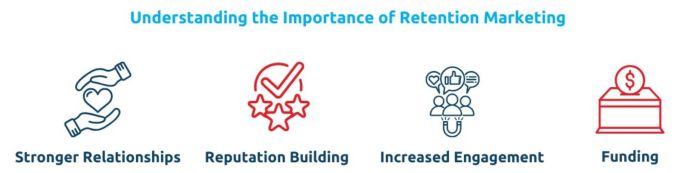
What is retention marketing? Retention marketing is the strategic use of targeted campaigns, communication, and engagement initiatives that keep current students enrolled and actively involved in their educational journey. Unlike traditional marketing, which focuses on acquiring new students, retention marketing is about maintaining student satisfaction and addressing concerns before they result in attrition.
Investing in retention marketing helps schools build stronger student relationships, providing the necessary support to ensure academic persistence. Now let us explore key college student retention strategies to incorporate into your marketing plan.
Source: HEM
1. Personalizing Communication to Address Individual Student Needs
One of the most effective ways to retain students is through personalized communication. Today’s students expect tailored messaging that speaks directly to their needs, challenges, and aspirations.
Automated email campaigns, segmented messaging, and personalized advising can go a long way in making students feel seen and heard. Implementing AI-driven chatbots and predictive analytics can help anticipate student concerns before they escalate, allowing your institution to intervene at critical moments.
2. Creating a Strong Sense of Community and Belonging
Feeling connected to a campus community is a key driver of student success. Institutions that foster a sense of belonging through student organizations, mentorship programs, and social events tend to see higher levels of college student retention.
Marketing teams can contribute by showcasing stories of engaged students and alumni, creating social media groups, and facilitating virtual and in-person networking opportunities that keep students feeling involved.
Example:Here, Nichol’s College demonstrates its commitment to student belonging with a dedicated Instagram for making its current students feel at home. In addition to fostering belonging in your classrooms, clubs, and offices, to improve retention through your digital marketing efforts, it’s essential to champion each student’s role as a valued member of your community in posts and site content.
Source: Nichols College | Instagram
3. Offering Robust Academic Support Services
Academic challenges are one of the leading reasons students drop out. By promoting tutoring centers, academic coaching, and faculty office hours, your institution can reinforce its commitment to student success. Marketing these services effectively ensures students know where to get help when needed. Outreach campaigns can highlight real student success stories, demonstrating the impact of these resources.
Beyond traditional support, schools can integrate technology-driven solutions such as virtual tutoring and on-demand academic workshops. Proactively reaching out to students who show signs of struggling, such as declining grades or low attendance, can also prevent academic disengagement.
Additionally, faculty can offer structured study groups or mentoring programs to ensure students receive guidance outside of class hours. By fostering a strong academic support network, institutions can significantly improve student persistence and overall satisfaction.
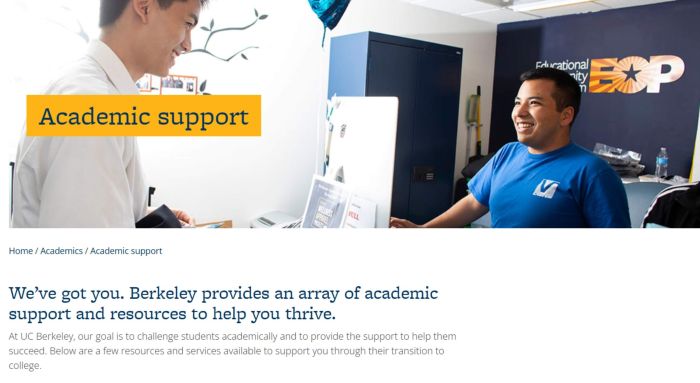
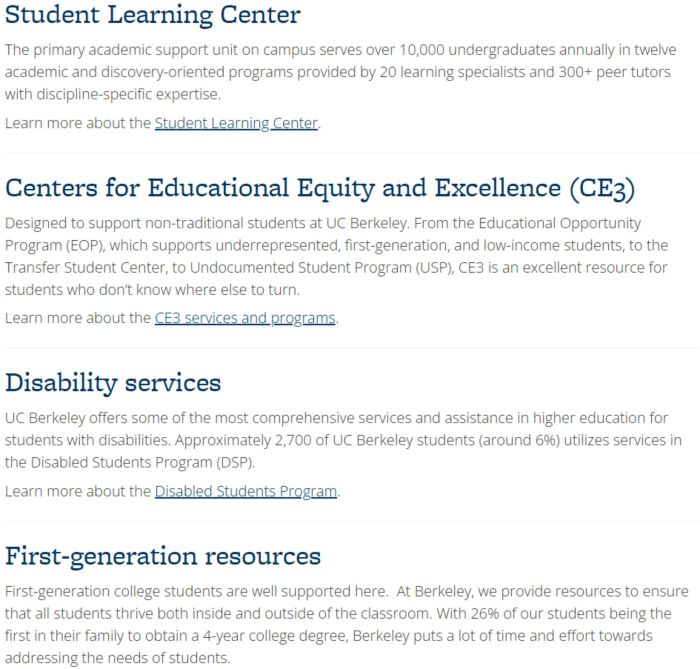
Example: Discover the robust academic support system available to students at UC Berkeley. On their website, they make it clear that they are committed to meeting the learning needs of every student. Below, you’ll see an array of academic resources tailored to different subgroups of the Berkeley student body. Low-income, underrepresented, first-generation, and students with disabilities are acknowledged and supported to reach their full potential.
Source: UC Berkeley
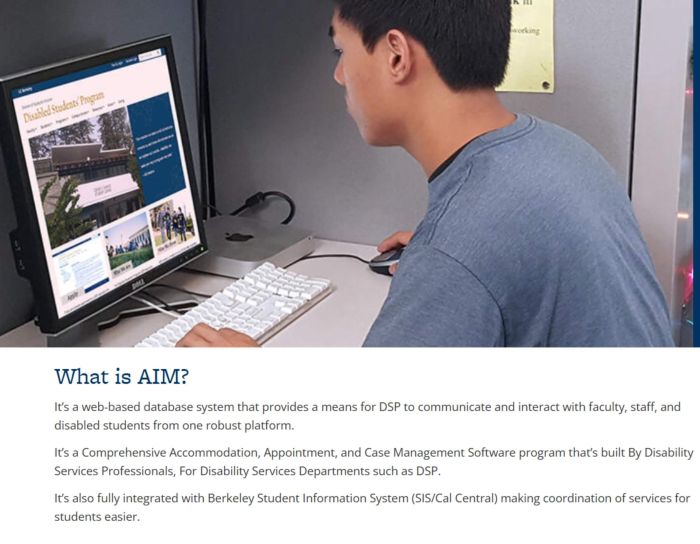
In addition, UC Berkeley leverages technology to serve its students through the AIM platform, specifically tailored to learners with disabilities. AIM, pictured at the bottom, is an accessible Student Information System designed to facilitate communication between students and faculty, streamline the process of requesting accommodations, and centralize the management of their information.
To boost retention, make sure students know how you support their learning. Make it as convenient and inclusive as possible for students to access your resources.
4. Providing Career Development Opportunities Early On
Students often enroll in college with long-term career aspirations in mind, yet many feel uncertain about how to achieve their goals. By integrating career services from day one, schools can help students see a clear pathway from education to employment. Internship programs, networking events, and job placement support should be at the forefront of marketing efforts. When students perceive that their investment in education will lead to tangible career outcomes, they are more likely to persist.
To enhance engagement, institutions should provide hands-on career workshops, alumni networking events, and mentorship opportunities that connect students with professionals in their fields of interest. Career counselors can conduct personalized career assessments to help students identify potential career paths that align with their strengths and interests.
Additionally, integrating career-focused coursework, such as resume-building sessions and mock interviews, can help students feel more confident about their job prospects post-graduation. Schools that establish strong employer partnerships can also facilitate job placement programs, internships, and co-op opportunities that give students real-world experience while still in school, reinforcing their motivation to stay enrolled and complete their studies.
Example:In this video, AAPS, an institution that mainly appeals to graduate students who are focused on starting or developing their careers, markets its career services which include: access to career and employment experts, resume writing support, and interview workshops.
Source: Academy of Applied Pharmaceutical Sciences | YouTube
Their marketing shows how effective the career services at AAPS are, citing their 100% employer satisfaction rate and a solid 88% graduation rate. As you promote your career services, be sure to provide tangible results because that’s what your prospects and current students are looking for.
5. Focus on Student Engagement Initiatives
Student engagement plays a crucial role in student retention, as engaged students are more likely to complete their programs and feel a strong connection to their institution. Schools must take proactive steps to foster engagement through meaningful initiatives that encourage academic, social, and extracurricular involvement.
One way to drive engagement is by creating dynamic student events, such as leadership workshops, cultural festivals, and career networking opportunities. These events provide students with valuable connections, skills, and a greater sense of belonging, reducing feelings of isolation and disengagement.
Another highly effective strategy is gamification, where game design elements, such as rewards, leaderboards, and challenges, are integrated into academic and extracurricular activities. For instance, you could introduce a points-based system that rewards students for attending classes, participating in discussions, or completing extra-curricular workshops.
Social media engagement is another powerful tool. Schools can create dedicated student communities on platforms like Discord, LinkedIn, or Instagram where students can connect, share experiences, and support one another. Institutions that regularly post interactive content, student highlights, and live Q&A sessions see stronger student participation.
Additionally, peer mentorship programs help students build support networks that enhance their academic and personal experiences. New students, especially freshmen, often struggle with the transition to college life. Pairing them with experienced peers who can guide them through academic and social challenges creates a sense of stability and reassurance, leading to increased persistence.
Finally, experiential learning opportunities, such as service-learning projects, research collaborations, and internships, allow students to see the real-world value of their education. When students feel that their coursework directly impacts their future career prospects, they are more likely to remain engaged and committed to completing their studies.
Example: As part of their Student Life Program, the University of Toronto offers Mentorship and Peer Programs to increase student engagement, keeping them invested in both their studies and social lives at U of T, in turn, supporting student retention. In this video, they make the voices of their student body heard, allowing them to express just how the Mentorship and Peer Support programs at U of T have impacted their education. When promoting your student engagement initiatives, try to leverage student testimonials for better relatability and credibility.
Source: U of T Student Life | YouTube
6. Utilizing Data-Driven Insights to Address Student Challenges
Predictive analytics and student data tracking allow institutions to identify at-risk students and intervene early. By analyzing factors such as attendance, engagement levels, and academic performance, schools can proactively reach out to students who may be struggling. Automated alerts and personalized advising sessions ensure students receive timely support tailored to their individual needs.
In addition to tracking academic performance, you can use data insights to improve curriculum design and support services. For example, if a large number of students are struggling with a specific course, faculty can adjust the syllabus, provide supplemental learning materials, or offer additional tutoring sessions.
Schools can also analyze patterns of student engagement in extracurricular activities and campus events to determine what initiatives are most effective in fostering a sense of community. By using data to refine support systems continuously, institutions can create a proactive, student-centric approach that minimizes dropouts and maximizes success.
7. Enhancing Financial Aid Awareness and Support
Financial difficulties are one of the biggest reasons students leave college before completing their programs. Many students are unaware of the full range of financial aid options available. Your school’s marketing team can provide students access to vital scholarships, grants, and payment plans. Institutions should regularly communicate financial aid opportunities through social media, email campaigns, and student portals to alleviate financial stress and keep students enrolled.
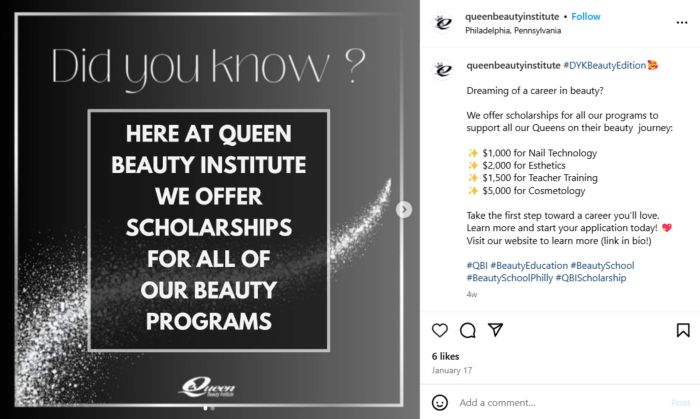
Example: Unfortunately, many students leave their education behind due to their financial situations. Surely, some of these students are unaware of the financial assistance options available to them. To boost student retention, let your community know you can help them invest in their futures. Here, Queen Beauty Institute promotes its financial aid programs on social media, letting students know that support is available should they need it.
Source: Queen Beauty Institute Instagram
8. Promoting a Flexible and Inclusive Learning Environment
Flexibility is key to student retention in higher education, particularly for non-traditional students balancing work, family, and school. Online learning options, hybrid models, and asynchronous coursework can make higher education more accessible. Schools should highlight these flexible learning opportunities in their marketing materials, emphasizing how they accommodate diverse student needs and lifestyles.
In addition to offering different learning formats, you can provide adaptive scheduling options that allow students to select courses that fit their personal and professional commitments. Some colleges have introduced weekend or evening classes to serve students with full-time jobs or family obligations. Additionally, having a robust support system for online students, such as virtual study groups, 24/7 tech support, and faculty office hours, ensures they receive the same level of engagement as in-person learners.
Another important aspect of fostering inclusivity is providing accessible resources for students with disabilities. Ensuring that digital learning platforms are compatible with screen readers, offering captioned lecture videos, and creating inclusive classroom environments can greatly enhance the learning experience. You can also implement specialized advising services to assist students in navigating academic and personal challenges, further reinforcing your commitment to diversity and inclusion.
Example:Here, the Academy of Learning Career College introduces students to its Integrated Learning System, an educational resource designed to put students “in the driver’s seat of their learning experience”. It fosters flexibility and was created with many learning styles and neurodiversity in mind. Make it known how your school aims to meet students where they are.
Source: The Academy of Learning Career College | YouTube
9. Encouraging Faculty-Student Engagement
Professors play a crucial role in retaining students. Meaningful connections between students and faculty members can significantly impact a student’s decision to persist in their studies. Your marketing team can facilitate this by spotlighting faculty members in newsletters, creating video content featuring faculty mentorship stories, and promoting faculty office hours as a key resource.
Institutions can also encourage faculty to take an active role in student success by implementing early intervention programs. If a professor notices a student struggling, they can reach out with personalized support or recommend tutoring services. Additionally, fostering a culture of open communication through regular check-ins, discussion forums, and one-on-one mentorship opportunities helps build trust and rapport between faculty and students.
Another approach is incorporating faculty-led engagement opportunities such as research projects, community outreach programs, and interdisciplinary collaborations. When students work closely with faculty on meaningful academic projects, they feel more invested in their studies and are less likely to disengage. Schools that promote faculty involvement as a cornerstone of student support will see stronger connections, higher levels of academic motivation, and improved retention rates.
10. Establishing Clear Pathways for Student Success
Students are more likely to stay enrolled when they clearly understand their academic roadmap. Schools should provide structured academic pathways, regular progress check-ins, and advising support to help students navigate their journey efficiently. Marketing teams can assist by crafting student success stories highlighting how structured pathways have helped past students graduate on time and achieve their goals.
In addition to offering clear course sequences, institutions can provide academic planning workshops that help students map out their degree completion plan. Schools should also ensure that students have easy access to academic advisors who can guide them in selecting courses aligned with their career goals. By integrating digital tools such as degree audit software, students can track their progress and receive real-time updates on their academic standing.
Offering flexible course options, such as summer sessions or online alternatives, can further help students stay on track and avoid delays in graduation. When students feel they are making steady progress, they are more likely to stay motivated and complete their degrees successfully.
How to Improve Student Retention With a Comprehensive Marketing Strategy
How to improve student retention? A comprehensive marketing strategy should involve consistent engagement with students through multiple touchpoints, addressing common concerns before they lead to dropout. By implementing strategic communication, financial aid awareness, community-building initiatives, and academic support, you can foster an environment where students feel valued and encouraged to complete their education.
At Higher Education Marketing, we specialize in crafting tailored marketing strategies that attract students and keep them engaged throughout their academic journey. HEM specializes in student retention strategies that drive measurable success. Let’s craft a marketing plan that keeps students engaged from enrolment to graduation. that fosters long-term student success.
Struggling with enrollment?
Our expert digital marketing services can help you attract and enroll more students!
Frequently Asked Questions
Question: What is retention marketing?
Answer: Retention marketing is the strategic use of targeted campaigns, communication, and engagement initiatives that keep current students enrolled and actively involved in their educational journey.
Question: How to improve student retention?
Answer: A comprehensive marketing strategy should involve consistent engagement with students through multiple touchpoints, addressing common concerns before they lead to dropout. By implementing strategic communication, financial aid awareness, community-building initiatives, and academic support, you can foster an environment where students feel valued and encouraged to complete their education.
Are you an administrator or marketer at a small private school? If so, you likely face unique challenges in growing your school community. Unlike large institutions with extensive resources, your budget may be more limited, and your brand may not have the same level of recognition. Yet, your school likely offers something invaluable: a personalized, high-quality educational experience that deserves greater visibility. Your marketing strategy should spotlight the unique selling points that differentiate your private school from other institutions.
How do you market a small private school? Traditional outbound marketing methods, such as print ads and direct mail, are costly and less effective in today’s digital market. Instead, try inbound marketing, a group of strategies that offer a cost-efficient and impactful way to attract, engage, and retain families interested in your school. Keep reading to explore ten effective private school marketing ideas that will grow your community.
Struggling with enrollment?
Our expert digital marketing services can help you attract and enroll more students!
What Is Inbound Marketing and Why Is It Ideal for Private Schools Like Yours?
Inbound marketing is a strategy that focuses on attracting prospective families to your school through valuable content, SEO, social media engagement, and other digital efforts. Instead of pushing advertisements onto audiences who may not be interested, inbound marketing creates meaningful connections with families actively looking for the right educational institution.
If you’re wondering how to market a new private school using inbound strategies, remember that the key is to build trust and provide the right information at the right time. Parents today research extensively before choosing a school for their children. Though many outbound strategies remain relevant today, namely to increase visibility, offer useful content, address concerns, and showcase your school’s strengths. Inbound marketing can position your institution as the best choice. Now, let’s explore specific ways that you can grow your private school community.
Source: HEM
10 Proven Inbound Marketing Strategies for Private Schools
Incorporating these tactics into your marketing strategy can reach your target audience, create relationships by providing value, and incite desired action. An effective private school marketing campaign combines several, if not all, of the techniques discussed below. If any are missing from your current plan, now’s the time to start implementing them!
1. Create a High-Quality, SEO-Optimized Website
Your website is the foundation of your school marketing strategy. It must be visually appealing, easy to navigate, and optimized for search engines. Parents should find essential information, such as tuition, curriculum, testimonials, and admissions requirements quickly and effortlessly. A well-structured website should include dedicated pages for admissions, academic programs, extracurricular activities, and student life.
Ensuring mobile responsiveness and fast load speeds will improve user experience and increase engagement. Incorporating multilingual and culturally adapted content can expand your reach, particularly if you’re targeting international students. Regularly updating your website with blog posts, news, and event details ensures prospective parents see a dynamic, engaged school community.
Example: Are you trying to expand your private school community beyond borders? If so, you’ll want to borrow this effective SEO technique from Crimson Global Academy. Below, you’ll see that they’ve tailored their site content to different countries and used subdirectories in their URLs.
Using sub-directories (/uk/, /ca/) signals to search engines that the content is tailored for a specific region. Google prioritizes localized content in search results, meaning parents and students searching for private schools in their home country are more likely to find your institution.
The benefits of this SEO strategy are far-reaching. They include broadened international reach, higher performance in multilingual searches, and higher click-through rates due to relevance.
Source: Crimson Global Academy
2. Develop Engaging Blog Content
A well-crafted blog is a valuable resource for current and prospective families, positioning your school as a thought leader in education. By publishing informative and engaging content, you can address parents’ most pressing concerns, showcase student success stories, and highlight what makes your school unique.
For example, you can write about how to help children transition to a new school successfully by offering expert advice and real-life experiences from parents and students. Another great topic is discussing the benefits of small class sizes and how they enhance student learning, highlighting the personalized attention and academic advantages your school provides.
You can also explore how your school’s curriculum prepares students for future success in higher education and beyond, showcasing testimonials from alumni who have excelled. Additionally, sharing success stories from students and faculty can illustrate the positive impact of your educational programs.
Finally, providing a step-by-step guide for parents navigating the private school admissions process can ease their concerns and position your school as a supportive and transparent institution. Consistently publishing high-quality blog posts improves search engine rankings, making your school more visible to families searching for private education options.
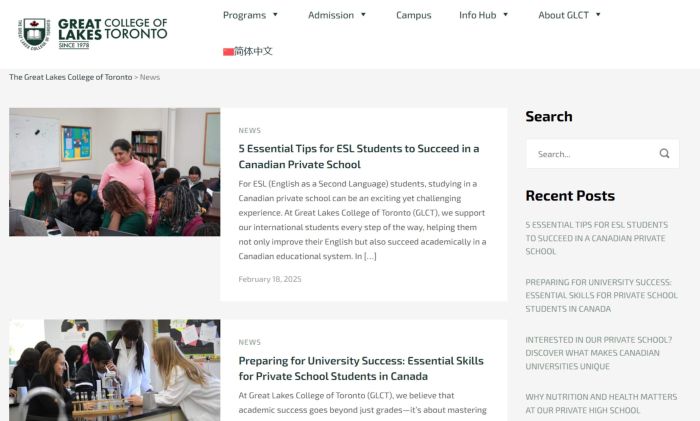
Example: The Great Lakes College of Toronto publishes blogs relevant to their prospects – students from all over the world interested in attending prestigious Canadian universities. With their target audience in mind, GLCT creates content that provides value. For example, learning tips for ESL learners, how to prepare for Canadian universities, and much more. Make sure your blog content aligns with your site visitors’ needs and provides valuable information.
Source: Great Lakes College of Toronto
3. Leverage Social Media Marketing
Social media platforms like Facebook, Instagram, and LinkedIn are powerful tools for building community and engagement. Your school can foster stronger connections with prospective and current families by posting student achievements, behind-the-scenes content, and faculty highlights.
Live Q&A sessions can address frequently asked questions about your school’s programs and admission process. Hosting interactive polls, student takeovers, and parent testimonials can increase engagement and trust.
Additionally, investing in paid social media advertising can expand your school’s reach to target families actively searching for private school options. Schools can also create private Facebook groups for prospective and current parents, providing a space for questions and engagement.
Example: This Instagram post from CLS West Covina highlights the strength of the school community. In addition to academic excellence, your private school should highlight other features of the student experience that contribute positively to learning, such as extracurricular activities, a nurturing environment, community involvement, global awareness, and more. Social media remains the perfect stage for your school’s unique selling points.
Source: CLS West Covina | Instagram
4. Implement a Lead Nurturing Email Campaign
Once a prospective family expresses interest, it’s essential to maintain communication through well-crafted email campaigns. Personalized drip campaigns can guide them through enrolling, providing timely information about your school, key deadlines, and success stories from current students.
Automated email sequences can include welcome emails, event reminders for open houses, and curriculum overviews. A segmented approach, where emails are tailored to different stages of the admission journey, can significantly improve conversion rates. Sending personalized content based on user interaction, such as downloadable brochures, testimonials, and exclusive invitations, keeps families engaged throughout the decision-making process.
5. Use Video Marketing to Showcase Your School’s Culture
Video content is one of the most effective ways to give prospective families an immersive experience of your school. Creating high-quality video tours, faculty introductions, and student testimonials can provide a dynamic look into daily life at your institution. Highlighting classroom environments, extracurricular activities, and real-world student experiences can create an emotional connection with families.
Short-form videos on platforms like Instagram Reels and TikTok can help boost engagement among younger audiences, while long-form content on YouTube and your website can provide in-depth insights. Hosting live virtual tours where prospective families can ask real-time questions enhances engagement.
6. Optimize Your Google My Business Profile
Many parents start their search for private schools on Google. A fully optimized Google My Business profile ensures your school appears in local search results with accurate contact details, reviews, and images. Encouraging satisfied parents to leave positive reviews can significantly enhance your school’s online reputation.
Regularly updating your profile with recent photos, upcoming events, and engaging posts can make your school stand out among competitors. Answering common parent inquiries directly on your profile, such as tuition costs and curriculum highlights, helps streamline decision-making. Additionally, responding promptly to positive and negative reviews demonstrates strong community engagement and builds trust with prospective families.
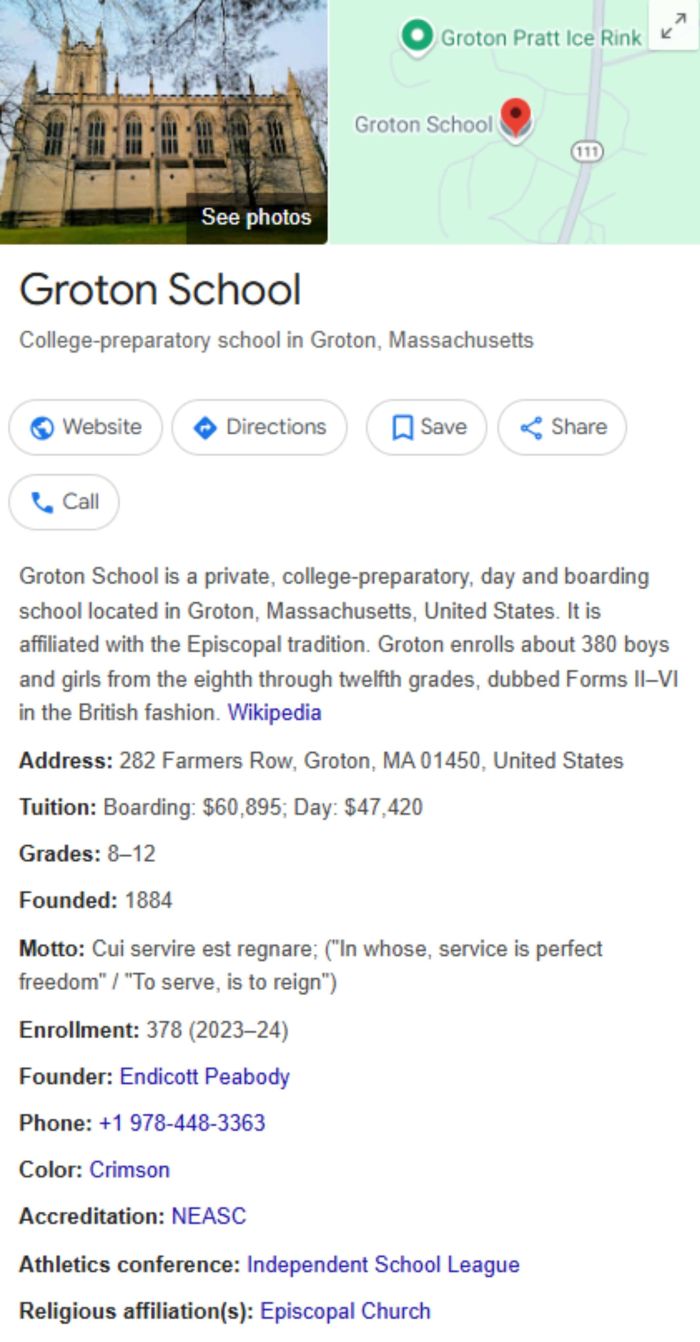
Example: This is what your private school looks like in search results when you optimize your Google My Business account. This essential feature provides an easily digestible snapshot of your institution, presents a professional image to web users, and makes it much easier for your target audience to find you.
Source: Groton School | Google
7. Host Virtual and In-Person Open Houses
In today’s digital landscape, virtual open houses offer a convenient way for parents to learn about your school from anywhere. In-person tours and interactive virtual sessions cater to a broader audience while answering common questions in real time.
A well-structured open house should include live presentations from school leaders, faculty members, and current students who can share their experiences. Offering breakout sessions for different grade levels or programs allows parents to focus on the most relevant aspects of your school.
Additionally, incorporating Q&A panels, video tours of classrooms and facilities, and even virtual meet-and-greet opportunities with teachers can help prospective families get a more personal feel for your school’s community. Recording these sessions and making them available on your website also ensures that families who couldn’t attend live still have access to the information.
Example: Queen Anne’s School makes it a priority to offer prospects a positive first impression through in-person “Open Morning” events and a virtual tour to showcase their beautiful campus. They also offer personal tours, group tours on site, taster days, and taster boarder experiences to accommodate every prospect’s preferences. Wow future students and their families by giving them a taste of your unique student life experience.
Source: Queen Anne’s School
8. Invest in Paid Digital Advertising
While organic traffic is essential, strategic paid advertising can help small private schools reach highly targeted audiences. Google Ads and Facebook Ads can be optimized to reach families searching for private school options in your area.
Displaying retargeting ads to parents who previously visited your website can help keep your school top-of-mind. Running A/B tests on ad creatives and messaging can improve ad performance and maximize return on investment.
9. Create Downloadable Resources to Capture LEADS
Providing valuable downloadable resources, like e-books, checklists, and guides, can encourage prospective families to share their contact information. For instance, a downloadable guide on “Choosing the Right Private School for Your Child” can position your institution as an industry expert while generating qualified leads. Interactive tools, such as school comparison charts and tuition calculators, can further engage visitors and increase conversion rates.
To maximize the effectiveness of downloadable resources, schools should ensure that these materials are highly relevant, visually appealing, and easy to understand. Including real-world examples, student success stories, or insights from school faculty can add credibility and value.
Additionally, placing lead capture forms strategically throughout the website, such as on admissions pages, blog posts, and program descriptions, can encourage more sign-ups. Schools can also create exclusive content for different stages of the enrollment journey, such as a “First-Time Parent’s Guide to Private School Admissions” or a “Step-by-Step Checklist for Enrollment Success,” providing tailored resources that guide families through the decision-making process. Regularly updating these materials ensures they remain relevant and aligned with current education trends.
10. Utilize Retargeting Strategies
Most parents don’t enroll immediately after visiting your website. Retargeting strategies, such as displaying ads to users who previously visited your site, can help keep your school top-of-mind. This ensures interested families receive gentle reminders to revisit your offerings and complete the application process. Email remarketing campaigns can also re-engage families who started but did not complete an application.
To enhance retargeting effectiveness, schools should segment their audience based on engagement levels, such as visitors who viewed tuition pages, downloaded an admissions guide, or attended a virtual open house. Personalized messaging, such as an email featuring student testimonials or a special enrollment incentive, can encourage hesitant families to take the next step.
Schools can also leverage dynamic display ads that adjust content based on a user’s previous website activity, like showing program-specific ads for those who viewed a particular course or highlighting upcoming admissions deadlines. Schools can effectively nurture leads and increase enrollment conversions using a multi-channel approach, combining retargeting ads with personalized email follow-ups.
Getting Professional Marketing Support Can Help Your Private School Grow
Navigating the complexities of digital marketing can be overwhelming, especially for small private schools with limited resources. That’s where expert guidance can make all the difference.
At Higher Education Marketing, we specialize in helping educational institutions maximize their online presence through customized inbound marketing strategies. Whether you need assistance with content creation, SEO, social media management, or lead nurturing, our team of education marketing experts ensures that your school effectively reaches its target audience.
With over 15 years of experience, we understand the nuances of school marketing ideas and tailor our solutions to your institution’s specific needs. Our digital marketing services include:
SEO Optimization
Paid Advertising Campaigns
Social Media Management
Website Development
Email Marketing Automation
Start Growing Your Private School Today
By embracing inbound marketing, your small private school can attract the right families, establish a strong online presence, and build a thriving school community. Whether you’re looking to optimize your digital strategy, refine your content marketing approach, or improve engagement through paid advertising, HEM is here to help.
The combination of a strong website, engaging blog content, an active social media presence, and targeted email marketing ensures that your school remains visible and competitive in the evolving field of education.
Struggling with enrollment?
Our expert digital marketing services can help you attract and enroll more students!
Frequently Asked Questions
Question: How do you market a small private school?
Answer: Traditional outbound marketing methods, such as print ads and direct mail, are costly and less effective in today’s digital market. Instead, try inbound marketing, a group of strategies that offer a cost-efficient and impactful way to attract, engage, and retain families interested in your school.
Question: How to market a new private school?
Answer: The key is to build trust and provide the right information at the right time. Parents today research extensively before choosing a school for their children. Though many outbound strategies remain relevant today, namely to increase visibility, offer useful content, address concerns, and showcase your school’s strengths. Inbound marketing can position your institution as the best choice.
“Global law firms have for years played an outsized role in undermining the judicial process and in the destruction of bedrock American principles.” —Executive Order (3-14-25)
“Law firms refuse to represent Trump opponents in the wake of his attacks” — The Washington Post (3-25-25)
The wolf is at the door.
Those who do not yet realize this may be forgiven for perhaps two reasons: They do not know the wolf is ravenous, and they do not know the door is ajar.
To get but a whiff of this, just read Brad Karp’s March 23 memo to his colleagues at the Paul Weiss firm, from which the title of this edition of FAN gets its title.
Also this, from MSNBC legal correspondent Lisa Rubin:
[The attacks on law firms] began with Trump issuing executive actions punishing three firms — Covington & Burling, which did not react; Perkins Coie, which fought back and won a partial temporary restraining order; and Paul Weiss, which ultimately capitulated to a deal announced last Thursday, the terms of which are still a matter of some debate. But the president has now directed Attorney General Pam Bondi, in a memo issued Friday night, to seek sanctions “against attorneys and law firms who engage in frivolous, unreasonable, and vexatious litigation against the United States.”
Now back to the Paul, Weiss controversy.
A little background at the outset to help set the retributive stage: According to Wikipedia, Karp “is a bundler for Democratic Party presidential candidates . . . having raised sums for the presidential campaigns of Kamala Harris, Cory Booker, Joe Biden, Amy Klobuchar, and others.”
In other words, if Trump was out for political retribution, Karp was a perfect target. And then consider this: One of Karp’s former partners was Mark Pomerantz, author of “People vs. Donald Trump: An Inside Account,” which details the attempt to prosecute former president Donald Trump, written by one of the lawyers who worked on the case and who resigned in protest when Manhattan’s district attorney refused to act.
And now on to the Executive Order from March 14, “Addressing Risks from Paul Weiss.” Excerpts below:
In 2022, Paul Weiss hired unethical attorney Mark Pomerantz, who had previously left Paul Weiss to join the Manhattan District Attorney’s office solely to manufacture a prosecution against me and who, according to his co-workers, unethically led witnesses in ways designed to implicate me. After being unable to convince even Manhattan District Attorney Alvin Bragg that a fraud case was feasible, Pomerantz engaged in a media campaign to gin up support for this unwarranted prosecution.
Additionally, Paul Weiss discriminates against its own employees on the basis of race and other categories prohibited by civil rights laws. Paul Weiss, along with nearly every other large, influential, or industry leading law firm, makes decisions around ‘targets’ based on race and sex.
My Administration is committed to ending such unlawful discrimination perpetrated in the name of “diversity, equity, and inclusion” policies and ensuring that Federal benefits support the laws and policies of the United States, including those laws and policies promoting our national security and respecting the democratic process.
Now, the Weiss law firm’s memo in response, from Brad Karp:
Brad Karp
Only several days ago, our firm faced an existential crisis. The executive order could easily have destroyed our firm. It brought the full weight of the government down on our firm, our people, and our clients. In particular, it threatened our clients with the loss of their government contracts, and the loss of access to the government, if they continued to use the firm as their lawyers. And in an obvious effort to target all of you as well as the firm, it raised the specter that the government would not hire our employees.
We were hopeful that the legal industry would rally to our side, even though it had not done so in response to executive orders targeting other firms. We had tried to persuade other firms to come out in public support of Covington and Perkins Coie. And we waited for firms to support us in the wake of the President’s executive order targeting Paul, Weiss. Disappointingly, far from support, we learned that certain other firms were seeking to exploit our vulnerabilities by aggressively soliciting our clients and recruiting our attorneys.
We initially prepared to challenge the executive order in court, and a team of Paul, Weiss attorneys prepared a lawsuit in the finest traditions of the firm. But it became clear that, even if we were successful in initially enjoining the executive order in litigation, it would not solve the fundamental problem, which was that clients perceived our firm as being persona non grata with the Administration. We could prevent the executive order from taking effect, but we couldn’t erase it. Clients had told us that they were not going to be able to stay with us, even though they wanted to. It was very likely that our firm would not be able to survive a protracted dispute with the Administration.
Commentary:
President Donald Trump’s crackdown on lawyers is having a chilling effect on his opponents’ ability to defend themselves or challenge his actions in court, according to people who say they are struggling to find legal representation as a result of his challenges.
[Such executive orders and pressured settlements set] an ominous precedent for future presidents to exploit. . . . [H]ow can a lawyer who is considering representing a politically controversial client know that she will not be targeted the next time control of the White House changes hands? The safest course of action will be to avoid representing clients of any political salience, right or left, even if their cause is just.
Related
Constitutional scholars on the Trump Administration’s threats against Columbia University
We write as constitutional scholars — some liberal and some conservative — who seek to defend academic freedom and the First Amendment in the wake of the federal government’s recent treatment of Columbia University.
The First Amendment protects speech many of us find wrongheaded or deeply offensive, including anti-Israel advocacy and even antisemitic advocacy. The government may not threaten funding cuts as a tool to pressure recipients into suppressing such viewpoints. This is especially so for universities, which should be committed to respecting free speech.
At the same time, the First Amendment of course doesn’t protect antisemitic violence, true threats of violence, or certain kinds of speech that may properly be labeled ‘harassment.’ Title VI rightly requires universities to protect their students and other community members from such behavior. But the lines between legally unprotected harassment on the one hand and protected speech on the other are notoriously difficult to draw and are often fact-specific. In part because of that, any sanctions imposed on universities for Title VI violations must follow that statute’s well-established procedural rules, which help make clear what speech is sanctionable and what speech is constitutionally protected.
Yet the administration’s March 7 cancellation of $400 million in federal funding to Columbia University did not adhere to such procedural safeguards. Neither did its March 13 ultimatum stipulating that Columbia make numerous changes to its academic policies — including the demand that, within one week, it “provide a full plan” to place an entire “department under academic receivership for a minimum of five years” — as “a precondition for formal negotiations regarding Columbia University’s continued financial relationship with the United States government.”
Signatories
Steven G. Calabresi Clayton J. and Henry R. Barber Professor of Law, Northwestern Law School
Erwin Chemerinsky Dean and Jesse H. Choper Distinguished Professor of Law, Berkeley Law School
David Cole Hon. George J. Mitchell Professor in Law and Public Policy, Georgetown University Law Center
Michael C. Dorf Robert S. Stevens Professor of Law, Cornell Law School
Richard Epstein Laurence A. Tisch Professor of Law, NYU School of Law
Owen Fiss Sterling Professor Emeritus of Law, Yale Law School
Aziz Huq Frank and Bernice J. Greenberg Professor of Law, University of Chicago Law School
Pamela Karlan Kenneth and Harle Montgomery Professor of Public Interest Law, Stanford Law School
Randall Kennedy Michael R. Klein Professor of Law, Harvard Law School
Genevieve Lakier Professor of Law, Herbert and Marjorie Fried Teaching Scholar, University of Chicago Law School
Michael McConnell Richard and Frances Mallery Professor of Law, Stanford Law School
Michael Paulsen Distinguished University Chair and Professor, St. Thomas Law School
Robert Post Sterling Professor of Law, Yale Law School
David Rabban Dahr Jamail, Randall Hage Jamail, and Robert Lee Jamail Regents Chair in Law, University of Texas Law School
Geoffrey R. Stone Edward H. Levi Distinguished Service Professor of Law, University of Chicago Law School
Nadine Strossen John Marshall Harlan II Professor of Law Emerita, New York Law School
Eugene Volokh Thomas M. Siebel Senior Fellow, Hoover Institution, Stanford University
Keith Whittington David Boies Professor of Law, Yale Law School
SCOTUS denies review in case urging that Sullivan be overruled
Wynn v. Associated Press (issue: Whether this Court should overturn Sullivan’s actual-malice standard or, at a minimum, overrule Curtis Publishing Co.’s expansion of it to public figures)
On the Trump administration targeting campuses
The United States is home to the best collection of research universities in the world. Those universities have contributed tremendously to America’s prosperity, health, and security. They are magnets for outstanding talent from throughout the country and around the world. The Trump administration’s recent attack on Columbia University puts all of that at risk, presenting the greatest threat to American universities since the Red Scare of the 1950s. Every American should be concerned.
Until recently, it was a little-known program to help Black and Latino students pursue business degrees.
But in January, conservative strategist Christopher Rufo flagged the program known as The PhD Project in social media posts that caught the attention of Republican politicians. The program is now at the center of a Trump administration campaign to root out diversity, equity and inclusion programs in higher education.
The U.S. Education Department last week said it was investigating dozens of universities for alleged racial discrimination, citing ties to the nonprofit organization. That followed a warning a month earlier that schools could lose federal money over “race-based preferences” in admissions, scholarships or any aspect of student life.
The investigations left some school leaders startled and confused, wondering what prompted the inquiries. Many scrambled to distance themselves from The PhD Project, which has aimed to help diversify the business world and higher education faculty.
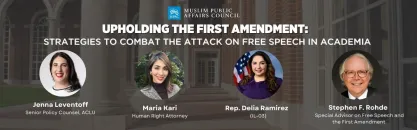
Zoom webinar on strategies to combat attacks on free speech in academia
Thursday, March 27, 2025, 1:00 – 2:00 PM ET
As efforts to silence dissent grow more aggressive, the immediate and long-term threats to our constitutional freedoms — especially in educational institutions — cannot be ignored.
This virtual panel will bring together top legal minds and policy experts to examine how these actions affect student activists, journalists, and marginalized communities. Together, we’ll explore the legal strategies needed to safeguard First Amendment rights and resist the erosion of civil liberties.
Featured Panelists: Maria Kari, Human Rights Attorney Rep. Delia Ramirez (IL-03) Jenna Leventoff, Senior Policy Counsel, ACLU Stephen F. Rohde, MPAC Special Advisor on Free Speech and the First Amendment Whether you’re a student, educator, advocate, or supporter of civil rights, this is a conversation you won’t want to miss.
➡️ Register today and join us in defending the values that define our democracy.
Whittington on diversity statements and college hiring
Keith Whittington
The University of California is the godfather of the use of so-called diversity statements in faculty hiring. I have a piece forthcoming at the Nebraska Law Review arguing that such diversity statement requirements for general faculty hiring at state universities violate the First Amendment and violate academic freedom principles everywhere. It seems quite likely that in practice such diversity statement requirements are also used to facilitate illegal racial discrimination in faculty hiring.
The University of California system’s board of regents has now put an end to the use of such diversity statements at those schools. This is a truly remarkable development. Not unreasonably, this decision is being put in the context of the Trump administration’s extraordinary attack on Columbia University, a move that I think is both lawless and itself a threat to academic freedom. But there’s no question that it got the attention of university leaders across the country, and if it encourages some of them to rededicate themselves to their core institutional mission and its central values then at least some good will come of it. So silver linings and all that.
Trump rails against portrait at the Colorado Capitol
Institute for Free Speech files brief in campaign disclosure-fee case
The case is Sullivan v. Texas Ethics Commission. The issue in the case is whether — and if so, under what circumstances — the First Amendment permits the government to require ordinary citizens to register and pay a fee to communicate with their government representatives.
Amicus brief here. Counsel of record: Alan Gura. The Institute’s brief argues that the 1954 precedent of United States v. Harriss no longer reflects modern First Amendment jurisprudence and fails to protect the right to speak anonymously about matters of public policy.
Forthcoming book by Princeton’s president on campus free speech
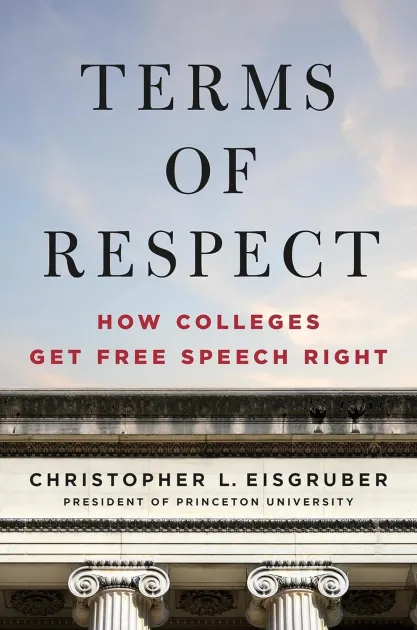
The president of Princeton, a constitutional scholar, reveals how colleges are getting free speech on campuses right and how they can do better to nurture civil discourse and foster mutual respect
Conversations about higher education teem with accusations that American colleges and universities are betraying free speech, indoctrinating students with left-wing dogma, and censoring civil discussions. But these complaints are badly misguided.
In Terms of Respect, constitutional scholar and Princeton University president Christopher L. Eisgruber argues that colleges and universities are largely getting free speech right. Today’s students engage in vigorous discussions on sensitive topics and embrace both the opportunity to learn and the right to protest. Like past generations, they value free speech, but, like all of us, they sometimes misunderstand what it requires. Ultimately, the polarization and turmoil visible on many campuses reflect an American civic crisis that affects universities along with the rest of society. But colleges, Eisgruber argues, can help to promote civil discussion in this raucous, angry world — and they can show us how to embrace free speech without sacrificing ideals of equality, diversity, and respect.
Urgent and original, Terms of Respect is an ardent defense of our universities, and a hopeful vision for navigating the challenges that free speech provokes for us all.
Forthcoming scholarly article on AI and the First Amendment
This paper challenges the assumption that courts should grant outputs from large generative AI models, such as GPT-4 and Gemini, First Amendment protections. We argue that because these models lack intentionality, their outputs do not constitute speech as understood in the context of established legal precedent, so there can be no speech to protect. Furthermore, if the model outputs are not speech, users cannot claim a First Amendment right to receive the outputs.
We also argue that extending First Amendment rights to AI models would not serve the fundamental purposes of free speech, such as promoting a marketplace of ideas, facilitating self-governance, or fostering self-expression. In fact, granting First Amendment protections to AI models would be detrimental to society because it would hinder the government’s ability to regulate these powerful technologies effectively, potentially leading to the unchecked spread of misinformation and other harms.
2024-2025 SCOTUS term: Free expression and related cases
Cases decided
Villarreal v. Alaniz(Petition granted. Judgment vacated and case remanded for further consideration in light of Gonzalez v. Trevino, 602 U. S. ___ (2024) (per curiam))
Murphy v. Schmitt (“The petition for a writ of certiorari is granted. The judgment is vacated, and the case is remanded to the United States Court of Appeals for the Eighth Circuit for further consideration in light of Gonzalez v. Trevino, 602 U. S. ___ (2024) (per curiam).”)
TikTok Inc. and ByteDance Ltd v. Garland (The challenged provisions of the Protecting Americans from Foreign Adversary Controlled Applications Act do not violate petitioners’ First Amendment rights.)
Review granted
Pending petitions
Petitions denied
Free speech related
Thompson v. United States (decided: 3-21-25/ 9-0 w special concurrences by Alito and Jackson) (interpretation of 18 U. S. C. §1014 re “false statements”)
This article is part of First Amendment News, an editorially independent publication edited by Ronald K. L. Collins and hosted by FIRE as part of our mission to educate the public about First Amendment issues. The opinions expressed are those of the article’s author(s) and may not reflect the opinions of FIRE or Mr. Collins.
Since its founding in 1836, the Harvard Alumni Association (HAA) has sought to “renew that interest in Harvard’s welfare and glory which separation and absence have hitherto caused too long and lamentably to slumber.”
Today, as Harvard faces mounting challenges to its foundational commitment to Veritas(Truth) — steadily being replaced, it seems, by Pontius Pilate’s cynical sneer: Quid est veritas? (What is truth?) — a renewed interest among alumni in their alma mater’s “welfare and glory” is more vital than ever.
And the upcoming HAA Board elections offer Harvard alumni the perfect place to start. The task is to elect leaders who will champion free expression, viewpoint diversity, civil discourse, and academic freedom — the very tools that make the pursuit of Veritas possible.
Among the candidates seeking an elected director position, Allison Pillinger Choi, A.B. 2006, stands out with a compelling vision. Under the banner of “Building Balance,” Choi is campaigning for a Harvard where “all truth-seeking ideas — whether conservative, liberal, or otherwise — are heard, valued, and respected.”
Choi’s life story exemplifies the very balance she aims to promote. Born and raised in South Florida to a Korean immigrant mother and a third-generation Jewish American father, she mastered the art of equilibrium early on. This instinct for poise carried her through Harvard, where she balanced an economics degree, Division I varsity tennis, editorship on The Crimson’s business board, and shifts at various Cambridge eateries.
Allison Pillinger Choi with her husband, Brian, and two children in the Dunster House library at Harvard.
After a successful postgraduate career in finance and fitness — balancing checkbooks and barbells — she now lives in New York with her husband and two children while serving on local nonprofit boards dedicated to the arts, civics, and the environment. Most notably, she is the co-founder of Experiment in Dialogue, an initiative promoting conversations across ideological divides.
FIRE recently sat down with Choi to discuss her campaign for the HAA Board, her thoughts on free expression at Harvard, and how she envisions bringing balance to her alma mater. Below is our conversation, edited for readability.
How has your experience at Harvard, both as a student and alum, shaped your views on free expression and intellectual diversity?
As an undergraduate, I sensed unspoken limits on which political views were acceptable. In one instance, I remember taking a class on labor markets where the professor made it clear how he felt about unions. While I respected his research and affable style of teaching, as the daughter of a union worker, I knew the issue was more complex.
My father had explained to me and my brother that while unions can be a force for good, they also have downsides. I knew there was more to the argument than was offered in class, but I didn’t want to cross that invisible line — so I often just stayed quiet, went along with the prevailing view, and answered questions accordingly.
That experience stayed with me. Over the years, as an alum, I’ve heard even more troubling stories — students and faculty feeling pressured to hide their beliefs or adjust how they talk about certain issues to avoid backlash. It made me realize that maybe I was part of the problem by staying silent.
Now, I want to be part of the solution — not only by encouraging people to speak up but also by helping others see that viewpoint diversity is essential for genuine intellectual growth.
Your campaign focuses on “Bringing Balance.” Can you explain what that means and why you think it’s important right now, especially at Harvard?
The theme of my campaign, “Building Balance,” carries several layers of meaning. For one, it’s about fostering a diversity of viewpoints. This doesn’t mean insisting on a strict 50/50 split or symmetrical representation. Rather, it’s about broadening the spectrum of perspectives and opinions. It ensures that a wide range of voices are present. This approach helps prevent institutions from falling into the trap of echo chambers, where only reinforcing viewpoints are heard and where growth is limited.
“Building Balance” also refers to finding stability. Many higher education institutions today are navigating heightened tensions. I believe that embracing viewpoint diversity — by welcoming advocates from various personal and political backgrounds — can contribute to a healthier, more stable environment where all sincere, truth-seeking perspectives are respected and considered.
Finally, “Building Balance” is about recognizing and strengthening the extraordinary elements present at Harvard. It’s not about dismantling, it’s about building upon a strong foundation. I believe that viewpoint diversity, civil discourse, and academic freedom are the foundational elements of our university community, and integral to continued success.
What role do you see alumni playing in promoting free expression and viewpoint diversity at Harvard?
Alumni have numerous ways to contribute to the promotion of free expression and viewpoint diversity at Harvard. One of the most simple and effective actions is to just show up. Attend HAA events and broader Harvard community gatherings that highlight heterodox thinkers and speakers. And why not invite an alumni friend along? Extra credit if that friend brings a different political perspective!
The HAA is always looking for new ways to engage alumni and increase participation. With the growing number of initiatives supporting the classical liberal values of freedom and expression at Harvard, our community has more opportunities for anyone eager to champion viewpoint diversity. As an HAA elected director, I would support and expand these initiatives.
One of the unique — and often overlooked — aspects of being a viewpoint diversity advocate is that there’s no requirement to hold any particular opinion. All that’s needed is curiosity. However, if a viewpoint diversity advocate does have strong convictions, that’s perfectly fine, too. The key is to approach differing views with humility and charity. With these qualities, every alumnus is capable of both promoting and exercising free expression and viewpoint diversity.
Indeed, it’s an “exercise.” As Harvard professor Eric Beerbohm, head of the university’s new Civil Discourse Initiative, aptly puts it, “The ability to engage in empathetic disagreement is like a muscle — it grows stronger with deliberate practice. These kinds of scenarios, where participants are challenged to consider new perspectives and make tough decisions, provide exactly that kind of exercise.”
How can the HAA better engage alumni who feel disconnected or frustrated with the current campus climate?
As an elected director, I would love to help the HAA deepen alumni engagement and re-engage those who feel disconnected or frustrated. One effective approach is to expand the variety of event themes, particularly by hosting panel discussions that feature diverse viewpoints on a range of important topics.
While the panelists would be experts in their fields, each would offer a unique perspective and set of beliefs. The common thread among them would be their shared commitment to open inquiry and civil discourse.
These events could be modeled after the spirit of professor Michael Sandel’s renowned undergraduate course, “Justice,” one of Harvard’s most popular classes. In Sandel’s lectures, he regularly invited professors with opposing viewpoints to debate controversial topics, with the goal of seeking truth. Professors like Sandel understand that complex issues rarely have clear-cut answers.
It is only through the rigorous process of challenging and questioning that we improve our understanding, move closer to truth, and expand our communities. Alumni groups could carry forward Sandel’s legacy of viewpoint diversity by hosting events where renowned thinkers debate significant topics, fostering a space for respectful and productive dialogue among heterodox thinkers and doers.
If elected, what would success look like for you at the end of your term as an elected director?
If elected, success at the end of my three-year term would mean accomplishing at least two key goals. The first would be seeing more HAA volunteers actively contributing to viewpoint diversity initiatives within their areas of interest. With roughly 200 Harvard clubs and 60 shared interest groups covering a range of professional fields, academic disciplines, and personal identity backgrounds, there is so much opportunity to foster diverse perspectives!
While these HAA groups share common interests, each alumnus brings something unique. I believe we can proactively seek and encourage a diversity of viewpoints across our HAA communities.
The second goal is to establish an alumni event series that pays homage to the deep friendship between Justices Ruth Bader Ginsburg and Antonin Scalia — both former Harvard Law students. Their remarkable bond transcended the controversial issues they often disagreed on in their judicial decisions.
United by their shared love of country and opera, among other interests, they demonstrated how mutual respect and admiration can flourish despite ideological differences. I want to celebrate this sentiment through events that feature speakers of opposing views, followed by a post-debate social.
Allison Pillinger Choi’s candidacy for HAA Board is a call to action –– to awaken alumni from their “slumber” and take an interest in the “welfare and glory” of Harvard. If you are a Harvard alum and are interested in supporting Choi’s vision for “Building Balance,” be sure to make your voice heard in this important election.
The HAA Board election begins on April 1 and will remain open until 5 p.m. EST on May 20th. All Harvard degree holders as of Jan. 1, 2025 are eligible to vote. Alumni can cast their ballots online, via the alumni portal, or by paper ballot, which you will receive in the mail, to fill six openings among the HAA elected directors.
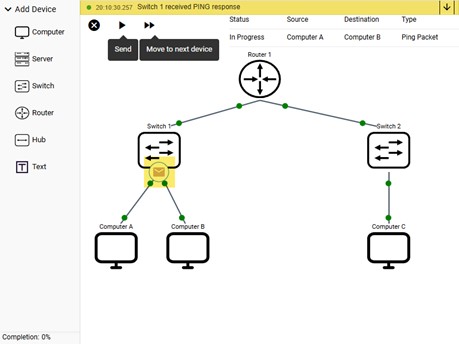
Today, I want to talk about an innovative and exciting tool for teaching and learning the subject of computer networking. I’ve been teaching and learning the expansive subject of computer networking for more than 25 years at the community college level. I also write networking and operating system textbooks for Cengage. I’ve always wished there was a tool available that offers accurate networking simulations while not being overly complicated for introductory students; that was focused first and foremost on teaching and learning the sometimes-difficult topic of networking. LabHUB Network Emulator from DTI Publishing is just such a tool.
I recently retired from full-time teaching, and I feel cheated that I will miss out using this tool in the classroom with my students. The good news for me is that I’m still writing networking textbooks, and this tool will be my go-to for developing virtual networking labs as a supplement to physical networking equipment labs.
What is LabHUB Network Emulator?
Network Emulator is a web-based networking simulation tool that anyone with a web browser and internet connection can access — no software installation required. For students, it’s easy to use. It visually shows the movement of network data through the network and allows students to configure network devices and topologies. It also gives immediate feedback as students work through lab exercises. For instructors, it’s fully customizable. While a library of pre-created, self-grading labs will be available with certain textbooks from Cengage, instructors can create their own labs to focus on the topics they feel are most important for students to grasp.
In addition, instructors can create self-check questions that provide immediate feedback with detailed explanations to validate learning outcomes as students work through lab steps. As I mentioned, this tool is focused on teaching and learning, so if a student gets stuck on a task, there’s a “Show Me” option that provides an explanation or plays a short video about the task at hand.
The vision behind Network Emulator
Every feature of Network Emulator was developed with teaching and learning in mind, and that has been the focus of the founder of DTI Publishing, Pierre Askmo, with all of DTI’s products. There are a few competing products in this space, and I asked Pierre why he decided to take on the competition and develop Network Emulator.
“We saw a need in the space between educational platforms with a fair amount of learning components but were static, and highly interactive professional network simulators geared towards engineers, which had hardly any learning features. The LabHUB Network Emulator merges the two to offer a highly interactive and educational network emulation platform.”
I pressed him further by asking what makes Network Emulator unique amongst the competition.
“It’s the ability to add educational features to a network emulation tool. Our tool was developed with students and instructors in mind. It enables instructors to insert questions, hints, and remedial texts while getting complete grading of the student’s actions. The LabHUB Network Emulator is an emulator developed for education.”
From what I have seen so far, that’s spot on.
Network Emulator has a clean, straightforward interface, as you can see from the figure. Moving from left to right in the figure, the lab written instructions are on the left, and you see a menu of devices and other options next, followed by the workspace. At the top are some controls including the Show Me option I mentioned before. The workspace can be pre-populated with devices as in the figure, and devices can be partially configured if desired depending on the learning objectives of the lab. The workspace can also be left completely empty so students can add and configure the necessary devices to complete the objectives of the lab.
Feedback in action: guiding students to understand networking concepts
One of the great things about Network Emulator is the feedback students get as they watch packets travel from device to device. The next figure shows a ping reply packet as it travels through the network from Computer B to Computer A. At the top right of the workspace, you see the current status of the packet, the source and destination devices, and the type of packet. At the very top of the workspace is the Network Log which is a running narrative of what is happening as the packet makes its way through the network.
Students can click the arrow at the top right of the screen and see the narrative history to better understand what occurred to get to this point in the packet’s journey. TheSendcontrol at the top of the workspace sends the packet so students can watch it traverse the network automatically. The Move to next devicecontrol simply forwards the packet to the next device, allowing students to click on the packet to see the packet details at any device.
The next two figures show packet contents and a partial view of the expanded Network Log. You can use the scroll bar to see the full log. When a packet reaches its destination, you’ll see a green checkmark and the status line reports “Successful.”
So, what happens if something goes wrong? For example, what if a student tries to send a ping packet, but the devices are not properly configured for a successful transmission? Again, feedback is the key. In the next figure, a ping was attempted between Computer A and Computer C. But, since a router is in between the computers, more configuration is required. The status bar at the top reports that the packet cannot be sent and if you hover your mouse over the exclamation point, you see a message: “No default gateway configured.” This type of feedback is excellent for students who are learning the basics of networking.
How instructors can build a personalized learning experience with Network Emulator
For instructors, Network Emulator allows them to create their own labs. Instructions can be written in Edit LabMode and audio instructions can be included. This is also where instructors can include a Show Me which can include a text narrative, a video, and audio.
In Studio Mode, instructors can design the topology with an initial state that students will see when they start the lab, and a correct state which is the state of the topology when the student completes the lab step.
Studio Mode is also where you can create self-check questions and configure grading criteria. After each step, instructors can create a self-check question to reinforce the learning objective for the lab step. Students will get instant correct/incorrect feedback and an explanation for the correct answer. In the Grading Settings, instructors can choose which configuration tasks are graded for each step. The next two figures show the grading settings and a self-check question.
There isn’t room on this blog post to show all the features of LabHUB Network Emulator, but what I’ve seen so far has me excited to incorporate Network Emulator labs into my Guide to Networking Essentials book. It has the right mix of accurate networking simulation capabilities and teaching and learning features for most introductory networking courses and certifications. And development is ongoing, so new features and capabilities are being added based on instructor and student feedback.
Speaking of development, I had a conversation with the chief architect of Network Emulator and asked him what was the most challenging aspect of developing the tool. He said, “I’d say the most challenging aspect was providing a SaaS platform where authors could create a multitude of diverse labs visually that students could access from anywhere in the world.” I bet that was a challenge! And it’s one of the things that makes Network Emulator so unique; whether you’re a student or instructor, if you have a web browser, you can use it.
Coming soon: the LabHUB Network Emulator will be available in MindTap for our next edition CompTIA Cloud+ and CompTIA A+ titles. In the meantime, visit our Computing & Information Technology page to find more engaging course materials from Cengage.
Let’s start by reviewing what we can and cannot know about staffing at Canadian universities. StatsCan tracks the number of permanent ranked faculty pretty accurately through its University and College Academic Staff Survey (UCASS), and in a loosey-goosier fashion through the Labour Force Survey. The latter gives much higher numbers than the former, as shown below in Figure 1, which compares the number of “ranked” academics from UCASS with the number of permanent, full-time academics from the LFS.
Figure 1 – Full-time Academic Staff Numbers According to LFS and UCASS
StatsCan also tracks the total number of employees—both salaried and hourly—in the university sector using the Survey of Employment, Payroll and Hours (SEPH). However, in theory, if you subtract the number of FT academic staff from the number of total staff, you should be able to get the total number of non-academic staff, right? Well, unfortunately, this is where the discrepancy between UCASS and LFS runs into some problems. In Figure 2, I show the implied number of non-academics using both methods. The growth rates are different because of the difference in observations in the early period, but the two estimates do both converge on the observation that there are about 130,000 non-academic staff at Canadian universities, or about two and a half times the complement of academic staff.
Figure 2 – Implied Non-Academic Staff Numbers using SEPH, LFS and UCASS
So, that’s evidence of bloat, right? Well, maybe. Personally, what I take from Figure 2 is that either (or both) the LFS numbers and the SEPH numbers are probably flaming hot garbage. There’s simply no way that the number of non-academic staff has increased by 170% in the past twenty years, as a combination of the SEPH and LFS data suggests. For reasons that will become apparent shortly, I also have serious doubts that it’s increased by 85% either, as the combination of SPEH and UCASS suggests. Because there is a second set of data available to look at this question, one that shows expenditure on salaries, and it shows a much different picture.
The annual FIUC survey shows how much money is spent on wages for ranked academics as well as how much is spent on non-academics (it also shows wages for instructional staff without academic rank,” but I exclude this here for ease of analysis). Over the past three years, it is true that non-academic salary mass has risen, and academic ones have not (score for the bloat theory!), but looked at with a 25-year lens, Figure 3 shows that the rate of increase is about the same (score one against).
Figure 3 – Total Expenditures on Salaries by Employee Group, in millions of $2023
Basically, the salary data in Figure 3 tells a completely different story than the SEPH/LFS/UCASS data in Figure 2. All you do is divide the spending data by the implied headcounts to see what I mean (which I do below). Figure 4 shows the implied change in average academic pay and average A&S pay, dividing total FIUC pay by the UCASS academic staff numbers and the A&S staff numbers implied by subtracting the UCASS numbers from the SEPH numbers, i.e., the orange line from Figure 2. To believe both sets of data, you have to believe that average academic salaries have increased substantially while average salaries for non-academics have declined substantially.
Figure 4 – Change in Implied Average Pay, Academic Staff vs. A&S Staff, 2001-02 = 100
In Figure 4, the blue line representing academic salaries is more or less consistent with the long-term trend in salaries we have seen by looking at salary survey data (which I last did back here): significant growth in the 00s and much slower growth thereafter. There are no staff salary surveys to use for comparison, but let’s put it this way: when people talk about “bloat” in non-academic staff positions, they normally mean it in the sense that the bloat is coming from expensive A&S staff, overpaid A&S staff, etc. For Figure 4 to be true, the growth in staff numbers would need to come almost entirely from more junior, less well-paid staff. It’s not impossible that this is true, but it’s not consistent with the general vibe about bloat, either
So who knows, really? There’s a lot of contradictory data here, some of which argues strongly in favour of the bloat argument, but quite a bit of which points in the other direction. Better data is needed to answer this question probably isn’t forthcoming.
Meanwhile, we can take one last look at A&S expenditure data. We can check to see if the pattern of A&S salary expenditures across university operating functions has changed over time. As Figure 5 shows, the answer is “a little bit.” Central Administration now takes up 25% of total A&S salary expenditures, up from 22% 20 years ago. Student services and external relations are up much more sharply in proportional terms, but since they were both starting from a low base, they don’t impact the overall numbers that much. Libraries, physical plant, and non-credit instruction are the categories losing share.
Figure 5: Share of Total A&S Salary Mass by Function, Canadian University Operating Grants, Select Years
And there you have it: more data than you probably needed on administrative bloat. See you back here again in 2030.
American foreign policy is vast, complex, and can change by the hour. The First Amendment protects our right to support, challenge, protest, or question the policy of the United States and every other government around the world.
But in seeking deportations of some legal residents in the United States, federal officials are claiming to target immigrants for expression that could, in their view, impact American diplomacy — and the implications for free expression are profound.
This broad justification effectively means any legal immigrant in the United States cannot speak his or her mind about any political issue without risking deportation, lest their words in some way implicate present or future foreign policy matters.
That’s the thing about broad justifications for censorship: They invite broad application.
In the case of Badar Khan Suri — an Indian citizen, Georgetown University postdoctoral fellow, and recent deportation target — The New York Times reported last week that “an official familiar with Dr. Suri’s case” asserted that “the State Department justified his deportation by arguing that he engaged in antisemitic activity that would undermine diplomatic efforts to get Israel and Hamas to agree to a cease-fire.”
Suri is a fellow at Alwaleed Bin Talal Center for Muslim-Christian Understanding at Georgetown’s Edmund A. Walsh School of Foreign Service. In a statement, the school said Suri “has committed no crime.” His father-in-law, Ahmed Yousef, was “a former adviser to Hamas” over a decade ago and “for his part, has criticized the Oct. 7, 2023, attack on Israel.” The ACLU of Virginia, which is serving on Suri’s legal team, asserts that his deportation is “in direct retaliation for his speech in support of Palestinian rights and his family’s ties to Gaza.”
And on Friday, Secretary of State Marco Rubio posted that he “will continue to cancel the visas of those whose presence or activities have potentially serious adverse foreign policy consequences for our country.”
This justification should set off a warning bell for anyone concerned about protecting freedom of expression in the U.S. There is effectively no limiting principle around speech that would allegedly “undermine diplomatic efforts.”
Can legal immigrants in the United States discuss human rights violations in Xinjiang or Hong Kong, even though doing so could theoretically imperil tariff talks or trade negotiations with China? What about criticism of the notion that Canada should become the “51st state”? Can Ukrainian immigrants criticize the actions of President Vladimir Putin while the U.S. is involved in talks between Russia and Ukraine?
That’s the thing about broad justifications for censorship: They invite broad application.
And that’s why, last week, FIRE filed a “friend of the court” brief along with a coalition of civil liberties groups contesting the federal government’s detention of lawful permanent resident Mahmoud Khalil.
The brief challenged the administration’s use of a statute empowering the secretary of state to deport a lawful non-citizen resident if the secretary determines their “presence or activities” has a “potentially serious” effect on American foreign policy.
As FIRE explains, none of the many immigrants in the U.S., including the million-plus on campus, “will feel safe criticizing the American government of the day — in class, scholarship, or on their own time — if a current or future secretary of state may, whenever he chooses and at his unreviewable discretion, deem them adverse to American foreign policy and have them deported.”
Noncitizens lawfully in the United States may lose their residency for many reasons, like criminal activity or overstaying beyond the authorized date.
Exercising the freedoms protected by our First Amendment should not be one of them.
Our study addresses the paradox of expanding higher education, particularly in Iran, failing to translate into substantial societal impact. We adopted an interpretive research paradigm to explore participants’ experiences and perspectives, emphasising qualitative inquiry. Specifically, we applied a basic qualitative research approach, focusing on thematic data analysis to understand underlying meanings and patterns. We conducted semi-structured, in-depth interviews with 23 professionals from Iran’s higher education system, including executive experts and academic scholars. The data was analysed using qualitative theme analysis with the thematic network approach. It highlights the interplay of internal and external factors driving this imbalance and offers practical recommendations for policymakers and university administrators. The study identifies multiple external and internal factors contributing to the imbalanced development of Iranian higher education.
External Factors:
Conflicting Political Discourse: Political divisions create inconsistent policy directions that hinder higher education reform. The resulting instability restricts universities from pursuing coherent strategies for social development.
Deficient Decision-Making Structures: Inefficient policy frameworks restrict universities’ ability to align with national development goals. This limits their capacity to engage in long-term planning, research commercialization, and innovation.
Lack of Social and Cultural Cohesion: Weak societal integration reduces higher education’s ability to contribute to social progress. Universities struggle to connect their knowledge outputs to broader societal needs without a shared cultural framework.
Low Demand for Science and Technology in the Economy: Limited integration of scientific advancements into economic sectors hinders universities’ relevance. Weak industry-university linkages prevent research outcomes from driving innovation and economic growth.
International Sanctions: Economic constraints and restricted access to global knowledge networks impede higher education progress. This isolation limits opportunities for research collaboration, technological exchange, and funding access.
Internal Factors:
Limited Engagement with National and Local Ecosystem Needs: Universities lack meaningful interaction with regional industries and communities. This disconnect limits their ability to address localized development challenges.
Insufficient Attention to Territorial Advantages in Development Planning: Universities often fail to leverage local strengths and opportunities, weakening their contribution to regional economic development.
Weak Endogenous Creativity: Overreliance on Western educational models stifles innovative academic approaches. As a result, Iranian universities struggle to develop unique solutions suited to local challenges.
Promotion of Emigration: University environments inadvertently encourage student and faculty migration, reducing local impact. This trend diminishes the human capital available to drive national innovation.
This study contributes new insights by highlighting the interplay between external political pressures and internal university strategies. While previous studies have emphasized government interventions and economic constraints, this research reveals the disruptive effects of conflicting political ideologies and weak social cohesion. Additionally, the study expands on the “quadruple helix” model by illustrating the absence of place-based leadership and strategies as critical gaps in Iranian higher education. The study also introduces a framework for integrating participatory governance models into university decision-making processes, enhancing institutions’ responsiveness to societal needs. The study emphasizes three key strategies for improving higher education’s societal impact:
Promoting National Dialogues via Universities: Encouraging open dialogue among academic leaders and policymakers can bridge ideological divides, fostering consensus on long-term educational goals. This step is vital to mitigate political interference and improve strategic planning for university development. Higher education can contribute to national stability and long-term planning by positioning universities as mediators in political debates.
Increasing Science and Technology Demand: Policymakers should enhance economic incentives for scientific research integration. Encouraging industrial partnerships and market-driven research will amplify universities’ role in economic growth. By creating a more dynamic innovation ecosystem, universities can expand their influence on industry practices and economic modernization.
Developing Science and Technology Diplomacy: Expanding diplomatic ties to bypass sanctions can enhance Iranian universities’ access to global scientific collaboration, fostering innovation and knowledge exchange. Such efforts include developing partnerships with international research centers and increasing participation in global academic networks.
The study to address internal factors recommends:
Expanding participatory teaching models, such as service learning, to connect universities with community development. These models empower students to engage with social challenges directly, enhancing their sense of responsibility and practical skills.
Aligning government support for universities based on regional strengths, promoting competition, and enhancing educational quality. By linking funding models to regional priorities, universities can better tailor their strategies to local economic and social needs.
Supporting creative teaching and research initiatives to foster academic innovation. This includes incentivising faculty to develop unconventional teaching methods and interdisciplinary research projects.
Encouraging initiatives that promote national pride and social responsibility among students and faculty, mitigating emigration trends. Universities can strengthen students’ connection to local development through values-based education and encourage talent retention.
The study highlights a critical limitation: its participants were drawn solely from the supply side of the science and technology ecosystem (university faculty and administrators). Future research should include stakeholders from the demand side, such as industry leaders, policymakers, and civil society representatives, to develop a more comprehensive understanding of higher education’s role in societal development. Exploring the interplay between social values, economic incentives, and political frameworks would provide deeper insights into higher education’s transformative potential.
This research underscores the need for a holistic approach to higher education reform. By addressing internal and external challenges, policymakers can create an educational landscape promoting social, economic, and political progress. Universities must evolve beyond expanding access to higher education and focus on fostering creativity, engagement, and accountability to enhance their contributions to society. Developing partnerships with industry, embracing participatory governance, and promoting inclusive dialogues will empower universities to become key drivers of social and economic transformation.
Amir Shahsavari is an Assistant Professor of Higher Education at Shahid Beheshti University in Tehran, Iran. His academic interests lie in higher education policy, academic management and planning, and teaching and learning, mainly focusing on higher education studies in Iran. Drawing on his research, he seeks to contribute to a deeper understanding of the challenges and opportunities facing Iranian universities to inform policy and improve educational practices. [email protected]
Mohammad Eslahi holds a PhD in Higher Education from the University of Tehran, Iran, specializing in Educational Administration and Planning. His research interests focus on the economics of higher education and the economics of university research. He is a lecturer and research assistant at the University of Tehran, actively contributing to teaching and scholarly endeavors in these fields.[email protected]