Author: admin

  • Making a sustained case for international student mobility

    Making a sustained case for international student mobility

    Today on the HEPI blog, Professor David Phoenix OBE and Dr. Katerina Kolyva explore how England’s post-16 education system can move beyond competition to create a more integrated, collaborative approach that benefits learners, local economies, and national prosperity. You can read the blog here.

    Below, colleagues at the University of Surrey explore the evolving landscape of global student mobility, highlighting innovative programmes and making the case for a new approach to student placements.

    • Professor Amelia Hadfield is Associate Vice-President for External Engagement and Founding Director of the Centre for Britain in Europe, and Liz Lynch is International Mobility Manager, both at the University of Surrey.

    In recent years, the UK’s governments have developed new initiatives such as the Turing Scheme, the Taith Scheme in Wales, and the Scottish Government’s Scottish Education Exchange Programme (SEEP). These mobility programmes aim to support students’ global experiences. While they have undoubtedly provided valuable opportunities for students – particularly for those from disadvantaged backgrounds – what is truly needed is a longer-term commitment from government to sustain and expand these life-changing opportunities.

    At the end of February, the annual Global Mobility conference hosted by Universities UK International (UUKi) brought together higher education professionals and thought leaders to explore the latest developments in global student mobility and what the future looks like. The conference showcased how universities are leveraging these funding opportunities to create meaningful and impactful programmes. However, it also highlighted the significant challenges faced by UK institutions, particularly in the aftermath of Brexit, the Covid-19 pandemic, the UK’s withdrawal from Erasmus+ and the ongoing financial pressures on both universities and students. These factors have created a complex landscape, making investment in international mobility more crucial than ever.

    The Impact of Mobility on Student Outcomes: Insights from UUKi Research

    During the conference, UUKi presented early-stage findings from their latest research, Gone International: A New Generation, conducted in collaboration with Jisc and the Northern Consortium. While the data revealed a significant decline in the number of students going abroad, perhaps reflecting the impact of recent global challenges, there remains strong evidence of the benefits to students. Reaffirming 2019 findings, the data continues to show students participating in mobility programmes not only attain higher degrees but are also more likely to earn higher salaries, secure professional-level jobs and experience lower unemployment rates. The research underscores the important role of global mobility in fostering social mobility.

    Nevertheless, while those of us working in the sector already understand the intrinsic value of international experiences, having concrete data to back up these claims strengthens the case for continued support and expansion of such opportunities. The University of Manchester, for example, has been evaluating the impact of its international mobility programmes on student outcomes, and the findings have helped raise the profile and importance of these opportunities across their institution. This kind of evidence-based approach is essential for ensuring that the sector – and governments – remain committed to facilitating global mobility for students.

    The Broader Benefits of International Mobility

    The British Council highlights the broader societal benefits of international student mobility, particularly in fostering cross-cultural understanding and long-term relationships between nations. By participating in mobility programmes, students develop cross-cultural competence, language proficiency, and global perspectives – all vital skills for success in today’s interconnected world. Inbound mobility, in particular, contributes significantly to the UK economy, with international students bringing cultural diversity, innovation, and fresh perspectives to campuses. These exchanges also build cross-cultural networks, which can endure long after students return to their home countries, fostering greater trust and understanding between nations and supporting the UK’s soft power overseas.

    All of this is in addition to the economic benefit that stems from the UK’s ability to attract international students, as discussed recently on the HEPI blog.

    Blended Mobility: Enabling flexibility and accessibility

    Blended mobility programmes represent a forward-thinking solution for making global education more accessible and flexible. Cardiff Metropolitan University, for example, has embraced a hybrid model supported by the Taith funding, combining one week of virtual learning with one week of physical mobility. This approach not only maintains the essence of cultural exchange but also offers students the flexibility to engage in international experiences that might otherwise be logistically or financially out of reach. The combination of virtual, blended, and physical mobility opens doors for students who might not be able to commit to a full-term study abroad programme, making global learning more inclusive and scalable.

    Whilst the Turing Scheme in its current form does not include blended mobility, the recent reduction in minimum duration to 14 days is a positive step towards providing greater accessibility for students. Hopefully, in future years, blended mobilities and shorter 7-day mobilities could be incorporated into future Turing projects, taking the impactful examples from both Taith and Erasmus+ as evidence of the value and enabling engagement from the most disadvantaged and underrepresented groups.  This, along with funding for staff mobility (offered by both Taith and Erasmus+), will only serve to enhance Turing overall.

    Surrey’s Approach: Empowering Students through International Mobility

    At the University of Surrey, we are committed to increasing the participation of our students in a range of international opportunities, whilst simultaneously expanding the international dimension of the student experience at our Guildford campus. In this respect, placement training options, study abroad opportunities, enhanced ‘global and cultural intelligence’ and ‘collaborative online international learning’ (COIL) content in degree pathways, as well as our Global Graduate Awards, ‘international’ is necessarily widely defined, and ‘mobility’ can take place intellectually, culturally, and socially, as well as just physically,

    Mobility also brings together traditional approaches to cross-border opportunities with enhanced approaches to supporting new demographics. A key strategic objective at Surrey, therefore, is focusing on access for underrepresented groups. We target Turing funding and additional grant funds to students who meet Surrey’s widening participation criteria to address inequality amongst underrepresented groups who may wish to experience international mobility but are unable to do so without grants. The portfolio of both longer-term and shorter mobility options we have developed facilitates equal access for all. As previous placements have illustrated, longer-term mobility provides deeper cultural experiences and learning opportunities for those able to commit to a full semester/year abroad. Shorter options can widen access for students from disadvantaged backgrounds and underrepresented groups.

    Through their international experiences, our students build global academic and professional networks and improve their job prospects. They return to Surrey as confident, resilient, and globally minded individuals, prepared to tackle the challenges of tomorrow’s world. Feedback from students who participated in Surrey’s Turing 2023 project shows the impact mobility has on their personal and professional development. 94% reported an increase in intercultural awareness, and 93% felt the experience enhanced their employability and professional skills.

    Looking Ahead: The Future of Global Mobility

    The global mobility landscape is changing, with rapid technological advancements and a growing emphasis on inclusivity and sustainability. At Surrey, we are embracing technological innovations that will enhance both the student experience and the efficiency of mobility programme management. Process automation, for example, is helping streamline administrative tasks, freeing up resources to better support students. We are also starting to use virtual reality (VR) to promote international opportunities, allowing students to virtually explore campus life abroad. Future opportunities for blended learning, as well as the incorporation of COIL projects within the curriculum, will nurture the skills necessary for students to engage with the world and develop the confidence and curiosity needed to thrive in an interconnected society.

    By incorporating data-driven approaches, we will continue to assess the impact of our mobility programmes, identifying areas for improvement and ensuring that our offerings align with both institutional and student goals. As the sector evolves, collaboration and innovation will be key in ensuring that all students can access transformative international experiences.

    Source link

  • Student experience is becoming more transactional – but that doesn’t make it less meaningful

    Student experience is becoming more transactional – but that doesn’t make it less meaningful

    It seems that few can agree about what the future student experience will look like but there is a growing consensus that for the majority of higher education institutions (bar a few outliers) it will – and probably should – look different from today.

    For your institution, that might look like a question of curriculum – addressing student demand for practical skills, career competencies and civic values to be more robustly embedded in academic courses. It might be about the structure of delivery – with the Lifelong Learning Entitlement funding per credit model due to roll out in the next few years and the associated opportunity to flex how students access programmes of study and accrue credit. It might be a question of modality and responding to demands for flexibility in accessing learning materials remotely using technology.

    When you combine all these changes and trends you potentially arrive at a more fragmented and transient model of higher education, with students passing through campus or logging in remotely to pick up their higher education work alongside their other commitments. Academic community – at least in the traditional sense of the campus being the locus of daily activity for students and academics – already appears at risk, and some worry that there is a version of the future in which it is much-reduced or disappears altogether.

    Flexibility, not fragmentation

    With most higher education institutions facing difficult financial circumstances without any immediate prospect of external relief, the likelihood is that cost-saving measures reduce both the institutional capacity to provide wraparound services and the opportunities for the kind of human-to-human contact that shows up organically when everyone is co-located. Sam Sanders

    One of the challenges for higher education in the decade ahead will be how to sustain motivation and engagement, build connection and belonging, and support students’ wellbeing, while responding to that shifting pattern of how students practically encounter learning.

    The current model still relies on high-quality person to person interaction in classrooms, labs, on placement, in accessing services, and in extra-curricular activities. When you have enough of that kind of rich human interaction it’s possible to some extent to tolerate a degree of (for want of a better word) shonky-ness in students’ functional and administrative interactions with their institution.

    That’s not a reflection of the skills and professionalism of the staff who manage those interactions; it’s testament to the messiness of decades of technology systems procurement that has not kept up with the changing demands of higher education operational management. The amount of institutional resource devoted to maintaining and updating these systems, setting up workarounds when they don’t serve desired institutional processes, and extracting and translating data from them is no longer justifiable in the current environment.

    Lots of institutional leaders accept that change is coming. Many are leading significant transformation and reform programmes that respond to one or more of the changes noted above. But they are often trying – at some expense – to build a change agenda on top of a fragile foundational infrastructure. And this is where a change in mindset and culture will be needed to allow institutions to build the kind of student experiences that we think are likely to become dominant within the next decade.

    Don’t fear the transactional

    Maintaining quality when resources are constrained requires a deep appreciation of the “moments that matter” in student experience – those that will have lasting impact on students’ sense of academic identity and connection, and by association their success – and those that can be, essentially, transactional. Pete Moss

    If, as seems to be the case, the sector is moving towards a world in which students need a greater bulk of their interaction with their institution to be in that “transactional” bucket two things follow:

    One is that the meaningful bits of learning, teaching, academic support and student development have to be REALLY meaningful, enriching encounters for both students and the staff who are educating them – because it’s these moments that will bring the education experience to life and have a transformative effect on students. To some degree how each institution creates that sense of meaningfulness and where it chooses to focus its pedagogical efforts may act as a differentiator to guide student choice.

    The second is that the transactional bits have to REALLY work – at a baseline be low-friction, designed with the user in mind, and make the best possible use of technologies to support a more grab-and-go, self-service, accessible-anywhere model that can be scaled for a diverse student body with complicated lives.

    Transactional should not mean ‘one-size-fits-all’ – in fact careful investment in technology should mean that it is possible to build a more inclusive experience through adapting to students’ needs, whether that’s about deploying translation software, integrating assistive technologies, or natural language search functionality. Lizzie Falkowska

    Optimally, institutions will be seeking to get to the point where it is possible to track a student right from their first interaction with the institution all the way through becoming an alumnus – and be able to accommodate a student being several things at once, or moving “backwards” along that critical path as well as “forwards.” Having the data foundations in place to understand where a student is now, as well as where they have come from, and even where they want to get to, makes it possible to build a genuinely personalised experience.

    In this “transactional” domain, there is much less opportunity for strategic differentiation with competitor institutions – though there is a lot of opportunity for hygiene failure, if students who find their institution difficult to deal with decide to take their credits and port them elsewhere. Institutional staff, too, need to be able to quickly and easily conduct transactional business with the institution, so that their time is devoted as much as possible to the knowledge and student engagement work that is simply more important.

    Critically, the more that institutions adopt common core frameworks and processes in that transactional bucket of activity, the more efficient the whole sector can be, and the more value can be realised in the “meaningful” bucket. That means resisting the urge to tinker and adapt, letting go of the myth of exceptionalism, and embracing an “adopt not adapt” mindset.

    Fixing the foundations

    To get there, institutions need to go back to basics in the engine-room of the student experience – the student record system. The student system of 15-20 years ago was a completely internally focused statutory engine, existing for award board grids and HESA returns. Student records is now seen as a student-centric platform that happens to support other outputs and outcomes, both student-facing interactions, and management information that can drive decision-making about where resource input is generating the best returns.

    The breadth of things in the student experience that need to be supported has expanded rapidly, and will continue to need to be adapted. Right now, institutions need their student record system to be able to cope with feeding data into other platforms to allow (within institutional data ethics frameworks) useful reporting on things like usage and engagement patterns. Increasingly ubiquitous AI functionality in information search, student support, and analytics needs to be underpinned by high quality data or it will not realise any value when rolled out.

    Going further, as institutions start to explore opportunities for strategic collaboration, co-design of qualifications and pathways in response to regional skills demands, or start to diversify their portfolio to capture the benefits of the LLE funding model, moving toward a common data framework and standards will be a key enabler for new opportunities to emerge.

    The extent to which the sector is able to adopt a common set of standards and interoperability expectations for student records is the extent to which it can move forward collectively with establishing a high quality baseline for managing the bit of student experience that might be “transactional” in their function, but that will matter greatly as creating the foundations for the bits that really do create lasting value.

    This article is published in association with KPMG.

    Source link

  • Joining two anti-Trump events this month (Bryan Alexander)

    Joining two anti-Trump events this month (Bryan Alexander)

    Over the past two weeks I carved out time to participate in two
    anti-Trump in-person events.  In this post I wanted to share some notes
    on the experiences, along with photos.

    Last Thursday, after the regular Future Trends Forum session, my son
    Owain and I went to a local town hall led by our federal representative,
    Democrat Suhas Subramanyam.
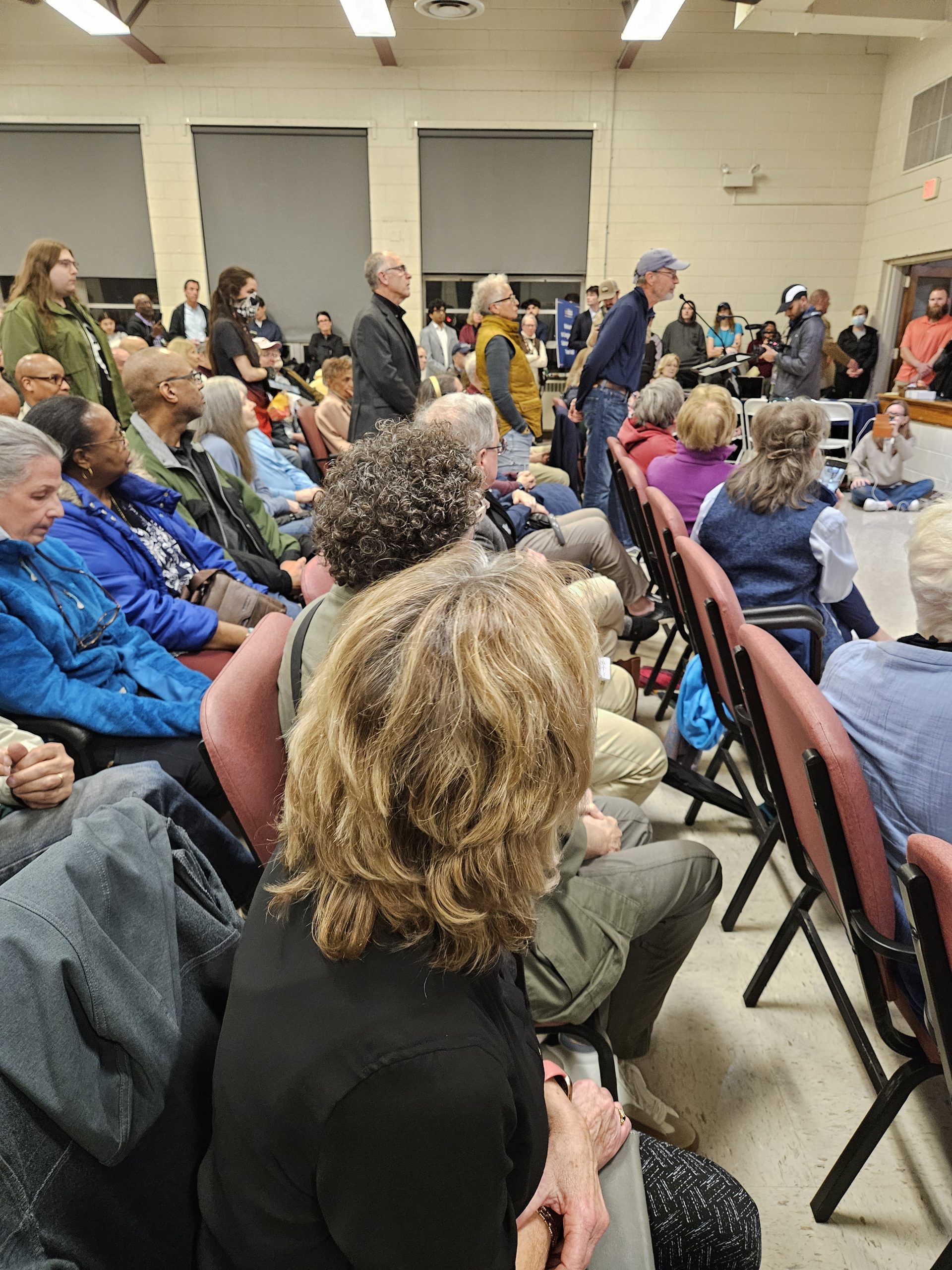
    It took place in a community center and was very crowded, packed with
    people.  Before it began I didn’t hear much discussion, but did see some
    folks with anti-Trump and -Musk signs.  I found some seats for Owain
    and I and we each opened up a Google Doc on our phones to take notes.

    Subramanyam took the stage and began with some brief remarks,
    starting with citing the dangers of DOGE. He mentioned working in the United States Digital Service
    during the Obama administration, the unit which DOGE took over as its
    institutional base. Subramanyam described why he voted against the
    continuing resolution to keep the government running and also spoke to
    the humanitarian and governmental problems of firing so many federal
    workers.

    Then it was over to questions. Folks lined up before two (somewhat
    functional) microphones. They told personal stories: of being lifelong
    federal workers, or having family members in those positions, and now
    facing their work being undone or their jobs ruined. Some spoke of
    depending on federal programs (SNAP, Medicare, Medicaid, Social
    Security) and fearing cuts to them.  Several had military experience,
    which won applause from the room. Above all was this seething sense that
    Trump was a brutal and extraordinary threat, that Democrats weren’t
    taking it seriously, and the question: what can we do to fight back?
    Subramanyam listened hard to each one and answered thoughtfully,
    respectfully, often pointing to resources or actions we could take.

    Subramanyam town hall 2025 March 20 questioner leaning forward
    Ever the extrovert, I joined the microphone line right away. I was going
    to ask about threats to higher education, but happily someone else beat
    me to it. The representative offered a positive response, praising the
    work of researchers and teachers, urging us to fight for educators.  So,
    standing in line, I came up with another question.  When my turn came I
    began by thanking the representative for actually doing a real town
    hall meeting, not a scripted thing. I compared this meeting favorably to
    Vermont’s town hall tradition, and mentioned Bernie Sanders as a
    comparable example of someone who also knows how to do a community
    meeting well, and the room erupted in applause.

    So I asked about climate change, how we – academics and everyone –
    can do climate work in this situation. I noted how the crisis was
    worsening, and how Trump was going to make things even more difficult. I
    was impressed to have Subramanyam’s full attention while I spoke.  I
    was equally impressed that he replied by supporting my remarks and work,
    then called for more climate action in the face of Trump’s actions.

    Nobody
    got a photo of me that I know of, so here’s a shot of the
    representative (on right) paying close attention to one resident
    (standing on left).

    (A sign of climate in culture today: people applauded my question.
    After I left the mic, several folks reached out to me – literally – to
    thank me for raising the topic.)

    Returning to that question of what can be done to oppose Trump, Subramanyam and questioners listed these actions:

      • Legal action: filing lawsuits and supporting other people’s.  Getting Democratic politicians to do the same.
      • Congressional investigations into Trump: the Congressman pointed out
        that these can expose administrative malfeasance and build resistance.
      • Flat out resistance to Trump actions. Subramanyam argued that when
        people refuse to comply, the admin sometimes backs down, saying they
        made a mistake.
      • Doing Freedom of Information Act (FOIA)
        requests to get the feds to cough up documentation. They can slow-walk
        queries or outright refuse, of course, but FOIA can produce results.
      • Phone calls to people in red counties. (I think this was aimed at calling GOP officials, but am not sure.
      • People telling stories of Trump harms in whatever setting works. At
        one point Subramanyam said if the GOP wants to “flood the zone” with
        bogus content we should flood it right back with true, personal stories.

    There were no calls for property damage or violence against people.
    Nor did anybody used the phrase “civil disobedience” or called for such
    actions.

    The hour grew late and people started to drift out.  Owain and I had to get home and we filed out as well.

    Two weeks ago I joined a different event, a rally for science in Washington, DC
    It took place at the Lincoln Memorial.  Several thousand people were
    there, all ages, races, genders. The mood was upbeat despite the chill
    and strong winds.

    A podium rested on the steps and from there spoke quite the program of luminaries, including Bill Nye (I missed him), Francis Collins (just stepped down as NIH head), Atul Gawande (excellent medical writer, also surgeon), Phil Plait (astronomer, science communicator), and some other people I didn’t recognize. There was some singing, too.

    Dr. Gawande

    The overall theme was that Trump’s science cuts were awful.  Speakers
    hit on points under this header, such as that RFK was a dangerous idiot
    and that research reductions meant that human lives would be harmed and
    lost.  Diversity along race and gender lines was vital.  All kinds of
    science were mentioned, with medicine and public health leading the
    charge.

    The consensus was on returning science funding to what it was under
    Biden, not in expanding it. There were no claims for adding scientific
    overviews to policy – it was a defensive, not offensive program.

    There were plenty of signs.  Some had a fine satirical edge:

    Off to one side – well, down along the reflecting pool – there was an
    Extinction Rebellion performance or group appearance, but I didn’t get
    to see if they staged anything besides looking awesome and grim.

    Stand up for science rally DC 2025 March 7_XR group

    During the time I was there no police appeared. There weren’t any counterprotesters.

    Eventually I had to start the trip home.  As I walked along the
    reflecting pool towards the Metro station I heard speakers continuing
    and the roar of the appreciative crowd.


    What can we take away from these two events?

    There is a fierce opposition to Trump and it occurs across various
    sectors of society, from scientists to everyday folks (with some
    overlap!). Pro-Trump people didn’t appear, so I didn’t see arguments or
    worse between groups. I don’t know if this means that the president’s
    supporters are just confident or prefer to work online.

    The Democratic party is not in a leadership role.  Outrage precedes
    and exceeds its actions so far.  The town hall liked Subramanyam, but it
    was clear they were bringing demands to him, and that he did not back
    the party leadership.

    Both events had a strong positive feel, even though each was based on
    outrage. There was a sense of energy to be exerted, action to be had.

    Many people visibly recorded each event, primarily through phones. I
    didn’t see anyone object to this.  (I tried to get people’s permission
    to photograph them, when they were clearly identifiable individuals.)

    My feel is that climate interest is waning among people who oppose
    Trump.  They aren’t denying it and will support those who speak and act
    on it, but it’s no longer a leading concern.

    Yet these were just two events, a very small sample size, and both in
    roughly the same geographic area, about 50 miles apart.  We can’t
    seriously generalize from this evidence, but hopefully it’s a useful
    snapshot and sample.

    Personally, I found both to be rewarding and supportive. It was good
    to be with people who were similarly outraged and willing to be so in
    public.

    American readers, are you seeing anything similar in your areas?  Non-Americans, what do you think of this glimpse?

    [Editors note: This article first appeared at BryanAlexander.org.]

    Source link

  • Any possible tertiary future for England’s post-18 system must lean into college-based HE

    Any possible tertiary future for England’s post-18 system must lean into college-based HE

    The Lifelong Education Institute’s latest report – “Taking Higher Education Further” – shines a spotlight on the contribution of FE colleges to England’s higher education sector.

    In partnership with the Mixed Economy Group of colleges – a group representing the 43 colleges with a strategic interest in HE – we have explored the rationale for college-based higher education, analysed some of the barriers holding it back from expansion, and suggested ways in which policymakers could support its growth.

    The report could hardly come out at a more interesting time for FE/HE relationships. After a decade or more of relative stasis following the introduction of the £9,000 undergraduate student fee cap in England, the tectonic plates of post-18 education are shifting rapidly towards an as-yet-unknown end state. There are three key drivers behind this potential re-setting of the status quo between the college and university sectors.

    First is the dramatic shift in the financial situation of universities and colleges, with many higher education institutions now facing the sort of cost-cutting that further education colleges have endured for years and needing to come up with new, more efficient business models to sustain themselves financially. Following the consolidation of many smaller colleges into large groups, there are now several colleges with larger annual turnovers than smaller universities, and the balance of power between FE and HE is moving steadily away from the traditional template of senior/junior partnership.

    Second is the move towards universities having place-based strategies, with civic university agreements proliferating in all parts of the country. This has partly been driven by the rise in influential devolved authorities across England, and partly by the increase in take up of degree pathways in a range of public sector professions, such as nursing, policing, and social work, which are vital to local communities and tend to recruit from local populations.

    Rising cost of living pressures have also played their part, with commuting students becoming an increasingly important segment of the HE student market. The introduction of degree apprenticeships has also pulled many universities into much more active engagement with local employers and much more of a focus on local skills development. Colleges, which have always had fairly tight catchment areas, now find themselves working their patches alongside local universities, and in some cases, through the network of 21 Institutes of Technology, offering higher technical qualifications and high level short courses directly in partnership with HE institutions.

    Third, and most importantly, the arrival of a new government is rapidly moving the political paradigm away from competition towards collaboration. Education ministers have taken every opportunity since the general election to drive home the message that partnership, cooperation and coordination have now replaced markets, competition and institutional individualism as “the default way of working across all providers,” in the recent words of skills minister Jacqui Smith. We are promised a white paper this summer setting out a comprehensive strategy for post-16 education and skills, and at the same time a “radical” package of HE reforms which will also emphasise the role of HE in collaborating around local and national skills priorities.

    Is the future for England tertiary?

    HE/FE collaboration has tended to be relatively transactional and fluid in England, and there is no standard blueprint for forging partnerships. A small number of colleges can now claim to be tertiary institutions, having been granted degree awarding powers, although with the Office for Students having currently suspended the application process until August, it’s now far from certain how quickly this number will grow in future. There are four universities which by virtue of having absorbed a failing FE college have become tertiary – Derby, London South Bank, Greater Manchester (formerly Bolton University) and the University of West London. But this is the result of specific local circumstances, not national policy.

    Arguably, these institutions are a microcosm of exactly what the government is trying to achieve at a national level. Tertiary institutions are able to develop coherent progression pathways from basic to undergraduate level for students of all aptitudes, embracing both academic and technical education routes without competition between them. David Phoenix, vice chancellor of London South Bank University, has been an articulate advocate for this model, and his vision, as set out in his November 2023 report “Connecting the dots: the need for an effective skills system in England” has been highly influential in Labour-leaning circles.

    It’s possible the government will introduce much greater incentives for universities and colleges to consider merger, and even be prepared to act as “matchmaker” for reluctant or hesitant brides and grooms. It would certainly make it much easier to develop integrated apprenticeships, higher technical qualifications and Lifelong Learning Entitlement offers if there were more tertiary providers.

    The Taking Higher Education Further report is generally supportive of greater tertiary integration, but with several important reservations. To begin with, although most FE colleges are appreciative of the relationships they have with universities – mostly still based on validation agreements – there are many who are critical of the cost and in some cases one-sided nature of the partnership, with some having experienced the disruption caused by an HE institution deciding unilaterally to withdraw from the agreement. Another concern has been the proliferation of foundation years at many universities, which was seen as unwelcome competition for Level 3 students and met with dismay by many in the FE sector. This has abated considerably since the introduction of a much reduced fee cap for foundation years.

    While some institutes of technology have strengthened FE/HE relationships, others have struggled to bridge the gap between the two sectors. One aspect of that gap – the difference in pay and conditions between FE and HE lecturers – has proved particularly troublesome. But those institutes of technology which have been successful have demonstrated that joint working between FE and HE can be highly effective. Overall, despite the caveats, the FE leaders consulted as part of the research for the report were generally positive about the idea of working more closely with HE.

    In a political climate where economically relevant skills and wider access to job-related skills are now central to the government agenda, college-based higher education has both issues at its heart. The HE students who study in FE colleges are overwhelmingly, adult, very local and from disadvantaged backgrounds. The courses they take are typically directly related to opportunities in the local labour market and focused on career progression. Whereas the student loan system has tended to incentivise HE institutions to prioritise three year degree courses, FE colleges offer a much more incremental approach, with multiple entry and exit points and a high proportion of part-time and modular options. This could be a significant advantage as colleges prepare for the implementation of the Lifelong Learning Entitlement in 2026–27.

    In summary, the report is a plea for government to give more support to the expansion of HE in FE, but is not in any way antagonistic towards the HE sector. The aim is to strengthen the relationship between colleges and universities, not to weaken it. As the foreword says, “Working together, colleges and universities can open up accessible opportunities and make a real difference to people’s lives.” In this, FE and HE share a common purpose.

    Source link

  • The franchise problem may not have a quick answer

    The franchise problem may not have a quick answer

    So everyone is (still, after more than a decade) agreed that student loan fraud and poor quality provision is a huge mark against the practice of franchise provision.

    Moreover, we’ve generally come to the conclusion that something needs to be done – and although an investigation will be helpful, that something needs to be fairly swift and concrete action.

    Most people are assuming that this will take the form of a requirement to regulate franchise partners, via compulsory registration by the OfS, or some other regulatory change.

    Didn’t we try something like that before?

    The government is currently consulting on whether all institutions in England delivering higher education to more than 300 students should register, at some level, with the regulator.

    This in itself is far from a new idea. When the Department for Education first consulted on what became the Office for Students regulatory framework, providers had the option to register in the “Registered basic” category – a third category that simply recognised that an institution was providing higher education in England.

    This category will provide a degree of confidence for students that is not present in the current system with providers in the Registered basic category being able to let students and other bodies know that they are recognised by the OfS as offering higher education courses.

    As registration in this category was intended to be optional there would need to have been a benefit to registration, and there would be no way of assuming that all England’s higher education provision was covered. On franchise arrangements in particular, the initial proposals suggested that:

    the delivery provider [in a franchise arrangement] will not normally be required to register. If it chooses to register, the Registered basic category will normally be the most suitable category because the lead provider is responsible for compliance with all required registration conditions for the Approved and Approved (fee cap) categories.

    For many in the sector responding to these ideas, these assumptions offered little to protect students or the system as a whole. In summarising the consultation responses, the government reported that

    there were widespread calls for the Registered (basic) category to carry additional conditions to protect students’ interests, such as transparency, student protection plans, student transfer and electoral registration conditions. Respondents were concerned that students at those providers in the Registered (basic) category would be at risk of assuming greater protection than will be provided in that category

    The combination of the limited oversight offered to those in the “Registered basic” category (which was configured pretty much as a list of people who had paid OfS £1,000), and the additional burden that that any more active requirement would place on smaller providers, meant that OfS concluded that:

    we have decided to remove the Registered (basic) category from the published regulatory framework. The effect of this decision is to avoid misleading students about the protections available at Registered (basic) providers

    But that wasn’t the end of it. OfS also noted (and this is worth setting out in full):

    we recognise that unregulated providers will continue to operate, as they would have done even if the Registered (basic) category had been included (albeit, possibly, in lesser numbers). We are concerned with all students, not only those at registered providers, and remain committed to the policy intention set out in the regulatory framework consultation – to improve transparency and student protection at those higher education providers that are currently unregulated. We shall therefore give priority to developing our understanding of providers and students in the unregulated parts of the sector, to determine how we can most effectively have a role in protecting the interests of students at these providers

    At the time, when franchise arrangements were considered at all by ministers, they were painted as an unnecessary rigmarole for exciting new entrants to the market. Speaking to Universities UK in 2015, then higher education minister Jo Johnson famously said:

    Many of you validate degree courses at alternative providers. Many choose not to do so. I know some validation relationships work well, but the requirement for new providers to seek out a suitable validating body from amongst the pool of incumbents is quite frankly anti-competitive. It’s akin to Byron Burger having to ask permission of McDonald’s to open up a new restaurant.

    So how’s all that going, then?

    Byron Burger, of course, entered administration twice in three years. In contrast, the franchise model in higher education never looked short of cash or interest. The Office for Students never used its own “validation powers” (section 51 of the Higher Education and Research Act allowed the OfS to get involved in academic partnerships directly, as kind of a response to the argument that delivering courses on behalf of a competitor in order to enter the sector was anti-competitive). Instead, it commissioned the Open University to be (effectively) a validator of last resort for FE colleges on others seeking to enter the HE market (this arrangement is set to conclude in July 2025).

    When the Higher Education Funding Council for England closed in March 2018, it directly funded 313 higher education providers, while having at least an awareness of 816 places in England where higher education was being delivered. The Office for Students currently has a funding and regulatory arrangement with 425 providers – for the current regulator, there is no regulation without funding. The impact assessment published alongside HERA implied that in 2024-25 there would be 631 in either the Approved or Approved (Fee Cap) registration category – postulating 1,131 institutions delivering higher education in England in total.

    The postulated rush to register did not happen, even when DfE closed the old “specific course designation” route to regulated and funded provision for alternative providers in August 2019. As sector interest group Independent HE has documented, the Office for Student registration process was generally experienced as expensive and cumbersome: where providers have been actively seeking regulation and oversight, it has been very difficult to obtain. Indeed, when OfS faced pressure to get more actively involved in securing sector finances, it was able to unlock significant internal resources by “pausing” registration.

    By closing the “specific course designation” route, and making full registration slow and difficult, OfS has incentivised smaller providers to enter the least regulated (and riskiest, for students and public funds) part of the higher education sector. If that constitutes “developing an understanding” of the unregulated part of the sector, one has to question what this “understanding” actually is.

    The other end

    The financial pressures currently engulfing the sector has encouraged many established providers to get involved in franchising arrangements – they get to keep a portion of the fee income related to students involved in such arrangements. In return, they are expected to provide oversight of quality and standards on courses leading to awards bearing their names, and handle all of the regulatory requirements relating to those students.

    The numeric threshold approach to regulation (wherein a provider faces further investigation if the proportion of students continuing on their course, completing their course, and progressing into employment or further study, falls below a minimum) does mean that such provision is regulated, after a fashion. There is an open investigation on franchising at Leeds Trinity University, and we understand that current quality-related investigations are focused in part on franchise provision.

    Where the Student Loans Company spots evidence of potential fraud (or when OfS is notified of a concern) usually but not always involving a franchise arrangement, both OfS and DfE may become involved in an investigation. A recent uptick in such cases has led OfS to set out expectations in more detail.

    For these reasons most providers that franchise out provision are assiduous in ensuring what is being delivered is of a decent quality. However, the market incentives – at least in the short term – are stacked in the other direction. Some larger providers are increasingly reliant on income relating to students studying within franchise arrangements, and the demand for such relationships gives franchise providers the ability to shop around. Where an awarding organisation has attempted to impose more stringent quality requirements, there have been instances where the delivery partner has simply ended the partnership and entered a new relationship that offers less work and/or more cash.

    What regulatory tools are actually workable?

    So when something bad is identified, there’s always a subset of the population who think that there should be a law (or at least, regulation) to stop it happening. It’s an attractive idea, until you start to think about implementation. There are many trade offs.

    Option one: ban all franchise provision

    In other words, you would decree that unless you have degree awarding powers, you shouldn’t be delivering higher education. You would, in practice, have to ban all new recruitment to franchised courses and allow for some form of teach-out, unless you want to face a mass legal action. On a teach out, with no likelihood of any new students, the quality of provision would fall even further as providers withdraw funding and interest.

    Meanwhile, a fair number of large providers rely on franchise income to make ends meet. So factor in the closure of a few universities – with further pressure on other providers to offer teach out – as that part of the sector slowly becomes unviable. Which would be a shame for all those students working hard at FE colleges (franchising pretty much started as a way to support FE colleges delivering HE in hard-to-reach areas), and at the quality and specialist end of franchise provision, and for on campus students at providers heavily involved in franchise provision.

    To be clear – you may not value some of the providers involved, or some of the courses students are enrolled on. But if either disappeared you would need to come up with a way to look after the interests of the legitimate students involved.

    Option two: selectively ban some franchise provision

    Take all the drawbacks of option one, but also add in the difficulty of reliably and consistently distinguishing the kinds of provision you want to see supported in this way from that which you want rid of. You could use metric thresholds in a B3-esque way, you could attempt to do something clever with subject areas, or even base the ban directly on your suspicions of fraudulent activity. You’d have to be absolutely certain, mind – such decisions will almost certainly end up in court (you are dealing with a lot of higher education income, and it is unlikely you will get it dead right every time). Even something as straightforward as a subject area (“business studies”) is notoriously tricky to define when you get down to actual course content.

    Option three: require all providers involved to register with OfS

    Even assuming OfS has the capacity to quickly register a load of providers currently delivering franchise provision, there has to be a question as to how quickly and how well the regulator can then act where there is low quality provision. Back in 2024 we got a promise that the next round of OfS quality investigations would have a particular focus on franchise provision (from last time this story cropped up) – as yet we’ve not even seen reports, much less regulatory action.

    It’s looks like this has been one of many casualties of the regulator, at the urging of the government, throwing as much effort as possible behind addressing the financial issues the sector has been facing (we’re also expecting findings from the investigation into the academic partners of Leeds Trinity University that kicked off more than a year ago)

    Option 4: continue with tripartite enforcement

    OfS, DfE, and SLC already work together (increasingly regularly) to act on evidence and information relating to student finance fraud. One approach to address the problems as reported – which encompass value for taxpayer funding in the wider sense of good quality provision as well as the more specific fraudulent and criminal examples – would be to continue to reinforce and prioritise this collaboration and data sharing. There have been some steps taken to ensure that OfS is gathering and using the appropriate data, and that the three organisations are able to work together in using regulatory or financial sanctions to deal with concerning situations.

    However, this is what we are doing currently, and it would appear that the rate of success is not yet high enough. There were recommendations in the NAO report that cover stuff like risk management, drawing on evidence, and agreeing responsibilities: all of which are examples of basic stuff that is not being done consistently or well. That’s a worry.

    Option 5: number controls

    There is a case for number controls for franchised provision, linked to a regular (ideally cyclical rather than risk based) quality engagement. Where there is good and useful franchise provision we should be happy to let it expand, where there are even mild concerns we should be happy to constrain recruitment. And there is no way that the kind of rapid scale up of activity we’ve seen at some providers can be done without compromising quality – there should be an absolute proportional limit on expansion.

    Last time this story did the rounds, Jim made a compelling case for a 25 per cent of total provision cap similar to that used by the ESFA to regulate franchise FE provision in 2020. There’s not a lot of the current HE sector that would be hit by such a rule, but there are a handful of prominent examples for whom a higher ratio is pretty much existential (yes, you could argue that such institutions may not be viable anyway, but how does that help students or the wider sector?). There would need to be a time delay on full implementation, and support and guidance for those that need to rapidly downsize existing operations. Again, you might need to consider teach out arrangements as well.

    So where next?

    If you’ve set up, as the government in England has over the last decade, a fairly open market for higher education provision based on students as consumers having enough information, you need to regulate in the interests of the consumer (in this case both the individual students and the taxpayer). It’s neither unexpected or unprecedented for schemes with incomplete safeguards and developing approaches to regulation to be at risk of fraud – and it is essential to be able to quickly identify and act where it is happening.

    For me, the speedier collection and use of data around franchise provision – regarding the student experience, student outcomes, and the financial and operational approaches involved – is essential. There should be specific and regular data submission points for lead providers involved in franchise provision – this should be assessed quickly and action taken where there are causes for concern. OfS already has a notification system, which should be better promoted – it should also work with other bodies who collect information about the student experience. As much data as possible should be published: transparency is a valuable tool in avoiding murkier practices.

    I’m not convinced of the benefit of a full regulatory relationship with franchise providers. OfS does need to know who they are and keep some records as to which delivery providers have been problematic in the past – but in terms of incentives it makes more sense to regulate the lead partner. And number controls, while far from universally popular, would help in this case.

    You’ll note that none of this requires new legislation – we should take with a grain of salt the claim that OfS does not have the powers to act in these situations, it absolutely does. However the regulator may not have the capacity to act as quickly or as decisively as it may like – so there may need to be additional money available from DfE to build these capabilities.

    Source link

  • Upcoming Events April 1st and April 8th (Higher Ed Labor United)

    Upcoming Events April 1st and April 8th (Higher Ed Labor United)

    By cutting funds to lifesaving research and medical care, the Trump administration is abandoning families who are suffering and costing taxpayers billions of dollars. These cuts are dangerous to our health, and dangerous to our economy.

    On Tuesday, April 8th, 2025 workers across the country are standing up and demanding NO cuts to education and life-saving research.

    Organize an action for April 8 or join one already in the works.
     

    Source link

  • Alice Lloyd College – Edu Alliance Journal

    Alice Lloyd College – Edu Alliance Journal

    March 24, 2025, by Dean Hoke: Each small college has something special about it. Alice Lloyd College in Pippa Passes, Kentucky, was founded by Alice Spencer Geddes Lloyd and June Buchanan. They established the school in 1923 with minimal funds to provide affordable, quality education for Appalachian students facing economic hardship and limited educational opportunities. Their pioneering vision continues today, empowering students to become leaders dedicated to serving their Appalachian communities. This profile of Alice Lloyd College ​is the seventh in a series presenting small colleges throughout the United States.

    Background

    Established in 1923, Alice Lloyd College (ALC) is a private liberal arts college located in Pippa Passes, Kentucky, in the heart of Appalachia. The campus occupies approximately 175 acres in a picturesque mountain valley, offering an idyllic rural setting. Alice Spencer Geddes Lloyd (1876 – 1962) and her co-founder June Buchanan (1887 – 1988)  were the co-founders and worked without pay on both education and fundraising for the college.

    The school was created to provide post-secondary educational opportunities to serve students from Appalachia; the college remains steadfastly committed to its original mission of providing affordable, quality education, especially to students from Kentucky’s Appalachian region. It became a bachelor’s degree-granting institution in the early 1980s. Alice Lloyd College serves almost exclusively a 108-county Central Appalachian service area. Tuition is guaranteed to full-time students residing in the service area.

    Alice Lloyd College remains dependent on the private support of the American free-enterprise system for over half of its revenue sources.

    Curricula

    Alice Lloyd College offers bachelor’s degrees across numerous academic fields, including Biological Sciences, Education, English, History, Sociology, Business Administration, and Criminal Justice. Education remains a cornerstone of ALC, reflecting its historic mission, with notable concentrations in Elementary Education, Secondary Education, and Special Education.

    ALC’s distinctive curriculum model is designed around leadership education and character development, which are integral to the college’s foundational philosophy. Alice Lloyd’s Gatton Winston Scholars Program (formerly The Caney Scholars Program) financially supports ALC graduates seeking advanced degrees. It is the only program of its kind in the nation. Applicants must have high academic standards, be of strong character, and show potential for leadership. The College’s “Caney Scholars” program emphasizes leadership, community service, and personal responsibility, complementing traditional liberal arts education.

    Strengths

    • Tuition Guarantee and Financial Aid: Alice Lloyd College offers free tuition for full-time students residing within its designated service area, making higher education accessible to economically disadvantaged students in Appalachia. This tuition-guarantee policy, funded through endowment revenues and private donations, covers full tuition for eligible students.
    • Work-Study Program: Uniquely, all full-time students participate in a mandatory work-study program. This program requires them to contribute labor weekly to campus operations, fostering a strong work ethic, practical experience, and reduced operating costs for the institution. Only seven colleges in the US have such a program.
    • High Graduate Success Rates: Nearly 95% of Alice Lloyd graduates secure employment or acceptance to graduate programs within six months of graduation, demonstrating the effectiveness of the College’s rigorous academic and character development programs.
    • Leadership and Character Development: A cornerstone of Alice Lloyd College’s educational experience is the emphasis on developing leaders through service learning and character education, which external evaluators consistently recognize as a defining institutional strength.

    Weaknesses

    • Alice Lloyd College’s student retention and six-year graduation rate is below both national and regional averages for private colleges.  
    • Financial Dependency on Donations: Alice Lloyd College operates tuition-free for eligible students from its service region, placing considerable reliance on donations, grants, and endowment income. This dependence can pose financial stability risks if philanthropic trends shift negatively.
    • Rural Isolation: The College’s isolated location, while picturesque, can deter students seeking urban experiences or greater proximity to metropolitan opportunities, limiting the pool of prospective students to those primarily interested in a rural collegiate experience.

    Economic Impact

    Alice Lloyd College significantly impacts the economy and social infrastructure of eastern Kentucky. Alice Lloyd College significantly contributes to the local and regional economy, generating $33 million in total economic impact for the Fiscal Year 2021-2022, according to a recent study commissioned by the Association of Independent Kentucky Colleges and Universities. According to Alice Lloyd College President Jim Stepp,  “Today, 83% of our alumni live, work, and serve in these mountains and are fulfilling our founders’ vision. Additionally, the college frequently engages in community initiatives, supporting local economic and educational development.

    Enrollment

    Enrollment at Alice Lloyd College remains stable between 550 and 600, primarily from Appalachia. However, recent years have seen an uptick in applications from outside the immediate region due to increased awareness of its distinctive tuition-free and work-study models.  Key points:

    • The acceptance rate in Fall 2023 is 86%—source: National Center for Education Statistics.
    • 48% of graduates are first-generation, 4-year college graduates.
    • 98% of their students come from the 108-county Appalachia Region.

    Graduation and Retention Rates

    Source: Alice Lloyd College Student Achievement Report

    The graduation and retention rates for private colleges are below both national and regional averages. The National Student Clearinghouse Research Center reports that private nonprofit institutions have an average six-year graduation rate of 68%. In Kentucky, the average six-year graduation rate for private colleges is approximately 52.5%. For freshman-to-sophomore retention, the national average is 75%, and Kentucky is about 79%.

    Alice Lloyd College’s graduation and retention rates reflect its explicit mission to serve Appalachian students facing significant socioeconomic, geographic, educational, and cultural barriers. Many students are first-generation, with limited financial resources and weaker academic preparation. The institution’s rural location limits access to employment, internships, and support services common in urban areas. Additionally, strong family obligations in Appalachian culture can disrupt students’ academic progress. The college’s pronounced commitment to educating high-risk students partially accounts for lower retention and graduation rates relative to national and regional averages for private nonprofit colleges.

    Degrees Awarded by Major

    In 2022- 2023, Alice Lloyd College conferred degrees as follows: 92 seniors graduated. In the Class of 2022, 50% are working (all in Appalachia), 45% are in graduate or professional school, 2% are in the military, and 3% are unemployed 6 months after graduation.

    Alumni

    Alice Lloyd College boasts an alumni network committed to community service, leadership, and regional development, with graduates frequently occupying influential positions in education, healthcare, business, and public service within Appalachia.  According to LinkedIn, which has 1,169 alums registered, of which 704 live in Kentucky.

    Notable alumni include:

    • Carl Perkins ( attended in the early 1930s) House of Representatives 1949 – 1984 Known for his advocacy of higher education, including the Carl D. Perkins Career and Technical Education Act, which focuses on improving career and technical education programs
    • Dr. Clyde Thornsberry (39) Centers for Disease Control, where he gained a national and international reputation as a scientist and expert in several fields, including microbiology and infectious diseases.
    • Dr. Warren Grady Stumbo (65) is a Distinguished physician and public servant from Eastern Kentucky.
    • Preston Spradlin (09) Head Basketball Coach James Madison University

    Endowment and Financial Standing

    Alice Lloyd College maintains a modest yet healthy endowment, valued around $60 – $70 million. Financial stability remains reliant mainly on consistent fundraising efforts and prudent asset management. Forbes 2023 Financial Health Evaluation gives a GPA of 3.463 out of 4.5 and a grade of A-. This reflects Alice Lloyd College’s fiscal responsibility, with continued positive ratings from financial health assessments.

    Why is Alice Lloyd Important?

    • Strong Regional Commitment: The college addresses Appalachian educational disparities and actively contributes to the region’s long-term economic and social well-being.
    • Providing Tuition-Free Education: ALC significantly reduces financial barriers for Appalachian students, enabling higher education access for underserved populations.
    • Community Development: The college nurtures local economic and social growth by educating regional students who return as impactful leaders.
    • Innovative Work-Study Model: ALC’s mandatory Student Work Program teaches graduates practical workplace skills and instills a strong work ethic.

    Alice Lloyd College is a unique school that fulfills its mission to educate mountain people for positions of leadership and service to the Appalachian region. 98% of its students come from the region, and 83% of its alumni return to live, work, and serve in the Appalachian region.


    Dean Hoke is Managing Partner of Edu Alliance Group, a higher education consultancy, and a Senior Fellow with the Sagamore Institute. He formerly served as President/CEO of the American Association of University Administrators (AAUA). With decades of experience in higher education leadership, consulting, and institutional strategy, he brings a wealth of knowledge on small colleges’ challenges and opportunities. Dean, along with Kent Barnds, are co-hosts for the podcast series Small College America. 

    Source link

  • VICTORY: Federal court blocks Texas A&M’s unconstitutional drag ban

    VICTORY: Federal court blocks Texas A&M’s unconstitutional drag ban

    HOUSTON, March 24, 2025 —  A federal judge today upheld the First Amendment rights of a Texas A&M student group by blocking an attempt by officials to prohibit the group’s upcoming drag show on the College Station campus.

    In her ruling, Judge Lee H. Rosenthal of the U.S. District Court for the Southern District of Texas held that a student organization, the Texas A&M Queer Empowerment Council, was likely to succeed in showing the drag ban violated the First Amendment. The court held that drag is theatrical expression protected by the First Amendment and that the university’s justifications for prohibiting the student-funded, student-organized “Draggieland” performance fell short. Draggieland will now take place as planned on Thursday evening.

    “In recent years, the commitment to free speech on campuses has been both challenging and challenged,” ruled Judge Rosenthal. “There have been efforts from all sides of the political spectrum to disrupt or prevent students, faculty, and others from expressing opinions and speech that are deemed, or actually are, offensive or wrong. But the law requires the recognition and application of speech rights and guardrails that preserve and protect all our treasured First Amendment rights.”

    “Today is a resounding victory for the First Amendment at public universities in Texas,” said Adam Steinbaugh, an attorney with the Foundation for Individual Rights and Expression, who argued last week at the district court. “The court reaffirmed that state university officials cannot block student expression they claim is offensive. State officials should stop trying to score political points at the expense of students’ First Amendment rights.”

    Every year since 2020, students at Texas A&M University-College Station have held “Draggieland” (a combination of “Drag” and “Aggieland”) on campus. But in February, citing a recent executive order issued by President Donald Trump on “gender ideology,” the Texas A&M University System Board of Regents abruptly voted to ban drag performances across all 11 campuses, claiming drag was “offensive” and “inconsistent with” the “core values of its universities, including the value of respect for others.”

    That vote canceled Draggieland’s March 27 performance, which the Queer Empowerment Council plans and hosts in a campus theatre open to all student groups. But the regents’ edict clearly violated the First Amendment, which does not allow public university officials to censor student performances based on nothing more than their personal dislike of its content or perceived ideology. 

    FIRE sued on the Queer Empowerment Council’s behalf earlier this month seeking to have the ban overturned on First Amendment grounds, and filed a motion for an injunction that would allow the show to go on while the case made its way through the courts.

    “We’re overjoyed with today’s decision,” said the Queer Empowerment Council. “This is another display of the resilience of queer joy, as that is an unstoppable force despite those that wish to see it destroyed. While this fight isn’t over, we are going to appreciate the joy we get to bring by putting on the best show that we can do.”

    “Texas A&M, like any public university, has the utmost duty to respect the First Amendment rights of students,” said FIRE Supervising Senior Attorney JT Morris. “As public officials, they can’t banish speech from campus just because it offends them, any more than they could shut down a political rally or a Christmas pageant.” 


    The Foundation for Individual Rights and Expression (FIRE) is a nonpartisan, nonprofit organization dedicated to defending and sustaining the individual rights of all Americans to free speech and free thought—the most essential qualities of liberty. FIRE recognizes that colleges and universities play a vital role in preserving free thought within a free society. To this end, we place a special emphasis on defending the individual rights of students and faculty members on our nation’s campuses, including freedom of speech, freedom of association, due process, legal equality, religious liberty, and sanctity of conscience.

    CONTACT:

    Alex Griswold, Communications Campaign Manager, FIRE: 215-717-3473; [email protected]

    Source link

  • How do you get from skills planning to effective learning provision?

    How do you get from skills planning to effective learning provision?

    For countries, regions and organisations across the UK and globally linking learning and skills has been a perennial problem. Employers and governments talk about skills gaps and shortages and look to education and skills providers to plug them. If it were that simple, gaps would be plugged already – so what gets in the way? And how might we create the conditions to overcome challenges and build a system that works?

    Through the Regional Tertiary Pathfinders programme the Scottish Funding Council (SFC) worked alongside enterprise and skills partners and colleges and universities to take a “learning by doing” approach to finding out how Scotland’s tertiary education and skills system can be made more responsive, more integrated, and better able to support regional economies.

    Seven pilot projects operating in the North East and South of Scotland helped us do just that, providing a real-world opportunity to learn from their work to deliver quick improvements. We are grateful to all the people in colleges, universities and regional organisations that have been involved along the way.

    The projects are delivering changes in their curriculum, course offer and marketing materials which will have positive impacts for learners, improving the information on which they base their choices, smoothing and supporting learner journeys and pathways, and enabling them to progress into key areas of employment in the region or beyond.

    Working regionally and as part of the programme, the education partners involved – three colleges, three universities and a tertiary institution – have been able to test how best to deliver ‘“next level” collaboration and together determine how best to achieve a shared local understanding of issues and needs.

    The programme has also enabled us to test what collaboration across the two halves of tertiary provision might look like. Too often people think tertiary means merging colleges and universities – it might, but there are other models. We’ve been able to see new forms of shared governance develop, pursuing a greater emphasis on a systems approach which moves to lower, blur or remove some institutional boundaries.

    Learning from experience

    As one of the Pathfinder participants told us: “Defining what is different about the approach is important, it’s not just a talking shop; it’s about getting things done and meeting the needs of our young people and industry and for the region.”

    The programme has been rich and multidimensional, providing insights at a project, regional and system level. I can only provide a flavour of the learning here with much more specific and practical learning contained in the reports, videos and other resources published on the Scottish Funding Council’s website.

    At a programme and system level the factors for success have been:

    Creating the right conditions for collaboration. It is important to have the right governance structures to facilitate effective collaboration with clear roles and responsibilities for development and delivery. It is also crucial that senior leaders provide the authorising environment for the work and are seen to be actively involved and supportive.

    Working together differently. This was made possible by focusing on joint curriculum development, shared resources, and regional agreement on shared priorities. It enabled institutions to collaborate to create more effective learner pathways, courses and information products. Examples from the programme demonstrate how deeper, sustained partnerships between colleges, universities, and employers contributed to more dynamic and responsive education models, providing benefits to both learners and the regional economy.

    Different models of collaboration. Formal institutional agreements emerged and provided long-term stability, while informal partnerships allowed for flexibility and adaptability in responding to emerging regional demands – and both provided opportunities for collaborations to grow and deepen into new curriculum areas.

    Skills planning partnerships operating to influence the successful development of learning provision. It is vital that there is a clear and coherent approach to accountability so there is clarity about the roles and responsibilities of various stakeholders within existing regional and local partnership planning fora in developing and delivering regional skills priorities and associated provision.

    Improving communication channels and formalising responsibilities ensures all partners understand their contributions to skills planning, enabling more effective alignment between educational pathways and regional economic needs. To enable more cohesive skills planning across sectors and partnerships, educational institutions should be empowered to lead skills responses – effectively using their brokering role to plan across multiple local authority areas and partnerships within a region.

    Supporting long term success

    Spreading and sustaining impact will be important as we move from programme to business as usual. Some key features which support both project and longer-term success include:

    Inter-regional collaboration: A consistent feature across all projects was the collaboration between institutions in different localities, aligning their programmes and resources to serve the broader region. This approach has not only reduced duplication but also created more cohesive learning pathways. Expanding this model to other sectors and regions offers the potential to improve coordination, ensuring consistent and accessible educational opportunities across local authorities.

    Recognising the role of the project co-ordinator: The project co-ordinator played a critical role in ensuring project success by facilitating collaboration, engaging the right stakeholders, and maintaining continuous progress. The success of this role demonstrates its potential to be scaled and adapted for use in other projects, ensuring smooth facilitation of partnerships and sustained momentum in multi-institutional collaborations.

    Data sharing and collaborative analysis: Several projects benefited from data-sharing agreements that allowed institutions to analyse application and enrolment data together. Shared analysis helped align recruitment strategies, improve learner outcomes, and enhance marketing efforts. The model of using shared data to drive collaborative insights and decision-making can be scaled to other institutions, sectors, or regions, offering a framework for improving alignment between educational programmes and market needs.

    Cross-institutional dialogue at multiple levels: A key feature of projects was regular dialogue between senior leaders, heads of departments, and professional service teams (including recruitment, admissions, and marketing). This dialogue enhanced collaboration at multiple levels, ensuring that institutions were aligned in their goals and activities. The multi-level dialogue model can be adopted by other institutions aiming to build closer working relationships across departments and leadership levels.

    Sustaining collaboration

    My list for enduring skills partnerships includes:

    • Developing a shared understanding of how to work together within the learning, skills and economy regional planning structures.
    • Avoiding over-reliance on individual relationships, which can be put at risk due to staff turnover. Take a systems-based approach instead – there is a role for the Scottish Government and SFC in creating the conditions for the system to work effectively.
    • Recognising there is an institutional cost associated with co-ordination and appropriately resource the partnership element of the work.
    • Having a dual focus on doing things together and maintaining the relationships that underpin joint delivery.
    • Obtaining meaningful buy-in from leaders at all levels, to enable and encourage staff to take the time required to build relationships and explore opportunities for deeper collaboration.
    • Discussing and agreeing attitude to risk – how open are partners to exploring and testing innovative solutions?
    • Including regular review points (as built into the Pathfinders programme) where partners step back and review, reflect and adapt together.
    • Facilitating better liaison with employers. For example, encourage more industry engagement in curriculum for a wider range of work-based learning opportunities.
    • Improving data sharing, e.g. Create central data sharing agreements to reduce institutional burdens, and have overarching tracking data for all.
    • Continuing to ask the questions:
      1. How far will our proposals meet learner, employer and societal needs?
      2. To what extent will they enable us to cope with increasingly tightening budget settlements?

    A project lead told us: “What makes the approach successful is being really clear about what we’re trying to achieve; using action plans for delivery means people own the actions and the outcomes; they can see that the outcomes will make a real difference to learners, college staff, employers and employees and make life easier for business providers in the region.”

    We want colleges and universities across Scotland to be inspired by what we’ve learnt through this programme and to use the Pathfinders resources to see what is possible. I hope the lessons learned (things to do, and things to avoid!) can be used to roll out a new approach more widely. The Pathfinders are an example of policy making as bottom-up, action-based research.

    The full suite of Pathfinders reports is now available Regional Tertiary Pathfinders – Scottish Funding Council.

    Source link

  • Try Reading Job Descriptions With a Growth Mindset (Opinion)

    Try Reading Job Descriptions With a Growth Mindset (Opinion)

    In a résumé workshop with a group of Ph.D. students, I shared a job description for a position for which they were qualified. The students had participated in an advanced pedagogy program at my university’s Center for Teaching and Learning, and the position was an instructional technologist at a small liberal arts college. Immediately, the students searched the job description for qualities and experiences they lacked and reasons why they were unqualified. Many were so turned off by the job title that they likely would not have continued reading had they come across this position on their own.

    Then I encouraged the students to approach the position description with a bias toward “I’m qualified.” In other words, instead of starting with the assumption that they were not qualified for the role, do the opposite. Once they changed their mindset and believed that they were qualified, they were able to see many connections between their skills and experiences and what they read in the job description.

    In my work as a graduate student career adviser, I have found that this tendency for Ph.D. students to approach descriptions for jobs outside their academic field from a deficit perspective is quite common. Graduate students who have trained for years with an eye toward an academic position in their field often see themselves as utterly unqualified when they begin to search for jobs in other sectors. This can even be the case for those who have spent considerable amounts of time on career exploration and self-reflection and feel committed to a career in a field other than academia. Once they get to the job search process, they get hung up on the job descriptions themselves.

    When I told another career adviser about my “bias toward ‘I’m qualified’” approach, she said that this reminded her of the growth mindset concept. Psychologist Carol Dweck came up with the concept of the growth mindset nearly 20 years ago, and it has since been applied to everything from business to professional sports to early childhood education. In short, a growth mindset is, to cite Dweck’s definition, “based on the belief that your basic qualities are things you can cultivate through your efforts, your strategies, and help from others.” In other words, you can change and improve many aspects of yourself through hard work and help from others. This is in contrast to a fixed mindset, which is the belief that your qualities are “carved in stone” and cannot be changed.

    This concept has many applications in work and life, and when we are stressed about a job search it is easy to let a fixed mindset take over. However, adopting a growth mindset in just one context—reading job descriptions—can help you be more positive and open-minded in your job search. Of course, not everyone can do every job, but a growth mindset will help you see and articulate both your qualifications and your potential in a new career field.

    Consider the following ways in which reading job descriptions with a growth mindset can create more opportunities in your career exploration and job search.

    • See and articulate your transferable skills and experiences.

    Talk to a career adviser for five minutes, and they are likely to discuss the importance of transferable skills. Yet it can be tough to conceive of your skills, know which skills are most important, see how they might come in handy in other contexts and then articulate those skills in a way that is appealing to other audiences. Here is an example from my own career about how reading a job description with a growth mindset helped me identify and articulate a skill set I didn’t know I had.

    Shortly after finishing my Ph.D., I came across a job posting for a school relations manager at a nonprofit organization, liaising between high school teachers and the organization. The job fit my interests, but at first glance it didn’t seem to match my skill set. In particular, the job description asked for relationship-building skills, which I had never thought about as a skill set, let alone one that I possessed. As I reflected on my experience throughout my time in graduate school, I thought about a short-term, part-time position I had meeting once a month with high school history teachers to help them design lesson plans. I enjoyed this work and was good at it and, though I had never thought about it before, realized that I could frame this experience as relationship building. In my application materials and job interviews, I emphasized this skill set and expressed confidence in continuing to grow in this area, and I got the job.

    • Open up new career fields.

    Several years ago, I worked with a Ph.D. student in art history who was interested in a career in user experience research. Although she was still two years away from graduation, she started looking at job descriptions to get a better sense of the responsibilities and qualifications for the kinds of roles she desired. In her research, she noticed that many positions asked for evidence of user experience projects, and some even asked for a portfolio. While some students would have seen this as an insurmountable barrier (a fixed mindset), she instead let her growth mindset kick in and got to work building her portfolio through project-based online courses, independent projects and on-campus jobs, and continued to network with practitioners in the field. Her hard work and help from others paid off, and she was able to move into the field after she graduated.

    • Compete for jobs for which you may be somewhat underqualified.

    Students often let the perception of being underqualified for a job prevent them from applying. This is a well-documented tendency among women and underrepresented groups, and, for graduate students, the impostor phenomenon often contributes to reduced confidence in relation to career possibilities. Most graduate students know about this tendency and the advice to apply if you meet 60 to 75 percent of the qualifications, Yet, many still have difficulty getting over the hump to apply when they don’t meet 100 percent of the qualifications in the job description. Or, if they do apply, they undersell their qualifications in their application materials.

    When you approach a position description for a job that interests you but feels like a reach, start with the job responsibilities and imagine yourself performing the tasks listed. If there are things on the list you haven’t done before, imagine how you could build on the skills and capacities you have in a new setting and then improve over time. Next, go through each qualification and look for some connection, however tenuous, to something you have done before and write it down. If you have trouble doing this on your own, work with a career adviser who can help. Usually this process helps you see capacities and qualifications you didn’t know you had and will give you confidence that you can grow into a role that feels like a stretch.

    • Apply for jobs for which you may feel overqualified.

    This next piece of advice addresses the other end of the spectrum—jobs for which you feel overqualified. Ph.D. students who are entering a field other than academia are making a career transition, which often requires spending some time in a role that might feel beneath your qualifications. This is especially true in certain industries like publishing, journalism, marketing and communications, and others. It can feel demoralizing for doctoral students to apply for jobs that only require a bachelor’s degree.

    In this case, use a growth mindset to imagine how you could advance within the organization or how this first position could be a stepping-stone to another opportunity in a couple of years. Keep in mind that people with advanced degrees tend to get promoted to a higher level and more quickly than those with just a bachelor’s. You won’t be stuck in this first role forever, and it will give you a chance to demonstrate your skills in your new field.

    Underlying these tips is a nudge to get online and read some job descriptions, even if you aren’t yet ready to apply. Just make sure that when you do, you suit up with your growth mindset first.

    Rachel Bernard is the GSAS Compass Consultant at Columbia University’s Graduate School of Arts and Sciences, where she focuses on career development for master’s and doctoral students. She is a member of the Graduate Career Consortium—an organization providing a national voice for graduate-level career and professional development leaders.

    Source link