



Megan O’Meara, M.D., head of early-stage development at Pfizer Oncology, is deeply committed to scientific innovation, mentorship, and breaking barriers for the next generation of women in science, technology, engineering, and mathematics (STEM) industries. In this conversation, Megan shares her journey in oncology, leadership philosophy, and vision of a world where people with cancer live better and longer lives.
Head of Early-Stage Development, Pfizer Oncology
What drew you to pursue a career in oncology and what is it that inspires you most about working in this field?
I’ve always been curious about science. My grandfather was a pediatrician, and as a child he read books to me about the history of medicine. In high school, I worked in cancer research labs, and that gave me exposure to the field from an early age. By the time I was in college, there were exciting advancements happening, including broader use of tumor profiling and targeted therapies. I felt there was a huge opportunity to transform cancer treatment, and I knew I wanted to be part of it. I pursued my medical degree and later went into academic research before transitioning to industry, where I felt I might have the broadest impact on the greatest number of people.
Women make up less than 30% of the global STEM workforce. What has your experience been as a woman in research?
Being a woman in a historically male-dominated field can come with unique challenges and opportunities. There were times when I was the only woman in the room. On occasion, I felt like the only one leaving the office on time to make dinner for my family and worried about missing opportunities or important conversations that were happening when I wasn’t there.
Over time, I learned to accept the situation and be confident in setting personal boundaries. I inserted myself in different ways and advanced my career without losing who I am. I developed the confidence to be me — bringing my most authentic and whole self to work. Now, I encourage and empower other women to do the same.
As an industry, there’s still a long way to go. At a recent oncology conference, research showed that men presenting were introduced as “Dr.” while women were introduced by their first names. It seems nuanced, but it reflects a larger issue. Even in a field like oncology, where we pride ourselves on progress, bias still exists in subtle but pervasive ways. Things are improving, but they’re not where they should be yet. That’s why I feel so strongly about uplifting other women and creating opportunities for women in science.
Learn more about Pfizer Oncology at Let’s Outdo Cancer.
How are you working to change the research field to be more inclusive and supportive of women?
There were many people, particularly female leaders, throughout my career who saw my potential and championed my advancement. I try to do the same for all my team at Pfizer, including the talented women that work with me. I mention their names when I’m in a room with other leaders; I look for opportunities that will showcase their potential.
Outside of work, I volunteer at my daughter’s elementary school to organize events that engage students with science, such as bringing in Pfizer scientists to demonstrate lab techniques like DNA isolation and talk about how science can be applied to areas they are interested in. Studies show that girls start losing interest in science around age 12, so, if we can work to address that early, it can make a difference in improving female representation in STEM fields.
I’m also active in the Society for Immunotherapy in Cancer (SITC) Women in Cancer Immunotherapy Network. I’ve spoken about my journey in research at their events, which are often attended by many women in both academia and industry who are at a crossroads in their career. They’re wondering, “Can I do this?” Hearing people’s stories about how they made it work can be incredibly inspiring.
As head of the division at Pfizer Oncology responsible for developing innovative cancer treatments, what excites you most about the work your team is currently doing?
Right now, I’m particularly excited about our work in antibody-drug conjugates (ADCs). ADCs are innovative cancer medicines that specifically target cancer cells and deliver cancer-killing drugs directly to tumors, while sparing more of the healthy cells in the body.
ADCs have been the foundation of my career, having worked in the space for almost 15 years. This depth of experience, knowledge, and history is being applied now to what we’re doing at Pfizer to advance the field. And we’ve had a huge impact already — bringing treatments to people with blood cancer for the first time in decades and significantly changing the standard of care across tumor types.
Now, as a company, we’re asking, “How do we make ADCs even safer and more effective?” We’re exploring new drug linkers, different payloads, and novel combinations, all with the goal of giving patients better options. This kind of innovation is why I pursued a career in STEM — it’s tremendously fulfilling to be bringing us closer to a world where people with cancer live better and longer lives.
How is Pfizer uniquely positioned to make progress in cancer treatment?
I like to say Pfizer embodies a spirit of innovation and we have some of the most brilliant and dedicated scientists I’ve ever worked with. It’s rare to work at a company, even in big pharma, that has demonstrated leadership across multiple modalities of science the way Pfizer has. We’re constantly learning, adapting, and investing in what’s next across a wide pipeline of products. It’s an amazing powerhouse to be a part of.
For me, our success is also due to a culture — set by our executives — where each person has the opportunity to thrive. Chris Boshoff, chief scientific officer and president, R&D, is passionate about showcasing the team and giving people opportunities. I’ve experienced the same from other leaders. When I first joined Pfizer, Sally Susman, executive vice president and chief corporate affairs officer, introduced herself and said, “Next time you’re in New York, come meet my team.” She brought me into her leadership meeting and helped me build connections. These are just two of many people that have gone out of their way to create an environment where I am able to bring my best self to work, and I am doing the same to ensure my team of scientists has everything they need to succeed.
What do you hope for the future of women in STEM?
I hope that in 20 years, women don’t have to navigate as many barriers. I hope everyone can bring their whole self to the table without feeling like they need to sacrifice a piece of their personal life to succeed. Instead of feeling impostor syndrome around big opportunities, I hope women ask themselves, “Why not me?”
We still have work to do, but I truly believe we’re making progress. By supporting women, we’re supporting a better industry and better science.
Learn more about Pfizer Oncology at Let’s Outdo Cancer.

The Higher Education Inquirer has been ranked 14th in Feed Spot’s 90 best higher education blogs, just behind a number of larger name brand blogs, including Higher Ed Dive, Diverse: Issues in Higher Education, Inside Higher Education, and Times Higher Education. Feed Spot ranks blogs by “relevancy, authority, social media followers & freshness.” While we appreciate the recognition, we consider HEI a different animal, creating content for higher education students, student loan debtors, and higher education workers that cannot be found anywhere else.

He will reduce the US educational establishment to a gigantic private school system, which means that large chunks of it will collapse. Except for Catholic parish schools, private day schools last maybe 25 years at their best, and that’s after a bunch of name changes or changes in location thanks to ownership changes. Trump is dooming the poorest states to shutting down huge numbers of public schools, because they will not find buyers. This situation is madness.
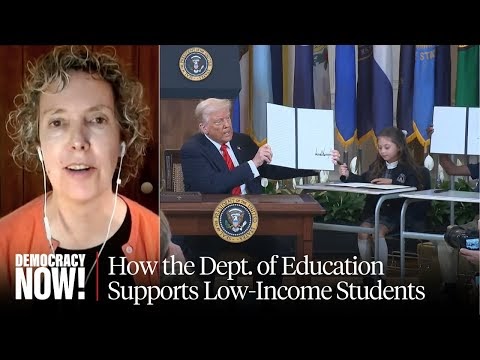
President
Donald Trump signed an executive order Thursday instructing Secretary
of Education Linda McMahon to start dismantling her agency, although it
cannot be formally shut down without congressional approval. Since
returning to office in January, Trump has already slashed the Education
Department’s workforce in half and cut $600 million in grants. Education
journalist Jennifer Berkshire says despite Trump’s claims that he is
merely returning power and resources to the states, his moves were
previewed in Project 2025. “The goal is not to continue to spend the
same amount of money but just in a different way; it’s ultimately to
phase out spending … and make it more difficult and more expensive for
kids to go to college,” Berkshire says. She is co-author of the book The
Education Wars: A Citizen’s Guide and Defense Manual and host of the
education podcast Have You Heard.
Get stories like this delivered straight to your inbox. Sign up for The 74 Newsletter
Lawmakers want to turn the tide on the growing number of unprepared and uncertified teachers by restricting who can lead Texas classrooms. But school leaders worry those limits will leave them with fewer options to refill their teacher ranks.
Tucked inside the Texas House’s $7.6 billion school finance package is a provision that would ban uncertified teachers from instructing core classes in public schools. House Bill 2 gives districts until fall 2026 to certify their K-5 math and reading teachers and until fall 2027 to certify teachers in other academic classes.
Texas would help uncertified teachers pay for the cost of getting credentialed. Under HB 2, those who participate in an in-school training and mentoring program would receive a one-time $10,000 payment and those who go through a traditional university or alternative certification program would get $3,000. Special education and emergent bilingual teachers would get their certification fees waived. Educator training experts say it could be the biggest financial investment Texas made in teacher preparation. Rep. Brad Buckley, the Salado Republican who authored the bill, has signaled the House Public Education Committee will vote on HB 2 on Tuesday.
District leaders, once reluctant to hire uncertified teachers, now rely on them often to respond to the state’s growing teacher shortage. And while they agree with the spirit of the legislation, some worry the bill would ask too much too soon of districts and doesn’t offer a meaningful solution to replace uncertified teachers who leave the profession.
“What’s going to happen when we’re no longer able to hire uncertified teachers? Class sizes have to go up, programs have to disappear…. We won’t have a choice,” said David Vroonland, the former superintendent of the Mesquite school district near Dallas and the Frenship school district near Lubbock. “There will be negative consequences if we don’t put in place serious recruitment efforts.”
Nowadays, superintendents often go to job fairs to recruit teachers and come out empty-handed. There are not as many Texans who want to be teachers as there used to be.
The salary in Texas is about $9,000 less than the national average, so people choose better-paying careers. Teachers say they are overworked, sometimes navigating unwieldy class sizes and using weekends to catch up on grading.
Heath Morrison started to see the pool of teacher applicants shrink years ago when he was at the helm of Montgomery ISD. Many teachers left the job during the COVID-19 pandemic, which accelerated the problem.
“This teacher shortage is getting more and more pronounced,” said Morrison, who is now the CEO of Teachers of Tomorrow, a popular alternative teacher certification program. “The reality of most school districts across the country is you’re not making a whole lot more money 10 years into your job than you were when you first entered … And so that becomes a deterrent.”
As the pool of certified teachers shrunk, districts found a stopgap solution: bringing on uncertified teachers. Uncertified teachers accounted for roughly 38% of newly hired instructors last year, with many concentrated in rural districts.
The Texas Legislature facilitated the flood of uncertified teachers. A 2015 law lets public schools get exemptions from requirements like teacher certification, school start dates and class sizes — the same exemptions allowed for open enrollment charter schools.
Usually, to teach in Texas classrooms, candidates must obtain a certification by earning a bachelor’s degree from an accredited college or university, completing an educator preparation program and passing teacher certification exams.
Teacher preparation experts say certifications give teachers the tools to lead a high quality classroom. To pass certification tests, teaching candidates learn how to plan for lessons and manage discipline in a classroom.
But the 2015 law allowed districts to hire uncertified teachers by presenting a so-called “district of innovation plan” to show they were struggling to meet credential requirements because of a teacher shortage. By 2018, more than 600 rural and urban districts had gotten teacher certification exemptions.
“Now, what we’ve seen is everyone can demonstrate a shortage,” said Jacob Kirksey, a researcher at Texas Tech University. “Almost every district in Texas is a district of innovation. That is what has allowed for the influx of uncertified teachers. Everybody is getting that waiver for certification requirements.”
This session, House lawmakers are steadfast on undoing the loophole they created after new research from Kirksey sounded the alarm on the impacts of unprepared teachers on student learning. Students with new uncertified teachers lost about four months of learning in reading and three months in math, his analysis found. They missed class more than students with certified teachers, a signal of disengagement.
Uncertified teachers are also less likely to stick with the job long-term, disrupting school stability.
“The state should act urgently on how to address the number of uncertified teachers in classrooms,” said Kate Greer, a policy director at Commit Partnership. The bill “rights a wrong that we’ve had in the state for a long time.”
Rep. Jeff Leach, a Plano Republican who sits on the House Public Education Committee, said his wife has worked as an uncertified art teacher at Allen ISD. She started a program to get certified this winter and had to pay $5,000 out of pocket.
That cost may be “not only a hurdle but an impediment for someone who wants to teach and is called and equipped to teach,” Leach said earlier this month during a committee hearing on HB 2.
House lawmakers are proposing to lower the financial barriers that keep Texans who want to become teachers from getting certified.
“Quality preparation takes longer, is harder and it’s more expensive. In the past, we’ve given [uncertified candidates] an opportunity just to walk into the classroom,” said Jean Streepey, the chair of the State Board for Educator Certification. “How do we help teachers at the beginning of their journey to choose something that’s longer, harder and more expensive?”
Streepey sat on the teacher vacancy task force that Gov. Greg Abbott established in 2022 to recommend fixes to retention and recruitment challenges at Texas schools. The task force’s recommendations, such as prioritizing raises and improving training, have fingerprints all over the Texas House’s school finance package.
Under HB 2, districts would see money flow in when they put uncertified teachers on the path to certification. And those financial rewards would be higher depending on the quality of the certification program.
Schools with instructors who complete yearlong teacher residencies — which include classroom training and are widely seen as the gold standard for preparing teacher candidates — would receive bigger financial rewards than those with teachers who finish traditional university or alternative certification programs.
Even with the financial help, lawmakers are making a tall order. In two years, the more than 35,000 uncertified teachers in the state would have to get their credential or be replaced with new, certified teachers.
“The shortages have grown to be so great that I think none of us have a really firm handle on the measures that it’s going to take to turn things around.” said Michael Marder, the executive director of UTeach, a UT-Austin teacher preparatory program. “There is financial support in HB 2 to try to move us back towards the previous situation. However, I just don’t know whether the amounts that are laid out there are sufficient.”
Only one in five uncertified teachers from 2017 to 2020 went on to get a credential within their first three years of teaching. Texas can expect a jump in uncertified teachers going through teacher preparatory programs because of the financial resources and pressure on schools through HB 2, Marder said.
But for every teacher who does not get credentialed, school leaders will have to go out and find new teachers. And they will have to look from a smaller pool.
The restrictions on uncertified teachers “handcuffs us,”said Gilbert Trevino, the superintendent at Floydada Collegiate ISD, which sits in a rural farming town in West Texas. In recent years, recruiters with his district have gone out to job fairs and hired uncertified teachers with a college degree and field experience in the subjects they want to teach in.
Rural schools across the state have acutely experienced the challenges of the teacher shortage — and have leaned on uncertified teachers more heavily than their urban peers.
“We have to recruit locally and grow our own or hire people who have connections or roots in the community,” Trevino said. “If we hire a teacher straight out of Texas Tech University, we may have them for a year. … And then they may get on at Lubbock ISD or Plainview ISD, where there’s more of a social life.”
Floydada Collegiate ISD recruits local high school students who are working toward their associate’s degree through what is known as a Grown Your Own Teacher program. But Trevino says HB 2 does not give him the time to use this program to replace uncertified teachers. From recruitment to graduation, it takes at least three years before students can lead a classroom on their own, he said.
School leaders fear if they can’t fill all their vacancies, they’ll be pushed to increase class sizes or ask their teachers to prepare lessons for multiple subjects.
“Our smaller districts are already doing that, where teachers have multiple preps,” Trevino said. “Things are already hard on our teachers. So if you add more to their plate, how likely are they to remain in the profession or remain in this district?”
At Wylie ISD in Taylor County, it’s been difficult to find teachers to keep up with student growth. Uncertified teachers in recent years have made up a large number of teacher applicants, according to Cameron Wiley, a school board trustee.
Wiley said restrictions on uncertified teachers is a “good end goal” but would compound the district’s struggles.
“It limits the pot of people that’s already small to a smaller pot. That’s just going to make it more difficult to recruit,” Wiley said. “And if we have a hard time finding people to come in, or we’re not allowed to hire certain people to take some of that pressure off, those class sizes are just going to get bigger.”
Learning suffers when class sizes get too big because students are not able to get the attention they need.
“This bill, it’s just another obstacle that we as districts are having to maneuver around and hurl over,” Wiley said. “We’re not addressing the root cause [recruitment]. We’re just putting a Band-Aid on it right now.”
This article originally appeared in The Texas Tribune at https://www.texastribune.org/2025/03/15/texas-school-funding-uncertified-teachers-shortage/.
The Texas Tribune is a member-supported, nonpartisan newsroom informing and engaging Texans on state politics and policy. Learn more at texastribune.org.
Get stories like these delivered straight to your inbox. Sign up for The 74 Newsletter

On February 4, Nick Graetz joined the University of Michigan’s Stone Center to present “Individualizing Climate Risk: Credit Score Penalties in the Home Insurance Market.”
Nick Graetz is an Assistant Professor at the University of Minnesota in the Department of Sociology and the Institute for Social Research and Data Innovation. He is also a Fellow at the Climate and Community Institute, a progressive climate policy think tank developing research on the climate and inequality nexus. His work focuses on the intersection of housing, population health, and political economy in the United States. Learn more at ncgraetz.com.

Almost everyone has views on the school curriculum. It’s too academic; it’s not academic enough; it’s too crowded; it has major omissions; it’s too subject-dominated; it doesn’t spend enough time on subject depth. Debates about the curriculum can be wearying: just as everyone has a view on the school curriculum, so almost everyone has views about what should be added to it, though relatively few people have equally forceful ideas about what should be dropped to make room for Latin, or personal finance education, or more civic education and so on.
One of the achievements of Becky Francis’s interim report on school curriculum and assessment is that it tries to turn most of these essentially philosophical (or at least opinionated) propositions into debates about evidence and effectiveness and to use those conclusions to set out a route to more specific recommendations which will follow later in the year. It’s no small achievement. As the report says, and as Becky has maintained in interviews, ‘all potential reforms come with trade-offs’ (p 8); the key is to be clear about the nature of those trade-offs so that there can be an open, if essentially political debate about how to weight them.
The methodology adopted by Becky and her panel points towards an essentially evolutionary approach for both curriculum and assessment reform. The first half of that quoted sentence on trade-offs is an assertion that ‘our system is not perfect’ (p 8) and of course, no system is. But the report is largely positive about key building blocks of the system, and it proposes that they will remain: the structure of four key stages, which has been in place since the 1980s; the early focus on phonics as the basis of learning to read, which has been a focus of policy since the 2000s; the knowledge-rich, subject-based approach which has been in place for the last decade; and the essentials of the current assessment arrangements with formal testing at the end of Key Stage 2 (age 11), key stage 4 (essentially GCSEs) and post-16 which were established in the 1988 Education Reform Act.
More directly relevant to higher education, the report’s view is that ‘the A level route is seen as strong, well-respected and widely recognised, and facilitates progression to higher education’ (p 30) and that ‘A-levels provide successful preparation for a three-year degree’ (p 7). Whilst the review talks about returning to assess ‘whether there are opportunities to reduce the overall volume of assessment at key stage 4’ (p 41), it does not propose doing so for A-level. The underlying message is one of system stability, because ‘many aspects of the current system are working well’ (p 5).
However: one of the most frequently used words in the interim report is, in fact, ‘however’: the word appears 29 times on 37 pages of body text, and that doesn’t include synonyms including ‘but’ (32 appearances), ‘while’ (19 appearances) and a single ‘on the other hand’. Frequently, ‘however’ is used to undercut an initial judgement. The national curriculum has been a success (p 17),'[h]owever, excellence is not yet provided for all: persistent gaps remain’, The panel “share the widely held ambition to promote high standards. However, in practice, “high standards” currently too often means ‘high standards for some’”(p 5).
These ‘however’ formulations have three effects: first, and not unreasonably in an interim report, they defer difficult questions for the final report. The final report promises deep dives ‘to diagnose each subject’s specific issues and explore and test a range of solutions’, and ‘about the specificity, relevance, volume and diversity of content’ (p.42). It’s this which will prove very tough for the panel, because it is always detail which challenges in curriculum change. If the curriculum as a whole is always a focus for energetic debate, individual subjects and their structure invariably arouse very strong passions. The report sets up a future debate here about teacher autonomy, arguing, perhaps controversially in an implied ‘however’ that ‘lack of specificity can, counter-intuitively, contribute to greater curriculum volume, as teachers try to cover all eventualities’ (p 28).
Secondly, and in almost every case, the ‘however’ undercuts the positive systems judgement: ‘the system is broadly working well, and we intend to retain the mainstay of existing arrangements. However, there are opportunities for improvement’ (p 8). It’s a repeated rhetorical device which plays both to broad stability and the need for extensive change, and it suggests that some of the technical challenges are going to rest on value – and so political – judgements about how to balance the competing needs of different groups. Sometimes the complexity of those interests overwhelms the systems judgements. The review’s intention is to return to 16-19 questions, “with the aim of building on the successes of existing academic and technical pathways, particularly considering [possibly another implied ‘however’] how best to support learners who do not study A levels or T Levels” (p 9) is right to focus on the currently excluded, but the problem is often mapping a route through overly rigid structures.
The qualifications system has been better geared for higher attainers, perhaps exemplified by the EBacc [English Baccalaureate] of conventional academic subjects. Although the Panel cites evidence that a portfolio of academic subjects aids access to higher education, ‘there is little evidence to suggest that the EBacc combination [of subjects] per se has driven better attendance to Russell Group universities’ (p 24) – the latter despite the rapid growth of high tariff universities’ market share over recent years. This issue is linked to one of the most curious aspects of the report from an evidential point of view. It is overwhelmingly positive about T-levels, ‘a new, high-quality technical route for young people who are clear about their intended career destination’ which ‘show great promise’ (p 7). But (“however”) take up (2% of learners) has been very poor, and not just because not all 16-year-olds are ‘clear about their intended career pathway’. The next phase of the Review promises to ‘look at how we can achieve the aim of a simpler, clearer offer which provides strong academic and technical/vocational pathways for all’ (p 31). But that ‘simpler, clearer offer’ has defied either technical design or political will for a very long time. If it is to succeed, the review will need to consider approaches which allow combinations of vocational and academic qualifications at 16-19, partly because much higher education is both vocational and academic and more because at age 16, most learners do not have an ‘intended career pathway’.
And thirdly, related to that, the ‘howevers’ unveil a theme which looms over the report, the big challenge for national reform which seeks to deliver excellence for all. Pulling evidence together from across the report tells us that 80% of pupils met the expected standard in the phonics screening check and at age 11, 61% of pupils achieved the expected standards in reading, writing and maths (p 17). Some 40% of young people did not achieve level 2 (a grade 4 or above at GCSE) in English and maths by age 16 (p 30). To simplify: attainment gaps open early; they are not closed by the curriculum and assessment system, and one of the few graphs in the report (p 18) suggests that they are widening, leaving behind a large minority of learners who struggle to access a qualifications system which is not working for them. As the report says, the requirement to repeat GCSE English and Maths has been especially problematic.
The report is thorough, technical and thoughtful; it is evolutionary not revolutionary, and none the worse for that. Curriculum and assessment policy is full of interconnection and unintended consequences. There are tough challenges in system design to secure excellence and equity, inclusion and attainment, and to address those ‘howevers’. The difficult decisions have been left for the final report.

Yesterday, President Trump signed an executive order ordering the shutdown of the U.S. Department of Education (ED). The order claims to ensure the “uninterrupted delivery of services, programs, and benefits on which Americans rely,” yet Trump and Secretary Linda McMahon have gutted the arms of ED that make those functions possible. Read our statement on yesterday’s executive order here. Last week, Trump announced a 50 percent reduction in the workforce at the Department. Now he plans to move student loans to the Small Business Administration?!?!
The Trump Administration is intentionally breaking the student loan system and attacking borrowers and working families with student debt. But we’ve been fighting back.
On Tuesday night, the 1.8 million-member AFT sued ED for denying borrowers’ access to affordable loan payments and blocking progress towards Public Service Loan Forgiveness (PSLF)—in violation of federal law.
Three weeks ago, federal education officials eliminated access to Income-Driven Repayment (IDR) plans by removing the application from ED’s website and secretly ordering student loan servicers to halt processing all applications. These IDR plans provide millions of borrowers the right to tie their monthly payment to their income and family size, giving them the option to make loan payments they can afford.
IDR plans are also the only way for public service workers to benefit from PSLF—a critical lifeline for teachers, nurses, first responders, and millions of other public service workers across the country.
SBPC Executive Director Mike Pierce’s statement:
Title: What do Republican Voters Want on Higher Education?
Author: Ben Cecil
Source: Third Way
During the budgetary process that recently concluded, Congress considered substantial funding cuts to numerous areas, including higher education. Republican voters, however, may not view heavy cuts to higher education favorably. A recent survey of 500 Republican voters nationwide conducted by Third Way and the Republican polling firm GS Strategy Group found that Republicans value and support higher education, are in favor of less invasive reforms, and largely support policies directed at college affordability and accountability.
The survey responses make clear that Republican voters haven’t abandoned the concept of higher education, with over 60 percent of respondents reporting that a four-year degree is valuable in today’s economy. Beyond traditional four-year programs, Republican voters demonstrated substantial support for trade schools and community colleges, with favorability for the institutions at 91 and 87 percent, respectively. While Republican perspectives regarding the value of education remain positive, nearly 90 percent of voters polled said that more accountability is required for higher education.
Republican voters also rated many current higher education policies very favorably. Eighty-one percent of respondents said they support Pell Grants, while 79 percent supported Public Service Loan Forgiveness and income-driven repayment for student loans. The support for these programs aligns with one of respondents’ primary policy concerns; just under half of Republican voters said that affordability is the most significant problem that needs to be addressed within higher education.
To address college affordability concerns, Republicans aren’t in favor of relying on private industry; of the 12 policy reforms Third Way tested, privatization of student loan programs was ranked number 11, with just over half of respondents viewing it as a viable option. With affordability as a chief concern, Republican voters recognize and support the role the federal government plays in offering financial support for students.
The perspectives of Republican voters on higher education demonstrate clear policy aims and a hesitation to substantially change funding structures and government involvement. When asked if they prefer sweeping cuts to graduate lending or more accountability from institutions to improve their return on investment, only 20 percent of voters chose funding cuts. The message is clear: Republicans support increases to institutional accountability and college affordability but aren’t looking for broad cuts to higher education.
For further information, click here to read the full article from the Third Way.
If you have any questions or comments about this blog post, please contact us.
%20%E2%80%94%20Scaled%20(76%25).png)