In 1862 the United States passed the first of a series of laws – known as the Morrill Land-Grant Acts – which allowed states to sell federally owned land to fund the creation of colleges. These colleges – known now as land-grant universities – form a large chunk of the US higher education system. And its important to note – as America tries to forget its history – that the land sold to fund them was often bought, granted by or stolen from Native American tribes.
The state of Indiana decided in 1865 to take advantage of the act, and a process to decide where and how to spend the money began. The state could have chosen a couple of existing institutions, but in 1869 was swayed by proposals from Tippecanoe County which included pledges of $200,000 (about worth $4.6 million today) and 100 acres of land. And so Purdue University, named after the benefactor who had pledged the lion’s share of the $200,000, was established in West Lafayette, on the Wabash River.
Purdue developed into a university focusing on engineering and agricultural subjects. This was under the guidance of Emerson E White, president of Purdue from 1876 to 1883. He sought to differentiate Purdue from the “classical” American universities, and the syllabus reflected this. Humanities and social sciences were not prohibited, but were not prioritised. He sought also to ban fraternities from campus, and when the Indiana state legislature required the university to allow fraternities, he resigned. But it was too late, and that year Purdue received no state grant.
Purdue became a leading institution for research into steam traction on the railways. By the 1890s it owned several locomotives, and a railway dynamometer which enabled research. There was a local railroad – the Monon railroad – which operated works near Purdue. In 1891 the Purdue football team (gridiron, not association or union or league) beat neighbours Wabash College 44–0; there were suggestions that the team had included some ringers – boilermakers from the Monon works. Which led to the nickname Boilermakers, given to the university’s sports teams.
(Its a bit of a tradition in American universities for their teams to have nicknames; a little like the now sometimes quaint nicknames used for football teams in Britain. A few still have local meaning, but other than journalists looking for copy, do many people still call their team by its nickname? Answers in the chat, please. But in America they are still used, it seems.)
Purdue became the first US university to have its own airport, in 1934, and introduce credit bearing courses in learning to fly. Amelia Earhart was an instructor for those courses, and a career counsellor for women students. Her round-the-world flight attempt in 1937, in which she disappeared, used an aeroplane funded by Purdue’s research foundation.
Purdue scientists discovered properties of the element germanium which enabled the invention of transistors. Transistors were fundamental to the development of electronics and computing. Transistors themselves were invented at Bell Laboratories but without germanium semiconducting crystals, which the Purdue team produced, transistors would not have operated quickly enough.
In 2017 Purdue University bought Kaplan, the early online university, and transformed it into Purdue University Global.
The card – here’s a jigsaw – shows the Boilermaker Special, Purdue’s official mascot. The Boilermaker was introduced in 1940, paid for by alumni and members of the Purdue Reamer Club, a student club formed as an alternative to the fraternity societies. The first vehicle comprised a body made by the Baldwin Locomotive Works, mounted on a Studebaker chassis. The card shows the third Boilermaker Special, which was in service from 1960 to 1993. It was made by General Motors, on a bus chassis. The current Boilermaker Special is the eighth; a ninth is expected to be in service from this summer.
The card was posted in February 1973 to a couple in Washington DC:
Came out here yesterday to let M.G. take a look at Purdue…
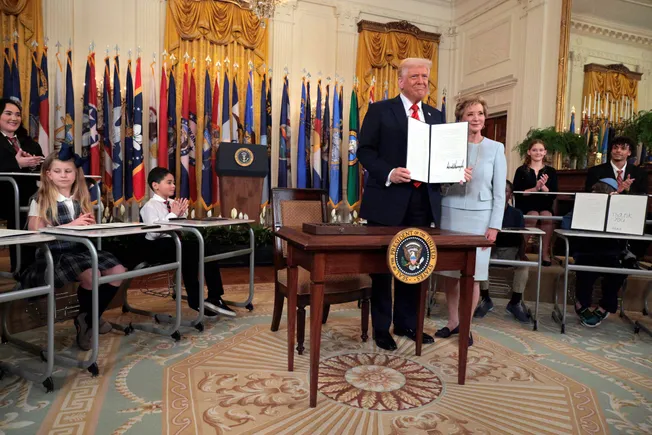
On March 20, President Trump signed an executive order titled “Improving Education Outcomes by Empowering Parents, States, and Communities.” The order directs the secretary of education to “take all necessary steps to facilitate the closure of the Department of Education and return authority over education to the States and local communities while ensuring the effective and uninterrupted delivery of services, programs, and benefits on which Americans rely.”
The order additionally states that the secretary of education “shall ensure that the allocation of any Federal Department of Education funds is subject to rigorous compliance with Federal law and Administration policy.” According to the order, this includes compliance with federal requirements to terminate “illegal discrimination obscured under the label ‘diversity, equity, and inclusion’” and to terminate programs that promote gender ideology.
With respect to higher education, the executive order asserts that closure of the ED “would drastically improve program implementation.” It specifically discusses ED’s role in managing the federal student loan debt portfolio, and it claims that ED “is not a bank, and it must return bank functions to an entity equipped to serve America’s students.”
It is still unknown how Secretary McMahon will execute this order. Despite Trump’s clear intentions to close ED, Congress would still need to pass legislation to officially dissolve the department. It remains to be seen whether McMahon and the Trump administration will move ED’s subagencies and their functions to other federal agencies as speculated.
More information is needed from ED to understand how this order will be implemented. CUPA-HR will continue to monitor for additional news and guidance from ED as it relates to the order.
The University of California is implementing a hiring freeze across its 10 campuses as it navigates potential funding cuts at both the federal and state levels, system President Michael Drake said in a message Wednesday.
Drake also directed UC locations to roll out other cost-cutting measures, such as delaying maintenance and reducing travel expenses.
“I recognize this is a time of great uncertainty for many in our UC community and in higher education across the country,” Drake said. “Throughout our history as an institution and as a nation, we have weathered struggles and found new ways to show up for the people we serve.”
Dive Insight:
UC joins an ever-growing cohort of higher education institutions taking preemptive steps to brace their budgets against a storm of funding cuts and financial attacks coming from the Trump administration.
Many institutions have cited the 15% cap on indirect research cost funding that the National Institutes of Health announced in February. Such a reduction would amount to billions of dollars collectively and could translate into funding shortfalls in the tens of millions of dollars for many universities.
NIH is the largest funder of UC research, having provided a total $2.6 billion to the system in the 2023-24 academic year, according to the system. Among the system’s campuses that could be hardest hit, UCLA stands to lose $65 million under the funding cap, UC San Francisco $121 million and UC San Diego $102 million, according to a New York Times analysis.
Faced with massive cuts to its research funding from the agency, UC filed a declaration in support of the lawsuit against NIH brought by the California attorney general and more than 20 other states.
A judge overseeing multiple lawsuits against NIH has paused the funding cap, but uncertainty abounds among higher education leaders over the issue and other potential funding stoppages in Washington.
“The University’s legal team prepared for this moment and has been working diligently to protect the University and our mission through the courts,” Drake said. “These efforts have allowed us to stave off some of the immediate and projected financial impacts — but not all.”
Even before President Donald Trump took office, UC faced potential future budget strains from state-level cuts. A fiscal 2025-26 budget proposal unveiled in January by Gov. Gavin Newsom would reduce UC’s funding by $271 million. At the time, Drake— who plans to step down as system leader at the end of the 2024-25 academic year — expressed concern about how the cuts would affect UC students and services.
Prior to that, the system had been improving its financial trajectory, with the system’s overall total budget loss shrinking significantly in fiscal 2024 to $178 million, less than a tenth of the prior year’s shortfall.
In his message Wednesday, Drake said he asked the presidents of all UC locations to “prepare financial strategies and workforce management plans that address any potential shortfalls,” adding that “every action that impacts our University and our workforce will only be taken after serious and deliberative consideration.”
This audio is auto-generated. Please let us know if you have feedback.
President Donald Trump on Thursday afternoon ordered U.S. Secretary of Education Linda McMahon to “take all necessary steps to facilitate the closure of the Department of Education,” marking the boldest push from the president to shut down the agency since its establishment under the Carter administration over four decades ago.
Trump also said prior to the signing that he intends to disperse the department’s core functions — such as Pell Grants, Title I funding, and providing funding and resources for students with disabilities — to other parts of the government.
“They’re going to be preserved in full and redistributed to various other agencies and departments that will take very good care of them,” he said. “My administration will take all lawful steps to shut down the department. We’re going to shut it down and shut it down as quickly as possible.”
The layoffs preceding the Thursday order impacted nearly 1,300 workers in addition to the nearly 600 employees who accepted “buyouts.”
Trump has repeatedly and forcefully threatened to shut down the department since his first term in the White House, citing what he has called the agency’s “bloated budget” and a need to return education control to the states. His push to dismantle the department is in line with the 2024 Republican agenda, which included closing the department to “let the States run our educational system as it should be run.”
In a Thursday speech, just prior to signing the order, Trump also cited low student test scores as reason to close the department.
“After 45 years, the United States spends more money in education by far than any other country, and spends, likewise, by far, more money per pupil than any country,” he said. “But yet we rank near the bottom of the list in terms of success. That’s where we are — like it or not — and we’ve been there for a long time.”
Abolishing the 45-year-old agency altogether, however, requires a Senate supermajority of 60 votes. A similar proposal from conservatives in the House failed in 2023 when 60 House Republicans joined Democrats to defeat the measure.
Given the current closely divided Congress, many have considered it a longshot that lawmakers would approve the department’s demise.
However, in his Thursday speech, Trump said he hopes Democrats would be onboard if the legislation to officially close the department eventually comes before Congressional lawmakers.
What will be impacted?
Although the administration technically needs Congressional action to close the department, the Thursday order tells McMahon to push its closures “to the maximum extent appropriate and permitted by law.”
The agency is responsible for a slew of programs key to school and college operations, including conducting federal civil rights investigations, overseeing federal student financial aid, and enforcing regulations on Title IX and other education laws. It is in charge of large programs that schools depend on, like Title I, which sends aid to low-income school districts, and the Individuals with Disabilities Education Act that supports special education services.
Following the layoffs earlier this month, the department claimed its key functions, including overseeing COVID-19 pandemic relief, wouldn’t be impacted.
“Closing the Department does not mean cutting off funds from those who depend on them — we will continue to support K-12 students, students with special needs, college student borrowers, and others who rely on essential programs,” said McMahon in a statement praising the executive order on Thursday.
However, former employees and education policy experts have warned that a department functioning on only half its former manpower could lead to a decline in oversight, guidance and student protections while creating systemic “chaos.”
“Eliminating it would roll back decades of progress, leaving countless children behind in an education system that has historically failed the most marginalized,” said Keri Rodrigues, president of National Parents Union, in a Thursday statement responding to the order. “Without federal oversight, states will have free rein to lower standards, siphon funds from public schools, and dismantle hard-won civil rights protections.”
Educators have also warned that gutting the department would eventually lead to an increase in class sizes and reduce special education services for students with disabilities.
McMahon disagreed.
“Teachers will be unshackled from burdensome regulations and paperwork, empowering them to get back to teaching basic subjects,” she said in the statement. “Taxpayers will no longer be burdened with tens of billions of dollars of waste on progressive social experiments and obsolete programs,” she added.
Order follows McMahon’s ‘final mission’
During her Feb. 13 Senate confirmation hearing, McMahon did not commit to closing the Education Department and acknowledged that closure of the entire Education Department would need congressional approval. The White House echoed those sentiments on Thursday, just prior to the order’s signing.
McMahon also said programs established by federal statute, such as Title I for low-income schools and services to students with disabilities under the Individuals with Disabilities Education Act, would need to continue with or without an Education Department. But some federal education statutes are specific about certain offices’ responsibilities within the Education Department.
Still, on McMahon’s first day on the job last month, she publicly said she was planning for the “historic overhaul” of the department as its “final mission.”
“This review of our programs is long overdue,” she wrote in a letter posted by the department that same night, supporting what she called “elimination of bureaucratic bloat here at the Department of Education — a momentous final mission — quickly and responsibly.” McMahon and Trump have touted giving education decision-making power back to the states and parents.
However, “This is not about cutting bureaucracy — it’s about gutting the protections that safeguard our children’s education,” Rodrigues said in her statement.
Democratic lawmakers have also resisted the department’s recent cuts and have already pushed back against the order that followed it today.
“President Trump’s executive order to dismantle the Department of Education (ED) and ‘return education to the states’ will be challenged in the Courts,” said Rep. Bobby Scott, D-Va., ranking member on the House Committee on Education and the Workforce.
Sen. Patty Murray of Washington, along with two other Democratic lawmakers, also demanded answers from the agency in a 10-page letter sent Monday, asking McMahon and Institute of Education Sciences Acting Director Matthew Soldner how the agency intends to fulfill its statutory obligations with a reduced staff.
Others are celebrating the historic order.
“With the federal government stepping back, the potential for new, transformative education models has never been greater,” said Jeanne Allen, founder and CEO of the Center for Education Reform, in a statement on Wednesday night in anticipation of today’s order. “As every great innovator knows – whether in education, business, or technology – government interference stifles progress and disruptive innovations accelerate it.”
Many Republican lawmakers are also on board with gutting the agency.
“The key to improving education is empowering parents and students and reducing the role of Washington bureaucrats,” said House Committee on Education and the Workforce Chair Tim Walberg, R-Mi., in a Thursday statement. Walberg cited the Biden administration’s decisions during the pandemic, slowed student performance in the wake of the crisis, and its LGTBQ+ inclusive policies as some reasons to cut the department.
“Bottom line, the Department of Education has failed to deliver results for America’s students and today’s actions by the Trump administration will help ensure our nation’s youth are put first.”
How can you illuminate a path to success in a turbulent environment?
This last half decade has delivered unprecedented disruption for university leaders. The pandemic, economic uncertainty, greater need among students and families, and sweeping governmental changes have buffeted campuses of every size, type, and mission. As we move through 2025 and look at the landscape beyond, it’s clear that adaptability, resilience, and innovative thinking are crucial for successful university management.
As my colleagues and I partner with university leaders on key areas such as strategic enrollment planning and working with university boards, we help leaders assess and address five key challenges that impact institutional sustainability. Addressing these areas strengthens fiscal health, campus alignment and collaboration, efficiency, and other challenges that are roadblocks to a campus achieving its full potential.
Embracing Enterprise Risk Management
There is one preliminary key strategy that has become especially vital for navigating uncertain times: Enterprise Risk Management (ERM). This approach replaces siloed risk management that dilutes campus resources and responses with a stronger, integrated perspective—allowing senior leaders and boards of trustees to gain a comprehensive view of potential threats and their interconnections. By implementing ERM, universities can develop more effective strategies for identifying, mitigating, and managing risks across all aspects of their operations.
Addressing five key challenges
Once you have embraced ERM, that can help guide your strategies and tactics in addressing these five key university challenges.
1. Financial stability and funding
With potential changes in federal funding and financial aid structures, universities must diversify their revenue streams and explore new partnerships. This may include collaborations with private industry, international organizations, and philanthropic entities to sustain critical academic research and support student access to education.
Additionally and perhaps more urgently, leaders need to dive deep into financial aid budgets, leveraging strategies, funding sources, and how they tie to recruitment and admissions strategies. RNL is working closely with our partners to redesign models if/when funding sources disappear, ensuring that you can meet your enrollment goals and serve your mission amidst tremendous uncertainly regarding government sources of funding.
2. Technological integration
The rapid advancement of technology, particularly artificial intelligence, is disrupting traditional teaching and learning methods. University leaders must navigate this transformation by:
Investing in faculty training for AI integration
Updating curricula to reflect emerging technologies
Developing ethical guidelines for AI use in academia
From pandemics to natural disasters disrupting higher education, having a comprehensive crisis management plan is essential. This should include:
Regular scenario planning and contingency exercises
Clear communication protocols for all stakeholders
Ongoing training for staff and administrators
Most institutions have the logistics of crisis management figured out: crisis captains, protocols, policies, and procedures. What they have not accommodated for in the midst of myriad external forces is the long-term impact of these singular events and ongoing circumstances on their communities—students, families, faculty, and staff. The mental health crisis in education is on the rise and now, more than ever, campuses need to lead with compassion and understanding to bring communities together. Ultimately, your institution needs to be able to anticipate potential crisis and be ready to adapt rapidly to ensure that students are cared for and their college experience can continue.
4. Fostering a culture of innovation and adaptability
Taking the optimal approach to technological changes and crisis preparedness requires cultivating a culture of continuous innovation. This involves:
Creating dedicated teams to explore new areas of innovation
Encouraging interdisciplinary collaboration
Promoting flexibility in learning paths and program offerings
The higher education marketplace does not stand still, and universities therefore cannot afford to be set in their ways and be slow to adapt.
5. Prioritizing stakeholder trust and communication
Addressing these challenges and achieving goals in a period of disruption requires unity, transparency, and communication among key stakeholders. University leaders should:
Maintain open lines of communication with all stakeholders
Build trust through consistent and honest messaging
Engage in active listening to address concerns and gather feedback
Difficult messages can be difficult to deliver, but more transparency and dialogue with stakeholders will increase collaboration and focus that will produce transformative results.
Great university leadership is needed more than ever
Managing a university during times of great disruption and uncertainty requires a delicate balance of strategic foresight, agile decision-making, and compassionate leadership. By embracing risk management, fostering innovation, and prioritizing clear communication, university leaders can navigate these challenging waters and emerge stronger, more resilient, and better equipped to fulfill their educational missions in an ever-changing world.
From speed-to-lead to 24/7 support: Meeting student needs in the digital age
In our recent webinar, “The Importance of Speed to Lead in Meeting Your Enrollment Goals,” we highlighted how rapid, personalized responses to prospective students can significantly impact their perception of an institution’s quality and commitment. This principle of timely, relevant communication extends beyond the admissions process and into the heart of the student experience, particularly in online education. In this post, we’ll delve into how this same philosophy applies to technical support, forming a crucial component of student success and retention.
The critical role of 24/7 technical support in online education
Building on the speed-to-lead concept, the need for swift and effective technical support in online learning environments has become paramount. As we transition from initial student engagement to ongoing support, responsive assistance becomes even more critical. Let’s explore why timely technical support is essential and how it ties to student retention, institutional credibility, and mission fulfillment.
The importance of quick response to technical needs
Just as rapid responses to inquiries can influence a student’s decision to enroll, quick resolution of technical issues can determine a student’s ability to succeed in their coursework. Student satisfaction is closely tied to the quality of the overall experience institutions provide to students, including addressing technical issues and how the institution responds to the students as individuals when they have a concern. When students encounter technical barriers without immediate resolution, their frustration can lead to disengagement and even withdrawal from courses.
The importance of swift technical support in higher education cannot be overstated, as exemplified by several leading institutions.
Penn State University’s IT Service Desk stands out with its comprehensive 24/7 technology support model. Utilizing a blend of 20 students and full-time staff members, they efficiently manage up to 600 daily requests during peak periods. This continuous operation throughout the year, pausing only for university holidays, ensures that the Penn State community receives timely assistance for diverse IT-related issues, from learning management systems to account access and new IT service implementations.
Arizona State University (ASU): ASU’s help center provides round-the-clock service for their large student body. They have 81 employees and 22 student representatives who offer 24/7 support for approximately 100,000 students, including both on-campus and online learners. The center serves as a comprehensive “front door” to the university, assisting with various inquiries beyond just technical issues.
The University of Central Florida (UCF) has adopted a strategic approach to technical support. By deploying technicians during high-demand hours, UCF effectively minimizes downtime for both students and faculty. This proactive strategy maintains the continuity of the learning process and demonstrates the institution’s commitment to student success.
In instances where staffing may be limited, universities are increasingly turning to AI-powered solutions to meet the demand for immediate, round-the-clock support. For example, Thompson Rivers University has implemented a 24/7 chatbot support system. This AI-driven tool automates 83% of incoming chats to their Future Student department, providing instant responses outside of regular business hours. Moreover, a number of innovative platforms such as RNL’s Compass digital assistant provide AI-powered chatbots designed for higher education. These AI-powered assistants can seamlessly integrate with various campus systems, including SIS/ERP, ITSM, and LMS, to address a wide range of inquiries related to IT, admissions, financial aid, and more. By leveraging such technologies, institutions can significantly reduce support costs while ensuring students and faculty receive timely, personalized assistance at any hour.
The case for a 24×7 support model
A 24/7 support model aligns with the flexibility that online education promises. Students often engage with coursework outside traditional hours, making access to technical assistance at any time a necessity rather than a luxury. Institutions like Faith Christian School emphasize the importance of uninterrupted access to educational resources, which fosters independence and self-directed learning. Similarly, Google Cloud’s Student Success Services leverage virtual assistants to provide instant answers around the clock, freeing up staff for more personalized guidance.
The availability of 24/7 technical support is increasingly viewed as a marker of institutional quality. Students now expect seamless access to both academic content and support services when selecting a university. Institutions that fail to meet these expectations risk damaging their reputation and losing prospective students. RNL student satisfaction and priorities data shows that approximately two-thirds of students value institutions addressing their personal needs throughout the recruitment process, which can factor in their decision to enroll at the institution. Offering robust technical support signals that a university is technologically advanced and committed to providing an optimal learning environment.
Enabling student success and institutional mission
Timely technical support directly contributes to student success by removing barriers to learning. When students can focus on their studies without being derailed by technical difficulties, they are more likely to persist in their programs. This aligns with the broader mission of most universities: helping students succeed academically and graduate. Demonstrating the lived expression of institutional mission through 24/7 support for student services can enhance retention and overall well-being. By addressing both academic and non-academic challenges in real-time, universities create an ecosystem where students thrive.
Conclusion: Timely support is critical to the online student experience
From the initial point of contact through to graduation, the principle of timely, personalized support remains crucial. The importance of responding quickly to students’ technical needs is a natural extension of the speed-to-lead philosophy in enrollment management. A 24/7 support model not only ensures uninterrupted learning but also strengthens institutional credibility and fosters student retention. By prioritizing timely assistance across all aspects of the student journey, universities can live up to their mission of empowering students to succeed academically and graduate with confidence. As these examples illustrate, investing in comprehensive support systems is an investment in both student success and institutional sustainability.
How can you leverage technology across the student lifecycle?
With students expecting personalized attention 24/7, you need to be able to engage them at any point in the student lifecycle. Talk with our experts about how you can use the latest technology to create those connections to strengthen recruitment and retention.
On March 19, the Equal Employment Opportunity Commission (EEOC) and Department of Justice (DOJ) released two technical assistance documents intended to educate “the public about unlawful discrimination related to ‘diversity, equity, and inclusion’ (DEI) in the workplace.” The two documents aim to inform the public about how civil rights rules and laws like Title VII of the Civil Rights Act of 1964 apply to employment policies, programs and practices, including those labeled or framed as “DEI.”
Title VII prohibits employment discrimination based on protected characteristics, including race, color, religion, sex or national origin. As the agencies note in both documents, DEI is a broad term that is not defined under statute. The technical assistance explains that DEI practices may be unlawful if they involve an employer or other covered entity taking an employment action motivated in whole or in part by an employee’s race, sex, or other protected characteristic. The agencies emphasize that Title VII’s protections apply equally to all racial, ethnic, and national origin groups, as well as both sexes, and that unlawful discrimination may exist no matter which employees are harmed.
Technical Assistance Document #1: The EEOC describes what DEI-related discrimination looks like.
Title VII bars disparate treatment: Any employment action motivated in whole or in part by race, sex, or another protected characteristic that is taken in the context of the terms, conditions, or privileges of employment may be unlawful.*
Title VII prohibits limiting, segregating, and classifying: Any action taken that limits, segregates, or classifies employees based on race, sex, or other protected characteristics in a manner affecting their status or depriving them of employment opportunities may be unlawful. Examples of these practices include the establishment of workplace groups (employee resource groups or employee affinity groups) that limit membership to a protected group or groups, as well as the separation of employees into groups based on a protected characteristic when administering trainings or other privileges of employment. The document makes clear that the latter may still violate Title VII even if the separate groups receive the same training or programming content.
Title VII prohibits workplace harassment: Workplace harassment is illegal when it results in an adverse change to a term, condition, or privilege of employment, or it is so frequent or severe to reasonably be considered intimidating, hostile, or abusive. The document explains that DEI training may give rise to a hostile work environment claim and that harassment may occur when an employee is subject to unwelcome remarks or conduct based on protected characteristics.
Title VII prohibits employer retaliation: The agencies explain that reasonable opposition to a DEI training may constitute protected activity if the employee provides a fact-specific basis for their belief that the training violated Title VII, and that an employer may not retaliate if an employee participates in an EEOC investigation or files an EEOC charge.
The document reaffirms that Title VII protects employees, potential and actual applicants, interns, and training program participants. It directs individuals who suspect to have experienced DEI-related discrimination to contact the EEOC “promptly” as claimants have 180 to 300 days to file a claim depending on whether a state or local agency enforces a law that prohibits employment discrimination on the same basis.
Technical Assistance Document #2: The EEOC answers additional questions about DEI-related discrimination in the workplace.
The second technical assistance document, titled “What You Should Know About DEI-Related Discrimination At Work,” expands upon the information provided in the technical assistance document discussed above and answers a number of additional questions on how Title VII intersects with DEI-related practices in the workplace.
Notably, the document addresses questions surrounding employers’ DEI-related considerations of race, sex, and other protected characteristics when the protected characteristic wasn’t the “sole or deciding factor” for the employers’ action. The document states that “race or sex (or any other protected characteristic under Title VII) does not have to be the exclusive (sole) reason for an employment action or the ‘but-for’ (deciding) factor for the action” for there to be unlawful discrimination. Additionally, the agencies explain that workers only need to show “some injury” or “some harm” affecting their terms, conditions or privileges of employment to allege a colorable claim of discrimination under Title VII.
The document also makes clear that an employer may not justify an employment action simply on the basis that they have a business necessity or interest in “diversity” as Title VII prohibits employers from using business necessity as a defense against intentional discrimination claims. Likewise, the agencies explain that “client or customer preference is not a defense to race or color discrimination” and that “basing employment decisions on the racial preferences of clients, customers, or coworkers constitutes intentional race discrimination.”
CUPA-HR will continue to monitor for updates related to Title VII enforcement from the EEOC.
*The terms and conditions of employment include: hiring; firing; promotion; demotion; compensation; fringe benefits; exclusion from training; exclusion from mentoring or sponsorship programs; exclusion from fellowships; selection for interviews (including placement on candidate slates).
Dr. Mary Dana HintonMarch 12th would have been my mother’s 99th birthday. It surprises me every day that she’s not here to celebrate it. For her entire life, she was a vibrant testament to the value and the necessity of education for women.
My mother believed in the promise that with an education, you could not only help yourself but also have an obligation to help those around you. She believed that all that stood between a woman and anything she wanted to achieve in this world was an education.
As someone who was forbidden from getting an education, it became her life’s work to learn as much as she could on her own and to remind others – especially women – of the great privilege of an education.
When I think of those lessons from my mother, I invariably think of her knees. My mother worked as a domestic for much of her life. For my entire childhood, I remember she would come home with her knees swollen to the size of grapefruits. Throughout her life, for her work and for her family, she cleaned floors on her hands and knees because that’s how you did that job with excellence. To my mother, your value was not determined by what job you did, but by the quality with which you completed the job.
She expected the same level of excellence from me in school and would expect the same from me in my work today.
When I’m wearied by the work of being a college president, when I’m exhausted by the demands of this moment, when I’m tired of trying to think of another way to move our mission forward, I think of my mother’s knees. Those knees made sure I could get an education. Those knees that for 94 years held up a woman who had a complicated relationship with the United States given that as much of her life was spent in a segregated Jim Crow society as not. But those knees never dampened her belief in the promise of education, which was also a belief in the promise of democracy.
As such, my mother would be irate that, among those on a long list, the word “women” is one that federal agencies are now discouraged from using or being asked to eliminate from official language. That, with the reduction of support for education, would have felt like a violation to her. An erasure of our shared humanity. She might have said that these choices are beyond puzzling, and the irony would not have been lost on her that this request arrived during this annual month designated to celebrate women’s history.
As I celebrate my mother, I also want to take a moment and honor what is a result of her legacy. Her deep and abiding belief in education has now become my deep and abiding belief in education, and I am so very proud of what my institution is able to offer women, not only on behalf of my institution and myself but on behalf of the work and commitment of my mother.
While we mark this year’s celebration of Women’s History Month in America, I want to honor my mother, Susie Ann Hinton, and all the women who believe in and deserve an excellent education. They and their legacies will not be erased.
Dr. Mary Dana Hinton is president of Hollins University, chair of the Council of Independent Colleges of Virginia and chair of the National Association of Independent Colleges and Universities.
FIRE along with the National Coalition Against Censorship, The Rutherford Institute, PEN America, and First Amendment Lawyers Association today filed a “friend of the court” brief arguing that the jailing of Mahmoud Khalil violates the First Amendment. What follows is the brief’s summary of argument.
America’s founding principle, core to who and what we are as a Nation, is that liberty comes not from the benevolent hand of a king, but is an inherent right of every man, woman, and child. That includes “the opportunity for free political discussion” as “a basic tenet of our constitutional democracy.” (Cox v. Louisiana). And “a function of free speech under our system of government is to invite dispute. It may indeed best serve its high purpose when it induces a condition of unrest, creates dissatisfaction with conditions as they are, or even stirs people to anger.” (Terminiello v. City of Chicago). For these reasons, along with all citizens, “freedom of speech and of press is accorded aliens residing in this country.” (Bridges v. Wixon).
Secretary of State Marco Rubio, however, is attempting to deport a permanent resident, Mahmoud Khalil, not because the government claims he committed a crime or other deportable offense, but for the seemingly sole reason that his expression stirred the Trump administration to anger. The Secretary claims he can deport Mr. Khalil under a Cold War–era statute giving the secretary of state the power to deport anyone he “personally determines” is contrary to America’s “foreign policy interest.” And he argues this power extends even to deporting permanent residents for protected speech. It does not.
The First Amendment’s protection for free speech trumps a federal statute. (United States v. Robel). Accepting Secretary Rubio’s position would irreparably damage free expression in the United States, particularly on college campuses. Foreign students would (with good reason) fear criticizing the American government during classroom debates, in term papers, and on social media, lest they risk deportation. That result is utterly incompatible with the longstanding recognition that “[t]he essentiality of freedom in the community of American universities is almost self-evident,” and that “students must always remain free to inquire, to study and to evaluate, to gain new maturity and understanding.” (Sweezy v. New Hampshire).
Secretary Rubio claims (as do all censors) that this time is different, that the supposed repulsiveness of Mr. Khalil’s pro-Palestine (and, as Secretary Rubio alleges, pro-Hamas) views cannot be tolerated. But “if there is a bedrock principle underlying the First Amendment, it is that the government may not prohibit the expression of an idea simply because society finds the idea itself offensive.” (Texas v. Johnson) (holding the First Amendment protects burning the American flag in protest); see also (Snyder v. Phelps) (holding the First Amendment protects displaying “God Hates Fags” and “Thank God for Dead Soldiers” posters outside a military funeral).
Allowing the Secretary of State to deport any non-citizen whose views, in his subjective judgment, are against America’s foreign policy interests places free expression in mortal peril. China’s Constitution, for example, provides that “when exercising their freedoms and rights, citizens . . . shall not undermine the interests of the state.” As China’s experience shows, allowing the government to step in as censor when it believes speech threatens the government’s interests is a loophole with infinite diameter. It has no place in America’s tradition of individual liberty.
The only court to address the deportation provision Secretary Rubio relies upon to deport Mr. Khalil reached a similar conclusion, holding the law unconstitutional. As that court explained, “If the Constitution was adopted to protect individuals against anything, it was the abuses made possible through just this type of unbounded executive authority.” (Massieu v. Reno).
The “First Amendment does not speak equivocally. It prohibits any law ‘abridging the freedom of speech, or of the press.’ It must be taken as a command of the broadest scope that explicit language, read in the context of a liberty-loving society, will allow.” (Bridges v. California) (invalidating criminal convictions, including of a non-citizen, based on protected speech). Our “liberty-loving society” does not permit deportation as a punishment solely based on expression the government disfavors. The Court should grant Mr. Khalil’s motion.
WASHINGTON, March 20, 2025 — The Foundation for Individual Rights and Expression filed a brief Thursday with a clear message: Jailing people for their political expression betrays America’s commitment to free speech.
FIRE’s brief — joined by a coalition of civil liberties groups — explains the First Amendment violations stemming from the Trump administration’s unconstitutional detention of and attempts to deport Mahmoud Khalil, a lawful permanent resident of the United States, for his expression. After 12 days in detention, the government still has not charged Khalil with a crime.
The “friend of the court” brief from FIRE, the National Coalition Against Censorship, the Rutherford Institute, PEN America, and the First Amendment Lawyers Association argues the Trump administration’s attempt to deport Khalil constitutes textbook viewpoint discrimination and retaliation in violation of the First Amendment.
“Khalil’s arrest, which President Donald Trump heralded as the ‘first of many to come,’ is an affront to the First Amendment and the cherished American principle that the government may not punish people based on their opinions,” said Conor Fitzpatrick, FIRE supervising senior attorney.
In its attempt to deport Khalil, the government has thus far focused solely on Khalil’s protected speech rather than charging him with criminal behavior. An administration official told The Free Press that the “allegation here is not that he was breaking the law,” and White House Press Secretary Karoline Leavitt said Khalil faces deportation because he was “siding with terrorists” and “distributed pro-Hamas propaganda flyers with the logo of Hamas.”
The Supreme Court held in 1945 that non-citizens are entitled to full First Amendment protections. And those protections cover unpopular expression, especially when that expression is political speech. The Supreme Court held in its landmark Texas v. Johnsondecision that “if there is a bedrock principle underlying the First Amendment, it is that the government may not prohibit the expression of an idea simply because society finds the idea itself offensive.”
The administration is relying on a rarely used Cold War-erastatute that empowers the secretary of state to deport a lawfully present non-citizen if the secretary determines their “presence or activities” has a “potentially serious” effect on America’s foreign policy. The administration claims that authority extends even to deporting green card holders for protected speech.
FIRE disagrees. The statute is unconstitutionally vague and gives the secretary of state unfettered discretion to deport lawful permanent residents without giving them notice of what conduct triggers expulsion. Not only does the First Amendment trump a Cold War-era statute, but the sweeping authority the administration claims it confers “places free expression in mortal peril,” as FIRE’s brief argues.
The brief also explains that the contours of the United States’ foreign policy are ever-changing and provide no meaningful guidance as to what opinions lawful permanent residents may or may not voice. If lawfully present non-citizens can be deported simply for endangering American “foreign policy,” the only sure way to avoid deportation is to self-censor and not voice any opinions.
“No one in the United States of America should fear a midnight knock on their door because they voiced an opinion the government doesn’t like,” Fitzpatrick said. “Accepting Secretary Rubio’s position would irreparably damage free expression in the United States.”
FIRE’s brief analogized the administration’s approach to Article 51 of the Chinese Constitution, which warns that exercising “freedom” must not conflict with the “interests” of the government. “Allowing the government to step in as a censor when it believes free speech threatens the government’s interests is a loophole with an infinite diameter,” Fitzpatrick said. “It has no place in America’s tradition of individual liberty.”
If Khalil’s deportation proceeds, the chilling effect will be profound for other international students who are presently studying at American universities.
“Other foreign college students will have good reason to fear criticizing the American government during classroom debates, in term papers, and on social media,” FIRE attorney Colin McDonell said. “Holding students engaged in basic political expression to different standards based on their citizenship status is poisonous to free speech on campus.”
The Foundation for Individual Rights and Expression (FIRE) is a nonpartisan, nonprofit organization dedicated to defending and sustaining the individual rights of all Americans to free speech and free thought — the most essential qualities of liberty. FIRE educates Americans about the importance of these inalienable rights, promotes a culture of respect for these rights, and provides the means to preserve them.
CONTACT: Karl de Vries, Director of Media Relations, FIRE: 215.717.3473 x335; [email protected]