Reading my colleague Jackie Mader’s latest story about the vital importance of warm, interactive exchanges between caregivers and children brought back the terrifying feeling that comes with leaving your baby in the hands of someone you don’t really know — and the relief when you see an experienced, loving educator taking charge.
Mader’s story details how a growing number of cities and states — red and blue — are pouring resources into training teachers and even evaluating programs on how warm and responsive teachers are. As Bridget Hamre, a research associate professor at the University of Virginia, told Mader, other elements of quality, like teacher education are “only important to the degree to which they change the way that teachers interact with kids.”
The story, as well as a documentary that I saw last week at the SXSW EDU conference on model child care programs, left me feeling inspired about the future of child care in America for the first time in a while. The documentary, “Make a Circle,” tells the story of highly trained and qualified child care workers in the California Bay Area, and their efforts to transform the way society views their industry. It will be available on PBS in the fall, and is being shown at film festivals and other events across the U.S.
Throughout the film, you see the intricate and important work of early educators as they play with children, teach them letters, colors and sounds, and take them for walks in the woods. That might sound basic but, like the thoughtful interactions described in Mader’s piece, can ultimately make a huge difference in the lives and well-being of children. And sadly, this kind of child care is not widely available or affordable.
Fortunately, it was for the children of the filmmakers, husband-and-wife team Todd Boekelheide and Jen Bradwell. They actually knew some preschool owners and teachers featured in the film: Their own two children attended one of them. Bradwell calls the documentary “a love letter to early educators and a rallying cry for a child care system in crisis.”
The system needs all of the love it can get: a point that Isabelle Hau makes in her new book, “Love to Learn,” a deep dive into the importance of building quality relationships in early childhood care. (I’ll be moderating a discussion of some of her findings at the ASU+GSV conference in San Diego next month.)
“Close, nurturing relationships in the early years are like the foundation of a house,” Hau writes. “If the foundation is not solid, the house may shake apart later in strong winds.”
Both Bradwell and Hau had a chance to expound on their findings at another early childhood event: a celebration of Hau’s book at the Austin, Texas, home of Libby Doggett, who over the years taught me a great deal about the importance of quality early childhood education as the former director of Pre-K Now, a 10-year campaign to advance high-quality, voluntary pre-K for all 3- and 4-year-olds across the U.S.
Here was a crowd committed to improving the way we teach our littlest learners and training their teachers during this difficult time for the early childhood industry. The Hechinger Report is documenting cuts to research and other shifts in early childhood spending under the Trump administration. We keep an updated Trump tracker on our site to catalog everything we know. We also love hearing from you on these issues, so please respond to this newsletter to get in touch!
This story about responsive teachers was produced by The Hechinger Report, a nonprofit, independent news organization focused on inequality and innovation in education. Sign up for the Hechinger newsletter.
The Hechinger Report provides in-depth, fact-based, unbiased reporting on education that is free to all readers. But that doesn’t mean it’s free to produce. Our work keeps educators and the public informed about pressing issues at schools and on campuses throughout the country. We tell the whole story, even when the details are inconvenient. Help us keep doing that.
Let’s talk about how students really tackle college planning. Forget the stereotypes about Gen Z being glued to their phones or allergic to human interaction. Our latest research reveals something more interesting: there isn’t just one type of college searcher anymore.
In our recent research with TeenVoice we identified four distinct personalities in how students approach their college planning, especially when it comes to using AI tools. And trust me, the results might surprise you!
Meet the cast of characters
First are the AI Pioneers – your early adopters who aren’t afraid to try new things. They’re all over college websites (62% of them use them!), but here’s the kicker: they still heavily rely on counselors (46%) and family input (48%). These students aren’t replacing human connection with technology; they combine both. They’re natural experimenters, comfortable jumping between digital and traditional resources to find what works best for each task.
Then there’s the AI Resistors. Despite their name, these students aren’t living under a rock – they’re actually the most likely to use counselors (55%). They’re old school in the best way possible, preferring face-to-face conversations over digital solutions. They are the “let’s grab a coffee and talk about it” crowd. For them, learning is deeply personal and relationship-based.
The AI Aspirers are our “interested but cautious” group. They’re spread evenly across their resources – about 40% use college websites, counselors, and social media. They’re curious about AI but haven’t fully embraced it yet. Think of them as methodical learners who want to understand all their options before diving in.
Finally, we have the AI Fence Sitters. These students are taking a more minimal approach across the board. They use college websites (40%) and family advice (38%), but they’re less likely to engage with any resource intensively. They might be overwhelmed by choices or still finding their preferred learning style.
The bigger picture: it’s about learning styles, not just tools
Here’s what makes these personas so fascinating: they’re not just about technology preferences. They reveal fundamental differences in how students learn, process information, and make decisions. The AI Pioneer isn’t just tech-savvy; they’re likely an active learner who thrives on exploring multiple information channels. The AI Resistor isn’t anti-technology; they’re probably someone who processes information best through dialogue and personal interaction.
Remember when we started talking about differentiated instruction in education? How we recognized that students learn differently and need various pathways to success? Well, these personas are telling us the same story about college planning. Some students will grasp complex college decisions better through AI-powered interactive tools, while others need face-to-face conversations to process the same information, and that’s OK, or it should be!
The evolution of college planning
This isn’t just about adding new tools to the toolbox. It’s about recognizing that the college planning journey itself looks different for each student. An AI Pioneer might start their search with ChatGPT, bounce to a college’s website, then validate their findings with a counselor. An AI Resistor might begin with a counselor meeting, use that framework to explore college websites, and rely on family discussions to process what they’ve learned.
Think about it: we’ve spent decades in K-12 education adapting to different learning styles – visual, auditory, kinesthetic, you name it. Isn’t it time we brought that same thoughtful approach to college planning? Our research suggests students are already naturally gravitating toward their preferred learning styles. Now it’s our turn to meet them there!
Supercharge your enrollment outreach with AI
RNL’s enrollment experts can help you understand how AI can help you engage more students on a personalized level at a scale your institution can handle. Ask for a complimentary consultation and we’ll discuss the best ways to add AI to your toolkit.
Understanding these personalities is only helpful if it leads to action. So, how can colleges adapt?
1. Mix it up, but keep it human
Every group, even the most tech-savvy, still values real human connections. AI can be useful, but it shouldn’t replace personalized outreach. Offer multiple ways for students to engage—AI chat tools, live Q&A sessions, and good old-fashioned phone calls.
2. Optimize college websites for different search styles
Since college websites are a top resource across all groups, they must serve different user preferences. Consider interactive AI tools for Pioneers and Aspirers while ensuring Resistors and Fence Sitters can easily find traditional contact options.
3. Equip counselors with the right tools
Counselors are still a major influence, especially for Resistors. Provide them with updated guides, resources, and training so they can confidently support all types of students—whether AI-driven or not.
4. Keep families in the loop
Parents remain a critical influence in college decisions. Institutions should create family-friendly resources that explain AI tools while reinforcing the importance of personal conversations.
5. Offer AI as an option—not a requirement
Some students love AI, and some won’t touch it. The key is providing flexibility. Let students decide how they engage rather than pushing AI as the default solution.
The bottom line
College planning isn’t one-size-fits-all (if it ever was). Some students will embrace AI, while others prefer traditional methods. The most successful institutions will be those that respect these differences, offering flexible pathways that meet students where they are—not where we think they should be. Because, at the end of the day, college search is personal. Whether students chat with AI, sit down with a counselor, or lean on family advice, what truly matters is that they feel supported in finding the right fit.
Click for larger size
Learn more in our webinar
Be sure to watch our webinar, The Four Faces of AI In College Planning, where we will dive into these personas and what we have learned about them. During our session, we will discuss how to:
Identify and understand student personas: Gain practical insights into the four distinct student personas.
Optimize AI tool strategies: Develop actionable strategies to effectively integrate AI tools in college planning, tailored to meet the needs and preferences of each student persona, ensuring maximum engagement and support.
Enhance communication and support systems: Learn how to implement communication and support systems that resonate with each persona, utilizing a blend of digital outreach, peer interaction, and traditional counseling to create a comprehensive support environment.
As higher education faces what experts call an “enrollment cliff,” with projections showing a potential 15% decline in traditional college-aged students, institutions are radically re-imagining their recruitment strategies. The latest data from RNL’s 2025 Marketing and Recruitment Practices For Undergraduate Students report reveals fascinating shifts in how different institutions connect with prospective students in this challenging landscape.
The human touch remains supreme
In an era dominated by digital technology, the enduring power of human connection stands out prominently in the data. Face-to-face interactions continue to be the most effective recruitment tool for both four-year private and public institutions while ranking as the second most effective strategy for two-year colleges. This finding reinforces what many enrollment professionals have long suspected: despite technological advances, students crave authentic, personal connections when making significant life decisions.
The effectiveness of in-person meetings spans various formats—from traditional campus tours to innovative “mini-sessions” with faculty and current students. These interactions provide prospective students with tangible experiences that digital alternatives cannot replicate. Recent research from Higher Education Marketing confirms that prospective students in 2025 seek personalized experiences that resonate with their individual aspirations and concerns.
Digital innovation takes center stage
While the human element remains crucial, the digital recruitment landscape has evolved beyond basic email campaigns into a sophisticated ecosystem of interconnected strategies. Two-year institutions are particularly notable for successfully adopting digital advertising as their primary recruitment tool, demonstrating how smaller institutions can effectively compete in the digital space.
Personalized videos have emerged as a powerful medium across all institution types, appearing in the top three most effective strategies for public universities and community colleges in the RNL Marketing and Recruitment report. These aren’t generic promotional videos—they’re customized content pieces that speak directly to individual student interests, academic goals, and career aspirations.
Text messaging has become a crucial communication channel, particularly for four-year institutions. This shift reflects the broader trend of meeting students where they are—on their mobile devices. Successful institutions are using texting not just for announcements but for meaningful engagement, including quick Q&A sessions, application status updates, and deadline reminders.
The advertising landscape
The advertising strategies employed by institutions reveal a nuanced understanding of their target audiences. Social media advertising dominates the scene for four-year private and two-year institutions, while public universities are finding success with a more diverse media mix, including television ads. This divergence suggests that different institutional types successfully identify and leverage the channels most effective for their specific audience segments.
Re-targeted ads have proven particularly effective in the top three strategies for private institutions and community colleges. This sophisticated approach indicates a deep understanding of the modern student’s digital journey—from initial awareness through the final enrollment decision. Video advertising’s strong performance across all categories underscores the growing importance of dynamic, visual content in capturing and maintaining student attention in an increasingly competitive digital landscape.
Digital strategy deep dive
Search engine optimization (SEO) has emerged as a cornerstone of digital strategy, particularly for private institutions. This emphasis on SEO reflects a fundamental truth about modern student behavior: the college search process overwhelmingly begins online. Institutions that excel at SEO are ensuring they’re visible at the crucial moment when students begin their higher education journey.
Request for information (RFI) forms continue to play a vital role, though their implementation has evolved significantly. The most successful institutions are now embedding RFI forms within interactive content experiences and using AI-powered chatbots to provide immediate, personalized responses. This shift toward automated yet personalized engagement represents a crucial evolution in how institutions manage initial student inquiries.
Management practices: The rise of AI and analytics
Behind the scenes, the most transformative changes occur in how institutions manage and analyze their recruitment efforts. The integration of AI in admissions has reached a tipping point, with eight in 10 colleges now utilizing some form of artificial intelligence in their processes. This technology is used for basic tasks, sophisticated predictive modeling, and personalized communication strategies.
Private institutions are leading the charge in leveraging AI for enrollment operations, while all institution types are embracing increasingly sophisticated tracking and analytics tools. Behavioral scoring and engagement tracking have moved from an innovative approach to an essential practice, indicating a decisive shift toward data-driven decision-making in enrollment management.
CRM systems have become particularly crucial for two-year institutions according to the RNL report, suggesting a growing emphasis on relationship management throughout the enrollment funnel. These systems are no longer simple contact databases but have evolved into comprehensive platforms that track, analyze, and optimize every student interaction.
Looking forward
These findings paint a picture of an industry in transition, balancing traditional high-touch approaches with innovative digital solutions. Success in 2025’s challenging enrollment landscape requires a sophisticated blend of:
Personal connection through face-to-face interactions
Strategic digital engagement across multiple channels
Data-driven decision-making powered by AI and analytics
Personalized communication at scale
For enrollment professionals, the message is clear: while the tools and techniques may evolve, the fundamental goal remains unchanged—connecting with prospective students in meaningful ways that address their individual needs and aspirations.
The institutions that will thrive can effectively combine the warmth of personal interaction with the efficiency of digital innovation, all while maintaining authentic connections with their prospective students.
Heat networks enable heat and hot water to be distributed from a central ‘energy centre’, via mainly underground pipes, to multiple buildings.
Boiler systems in connected buildings would be replaced with new infrastructure, to enable circulation of heat from the network. The energy centre becomes the source of the heat supply.
Heat networks have a long history — with the first networks being tested nearly 150 years ago. Distribution of heat from a centralised heat source was taken forward in New York city in the late nineteenth century. In the UK, heat networks were used in blocks of flats in the 1960s and 70s. Denmark was one of the first countries to start using heat networks on a wide scale, in response to the oil crisis in 1973. Currently, heat networks are commonly used in Scandinavia and Eastern Europe and in cities across the USA and Canada. There are around 14,000 heat networks in the UK with many being campus-style, providing heat to groups of social housing or hospital/NHS campuses.
Modern heat networks can utilise sources of low carbon heat. These include energy from waste facilities, geothermal sources, solar thermal arrays, air and ground source heat pumps and data centres.
Participating in a heat network is likely to be more environmentally friendly and, in some cases, more cost-effective than maintaining older, inefficient gas-fired heating systems.
Funding available
It’s estimated that fifty per cent of buildings in the UK are located in areas suitable for the construction of a heat network, which currently supply around 2 to 3 per cent of the UK’s heat. The Committee on Climate Change predicts that in order to meet net zero targets (with around 20 per cent of heat supply being from heat networks), it is estimated that investment will need to be around £60 to £80 billion by 2050.
The government has confirmed its support for the sector, as re-iterated at November’s Association for Decentralised Energy Conference by Miatta Fahnbulleh, Minister for Energy Consumers. The government has set a target for at least 18 per cent of the UK’s heat demand to be met from heat networks by 2050. Over £600 million of government funding has been allocated to develop and improve heat networks.
The government’s recently published “Clean Power 2030” action plan sets out that the national wealth fund will make available an expanded suite of financial instruments, as part of investment in heat networks and other clean energy sectors.
The Department for Energy Security and Net Zero already significantly supports the sector via capital grant funding from the Green Heat Network Fund. Education institutions have a range of grant options available to them. One example is the Public Sector Decarbonisation Scheme (via its delivery body, Salix Finance), being a fund dedicated to supporting energy efficiency and decarbonisation initiatives.
Financial support for heat networks is supplemented by the work of other bodies such as the Heat Networks Industry Council, which is a joint industry and Government forum that aims to grow the heat network sector.
Taken together, it is clear that there is genuine ambition to ensure that heat networks play a key role in helping the UK meet its net zero ambitions.
Notable heat network developments
A number of major heat network projects are underway, including the hugely ambitious South Westminster Area Network (referred to as “SWAN”), which will supply low carbon heating to the Houses of Parliament, the National Gallery and large areas of Whitehall, and the Leeds PIPES heat network, which connects to over 3000 dwellings.
The existence of these projects, and numerous others, is evidence of a growing trend in the emergence of heat networks as a major contributor to the UK’s net zero ambitions.
Campus based networks
Heat networks can work well on campus-style facilities. Given the location of the projects mentioned above, city-based higher education institutions should also consider whether it is feasible for their buildings to connect to a heat network, and whether a heat network is planned in their area.
There are a number of recent adopters of heat networks in the education sector, including the University of Liverpool, the University of Bradford and the University of Warwick, with many more universities considering becoming heat off-takers.
Heat networks present academic institutions with an exciting opportunity to forge the way in supporting both new sources of heat, and decarbonising heat in urban areas.
Regulation matters
Aside from regulations that govern billing and metering, the heat network sector is not regulated. This, however, will change – the heat networks market framework regulations 2025 (currently in draft) is to come into force in stages over the next 12 months.
Future regulation is subject to ongoing consultation, which includes consideration of how different groups of consumers are to be protected, and specific arrangements on standards of conduct and billing transparency.
In particular, the proposed regulations do not specifically refer to a ‘supplier of last resort’ regime, which would enable a state-nominated entity to continue the operation of a heat network where the relevant operator had become insolvent. We understand that Ofgem and the government are considering how this would work, given the complexity of arranging for the ownership transfer of infrastructure and capital assets. We await further developments on this.
The scheme rules of the Heat Trust, which operates to protect the interests of domestic and micro-business customers of heat networks, partly informed the content of forthcoming regulations. The Heat Trust’s voluntary scheme is intended to establish common standards of heat supply and associated customer service (with standards of service comparable to those required by Ofgem of electricity and gas suppliers). We therefore anticipate robust standards to be introduced within the regulations, for a wider group of consumers.
Connecting to a heat network involves technical aspects relating to design, maintenance, service standards, and availability of a ‘green’ heat supply. Legal support is essential in navigating new networks as well as specialised technical support. For example, procurement risks, design and delivery risks, real estate and contamination issues, constructions issues, particularly around connection work and secondary side works, exclusivity arrangements and “change in law” provisions given forthcoming regulatory requirements.
Mills & Reeve advises a number of Universities and other bodies on their participation in heat networks.
If you are considering participating in a heat network and would like to speak to us about how we can help, please do contact any member of the M&R team.
The Higher Education Inquirer has recently received a Freedom of Information (FOIA) response regarding student loan debt held by former Liberty University students. The FOIA was 25-01939-F.
I am as aware as anyone else of the reputation of AUDE (the Association of University Directors of Estates) for being something of a white male club.
As the Executive Director of that club, I think the reputation is less and less true with every passing year, though of course I would say that. The association is very much on a journey on EDI issues, but we are doing more than you might imagine.
Our small office team is undertaking ILM Level 4 training on managing equality and diversity. We are looking at inclusive design and have recently published a new guide to neurodiversity design and management. And we are looking more closely at the association membership itself to read between the lines of the demographic patterns available to us.
What we found
Our membership identity data is patchy: we’ve only been measuring this since 2022, and it isn’t compulsory for members to share. 47 per cent of those members we can measure are women. That starts to seem something like parity. But at the most senior level of membership, of those colleagues making it through to a director role, the proportion is more like one in six, significantly below the level in other professional services. We wanted to examine the barriers to women’s progress in estates, and did so in the recently published report Well the assumption is…: Conversations with women leaders in estates and facilities which is available to colleagues across the sector on the AUDE website.
The report looks at the career experiences of women in estates – colleagues that are leading on the fabric and the development of your campuses today, vital to the successful and financially viable functioning of your institution. And it highlighted a very consistent set of obstacles, including the lack of a visible career path, the constantly undermining nature of casual sexism– anything but casual and at its worst deployed in abhorrent and confidence-wrecking verbal hand grenades – as well as issues around health, maternity and menopause, and more.
Responses to the report
It taps into the frustration of women telling us their stories and processes them into an emotive document that is quite unlike the tone of anything we’ve published before. I recommend a read. We’ve had several very consistent reactions to this work.
The first is most common from women. “Yes”, they have told us, “This is the experience exactly. You haven’t missed anything out. I recognise these stories from my own life”. In private we’ve heard further stories, of things happening now, that would bring many of us to an abrupt and shocked halt, and more than reinforce every word of the report. I’ve spoken to many female members of AUDE, and it doesn’t take much work to uncover experience and attitudes that are damaging and have held us back, or acted as entirely unwelcome and unnecessary obstacles, including several in my own career which are referenced in the report.
A second common reaction has been from male members of the association scrambling to get past the sheer embarrassment of having it spelt out to them how awful other men can be – in their teams, in their universities, now. This group includes colleagues doing great proactive things to quickly learn from the report and have fruitful conversations with others about what needs to improve. Those colleagues are swotting up on pay gap information, talking to HR about family friendly policy and blind recruitment processes. They are opening their eyes to the issues, seeking a greater level of understanding including within their own teams, challenging the status quo, and taking steps towards becoming EDI allies within their institutions.
But we’ve also had a reaction which can best be expressed as – and in awareness of a very un-Wonkhe-like word coming up – “Why have AUDE been so arsey about this? AUDE have slightly embarrassed themselves here by being so visibly annoyed. What bad taste they’ve shown. We’re going to stay silent and dignified.”
For me, it takes a particularly adept form of mental gymnastics to be more annoyed by the tone than by the message. Yes, with the help of the dictionary definition, we have been bad-tempered. Collecting and listening to our report participants’ stories as we did, bad-tempered is what we felt.
Refreshing honesty
The entire EDI agenda faces more of a pushback, right now, than for decades. Silence in the face of grotesque disadvantage may seem dignified to some. But to others it will seem altogether darker, a caving into the status quo that is impossible to justify. Many people can see the difference and have thanked us for calling out the unacceptable, and our “refreshing, real, human honesty”.
Those women participating in the report’s production were immensely keen to give full credit to the many men who had acted as career mentors and role models. But such solidarity was far from the only experience. People don’t like being forced to confront difficult issues, but it is what we have asked of the AUDE membership with the publishing of this report. This is a difficult issue, and it is right under our noses. If (male) colleagues will not trust the take of our report, trust other things. Speak to the women in your family as your first port of call. Casually undermined at work by men without the experience or the understanding or the insight of the woman in the conversation? That’s the least of it. When was the last time you truly listened to some of the quieter voices in your institution? What would you hear if you did?
What’s next?
We fully acknowledge our shortcomings. The report, about women’s experiences, was commissioned by the man that leads our EDI group and written by the man that leads on the association’s comms. Not everyone will like that. We fully understand we haven’t dealt with intersectional experiences in an attempt to understand the differences that faith or disability or sexuality or ethnicity may add to the mix.
From my perspective the association is late to the party so can hardly expect congratulations on finally arriving; our (construction) industry is behind the times; our colleagues (via a September 2024 benchmarking report on salary and conditions) tell us that the institutional stance on EDI is highly significant in their decision to stay in HE roles; and corporately, buy-in to EDI is expected of us at every level of seniority, and a gap in this area could rightly hamper our promotion prospects.
Culture change takes a long time. We don’t want to be an obstacle but an enabler. This is exactly where we should be – learning, changing, and bringing others with us whenever we can. I’m proud the association is on this journey.
This audio is auto-generated. Please let us know if you have feedback.
The Trump administration has suspended $175 million in federal funding for theUniversity of Pennsylvania, citing its athletics participation policies for transgender students, according to a Wednesday post from a White House social media account.
The cuts are to discretionary spending from the U.S. Department of Defense and the U.S. Department of Health and Human Services, according toFox Business, the first to report the news.
“We are aware of media reports suggesting a suspension of $175 million in federal funding to Penn, but have not yet received any official notification or any details,” a Penn spokesperson said via email Wednesday.
The spokesperson added, “We have been in the past, and remain today, in full compliance with the regulations that apply to not only Penn, but all of our NCAA and Ivy League peer institutions.”
In an executive order last month, President Donald Trump barred colleges and K-12 schools from allowing transgender women to play on sports teams that align with their gender identity and threatened to pull all federal funding from institutions that don’t comply.
The day after Trump signed the directive, the U.S. Department of Education opened a Title IX investigation into Penn, San José State University and a K-12 athletics association over policies the agency said were out of step with the executive order.
Former Penn swimmer Lia Thomas, a transgender woman, has been at the center of polarizing debates over gender identity and college athletics participation.In 2022, Thomas became the first openly transgender athlete to win a NCAA Division I championship for her victory in the women’s 500-yard freestyle.
Last week, more than a dozen college athletes sued the NCAA, alleging that allowing Thomas to compete in the championship violated Title IX, the sweeping statute barring sex-based discrimination in federally funded institutions.
The complaint comes only a month after a similar lawsuit was filed against Penn and the NCAA over Thomas’ participation in the Ivy League’s 2022 swimming championship.
The NCAA updated its policies after Trump’s executive order to only allow students assigned female at birth to compete in women’s athletics.
Marketing your summer camp successfully requires a well-rounded approach integrating digital strategies to maximize reach and engagement. With families and students searching online for the perfect summer experience, schools must stay ahead of the competition by adopting fresh, innovative methods.
This blog explores ten of the best summer camp marketing strategies to ensure your program stands out.
Struggling with enrollment?
Our expert digital marketing services can help you attract and enroll more students!
1. Leverage Content Marketing to Build Trust and Authority
You’ve probably heard this before, but we’ll say it again: Content is king! One of the most effective ways to promote your summer camp is by creating blog posts, videos, and articles about the benefits of attending your camp. This helps engage prospective attendees and parents. Highlight success stories, showcase daily camp activities, and provide insights into what makes your program unique.
The first step to creating an effective summer content marketing campaign is choosing what platforms to use. You might be wondering, “Where can I promote my summer camp?” The best places include social media sites like Facebook, Instagram, and TikTok, as well as Google Ads and YouTube for targeted paid campaigns.
Local community websites, parenting blogs, and school newsletters are effective promotional channels. Focus on building credibility and encouraging trust among parents evaluating different options.
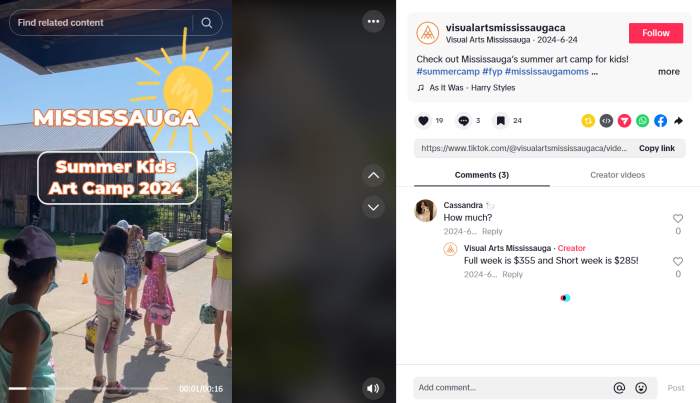
Example:Here is a simple way to garner interest in your summer camp program. Visual Arts Mississauga posts a video of the activities they provide, including studio and outdoor creative activities, a variety of themes (a new one each week), and special guests. Try filming a few brief snippets of your daily camp activities and list some of your campers’ favorite things about the experience. With minimal editing and some upbeat music, you can certainly catch the attention of a parent searching for a positive camp experience for their child. It worked for Visual Arts Mississauga!
As you can see in the comments, a parent inquired for pricing information. The great thing about social media platforms like TikTok? You can answer questions directly. Don’t forget to obtain permission from parents and campers before posting them.
Source: Visual Arts Mississauga | TikTok
2. Optimize Your Website for Search Engines
If your website isn’t optimized for search engines, you’re missing a significant number of potential campers. Search Engine Optimization (SEO) ensures that your summer camp appears when families search for programs online. By enhancing your site’s structure, improving page speed, and using long-tail keywords like “summer camp programs in (insert your location here),” you can improve visibility.
To further enhance visibility, you should optimize your summer camp program pages by structuring them with clear headings, engaging descriptions, and high-quality images of camp activities. Adding frequently asked questions (FAQs) to the page improves user experience and provides quick answers to common inquiries.
Internal linking to other relevant pages, such as registration forms or blog posts, boosts SEO by keeping visitors engaged. Additionally, integrating schema markup allows search engines to understand the content better, increasing the chances of appearing in featured snippets.
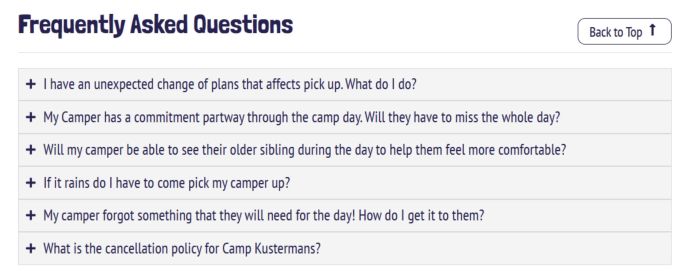
Example: This is what an FAQ section could look like on your camp landing page. Adding structured data to your FAQs increases the likelihood of appearing as a featured snippet on search engines. Be sure to use conversational language to optimize for voice search results. Don’t forget to leverage your FAQs for content planning. This is a great way to add value for site visitors – providing the answers they’re searching for in detail in more detail.
Source: Kustermans
3. Create a Strong Social Media Presence
Beyond posting regularly, an effective social media strategy involves using platform-specific features to maximize engagement. Instagram Stories and Reels allow you to share real-time updates, camper testimonials, and behind-the-scenes glimpses of camp life.
Facebook Groups can build a community of returning campers and interested parents, fostering discussion and sharing updates. TikTok offers a creative space to showcase fun camp activities through short, engaging videos that appeal to younger audiences.
Additionally, paid social media advertising is a great way to extend your reach. By running targeted ad campaigns on platforms like Facebook and Instagram, you can ensure your summer camp marketing efforts reach families actively looking for programs.
Geo-targeting and interest-based targeting allow you to refine your audience, ensuring your ads reach parents who are most likely to enroll their children. Running contests and giveaways on social media can also increase engagement and word-of-mouth promotion as parents and campers share your content with their networks.
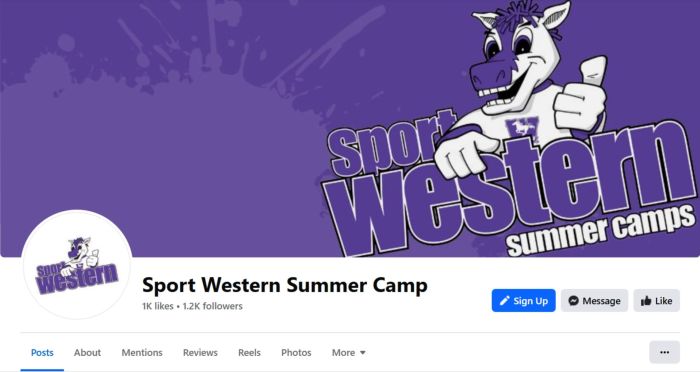
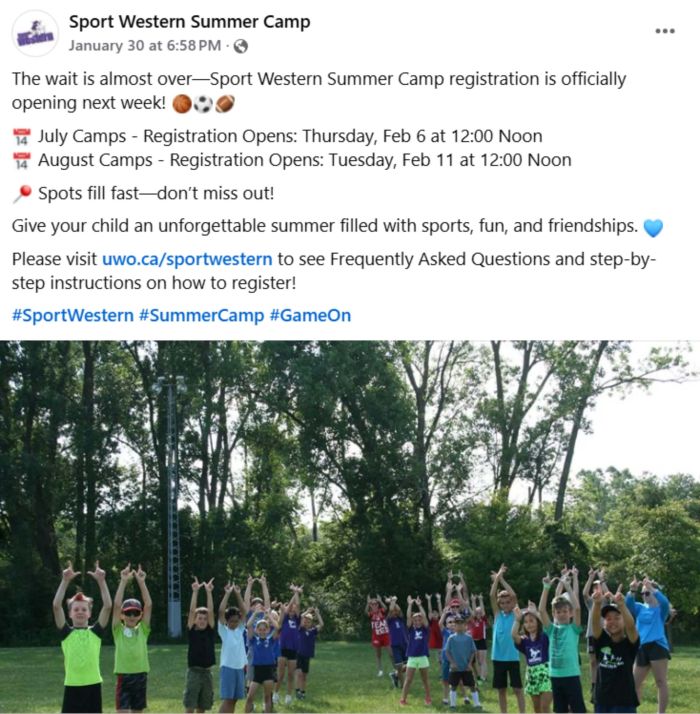
Example:Here, Western University uses its active Facebook page to maintain a strong presence, notify parents of important dates, build anticipation for the summer, and show off all of the fun activities in store. Their page features consistent branding setting them apart from other school summer camps.
Source: Sport Western Summer Camp | Facebook
4. Utilize Email Marketing Campaigns
Email marketing remains a powerful tool for reaching prospective campers and their families. Sending out newsletters with enrolment updates, discounts, and testimonials keeps your audience informed and engaged.
An effective email marketing strategy involves segmentation, where prospective families are grouped based on their engagement levels, preferences, and past interactions. You can ensure that each recipient receives relevant messaging by tailoring content to different segments, such as new inquiries, returning campers, and families who haven’t yet completed registration.
Drip email campaigns are particularly valuable for nurturing leads. These automated sequences gradually provide information about your camp, from program details to testimonials, making it easier for parents to commit. Additionally, incorporating visually appealing emails with compelling subject lines improves open rates and engagement.
5. Targeted Digital Advertising Campaigns
Traditional advertising is still effective, relevant, and part of a well-rounded marketing campaign. “How do I advertise my summer camp?” you ask. To advertise your summer camp using targeted ads, leverage platforms like Google Ads, Facebook, and Instagram to target parents actively searching for summer programs. By utilizing geo-targeting, interest-based segmentation, and retargeting campaigns, you can maximize ad visibility, drive inquiries, and increase enrolment conversions efficiently.
Google Ads enables your summer camp to appear at the top of search results when parents look for camp programs, increasing visibility. Running display ads and retargeting campaigns ensures that those who have previously visited your website are reminded of your offerings, improving conversion rates. Additionally, YouTube Ads allow you to showcase engaging video content of camp activities, testimonials, and program highlights to attract more interest.
Facebook and Instagram Ads offer detailed audience segmentation tools, allowing you to reach parents based on location, interests, and browsing behavior. Carousel, video, and story ads create immersive experiences that engage prospective campers and their families. To further boost engagement, A/B testing different ad creatives and copy variations helps refine messaging to determine what resonates best with your audience.
A/B testing involves creating multiple versions of an advertisement, landing page, or email to determine which version performs best. In digital advertising, A/B testing can compare different ad headlines, images, calls to action, and audience targeting strategies.
Advertisers can analyze performance metrics such as click-through rates (CTR), conversion rates, and engagement levels by running multiple variations simultaneously. The winning version can then be scaled for maximum impact, ensuring your budget is allocated to the most effective ad variations.
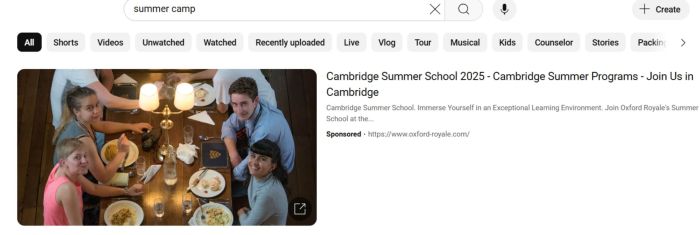
Example: When you invest in YouTube ads like the one pictured below, you can show up at the top of the platform’s summer camp search results and greatly expand your reach.
Source: YouTube
6. Encourage Camper and Parent Testimonials
Word-of-mouth remains a powerful marketing tool. Encouraging past campers and their parents to leave reviews on Google, Facebook, and your website adds credibility to your program. Video testimonials are particularly effective at providing an authentic look into the camp experience. Families researching camps trust peer reviews, and showcasing positive experiences helps establish trust and attract new registrations.
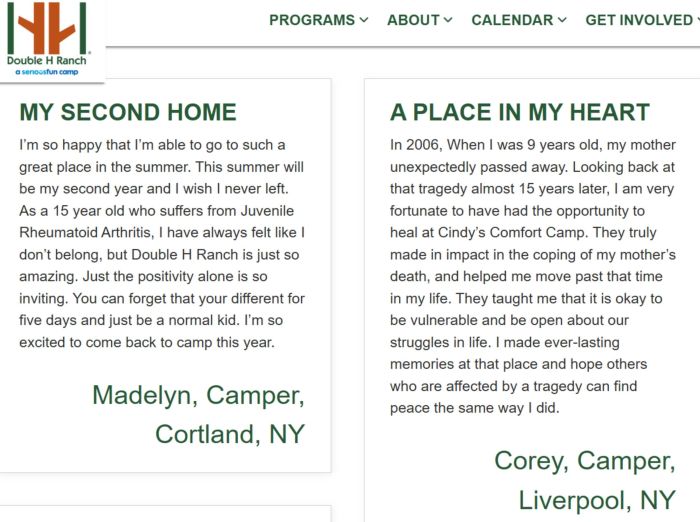
Example:Encourage happy campers to leave high-value testimonials highlighting how your program has positivly impacted their lives. The two pictured below are excellent examples of moving word-of-mouth endorsements that improve your program’s public reception and potentially incite desired action.
Source: Double H Ranch
7. Develop an Ambassador Program
Leveraging past campers as ambassadors can create a community-driven summer camp marketing effect that builds long-term brand loyalty. Encouraging past attendees to share their experiences and recommend your camp to friends and family fosters authentic promotion.
One of the most effective approaches is a structured referral program, where returning campers receive discounts or perks when they bring a friend. Offering rewards such as camp merchandise, VIP experiences, or exclusive access to special activities can further incentivize participation.
When working with minors as ambassadors, schools should obtain parental consent, follow child privacy regulations such as COPPA, and ensure that all promotional activities align with ethical guidelines to protect student identity and well-being.
Beyond peer referrals, partnering with local influencers, parenting bloggers, and community leaders can significantly amplify your reach. Inviting these ambassadors to visit your camp, create content, and share their experiences with their followers can increase visibility among parents searching for reputable programs. Providing them with branded hashtags, social media templates, and storytelling prompts ensures consistent and compelling messaging.
To sustain engagement, camps should maintain an ongoing relationship with ambassadors by featuring them in newsletters, social media posts, and alumni spotlights. Creating private groups or online communities for ambassadors fosters a sense of belonging and motivates them to continue advocating for your camp. Implementing an easy-to-use referral tracking system helps measure success and refine strategies for maximum impact.
8. Highlight Your Camp’s Unique Selling Points (USPS)
In a competitive summer camp market, it is crucial to clearly define and communicate your camp’s unique selling points (USPs) to stand out from the rest. Parents and campers have many choices, so highlighting what makes your camp different will help you attract the right audience and increase enrolment.
A USP is a distinct feature or quality that sets your camp apart. To effectively market your camp, you must identify and promote these features across your website, social media, and advertising campaigns. Below are some strong examples of USPs that summer camps can highlight:
Specialized Programs
Small Camper-to-Counselor Ratio
Exclusive Locations
Highly Qualified Staff
Customizable Camp Experiences
Unique Themes or Storylines
Exclusive Partnerships
All-Inclusive Pricing and Amenities
Once you’ve identified your USPs, ensure they are featured prominently on your website homepage, camp brochures, social media posts, and digital advertising. Use testimonials from past campers and parents to reinforce the uniqueness of your offerings.
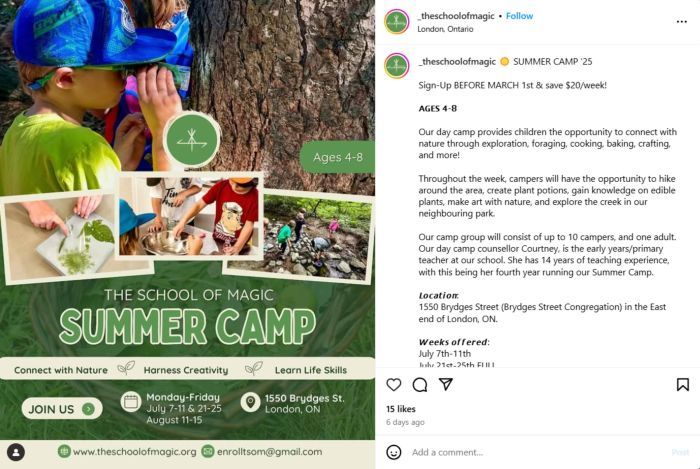
Example: The School of Magic is unique because of its emphasis on connecting with nature and developing real-world skills. Those unique selling points are evident in the Instagram post below. What sets your summer camp program apart?
Source: The School of Magic
9. Partner With Schools and Community Organizations
Collaborating with schools and local community centers broadens your marketing reach. Schools can distribute flyers and email newsletters promoting your camp, while community organizations can help you reach families looking for summer activities. Building partnerships with educational institutions ensures that your camp gains credibility and visibility in trusted spaces where families make enrolment decisions. Create a buzz around any partnerships in your content across various platforms.
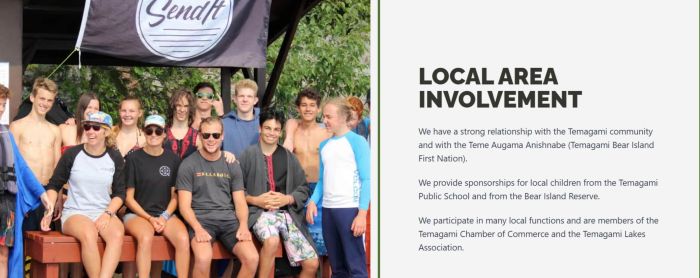
Example: On its website, the Canadian Adventure Camp has a tab called Memberships and Partnerships. There, they list and explain their collaborations and community involvement, showcasing how they add value for campers, families, and those in need. If you’re collaborating with any organization or if you’re involved in charity work, be sure to highlight how you make a difference!
Source: Canadian Adventure Camp
10. Optimize Your Camp’s Mobile Experience
With more parents researching and booking camps on their smartphones, having a mobile-optimized digital presence is essential. A slow or non-responsive website can drive potential campers away, leading to lost enrolment opportunities. To ensure a seamless mobile experience, camps should prioritize mobile usability in all aspects of their digital marketing strategy.
Responsive web design is the foundation of a successful mobile experience. Your website should automatically adjust to different screen sizes, ensuring readers can easily browse your camp’s programs, pricing, and enrolment details on any device. Without this adaptability, parents may abandon their search in favor of a competitor with a more mobile-friendly platform.
Fast load times are another critical factor. If a webpage takes too long to load, parents may become frustrated and leave before completing the registration process. Optimizing images, minimizing unnecessary code, and leveraging browser caching can significantly improve site speed. Google prioritizes fast-loading websites in search results, meaning that a well-optimized mobile site can enhance your summer camp advertisement efforts by increasing visibility in search rankings.
Once a parent arrives on your site, easy navigation and registration are essential. Mobile users should be able to access key pages; such as program descriptions, schedules, and pricing, within a few taps. Registration forms should be concise, requiring only necessary information, and offer autofill features to streamline the process.
Providing click-to-call and chat features offers immediate communication options for parents with questions. A simple button allowing users to call directly from their mobile device or engage in a live chat session with a representative can make a huge difference in converting inquiries into sign-ups. Chatbots can also be used for quick responses outside of business hours, ensuring prospective campers receive the information they need when they need it.
Finally, mobile-friendly payment options make transactions seamless. Integrating secure, one-click payment solutions like Apple Pay, Google Pay, or PayPal can speed up registration and reduce drop-offs. Parents should be able to complete payment without switching devices or navigating through a complex checkout system.
Boost Your Camp Enrolment Today!
Marketing a summer camp successfully requires a well-rounded, strategic approach that meets parents and campers where they are—online! By leveraging SEO, content marketing, social media, email campaigns, paid advertising, and mobile optimization, you can increase visibility, boost engagement, and ultimately drive more enrolments. Highlighting your camp’s unique selling points, developing a strong ambassador program, and ensuring a seamless mobile experience will set your camp apart in a competitive market.
With the right mix of digital marketing techniques, your summer camp can attract the right audience and maximize registrations year after year. Whether refining your summer camp advertisement strategy, improving your website, or launching targeted ad campaigns, a data-driven approach ensures long-term success.
At Higher Education Marketing, we specialize in helping camps and educational institutions implement proven digital marketing strategies that deliver results. If you’re ready to take your summer camp marketing to the next level, reach out to us today to learn how we can help you achieve your enrolment goals.
Struggling with enrollment?
Our expert digital marketing services can help you attract and enroll more students!
Navigating budget cuts — especially when it comes to personnel decisions — is one of the most difficult challenges HR professionals can face, both professionally and emotionally.
As payroll is often an institution’s biggest budget line item, it’s often one of the first places to be impacted by cuts. Whether HR is considering instituting hiring freezes or moving toward a reduction in force (RIF), the path forward requires strategic thinking and compassionate implementation.
Cultivate collaboration between HR and finance. A reduction in force requires a strong partnership between HR and finance. This partnership was brought to life by webinar presenters Shawna Kuether, the associate vice chancellor of human resources at the University of Wisconsin Oshkosh, and Bethany Rusch, now the vice president of finance and administration at Moraine Park Technical College (previously of UWO). For actions like personnel reductions and severance packages, finance focused on cost control and supplying relevant metrics, while HR addressed risk mitigation by identifying legal and compliance implications.
Their advice to HR: If you don’t already have a strong partnership with finance, begin building one now. A working relationship built on mutual respect is not only beneficial when difficult budgetary constraints arise, but also vital to the overall health of your institution.
Meet a tight timeline if necessary. UWO was looking to improve its financial position within one year. That meant HR and finance had three months from the project approval stage to notifying employees.
Here are the five broad strategies they implemented in that timeframe:
Offering voluntary retirement incentive options.
Freezing all personnel actions, including searches already underway.
Pledging to no new financial commitments.
Enacting graduated, intermittent furloughs for all non-academic employees, which provided the funds for the voluntary retirement incentives.
Implementing a reduction in force to reduce salary costs.
Consider a workforce-planning workshop. In the webinar, Kuether and Rusch detail their five-day planning workshop, which was driven by their why (a set of five guiding principles); their who (such as subject matter experts who understood which critical skill sets were needed to ensure continuity of operations); and their what (such as key metrics to determine what staff-to-student ratios to use).
Communicate early and often what criteria you employ — and document them. During an RIF, clear and transparent communication and documentation are fundamental to success. Criteria for layoffs followed the documented university policy, which is publicly available online, and these criteria were communicated clearly during the course of the RIF process, thereby minimizing liability, employee appeals, and potential litigation.
Provide employee transitional planning and resources. HR’s work is far from over once RIF decisions are announced. At UWO, transition support to affected employees and their supervisors included:
Offering EAP resources, including onsite walk-in sessions with counselors.
Providing toolkits to managers handling difficult conversations.
Offering rapid-response sessions in collaboration with the Department of Workforce Development to provide training on filing unemployment and finding job opportunities in the state.
Contracting with an external vendor to provide outplacement services, including training and interviewing skills.
Hosting a job fair specifically for dislocated workers.
Maintain the results after the RIF has concluded. Following through with a RIF is emotionally and operationally challenging — you want to ensure the results last. The webinar covered tips on maintaining proper guardrails to protect the results.
Acknowledge the emotional toll. “This is heavy and oftentimes heartbreaking work,” Kuether and Rusch stressed. “But for us, and maybe for you, the financial realities of our university could not be ignored. You have to find your motivation in knowing you are making your college financially viable and able to focus on accomplishing its educational mission.”
They say the two most important traits that higher ed leaders need during budget cuts are resilience and adaptability. Resilience allowed the HR and finance teams to stay focused in moments of stress, while adaptability helped them remove barriers as they came up and stay the course.
Layoff/RIF/Furlough Toolkit — A highlight of this HR toolkit is “You Can Get There From Here: The Road to Downsizing in Higher Education,” a comprehensive guide to all aspects of budget reductions.
Change Management Toolkit — This HR toolkit includes resources ranging from change-management basics to best practices from higher ed institutions.
The Trump administration is pausing $175 million in federal funding to the University of Pennsylvania, apparently because the college allowed a transgender woman to compete in women’s sports three years ago.
The funding pause, announced Wednesday via a White House social media post, is not related to any investigation. Instead, the Departments of Defense and Health and Human Services stopped the $175 million as part of an “immediate proactive action to review discretionary funding streams,” a senior White House official said in a statement. The legality of the move isn’t clear, and officials didn’t specify what the paused funding was intended to be used for.
The official did note that the university “infamously permitted a male to compete on its women’s swimming team.”
The University of Pennsylvania became a target for Republicans and conservatives after swimmer Lia Thomas, who initially competed on the men’s swimming team, transitioned and then swam for the women’s team during the 2021–22 season—in compliance with the NCAA policies at the time. Thomas went on to win the NCAA championship in the 500-yard freestyle, although her time was not an NCAA record.
President Donald Trump campaigned in part on getting “men out of women’s sports,” and signed an executive order in early February specifically banning transgender women from competing in women’s sports. The order is part of a broader rollback of trans rights, and Trump has gone so far as to deny the existence of trans and gender-nonconforming people, declaring that there are only two sexes, male and female.
Shortly after the order was signed, the Education Department’s Office for Civil Rights opened a Title IX investigation into transgender athletes participating in college sports at the University of Pennsylvania. The Education Department also urged the NCAA to rescind all “records, titles, awards, and recognitions” given to trans women and girls. Since Trump’s order, the NCAA and Penn have acceded and revised policies to prevent trans women from competing in women’s sports.
A senior Trump administration official told Fox Business that the pause was a “proactive punishment” and that the university is at risk of losing all federal funding as part of the ongoing Title IX investigation.
“This is just a taste of what could be coming down the pipe for Penn,” the official told Fox Business, which first reported on the pause.
A University of Pennsylvania spokesperson said Wednesday afternoon that the institution had yet to receive any official notification or any details about the pause. The spokesperson noted that Penn follows NCAA and Ivy League policies regarding student participation on athletic teams.
“We have been in the past, and remain today, in full compliance with the regulations that apply to not only Penn, but all of our NCAA and Ivy League peer institutions,” the spokesperson said.
Columbia, Penn and other universities are facing great uncertainty when it comes to federal funding as Trump looks to cut spending and crack down on programs that don’t align with his priorities. Penn recently paused hiring and took other steps to curb spending.
Pausing Penn’s funding without any formal investigation and outside the typical processes for such a punishment is just the latest salvo in Trump’s attacks on wealthy universities. Earlier this month, the administration cut $400 million in grants and contracts from Columbia University, accusing the institution of “continued inaction in the face of persistent harassment of Jewish students”—an unprecedented move that alarmed experts and higher education advocates. Trump officials then ratcheted up the pressure by demanding sweeping changes at Columbia as a precondition to formal negotiations. Columbia has until Thursday, March 20, to respond.
Jon Fansmith, senior vice president of government relations at the American Council on Education, said the administration is punishing conduct they disagree with, adding that he found the Penn pause “more troubling” because of the lack of explanation or rationale.
“It’s one thing to say we think there’s a big problem,” he said. “It’s a much bigger deal to say we’re arbitrarily suspending funding without a reason … You should at least have a reason for taking serious action.”
He noted that the current regulations governing Title IX don’t specifically bar transgender students from participating in women’s sports, and that Penn is in compliance with the policies. So he’s not sure what Penn could offer the Trump administration to restore the funding.
Blake Emerson, a professor of law and political science at the University of California, Los Angeles, said the funding pause is illegal since the administration didn’t follow the processes under Title IX to pull funding. That process includes a formal hearing and a report to Congress.
“There is no freestanding executive power to cut off money without legal authority,” he said. “It’s another instance in this pattern of the Trump administration not just aggressively using the law to target political opponents and universities, but flouting the law and not even showing casual regard for the legal process.”
Emerson noted that executive orders aren’t laws, and that if the Trump administration wants to change the existing interpretations of Title IX, it has to go through the rule-making process.
He urged Penn and Columbia to fight the cuts, as he doesn’t think “acquiescence is likely to appease” the Trump administration.
“Universities have a strong case to make that the funds being cut off are really necessary to provide essential public services the universities provide,” he said. “We’re losing scientific research because of these illegal steps, and universities are failing to make the case for their own programs when the actions being taken against them are clearly illegal. To my mind, acquiescence is a major blunder.”
Meanwhile, conservative activists who have railed against trans athletes praised the move.
Riley Gaines, who competed against Thomas, called the timing of the announcement “serendipitous” in a social media post. Three years ago Wednesday, she tied with Thomas for fifth place in the 200-yard freestyle at the 2022 NCAA championships.
Beth Parlato, senior legal adviser for the Independent Women’s Law Center, said in a statement that the message from the funding pause was clear: comply or suffer the consequences.
“President Trump means business and he’s not going to tolerate any school willfully violating the law,” Parlato said. “It is so encouraging to see an administration actually follow through with promises made to the American people, and I’m looking forward to watching each and every school that fails to protect women and girls be held accountable.”