Arizona State University (ASU) chief information officer Lev Gonick and Dave Rosowsky, senior advisor to the president of ASU, both believe universities can thrive in the age of AI by actively shaping how the technology is integrated into higher education.
In this podcast, they share how ASU fosters innovation through bold leadership, a culture of rapid experimentation, and partnerships with over 300 tech companies.
Get a sneak peek into the lessons they’ll be sharing at HEDx’s April conference in Melbourne, which will offer insights into how universities can “do the work to change the model” and embrace the transformative potential of AI.
Universities will be expected to publish de-identified complaints data publicly, make student complaints processes clearer, and analyse the data twice a year if the university regulator’s interim guidelines for student complaints mechanisms are adopted.
Please login below to view content or subscribe now.
This audio is auto-generated. Please let us know if you have feedback.
The Trump administration has all but axed the U.S. Department of Education’sstatistical research arm — the National Center for Education Statistics — sparing only a handful of employees who are left without department staff needed to analyze education data.
“They didn’t just RIF a few people, they deleted the agency for all intents and purposes,” said an NCES employee of more than a decade who was part of the massive March 11 layoffs.
The loss of over a hundred Institute of Education Sciences employees — including almost all of the NCES staff — comes as part of sweeping cuts to the Education Department that left the federal agency with only half of its workforce. NCES, which traces its existence to an 1867 law establishing a federal statistical agency to collect, analyze and report education data, has been tasked with research and analysis on everything from graduation rates and student outcomes to teacher and principal development.
Overall, NCES research tracked the condition of education in the nation, including gaps in achievement and resources for underserved students. During the pandemic, the unit closely analyzed trends in school resources and educator and student mental health.
Perhaps most notably, NCES oversaw and ensured the quality of the Nation’s Report Card, along with other key student outcome studies. School and college leaders rely on such NCES research to improve student performance, and its findings often help inform federal and state policymakers on funding decisions.
Now, those caught in the latest wave of the administration’s cuts are warning that their haphazard nature will lead to a decline in the quality of assessments and data overseen by NCES. Longtime NCES employees report being fired at a moment’s notice and abruptly losing access to years — sometimes decades — of work, with no communication from the administration about how to offboard so as to preserve and pass on critical information.
“A lot of institutional knowledge is going to be lost,” said another former NCES employee who worked closely on the Nation’s Report Card. This employee and the others who spoke to K-12 Dive asked to remain anonymous for fear that identification could affect their severance terms.
NAEP and international assessment employees impacted
Although NCES employees are nearly all gone, many of NCES’ functions they previously carried out are congressionally mandated, meaning they will still need to be done. That includes portions of the National Assessment of Educational Progress, commonly known as the Nation’s Report Card.
The required parts include: reading and math assessments in 4th and 8th grade, long-term trend assessments for 9, 13 and 17-years-olds, and 12th grade reading and math assessments. The long-term assessment for 17-year-oldswas last administered in 2012, having been canceled during the pandemic, and again for this spring due to what the Education Department cited as funding issues.
Other portions of the federal test such as science, U.S. history and civics are optional.
The federally mandated assessment has often served as a yardstick for student performance in various subjects, most notably reading and math. Following the pandemic, it helped educators understand which subject areas students struggled in the most during and following school closures.
“Despite spending hundreds of millions in taxpayer funds annually, IES has failed to effectively fulfill its mandate to identify best practices and new approaches that improve educational outcomes and close achievement gaps for students.”
Madi Biedermann
U.S. Department of Education’s Deputy Assistant Secretary for Communications
Congress also mandates that student performance be compared on an international level, a requirement usually fulfilled by the Program for International Student Assessment, or PISA.
The latest round of PISA testing was expected to begin by the end of March. Plus, the main NAEP for grades 4, 8 and 12 was supposed to begin early next year — preparation for which was set to begin this summer, according to former NCES employees.
The Education Department, in a March 13 statement emailed to sister publication Higher Ed Dive, said, “IES employees impacted by the reduction in force conducted none of the research related to NAEP, the College Scorecard, and IPEDS.”
“That work is all done through contracts that are still maintained by the Department,” said Madi Biedermann, deputy assistant secretary for communications at the department, in the statement.
Some NCES contracts that were terminated as part of the $900 million in federal contract cuts have been revived, those laid off said. Just prior to being let go, employees were in the throes of reestablishing contractual relationships and systems required to carry out some congressionally mandated assessments.
The laid-off employees refuted the department’s assertion that those who were fired “conducted none of the research related to NAEP.” Instead, they say, the employees were tasked with ensuring the quality of both the research collection and the post-collection analysis.
Meaning: Some of the contracts for required assessments were canceled, then revived, and then in the process of being reestablished by NCES employees — who were then fired and blocked from accessing the technology systems they say they needed to pass on their knowledge and thereby maintain assessment quality.
One of the former employees K-12 Dive spoke with described the situation as “chaotic” and said the handful of remaining employees are “overwhelmed.”
“It can’t function in the current state it’s in,” said the employee who had worked on NAEP. “The Nation’s Report Card is not going to be the gold star that it has been.”
Department restructuring on the horizon
The administration takes a different view.
“Despite spending hundreds of millions in taxpayer funds annually, IES has failed to effectively fulfill its mandate to identify best practices and new approaches that improve educational outcomes and close achievement gaps for students,” said Biedermann in the emailed statement.
Biedermann said the administration plans to restructure IES in the coming months “with input from existing leadership and expert stakeholders so that the Institute provides states with more useful data to improve student outcomes while maintaining rigorous scientific integrity and cost effectiveness.”
One of NCES’ longtime leaders,Peggy Carr, was appointed commissioner for NCES by the Biden administration in 2021 after serving as associate commissioner for assessment for over two decades. As such Carr has been the leading voice on the Nation’s Report Card in recent years.
Carr was put on administrative leave in February, in the lead-up to the Trump administration’s staffing cuts. Her position remains within the department, according to an organizational chart provided by the department to AFGE Local 252, a union representing a majority of the workers laid off, on March 11 just prior to the layoffs. The chart shows both remaining positions and shuttered departments.
The Education Department and its human resources office did not respond to multiple requests from K-12 Dive on the status of Carr’s employment.
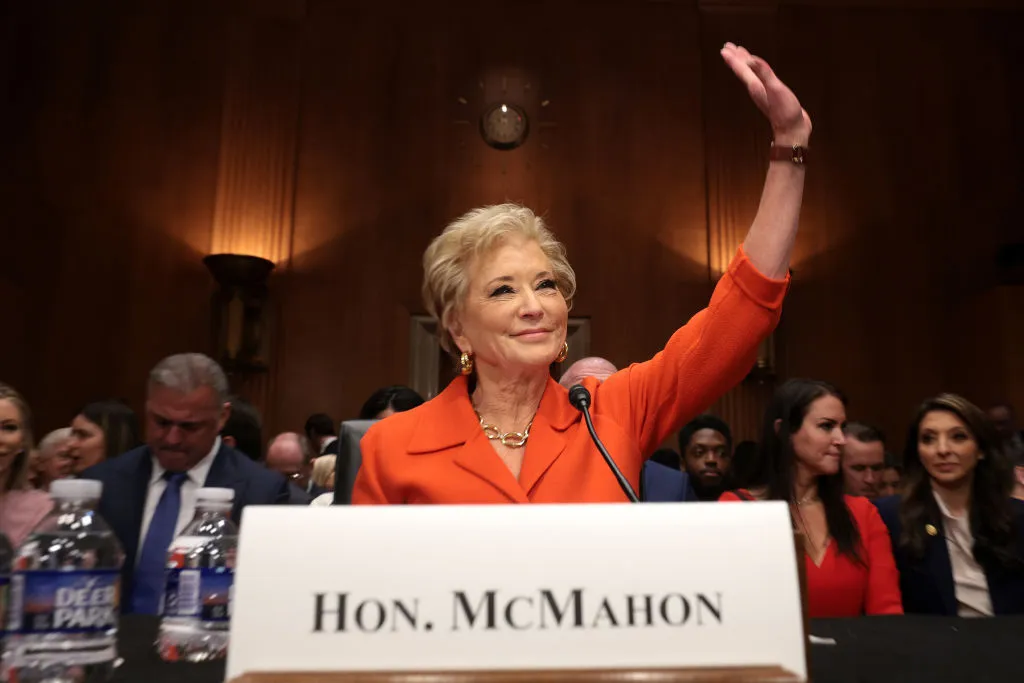
The department under Education Secretary Linda McMahon, who was confirmed by the Senate on March 3, has undergone massive employee and contract cuts, including sending the National Center for Education Statistics to near extinction.
Win McNamee via Getty Images
Prior to the cuts that laid off nearly her entire department, Carr was spearheading the modernization of NAEP, including the remote proctoring and administration catapulted forward by the pandemic. The department had already field-tested online administration in the past few years and was on track to remotely administer the assessment by 2026.
Such a transition requires research like bridge studies — which allow older assessment results to be compared to newer versions of the test — and analyses overseen by the kind of NCES employees who are now laid off, NCES assessment experts have said.
“From what I know, they’ve cut that out because the new administration wants to do the bare minimum,” said the NCES employee familiar with NAEP. “I think they want to do everything barebones.”
‘Everybody relies on NAEP data’
The department said in a March 14 letter to education stakeholders that, “These reductions are strategic cuts to offices and programs that will not directly impact students and families but rather empower states and localities.”
However, educators and researchers disagree with the department’s take and are shocked by the loss of half of the Education Department staff and nearly all of NCES.
The National Council on Teacher Quality — which includes district and state policymakers along with former teachers — warned that states are “likely to weaken or abandon commitments to maintaining high standards for student learning and accountability for student outcomes” as a result of the federal layoffs.
“Without NAEP, we will not know to what extent children in Massachusetts are reaching the same standards of performance as children in Mississippi,” the council said in a March 11 statement following the reduction in force.
The council is also worried about the loss of NCES research on the teacher workforce, which states rely on to identify the extent of their supply and demand.
“It’s our own quiet act of patriotism to put out objective data.”
In an open letter to Secretary of Education Linda McMahon prior to the March 11 firings, William Bennett, education secretary under President Ronald Reagan, and Chester Finn, who served at the department under Reagan as an assistant secretary, highlighted NAEP’s importance.
The assessment is still “the single most important activity” of the department and serves as the “primary gauge by which we know how American education is doing, both nationally and in the states to which you rightly seek to restore its control,” wrote Bennett and Finn, both of whom are conservatives who served under a Republican president who also wanted to shut down the Education Department.
Still, they decried any move to do away with NCES’ flagship product: the Nation’s Report Card.
“You alluded to NAEP data during your confirmation hearing,” they told McMahon, and Trump “deploys it when referencing the shortcomings of U.S. schools.”
“Everybody relies on NAEP data, and its governing board’s standards have become the criteria by which states gauge whether their own standards are rigorous enough,” Bennett and Finn said.
That’s partly what’s taken many — including NCES employees themselves — by surprise: The statistical center and its data have long been considered a nonpartisan source of critical information by which administrations could measure whether their policies were effective.
“No matter what side you’re on, it’s absolutely essential,” a laid-off employee said. “It’s our own quiet act of patriotism to put out objective data.”
This audio is auto-generated. Please let us know if you have feedback.
Dive Brief:
St. Norbert College’s trustee board recently approved discontinuing 20 academic programs, according to a message last week from college President Laurie Joyner.
Additionally, the Wisconsin college expects to terminate 21 faculty positions by May. It will eliminate another six faculty positions in 2026.
The cuts come as the private Catholic institution looks to shed $7 million in costs to balance its budget for fiscal 2026. “These decisions, though difficult, set us on a path to emerge stronger from this transitional period,” Joyner said Thursday.
Dive Insight:
Not long after Joyner joined St. Norbert in July 2023 — having previously led St. Xavier University in Chicago — she found “a significant miscalculation” in the upcoming budget for the fiscal 2024 year, according to the college.
After two consecutive years of running deficits, the 2024 budget’s gap was even larger than expected. The college subsequently moved to cut $12 million from the budget — including through multiple rounds of layoffs.But it still faces a $7 million deficit in fiscal 2026 and anticipated further gaps in the years ahead.
The deficits follow shrinking enrollments and rising costs. In 2022, according to the college, it had the highest faculty numbers in a decade but hundreds fewer students. Headcount during those 10 years fell by 405 students, with 1,882 students attending in fall 2022, per federal data.
The shrinking student body is a major source of financial strain on St. Norbert. The college received 50% of its core revenue from tuition and fees in the 2023 fiscal year, according to latest federal data.
Between fiscal 2021 and 2024, revenue from tuition and fees fell 13.1% to $35.8 million at St. Norbert, according to its financial statements.
The college says it is restructuring from “a position of relative strength as it adjusts its staffing to mirror its student population,” and the cuts are “creating an even stronger foundation as we prepare to weather the headwinds facing higher education.”
The slate of programs approved for discontinuation include both majors and minors running the gamut from studio art and theology to physics and applied mathematics. Students enrolled in majors and minors set for discontinuation will be able to complete them, Joyner said. And some coursework in discontinued programs will continue to be taught.
The Collaborative for Academic, Social, and Emotional Learning (CASEL) recently announced that it has become the new steward of Engaging Schools’ extensive body of educational resources. With Engaging Schools set to close in early 2025 after more than four decades of impact, CASEL will ensure the organization’s valuable tools, books, and frameworks remain available to educators worldwide.
As part of this transition, CASEL is making these resources freely accessible to the public. Over time, CASEL will integrate elements of Engaging Schools’ work into several areas including the free Guide for Schoolwide SEL to further advance high-quality, evidence-based SEL implementation in schools and districts.
“For more than 40 years, Engaging Schools has helped educators create safe and supportive learning environments where students thrive,” said Aaliyah A. Samuel, president and CEO of CASEL. “We are honored to carry forward their legacy by making these resources widely available and embedding them into our work to create school communities that prioritize academic, social, and emotional development.”
Engaging Schools has long been recognized for its contributions to fostering inclusive school climates, strengthening restorative and equitable discipline, and advancing engaging teaching practices.
“We take immense pride in the lasting impact of Engaging Schools’ work,” said Larry Dieringer, Executive Director of Engaging Schools. “Though our organization’s chapter is closing, we are deeply grateful to CASEL for ensuring our resources continue to benefit educators and students for years to come.”
For more than 30 years, CASEL has been a trusted leader in advancing SEL through research, practice, and policy. By integrating Engaging Schools’ resources into its offerings, CASEL reaffirms its commitment to supporting educators with the tools they need to create engaging, inclusive, and academically rich learning environments.
Kevin is a forward-thinking media executive with more than 25 years of experience building brands and audiences online, in print, and face to face. He is an acclaimed writer, editor, and commentator covering the intersection of society and technology, especially education technology. You can reach Kevin at [email protected]
This audio is auto-generated. Please let us know if you have feedback.
The Trump administration has all but axed the U.S. Department of Education’sstatistical research arm — the National Center for Education Statistics — sparing only a handful of employees who are left without department staff needed to analyze education data.
“They didn’t just RIF a few people, they deleted the agency for all intents and purposes,” said an NCES employee of more than a decade who was part of the massive March 11 layoffs.
The loss of over a hundred Institute of Education Sciences employees — including almost all of the NCES staff — comes as part of sweeping cuts to the Education Department that left the federal agency with only half of its workforce. NCES, which traces its existence to an 1867 law establishing a federal statistical agency to collect, analyze and report education data, has been tasked with research and analysis on everything from graduation rates and student outcomes to teacher and principal development.
Overall, NCES research tracked the condition of education in the nation, including gaps in achievement and resources for underserved students. During the pandemic, the unit closely analyzed trends in school resources and educator and student mental health.
Perhaps most notably, NCES oversaw and ensured the quality of the Nation’s Report Card, along with other key student outcome studies. School and college leaders rely on such NCES research to improve student performance, and its findings often help inform federal and state policymakers on funding decisions.
Now, those caught in the latest wave of the administration’s cuts are warning that their haphazard nature will lead to a decline in the quality of assessments and data overseen by NCES. Longtime NCES employees report being fired at a moment’s notice and abruptly losing access to years — sometimes decades — of work, with no communication from the administration about how to offboard so as to preserve and pass on critical information.
“A lot of institutional knowledge is going to be lost,” said another former NCES employee who worked closely on the Nation’s Report Card. This employee and the others who spoke to K-12 Dive asked to remain anonymous for fear that identification could affect their severance terms.
NAEP and international assessment employees impacted
Although NCES employees are nearly all gone, many of NCES’ functions they previously carried out are congressionally mandated, meaning they will still need to be done. That includes portions of the National Assessment of Educational Progress, commonly known as the Nation’s Report Card.
The required parts include: reading and math assessments in 4th and 8th grade, long-term trend assessments for 9, 13 and 17-years-olds, and 12th grade reading and math assessments. The long-term assessment for 17-year-oldswas last administered in 2012, having been canceled during the pandemic, and again for this spring due to what the Education Department cited as funding issues.
Other portions of the federal test such as science, U.S. history and civics are optional.
The federally mandated assessment has often served as a yardstick for student performance in various subjects, most notably reading and math. Following the pandemic, it helped educators understand which subject areas students struggled in the most during and following school closures.
“Despite spending hundreds of millions in taxpayer funds annually, IES has failed to effectively fulfill its mandate to identify best practices and new approaches that improve educational outcomes and close achievement gaps for students.”
Madi Biedermann
U.S. Department of Education’s Deputy Assistant Secretary for Communications
Congress also mandates that student performance be compared on an international level, a requirement usually fulfilled by the Program for International Student Assessment, or PISA.
The latest round of PISA testing was expected to begin by the end of March. Plus, the main NAEP for grades 4, 8 and 12 was supposed to begin early next year — preparation for which was set to begin this summer, according to former NCES employees.
The Education Department, in a March 13 statement emailed to sister publication Higher Ed Dive, said, “IES employees impacted by the reduction in force conducted none of the research related to NAEP, the College Scorecard, and IPEDS.”
“That work is all done through contracts that are still maintained by the Department,” said Madi Biedermann, deputy assistant secretary for communications at the department, in the statement.
Some NCES contracts that were terminated as part of the $900 million in federal contract cuts have been revived, those laid off said. Just prior to being let go, employees were in the throes of reestablishing contractual relationships and systems required to carry out some congressionally mandated assessments.
The laid-off employees refuted the department’s assertion that those who were fired “conducted none of the research related to NAEP.” Instead, they say, the employees were tasked with ensuring the quality of both the research collection and the post-collection analysis.
Meaning: Some of the contracts for required assessments were canceled, then revived, and then in the process of being reestablished by NCES employees — who were then fired and blocked from accessing the technology systems they say they needed to pass on their knowledge and thereby maintain assessment quality.
One of the former employees K-12 Dive spoke with described the situation as “chaotic” and said the handful of remaining employees are “overwhelmed.”
“It can’t function in the current state it’s in,” said the employee who had worked on NAEP. “The Nation’s Report Card is not going to be the gold star that it has been.”
Department restructuring on the horizon
The administration takes a different view.
“Despite spending hundreds of millions in taxpayer funds annually, IES has failed to effectively fulfill its mandate to identify best practices and new approaches that improve educational outcomes and close achievement gaps for students,” said Biedermann in the emailed statement.
Biedermann said the administration plans to restructure IES in the coming months “with input from existing leadership and expert stakeholders so that the Institute provides states with more useful data to improve student outcomes while maintaining rigorous scientific integrity and cost effectiveness.”
One of NCES’ longtime leaders,Peggy Carr, was appointed commissioner for NCES by the Biden administration in 2021 after serving as associate commissioner for assessment for over two decades. As such Carr has been the leading voice on the Nation’s Report Card in recent years.
Carr was put on administrative leave in February, in the lead-up to the Trump administration’s staffing cuts. Her position remains within the department, according to an organizational chart provided by the department to AFGE Local 252, a union representing a majority of the workers laid off, on March 11 just prior to the layoffs. The chart shows both remaining positions and shuttered departments.
The Education Department and its human resources office did not respond to multiple requests from K-12 Dive on the status of Carr’s employment.
The department under Education Secretary Linda McMahon, who was confirmed by the Senate on March 3, has undergone massive employee and contract cuts, including sending the National Center for Education Statistics to near extinction.
Win McNamee via Getty Images
Prior to the cuts that laid off nearly her entire department, Carr was spearheading the modernization of NAEP, including the remote proctoring and administration catapulted forward by the pandemic. The department had already field-tested online administration in the past few years and was on track to remotely administer the assessment by 2026.
Such a transition requires research like bridge studies — which allow older assessment results to be compared to newer versions of the test — and analyses overseen by the kind of NCES employees who are now laid off, NCES assessment experts have said.
“From what I know, they’ve cut that out because the new administration wants to do the bare minimum,” said the NCES employee familiar with NAEP. “I think they want to do everything barebones.”
‘Everybody relies on NAEP data’
The department said in a March 14 letter to education stakeholders that, “These reductions are strategic cuts to offices and programs that will not directly impact students and families but rather empower states and localities.”
However, educators and researchers disagree with the department’s take and are shocked by the loss of half of the Education Department staff and nearly all of NCES.
The National Council on Teacher Quality — which includes district and state policymakers along with former teachers — warned that states are “likely to weaken or abandon commitments to maintaining high standards for student learning and accountability for student outcomes” as a result of the federal layoffs.
“Without NAEP, we will not know to what extent children in Massachusetts are reaching the same standards of performance as children in Mississippi,” the council said in a March 11 statement following the reduction in force.
The council is also worried about the loss of NCES research on the teacher workforce, which states rely on to identify the extent of their supply and demand.
“It’s our own quiet act of patriotism to put out objective data.”
In an open letter to Secretary of Education Linda McMahon prior to the March 11 firings, William Bennett, education secretary under President Ronald Reagan, and Chester Finn, who served at the department under Reagan as an assistant secretary, highlighted NAEP’s importance.
The assessment is still “the single most important activity” of the department and serves as the “primary gauge by which we know how American education is doing, both nationally and in the states to which you rightly seek to restore its control,” wrote Bennett and Finn, both of whom are conservatives who served under a Republican president who also wanted to shut down the Education Department.
Still, they decried any move to do away with NCES’ flagship product: the Nation’s Report Card.
“You alluded to NAEP data during your confirmation hearing,” they told McMahon, and Trump “deploys it when referencing the shortcomings of U.S. schools.”
“Everybody relies on NAEP data, and its governing board’s standards have become the criteria by which states gauge whether their own standards are rigorous enough,” Bennett and Finn said.
That’s partly what’s taken many — including NCES employees themselves — by surprise: The statistical center and its data have long been considered a nonpartisan source of critical information by which administrations could measure whether their policies were effective.
“No matter what side you’re on, it’s absolutely essential,” a laid-off employee said. “It’s our own quiet act of patriotism to put out objective data.”
Effective March 14, the Institute of International Education (IIE) announced that it had been forced to furlough the majority of EducationUSA staff and employees of other ECA-funded programs, as it struggles to maintain operations under the Trump administration.
“Over the past several weeks, IIE has been impacted by a myriad of external changes, requiring us to quickly adapt and to respond to the evolving needs of multiple stakeholders.
“Numerous factors, including Executive Orders, program suspensions, and changes in the payments and processes of the US Department of State have impacted our operations,” IIE’s EducationUSA team wrote in a staff update.
The US State Department’s flagship study abroad network added that it had taken the “difficult but necessary” step of dismissing all but two domestic staff members to maintain operations. Regional managers outside the US will also have limited scope, said EducationUSA.
The organisation emphasised that the program had not been cancelled or cut, but that funding remained frozen, limiting the institute’s ability to retain full staffing levels.
It is unclear how many employees have been affected in total, let alone when or even whether their jobs will resume.
Further programs implicated in the furloughs include the Fulbright, Humphrey and Gilman scholarships, which rely on funding from the State Department’s Bureau of Educational and Cultural Affairs (ECA) that was frozen by the State Department on February 12 and has not yet resumed.
Intended as a temporary 15-day pause on federal funding, the Trump administration provided no rationale for the freeze, with stakeholders warning the measure threatened the survival of US study abroad.
For decades, EducationUSA has been a cornerstone of global engagement
Fanta Aw, NAFSA
In a public statement, IIE said it regretted the workforce reduction but that it remained “hopeful that this is temporary and that we will be able to resume full staffing levels soon”.
“Our priority is to ensure that students and scholars continue to be able to have life-changing international educational opportunities,” it added.
There has been an outpouring of support from colleagues, facing unprecedented challenges under the Trump administration, which recently cut 50% of Education Department staff and proposed a ban on all Chinese study visas, alongside the financial freeze crippling study abroad.
“This is another pivotal moment for international education in the US,” said NAFSA CEO Fanta Aw: “For decades, EducationUSA has been a cornerstone of global engagement, providing students, families, and institutions worldwide with trusted, reliable guidance on US higher education.”
“We must do all we can to preserve and strengthen this critical program,” wrote Aw on LinkedIn.
With a network of over 430 international student advising centres across more than 175 countries and territories, the impact of staff furloughs at EducationUSA will be widespread, with operations largely ceasing across the globe.
Kevin HowellThe University of North Carolina Board of Governors has elected Kevin Howell as North Carolina State University’s 15th chancellor, marking a historic appointment as the first chancellor to have also served as the university’s student body president.
Howell, who will assume the role on May 5, will succeed Chancellor Randy Woodson, who is retiring in June after 15 years of leadership.
UNC System President Peter Hans recommended Howell following a national search that attracted more than 75 candidates.
“Kevin Howell is a born leader with a long record of service to North Carolina, the UNC System and NC State University,” Hans said. “His deep relationships across the state have helped drive investment and growth. I am confident that he will strengthen NC State’s role as a frontier research university, keeping North Carolina competitive in the most important fields of our future.”
Howell currently serves as chief external affairs officer at UNC Health. His previous experience includes various leadership positions at NC State, including vice chancellor for external affairs, partnerships and economic development from 2018 to 2023. He also worked as assistant to the chancellor for external affairs from 2006 to 2016 and has held interim roles in university advancement and alumni affairs.
From 2016 to 2018, Howell served as senior vice president for external affairs at the UNC System Office. His government experience includes working as a legislative liaison to two former governors, along with roles at the NC Bar Association and Jefferson-Pilot Financial Insurance Company. He began his career as a legal clerk at the North Carolina Court of Appeals.
“This university shaped my life in profound and generous ways, and I am honored for the chance to lead my alma mater,” Howell said. “NC State is a brilliant and inspiring place, just like the state we serve. There are exciting days ahead for the Pack, and I’m ready to make a difference.”
A native of Cleveland County, Howell earned his bachelor’s degree in political science from NC State, where he represented students on the university’s Board of Trustees as student body president. He later received his law degree from the University of North Carolina School of Law.
Ed Stack, vice chair of the NC State Board of Trustees and chair of the chancellor search advisory committee, praised the selection. “Among an impressive group of candidates, he stood out as the strongest choice. Kevin truly exemplifies the university’s ‘think and do’ spirit – especially in driving economic development and improving the lives of North Carolinians,” said Stack.
Ed Weisiger, chair of the NC State Board of Trustees and a member of the search committee, highlighted Howell’s relationship-building skills, calling him “a trusted partner to those he leads and those with whom he interacts and works.”
UNC Board of Governors Chair Wendy Murphy said that she is confident that Howell “will steward university resources, build industry relationships and lead the institution to even greater success.”
Atticus Finch is remembered as one of literature’s greatest heroes for his willingness to defend an unpopular client despite great professional and personal cost. I was reminded of Atticus when the Trump administration recently retaliated against attorneys explicitly because they represented clients and causes the president dislikes.
On March 6, President Trump issued an executive order targeting a law firm, Perkins Coie, for activities that are protected by the First Amendment. The order cites the firm for “representing failed Presidential candidate Hillary Clinton” and commissioning opposition research into the Trump campaign. Trump also critiqued Perkins Coie for bringing a lawsuit to challenge election laws Trump supports, “including those requiring voter identification.”
This order came after the president revoked the security clearances of attorneys at another firm for representing a client the president dislikes: former Department of Justice Special Counsel Jack Smith, who had led the government’s investigations into Trump’s role on January 6 and his handling of classified documents.
In yet another order, Trump also singled out attorneys at a third firm, Paul Weiss, for bringing a lawsuit against individuals who protested at the Capitol on January 6, and for hiring an attorney who had investigated Trump while in government service. Trump’s orders against Perkins Coie and Paul Weiss not only barred federal agencies from engaging the firms’ services but also suspended the security clearances of its attorneys and restricted their access to federal buildings. These sanctions cripple the attorneys’ ability to represent clients in disputes with the federal government. The administration points to no evidence that these firms are a genuine security risk, and expressly targets these firms for their client selection and speech.
This is deeply troubling regardless of where one stands on the activities or firms affected. The process of defending constitutional rights relies heavily on the ability of private attorneys to bring lawsuits against the government. This requires lawyers to be free from official government pressure when choosing which clients and causes to represent. If lawyers are put in fear of federal government retaliation for representing clients who challenge the government or stand for unpopular causes, many injustices will never be challenged.
The administration’s actions represent a direct assault on this freedom. Punishing firms for their choice of clients or the nature of their legal work cannot help but intimidate the legal community, discouraging attorneys from taking on cases that may be politically unpopular or present a challenge to those in power.
History is repeating itself with Trump’s latest efforts. What is at stake here is nothing less than the legal profession’s capacity to fulfill its role in a democratic society.
It also sets an ominous precedent for future presidents to exploit. If the Trump administration can target specific firms on this basis, what prevents future administrations from blacklisting firms that represent, say, gun-rights groups? This concern is hardly theoretical: just last year, the Supreme Court had to slap down a New York state official for trying to punish a third party for doing business with the NRA. Could religious organizations be next? Or animal-rights activists? Could the next Democratic president ban from federal buildings any attorneys that represented Republican candidates? What is the limiting principle?
Furthermore, how can a lawyer who is considering representing a politically controversial client know that she will not be targeted the next time control of the White House changes hands? The safest course of action will be to avoid representing clients of any political salience, right or left, even if their cause is just.
Even before Trump’s latest actions on this front, a number of law firms have already shown their willingness to run from controversial causes, such as when Kirkland & Ellis withdrew from its representation of the NRA because the NRA advocates for gun rights. Supreme Court litigator Paul Clement, one of the firm’s most famous attorneys, had to leave the firm entirely simply so he could continue to represent his gun-related clients. Clement could afford to do this precisely because he was so well-known. But if the government can punish an entire law firm over the nature of the work of one of its attorneys, less influential attorneys will face enormous pressure from colleagues to avoid taking controversial cases and clients.
These actions also directly violate the First Amendment. They explicitly target these firms for the clients they have represented and the legal positions they have taken on election law matters. The Supreme Court has recognized the First Amendment right of lawyers “to associate for the purpose of assisting persons who seek legal redress for infringements of their constitutionally guaranteed and other rights.” By officially punishing lawyers on the basis of these associations, the executive order therefore is unconstitutional viewpoint-based retaliation and violates the right of freedom of association. For this reason, a federal judge this week issued a temporary restraining order blocking the order against Perkins Coie.
There is a long, troubling history of trying to silence advocacy through fear and intimidation of the advocates. Attorneys who fought for abolition and civil rights were frequently harassed, or even subjected to threats and violence such as when Thurgood Marshall barely escaped a lynch mob while arguing civil rights cases in the South before Brown v. Board of Education (1954). Many other civil rights attorneys, including those working for the NAACP, were investigated by the FBI, accused of communist sympathies, and faced professional blacklisting. More recently, government officials pressured the firms that represented Guantanamo Bay detainees in the 2000s to drop the cases.
History is repeating itself with Trump’s latest efforts. What is at stake here is nothing less than the legal profession’s capacity to fulfill its role in a democratic society. As the judge in Perkins Coie’s lawsuit warned, the administration’s decision “threatens to significantly undermine our entire legal system and the ability of all people to access justice.”
Public interest organizations like FIRE understand this principle well. Because we are committed to the nonpartisan defense of free speech, we are routinely accused of being “right-wing hacks” or “left-wing radicals,” often during the same week. But defending the rights of the unpopular is not about political allegiance — it’s about ensuring that fundamental freedoms apply to everyone. Civil rights groups must be able to defend speech and causes that challenge those in power, regardless of who holds office.
Atticus Finch understood how crucial vigorous representation is. In his impassioned speech to the jury, he explained, “In this country our courts are great levelers, and in our courts all men are created equal.” If lawyers fear retaliation for simply doing their jobs, then the courts can no longer serve as the “great levelers” as unpopular or politically powerless individuals and causes are unable to get their day in court. We’re all better off when even “bad people” can get a good lawyer — whoever those in power have deemed “bad people” today.