Facing challenges in enrollment, retention, or tech integration? Seeking growth in new markets? Our strategic insights pave a clear path for overcoming obstacles and driving success in higher education.
Unlock the transformative potential within your institution – partner with us to turn today’s roadblocks into tomorrow’s achievements. Let’s chat.
Reskilling, upskilling and lifelong learning are creating a big opportunity for higher education to become the go-to resource for career-minded adults. But not all adult learners are alike. In this report, we break them down into four types of adult learners (Career Advancer, Career Builder, Discerning Academic and Hesitant Learner).
Download the white paper with the following insights for each persona:
Top motivations
Recruitment strategies
Program optimization recommendations
Collegis Education surveyed 1,000 adult learners interested in pursuing degrees for this white paper, Rethink Your Student Population. Discover who makes up the majority of the adult learner market and how to target your outreach to grow your enrollment in this untapped population.
Facing challenges in enrollment, retention, or tech integration? Seeking growth in new markets? Our strategic insights pave a clear path for overcoming obstacles and driving success in higher education.
Unlock the transformative potential within your institution – partner with us to turn today’s roadblocks into tomorrow’s achievements. Let’s chat.
// START Analytics scripts //////////////////////////////////
function readCookie(name) {
name += ‘=’;
for (var ca = document.cookie.split(/;s*/), i = ca.length – 1; i >= 0; i–)
if (!ca[i].indexOf(name)) return ca[i].replace(name, ”);
}
function PrepareCookieForRead() {
var d = new Date();
d.setTime(d.getTime() + 1800000);
var expires = “expires=” + d.toGMTString();
document.cookie = “idSession=1; ” + expires + “; path=/”;
}
Facing challenges in enrollment, retention, or tech integration? Seeking growth in new markets? Our strategic insights pave a clear path for overcoming obstacles and driving success in higher education.
Unlock the transformative potential within your institution – partner with us to turn today’s roadblocks into tomorrow’s achievements. Let’s chat.
NORMAN, Okla. — Sometimes, Jakob Topper teaches his Christian faith to his 6-year-old daughter using children’s Bible stories illustrated with teddy bears. Other days, he might use her kid-friendly Bible featuring Precious Moments figures as characters. One thing he knows for sure: The King James version is not on the reading list, given some of its adult themes of sexual assault and incest.
As a parent and a Baptist pastor, Topper opposes Oklahoma’s state superintendent of public instruction’s mandate to put a King James Version Bible in every grade 5–12 classroom. The father of three is also not keen on the state’s newly proposed social studies standards that would require biblical lessons starting in first grade.
“I want the Bible taught to my daughter, and I want to be the one who chooses how that’s done,” said Topper, who also has a 1-year-old and a 3-year-old and is pastor of NorthHaven Church in Norman, a university town. “If we’re talking about parental choice, that’s my choice. I don’t want it to be farmed out to anyone else.”
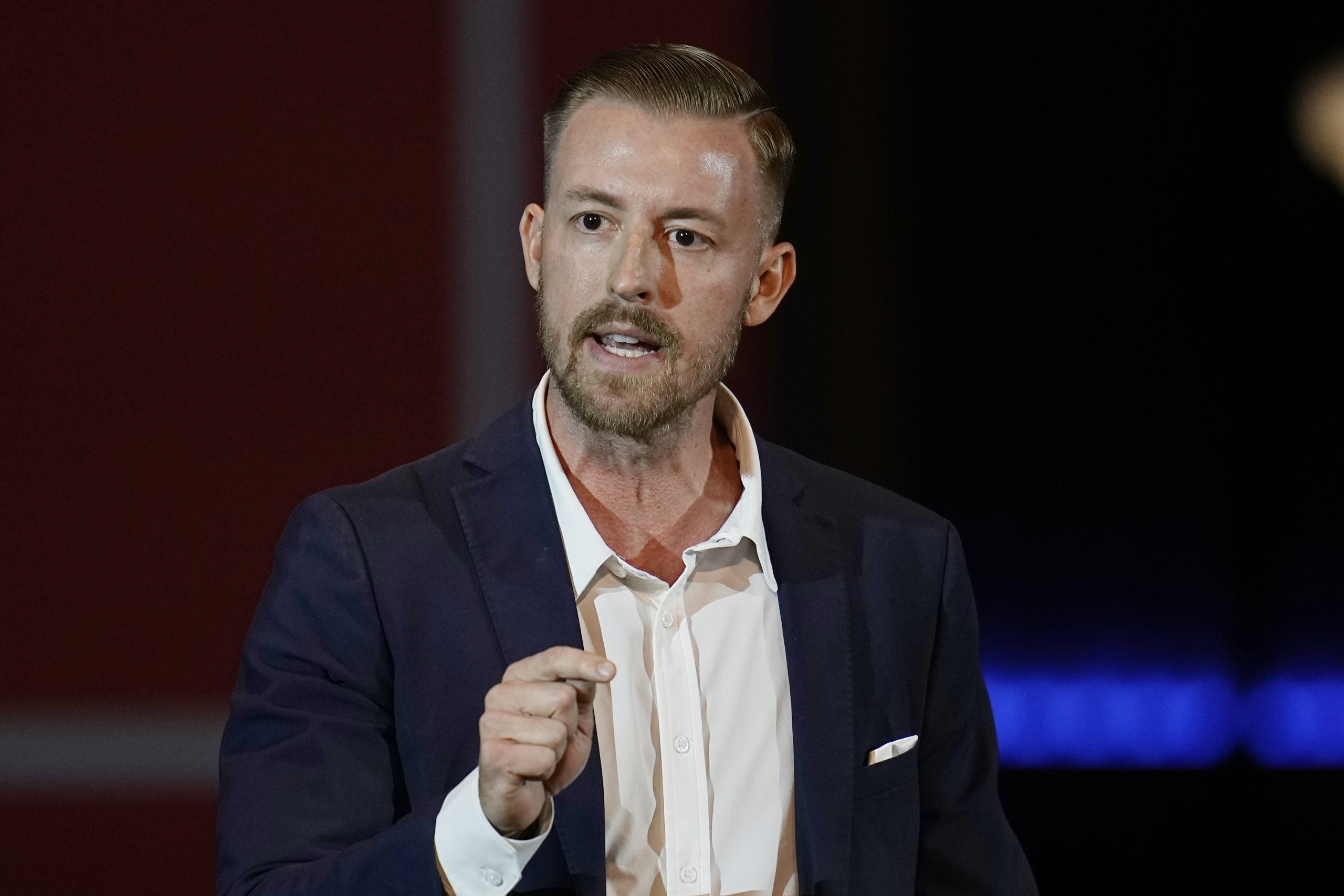
Norman, a central Oklahoman city of about 130,000, is an epicenter of resistance to the Bible mandate that the state superintendent of public instruction, Ryan Walters, announced last June. Opposition here has come from pastors, religion professors, students, parents, teachers, school board members and the school district superintendent, among others. The prevailing philosophy among Norman residents, who are predominantly Christian, is that they do not want the state — and namely, Walters — mandating how children should be taught scriptures. They want their children to learn from holy books at home or in church.
Pastor Jakob Topper, of NorthHaven Church, says he prefers to teach his children about the Bible rather than placing that responsibility on teachers. Credit: Mike Simmons for The Hechinger Report
Many residents see Walters’s pitch as a play for national attention, given his abundance of social media posts praising Donald Trump, who campaigned on returning prayer to schools and as president has established a White House Faith Office and a task force to root out “anti-Christian bias.” In September, Walters proposed spending $3 million to buy 55,000 copies of the Bible that has been endorsed by the president and for which he receives royalties. More recently, Walters — who in February clashed with his state’s governor for proposing that public schools track students’ immigration statuses — made media lists as a possible candidate for Trump’s education secretary. He was not picked.
But beyond Walter’s national aspirations, the Bible mandate also seems like an attempt at one-upmanship, with other states angling to infuse Christianity into public schools. Louisiana, for instance, is in a court battle over its push for Ten Commandments posters in schools. Texas fought off Democratic opposition to approve an optional Bible-infused curriculum and financial incentives for school districts that use the materials. A slew of states have passed or promoted similar measures, including ones allowing chaplains to act as counselors in schools. Unsurprisingly, Walters, too, has advocated for displaying the Ten Commandments in every classroom and also has backed the conversion of a private virtual Catholic school into a charter school; the Supreme Court plans to hear oral arguments on the case on April 30.
It goes without saying that Walters’s crusade is multifaceted. But fundamentally, all of his efforts amount to teaching the Bible “in inappropriate ways in public schools,” said Amanda Tyler, author of “How to End Christian Nationalism” and executive director of the Baptist Joint Committee for Religious Liberty, a Washington, DC–based organization of attorneys, ministers, and others who advocate for religious freedom. “He’s saying you can’t be a good American citizen if you don’t understand the Bible,” she added. “It’s this merger of American and Christian identities, the idea that only Christians are true Americans.”
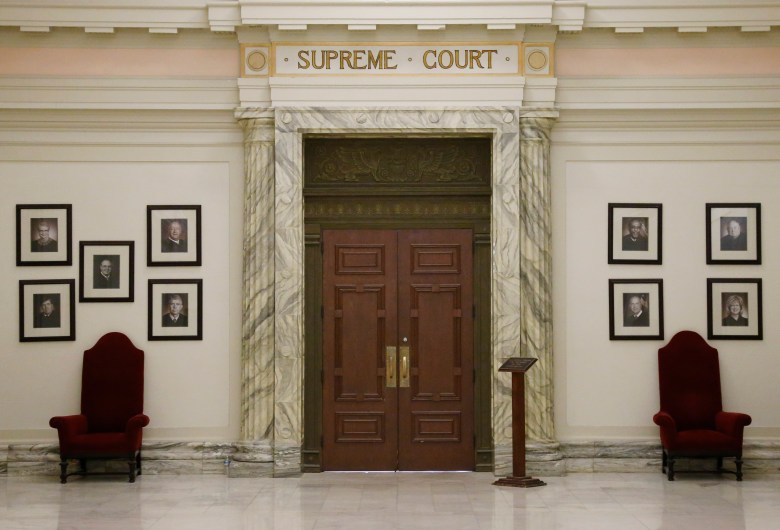
On March 10, the Oklahoma Supreme Court dealt a blow to Walters’s plans: It issued a temporary stay prohibiting the state’s department of education from purchasing 55,000 Bibles with certain characteristics and from buying Bible-infused lessons and material for elementary schools.
The stay stems from a lawsuit led by Americans United for Separation of Church and State on behalf of 32 plaintiffs, including parents, clergy, students and teachers. The group, which is suing Walters, claims the Bible mandate violated the state’s prohibition against using state funds for religious purposes and the state’s own statutes allowing local district control over curriculum.
As of now, until the court issues a final ruling, its decision marks a victory in Americans United’s attempt to stop Walters, said Alex Luchenitser, the organization’s associate legal director: “It protects the separation of church and state. It protects the religious freedom of students.” Speaking about the court’s stay, Walters, through spokeswoman Grace Kim, said in a statement: “The Bible has been a cornerstone of our nation’s history and education for generations. We will continue fighting to ensure students have access to this foundational text in the classroom.”
Oklahoma Supreme Court, pictured in the state Capitol building, in March issued a stay that would prohibit the state education department from purchasing Bibles and Bible-infused lessons for elementary students. Credit: Sue Ogrocki/ Associated Press
Meanwhile, Walters was also sued separately last summer by a parent in Locust Grove who contended the mandate violated the state and federal constitutions. The state education department has denied the claims of both suits and contended in legal briefs that using the Bible for its secular value does not violate the state’s constitution.
Walters’s mandate has also sparked concern because of the proposed social studies standards that followed. The standards, which were initially released in December and would require legislative approval, mention the Bible and its historical impact more than 40 times. Several of the standards attempt to erroneously frame the Bible, and specifically the Ten Commandments, as the foundation of American law. Biblical scholars from the University of Oklahoma and elsewhere believe these standards promote the long-standing trope of Christian nationalism, which is premised in part on the false idea that the nation’s founding documents stemmed from the Bible. (The founders were Bible readers, but not necessarily fans of the same versions or holy texts in general. In fact, Thomas Jefferson cut up pages of the Bible to remove mention of miracles or the supernatural.)
For example, Walters’s standards would require students in first grade to learn about David and Goliath, as well as Moses and the Ten Commandments, because the standards cite them as influences on the American colonists and others. Second graders would be asked to “identify stories from Christianity that influenced the American colonists, Founders, and culture, including the teachings of Jesus the Nazareth (e.g. the ‘Golden Rule,’ the Sermon on the Mount).”
“These new standards,” said a news release from the state department of education, “reflect what the people of Oklahoma — and all across America — have long been demanding of their public schools: a return to education curricula that upholds pro-family, pro-American values.” (Walters’s press office, despite repeated requests, did not make the state superintendent available for an interview.)
Critics in Oklahoma and elsewhere see Walters’s Bible mandate as part of a broader Christian nationalist movement. “I think Oklahoma is the test case for the nation,” said Dawn Brockman,a Norman school board member.
Walters, though, has been steadfast in his belief that the mandate is legal and critical for the education of Oklahomans. In the fall, after Americans United sued, Walters wrote on X: “The simple fact is that understanding how the Bible has impacted our nation, in its proper historical and literary context, was the norm in America until the 1960s and its removal has coincided with a precipitous decline in American schools.”
But nothing is simple about the history of the Bible in America’s schools. When public schools started to open in the 1800s, some required regular Bible readings. From the beginning, that practice was controversial: Schools typically favored the King James Version, pitting Protestants against Catholics, and riots over school Bible readings broke out from the 1840s into the 1870s, said Mark Chancey, a professor of religious studies at Southern Methodist University in Dallas. By 1930, 36 states allowed Bible reading to be a requirement or an option, but another dozen banned such activities.
A few decades later, a Pennsylvania family sued their school district for heeding the state’s 1949 law requiring the reading of 10 Bible verses and the recitation of prayers at the start of each school day. In 1963, just a year after a similar opinion, the Supreme Court ruled that requiring in-school Bible readings and prayers was unconstitutional. After those rulings, daily teaching from the Bible, for the most part, was halted, Chancey said, but backlash continued, with critics charging that removing prayer and Bible readings from schools had led to a decline in the morality of schoolchildren.
In subsequent decades, the Supreme Court ruled against clergy-led prayer and prayer over the loudspeakers at football games in several school-related cases. But in a seeming reversal, in 2022, the high court ruled in favor of allowing a football coach to conduct midfield, postgame prayers, shifting the legal landscape. The majority’s opinion on the football coach’s prayer has prompted politicians and states to further test the limits of the separation of church and state. In February, lawmakers in Idaho and Texas even proposed measures to allow daily Bible readings in public schools again.
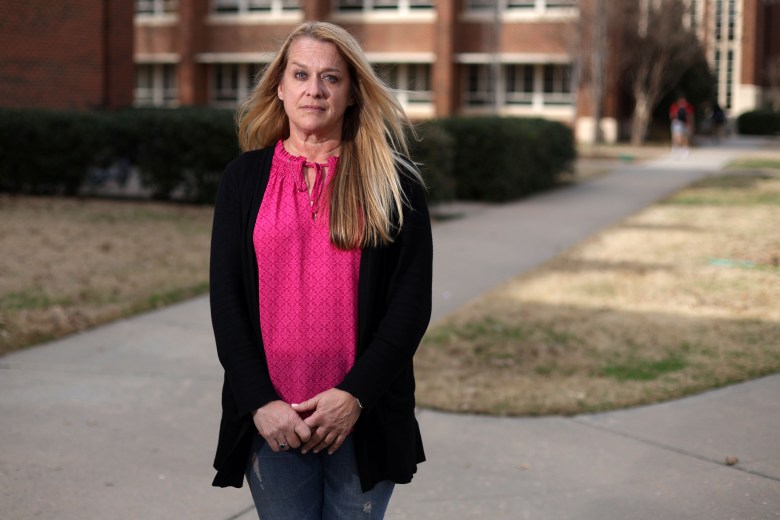
Darcy Pippins, who teaches Spanish at Norman High School, said she doesn’t feel qualified to teach about the Bible. Credit: Mike Simmons for The Hechinger Report
In Norman, many teachers reacted to news of the Bible mandate with concern and fear. Spanish teacher Darcy Pippins,who is in her 27th year at Norman High, said she sometimes teaches about Catholicism because it is the religion of the Spanish-speaking world. But putting a Bible in every classroom and teaching from it is different. “I just don’t feel comfortable,” said Pippins, also a parent. “I’m not qualified to teach and to incorporate the Bible into what I teach.’’
Other teachers, said Brockman, the school board member, worried about professional repercussions were they not to follow the mandate, given that Walters had already targeted at least one Norman teacher in the past for objecting to bans on particular books.
Nick Migliorino, the public school system’s superintendent since 2017, was the first superintendent in the state to publicly oppose the Bible mandate. When asked about it in a July interview with a local paper, he responded: “I’m just going to cut to the chase on that. Norman Public Schools is not going to have Bibles in our classrooms, and we are not going to require our teachers to teach from the Bible.”
Other superintendents followed, and by late July, at least 17 school district leaders said they had no plans to change curriculum in response to the Bible mandate, according to a report by StateImpact Oklahoma.
In an interview at his district’s headquarters, Migliorino emphasized that his school system already teaches how different religions affect history. Bibles, he noted, are accessible to students through the library. Migliorino added that the state superintendent had no authority to make school districts follow the mandate and that it would result in pushing Christianity on students.
“It’s a captive audience, and that is not our role to push things onto kids,” he said. “Our role is to educate them and to create thinkers.”
Oklahoma already has a 2010 measure allowing school districts to offer elective Bible classes and to give students the latitude to pick the biblical text they prefer to use. But unlike Walters’s mandate, it allows for different biblical perspectives, said Alan Levenson, chair of Judaic history at the University of Oklahoma and a biblical scholar. Even still, there has never been widespread interest in a Bible elective in Norman, said Jane Purcell, the school system’s social studies coordinator. Nor was there much interest in such a class when she taught in Florida. Since 2006, at least a dozen states have passed laws promoting elective Bible classes.
This may be, in part, because educators worry about potential issues with teaching Bible courses, said Purcell: “It’s very easy for it to appear to be proselytizing.”
Walters, for his part, has not taken any of this pushback in stride. At a July 31 state board of education meeting, he lashed out against “rogue administrators” who opposed him, saying of the left: “They might be offended by it, but they cannot rewrite our history and lie to our kids.”
After the public schools superintendent publicly rejected Walters’s mandate, community members and teachers in Norman expressed relief. Meg Moulton, a realtor and mother of three, came to a July board meeting to thank the superintendent in person. “I’m a Christian mama,” she said. “I love teaching my kids about God. I love going to church.”
But, she added, “Ryan Walters’s mandate makes it so that teachers and students who may not be Christians…[or] who may believe something different, are going to be essentially forced to learn something that they may not believe in.”
Students and others I met with at a popular Norman coffee shop said they were concerned about how Walters’s mandate could affect religious minorities, women, and members of the LGBTQ+ community. “What Ryan Walters is trying to push goes in line with a lot of trends of kind of pushing back against LGBTQ,” said Isandro Moreno,a 17-year-old senior at Norman High.
Phoebe Risch, a 17-year-old senior at Norman North, the town’s other public high school, said Walters’s mandate was part of what motivated her to restart her high school’s Young Democrats club and recruit roughly 30 members. Risch, already upset about her state’s readiness to ban abortion following the Supreme Court’s overturn of Roe v. Wade, fears that requiring Bible-based instruction could lead to the promotion of the idea that women are submissive. “As a young woman, the implications of implementing religion into our schools is a little scary,” she said, “especially because Oklahoma is already a very conservative state.”
Among the half dozen teens attending a confirmation class in December at Oklahoma City Reform temple B’nai Israel, most opposed the mandate, except for one. She said she supported it as long as the classroom teacher was careful and encouraged critical thinking.
One teen recounted tearily how, during class the previous week, a friend had drawn a swastika on her paper as a taunt. “Stuff like that is so normalized,” she said. “It’s antisemitism. If that’s so normalized, normalizing Christianity further, it’s just worse.”
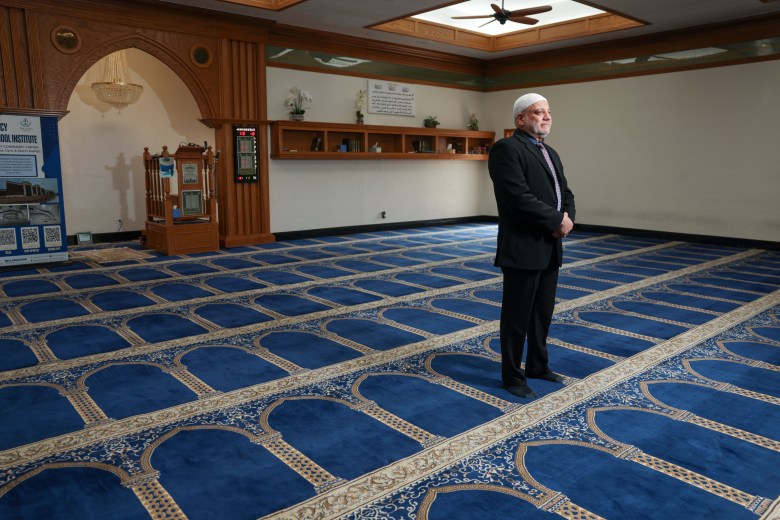
Imad Enchassi, an imam who oversees an Oklahoma City mosque and also chairs the Islamic Studies department at Oklahoma City University, said he worries that Superintendent Ryan Walter’s policies will further isolate Muslim children. Credit: Mike Simmons for The Hechinger Report
Imad Enchassi, an imam who oversees an Oklahoma City mosque and serves as chair of Islamic studies at Oklahoma City University, echoed similar fears for the Muslim community. “We’re already experiencing Islamophobia. Muslim kids who wear the headscarf already have been told they’re going to hell because they don’t believe in the Bible or they don’t believe in Jesus,” he said. “When curriculum mandates one religion over the other, that will further isolate our children.”
Some Oklahomans, though, do support the mandate. And at one of the state board of education meetings where Walters touted it, three residents expressed support for the idea — during public comment — as did at least one board member. That board member said he thought biblical literacy was important, while other supporters see the Bible mandate as a way to instill morality in the public schools. Ann Jayne,a 62-year-old resident of Edmond, about 15 miles north of Oklahoma City, makes a point of letting Walters know on his Facebook page that she’s praying for him, because she believes public schools need to instill Christian values. “I think we need church in the state,” she said. “I don’t see a problem with God being back in the school. Nobody is forcing them to become a Christian.”
Since last summer, Walters’s efforts to push Christianity have only become bolder. In mid-November, he announced the opening of the Office of Religious Liberty and Patriotism, which would, among other things, investigate alleged abuses against religious freedom and patriotic displays. Two days later, he announced that he was sending 500 Bibles to Advanced Placement government classes. He also emailed superintendents around the state with the order to show their students a one-minute-and-24-second video announcing the religious liberty office and praying for newly elected President Trump.
At a Christmas parade in Norman in early December, some residents called the video embarrassing, with many superintendents, including Norman’s, having declined to show it. However, while many residents seem to abhor the Bible mandate, they do not agree on how religion should be handled in public life. Despite some religious diversity and some liberal leanings common in a university town, Norman skews religiously conservative. That dichotomy means many residents see the Bible as so sacrosanct that they don’t want it taught in schools, yet they see no problem with other Christian-oriented school activities.
In some cases, residents like school board member Brockman, who is also a former teacher and lawyer with training on the First Amendment, have objected to school promotion of the religious aspects of Christmas. When she was a teacher at one of Norman’s two high schools, she asked to stop the playing of overtly religious Christmas songs in the halls during passing periods. She saw it as a “gentle reminder that the Supreme Court says we need to remain neutral on religion.” Her wish was granted. “They took it down with some consternation and played the Grinch in my honor.”
Residents have also quibbled over what to call the parade featuring Santa each December. Should it be called the Norman holiday or Christmas parade? It’s now known as the Norman Christmas Holiday Parade. In early December, the city’s mix of liberal and conservative influences shone through the glitz during the parade. The Knights of Columbus float had a sign that said “Merry CHRISTmas.” Norman’s Pride organization participated, with its human angels wearing wings lit up in rainbow colors.
Tracey Langford, watching the parade from the back of her SUV, was dressed in a red stocking cap and a red sweatshirt that read “Santa, define good,” a jab at the fact that she is a lawyer who cares about legal definitions. To her, the Bible mandate is a clear violation of separation of church and state.“Every home here has a Bible…. We don’t need to spend a dollar to get a Bible in every classroom,” said Langford, a lawyer at the University of Oklahoma and a parent of a first grader in Norman schools and a 15-year-old in a private school.
Traci Jones, a parent of both a Norman sixth grader and fifth grader, likewise asked, “Who’s supposed to be teaching these kids the Bible? Is it just a random person? What if it’s an atheist or someone who has totally different beliefs than me?” As a nondenominational Christian, she added, “I think it’s wack to ask these poor teachers to teach that.”
What happens next may ultimately be decided in a courtroom. There is no sign yet when final opinions may be issued in either lawsuit.
State lawmakers at recent appropriation hearings said they were worried about the directive’s constitutionality, and in fact, in March, the Senate Appropriations’ Education Subcommittee said it did not consider Walters’s $3 million request to purchase Bibles. The next day Walters announced he was launching a national campaign with a country singer to get Bibles donated to Oklahoma schools. (The legislature gets the final word on the Bible purchases, a line item in the education budget, and the standards, which the state board of education approved in late February.) Meanwhile, the fate of religion’s place in public schools on a national level likely will rest with the Supreme Court, with various lawsuits against state measures promoting Christianity making their way through the court system.
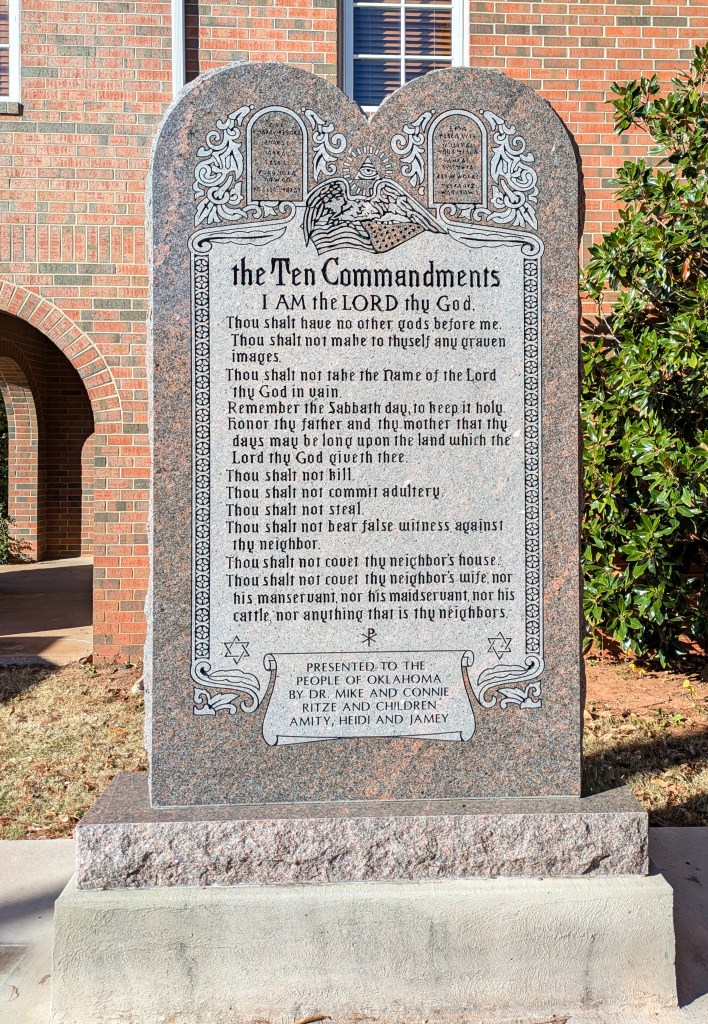
A Ten Commandments monument that sat on Oklahoma State Capitol grounds until the state Supreme Court ruled its presence violated the separation of church and state. It now is at the headquarters of a conservative lobbying group. Credit: Linda K. Wertheimer for The Hechinger Report
In Norman, Jakob Topper, Kyle Tubbs and other Baptist pastors I met with at the headquarters of a statewide Baptist church organization were increasingly aghast at Walters’s mixing of religion and politics. Rick Anthony, pastor of Grace Fellowship, a Baptist church, centered his November 17 sermon on such concerns. “Almost comically, we’ve heard this week about a video made that was ordered to be shown to all children in the public schools and then sent to their parents,” he said. “Our question is…where are our voices as our political leaders cozy up to faith leaders, all the while destroying our faith institutions?”
Kaily Tubbs, Tubbs’s wife and a fifth grade teacher in Norman schools, said the mandate conflicts with her personal belief on how faith should be handled in schools. She spoke also as a mother of a kindergartener and a third grader, both in Norman schools. “Our faith is really important to us,” she said. “I don’t want it to be used as a prop in a classroom.”
Topper said that at his church, the majority of his congregation believes in separation of church and state. He said he is aware of the religious diversity that exists in his town, too, and has both Muslim and Jewish neighbors. Like Anthony, he spoke with his congregation about Walters’s mandate, though in an informal weeknight meeting at his church, rather than as part of a formal sermon. “I wish,” he said, “that Jesus was left out of schools and left for the religious realm.”
Contact editor Caroline Preston at 212-870-8965, via Signal at CarolineP.83 or on email at [email protected].
The Hechinger Report provides in-depth, fact-based, unbiased reporting on education that is free to all readers. But that doesn’t mean it’s free to produce. Our work keeps educators and the public informed about pressing issues at schools and on campuses throughout the country. We tell the whole story, even when the details are inconvenient. Help us keep doing that.
Title: Pillars of Support: Results from an Evaluation of the Parenting Students Project at Austin Community College
Authors: May Helena Plumb and Paige-Erin Wheeler
Source: Trellis Strategies
A new report from Trellis Strategies evaluates the impact of the Parenting Students Project (PSP) at Austin Community College (ACC), highlighting the challenges student parents face and the program’s efforts to support them. Data show that students who are parents have high rates of financial and basic needs insecurity. In addition to the demands of being a student with parental responsibilities, these students are more likely to be working.
As part of the United Way for Greater Austin’s PSP initiative, parenting students met monthly with each other, attended seminars about financial wellness and mental health, and received a $500 monthly stipend. Additionally, PSP participants received services in coordination with ACC, such as case managers and childcare scholarships.
The report highlights the positive impact on participants’ academic progress, including a 95 percent term-to-term retention rate and an increased likelihood of taking nine credit hours per semester. A second area of impact was financial wellness, as increased financial stability lowered borrowing and alleviated transportation insecurity through a more flexible schedule. Third, PSP empowered parenting students to be better parents, as well as provided them with scholarships for childcare. Finally, PSP bolstered mental health through an increased sense of community and belonging.
The report also identifies areas for growth and offers the following recommendations:
Refine program requirements so that they best support student success. While credit requirements are helpful in moving students forward, parenting students still need some flexibility in enrollment intensity. A participant suggested scaling the number of credits taken to correspond to the stipend so that PSP support is not all or nothing. Participants also expressed a desire to choose some of the seminar topics.
Consider areas of need. PSP participants indicated a desire for more flexible childcare options. Some also discussed other forms of support, such as housing resources, cooking classes, and diapers and toys for children. The needs will vary based on the group, so it is important to evaluate what students need.
Address different needs for fathers. There was a large disparity between the share of fathers who participated in PSP and the percentage of student parents at ACC who are fathers. While student fathers are more likely to be married and have access to childcare, they are also more likely to have specific mental health challenges and to stop out of college.
The Federal Communications Commission is conducting an unseemly and unconstitutional spectacle, ostensibly to determine whether CBS violated its policy against “news distortion” by editing a “60 Minutes” interview with then-Vice President Kamala Harris. Its real purpose is to exercise raw partisan power.
The FCC already knows CBS did not violate any rules and merely engaged in everyday journalism. And there is nothing to be learned from the over 8,000 comments and counting that have poured into the commission’s inbox. Many simply registered their like or dislike of the network and mainstream media in general, and many others were just unserious quips submitted to troll the regulators.
But judging the merits of the “news distortion” allegation was never the point. The FCC staff already dismissed the complaint—filed by a partisan activist group—as fatally defective back in January. As outgoing FCC Chairwoman Jessica Rosenworcel explained, “The FCC should not be the President’s speech police. . . . The FCC should not be journalism’s censor-in-chief.” But one of Brendan Carr’s first acts as the new FCC chair in Donald Trump’s administration was to reinstate the complaint and call for public comments.
Asking members of the public to “vote” on how they feel about a news organization’s editorial policies or whether they think the network violated FCC rules is both pointless and constitutionally infirm. In 1943, Justice Robert Jackson wrote that the right to free speech and a free press “may not be submitted to vote; they depend on the outcome of no elections.”
The FCC’s reanimated proceeding lacks any legitimate regulatory rationale. But its realpolitik purpose is sadly transparent. This fishing expedition is designed to exert maximum political leverage on the CBS network at a time when Trump is engaged in preposterous litigation over the same “60 Minutes” broadcast, claiming CBS’ editing violates a Texas law against fraudulent commercial transactions. Adding to the pressure, Chairman Carr said he will consider the thousands of comments in this proceeding when evaluating whether to approve a merger of Skydance Media and CBS parent company Paramount Global worth billions of dollars.
There is a name for what the FCC is doing in this proceeding: a show trial. When investigations become a performative exercise designed to further a political purpose, they forfeit any claim to legitimacy.
There is nothing here for the FCC to investigate. The complaint alleges that Harris gave a “word salad” response to a question about whether Israeli Prime Minister Benjamin Netanyahu was listening to the Biden administration and that CBS edited it to make her sound more articulate. One part of her responses was aired on “60 Minutes” and another part aired on “Face the Nation.”
In short, CBS stands accused of committing journalism. Every day, from the smallest newspaper to the largest network, reporters and editors must make sense of and condense the information they collect—including quotes from politicians and other newsmakers—to tell their stories concisely and understandably. That task necessarily requires editing, including selecting what quotes to use. If the cockamamie theory underlying this FCC “investigation” had any merit, every newsroom in America would be a crime scene.
That’s why the FCC in the past has never defined the editing process as “news distortion.” In fact, the commission made quite clear when it first articulated the news distortion policy in 1969 that “we do not mean the type of situation, frequently encountered, where a person quoted on a news program complains that he very clearly said something else.” It stressed, “We do not sit to review the broadcaster’s news judgment, the quality of his news and public affairs reporting, or his taste.”
The commission understood that this very narrow approach is required to respect both the First Amendment and the Communications Act, which denies the FCC “the power of censorship.” As the FCC observed, “In this democracy, no Government agency can authenticate the news, or should try to do so.”
There is a name for what the FCC is doing in this proceeding: a show trial. When investigations become a performative exercise designed to further a political purpose, they forfeit any claim to legitimacy. Show trials are intended to send a message, not just to their unfortunate victims, but to other would-be transgressors.
FIRE calls out 60 Minutes investigation as ‘political stunt’ in comment to FCC
News
FIRE submitted a comment to the Federal Communications Commission about a complaint about a 60 Minutes interview with then Vice President Kamala Harris.
There is a dark and deadly history of such proceedings in authoritarian regimes around the world, ranging from Josef Stalin’s purges of perceived political opponents to China’s trials of “rioters and counterrevolutionaries” after the 1989 Tiananmen Square protests. Though less extreme in nature, during the Red Scare, the House Committee on Un-American Activities similarly staged show hearings where they pressured witnesses to name names while presuming guilt. The stakes of a sham FCC proceeding may differ, but the tactics and perversion of the rule of law are the same.
Somewhere along the way, the FCC’s current leadership abandoned that basic truth in exchange for political expediency. And in doing so, it is ignoring a unanimous holding from the Supreme Court just last term that threatening legal sanctions and other means of coercion to suppress disfavored speech violates the First Amendment.
The commission can begin to recover some dignity only by dropping this show trial immediately.
During the month of March, we celebrate Women’s History Month. This year’s theme is “Moving Forward Together! Women Educating and Inspiring Generations.” And we can’t think of a better way to celebrate than by paying tribute to the remarkable women educators who are doing just that.
We’re so proud to highlight some of our women faculty partners who are shaping the next generation of experts in fields like astronomy, automotive and math. Your commitment to educating and inspiring students doesn’t go unnoticed. While no words can truly capture the impact you make every day, this is our chance to show our gratitude (and give you the applause you deserve).
Kim Zoldak is a Teaching Assistant Professor at Oklahoma State University. Whether she’s teaching introductory astronomy, astrophysics or physics courses, her passion for sharing the wonders of the universe always shines through. She’s more than just an expert — she’s a guide who sparks curiosity and helps students discover new perspectives and ideas.
As the department’s dedicated teaching professor, Kim is always ready to jump in and teach whichever physics course is needed. So far, that’s included College Physics I & II and University Physics I. Kim’s journey to Oklahoma State started with a B.S. in meteorology from California University of Pennsylvania, followed by a Ph.D. in space and planetary sciences/astrophysics from the University of Arkansas. In addition to teaching, she oversees responsibilities for OSU’s Mendenhall Observatory. Above all, Kim believes that learning should be exciting and accessible to everyone. Her commitment to helping students grow — not just as learners but as thinkers — is what makes her an invaluable part of the OSU community and higher education.
“As a female in a male-dominated area of the sciences, I think that I encourage other females to follow their passion in physics and astronomy simply by being their instructor in these courses. Every year I am seeing more and more women in my classes…When women see other women doing something that they thought was out of their reach — it gives them hope that they can do it too.” – Kim Zoldak
Janalyn Kehm is the Department Chair in the School of Business & Computer Engineering Technology at Spartanburg Community College. Having taught at SCC since 2000, she’s devoted her career to shaping successful student outcomes and promoting meaningful collaboration with faculty members. In this role, she raises the bar, assessing learning needs within business and other courses, and working alongside faculty to develop quality curriculum. Before embarking on her decades-long career in higher education, she received her B.A degree in journalism – advertising/public relations from the University of South Carolina and her M.A degree in computer resource management from Webster University. But Janalyn didn’t stop there, continuing on to pursue her own educational growth by obtaining a Certificate of Graduate Studies in Higher Education Leadership from University of South Carolina and a DBA from California Southern University.
Having been twice recognized by her peers and students with the Faculty of the Year award, she personifies exceptionalism in her field, creating remarkable connections with those she mentors and works with.
After earning her B.S and M.S degrees in mathematics from Texas State University, Ellen Couvillion’s passion for the subject would lead her back there in the form of a teaching career. Now an Associate Professor of Instruction of Mathematics, she practices a growth mindset approach to teaching, prioritizing students’ individual learning needs and unique paths to development.
In a nutshell, Ellen is a star educator, admired as a mentor by her students, and respected by her faculty peers who have an immense appreciation of her teaching contributions. She has won numerous awards, including the Service Excellence Award from the Department of Mathematics and the Favorite Professor Award, courtesy of the Alpha Chi National College Honor Society. Beyond teaching, Ellen immerses herself in every aspect of university life, serving as member, advisor and organizer of several committees, demonstrating her commitment to enhancing and shaping the campus community around her.
Pam Schmelz is an Interim Dean for the School of Information Technology, School of Business, Logistics & Supply Chain and the Garatoni School of Entrepreneurship and Innovation at Ivy Tech Community College. With a lifelong passion for information technology, she’s earned several certifications, including CISSP (Certified Information Systems Security Professional), CCENT (Cisco Entry level Network Technician) and Amazon Cloud Practitioner, to name only a few. As a certified Quality Matters peer reviewer, she lends her critical expertise to the development of online courses, creating a quality learning experience for future generations of students.
Being a consummate innovator with a fierce dedication to helping students thrive, Pam also started up the CyberAcademy at Muscatatuck Urban Training Center in Butlerville, IN. This intense and revolutionary program takes students through the AAS Cybersecurity program in a record-breaking 11 months, providing graduates with essential cybersecurity career skills, setting them for future success and elevating their levels of expertise to new heights.
Samantha Candler is a General Motors World Class Technician with 18 years of experience in the automotive industry. As one of the few female World-Class Technicians and instructors nationwide, she’s no stranger when it comes to breaking down barriers. Her unwavering determination and immeasurable skillset speaks volumes. Before spending 10 years as a technician and 8 years as a GM ASEP Instructor, Samantha long had her sights set on making her mark in the field. Her passion for vehicles began in high school, leading her to achieve the highest level of GM technician training. As an automotive faculty member at Dallas College, she puts her immense knowledge into practice every day in the classroom, inspiring her students and undoubtedly setting an example for what heights they can reach and push beyond.
Samantha would ultimately like to see more women enter the automotive industry, and believes that anyone with the determination to dive in and work hard can succeed. She considers herself fortunate to have worked in a dealership that allowed her the freedom to grow and thrive into the inspiration she is today.
“Being a technician isn’t just about heavy lifting and getting greasy. Women bring unique strengths to automotive work — attention to detail, problem-solving, and adaptability— that are invaluable in today’s evolving automotive field…I’m proud and excited to be a part of the automotive transformation and to be training the next generation of technicians.” – Samantha Candler
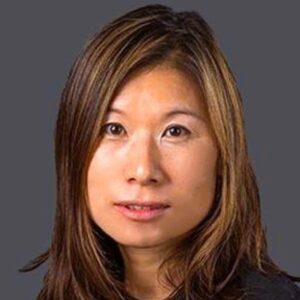
Jinhwa Lee is an Assistant Professor of Instruction of Mathematics at Ohio State University and an experienced educator. With a decade’s worth of experience teaching various mathematics courses, Jinhwa believes that all students can grow to become confident learners when given the right tools and individualized support. Her teaching philosophy centers on a common goal — helping students overcome their math anxiety. She wants students to find the fun and relevance within a subject she loves and believes is critical across multiple disciplines.
As an educator, Jinhwa recognizes that her role is part of a much bigger picture. She’s proud to contribute to student development and hopes to inspire her learners to become future leaders in fields like economics, science and engineering.
“…every student can excel with the right support.” – Jinhwa Lee
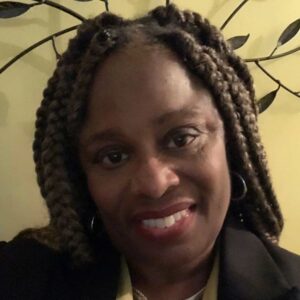
Monica Hampton is a retired cybersecurity officer, an Adjunct Professor of Cybersecurity and Criminal Justice and an Instructional Designer at Benedict College. Monica’s teaching experience stretches far beyond the higher ed classroom, having previously taught firearms and safety, as well as cybersecurity to law enforcement officers at national and local levels. She now brings personal field experience and real-world insights to her students, teaching undergraduate cybersecurity and criminal justice courses. Before entering the world of cybersecurity, she earned a B.A. degree in criminal justice from the University of Central Florida and an M.A. degree in computer resources and information management from Webster University. Monica took a comprehensive approach to her teaching role. Striving to gain proficiency in both instructional design and the application of rubrics, she obtained a Quality Matters (QM) certification for Applying the QM Rubric and Designing Your Online Course.
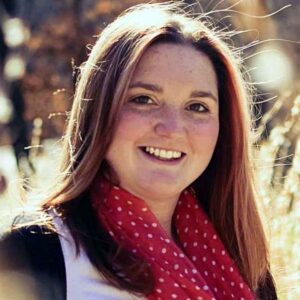
Dr. EmmaLeigh Kirchner is an Associate Professor of Criminal Justice and Chair of the Social Justice & Community Health Department at Mercyhurst University. Her experience spans across undergraduate, graduate and study abroad programs, where she teaches multiple courses, both online and in-person. Some of those courses include Methods and Social Science Statistics. Holding a Ph.D. in criminology from Indiana University of Pennsylvania, EmmaLeigh’s focus has been primarily within the higher ed sphere. Yet, she’s also a leading example of how to enact meaningful community-based change outside the classroom. She currently serves on the executive board for the Northeastern Association of Criminal Justice Sciences and is the faculty advisor of the Criminal Justice Association. EmmaLeigh’s various outreach efforts and contributions represent her resolution to make a difference.
Thank you to all of our women faculty partners. You’ve made an incredible educational impact on not only your students and institutions, but on the future of higher education overall.
Women’s History Month reminds us to recognize the incredible achievements and contributions made by women throughout our history.
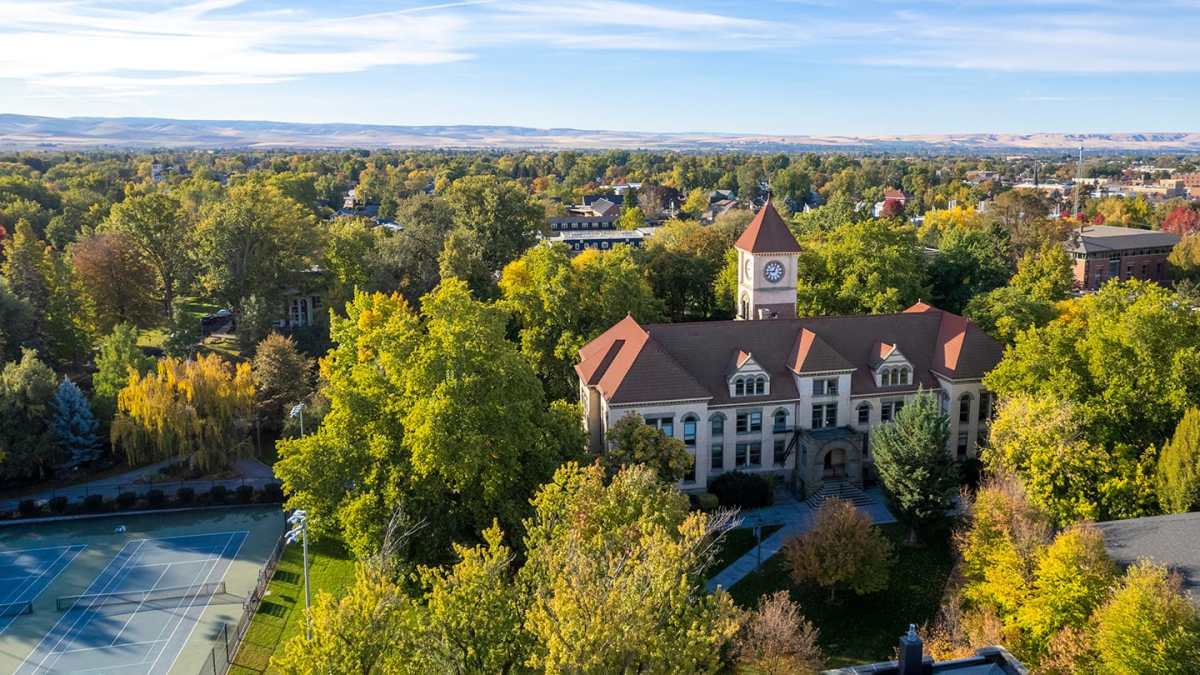
March 17, 2025, by Dean Hoke: This profile of Whitman College is the sixth in a series presenting small colleges throughout the United States.
Background
Founded in 1859, Whitman College is a private liberal arts institution located in Walla Walla, Washington. Its 117-acre campus blends historic architecture with modern facilities, creating an inviting environment for academic pursuits and campus life. Originally established as a seminary, Whitman transitioned to a secular liberal arts institution in the early 1880s and has since garnered recognition for its academic rigor, liberal arts commitment, and tight-knit community.
Whitman prides itself on a student-to-faculty ratio of 9:1, facilitating personalized education. Approximately 1,500 students from across the United States and internationally enroll at Whitman, attracted by its personalized instruction and strong emphasis on experiential learning.
Curricula
Whitman College offers over 45 majors and numerous minors spanning the arts, humanities, sciences, and social sciences. Popular disciplines include Environmental Studies, Political Science, Psychology, Economics, and Biology. The curriculum, deeply rooted in the traditional liberal arts, continues to evolve, notably introducing two new majors in Fall 2023: Brain, Behavior & Cognition (Neuroscience) and Ethics & Society, reflecting increasing student interest in neuroscience and applied ethics.
One hallmark program at Whitman is Semester in the West, a unique field-based study experience where students engage directly with environmental and policy research across the American West. Additionally, Whitman’s Encounters Program forms a cornerstone of the first-year academic experience, promoting critical thinking and interdisciplinary learning.
Graduate outcomes at Whitman are exceptional, with nearly 70% of alumni enrolling in graduate or professional programs within five years of graduation. The six-year graduation rate stands at an impressive 88%, among the highest for liberal arts colleges in the Pacific Northwest.
Strengths
Strong Post-Graduate Outcomes: Over 91% of Whitman graduates secure employment or enroll in graduate programs within six months after graduation, highlighting the institution’s effectiveness in preparing students for professional success.
Experiential Learning: More than 80% of students participate in internships, research, or off-campus programs such as Semester in the West and the Whitman in China teaching fellowship, exemplifying Whitman’s commitment to hands-on learning experiences.
Prestigious Recognition: Whitman students consistently win competitive fellowships and awards, including Fulbright grants, Watson Fellowships, and NSF Fellowships. Since 2000, students have secured more than 600 awards.
Sustainability and Outdoor Leadership: Whitman’s Outdoor Program provides extensive opportunities for students to engage in activities like hiking, kayaking, skiing, and environmental stewardship, reflecting the institution’s emphasis on sustainability and outdoor leadership.
Financial Strength and Support: Despite its modest enrollment, Whitman maintains a substantial endowment nearing $800 million. This financial strength enables the college to offer robust financial aid packages, greatly reducing costs for middle-income families and improving access.
Weaknesses
Geographic Isolation and Limited Visibility: Whitman’s location in Walla Walla presents both advantages and challenges. While the picturesque rural setting fosters a tight-knit community, the distance from major urban centers—roughly four hours from Seattle or Portland—can deter prospective students seeking metropolitan amenities. Consequently, Whitman must invest heavily in marketing and recruitment to attract students beyond the Pacific Northwest.
Dependence on Tuition Revenue: While Whitman is financially stable, its operating model remains heavily reliant on tuition, with endowment payouts currently covering around 40% of operational expenses. This reliance necessitates careful financial management and continued growth in the endowment.
Enrollment and Demographic Trends: Like many liberal arts colleges, Whitman faces a national decline in the traditional college-age population, coupled with increased competition for top-tier students. In response, Whitman has significantly expanded merit-based and need-based financial aid packages, currently averaging a tuition discount rate over 50%. To address demographic challenges, Whitman is actively broadening its applicant pool through partnerships with organizations such as the Posse Foundation and Matriculate.
Economic Impact
Whitman College is a significant economic driver in Walla Walla. It is among the largest employers in the region, accounting collectively for roughly 1,600 jobs in Walla Walla County.
Beyond direct employment, Whitman attracts thousands of students and visitors to the area each year, which boosts the local hospitality and retail sectors. Students spend on housing, groceries, dining, and entertainment in town, and their families visit for events like orientation, Family Weekend, and Commencement, filling hotels and restaurants. The tourism bureau has even created guides for families visiting their “scholars” at Whitman, recognizing the economic benefit of college-related travel.
Whitman also fosters long-term regional economic growth through strategic partnerships. A key example is the Gateway Program, in collaboration with Walla Walla Community College, which encourages community college students—particularly first-generation and low-income students—to pursue four-year degrees at Whitman. These initiatives enhance local educational attainment and create a talent pipeline beneficial to the regional economy. Additionally, Whitman engages actively with the Confederated Tribes of the Umatilla Indian Reservation, supporting educational and cultural initiatives that enrich the local community.
Enrollment Trends As of Fall 2024, Whitman enrollment is 1,561 students. Over the past decade, enrollment has slightly increased despite national declines in liberal arts college applications and the COVID crisis. To counteract demographic shifts, Whitman has expanded financial aid offerings and enhanced recruitment efforts in the Western U.S., international markets, and underrepresented student populations.
Degrees Awarded by Major In the 2023 graduating class, Whitman College conferred degrees across various disciplines.
Alumni
Whitman College boasts a vibrant alumni network comprising over 18,000 graduates worldwide. Alumni connections are notably strong in the Pacific Northwest, California, and Washington, D.C., providing substantial networking opportunities through programs such as “Whitties Helping Whitties.” This network significantly aids in securing internships, job placements, and mentoring opportunities for current students.
Notable Alumni
Adam West (Class of 1951) – Actor best known for portraying Batman in the 1960s television series.
William O. Douglas (Class of 1920) – U.S. Supreme Court Justice, serving from 1939 to 1975.
John W. Stanton (Class of 1977)- Chairman of the Board Trilogy Partners and majority owners of the Seattle Mariners.
Peter Adkison (Class of 1985) – Founder of Wizards of the Coast, publisher of Magic: The Gathering.
Dorothy Marie “Dottie” Metcalf-Lindenburger(Class of 1997) is a retired American astronaut. She was a high school science teacher when she was selected in 2004 as an educator mission specialist.
Holly Brooks (Class 2004) – Winter Olympian in Nordic Skiing
Endowment and Financial Standing
As of 2024, Whitman College’s endowment is valued at nearly $800 million. While this places Whitman on solid financial footing, the college remains largely tuition-dependent. In the 2024–25 budget year, the endowment payout will cover over 40% of Whitman’s operating expenses, which significantly reduces reliance on tuition revenue.
Whitman College Endowment Growth:
Whitman’s financial aid program has expanded in recent years, aiming to increase affordability and access for students from all economic backgrounds. Forbes 2023 Financial Health Evaluation gave Whitman a B+ grade and a financial grade of 3.345 out of 4.5. Whitman enters 2025 in a favorable financial position.
Why is Whitman College Important?
Academic Excellence: Whitman College maintains a challenging liberal arts curriculum that prepares students for a wide range of careers and graduate studies.
High Graduate Success Rates: With 91% of graduates employed or in graduate school within six months, Whitman produces competitive and well-rounded professionals.
Experiential Learning and Outdoor Leadership: Signature programs such as Semester in the West and the Outdoor Program allow students to engage in real-world learning.
Sustainability and Civic Engagement: Whitman plays a key role in environmental advocacy, sustainability, and community service.
With its strong academic reputation, experiential learning opportunities, and commitment to sustainability, Whitman College remains a leading liberal arts institution in the Pacific Northwest.
Dean Hoke is Managing Partner of Edu Alliance Group, a higher education consultancy, and a Senior Fellow with the Sagamore Institute. He formerly served as President/CEO of the American Association of University Administrators (AAUA). With decades of experience in higher education leadership, consulting, and institutional strategy, he brings a wealth of knowledge on small colleges’ challenges and opportunities. Dean, along with Kent Barnds, are co-hosts for the podcast series Small College America.
On March 14, the U.S. Court of Appeals for the 4th Circuit issued a decision allowing the Trump administration to enforce Executive Orders 14151 and 14173, both of which target “illegal … DEI preferences, mandates, policies, programs, and activities” in the public and private sectors and in federal contracts. The 4th Circuit’s decision effectively overrules a February 21 preliminary injunction issued in a U.S. District Court in Maryland that had blocked the administration from enforcing some provisions in the orders.
As a reminder, orders 14151 and 14173 revoke prior executive orders, including Executive Order 11246, which required federal contractors to maintain affirmative action plans. Among other things, orders 14151 and 14173 also mandate that:
federal agencies include provisions in federal contracts requiring that contractors agree to comply with nondiscrimination laws and certify they do not operate any DEI programs that violate discrimination laws;
the Office of Management and Budget terminate all “‘diversity,’ ‘equity,’ ‘equitable decision-making,’ ‘equitable deployment of financial and technical assistance,’ ‘advancing equity,’ and like mandates, requirements, programs, or activities, as appropriate;” and
each agency “identify up to nine potential civil compliance investigations of publicly traded corporations, large non-profit corporations or associations, foundations with assets of 500 million dollars or more, State and local bar and medical associations, and institutions of higher education with endowments over 1 billion dollars.”
CUPA-HR will continue to share further developments regarding the lawsuits challenging orders 14151 and 14173.
The Higher Education Inquirer has recently received a Freedom of Information (FOIA) response regarding student loan debt held by former DeVry University students. The FOIA was 25-01942-F.










 Logistics & Supply Chain and the Garatoni School of Entrepreneurship and Innovation at Ivy Tech Community College. With a lifelong passion for
  Samantha Candler is a General Motors World Class Technician with 18 years of experience in the
  experienced educator. With a decade’s worth of experience teaching various
  Monica Hampton is a retired cybersecurity officer, an Adjunct Professor of Cybersecurity and Criminal Justice and an Instructional Designer at Benedict College. Monica’s teaching experience stretches far beyond the higher ed classroom, having previously taught firearms and safety, as well as cybersecurity to law enforcement officers at national and local levels. She now brings personal field experience and real-world insights to her students, teaching undergraduate cybersecurity and
  Community Health Department at Mercyhurst University. Her experience spans across undergraduate, graduate and study abroad programs, where she teaches multiple courses, both online and in-person. Some of those courses include Methods and Social Science Statistics. Holding a Ph.D. in criminology from Indiana University of Pennsylvania, EmmaLeigh’s focus has been primarily within the higher ed sphere. Yet, she’s also a leading example of how to enact meaningful community-based change outside the classroom. She currently serves on the executive board for the Northeastern Association of Criminal Justice Sciences and is the faculty advisor of the Criminal Justice Association. EmmaLeigh’s various outreach efforts and contributions represent her resolution to make a difference.