The Southern Association of Colleges and Schools Commission on Colleges denied Saint Augustine’s University’s appeal to remain accredited, SAU announced Thursday.
The decision is the latest blow to the embattled historically Black university in North Carolina, which has struggled to maintain its accreditation since December 2023, when SACSCOC voted to strip it of its membership due to compliance issues related to governance and finances. Following that decision, SAU lost an appeal to remain accredited; it won a reprieve in the courts last July but lost accreditation again in December. Now that SASCOC has denied SAU’s latest appeal, the university will again pursue a legal remedy, officials announced.
“We have made substantial progress and are confident that our strengthened financial position and governance will ensure a positive outcome,” Board of Trustees chairman Brian Boulware said in a Thursday statement announcing plans to contest the accreditation decision in court. “SAU is resilient, and we are resolute in our commitment to academic excellence.”
Beyond accreditation issues, Saint Augustine’s has navigated severe fiscal issues that left it teetering on the brink of closure for months as it pursued various financial lifelines. SAU recently attempted to lease its campus to 50 Plus 1 Sports, a fledgling Florida company. The $70 million deal to lease property for 99 years with development options would have provided much-needed funds for SAU, but following a review required by state law, North Carolina officials declined to sign off on the arrangement due to the transfer of nonprofit assets.
SAU had unsuccessfully sought approval of the deal before its appeal to SACSCOC last month.
The North Carolina attorney general’s office, which reviewed the deal, cited insufficient documentation and concerns that SAU was only receiving $70 million for property appraised at $198 million. Saint Augustine’s and 50 Plus 1 Sports have since restructured the terms of the deal.
In Thursday’s statement, SAU announced it “secured up to $70 million in sustainability-focused funding at competitive market rates and terms,” which it expects to close later this month. It added that nondisclosure agreements “prevent SAU from publicly disclosing the partners’ names.”
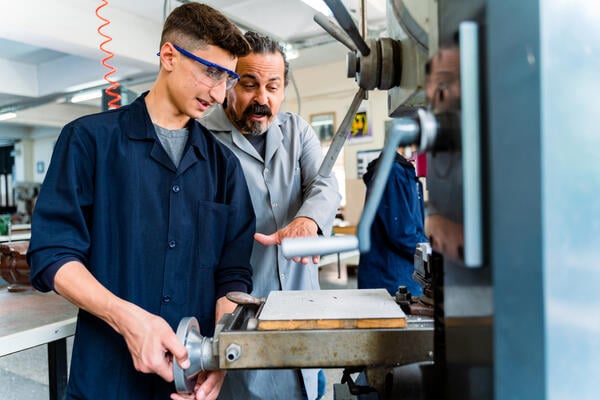
Advocates for apprenticeship programs came into a second Trump administration with a rosy outlook on their future.
Historically, these on-the-job training programs have enjoyed bipartisan support, and apprenticeships featured prominently in Project 2025, the conservative policy blueprint for a second Trump administration put forth by the Heritage Foundation, a right-wing think tank. The plan encouraged their expansion, lauding the programs as a meaningful alternative to “the woke-dominated system of public schools and universities.”
But now, apprenticeship proponents are divided on how hopeful to feel.
Some maintain their optimism. They foresee a potential period of growth for the programs, as Trump administration officials and supporters speak positively about apprenticeships and nondegree pathways.
But others worry that at least some apprenticeship programs—and their financial supports—could be hurt by the administration’s slashing of federal spending. Already, some grants supporting apprenticeship programs have been cut to trim costs or for perceived connections to diversity, equity and inclusion work. The Advisory Committee on Apprenticeship, which advises the Department of Labor on apprenticeship issues, has been disbanded, along with other federal advisory bodies.
“If the approach is to just cut, cut, cut grants across the government—and the kind of machete-wielding, indiscriminate cutting of things continues—I think that could pose some long-term stress on the system and halt a lot of the momentum that it’s had,” said Taylor White, director of postsecondary pathways for youth at New America, a left-wing think tank, and a former member of the now-defunct advisory committee. She fears the uncertainty caused by federal spending cuts in general could scare off employers or state agencies that otherwise would have invested in these programs.
Apprenticeship-related grants have gotten “caught up” in efforts to scrutinize government spending, said Vinz Koller, vice president of the Center for Apprenticeship and Work-Based Learning at Jobs for the Future, an organization focused on workforce development, though he doesn’t think “they’ve been the target” or that the moves are necessarily indicative of apprenticeships’ future under Trump.
“What we are hearing from the administration is a commitment to registered apprenticeship and to apprenticeship writ large and to making it more widely accessible,” he said. “That leads us to believe, looking into the future, that’s where we’re headed.”
Reasons for Optimism
John Colborn, executive director of Apprenticeships for America, a nonprofit working to expand apprenticeships in the U.S., said it’s “too early to say for sure” what the next four years hold for apprenticeships. But he sees “plenty of positive signs out there,” including supportive rhetoric from current and nominated Trump administration officials.
For example, Secretary of Education Linda McMahon posted on X in November that apprenticeship programs “are a pathway to successful careers,” praising Switzerland’s apprenticeship system as “a model the rest of the world can adapt.”
Similarly, Trump’s pick for secretary of labor, Lori Chavez-DeRemer, said during her Feb. 19 confirmation hearing that she values investing in and “doubling down” on registered or federally recognized apprenticeships.
“Right now, we’re focused on the registered apprenticeships, growing those, investing in those and making sure that those are adhered to,” she told lawmakers.
Her comments were a notable departure from the vision for apprenticeships laid out in Project 2025, which called for a return to an earlier Trump policy of industry-recognized apprenticeships, a separate system to circumvent what Republican lawmakers view as excessive federal regulation. Registered apprenticeships are required to meet certain quality standards to receive federal dollars.
Chavez-DeRemer’s position “came as good news to many of us listening and watching,” White said, though she wonders if Chavez-DeRemer will retain that stance if there’s pressure from the administration to do otherwise.
Colborn believes the current administration might improve the registered apprenticeship system, including speeding up program approvals and expanding the types of occupations that offer apprenticeship options.
He added that so far, the Trump administration hasn’t interfered with financial supports for apprenticeships that the Biden administration instituted. Under Biden, the Department of Labor announced the State Apprenticeship Expansion Formula grant program, which makes $85 million available for states and territories to grow the capacity of existing registered apprenticeships and invest in new offerings.
“I don’t have any official word on this, but every indication we have is that that grant process is going forward,” Colborn said. “We take that as a signifier that this administration is committed to apprenticeship.”
Some apprenticeship advocates hope the moment might be ripe to push for more support and see their policy wish lists fulfilled, including more reliable federal and state funding for apprenticeships, rather than one-off grants, and incentives like tax credits for employers to participate in apprenticeship programs.
“There’s definitely room for the administration to make a mark on the broadening of apprenticeship into more sectors where traditionally they haven’t been as common,” Koller said.
Causes for Concern
Still, some advocates worry apprenticeships will be negatively affected by other policies advanced by the Trump administration.
White, for example, was jarred by the Department of Labor’s decision to ax its Advisory Committee on Apprenticeship, a group of about 30 employers, labor organization representatives and other stakeholders that advises the department on apprenticeship-related policy.
She doesn’t believe the move was intended to signal an anti-apprenticeship stance, given that the committee isn’t the only federal advisory body to bite the dust. A February executive order got rid of a handful of them and called on government officials to flag “Federal Advisory Committees that should be terminated on grounds that they are unnecessary.”
But the disbanding of the committee still feels like a “confusing signal” and a potential obstacle to progress, White said.
“What’s lost by dissolving a community like that is the connection to the people on the ground who are actually having to interpret regulation, live regulation, build the programs, implement the programs,” she added. She sees such perspectives as critical to making apprenticeships “more efficient, more accessible, more functional and, frankly, a more mainstream training option for Americans to access high-quality training and good middle-class jobs.”
Like the advisory committee, some federal funding for apprenticeship programs and apprenticeship-related research projects has gotten caught in the crossfire as the administration works to downsize government and curtail DEI work.
Notably, the Department of Government Efficiency’s website shows about $18 million in cuts to three grants issued by the Department of Labor’s Office of Apprenticeship, according to The Job, a newsletter that covers education and workforce issues.
Managed by the consulting firm ICF, one of the grants was for “technical assistance and coaching support” and one for “industry engagement and outreach.” DOGE’s documentation said only that the grants were terminated “for convenience,” meaning the cuts were in the government’s interest. Another impacted grant was for “technical and coaching assistance support,” managed by a subsidiary of the American Institutes for Research. The Job also reported in late February that several research projects related to apprenticeships had their federal funding frozen.
Another victim of federal cuts was Reach University, a nonprofit institution with a mission to offer on-the-job credentials, called apprenticeship degrees. The institution lost three grants, totaling $14.7 million, from the Education Department. (Teacher-training grants at other institutions have also been slashed for supposed connections to DEI. Three teacher preparation groups sued the Department on Monday over the slew of grant cuts in the field.)
The grants to Reach were supposed to support apprenticeship-based degree programs training teachers in rural Arkansas and Louisiana through 2028. One program helps associate degree holders earn bachelor’s degrees while learning teaching skills on the job in local schools. (The grant application mentioned that the program is a partnership with Delgado Community College, a predominantly Black institution in New Orleans, and would “increase the number of teachers of color in high-need Louisiana schools,” The Jobreported.) The other two grants were partnerships with nonprofits to help people in more isolated rural areas earn teaching credentials on the job.
Joe E. Ross, president and CEO of Reach, wrote to Inside Higher Ed that he remains “hopeful” the university will regain the funds through the Education Department’s internal appeals process, and he said university leaders are in touch with department officials. Despite the financial hits, he’s optimistic the administration will be good news for apprenticeships over all.
“We are confident that the projects funded by these grants align with long-standing, bipartisan priorities, including those of this administration,” Ross said. “As applied by Reach, all three of these grants are a merit-based, discrimination-free application of federal funds to meet the department’s long-held priority of alleviating the teacher shortage with residents of the local community.”
A new report finds that $41 million in state appropriations “were not properly restricted and in some instances were co-mingled with other funds” at Oklahoma State University in violation of state laws and policies, according to an internal audit obtained by media outlets in the state.
The audit—conducted by an office of the Oklahoma Agricultural and Mechanical Colleges Board of Regents, which oversees Oklahoma State and other public institutions—found “significant issues in the allocation and management of legislatively appropriated funds” at OSU.
The report found examples of such funds being transferred improperly, including $11.5 million for aerospace, health and polytechnic programs being directed to the OSU Innovation Foundation instead, without a contractual agreement or approval from regents.
“As a result, some state appropriated funds were utilized for unauthorized and unrelated purposes, and were not retained in full by OSU, the intended recipient,” the audit found.
A university spokesperson told the Tulsa World that “while the financial decisions and transactions which occurred are concerning, they were isolated and do not impact OSU’s overall financial foundation.”
The audit also called on Oklahoma State to improve financial oversight and transparency.
Though the audit did not name former president Kayse Shrum, who resigned abruptly without explanation last month, it indicated the alleged misappropriation happened during her administration. Shrum did not appear to be interviewed as part of the audit, according to a list of individuals who were contacted as part of the investigation into the use of appropriated funds.
Student protesters at Barnard College were arrested Wednesday afternoon for refusing to leave the campus’s library when asked by police, who were clearing the building due to a bomb threat, The New York Times reported. The students were protesting the recent expulsions of three student demonstrators.
Protesters gathered for a sit-in in the Milstein Center at around 1 p.m. Wednesday. Several hours later, administrators shared that they had received a bomb threat, and police began evacuating the building. The New York Police Department posted on social media that “anyone who refuses to leave the location is subject to arrest.” (The bomb threat was later found to be false.)
Many students initially refused to leave, continuing to chant above the sound of a fire alarm, until police began pushing students out of the building. Eventually, nine students were taken into custody for resisting police.
Columbia University Apartheid Divest, a pro-Palestinian activist group, as well as the college’s student government, condemned Barnard’s leaders for calling on NYPD officers to remove students from the building.
“Barnard College has broken a long-standing promise. SGA has been explicitly told by President [Laura] Rosenbury, in the presence of other senior staff, that the College would never invite the NYPD onto campus,” student government members wrote in an email to the Barnard community. “To go against this commitment blatantly violates a precedent that was meant to protect our students.”
Rosenbury defended the decision to bring NYPD officers to campus, saying it was necessary to protect protesters from injury after they refused to follow staff members’ instructions to leave the Milstein Center. (Copies of both the SGA’s and Rosenbury’s emails were shared in an article by Bwog, an independent student newspaper at Columbia.)
“For the safety of our entire community—including the safety of the masked disrupters—Barnard made the necessary decision to request NYPD assistance so they could evacuate the building to reduce the risk of harm … The decision to request NYPD assistance was guided and informed entirely by the absolute obligation we have to keep every member of our community safe,” Rosenbury said via email.
Secretary of State Marco Rubio plans to use artificial intelligence to review and revoke visas of foreign students who appear to be Hamas sympathizers, Axiosreported Thursday, citing State Department officials.
The “Catch and Revoke” initiative will use AI to review tens of thousands of student visa holders’ social media accounts, looking for signs that they supported Hamas’s Oct. 7, 2023, attack on Israel.
If officials find a social media post from an international student that appears to endorse the attack and looks “pro-Hamas,” that could be grounds for visa revocation, an official told Axios.
Officials also plan to check news reports of anti-Israel demonstrations and lawsuits brought by Jewish students that might indicate a foreign national engaged in antisemitic activity.
Axios reported that to launch Catch and Revoke, the department examined a database of 100,000 people in the Student Exchange Visitor System since October 2023 to see if any visas had been revoked but the student was allowed to stay in the country during the Biden administration.
“We found literally zero visa revocations during the Biden administration,” a State Department official said, “which suggests a blind eye attitude toward law enforcement.”
The official said, “It would be negligent for the department that takes national security seriously to ignore publicly available information about [visa] applicants in terms of AI tools … AI is one of the resources available to the government that’s very different from where we were technologically decades ago.”
“Under President Trump, the Immigration Nationality Act [sic] is great again,” the official added.
Smith College has received a $51 million gift from an anonymous alumna, the Massachusetts women’s college announced Thursday.
It is the largest planned gift in the institution’s history and will be used to support financial aid and two faculty positions: one in engineering and one in statistical and data sciences.
Boosting financial aid “will allow young women from all economic backgrounds to realize their biggest dreams for educational opportunity, permitting them to make a difference in their local communities, in their nations, and in the advancement of humankind worldwide,” said the donor, who graduated in 1979.
She also articulated her belief in the value of STEM education.
“In an age in which it is more important than ever for women to excel in technology, especially in the fields of engineering and computing, it is crucial to endow a leading educational institution like Smith College and to benefit women’s contributions in the STEM fields.”
The path from early promise to widespread impact requires one thing and one thing only: scalability – the capacity to grow and expand in a robust and sustainable way. Put simply: you can only change the world at scale.
To tackle inequality in higher education, we need scalable interventions. The interventions that make the biggest difference will be those that we can successfully expand from a small group to a much bigger one.
Across many policy areas, ideas that appear promising after being tested at a small scale often have a much lower impact when expanded. Existing evidence suggests the majority of interventions – somewhere in the range of 50% to 90% – will have weak effects when scaled. This is what the economist John List terms a ‘voltage drop’: ‘when an enterprising idea falls apart at scale and positive results fizzle’.
Interventions in higher education are frequently designed at either the module or school level, with the intention to eventually scale up. Often, interventions are started by a single enthusiastic practitioner, who then tries to scale up the intervention later on. For example, a student support programme may go from being implemented within the school of psychology to across the whole institution. Similarly, policymakers may seek to scale an idea that was successful at one institution by implementing it across a range of other institutions.
As a result, higher education emerges as a prime area where we should consider the intended scale of implementation from the outset. While many interventions struggle to scale, List argues this challenge is surmountable by building into our processes an understanding of five key factors that impede scaling.
1. False positives
The first major cause of voltage drops is the prevalence of false positives: concluding there is a significant effect when there is not. False positives can arise in a manner of ways, but we can split them into three categories: statistical error, human error, and fraud.
We can go a long way to addressing this trifecta of false positives by embracing the open science movement. Key tenets of this approach include pre-registration of trials, independent evaluation, and open publication of data and code. Opening our research up in this way not only helps to prevent fraud (more prevalent than we might think in academia) but also encourages more collaboration with peers and enables others to build on your work.
2. Know your intended audience
When testing your intervention, consider whether this initial group is representative of the broader population you hope to impact. If the intervention is not designed for only one group, we should not test it with only one group.
For example, say we trial an intervention with Engineering students before rolling it out across the institution. This could cause difficulties if Engineering students are different from the wider population we are interested in. It may be that the intervention only works on our sampled population (in this case Engineering students) and no longer works when we roll it out to the entire student population.
3. Spillovers
Interventions often give us evidence of what works at a small scale, but it is difficult to anticipate how this could change when an intervention becomes a large-scale movement.
This is particularly important when we look at scaling interventions from one institution to many. We should consider that the positive effects of an intervention at the institution level may disappear once the programme is scaled further. For example, consider a career guidance programme that improves graduate outcomes at an institution. When rolled out across the country, it may alter the dynamics of the graduate labour market in such a way that the original benefits are negated.
4. Is the success due to the practitioner, or the idea?
We should consider whether the intervention, as tested, accurately reflects the characteristics it will have when deployed widely.
The key analogy here is one of chefs and ingredients. If the reason behind a restaurant’s success is its ingredients, it will be more likely to scale well, as the ingredients can be scaled across many branches. But a restaurant will struggle to scale if its success is down to the unique magic of the chef.
Similarly, an intervention may fail to scale if we can mainly attribute its positive impact to a practitioner’s individual brilliance at a specialised skill: the talented practitioner cannot be so easily scaled.
5. Rising costs
If the costs grow disproportionately with the intervention, it will struggle to scale. For example, at a small scale, it may be relatively easy to find an effective practitioner who can deliver the intervention as it was intended and have a high impact on students.
But, as we’ve seen, if the success of a programme rests on the talent of practitioners, this is unlikely to scale well. As the intervention scales and hires more staff, finding staff who can have the desired impact will become increasingly difficult and expensive.
Moving towards having an impact at scale
It is a worthwhile pursuit to make incremental but meaningful changes that improve the lives of students. Many practitioners, not to mention students themselves, will be able to attest to the difference a small-scale intervention can have on a student’s life, helping to break down barriers, narrow gaps and open up doors.
But to move the dial on inequality in higher education, we should build considerations around scaling into our interventions. In doing so, we can move our focus towards building an evidence base that helps us make a much larger change. By making this move, we can realise List’s powerful assertion: ‘you can only change the world at scale’.
Hancy Maxis spent 17 years incarcerated in New York prisons. He knew that he needed to have a plan for when he got out.
“Once I am back in New York City, once I am back in the economy, how will I be marketable?” he said. “For me, math was that pathway.”
In 2015, Maxis completed a bachelor’s degree in math through the Bard Prison Initiative, an accredited college-in-prison program. He wrote his senior project about how to use game theory to advance health care equity, after observing the disjointed care his mom received when she was diagnosed with breast cancer. (She’s now recovered.)
When he was released in 2018, Maxis immediately applied for a master’s program at Columbia University’s Mailman School of Public Health. He graduated and now works as the assistant director of operations at Montefiore Medical Center in the Bronx. He helped guide the hospital’s response to Covid.
Maxis is one of many people I’ve spoken to in recent years while reporting on the role that learning math can play in the lives of those who are incarcerated. Math literacy often contributes to economic success: A 2021 study of more than 5,500 adults found that participants made $4,062 more per year for each correct answer on an eight-question math test.
While there don’t appear to be any studies specifically on the effect of math education for people in prison, a pile of research shows that prison education programs lower recidivism rates among participants and increase their chances of employment after they’re released.
Hancy Maxis spent 17 years incarcerated in New York prisons. He now works as the assistant director of operations at Montefiore Medical Center in the Bronx. Credit: Yunuen Bonaparte for The Hechinger Report
Plus, math — and education in general — can be empowering. A 2022 study found that women in prison education programs reported higher self-esteem, a greater sense of belonging and more hope for the future than women who had never been incarcerated and had not completed post-secondary education.
Yet many people who enter prison have limited math skills and have had poor relationships with math in school. More than half (52 percent) of those incarcerated in U.S. prisons lack basic numeracy skills, such as the ability to do multiplication with larger numbers, long division or interpret simple graphs, according to the most recent numbers from the National Center for Educational Statistics. The absence of these basic skills is even more pronounced among Black and Hispanic people in prison, who make up more than half of those incarcerated in federal prisons.
In my reporting, I discovered that there are few programs offering math instruction in prison, and those that do exist typically include few participants. Bard’s highly competitive program, for example, is supported primarily through private donations, and is limited to seven of New York’s 42 prisons. The recent expansion of federal Pell Grants to individuals who are incarcerated presents an opportunity for more people in prison to get these basic skills and better their chances for employment after release.
Alyssa Knight, executive director of the Freedom Education Project Puget Sound, which she co-founded while incarcerated, said that for years, educational opportunities in prison were created primarily by people who were incarcerated, who wrote to professors and educators to ask if they might send materials or teach inside the prison. But public recognition of the value of prison education, including math, is rising, and the Pell Grant expansion and state-level legislationhave made it easier for colleges to set up programs for people serving time. Now, Knight said, “Colleges are seeking prisons.”
Related: Interested in innovations in higher education? Subscribe to our free biweekly higher education newsletter.
Jeffrey Abramowitz understands firsthand how math can help someone after prison. After completing a five-year stint in a federal prison, his first post-prison job was teaching math to adults who were preparing to take the GED exam.
Fast forward nearly a decade, and Abramowitz is now the CEO of The Petey Greene Program, an organization that provides one-on-one tutoring, educational supports and programs in reading, writing and now math, to help people in prison and who have left prison receive the necessary education requirements for a high school diploma, college acceptance or career credentials.
The average Petey Greene student’s math skills are at a fourth- or fifth-grade level, according to Abramowitz, which is in line with the average for “justice-impacted” learners; the students tend to struggle with basic math such as addition and multiplication.
“You can’t be successful within most industries without being able to read, write and do basic math,” Abramowitz said. “We’re starting to see more blended programs that help people find a career pathway when they come home — and the center of all this is math and reading.”
Abramowitz and his team noticed this lack of math skills particularly among students in vocational training programs, such as carpentry, heating and cooling and commercial driving. To qualify to work in these fields, these students often need to pass a licensing test, requiring math and reading knowledge.
The nonprofit offers “integrated education training” to help students learn the relevant math for their professions. For instance, a carpentry teacher will teach students how to use a saw in or near a classroom where a math teacher explains fractions and how they relate to the measurements needed to cut a piece of wood.
“They may be able to do the task fine, but they can’t pass the test because they don’t know the math,” Abramowitz said.
Math helped Paul Morton after he left prison, he told me. When he began his 10.5 years in prison, he only could do GED-level math. After coming across an introductory physics book in the third year of his time in prison, he realized he didn’t have the math skills needed for the science described in it.
He asked his family to send him math textbooks and, over the seven years until his release, taught himself algebra and calculus.
The recent expansion of federal Pell Grants to individuals who are incarcerated presents an opportunity for more people in prison to get these basic skills and better their chances for employment after release. Credit: Helen H. Richardson/The Denver Post via Getty Images
“I relentlessly spent six hours on one problem one day,” he said. “I was determined to do it, to get it right.”
I met Morton through the organization the Prison Mathematics Project, which helped him develop his math knowledge inside prison by connecting him with an outside mathematician. After his release from a New York prison in 2023, he moved to Rochester, New York, and is hoping to take the actuarial exam, which requires a lot of math. He continues to study differential equations on his own.
The Prison Mathematics Project delivers math materials and programs to people in prison, and connects them with mathematicians as mentors. (It also brings math professors, educators and enthusiasts to meet program participants through “Pi Day” events; I attended one such event in 2023 when I produced a podcast episode about the program, and the organization paid for my travel and accommodations.)
The organization was started in 2015 by Christopher Havens, who was then incarcerated at Washington State Penitentiary in Walla Walla. Havens’ interest in math puzzles, and then in algebra, calculus and other areas of mathematics, was ignited early in his 25-year- term when a prison volunteer slid some sudoku puzzles under his door.
“I had noticed all these changes happening inside of me,” Havens told me. “My whole life, I was searching for that beauty through drugs and social acceptance … When I found real beauty [in math], it got me to practice introspection.”
As he fell in love with math, he started corresponding with mathematicians to help him solve problems, and talking to other men at the prison to get them interested too. He created a network of math resources for people in prisons, which became the Prison Mathematics Project.
The group’s website says it helps people in prison use math to help with “rebuilding their lives both during and after their incarceration.”
But Ben Jeffers, its executive director, has noticed that the message doesn’t connect with everyone in prison. Among the 299 Prison Mathematics Project participants on whom the program has data, the majority — 56 percent — are white, he told me, while 25 percent are Black, 10 percent are Hispanic, 2 percent are Asian and 6 percent are another race or identity. Ninety-three percent of project participants are male.
Yet just 30 percent of the U.S. prison population is white, while 35 percent of those incarcerated are Black, 31 percent are Hispanic and 4 percent are of other races, according to the United State Sentencing Commission. (The racial makeup of the program’s 18 female participants at women’s facilities is much more in line with that of the prison population at large.)
“[It’s] the same issues that you have like in any classroom in higher education,” said Jeffers, who is finishing his master’s in math in Italy. “At the university level and beyond, every single class is majority white male.”
He noted that anxiety about math tends to be more acute among women and people of any gender who are Black, Hispanic, or from other underrepresented groups, and may keep them from signing up for the program.
Sherry Smith understands that kind of anxiety. She didn’t even want to step foot into a math class. When she arrived at Southern Maine Women’s Reentry Center in December 2021, she was 51, had left high school when she was 16, and had only attended two weeks of a ninth grade math class.
“I was embarrassed that I had dropped out,” she said. “I hated to disclose that to people.”
Smith decided to enroll in the prison’s GED program because she could do the classes one-on-one with a friendly and patient teacher. “It was my time,” she said. “Nobody else was listening, I could ask any question I needed.”
In just five months, Smith completed her GED math class. She said she cried on her last day. Since 2022, she’s been pursuing an associate’s degree in human services — from prison — through a remote program with Washington County Community College.
In Washington, Prison Mathematics Project founder Havens is finishing his sentence and continuing to study math. (Havens has been granted a clemency hearing and may be released as early as this year.) Since 2020, he has published four academic papers: three in math and one in sociology. He works remotely from prison as a staff research associate in cryptography at the University of California, Los Angeles, and wrote a math textbook about continued fractions.
Havens is still involved in the Prison Mathematics Project, but handed leadership of the program over to Jeffers in October 2023. Now run from outside the prison, it is easier for the program to bring resources and mentorship to incarcerated students.
“For 25 years of my life, I can learn something that I wouldn’t have the opportunity to learn in any other circumstances,” Havens said. “So I decided that I would, for the rest of my life, study mathematics.”
Contact editor Caroline Preston at 212-870-8965 or [email protected].
The Hechinger Report provides in-depth, fact-based, unbiased reporting on education that is free to all readers. But that doesn’t mean it’s free to produce. Our work keeps educators and the public informed about pressing issues at schools and on campuses throughout the country. We tell the whole story, even when the details are inconvenient. Help us keep doing that.
Nueve días después de que el presidente Donald Trump firmara órdenes ejecutivas con medidas enérgicas contra la inmigración ilegal, Damaris Alvarado-Rodríguez decidió cerrar un aula en una de sus guarderías en Filadelfia.
A pesar de tener tarjetas de residencia, las maestras de ese salón de clases, en donde atienden a niños y niñas que tienen un año de edad, estaban demasiado nerviosas para ir a trabajar. Desde que Trump tomó posesión, sus funcionarios se han enfocado en Filadelfia y otras denominadas ciudades santuario donde se limita la cooperación en la aplicación de las leyes de inmigración. Los agentes de inmigración han estado presentes constantemente en los vecindarios donde están situados los tres centros de Alvarado-Rodríguez.
“Tengo mucho miedo de cómo esto va a afectar a nuestros niños, familias y personal”, dijo.
En un programa de cuidado infantil familiar en Albuquerque, Nuevo México, Maggie, de 47 años, quien fue abogada antes de emigrar desde México hace 10 años, también ha visto los rápidos efectos de las órdenes ejecutivas. Cinco de los 12 niños a su cuidado dejaron de presentarse. Maggie dijo a través de un intérprete que los padres deciden dejar a sus hijos pequeños con hermanos mayores o abuelos en lugar de con ella, es decir, que salen de casa solo para trabajar y así estar fuera del alcance de las autoridades lo más posible. (The Hechinger Report no utiliza los nombres completos de algunos de los entrevistados porque temen por su seguridad).
“Los padres dijeron: ‘Vamos a esperar a que las cosas se calmen’”, dijo Maggie.
Relacionado: La educación es una labor de toda la vida. Suscríbete a nuestroboletín semanal gratuito, que incluye las noticias más importantes sobre el mundo de la educación.
En Estados Unidos, 1 de cada 5 trabajadores de cuidado infantil es inmigrante. En ciudades grandes como Nueva York, los inmigrantes constituyen más del 40 % de la fuerza laboral de cuidado infantil. En Los Ángeles, es de casi el 50 %.
“En la economía del cuidado infantil, los inmigrantes son la columna vertebral de este trabajo”, afirma Erica Phillips, directora ejecutiva de la Asociación Nacional de Cuidado Infantil Familiar. Estos educadores de la primera infancia se “dedican a prestar uno de los servicios más esenciales y con mayor impacto para los niños pequeños de todo el país”.
Los expertos opinan que las órdenes ejecutivas de Trump amenazan dicha columna vertebral. Entre otros cambios, las órdenes amplían las normas sobre qué inmigrantes pueden ser deportados rápidamente, sin tener una audiencia; exigen que algunos no ciudadanos se registren y presenten huellas dactilares; y limitan los permisos de trabajo.
Un patio de recreo en uno de los centros de cuidado infantil que Damaris Alvarado-Rodríguez dirige en Filadelfia. Alvarado-Rodríguez recientemente cerró una de las aulas porque varios maestros tenían miedo de ir a trabajar debido a posibles redadas de ICE. Credit: Image provided by Damaris Alvarado-Rodriguez
Varios proveedores de cuidado infantil dijeron que la situación parece más grave que en años anteriores. La actual administración ha establecido cuotas diarias de aprehensiones de inmigrantes, lo que ha producido arrestos de más inmigrantes por día que el promedio bajo la administración anterior. Esto incluyea muchos sin antecedentes penales, que no eran el blanco de la ejecución de la ley bajo el expresidente Joe Biden. Asimismo, Trump ha impulsado medidas para terminar con el estatus legal de millones de personas pues propuso eliminar la ciudadanía por nacimiento.
Estados Unidos no puede permitirse perder personal de cuidado infantil. Hay ya muchos programas que tienen problemas crónicos de rotación de trabajadores, lo que puede crear inestabilidad en las vidas de los niños y niñas a su cuidado. Las tasas de rotación en el sector de cuidado infantil son 65 % más altas que el promedio en otros sectores. Los salarios bajos (una trabajadora promedio de cuidado infantil gana 13,07 dólares la hora) dificultan la contratación de personal. A menudo, los cuidadores carecen de prestaciones y pueden ganar más al trabajar en restaurantes de comida rápida o en venta minorista. La pandemia debilitó la fuerza laboral, algo que se ha tardado en reponer. Para lidiar con la escasez de cuidadores infantiles, varios estados han intentado aprobar leyes que permitan a los adolescentes trabajar en dichas aulas.
“Ya estamos empezando desde un punto en el que no hay suficiente cuidado infantil, los programas están en apuros y la fuerza laboral ya está viviendo un estrés increíble”, dijo Lea Austin, directora ejecutiva del Centro para el Estudio del Empleo en el Cuidado Infantil de la Universidad de California en Berkeley. “Solo podemos esperar que esto vaya a devastar aún más todo el ecosistema de cuidado y educación temprana”.
El país lleva mucho tiempo recurriendo a los inmigrantes para los trabajos de cuidado, incluido el cuidado infantil y otras labores como el cuidado de personas mayores. Los inmigrantes tienen mayor probabilidad de servir como cuidadores de “amistades, familiares y vecinos” al asumir acuerdos informales de atención donde hay flexibilidad y que son más populares entre padres de familia.
Al desempeñar estas funciones de cuidado, los inmigrantes permiten que otros padres puedan trabajar. Se calcula que hay 142.000 inmigrantes indocumentados que trabajan como niñeras y asistentes de atención personal o de salud en el hogar en todo el país, lo que crea “un efecto multiplicador de productividad en toda la economía”, según una investigación del Center for American Progress. En la ciudad de Nueva York, la mayoría de las 14.000 niñeras de la ciudad son inmigrantes.
En el norte de California, Adriana, una joven de 27 años que emigró de México hace dos años, dijo que quiere empezar a trabajar y que recientemente le ofrecieron un empleo en una compañía grande. No obstante, primero necesita encontrar una guardería para su bebé de 3 meses, y le preocupa que los funcionarios de inmigración la separen de su bebé. “Tengo miedo, sobre todo porque parece que podrán entrar en mi lugar de trabajo”, dijo a través de un intérprete. “Me preocupa dejar a mi bebé solo”.
El Servicio de Inmigración y Control de Aduanas de EE. UU. (ICE, por sus siglas en inglés) no respondió a las múltiples solicitudes de comentarios. Una de las órdenes ejecutivas de Trump, firmada poco después de haber asumido el cargo, anuló las restricciones que impedían que ICE realice redadas en escuelas y programas de cuidado infantil.
Las tarjetas rojas que ofrecen algunos programas de cuidado infantil y escuelas, como estas en un centro en Texas, tienen como objetivo ayudar a las familias a comprender sus derechos en caso de ser detenidas por agentes de inmigración. Credit: Jackie Mader/The Hechinger Report
La política de inmigración puede tener un efecto paralizador en las comunidades, lo que hace que los inmigrantes eviten trabajos que podrían aumentar su visibilidad ante las autoridades, dijo Chris Herbst, profesor asociado de la Universidad Estatal de Arizona, que estudió el impacto de la política en el cuidado infantil entre 2008 y 2014. Debido a que el sistema de cuidado infantil de Estados Unidos depende tanto del trabajo de los inmigrantes, “los impactos son instantáneos”, añadió.
En Albuquerque, Ana dirige un programa de cuidado infantil que atiende a 50 familias del área, la mayoría de las cuales son ciudadanas estadounidenses. Ana se fue de México en 2020 con su esposo y su hijo pequeño cuando la violencia aumentó en su estado natal de Sinaloa, y ahora le preocupa que la puedan deportar. Ese tipo de preocupación la comparte su personal: tres de sus 14 empleados han dejado de ir a trabajar por miedo a las redadas de inmigración.
Recientemente, Ana y su esposo reunieron algunas pertenencias en caso de ser detenidos. Para prepararse, también han considerado certificar un documento de tutela encargando a su hijo de 3 años, que es ciudadano estadounidense, así como de su hijo de 8 años, que no es ciudadano, a un familiar. “Lo que nos motiva es mejorar la situación de nuestras familias, vivir en mejores lugares y aumentar las oportunidades para nuestros hijos”, dijo. “Esperamos que [los funcionarios de inmigración] persigan a los delincuentes y no intenten seguir o perseguir a personas que son buenas y trabajadoras”.
Elida Cruz dirige un programa de cuidado infantil en el centro de California donde atiende a los hijos de trabajadores migrantes. Cruz opina que el miedo es palpable en algunos de los padres de familia; tanto ella como su esposo reparten víveres y transportan a los pequeños hacia y desde su programa de cuidado infantil para que los padres puedan limitar su tiempo fuera de casa. Su esposo escogió una palabra clave con una familia, la cual pronuncia tres veces para que los padres sepan que es seguro abrir la puerta.
Cruz, como muchas otras proveedoras de cuidado infantil, ha intentado educar a las familias inmigrantes sobre sus derechos al compartir con ellas recursos disponibles y entregarles “tarjetas rojas” que aconsejan a las personas sobre qué hacer si se les acercan agentes de inmigración. Además de preocuparse por los efectos en las familias y los niños, le preocupa qué sucederá si dichas familias se van. “Financieramente, sería la devastación de mi negocio”, dijo. “Tendría que cerrar. Me quedaría sin clientes, sin niños”, añadió. “Nuestros negocios se van a hundir porque todos dependemos de los trabajadores del campo”.
Puede que solo sea cuestión de tiempo: incluso los niños pequeños a su cargo parecen estar conscientes de que las cosas podrían cambiar en cualquier momento. “Es desgarrador ver las caritas de los niños, llenas de miedo”, dijo. Un niño preguntó si los agentes de inmigración vendrían a su centro.
Cruz le dijo lo único que se le ocurrió, aunque sabía que era una mentira piadosa.
“Le dije: ‘¿Sabes por qué no van a venir aquí? … Porque ni siquiera tienen nuestra dirección, así que no saben que estamos aquí, mijo’”.
Este artículo sobre el cuidado infantil fue producido por The Hechinger Report, una organización de noticias independiente sin fines de lucro centrada en la desigualdad y la innovación en la educación. Suscríbete a nuestro boletín de noticias.
The Hechinger Report provides in-depth, fact-based, unbiased reporting on education that is free to all readers. But that doesn’t mean it’s free to produce. Our work keeps educators and the public informed about pressing issues at schools and on campuses throughout the country. We tell the whole story, even when the details are inconvenient. Help us keep doing that.
Three years into the current Artificial Intelligence (AI) hype cycle, catalyzed by the release of ChatGPT in November 2022, AI continues to profoundly disrupt higher education. A recent survey of more than 300 university leaders affirms many of the concerns expressed in public discourse: the majority of students use generative AI while the majority of faculty do not; cheating has increased while AI detection tools remain unreliable; almost all institutions feel behind progress in some way. While we certainly share these concerns, we do remain relatively optimistic about one aspect of higher education: learning to write.
Generative AI tools such as ChatGPT can now produce polished, technically competent texts in seconds, challenging our traditional understanding of writing as a uniquely human process of creation, reflection, and learning. For many educators, this disruption raises questions about the role of writing in their disciplines. In our new book, How to Use Writing for Teaching and Learning, we argue that this disruption presents an opportunity rather than a threat. Notice from our book’s title that our focus is not necessarily on “how to teach writing.” For us, writing is not an end goal, which means our students do not necessarily learn to write for the sake of writing. Rather, we define writing as a method of inquiry that allows access to various discourse communities (e.g., an academic discipline), social worlds (e.g., the knowledge economy), and forms of knowledge (e.g., literature).
The true value of writing lies in the thinking it generates (pun intended)—prioritizing new information, triangulating it with other sources of information to uncover new insights, and analogizing the information to make sense of it from different perspectives. We call this process of prioritization, triangulation, and analogizing “concentric thinking,” as it involves making multiple layered connections, similar to how our brains develop schemas. We not only assign writing in order to teach our content, but students also use writing to explore connections between assigned texts, lived experiences, and other course content.
By reframing writing as a cognitive process rather than merely an outcome, AI’s existence compels us to integrate writing more intentionally into our courses, regardless of the discipline. Sure, AI might produce an A-quality essay in seconds, but we humans remain a curious species; writing, along with its equivalent reading, is the primary way we satisfy our information-seeking drive. AI not only presents a good excuse to use writing for teaching and learning, but it also demands it. After all, to use generative AI effectively, one must be able to clearly prompt the tool as well as critically read the output.
The other cause for hope is that we describe a pedagogical issue, something we can influence by the ways we design and teach courses. We have the agency and the ability to foster quality learning, especially in our current era. Below, we explore the three cognitive moves of concentric thinking—prioritization, translation, and analogy—and show how low stakes, informal writing assignments can leverage these moves to enhance teaching and learning in the AI era.
Concentric Thinking
At the core of our model are three interrelated cognitive moves that writing facilitates: prioritization, translation, and analogy. These moves align with the ways experts organize and apply knowledge in their fields.
Prioritize Information: Before students can write effectively, they must learn to identify and rank key ideas from their readings, lectures, or discussions. For instance, in a history course, an informal writing prompt might ask students to select the most significant event in a unit on the Civil Rights Movement and justify their choice. This exercise encourages students to engage critically with the material, distinguishing central ideas from supporting details.
Translate Understanding: Translation involves reframing complex concepts into accessible language. This step not only reinforces comprehension but also prepares students to communicate ideas effectively to diverse audiences. In a biology course, students might write a brief explanation of DNA replication as if they were explaining it to a high school student. By simplifying the concept, they deepen their own understanding.
Analogize Insights: Drawing connections between course material and real-world problems fosters higher-order thinking. For example, in a sociology course, students could write about how current debates on economic inequality mirror historical patterns of social stratification. Analogical thinking helps students see the broader relevance of their studies and prepares them to apply knowledge in new contexts.
These moves are recursive, building on one another as students progress from informal reflections to more formal assignments. By designing prompts that scaffold these moves, teachers can help students develop the habits of mind necessary for disciplinary expertise.
Low-Stakes Informal Writing in the Classoom
Informal writing assignments, also known as “writing-to-learn,” are versatile tools that can be adapted to any discipline. Here are a few examples of how concentric thinking can be fostered through writing tasks that focus more on learning than evaluation:
Pre-Class Reflections: Before class, students might write a short response prioritizing the most compelling argument from the assigned reading. These reflections can be used to structure class discussions, ensuring that students engage with the material in meaningful ways.
In-Class Exercises: During class, students could work in pairs to translate a challenging concept into simple terms, then share their explanations with the group. This collaborative exercise reinforces understanding while fostering communication skills.
Post-Class Applications: After a lecture, students might be tasked with writing a brief analogy connecting the day’s topic to a real-world issue. For example, in an environmental science course, students could relate concepts of ecosystem balance to urban planning challenges.
Such assignments require minimal grading and can be formatively assessed for students’ learning journeys. The focus remains on developing students’ critical thinking and cognitive flexibility rather than correctness or adherence to conventions.
Writing as a Lifelong Pathway Towards Expertise
In an era where AI-generated text can mimic expertise without truly embodying it, writing as concentric thinking offers an irreplaceable cognitive pathway for developing genuine mastery. Expertise, as cognitive science shows, is not about merely accumulating knowledge; it involves organizing and integrating information into deeply connected schemas that can be applied across contexts. Writing fosters this process by requiring students to prioritize significant ideas, translate complex concepts into accessible language, and analogize insights to new or interdisciplinary challenges.
The informal writing we assign act as low-stakes opportunities for students to engage in deliberate practice. These prompts scaffold the connections between prior knowledge and new content, providing essential practice in disciplinary thinking. Through iterative feedback—designed not only to identify gaps but to guide deeper reflection—students gradually shift from surface-level memorization to a nuanced understanding of course material. Formative feedback serves as a bridge, helping students navigate challenges and transform their understanding of difficult concepts.
Furthermore, the interplay between formative and summative assessments underscores the relevance of writing to developing expertise. When students revisit their informal writing during the organizational phase of a major assignment, they engage in an essential process of synthesizing their learning. By integrating informal writing with final assignments, teachers provide a cohesive learning arc that fosters not just task completion but a deep understanding of disciplinary methods and epistemologies.
AI may offer polished outputs, but it cannot replicate the intellectual journey students undertake as they engage with course content, assigned readings, and other learning experiences with writing as the vehicle. The metacognitive insights gained through concentric thinking—prioritizing, translating, and analogizing—equip students with a level of expertise that transcends what any AI can generate. These skills are not only critical for academic success but also for navigating the complex, information-saturated world beyond the classroom.
As educators, we hold the tools to design writing processes that cultivate authentic learning and expertise. By reframing writing as a dynamic scaffold for inquiry rather than a static product, we prepare our students to think critically, synthesize knowledge, and apply their learning in meaningful ways. In this, we not only preserve the value of writing in higher education but also ensure that our students emerge as confident, capably generative (pun once again intended) of new knowledge.
Suzanne Hudd is an Emeritus Professor of Sociology who also served as Director of the Writing Across the Curriculum program at Quinnipiac University.
Robert A. Smart is a former Dean of Arts & Sciences at QU, Professor Emeritus of English, and resident of the great state of Maine.
Andrew W. Delohery is the associate vice president of retention and academic success at Quinnipiac University, where he has also teaches courses in First Year Writing and the First-Year Seminar.
JT Torres is the Director of the Houston H. Harte Center for Teaching and Learning at Washington & Lee University.