Author: admin

  • Apprenticeships are not an “alternative” to uni, they’re alt-uni

    Apprenticeships are not an “alternative” to uni, they’re alt-uni

    On the first Sunday in July, Ipswich runs a free music festival at Christchurch Park.

    It’s a great experience for Ipswich – it’s one of few times in a year where the town is full and busy.

    Anyone from an Ipswich secondary school will likely have fond memories – meeting their friends on Hippie Hill – seeing multiple people you know all at once, getting into mosh pits, going on the Booster. The list goes on.

    But despite my advocacy for Ipswich, I once found myself anxious to attend. Earlier in my apprenticeship, I had difficult experiences at work with a frequent performer at this festival.

    This is something which, nearly six years after the ordeal ended, I am still coming to terms with.

    Something which has helped me a great deal is the idea of exposure therapy. This is the act of revisiting certain ideas and places from a new reference point.

    The intent is that it neutralises any bad associations with an idea or place by creating new associations. Over time, more neutral or even good experiences will outnumber the bad ones.

    It’s like treating grief as a ball in a jar, where the jar grows around the ball over time. The pain is still there when the ball hits the jar, though the ball is much less likely to hit the expanding insides of the jar.

    Along these lines, I approached the 2024 Ipswich Music Day with a fresh perspective. Seeing the band in the programme made me reflect on the rhetoric around being an apprentice and how it’s positioned alongside other options.

    No alternative

    I would argue that apprenticeships are not an alternative to university, at least not in all cases. Whilst it is a clear-cut alternative in some cases, such as advanced apprenticeships, it is more complex for Higher and Degree apprenticeships.

    In these cases, it is debatable – on the one hand, these apprentices can attain qualifications at the equivalent level of a degree without attending a university.

    In others, such as in my own personal experience, going to university was a core part of my experience – my qualification was a degree accredited by a university.

    Gaining an academic education is what drew me to my degree apprenticeship, along with the opportunity to meet other students and experience (and create) a stimulating academic environment with them.

    The difference in my case was that I wanted to apply what I had learned much more immediately and meaningfully – doing this would allow the knowledge to be retained more easily for me.

    Maybe my experience is not universal – I can’t claim to know what other students’ experience has been like.

    Nevertheless, I did my best to gain a fulfilling student experience, which was easier to achieve when I lived locally.

    Whilst I did attend the university Film Society and meet up with friends, I did not have the “full” experience – I wasn’t living away from home, and I didn’t have as much free time to study and discover my interests. This is because much of the free time was consumed by a full-time job.

    On paper, it does appear to be mostly work with some study release thrown in. This only accounts for the official contact hours, respectively from the employer and the university. To do well as a degree apprentice, you need to be willing to invest time in serious, self-paced academic study outside of the allotted contact hours. From my experience, this was as much as the time I spent at work.

    If people who have chosen these options with the express intention of not going to university realise that they have to go to one, then they’re going to dislike the experience or drop out altogether.

    Therefore, a contradiction presents itself:

    Why is an option promoted as an “alternative to university” when half of it involves going to university?

    The common resolution to this contradiction for policymakers and marketers is to just diminish or hide the role of the university as much as possible.

    Then, the purpose of the apprenticeship is perceived as solely a means of gaining employment, rather than for its educational merit – university, within this paradigm, is viewed as a distraction or an obstacle to be traversed in order to accomplish solely career-focussed success

    But the problem with the approach is disengagement, both socially and academically.

    Making the most of it

    For me, making the most of the educational aspects of the apprenticeship is as important as making the most of the position of employment.

    The goal of an apprenticeship is to start from nothing and to gain experience in a given domain – my own experience shows that the creation of a virtuous cycle of learning is essential in gaining this experience:

    The root of the contradiction is a separation between the experience of studying for a degree and the other aspects of university education. These other aspects are often overlooked, of which I have some first-hand experience.

    When I have made genuine efforts to engage with every aspect of the experience, I am told that I should have gone to university full-time or that I am spending too much time focussed on academics at the expense of my professional work.

    Seeing the band in the Ipswich Music Day programme made me reflect on an approach to resolve the contradiction of promoting degree apprenticeships to people who don’t want to go to university. This solution arguably comes from a change in definitions.

    The band defines itself on their website as being “alt-rock”. Alternative rock is a broad genre of rock defined by the fact it is influenced from a diversity of independent music genres.

    It is defined as an alternative to forms of rock that were becoming mainstream, such as arena rock – it is a different approach to the common genre of rock. Alt rock is not an alternative to rock as a whole – jazz and classical music are not considered “Alt Rock” for this reason.

    We can see that alt-rock doesn’t describe a genre separate from rock. Its approach is different, with alt-rock defining a range of heterophonic subgenres.

    Likewise, it can be argued that we should consider arguing for “alt-uni”. This terminology would reflect the fact that degree apprenticeships are alternative to the mainstream of full-time university education, but are not an alternative to university as a whole.

    It’s still uni

    Arguably, degree apprentices bring a range of learning approaches and knowledge to universities, such as through their professional training.

    When I have previously suggested this idea, some argued that “alt-degree” would be a better term, as it focuses on the approach to the degree rather than the university.

    But I believe the approach to a degree should be the same for all students, and this expectation contributes to the challenges of completing a degree apprenticeship.

    The definition of what this alternative approach would constitute may vary amongst apprentices. Some debate is definitely due, though I would say that the following are important to the definition of alt-uni:

    • Every second of university experience matters – an apprenticeship is finite, and we have less time than full-time students. This means careful evaluation of the experience to get the best outcome, academically and socially
    • We can immediately and meaningfully apply both academic and professional work to improve the world
    • There is the need to establish new precedents over accommodation, socialisation and engagement with university [youth] culture
    • We can provide positive role models for studentship unencumbered by student debt, as a means of encouraging the reduction of student debt to ensure that the best options are available for all types of student
    • We approach university similarly to students on scholarship. We have effectively been given a scholarship that covers our full loans. I would argue that apprenticeships should seek scholars across the university to inspire each other
    • We cannot socialise as much as other students, but socialisation with them is valuable. This is especially true for apprentices of school-leaver age

    Degree apprenticeships are not an alternative to university when a university education is involved.

    Instead, just as alt-rock is not an alternative to rock, they should be conceived as an alternative approach to university (“alt-uni”).

    This approach necessarily requires intentionality, balancing a university life with professional work. Done right, it will create a more inclusive, experience-rich education that values both theory and practice.

    Source link

  • Higher education postcard: Nalanda | Wonkhe

    Higher education postcard: Nalanda | Wonkhe

    A long time ago, in a land far, far away from where I sit in Swansea, King Kumaragupta I established a monastery as a centre for higher learning. The monastery was in Nalanda, in modern-day India, and the year was something like 427 CE.

    Nalanda was already a holy site: it had been visited by Siddhartha Gautama – who you might know better as Buddha – and was the birthplace of one of his disciples. By 427 CE there had for some 700 years been a stupa at the site, containing the remains of Sariputta, the disciple. Mahavira, a significant character in Jainism, had lived there. It was a place of pilgrimage.

    Roy Lowe and Yoshihito Yasuhara’s 2016 work, The origins of higher learning, contains a good discussion on Nalanda, on which this blog draws. The monastery was active between 427 and the twelfth century CE, so it had about 700 years of existence, and overlapped the creation of the first European universities and the Islamic centre of learning based upon mosques and libraries.

    Nalanda attracted scholars from many countries and regions – Lowe and Yasuhara report Persia, Tibet, Chia, Korea, Indonesia and Mongolia. (Their book highlights just how mobile scholars – and their ideas – were in the ancient world. It’s well worth a read.) From two of the Chinese scholars, Hiuen Tsang (who spent three years at Nalanda) and I Tsing (who, emulating Hiuen Tsang, spent ten years there), we can find out about life and learning at Nalanda.

    It seems that Nalanda was organised on a collegiate basis – that is, residential, with tutors supervising students’ learning. At its height there were about 1,500 tutors and 8,000 students, which is a very Oxbridge ratio.

    To gain admission, a student had to answers questions posed by the gatekeeper; apparently only one third of those who sought entry were successful. A high degree of literacy was expected of applicants: they must be familiar with core Buddhist texts and philosophical writings, although there was no religious belief bar to study.

    Kumara Gupta I and subsequent rules had granted Nalanda a substantial income, from the produce of over 200 villages. This income supported the tutors and scholars: there were no tuition fees, and no requirement for students to undertake any task other than learning, discussion and contemplation.

    The site was about the size of the City of London; there were ten temples, eight monastic buildings – which served as colleges – and over 600 individual study-bedrooms. But don’t think modern rooms with ensuite – this means space for a bed, and niches in the walls for a light and a bookshelf. The library was in three buildings, one of which was nine stories high; it is estimated that it held several hundred thousand texts; and copies were given to scholars who left for elsewhere.

    Nalanda was governed by an assembly which took all major decisions, including those relating to admission, allocation of study-bedrooms, and students discipline. (Nalanda’s authority over its members seems to have been like that of a medieval European university.) There was a clepsydra, which regulated the times for eating and bathing.

    The curriculum is known to have included study of Buddhist texts, and other subjects such as medicine and magic. Amartya Sen identified the subjects as including “medicine, public health, architecture, sculpture and astronomy… religion, literature, law and linguistics.” It is clear that Nalanda was a site for secular learning, not simply religious instruction. There was a tall tower for astronomy.

    And, wonderfully, it seems that Nalanda spawned other institutions of higher learning. Gopala, who came to power in the region in the 700s, after a century in which there had been a power vacuum and much strife, founded several institutions which formed, with Nalanda, a network. These were at Odantapura, Vikramshila, Somapura and Jaggadala. Lowe and Yasuhara speculate that this could be thought of as a federal organisation: tutors and scholars were able, and indeed were encouraged, to move freely between them; it was a single project to enhance learning.

    Nalanda is now simply ruins, although a modern university was established near the site in 2010, and in the 1960s there was what was regarded as a new university on the site. It says so on a postcard, which, as we know, never lie.

    Here’s a jigsaw of the postcard, which is from a 1960s tourist pack of several of the site and the temple. It is unsent, and the pack had been held together by a rusty staple whose disintegration enabled me to scan this one without damaging the others.

    Source link

  • Education Department staff anxiously await sweeping cuts

    Education Department staff anxiously await sweeping cuts

    It’s been a whirlwind week at the Department of Education, and some career staffers are anguished over its bleak, uncertain future.

    On Monday, the Senate confirmed Linda McMahon as the new secretary of education, and shortly afterward, she released a memo laying out department personnel’s “final mission”: “the elimination of bureaucratic bloat here at the Department of Education.”

    The next day, department leaders scheduled a meeting to announce a major reduction in force, which current staffers say is rumored to include layoffs of nearly 50 percent of the workforce—but the meeting was canceled at the last minute, according to a department employee.

    Then, on Wednesday, media outlets, citing sources in the administration, reported that President Trump would sign an executive order to abolish the Education Department as soon as Thursday, sending frenzied staffers scrambling to prepare.

    When White House press secretary Karoline Leavitt announced Thursday morning on X that Trump wouldn’t be signing the order that day after all, one staffer said it felt like cruel misdirection.

    “It’s definitely feeling like whiplash,” they said. “Folks had steeled themselves for today … Everyone seems ready to rip off the Band-Aid, and the delay feels like a game to torture people.”

    Several current department employees, who spoke with Inside Higher Ed on background and on the condition of anonymity, offered a chaotic picture of upheaval and uncertainty within the department, with staff scrambling to prepare for the dissolution of their offices, even as the administration’s plans and timeline remain unclear.

    One current employee told Inside Higher Ed that McMahon’s memo announcing the administration’s plan to downsize the department was “insulting and antagonizing.”

    “The notion that we should be honored to undertake this ‘final mission’ is absurd,” they said. “It’s basically saying, ‘You should thank us for firing you.’”

    One career staffer who’s been with the department for more than a decade said most employees are anxiously waiting for the other shoe to drop. Over the past few weeks, they said, anger and indignation have turned to heartbreak.

    “Reality is sinking in everywhere … Folks are seriously depressed,” they said. “And yet, working to advance the goals of this administration may actually be worse than not having a job.”

    ‘Slash and Burn’

    Trump has advocated for eliminating the 45-year-old Education Department since the early days of his campaign. When he nominated McMahon as secretary, he said he hoped she would “put herself out of a job.” Still, many department employees were taken aback by the sudden escalation.

    The longtime staffer said that when Trump was inaugurated, they anticipated some serious changes at the department. But the speed and wantonness of the move to abolish it has surprised them.

    “I foolishly believed they’d try to take a studied approach to any changes, consult with seasoned career staffers with institutional knowledge and expertise,” they said. “Instead it’s slash and burn.”

    Last week, the Office of Management and Budget and the Office of Personnel Management directed all federal agencies to prepare for “large-scale reductions in force” and the elimination of “non-statutorily mandated functions,” which could be a precursor to the Trump administration’s plans to heavily reduce the head count at Education Department as much as possible without congressional approval.

    A draft of Trump’s forthcoming executive order, obtained by Inside Higher Ed, includes a two-paragraph guideline for winding down department activity and little else. James Kvaal, who served as under secretary of education under President Joe Biden, said the absence of a plan is revealing and concerning.

    “[The document] reflects a lack of clarity within the Trump administration about what they’re trying to do, or even disagreement among certain elements,” Kvaal said.

    Department staffers are concerned about the administration’s strategy for implementing its ambitious spending cuts. One employee who spoke with Inside Higher Ed was placed on administrative leave last month and said their experience was “chaotic and haphazard.” The staffer said cuts to programs, contracts and personnel have been largely left up to a small group of young Department of Government Efficiency employees, whose approach has been “like throwing spaghetti at the wall to see what they can get away with.”

    They said that if the Trump administration’s approach to cuts at the department so far is any indication how they will handle plans to gut the department, it could exacerbate the impact on students and educational institutions.

    “Nobody is going to know what’s happening, which means zero accountability,” they said. “It’s going to be a mess.”

    DOGE has already canceled hundreds of millions of dollars in department contracts, including some that are essential to the operation of the Free Application for Federal Student Aid. And sources within the department say that hundreds of Federal Student Aid staff have either taken a buyout or been placed on leave.

    A current department employee who specializes in higher education said they fear that the department’s closure—or the major cuts that precipitate it—will have a devastating impact on the sector, and on affordability and access in particular.

    “There’s going to be a huge setback in the progress we’ve made even just in terms of who gets to go to college,” they said. “Universities are being put on such a high alert on every front … it’s a wholesale attack on the sector.”

    Kvaal said that even under Biden, the department in general—and the student aid office in particular—were severely understaffed, a problem that he has said contributed to the bungled rollout of the new FAFSA last year. He added that further reductions could hobble agencies’ capacity to perform essential duties like student loan and aid disbursement.

    “The department was thinly staffed even prior to these cuts, and as a result it was difficult to run programs smoothly and deliver benefits that students needed,” he said. “If there are, in fact, hundreds of people leaving FSA, that could put our progress with FAFSA at risk and upend our efforts to prevent student loan defaults. If nothing else, asking senior managers to focus on nudging their staff out the door and preparing for legislation that will never come is a real distraction.”

    Both Kvaal and current employees are concerned that when the Trump administration does release concrete plans for distributing the department’s responsibilities, they will welcome the private sector into administering services like student loans and financial aid.

    “It seems like the longer-term goal here would be to privatize the FSA, like they’re doing with Social Security,” one staffer said. “That’s a mess waiting to happen and would take way longer than four years. In the interim, the damage could be enormous.”

    Source link

  • Draft order outlines plan to close Education Dept.

    Draft order outlines plan to close Education Dept.

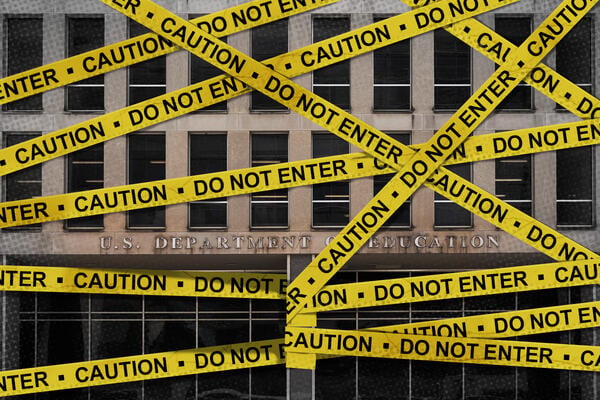
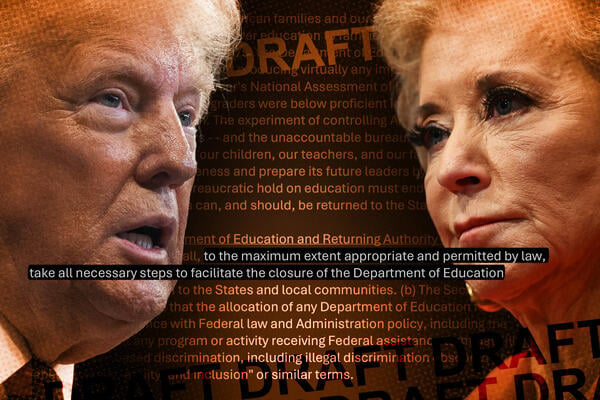
    A draft executive order obtained Thursday by Inside Higher Ed directs the newly confirmed education secretary, Linda McMahon, to “take all necessary steps” to return authority over education to the states and facilitate closure of the Department of Education “to the maximum extent appropriate and permitted by law.”

    If signed, the order—which has been rumored for weeks but is not yet official—would be the first step in carrying out the president’s controversial campaign promise to abolish the 45-year-old department, which he believes is unconstitutional and has grown too large.

    Several media outlets reported Wednesday night that Trump would sign the order as soon as Thursday, but shortly after the news circulated, White House press secretary Karoline Leavitt posted on X, “President Trump is NOT signing an Executive Order on the Department of Education today” and called the reports “fake news.”

    Still, the reports set off a wave of comments from advocates and analysts. Liberals warned that shutting down the Education Department would be devastating for families and students, while conservatives backed Trump’s plan and said the draft order was key to cleaning up the agency.

    McMahon, who took office Monday and will spearhead the closure effort, is supportive of overhauling the agency. She told department staff earlier this week to prepare for a “momentous final mission” to eliminate “bureaucratic bloat” and return education to the states.

    Although vague, the secretary’s memo and the draft executive order give policy experts some idea of what could come next.

    At the very least, they expect to see a major reduction in staff and a diminished federal role in education; some of that work is already underway. The agency has slashed millions in contracts and grants as well as fired dozens of employees. A larger reduction in force is also in the works, fueling concerns among department staff.

    “There is probably not going to be anything in [the order] that isn’t already happening, largely,” said Kelly McManus, vice president of higher education at Arnold Ventures, a philanthropic group. “The secretary’s final mission was clear … so I’m not particularly worked up about the EO specifically, because I don’t think it’s going to fundamentally change that.”

    Abolishing the department would require an act of Congress, which McManus said the draft order appears to acknowledge. She and other experts say any effort to close the department will be lengthy and complicated.

    “This is not a flip-on, flip-off situation here,” she said. “Practically, there will have to be a process … You cannot shut the doors tomorrow and be done.”

    The 416-word draft order gives little detail as to what the “steps” of dismantling the department are or what would happen to certain congressionally mandated programs such as the Pell Grant, the student loan system or the Individuals With Disabilities Education Act. However, the document does say that any funds allocated by the department should comply with federal law, including Trump’s previous orders on diversity, equity and inclusion and transgender athletes—both of which have been caught up in court.

    Neither Trump nor McMahon has so far offered any plan outlining how closing the department would work, though some conservative plans recommend moving the Office for Federal Student Aid to the Treasury and sending the Office for Civil Rights to the Justice Department.

    More than 4,000 people currently work for the department, which was created in 1979 and now has a $80 billion discretionary budget. Each year, the agency issues about $100 billion in student loans and doles out more than $30 billion in Pell Grants.

    Shutting down the department isn’t popular with voters, recent surveys have found. One recent opinion poll found that 61 percent of all respondents “somewhat” or “strongly” opposed the idea of eliminating the department. Another showed that up to 72 percent either opposed the plan or weren’t sure how they felt. That number was 49 percent among Republicans.

    Minimizing a D.C. ‘Footprint’

    Trump has signaled for months, if not years, that he wants to shut down the Education Department, and many analysts have already taken a position on the issue.

    To Michael Brickman, an adjunct fellow at the conservative think tank the American Enterprise Institute, nothing about the draft was a surprise. Like McManus, he noted that much of what the order directs McMahon to do is already underway.

    Brickman expects the next steps will focus on finding new and “better” ways to maintain the department’s core functions as required under law with “less funding, less staff and possibly in conjunction with other agencies.”

    “I don’t think anybody’s talking about cutting major programs,” he said, referencing financial aid services like the Pell Grant and disability protection acts like IDEA. “So the question will be, what is required under law? What can Congress change? And how can the department streamline things to minimize the footprint in D.C.?”

    Shutting down the Education Department likely would be disruptive for colleges and students, advocates say.

    J. David Ake/Getty Images

    McManus stressed that it will be important to protect these core functions, especially the ones related to higher ed, saying it doesn’t make sense to send them back to the states.

    “What is most important is that those core statutory functions have the people, capacity and expertise to be able to do effective oversight of how taxpayer dollars are being spent,” she said. “We are significantly less concerned about where those people sit, as long as there is the ability to safeguard taxpayer investments and to make sure that programs that are statutorily required and that have had long bipartisan support, like Pell Grants, are being effectively implemented.”

    In Brickman’s view, some of the department’s regulatory operations, like analyzing and creating reports on grant or contract applicants and managing third-party accreditors, are simply “make-work.” By hiring hundreds of staff members to execute these tasks, he said, the department pulls tax dollars from local governments and then forces those same communities to spend more writing grant proposals to get it back.

    “There’s just a lot of work and churn that evidence shows does not lead to improved student outcomes,” he said.

    But when asked what the Trump administration has done to convince stakeholders he not only intends to tear down the department but also build it back up again, Brickman didn’t directly answer the question. Instead, he referenced actions of the Biden administration.

    “The Biden administration broke the entire Federal Student Aid system on purpose … They were trying to illegally turn the trillion-plus-dollar portfolio from a loan program into a grant program,” he said. “That is not what the Trump administration is doing. The Trump administration has tried to improve these programs and make them actually work again.”

    Although what Biden did was “unfortunate,” Brickman said, it also creates an opportunity.

    “This mess isn’t being created; it’s being responded to,” he said. “I hope institutions that may be predisposed to oppose anything coming from the Trump administration will welcome this as the end of a failed experiment that just put more restrictions on teaching and learning.”

    Democrats Push Back

    Meanwhile, Democratic lawmakers, student advocacy groups, civil rights organizations and left-leaning think tanks warn that Trump has no intention of rebuilding, only dismantling. The American Federation of Teachers, a key higher ed union, said the order is a government attempt to “abdicate its responsibility to all children, students and working families.”

    Randi Weingarten, the union’s president, recognized in a statement Wednesday night that there are certainly ways the department could be more efficient, but she implied that’s not Trump’s goal.

    “No one likes bureaucracy, and everyone’s in favor of more efficiency, so let’s find ways to accomplish that,” she said. “But don’t use a ‘war on woke’ to attack the children living in poverty and the children with disabilities, in order to pay for vouchers and tax cuts for billionaires.”

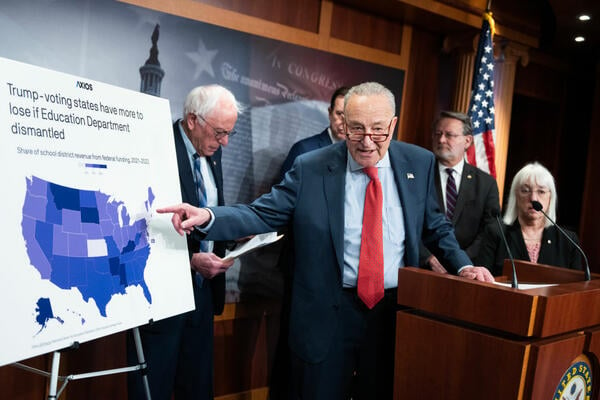
    Senator Chuck Schumer points to a poster board showing a map of the United States with the title "Trump-voting states have more to lose if Education Department dismantled."

    Senate Democrats criticized the pending executive order to abolish the Department of Education as a press conference Thursday.

    Tom Williams/CQ-Roll Call Inc. via Getty Images

    Senator Patty Murray, a Democrat from Washington State, blasted the Trump administration’s plans at a press conference Thursday. She said that Trump and his unelected government efficiency czar Elon Musk “don’t know what it’s like to count on their local public school having the resources to get their kids a great education … And they don’t care to learn why. They want to break the department, break our government, and enrich themselves.”

    To the American Association of University Professors, “dismantling the Department of Education would hasten us into a new dark age.”

    Former Biden under secretary James Kvaal told Inside Higher Ed that the draft order should dispel any notion that Trump is not trying to shut down the department. But at the same time, he said, the GOP administration’s approach to doing so has been “schizophrenic” and “inconsistent.”

    “It can’t be true that students of color and with disabilities will have their civil rights protected, but also the federal government is not going to be involved in those decisions,” he said.

    But at the same time, Kvaal and others note that, ultimately, the Trump administration lacks the legal authority to actually close the Department of Education, making full abolishment more complicated than the president suggests.

    Shuttering the agency would require 60 votes in the Senate as well as a majority in the House, as the department’s existence is written into statute. And with a 53-seat majority in the Senate, Republicans don’t currently have the votes unless some Democrats back the plan.

    “[The Republicans] don’t have the votes to close the department, and they already plan to enforce their plans on DEI, so it’s not clear what the EO adds to that,” Kvaal said. “It’ll get sorted out in the courts.”

    Katherine Knott and Liam Knox contributed to this report.

    Source link

  • College student’s classroom is the farm where he works (CBS Evening News)

    College student’s classroom is the farm where he works (CBS Evening News)

    At a time when college is unaffordable for many, some schools are re-imagining higher education, shifting their curricula from general knowledge to providing free training for specific jobs. Mark Strassmann reports from Merced, California.


    Source link

  • Graduate Student Preferences Webinar | Collegis Education

    Graduate Student Preferences Webinar | Collegis Education

    Your graduate programs should be thriving, but if you’re relying on outdated outreach tactics, you’re leaving enrollments on the table. Today’s grad students expect more personalization, relevance, and connection. And if you’re not aligning with their needs, another institution will. The only way to meet them where they are is by asking the right questions and getting real answers. That’s exactly what Collegis Education and UPCEA did, and now we’re pulling back the curtain to share what we found.

    Unlock Graduate Enrollment Growt
    Proven Strategies for Engaging Graduate Students
    Date
    : April 8, 2025
    Time: 2:00 pm (Eastern) / 1:00 pm (Central)

    Join Tracy Chapman, Chief Academic Officer at Collegis Education, and Bruce Etter, Senior Director of Research & Consulting at UPCEA, for their upcoming webinar “Unlock Graduate Enrollment Growth: Proven Strategies for Engaging Graduate Students.” In this session, they’ll reveal some surprising discoveries about graduate enrollment and the factors that drive impact and growth.

    Walk away with a clear understanding of:

    • graduate student needs and expectations,
    • why grad students disengage during their enrollment journey,
    • what information grad students are willing to give you and when, and
    • how to best communicate and reach graduate students actively evaluating programs. 

    Who should attend:

    • Presidents
    • Provosts
    • Enrollment leaders 
    • Marketing leaders

    At the end, we’ll leave room for questions and conversion, and all attendees will receive a copy of the entire research report. See you on April 8! 

    Source link

  • Trump reportedly set to order dismantling of Education Dept.

    Trump reportedly set to order dismantling of Education Dept.

    This story will be updated.

    President Donald Trump is planning to sign an executive order directing Education Secretary Linda McMahon to “take all necessary steps” to close the agency, The Wall Street Journal and other media outlets reported.

    The president’s order—scheduled to be signed at 2 p.m. in the Oval Office—is the first step in carrying out his controversial campaign promise to abolish the 45-year-old department. A draft of the order provided to Inside Higher Ed criticizes the department for spending “more than $1 trillion without producing virtually any improvement in student reading and mathematics scores.” Trump’s press secretary called reports about the order “fake news.”

    Education advocates have already shown staunch opposition to the executive action. The American Federation of Teachers, a key higher ed union, was one of the first groups to pipe up when the news broke Wednesday evening, calling the order a government attempt to “abdicate its responsibility to all children, students and working families.”

    “The Department of Education, and the laws it is supposed to execute, has one major purpose: to level the playing field and fill opportunity gaps to help every child in America succeed,” union president Randi Weingarten said in a statement. “No one likes bureaucracy, and everyone’s in favor of more efficiency, so let’s find ways to accomplish that. But don’t use a ‘war on woke’ to attack the children living in poverty and the children with disabilities, in order to pay for vouchers and tax cuts for billionaires.”

    The president and his allies have promoted the idea of dismantling the agency since the early days of his 2024 campaign, saying the department has grown too big and interferes in matters best left to local and state authorities. They also argue the agency’s existence violates the Constitution (because the document doesn’t mention education) and is a prime example of federal bloat and excess.

    Read More on Trump’s Plans to Break Up the Department

    Such an order has been rumored for weeks, and higher education officials have been nervously waiting for the shoe to drop since McMahon was confirmed by the Senate Monday afternoon. But the secretary backed plans to break up or diminish the department at her confirmation last month, and shortly after taking office, she wrote to agency staff about their “momentous final mission,” which includes overhauling the agency and eliminating “bureaucratic bloat.” She never did directly use the words “dismantle” or “abolish” but pledged to “send education back to the states.”

    “As I’ve learned many times throughout my career, disruption leads to innovation and gets results,” she wrote. “We must start thinking about our final mission at the department as an overhaul—a last chance to restore the culture of liberty and excellence that made American education great.”

    Eliminating the Education Department and sending key programs such as the Office for Civil Rights to other agencies was a key part of the conservative blueprint Project 2025’s plans to reshape education policy in America. But recent public opinion polls have found support for keeping the agency.

    One survey conducted by the progressive think tank Data for Progress, on behalf of the Student Borrower Protection Center, a left-wing advocacy group, showed that 61 percent of all respondents “somewhat” or “strongly” opposed the idea of eliminating the department. Another poll from Morning Consult, a data-driven insights company, showed that a large chunk of voters—41 percent—actually want to increase funding to the department.

    The order doesn’t mean the department will close tomorrow or even this month, as it calls for the secretary to create a plan to wind down operations. McMahon also told senators during her confirmation that only Congress can shut down the agency altogether.

    Higher Ed Officials Brace for Impact

    As talks about the department’s demise ramped up in recent weeks, lawmakers, student advocacy groups, civil rights organizations and left-leaning think tanks warned how destructive dismantling the department could be.

    Democrats in the House started pushing back on the idea as early as Feb. 10, when they walked directly up to the department’s front doors and demanded a meeting with then–acting education secretary Denise Carter. Denied entry, they argued the department’s existence is key to supporting students with disabilities and making higher education accessible to all.

    That same week, several key senators wrote a letter to the department outlining their “serious concerns” about its actions.

    “We will not stand by and allow the impact that dismantling the Department of Education would have on the nation’s students, parents, borrowers, educators, and communities,” the lawmakers wrote.

    Derrick Johnson, president of the National Association for the Advancement of Colored People, put out a statement expressing similar concerns for students of color just minutes after McMahon was confirmed. The NAACP played a key role in the landmark 1954 Supreme Court case Brown v. Board of Education, which outlawed racial segregation in public schools, and has been a longtime advocate for equality and opportunity in education. He said that protecting the Department of Education is critical, since the agency not only funds public schools, but “enforces essential civil rights laws.”

    “This is an agency we cannot afford to dismantle,” he said.

    On Tuesday morning, EdTrust, a nonprofit policy and advocacy group, said America has reached “a dangerous turning point for public education.”

    “Simply put: If we are truly to reach America’s ‘Golden Age,’ we need to build a better, stronger Department of Education, not tear it down altogether,” the organization wrote in a statement.

    Kevin Carey, vice president of education at New America, a left-leaning think tank, said in a statement that eliminating the department is a “deeply unpopular idea,” citing the organization’s own new polling data.

    The survey found that over all only 26 percent of adults support the department’s closure. And though the Trump administration says it is carrying out the will of the people who elected him to office, barely half of Republicans want closure. Even fewer members of the GOP support the specific consequences of shuttering the department, like moving federal financial aid to an agency with no experience overseeing the program.

    “This is all part of the standard authoritarian playbook for would-be dictators engaged in tearing down democratic institutions,” Carey wrote. Dismantling the department would be “a nihilistic act of civic vandalism, carried out by ideological zealots.”

    Gathering Congressional Support

    But Carey and others also note that, ultimately, the Trump administration lacks the legal authority to actually close the Department of Education, making full abolishment more complicated than the president suggests.

    Shuttering the agency would require 60 votes in the Senate as well as a majority in the House, as the department’s existence is written into statute. And with a 53-seat majority in the Senate, Republicans don’t currently have the votes unless some Democrats back the plan.

    Still, Trump has continued to promote the concept, and red states across the country have backed it. Although the president has not disclosed specific details on how he would try to overcome the political and legal hurdles, higher education policy experts predict he’s likely to leave the skeleton of the department standing while gutting the agency of everything but its statutorily protected duties.

    Conservative groups, most notably the Heritage Foundation, have suggested redistributing responsibilities by moving programs to other agencies. For example, the federal student loan system could be moved to the Treasury, and the Office for Civil Rights could be moved to the Department of Justice.

    Critics of the idea say that such proposals need more specifics that spell out how exactly the plan would work, what programs would stay, which ones would go away and what agencies would take over the department’s responsibilities.

    However, higher ed policy experts from the Cato Institute, a libertarian think tank, say getting rid of the department is “a good idea.” They describe the department as “unconstitutional,” given education is mentioned nowhere in the specific, enumerated powers given to the federal government, and call it “ineffective,” “incompetent,” “expensive” and “unnecessary.”

    The founding fathers chose to exclude dominion over education from the Constitution “because education was believed best left in the hands of parents and civil society—the families and communities closest to the children—and certainly not in a distant national government,” Neal McCluskey, director of Cato’s Center for Educational Freedom, wrote in a policy handbook. “Nearly 60 years of experience with major and, until very recently, constantly expanding federal meddling in K-12 education have proved them right.”

    Source link

  • Why Boycott? Maya Wind on the Case Against Israeli Universities

    Why Boycott? Maya Wind on the Case Against Israeli Universities

    Over the past few years, calls for the boycott of Israeli universities have grown louder. This discourse generally entwines two different sets of arguments. The first is an argument about the effectiveness or validity of academic boycotts.  The second, because it’s Israel, is about whether Israeli universities are being unfairly targeted due to anti-Semitism. Curiously, what Israeli universities themselves might have specifically done to deserve is often relegated to an afterthought.

    My guest today is Maya Wind. She is an Israeli citizen, and a postdoctoral scholar at the University of California Riverside. She is also the author of Towers of Ivory and Steel, How Israeli Universities Deny Palestinian Freedom, published last year by Verso press. Her book is a direct answer to that last question.  The charge sheet that she brings against Israeli universities is a long one. And it should give people pause before thinking that Israeli universities are unproblematic.

    Some of you are not going to like this interview. I suspect some will not enjoy the platform given to these opinions. But given the tenor of the times, I very much think it is worth a listen. I think there are two points in particular that are worth thinking about. The first is whether the boycott is about the universities themselves, or about Israel in general. The second is the standard for boycott. Wind makes it clear that she doesn’t see an absolute standard here other than that some oppressed group requests. So, for her, the relative level of complicity of Israeli universities in the dispossession of Palestinians and, say, that of Chinese universities in the repression of Uyghurs is irrelevant because the key factor is that one group asked for the boycott and the other didn’t. It’s about consistent allyship rather than relative guilt.  That wasn’t something I had understood beforehand, and I’m guessing it might be new for many of you as well. But maybe it’s best if I let my guest explain things on her own. Over to Maya.


    The World of Higher Education Podcast
    Episode 3.22 | Why Boycott? Maya Wind on the Case Against Israeli Universities 

    Transcript

    Alex Usher (AU): Maya, your book lays out the case for sanctions against Israeli universities and for boycotting them. But before we get to that, I want to ask about something you don’t really cover in the book: What’s the evidence that boycotts or academic sanctions are an effective strategy for forcing political change?

    Maya Wind (MW): That’s a really crucial question. First, for listeners who may not be as familiar with the context, the movement for boycott, divestment, and sanctions (BDS) was first called for by Palestinian civil society organizations in 2005—so, 20 years ago now. The BDS movement, including the call for an academic boycott of Israeli universities, was heavily inspired by the movement against apartheid in South Africa. In that case, the isolation of many apartheid institutions, including universities, played a key role in bringing an end to the apartheid system.

    Of course, as academics and students, we are all students of history. If we take seriously the idea that Israel is a settler state and that Israelis are colonizers, then history tells us that colonizers have never initiated the process of decolonization on their own. In every case of settler colonialism, external pressure has been necessary to compel colonizers to participate in that process. The BDS movement is specifically seeking to create that external pressure by building a grassroots international movement to hold the Israeli state—and its universities—accountable.

    PACBI, the Palestinian Campaign for the Academic and Cultural Boycott of Israel, actually predates the broader BDS call by a year. It was formed in 2004 and, even then—21 years ago now—identified Israeli universities as pillars of the system of racial rule and apartheid. As academics, particularly those in the West, we have an obligation to respond to this call by severing our ties to Israeli universities. Otherwise, we remain directly complicit.

    AU: Your charge sheet, if I can put it that way, against Israeli institutions is really threefold. The first major charge—using your words from the epilogue—is that they need to stop denying that their campuses stand on expropriated Palestinian lands and cease to serve as engines of Judaization, colonization, and Palestinian dispossession. What exactly do Israeli institutions do in this regard, and why does it matter so much?

    MW: Right. Here, I’m following not only Palestinian civil society and Palestinian scholars but also Indigenous scholars around the world—particularly in settler states—who have long examined the role of the settler university. These scholars have highlighted how universities have often functioned as pillars of ongoing Indigenous dispossession, built on stolen lands that were cleared through genocide. This is part of a broader, global movement, and there is extensive critical scholarship on this issue in other settler states as well.

    In the context of the Israeli settler state, “Judaization” is actually the official terminology used by the Israeli government. It refers to a process seen in many settler states: the twin projects of continual removal and ethnic cleansing of Palestinians, the transfer of Palestinian land ownership to Jewish Israelis, and the ongoing expansion of Israeli frontiers—redistributing the Jewish population across what was historic Palestine.

    If we trace the history of Israeli universities, this pattern becomes clear. It starts with Hebrew University, the first university of the Zionist movement, and continues with all the universities established by the Israeli state since then. For example, the University of Haifa is in the Galilee, the region with the highest Palestinian population. Ben-Gurion University is in the Negev, an arid southern region where Jewish Israelis were historically less likely to settle. The most recent university to be accredited, Ariel University, is located in the illegal settlement of Ariel, deep in the occupied West Bank.

    For over a century, Israeli universities have been physically designed, built, and strategically located to support the state’s project of Palestinian dispossession, particularly in regions of strategic concern to the Israeli government. Any reckoning with Israeli universities—or settler universities more broadly—must begin with the question of land itself. This is one of the central issues I explore in the book.

    AU: Before I go into the other elements of the charge sheet, you’ve used the term “settler” and “settler colonialism” a couple of times. What distinction, if any, do you draw between the need to boycott Israeli universities, as you argue, and the historical case that could be made for boycotting institutions in Canada or the United States? Why sanction one and not the other?

    MW: That’s a really important question. The first and primary answer is that the Indigenous population most directly impacted by the violence of these settler universities—in this case, Palestinians—have explicitly called for a boycott. A boycott is not a value; it is a tactic. Indigenous movements around the world have used different tactics to advance decolonization, and these tactics change over time and depend on the specific context.

    In this case, more than 20 years ago, the overwhelming majority of Palestinian civil society came together to advance their liberation struggle and issued a call for boycott. They outlined a theory of change, arguing that Western governments—particularly those heavily invested in the Israeli settler state—not only provide arms but also offer diplomatic and legal immunity that allows Israel to continue committing war crimes, including, most recently, the crime of genocide. Given this, they have made it clear that those of us in the international community have an obligation to rise up and pressure our own governments to sever ties and isolate the Israeli regime until the process of decolonization begins and the system of apartheid is dismantled.

    This is a grassroots movement, and we do not need to wait for our governments to act.

    AU: That’s a useful clarification. The second area where you’re most critical is the cooperation between universities on one hand and the military, Shin Bet, and other security services on the other. You write about how the connection between university research and the military in Israel is somewhat different from how it operates in the United States or other countries, partly because research institutes in Israel cooperate so directly with the security sector. What does this military cooperation look like in practice? And is it just about research, or is there also an academic programming element?

    MW: Right. This is a very important question because the collaboration between Israeli universities, the security state, and the military industry is incredibly deep and comprehensive. We see this in several ways.

    First, Israeli universities function as military bases by designing and operating specialized, degree-granting programs tailored for security state personnel, including the Israeli Security Agency (Shin Bet), Israeli police forces, and soldiers. These are the same forces that have engaged in decades of daily violations of Palestinian rights and international law. This is well documented, and these academic programs actively train soldiers and security personnel to refine their operations.

    One example is Hebrew University, where the Department of Islamic and Middle East Studies trains soldiers in the Intelligence Corps, providing them with linguistic and regional expertise to improve their surveillance of the Palestinian population. This training directly contributes to the creation of target banks for airstrikes in Gaza, as we have seen over the past 16 months. That is just one of many examples.

    Another form of cooperation is research and institutional collaborations. The Institute for Criminology at Hebrew University and the Dayan Center at Tel Aviv University work closely with military and security state experts to produce scholarship that advances security operations. Their research informs policy recommendations for the Israeli security establishment.

    A third example is the close ties between universities and military industries. It is not widely known that major arms manufacturers like Rafael Advanced Defense Systems, Israel Aerospace Industries, and Elbit Systems—the largest suppliers to the Israeli military and major global exporters of weapons—were actually founded on Israeli university campuses. These companies develop and refine their technologies by testing them in occupied Palestinian territories, violating international and human rights law daily. They then market these products globally as “battle-proven.” To this day, Israeli universities serve as critical laboratories for these industries.

    In all of these ways, it is impossible to understand the Israeli security state and military-industrial complex without examining the role of the Israeli university system.

    AU: The third charge you discuss is that Israeli universities are not academically neutral—that they do not provide all staff and students with equal opportunities to be protected from outside influence or to thrive academically. We often hear that Israeli universities do not discriminate, but you have a different perspective.

    MW: Yes. One of the things that really struck me while researching and writing this book was the extensive scholarly work that already exists on this issue. I conducted an ethnography of Israeli universities, spending significant time across Israel’s eight major public universities. I spoke with and accompanied Palestinian student organizers, and I interviewed both Palestinian and Jewish Israeli faculty and staff.

    What stood out to me—both in my fieldwork and in my background research—was just how much has already been written about this. There is a rich body of scholarship, not only in Hebrew and Arabic but also in English, often published in leading peer-reviewed journals in Europe and North America. Palestinian scholars, both in Palestinian and Israeli universities, have extensively documented the constraints on knowledge production, the marginalization of Palestinian critical epistemology, and the challenges of producing anti-colonial scholarship within the confines of the Zionist university system. They have also written in detail about the systematic discrimination Palestinian students face and their experiences within these institutions.

    Yet, despite this extensive scholarship, I find that it is largely unread in Western academic communities. This raises important questions about why we, in the West, have failed to engage with this work and why we have instead accepted the narratives presented by Jewish Israeli university administrators and scholars, who often portray Israeli universities as beacons of democracy. In reality, this has never been the case, and Palestinians have been documenting and writing about these inequalities for a very long time. I cite much of this work in my book, and I also corroborated it through my own interviews.

    What I found was not only that Israeli universities are embedded within and implicated in a broader system of apartheid, but also that Palestinian student organizing and political activism on campuses are violently suppressed. This suppression has intensified over the past 16 months, as Palestinian scholars and students speak out against the genocide and mobilize for Palestinian liberation on Israeli campuses.

    Advertisement: Student success, at scale, with a proven ROI of 4.4 times return for universities and colleges. Studiosity’s AI-for-Learning is designed specifically for post-secondary students to develop real skills, critical thinking, agency, belonging, and retention; to empower educators with reporting and insight into learning progress; and to build human connection – made possible with Studiosity’s strictly help-not-answers formative feedback and integrated Humans in the Loop design. In partnership with post-secondary institutions in Canada and around the world, Studiosity is for future-ready graduates and future-ready institutions. With over 200 post-secondary partners and more than 2 million student users, Studiosity is grounded in an academically-driven evidence base, leading the way to increasing life chances for students everywhere. Learn more about the world’s leading, ethical, AI student support at studiosity.com.

    AU: Maya, you’ve discussed issues at several institutions across Israel. You’ve specifically singled out Ariel University for its role in normalizing the occupation and Hebrew University for its failure to protect academic freedom. Are there any institutions that stand out to you as having a better record than others? Is there one that you might say should not be subject to a boycott?

    MW: The call for an academic boycott was laid out by Palestinian civil society and Palestinian scholars. Just last year, in 2023, this call was reiterated by not only the Union of Palestinian Faculty and Employees but also by every single Palestinian student union at every Palestinian university. They reaffirmed their call for us to enact the academic boycott.

    This is a call coming from Palestinian civil society, and as it is worded, it applies to all complicit Israeli universities. In the course of my research, I found that every single Israeli university is deeply implicated in the structures of occupation and apartheid. Not one is exempt.

    At this time, the call remains for a boycott of all Israeli universities, and I hope my book helps to substantiate why that is necessary.

    AU: It sounds to me like the Palestinian call is really about Israel as a whole, rather than specifically about Israeli universities, right? And I have to say, when I read the chapter on the relationship between universities and the military, I thought to myselfI can’t imagine a university in any country—let alone one as highly militarized as Israel—saying no to providing academic training for military officers.

    Universities are instrumental to the state, right? So when we talk about disapproving of university policies, aren’t we really talking about disapproving of Israeli state priorities? Is there any way an individual Israeli institution could change this if it wanted to?

    MW: I think that’s a really critical question. We have to understand—and take seriously—that settler states, systems of violence, and even genocide do not reproduce themselves automatically. These are systems of violence that are upheld by a vast network of institutions, including many in civil society. It is not just the military, not just the security state, and not just military industries. A whole host of public institutions—what we often think of as civil society institutions—lend themselves to this violence of elimination. This case is no different.

    But what we also have to recognize is that it is not just the institutions—it is the people within them who sustain and reproduce these structures. There is the active labor of thousands of Israelis, across hundreds of institutions, including universities, who are making this violence possible.

    What I want to emphasize here is that Israeli academics have tried very hard to have it both ways. The call for an academic boycott has been underway for more than two decades, and one of the main arguments used by Israeli university administrators and academics who oppose it is that they cannot possibly be held accountable for the crimes of the Israeli state—if such crimes even exist, as is still debated within Israeli universities. They claim that it is unjust to hold them responsible for what the state is doing.

    But at the same time, when they are confronted—particularly over the last year—by thousands of students, faculty, and staff participating in the boycott, pointing out that they are directly complicit in apartheid and now genocide, these same university administrators and Israeli academics respond in exactly the opposite way. They say precisely what you just said: Of course, we are embedded in the state. Many of our students are soldiers. Why wouldn’t we cooperate with the state we are a part of?

    They often go even further, offering justifications for genocide and apartheid. So they cannot have it both ways. Either they defend themselves by claiming they are not at all accountable and cannot be implicated in what the state is doing, or they admit that they are, in fact, part of the state—at which point they must also take responsibility for their role in sustaining its system of oppression.

    AU: One argument that emerged in Canada over the last few months—particularly around the end of the encampment at the University of Windsor, if I’m not mistaken—was that the university agreed to boycott Israeli universities as part of a resolution. In response, some argued—I can’t remember if it was Michael Geist or Anthony Housefather in the House of Commons—that if you boycott Israeli institutions but not universities in other countries guilty of similar actions, then that is antisemitic.

    For instance, many of the same criticisms you make about Israeli universities—such as failing to uphold free debate and cooperating with the military—could likely be made about Chinese universities in relation to the government’s policies in Xinjiang or Tibet. What do you make of that argument? Should we also be boycotting Chinese universities? And if not, why not?

    MW: Boycotts—whether organized by unions or any other group—are always made in response to a call. It is not up to us to unilaterally decide to boycott a university system. That decision belongs to the communities directly impacted by the violence of that university system. When such a call is made, it is then up to the international community to assess whether the institutions in question are, in fact, complicit—and to decide whether to participate in the boycott.

    To my knowledge, there has been no such call from other Indigenous communities in similar contexts. There could be, and if there were, I think many of us would absolutely consider participating. But this argument is ultimately a distraction—one that is often pushed by Israel and its Zionist supporters to divert attention from the central issue at hand. The reality is that Palestinians have called for a boycott. Now, it is up to us to assess whether that call is justified and whether we will comply

    AU: You wrote this book prior to October 7, 2023. What has changed since then, both in terms of how Israeli universities behave and in terms of the boycott movement?

    MW: Over the past 16 months, we have seen a devastating acceleration of a project that has spanned over a hundred years. Genocide is structural to the Israeli state, just as it is to settler states elsewhere. For two decades, Palestinian civil society has been telling us that various institutions in Israeli society have long served as part of the infrastructure laying the groundwork for the genocide we have witnessed unfold over the last 16 months—part of the Israeli state’s long-term project to ethnically cleanse Palestine of the Palestinian people.

    My book, which I submitted to the press shortly before this latest acceleration of the genocide began, details many of the ways in which universities are implicated. But it should come as no surprise that this is a structural problem. Israeli universities have continuously worked in service of the state, uninterrupted and ongoing, from before the state’s founding to the present moment—including this phase of the genocide.

    Over the last 16 months, Israeli universities have continued to develop weapons and technologies used against Palestinians in Gaza and the occupied West Bank. They have continued training soldiers and producing Hasbara—Israeli state propaganda—to shield Israel from international criticism. In fact, Israeli universities have actively intervened to prevent academic boycotts from being implemented on Western campuses, smearing student, faculty, and staff organizers, and in some cases, calling for them to be forcibly dispersed. They have also played a direct role in producing legal scholarship to aid the Israeli state in resisting the genocide case brought by South Africa at the International Court of Justice.

    Beyond this, universities have provided tangible benefits to soldiers, offering course credit, scholarships, and special privileges for those returning from Gaza. In countless ways, Israeli universities remain embedded in the infrastructure of violence that sustains the Israeli state, even as that state now stands on trial in the highest courts in the world for genocide.

    If you’re asking what has changed, I think the biggest shift is that more people have now come to recognize what Palestinians have been calling for over the past 20 years: the urgency of intervention. There is an increasing recognition that international civil society must take action and stand with the Palestinian people in their struggle for liberation—and participate in the broader project of decolonization. That is a significant development in the global movement for Palestinian liberation, and we will continue to build on it.

    There is no going back.

    AU: Maya, thanks so much for joining us today.

    MW: Thank you.

    AU: And that just leaves me to thank our excellent producers, Tiffany MacLennan and Sam Pufek, as well as you—our viewers, listeners, and readers—for tuning in. If you have any questions, comments, or concerns, please don’t hesitate to contact us at [email protected]. Folks, please subscribe to our YouTube channel so you never miss an episode of The World of Higher Education.

    Join us again next week when I’ll be joined by Hilligje van’t Land. She’s the Secretary General of the International Association of Universities, located in Paris, and she’ll be talking about the joys of running the world’s oldest transnational university organization. Bye for now.

    *This podcast transcript was generated using an AI transcription service with limited editing. Please forgive any errors made through this service. Please note, the views and opinions expressed in each episode are those of the individual contributors, and do not necessarily reflect those of the podcast host and team, or our sponsors.

    This episode is sponsored by Studiosity. Student success, at scale – with an evidence-based ROI of 4.4x return for universities and colleges. Because Studiosity is AI for Learning — not corrections – to develop critical thinking, agency, and retention — empowering educators with learning insight. For future-ready graduates — and for future-ready institutions. Learn more at studiosity.com.

    Source link

  • A taste for the good life

    A taste for the good life

    Postcard views, luxurious watches, delicious cheese and chocolate — the country that comes to mind is idyllic Switzerland in central Europe.

    But this seemingly perfect country comes at a price: its high cost of living. According to Coop and Carrefour, two leading supermarket chains in Switzerland and France, one chocolate bar in Switzerland costs more than one and a half times as much as the same chocolate bar in neighbouring France. 

    “The price of chocolate with regards to its quality in Switzerland is fair and for me worth paying,” said Andrina Deragisch, a 17-year-old student of Kantonsschule Zürich Nord, a Swiss high school. 

    Chocolate’s price is affected by various factors, most importantly the price of the cocoa bean. Nowadays that is at an all-time high due to climate change, plant-affecting pests in Africa and East Asia and packaging prices and taxes. Its price is four to five times higher than a year ago, according to Migros, the second-largest retail company in Switzerland. But what makes the difference in Switzerland? 

    “The most significant factor is the labour,” says Richie Gray, global head of SnackFutures, the Corporate Venture Capital Hub of Mondelez that invests in businesses in the snack industry. 

    How much would you pay for a chocolate bar?

    Workers in Switzerland are paid well, which makes them able to keep up with the high cost of living. This leads to a high-end price of chocolate in comparison to neighbouring countries. To avoid such high labour costs, Mondelez moved Toblerone’s production to Slovakia in 2023, imitating various international companies such as Nestlé and Barry Callebaut, that have shifted a great part of their production operations to Eastern Europe and Asia. 

    According to the 2017Swiss Manufacturing Survey from the University of St. Gallen, 46% of the interviewed firms are considering outsourcing parts of their manufacturing operations to China, Germany or Eastern Europe. 

    As a result, the Swiss manufacturing industry is seeing rising unemployment; the number of jobs has already fallen by 10% since 1990, and lower taxes from the international companies to Swiss authorities. In further development this leads to reduced purchasing power of customers and state incomes, weakening the country’s economy.  

    According to data from the Federal Statistical Office and the National Institute for Statistics and Economic Studies, the average Swiss person earns a little over 6,750 Swiss francs (CHF) monthly whereas in France, average wages are about 2,570 CHF a month. Switzerland counts as one of the best-earning countries in the world, creating a high-quality of life for its population.  

    According to Human Development Reports, Switzerland’s Human Development Index placed first among the whole world, providing wealth, comfort, material goods and exceptional healthcare and education. 

    A strong labour market

    High productivity and competitiveness shape the Swiss labour market, said Christian Gast, chief economist at Swissrock, an asset management company based in Zurich. “Switzerland is considered to be fully employed, with only 1.3% of the entire population having no job,” he said. 

    The demand for labour results in high pay. Moreover, when people earn more, they have more money to spend on products like chocolate. 

    Another factor is the strong Swiss franc. The European Central Bank reports that the exchange rate between the Swiss franc and the euro has constantly increased from 0.87 EUR per Swiss franc in 2018 to around 1.06 EUR per Swiss franc today.

    “If you’re coming from another country, you need more of your own currency to buy a Swiss franc,” Gast said.

    But what makes the Swiss currency so strong?  

    “Our fiscal policy is strongly regulated,” Gast said. “This means the expenses of the government are largely balanced with its incomes.”

    An attractive place for money

    If there is a stable relationship between expenses and income, there is little debt result and interest rates remain low. This makes Switzerland attractive to international investors. Purchases are made within the country, boosting its economy and simultaneously its prices. 

    However, where does Switzerland’s well-working economy with excessive prices for services and products originate from? The small country in the heart of Europe with no environmental advantages developed into a financial powerhouse with banks as its mines.

    According to the Swiss Bankers Association, Swiss banks held over a quarter of all assets present in all the banks across the globe in 2018. This means that 27.5% of global revenue, amounting to US.$6.5 trillion was stored in Swiss banks. 

    “There are barely any countries with more international banks than Switzerland,” Gast said. Since World War II, countless wealthy people have chosen to store their money in Swiss banks as Switzerland has a proven track record for its secrecy, neutrality and stable political system. 

    But wouldn’t there be frustration towards such high living costs among the population? On average, prices in Switzerland are 58.4% times higher than in the rest of the countries in the European Union. Consider that in the United States, Donald Trump won a second term as president in part because he promised lower prices and affordable living costs. However, Swiss people tend to accept the high prices in the country since the quality of life is also so high.  

    Additionally, the inflation rates in Switzerland are low — the price level has been relatively constant or only increasing minimally. According to the Federal Statistical Office, inflation rates were only at 1.1% in 2024, whereas in the United States it was at 2.9% in December 2024. People in the United States are displeased with the sudden higher prices which means they want a solution to solve this. At the same time, Swiss people have not experienced a drastic change and therefore are not as keen to make prices lower.  

    As Swiss people consume around 10kg of chocolate per person each year, there’s no doubting its popularity. We are both very fond consumers of Swiss chocolate and eat at least one bar of chocolate a week. The sweetness and comforting feeling of chocolate melting on your tongue is a sensation nobody can resist. 

    Source link

  • Peter Elbow was right about teaching writing

    Peter Elbow was right about teaching writing

    In the New York Times obituary of Peter Elbow, the giant of composition studies, he is said to have “transformed freshman comp,” which he definitely did, but also, maybe not?

    Even as someone who has done his fair share of thinking and writing about teaching writing, I did not realize that his landmark book, Writing Without Teachers, was first published all the way back in 1973. For sure, the approach to writing he advocated for in Writing Without Teachers and subsequent books challenged the prevailing dogma of academic writing by emphasizing freedom, student agency and audience above correctness and authority, but to consider the full import of Elbow’s message and compare it to what happens in writing classrooms, it’s tough to see a full “transformation” at work.

    At the time I started teaching freshman composition as a graduate TA (1994), I had never heard of Peter Elbow, and none of the people tasked with preparing me for the job introduced me to his work. In fact, I would not encounter Elbow until 2001, when I expressed frustration with teaching through the lens of rhetorical “modes” and how I wished that I could get students writing more freely and authentically because I was tired of reading performative B.S. written for a grade.

    “You should try Peter Elbow,” I was told. I did, and it was like the clouds suddenly parted and I could see the sun for the first time. Anyone who teaches writing as a process, who uses peer review and reflection, is working from Elbow-ian DNA. This surely fits any definition of transformation, doesn’t it?

    But also, why was I not introduced to Peter Elbow as a beginning writing teacher? Why, at the time I did discover him, were departments still teaching rhetorical modes, or composition as (essentially) essays responding to literature?

    In hindsight, I can tell that Elbow’s views on writing must have had a significant impact on the kind of writing I was asked to do in school and how I did it. I’ve written extensively how my grade school teachers of the 1970s privileged creativity and writing problem solving over correctness, engendering a lifelong curiosity about how writing works.

    But by the time I was a teacher, it seems as though whatever transformation Elbow had caused had been beaten back, at least to some degree. Focus on process and revision remained, but this process was deployed in the making of very standard, significantly prescriptive artifacts that were easy to explain, straightforward to grade—as they fit established rubrics—and (at least in my experience) largely uninteresting to read and (in the experience of many students) uninteresting to write.

    It isn’t surprising that attempts at giving students room to maneuver, which make it difficult to compare them to each other or standards of sufficiency, are resisted by those who prefer order to exploration. The most popular composition textbook of recent years is They Say/I Say (well over a million copies sold) a book that literally coaches students to write using Mad Libs–style templates to imitate forms of academic writing, under the theory students will learn academic expression through osmosis.

    Having tried this book for half a semester, I understand its appeal. It’s really just a more refined version of the prescriptive process I used in the 1990s teaching rhetorical modes. If your primary goal is to have students turn in an artifact that resembles the kind of writing that would be produced through a scholarly process, it is very handy.

    If the goal is to get students to think like scholars or go through a process that requires them to wrestle with the genuine challenges of academic inquiry and expression, it is a lousy choice. These are simulations of academic artifacts, predating the simulations now easily created by large language models like ChatGPT.

    The orderly logic of “schooling” seems to repeatedly win over the mess and chaos of learning. Elbow argued that discovery and differentiation was the highest calling of the learning process, and that writing was an excellent vehicle for fulfilling this calling. This requires one to get comfortable with discomfort. For some reason this is serially viewed as a kind of threat to school, rather than what it should be, the focus of the whole enterprise.

    The New York Times obituary calls Elbow’s approach a “more reflective and touchy-feely process,” which I read a signal as to the lack of rigor of the approach, but in truth, it’s the opposite. There’s nothing particularly rigorous about compliance, particularly when enforced by an authority above with all the power, like a teacher wielding their grade book.

    As I’ve found over and over in my career, including weekly in this space for the last 13 years, there is nothing more demanding than being asked to deliver a thought that could only come from your unique intelligence. There is also nothing more interesting for both the writer and the reader.

    Ultimately, I evolved in ways that make me not quite a full Elbow-ian. The experiences in The Writer’s Practice are structured in ways that do not quite square entirely with Writing With Teachers, though even as I write this sentence, I cannot help but note that calling the assignments in the book experiences, and the fact that I wrote the book in such a way that it could be engaged in the absence of a teacher, suggests that maybe the gap isn’t as wide as I perceive.

    While I was working on the manuscript of what would come to be called More Than Words: How to Think About Writing in the Age of AI, I would play around with possible titles, as the title on the proposal—“Writing With Robots”—was used for the purpose of getting attention for a book proposal, not something that genuinely reflected the sentiments of the book I planned to write.

    One of the titles I considered was “Everyone Should Write,” a reference to one of Elbow’s later collected volumes, Everyone Can Write.

    One of the gifts of the existence of large language models has been to demonstrate the gap between machine prose and that which can be produced by a unique human intelligence. In a way, this only revalidates Elbow’s original insights of Writing Without Teachers, that we, as humans, have a higher purpose than producing school artifacts for a grade.

    I’m not giving up hope that we can accept this gift.

    Source link