The Trump administration on Wednesday ordered federal agencies to start preparing for “large-scale reductions in force,” the latest step in a broader effort to dramatically reduce the federal workforce.
The memo from the Office of Management and Budget and Office of Personnel Management applies to all federal departments, and the Department of Education could face heavy cuts as a result of Trump’s promise to “sweepingly reform” what he calls a “bloated, corrupt federal bureaucracy.”
The president has repeatedly talked about shutting down the Education Department, and this memo’s orders could give him an opportunity to diminish the agency. Specifically, the OMB document tells agency heads to eliminate all “non-statutorily mandated functions”—an action proponents of abolishing the department have supported.
The OMB memo cites an executive order, “Implementing The President’s ‘Department of Government Efficiency’ Workforce Optimization Initiative,” that was signed Feb. 11 as justification and directed agencies to submit a reorganization plan by March 13.
“Pursuant to the President’s direction, agencies should focus on the maximum elimination of functions that are not statutorily mandated while driving the highest-quality, most efficient delivery of their statutorily-required functions,” wrote OMB director Russell Vought and Charles Ezell, the acting director of the Office of Personnel Management. “Agencies should also … implement technological solutions that automate routine tasks while enabling staff to focus on higher-value activities … and maximally reduce the use of outside consultants and contractors.”
The memo notes that reduction should not impact positions necessary to meet border security, national security or public safety responsibilities, nor should it affect agencies or services that are directly provided to citizens “such as Social Security, Medicare, and veterans’ health care.”
A North Carolina woman will face up to 20 years in prison after admitting that she scammed the Department of Education out of $5 million in financial aid, USA Today reported.
Cynthia Denise Melvin pleaded guilty Wednesday to conspiring with dozens of “straw students” through an elaborate, seven-year scheme, federal court records show. Melvin applied to colleges on the students’ behalf, submitted the Free Application for Federal Student Aid for them, and even went so far as to impersonate the students so it appeared they were attending class and completing assignments, according to charging documents. All the while, she pocketed any leftover aid dollars, giving a small portion to the individuals she was impersonating.
Melvin was charged with conspiracy to commit wire fraud. In addition to her time in prison, she will face three years of supervised release and be required to pay a $250,000 fine, as well as restitution.
The scam is among the biggest “straw student” schemes in years, according to a USA Today review of Department of Justice news announcements.
The clock is running out on colleges as they mull how to respond to a sweeping federal order to end all race-based policies and programs.
In the face of an imminent Friday night deadline, college leaders are scrambling to determine how to navigate the Feb. 14 Dear Colleague letter issued by the Education Department’s Office for Civil Rights, which declares all race-based educational programs and policies discriminatory and illegal. When they sent the letter on Valentine’s Day, department officials gave institutions two weeks to comply or face investigations and, possibly, the loss of federal funding.
Institutions aren’t going to lose federal funding overnight. The investigative process is notoriously lengthy, and the Education Department has never revoked a college’s federal funding over civil rights concerns. The OCR may also be rendered impotent, at least temporarily, if a judge decides to halt enforcement while considering a lawsuit filed Tuesday challenging the letter.
But college leaders are anxious about the threat of federal funding cuts, which would be catastrophic for the majority of postsecondary institutions. Ray Li, who previously worked as an attorney at the Office for Civil Rights, said he expects the office to launch investigations shortly and that many colleges will buckle under the pressure, shedding practices that fostered campus diversity and belonging.
For now, colleges seem to be taking a slow and cautious approach, removing language about race and DEI buzzwords from the names of programs and launching internal policy reviews.
University of Nebraska president Jeffrey P. Gold said system campuses are in the midst of a comprehensive review of programs and policies, but no changes have been made yet. The Nebraska Board of Regents discussed possible tweaks to its bylaws at a recent board meeting, like removing references to “cultural diversity” and revising language on equal opportunity in employment, but no final decisions were made.
Gold said that as the review process continues, he doesn’t expect to “turn up anything that looks or feels like discrimination,” as the letter describes.
But it’s possible “we will turn up some things that require some language changes or possibly some changes in titles, changes in offices … that could be misinterpreted by the Department of Education just because of [the] use of specific terminology.”
He added that Nebraska banned affirmative action in 2008 and the state’s second attempt at an anti-DEI bill is pending in the Legislature, so “we have been changing websites [and] titles for years—that’s why I believe that there’s nothing substantive that we really have to change at this time.”
The University of Montana undertook a similar compliance review that tasked senior administrators with assessing whether their departments had any policies or practices at odds with the Dear Colleague letter.
“We made the decision to be as thorough as possible,” said Dave Kuntz, the university’s director of strategic communications. The review, however, led to “very minimal changes and really no changes at a programmatic or operational level.”
University leaders over all concluded that the institution was already in compliance, though some programs, like the Women’s Leadership Initiative, chose to tweak their webpages to clarify that they don’t bar anyone who wants to participate.
A spokesperson for the Education Department did not respond to multiple questions from Inside Higher Ed in time for publication.
The University of Colorado removed all references to a former DEI office and replaced them with a website for a new “Office of Collaboration.” The University of Pennsylvania scrubbed the websites for all 16 undergraduate and graduate schools of DEI keywords and removed references to diversity and affirmative action from its nondiscrimination policies.
Shaun Harper, a professor of education, business and public policy at the University of Southern California, said he’s been disappointed that higher ed leaders are heavily revising their institutions’ online presences in the hopes that it will appease the OCR—a project he believes will prove futile. In the Dear Colleague letter, acting assistant secretary for civil rights Craig Trainor specifically warned against using “proxies for race” and promised to investigate race-neutral programs that “discriminate in less direct, but equally insidious, ways.”
“Scrubbing websites, launching reviews—these are the easy things to do while colleges are in ‘wait and see’ mode, to find out if that will take the target off their backs,” said Harper, an Inside Higher Ed contributor who authored a blog post last week recommending ways colleges can fight back against the Dear Colleague letter. “I think it’s both weak and reckless.”
Some institutions have gone one step further. Colorado State University issued a statement in which leaders simultaneously maintained that its policies are already race-neutral and promised to do more to comply with the new federal directives.
“The new administration’s interpretation of law marks a change,” the statement reads. “Given the university’s reliance on federal funding, it is necessary to take additional steps.”
And one day before the deadline, Ohio State University president Ted Carter announced the institution would shutter two DEI offices and eliminate more than a dozen staff positions, some of the most dramatic measures a college has taken during the new Trump administration.
In a particularly telling move, OSU’s Office of Institutional Equity will be renamed the Office of Civil Rights Compliance to “more accurately reflect its work,” according to an email sent to students Thursday.
‘We’ve Seen This Film Before’
For a glimpse of how anti-DEI compliance battles might play out between institutions and policymakers, consider the red states that have passed laws mandating similar cuts to race-conscious programs.
“We’ve seen the prequel to this film before in Texas,” Harper said. “When that Senate bill was looming, many institutions thought they were very smartly getting ahead of it by just renaming things. That proved to be a failed strategy, and I very comfortably predict that some version of that will also happen nationally.”
In some states, the “review and revamp” strategy for avoiding DEI crackdowns appeared to work for a while. The University of Arkansas eliminated its DEI office in June 2023 in part to pre-empt a bill that state lawmakers were considering to force spending cuts. And last year, the University of North Carolina system Board of Trustees passed an anti-DEI resolution just as legislation was gaining steam to mandate enforcement from the state; that legislation was never brought to a full vote.
But circumstances have changed as the Trump administration launches direct attacks on DEI. Arkansas governor Sarah Huckabee Sanders signed a law earlier this month that will “prohibit affirmative action and preferential treatment in state-supported institutions,” including public colleges like the University of Arkansas. Even in Texas, where public universities underwent broad layoffs and spending cuts in response to state legislation, lawmakers have threatened to cut $400 million in higher ed funding unless colleges do more to comply.
“If they don’t kick DEI out of their schools, they’re going to get a lot less,” Texas lieutenant governor Dan Patrick said at a policy forum last week.
What Happens Next?
Legal experts say it’s unclear what will happen after the OCR’s deadline passes. The Dear Colleague letter promised more detailed guidance, but none has materialized.
“We’re kind of all in agreement that [the letter] is really confusing and overbroad, and the timeline is really outrageous,” said Andrea Stagg, director of consulting services at Grand River Solutions, a company that works with colleges on legal compliance issues. She noted that many underresourced colleges don’t have in-house legal teams to assess their risk by the deadline.
“What actually happens after tomorrow? How fast will it be?” she said Thursday. “I don’t know.”
Typically, the Office for Civil Rights opens investigations based on complaints from students, families or legal advocates, but it can also launch its own direct investigations. Most cases end with a voluntary resolution, in which the institution agrees to make certain changes. But unresolved cases can be referred to the U.S. Department of Justice for litigation.
Li believes the OCR will likely receive complaints from anti-DEI groups as well as open some direct investigations into higher ed institutions with race-based scholarships, affinity group graduation ceremonies or other practices called out by the letter, starting next week. (He pointed out that the current OCR has already launched some direct investigations into universities related to Title IX.)
But that doesn’t mean the day after the Dear Colleague deadline “schools are just going to lose all their federal funding”—assuming normal procedures are followed, he said. Such investigations can take months, even years.
An investigation reaching the point of litigation is also “an incredibly rare step that, under most administrations, pretty much never happens,” Li said. And the Department of Education taking away federal funding over an OCR investigation would be completely unprecedented.
“But, also, rare things are happening right now,” Li conceded.
Stagg said it’s hard to tell to what extent normal processes will be followed, or how much the Department of Government Efficiency’s reductions to the federal workforce could affect investigations.
“There is a real question as to who will do these investigations” and how the OCR will choose institutions to focus on, she said. “Is there going to be an AI tool to search [college] websites for certain terms, the way we saw with the flagging of grants? It could be that the president has a bad interaction at a meeting with a leader and then they are targeted for investigation.”
An Education Department spokesperson did not respond to questions about planned investigations, agency capacity and enforcement mechanisms in time for publication.
It’s also unclear how much resistance colleges will put up. Li believes there’s a strong case to be made that some of the practices targeted in the Dear Colleague letter are perfectly legal. Higher ed institutions under investigation could refuse to make changes and go head to head with the Department of Justice. But they’d be signing up for an onerous, likely expensive process that puts their funding in jeopardy.
“The question is, is anyone willing to litigate it?” Li said.
Even if the Dear Colleague letter is rescinded, Li said the Office for Civil Rights has clearly signaled its plans for the next four years, and he believes higher ed institutions will continue working to rid themselves of anything that could attract scrutiny.
“I think there’s going to be an overcorrection,” he said. “It is going to lead to some perfectly legal programs that support fostering racially inclusive communities on campus being taken away.”
Conversations over students using artificial intelligence to cheat on their exams are masking wider discussions about how to improve assessment, a leading professor has argued.
Phillip Dawson, co-director of the Centre for Research in Assessment and Digital Learning at Deakin University in Australia, argued that “validity matters more than cheating,” adding that “cheating and AI have really taken over the assessment debate.”
Speaking at the conference of the U.K.’s Quality Assurance Agency, he said, “Cheating and all that matters. But assessing what we mean to assess is the thing that matters the most. That’s really what validity is … We need to address it, but cheating is not necessarily the most useful frame.”
Dawson was speaking shortly after the publication of a survey conducted by the Higher Education Policy Institute, which found that 88 percent of U.K. undergraduates said they had used AI tools in some form when completing assessments.
But the HEPI report argued that universities should “adopt a nuanced policy which reflects the fact that student use of AI is inevitable,” recognizing that chat bots and other tools “can genuinely aid learning and productivity.”
Dawson agreed, arguing that “assessment needs to change … in a world where AI can do the things that we used to assess,” he said.
Referencing—citing sources—may be a good example of something that can be offloaded to AI, he said. “I don’t know how to do referencing by hand, and I don’t care … We need to take that same sort of lens to what we do now and really be honest with ourselves: What’s busywork? Can we allow students to use AI for their busywork to do the cognitive offloading? Let’s not allow them to do it for what’s intrinsic, though.”
It was a “fantasy land” to introduce what he called “discursive” measures to limit AI use, where lecturers give instructions on how AI use may or may not be permitted. Instead, he argued that “structural changes” were needed for assessments.
“Discursive changes are not the way to go. You can’t address this problem of AI purely through talk. You need action. You need structural changes to assessment [and not just a] traffic light system that tells students, ‘This is an orange task, so you can use AI to edit but not to write.”
“We have no way of stopping people from using AI if we aren’t in some way supervising them; we need to accept that. We can’t pretend some sort of guidance to students is going to be effective at securing assessments. Because if you aren’t supervising, you can’t be sure how AI was or wasn’t used.”
He said there are three potential outcomes for the impact on grades as AI develops: grade inflation, where people are going to be able to do “so much more against our current standards, so things are just going to grow and grow”; and norm referencing, where students are graded on how they perform compared to other students.
The final option, which he said was preferable, was “standards inflation,” “where we just have to keep raising the standards over time, because what AI plus a student can do gets better and better.”
Over all, the impact of AI on assessments is fundamental, he said, adding, “The times of assessing what people know are gone.”
With the major challenges facing UK higher education at present, it is perhaps hardly surprising that many in the sector are concentrating on the short term. Survival rather than strategy is the order of the day. Higher education institutions (HEIs), though, are fundamentally long-term operations which educate students and undertake research intended to benefit society for many years to come.
Indeed, they embody what has been labelled ‘cathedral thinking’, that is, a long-term activity which is ultimately for the good of future generations. There is a real risk, though, that the short-termism endemic in institutions and wider society will undermine this core attribute of HEIs.
Here and now
The UK higher education sector is, arguably, facing some of the biggest challenges it has for generations. Coping with the consequences of the Covid-19 pandemic in 2020 and the worldwide recession following the 2007-08 financial crisis was hugely difficult, but they feel, in hindsight, somehow to be less problematic than where we are now.
Everyone is focused on survival, on getting through the next month, the next term, the next academic year. Certainly there is much lobbying going on from Universities UK, Vice-Chancellors and sector groupings to seek to persuade the government to do the right things for the sector in the forthcoming 2025 spending review. But, as the THE reported in garnering sector views on the year ahead, there is a great deal of uncertainty. Nick Hillman, quoted in the article, notes that the nature of politics, which HEIs are currently grappling with, is ‘a dirty, mucky, short-term, quick-fix sort of business.’
While Universities UK’s Vivienne Stern believes that many HEIs have already made or begun to make the difficult changes required to cope with the challenges ahead, the longer-term investments in infrastructure and facilities which are required to sustain and develop a world-class higher education offer remain somewhere in the future.
At times of great challenge, it is difficult to look beyond the immediate problems, the in-your-face issues which just have to be addressed, or there might be no future. Higher Education institutions should be well-placed to take longer-term views of everything and not be distracted by temporary turbulence. Many have been around for centuries in one form or another and have found ways to survive even when times were really, really tough. And yet it does feel that in common with just about every other organisation, HEIs are focused very much on the short term.
Planning the long game
However, so much in an HEI has to be viewed as long-term. Decisions around the development of the estate, research priorities, student recruitment and fundraising all require plans and commitment to sustained investment over the years.
Whilst strategic planning is often the subject of cynicism or even mockery in HEIs and strategies are easily critiqued as being very similar, they serve a really important purpose in drawing the institutional community’s attention to the need to consider the components of the long-term success of the enterprise. Strategic plans also provide a framework for decision-making and a set of markers to ensure that the long term is not forgotten in all of the current noise and turbulence. This feels more important now, given societal trends of focusing only on the immediate issues and the current challenges facing the sector.
Cathedral thinking
HEIs have all the ingredients to ensure they balance short-term needs and longer-term priorities. The nature of education and research dictates a different perspective. Private sector companies frequently beat themselves up about this kind of thing and try to find ways to move away from a model which demands a relentless focus on short term profitability at the expense of long-term success.
The idea of cathedral thinking, of delivering for future generations rather than just the current shareholders, has gained some purchase recently as companies have sought to develop a sense of purpose beyond just profit and be clearer with their investors what the long-term plan is. They have also sought to clarify longer-term goals and measure progress towards them whilst developing a culture which is focused on the long term. Universities and colleges are here already.
The worry is, though that they are being pushed in the other direction, towards the short term rather than the more distant future. Indeed, governing bodies are often dissatisfied with the kind of key performance indicators that institutions generate, which are inherently longer-term. Most of them change on an annual basis at best, and some of them, such as the Research Excellent Framework or Teaching Excellence Framework outcomes, are only reported over a much longer timescale.
As an aside, one of the important examples of taking a long-term view is in the appointment of staff. Careful and considered appointments are fundamentally long-term decisions. Many years ago when I worked at the University of Warwick, the ethos in appointing new administrators was very much about the long term. This was articulated, quaintly as it now seems, as ‘do they have a registrar’s baton in their knapsack?’ but the long-term view was clear in relation to the potential of appointees.
Universities and colleges should be really good at this. Not only is the fundamental service offered a long-term one, but everyone spends ages every few years developing strategic plans, which are just that, plans setting out the strategic, long-term ambitions for the university. These are usually the product of substantial dialogue across the institution and with governing bodies and external stakeholders.
Planning and punching
As Mike Tyson famously said when asked whether he was worried about the plan Evander Holyfield was said to have for their forthcoming fight: ‘Everyone has a plan until they get punched in the mouth.’ It’s not a hugely original comment, even in boxing, and echoes the old military adage that ‘no plan survives first contact with the enemy.’ Finding a way both to respond to the immediate shock or issue and to consider the actions which will serve best for long term success is challenging. But it is essential if everything is not to be about just dealing with what is in your face (literally or metaphorically) right now and that your plans can be flexed to cope with the new reality.
HEIs have to take a long-term view, but that is difficult when governments struggle to see beyond the next stage in the current election cycle. This is the dirty and mucky nature of politics described by Hillman. To ensure long-term certainty, universities and colleges ultimately have to take more into their own hands. This means a more vigorous defence of institutional autonomy while at the same time engaging with government priorities. It also means finding new ways to collaborate and to push back against the tide of excessive and burdensome regulation. Above all, though, it means taking the long-term view – cathedralic higher education.
SALT LAKE CITY — Nineteen-year-old Nevaeh Parker spent the fall semester at the University of Utah trying to figure out how to lead a student group that had been undercut overnight by matters far beyond student control.
Parker, the president of the Black Student Union, feared that a new Utah law banning diversity, equity and inclusion efforts at public colleges had sent a message to students from historically marginalized groups that they aren’t valued on campus. So this spring, while juggling 18 credit hours, an internship, a role in student government and waiting tables at a local cafe, she is doing everything in her power to change that message.
Because the university cut off support for the BSU — as well as groups for Asian American and for Pacific Islander students — Parker is organizing the BSU’s monthly meetings on a bare-bones budget that comes from student government funding for hundreds of clubs. She often drives to pick up the meeting’s pizza to avoid wasting those precious dollars on delivery fees. And she’s helping organize large community events that can help Black, Asian and Latino students build relationships with each other and connect with people working in Salt Lake City for mentorship and professional networking opportunities.
Nineteen-year-old University of Utah student Nevaeh Parker is working hard to keep the Black Student Union going after the organization lost financial support. Credit: Image provided by Duncan Allen
“Sometimes that means I’m sacrificing my grades, my personal time, my family,” Parker, a sophomore, said. “It makes it harder to succeed and achieve the things I want to achieve.”
But she’s dedicated to keeping the BSU going because it means so much to her fellow Black students. She said several of her peers have told her they don’t feel they have a place on campus and are considering transferring or dropping out.
Utah’s law arose from a conservative view that DEI initiatives promote different treatment of students based on race, ethnicity, gender or sexuality. House Bill 261, known as “Equal Opportunity Initiatives,” which took effect last July, broadly banished DEI efforts and prohibited institutions or their representatives speaking about related topics at public colleges and government agencies. Violators risk losing state funding.
Now President Donald Trump has set out to squelch DEI work across the federal government and in schools, colleges and businesses everywhere, through DEI-related executive orders and a recent “Dear Colleague” letter. As more states decide to banish DEI, Utah’s campus may represent what’s to come nationwide.
Related: Interested in more news about colleges and universities? Subscribe to our free biweekly higher education newsletter.
Because of the new state law, the university last year closed the Black Cultural Center, the Center for Equity and Student Belonging, the LGBT Resource Center and the Women’s Resource Center – in addition to making funding cuts to the student affinity groups.
In place of these centers, the university opened a new Center for Community and Cultural Engagement, to offer programming for education, celebration and awareness of different identity and cultural groups, and a new Center for Student Access and Resources, to offer practical support services like counseling to all students, regardless of identity.
For many students, the changes may have gone unnoticed. Utah’s undergraduate population is about 63 percent white. Black students are about 1 percent, Asian students about 8 percent and Hispanic students about 14 percent of the student body. Gender identity and sexuality among students is not tracked.
For others, however, the university’s racial composition makes the support of the centers that were eliminated that much more significant.
In response to a new state law that broadly banned diversity, equity and inclusion efforts, the University of Utah closed its Center for Equity and Student Belonging, the Black Cultural Center, the Women’s Resource Center and the LGBT Resource Center. Credit: Olivia Sanchez/The Hechinger Report
Some — like Parker — have worked to replace what was lost. For example, a group of queer and transgender students formed a student-run Pride Center, with support from the local Utah Pride Center. A few days a week, they set up camp in a study room in the library. They bring in pride flags, informational fliers and rainbow stickers to distribute around the room, and sit at a big table in case other students come looking for a space to study or spend time with friends.
Lori McDonald, the university’s vice president of student affairs, said so far, her staff has not seen as many students spending time in the two new centers as they did when that space was the Women’s Resource Center and the LGBT Resource Center, for example.
“I still hear from students who are grieving the loss of the centers that they felt such ownership of and comfort with,” McDonald said. “I expected that there would still be frustration with the situation, but yet still carrying on and finding new things.”
One of the Utah bill’s co-sponsors was Katy Hall, a Republican state representative. In an email, she said she wanted to ensure that support services were available to all students and that barriers to academic success were removed.
“My aim was to take the politics out of it and move forward with helping students and Utahns to focus on equal treatment under the law for all,” Hall said. “Long term, I hope that students who benefitted from these centers in the past know that the expectation is that they will still be able to receive services and support that they need.”
The law allows Utah colleges to operate cultural centers, so long as they offer only “cultural education, celebration, engagement, and awareness to provide opportunities for all students to learn with and from one another,” according to guidance from the Utah System of Higher Education.
Given the anti-DEI orders coming from the White House and the mandate from the Department of Education earlier this month calling for the elimination of any racial preferences, McDonald said, “This does seem to be a time that higher education will receive more direction on what can and cannot be done.”
But because the University of Utah has already had to make so many changes, she thinks that the university will be able to carry on with the centers and programs it now offers for all students.
Research has shown that a sense of belonging at college contributes to improved engagement in class and campus activities and to retaining students until they graduate.
“When we take away critical supports that we know have been so instrumental in student engagement and retention, we are not delivering on our promise to ensure student success,” said Royel M. Johnson, director of the national assessment of collegiate campus climates at the University of Southern California Race and Equity Center.
Creating an equitable and inclusive environment requires recognizing that there is no one-size-fits-all approach to supporting students, said Paulette Granberry Russell, president of the National Association of Diversity Officers in Higher Education. A student who grew up poor may not have had the same opportunities in preparing for college as a student from a wealthy or middle-class family. Students from some minority groups or those who are the first in their family to go to college may not understand how to get the support they need.
“This should not be a situation where our students arrive on campus and are expected to sink or swim,” she said.
Student Andy Whipple wears a beaded bracelet made at a “Fab Friday” event hosted by the LGBT Resource Center at the University of Utah. The LGBT Resource Center was closed recently to comply with a new state law that limits diversity, equity and inclusion work. Credit: Olivia Sanchez/The Hechinger Report
Kirstin Maanum is the director of the new Center for Student Access and Resources; it administers scholarships and guidance previously offered by the now-closed centers. She formerly served as the director of the Women’s Resource Center.
“Students have worked really hard to figure out where their place is and try to get connected,” Maanum said. “It’s on us to be telling students what we offer and even in some cases, what we don’t, and connecting them to places that do offer what they’re looking for.”
That has been difficult, she said, because the changeover happened so quickly, even though some staffers from the closed centers were reassigned to the new centers. (Others were reassigned elsewhere.)
“It was a heavy lift,” Maanum said. “We didn’t really get a chance to pause until this fall. We did a retreat at the end of October and it was the first time I felt like we were able to really reflect on how things were going and essentially do some grief work and team building.”
Before the new state law, the cultural, social and political activities of various student affinity groups used to be financed by the university — up to $11,000 per group per year — but that money was eliminated because it came from the Center for Equity and Student Belonging, which closed. The groups could have retained some financial support from the university if they agreed to avoid speaking about certain topics considered political and to explicitly welcome all students, not just those who shared their race, ethnicity or other personal identity characteristics, according to McDonald. Otherwise, the student groups are left to fundraise and petition the student government for funding alongside hundreds of other clubs.
Parker said the restrictions on speech felt impossible for the BSU, which often discusses racism and the way bias and discrimination affect students. She said, “Those things are not political, those things are real, and they impact the way students are able to perform on campus.”
She added: “I feel as though me living in this black body automatically makes myself and my existence here political, I feel like it makes my existence here debatable and questioned. I feel like every single day I’m having to prove myself extra.”
In October, she and other leaders of the Black Student Union decided to forgo being sponsored by the university, which had enabled traditional activities such as roller skating nights, a Jollof rice cook-off (which was a chance to engage with different cultures, students said) and speaker forums.
Alex Tokita, a senior who is the president of the Asian American Student Association, said his group did the same. To maintain their relationship with the university by complying with the law, Tokita said, was “bonkers.”
Alex Tokita, a senior at the University of Utah, is the president of the Asian American Student Association. The organization chose to forgo university sponsorship because it did not want to comply with a new state law that restricts speech on certain topics. Credit: Olivia Sanchez/The Hechinger Report
Tokita said it doesn’t make sense for the university to host events in observation of historical figures and moments that represent the struggle of marginalized people without being able to discuss things like racial privilege or implicit bias.
“It’s frustrating to me that we can have an MLK Jr. Day, but we can’t talk about implicit bias,” Tokita said. “We can’t talk about critical race theory, bias, implicit bias.”
As a student, Tokita can use these words and discuss these concepts. But he couldn’t if he were speaking on behalf of a university-sponsored organization.
LeiLoni Allan-McLaughlin, of the new Center for Community and Cultural Engagement, said that some students believe they must comply with the law even if they are not representing the university or participating in sponsored groups.
“We’ve been having to continually inform them, ‘Yes, you can usethose words. We cannot,’” Allan-McLaughlin said. “That’s been a roadblock for our office and for the students, because these are things that they’re studying so they need to use those words in their research, but also to advocate for each other and themselves.”
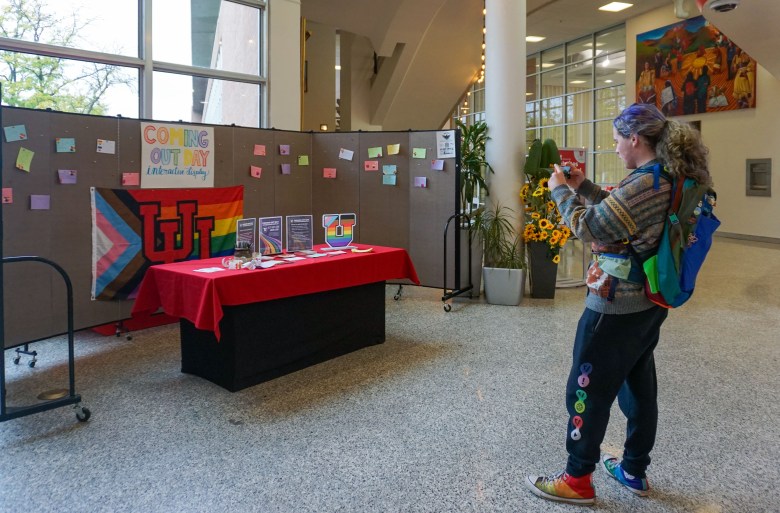
Last fall, Allan-McLaughlin’s center hosted an event around the time of National Coming Out Day, in October, with a screening of “Paris Is Burning,” a film about trans women and drag queens in New York City in the 1980s. Afterward, two staff members led a discussion with the students who attended. They prefaced the discussion with a disclaimer, saying that they were not speaking on behalf of the university.
Center staffers also set up an interactive exhibit in honor of National Coming Out Day, where students could write their experiences on colorful notecards and pin them on a bulletin board; created an altar for students to observe Día de los Muertos, in early November, and held an event to celebrate indigenous art. So far this semester, the center has hosted several events in observance of Martin Luther King Jr. Day and Black History Month, including an educational panel, a march and a pop-up library event.
Such events may add value to the campus experience overall, but students from groups that aren’t well represented on campus argue that those events do not make up for the loss of dedicated spaces to spend time with other students of similar backgrounds.
Sophomore Juniper Nilsson looks at a National Coming Out Day exhibit in the student union at the University of Utah. The exhibit was set up by the new Center for Community and Cultural Engagement. Credit: Olivia Sanchez/The Hechinger Report
For Taylor White, a recent graduate with a degree in psychology, connecting with fellow Black students through BSU events was, “honestly, the biggest relief of my life.” At the Black Cultural Center, she said, students could talk about what it was like to be the only Black person in their classes or to be Black in other predominantly white spaces. She said without the support of other Black students, she’s not sure she would have been able to finish her degree.
Nnenna Eke-Ukoh, a 2024 graduate who is now pursuing a master’s in higher educational leadership at nearby Weber State University, said it feels like the new Center for Community and Cultural Engagement at her alma mater is “lumping all the people of color together.”
“We’re not all the same,” Eke-Ukoh said, “and we have all different struggles, and so it’s not going to be helpful.”
Contact staff writer Olivia Sanchez at 212-678-8402 or [email protected].
The Hechinger Report provides in-depth, fact-based, unbiased reporting on education that is free to all readers. But that doesn’t mean it’s free to produce. Our work keeps educators and the public informed about pressing issues at schools and on campuses throughout the country. We tell the whole story, even when the details are inconvenient. Help us keep doing that.
As an industrial/organizational psychologist, work is always on my mind. Naturally, I am interested in understanding ways to make work better for others, but I also regularly apply research and theory to my own job. One long-standing approach to building better jobs is to make them more interesting for employees. Work that is interesting is inherently more motivating, more satisfying, and reduces turnover (Parker et al., 2017 for a summary).
The leading theory in job design is Job Characteristics Theory (JCT) (Hackman & Oldham, 1976). Specifically, JCT outlines that jobs facilitating 1) skill variety, 2) task identity, 3) task significance, 4) autonomy, and 5) feedback will be the most motivating and interesting. Importantly, building classes that contain these elements for both students and instructors can lead to benefits for all.
Below, I outline details about the five components and ideas for both students and instructors. As with all course design choices, these ideas are not required for success; you are welcome to choose what feels authentic to your style.
1. Skill Variety
Skill variety refers to jobs that require the use of several different skills or abilities. An example of a job that is low in skill variety is that of a typical manufacturing line. The same motion is used over and over again to perform the work. In a class, an example might be only having students submit a discussion board post for every assignment.
For students:
Allow for variety in the way students learn the information (e.g., reading, watching videos, discussing with peers).
Create a variety of activities and/or assessments such as an oral presentation, case study analysis, paper, or quiz. Where flexibility of how a project is completed can be given, encourage students to try something new or try a new technology to implement their idea.
Bloom’s taxonomy is also helpful here for allowing a variety of assessments and knowledge demonstration.
For instructors:
Consider what skills you currently would like to further develop and use your course to build accountability. For example, maybe there is a new software you’d like to learn. Have students also learn it in a course and you can work through skill development together.
Keep teaching fresh for yourself by incorporating different case studies, materials, videos, or guest speakers (when it makes sense!).
2. Task Identity
Task identity focuses on the ability to execute an entire project from start to finish. If a project requires each student to contribute something different and then put the pieces together, the project may be low on task identity as the individual members did not contribute to the entire process of the project.
For students:
Scaffolding naturally fits under task identity. Slowly build up knowledge and skills until students are able to fully engage in process or project from start to finish.
Occasionally zooming out and discussing how the topic fits within the entire semester, area of study, or career path can help students appreciate how what they are working on is part of a larger whole.
For instructors:
Reflect on your decision latitude to design your course from start to finish.
If you teach a course that fits within a large sequence, meeting with instructors to ensure the sequence makes sense. You are not beholden to conform to other’s choices, but building cohesion can benefit all involved.
If you have a TA for your course, considering ways to get them involved in whole processes (e.g., designing an assessment in addition to grading it).
3. Task Significance
Task significance facilitates finding meaning in one’s work. Specifically, task significance is high when a job has a clear impact on others. Teaching is inherently a job with high task significance, which is perhaps why many of us are drawn to it.
For students:
Connect class information to how it helps benefit others.
Create opportunities for students to interact with guest speakers, community members, or others who may benefit from their knowledge. A final project that supports a community group, for example, may be developed. Service learning is great here.
For instructors:
To help ensure you are having an impact, regularly and systematically collect information from students (e.g., surveys).
Track learning by measuring knowledge at the beginning and at the end of the semester. Inevitably so much growth occurs! Having evidence helps you see your impact, but also helps students appreciate how much they have grown too.
Create an inbox folder so save any and all positive emails you receive about your work.
Consider ways in which you can support new colleagues after you have settled into your position and have tips to share.
4. Autonomy
Autonomy is about the various ways in which individuals have a say in how, when, and where their work is completed. In the classroom, low autonomy might be a discussion board on a specific topic, under a specific word requirement that has to be completed in a short window of time.
For students:
Allow choices when it comes to topics, formats, or types of projects, as much as is reasonable.
Develop opportunities for students to become an expert within a specific area and then be responsible for sharing that expertise with peers.
For instructors:
Reflect on the various ways in which you have control over how to design and implement courses, select your courses, select the time you teach, and when you work on your class. For many instructors, autonomy is relatively high.
Develop your courses in a way that fit into the rest of your job duties. For example, remembering to execute the ability to schedule final paper due dates for a week that is different from conference deadlines.
Balance your autonomy with student autonomy. You can allow as much choice as you like, but make it make sense for you too.
5. Feedback
A high level of feedback is present when an individual is provided information about their performance in a clear and timely manner. Courses with multiple assessments throughout the semester that are scored with comments provide significant feedback.
For students:
Provide a rubric and include rubric comments to make it clear where students are doing well and where they still need work.
Provide summary-level feedback to the entire class.
Remind students to regularly access their grades and to review their feedback.
For instructors:
Provide ways for students to provide feedback to you throughout the semester through surveys, discussion, etc.
On end of semester evaluations, include open-ended questions directing them to share what went well about the course and what they would recommend changing next time. Framing questions this way can lead to more constructive feedback for you, rather than criticize.
Use assignments as feedback about how the material is landing with students. Re-visit topics or adjust as needed.
Conclusion
JCT provides five distinct areas instructors can focus on to evaluate opportunities to make their courses and their own work engaging and interesting. Adjusting these five levers can make the “job” of student as well as the job of instructor motivating and satisfying.
Of course, no theory is without limitations. One note is that individuals who have a high need for growth tend to benefit from this type of job design more than individuals who are not as concerned with growth. The original theory generally neglects social components, though more recent work has corrected that oversight (Humphrey et al., 2007; Oldham & Hackman, 2010). Finally, the limits of too much enrichment are not known. It is possible that maximizing all five components may produce a course that is more stressful than interesting. To combat any potential over-enrichment, instructors are advised to balance motivating course design with structure, routine, and clear expectations.
Overall, job design provides five clear areas to consider enhancing in your course design, both to the benefit of your job as instructor, and the ‘job’ of students as learners.
Sarina Maneotis, PhD is currently a teaching assistant professor at Kansas State University where she oversees K-State’s applied Master’s in Industrial and Organizational Psychology (MIOP) program. Prior to joining K-State in 2020, she worked in industry, advising on a variety of safety, leadership, and human resource data analysis projects. She earned her undergraduate degree in psychology at Colorado State University and her PhD in Industrial/Organizational Psychology at Pennsylvania State University. Her research focuses broadly on intersections of employee performance, wellbeing, and motivation. She is passionate about developing teaching practices that help students hone skills for translating research findings for organizational purposes and use scientific inquiry within the real-world parameters of organizations. She recently received K-State’s 2023 Global Campus Excellence in Online Teaching Award in recognition for her teaching practices.
References
Hackman, J. R., & Oldham, G. R. (1976). Motivation through the design of work: Test of a theory. Organizational behavior and human performance, 16(2), 250-279.
Humphrey, S. E., Nahrgang, J. D., & Morgeson, F. P. (2007). Integrating motivational, social, and contextual work design features: A meta-analytic summary and theoretical extension of the work design literature. Journal of Applied Psychology, 92(5), 1332-1356.
Oldham, G. R., & Hackman, J. R. (2010). Not what it was and not what it will be: the future of job design research. Journal of Organizational Behavior, 31, 463-479.
Parker, S. K., Morgeson, F. P., & Johns, G. (2017). One hundred years of work design research: Looking back and looking forward. Journal of Applied Psychology, 102(3), 403-420.
If you’re worried about losing your benefits, you’re not alone. With new budget resolutions and lawsuits targeting SNAP, Medicaid, and student loan forgiveness, millions of Americans could be impacted.
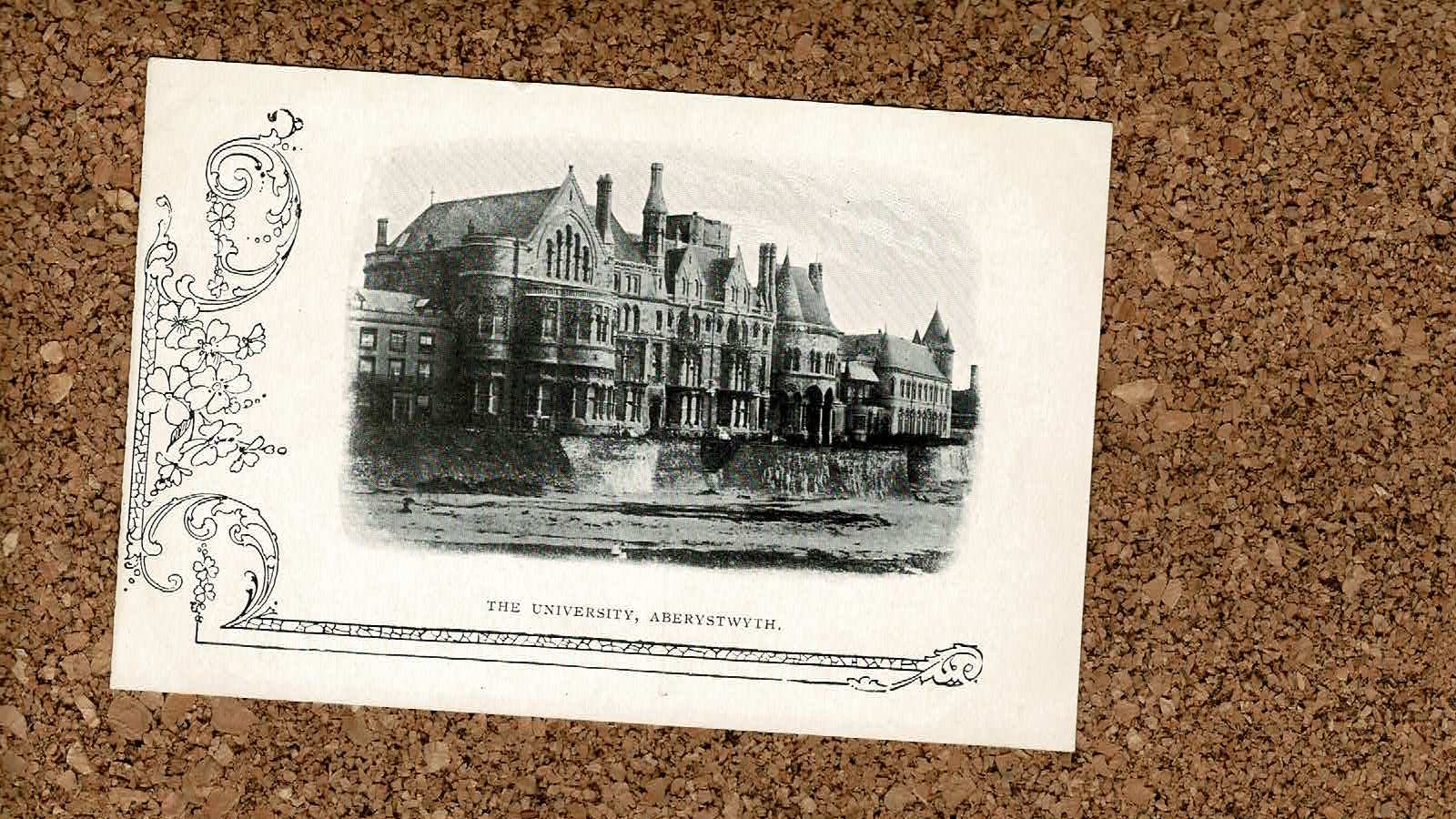
We’re in Aberystwyth again this week, but not for an in-depth look at the university – we’ve done that before.
Instead, we’re going to look into an aspect of old university governance, with an Aberystwyth artefact. This is a draft report to the University Court of Governors.
The older, chartered universities in the UK (which means, broadly, those founded between 1800 and 1992) tended to have three bodies involved in governance:
A senate, which was the academic decision-making body of the university, comprising all or some of the university’s academic staff
A council, which was the governing body of the university, but which couldn’t take a decision on an academic matter without first consulting the senate
A court, made up of stakeholders (ie graduates, local bigwigs, learned society representatives), which had very few if any powers, but to which council must account for itself and its activities.
Typically speaking, a court would meet once a year. Its powers might include appointing the chancellor of the university, but that is a ceremonial role, so is a very limited practical power (although one over which universities occasionally trip up). And at the annual meeting, there would be reports from the vice chancellor, and questions, and then that would be it for another year.
Now, this report is from a college of the University of Wales, which was a federal university. This means I’m not clear whether the report was to the court of the University College of Wales Aberystwyth, or to the court of the federal University of Wales. But either way, it gives a fascinating snapshot of what accountability looked like in 1920. (And if you know about the governance of the University of Wales in 1920, please do say in the comments below!)
The report would have been the first under the principalship of John Humphreys Davies, pictured here.
Davies was an alumnus of Aberystwyth; he succeeded Thomas Francis Roberts, who had been principal from 1891 to 1919, and had died in August of that year whilst still principal. He had since 1905 been registrar of University College Aberystwyth, making him another rare example of progression from senior professional service roles to institutional leadership.
The report starts with a brief statistical summary. It shows the impact of the first world war on numbers: there were 298 students in 1917–18; 410 in 1918–19, and 971 in 1919–20. About 30 per cent of the students were women; over 70 per cent came from south Wales; over 15 per cent from north Wales; over 10 per cent from England. And the remainder – nineteen students in total – came from Egypt, Scotland, Ireland, Belgium, France, India, Java, Jamaica and an unexpectedly large contingent – ten students – from Serbia.
There’s then a report on degree examinations, recording each student who had taken degree examinations, for bachelor of arts, master of arts, and certificates of education. I haven’t counted the names, but they stretch for fifteen pages of the report, so it looks like all of the students at the college. Jones is the most frequent name, with 60 in the faculty of arts, three in law, 31 in science, and two for the certificate in education. And we also get a report on alumni who had gained degrees from the University of London, or gained scholarships at Oxford.
And then the fun starts. Written reports from every department, starting with Greek, ending with the Officer Training Corps Contingent. Here are a few extracts:
Mr Jenkins, Greek: ‘Special: only two students took the course. Of these, Mr Neil Evans more than maintained his promise of the preceding session and attained a high standard in the examinations. As he intends to take Latin Honours in 1921, it may not be possible for him next session to devote to Greek as much time as he would wish, but if he can defer Greek honours till 1922, there is every prospect of his attaining a high class. The other candidate, Miss Young Evans, also did quite well, and showed improvement on the work of 1919.’
We have become much more squeamish about naming individuals in formal papers, even when praising them, or damning them with faint praise. Poor Miss Young Evans.
Professor Atkins, English: ‘The work this session has on the whole been satisfactory, though difficulties have not been wanting, owing to the large increase in the number of students and the varying ability of the ex-service students to settle down to serious study…’
Demobilisation was clearly not without its downsides.
We also get a fascinating insight into examination success rates. Here’s the data for undergraduate exams in English:
By my reckoning, this is a pass rate about 72 per cent for intermediate, 58 per cent for ordinary and 64 per cent for special levels. What would we make of these rates today?
We learn that the library received gifts including 600 volumes from the library of the late Principal Thomas Francis Roberts; the review of the Aberdeen Angus Cattle Society; the proceedings of the Royal Irish Academy in Dublin; and the report of the Association of Headmistresses in London. And, excitingly, that Miss Cummings of the Bodleian Library in Oxford has been appointed cataloguer to classify and catalogue the library’s holdings “in accordance with the rules of the Library of Congress.”
We have the first report from Professor Zimmern, the founding chair of international politics at Aberystwyth, a subject in which the college was to gain much renown.
And let’s end this set of extracts with this, about the Normal College’s music students. (You’ll remember that the Normal College, in Bangor, focused on teacher training.)
Apathy, irregularity and a lack of preparation. A sad and sorry state of affairs. I wonder if it was ever thus?
Overall I’m struck by the level of detail and the minutiae in the report. There’s a flavour of what life must have been like at Aberystwyth, and an openness to accountability which is interesting. Maybe it’s a genuine transparency, maybe it’s a desire to hide big issues behind the day-to-day. Anyway, I hope you enjoyed it.
This week on the podcast UK Research and Innovation and the Office for Students both have new leadership – but what does that mean for the future of regulation, research funding, and sector confidence?
Meanwhile, a new report reveals a dramatic rise in student use of generative AI, and as speculation swirls over potential changes to post-study work visas, the sector braces for further uncertainty in international student recruitment.
With Mark Bennett, Director (Audience & Insight) at FindAUniversity, Sarah Cowan, Head of Policy (Higher Education and Research) at the British Academy, Michael Salmon, News Editor at Wonkhe, and presented by Mark Leach, Editor-in-Chief at Wonkhe.