Each year, Achieving the Dream lifts up at least one community college in its network for adopting practices and strategies leading to a student-focused culture, notable increases in student outcomes and a reduction of equity gaps.
To be eligible for the Leah Meyer Austin Award, an institution must demonstrate four-year improvement of at least three percentage points in the IPEDS on-time completion for the level of associated credential awarded, or have been selected as one of the top 150 colleges in the Aspen Prize for Community College Excellence. The achievements of this year’s honorees—Chattanooga State Community College in Tennessee and Southwestern Oregon Community College—show how a holistic approach to student success that exists through the institution can result in whole-college transformation.
Setting the bar: In evaluating applicants, ATD considers gateway metrics, including leading indicators (early momentum metrics) and lagging indicators (completion or transfer), with substantial improvement of three percentage points or more over three years.
Equity metrics may highlight data such as the equity gap improvement between part-time and full-time student outcomes or between Pell-eligible and non-Pell-eligible students. Substantial improvement means closing or narrowing equity gaps over three years by at least two percentage points.
The following data demonstrate not just what Chattanooga State Community College and Southwestern Oregon Community College did to earn their honor, but also ways that other institutions can tell their own data stories.
Chattanooga State Community College actions and results: The Vision 2027 strategic plan has inspired a shift from 15-week to seven-week terms, more personalized academic advising, strengthened commitments to basic needs assistance and wraparound support services, and implementation of an affordable course materials program.
Fall-to-fall persistence rate from the fall 2019 cohort to the fall 2022 cohort saw a 7.1-percentage-point gain.
The credit completion rate jumped from 54.6 percent among the 2020 fall cohort to 66.4 percent among the fall 2023 cohort.
Articulation agreements and course road maps related to Tennessee Transfer Pathways resulted in an 8.2-percentage-point climb in the rate of students who transfer and earn a baccalaureate degree within six years of matriculating between the fall 2015 cohort and the fall 2018 cohort.
The adoption of a co-requisite model, with embedded tutors, for gateway English and math courses led to a rise in gateway math completion from 38.5 percent for the fall 2020 cohort to 49.5 percent for the fall 2023 cohort. Completion rates for gateway English courses, meanwhile, grew from 49.3 percent to 66.6 percent in that time frame. Approximately 45 to 48 percent of the college’s student population is still developing essential college-level academic skills.
Southwestern Oregon Community College actions and results: This rural institution’s recent efforts have included engaging and supporting its community’s adult and part-time learner populations, such as by creating targeted student orientations, evaluating community practices and its portfolio of academic and workforce programs, meeting the special financial needs of first-generation adult learners, and improving online services (40 percent of Southwestern’s overall student body are online learners).
In comparing the 2017 cohort to the 2020 cohort, the four-year completion rate among part-time learners improved by 8.7 percentage points, narrowing the equity gap between adult learners and traditional-aged learners by 3.2 percentage points. Between adult learners and traditional-aged learners, the gap narrowed by 6.7 percentage points, as the rate of completion among the former rose 12.3 percentage points.
The equity gap between first-generation and continuing-generation learners in fall-to-fall persistence narrowed by three percentage points, from 8.2 percent in the fall 2019 cohort to 5.2 percent in the fall 2022 cohort.
From the fall 2017 cohort to the fall 2020 cohort, the overall four-year completion rate grew 6.6 percentage points, and the rate at which students transfer and earn a baccalaureate degree (despite severe geographical hardships) rose 3.7 percentage points from the fall 2015 cohort to the fall 2018 cohort.
More information on both winners can be found here. In a March 31 webinar, Achieving the Dream will feature both winners.
Is your institution or department tracking new KPIs related to student success, or using data in a new way? Tell us about it.
Several colleges and universities are pausing admissions to some graduate programs, reducing class sizes or rescinding offers to students in an effort to cut costs amid uncertainty in federal funding.
The disruption to graduate school admissions is the latest cost-cutting move for colleges. After the National Institutes of Health proposed cutting reimbursements for costs related to research, several colleges and universities said they would pause hiring and cut spending, Inside Higher Edpreviously reported. (A federal judge has blocked the NIH plan from taking effect for now.)
In recent days, the University of Pittsburgh, the University of Pennsylvania and several other institutions have stopped doctoral admissions, at least temporarily. Some colleges are pausing admissions to some programs such as in the biomedical sciences, Stat Newsreported. At others, the pause is universitywide. The University of Southern California and Vanderbilt University temporarily paused graduate student admissions, though both universities latersaid that they’d ended the pause.
A University of Pittsburgh spokesperson told WESA, a local NPR station, that the university “temporarily paused additional Ph.D. offers of admission until the impacts of that [NIH] cap were better understood … the University is in the process of completing that analysis and expects to be in a position to resume offers soon.”
Meanwhile, the University of Pennsylvania is planning to cut graduate admissions rates, The Daily Pennsylvanianreported, citing an email from the interim dean of the School of Arts and Sciences, Jeffrey Kallberg, who wrote that the cuts were a “necessary cost-saving measure” to adjust to the NIH proposal.
“This is not a step any of us wanted to take,” Kallberg wrote, according to the Daily Penn. “We recognize that graduate students are central to the intellectual life of our school—as researchers, teachers, collaborators, and future scholars. However, we must ensure that we can continue to provide strong support for those students currently in our programs and sustain the school’s core teaching and research activities.”
Tom Kimbis, executive director of the National Postdoctoral Association, wrote in an email to Inside Higher Ed that academic institutions reliant on federal funding “are being forced to make tough decisions to support these researchers in a difficult environment.”
“The decisions in Washington to pause or cease funding for science and research is impacting early-career researchers across a wide range of disciplines,” Kimbis added. “Slowing or stopping their work, on topics from cancer and Alzheimer’s research to social science issues, hurts Americans in all 50 states.”
In the last week, some faculty began tracking the reductions in the biomedical sciences via a shared spreadsheet that includes verified cuts and unverified decisions based on word of mouth and internal emails. Faculty on social media said the cuts will have long-term ramifications for sciences as fewer students enter the field. On TikTok, several students who had applied to grad school shared their dismay at how the funding cuts meant they might have to say goodbye to their career plans and research.
Accepting graduate students, particularly for Ph.D. programs and in the biomedical sciences, requires universities to make a long-term financial commitment, which is more difficult now that the NIH has stopped making new grant awards and is aiming to cut funds. Colleges receive billions from the NIH to support research. If the proposed rate cuts move forward, institutions say they would have to shut down some labs and lay off employees.
“University research and scholarship operate on a time scale of years and decades,” the Rutgers AAUP-AFT chapter wrote in a letter to New Jersey senators Cory Booker and Andy Kim. “Higher education would become impossible in the face of capricious and arbitrary withholding of funding, elimination of entire areas of grant support for critical scientific research, and cancellation of long-held contracts.”
They went on to warn that the threat to funding would diminish the country’s strength as a research superpower. “The best scientists, the best scholars, and the best students will make the rational decision to take their talents elsewhere. Once lost, the historic excellence of United States universities, including world-leading institutions in New Jersey, both public and private, will not be easily regained.”
Martin Williams is Chair of the University of Cumbria and a former higher education policy official in the Department for Education.
It was interesting to read Jo Johnson’s 28 January HEPI blog about the OfS’s suspension of new applications to the Register and for Degree Awarding Powers (The Office for Students needs to walk and chew gum, by Jo Johnson). The OfS, apparently, is ‘failing to support the innovation vital to our success as a knowledge economy’. It is ‘abandoning its statutory duties to support innovation and choice’. By telling the world it is ‘snowed under with handling institutional failure’, it is sending bad messages to international students. I doubt that the recent OfS announcement of proposed new conditions for applications will have defused these criticisms.
As one of the main architects of the legislation that created OfS, Jo is certainly well-placed to assess how well it is delivering his vision of the future (and he is duly appreciative that OfS appears to be sticking with his particular love, the Teaching Excellence Framework.) He still believes in his policies. All credit to him.
Others, however, may ask whether that is because those policies have demonstrably worked for the public good, or because Jo does not want to question them.
Harsh though it is to place Jo Johnson alongside die-hard Brexiteers, there is something of the same conviction that the vision was glorious, but it was never properly implemented and has been sabotaged by the unbelievers. If the vision had been fully realised, English Higher Education should now be going through a period of unprecedented innovation, backed by massive entrepreneurial private investment, creating the best time ever to be a student and the best ever generation of students. If it isn’t, then those reliable whipping boys, Bureaucracy and Regulation, can be sent to the pillory. It cannot be that the vision was naïve, or even plain wrong in parts.
Perhaps we are indeed on the way to that golden age. After all, there are now more than 400 higher education providers on the OfS Register, which is a lot more than were there in the old HEFCE days. This means more institutions are competing for students, and students have more institutions to choose between. Jo quotes the innovative examples of the Dyson Institute of Engineering and Technology, the New Model Institute for Technology and Engineering, the London Interdisciplinary School and The Engineering & Design Institute: London as the tip of the innovation iceberg. They are the first fruits of the harvest that should now be blossoming even more bountifully, but for OfS’s narrow-mindedness.
And perhaps we aren’t. Mike Ratcliffe, whose MoreMeansBetter blogs shine a valuable light on the parts of the English higher education sector that most people haven’t heard of, commented under Jo’s article that ‘his list doesn’t include the providers who have recruited large cohorts… The four great providers, with their distinctive offerings, need to be put alongside a raft of business management, performing arts and theology providers. He instances the Applied Business Academy, currently being wound up. This institution, which went from 420 students in 2020/21 to 2,360 in 2022/23, has, on Mike’s estimates, in the most recent year, ‘had twice as many students as the four providers have had in their entire existence combined’.
The Applied Business Academy is just as much the result of Jo Johnson’s vision as the Dyson Institute.
Which takes us back to the vision itself.
It was rooted in the post-2012 settlement and the new possibilities it opened up. It was a bold and imaginative experiment, and I would certainly not want to assert it has failed. I don’t have definitive evidence either way. But an experiment it was, and it should be recognised as such. It now deserves to be evaluated, seriously and dispassionately, with no preconceptions. A new government, due to publish its own vision for higher education later this year, has the chance to commission such an evaluation.
How we got here
We got here because of the raising of the fee cap in 2012. This made it possible, for the first time, for serious profits to be made from providing higher education in England, with these profits underwritten by the public purse.
Both before and after 2012, the State has been the largest financial contributor to English higher education institutions – either directly, through grants, or indirectly via the student loan guarantee. However, before 2012 the State’s contribution to teaching was split fairly evenly between grants and loans. The maximum loan was around £3,500; the residual costs of providing a course were met by grants, paid by the Funding Council, HEFCE, according to the perceived costs of teaching different subjects (just over £6,000 per student was considered the minimum cost for a “classroom-based” subject like Law).
To control grant expenditure, there were also broad “targets” for each institution for the number of students they would take each year. This limited an individual institution’s room to grow. It also limited the number of new institutions that would be accommodated in the whole HE system.
The settlement reached after the 2010 Election very deliberately and fundamentally changed this system, as Nick Hillman has recently described:
Raising the tuition fee loan cap to £9,000 sent it well above the ‘break-even point’ for most HE courses (whereas the previous £3,500 fee loan was well below it).
Removing limits on funded student numbers meant that the State undertook to pay the fees for any student accepted by an eligible institution. Hence, it allowed the rapid expansion of institutions that could recruit students, including completely new institutions entering the market for the first time.
That – entirely intentionally – included for-profit institutions.
Where We Now Are
The regulatory environment that has been created incentivises institutions to recruit as many students as they can, while delivering courses as cheaply as they can. That applies to all providers, but is especially helpful to new for-profit providers, entering the market unencumbered by arrangements made under the previous system.
Some would simply call this efficiency. They would have a fair point. All institutions have to cover their costs and make sufficient surpluses to finance their futures. But there are some differences.
To illustrate, my own institution (University of Cumbria) is required by its governing documents to operate as a charity for the benefit of education in Cumbria. That is why we were created. When surpluses are made (and we are making surpluses!), they go towards that goal. Neither I, nor any of my Board, nor any external investor, benefits financially. We are an institution that is devoted, however imperfectly, to the public good.
In a for-profit institution, naturally, the picture is different. Very sensibly, they will locate themselves wherever they think offers the best prospects (usually big cities). If they are not prospering there, they will leave without a backward glance. If they are prospering, the profits may well leave too; they are not in business to invest in places. And a look through Mike Ratcliffe’s blogs gives a sense of some of the profits that are being made; in some cases, more than 25%, and tens of millions of pounds. The beneficiaries are the investors and the owners, wherever they may be, and the funds have come from the British taxpayer.
I am not trying to imply that there is anything wrong or unethical going on here. Any institution is entitled to operate within the regulatory system as it exists, and this is what these institutions have done. Of course they should be trying to minimise costs; they are for-profit institutions.
But I am saying that it is reasonable for the government, on behalf of the taxpayer and the citizen, to ask itself whether this demonstrates a higher education regulatory regime that is operating in the public interest.
That is a genuinely open question. I don’t have the information to do a cost-benefit analysis. Some of this boils down to gut reactions anyway. Offering good quality educational opportunities is a public benefit, whoever does it. If an agile, low-cost, slimmed-down provider can attract lots of students onto Business Studies courses in Birmingham or Manchester, and some of those students therefore don’t go to universities like mine, so what? Students are presumably exercising choice, and that is a good thing. Making money from providing a service is not against the public interest.
On the other hand, the current regulatory regime actively incentivises institutions like the Applied Business Academy to enter the market. It is an unusual market, because there is no need to compete on price; the taxpayer obligingly provides students with the money to pay an institution’s fees. This underpins the profits that can be made and pocketed by private investors anywhere in the world. Some people would feel this wasn’t the right use of taxpayer money. And if – it is a genuine if – the presence of a lot of ABAs were sucking some students away from the ‘public interest’ providers, and thereby destabilising them financially, the State, and the taxpayer, may find themselves with a further set of headaches. The fate of the University of Remoteshire, the largest employer in its area and the recipient of considerable public funding over the decades, is a matter of legitimate public concern.
What should happen now?
The new government should be asking itself, and OfS, about the system it has inherited. It should not automatically trash the work of its predecessors, but should also apply some common-sense scepticism to claims from those who have an obvious vested interest in preserving the status quo (which means the system created after 2012). It should seek an honest assessment of the costs and benefits in the round, recognising that there are both. And ultimately, it should decide for itself whether the new marks that are becoming visible on the face of English higher education are predominantly charming freckles, that add to the attractiveness of the whole, or something less benign.
Imagine this: a business student managing a virtual company makes a poor decision, leading to a simulated bankruptcy. Across campus, a medical student adjusts a treatment in a patient simulation and observes improvements in the virtual patient’s condition.
When students practice in a simulated real-world environment they have access to a rich set of feedback information, including consequential feedback. Consequential feedback provides vital information about the consequences of students’ actions and decisions. Typically, though, in the perennial NSS-driven hand-wringing about improving feedback in higher education, we are thinking only about evaluative feedback information – when educators or peers critique students’ work and suggest improvements.
There’s no doubt evaluative feedback, especially corrective feedback, is important. But if we’re only talking about evaluative feedback, we are missing whole swathes of invaluable feedback information crucial to preparing graduates for professional roles.
In a recently published, open access paper in Assessment and Evaluation in Higher Education, we make the case for educators to design for and support students in noticing, interpreting and learning from consequential feedback information.
What’s consequential feedback?
Consequential feedback involves noticing the connection between actions and their outcomes (consequences). For example, if we touch a hot stove, we get burned. In this example, noticing the burn is both immediate and obvious. Connecting it to the action of touching the stove is also easy – little interpretation needs to be made. However, there are many cause-effect (action-consequence) sequences embedded in professional practice that are not so easy to connect. Students may need help in noticing the linkages, interpreting them and making corrections to their actions to lead to better consequences in the future.
For instance, the business student above might decide on a pricing strategy and observe its effect on market share. The simulation speeds up time so students can observe the effects of price change on sales and market share. In real life, observing the consequences of a pricing change might take weeks or months. Through the simulation, learners can experiment with different pricing strategies, making different assumptions about the market, and observing the effects, to build their understanding of how these two variables are linked under different conditions. Critically, they learn the importance of this linkage so they can monitor in the messier, delayed real life situations they might face as a marketing professional.
Consequential feedback isn’t just theoretical. It is already making an impact in diverse educational fields such as healthcare, business, mathematics and the arts. But the disparate literature we reviewed almost never names this information as consequential feedback. To improve feedback in higher education, we need to be able to talk to educators and students explicitly about this rich font of feedback information. We need a language for it so we can explore how it is distinct from and complementary to evaluative feedback. Naming it allows us to deliberately practice different ways of enhancing it and build evidence about how to teach students to use it well.
Why does it matter?
Attending to consequential feedback shifts the focus from external judgments of quality to an internalised understanding of cause and effect. It enables students to experience the results of their decisions and use these insights to refine their practice. Thus, it forms the grist for reflective thinking and a host of twenty-first century skills needed to solve the world’s most pressing problems.
In “real-life” after university, graduates are unlikely to have a mentor or teacher standing over them offering the kind of evaluative feedback that dominates discussion of feedback in higher education. Instead, they need to be able to learn independently from the consequential feedback readily available in the workplace and beyond. Drawing on consequential feedback information, professionals can continuously learn and adapt their practice to changing contexts. Thus, educators need to design opportunities that simulate professional practices, paying explicit attention to helping students learn from the consequential feedback afforded by these instructional designs.
How can educators harness it?
While consequential feedback is powerful, capitalising on it during higher education requires careful design. Here are some strategies for educators to try in their practice:
Use simulations, role-plays, and projects: Simulations provide a controlled environment where students can explore the outcomes of their actions. For example, in a healthcare setting, students might use patient mannequins or virtual reality tools to practice diagnostic and treatment skills. In a human resources course, students might engage in mediation role plays. In an engineering course, students could design and test products like model bridges or rockets.
Design for realism: Whenever possible, feedback opportunities should replicate real-world conditions. For instance, a law student participating in a moot court can see how their arguments hold up under cross-examination or a comedy student can see how a real audience responds to their show.
Encourage reflection: Consequential feedback is most effective when paired with reflection. Educators can prompt students to consider questions such as: What did you do? Why? What happened when you did x? Was y what you expected or wanted? How do these results compare to professional standards? Why did you get that result? What could you change to get the results you want?
Pair with evaluative feedback: Students may see that they didn’t get the result they wanted but not know how to correct their actions. Consequential feedback doesn’t replace evaluative feedback; it complements it. For example, after a business simulation, an instructor might provide additional guidance on interpreting KPIs or suggest strategies for improvement. This pairing helps students connect outcomes with actionable next steps.
Shifting the frame
Focusing on consequential feedback represents a shift in how we think about assessment, feedback, and learning itself. By designing learning experiences that allow students to act and observe the natural outcomes of their actions, we create opportunities for deeper, more meaningful engagement in the learning process. As students study the impact of their actions, they learn to take responsibility for their choices. This approach fosters the problem-solving, adaptability, independence, and professional and social responsibility they’ll need throughout their lives.
A key question educators should be asking is: how can I help students recognise and learn from the outcomes of their actions? The answer lies in designing for and highlighting consequential feedback.
When the University of Hawai‘i at Manoa planned a Black History Month event in February 2023 that lacked any black facilitators, law professor Kenneth Lawson publicly challenged a dean about it at a faculty meeting. Nearly two years later, and shortly after clashing with administrators over their decision to doctor one of his class presentations, Lawson suddenly must defend himself against a defamation lawsuit over his remarks — one filed by that same dean.
On Feb. 20, Lawson’s legal team filed an anti-SLAPP motion to dismiss the dean’s lawsuit, in which she alleged that Lawson’s heated arguments with her concerning the Black History Month event, as well as Lawson’s call to boycott the event, were defamatory. Lawson’s legal team argues that the defamation suit is “an attempt to chill and silence Professor Lawson’s constitutionally protected speech.” And the fact that it came fast on the heels of a curriculum dispute raises further questions of retaliation.
2023: Lawson files First Amendment lawsuit against university following imbroglio over Black History Month event
The threats to Lawson’s expressive freedoms date to a faculty meeting back in February 2023, where he voiced vehement objections to a scheduled Black History Month event that was to feature a panel with no black facilitators. (Lawson is black.)
At the meeting, UH Dean Camille Nelson clashed with Lawson over the issue. Lawson claimed Nelson (who is also black) didn’t have sufficient experience in or understanding of the Civil Rights Movement. Nelson retorted that her experience as a black woman gave her perspective to understand racism, but that she did not want to litigate that issue during the meeting. In a follow-up email, Lawson accused Nelson of being “highly dismissive” of his objections, and a few days later, he called for a boycott of the panel via a university listserv.
Law professor challenges university after campus ‘shooting’ hypothetical changed in lesson plan
News
The University of Hawai’i violated academic freedom and set a dangerous precedent with unilateral revisions to a law professor’s presentation on a legal concept.
UH banned Lawson from campus and launched an investigation to determine whether he had created a “hostile work environment” for his colleagues. The university also issued no-contact orders barring Lawson from contacting certain administrators and restricting his use of university listservs.
Lawson, in turn, sued UH for violating his First Amendment rights to speak on a matter of public concern: racism and inclusion at the university.
The university eventually sanctioned Lawson for the February 2023 incident, requiring him to complete mandatory training and serve a one-month suspension without pay. Lawson returned to teaching in August of 2024, after completing the university’s sanctions under protest as his legal case proceeded.
2025: Lawson becomes locked in conflict over academic freedom violations
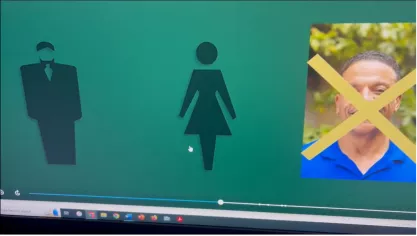
Last month, we told readers about Lawson’s clash with the university over an in-class PowerPoint presentation. Last September, Lawson used a hypothetical involving himself and two deans — one of whom shoots at the other, misses, and hits Lawson accidentally — to teach his law students the legal concept of transferred intent. The accompanying slide included website portraits of himself and the two deans to illustrate the example.
When an anonymous student filed a complaint about the example, the university’s response to the complaint presented a master class in how to violate academic freedom. The university ordered Lawson to change the hypothetical because it could be “disturbing and harmful,” despite the fact that he had not violated any policy. When Lawson rightfully demurred, the university unilaterally changed Lawson’s slides, removing images of the two deans—but leaving Lawson as the victim of the shooting. (Why students would be less disturbed by a hypothetical that still depicted their professor as a shooting victim was not explained.)
FIRE sent twoletters to the university urging it to restore the hypothetical to its original state. We argued that unilaterally changing a faculty member’s teaching materials raised serious concerns about the university’s fealty to the basic tenets of academic freedom. Those tenets protect the right of faculty members to determine how best to teach their subjects. This freedom is even more important when those topics are complicated, difficult, or potentially upsetting to students. Going over Lawson’s head to change the hypothetical without his consent also raises serious concerns for future academic freedom issues. Would UH consistently bypass faculty rights to change instruction until the teaching satisfied administrators?
UH dean files defamation lawsuit
Shortly after Lawson filed his censorship grievance, and nearly two years after the case’s original filing, Nelson hit Lawson with a lawsuit of her own: She alleged that Lawson’s behavior at the meeting nearly two years earlier, and his subsequent email to the university listserv, had defamed her.
She suffered significant emotional distress and reputational harm, she says, because of Lawson’s alleged accusations of her of being a silent “Intellectual Negro.”
We hope this motion will give UH the sharp reminder it needs that faculty members have a right to speak on matters of public concern. Faculty members also have the right to determine how to approach their courses. And faculty members shouldn’t have to fear retaliation — in the university setting or in the court of law — for exercising their First Amendment rights.
We’ll continue to keep readers apprised of Lawson’s battle against his university.
On February 21, a U.S. district judge issued a preliminary injunction against portions of two of the Trump administration’s executive orders regarding DEI programs. The decision, issued in U.S. District Court for the District of Maryland, blocks federal agencies from taking action to withhold federal funding from federal contractors that conduct programs or initiatives related to DEI.
The preliminary injunction strikes down three separate provisions across these executive orders:
EO 14151 requires the federal government to terminate all equity-related grants or contracts within 60 days (known as the “Termination Provision”).
EO 14173 requires that every grant recipient or federal contractor affirm its compliance with all federal antidiscrimination laws and that it does not operate any DEI programs (known as the “Certification Provision”).
EO 14173 directs the attorney general, in consultation with other relevant agencies, to promulgate a report with recommendations to enforce civil rights laws and encourage the private sector to end DEI practices. The report is required to identify “the most egregious and discriminatory DEI practitioners in each sector of concern.” It also requires each agency to identify up to nine potential civil compliance investigations as a way to deter DEI programs or principles. The EO lists institutions of higher education with endowments over $1 billion as potential targets for the civil compliance investigations (known as the “Enforcement Threat Provision”).
The National Association of Diversity Officers in Higher Education, the American Association of University Professors, Restaurant Opportunities Centers United, and the mayor and city council of Baltimore, Maryland, challenged these three provisions, arguing that they violate free speech rights under the First Amendment and are unconstitutionally vague — violating the Fifth Amendment. Plaintiffs additionally alleged four types of irreparable harm: threat of loss of funds, uncertainty regarding future operations, loss of reputation, and chilled speech.
The court ultimately ruled that the plaintiffs were likely to succeed on their constitutional complaints and adequately demonstrated a sufficient likelihood of irreparable harm. The decision concluded that EO 14173 offers no guidance or notice of what the government now considers illegal DEI, and that plaintiffs showed “substantial evidence of the risks of such arbitrariness,” and that by “threatening the private sector with enforcement actions based on those vague, undefined standards, the Enforcement Threat Provision is facially unconstitutional under the due process clause of the Fifth Amendment.”
The preliminary injunction means that federal agencies may not:
pause, freeze, impede, block, cancel or terminate any awards, contracts or obligations, or change any current obligation terms on the basis of the Termination Provision;
require any contractor to make any certification or other representation pursuant to the Certification Provision; or
bring any enforcement action under the False Claims Act in relation to the Enforcement Threat Provision.
The injunction does not speak to actions that federal agencies may have already taken in response to both executive orders. Nonetheless, the Trump administration will likely appeal the ruling. Given that the policies raised in these executive orders will hold widespread implications for federal contractors in the higher education community, CUPA-HR will continue to share further developments.
David John Baer McNicholas’s first novella is inspired by a darkly comedic poem he once wrote about a town that outlawed canned food and built a massive trebuchet, or catapult, to hurl the cans into the distance — only to receive thank-you notes tied to bricks hurled back at them.
Lately, McNicholas has been entangled in a real-life plot eerily similar to his writing. At the Institute of American Indian Arts in Santa Fe, New Mexico, food pantries were empty despite a $50,000 grant meant to support them. When student publication The Young Warrior printed criticisms of school officials for these failures and the Associated Student Government began investigating, administrators swiftly retaliated — kicking students out of housing, putting them on probation, and even threatening them with lawsuits.
This may sound like the plot of a neo-noir film bleak enough to rival “Chinatown,” but for McNicholas, a creative writing student at IAIA and the founder and editor of The Young Warrior, it’s reality.
Young Warrior editor David McNicholas recalls, “Oh shit, they’re going to throw everything at me” for exposing the administration. (Ponic Photography)
McNicholas connects IAIA’s pattern of silencing dissent to broader institutional failures. He recounts how during a faculty meeting with the Board of Trustees, a sculpture professor once dared to mention an academic paper written by a former IAIA department head. The paper showed that even conservative estimates put IAIA’s staff turnover rate at about 30%. McNicholas says when the professor brought it up, “everyone in the meeting clammed up, and later they came down on him hard. They told him he embarrassed the dean of students and demanded he write a public apology and retraction. He wrote a coerced apology and quit the next day.”
The Young Warrior published the academic paper before quickly being told to retract it.
“We want better,” says McNicholas. “Student retention is 50%. Graduation is 25% . . . The faculty, staff, and students here are top-notch people, but the administration just supports the rising stars and lets everyone else evaporate.”
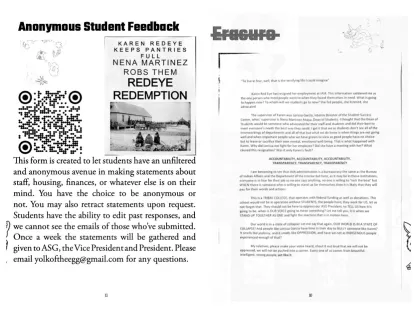
McNicholas’s own showdown with the administration began when he published an anonymous student letter and flyer accusing the dean of students of bullying and suggesting food-pantry funds had been misappropriated. The letter and flyer resonated with the student body, according to McNicholas, and many came forward to thank him and to offer support.
I love this school. I love the community. I love the students and the faculty. I struggle with the administration after this, but I think that that struggle was there long before I came along. I just kind of exposed it.
When McNicholas published the anonymous letter and flyer, he says students were being forced to buy meal plans they couldn’t always use while the dean of students, McNicholas says, dismissed the need for food pantries altogether, claiming, “Students have meal plans; they don’t need food pantries.”
This explanation rang hollow for McNicholas who, like many of his peers, falls below the poverty line and relies on food pantries to survive.
After the letter and flyer came out, the administration promptly accused McNicholas of “bullying” staff with his publication, and IAIA Provost Felipe Colón put him under investigation.
“They came down on me primarily, but also on a peer who had made an Instagram post, of all things,” he recalls. “I said, ‘Oh shit, they’re going to throw everything at me.’”
Anticipating housing sanctions, McNicholas preemptively left campus and lived out of his van.
“It sucked, because I wasn’t prepared for it. I had to go sleep in a friend’s driveway,” he remembers. The forcefulness of the school’s response only made McNicholas more suspicious, bringing to mind Shakespeare’s famous line, “The lady doth protest too much.”
Institute of American Indian Arts Can’t Ignore the First Amendment
Page (Two-Column)
Tell the Institute of American Indian Arts to lift sanctions against David McNicholas and revise its anti-bullying policy.
The situation escalated when the administration denied that the grant even existed during a meeting with McNicholas and other members of the Associated Student Government who had taken an interest in the matter. Despite the administration’s denials, an anonymous source provided McNicholas with a photocopy of a grant award letter for the rumored $50,000. Armed with this evidence, McNicholas and the ASG president confronted the administration, only to face threats of legal action.
The administration’s behavior took an emotional toll on students, according to McNicholas. One day, the ASG called a meeting to discuss the situation — just ASG members, since advisors employed by the college couldn’t be trusted — and the ASG president showed up in tears. She had just come from a meeting with IAIA President Robert Martin, who delivered a shocking ultimatum.
“She said that he told her the school was seriously considering suing ASG — and her — because of the bad publicity,” McNicholas says. “She came to us and said, ‘They told me to fix it.’ She was in tears, you know, and that made me mad.”
When they confronted the provost with the grant award letter, he changed his tune.
“He showed up at the next meeting and said, ‘Oh, you know what? I did some looking, I researched it, and I think I found the grant that you guys were talking about, and I’d like to come and explain how it was spent,’” McNicholas recalls. “I was like, yeah, I bet you do.”
Meanwhile, Provost Colón’s investigation of McNicholas for publishing the student critiques found him responsible for violating the school’s unconstitutional anti-bullying policy. Exhausted and beaten down, he was unable to attend the meeting where the provost attempted to explain the grant’s expenditures. McNicholas says, “I got the sheet he handed out, which showed budget-to-actual figures, but when pressed to release the ledger, he claimed bank statements might not go back that far. We’re talking a year, maybe two at most. I think he thought you could say that because he was with a room full of like 19, 20 year olds. But if I had been in that room, I would have pushed back.”
Though McNicholas later successfully appealed the housing sanctions and recovered about $2,000 in lost fees, he remains outraged at how other students were treated.
McNicholas never did accept IAIA’s “as little as possible” philosophy, in which truth had no place, power thrived on silence, and the ones who dared to ask questions were the first to pay the price.
“What I really can’t stand is that they did the same thing to a 19-year-old freshman for making an Instagram post. That person didn’t move out on their own accord. They lost all their housing and meal plan money. They lost $2,000,” McNicholas says. “They kicked that person out, kept their money, and made a 19-year-old student homeless. As far as I’m concerned, that’s unconscionable.”
Not only did the sanctions against McNicholas affect his ability to participate in campus life, they also threatened his employment opportunities, including a federal work-study opportunity that should have been protected from administrative interference.
“I was hired to be an orientation mentor at the end of last summer,” he says “And the day before I was going to start, I got a call from the director of that program who said, ‘Yeah, you can’t participate because you’re on institutional probation.’”
Finding himself ruthlessly targeted by the administration, McNicholas turned to the press. Teaming up with a few peers, they went to the Santa Fe Reporter, and the article that followed — which detailed the administration’s retaliatory actions against him — made an immediate impact.
“When that article came out, both the interim director and dean of students were gone within days,” he says. “Like, they were gone.”
Anticipating housing sanctions, Young Warrior editor David McNicholas preemptively left campus and lived out of his van. “It sucked, because I wasn’t prepared for it. I had to go sleep in a friend’s driveway.” (Ponic Photography)
After the Santa Fe Reporter exposé and leadership shakeup, the food pantry miraculously transformed. A 20-foot-long conference table in the Student Success Center, once filled with nothing but cans of tomatoes that no one was using, suddenly became a bounty of groceries.
Last semester, McNicholas delved into the intersection of journalism and free speech through an independent study. His research included works like Dean Spade’s “Mutual Aid” and FIRE’s “Guide to Free Speech on Campus,” laying the groundwork for his evolving understanding of rights and responsibilities.
This semester, McNicholas has already published a new issue of The Young Warrior, which reflects his growing interest in matters of free expression. The issue includes a letter from FIRE written on his behalf and a personal acknowledgment of his own rights and responsibilities as a journalist.
“Yes, the school violated my rights and they need to be held accountable, but also, I could have been a better journalist. And there’s room to talk about that,” he says with characteristic humility. The issue also strikes a lighter tone with a comic poking fun at the provost — because, as McNicholas says with a grin, “why not?”
The intersection of art, politics, and personal freedom is a driving force for McNicholas. “My work is very personal,” he explains. “I live in a political morass metaphorically surrounded by people on both sides of a binary who think censorship is fine as long as it’s censoring the other guy. I’m a non-binary thinker. I’m an anarchist. For an artist like me to make art, I can’t be worried about who I will offend. I can’t tailor my work to thread between all these idiots who can’t think for themselves, who can’t be critical without taking sides. If I worried about that, I couldn’t get up in the morning. I couldn’t be an artist.”
McNicholas never did accept IAIA’s “as little as possible” philosophy, in which truth had no place, power thrived on silence, and the ones who dared to ask questions were the first to pay the price. Nevertheless, he speaks with deep affection about IAIA.
“I love this school. I love the community. I love the students and the faculty. I struggle with the administration after this, but I think that that struggle was there long before I came along. I just kind of exposed it.”
As we are marking three years since the start of the full-scale invasion of Ukraine and 11 years since the start of the Revolution of Dignity, it is impossible not to notice the scars and the suffering but also Ukraine’s resolve to continue rebuilding, innovating and even thriving among adversity.
Support from the UK remains unwavering. President Volodymyr Zelenskyy and Prime Minster Keir Starmer have signed a 100-year partnership agreement between Ukraine and the United Kingdom with historic significance to strengthen the ties between the two nations. It includes two “pillars” with items of particular significance to the education community: Pillar 8, focused on partnerships in science, technology, and innovation; and Pillar 9, focused on harnessing socio-cultural ties. These two pillars outline the development of new and the strengthening of existing links between higher education institutions and academic communities. It is this kind of constructive collaboration that creates hope against a background of the recent volte-face of the US towards Ukraine.
Twinning and British Council
Building on the success of the HE Twinning scheme, launched at the start of the full scale invasion, led by Cormack Consultancy with support from Universities UK International (UUKi), the 100 year agreement seeks to twin 100 schools in Ukraine and the United Kingdom to establish partnerships between learners and educators in secondary and primary education.
The British Council, a key funder and supporter of many educational initiatives, will continue to organise English language courses for Ukrainian civil servants and contribute to the professional development of English language teachers. In a more directed effort, the British Council has funded expertise exchange visits for senior leaders from Ukrainian universities to UK universities, and repeat-funded collaborations coming forth from such visits.
In our own case at Warwick, the visits from senior colleagues from V.N.Karazin Kharkiv National University have led to a flourishing research and expertise exchange on developing new forms of teacher training, educational leadership development, and trauma informed teaching and leadership practices. An international conference later this year will allow others in the HE sector to benefit from the insights the collaboration has brought forward.
Building leadership capacity for educational reforms
The UK has also made a commitment to “support education recovery and reform ambitions through policy exchanges, technical assistance, leadership training, education partnerships, and sharing best practice including on funding systems.” Warwick’s Leadership for Educational Transformation (LET) programme, founded in partnership with the Ukrainian Leadership Academy, has showed the significance and impact of such programmes on individual educational leaders as well as on building the cadre of educational leadership in Ukraine.
There is a commitment to “seek opportunities to collaborate in science, technology and innovation” including interest in developing AI and its related governance and regulation, building on Ukraine’s advancement in e-governance, transferring the experience into the gov.uk wallet (with, for example, an initial move to a digital driving licence).
Higher education in Ukraine is growing its stake in the rebuilding of the country and in innovation. There are many lessons that can be learnt from the UK experience, and indeed, thanks to the UK International Development and the Good Governance Fund, Kyiv Aviation Institute (KAI) will become one of the first universities in Ukraine to establish a science park, paving the way for the universities to become hubs for innovation where science, industry and education will join forces to develop Ukraine’s innovation potential. Having officially presented the concept of KAI Science Park at the end of January as part of the Win-Win 2030 strategy KAI will focus its research in deep tech, remotely piloted/unmanned aerial vehicles), cybersecurity, defence tech, AI, machine learning, materials, robotics and engineering.
There is also much to exchange in the entrepreneurship education space. Whilst the UK has some incredible success stories around knowledge transfer, student and regional entrepreneurship development, the European Startup National Alliance (ESNA), in 2024 ranked Ukraine fourth among 24 European countries (after Lithuanian, Spain and France) exceeding the average by 12 per cent for supporting start ups, enabled by its sophisticated digital ecosystem.
Other partnerships between the academic communities mentioned in the two pillars include space, increasing diversity in science, and particularly focusing on women in STEM, women’s rights more broadly, student mobility, sports and culture, youth programmes.
Of critical value is also medicine and healthcare innovation. As Ukraine faces unprecedented medical challenges due to the war, there is a pressing need to build expertise in hospital management, medical training, and rehabilitation – fields that remain underdeveloped. Collaboration between universities, research institutions, and healthcare professionals can lay the foundation for new academic programmes, joint research initiatives, and knowledge exchange in areas such as med tech, mental health, and especially trauma treatment.
A journey of 100 years
From our own experience working on the LET programme, we have seen the sense of purpose colleagues experience from collaborations between Ukrainian and UK institutions. Moreover, following Brexit and the current recasting of geopolitical alliances, the UK’s commitment to contributing positively to Europe may look different than before, but this is a prime opportunity to renew our commitment to prosperity and peace on the continent. With the financial squeeze on many UK institutions, we must also remain pragmatic as securing projects, funding and commitments is becoming harder. Seeking opportunities for win-win collaborations will be the way forward.
For instance:
Exchanging guest lecturing opportunities to offer different perspectives in the classroom and support each other with developing international ties, presence and impact.
Mentoring on all aspects of academic careers, building on the success of Science for Ukraine.
Exchanging data access opportunities to build mutually beneficial research dissemination partnerships.
Education has always been and will remain a catalyst for peace, and unity during tough times can help to nurture hope. Educational partnerships are making a tangible difference. And whilst there are many challenges ahead of our two education communities, the shared commitment to building resilience outlined in the 100-year partnership makes one thing clear: we must continue standing with Ukraine, as there is much to be done and to be gained from working together.
A report in The Times had suggested that the UK is set to table a deal for a reciprocal scheme that will see young EU citizens, aged 18-30, able to live and work in the UK for up to three years.
However, the government has since insisted it has no plans for such a scheme.
“We do not have plans for a youth mobility agreement,” a spokesperson told The PIENews on February 21.
“We are committed to resetting the relationship with the EU to improve the British people’s security, safety and prosperity. We will of course listen to sensible proposals. But we have been clear there will be no return to freedom of movement, the customs union or the single market.”
The Labour government has previously dismissed proposals for such a scheme, but recent reports had suggested new plans could contain a cap on the number of young people allowed into the UK through the scheme and could therefore alleviate concerns from UK government as it seeks to curb migration.
The UK government has previously made it clear its preference to do deals with individual member states, but subsequently rejected deals proposed by countries such as Spain.
The UK already has a Youth Mobility Scheme with a number of countries including Australia, New Zealand, Japan and Canada that allow individuals to study and work in the country for up to two years, with the possibility of extensions for some countries.
The membership body for English language schools in the UK, English UK, has been campaigning for an EU Youth Mobility Scheme since Brexit.
“We welcome reports that the government plans to negotiate a youth mobility deal with the EU,” Huan Japes, membership director, English UK, told The PIE.
“For young people in Europe and the UK to have the opportunity to live, work and study in each others’ countries will have immense benefits – not only for the young people themselves but also for language teaching centres and other educational organisations, the hospitality industry and for the UK’s future relations with the EU.”
“And this kind of time-limited, mutually beneficial immigration has broad support from the British public,” said Japes, who added that he would like to see a scheme with “a generous allocation of places so that this scheme can really make a difference to young people’s lives.”
According to advocacy group European Movement UK, mobility for young people could be a gateway to much closer ties with neighbouring European countries.
European Movement UK CEO, Nick Harvey, said the government’s hostility to the idea “could not be justified” when the benefits of such a scheme are so obvious.
“After all, the UK has youth mobility schemes with 13 other countries – including Australia and Japan – so it makes sense to have one with our nearest neighbours and closest partners,” said Harvey.
“Dismissing the idea of reciprocal youth mobility simply meant letting down British young people who face all sorts of economic difficulties, and have seen their horizons curtailed by Brexit. Young people want and deserve the chance to study or work in Europe. The government owes it to them to make sure they get that chance.”
We need to start pulling this country out of the no-growth quagmire of Brexit and start giving people hope for a better, brighter future Mike Galsworthy, chair of European Movement UK
Similarly, Mike Galsworthy, chair of European Movement UK, is calling for a deal to be made.
“We need to start pulling this country out of the no-growth quagmire of Brexit and start giving people hope for a better, brighter future,” he said.
“Liberating our youth and small businesses alike to engage is an important start. Hopefully the government will now see that being bold, hopeful and engaged with Europe brings a sigh of relief from the public and a more positive outlook for the UK.”
Writing in her column for The PIE last week, outgoing London Higher CEO Diana Beech mused on a refreshed relationship for the UK and the EU and what it might mean for the sector.
“The process of resetting the UK-EU relationship by the spring is one to watch for the UK’s higher education sector,” she wrote.
“This is because, while the EU has the power to ease restrictions on UK businesses to improve British trade prospects, the UK also has something that many in the EU want in return: namely the power to reinstate a youth mobility scheme between the UK and the EU.
“At its most ambitious, such a scheme could allow young people from the UK and Europe the freedom to travel across countries to study and work as was the norm before Brexit.
“A curtailed version could at least see mobility enacted for shorter, time-limited placements. Either way, UK universities could find themselves becoming an important bargaining chip in any future renegotiations,” wrote Beech.
Beech considered that previously, the UK higher education sector would have “been first to welcome” the return of a Youth Mobility Scheme such as Erasmus+. But financial woes facing the sector are “likely to dampen university managers’ enthusiasm” for such measures, considering EU students would once again be regarded as ‘home’ students, thereby capping the fees they pay.
When I was 12, my family lived adjacent to a small farm. Though I was not old enough to work, the farm’s owner, Mr. Hall, hired me to man his roadside stand on weekends. Mr. Hall had one rule: no calculators. Technology wasn’t his vibe.
Math was my strong suit in school, but I struggled to tally the sums in my head. I weighed odd amounts of tomatoes, zucchini and peppers on a scale and frantically scribbled calculations on a notepad. When it got busy, customers lined up waiting for me to multiply and add. I’m sure I mischarged them.
I was thinking about my old job as I read a quirky math study published this month in the journal Nature. Nobel Prize winning economists Abhijit Banerjee and Esther Duflo, a husband and wife research team at MIT, documented how teenage street sellers who were excellent at mental arithmetic weren’t good at rudimentary classroom math. Meanwhile, strong math students their same age couldn’t calculate nearly as well as impoverished street sellers.
“When you spend a lot of time in India, what is striking is that these market kids seem to be able to count very well,” said Duflo, whose primary work in India involves alleviating poverty and raising the educational achievement of poor children. “But they are really not able to go from street math to formal math and vice versa.”
Related: Our free weekly newsletter alerts you to what research says about schools and classrooms.
Ina series of experiments, Duflo’s field staff in India pretended to be ordinary shoppers and purposely bought unusual quantities of items from more than 1,400 child street sellers in Delhi and Kolkata. A purchase might be 800 grams of potatoes at 20 rupees per kilogram and 1.4 kilograms of onions at 15 rupees per kilogram. Most of the child sellers quoted the correct price of 37 rupees and gave the correct change from a 200 rupee note without using a calculator or pencil and paper. The odd quantities were to make sure the children hadn’t simply memorized the price of common purchases. They were actually making calculations.
However, these same children, the majority of whom were 14 or 15 years old, struggled to solve much simpler school math problems, such as basic division. (After making the purchases, the undercover shoppers revealed their identities and asked the sellers to participate in the study and complete a set of abstract math exercises.)
The market sellers had some formal education. Most were attending school part time, or had previously been in school for years.
Duflo doesn’t know how the young street sellers learned to calculate so quickly in their heads. That would take a longer anthropological study to observe them over time. But Duflo was able to glean some of their strategies, such as rounding. For example, instead of multiplying 490 by 20, the street sellers might multiply 500 by 20 and then remove 10 of the 20s, or 200. Schoolchildren, by contrast, are prone to making lengthy pencil and paper calculations using an algorithm for multiplication. They often don’t see a more efficient way to solve a problem.
Lessons from this research on the other side of the world might be relevant here in the United States. Some cognitive psychologists theorize that learning math in a real-world context can help children absorb abstract math and apply it in different situations. However, this Indian study shows that this type of knowledge transfer probably won’t happen automatically or easily for most students. Educators need to figure out how to better leverage the math skills that students already have, Duflo said. Easier said than done, I suspect.
Duflo says her study is not an argument for either applied or abstract math. “It would be a mistake to conclude that we should switch to doing only concrete problems because we also see that kids who are extremely good at concrete problems are unable to solve an abstract problem,” she said. “And in life, at least in school life, you’re going to need both.” Many of the market children ultimately drop out of school altogether.
Back at my neighborhood farmstand, I remember how I magically got the hang of it and rarely needed pencil and paper after a few months. Sadly, the Hall farm is no longer there for the town’s children to practice mental math. It’s now been replaced by a suburban subdivision of fancy houses.
This story about applied math was written by Jill Barshay and produced by The Hechinger Report, a nonprofit, independent news organization focused on inequality and innovation in education. Sign up for Proof Points and other Hechinger newsletters.
The Hechinger Report provides in-depth, fact-based, unbiased reporting on education that is free to all readers. But that doesn’t mean it’s free to produce. Our work keeps educators and the public informed about pressing issues at schools and on campuses throughout the country. We tell the whole story, even when the details are inconvenient. Help us keep doing that.