An initial response to yesterday’s Curriculum and Assessment Review from HEPI Director, Nick Hillman, is available on the HEPI website here.
Today’s blog was kindly authored by Martin Webster, Director of the National Education Opportunities Network (NEON). It is the fifth blog in HEPI’s series responding to the Post-16 Education and Skills white paper. You can find the other blogs here, here, here, and here.
Since the Labour Party formed the Government in 2024, things have undoubtedly changed for higher education and specifically widening access. At the Labour Party Conference in 2024, there was a feeling of optimism with the Minister for Skills, the Rt Hon Baroness Smith, describing widening access as the Government’s number one priority for higher education. We now have a Government that not only believes in the importance of higher education but is putting a new emphasis on both expanding access and improving the outcomes of disadvantaged students.
This ambition for widening access has now been crystallised in the recently published Post 16 Education and Skills white paper, which lays out the key steps that will be taken, the main ones being:
increasing the maintenance loan in line with forecast inflation each academic year.
introducing the Lifelong Learning Entitlement to include modular funding, for both full and part-time study.
reintroducing targeted, means-tested maintenance grants by the end of this Parliament.
reforming the regulation of access and participation plans to allow an approach where the Office for Students (OfS) can be more risk-based with an expectation that providers will continue to strengthen evaluation.
bringing together a Task and Finish group of sector experts, charities, OfS, and UCAS to consider how the system can best widen access.
demonstrating a commitment to widening access to postgraduate level studies.
All of the above demonstrate the importance that the current Government are placing upon widening access and lays out their expectations for change, a change to a more equitable higher education system. Whilst there may be some who critique some of the steps outlined, and may feel they do not go far enough, if the higher education sector can make these changes, we will end up producing better outcomes for disadvantaged learners.
But…
Westminster, we have a problem
It is no secret that the higher education sector is under pressure with providers trying their hardest to ensure they can maximise efficiency from limited resources. Nowhere has this been felt more keenly than within widening access. Over the past couple of years, the National Education Opportunities Network (NEON) started to hear anecdotes from our members about ‘efficiency measures’ that were being taken. These ranged from recruitment freezes on their teams and reductions in dedicated budgets to staffing reorganisations where certain roles, and in some cases whole widening access teams, were being put at risk of redundancy. In the spring of 2025, we therefore surveyed NEON members in order to try to ascertain a more accurate picture of the extent of the problem.
Thirty six of our members responded, and whilst the results may not be statistically significant, they indicate a concerning trend. For the 2025/26 financial year 58% reported a reduced level of financial resources for widening access, and 58% reported a reduced level of staffing resources.
Even within NEON we have seen some of our members unable to renew their membership with us, not because they do not feel their membership is not giving them and their colleagues benefits, but because they have so little available budget that they cannot afford, or are not allowed to invest in, the relatively modest subscription amount.
These findings should concern both the Government and policymakers. Despite being the number one priority for higher education, widening access budgets are being diverted within institutions, sometimes due not to a lack of commitment, but due to necessity. Staffing is being cut and, in one case that we know of, this has included the removal of dedicated evaluation colleagues, an area that the Government are placing even greater emphasis upon. Higher education providers have made a range of commitments in their Access and Participation Plans, and those commitments are at serious risk of not being met.
As one anonymous NEON lead member stated in their response to our survey:
It is increasingly difficult to prioritise widening access activity over such things as recruitment activity when the University’s most pressing need is to balance the books. The resource for widening access will be reduced and we will simply be unable to maintain the level of current activity. This will of course have a disproportionately negative impact on under-represented and hard to reach groups.
Another NEON lead member commented:
The reduction in [institutional] funding means we’re only able to reach a fraction of the disadvantaged learners who would benefit from our outreach offer – we’re currently working with approximately 40% of the schools in our region due to capacity. Of the remaining 60%, over 50% of those have average or higher than average numbers of PP learners.
The Task and Finish group will undoubtedly come up with an excellent set of recommendations, but the reality is that, on the ground, there are even fewer colleagues to deliver the important work that is taking place across England to ensure it is effectively evaluated. Steps need to be taken now to ensure widening access is protected and that providers can support the Government’s ambitions.
So what should the Task and Finish group consider?
ensuring that funding for widening access is ring-fenced and subject to further accountability measures;
establishing an expectation that all providers work with learners across all age groups, from primary school level up to and including mature learners;
considering how the evaluation of access and success initiatives can be strengthened for all providers, including small specialist providers, through a regional approach delivered by collaborative partnerships;
considering how widening access can be established as a strategic driver within schools and colleges; and
developing greater, direct communication between the Department for Education and higher education providers to ensure the Government’s strategic priorities are being met and greater understanding can be developed.
Widening access is at a crossroads. We can stand by and watch progress continue to wane away, or we can put measures in place to continue to build upon the hard of work of colleagues across the higher education sector and improve equitable access and success.
by Laura Pappano, The Hechinger Report November 6, 2025
TALLAHASSEE, Fla. — As principal of Hartsfield Elementary School in the Leon County School District, John Olson is not just the lead educator, but in this era of fast-expanding school choice, also its chief salesperson.
He works to drum up enrollment by speaking to parent and church groups, offering private tours and giving Hartsfield parents his cell phone number. He fields calls on nights, weekends and holidays. With the building at just 61 percent capacity, Olson is frank about the hustle required: “Customer service is key.”
It’s no secret that many public schools are in a battle for students. As school started in Florida this August, large districts, including Hillsborough, Miami-Dade and Orange, reported thousands fewer students, representing drops of more than 3 percent year over year. In Leon County, enrollment was down 8 percent from the end of last year.
Part of the issue is the decline in the number of school-age children, both here and across the country. But there’s also the growing popularity of school choice in Florida and elsewhere — and what that means for school budgets. Leon County’s leaders anticipate cutting about $6 million next year unless the state increases its budget, which could mean reduced services for students and even school closures.
Other Florida school districts are also trimming budgets, and some have closed schools. As districts scramble for students, some are hiring consulting firms to help recruit, and also trying to sell seats in existing classes to homeschoolers. There is also the instability of students frequently switching schools — and of new charter or voucher schools that open and then shut down, or never open at all as promised.
Two years after the Florida Legislature expanded eligibility for school vouchers to all students, regardless of family income, nearly 500,000 kids in the state now receive vouchers worth about $8,000 each to spend on private or home education, according to Step Up For Students, the nonprofit that administers the bulk of the scholarships. And Florida’s Tax Credit Scholarship, created in 2001 to allow corporations to make contributions to private school tuition, is the model for the new federal school voucher program, passed this summer as part of Republicans’ “one big, beautiful bill.” The program, which will go into effect in 2027, lets individuals in participating states contribute up to $1,700 per year to help qualifying families pay for private school in exchange for a 1:1 tax credit.
“We are in that next phase of public education,” said Keith Jacobs of Step Up For Students, who recruits public school districts to offer up their services and classes on its educational marketplace. “Gone are the days when a government institution or your zoned neighborhood school had the authority to assign a child to that school.”
Related: Become a lifelong learner. Subscribe to our free weekly newsletter featuring the most important stories in education.
That’s a problem for Leon County Schools, which boasts a solid “B” rating from the state and five high schools in the top 20 percent of U.S. News’ national rankings. The district, located in the Florida panhandle, serves a population of around 30,000 students, 44 percent of whom are Black, 43 percent white and 6 percent Hispanic.
“There’s just not enough money to fund two parallel programs, one for public schools and one for private schools,” said Rocky Hanna, the Leon County Schools superintendent.
Over the past few years, the Legislature has increased state and local funding for charter schools and created new rules to encourage more to open. (Charter schools are public schools that are independently operated; the Trump administration recently announced a $60 million increase in charter school funding this year, along with additional competitive grants.)
But vouchers are the big disrupter. The nonprofit Florida Policy Institute projects annual voucher spending in Florida will hit $5 billion this year. In Leon County, money redirected from district school budgets to vouchers has ballooned from $3.2 million in 2020-21 to nearly $38 million this academic year, according to state and district figures. Enrollment in local charter schools has also ticked up, as has state per-pupil money directed to them, from $12 million to $15 million over that time.
As a mark of how the landscape is shifting, Step Up For Students is now helping districts market in-person classes to homeschoolers on the group’s Amazon-like marketplace to fill seats and capture some money. Jacobs said Osceola County put its entire K-12 course catalog on the site. A year of math at a Miami elementary school? It’s $1,028.16. And just $514.08 for science, writing or P.E.
“A student can come take a class for nine weeks, for a semester, for a year,” said Jacobs, adding that 30 districts have signed on. They are thinking, he said, “if we can’t have them full-time, we have them part-time.”
Leon County is considering signing on, said Hanna, “to basically offer our courses à la carte.” It could be a recruitment tool, said Marcus Nicolas, vice chair of the county’s school board. “If we give them an opportunity to sniff the culture of the school and they like it, it could potentially bring that kid back full-time.”
Because of his shrinking budget, Hanna is looking at cuts to IT, athletics, arts, counselors, social workers and special tutors for struggling students, along with exploring school closings or consolidations.
Another challenge: With more school options, a growing number of students are leaving charters or private schools and enrolling in the district mid-year. Yet state allocations are based on October and February enrollment counts.
Last year, 2,513 students — about 8 percent of Leon County’s district enrollment — entered after February. “Those are 2,500 students we don’t receive any money for,” Hanna said at an August school board meeting.
Public schools do a lot well, but have been slow to share that, said Nicolas. “We got lazy, and we got complacent, and we took for granted that people would choose us because we’re the neighborhood school,” he said.
Even as more parents choose private voucher schools, it’s not necessarily easy for them to determine if those schools are performing well. Although Florida State University evaluates the state’s Tax Credit Scholarship program, its report lags by about two years. It includes an appendix with voucher schools’ test scores, but there is no consequence for low performance. And scores cannot be compared, because even though schools must test students in grades 3 to 10, the schools pick which test to give.
The result, said Carolyn Herrington, director of the Education Policy Center at Florida State University, who has written some of the evaluation reports, is that “the only real metric here is parent satisfaction,” which she said “is not sufficient.”
Yet many parents like the idea of school choice. According to a poll released last month by EdChoice, a school choice advocacy group, just over half of all Americans and 62 percent of parents broadly favor school vouchers.
Mother Carrie Gaudio, who attended the local charter school her parents helped to found, was surprised when her son Ross visited Hartsfield Elementary, a Title I school that serves a high percentage of low-income households — and loved it.
Before enrolling him, however, she and her husband, Ben Boyter, studied the enrollment situation. The school was under capacity, but they noticed more students coming each year.
“We felt like if they ended up having to close a school it wouldn’t be one that’s had continual increases in enrollment,” she said, and added, “it’s a real bummer that you have to consider that, that you can’t just consider, ‘Are these people kind? Is my kid comfortable here? Do we feel safe here?’”
Indeed, a school that a parent chooses one year may close the next.
That’s what happened last year to Kenia Martinez. Since fall 2022, her two sons had attended a charter school run by Charter Schools USA, among the largest for-profit charter operators in the state. Last spring, she learned from a teacher that the school, Renaissance Academy, was shutting down.
Previously named Governor’s Charter Academy, Renaissance recently received a “D” grade, and saw enrollment fall from 420 students in 2020-21 to 220 last year. It also ran deficits, with a negative net position of $1.9 million at the end of the 2023-24 school year, according to the most recent state audit report. It closed last May.
The school building was to re-open as Tallahassee Preparatory Academy — a private school — which was advertised on its website as a STEM school for “advanced learners” that would charge a fee, ranging from $1,500 to $3,200, in addition to the money paid through a voucher.
The school was to be run not by Charter Schools USA but by Discovery Science Schools, which operates several STEM charter schools in the state. The deal revealed a possible exit strategy for faltering charters: conversion to a private voucher school that gets state money, but without the requirement of state tests, grades or certified teachers — in other words, without accountability.
Yet as this school year began, the building remained dark. The parking lot was vacant. There was no response to the doorbell, or to emails or phone calls made to the contact information on the new school’s website. Discovery Science Schools’ phone number and email were not in service, and emails to founder Yalcin Akin and board president David Fortna went unanswered. A Charter Schools USA spokesperson, Colleen Reynolds, wrote in an email that “CUSA is not involved with the building located where the former Renaissance Academy Building stands” and did not provide additional clarification on why state audit reports indicate otherwise.
The Leon County School Board fiercely debated whether to sue Charter Schools USA for access to the building and its contents, which had been funded with taxpayer dollars. But school board members dropped the idea after learning that the building had a large lien, the result of how financing was crafted through Red Apple Development, the real estate arm of Charter Schools USA. Hanna was frustrated that for-profit companies benefited from taxpayer dollars — but still owned the assets.
When Renaissance announced it was closing, a friend of Martinez’s suggested her family apply for vouchers, which covered the full cost of attendance for her two sons at the Avant Schools of Excellence, a private Christian school with campuses in Tallahassee and Florida City.
The school takes vouchers (along with a school scholarship) as full payment, although its website lists tuition and fees at $22,775 per year. Martinez liked that the school is Christian, and small. None of their friends from Renaissance Academy are there. Martinez drives them 30 minutes each way, every day.
The Tallahassee building that houses Avant was previously home to at least two charter schools. (One lasted a month.) Since the campus opened three years ago, said Donald Ravenell, who co-founded Avant with his wife, enrollment has jumped from 55 to 175.
Ravenell, who on a recent weekday wore a red and blue tie (school colors are red, white and blue), attributed the school’s success to a focus on faith (“We talk about God all the time”) and the aim of preparing each student to be “a successful citizen and person.”
Like Olson at Hartsfield, he well understands this is a competitive marketplace. He wants his school to be known for offering a quality product, which he underscored by drawing a comparison to fried chicken.
“I have nothing against Chester’s Chicken,” said Ravenell, referring to the quick-service chain sold in gas stations and rest stops. But he expects Avant to reach for more: “We want to be Chick-fil-A.”
Contact editor Caroline Preston at 212-870-8965, via Signal at CarolineP.83 or on email at [email protected].
This <a target=”_blank” href=”https://hechingerreport.org/universal-vouchers-have-public-schools-worried-about-something-new-market-share/”>article</a> first appeared on <a target=”_blank” href=”https://hechingerreport.org”>The Hechinger Report</a> and is republished here under a <a target=”_blank” href=”https://creativecommons.org/licenses/by-nc-nd/4.0/”>Creative Commons Attribution-NonCommercial-NoDerivatives 4.0 International License</a>.<img src=”https://i0.wp.com/hechingerreport.org/wp-content/uploads/2018/06/cropped-favicon.jpg?fit=150%2C150&ssl=1″ style=”width:1em;height:1em;margin-left:10px;”>
In an era where higher education emphasises retention, progression, and student success, there remains a striking omission in policy and practice: how best to support students who are struggling to meet their course requirements.
We talk confidently about inclusion, engagement and student voice but for students required to resit exams, the reality is often isolation, confusion, and a lack of meaningful academic contact. This is not just a pastoral concern, it’s strategic failure.
The hidden cost of resits
Every summer, thousands of students across the UK undertake resit assessments. Failing to pass second time around can delay progression or, in some cases, threaten continuation. To provide a sense of scale, it has been estimated that somewhere between five and 25 per cent of students need to resit at least one assessment during their degree – this could be around 90,000 or more.
In many institutions, including my own at the University of Manchester, the resit period overlaps with a time when many academic staff are away or busy with other things. It is at a time (for us, in late August) when there are no structured teaching activities, and likely minimal tailored guidance. These students are often left navigating complex academic demands while juggling paid work, accommodation issues, and other commitments with little support beyond generic study tips. It’s a recipe for disengagement.
Resits are rarely discussed in pedagogic terms, and almost never in policy conversations. This topic remains under-explored, under-theorised, and under-supported. Yet, resits are pivotal moments in students’ lives, with a clear link to continuation and completion. So why do we treat them as an afterthought?
What students told us
To better understand the support gaps, we ran a student-partnered inquiry at the University of Manchester, focusing on students’ experiences of resits. We set out to work with students to understand how they experience resits and what support might help them succeed the second time around.
Using thematic analysis, we drew out three main themes from our discussions. Our findings weren’t surprising, but they were striking. Students reported a lack of academic contact during the summer period with, students feeling “out of touch and isolated” during the summer. Students struggled with concerns about how to improve their knowledge and they felt unclear on what doing better looked like. And critically, they lacked confidence in their own ability to succeed.
Importantly, students weren’t necessarily asking for more support, but they were asking for the right support. Generic toolkits and peer mentoring were rated as the least useful support strategies. Instead, what they valued was targeted feedback, clarity about expectations, and a sense of continued connection to their course and teaching team.
What needs to change
If institutions are serious about retention and inclusive education, they need to take resits seriously and students undertaking resits need specific pedagogic support. This means embedding revision and review into regular teaching, providing personalised feedback that explicitly supports second attempts, and recognising the resit period as a time where academic confidence is likely to be low and meaningful academic contact can make or break motivation and self-efficacy.
Our findings suggest that students facing resits are not a homogenous group. They are individuals each navigating their own set of academic, emotional, and logistical challenges. Critically, the strategies they value most are those that give them insight into their own performance and actionable ways to improve.
More broadly, we need to challenge the idea that resits are just a student problem. Whether a resit is seen as a hurdle, a second chance, or a psychological burden has implications for how we structure and support our students. Resits are an organisational issue where institutional priorities, academic calendars, and staffing models collide to create patchy and inconsistent support.
Resits should not be a footnote in our academic policies. They are a critical part of the learning journey for many students, and we need to consider examining both University led and individual led strategies of support. We need to also talk to students who don’t pass their resits. What support was missing? Were the barriers academic, personal, or structural? And crucially what interventions might have made a difference.
We need sector-wide conversations about what effective resit support looks like, how it is resourced, and who is responsible. Research on this is scarce, but growing (you can read more about our student-partnered inquiry in our recently published Advance HE case study).
Taking resits seriously is not about lowering standards. It’s about recognising that failure when properly supported may even serve as a pedagogical “leg up” for learning. However, when left unsupported, it risks becoming the moment students fall through the cracks.
The Lifelong Learning Entitlement (LLE) has been promoted as a transformational change that will broaden access to flexible education and training.
Though there have been several delays to implementation, the recent Post-16 Education and Skills White Paper has solidified the government’s commitment to delivering the LLE as planned.
In theory, the LLE could open the door for learners who never imagined higher study, while unlocking a pipeline of talent for the high-skill jobs our economy desperately needs.
For most undergraduates, the student finance process will remain largely the same with new features added to their application portal. For providers, it is a major operational shift that will require new systems, administration processes and advice and guidance. And while the policy spotlight has been fixed on modular learning, there are other opportunities that could be easily missed.
The appetite for modular learning
Modular learning has been pitched as the new frontier of flexibility. In its latest publication, the OfS shared outcomes from their Call for Evidence on how to measure student outcomes in modular study. While the report offers guidance for curriculum designers and quality assurance teams, the policy agenda has shifted since 2023, and demand is still uncertain. The OfS’ own short course trial indicated that demand was limited and the Modular Acceleration Programme has yet to deliver clear lessons.
A 30-credit bundle would cost around £2,383 (assuming a £9,535 fee is applied to the parent course), this rate for a single module looks questionable compared to cheaper, industry-recognised certificates. With a credit transfer consultation not due until spring 2026, a national framework remains distant, and it is still unclear whether there is broad sector support for such a framework. If a national framework were to be implemented, some HEIs may see this as a challenge to their institutional autonomy and academic distinctiveness.
If interest in modularity grows, providers will still need to consider whether employers will value standalone modules as much as full qualifications, the duration it will take to stack credits (accumulation to a full award), and the validity of earlier modules when pursuing a professional qualification. These factors will determine whether development in modular learning is a worthwhile investment.
The target audience
The rhetoric often frames modular study as a boon for employers. But there’s a problem: if staff are encouraged to take out loans for training their employer needs, it could be seen as a pay cut because the loans will need to be paid back with interest by the employee.
It is in our view that CPD should sit in the employer-funded training budget, or within the forthcoming Growth and Skills Levy. Employers are of course important – but in terms of helping providers ensure there is labour market currency in a course. The learner will be accountable for the loan and so it should ultimately be viewed in terms of its benefit to the learner and not the employer; any digression from this may risk employers using the LLE as a replacement for their CPD budget, with employees picking up the bill.
If you take out employer-driven training from this, there are three main group of learners that may be attracted to modular learning:
Top-uppers – employees whose employers have funded some modules and who now want to complete a qualification.
Passionate learners – individuals happy to pay for a module to support their career or for the joy of learning.
Mature learners – carers, full-time workers, and others who need smaller, flexible entry points into HE.
The bigger opportunities hiding in plain sight
While modularity dominates discussion, two quieter reforms within the LLE could prove even more transformative.
Priority additional entitlement (PAE) will expand to include areas such as teaching, social work, and healthcare – vital for sustaining public services. Learners who have already used up their entitlement will still be able to access loans in these areas for full degrees.
And the removal of the equivalent and lower qualification (ELQ) rule means graduates with residual funding and/or those that use PAE can now retrain at the same or lower level (up to level 6, at least). This opens retraining and reskilling opportunities that were previously out of reach.
Together, these changes could unlock the mature learner market – carers, career-changers, full-time workers, those who exhausted loan entitlement on a previous degree, or NEET graduates looking for a route back into the labour market.
It also raises another question on whether the LLE should have been capped at age 60 as many in their sixties could still make meaningful contributions in teaching, health, and social care if they had the funding to retrain.
Our recommendations
For the sector to take full advantage of the LLE, we recommend that providers plan for continuity – ensure there is a seamless transition from higher education student finance (HESF) to LLE for mainstream undergraduates. Operational teams should have a firm understanding of the in service changes detailed in key guidelines such as the Course Service Management Definition. This is important in distinguishing the differences between technical requirements and aspirational aspects of the policy.
Within this technical preparation, there is a need to treat modular learning as an evolving opportunity – demand, delivery, and impact are still emerging. The Post-16 Education and Skills White Paper confirmed there will be some interaction between the LLE with the forthcoming Growth and Skills Levy, likely initially through “apprenticeship units” and Higher Technical Qualification modules beingt tied to occupational standards. Providers should anticipate how this might unfold in priority areas such as artificial intelligence, digital skills, and engineering, and plan strategically for early implementation.
Within all of this we need to make it clear that the LLE is for the learner – the LLE should be a learner entitlement, not a subsidy for corporate upskilling. Mapping how different funding streams (e.g. LLE, Growth and Skills Levy, Skills Bootcamps, Adult Skills Fund) interact will be vital. Institutions must ensure that learners receive clear advice and that funding follows the purpose of study, whether employer-driven or learner-led. There’s an opportunity to radically expand access – the expanded entitlement and ELQ reform present major opportunities for retraining and second-chance learning. To unlock this market, provision must be genuinely flexible, accessible, and clearly explained. Institutions should design modular and part-time routes that accommodate work and caring responsibilities while demystifying the complex funding landscape through transparent guidance.
Further considerations for long-term success
The sector has been encouraged to explore modular learning, however, for many HEIs modularity is best viewed as an enabler rather than a standalone offer. The real prize of the LLE lies in the funding flexibilities in widening access to learning, retraining pathways, and mature learner opportunities sitting just beneath the headlines.
If we want the LLE to deliver on its promise, we need to first ensure that all HEIs feel confident in transitioning to a new funding system to minimise disruptions to students. Following this, to truly achieve long-term transformation, we need to ask the hard questions about the purpose of modularity, the dichotomy between learner- and market-driven education, and the cultural shift required to draw more people into different higher-level learning, no matter where they are in life.
The University of Austin announced Wednesday that Republican megadonor Jeff Yass is donating $100 million, it’s “ending tuition forever” and it will also “never take government money.” At the same time, it said Yass’s gift represents the first third of “a $300 million campaign to build a university that sets students free.”
University president Carlos Carvalho told Inside Higher Ed he doesn’t plan for this $300 million to become an endowment meant to last forever. Instead, he said it will be invested but spent down as a “bridge” until the institution produces enough donating alumni to keep tuition free. He estimated this will take 25 years, “give or take.”
“We understand there’s risk in this approach,” Carvalho said. But he said he believes in the product, calling his students his “equity partners”—but stressed that “all they owe is their greatness.”
When the institution welcomed its first class of students last fall, it said annual tuition was $32,000, but Carvalho said nobody has ever paid tuition. The university still hasn’t earned accreditation, which can take years, but the state of Texas allowed it to grant degrees and the Middle States Commission on Higher Education, an accrediting body, has granted it candidate status on its path to recognition. The university says it expects to complete “the first accreditation cycle” between 2028 and 2031.
Yass—a billionaire co-founder of financial trading firm Susquehanna International Group and a significant investor in TikTok owner ByteDance—was very recently in the news for other gifts. He had backed Republicans in a bid to end the Pennsylvania Supreme Court’s Democratic majority, but voters reappointed all three justices up for re-election to another decade on the bench (though one is required to retire in a few years). He’s also provided millions in support of private K–12 school vouchers and electing Republicans to Congress.
He told The Wall Street Journal, which broke the news of the University of Austin gift, that he’s been impressed by the university, wants to eliminate stress for parents and supports separation between education and government. His donation to the fledgling institution—which Carvalho said is atop Yass’s previous $36 million gift—is another example of its continued support from prominent conservatives. Carvalho said the university has raised more than $300 million, including the $100 million going toward the new $300 million campaign. The Journal reported that real estate developer Harlan Crow, who controversially funded trips for U.S. Supreme Court Justice Clarence Thomas, and Peter Thiel, a co-founder of Palantir and friend to Vice President JD Vance, have been among the donors.
Such donations may enable the university to do what other universities can’t: rely neither on student, nor state, nor federal contributions to survive. Instead, the university says it’s banking on alumni sustaining it. The first group of students is slated to graduate in 2028.
“Our bet: Create graduates so exceptional they’ll pay it forward when they succeed, financing the tuition of the next generation,” the university said in its announcement. “When our students build important companies, defend our nation, advance scientific frontiers, build families, and create works that elicit awe, they’ll remember who made their excellence possible. And they’ll give back.”
It went on to say that “other Americans will take notice” and invest. “Every other college gets paid whether students succeed or fail. At UATX, if our graduates don’t become essential to American excellence—and if their work doesn’t inspire others to fund this mission—we’re done.”
Some higher ed observers are skeptical. Mark DeFusco, a principal at Prometheus Education, which performs mergers and acquisitions for troubled colleges, said running a “serious college … a college as we know it” on just a $300 million fund would be “nearly impossible.”
“If they can pull it off, God bless ’em,” DeFusco said. “While I really understand their urge, the practicality doesn’t seem like it’s possible, and I’d like to see the details.”
Carvalho said the university currently has 150 students in its freshman and sophomore classes, and he plans to grow total enrollment to 400 to 500 for now. “We need this first phase of growth to be small,” he said.
“We talk about building the Navy SEALs of the mind,” he said. “The Navy SEALs are not a class of thousands and thousands.”
He said the university offers courses in, among other things, computer science, journalism and prelaw, and wants to launch programs in all three areas. One of the university’s founders is Bari Weiss, who also founded The Free Press and recently became editor in chief of CBS News.
Other universities have also tried to jettison tuition in favor of alumni support. In 2021, Hope College in Michigan aimed to raise $1 billion for its endowment in order to go tuition-free. As part of that plan, students would commit to donate to the college after graduation. The first cohort graduated this past spring, and 126 students have participated over the first four years, according to an annual report from the college. Roughly 85 percent of the graduating seniors and 70 percent of freshmen through juniors have donated.
Neal Hutchens, a university research professor and faculty member in the University of Kentucky’s College of Education, said the no-tuition, no-government-funding plan raises questions about how large UATX could grow and whether its model could be replicated elsewhere.
He also noted that the university’s marketing of itself as against the grain of academe isn’t unique. A video on UATX’s homepage critiques “coddling,” “virtue signaling” and the “disastrous” state of higher ed “in the Western world,” complete with images of a building with a rainbow-colored sign above an entrance, people wearing cloth masks while blowing into instruments and pro-Palestine protesters being arrested. In the video, Weiss says to understand why “the museums you love, and the publishing houses you love, and the newspapers you used to trust” are “hollowed out, you have to look at the nucleation point for this—and that is the university.”
Hutchens said New College of Florida, a public institution taken over by Gov. Ron DeSantis’s conservative board appointees, appears to be charting “a similar iconoclastic path.” He noted New College took a public stand early against what some call wokeness.
“That’s not necessarily been an easy fix for New College to just automatically thrive,” he said. He said he’s curious if such institutions are going after the same donors, and they may eventually be competing more with one another than the institutions they’re setting themselves apart from.
However, Hutchens said, UATX might be able to gain currency in the tech industry and make further inroads with people with deep pockets.
“It doesn’t take too many $100 million gifts to add up to a pretty good endowment,” he said.
Asked about assertions that his university pushes conservative ideology, Carvalho said, “We have a core curriculum that is teaching the best that has been done and has been seen in the Western tradition,” from philosophy to science, literature and more. He said none of those things are conservative.
“We do have an institution that’s very patriotic,” he said, adding that if that’s a “conservative statement these days—again, not my choice.”
Is your website’s organic traffic dipping lower each month? You’re not alone. Search behavior is undergoing its biggest transformation in decades, one powered by AI-driven tools that are rewriting the rules of how people find and consume information.
Instead of clicking through pages of search results, users now get instant, conversational answers from AI chatbots or search engine summaries. Google’s own Search Generative Experience (SGE) is a clear response to this shift, generating AI summaries directly in search results. The effect? A surge in zero-click searches, where users get what they need without ever visiting a website.
For higher education marketers, this new landscape poses a serious challenge. Prospective students can now learn about programs, tuition, and campus life straight from AI assistants, without setting foot on your website. If your school’s content isn’t being surfaced in these AI summaries, you risk losing both visibility and leads.
But here’s the good news: SEO isn’t dead, it’s evolving. By adapting your strategy to align with how AI engines interpret and present content, you can protect and even expand your organic reach.
In this article, we’ll unpack how AI-driven search and SEO evolution are reshaping student discovery, and what steps you can take to optimize for both traditional search and the emerging world of Generative Engine Optimization (GEO). Ready to future-proof your visibility? Let’s get started.
Today’s Student Search Reality
Today’s prospective students have more ways than ever to find information, and they’re not just typing into search bars. They’re talking to AI tools. Voice assistants, chatbots, and platforms like ChatGPT are now part of everyday research habits. In fact, 54% of U.S. teens say it’s acceptable to use ChatGPT to explore new topics for school, a clear sign that AI is becoming a mainstream source of information. When future students want to know, “What are the best business programs in Canada?” or “How do I apply for scholarship X?”, they expect an instant, conversational answer, not a list of links.
Search engines are evolving to meet that expectation. Google’s Search Generative Experience (SGE) now delivers AI-generated overviews for nearly 47% of search queries, compiling snippets from multiple sites into a single summary. While convenient for users, this means fewer clicks for everyone else. According to Ahrefs, when an AI overview appears, the top organic result sees an average 34.5% drop in click-through rate.
This “zero-click” behavior has been building for years. By 2020, nearly 65% of Google searches ended without a single click, and AI summaries are accelerating that trend. In the past year alone, zero-click searches rose from 24.4% to 27.2%, with many results pulling directly from Google-owned platforms like Maps and YouTube.
Why SEO Still Matters in the Age of AI
Does SEO still matter in the age of AI? With AI tools answering questions directly on search pages, it’s a fair question to ask: The short answer is absolutely. But it’s no longer SEO as usual. Even as AI search evolves, organic SEO remains the foundation of online visibility for schools. Roughly 91% of organizations still report significant marketing gains from SEO.
Here’s why: AI depends on SEO. Google’s generative AI and similar systems pull information from optimized web pages, especially those already ranking high. One study found that 75% of pages featured in AI Overviews also appeared in the top organic results. Translation? Ranking well still boosts your odds of being cited by AI.
That said, SEO must adapt. Keyword stuffing is out; intent-based, high-quality content is in. Strong metadata, logical structure, and mobile-friendly design improve both SEO and user experience. Consistent, credible content also builds authority and trust, signals that matter to both Google and AI.
SEO Best Practices for Today’s Search Landscape
Search has changed, but the fundamentals of SEO haven’t disappeared. What’s different is how you apply them. The same pillars still matter: high-quality content, logical site structure, and credible backlinks, yet the way they’re interpreted by search engines and AI systems is evolving. To remain visible, your strategy must adapt. Here’s how.
1. Develop High-Quality, Intent-Focused Content
Content remains the cornerstone of SEO, and in the AI era, its importance has only deepened. Search engines and large language models now evaluate depth, clarity, and user intent more than ever. Each page should have a clear purpose and directly answer the kinds of questions your audience is asking.
Rather than thin content that skims the surface, build comprehensive, easy-to-scan pages that explore a topic fully, from program overviews and admission requirements to career outcomes and FAQs. This makes your content valuable to both users and AI systems, which pull key points from authoritative pages to construct summaries.
Freshness also counts. Adding new articles, student stories, or data-driven insights at least once a month signals that your site is active and relevant. High-quality, well-structured content written in your audience’s language (not overstuffed with keywords) naturally attracts both clicks and citations in AI-driven results.
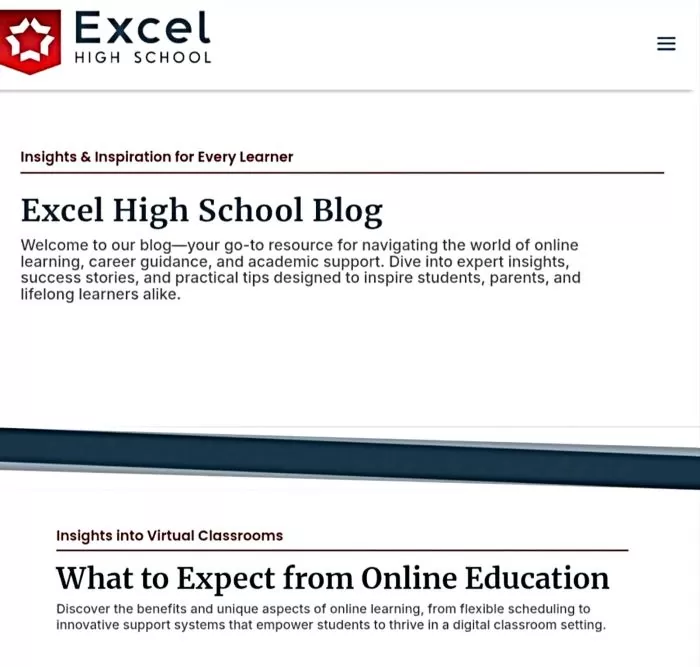
Example: Excel High School maintains an active blog of expert tips and student success stories tailored to common questions from students and parents. The blog’s content is written in an easy-to-scan format with conversational titles (e.g., “Is Online Private High School Right for Your Child?”) and highlights like “Student Success Spotlight” profiles. These posts directly address the audience’s concerns (such as comparing online school vs. homeschooling) with depth and clarity. The school publishes new articles frequently (covering online learning tips, college prep, etc.), showing a commitment to fresh, high-quality content. By focusing on topics parents and students are asking, and answering them in detail, Excel High School naturally earns both user engagement and citations in AI-driven results.
Today’s algorithms understand context, relationships, and intent, not just keywords. That’s where semantic SEO comes in. Instead of creating isolated posts, organize your content around topic clusters: a central pillar page supported by subpages that dive deeper into related areas such as courses, career paths, and student experiences.
This approach demonstrates expertise and gives both users and search engines a clear content map. It also increases your chances of ranking for multiple queries and being cited in AI-generated answers.
Don’t neglect long-tail keywords, the natural, conversational queries people use with voice and AI search. Phrases like “What is the best MBA program in Canada for working professionals?” signal specific intent. Use these as subheadings or FAQs to capture users who speak their searches out loud. The more your content mirrors natural language, the more relevant it becomes to AI assistants and human readers alike.
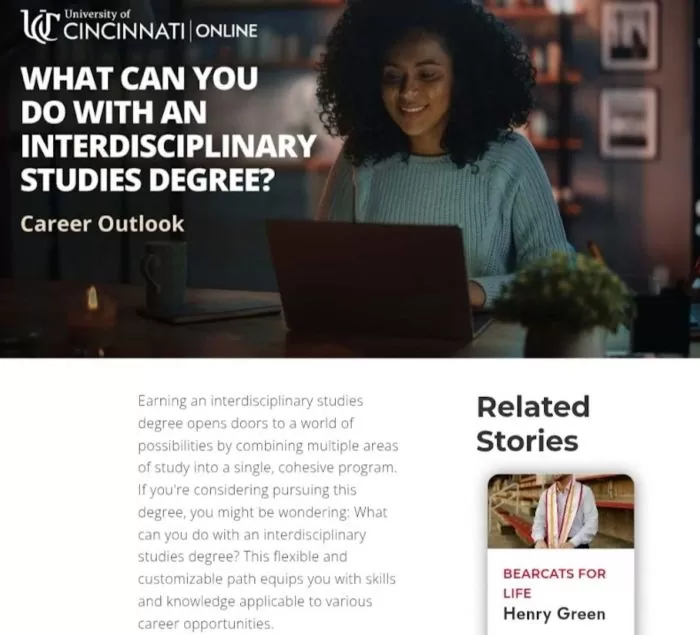
Example: The University of Cincinnati demonstrates semantic SEO by incorporating FAQ sections and natural long-tail queries into its content. In a blog post about an Interdisciplinary Studies degree, the page concludes with a Frequently Asked Questions section that uses the exact questions prospective students might ask, such as “Is interdisciplinary studies a good degree?” and provides a concise answer. These Q&A subheadings (which include conversational phrases like “Can I teach with an interdisciplinary studies degree?”) act as long-tail keyword targets. The surrounding content is organized in a hub-and-spoke model (overview, deeper career paths, then specific FAQs), reinforcing contextual relationships. This strategy not only improves human readability but also helps AI systems easily extract direct answers to niche voice queries.
A clear structure benefits both your audience and AI models. Use descriptive “Heading 2s; H2s” and (Heading 3s; H3s) to organize content logically.
For example: “Overview,” “Curriculum,” “Faculty,” “Admission Requirements,” and “FAQs.” This hierarchy improves readability, crawlability, and the likelihood that an AI engine will lift your text as a cited answer.
Equally important are your title tags and meta descriptions. Keep title tags concise and front-load the main keyword. Write meta descriptions that summarize the page with clarity and value. For instance:
“Explore the curriculum, admission requirements, and career outcomes of our Business Management Diploma, all in one place.”
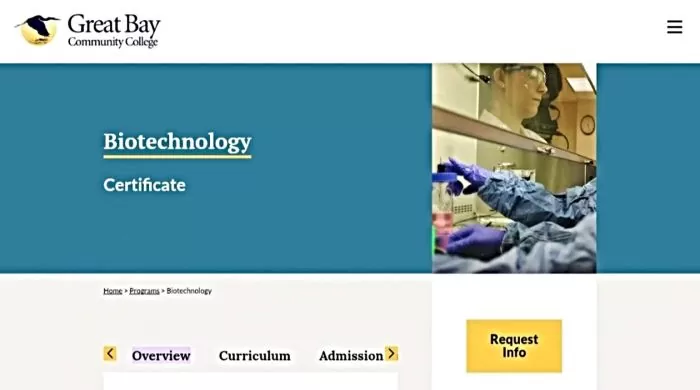
Example: Great Bay CC’s program pages use a logical, repeatable structure that benefits both users and crawlers. Each certificate or degree page is segmented with descriptive headings such as “Overview,” “Curriculum,” “Admission Requirements,” “Outcomes,” and “Faculty.” For example, the Biotechnology Certificate page clearly presents these sections in order. A visitor can jump straight to Admission Requirements or Outcomes, and an AI can quickly identify which paragraph addresses which subtopic. This structured hierarchy (implemented via heading tags) improves crawlability and the likelihood of content being featured as rich results. Notably, each section is labeled in plain language (“Curriculum Outline,” “Admission Requirements”) so both search engines and prospective students instantly know what information follows. Even Great Bay’s site listings show these section labels, underscoring how metadata and structure align.
Even though Google may generate its own snippet, a strong description improves click-through rates and shapes how AI interprets your page.
Finally, optimize images with alt text and use descriptive anchor text for internal links. These seemingly small steps provide search engines with more context and make your pages more accessible, a win for both humans and machines.
4. Enhance Site Experience and Technical SEO
A technically healthy, user-friendly site is the foundation of all SEO. With mobile-first indexing, Google prioritizes mobile performance, and that’s crucial given how students search. Most Gen Z users browse on phones and rely heavily on voice assistants.
Ensure your pages load quickly, your navigation is intuitive, and your layout adapts smoothly to smaller screens. Use HTTPS, repair broken links, and maintain clean sitemaps and robots.txt files so your content can be crawled and indexed without friction.
Engagement also matters. Multimedia such as videos, infographics, or virtual tours can keep visitors on your site longer, signaling value to Google. Include captions or transcripts to make these assets indexable and accessible. Ultimately, fast, secure, and engaging sites don’t just rank better. They retain attention, a metric both search engines and AI models consider indicators of trustworthiness.
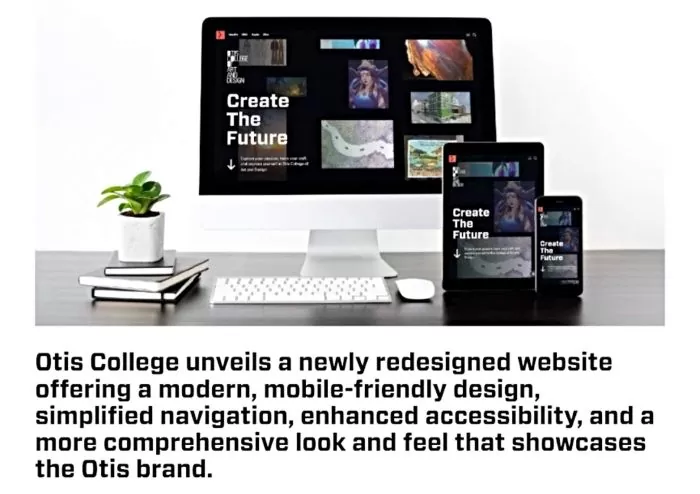
Example: Otis College provides a real-world example of technical and UX improvements elevating SEO. In June 2024, Otis unveiled its newly redesigned website. The responsive design ensures that whether a prospective student is on a phone or a laptop, the pages render correctly and quickly, a key factor now that Google uses mobile-first indexing. Otis also streamlined site structure (e.g., more logical menu categories and internal links), which helps web crawlers index the site efficiently.
Local search remains vital for institutions with multiple campuses or regional presence. Students often search with geographic intent, “colleges in Ontario biology program,” and Google tailors results accordingly.
Start by optimizing your Google Business Profile for each location: include up-to-date contact info, hours, and descriptions. Encourage authentic student reviews, as strong ratings can improve local visibility.
Create location-specific landing pages. For example, “Toronto Campus: Programs and Student Life” includes city or neighborhood references naturally within the text. Consistent local citations (accurate listings of your name, address, and phone number across directories) reinforce credibility and help you rank in local results.
These efforts support traditional SEO and feed data to AI systems, generating regional recommendations. When someone asks, “What’s the best college in Toronto for healthcare programs?” your optimized profile improves the odds of being mentioned.
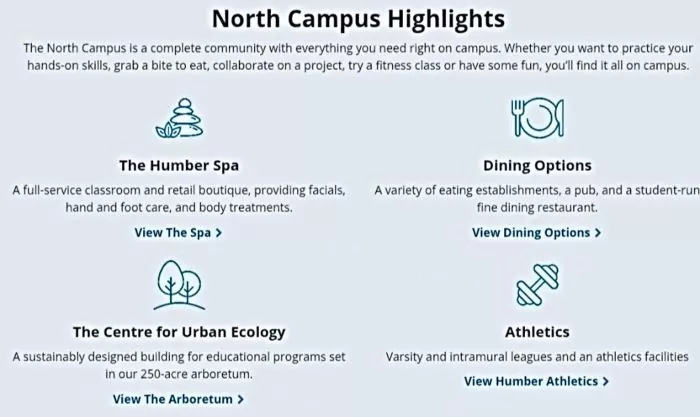
Example:Humber College, which has multiple campuses in Ontario, optimizes for local search by creating dedicated location-specific landing pages. For example, its North Campus page welcomes users with localized content: a description of the campus setting in Toronto, highlights of on-campus amenities, and most critically, the full campus address and transit details prominently shown. The page naturally weaves in the city name (“Toronto”) and neighborhood context (adjacent to the Humber River, etc.), which improves its relevance for queries like “colleges in Toronto with residence”. The inclusion of a map link and transit routes not only helps users but also counts as structured local information that search engines can parse. Furthermore, Humber’s site encourages local engagement by listing “Nearby Toronto Attractions” near the bottom, referencing landmarks like the CN Tower and Royal Ontario Museum. These geo-references strengthen Humber’s local SEO signals.
GEO Best Practices: Optimizing for AI-Driven Search Results
What is Generative Engine Optimization (GEO), and how does it differ from traditional SEO? The rise of Generative AI in search has created a new SEO frontier known as Generative Engine Optimization (GEO): the art of making your content discoverable, understandable, and quotable by AI-powered tools like Google’s Search Generative Experience (SGE), Bing Chat, ChatGPT, and others. While traditional SEO aims to improve rankings on a results page, GEO focuses on helping AI models use your content effectively in their generated answers. In essence, GEO extends SEO principles into a new space where machines summarize.
Unlike standard search results, AI overviews read and synthesize multiple sources to provide a direct, conversational response. To stay visible in this landscape, your content must be structured, authoritative, and AI-readable. Below are the essential GEO strategies to strengthen your position in AI-driven search.
1. Create Answer-Focused Content
Generative models extract concise, relevant passages to address user queries. The easier you make it for them to identify answers, the better your visibility. Structure sections in Q&A format or include an FAQ block with clear, scannable responses.
For example, if a user asks, “How much does it cost to attend your business diploma program?” an AI engine should easily find a line that reads:
“Tuition for the Business Diploma program is $X per year.”
This direct, declarative format makes your content quotable. Blogs framed as questions, such as “What Can You Do With a Psychology Degree?” often perform well in both AI summaries and voice search.
In other words: anticipate and answer the questions students are asking. If your institution doesn’t address them on its website, someone else, or the AI itself, will. The goal is to become the source AI systems trust to provide accurate, concise information about your programs and services.
2. Maintain Authority and Accuracy
AI models are built to prioritize credibility. They prefer information from authoritative, verifiable sources, and that means your content must demonstrate expertise.
Start by creating in-depth, well-researched resources that cite reliable references such as government data or industry reports. For example, a blog citing official labor statistics on graduate employment rates signals trustworthiness to both users and AI. Include bylines and author bios to show content expertise and keep your facts up to date.
Accuracy and consistency matter more than ever. If one page says your nursing diploma is two years and another says three, AI systems will hesitate to use either. Review and update your website regularly to maintain coherence across all mentions of tuition, program length, and admissions details.
Finally, use citations within your text where appropriate: “According to the Canadian Nurses Association, nursing graduates will see 7% job growth by 2030.” Such phrasing reinforces reliability and gives AI models clear attribution patterns to replicate.
Be the source worth quoting. In the AI era, your brand’s authority is built not just through backlinks but through data integrity and factual precision.
3. Implement AI-Friendly Schema Markup
Structured data, or schema markup, is the hidden language that helps search engines and AI systems understand your content. By tagging key elements of your pages (program names, events, FAQs, how-to steps), you make it easier for machines to extract and display your information accurately.
Use the FAQ schema and QAPage schema for question-based sections, the Course schema for program descriptions, and the Event schema for open houses, deadlines, and campus events. These schemas enable AI to pull details like:
“The next Open House is on October 15 at 10:00 AM.”
Schema can also help voice assistants through Speakable markup, which identifies which parts of your content are ideal for being read aloud.
Why it matters: Google’s SGE and Bing Chat frequently rely on structured data to identify authoritative responses. When your content is tagged properly, you make it easier for AI systems to find and quote your material verbatim.
Even if you’re not a developer, there are tools and generators for creating JSON-LD schema code for FAQs, events, and courses. Implementing this markup bridges the gap between human-readable content and machine understanding, boosting both traditional SEO and GEO performance.
4. Diversify Content Formats and Channels
AI doesn’t just read websites; it pulls data from across the web, including YouTube, LinkedIn, Reddit, and other platforms. That means your visibility in AI search improves when your content ecosystem extends beyond your main site.
Repurpose your strongest content into multiple formats. For instance, transform a blog on “Tips for Successful College Applications” into a YouTube video, an infographic, and a short LinkedIn post. Transcripts from your videos, captions on social media, and consistent keyword use across platforms all increase your digital footprint.
AI models often reference content from high-engagement communities. After seeing an AI summary, users frequently validate information through YouTube reviews or Reddit discussions. Being active and consistent on these platforms helps your brand appear wherever AI or your audience looks for confirmation.
When your messaging is aligned across channels, you build “community proof.” This type of engagement-driven validation strengthens how AI interprets your trustworthiness. The takeaway? Don’t let your best content live in isolation. Let it circulate. The wider your reach, the greater your chance of inclusion in AI-generated results.
5. Welcome AI Crawlers and Monitor Mentions
Just as you optimize for Googlebot, ensure your site welcomes legitimate AI crawlers. Tools like GPTBot (used by OpenAI) and similar agents from Anthropic, Perplexity, or Google can index your content for inclusion in their AI-generated answers.
Check your robots.txt file to confirm these crawlers aren’t unintentionally blocked. Allowing access means your pages can be referenced when users query AI assistants.
Once you’re visible to AI crawlers, start tracking how your content appears in AI-generated results. Emerging SEO analytics tools can now identify when your site is mentioned within AI overviews or cited in chat responses. Pay attention to referral traffic from sources like bard.google.com or chat.openai.com. These indicate clicks coming from AI-powered experiences.
While the volume of AI referral traffic is still relatively low, it’s expanding fast. Some studies report tenfold growth in a single year. And because these users arrive after seeing your content recommended by an AI model, they’re often high-intent visitors; individuals seeking more detail, verification, or enrollment information.
Track which pages attract this traffic and which topics generate it. This data can guide your next content updates and show where you’re already succeeding in GEO.
Measuring Your Progress and Adjusting Course
Implementing a strong SEO and GEO strategy is only half the battle. The other half is knowing whether it’s working. In an AI-driven search environment, measuring success means tracking both traditional SEO metrics and new signals that reflect your visibility within AI-generated results. Here’s how to evaluate progress, interpret your data, and refine your strategy over time.
Use the Right Analytics and Tools
Start with the essentials. Google Search Console remains your most valuable tool for understanding organic performance. It reveals which queries trigger your site, your average ranking position, impressions, and click-through rates (CTR). Pay attention to the relationship between impressions and clicks: if impressions stay steady or rise while clicks decline, you may be seeing the effects of zero-click searches, where users get answers directly from AI overviews or snippets.
Google Analytics (GA) complements this by providing insight into user behavior after they arrive. Track organic traffic volume, session duration, bounce rates, and key conversion events such as brochure downloads, form submissions, or virtual tour signups. If you notice a dip in organic traffic that aligns with the rollout of a new AI search feature, that correlation is important. GA’s referral data can also highlight hits from sources like chat.openai.com or Bing’s chatbot, small but growing indicators of AI-driven referrals.
Beyond free tools, platforms like Ahrefs and SEMrush are invaluable for deeper competitive and keyword insights. Ahrefs can show when a keyword’s results page includes an AI overview or featured snippet, while SEMrush offers comparative content analysis to identify what competitor pages are doing differently, such as using schema markup or answering queries more directly.
Finally, experiment with emerging platforms like Keyword.com’s AI Overview Tracker or similar products that monitor how often AI overviews appear for your target keywords. If your budget allows, these new metrics can help quantify your AI visibility, not just your search ranking.
Key Metrics to Watch
Organic Rankings: Continue monitoring rankings for your high-priority queries. For instance, “[Province] business diploma” or “[Your College] admissions.” If your positions hold steady but traffic drops, AI summaries could be diverting clicks. A sharp fall in rankings, meanwhile, may signal a technical or algorithmic issue that needs attention.
Click-Through Rate (CTR): In Search Console, compare CTR trends for your top-ranking pages. A consistent decline, say, a drop from 5% to 3% at the same rank, may indicate that an AI box is capturing user attention. Studies show that when AI overviews appear, the top organic result can lose up to one-third of its clicks. If this pattern matches your data, consider optimizing content to appear within the AI-generated summary, not just beneath it.
Zero-Click Indicators and Dwell Time: You can’t directly measure zero-click searches, but a combination of high impressions and low CTR is a clear proxy. Focus on dwell time or average session duration for those who do click through. Recent findings suggest that although fewer users click from AI-heavy results, those who do are more engaged, viewing multiple pages or staying longer on-site. If your analytics show longer sessions for specific queries, that’s a sign your content is effectively deepening the user journey beyond what the AI overview offers.
AI Referral Traffic: Check GA for referral traffic from AI platforms like bard.google.com, bing.com/chat, or chat.openai.com. While numbers may be modest now, early adopters are seeing these referrals increase quickly, in some cases by tenfold year-over-year. Each click from an AI platform often represents a highly motivated user seeking further detail or validation. Treat these as premium leads and track how they behave once on your site.
Conversion Metrics: Ultimately, your goal is engagement: inquiries, applications, and conversions. Even if top-of-funnel traffic decreases, conversion rates may improve as AI filters out casual browsers and sends you high-intent visitors.
Research suggests that users who click after an AI overview view roughly six pages per session, similar to traditional searchers but with greater purchase or enrollment intent. Monitor lead form submissions, email signups, and other goal completions closely; steady or rising conversions amid lower traffic mean your strategy is targeting the right audience.
Adjusting Your Strategy
Analytics are only useful if they lead to action. Once you’ve identified which queries or pages are underperforming, adjust your approach based on the data.
If a critical keyword consistently generates an AI overview that excludes your content, create a new page or update an existing one to address that question directly, complete with schema markup and concise Q&A formatting. Conversely, if you notice certain pages repeatedly mentioned in AI summaries or drawing high engagement, double down: expand those topics, interlink related content, and promote them across your channels.
SEO and GEO are iterative disciplines. As AI search behavior evolves, so must your content. Make small, data-informed adjustments regularly rather than waiting for major overhauls.
Stay Ahead of Algorithm and AI Changes
Search engines are transparent, to a point, about major changes. Monitor updates from Google’s Search Central Blog, follow industry analysts, and participate in professional SEO communities to stay informed about algorithm shifts and AI integration.
For instance, during the Google March 2025 Core Update, industry data revealed a 115% increase in AI-generated overviews across queries. Knowing such patterns can help you anticipate traffic fluctuations and explain them internally before panic sets in. It also allows you to update your content proactively for new features, such as AI-generated “Education Q&A” boxes or visual search summaries.
Gather Qualitative Feedback
Not all insights come from dashboards. Pay attention to what prospective students and your admissions team are saying. If applicants mention, “I saw on Google that your program offers…”, check if that information is accurate. AI summaries sometimes simplify or misrepresent data. When they do, it’s your cue to clarify the information on your site so the AI can correct itself over time.
Listening to these real-world interactions helps bridge the gap between technical optimization and student perception. Remember: algorithms change constantly, but student questions about cost, programs, and outcomes remain remarkably consistent.
Partner with HEM to Make the Most of The AI Revolution
The rise of generative AI marks a turning point in search, but not the end of organic visibility. Like every major evolution in digital marketing, this shift calls for adaptation, not abandonment. The institutions that will stand out are those that embrace innovation while staying grounded in authenticity.
How can schools and marketers protect their organic traffic as AI-driven search evolves? To thrive, higher education marketers must blend SEO fundamentals: relevance, structure, and authority, with AI-era tactics like structured data, conversational formatting, and ongoing performance tracking. The goal isn’t just to rank; it’s to become the source AI trusts when answering students’ questions.
By creating genuinely useful, clearly structured content and continually measuring what works, your school can remain visible and credible, even as zero-click searches grow. Remember: AI hasn’t changed what students want, only how they find it. Keep listening, refining, and sharing real stories that resonate. In doing so, you won’t just survive the search revolution, you’ll lead it.
Frequently Asked Questions
Question: Does SEO still matter in the age of AI?
Answer: With AI tools answering questions directly on search pages, it’s a fair question to ask: The short answer is absolutely. But it’s no longer SEO as usual. Even as AI search evolves, organic SEO remains the foundation of online visibility for schools. Roughly 91% of organizations still report significant marketing gains from SEO.
Question: How can schools and marketers protect their organic traffic as AI-driven search evolves?
Answer: To thrive, higher education marketers must blend SEO fundamentals: relevance, structure, and authority, with AI-era tactics like structured data, conversational formatting, and ongoing performance tracking. The goal isn’t just to rank; it’s to become the source AI trusts when answering students’ questions.
Question: What is Generative Engine Optimization (GEO), and how does it differ from traditional SEO?
Answer: The rise of Generative AI in search has created a new SEO frontier known as Generative Engine Optimization (GEO): the art of making your content discoverable, understandable, and quotable by AI-powered tools like Google’s Search Generative Experience (SGE), Bing Chat, ChatGPT, and others.
This audio is auto-generated. Please let us know if you have feedback.
Dive Brief:
Trinity Christian College plans to close after the 2025-2026 academic year amid mounting financial issues, the private liberal arts institutionsaid Tuesday.
“The board has worked faithfully and tirelessly to consider every possible option in the face of significant and rapidly evolving financial challenges,”Acting President Jeanine Mozie said in a video message.
In explaining why it was closing, Trinity, based near Chicago, cited persistent deficits, falling enrollment, shifts in charitable giving and financial challenges since the pandemic.
Dive Insight:
Trinity said it worked with advisers on possible solutions to its financial struggles, including “significant programmatic changes” and strategic partnerships with other institutions.
“However, there is no sustainable path forward for our beloved institution,”Mozie said in the video message, in which she appeared with board chair Ken Dryfhout.
Between fiscal years 2020 and 2024, the college’s total assets fell by nearly14% to $72.3 million. Much of that decline came in its cash holdings, which fell by nearly $8 million during that period, to $5 million.Trinity also reported operating deficits every year during that time.
In June, Trinity reported that it could fail to meet bond requirements for cash on hand and a metric measuring its ability to pay its debt obligations. The college said at the time that it was soliciting donors to help it meet the covenants.
Many of Trinity’s financial woes stem from its shrinking student body and the pressures on small liberal arts institutions. Already small, the college’s fall enrollment dropped to 883 students in fall 2023, a nearly 22% decline from five years prior, according to the latest federal data.
Enrollment declines hurt Trinity’s revenue. In fiscal 2024, net tuition and fee revenue stood at $12.1 million, roughly 14% less than 2020 levels.
The revenue drop also came after a period of steep inflation in higher education and the broader economy. At Trinity, total expenses rose at nearly the same rate as revenue declined between fiscal 2020 and fiscal 2024, reaching $32.9 million.
Mozie was appointed acting president, replacing Aaron Kuecker, just two months before she announced the college’s closure. Prior to that, she was Trinity’s chief operating officer.
Founded with a nondenominational Christian mission, Trinity elected its first board of trustees in 1959.It soon opened a two-year college with just five faculty members and roughly three dozen students on a former golf course, using a renovated clubhouse and pro shop. By 1971, the institution was issuing four-year degrees, and it added graduate programs in 2012.
Trinity plans to hold its last commencement next year for the class of 2026. It is allowing students to take above the max course load per semester to graduate as many as possible, with the rest offered teach-out and transfer options.
The college has teach-out agreements in place for most undergraduate programs with regional neighbors Saint Xavier, Calvin and Olivet Nazarene universities.It is working on agreements for many of its remaining programs.
Trinity said it plans to sell its property after closing to repay its debt. As of fiscal 2024, Trinity owned property and equipment valued at $44.2 million and owed $14.8 million in bonds.
At a moment of political turmoil in American history, rife with violence, mass protest, and division, one university chose neutrality.
In 1967, when the president of the University of Chicago convened a faculty committee to deliberate on how the university should approach social and political issues, American higher education faced a pivotal moment. The Berkeley Free Speech Movement had changed the face of campus activism just three years prior. American society was rocked by protests against the Vietnam War and racial segregation.
That the committee emerged from deliberations with the Kalven Report, which recommended that colleges and universities stay neutral on major social and political issues, was a testament to the committee’s understanding of the purpose of the university to advance knowledge and truth-seeking.
The Kalven Report, named for the chair of the committee Harry Kalven Jr., articulated the role of faculty and students as instruments of “dissent and criticism,” and the university’s role as the “home and sponsor of critics.” Importantly, the report noted that the university “is not itself the critic,” and added that the spirit of independence and neutrality mean the university “must embrace, be hospitable to, and encourage the widest diversity of views within its own community.”
FAQ: Institutional Neutrality and the Kalven Report
What is institutional neutrality? The idea that colleges and universities should not, as institutions, take positions on social and political issues.
FIRE has previously argued for colleges and universities to adopt institutional neutrality, both as a boon for the campus climate and as an insurance policy for the university. By declaring itself neutral on major political and social issues, a university ensures that it does not chill potential dissenters on campus by constantly taking official positions on unresolved topics. And it is worth noting that the Kalven Report makes a significant exception for threats to the “very mission of the university and its values of free inquiry.” There, a university may feel obligated to speak out on issues related to university governance.
But recently, two public universities demonstrated that they misunderstand what institutional neutrality entails. They used the principle to restrict student speech under the guise of protecting university neutrality.
At the University of Texas at Austin, a Graduate Student Assembly representative introduced two resolutionsopposing implementation of a Texas law eliminating university DEI programs and initiatives. The GSA prepared to bring the resolutions to the floor for consideration.
But an administrator intervened on the grounds that the resolution constituted “political speech that is not permitted to be issued by a sponsored student organization in their official capacity.” This move directly contravened the GSA’s stated purpose to “serve as a voice for graduate students on matters of academics, student welfare, and campus policy.”
FIRE and the ACLU of Texas wrote to UT Austin to explain why the university’s restrictions on the GSA are not required by the university’s adoption of institutional neutrality.
When a student government merely expresses an opinion about a policy that has significant impact on campus, it is engaging in expressive activity protected by the same First Amendment principles that safeguard the speech of individual students.
Institutional neutrality restrains an institution from adopting official positions on major issues. While there are open questions about how far within a university institutional neutrality must extend, neutrality certainly does not require — and indeed, is at odds with — a university restricting the speech of student bodies. This is an especially important distinction to make, given the fact that student associations and governments are supposed to serve, in part, as voices for the student body.
There are certain circumstances where student governments do exercise powers delegated by their universities, and so must abide by the same constitutional and legal obligations that bind the university itself. Student group funding, for example, is one area where student governments are required to be viewpoint-neutral, and FIRE has urged universities to intervene when student governments violate that obligation.
But when a student government merely expresses an opinion about a policy that has significant impact on campus, it is engaging in expressive activity protected by the same First Amendment principles that safeguard the speech of individual students. Unduly restricting it violates students’ rights and the spirit of institutional neutrality, which is intended to allow the university to house exactly this kind of discourse and debate.
UT Austin is not alone. This past summer, Purdue, just one year after adopting institutional neutrality, ordered an independent student publication to stop using “Purdue” in the publication’s URL and said it would end facilitating the publication’s free circulation on campus.
The university did so because the publication is a private entity, and the university feared, in light of its stance on institutional neutrality, that the publication’s speech would be associated with the university. But this order made clear that Purdue misunderstood institutional neutrality. The university was incorrect that allowing a clearly independent student publication to use Purdue’s name in its URL was somehow a violation of institutional neutrality.
This was simply an attempt to censor student speech by removing long-standing informal arrangements the paper had with the university — an entirely unnecessary decision that could chill expression on campus. A reasonable person would not assume that an independent student publication or student organization is speaking on behalf of a university. This is especially so when one considers how many disparate university organizations use a university’s name or receive university funding.
Punishing student or faculty speech in the name of maintaining institutional neutrality turns the entire concept on its head.
Indeed, the wisdom of institutional neutrality is that it allows universities to foster the widest possible ranges of voices and perspectives on campus. It is not about protecting universities from being associated with views they dislike. Rather, universities can create environments where their community members feel free to take unpopular positions and debate difficult ideas without feeling that their university is putting its thumb on the scale in one direction or another.
Institutional neutrality does not mean penalizing student publications for their viewpoints, just as it does not justify muzzling student governments. Punishing student or faculty speech in the name of maintaining institutional neutrality turns the entire concept on its head.
Nearly 40 institutions, including university systems, have adopted institutional neutrality, and FIRE will continue to urge other universities to follow suit. But institutional neutrality must not be misunderstood as obligating a university to restrict the speech of student governments or publications. We urge UT Austin, Purdue, and other neutral institutions to refrain from using neutrality as an excuse to censor student speech.
Caldwell has served as president of Centenary University since 2023.
Eduardo Munoz Alvarez/Getty Images
As running mate to Governor-elect Mikie Sherrill, Centenary University president Dale Caldwell, a Democrat, won the New Jersey gubernatorial race on Tuesday in a 56 percent–to–43 percent victory over Republicans Jack Ciattarelli and James Gannon.
“Every single day of this campaign has been a reminder of what a special place New Jersey is,” Caldwell wrote on X Wednesday. “I’m humbled and honored to be your next Lieutenant Governor.”
Caldwell has served as president of Centenary, a Methodist university in Hackettstown, N.J., since 2023. Prior to assuming the presidency, he served on Centenary’s board, and he is also a pastor at Covenant United Methodist Church in Plainfield. Caldwell was the university’s first Black president and in January will become New Jersey’s first Black lieutenant governor.
“Centenary University would like to congratulate Gov. Elect Mikie Sherrill and Lt. Gov. Elect Dale Caldwell, Ed.D., on their victory in the recent New Jersey gubernatorial election,” university officials wrote in a statement Wednesday.
Centenary officials have not yet announced who will serve as interim president or their plans to find a permanent replacement when Caldwell departs in January.
HEPI Director, Nick Hillman, takes a first look at today’s Final Report from the Curriculum and Assessment Review.
It feels like Christmas has come early for policy nerds. At 6.01am this morning, we finally got sight of Building a world-class curriculum for all, the long-awaited report from the Government’s independent Curriculum and Assessment Review (CAR).
Overseen by Professor Becky Francis, who is an experienced educational leader and researcher and someone who also has a background in policy, it was commissioned when the Labour Government was facing brighter days back in their first flush.
The first thing to note about the report is that, in truth, independent reports commissioned by governments are only half independent. For example, the lead reviewer is usually keen to ensure their report lands on fertile soil (and, indeed, is usually chosen because they have some affinity to the people in charge). In addition, independent reviews are supported by established civil servants inside the machine and there is usually a conversation behind the scenes between the independent review team and those closest to ministers as the work progresses. (In higher education, for example, both the Browne and Augar reviews fit this model.) So it is no great surprise that the Government has accepted most of what Becky’s largely evidence-led team has said.
Yet anyone reading the press coverage of the CAR while it has been underway, or anyone who has seen the front page of today’s Daily Mail, which screams ‘LABOUR DUMBS DOWN SCHOOLS’, may wonder if the report that has landed today is the nightmare before Christmas rather than a welcome festive present. There is lots to like but the document also feels incomplete, especially – for example – for people with an interest in higher education. So it is perhaps best thought of as a present for which the batteries have yet to arrive.
Nonetheless, this morning I spoke at the always excellent University Admissions Conference hosted annually by the Headmasters’ and Headmistresses’ Conference (HMC) and the Girls’ School Association (GSA) and I could not help wondering aloud whether any new restraints on state-maintained schools might give our leading independent schools, who are much freer to teach what they like, an additional edge – especially as academy schools are already, even before today, having freedoms ripped from them.
What does the CAR say (and what does it not say)
But what does the review, which had a team of 11 beneath Becky (including one Vice-Chancellor in Professor Nic Beech and also Jo-Anne Baird from the Oxford University Centre for Educational Assessment) actually say?
The first thing to note is that it is much better than the Interim Report, which said little, sought to be all things to all people and read like it had been written by one of the better generative AI tools.
In terms of hard proposals, the Final Report starts and ends with older pupils, those aged 16 to 19, for whom we are told there should be ’a new third pathway at level 3 to sit alongside A-Levels and T Levels.’ If this feels familiar, it is because the Curriculum and Assessment Review’s emerging findings helped shape the recent Post-16 Education and Skills white paper and, more importantly, because there is already such a pathway populated by qualifications like BTECs.
So there is a sense of reinventing the wheel here, with (to mix my metaphors) politicians putting a new coat of paint on the current system. In many respects, the material on 16-to-19 pupils is the least interesting part of the report – especially as there is next to nothing at all on A-Levels. The review team starkly states, ‘we heard very little concern regarding A Levels in our Call for Evidence and our sector engagement’, so they basically ignore them – in a world of change, A Levels continue to sail steadfastly on.
As trailed in the newspapers, there is a recommendation for new ‘diagnostic Maths and English tests to be taken in Year 8.’ This would obviously help track progress between the tests taken at the end of primary school (in Year 6) and the public exams taken at age 16. But the idea has already prompted anger from trade unionists, almost guaranteeing that the benefits and downsides will be overegged in the inevitable political rows to come.
There are also numerous scattergun subject-by-subject recommendations. These are largely sensible (see, for example, the iideas on improving English GCSEs or the section on Science) but also a little unsatisfying. Some of the subject-specific changes are a little trite or inconsequential (like tweaks to the name of individual GCSEs) while others need much more detail than a general review of everything that happens between the ages of 11 and 19 is able to offer. Any material changes will need to be at a wholly different level of detail to what we have got today, and they will be some years away, so may make no difference to anyone already at secondary school.
Other points to note include that the Review is Gove-ian in its love of exams, which it stresses are a protection against the negatives of AI, over coursework. (I suspect Dennis Sherwood, the campaigner against grading inaccuracy will be incandescent about how the report appears to skate over some of the imperfections of how exams currently operate.) However, despite the support for exams, one of the crunchiest recommendations in the review is the proposal of a 10% reduction in ‘overall GCSE exam volume’, which we are told can happen without any significant downsides, though the tricky details are palmed off to Ofqual and others.
The English Baccalaureate and Progress 8
The one really clear place where Professor Francis’s review team and the Government, who have generally accepted the recommendations, are out of kilter with one another is on Progress 8.
Progress 8 is a school accountability measure that assesses how much ‘value-added’ progress occurs between primary school (SATs) and GCSEs. It is such a favoured measure that the Government has recently proposed a new Progress 8 measure for universities (which is a mad idea that wrongly assumes universities are just big schools – in reality, it is a defining feature of universities that they set their own curricula and are their own awarding body).
Becky Francis opposes the EBacc, which is a metric related to, but separate, from Progress 8, yet she wishes to maintain some vestiges of the EBacc within Progress 8. While the EBacc focuses specifically on how many students achieve qualifications in a list of specially favoured subject areas (English Lang and Lit, Maths, Sciences, Geography or History plus a language), the CAR recommends ‘the removal of the EBacc measures but the retention of the EBacc “bucket” in Progress 8 under the new title of “Academic Breadth”.’
This is something the Government is not running with, favouring less restrictions on Progress 8 instead, which may or may not reinvigorate some creative subjects. Yes, it is all exceptionally complicated but Schools Week have an excellent guide and the two pictures below (from Government sources) might help: the first shows the status quo on Progress 8 and is what Becky Francis wishes to maintain (though pillars 3, 4 and 5 would be renamed if she got her way); the second shows the Government’s proposal.
How does it fare?
Call me simple, but I was always going to judge the Curriculum and Assessment Review partly on the extent to which it tackled specific challenges that we have looked at closely at HEPI In recent years. Here the CAR is a mixed bag. On the positive side of the ledger, the review recommends more financial education, reflecting the polling we conducted to help inform the CAR’s work: when we asked undergraduates how well prepared they felt for higher education, 59% said they felt they should have had more education on finances and budgeting.
The most obvious problem that the CAR insufficiently addresses is the huge underperformance of boys. This issue usually gets a namecheck in Bridget Phillipson’s interviews but it was entirely ignored in the recent Post-16 white paper; in the CAR, it does at least receive a quick nod and just maybe some of the proposed curriculum changes will benefit boys more than girls. But there is more focus on class and other personal characteristics than sex and in the end the brief acknowledgement of boys’ underperformance does not lead to anything properly focused on the problem.
This is very strange for we simply cannot fix the inequalities in outcomes until we give the gaps in the attainment of boys and girls the attention they deserve. I am beginning to think I was wrong to be so hopeful that a female Secretary of State was more likely to focus on this issue than a male one (on the grounds that it would be less sensitive politically).
Another area where we at HEPI have been mildly obsessed is the catastrophic decline in language learning, as tracked for us by the Oxonian Megan Bowler. Here, as with boys, the new review is disappointing. In the section looking at welcome subject-by-subject changes, the recommendations on languages are both relatively tentative and relatively weak. As one linguist emailed me first thing this morning, ‘It is pretty remarkable that the CAR’s decision on languages runs exactly contrary to the best and consistent advice of the key language advisers on the issue’. However, the Government’s response goes a little further and Ministers promise to ‘explore the feasibility of developing a new qualification for languages that enables all pupils to have their achievements acknowledged when they are ready rather than at fixed points.’ We might not want languages always to be treated so differently from other subjects but I am still chalking that up as a win.
The CAR also ignores entirely one issue that is currently filling some MPs’ postbags – the defunding of the International Baccalaureate (IB). The IB delivers a broad curriculum for sixth-formers, is liked by highly selective universities and tackles the early specialisation which marks out our education system from those in many competitor nations. Back in the heady Blair years, Labour politicians loved the qualification and promised to bring it within touching distance of most young people.
As HEPI is a higher education body, it also feels incumbent upon me to point out that higher education is largely notable by its absence in the CAR, with universities being mentioned just nine times across the (almost) 200 pages and despite schools and colleges obviously being the main pipeline for new students. It is rather different from the days when universities were regarded as having a key direct role to play in designing what goes on in schools. Indeed, our exam boards tended to originate within universities.
The odd references to universities that do make it in to the CAR report are not especially illuminating. For example, more selective universities appear as part of the rationale for killing the EBacc ‘the evidence does not suggest that taking the EBacc combination of subjects increases the likelihood that students attend Russell Group universities.’ Universities also appear in the section on bolstering T Levels, with the review proposing ‘The Government should continue to promote awareness and understanding of T Levels to the HE sector.’ But that is about it.
Incidentally, there is also less in the report on extracurricular activities than the pre-publication press coverage might have led you to believe, even if the Government’s response to the review does focus on improving the offer here.
Trade-offs
Becky Francis used to head up the UCL Institute of Education (IoE), which is an institution that has always wrestled with excellence versus opportunity. Years ago, I sat in a learnèd IoE seminar on why university league tables are supposedly pernicious – but I had to walk past multiple banners boasting that the IoE was ‘Number 1’ in the world for studying education to get to the seminar and, while I was in the room, news came through that the IoE was going to cement its reputation and position by merging with UCL.
Such tension is a reminder that educational changes generally have trade-offs and the Executive Summary of the main CAR document admits: ‘All potential reforms to curriculum and assessment come with trade-offs’. Abolishing the EBacc as the CAR team want and watering down Progress 8 as the Department for Education want, might help some pupils and some disciplines while making the numbers we produce about ourselves look better – though the numbers produced by others about us (at places like the OECD) could come to tell a different story in time.
In the end, we have to recognise that there are only so many hours in the school day, only so many (ie not enough) teachers and only so much room in pupils’ lives, not to mention huge diversity among pupils, schools and staff, which together ensure there can be no perfect curriculum. More of one subject or more extracurricular activities are likely to mean less of other things because the school day is not infinitely expandable (and there is nothing here to free up teachers’ time or fill in all those teacher vacancies). Yet the school curriculum does need to be revised over time to ensure it remains fit for purpose.
The question now is whether the CAR report matters. Will we still be talking about it in 20 years time? Can a Government buffeted by all sides, facing a huge fiscal crisis and with a Secretary of State for Education who sometimes seems more focused on political battles (like the recent Deputy Leadership election of the Labour Party) than on engaging with the latest educational evidence really deliver Becky Francis’s vision? Or will the CAR’s proposals wilt as quickly as the last really big proposal for curriculum reform: Rishi Sunak’s British Baccalaureate? In all honesty, I am not certain but there are, in theory at least, four years of this Parliament left whereas Rishi Sunak spent more like four months pushing his idea.
My parting thought, however, is different. It is that, while the trade-offs in the CAR report partly just represent the facts of life in education, they do not entirely do so. Trade-offs are much trickier to deal with when you are also seeking to root out diversity of provision. And in the end, if there is one thing that marks this Government’s mixed approach to schooling out above all, it is the desire to make all schools more alike, whether that is reducing academy freedoms, micromanaging the rules on school uniforms, defunding the IB, forcing state schools to stop offering classical languages or pushing independent schools to the wall. Would it be better, and also make politicians’ lives easier, if we stopped pretending that the 700,000 kids in each school year group are more like one another than they really are?
Postscript: While the CAR paper is infinitely more digestible than the interim document, there is still some wonderful eduspeak, my favourite of which is:
A vocational qualification is aligned to a sector and is usually taught and assessed in an applied way. A technical qualification meanwhile has a direct alignment with an occupational standard. Despite the name ‘Technical Awards’, these qualifications are therefore vocational rather than technical.