Author: admin

  • Why so much confusion over climate change?

    Why so much confusion over climate change?

    Bwambale estimates that less than 1% of the global population truly grasps the implications of climate change. “Even worse are Ugandans,” he said.

    Gerison pointed out that much of the population of Uganda is young. “With 80% below the age of 25, many haven’t witnessed the full extent of climate changes,” he said.

    A diminishing crop is easily understood.

    Janet Ndagire, Bwambale’s colleague, said it is difficult for Ugandan natives to connect with climate campaigns. They often perceive them as obstacles to survival rather than crucial interventions.

    “Imagine telling someone who relies on charcoal burning for survival that cutting down a tree could be hazardous!” Ndagire said. “It doesn’t make sense to them, especially when the tree is on their plot of land.”

    Reflecting on personal experiences, Ndagire recalled childhood days of going to sleep fully covered. Nowadays it is too hot to do that, he said.

    Ssiragaba Edison Tubonyintwari, a seasoned bus driver originally from western Uganda but currently driving with the United Nations, recounts the challenges of driving between 5 and 9 AM in the Albertine rift eco-region especially around the Ecuya forest reserve.

    “It would be covered in mist,” said Tubonyintwari. “We’d ask two people to stand in front, one on either side of the bus, signalling for you to drive forward, or else, you couldn’t see two metres away. Currently, people drive all day and night!”

    Irish potatoes in the African wetlands

    What happened? Tubonyintwari pointed to unauthorised tree cutting in the reserve, residential constructions and the cultivation of tea alongside Irish potatoes in the wetlands. The result was rising temperatures.

    His account supplements a Global Forest Watch report which puts commodity-driven deforestation above urbanisation.

    It’s notable that Tubonyintwari didn’t explicitly use the term “climate change,” yet the sexagenarian can effectively explain the underlying concept through his detailed description of altered environmental conditions.

    Global Forest Watch reports alarming deforestation trends, with 5.8 million hectares lost globally in 2022. In Uganda, more than 6,000 deforestation alerts were recorded between 22 and 29 November this year.

    The consequences of such environmental degradation are dire. Ndagire emphasised that those who once wielded axes and chainsaws for firewood are now the very individuals facing reduced crop yields due to extreme weather conditions.

    Even as Uganda grapples with the aftermath of a sudden surge in heavy rains from last October, Bwambale questions the country’s meteorological department, highlighting the failure to provide precise explanations and climate-aware preparations.

    These interconnected narratives emphasise the need for accessible climate campaigns and community-driven solutions. As COP28 gathers elites, the call for a simplified narrative gains prominence, mirroring successful communication models seen during the Covid-19 pandemic; else it’s the same old throwing of good money after bad.


    Questions to consider:

    1. Why does deforestation continue in places like Uganda when people know about its long-term consequences?

    2. In what ways are high level discussions about climate change disconnected from people’s everyday experiences?

    3. In what way do you think scientists and environmentalists need to change the climate change narrative?

    Source link

  • Creating a classroom built for success

    Creating a classroom built for success

    Key points:

    For decades, curriculum, pedagogy, and technology have evolved to meet the changing needs of students. But in many schools, the classroom environment itself hasn’t kept pace. Classic layouts that typically feature rows of desks, limited flexibility, and a single focal point can often make it harder for educators to support the dynamic ways students learn today.

    Classrooms are more than places to sit–when curated intentionally, they can become powerful tools for learning. These spaces can either constrain or amplify great teaching. By reimagining how classrooms are designed and used, schools can create environments that foster engagement, reduce stress, and help both teachers and students thrive.

    Designing a classroom for student learning outcomes and well-being

    Many educators naturally draw on their own school experiences when shaping classroom environments, often carrying forward familiar setups that reflect how they once learned. Over time, these classic arrangements have become the norm, even as today’s students benefit from more flexible, adaptable spaces that align with modern teaching and learning needs.

    The challenge is that classic classroom setups don’t always align with the ways students learn and interact today. With technology woven into nearly every aspect of their lives, students are used to engaging in environments that are more dynamic, collaborative, and responsive. Classrooms designed with flexibility in mind can better mirror these experiences, supporting teaching and learning in meaningful ways, even without using technology.

    To truly engage students, the classroom must become an active participant in the learning process. Educational psychologist Loris Malaguzzi famously described the classroom as the “third teacher,” claiming it has just as much influence in a child’s development as parents or educators. With that in mind, teachers should be able to lean on this “teacher” to help keep students engaged and attentive, rather than doing all the heavy lifting themselves.

    For example, rows of desks often limit interaction and activity, forcing a singular, passive learning style. Flexible seating, on the other hand, encourages active participation and peer-to-peer learning, allowing students to easily move and reconfigure their learning spaces for group work or individual work time.

    I saw this firsthand when I was a teacher. When I moved into one of my third-grade classrooms, I was met with tables that quickly proved insufficient for the needs of my students. I requested a change, integrating alternative seating options and giving students the freedom to choose where they felt most comfortable learning. The results exceeded my expectations. My students were noticeably more engaged, collaborative, and invested in class discussions and activities. That experience showed me that even the simplest changes to the physical learning environment can have a profound impact on student motivation and learning outcomes.

    Allowing students to select their preferred spot for a given activity or day gives them agency over their learning experience. Students with this choice are more likely to engage in discussions, share ideas, and develop a sense of community. A comfortable and deliberately designed environment can also reduce anxiety and improve focus. This means teachers experience fewer disruptions and less need for intervention, directly alleviating a major source of stress by decreasing the disciplinary actions educators must make to resolve classroom misbehavior. With less disruption, teachers can focus on instruction.

    Supporting teachers’ well-being

    Just as classroom design can directly benefit student outcomes, it can also contribute to teacher well-being. Creating spaces that support collaboration among staff, provide opportunities to reset, and reduce the demands of the job is a tangible first step towards developing a more sustainable environment for educators and can be one factor in reducing turnover.

    Intentional classroom design should balance consistency with teacher voice. Schools don’t need a one-size-fits-all model for every room, but they can establish adaptable design standards for each type of space, such as science labs, elementary classrooms, or collaboration areas. Within those frameworks, teachers should be active partners in shaping how the space works best for their instruction. This approach honors teacher expertise while ensuring that learning environments across the school are both flexible and cohesive.

    Supporting teacher voice and expertise also encourages “early adopters” to try new things. While some teachers may jump at the opportunity to redesign their space, others might be more hesitant. For those teachers, school leaders can help ease these concerns by reinforcing that meaningful change doesn’t require a full-scale overhaul. Even small steps, like rearranging existing furniture or introducing one or two new pieces, can make a space feel refreshed and more responsive to both teaching and learning needs. To support this process, schools can also collaborate with learning environment specialists to help educators identify practical starting points and design solutions tailored to their goals.

    Designing a brighter future for education

    Investing in thoughtfully designed school environments that prioritize teacher well-being isn’t just about creating a more pleasant workplace; it’s a strategic move to build a stronger, more sustainable educational system. By providing teachers with flexible, adaptable, and future-ready classrooms, schools can address issues like stress, burnout, and student disengagement. When educators feel valued and empowered in their spaces, they create a better work environment for themselves and a better learning experience for their students. Ultimately, a supportive, well-designed classroom is an environment that sets both educators and students up for success.

    Latest posts by eSchool Media Contributors (see all)

    Source link

  • University of Nebraska-Lincoln committee opposes most academic program cuts

    University of Nebraska-Lincoln committee opposes most academic program cuts

    An academic advisory group at the University of Nebraska-Lincoln has opposed most of the program cuts recommended by the institution’s chancellor and is calling for more time before considering major budget reductions. 

    A majority of the Academic Planning Committee members voted against eliminating four of the six programs put on the chopping block by UNL Chancellor Rodney Bennett in September as part of an effort to save $27.5 million annually. 

    The 21-person committee — composed of 10 faculty members as well as deans, administrators, staffers and studentsofficially issued its recommendation to Bennett in an Oct. 24 memo. 

    Bennett plans to issue his final recommendation in the coming weeks, and the University of Nebraska System regents will consider it in December. 

    In the memo, the committee pointed to concerns raised by faculty about the process Bennett and other UNL leaders used to determine which academic programs to slash. Those issues largely revolved around potential problems with the metrics and the short evaluation period used to make permanent decisions. 

    “We strongly recommend to the Chancellor, the President, and the Board of Regents that the approval of any budget cuts be delayed allowing time for units to identify creative alternative solutions that reduce or prevent the need for these cuts,” the committee said. 

    In a note Friday, Bennett thanked the committee for its work and said, “I am now carefully reviewing the APC’s recommendations and continuing consultations with our shared governance partners before finalizing the budget reduction plan.”

    A ‘top-down’ process for judging programs

    Over the past month, the academic planning committee has been collecting feedback from UNL stakeholders through hearings and nearly 3,000 submitted comments, the memo noted.

    Many questioned the validity and usefulness of the statistical metrics and data used to evaluate programs, while also accusing the administration of not being transparent about those measures. 

    Those metrics led to Bennett’s proposal that UNL permanently eliminate degrees in community and regional planning; Earth and atmospheric sciences; educational administration; landscape architecture; statistics; and textiles, merchandising and fashion design.

    In past budget deliberations, deans were given a target for reductions and could design unit-specific ways to meet goals, a process the committee described as “bottom-up.” 

    “In the current process, metrics were used in a ‘top-down’ approach to identify lower-performing units, and then a holistic review of those units was undertaken by upper administration,” the committee said. 

    Moreover, leaders only shared metrics to make program decisions confidentially with deans and the academic planning committee, which left faculty scrambling to understand those measures. 

    “No one was able to fully validate the metrics, either through confirming the accuracy of the underlying data or via analysis to confirm that the metrics were statistically valid ways to quantify the desired performance indicators,” the committee said. 

    For example, faculty from multiple units said that programs were revenue-positive, meaning cutting them would cost the university more in lost revenue than it saved in expenses. Others pointed to the extension work done by programs that make them important to the state and help UNL fulfill its mission as a public land-grant university. 

    But the comments from faculty and other UNL stakeholders weren’t just critical — they were also creative, suggesting alternative ways that programs and the university could save on costs or generate new revenue, the committee said. In fact, every unit had ideas of ways to generate revenue and save costs.

    “Given that a budget deficit has been looming for years, it is unfortunate that the process was invoked with so little time to engage the creativity and collective intelligence of the full University community,” the committee said. “When the energy of our faculty, staff, students, and stakeholders is unleashed on the problem of the budget deficit, creative and selfless solutions can emerge.”

    Source link

  • 8 HBCUs share in $387M donation spree from MacKenzie Scott

    8 HBCUs share in $387M donation spree from MacKenzie Scott

    This audio is auto-generated. Please let us know if you have feedback.

    Dive Brief:

    • Eight historically Black colleges and universities have received a total of $387 million in unrestricted donations from billionaire philanthropist MacKenzie Scott since mid-October.
    • On Sunday, Howard University, in Washington, D.C., revealed it had received an $80 million gift from Scott, with $17 million earmarked for its medical school. The following day, Spelman College, a women’s HBCU in Georgia, said Scott had donated $38 million.
    • Both colleges, along with most of the six other HBCUs, previously received multimillion dollar donations from Scott during her first round of higher education giving in 2020. Each described their gift as one of the biggest — if not the largest — in their history.

    Dive Insight:

    In 2019, the same year Scott divorced Amazon founder Jeff Bezos, she signed the Giving Pledge, a pact directed at the world’s wealthiest people to donate more than half their wealth.

    “I have a disproportionate amount of money to share,” Scott, one of the richest women in the world, wrote in her pledge statement at the time. “And I will keep at it until the safe is empty.”

    She still has quite a ways to go. As of this week, Bloomberg estimated Scott’s net worth at $42 billion — up from $39.4 billion last November.

    Scott is now in the midst of another significant round of donations, and the notably private donor acknowledged the attention it would attract in a rare online statement last month.

    “When my next cycle of gifts is posted to my database online, the dollar total will likely be reported in the news,” she said in an Oct. 15 blog post. But she characterized that amount as “a vanishingly tiny fraction” of the hundreds of billions of dollars in annual charitable giving in the U.S. each year “that we don’t read about online or hear about on the nightly news.”

    Her most recent spate of HBCU donations include:

    Scott also donated $70 million in September to UNCF, the largest private scholarship provider for minority students in the U.S. The organization, which counts 37 private HBCUs as members, said the money would go to bolstering the long-term financial health of those colleges.

    In 2020, Scott donated over $800 million to colleges, focusing much of the funding on HBCUs. In addition to their high-dollar value, her gifts stood out because they were unrestricted, and she did not appear to have a personal relationship with the recipients.

    The Council for Advancement and Support of Education found that unrestricted contributions to surveyed colleges increased by nearly a third in fiscal 2021 compared to the year before, attributing much of that growth to Scott.

    By early 2023, she had donated at least $1.5 billion to roughly six dozen colleges, with an emphasis on minority-serving institutions like HBCUs.

    Foundations disproportionately give less to HBCUs compared to similar non-HBCUs, and public HBCUs have historically been underfunded by the government.

    From 2015 to 2019, foundations donated a combined $5.5 billion to the eight Ivy League institutions, compared to $303 million for 99 HBCUs, according to a 2023 study. That worked out to the average Ivy League institution receiving 178 times more foundation funding than the average HBCU.

    And a 2023 analysis from the Biden administration found that land-grant HBCUs in 16 states missed out on over $12 billion from 1987 to 2020 due to state underfunding.

    Five years out from Scott’s first donations, research suggests those funds may help boost enrollment and retention. 

    A 2021 analysis of the 23 HBCUs that received a total of $560 million from Scott in 2020 found that their median new student enrollment was more than 300 students higher than HBCU counterparts that did not receive funding. Their retention rates were an average of 15% higher as well.

    Colleges have reported using the money in a variety of ways.

    Spelman, for example, received $20 million from Scott in 2020. Of that, $11 million went to the college’s endowment, and $1.1 million went to its Social Justice Scholars program, a spokesperson told The Atlantic Journal-Constitution. In addition, every student that year received a $3,500 scholarship. The remainder of the gift went to technology upgrades, academic programming and other improvements, the spokesperson said. 

    Beyond adding to a college’s coffers directly, a large dollar donation can help raise an institution’s profile.

    Clark Atlanta saw a “catalytic impact” to its fundraising efforts thanks to Scott’s $15 million donation in 2020, college President George French Jr. told AJC before the latest round of donations became public.

    Source link

  • Higher Education Inquirer : University of Phoenix’s “TransferPath” App: Convenience or Marketing Hype?

    Higher Education Inquirer : University of Phoenix’s “TransferPath” App: Convenience or Marketing Hype?

    The University of Phoenix has launched TransferPath, a mobile app promising prospective students a quick estimate of how many previous college credits might transfer toward a Phoenix degree. At first glance, it sounds like a win: upload your transcripts, get a pre-evaluation, and move faster toward completing your degree. The EdTech Innovation Hub article covering the launch presents the app as an unambiguously positive innovation—but a closer look raises serious questions.

    The EdTech piece reads more like a press release than investigative reporting. It offers no insight into how pre-evaluations are calculated, whether faculty are involved, or how often initial predictions align with final credit acceptance. Without this transparency, students risk developing false confidence and making financial or academic decisions based on incomplete or misleading information.

    The app also reflects the asymmetry of power between institution and student. While marketed as a convenience, it is ultimately a recruitment tool. The University of Phoenix controls which credits are accepted, and the app’s messaging may funnel students into its programs regardless of whether other paths would better serve their educational goals.

    Missing from the coverage is context. Phoenix’s history as a for-profit institution has drawn scrutiny over retention rates, student debt, and degree outcomes. Presenting TransferPath without acknowledging this background creates a misleading narrative that the app is purely a student-centered innovation. Equity concerns are similarly absent. Students without smartphones, stable internet, or digital literacy may be excluded or misled. There is no evidence that the app serves all students fairly or that its credit predictions are accurate across diverse educational backgrounds.

    TransferPath may indeed offer some convenience, but convenience alone does not equal value. Prospective students deserve clarity, honesty, and rigorous evaluation of how tools like this actually function. They need more than marketing optimism—they need realistic guidance to navigate the complexities of credit transfer, institutional incentives, and long-term outcomes.

    Until such transparency and accountability are provided, TransferPath risks being more of a recruitment gimmick than a meaningful step forward in higher education.

    Source link

  • UC to Stop Funding Systemwide Postdoc Program

    UC to Stop Funding Systemwide Postdoc Program

    Juliana Yamada/Los Angeles Times/Getty Images

    Starting next fall, the University of California system office will no longer pay for the UC President’s Postdoctoral Fellowship Program, a fellowship established in 1984 to encourage more women and minority Ph.D.s to pursue academic careers.

    The fellowship program, available at all 10 UC campuses and three national laboratories, has inspired numerous copycats at other state universities, including at the University of Maryland, the University of Minnesota–Twin Cities, the University of Michigan and Pennsylvania State University. But its focus on recruiting diverse candidates has also been criticized by conservatives who claim it’s a pipeline for young hires with radical leftist politics.

    The UC system office will stop providing financial support for the program beginning with fellows hired after summer 2025, a system spokesperson told Inside Higher Ed. Since 2003, the UC system office has paid the $85,000 salaries of PPFP fellows for their first five years on the faculty; then the UC campus where they are employed takes over. To date, the system has spent $162 million on PPFP faculty salaries, averaging about $7.36 million per year.

    “Due to the severe budget constraints currently facing UC, the PPFP faculty hiring incentive is sunsetting as of fall 2025,” the spokesperson said in a statement. “While the University will continue to provide five years of salary support to PPFP fellows hired by summer 2025 and in earlier years, no new incentives will be provided going forward. Campuses will still be able to hire PPFP fellows as part of their normal search and hiring processes, but the additional financial contribution from the incentive program will no longer be available.”

    The University of California system is facing a decline in state funding and pressure from the Trump administration to implement a number of changes that weaken or abolish diversity, equity and inclusion practices. In March, former system president Michael Drake announced a systemwide hiring freeze and other cost-saving measures. At the same time, the system board prohibited campus officials from asking job candidates to submit a diversity statement as part of the hiring process. In August, the Trump administration demanded that the University of California, Los Angeles, pay a $1.2 billion fine for allegedly failing to address antisemitism on campus, as well as overhaul numerous policies related to admissions, hiring, athletics, scholarships, gender identity and discrimination.

    In a thread posted to Bluesky, Sarah Roberts, a professor of information studies, gender studies and labor studies at UCLA, called the PPFP program a “jewel in the crown for faculty development and recruitment at the University of California.”

    “To my mind, not only is this a direct attack by a UC central admin content to capitulate and emulate the federal position that arrived via extortion letter, it is part of a much larger plan, congruent with UC central admin, of weakening and eliminating faculty governance and power,” Roberts wrote about the decision to end funding for the program.

    Despite its origins, the PPFP no longer explicitly seeks women and minority candidates and instead considers applicants “whose life experiences and educational background would help to broaden the perspectives represented in the faculty of the University of California,” according to the website.

    This is a recent change; in 2024, the PPFP webpage included the tagline “advancing excellence through faculty diversity.” The criteria also stated that “faculty reviewers will evaluate candidates according to their academic accomplishments, the strength of their research proposal, and their potential for faculty careers that will contribute to diversity and equal opportunity through their teaching, research and service. Faculty reviewers also may consider the mentor’s potential to work productively with the candidate and commitment to equity and diversity in higher education.”

    The PPFP, and fellow-to-faculty programs at large, have drawn criticism from conservatives including John D. Sailer, a senior fellow at the Manhattan Institute who has written extensively on the programs. He believes they allow universities to recruit scholars who “embrace positions on the fringes of leftist politics.”

    “Ideological screening has downstream consequences for our sensemaking institutions,” Sailer wrote in a February article. “Ultimately, the fellow-to-faculty model pushes conformity across once-distinct academic fields. As the UC professor put it, ‘it erodes disciplinary boundaries,’ flattening all forms of inquiry into a discussion of race and oppression.”

    Source link

  • Partial Victory for Freedom of the Press at Indiana U

    Partial Victory for Freedom of the Press at Indiana U

    The decision by Indiana University administrators to allow the Indiana Daily Student newspaper to resume occasional publication is a victory for the advocates of free expression on campus. The Student Press Law Center, the Foundation for Individual Rights and Expression, and the American Association of University Professors, along with student newspapers across the country, spoke out loudly in defense of Indiana student journalists. Particular praise goes to the students at the Purdue Exponent, which printed the censored homecoming issue of the Indiana Daily Student and distributed it around Bloomington, Ind., in solidarity with fellow journalists.

    It’s rare for administrators to quickly reverse course and effectively admit they made a mistake. But while we need to celebrate a win, we also need to recognize how partial and temporary it was—and the enormous threat to freedom of the press that still exists at Indiana and beyond.

    What Indiana University administrators did was one of the worst attacks on a free press at a public university in the history of American higher education. It combined three of the most terrible types of censorship of the press: 1) imposing massive content restrictions by attempting to ban the newspaper from printing any news, 2) banning the newspaper completely from being printed when the editors refused to obey these unlawful demands and 3) firing the professor who served as newspaper adviser, student media director Jim Rodenbush, for defending freedom of the press.

    While the first two forms of repression have now been (temporarily) lifted, the last one still remains. When the newspaper adviser who was fired for opposing censorship remains fired, it’s still censorship. And Chancellor David Reingold’s decision to allow the newspaper to publish still includes severe budget cutbacks and elimination of university support for the publication.

    Suppression of a free press at Indiana is linked to its broader repression of free expression. FIRE recently ranked Indiana University as the worst public university in America for free speech (and the student newspaper’s article about this ranking reportedly was one of the reasons why the administration cracked down on the free press). The repression by Indiana administrators has been astonishing. In December 2023, Indiana University suspended professor Abdulkader Sinno for the crime of reserving a room for an event critical of Israel. At the same time, the administration also canceled its art museum exhibit of abstract art paintings by Samia Halaby, a Palestinian American artist who had been critical of the Israeli government. In 2024, Indiana officials banned all expression on campus between 11 p.m. and 6 a.m., which a federal judge paused while an ACLU lawsuit against the censorship continues.

    In my 2020 report for the University of California National Center for Free Speech and Civic Engagement about freedom of the press on campus, I noted some of the severe threats to free expression: punishing independent media advisers who fail to rein in student newspapers, censoring campus papers directly, restricting access to campus, limiting the rights of faculty and staff to speak to reporters, and many more. But perhaps the greatest threat to journalism on campus is economic, when student newspapers are defunded and eventually decline from a thousand budget cuts.

    The dire economic environment for newspapers across the country has also affected student publications. The drop in advertising revenue has hit campus newspapers, and many universities would rather put resources into public relations staff under the control of administrators rather than support student journalists who challenge them.

    What universities can do to respect freedom of the press: First, do no harm. Stop trying to censor newspapers. Enact free expression policies that protect freedom of the campus press and the rights of their advisers and sources.

    Second, integrate journalism into the curriculum. Offer classes about journalism, but recognize that many different classes (and especially writing-focused classes) can encourage students to publish their work, both online and in print. Good journalism is just good writing, and colleges should encourage students to publicly express their ideas on a wide range of topics.

    Third, support campus journalism financially. Colleges ought to provide a substantial fund to campus newspapers to publish ads promoting events and activities on campus. By allocating this money for newspaper ads and then allowing campus programs and student organizations to freely use it for their events, colleges can promote what they are doing while supporting independent journalism. The belief that student newspapers shouldn’t be subsidized and must independently finance every word they print is a strange concept for colleges that are devoted to subsidizing the free exchange of ideas.

    Student newspapers are the most important extramural activity on college campuses, and more essential than much of the courses, research and administrative work that receives vastly greater funding. A campus newspaper is more than just a critical source of information about what happens at colleges: It’s an education for writers and readers alike. It’s a bridge between the campus and the community, where growing news deserts make student papers more important than ever. And the campus newspaper is a symbol of intellectual debate, the most public place at a college where ideas are exchanged and arguments between different viewpoints are heard.

    Source link

  • UC Can Hire Undocumented Students

    UC Can Hire Undocumented Students

    The California Supreme Court chose not to review a lower court’s decision that concluded the University of California system is discriminating against undocumented students by not allowing them to work in on-campus jobs. As a result, the lower court decision stands, the Los Angeles Times reported.

    The California Supreme Court’s move not to take up the case is the latest development in a lawsuit filed by a University of California, Los Angeles, alumnus and lecturer last year. The plaintiffs are represented by attorneys from Altshuler Berzon LLP, UCLA’s Center for Immigration Law and Policy, and the National Day Laborer Organizing Network.

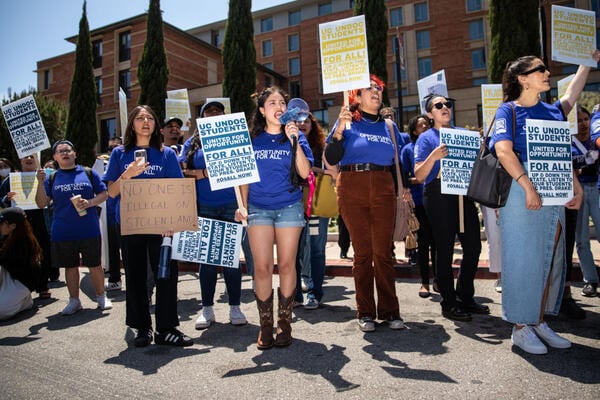
    Undocumented students, backed by a legal theory developed by scholars at the Center for Immigration Law and Policy, have argued that state entities, such as the public university system, are permitted to hire undocumented individuals. But the UC Board of Regents rejected the idea last year.

    A three-judge panel for the Court of Appeal for the First District ruled in August that the UC system’s employment policy “facially discriminates based on immigration status and, in light of applicable state law, the discriminatory policy cannot be justified.” The ruling asked the system to reconsider its hiring policy. But the UC Board of Regents appealed that decision two months ago.

    UC spokesperson Rachel Zaentz said in a statement that the California Supreme Court’s decision “creates serious legal risks for the University and all other state employers in California.”

    But undocumented students and their advocates are celebrating. Iliana G. Perez, a plaintiff and former UCLA lecturer, said as a formerly undocumented immigrant, she’s seen how employment restrictions can hold immigrant students back.

    “The California Supreme Court’s decision not only reaffirms that discriminating against undocumented immigrants from accessing on-campus employment cannot continue to be tolerated, but it also gives the UC the clarity to finally unlock life-changing opportunities for the thousands of immigrant students who contribute to its campuses, and to the state’s economy and workforce,” Perez said in a news release from the Center for Immigration Law and Policy.

    Source link

  • Would We Rather Humanities “Be Ruined Than Changed”? (opinion

    Would We Rather Humanities “Be Ruined Than Changed”? (opinion

    Like most of my colleagues in art history, English, history, modern languages, musicology, philosophy, rhetoric and adjacent fields, I am concerned about the current crisis in the humanities. Then again, as a student of the history of the modern university, I know that there haven’t been too many decades over the last 150 years during which we humanities scholars have not employed the term “crisis” to portray our place in the academy.

    Our Greek forebears, as early as Hippocrates, coined the term “kρίσις” to describe a “turning point”; kρίσις, a word related to the Proto-Indo-European root krei-, is etymologically connected to practices like “sieving,” “discriminating” and “judging.” In fact, the most widely mentioned skill we humanists offer our students, critical thinking, originates from the same practice of deliberate “sieving.” Thus, when we call ourselves critics and write critical theory, we admit that crisis might just be our natural habitat.

    What’s Different This Time Around?

    A look at the helpful statistics provided by the American Academy of Arts and Sciences indicates that this latest crisis in humanities enrollments and degree completions is not like the previous fluctuations in our history, but more foundational. Things sounded bad enough when a state flagship like West Virginia University slashed modern languages (and math!) two years ago. But when that beacon of humanistic learning, the University of Chicago, pauses Ph.D. admissions across all but two of its humanities programs, we know the crisis is existential. Wasn’t it Chicago’s Kalven report that once stated boldly, and for the entire nation, that the university was “the home and sponsor of critics”?

    Cultures of Complaint, and a Pinch of Hubris

    Feeling powerless in the face of dwindling enrollment and support for our disciplines, some of us have resorted to digging up conspiracy theories, perhaps because, as Stanley Fish opined, in the psychic economy of academic critics, “oppression is the sign of virtue.” The tenor of such virtue-signaling complaints is that an unholy alliance of tech and business bros and their programs, together with politicians and academic leaders, promote only “useful” disciplines and crowd out interest in the humanities.

    I think intellectual honesty would demand we remember that it was the humanities, custodians of high-culture education (Bildung), that once upon a time crowded out the applied arts, crafts and technologies, accusing them of lacking intellectual depth. Humanistic Ivy League and Oxbridge schools championed the classics, philosophy and literary studies as “liberal” and sneered at professional education in the “mechanical arts” (engineering, agriculture, business, etc.) as “servile.” When the humanities (and natural sciences) faculty at these elite colleges refused to open their classist “gentlemen’s education” to larger publics, land-grant universities and technological institutes emerged to increase access and to educate teachers, lawyers and engineers.

    Could it be that today’s humanists still retain some of this original hubris toward technical, vocational and applied training, which makes the current inversion of disciplinary hierarchy even tougher to accept? Are warnings against instrumentalizing the humanities for economic gain (Martha C. Nussbaum, Not for Profit) or applying them to support vocational or technical disciplines (Frank Donoghue, The Last Professors) echoes of such hubris? Will this mentality, based on the knowledge economy of the late 19th century, convince today’s students to work with us?

    Angsting About Ancillarity

    The modernist poet W. H. Auden, in his book-length poem about anxiety, wrote that “We would rather be ruined than changed / We would rather die in our dread / Than climb the cross of the moment / And let our illusions die.” For sure, some among us deny the signs of the time, yearning for the golden days when humanities departments were ever expanding, arguing that an essential third Victorianist (focusing on drama) be added to the colleagues already focusing on fiction and poetry. If these golden days ever existed (in the early 1970s?), they are gone now. Nostalgia for the simulacrum persists.

    Closer to reality, many colleagues in the humanities have been “climbing the cross of the moment,” adapting to the inversion of disciplinary hierarchies at our institutions and accepting the mandate to show at least some measurable outcomes instead of our beloved unquantifiable humanistic critique. We have been aligning with the new lead disciplines by creating a vast infrastructure of certificates, degrees, journals, book series and organizations in the medical, health, digital, environmental and energy humanities, in science and technology studies, computational media, and music technology.

    However, as Colin Potts observed, when we partner with our colleagues in these better-funded and high-visibility disciplines, we are rarely “co-equal contributors.” We are like alms seekers, condensing our lifelong training and knowledge into an ethics, civics and policy module required for our partners’ accreditation, or infusing technical writing and communication skills into a STEM curriculum to amplify their majors’ impact. These collaborations offer a modicum of recognition and an honorable mention in a holistically minded National Academies consensus report. But they also make us feel dreadfully ancillary.

    Institutional strategic plans that exalt the value of the humanities with terms like “cornerstone,” “core” and “heart” only deepen our suspicions, especially when our budgets don’t match the performative strategic grandiloquence. From the medieval through the 18th-century university, the humanities suffered the trauma of being “handmaidens to theology” (ancillae theologiae), then the doctrinal master discipline. Now, technology has taken theology’s place, and we are once again “pleasant (but more or less inconsequential) helpmeets.” Trauma redux.

    Hyperbole Won’t Help

    In an existential crisis, hyperbole in the defense of our field no longer feels like a vice. Therefore, some of us now claim that the end of the humanities heralds the end of humanity and human civilization. Brenna Gerhardt, for example, warned that, because of the 2025 funding cuts to the National Endowment for the Humanities, “we may find that a society that forgets to ask what it means to be human forgets how to be one.”

    Similarly, the 2024 World Humanities Report asserts that “the humanities are of critical importance” at a time when the “world and planet [are] under duress” and in dire need of “tools and concepts that will foster change and help us live under these shared, if still uneven, conditions.” These kinds of well-meaning statements, and the desperate daily news item (preferably from Oxbridge) amplifying our relevance and adaptability, burden the academic humanities with a responsibility incommensurate with the cultural and educational work we can perform. Their claim that “either you support the humanities, or inhumanity prevails” scares only us, but nobody else. As the authors of WhatEvery1Says: The Humanities in Public Discourse find, “The humanities appear to the public to be siloed in universities (unlike the sciences).”

    This I Believe

    If the previous paragraphs didn’t sound resilient and hopeful enough, please remember that my first obligation as a humanist is to be a critic, not a cheerleader. I believe that the humanities do have an important place in the ecosystem of higher education and at each university, that integrating STEM and liberal arts practices increases student success and leads to better research and scholarship, that humanistic considerations contribute to a more just and benign world, and that we need to continue our important work in core education.

    However, I don’t think that we academic humanists have sufficient standing to make hyperbolic claims about what we can achieve. Just consider: Have we ever advanced how many majors and faculty positions would be enough to keep the world humane and civilized? Have we, as Roosevelt Montás asks in Rescuing Socrates, ever overcome the “crisis of consensus … about what things are most worth knowing”? And should we lecture our STEM colleagues on ethics and gender equity when, as recently as 2019, fewer than one-third of tenure-track faculty and fewer than one-fourth of non-tenure- track professors in U.S. philosophy departments were women?

    We humanists are really good at asking critical questions, “sieving,” “discriminating” and “judging” at the highest levels of abstraction, but we are not so good at offering solutions. When we do, they often come from the same intellectual heights that have alienated us from undergraduate populations and the public. In a recent essay for the Journal of Theoretical Humanities, Wayne Stables takes us beyond hyperbole. He asks us to envision our lives and work “as if the humanities were dead,” thereby (he hopes) freeing us to consider collective action based on the likes of G. W. F. Hegel, Karl Marx, Friedrich Nietzsche, Theodor W. Adorno, Michel Foucault, Jacques Derrida and Wendy Brown. He believes this kind of “critical orientation” may help us survive “the troubling interregnum” in which we now find ourselves.

    While I sympathize with Stables’s call to action (though I would add Hannah Arendt, Simone de Beauvoir, Julia Kristeva, bell hooks and Judith Butler to his list), I believe it takes us back to the time when the humanities strove to be “all breathing human passion far above.”

    I recommend we befriend the idea that our humanistic values and practices may relate to more public-oriented and holistic goals, as exemplified by the University of Arizona’s successful degree in the public and applied humanities, which wants “to translate the personal enrichment of humanities study into public enrichment and the direct and tangible improvement of the human condition” and offers a “fundamentally experimental, entrepreneurial, and transdisciplinary” educational experience that “focuses on public and private opportunities that straddle rather than fall between purviews, or are confined by them.”

    Since the introduction of this new kind of humanities program, connected with such fields as business, engineering and medicine, the number of students majoring in the humanities at Arizona has increased by 76 percent. This true kind of integrated partnership, and similar initiatives at St. Anselm College, Virginia Tech and my home institution of Georgia Tech, give me hope for a turning point—kρίσις—for the humanities in higher education.

    Richard Utz is senior associate dean for strategic initiatives in the Ivan Allen College of Liberal Arts at Georgia Institute of Technology.


    Source link

  • How generative AI could re-shape professional services and graduate careers

    How generative AI could re-shape professional services and graduate careers

    Join HEPI and the University of Southampton for a webinar on Monday 10 November 2025 from 11am to 12pm to mark the launch of a new collection of essays, AI and the Future of Universities. Sign up now to hear our speakers explore the collection’s key themes and the urgent questions surrounding AI’s impact on higher education.

    This blog was kindly authored by Richard Brown, Associate Fellow at the University of London’s School of Advanced Study.

    Universities are on the front line of a new technological revolution. Generative AI (genAI) use (mainly large language mode-based chatbots like ChaptGPT and Claude) is almost universal among students. Plagiarism and accuracy are continuing challenges, and universities are considering how learning and assessment can respond positively to the daunting but uneven capabilities of these new technologies.

    How genAI is transforming professional services

    The world of work that students face after graduation is also being transformed. While it is unclear how much of the current slowdown in graduate recruitment can be attributed to current AI use, or uncertainty about its long-term impacts, it is likely that graduate careers will see great change as the technology develops. Surveys by McKinsey indicate that adoption of AI spread fastest between 2023/24 in media, communications, business, legal and professional services – the sectors with the highest proportions of graduates in their workforce (around 80 per cent in London and 60 per cent in the rest of the UK).

    ‘Human-centric’, a new report from the University of London looks at how AI is being adopted by professional service firms, and at what this might mean for the future shape and delivery of higher education.

    The report identifies how AI is being adopted both through grassroots initiatives and corporate action. In some firms, genAI is still the preserve of ‘secret cyborgs’ –  individual workers using chatbots under the radar. In others, task forces of younger workers have been deployed to find new uses for the tech to tackle chronic workflow problems or develop new services. Lawyers and accountants are codifying expertise into proprietary knowledge bases. These are private chatbots that minimise the risks of falsehood that still plague open systems, and offer potential to extend cheap professional-grade advice to many more people.

    Graduate careers re-thought

    What does this mean for graduate employment and skills? Many of the routine tasks frequently allocated to graduates can be automated through AI. This could be a doubled-edged sword. On the one hand, genAI may open up more varied and engaging ways for graduates to develop their skills, including the applied client-facing and problem-solving capabilities that  underpin professional practice.

    On the other hand, employers may question whether they need to employ as many graduates. Some of our interviewees talked of the potential for the ‘triangle’ structure of mass graduate recruitment being replaced by a ‘diamond-shaped’ refocus on mid-career hires. The obvious problem with this approach – of where mid-career hires will come from if there is no graduate recruitment – means that graduate recruitment is unlikely to dry up in the short term, but graduate careers may look very different as the knowledge economy is transformed.

    The agile university in an age of career turbulence

    This will have an impact on universities as well as employers. AI literacy, and the ability to use AI responsibly and authentically, are likely to become baseline expectations – suggesting that this should be core to university teaching and learning. Intriguingly, this is less about traditional computing skills and more about setting AI in context: research shows that software engineers were less in demand in early 2025 than AI ethicists and compliance specialists.

    Broader ‘soft’ skills (what a previous University of London / Demos report called GRASP skills – general, relational, analytic, social and personal) will remain in demand, particularly as critical judgement, empathy and the ability to work as a team remain human-centric specialities. Employers also said that, while deep domain knowledge was still needed to assess and interrogate AI outputs, they were also looking for employees with a broader understanding of issues such as cybersecurity, climate regulation and ESG (Environmental, Social, and Governance), who could work across diverse disciplines and perspectives to create new knowledge and applications.

    The shape of higher education may also need to change. Given the speed of advances in AI, it is likely that most propositions about which skills will be needed in the future may quickly become outdated (including this one). This will call for a more responsive and agile system, which can experiment with new course content and innovative teaching methods, while sustaining the rigour that underpins the value of their degrees and other qualifications.

    As the Lifelong Learning Entitlement is implemented, the relationship between students and universities may also need to become more long-term, rather than an intense three-year affair. Exposure to the world of work will be important too, but this needs to be open to all, not just to those with contacts and social capital.

    Longer term – beyond workplace skills?

    In the longer term, all bets are off, or at least pretty risky. Public concerns (over everything from privacy, to corporate control, to disinformation, to environmental impact) and regulatory pressures may slow the adoption of AI. Or AI may so radically transform our world that workplace skills are no longer such a central concern. Previous predictions of technology unlocking a more leisured world have not been realised, but maybe this time it will be different. If so, universities will not just be preparing students for the workplace, but also helping students to prepare for, shape and flourish in a radically transformed world.

    Source link