Author: admin

  • Marian High School Chooses BenQ’s LK936ST Golf Simulator Projector for New Golf Training Lab

    Marian High School Chooses BenQ’s LK936ST Golf Simulator Projector for New Golf Training Lab

    COSTA MESA, Calif. — BenQ, an internationally renowned provider of visual display and collaboration solutions, today announced that Marian High School in Omaha, Nebraska, selected and installed two BenQ LK936ST 4K HDR short-throw golf simulator projectors for its golf sim Golf Training Lab at the Marian Athletic Center. In 2024, the Marian girls’ golf team became the undefeated Nebraska State Champions in Class A golf. Designed to help analyze and improve the golfers’ swings and give them the ability to practice in all weather conditions, the Marian Golf Training Lab provides the girls’ high school and junior teams with an immersive and realistic golf course environment. Based on research and recommendations from golf simulation experts, Marian High School chose the BenQ LK936ST for its exceptional color accuracy, powerful brightness, and maintenance-free operation.

    Head Coach Robert Davis led the effort to build the Golf Training Lab, which includes two golf simulator bays featuring Carl’s Place 16×10 impact screens and ProTee VX launch monitors. Seeking a high-performance projector that could deliver realistic course visuals, bright images in a well-lit environment, and long-term, maintenance-free operation, Davis consulted with golf simulator manufacturers and reviewers. After thorough research, BenQ’s LK936ST emerged as the top choice.

    “Our athletes benefit from an experience that’s as close as you can get to being on an actual course,” said Davis. “When we pull up courses, you can see distinct leaves on the trees. That level of realism not only makes training more effective but also more enjoyable.”

    The BenQ LK936ST’s 4K UHD resolution, combined with BenQ’s exclusive Golf Mode, ensures a highly detailed, true-to-life golfing experience. Its 5,100 lumens of brightness allow it to perform exceptionally well in the Marian Athletic Center’s brightly lit environment, ensuring clear visuals even without dimming the lights. Additionally, its short-throw lens and advanced installation tools — such as digital shrink, lens shift, and keystone correction — allow for a flexible and seamless setup within the limited space of the simulator bays.

    “The golf simulation market has grown rapidly as more schools, athletes, and enthusiasts seek ways to improve their game year-round,” said Bob Wudeck, senior director of business development at BenQ America Corp. “With the LK936ST, we’ve provided everything a golf simulator needs to deliver a truly immersive experience. Its 4K resolution, high brightness, and laser-powered color accuracy ensure that golfers can see every detail with precision, whether it’s the grain of the greens or the clear blue sky. By combining these features, we’ve created a projector that meets the high standards required for today’s golf training environments.”

    The BenQ LK936ST is engineered to provide a truly immersive and precise golf simulation experience, making it an ideal choice for Marian High School’s Golf Training Lab. With a 4K UHD resolution powered by Texas Instruments’ DLP chip technology, it delivers razor-sharp visuals and a stunning 3,000,000:1 contrast ratio, which allows for enhanced graphics and a lifelike recreation of the world’s top golf courses. Its exclusive Golf Mode, designed specifically for golf simulation, reproduces the vivid greens and brilliant blues of fairways and skies, offering 92% of the Rec. 709 color gamut for true-to-life color accuracy. This unprecedented visual fidelity helps golfers maintain their focus and engagement, simulating real-world conditions to perfect their game.

    In addition to its color and image quality, the LK936ST is designed to excel in challenging environments. The projector’s short-throw lens (0.81-0.89) and 1.1x zoom capacity make it easy to install outside of the swing zone, projecting a large image without casting shadows on the screen. Digital shrink, offset, lens shift, keystone correction, and corner fit provide advanced installation flexibility, enabling perfect alignment with the screen, even in tight or unconventional spaces like garages, basements, or smaller training rooms.

    Built for long-lasting, maintenance-free operation, the LK936ST features a sealed IP5X-rated dustproof optical engine, eliminating the need for filter changes and ensuring optimal performance even in dusty environments. Its laser light source guarantees 20,000 hours of use with consistent color and brightness, far outlasting traditional lamp-based projectors. The projector also offers instant power-up without the need for warm-up or cool-down times, allowing golfers to jump straight into their training. With multiple HDMI inputs and networking options, it integrates easily with other entertainment or training components, making it a versatile centerpiece for not only golf simulations but also home theater and gaming setups.

    More information on the BenQ LK936ST 4K HDR short-throw golf simulator projector is available at bit.ly/3na585n.

    About BenQ America — Business & Education Solutions
    The No. 1 selling global projector brand powered by TI DLP technology, according to Futuresource, the BenQ digital lifestyle brand stands for “Bringing Enjoyment and Quality to Life,” fusing ease of use with productivity and aesthetics with purpose-built engineering. BenQ is a world-leading human technology and professional solutions provider serving the enterprise, education, and entertainment markets. To realize this vision, the company focuses on the aspects that matter most to users, redefining traditional technology with innovative capabilities that increase efficiency, enhance learning, and amplify entertainment — all while ensuring a healthy, safe, and intuitive user experience. BenQ’s broad portfolio of professional installation solutions includes digital, laser, and interactive projectors; premium flat panels; and interactive large-format displays that take visual enjoyment to new heights in corporate offices, classrooms and lecture halls, and home theaters. The company’s products are available across North America through leading value-added distributors, resellers, and retailers. Because it matters. More information is available at www.BenQ.com.

    All trademarks and registered trademarks mentioned herein are the property of their respective owners.

    Image Link:
    www.ingearpr.com/BenQ_Marian_High_School_Golf_Lab_2.jpg
    www.ingearpr.com/BenQ_Marian_High_School_Golf_Lab_1.jpg
    www.ingearpr.com/BenQ_Marian_High_School_Golf_Lab_4.jpg
    www.ingearpr.com/BenQ_Marian_High_School_Golf_Lab_3.jpg
    Image Caption: Marian High School Chooses BenQ’s LK936ST Golf Simulator Projector for New Golf Training Lab

    Follow BenQ America Corp.
    Blog: https://www.BenQ.com/en-us/business/resource.html?category=Trends%20and%20Knowledge
    Facebook: https://www.facebook.com/BenQNorthAmerica
    Instagram: https://www.instagram.com/BenQnorthamerica/
    LinkedIn: https://www.linkedin.com/company/BenQ-america/
    Twitter: https://twitter.com/BenQamerica
    YouTube: https://www.youtube.com/channel/UCqz1hlN9lW1mfUe4_XMEo2A/featured?

    eSchool News Staff
    Latest posts by eSchool News Staff (see all)


    Source link

  • Writing notes instead of typing pits scholars against each other

    Writing notes instead of typing pits scholars against each other

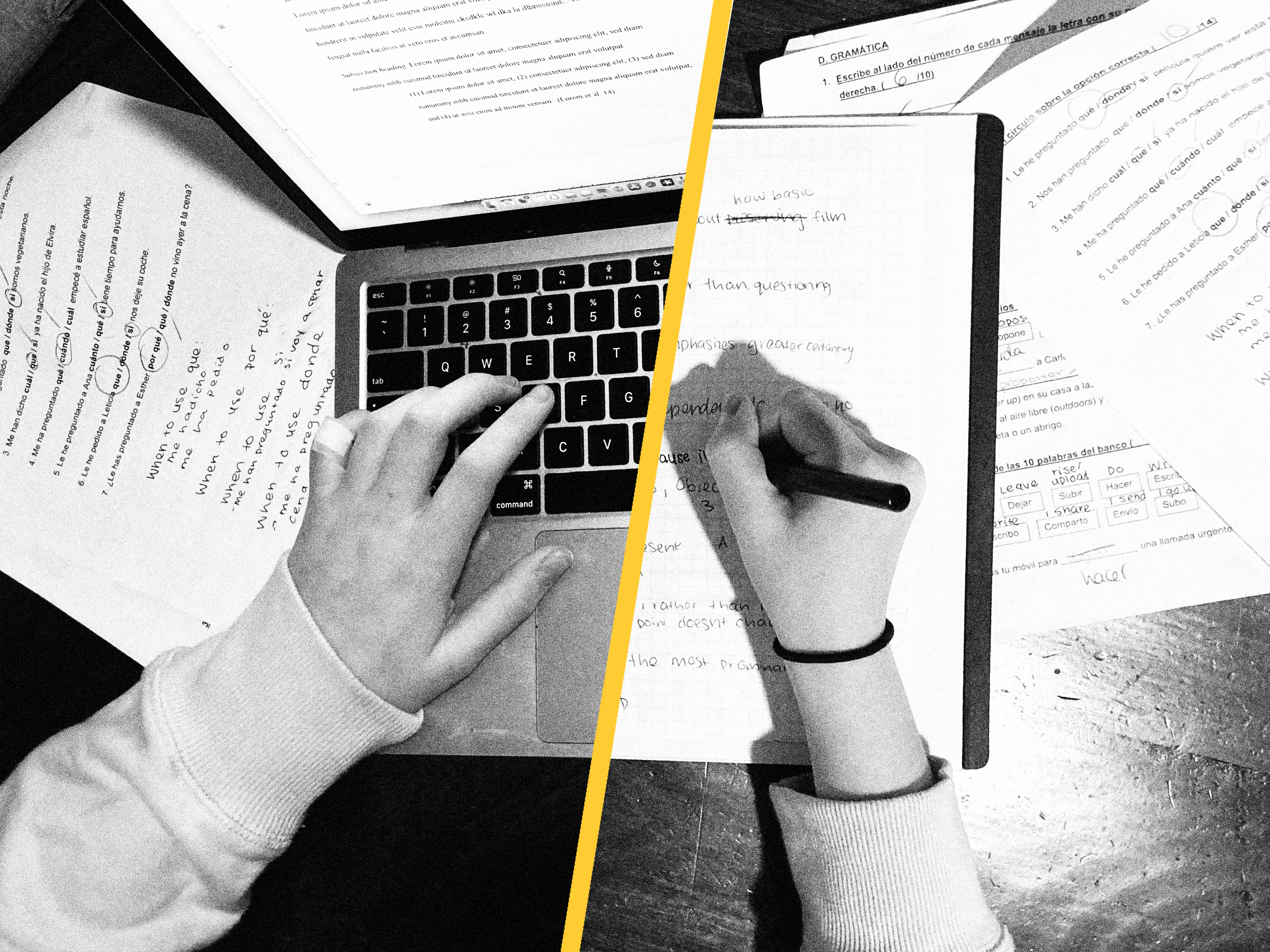
    Imagine you’re a student in high school or college. Class is about to start. You are faced with a notable dilemma: Should you whip out a notebook or a laptop to take notes?

    The answer is not so simple. A year ago, paper and pen seemed to be the winner when the journal Frontiers in Psychology published a Norwegian study that documented how different areas of the brain were communicating more frequently when students were writing by hand. When students were typing, the brain was not nearly so active. This extra brain activity, the neuroscientists wrote, is “beneficial for learning.” 

    The study ricocheted around the world. Almost 200 news stories promoted the idea that we remember things better when we write them down by hand instead of typing. It confirmed what many of us instinctively feel. That’s why I still take notes in a notebook even though I can hardly read my chicken scratch.

    Yet earlier this month, the same academic journal published a scathing rebuttal to the handwriting study. A pair of scientists in Spain and France pointed out that none of the Norwegian college students was asked to learn anything in the laboratory experiment. “Drawing conclusions on learning processes in children in a classroom from a lab study carried out on a group of university students that did not include any type of learning seems slippery at best,” the critics wrote.

    The Norwegian study asked 36 college students in their early 20s to write words from the game Pictionary using either a digital pen on a touchscreen or typing on a keyboard. The participants wore stretchy hair nets studded with electrodes to capture their brain activity. The scientists documented the differences between the two modes of writing. 

    Neither mode approximated real life conditions. The students were instructed to write in cursive without lifting the stylus from the screen. And they were only allowed to type with their right index finger.

    The critics also questioned whether elevated brain activity is proof of better learning. Increased brain activity could equally be interpreted as a sign that handwriting is slower and more taxing than typing. We don’t know.

    I contacted Audrey van der Meer, one of the co-authors of the Norwegian study who runs a neuroscience lab at the Norwegian University of Science and Technology in Trondheim. She pointed out that her critics promote the use of keyboards in education, and so they may not be unbiased. But she admitted that her study didn’t test whether students learned anything. 

    Van der Meer is conducting a fresh experiment that involves actual learning with 140 teenagers. She had the high school students watch a recorded lecture. Half of them were randomly assigned to take notes by hand, using a digital pen and touchscreen, and the other half typed their notes. Afterward, they all took the same exam graded by teachers at the school. 

    So far, she’s noticed clear differences in note-taking styles. Those who typed their notes wrote significantly more words, often transcribing parts of the lecture verbatim. They didn’t make any drawings. Those who used a digital pen mainly wrote key words and short sentences and produced two drawings, on average. 

    According to van der Meer, students who use the keyboard are writing down everything the teacher says “because they can.” But, she said in an email, “the information appears to be coming in through the ears and, without any form of processing, going out through the fingertips.” She added that when taking notes by hand, “it is impossible to write down everything, so students have to process the incoming information, summarize it, and link it to knowledge they already have.” That helps the “new information to stick better, resulting in better retention.”

    Van der Meer said she could not yet share the exam results with me as she is still analyzing them. She explained that there are “many confounding variables” that make it difficult to tell if those who used handwritten notes performed better on the exam.

    Even the pro-typing scientists admit that handwriting is important. Previous research has shown that writing letters by hand, compared to typing them, helps young children learn their letters much better. A 2015 study found that adults were better able to recall words in a memory game when they wrote them down by hand first instead of typing them. And a 2010 book chapter documented positive associations between writing words and being able to read them. 

    While there’s fairly compelling evidence that handwriting can help children learn their letters and new words, there’s less proof that handwriting helps us absorb new information and ideas. That’s not to say the Norwegian neuroscientists are wrong. But we still need the proof.

    I’d also add that not all learning is the same. Learning to write is different from learning Spanish vocabulary. There may be times when typing is the ideal way to learn something and other times when handwriting is. Also, learning something involves far more than either typing or handwriting, and the method we use to take notes might ultimately be of small importance compared to how we study our notes afterwards. 

    In the meantime, where did I put my notebook?

    Contact staff writer Jill Barshay at 212-678-3595 or [email protected].

    This story about handwriting versus typing was written by Jill Barshay and produced by The Hechinger Report, a nonprofit, independent news organization focused on inequality and innovation in education. Sign up forProof Points and other Hechinger newsletters.

    The Hechinger Report provides in-depth, fact-based, unbiased reporting on education that is free to all readers. But that doesn’t mean it’s free to produce. Our work keeps educators and the public informed about pressing issues at schools and on campuses throughout the country. We tell the whole story, even when the details are inconvenient. Help us keep doing that.

    Join us today.

    Source link

  • Is freedom of speech the same as freedom to lie?

    Is freedom of speech the same as freedom to lie?

    Meta will stop checking falsehoods. Does that mean more free speech or a free-for-all?

    “First, we’re going to get rid of fact-checkers,” Mark Zuckerberg, the founder of Meta, said in a video statement early this January. “Second, we’re going to simplify our content policies and get rid of a bunch of restrictions on topics like immigration and gender that are just out of touch with mainstream discourse.”

    This statement marks another turn in the company’s policies in handling disinformation and hate speech on their widely used platforms Facebook, Instagram and Threads. 

    Meta built up its moderation capabilities and started its fact-checking program after Russia’s attempts to use Facebook to influence American voters in 2016 and after it was partially blamed by various human rights groups like Amnesty International for allowing the spread of hate speech leading to genocide in Myanmar. 

    Until now, according to Meta, about 15 thousand people review content on the platform in 70 languages to see if it is in line with the company’s community standards.

    Adding information, not deleting

    For other content, the company involves professional fact-checking organizations with journalists around the world. They independently identify and research viral posts that might contain false information. 

    Fact-checkers, like any other journalists, publish their findings in articles. They compare what is claimed in the post with statistics, research findings and expert commentary or they analyze if the media in the post are manipulated or AI generated. 

    But fact-checkers have a privilege that other journalists don’t – they can add information to the posts they find false or out of context on Meta platforms. It appears in the form of a warning label. The user can then read the full article by fact-checkers to see the reasons or close the warning and interact with the post.

    Fact-checkers can’t take any further action like removing or demoting content or accounts, according to Meta. That is up to the company. 

    However, Meta now likens the fact-checking program to censorship. Zuckerberg also argued for the end of the program saying that the fact-checkers “have just been too politically biased and have destroyed more trust than they’ve created.”

    Can untrained people regulate the Web?

    For now, the fact-checking program will be discontinued in the United States. Meta plans to rely instead on regular users to evaluate content under a new program it calls “Community Notes.” The company promises to improve it over the course of the year before expanding it to other countries.

    In a way, Meta walking back on their commitments to fight disinformation wasn’t a surprise, said Carlos Hernández- Echevarría, the associate director of the Spanish fact-checking outlet Maldita and a deputy member of the governance body that assesses and approves European fact-checking organizations before they can work with Meta called the European Fact-Checking Standards Network. 

    Zuckerberg had previously said that the company was unfairly blamed for societal ills and that he was done apologizing. But fact-checking partners weren’t warned ahead of the announcement of the plans to scrap the program, Hernández- Echevarría said.

    It bothers him that Meta connects fact-checking to censorship.

    “It’s actually very frustrating to see the Meta CEO talking about censorship when fact-checkers never had the ability and never wanted the ability to remove any content,” Hernández-Echevarría said. He argues that instead, fact-checkers contribute to speech by adding more information. 

    Are fact-checkers biased?

    Hernández-Echevarría also pushes back against the accusation that fact-checkers are biased. He said that mistakes do occur, but the organizations and people doing the work get carefully vetted and the criteria can be seen in the networks’ Code of Standards

    For example, fact-checkers must publish their methodology for choosing and evaluating information. Fact-checkers also can’t endorse any political parties or have any agreements with them. They also have to provide proof of who they are owned by as well as publicly disclose information about their employees and funding.

    Meta’s own data about Facebook, which they disclose to EU institutions, also shows that erroneous decisions to demote posts based on fact-checking labels occur much less often than when posts are demoted for other reasons — nudity, bullying, hate speech and violence, for example. 

    In the period from April to September last year, Meta received 172,550 complaints about the demotion of posts with fact-checking labels and, after having another look, reversed it for 5,440 posts — a little over 3%. 

    However, in all other categories combined, the demotion had to be reversed for 87% of those posts.

    The sharing of unverified information

    Research shows that the perception of the unequal treatment of different political groups might form because people on the political right publish more unreliable information.

    A paper published in the scientific magazine Nature says that conservative users indeed face penalties more often, but they also share more low-quality news. Researchers therefore argued that even if the policies contain no bias, there can be an asymmetry in how they are enforced on platforms.

    Meta is also making other changes. On 7 January, the company published a revised version of its hateful conduct policies. The platform now allows comparing women to household objects and “insulting language in the context of discussing political or religious topics, such as when discussing transgender rights, immigration, or homosexuality”. The revised policies also now permit “allegations of mental illness or abnormality when based on gender or sexual orientation”.

    LGBTQ+ advocacy group GLAAD called these changes alarming and extreme and said they will result in platforms becoming “unsafe landscapes filled with dangerous hate speech, violence, harassment, and misinformation”. 

    Journalists also report that the changes divided the employees of the company. The New York Times reported that as some upset employees posted on the internal message board, human resources workers quickly removed the posts saying they broke the rules of a company policy on community engagement.

    Political pressure

    In a statement published on her social media channels. Angie Drobnic Holan, the director of the International Fact-Checking Network, which represents fact-checkers in the United States, linked Meta’s decision to political pressure.

    “It’s unfortunate that this decision comes in the wake of extreme political pressure from a new administration and its supporters,” Holan said. “Fact-checkers have not been biased in their work. That attack line comes from those who feel they should be able to exaggerate and lie without rebuttal or contradiction.”

    In his book “Save America” published in August 2024, Donald Trump whose term as U.S. President begins today, accused Zuckerberg of plotting against him. “We are watching him closely, and if he does anything illegal this time he will spend the rest of his life in prison,” he wrote. 

    Now, with the changes Zuckerberg announced, Trump is praising Meta and said they’ve come a long way. When asked during a press conference 7 January if he thought Zuckerberg was responding to Trump’s threats, Trump replied, “Probably.”

    After Meta’s announcement, the science magazine Nature published a review of research with comments from experts on the effectiveness of fact-checking. For example, a study in 2019 analyzing 30 research papers covering 20 thousand participants found an influence on beliefs but the effects were weakened by participants’ preexisting beliefs, ideology and knowledge. 

    Sander van der Linden, a social psychologist at the University of Cambridge told Nature that ideally, people wouldn’t form misperceptions in the first place but “if we have to work with the fact that people are already exposed, then reducing it is almost as good as it as it’s going to get”. 

    Hernández-Echevarría said that although the loss of Meta’s funding will be a hard hit to some organizations in the fact-checking community, it won’t end the movement. He said, “They are going to be here, fighting disinformation. No matter what, they will find a way to do it. They will find support. They will do it because their central mission is to fight disinformation.”


    Questions to consider:

    • What is now allowed under Meta’s new rules for posts that wasn’t previously?

    • How is fact-checking not the same as censorship?

    • When you read social media posts, do you care if the poster is telling the truth?


    Source link

  • Make Universities Great Again – HEPI

    Make Universities Great Again – HEPI

    ***Join HEPI and Jisc at 2pm next Monday, 27 January for a webinar on ‘Competition or collaboration’ in the higher education sector: you can register here.***

    On the day that Donald Trump is inaugurated as US President for the second time, with JD Vance as his Vice-President, HEPI Director of Partnerships Lucy Haire reviews Vance’s Hillbilly Elegy – and asks what it can teach us about his attitudes to universities.

    It is not a new publication, but it has taken on new significance. JD Vance’s Hillbilly Elegy: A Memoir of a Family and Culture in Crisis was published in 2016, well before anyone had an inkling that the author would be the US Vice-President nine years later. I read this autobiography of Vance’s youth to try to better understand one of the most powerful men in the world. 

    Five things that saved JD Vance

    The basic story of the first thirty or so years of Vance’s life reflects a challenging upbringing in Middletown, Ohio, a community in economic decline. Born to a mother struggling with addiction, Vance grew up amid instability, surrounded by school dropouts, joblessness and crime.

    Vance attributes his escape from a stricken trajectory to five main themes.

    First, his steadfast grandparents,  especially ‘Mamaw’ who eventually raised him.

    Second, the US Marines, which instilled discipline.

    Third, his girlfriend and future wife, Usha, who refined his social skills.

    Fourth, his own grit and drive.

    Fifth, universities, of which JD Vance attended two. 

    He says of Ohio State University:

    Ohio State’s main campus in Columbus is about a hundred miles from Middletown… Columbus felt like an urban paradise. It was (and remains) one of the fastest-growing cities in the country, powered in large part by the bustling university that was now my home. OSU grads were starting businesses, historic buildings were being converted into new restaurants and bars, and even the worst neighbourhoods seemed to be undergoing revitalization.

    This passage could be taken straight from the pages of a US equivalent of UPP Foundation’s excellent Kerslake Collection on the economic and social benefits that universities have on their local communities. It chimes entirely with the sentiment in the UK’s Secretary of State for Education, Bridgit Phillipson’s recent letter to UK universities

    Vance explains how the majority of his education was paid for by the G.I. Bill, a US law that provides a range of benefits for veterans. Yet he still had to take on three jobs to pay for his living costs, a scenario which we know has become increasingly common in the UK. HEPI’s seminal report, the Student Minimum Income Standard, produced with the support of Technology1 in spring 2024, showed that student maintenance loans now fall well below what students actually need to live on. Students therefore have to look elsewhere for support. HEPI and AdvanceHE’s long-running annual Student Academic Experience Survey showed that for the first time in 2024, the majority of students in the UK now take on paid work to make ends meet.   

    Vance and his grandmother’s navigation of the financial aid forms highlighted their unfamiliarity with university bureaucratic processes, a case-study in inclusive admissions.

    I had puzzled through those financial aid forms with Mamaw … arguing about whether to list her as Mom or as my ‘parent/guardian’. We had worried that unless I somehow obtained and submitted the financial information of Bob Hamel (my legal father), I’d be guilty of fraud. The whole experience had made both of us painfully aware of how unfamiliar we were with the outside world.

    Furthermore, Vance discusses that, as a US Marine veteran, he was a mature student at Ohio State, so a few years older than most classmates. Some irritated him with their lack of real-world experience; one disparaged soldiers deployed to Iraq, where Vance had served. Vance decided that he wanted to accelerate his studies and arranged to fast-track his course so that he could graduate in just under two years. 

    This serves as a reminder about the challenges of ensuring that university classes are inclusive and accommodate diverse students. It also touches on the concept of fast-track degrees which remain quite rare in the UK. 

    Vance’s declared thinking about which law school to choose after Ohio provides still more food for thought for widening participation professionals. He didn’t consider Yale, Stanford or Harvard at first, the ‘mythical top three’, assuming he didn’t stand a chance of acceptance. But he changed his mind when he heard about a new law graduate hailing not from the ‘top three’ forced to wait tables for lack of other opportunities.

    Vance still would not try for Stanford as it required him to obtain a personal sign-off from the Dean at Ohio State which he dared not request. He got into Yale where he clearly acquired imposter syndrome and conflicting identities: was he an Ivy League student or Hillbilly kid? He was unnerved by the sense of entitlement among his mainly upper-middle-class peers, by some snobbery among the academics and by the extensive networks his fellow students could tap into when it mattered.

    He is nevertheless very appreciative of the whole experience, revelling in the stellar roster of famous visiting speakers, imposing architecture and the chance to edit the Yale Law Journal. He held his own academically, was taken under the wing of Professor Amy Chua and fell in love with one upper-middle-class student, Usha, his future wife. There are pages of his Yalie reflections on educational, economic and cultural upward mobility which foretell his move into politics.     

    I did not expect to find so many insights into the structure, funding and culture of the higher education system in this book. Some reviewers of Hillbilly Elegy say that it is not a completely true nor fair account of JD Vance’s experiences, that it over-emphasises the role of personal grit and determination in facilitating upward mobility, and that much of it is at odds with sentiments that Vance has expressed more recently. Nevertheless, if Vance is encouraging us to value higher education, recognize its crucial role for individuals and communities and to strive to get its systems and culture right for those with challenging backgrounds, then that is all to the good. Deep down, Vance knows that universities will help to Make America Great Again.

    For more information about the US university system, take a look at this recent HEPI report supported by the Richmond American University London.

    Source link

  • Why Data Alone Won’t Improve Retention – Faculty Focus

    Why Data Alone Won’t Improve Retention – Faculty Focus

    Source link

  • Keep talking about data | Wonkhe

    Keep talking about data | Wonkhe

    How’s your student data this morning?

    Depending on how close you sit to your institutional student data systems, your answer may range from a bemused shrug to an anguished yelp.

    In the most part, we remain blissfully unaware of how much work it currently takes to derive useful and actionable insights from the various data traces our students leave behind them. We’ve all seen the advertisements promising seamless systems integration and a tangible improvement in the student experience, but in most cases the reality is far different.

    James Gray’s aim is to start a meaningful conversation about how we get there and what systems need to be in place to make it happen – at a sector as well as a provider level. As he says:

    There is a genuine predictive value in using data to design future solutions to engage students and drive improved outcomes. We now have the technical capability to bring content, data, and context together in a way that simply has not been possible before now.”

    All well and good, but just because we have the technology doesn’t mean we have the data in the right place or the right format – the problem is, as Helen O’Sullivan has already pointed out on Wonkhe, silos.

    Think again about your student data.

    Some of it is in your student information system (assessment performance, module choices), which may or may not link to the application tracking systems that got students on to courses in the first place. You’ll also have information about how students engage with your virtual learning environment, what books they are reading in the library, how they interact with support services, whether and how often they attend in person, and their (disclosed) underlying health conditions and specific support needs.

    The value of this stuff is clear – but without a whole-institution strategic approach to data it remains just a possibility. James notes that:

    We have learned that a focus on the student digital journey and institutional digital transformation means that we need to bring data silos together, both in terms of use and collection. There needs to be a coherent strategy to drive deployment and data use.

    But how do we get there? From what James has seen overseas, in the big online US providers like Georgia Tech and Arizona State data is something that is managed strategically at the highest levels of university leadership. It’s perhaps a truism to suggest that if you really care about something it needs ownership at a senior level, but having that level of buy-in unlocks the resource and momentum that a big project like this needs.

    We also talked about the finer-grained aspects of implementation – James felt that the way to bring students and staff on board is to clearly demonstrate the benefits, and listen (and respond) to concerns. That latter is essential because “you will annoy folks”.

    Is it worth this annoyance to unlock gains in productivity and effectiveness? Ideally, we’d all be focused on getting the greatest benefit from our resources – but often processes and common practices are arranged in sub-optimal ways for historical reasons, and rewiring large parts of someone’s role is a big ask. The hope is that the new way will prove simpler and less arduous, so it absolutely makes sense to focus on potential benefits and their realisation – and bringing in staff voices at the design stage can make for gains in autonomy and job satisfaction.

    The other end of the problem concerns procurement. Many providers have updated their student records systems in recent years in response to the demands of the Data Futures programme. The trend has been away from bespoke and customised solutions and towards commercial off-the-shelf (COTS) procurement: the thinking here being that updates and modifications are easier to apply consistently with a standard install.

    As James outlines, providers are looking at a “buy, build, or partner” decision – and institutions with different goals (and at different stages of data maturity) may choose different options. There is though enormous value in senior leaders talking across institutions about decisions such as these. “We had to go through the same process” James outlined. “In the end we decided to focus on our existing partnership with Microsoft to build a cutting edge data warehouse, and data ingestion, hierarchy and management process leveraging Azure and MS Fabric with direct connectivity to Gen AI capabilities to support our university customers with their data, and digital transformation journey.” – there is certainly both knowledge and hard-won experience out there about the different trade-offs, but what university leader wants to tell a competitor about the time they spent thousands of pounds on a platform that didn’t communicate with the rest of their data ecosystem?

    As Claire Taylor recently noted on Wonkhe there is a power in relationships and networks among senior leaders that exist to share learning for the benefit of many. It is becoming increasingly clear that higher education is a data-intensive sector – so every provider should feel empowered to make one of the most important decisions they will make in the light of a collective understanding of the landscape.

    This article is published in association with Kortext. Join us at an upcoming Kortext LIVE event in London, Manchester and Edinburgh in January and February 2025 to find out more about Wonkhe and Kortext’s work on leading digital capability for learning, teaching and student success.

    Source link

  • A higher education institution’s relationship with technology crosses all its missions

    A higher education institution’s relationship with technology crosses all its missions

    Universities have a critical role to play at the intersection of academic thought, organisational practice, and social benefits of technology.

    It’s easy when thinking about universities’ digital strategies to see that as a technical question of organisational capability and solutions rather than one part of the wider public role universities have in leading thinking and shaping practice for the benefit of society.

    But for universities the relationship with technology is multifaceted: some parts of the institution are engaged in driving forward technological developments; others may be critically assessing how those developments reshape the human experience and throw up ethical challenges that must be addressed; while others may be seeking to deploy technologies in the service of improving teaching and research. The question, then, for universities, must be how to bring these relationships together in a critical but productive way.

    Thinking into practice

    The University of Edinburgh hosts one of the country’s foremost informatics and computer science departments, one of the largest centres of AI research in Europe. Edinburgh’s computing infrastructure has lately hit headlines when the Westminster government decided to cancel planned investment in a new supercomputing facility at the university, only to announce new plans for supercomputing investment in last week’s AI opportunities action plan, location as yet undetermined.

    But while the university’s technological research prowess is evident, there’s also a strong academic tradition of critical thought around technology – such as in the work of philosopher Shannon Vallor, director of the Centre for Technomoral Futures at the Edinburgh Futures Institute and author of The AI Mirror. In the HE-specific research field, Janja Komljenovic has explored the phenomenon of the “datafication” of higher education, raising questions of a mismatch and incoherence between how data is valued and used in different parts of an institution.

    When I speak to Edinburgh’s principal Peter Mathieson ahead of his keynote at the upcoming Kortext Live leaders event in Edinburgh on 4 February he’s reflecting on a key challenge: how to continue a legacy of thought leadership on digital technology and data science into the future, especially when the pace of technological change is so rapid?

    “It’s imperative for universities to be places that shape the debate, but also that study the advantages and disadvantages of different technologies and how they are adopted. We need to help the public make the best use of technology,” says Peter.

    There’s work going on to mobilise knowledge across disciplines, for example, data scientists interrogating Scotland’s unique identifier data to gain insights on public health – which was particularly important during Covid. The university is a lead partner in the delivery of the Edinburgh and south east Scotland city region deal, a key strand of which is focused on data-driven innovation. “The city region deal builds on our heritage of excellence in AI and computer science and brings that to addressing the exam question of how to create growth in our region, attract inward investment, and create jobs,” explains Peter.

    Peter is also of the opinion that more could be done to bring university expertise to bear across the education system. Currently the university is working with a secondary school to develop a data science programme that will see secondary pupils graduate with a data science qualification. Another initiative sees primary school classrooms equipped with sensors that detect earth movements in different parts of the world – Peter recounts having been proudly shown a squiggle on a piece of paper by two primary school pupils, which turned out to denote an earthquake in Tonga.

    “Data education in schools is a really important function for universities,” he says.”It’s not a recruiting exercise – I see it as a way of the region and community benefiting from having a research intensive university in their midst.”

    Connecting the bits

    The elephant in the room is, of course, the link between academic knowledge and organisational practice, and where and how those come together in a university as large and decentralised as Edinburgh.

    “There is a distinction between the academic mission and the day to day nuts and bolts,” Peter admits. “There is some irony that we are one of finest computer science institutions but we had trouble installing our new finance system. But the capability we have in a place like this should allow us to feel positive about the opportunities to do interesting things with technology.”

    Peter points to the university-wide enablement of Internet of Things which allows the university to monitor building usage, and which helps to identify where buildings may be under-utilised. As principal Peter also brought together estates and digital infrastructure business planning so that the physical and digital estate can be developed in tandem and with reference to each other rather than remaining in silos.

    “Being able to make decisions based on data is very empowering,” he says. “But it’s important that we think very carefully about what data is anonymised and reassure people we are not trying to operate a surveillance system.” Peter is also interested in how AI could help to streamline large administrative tasks, and the experimental deployment of generative AI across university activity. The university has developed its own AI innovation platform, ELM, the Edinburgh (access to) Language Models, which is free to use for all staff and students, and which gives the user access to large language models including the latest version of Chat-GPT but, importantly, without sharing user data with OpenAI.

    At the leadership level, Peter has endeavoured to put professional service leaders on the same footing as academic leaders rather than, as he says, “defining professional services by what they are not, ie non-academic.” It’s one example of the ways that roles and structures in universities are evolving, not necessarily as a direct response to technological change, but with technology being one of the aspects of social change that create a need inside universities for the ability to look at challenges from a range of professional perspectives.

    It’s rarely as straightforward as “automation leading to staffing reductions” though Peter is alive to the perceived risks and their implications. “People worry about automation leading to loss of jobs, but I think jobs will evolve in universities as they will elsewhere in society,” he says. “Much of the value of the university experience is defined by the human interactions that take place, especially in an international university, and we can’t replace physical presence on campus. I’m optimistic that humans can get more good than harm out of AI – we just need to be mindful that we will need to adapt more quickly to this innovation than to earlier technological advances like the printing press, or the Internet.”

    This article is published in association with Kortext. Peter Mathieson will be giving a keynote address at the upcoming Kortext LIVE leaders’ event in Edinburgh on 4 February – join us there or at the the London or Manchester events on 29 January and 6 February to find out more about Wonkhe and Kortext’s work on leading digital capability for learning, teaching and student success, and be part of the conversation.

    Source link

  • Daring students to take risks and be wrong is key to solving the campus culture wars

    Daring students to take risks and be wrong is key to solving the campus culture wars

    Goodbye then, the Higher Education (Freedom of Speech) Act parts A3, A4, A7 and parts of A8 – we hardly knew you.

    The legal tort – a mechanism that seemed somehow to be designed to say “we’ve told the regulator to set up a rapid alternative mechanism to avoid having to lawyer up, but here’s a fast track way to bypass it anyway”, is to be deleted.

    The complaints scheme – a wheeze which allowed an installed Director for Freedom of Speech and Academic Freedom to rapidly rule on whatever it was that the Sunday papers were upset about that week – will now be “free” (expected) to not take up every dispute thrown its way.

    Students themselves with a complaint about a free speech issue will no longer have to flip a coin between a widely respected way of avoiding legal disputes and an untested but apparently faster one operated by the Director which was to be flagged in Freshers’ handbooks. The OIA it is.

    Foreign funding measures – bodged into the act by China hawks who could never work out whether the security services, the Foreign Office or the Department for Education were more to blame for encouraging universities to take on Chinese students – will now likely form part of the revised “Foreign Influence Registration Scheme” created by the National Security Act 2023.

    A measure banning universities from silencing victims of harassment via a non-disclosure agreement will stay, despite OfS saying it was going to ban NDAs anyway – although nobody seems able to explain why their use will still be fine for other victims with other complaints.

    And direct regulation of students’ unions – a measure that had somehow fallen for the fanciful idea that their activities are neither regulated nor controlled by powerless university managements and the Charity Commission – will also go. The “parent” institution will, as has always been the case, revert to reasonably practicable steps – like yanking its funding.

    As such, save for a new and vague duty to “promote” free speech and academic freedom, the new government’s intended partial repeal of legislation that somehow took the old one two parliaments to pass – a period of gestation that always seemed more designed to extend the issue’s prevalence in the press than to perfect its provisions – now leaves the sector largely back in the framework it’s been in for the best part of 40 years.

    That the Secretary of State says that all of the above is about proceeding in a way that “actually works” will raise an eyebrow from those who think a crisis in the academy has been growing – especially when the government’s position is that the problem to be fixed is as follows:

    In a university or a polytechnic, above all places, there should be room for discussion of all issues, for the willingness to hear and to dispute all views including those that are unpopular or eccentric or wrong.

    Actually, that was a quote from Education Secretary Keith Joseph in 1986, writing to the National Union of Students over free speech measures in the 1986 act. But Bridget Phillipson’s quote wasn’t much different:

    These fundamental freedoms are more important—much more important—than the wishes of some students not to be offended. University is a place for ideas to be exposed and debated, to be tried and tested. For young people, it is a space for horizons to be broadened, perspectives to be challenged and ideas to be examined. It is not a place for students to shut down any view with which they disagree.

    The message for vice chancellors who fail to take this seriously couldn’t have been clearer – “protect free speech on your campuses or face the consequences”. But if it’s true that for “too long, too many universities have been too relaxed about these issues”, and that “too few took them seriously enough” – what is it that that must now change?

    Back to the future

    There is no point rehearsing here the arguments that the “problem” has been overblown, centring on a handful of incidents in a part of the sector more likely to have been populated by the lawmakers and journalists whose thirst for crises to crack down on needs constant fuel. And anyway, for those on the wrong end of cancellation, the pain is real.

    There is little to be gained here from pointing out the endless inconsistencies in an agenda that seemed to have been designed to offer a simplistically minimalist definition of harassment and harm and a simplistically maximalist definition of free speech – until October 7th 2023 turned all that on its head.

    There isn’t a lot of benefit in pointing out how unhelpful the conflation between academic freedom and freedom of speech has been – one that made sense for gender-critical academics feeling the force of protest, but has been of no help for almost anyone involved in a discipline attempting to find truth in historic or systemic reasons for other equality disparities in contemporary society.

    Others write better than me, sometimes in ways I don’t recognise, sometimes in ways I do, about the way in which the need to competitively recruit students, or keep funders happy, or to not be the victim of a fresh round of course cuts inhibits challenge, drains the bravery to be unpopular, and is the real cause of a culture of “safetyism” on campus.

    And while of course it is the case that higher education isn’t what it was – which even in its “new universities” manifestations in the 1960s imagined small parts of the population engaging in small-group discussions between liberal-minded individuals able to indulge in activism before a life of elitism – I’ve grown tired of pointing out that the higher education that people sometimes call for isn’t what it is, either.

    What I’m most concerned about isn’t a nostalgic return to elite HE, or business-as-usual return to whatever it was or wasn’t done in the name of academic freedom or freedom of speech in a mass age – and nor is it whatever universities or their SUs might do to either demonstrate or promote a more complex reality. I’m most concerned about students’ confidence.

    The real crisis on campus

    Back in early 2023, we had seen surveys that told us about self-censorship, pamphlets that professed to show a culture of campus “silent” no platforming, and polling data that invited alarm at students’ apparent preference for safety rather than freedom.

    But one thing that I’d found consistently frustrating about the findings was the lack of intelligence on why students were responding the way they apparently were.

    For the endless agents drawing conclusions, it was too easy to project their own assumptions and prejudices, forged in generational memory loss and their own experiences of HE. Too easy to worry about the 14 per cent of undergrads who went on to say they didn’t feel free to express themselves in the NSS – and too easy to guess “why” that minority said so.

    As part of our work with our partners at Cibyl and a group of SUs, we polled a sample of 1,600 students and weighted for gender and age.

    We found that men were almost ten percentage points higher than women on “very free”, although there was gender consistency across the two “not free” options. Disabled students felt less free than non-disabled peers, privately educated students felt more free than those from the state system, and those eligible for means-tested bursaries were less confident than those who weren’t.

    In the stats, those who felt part of a community of students and staff were significantly more likely to feel free to express themselves than those who didn’t – and we know that it’s the socio-economic factors that are most likely to cause feelings of not “fitting in”.

    But it was the qualitative comments that stuck with me. Of those ticking one of the “not free” options, one said that because the students on their course were majority white students, they “often felt intimidated to speak about certain things”.

    Another said that northern state school students are minorities – and didn’t really have voices there:

    Tends to be posher middle class private school educated students who are heard.

    Mature students aren’t part of the majority and what I have said in the past tends to get ignored.

    Many talked about the sort of high-level technical courses that policymakers still imagine universities don’t deliver. “Engineering doesn’t leave much room for opinion like other courses”, said one. “Not a lot of room in my degree for expression” said another.

    And another gave real challenge to those in the culture wars that believe that all opinions are somehow valid:

    My course doesn’t necessarily allow me to express my freedom as everything is researched based with facts.

    Ask anyone that attempted to run a seminar on Zoom during Covid-19, and you get the same story – switched-off cameras, long silences, students seemingly afraid to say something for fear of being ostracised, or laughed at, or “getting it wrong”.

    As a former SU President put it on the site in 2023:

    This year there have been lecture halls on every campus stacked with students who don’t know how to start up a conversation with the person sat next to them. There were emails waiting to be sent, the cursor flashing at the start of a sentence, that the struggling student didn’t know how to word… This question is whether or not the next generation is actually being taught how to interact and be comfortable in their own skin… They have to if they’re claiming to.

    Freedom from fear?

    The biggest contradiction of all in both the freedom of speech and academic freedom debates that have engulfed the sector in recent years was not a lack of freedom – it was the idea that you can legislate to cause people to take advantage of it:

    In lectures and seminars there is often complete silence. The unanimity of asking a question or communicating becomes daunting when you’re the only one.

    Fear you’ll be laughed at or judged if you get it wrong

    In terms of lectures, the students in my class feel shy to share opinions which affects me when I want to share.

    Again this is a personal thing I don’t often like expressing my points of view in person to people I don’t know very well. Also they probably won’t be listened to so I don’t see the point.

    I feel very free amongst my other students in our WhatsApp groups (not governed by the university). However, freedom of expression in support sessions often ends up not occurring as everyone is anxious due to how the class has been set up.

    Once in class I simply got one word mixed up with another and the lecturer laughed and said. ‘yes…well…they do mean the same thing so that has already been stated.’ Making me and also my fellow students reluctant to ask any questions at all as we then feel some questions are ridiculous to ask. How are we to express our thoughts if we feel we will be ridiculed or made to feel ridiculous?

    For those not on programmes especially suited to endless moral and philosophical debates, a system where the time to take part in extracurriculars is squeezed by part-time work or public transport delays is not one that builds confidence to take part in them.

    The stratification of the sector – where both within universities and between them, students of a particular type and characteristic cluster in ways that few want to admit – drives a lack of diversity within the encounters that students do have in the classroom.

    And even for those whose seminars offer the opportunity for “debate”, why would you? Students have been in social media bubbles and form political opinions long before they enrol. And Leo Bursztyn and David Yang’s paper demonstrates that people think everyone in their group shares the same views, and that everyone in the outgroup believes the opposite.

    As Harvard political scientist David Deming argues here:

    Suppose a politically progressive person offers a commonly held progressive view on an issue like Israel-Palestine, affirmative action, or some other topic. Fearing social sanction, people in the out-group remain silent. But so do in-group members who disagree with their group’s stance on that particular issue. They stay silent because they assume that they are the only ones in the group who disagree, and they do not want to be isolated from their group. The only people who speak up are those who agree with the original speaker, and so the perception of in-group unanimity gets reinforced.

    Deming’s solution is that universities should tackle “pluralistic ignorance” – where most people hold an opinion privately but believe incorrectly that other people believe the opposite.

    He argues that fear of social isolation silences dissenting views within an in-group, and reinforces the belief that such views are not widely shared – and so suggests making use of classroom polling tech to elicit views anonymously, and for students to get to know each other privately first, giving people space to say things like “yes I’m progressive, but my views differ on topic X.”

    Promoting free speech?

    Within that new “promote” duty, it may be that pedagogical innovation of that sort within the curriculum will make a difference. It may also be that extracurricular innovation – from bringing seemingly opposed activist groups on campus together to listen to each other, through to carefully crafted induction talks on what free speech and academic means in practice – would help. Whether it’s possible to be positive about EDI in the face of the right to disagree with it remains to be seen.

    Upstream work on this agenda might help too – it’s odd that a “problem” that must be partly about what happens in schools and colleges is never mentioned in the APP outreach agenda, just as it’s frustrating that the surface diversity of a provider is celebrated while inside, the differences in characteristics between, say, medical students and those studying Business and Management are as vast as ever.

    Students unions – relieved of direct scrutiny on the basis that they are neither “equipped nor funded” to navigate such a complex regulatory environment – might argue that the solution is to equip them and fund them, not remove the regulation. They might also revisit work we coordinated back in 2021 – much of which was about strengthening political debate in their own structures as a way to demonstrate that democracy can work.

    Overall, though, someone somewhere is going to get something wrong again. They’ll fail to act to protect something lawful; or they’ll send a signal that something was OK, or wrong, when they should have decided the opposite.

    As such, I’ve long believed that the practice of being “wrong” needs to be role-modelled as strongly as that of being right. If universities really are spaces of debate and the lines between free speech and harassment are contested and context-specific, the sector needs to find a way to adjudicate conflict within universities rather than leaving that to the OIA, OfS, the courts or that other court of public opinion – because once it gets that far, the endless allegations of “bad faith” on both sides prevent nuance, resolution and trust.

    Perhaps internal resolution can be carried out in the way we found in use in Poland on our study tour, using trusted figures appointed from within – and perhaps it can be done by identifying types of democratic debate within both academic and corporate governance that give space to groups of staff and students with which one can agree or disagree.

    If nothing else, if Arif Ahmed is right – and “speech and expression were essential to Civil Rights protestors, just as censorship was their opponents’ most convenient weapon”, we will have to accept that “nonviolent direct action seeks to… dramatize an issue that it can no longer be ignored” – and it has as much a place on campus as the romantic ideals of a seminar room exploring nuance.

    Lightbulb moments need electricity

    But even if that helps, I’m still stuck with the horse/water/drink problem – that however much you promote the importance of something, you still need to create the conditions to take up what’s on offer. What is desired feels rich – when the contemporary student experience is often, in reality, thin. What if the real problem isn’t student protest going too far, but too few students willing to say anything out loud at all?

    Students (and their representatives) left Twitter/X/Bluesky half a decade ago, preferring the positivity of LinkedIn to being piled-onto for an opinion. Spend half an hour on Reddit’s r/UniUK and you can see it all – students terrified that one wrong move, one bad grade, one conversation taken the wrong way, one email to a tutor asking why their mark was the way it was – will lead to disaster. The stakes are too high, and the cushion for getting anything wrong too thin, to risk anything.

    Just as strong messages about the importance of extracurricular participation don’t work if you’re holding down a full-time job and live 90 minutes from campus, saying that exploring the nuances of moral and political debate is important will fall flat if you’re a first-in-family student hanging on by a thread.

    Much of this all, for me, comes back to time. Whatever else people think higher education is there to do, it only provides the opportunity to get things wrong once the pressure is off on always getting things right. Huge class sizes, that British obsession with sorting and grading rather than passing or failing, precarious employment (of staff and students) and models of student finance that render being full-time into part-time are not circumstances that lead anyone to exploring and challenging their ideas.

    Put another way, the government’s desire that higher education offers something which allows horizons to be broadened, perspectives to be challenged and ideas to be examined is laudable. But if it really wants it happen, it does have to have a much better understanding of – and a desire to improve – the hopeless precarity that students find themselves in now.


    Source link

  • The Business Plots, Then and Now

    The Business Plots, Then and Now

    In 1933, a group of American businessman planned a coup to take down the new President, Franklin Roosevelt. In this scheme, General Smedley Butler would be tasked with orchestrating the overthrow. This attempted coup was called the Business Plot.  

    College students today may ask, so what’s so important about this moment in history?  The point is that we have entered an era again where big business has a dominating influence over American politics. In the case of the 1933 moment, the coup was reactive. American business had failed, a Great Depression was in progress, and businessmen were fighting to maintain control, a control that they were used to having under Harding, Coolidge, and Hoover. The man tasked to lead the plot, General Butler, squashed it before it happened. And the story largely faded away. 

    Eight years later, in 1941, the US would be fighting a world war against global fascism and imperialism.  In the aftermath of the war, a stronger nation would arise. Today, we are also a nation facing intense competition and conflict, this time against China, Russia, India and other nations, with global climate change being a factor that wasn’t apparent back then. 

    In 2024, US business people, some of the richest people in the world,
    did something similar, but more proactive and less controversial. Today, folks, in general are OK with American businessmen pulling the strings. The most wealthy man have succeeded where big banks and big business failed before. And they have elected a friend. Today, cryptocurrency is booming. The stock market is booming for now. Unemployment is at record lows–for now. Big business has managed to gain greater control of the US government with little or no uproar. 


    Source link