There has been much excitement since Australia signed a landmark agreement with the United States last month to expand cooperation on critical minerals and rare earth elements.
Please login below to view content or subscribe now.
Membership Login

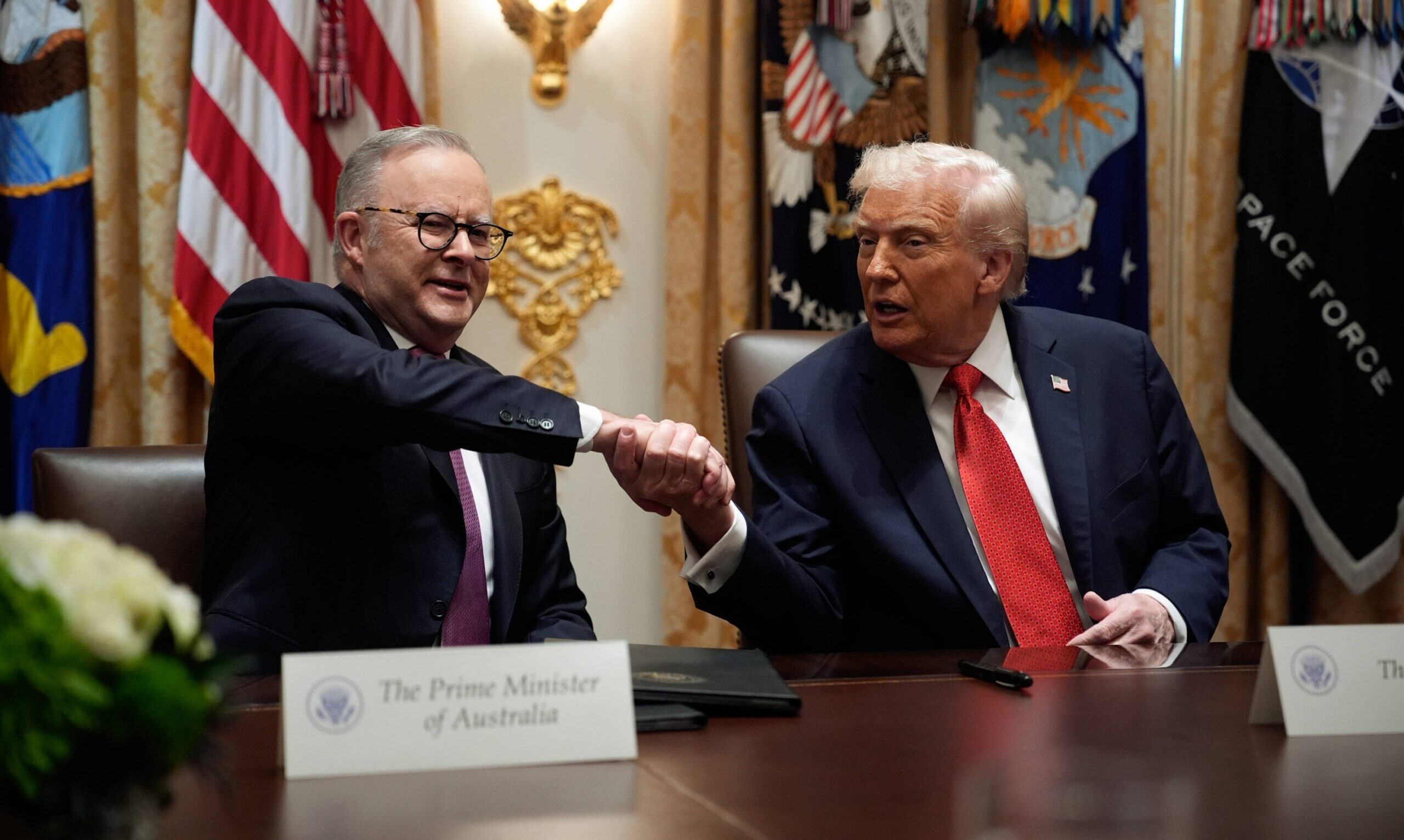
There has been much excitement since Australia signed a landmark agreement with the United States last month to expand cooperation on critical minerals and rare earth elements.
Please login below to view content or subscribe now.
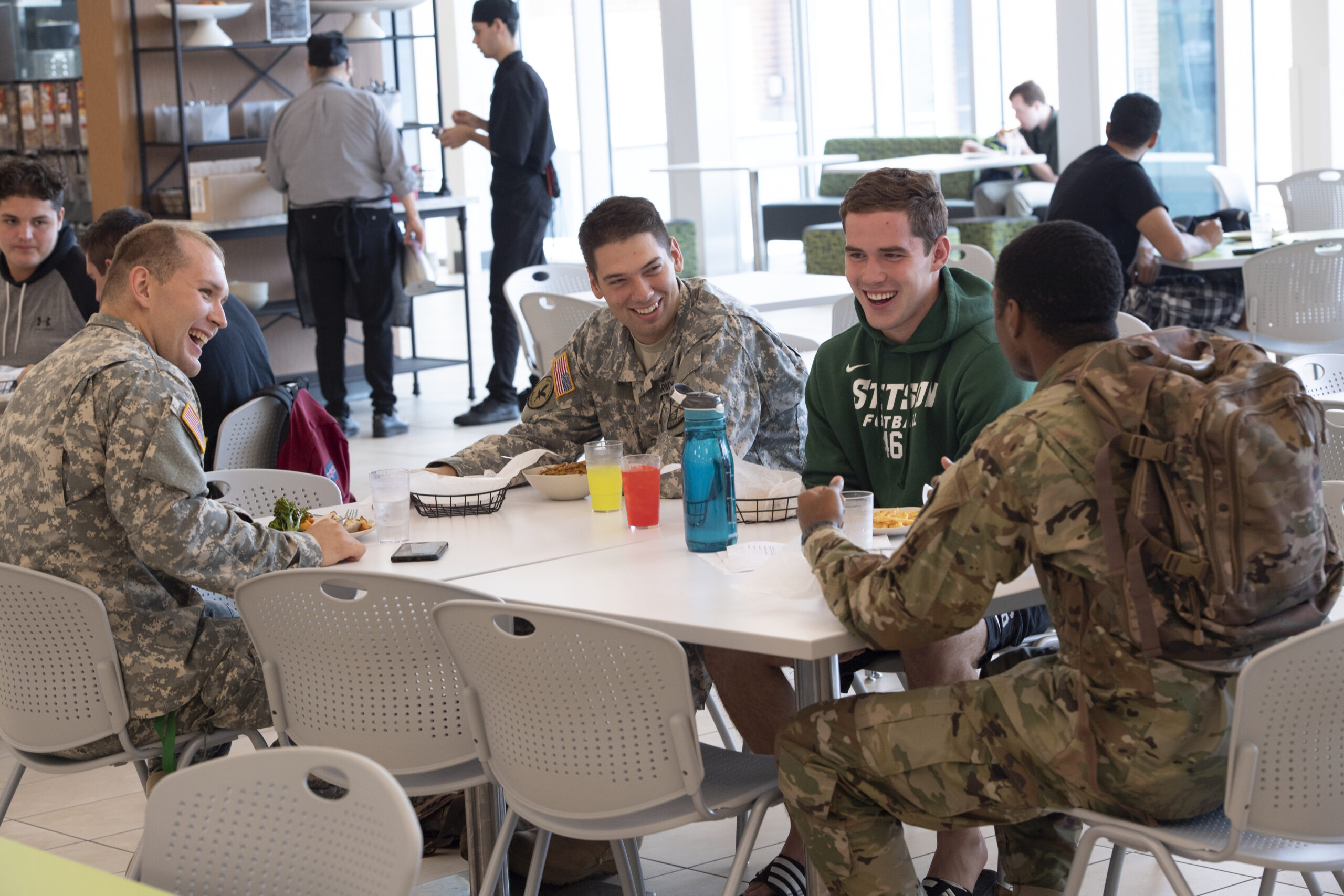
This Veterans Day, we’re reminded that honoring service means more than recognition; it’s a shared responsibility. Colleges and universities play a vital role in translating appreciation into action by working with community and employer partners to expand access, reduce barriers, and build clear, accelerated pathways for veterans to thrive before, during, and after their postsecondary education.
Each year, about 200,000 service members transition out of active duty. They bring with them leadership, discipline, and adaptability, qualities employers consistently say they need most. For many veterans, the first stop is college, supported by the Post-9/11 GI Bill. But not all want, need, or can afford to wait for a four-year degree to launch their next chapter. The real question is: How do we ensure veterans don’t miss the job-ready pathways already reshaping the workforce?
On the surface, veterans appear to be doing well; unemployment among former service members is approximately 3% in comparison to non-veterans at 3.9%. But the picture changes when we look deeper. Nearly one in three veterans is underemployed, working in roles that don’t fully use their skills or pay family-sustaining wages. The compressed 180-day transition window, during which service members must make rapid choices about careers, finances, and education, makes it harder to align strengths with opportunity. Veterans who do not find meaningful employment or education in that first year risk long-term financial instability and lower lifetime earnings.
At the same time, labor market demand makes the case urgent. Employers in healthcare, cybersecurity, advanced manufacturing, logistics, and clean energy face acute shortages. More than a million cybersecurity roles are currently unfilled, and clean energy jobs grew nearly 4% last year. Veterans, who bring technical expertise, leadership, and adaptability, are uniquely positioned to step into these roles if their skills are translated and recognized in ways that match employer needs.
Across the country, alternative career pathways are gaining momentum. Apprenticeships, certificates, industry certifications, and work-integrated learning programs are offering faster, lower-cost routes into well-paid jobs. National efforts to expand registered apprenticeships highlight just how far the U.S. has to go compared with peer nations. If even a fraction of community college students were connected to apprenticeships, hundreds of thousands of new slots could open roles where veterans’ discipline and readiness give them a natural advantage.
At the same time, higher education is recalibrating. Undergraduate enrollment has dropped by more than a million students since 2019, while institutions are investing in short-term credentials and competency-based programs. Senior leaders are deeply concerned about the public perception of the value of college and their institutions’ long-term financial viability, with nearly eight in ten presidents citing public trust as a major issue. Those concerns are not abstract: by 2032, an estimated 18.4 million experienced workers with postsecondary education are expected to retire, creating urgent pressure to prepare the next generation. Veterans are well-positioned to help fill this gap if institutions translate military learning into both degrees and short-term credentials.
If institutions recognize and apply military learning through credit for prior learning (CPL) and short-term credential pathways, they can accelerate veterans’ success while rebuilding confidence in the relevance of higher education itself. ACE supports this effort through Military Guide, which helps colleges translate military training into academic credit, and through expanding frameworks for CPL that ensure quality and equity in how experience counts. These tools make it possible for veterans to see their service recognized as learning and for institutions to meet learners where they are.
This convergence of policy momentum, employer demand, and institutional innovation creates a rare window of opportunity. The traditional “college-for-all” approach is showing its limits, with more than half of four-year graduates underemployed a year after graduation. For veterans, the stakes are even higher. Transition is a once-in-a-lifetime moment to align skills, benefits, and pathways.
Employers: Don’t overlook veteran talent. Create or expand apprenticeships and structured on-ramps that recognize military skills. Veterans bring discipline, adaptability, and leadership—traits every sector needs to stay competitive. They also carry official military transcripts that document their training and education, which can be mapped directly to specific skills and competencies. Military job titles and occupational codes however can be deceiving in the civilian market. Demystifying those roles and challenging stereotypes is essential to avoid overlooking highly qualified candidates. Leveraging veterans’ records and experiences can shorten onboarding, reduce training costs, and ensure they are matched to roles where they can thrive.
Higher education: Build shorter, stackable programs that honor prior learning gained through military service and beyond. Military transcripts and experience can serve not only as transfer credit but also as tools for admissions decisions, prerequisite fulfillment, and course waivers, accelerating time to completion. Just as important, institutions should recognize that many veterans are looking to pivot into entirely new career fields. By meeting veterans where they are, higher education can both close critical skills gaps and strengthen enrollment while rebuilding public trust.
Credential providers: Ensure certifications are accessible, affordable, and aligned with industry demand. You are uniquely positioned to bridge the federal government, corporate America, learners, and higher education institutions, making pathways clearer and faster for veterans. In your validation processes, include recognition of military and prior learning so veterans can more easily demonstrate their competencies and translate service-earned experience into credentials with immediate labor market value.
Veterans bring unmatched skills, experience, and determination, but they shouldn’t have to navigate their next chapter alone. Employers, higher education, and credential providers each have a role to play in creating faster, more transparent, and career-aligned pathways that turn potential into progress.
Higher education has always been central to the American narrative, a source of opportunity, innovation, and community strength. Its next chapter depends on unlocking the full potential of every learner, especially those who have proudly served. When institutions, employers, and credential organizations work in concert, we transform gratitude into real pathways.
For example, Dixon Center for Military and Veterans Services has long championed a “united in purpose” approach, offering technical assistance, resource-sharing, and leadership to amplify veteran-serving efforts across all sectors. Their work underscores the importance of collective responsibility: honoring service not just with words, but with system-wide action. As one example, the center led an effort to formulate and administer the Trucking Business Academy, which mustered colleges, industry leaders, and other nonprofits to chart a comprehensive curriculum for truck drivers to successfully build their own businesses.
This Veterans Day, honoring military service means building pathways forward. By opening clearer, faster, and more trusted routes to learning and work and by aligning across sectors, we can ensure veterans don’t just find jobs. They lead the way in shaping the future of education, workforce development, and national resilience.
If you have any questions or comments about this blog post, please contact us.
When she was 10, Ella Spurlock spent her free time making little booklets for her grandparents — drawing and coloring short, stapled stories about flowers, her dog, or whatever caught her eye that week. “I would staple them and give them to my Nana and Pop,” she remembers. “I liked making something that lasted.”
A decade later, in her freshman year at the University of Central Oklahoma, she found an adult version of that ritual: a byline. Her first story for The Vista, a feature on an art gallery show, ran on a Wednesday. She knew the issue was out before class ended. She sprinted from the Liberal Arts Building to the nearest news rack, slid a copy free, and saw her name there in the ink. The Vista, founded in 1903, is Oklahoma’s oldest student newspaper, an abiding symbol of a free press on campus — and now Spurlock was part of that history.
“I sent a picture to my dad and grandparents,” she says. “Then I showed it to my roommate. I was so excited — just over the moon.”
She folded the paper and carried it all day, the same way she had with those prized booklets years ago.
That memory has since taken on a strange weight. The very spring after her first story in The Vista, UCO administrators began discussing a “digital transition,” foreshadowing the end of the paper’s print edition. They said it was about the budget. But Spurlock suspected more. Administrators at UCO had voiced their displeasure with the paper’s investigative work before.
Colleges are more obsessed with ‘protecting the brand’ than they’ve ever been before. The result? An epidemic of student media censorship.
Print funding supposedly hinged on votes that administrators didn’t control. In May 2025, the Student Media Advisory Board met and voted unanimously to fund The Vista and its sister broadcast program, UCentral, with a $56,000 budget — enough to maintain the paper’s biweekly print schedule through the end of the year. Despite the vote, administrators overruled the board and announced that the historic paper would cease to print and would go digital-only in fall 2025.
On July 21, faculty adviser Erika Williams emailed Dean Elizabeth Maier regarding the push to end print. Later that day, Maier replied that going digital “was a statement, not a request,” adding, “That decision is final and not up for debate or negotiation.”
Andrew Frazier remembers that summer as a blur of forwarded messages and quiet anger. He had just started reporting for The Vista. “I came in around July or August,” he says. “I was pretty vocal about how frustrated I was — not even about it going digital, but about the lack of transparency. They were lying to us, pretending not to know things, and gaslighting us.”
Frazier grew up in Oklahoma City, watching his father read the newspaper over breakfast every morning. He remembers well the ritual of the paper being folded and refolded, the sound of the pages, his father’s occasional comments, the smell of coffee. “I’d see him sitting out there every morning,” Frazier says, “and when he finished, I’d pick it up and read the comics — Peanuts or Calvin and Hobbes.”
That’s part of why the summer’s news stung. The Vista is older than the state of Oklahoma. Yet its steward had decided the printed page was no longer worth keeping. “It was everything I hate,” Frazier says. “Spin, control, top-down messaging — happening right here, in my own community.”
The university didn’t budge. Their plea for a free press had fallen on deaf ears.
UCO administrators said print was too expensive and outdated. But their actions belied their true motives. After the advisory board’s unanimous vote to keep printing, Dean Maier floated a “Vista Going Digital Launch Party” and even offered to pay for refreshments. Board chair Joe Hight objected that the administration’s decision ignored both data and process. When Hight shared a letter from Vista donors Jim Epperson and Bob Ray, in which they warned that ending print would betray The Vista’s tradition as “a watchdog . . . protected by the First Amendment” — the university didn’t budge. Their plea for a free press had fallen on deaf ears.
Not only that, but the university kept pushing to ensure their voice wouldn’t find a print audience. Students asked if they could print using money from the Dennie Hall Endowment, an alumni fund for The Vista. Administrators said no. At a budget meeting before the semester, students say they were warned that if they printed with donor funds, the university would cut funding for the entire student-media program. “They read our emails out loud,” Spurlock remembers, referring to messages students had written to professors, asking for help. “And then they said they’d cut everything if we printed. That’s when I cried.”
A week later, at administrators’ direction, facilities workers removed The Vista’s newspaper racks from campus.
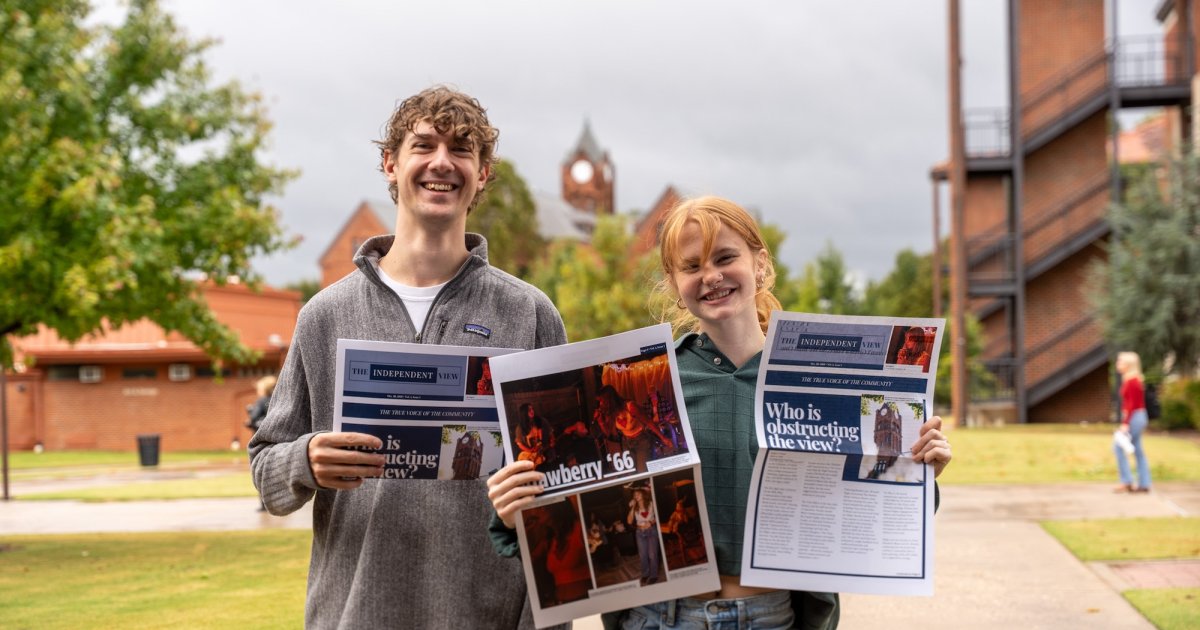
By fall, Frazier and several other students decided that if The Vista couldn’t publish freely, they’d build something that could. They called it The Independent View. It was scrappy, student-run, and fueled by small donations and borrowed space. “It feels like a startup with your friends,” Frazier says. “We’re all in it together, building something honest.”
Their first major story, published in their inaugural edition on Oct. 28, showed exactly why that sense of independence mattered.
In late September, two UCO juniors, Maggie Lawson and Liberty Welch, were preparing to direct the play Boy My Greatness, about the boys who played women’s roles in Shakespeare’s England. “It’s so heartbreaking but also so heartwarming,” Welch told The Independent View. “You see these people who are exactly like you, but it’s 1606.”
The students had spent months rehearsing. Their actors were cast, their set built, and the script licensed from the playwright. Then, hours before their first dress rehearsal on Sept. 3, the play lost university support. The reason? Senate Bill 796, Oklahoma’s new law restricting DEI programming at public colleges.
At first, no one could say who made the call. The Independent View’s coverage detailed what the university had tried to obscure: that the decision had come not from the theater department, but from upper administration, which cited legal concerns over the play’s “contract requirements.”
Lawson and Welch were offered a choice: pick a different play under university oversight, or continue without university support. They chose independence.
That night, they posted a TikTok explaining what happened and launched a GoFundMe, hoping for a few hundred dollars. Instead, they raised nearly $10,000 overnight, and their story spread across campus and into national outlets like Playbill.
“We thought we’d get a couple hundred bucks and a pat on the back,” Welch said. “We were shocked when it blew up.”
To the students behind The Independent View, the story wasn’t just about a canceled show. It was about how easily art and journalism could be choked by the same bureaucratic caution. “If they can pull a play hours before rehearsal,” Frazier said, “what can’t they pull?”
For Spurlock, the stakes were clear long before that first edition of The Independent View. Her breaking point had come months earlier at The Vista, when she covered the University of Central Oklahoma Student Association and its student activity fee allocations. The fee is approximately $5 per student. Spurlock found that the UCOSA president controlled roughly 84% of the funds — but couldn’t fully account for them.
When Spurlock pressed him, UCOSA President Cooper Autry stalled and evaded. “He did not want to talk to me,” she recalls. “I had to follow up three times.” She spoke to an anonymous source within UCOSA who confirmed the numbers. Spurlock filed her report and saw it pass through every level of review. With no red flags raised in the editorial process, The Vista took the article to press. Then, UCOSA leadership and university staff demanded a meeting. “They printed out my story and highlighted everything they didn’t like,” she says. “They called it defamation.”
She remembers the meeting feeling like a trial. Around the table sat UCOSA’s president, vice president, two advisors, and a university budget administrator. On her side were a fellow student, Jake Ramsey, and her faculty adviser, Erika Williams. “It felt like divorce court,” she says. “They tore it apart, line by line.”
‘Once you’ve had your story deleted, you know how easily the truth can just… vanish.’
When the meeting ended, administrators told Spurlock not to worry, that it was “not a big deal.” But she left shaken. “I didn’t know if I’d done something wrong,” she says. “I just knew I was supposed to be learning to be a watchdog, and instead I was being told to sit down.”
Williams, who had told Spurlock beforehand that the piece was solid, took the story down from The Vista’s website soon after. “They didn’t fix an error,” Spurlock says. “They erased a story.”
The numbers she’d reported never changed. The university never issued a correction. That experience shaped how Spurlock saw everything that came next: the summer votes, the override, the disappearance of the newspaper racks. “Once you’ve had your story deleted,” she says, “you know how easily the truth can just… vanish.”
That disappearing act gets even easier when the story is never printed on paper in the first place. So when the print ban came, she recognized the pattern. “I’m not here to cover up the ugly,” she says. “I’m here to make it known.”
In late October, FIRE sent a letter to UCO President Todd Lamb, accusing the school of violating the Constitution by meddling in The Vista’s operations. The letter cited every detail the students had described — the print ban, the confiscated racks, the threats to defund the program, and the retaliation against those who resisted. It even noted an earlier remark Lamb made to a former editor suggesting the paper stop focusing on “broken eggs” and focus instead on “perfectly good omelette” stories.
FIRE called the university’s actions a “prior restraint on expression” and a form of viewpoint discrimination, urging UCO to lift the print ban and reaffirm its student journalists’ right to publish freely. So far, the university has stayed silent.
‘It was never about printing a paper. It was about how they took away our voice.’
Meanwhile, The Independent View grows. Its newsroom is a patchwork of laptops, coffee shops, and Zoom calls. Reporters write between classes and part-time jobs. Their funding comes not from the university but from alumni and locals — many of them graduates who remember reading The Vista in its heyday.
“We’re not funded by the university,” Frazier says. “Our funders just want good, honest news.”
Spurlock’s old copy of her first article sits in a drawer in her dorm room. The paper has yellowed a bit. Before the first edition of The Independent View went to press, she recalled missing the smell of ink, the weight of the page. “At the end of the day,” she says, “it was never about printing a paper. It was about how they took away our voice.”
She thinks back to the crooked staples of her childhood booklets, where she got her first taste of the power of storytelling — the pride of putting ink to an idea, shaping something lasting from scattered scraps. She knows now that making something real means breaking a few eggs.
And at The Independent View, they’ve only just started to cook.
Trinity Christian College outside Chicago will close at the end of the current 2025–26 academic year due to insurmountable financial pressures.
The college announced the move Tuesday, citing a litany of challenges, which include “post-Covid financial losses; persistent operating deficits; a decline in college enrollment and increased competition for students; and a shift in donor giving and financial circumstances,” according to a statement from officials posted on a frequently asked questions webpage.
Acting President Jeanine Mozie said in a video message that the Board of Trustees considered multiple options to address “significant and rapidly evolving financial challenges,” but ultimately, there was “no sustainable path forward for our beloved institution.”
The FAQ page noted that the Board of Trustees considered “significant programmatic changes, strategic partnerships, and the like” but “determined that these and other alternatives were insufficient to overcome the college’s deficit” and sustain Trinity’s mission over the long term.
The closure announcement follows a recent leadership change at the college. Former president Aaron Kuecker resigned in August after less than two years in the top job but nearly 14 at Trinity altogether. Multiple staff members were also reportedly laid off in August.
A review of the college’s finances shows that Trinity operated at a loss in eight of the last 10 fiscal years and relied significantly on a small pool of donors. An estimated 76 percent of all financial contributions came from just three donors in 2024, according to Trinity’s latest audit.
Trinity also had less and less cash on hand. According to the audit, “cash and cash equivalents” fell from nearly $7.2 million in fiscal year 2023 to just under $5 million—a drop of nearly 31 percent. Trinity also had a meager endowment, valued at $11 million at the end of the 2024 fiscal year. (A recent study found the median endowment across the sector is $243 million.)
Bondholders warned the college in June that Trinity was at risk of violating its financial covenants because of its limited liquidity, according to publicly available documents.
Both faculty numbers and student head count had dropped in recent years, bond documents show. Both of those numbers have been in decline in recent years with total faculty falling from 145 to 126 and enrollment dropping from a total head count of 1,068 in fall 2019 to 872 last year, despite a recent tuition reset to attract students. Trinity aimed to hit 1,081 students by the 2027–28 academic year, financial documents show.
Trinity was founded by Chicago businessmen in 1959 and is located on a 56-acre campus in Palos Heights, Ill., outside Chicago, which was recently estimated to be worth $25 million.
College officials announced teach-out and transfer agreements with Calvin University in Michigan as well as Olivet Nazarene University and Saint Xavier University, both of which are in Illinois.
Trinity follows several other small, cash-strapped Christian colleges that have announced closures this year, some of which have shut down abruptly, such as Limestone University and St. Andrews University. Siena Heights University, a Roman Catholic institution, also announced plans to close. On the secular side, Northland College in Wisconsin closed earlier this year, and Pennsylvania State University announced plans to shut down seven rural campuses by 2027 after years of shrinking enrollment.

But after learning he had won first prize, he realized that his stories didn’t have to inspire everybody at once. “Every story has some kind of relevance good enough to satisfy the thirsts of inspirations for a set of audience,” he said. “This has even given me the confidence to share everything I have found irrelevant before.”
By encouraging students to enter their stories we are asking them to first assess their own work. We want them to understand that what they created is worthy of critical assessment.
The students aren’t the only ones to take lessons away from contest. That’s what Tim Agnew, an expert in commercial finance and economic development and a member of News Decoder’s Advisory Board, discovered when he served on the judging panel that awarded Fofana first prize. “By reading the stories, I not only learned what students are thinking about, I learned about issues and challenges in the world that I wasn’t aware of,” Agnew said back then. “That is the mark of great journalism.”
If students enter their work early enough, we give them the opportunity to work with us to revise it. Some 600 students have entered their work into our competitions.
The point for News Decoder isn’t to determine which story is “best”. Instead, we want young people to realize that even if ultimately they aren’t chosen as the best, they deserve to be considered among the best.
Their work, their creation is worthy of consideration. And the stories they found to tell, whether about themselves or others, are important stories that should be read and heard — that their voice and the voices of the people they interviewed for the article matter.
The results of each competition are always a bit of a surprise. All student stories that News Decoder publishes throughout the year automatically get entered into the contest, so you would think that it would be those stories that would win. After all, to get published on News Decoder, a student needs to persevere through our signature Pitch, Report, Draft and Revise process, and that means that they have received significant feedback and professional editing from us.
But that isn’t the case. In each contest, the judges invariably pick a mixture of stories: some that have been published on News Decoder ‚ although they don’t know that when they read them — and some that are drafts that haven’t been previously read by us.
This reflects our philosophy. When a student sends us their story pitch and story draft, we will never tell them it isn’t worthy of publication. The message we send is that it is a great beginning; that you can bring any idea to fruition and take anything you have done and make it even better.
This is important in the age of artificial intelligence. We want young people to accept the idea that AI is a beginning, a tool they can use to explore big, complicated ideas and a tool that will help them create something unique and original. But it is just part of a process.
This is why we see journalism as a great way of fostering all kinds of things: media literacy and global awareness, critical thinking and empowerment. Ask any journalist about any story they have done and they will tell you that if they had just a little more time and more resources it would have been a better story.
Journalism is an exercise in getting just enough to make a story accurate and convincing and that has context and clarity. In journalism there is no perfect. Each source you get makes your story stronger, each draft you write makes it more powerful.
Journalists work under a deadline because if they didn’t have that deadline, they would never stop reporting and writing that story. It is a process of steady improvement. And it involves working with an editor so it is a process of collaboration with others to make something better.
With our storytelling competitions, we give students a difficult challenge. First they must come up with an original topic to explore and find credible sources for their information. Then, if they are telling other people’s stories, they need to interview someone. If writing about their own experience, they need to show how that experience is relevant to a global audience.
Twice a year, students deliver.
Back in 2024, I noted that the variety of the topics showed how much and about how many things young people care about — problems happening around them and in other parts of the world. And I noted how impressed I was at the breadth of their sourcing.
“Every time we do this contest I am reminded that great journalism isn’t something only seasoned professionals can produce,” I said at the time. “Young people have the knack for asking really perceptive questions and the persistence to find people who can provide the answers.”
It is our mission at News Decoder to give students the opportunity to ask those questions and the forum to explore the problems they see happening around them. We want to show them that they can start a conversation about those problems with a worldwide audience.
It is our hope that from this they will realize that the world isn’t too confusing to care about and that they don’t have to zone out and tune out to what is happening around them and across the world.
We want to empower them to ask questions and get answers and find the people working on solutions. By telling important stories through that exploration, they can help make the world a little more understandable and a little more connected.
Graves noted that teens are our next generation of leaders. “Nothing could have made Arch Roberts more proud than to see News Decoder students put themselves forward as they prepare to inherit the earth,” he said.
For 10 years it has been our mission to inform, connect and empower youth. We intend to keep doing it for another decade. You can check out the winners of our last competition here and more about our academic programs here. If you aren’t already part of our News Decoder network, we would love for you to join us.
Like staring at the Sun too long, that brief window in time, when higher ed was a public good, has left a permanent hole for nostalgia to leak in, becoming a massive black hole for trillions of dollars, and a blind-spot for misguided national policies and scholars alike.
The notion that American higher education was ever a true public good is largely a myth. From the colonial colleges to the neoliberal university of today, higher education has functioned primarily as a mechanism of class reproduction and elite consolidation—with one brief, historically anomalous exception during the Cold War.
The first American colleges—Harvard, William and Mary, Yale, Princeton, and a handful of others—were founded not for the benefit of the public, but to serve narrow elite interests. Their stated missions were to train Protestant clergy and prepare the sons of wealthy white families for leadership. They operated under monopoly charters and drew funding from landowners, merchants, and slave traders.
Elihu Yale, namesake of Yale University, derived wealth from his commercial ties to the East India Company and the slave trade. Harvard’s early trustees owned enslaved people. These institutions functioned as “old boys’ clubs,” perpetuating privilege rather than promoting equality. Their educational mission was to cultivate “gentlemen fit to govern,” not citizens of a democracy.
After independence, the number of colleges exploded—from 19 in 1790 to more than 800 by 1880—but not because of any commitment to the public good. Colleges became tools for two private interests: religious denominations seeking influence, and land speculators eager to raise property values.
Ministers often doubled as land dealers, founding small, parochial colleges to anchor towns and boost prices. State governments played a minimal role, providing funding only in times of crisis. The Supreme Court’s 1819 Dartmouth College decision enshrined institutional autonomy, shielding private colleges from state interference. Even state universities were created mainly out of interstate competition—every state needed its own to “keep up with its neighbors.”
By the late 19th century, industrial capitalism had transformed higher education into a private good—something purchased for individual advancement. As family farms and small businesses disappeared, college credentials became the ticket to white-collar respectability.
Sociologist Burton Bledstein called this the “culture of professionalism.” Families invested in degrees to secure middle-class futures for their children. By the 1920s, most students attended college not to seek enlightenment, but “to get ready for a particular job.”
Elite universities such as Harvard, Yale, and Princeton solidified their dominance through exclusive networks. C. Wright Mills later observed that America’s “power elite” circulated through these same institutions and their associated clubs. Pierre Bourdieu’s concept of cultural capital helps explain this continuity: elite universities convert inherited privilege into certified merit, preserving hierarchy under the guise of meritocracy.
The Morrill Act of 1862 established land-grant colleges to promote “practical education” in agriculture and engineering. While often cited as a triumph of public-minded policy, the act’s legacy is ambivalent.
Land-grant universities were built on land expropriated from Indigenous peoples—often without compensation—and the 1890 Morrill Act entrenched segregation by mandating separate institutions for Black Americans in the Jim Crow South. Even as these colleges expanded access for white working-class men, they simultaneously reinforced racial and economic hierarchies.
For roughly thirty years, during World War II and the Cold War, American universities functioned as genuine public goods—but only because national survival seemed to depend on them.
The GI Bill opened college to millions of veterans, stabilizing the economy and expanding the middle class. Massive federal investments in research transformed universities into engines of technological and scientific innovation. The university, for a moment, was understood as a public instrument for national progress.
Yet this golden age was marred by exclusion. Black veterans were often denied GI Bill benefits, particularly in the South, where discriminatory admissions and housing policies blocked their participation. The “military-industrial-academic complex” that emerged from wartime funding created a new elite network centered on research universities like MIT, Stanford, and Berkeley.
After 1970, the system reverted to its long-standing norm: higher education as a private good. The Cold War’s end, the tax revolt, and the rise of neoliberal ideology dismantled the postwar consensus.
Ronald Reagan led the charge—first as California governor, cutting higher education funding by 20%, then as president, slashing federal support. He argued that tuition should replace public subsidies, casting education as an individual investment rather than a social right.
Since 1980, state funding per student has fallen sharply while tuition at public universities has tripled. Students are now treated as “customers,” and universities as corporations—complete with branding departments, executive pay packages, and relentless tuition hikes.
Today, the benefits of higher education flow through a closed circuit of power that links elite universities, corporations, government agencies, and wealthy families.
Elite Universities consolidate wealth and prestige through research funding, patents, and endowments.
Corporations recruit talent and license discoveries, feeding the same institutions that produce their executives.
Government and Military Agencies are staffed by alumni of elite universities, reinforcing a revolving door of privilege.
Elite Professions—law, medicine, finance, consulting—use degrees as gatekeeping mechanisms, driving credential inflation.
Wealthy Families invest in elite education as a means of preserving status across generations.
What the public receives are only residual benefits—technologies and medical innovations that remain inaccessible without money or insurance.
The idea of higher education as a public good has always been more myth than reality. For most of American history, colleges and universities have functioned as institutions of elite reproduction, not engines of democratic uplift.
Only during the extraordinary conditions of the mid-20th century—when global war and ideological conflict made mass education a national imperative—did higher education briefly align with the public interest.
Today’s universities continue to speak the language of “public good,” but their actions reveal a different truth. They serve as factories of credentialism and as nodes in an elite network that translates privilege into prestige. What masquerades as a public good is, in practice, elite network capital—a system designed not to democratize opportunity, but to manage and legitimize inequality.
Sources:
Labaree (2017), Bledstein (1976), Bourdieu (1984, 1986), Mills (1956), Geiger (2015), Thelin (2019), and McGhee (2025).

Key points:
I know what it feels like to stand in front of a classroom that does not have enough. Not enough computers. Not enough up-to-date software and technical tools. Not enough resources to give every student the experience they deserve. When students notice these gaps, they notice more than the missing tools. They begin to question whether their education and, by extension, their potential really matters. That doubt can quietly drain their confidence.
This is why dependable resources are not simply a bonus in education. They are a lifeline. In my role leading the Scholastic Esports Academy in the Five Carat Choice Program at Palm Beach Lakes High School, I have watched how access to quality equipment and meaningful project-based learning transforms students from the inside out. It is not only about what they learn but about how they begin to see themselves.
I have been fortunate to develop partnerships with organizations like Cleverlike Studios, changing the game for my students by bringing advanced technology and creativity directly into the classroom. For example, they learned how to create new characters for Minecraft and designed custom esports jerseys for their Minecraft characters. Students were engaged while learning in games they know and love. These experiences allow them to express their creativity and see their ideas come to life while building complex skills such as coding, digital media, and game design.
When students make the leap from simple play to design, careers in technology and digital media suddenly seem accessible, even if they have never seen themselves in these fields before. Scholastic esports is an avenue within the educational landscape that merges the captivating realm of the video game industry with project based learning and educational objectives. It capitalizes on students’ existing interests for STEM subjects, including gamification, digital media, robotics, and financial literacy, directing them towards a structured and educational setting.
In just five years, the Palm Beach Lakes Scholastic Esports Academy has grown from a small club of ten students to more than five hundred, becoming a full CTE academy that operates both during the school day and after school. Through this experience, students are earning four to five industry certifications along their four year pathway. Their success demonstrates what happens when resources are reliable, relatable, and creativity is encouraged. Students are now able to see themselves in real time through 3D models and their own digital designs, creating new characters for Minecraft and customizing their own esports jerseys.
Recognizing this success, the Pew Foundation invested nearly $500,000 to expand our infrastructure and transform the program from an after school club into a full daytime classroom experience, creating even greater opportunities for growth and student success. Now, when our students walk into the Esports classroom, they enter a space built around their passions. They see powerful gaming computers, professional streaming equipment, and projects that speak their language. Suddenly, the skills they once thought were only for others become reachable. They begin to realize that their love for video games, robotics, and digital media can open doors to real world careers and college opportunities.
The results speak for themselves:
These numbers match what I see every day. Students who once struggled to stay engaged now show up early to practice. They stay late to collaborate. They treat each other with a level of respect and teamwork that carries over into their other classes.
None of this would be possible without reliable and relatable resources that connect directly to students’ interests and experiences. In a Title I school, these tools make learning meaningful by turning abstract ideas into hands-on projects that students can see, touch, and create. Expanding their minds through hands-on learning and project based materials from companies like Cleverlike Studios, our students gain access to educational tools that connect classroom lessons to real world applications. Coding challenges, game design projects, and digital media activities inspire creativity, critical thinking, and collaboration. Most importantly, this work helps students see that their ideas and talents have value and that their creativity can open doors to future opportunities.
For many of my students’ resources have always been scarce. But in the Scholastic Esports Academy they find more than equipment. They find opportunity. They discover that their skills have value beyond the game and that their voices and ideas matter. They begin to picture themselves as leaders in technology, media, and STEM fields.
Student Alyssa Chavez said, “Last year, we completed an assignment to design a jersey for our esports teams to wear on Minecraft. The Esports Jersey assignment was very helpful and even inspiring to me because it helped me learn to adapt and appeal to the suggestions and requirements that a client or partner would want me to apply to a project. The use of the Blockbench program helped me to understand the importance of knowing how to navigate and use a program to do my best work for certain projects. When making the jersey, I took the elements and colors of our ‘Retro Rams’ branding and applied them to the jersey to create a design that represents unity and teamwork, showcasing the unity of our esports team.”
This is why I believe scholastic esports is not just about gaming. It is about creating a bridge between curiosity and opportunity. It is about giving students in under-resourced communities the confidence to dream bigger and the tools to make those dreams real.
The ongoing success of our academy is proof that when education is supported with vision, dedication, and the right resources, students will rise. We have created a space where learning feels real, where creativity thrives, and where confidence is built through experience. Partners like Cleverlike Studios have played a part in this progress by providing educational tools that enhance what we do every day. Together, we are demonstrating that reliable and relatable learning environments not only inspire achievement but also prepare students to succeed beyond the classroom.

Are you leading a search for a role at the intersection of learning, technology and organizational change? Today, we hear from Eric Kunnen, senior director of IT innovation and research at Grand Valley State University, who is recruiting for an innovation project experience designer.
Q: What is the university’s mandate behind this role? How does it help align with and advance the university’s strategic priorities?
A: Put simply, the IT innovation and research team’s futurEDlab is on a mission to unite faculty, staff and students to spark innovation and help shape the future of education. At Grand Valley State University, our Reach Higher Strategic Plan highlights the value of innovation as well as the university’s commitment to empowering learners and enriching society. Specifically, this role contributes to enhancing education through incubating ideas and facilitating project management in our work to design, develop and deliver innovative immersive experiences leveraging emerging technologies.
Q: Where does the role sit within the university structure? How will the person in this role engage with other units and leaders across campus?
A: The innovation project experience designer at GVSU will serve on the information technology division’s innovation and research team, engaging across the university through partnerships and interdisciplinary partnerships.
Q: What would success look like in one year? Three years? Beyond?
A: In year one, success includes catalyzing our project intake and management operational procedures within the futurEDlab, building momentum, capacity, efficiency and effectiveness as we deliver high-impact innovation experiences at Grand Valley State University. In three years, this role will be pivotal as we increase the value of digital transformation in teaching and learning as part of the innovation pipeline with the Blue Dot Lab ecosystem.
Q: What kinds of future roles would someone who took this position be prepared for?
A: Future roles for this position include coordination, management, leadership and innovation pathways in higher education, such as innovation strategy, digital transformation and senior level innovation program and project management.
Members of the American Association of University Professors, the affiliated American Federation of Teachers and student groups are planning protests in more than 50 cities Friday against “the Trump administration’s broad assault” on higher ed, the AAUP announced in a news release.
The AAUP said demonstrators will urge institutions to continue rejecting Trump’s “Compact for Academic Excellence in Higher Education” and instead “commit to the freedom to teach, learn, research, and speak out without government coercion or censorship.”
“From attacks on academic freedom in the classroom to the defunding of life-saving scientific research to surveilling and arresting peaceful student protesters, Trump’s higher education policies have been catastrophic for our communities and our democracy,” AAUP president Todd Wolfson said in the release. “We’re excited to help build a coalition of students and workers united in fighting back for a higher education system that is accessible and affordable for all and serves the common good.”
The protests are part of a progressive movement called Students Rise Up, or Project Rise Up. The Action Network website says there will be “walkouts and protests at hundreds of schools” Friday—the start of a buildup “to a mass student strike on May 1st, 2026, when we’ll join workers in the streets to disrupt business as usual.”
“We’re demanding free college, a fair wage for workers, and schools where everyone is safe to learn and protest—regardless of their gender or race or immigration status,” the website says.
Other groups listed as organizing or supporting the protests include the Campus Climate Network, College Democrats of America, Florida Youth Action Fund, Frontline for Freedom, Higher Ed Labor United, Ohio Student Association, Sunrise Movement, Dissenters, Feminist Generation, Gen-Z for Change, Generation Vote (GenVote), March for Our Lives, Oil and Gas Action Network, Socialist Alternative, Together Across America, Voters of Tomorrow, Blue Future, Get Free, and NOW Young Feminists.
Asked for a comment from the Education Department, Madi Biedermann, deputy assistant secretary for communications, repeated statements the department previously made, saying, “The Trump Administration is achieving reforms on higher education campuses that conservatives have dreamed about for 50 years.”
“Institutions are once again committed to enforcing federal civil rights laws consistently, they are rooting out DEI and unconstitutional race preferences, and they are acknowledging sex as a biological reality in sports and intimate spaces,” she wrote.

The research statement that you include in your promotion and tenure dossier is one of the most important documents of your scholarly career—and one you’ll have little experience writing or even reading, unless you have a generous network of senior colleagues. As an academic editor, I support a half dozen or so academics each year as they revise (and re-revise, and throw out, and retrieve from the bin, and re-revise again) and submit their research statements and P&T dossiers. My experience is with—and so these recommendations are directed at—tenure-track researchers at American R-1s and R-2s and equivalent Canadian and Australian institutions.
In my experience, most academics are good at describing what their research is and how and why they do it, but few feel confident in crafting a research statement that attests to the impact of their accomplishments. And “impact” is a dreaded word across the disciplines—one that implies reducing years of labor to mere numbers that fail to account for the depth, quality or importance of your work.
When I think about “impact,” I think of course of the conventional metrics, but I think as well of your work’s influence among your peers in academia, and also of its resonance in nonacademic communities, be they communities of clinicians, patients, people with lived experiences of illness or oppression, people from a specific equity-deserving group, or literal neighborhoods that can be outlined on a map. When I edit research statements, I support faculty to shift their language from “I study X” to “My study of X has achieved Y” or “My work on X has accomplished Z.” This shift depends on providing evidence to show how your work has changed other people’s lives, work or thinking.
For researchers who seek to make substantial contributions outside of academia—to cure a major disease, to change national policy or legislation—such a focus on impact, influence and resonance can be frustratingly short-termist. Yet if it is your goal to improve the world beyond the boundaries of your classroom and campus, then it seems worthwhile to find ways to show whether and how you are making progress toward that goal.
If you’re preparing to go up for tenure or promotion, here’s a basic framework for a research statement, which you can adopt and adapt as you prepare your own impact-, influence- or resonance-focused research statement:
Start with a high-level description of your overarching program of research. What big question unites the disparate parts of your work? What problem are you working toward solving? If your individual publications, presentations and grants were puzzle pieces, what big picture would they form?
Briefly sketch the background that informed your current preoccupations. Draw, if relevant, on your personal or professional background before your graduate studies. This paragraph should be short and should emphasize how your pre-academic life laid the foundation that has prepared you, uniquely, to address the key concerns that now occupy your intellectual life. For folks in some disciplines or institutions, this paragraph will be irrelevant and shouldn’t be included: trust your gut, or, if in doubt, ask a trusted senior colleague.
Cluster thematically—usually into two, three or four themes—the topics or areas into which your disparate projects and publications can be categorized. Within each theme, identify what you’re interested in and, if your methods are innovative, how you work to advance scholarly understandings of your subject. Depending on the expected length of your research statement, you might write three or four paragraphs for each theme. Each paragraph should identify external funding that you secured to advance your work and point to any outputs—publications, conference presentations, journal special issues, monographs, edited books, keynotes, invited talks, events, policy papers, white papers, end-user training guides, patents, op-eds and so on—that you produced.
If the output is more than a few years old, you’ll also want to identify what impact (yes) that output had on other people. Doing so might involve pointing at your numbers of citations, but you might also:
If you’re in a traditional research institution—one that would rarely be described by other academics as progressive or politically radical—then it may be advantageous for you to conclude your research statement with three summary paragraphs.
The first would summarize your total career publications and your publications since appointment, highlighting any that received awards or nominations or that are notable for the number of citations or the critical response they have elicited. This paragraph should also describe, if your numbers are impressive, your total number of career conference presentations and invited talks or keynotes as well as the number since either your appointment or your last promotion, and the total number of publications and conference presentations you’ve co-authored with your students or trainees or partners from community or patient groups.
A second closing paragraph can summarize your total career research funding and funding received since appointment, highlighting the money you have secured as principal investigator, the money that comes from external (regional, national and international) funders, and, if relevant, the new donor funding you’ve brought in.
A final closing paragraph can summarize your public scholarship, including numbers of media mentions, hours of interviews provided to journalists, podcast episodes featured on or produced, public lectures delivered, community-led projects facilitated, or numbers of op-eds published (and, if available, the web analytics associated with these op-eds; was your piece in The Conversation one of the top 10 most cited in that year from your institution?).
Look forward with excitement. Outline the upcoming projects, described in your middle paragraphs, to which you are already committed, including funding applications that are still under review. Paint for your reader a picture of the next three to five years of your research and then the rest of your career as you progress toward achieving the overarching goal that you identified in your opening paragraph.
While some departments and schools are advising their pretenure faculty that references to metrics aren’t necessary in research statements, I—perhaps cynically—worry that the senior administrators who review tenure dossiers after your department head will still expect to see your h-index, total number of publications, number of high-impact-factor journals published in and those almighty external dollars awarded.
Unless you are confident that your senior administrators have abandoned conventional impact metrics, I’d encourage you to provide these numbers and your disciplinary context. I’ve seen faculty members identify, for example, the average word count of a journal article in their niche, to show that their number of publications is not low but rather is appropriate given the length of a single article. I’ve seen faculty members use data from journals like Scientometrics to show that their single-digit h-index compares to the average h-index for associate professors in their field, even though they are not yet tenured. Such context will help your reader to understand that your h-index of eight is, in fact, a high number, and should be understood as such.
You’ll additionally receive any number of recommendations from colleagues and mentors; for those of you who don’t have trusted colleagues or mentors at your institution, I’ve collected the advice of recently tenured and promoted associate professors and full professors from a range of disciplines and institutional contexts in this free 30-page PDF.
I imagine that most of the peers and mentors whom you consult will remind you to align with any guidelines that your institution provides. Definitely, you should do this—and you should return to those guidelines and evaluation criteria, if they exist, as you iteratively revise your draft statement based on the feedback you receive from peers. You’ll also need to know what pieces of your P&T dossier will be read by what audience—external readers, a departmental or faculty committee, senior administrators. Anyone can tell you this; every piece of writing will need to consider both audience and context.
But my biggest takeaway is something no client of mine has ever been told by a peer, colleague or mentor: Don’t just describe what you’ve done. Instead, point to the evidence that shows that you’ve done your work well.
