Author: admin

  • Higher Education and the American Empire

    Higher Education and the American Empire

    The Higher Education Inquirer has had the good fortune to include scholars like Henry Giroux, Gary Roth, Wendy Lynne Lee, Bryan Alexander and Richard Wolff.  And their work certainly informs us about higher education. With those authors and others from the past and present (like Upton Sinclair, Craig Steven Wilder, Davarian Baldwin, and Sharon Stein), we can better understand puzzling issues that are rarely pieced together.  

    In 2023, we suggested that a People’s History of US Higher Education be written. And to expand its scope, the key word “Empire” is essential in establishing a critical (and honest) analysis. Otherwise, it’s work that only serves to indoctrinate rather than educate its citizens.  And it’s also work that smart and diligent students know is untrue.  

    A volume on Higher Education and the American Empire needs to explain how elite universities have worked for US special interests and the interests of wealthy people across the globe–often at the expense of folks in university cities and places around the world–and at the expense of the planet and its ecosystems. With global climate change in our face (and denied), and with the US in competition with China, India, Russia, in our face (and denied), this story cannot be ignored.

    This necessary work on Higher Education and the US Empire needs to include detailed timelines, and lots of charts, graphs, and statistical analyses–as well as stories. Outstanding books and articles have been written over the decades, but they have not been comprehensive. And in many cases, there is little to be said about how this information can be used for reform and resistance. 

    Information is available for those who are interested enough to dig. 

    Understanding the efforts of the American Empire (and the wealthy and powerful who control it) is more important than ever. And understanding how this information can be used to educate, agitate, and organize the People is even more essential.  We hear there are such projects in the pipeline and look forward to their publication. We hope they don’t pull punches and that the books do not gather dust on shelves, as many important books do. 

    Key links:

    The Best Classroom is the Struggle (Joshua Sooter)

    Higher Education Must Champion Democracy, Not Surrender to Fascism (Henry Giroux)

    Source link

  • Denied vote on pro-BDS resolution, MLA members protest

    Denied vote on pro-BDS resolution, MLA members protest

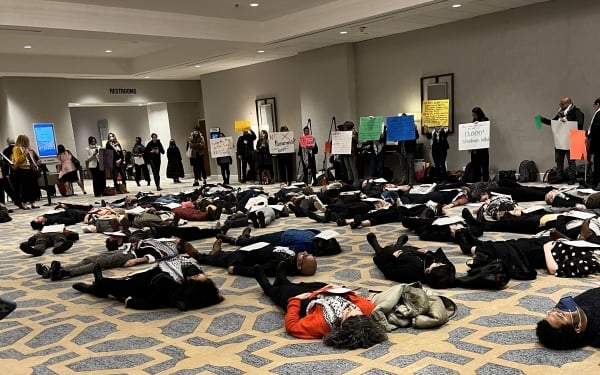
    A “die-in” protest at the MLA annual convention before Saturday’s Delegate Assembly meeting.

    As the Modern Language Association Delegate Assembly was beginning its meeting Saturday in New Orleans, audience members stood inside the hotel ballroom and chanted, “The more they try to silence us the louder we will be!” a video posted online shows. 

    The protesters, who made up a large number of the meeting’s attendees, read out a resolution endorsing the international boycott, divestment and sanctions movement against Israeli policy—the very resolution that the MLA’s elected Executive Council had blocked from going to the Delegate Assembly and the association’s full membership for a vote. Then the demonstrators walked out of the meeting. 

    It was one of multiple protests at this weekend’s annual MLA conference aimed at the Executive Council’s fall decision to reject the resolution without letting members vote on it.

    That resolution—like one that American Historical Association conference attendees overwhelmingly passed Jan. 5—also would have accused Israel of “scholasticide,” or the intentional eradication of an education system. But the AHA resolution didn’t endorse the BDS movement.  

    The demonstrations at the two conventions are the latest examples of scholarly associations and their members debating whether they should say anything as an organization about the ongoing war in Gaza at a time when politicians and people both inside and outside academe are criticizing scholars and institutions for expressing opinions on current events.  

    Anthony Alessandrini, an English professor at the City University of New York’s Kingsborough Community College, said he led a call and response demonstration. A few shouts of “Shame!” rang out.

    “Sometimes, this is what democracy looks like!” the demonstrators chanted in unison during the call and response. They raised hands or fists in the air, and some held signs that Alessandrini said bore the names of Palestinian academics killed in Gaza since October 2023. Protesters held a large banner that read, “MLA is Complicit in Genocide.”

    As they were walking out of the ballroom, protesters chanted “Free free Palestine!” and “You don’t have quorum!”—the minimum required numbers of attendees to conduct official business at a meeting. However, the MLA said quorum was maintained and the meeting continued.  

    The MLA Executive Council, an elected body, released a lengthy statement last month explaining its October decision to shoot down the resolution. The Council said it was concerned about “substantial” revenue loss if members endorsed the BDS movement, saying legal restrictions in many states on partnering with BDS-supporting organizations would end the MLA’s ability to contract with numerous colleges and universities and their libraries. It added that “some private institutions and major library consortia” also have such prohibitions.

    “Fully two-thirds of the operating budget of the MLA comes from sales of resources to universities and libraries, including the MLA International Bibliography,” the Council said.

    Dana Williams, president of the Executive Council and a professor of African-American literature at Howard University, told Inside Higher Ed Saturday that “the primary reason” for the council’s decision “was fiduciary.” But she also mentioned concerns about dividing the membership over endorsing the BDS movement, noting that “collegiality was one of many things that we were considering.”

    The Council’s statement in December suggested MLA members consider something short of endorsing the BDS movement. “Could not a motion calling for a statement protesting scholasticide in Gaza, while not focusing on BDS, be a powerful expression of solidarity?” it said.

    The fallout from the Executive Council’s decision included the resignation of two of its roughly 15 members, who were nearing the end of their terms. One was Esther Allen, a professor at the City University of New York’s Graduate Center and Baruch College.

    “The really don’t feel comfortable with any kind of member activism, they really don’t want it at all on any subject,” Allen told Inside Higher Ed.

    Williams said she supports members’ right to protest. “The association is the membership, we want to reiterate,” she said. What the members who walked out missed “was the one-hour open discussion [during the meeting] that … was really fruitful, thoughtful engagement with those delegates who were present that will inform the actions of the council going forward,” she added. The MLA didn’t provide a remote option for watching the meeting.

    The Council continues to believe that rejecting the resolution “was the right decision that would allow the association to continue to do its really important work to serve the members,” she said. “We had the benefit of a council that is bold enough and courageous enough to make very hard decisions.”

    MLA Members for Justice in Palestine is circulating a pledge for members to promise not to renew their memberships in protest. Alessandrini noted some other scholarly groups have endorsed the BDS movement.

    “My sort of forecast is a lot of people are going to move from organizations like the MLA and, I would add, the AHA [American Historical Association] if they don’t sort of endorse the will of the members—and towards the many organizations that have in fact taken the right stand,” he said. 

    Source link

  • Pro-Palestine Columbia professor departs after investigation

    Pro-Palestine Columbia professor departs after investigation

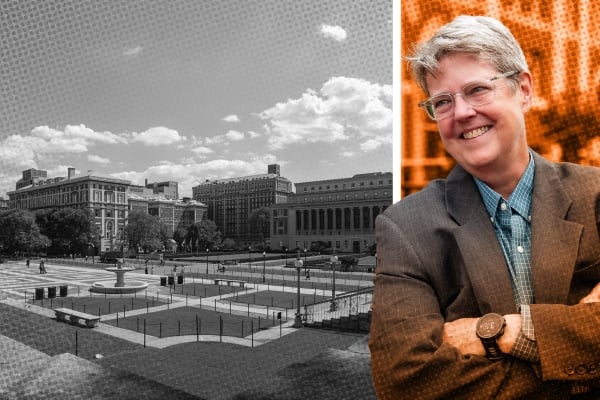
    A longtime tenured Columbia University law professor who faced public criticism from Columbia’s president and congressional Republicans will no longer teach at the institution, after more than 25 years as a faculty member there.

    Katherine Franke said Friday in a letter that she’s effectively been terminated, following a university investigation into a media interview she gave in which she criticized students who formerly served in the Israel Defense Forces for allegedly harming other students at Columbia. The investigation found that her media comments, and her alleged retaliation against a complainant in subsequent comments, had violated Columbia’s Division of Equal Opportunity and Affirmative Action Policies and Procedures. 

    She’s among multiple U.S. faculty members who’ve been investigated or punished in connection to speech that can broadly be considered pro-Palestinian.

    In a statement, Franke said she reached an agreement with Columbia “that relieves me of my obligations to teach or participate in faculty governance after serving on the Columbia law faculty for 25 years.” She added, “While the university may call this change in my status ‘retirement,’ it should be more accurately understood as a termination dressed up in more palatable terms.”

    She did not share a copy of the departure agreement, nor did the university. Columbia didn’t directly respond to her characterization of her departure.

    In a broadcast last January on Democracy Now!, a left-leaning radio and television newscast, Franke talked about an incident on campus in which pro-Palestinian protesters said they had been sprayed with a harmful chemical. Students were hospitalized, and protest organizers accused other students who had served in the Israeli military. The university said in August that the substance sprayed was “a non-toxic, legal, novelty item.”

    Franke told the host that Columbia has a program that connects it with “older students from other countries, including Israel. And it’s something that many of us were concerned about, because so many of those Israeli students, who then come to the Columbia campus, are coming right out of their military service. And they’ve been known to harass Palestinian and other students on our campus. And it’s something the university has not taken seriously in the past.”

    Most Jewish citizens of Israel must serve in the military for at least 32 months for men and 24 for women.

    “We know who they were,” Franke said on the program of the alleged attackers at Columbia. (Franke wrote in her statement Friday that, “I have long had a concern that the transition from the mindset required of a soldier to that of a student could be a difficult one for some people, and that the university needed to do more to protect the safety of all members of our community.”)

    Franke’s Democracy Now! comments became the subject of a university investigation as well as a broader congressional hearing related to campus antisemitism. Representative Elise Stefanik, a New York Republican, asked then–Columbia president Minouche Shafik what disciplinary action had been taken against Franke. She characterized Franke as saying, “Israeli students who have served in the IDF [Israel Defense Forces] are dangerous and shouldn’t be on campus.”

    Shafik didn’t answer Stefanik straightforwardly, but replied, “I agree with you that those comments are completely unacceptable and discriminatory.” Later during the televised hearing, Shafik confirmed that Franke was under investigation.

    That investigation found that in addition to the interview comments, Franke violated campus policy by retaliating against the complainants.

    A November 2024 Columbia EOAA Investigation Determination letter to one of the complainants, which was provided to Inside Higher Ed, says, “You also alleged retaliation on three separate occasions during the course of this investigation when complainant: (i) provided your name to a reporter who publicized your identity as an individual who initiated the complaint; (ii) reposted a tweet referring to you as a ‘genocide advocate’ and ‘McCarthyite bigot’; and (iii) posted a link to a document on social media indicating that you had made additional complaints against respondent.” (Franke had named the complainants—two of her faculty colleagues—to Inside Higher Ed for a July story.)

    The letter says the university concluded that the interview and the first two retaliation allegations violated the policy.

    In her statement Friday, Franke said she did appeal. But “upon reflection, it became clear to me that Columbia had become such a hostile environment that I could no longer serve as an active member of the faculty.”

    Over the last year, people have posed as students to secretly videotape her, and clips have ended up on “right-wing social media sites,” she said. Students have enrolled in her classes to provoke discussions they can record and complain about, she said, adding that law school colleagues have also secretly taped her and yelled “at me in front of students that I am a Hamas supporter.”

    “After President Shafik defamed me in Congress, I received several death threats at my home,” Franke said. “I regularly receive emails that express the hope that I am raped, murdered and otherwise assaulted on account of my support of Palestinian rights.”

    Columbia Law dean Daniel Abebe told colleagues Thursday that Franke “is accelerating her planned retirement and now will retire from Columbia on Friday.” Abebe praised her work.

    But Franke contests the word “retirement.” In an email to Inside Higher Ed on Friday, Franke explained that she signed an agreement with Columbia a year ago “to retire in a few years—phased in.” But she said the university “reneged on” providing routine retirement benefits, such as recommending her for emeritus status with the university’s Board of Trustees, providing her an office for five years and still allowing her to teach some classes.

    “Columbia University’s leadership has demonstrated a willingness to collaborate with the very enemies of our academic mission,” Franke wrote in her statement. “In a time when assaults on higher education are the most acute since the McCarthyite assaults of the 1950s, the university’s leadership and trustees have abandoned any duty to protect the university’s most precious resources: its faculty, students and academic mission.”

    The university didn’t provide an interview Friday. In an emailed statement, a Columbia spokesperson wrote, “Columbia is committed to being a community that is welcoming to all and our policies prohibit discrimination and harassment.”

    “As made public by parties in this matter, a complaint was filed alleging discriminatory harassment in violation of our policies,” the statement continued. “An investigation was conducted, and a finding was issued. As we have consistently stated, the university is committed to addressing all forms of discrimination consistent with our policies.”

    Source link

  • Key Trends in the Era of the Modern Learner

    Key Trends in the Era of the Modern Learner

    We are at a pivotal point in higher education, the Era of the Modern Learner. This new era, shaped by evolving technology, changing cultural dynamics, and shifting student priorities, is revolutionizing how colleges and universities engage with students.

    Modern Learners are not who they used to be. They are:

    • Discerning, using data and online resources to thoroughly research programs and institutions.
    • Highly Informed and Goal-Oriented, demanding personalized experiences tailored to their specific needs.
    • Focused on ROI, seeking educational options that offer a clear return on investment and equip them with practical skills for future financial viability.

    To succeed in the Era of the Modern Learner, institutions must adapt and embrace a Unified Enrollment Approach that seamlessly integrates marketing and communications across the campus, ensuring a consistent brand message reaches all audiences. This means moving beyond traditional demographic-driven strategies and embracing the commonalities that bind today’s diverse student population as Modern Learners.

    The 2025 Marketing and Enrollment Management Benchmarks Report offers higher education leaders with the knowledge and insights needed to effectively navigate the landscape.

    Key Trends Impacting Higher Education Marketing and Enrollment Management

    The Rise of Stealth Applicants

    A growing number of students prefer to explore college options privately, submitting applications directly without engaging with admissions offices beforehand. This trend, known as stealth applying, presents a challenge for institutions to connect with these elusive prospects, requiring refined media spending strategies to justify investments and adapt to this evolving application behavior.

    Program Demand Shifts

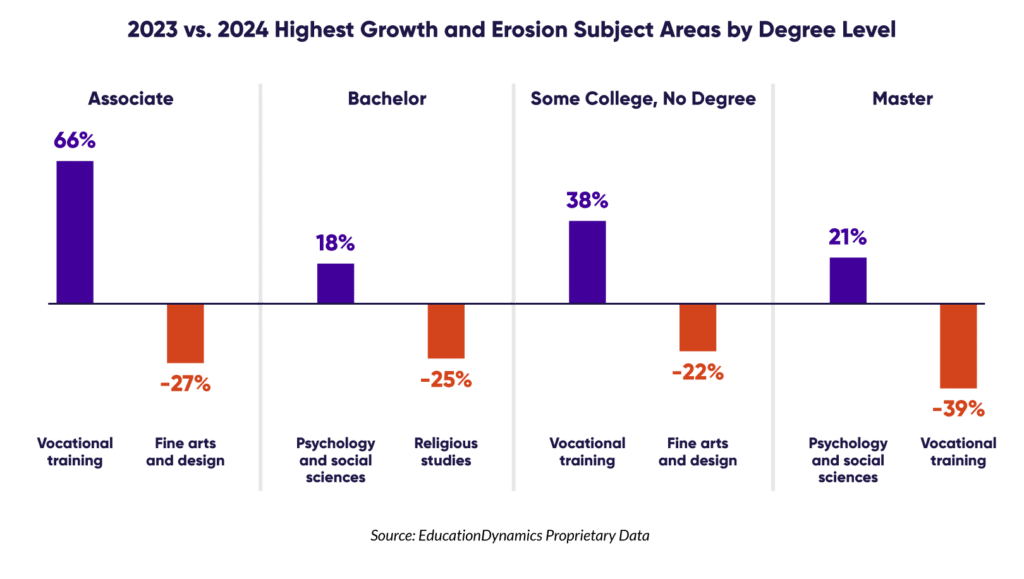
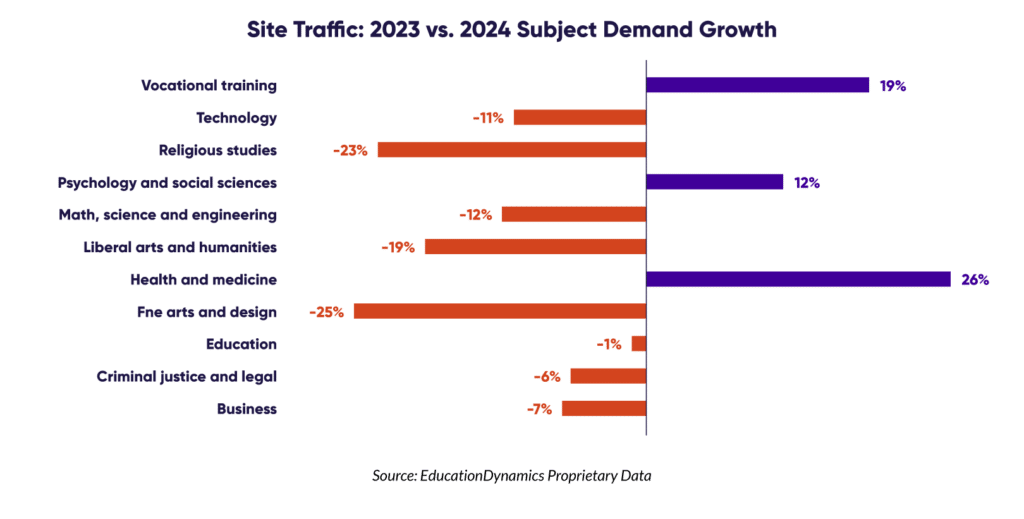
    Analysis of site traffic reveals significant shifts in program demand. Healthcare and vocational training programs are experiencing a surge in interest, reflecting a growing societal focus on healthcare careers and a shift towards practical skills and direct employment pathways. Conversely, traditional arts and humanities fields are facing declines, suggesting students are prioritizing fields perceived as more job ready.

    The Power of Organic Search

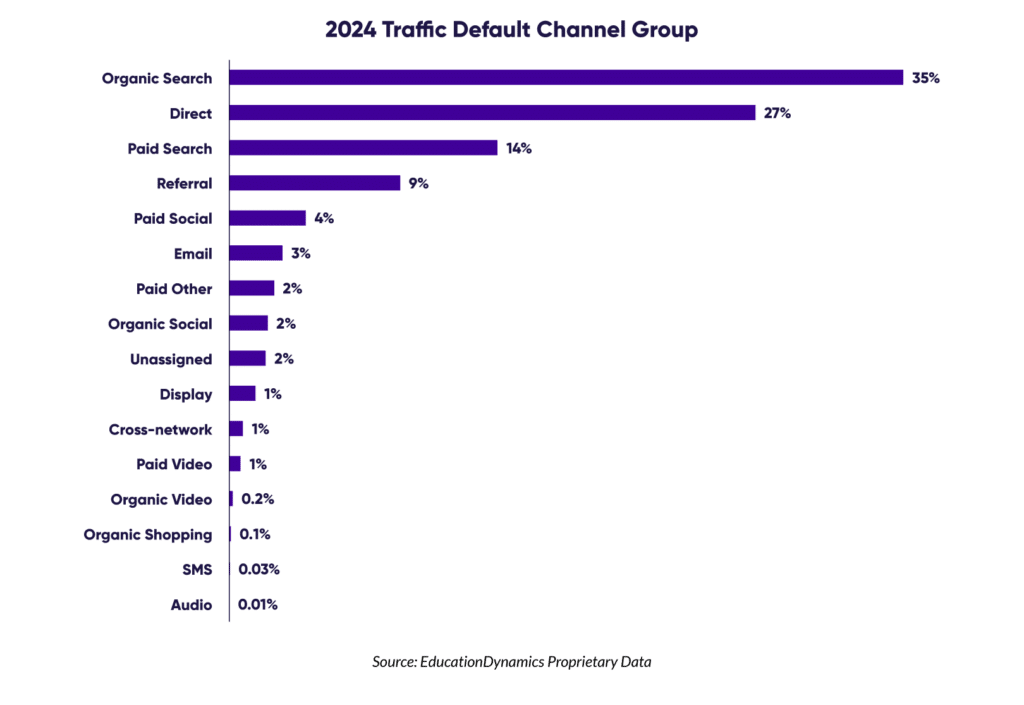
    Organic search remains a highly cost-effective way to attract prospective students, with over a third of all education website visits originating from organic search. Institutions need to prioritize website performance and optimize their online presence to capture this valuable traffic source.

    Digital Advertising Dominance

    Institutions are strategically increasing their investment in digital advertising, particularly across platforms like Google, social media, and mobile video. This shift reflects the Modern Learner’s digital-first consumption habits and the effectiveness of these channels in driving awareness and conversions.

    AI-Powered Personalization

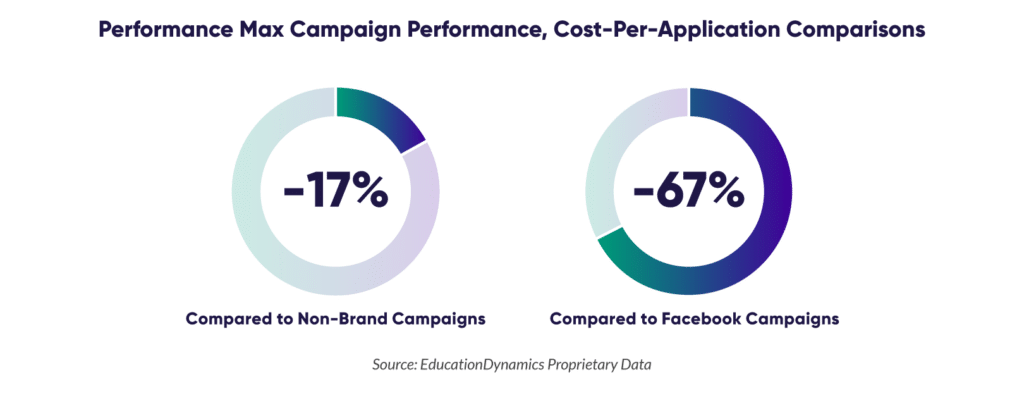
    AI-powered tools, such as Google’s Performance Max, are transforming how institutions optimize advertising campaigns and personalize content delivery. These tools leverage machine learning to enhance ad performance across multiple Google channels, leading to more efficient and effective outreach.

    2025 Key Recommendations for Higher Ed Leaders

    • Break Down the Walls:
      Embrace a unified approach to enrollment that integrates marketing and communication strategies across the entire institution.
    • Be Transparent and Demonstrate Value:
      Prioritize transparency and demonstrate value, providing clear information about costs, program details, and career outcomes.
    • Go Digital or Go Home:
      Develop a robust digital marketing strategy, leveraging the power of organic search, paid advertising, and video content.
    • Leverage the Power of AI:
      Harness the power of AI, utilizing tools like Google Performance Max to optimize campaigns and personalize content delivery.
    • Stay Agile and Responsive:
      Continuously adapt to the evolving needs and preferences of the Modern Learner.

    By understanding these trends and proactively adapting strategies, higher education institutions can effectively engage Modern Learners, navigate the evolving landscape, and achieve enrollment success in 2025 and beyond.

    For a more in-depth analysis of the current higher education marketing and enrollment landscape, download our comprehensive Marketing and Enrollment Management report. It’s packed with EducationDynamics’ proprietary data, insights and actionable strategies to help you grow enrollment.

    EducationDynamics is dedicated to helping colleges and universities navigate these complex challenges. We offer proven solutions to help you implement these key recommendations and achieve your enrollment goals. Contact us today to learn how we can partner with you to reach the Modern Learner and thrive in the evolving higher education environment.

    Source link

  • How Families Make College Work at Any Cost (Caitlin Zaloom)

    How Families Make College Work at Any Cost (Caitlin Zaloom)

    This audiobook narrated by Kate Harper examines how the financial pressures of paying for college affect the lives and well-being of middle-class families The struggle to pay for college is one of the defining features of middle-class life in America today. At kitchen tables all across the country, parents agonize over whether to burden their children with loans or to sacrifice their own financial security by taking out a second mortgage or draining their retirement savings. Indebted takes readers into the homes of middle-class families throughout the nation to reveal the hidden consequences of student debt and the ways that financing college has transformed family life. 

    Caitlin Zaloom gained the confidence of numerous parents and their college-age children, who talked candidly with her about stressful and intensely personal financial matters that are usually kept private. In this remarkable book, Zaloom describes the profound moral conflicts for parents as they try to honor what they see as their highest parental duty—providing their children with opportunity—and shows how parents and students alike are forced to take on enormous debts and gamble on an investment that might not pay off. 

    What emerges is a troubling portrait of an American middle class fettered by the “student finance complex”—the bewildering labyrinth of government-sponsored institutions, profit-seeking firms, and university offices that collect information on household earnings and assets, assess family needs, and decide who is eligible for aid and who is not. Superbly written and unflinchingly honest, Indebted breaks through the culture of silence surrounding the student debt crisis, revealing the unspoken costs of sending our kids to college.

    Source link

  • Moving Beyond New Year’s Resolutions to Embrace a Multi-Year Enrollment Strategy 

    Moving Beyond New Year’s Resolutions to Embrace a Multi-Year Enrollment Strategy 


    Developing New Year’s resolutions for personal growth is something many of us do. Unfortunately, it is often a set-it and forget-it process that is simply reupped the following year. When done correctly, however, creating a resolution that is developed as a sustained, long-term strategy—and that is regularly returned to and adjusted as needed—seems to be the best way to meet our personal goals.  
     
    As enrollment managers, we all have pursued the first approach in our professional lives by evaluating last year’s successes and failures annually, making a few tweaks, and then seeing how it all works out again the following year. The truth of the matter is that this approach was relatively sustainable for a time. Simply buying more names, adjusting the aid-leveraging model annually, or a developing a wider marketing plan often could drive greater enrollments—mostly because those tactics generally were designed to “add more fuel to the fire.” As long as the applications continued to grow, annual tweaks could help to maintain the core enrollments as well as improve on the margins for many institutions.  


    The Need for More Effective Strategic Enrollment Strategies

    Unfortunately, outside of key private and public flagship institutions, headwinds have developed over the past decade that are affecting higher education enrollments in significant ways. Ultimately, they may lead to campus closures for some, and to campus financial distress for many. As outlined in a paper from the Federal Reserve Bank of Philadelphia, “Predicting College Closures and Financial Distress,” those pressures include:

    • Post-pandemic enrollment challenges from traditional students (decreasing 15% from 2010-2021).


    • Changes among adult learners (“The number of adult students over the age of 25 has fallen by nearly half since the Great Recession”).


    • Growing competition.


    • A lack of public support for higher education nationally. 

    The combination of all these factors has brought about the need for enrollment managers to develop a wider multi-year strategy that includes tools with the ability to enable deeper, more highly data-informed fine tuning throughout any given cycle. A one-size-fits-all approach to creating a nuanced strategy can no longer work in an environment of shrinking applications and increased competition. 


    Liaison’s Partnership Philosophy

    Liaison is uniquely positioned to assist with higher education institutions in a true partnership. With the technology, services, and consultative approach that we provide our partners throughout the nation, we can assist in developing a comprehensive enrollment approach unique to your campus—ranging from single-point to full-enrollment planning solutions that are uniquely tailored to your unique needs. Liaison’s partnership philosophy, technology solutions, and industry knowledge and insights can not only help strengthen your enrollment planning and goals for this year but also set you up for long-term enrollment success.  


    Craig Cornell is the Vice President for Enrollment Strategy at Liaison. In that capacity, he oversees a team of enrollment strategists and brings best practices, consultation, and data trends to campuses across the country in all things enrollment management. Craig also serves as the dedicated resource to NASH (National Association of Higher Education Systems) and works closely with the higher education system that Liaison supports. Before joining Liaison in 2023, Craig served for over 30 years in multiple higher education executive enrollment management positions. During his tenure, the campuses he served often received national recognition for enrollment growth, effective financial aid leveraging, marketing enhancements, and innovative enrollment strategies.

    Source link

  • University of Washington alumni seek to revive the spirit of free inquiry

    University of Washington alumni seek to revive the spirit of free inquiry

    Amid the urban hum of downtown Seattle and the friendly clatter of a FIRE supporters’ meetup, a consequential alliance was born. 

    Two alumni of the University of Washington, separated by generations but united by a shared purpose, converged in conversation. Cole Daigneault, a freshly minted graduate from the class of 2024, and Bill Severson, a two-time UW graduate who earned his bachelor’s and law degree in the early 1970s, lamented over the encroaching illiberalism at their alma mater. 

    That evening’s conversation, later sustained through an alumni email listserv, soon crystallized into Husky Alumni for Academic Excellence

    This new, independent UW alumni group has articulated a mission that is ambitious yet essential: “To reinvigorate free and open academic inquiry and to foster a campus ethos where civil discourse and intellectual courage flourish.” 

    “My hope with this alumni group,” Daigneault says, “is to rally former UW students, who like me, are concerned about the culture of discourse on campus. The group will also be a place for graduated students to continue the fight long after they leave.” 

    Daigneault’s early activism was catalyzed by the controversy surrounding UW professor Stuart Reges, whose parody land acknowledgment and subsequent legal battles with the university became a major flashpoint in the free speech landscape. Inspired by Reges’ story — and FIRE’s robust defense of him — Daigneault founded Huskies for Liberty in 2022, a UW student organization devoted to “the preservation of free expression and individual liberty on campus and beyond.” 

    The fight for free speech on campus, as history has long demonstrated, is never truly won. It must be waged anew by each generation. 

    Furthermore, through FIRE’s Campus Scholar Program, Daigneault organized “Free Speech Matters,” UW’s first student-led conference devoted to the enduring relevance of free speech, civil discourse, and academic freedom. 

    Alongside Daigneault, Bill Severson brings over a half-century of legal experience and an unabiding love for his alma mater. His concerns over the state of higher education were sparked by the 2017 debacle at Evergreen State College, where an angry mob of students confronted Professor Bret Weinstein for publicly objecting to a proposal that white students and professors leave campus for Evergreen’s annual “Day of Absence.”

    “I was appalled by how that situation was handled,” Severson recounts. “It led me to explore thinkers like Jonathan Haidt and Steven Pinker and organizations like FIRE.” 

    Severson’s recollections of his time in school are colored with a mixture of nostalgia and grave concern. “When I attended UW in the late 1960s and early 1970s, the atmosphere on campus was markedly different than today. Then, as now, students and faculty leaned left, but it was not a monoculture and there was not such a marked intolerance of other viewpoints.” 

    The emergent partnership between Daigneault and Severson is not only remarkable, it highlights an enduring truth: The defense of free speech on campus is not a transient endeavor but a generational relay, requiring both the vigor of youth and wisdom of age. One without the other is as useful as a compass without a needle.

    Daigneault and Severson’s decision to form Husky Alumni for Academic Excellence is timely, to say the least. 

    “Last year, free speech became a major campus issue due to widespread protests over the Israel-Hamas War,” Daigneault recalls. “Unfortunately, alongside many instances of protected expression, we also saw a rise in illiberal behaviors, such as shouting down speakers, preventing students from accessing public areas, and even vandalizing historic buildings on campus.”

    Daigneault’s reflections are not mere anecdotes. They are substantiated by FIRE’s reports. UW has consistently languished near the bottom of FIRE’s College Free Speech Rankings (in 2022, UW was the lowest ranked public university). And 2024 was not much better: UW ranked 226 out of 257 schools. 

    The data is grim:

    • 71% of students believe it is sometimes acceptable to shout down a speaker.
    • 30% think using violence to silence a speaker is sometimes acceptable.
    • 50% admit to self-censoring on campus at least once or twice a month.

    Among the faculty and administration, the picture is scarcely brighter. According to FIRE’s 2024 Faculty Survey Report, over one-third of UW faculty respondents confessed to moderating their writing to avoid controversy, while 40% expressed uncertainty about the administration’s commitment to protecting free speech. 

    FIRE to Congress: More work needed to protect free speech on college campuses

    News

    FIRE joined Rep. Murphy’s annual Campus Free Speech Roundtable to discuss the free speech opportunities and challenges facing colleges.


    Read More

    For Severson, the conclusion is clear.

    “Educational institutions have lost their way,” he says, though he insists there is still hope. “Alumni can be a force to push schools back toward their mission — promoting honest inquiry, academic excellence, the pursuit of truth, and the dissemination of knowledge.”

    In the burgeoning movement of alumni stewardship,  Daigneault and Severson offer a clarion call to UW alumni who not only revere the university’s storied past (UW is one of the oldest universities on the West Coast), but also seek to reclaim it against the present maladies of orthodoxy and intellectual timidity.

    The fight for free speech on campus, as history has long demonstrated, is never truly won. It must be waged anew by each generation. Daigneault and Severson have valiantly taken up the mantle. The question remains, who will join them? 


    If you’re ready to join Husky Alumni for Academic Excellence, or if you’re interested in forming a free speech alumni alliance at your alma mater, contact us at [email protected]. We’ll connect you with like-minded alumni and offer guidance on how to effectively protect free speech and academic freedom for all. 

    Source link

  • How Admissions and Marketing Teams Can Collaborate

    How Admissions and Marketing Teams Can Collaborate

    Fostering Interdepartmental Collaboration to Drive a More Effective and Engaging Student Journey

    Achieving success in your higher education marketing strategy requires seamless collaboration between your admissions and marketing teams to create a connected, consistent student journey experience. When these teams align, they move beyond their isolated efforts and build a unified strategy that not only captures students’ attention but also drives meaningful engagement and enrollments.

    Admissions teams gain critical, real-time insights from their conversations with prospective students, and marketing teams transform those insights into strategies and assets that resonate with the right audiences. By sharing their insights, both teams can better inform campaigns, conversations, and touchpoints, ensuring every interaction feels intentional, relevant, and student-centered.

    However, this alignment doesn’t happen by chance. It requires deliberate collaboration, thoughtful planning, and the strategic use of data at every stage. From discovery interviews and customer relationship management (CRM) data analysis to shared campaign development, each step in the process plays a vital role in delivering a cohesive, engaging experience that guides prospective students from curiosity to commitment.

    The Importance and Benefits of Collaboration Between Admissions and Marketing Teams 

    In an increasingly competitive higher ed landscape, having admissions and marketing teams that collaborate and communicate with each other regularly can make a meaningful difference in the experience that an institution delivers to prospective students, while optimizing its marketing efforts for maximum impact.  

    When admissions and marketing operate in silos, the cohesion breaks down. Collaboration prevents these gaps, ensuring every message, from the first ad to the final admissions call, feels aligned and purposeful.

    Creating a Unified Message

    Students don’t distinguish between “admissions” and “marketing” — they only see the institution. That’s why a unified message is so crucial to every higher education marketing strategy. A consistent and unified message — whether it’s delivered through ads, emails, website visits, or conversations with admissions personnel — builds trust, strengthens the brand, and guides prospective students smoothly through their decision-making journey.

    Building a Powerful Feedback Loop  

    When admissions and marketing teams stay in consistent communication, they create a powerful feedback loop that strengthens the institution’s messaging and better serves its prospective students.

    Admissions teams are on the front lines, having daily conversations with students and hearing their motivations, hesitations, and questions firsthand. These interactions provide invaluable qualitative insights that can flow back into marketing assets and strategies. 

    For example, if students frequently ask about program outcomes — such as what they can do with a certain degree — marketing can develop targeted blog content, alumni video spotlights, or landing page updates showcasing career opportunities, industry connections, and success stories related to the degree. Additionally, if there are common points of confusion that come up in students’ conversations with admissions staff, marketing materials can be created that clearly and directly address these issues. 

    By tapping into this feedback loop, both teams can make meaningful, real-time adjustments that align the institution’s messaging with students’ priorities, enhance engagement, and drive better outcomes.

    Empowering Teams With Critical Insights and Knowledge

    Both admissions and marketing teams bring something unique and valuable to the table when it comes to understanding the institution’s brand, its offerings, and its students. While there are areas of overlap, each team also has its own distinct focal points that allow it to provide useful details the other team can benefit from, creating a richer and more comprehensive appreciation of how each team can best serve the institution’s students.

    Practical Ways to Collaborate 

    Now that we’ve established the importance of collaboration, let’s take a look at some practical ways to bring this strategy to life. 

    Coordinate and Share Learnings During a Discovery Process

    The first step is discovery, the phase where both admissions and marketing teams collaborate to analyze and uncover insights that will make their work more accurate, impactful, and aligned. The discovery process includes in-depth conversations with key university stakeholders; audits of existing school resources, marketing collateral, and program materials; and market research and competitive analysis to understand the institution’s positioning and audience needs.

    Each team adds unique value to the process. Admissions teams gather information about program-specific details, students’ motivations, and nuances that resonate during enrollment conversations, while marketing teams analyze the institution’s competitive positioning, audience behaviors, and key differentiators. By sharing and coordinating these efforts upfront, teams can reduce redundancies, ensure alignment, and create a more cohesive strategy that delivers consistent, tailored messaging. 

    Here are some tactics that can help in coordinating and consolidating discovery efforts:

    Schedule Ongoing Check-Ins With Teams

    Consistent communication is critical for collaboration. Regular monthly or quarterly meetings that include both admissions and marketing staff create space for sharing insights, identifying trends, and closing messaging gaps. 

    Admissions teams can spotlight common motivations, pain points, and areas of confusion among students, so marketing teams can update campaigns to address these themes in real time. These sessions ensure all higher education marketing strategies stay aligned and adaptive, making the student experience feel more cohesive.

    Leverage CRM Data

    Every interaction with a student leaves a breadcrumb trail of data. By tapping into call notes and CRM system data, admissions and marketing teams can track students’ questions, motivations, and hesitations. 

    Analyzing this data can reveal trends that marketing can address through website updates, FAQs, and ad campaigns. Sharing actionable summaries allows admissions teams to prepare for upcoming conversations and marketing teams to preemptively answer students’ concerns, creating a more seamless experience for prospects.

    Share and Understand Key Resources

    Developing key marketing resources, such as a Strategic Marketing Guide (SMG), and sharing them across teams can help keep admissions and marketing teams’ collaboration efforts on track. 

    An SMG isn’t just a document — it’s the framework that ensures every team is aligned in understanding the key components of the institution’s brand, story, and students. Personas, unique value propositions (UVPs), brand stories and positioning, and messaging frameworks outlined in an SMG help admissions and marketing teams speak the same language and tell a shared story.  

    Connect Your Admissions and Marketing Teams Through Collaboration With Archer

    At Archer Education, we don’t just build marketing strategies — we build lasting capabilities. Our approach goes beyond campaign launches and lead generation to focus on sustainable online infrastructure that empowers universities to thrive long after our work is done. From aligning admissions and marketing teams to developing data-driven messaging frameworks, we act as a true partner in developing custom higher education marketing strategies that work. 

    Our collaboration is designed to transfer knowledge, not just deliver results. We equip your teams with the tools, training, and insights they need to operate with confidence, ensuring your institution isn’t reliant on outside support to maintain momentum. The result is a marketing engine that runs smoothly long after Archer’s involvement has ended, empowering your teams to lead with agility in an ever-changing higher education landscape. 

    Contact us today to learn more. 

    Subscribe to the Higher Ed Marketing Journal:

    Source link

  • The Fifteen: January 10, 2025

    The Fifteen: January 10, 2025

    Our first Fifteen in the New Year! Although many institutions have been on winter break in recent weeks, numerous important stories from the world of higher education continue to unfold. This week on The Fifteen, we look at what’s happening around the globe. Enjoy!

    1. A thought-provoking post from the LSE Blog discusses whether traditional academics bring the ideal skills-set to institutional leadership positions as the UK PSE faces a financial crisis. Let’s look outside academia for university leaders. (LSE Blog)
    2. Staff at a UK university made a move to impeach the administration after they announced job cuts. Staff pass motion of no confidence in UEA executive. (BBC)
    3. Report from a US Conservative think-tank finds that US college accreditation is not an effective means of quality control and recommends scrapping it in favour of more general consumer protections to allow more new entrants to deliver higher education programs. Report: States Should Drop Accreditation Requirements for New Colleges. (AEI)
    4. Nazarbayev University in Kazakhstan was a pretty big deal when it opened 15 years ago. The President’s resignation in 2023 was something of a shock: here’s some interesting background to that story: The battle for Nazarbayev University’s future: Shigeo Katsu on financial mismanagement and accountability. (Eureporter)
    5. This is a quite fascinating look at a new venture which is attempting to create a network of universities across Eurasia and North Africa, in part by using course materials licensed form the ever-inventive Arizona State University. An experiment to watch. After bumpy start, ASU-backed university network picks up pace (Times Higher Education).
    6. A private Afrikaans university, Akademia, has been growing significantly since its establishment in 2012, and is now setting up a new campus. South Africa’s private Afrikaans university showing incredible growth. (BusinessTech)
    7. Finland is ramping up R&D spending, aiming to increase from 2.9% to 4% of GDP by 2030. The country hasn’t seen massive success in technology development since the days of Nokia: might this change soon? Will Finland’s big spending on R&D buy it the gift of growth? (Times Higher Education)
    8. Greece has a huge problem with students who enrol but simply neglect to finish their degrees. Rectors call for exemptions to law ousting university loafers. (ekathimerini.com)
    9. The Hungary-EU fight continues. The EU has been blocking funding from reaching institutions there due to concerns about the political influence of populist Prime Minister Viktor Orban’s Fidesz party. Hungarian universities stay blocked from EU grants despite appeal. (Times Higher Education)
    10. Belarus finds that being an international pariah is no barrier to increasing educational exports: BSU almost doubled exports of educational services in 2024. (SB News)
    11. Iran is very pleased at how its universities rank compared to those in countries it really shouldn’t be comparing itself against: Iran secures second place in D-8 universities ranking. (Tehran Times)
    12. Germany is trying to encourage PhD researchers to start their own companies with backing from a UK fund and a former Google exec. German innovation agency to fund spin-out focused PhDs. (Times Higher Education)
    13. Japan’s highly structured, seniority-based compensation system tends not to reward young people with very high levels of education. Result? A big drop in applicants to PhD programs. Now the government is experimenting with ways to make PhDs more financially appealing. Japan seeks to improve salary prospects for PhD graduates. (Times Higher Education)
    14. The Biden Administration has passed what is likely it’s final tranche of student loan forgiveness, this time for people enrolled in what is known as the Public Service Loan Forgiveness (PSLF) program. Biden-Harris Administration Approves Additional $4.28 Billion in Student Debt Relief for Nearly 55,000 Public Service Workers. (US Department of Education)
    15. A working paper put out by the National Bureau of Economic Research finds that American academics have (for several decades at least) been disproportionately drawn from better-off families, particularly in the humanities. Climbing the Ivory Tower: How socio-economic background shapes academia. (NBER)

    The post The Fifteen: January 10, 2025 appeared first on HESA.

    Source link