Author: admin

  • “Peak Higher Education” Book Debuts January 6, 2026 (Bryan Alexander)

    “Peak Higher Education” Book Debuts January 6, 2026 (Bryan Alexander)

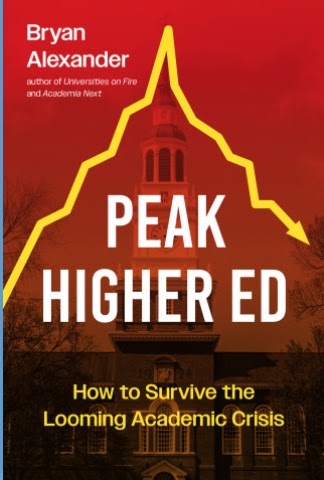
    Peak Higher Ed: How to Survive the Looming Academic Crisis by Bryan Alexander debuts January 6, 2026.  Here’s a synopsis. 

    Over the past decade, American colleges and universities have seen enrollment decline, campuses close, programs cut, faculty and staff laid off, and public confidence erode. In Peak Higher Ed, futurist Bryan Alexander forecasts what the next decade might hold if we continue down this path. He argues that the United States has passed its high-water mark for postsecondary education and now faces a critical turning point. How will higher ed institutions respond to this wave of change and crisis?

    Combining data-driven research with scenario modeling, Alexander outlines a powerful framework for understanding what led to this moment: declining birthrates, surging student debt, rising tuition, shifting political winds, and growing skepticism about the value of a college degree. He maps out how these forces, if left unchecked, could continue to reshape academia by shrinking its footprint, narrowing its mission, and jeopardizing its role in addressing the planet’s most pressing challenges, from climate change to artificial intelligence. Alexander explores how institutions might adapt or recover, presenting two possible futures: a path of managed descent and a more hopeful course of reinvention.

    Peak Higher Ed examines the fraying of the “college for all” consensus, the long shadow of pandemic-era disruptions, and the political polarization that has placed universities in the crosshairs. Written for educators, policymakers, students, and anyone invested in the future of higher learning, this book offers a deeply informed, unflinching look at the road ahead and the choices that will determine whether colleges and universities retreat from their peak or rise to a new one.

    Source link

  • US students are voting with their feet – and global universities are ready

    US students are voting with their feet – and global universities are ready

    A record number of American students are applying to UK universities, with applications up nearly 14% over last year. The shift reflects something deeper than academic preference. It’s a response to uncertainty – political, cultural, and institutional – within the US higher education system.

    Students are assessing the climate as carefully as the curriculum, and for many, overseas options are starting to look more stable, more supportive, and more aligned with their values.

    For years, US institutions have concentrated on drawing international students into their classrooms and research labs. These efforts have been crucial to advancing STEM research, sustaining graduate-level enrolment, and feeding innovation pipelines. That trend continues, but the story is evolving.

    An outbound shift is now underway, with a growing number of American students pursuing degrees abroad. They’re no longer just participating in short-term exchanges or postgraduate fellowships, they’re committing to full undergraduate and master’s programs in other countries.

    This change matters – and it signals both a loss of tuition revenue and a weakening of domestic confidence in US higher education itself.

    Global competitors are moving decisively

    Universities in the UK, Canada, Australia, Germany, and the Netherlands have responded to this moment with strategy and urgency. They’ve expanded international recruitment offices, developed targeted campaigns for US students, and aligned their degree programs with global employment pathways.

    Tuition transparency, faster visa timelines, and the option to work post-graduation are all part of a larger value proposition. These countries have positioned themselves as predictable, inclusive, and serious about talent retention.

    When American students earn degrees abroad, they begin forming professional relationships, research collaborations, and employment ties in other countries

    The messaging stands in sharp contrast to the environment many students perceive at home in the US, where they’re regrettably familiar with ongoing threats to federal research funding, campus free speech tensions, and anti-immigrant rhetoric. Legislative actions in some states, such as restrictions on DEI programs or faculty tenure, further complicate the picture for students who see higher education as a place of openness and critical inquiry.

    Even where the academic offering remains strong, the broader social climate is giving students pause. Many now fear that attending university in the US could come with limitations on expression, uncertainty around institutional support, or even diminished international credibility. These concerns are pushing more prospective students, both international and domestic, to weigh their options with increasing care.

    The landscape is becoming borderless

    Higher education is no longer a domestically bounded experience. Today’s students are growing up in a digital-first world where comparison is constant and information is immediate. They can browse course catalogs from universities in five countries before lunch.

    They’re watching lectures on TikTok from professors in London, Melbourne, and Berlin. They’re discussing housing, scholarships, and career prospects with peers on Reddit, Discord, and WhatsApp. The idea of applying to college abroad no longer feels radical or risky – it feels strategic.

    At the same time, the financial argument for international study has grown stronger. In the UK and parts of Europe, undergraduate degrees often take three years instead of four. Tuition is fixed, predictable, and, in some cases, lower than the out-of-state rates at US public universities.

    Students can begin building global networks immediately, with exposure to cross-cultural collaboration built into the experience. That combination of efficiency, affordability, and international orientation is hard to ignore.

    Consequences will extend beyond enrollment trends

    If this shift continues, the implications go well beyond enrolment figures. When American students earn degrees abroad, they begin forming professional relationships, research collaborations, and employment ties in other countries. That international experience can strengthen global literacy, which is good in theory, but it may also weaken long-term institutional connections to the US – particularly if graduates choose to live, work, and innovate elsewhere.

    This becomes especially relevant in sectors where talent mobility drives economic growth. If a critical mass of globally minded US students pursue AI, climate tech, public health, or diplomacy degrees abroad and then launch their careers overseas, the domestic pipeline for advanced skills and leadership becomes harder to sustain. These are early signs of a broader trend, and we should treat them with urgency.

    The same applies to the soft power of US education. For decades, American universities have served as platforms for international exchange, not only bringing foreign students in, but equipping domestic students to become global ambassadors. If that dynamic begins to fade, so does the country’s influence in shaping global norms around research, ethics, and innovation.

    Prioritising stability and trust 

    Reversing this trend will require more than competitive admissions packages. US institutions – and the policymakers who shape their environment – must work to restore trust. That means safeguarding academic freedom, ensuring transparent financial support structures, and publicly affirming the value of international engagement.

    Students are listening closely. They are attuned to leadership choices and the broader societal signals surrounding higher education. If they sense instability or retreat, they will continue to look abroad.

    Universities also need to communicate more effectively with prospective students about their long-term value. That includes articulating what makes a US education distinctive, and doing so without leaning solely on prestige or nostalgia. There must be a renewed emphasis on civic purpose, global relevance, and practical opportunity. The next generation is looking for clarity, meaning, and alignment between their educational investment and the world they hope to shape.

    The US can lead again, if it chooses to

    The United States still possesses unmatched institutional capacity in research, innovation, and cultural reach. But influence is not a static asset. It depends on the willingness to adapt and lead with principle. The current wave of outbound student mobility should not be dismissed as an anomaly. It’s a signal. How US higher education responds – at both the institutional and national levels – will determine whether it remains a magnet for talent or becomes just one option among many.

    Source link

  • [Podcast] Healthy Minds, Bright Futures: How to Navigate Mental Health & Build Support

    [Podcast] Healthy Minds, Bright Futures: How to Navigate Mental Health & Build Support

    Children’s mental health is in the spotlight like never before. Concerning data around anxiety and depression, as well as the increasing prevalence of conditions such as attention deficit hyperactivity disorder and autism spectrum disorder, are driving important discussions about supporting kids’ mental health.

    In this three-part series, our expert guests address evidence-based interventions and assessments to equip clinicians with the latest tools and tactics for enhancing a child or adolescent’s well-being. We’ll assess the current landscape of student mental health and dive deeper into ADHD, ASD and co-occurring conditions, and the latest BASCTM family of solutions.

    Check out the podcast episodes!


    1. Ep. 1
      Getting Your Attention: What You Can Do To Support Children and Teens with ADHD


    Ep. 1

    Getting Your Attention: What You Can Do To Support Children and Teens with ADHD

    ADHD diagnosis rates vary widely, and the condition itself presents many complexities. We’ll explore actionable strategies for clinicians to identify children who need additional ADHD support and how to provide the right learning environment for them, with our guest: Tyler Vassar, Ed.S., a licensed school psychologist and assessment consultant at Pearson.


    Source link

  • A Step in The Wrong Direction in Engaging College Students in our Democracy

    A Step in The Wrong Direction in Engaging College Students in our Democracy

    Amanda Fuchs Miller On this Election Day, it is critical to think about how we as a country want to ensure that more young people vote and get involved in public service.  As a democracy, we should all be striving to make it easier for new voters to register, get to the polls, and have their vote count.  However, what we are seeing instead are efforts to make it harder for college students to be engaged in our electoral process – through restrictions on supports and language designed to have a chilling effect on voting instead of encouraging it. 

    Right before college students returned to campuses, the U.S. Department of Education issued new guidance designed to make it harder for college students to vote.  Every school year, students receive an email with information about how to register to vote.  This is because it is required in law.  The Higher Education Act requires institutions of higher education to “make a good faith effort to distribute a mail voter registration form…to each student enrolled in a degree or certificate program and physically in attendance at the institution, and to make such forms widely available to students at the institution.” 

    Contrary to statute, the Trump Administration is now encouraging schools to limit who they send this information to – saying that if a school doesn’t send it to students who they have “reason to believe” are ineligible to vote, that’s okay.  In addition to this being contrary to law, which requires all students to receive this information, this will increase the likelihood of students who are eligible not receiving information about how to register to vote (thus suppressing their votes) – and is likely to most impact students of color.  The Department is also encouraging the voter registration information to include language reminding students of the list of ways that voting may be fraudulent – another tactic that may have a chilling effect on students going to the polls.

    The same Department guidance prohibits students from being paid with federal work-study funds for any voting-related activities.  A press release from the Department says that they are making a change to this longstanding policy because “Federal Work-Study is meant to provide students opportunities to gain real-world experience that prepares them to succeed in the workforce, not as a way to fund political activism on our college and university campuses.”

    As we prepare our next generation of leaders to play a role in our democracy, in government, and in public service, it is hard to see how allowing students to participate in nonpartisan voting engagement is not aligned with experience they will benefit from in the workplace. By engaging in nonpartisan voter registration efforts using work-study positions, college students are able to increase the number of their peers who are registered to vote while learning and participating fully in our democratic system – all while earning the funds they are entitled to so that they can afford a college degree.  It can’t go without saying that this restriction is also counter to statute and regulations which do not limit the types of on-campus work study positions to those that are in the “public interest,” as the guidance suggests.  That limitation is only linked to off-campus work-study positions.

    In a survey by CIRCLE following the 2024 elections about why young people didn’t register to vote, more than one in 10 – 12 percent – of people aged 18-34 said they did not know how to register or had problems with voter registration forms. Nearly a third of young people – 31 percent – said they were too busy, ran out of time, or missed the registration deadline.  Without receiving voter registration information, in an objective way, from their college or university or their peers on campus, these numbers are likely to go up as more students will lack the information they need about voter registration.

    Ensuring college students are able to vote shouldn’t be a partisan issue.  In 2024, there were disparities by both gender and race in youth voter turnout.  We all benefit from a democracy where everyone’s voice is heard and every vote is counted – for whomever the ballot is cast. 

    _________

    Amanda Fuchs Miller is president of Seventh Street Strategies and former Deputy Assistant Secretary for Higher Education Programs at the U.S. Department of Education in the Biden-Harris Administration.


    Source link

  • Can the world’s largest democracy accept all faiths?

    Can the world’s largest democracy accept all faiths?

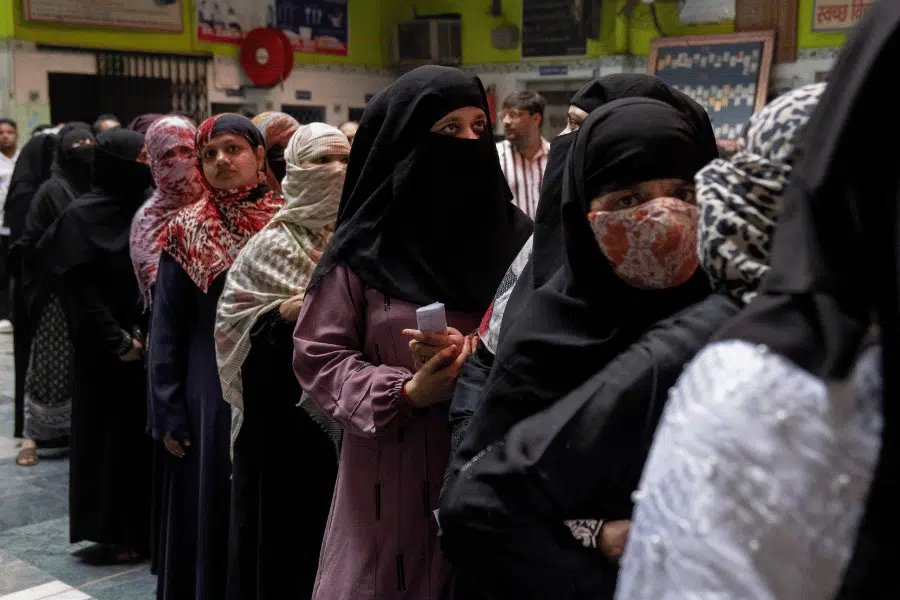
    Sidra Khan is a young Muslim woman in India who aspires to be a lawyer. Since early childhood, she has valued and respected Islam, the religion she was born into. But her headscarf now meets eagle eyes when she travels on public transport or tries to make a point during college lectures. 

    She feels that anti-Muslim rhetoric in India is causing her peers to judge her on the basis of religion and not merit. This, many Muslim students like Khan feel, is a casualty of having the government of Prime Minister Narendra Modi rule India.

    Over the last decade, the government of this secular country long considered the world’s largest democracy has introduced religious-based laws and politicians have incited anger and hatred against those who aren’t Hindu through rhetoric in speeches and AI campaigns. In northeast India’s Assam state, Wajid Alam, a college history student, watched a new election video from the ruling Bharatiya Janata Party with unease.

    An AI generated video shared by BJP’s official social media handles suggested that if the BJP loses power, Assam would be overrun by Muslims. It used AI-generated imagery to depict Muslims in hijabs and skull caps allegedly taking over airports, stadiums, tea gardens and other public spaces.

    It concluded with a message claiming Muslims could grow to 90% of Assam’s population, provoking other religious groups to choose the BJP to get rid of Muslims.

    The politics of religion

    For Alam and millions of Muslims in Assam, the video felt like an attack. And it is not the first time the BJP has been accused of demonizing religious minorities. Under Prime Minister Narendra Modi, India — a country founded on principles of secularism and religious freedom — has seen growing hostility toward Muslims and Christians.

    Some 200 million people in India practice the Muslim faith, making it the world’s third largest population of Muslims.

    Modi became India’s 14th prime minister in May 2014. Not long after, reports of attacks on religious minorities began to climb. In June 2014, Mohsin Shaikh, a young Muslim IT worker in Pune, was beaten to death by Hindu extremists — the first of several lynchings that followed. 

    A year later, in 2015, a Hindu mob in Dadri, Uttar Pradesh, killed Mohammad Akhlaq on suspicion of eating beef — considered a serious offense in the Hindu religion. That made global headlines and signalled the rise of cow-protection vigilantism. 

    By 2016–17, assaults on Muslims accused of trading or transporting cattle spread across northern India, with cases like the lynching of dairy farmer Pehlu Khan in Rajasthan. Christians, too, came under pressure during this period: nationalist groups staged forced reconversion campaigns, disrupted prayer meetings, vandalized churches and invoked new anti-conversion laws to arrest pastors and worshippers.

    Muslims under Modi’s rule

    Together, these incidents marked the early years of the Modi era as a turning point, when both Muslims and Christians began to face growing hostility in daily life.

    At the same time, hostile rhetoric against minorities became increasingly common in election campaigns. BJP leaders and affiliated Hindu nationalist groups framed Muslims as “outsiders” or “invaders,” with speeches warning of demographic “takeovers” or linking entire communities to terrorism and cow slaughter.

    Christians were accused of running covert “conversion factories,” with pastors painted as threats to India’s cultural identity. These narratives — echoed at rallies, on television debates and, more recently, through AI-generated propaganda — blurred the line between campaign messaging and hate speech. For many analysts, this marked a shift: politics was no longer just influenced by religion, but actively weaponizing it to polarize voters.

    These speeches were not isolated slips but part of a larger pattern. Muslims were painted as “infiltrators,” “termites” or participants in a supposed “love jihad” plot to convert Hindu women, while Christians were accused of running “conversion factories” and threatening India’s culture.

    Senior BJP figures, including party president Amit Shah and Uttar Pradesh Chief Minister Yogi Adityanath, used such language at rallies to mobilize support. Over time, this messaging blurred into mainstream political discourse, normalizing suspicion and hostility toward entire communities.

    Political divisions

    India’s experience is part of a wider global pattern. Around the world, political movements are blending nationalism and religion to define who “belongs.” A recent Pew Research Center study found that while the United States ranks lower than many countries on overall religious nationalism, it stands out among wealthy democracies for how many adults say the Bible should influence national laws or that being Christian is essential to being truly American.

    In the United States, debates over Christian nationalism have become a powerful current within the Republican Party and Donald Trump’s political rhetoric.

    Trump and allied evangelical leaders increasingly frame America as a “Christian nation,” a message that blurs the line between faith and state power. Commentators warn that this effort to link patriotism with religion mirrors broader global trends — from India to Israel to Turkey — where religious identity is being harnessed for political gain.

    Both the U.S. and Indian constitutions enshrine secularism, which is the idea that the state would keep equal distance from all religions. In India’s case, that principle mattered in a country where Hindus form the majority but millions of Muslims, Christians, Sikhs and Buddhists also call the nation home. 

    A history of strife

    Even before Modi, religion and politics were sometimes entwined: the Congress Party drew on Hindu symbolism, the 1984 anti-Sikh riots scarred the country and the destruction of the Babri mosque in 1992 shook faith in secularism. Still, the political consensus was that India was not to be defined by one faith.

    “But a lot has changed under Modi and the BJP,” said Sneha Lal, a Hindu student studying to become a primary school teacher. “We did not grow up in this India.”

    Lal is bothered by some of the BJP’s tactics that have promoted anti-conversion laws in several states, laws often used against Christians and Muslims accused of proselytizing. 

    In 2019, the Citizenship Amendment Act introduced fast-track citizenship for non-Muslim refugees, a move widely criticized as discriminatory toward Muslims. That same year, Delhi revoked the autonomy of Jammu and Kashmir, India’s only Muslim-majority state. Alongside these legal changes, election campaigns have increasingly featured polarizing rhetoric, and propaganda — including AI-generated videos — has circulated warning of demographic “takeovers.” 

    Critics say these policies and messages together mark a break from India’s founding secular vision, pushing the country toward a Hindu-first identity.

    Can there be a unified national identity?

    Seema Chishti, a senior journalist who has witnessed India’s journey from secular to right-wing, said that mixing religion with politics and diluting India’s unified national identity across religious and ethnic groups is a stated core principle of the ruling party, based on its militant roots. 

    “The Indian Constitution recognises no barriers to being Indian, i.e. nationality is not contingent on faith, caste, region, creed, gender or political views,” Chishti said. “BJP has loudly proclaimed ‘Hindu-India’ and instilled ‘Hindu’ nationalism in politics, education, the armed forces and every other facet of Indian life.”

    An example of Modi’s attempt to link Indian-ness with Hinduism is the Citizenship Amendment Act of 2019 which fast-tracks Indian citizenship for non-Muslims from three neighbours: Pakistan, Bangladesh and Afghanistan. “This action echoes ideas of India being a Hindu homeland,” Chishti said.

    On 15 August 2025, on India’s 79th Independence Day, Modi addressed crowds gathered at Delhi’s historical Red Fort, as he did the last 11 years that he has been in power. 

    On a day which commemorates India’s long struggle for self-rule that culminated in self-governance and independence from the British empire, Modi referred to the right-wing paramilitary organization Rashtriya Swayamsevak Sangh or RSS as a philanthropic organization. RSS has espoused an India for Hindus only. 

    Intolerance and violence

    All this has had tragic consequences. On 25 September, a seven-year-old Muslim boy was abducted from his neighborhood and brutally murdered in northern India’s Azamgarh. 

    But religious hate crimes haven’t only targeted Muslims. On 11 June, a mob allegedly linked to Hindu extremist groups attacked guests at a Christian wedding and set fire to a utility vehicle. And on 25 July, two Catholic nuns were arrested in central India’s Chhattisgarh state following a complaint by a member of an extremist Hindu group.

    India’s United Christian Forum reported that in 2024, Christians across the country witnessed 834 such incidents, up 100 incidents from 734 in 2023 — that comes out to more than two Christians being targeted every day in India simply for practising their faith. 

    These incidents of attacks and even public hate speeches against Christians are not limited to vandalism, they extend to physical assaults, disruption of prayer gatherings, financial boycotts and even motivated arrests. 

    This anti-Christian sentiment has been fanned by Hindu extremist groups in the country, which are indirectly and sometimes directly backed by the ruling BJP and other Hindu nationalist groups. These groups are increasingly using anti-conversion laws created in the Modi era to harass Christians. 

    Christians in India

    Arun Pannalal, president of the Chhattisgarh Christian Forum, said that two things are happening: Lawlessness of mobs who target Christians is ignored by police, while Christians often find themselves subject to seemingly random arrests. 

    “On random calls by Bajrang Dal goons the Police arrested the nuns, without evidence of anything,” Pannalal said. “But when the nuns wanted to complain against the goons, it was not lodged.

    Chishti said that more than politicising religion, by inserting religion into politics, the BJP is trying to portray itself as the only ‘Hindu’ party and the others consequently as not. She maintains that the BJP has fought elections on issues that polarise Indians, divide them and not on its performance or electoral record. Its electoral dominance has also meant that other parties in the fray, the opposition too find themselves playing on the BJP’s turf. 

    “The BJP has done its best to make the political discourse about faith, symbols of religion — Hindu and Muslim — and portraying themselves as saviours of the Hindu faith and righting so-called historical wrongs,” Chishti said.

    As a result, the media focuses on the religious conflicts, instead of other pressing issues, such as the economic well-being of people, the public health or education systems, joblessness and inflation, Chishti said.

    As India heads toward future elections, the blending of religion and politics raises questions not just for its own democracy but for others around the world. For young people in India, the stakes are immediate: whether their country remains true to its founding promise of secularism and equal rights.

    But for readers everywhere, India’s story is part of a larger global trend from the United States to Turkey to Israel, where religion and nationalism intertwine to shape politics. Understanding how these forces play out in the world’s largest democracy can help us make sense of how faith and power continue to influence politics across the globe.

    India’s struggle shows that when religion becomes a political weapon, democracy itself can become the battleground.


    Questions to consider:

    1. How is freedom of religion protected in India?

    2. In what ways are Muslims being treated differently by the Modi administration?

    3. In what ways to you feel comfortable or uncomfortable in your community expressing your faith?


    Source link

  • What research says about Mamdani and Cuomo’s education proposals

    What research says about Mamdani and Cuomo’s education proposals

    by Jill Barshay, The Hechinger Report
    November 3, 2025

    New York City, where I live, will elect a new mayor Tuesday, Nov. 4. The two front runners — state lawmaker Zohran Mamdani, the Democratic nominee, and former Gov. Andrew Cuomo, running as an independent — have largely ignored the city’s biggest single budget item: education. 

    One exception has been gifted education, which has generated a sharp debate between the two candidates. The controversy is over a tiny fraction of the student population. Only 18,000 students are in the city’s gifted and talented program out of more than 900,000 public school students. (Another 20,000 students attend the city’s elite exam-entrance high schools.) 

    But New Yorkers are understandably passionate about getting their kids into these “gated” classrooms, which have some of the best teachers in the city. Meanwhile, the racial composition of these separate (some say segregated) classes — disproportionately white and Asian — is shameful. Even many advocates of gifted education recognize that reform is needed. 

    Related: Our free weekly newsletter alerts you to what research says about schools and classrooms.

    Mamdani wants to end gifted programs for kindergarteners and wait until third grade to identify advanced students. Cuomo wants to expand gifted education and open up more seats for more children. 

    The primary justification for gifted programs is that some children learn so quickly that they need separate classrooms to progress at an accelerated pace. 

    But studies have found that students in gifted classrooms are not learning faster than their general education peers. And analyses of curricula show that many gifted classes don’t actually teach more advanced material; they simply group mostly white and Asian students together without raising academic rigor.

    In my reporting, I have found that researchers question whether we can accurately spot giftedness in 4- or 5-year-olds. My colleague Sarah Carr recently wrote about the many methods that have been used to try to identify young children with high potential, and how the science underpinning them is shaky. In addition, true giftedness is often domain-specific — a child might be advanced in math but not in reading, or vice versa — yet New York City’s system labels or excludes children globally rather than by subject. 

    Because of New York City’s size — it’s the nation’s largest public school system, even larger than 30 states — what happens here matters.

    Policy implications

    • Delaying identification until later grades, when cognitive profiles are clearer, could improve accuracy in picking students. 
    • Reforming the curriculum to make sure that gifted classes are truly advanced would make it easier to justify having them. 
    • Educators could consider ways for children to accelerate in a single subject — perhaps by moving up a grade in math or English classes. 
    • How to desegregate these classrooms, and make their racial/ethnic composition less lopsided, remains elusive.

    I’ve covered these questions before. Read my columns on gifted education:

    Size isn’t everything

    Another important issue in this election is class size. Under a 2022 state law, New York City must reduce class sizes to no more than 20 students in grades K-3 by 2028. (The cap will be 23 students per class in grades 4-8 and 25 students per class in high school.) To meet that mandate, the city will need to hire an estimated 18,000 new teachers.

    During the campaign, Mamdani said he would subsidize teacher training, offering tuition aid in exchange for a three-year commitment to teach in the city’s public schools. The idea isn’t unreasonable, but it’s modest — only $12 million a year, expected to produce about 1,000 additional teachers annually. That’s a small fraction of what’s needed.

    The bigger problem may be the law itself: Schools lack both physical space and enough qualified teachers. What parents want — small classes led by excellent, experienced educators — isn’t something the city can scale quickly. Hiring thousands of novices may not improve learning much, and will make the job of school principal, who must make all these hires, even harder.

    For more on the research behind class-size reductions, see my earlier columns:

    Contact staff writer Jill Barshay at 212-678-3595, jillbarshay.35 on Signal, or [email protected].

    This story about education issues in the New York City mayoral election was produced by The Hechinger Report, a nonprofit, independent news organization focused on inequality and innovation in education. Sign up for Proof Points and other Hechinger newsletters.

    This <a target=”_blank” href=”https://hechingerreport.org/proof-points-nyc-mayor-election-education/”>article</a> first appeared on <a target=”_blank” href=”https://hechingerreport.org”>The Hechinger Report</a> and is republished here under a <a target=”_blank” href=”https://creativecommons.org/licenses/by-nc-nd/4.0/”>Creative Commons Attribution-NonCommercial-NoDerivatives 4.0 International License</a>.<img src=”https://i0.wp.com/hechingerreport.org/wp-content/uploads/2018/06/cropped-favicon.jpg?fit=150%2C150&amp;ssl=1″ style=”width:1em;height:1em;margin-left:10px;”>

    <img id=”republication-tracker-tool-source” src=”https://hechingerreport.org/?republication-pixel=true&post=113202&amp;ga4=G-03KPHXDF3H” style=”width:1px;height:1px;”><script> PARSELY = { autotrack: false, onload: function() { PARSELY.beacon.trackPageView({ url: “https://hechingerreport.org/proof-points-nyc-mayor-election-education/”, urlref: window.location.href }); } } </script> <script id=”parsely-cfg” src=”//cdn.parsely.com/keys/hechingerreport.org/p.js”></script>

    Source link

  • How to stop sounding like every other university

    How to stop sounding like every other university

    Today’s students quickly spot generic, rinse-and-repeat marketing from a university. Cut through the sameness slop and create a positioning strategy that actually connects.

    Higher education is at a crossroads. Enrollment is declining. Public perception is shrinking. And nearly every institution is saying the same thing: excellence, innovation, community.

    Meanwhile, students and families are asking tough questions about the real-world value of a degree. In this new reality, universities can no longer rely on tradition or reputation alone. To thrive, they need clarity and courage. And they need a positioning strategy that captures who they are—and why that matters.

    A strong positioning strategy doesn’t just shape marketing. It shapes culture, recruitment, retention, and reputation. It helps universities tell a truer story about themselves—and connect that story to the students, faculty, and partners who will carry it forward.

    Here are the six elements every successful university positioning strategy must include.

    1. Target your audiences carefully.

    A strong positioning strategy starts with targeting specific student subsets.

    Are you recruiting first-generation students or career changers? Honors scholars or working professionals? Local residents or international learners? Understanding who you’re trying to reach—and what drives their decisions—anchors every other element of your strategy.

    And don’t forget the people behind the scenes: faculty, staff, and donors. The best universities understand that attracting the right people internally is just as important as recruiting students externally.

    2. Focus the Geography of Your Recruitment

    Where will you focus your recruitment efforts? Know where your target audiences are —geographically and digitally —so you can reach them. Which regions, cities, or even online communities align best with your programs and brand?

    Now is the time to revisit your recruiting map. Shifts in demographics and enrollment trends mean yesterday’s strongholds may not be tomorrow’s growth markets.

    3. Build on Academic Strengths

    What academic programs will attract your target audiences? Identify your institution’s strengths and areas of expertise. The programs you offer need to align with your audience’s needs.

    Whether it’s a renowned nursing program, an emerging data science initiative, or a distinctive liberal arts approach, clarity here will shape everything else—your messaging, recruitment, and even partnerships.

    Then, make your offerings accessible through the pathways your target audiences need—undergraduate, graduate, online, hybrid, or evening programs. It is likely that students need different pathways, so be flexible here.

    4. Price with Intention

    Your pricing strategy should reflect your positioning. Are your audiences looking for value, accessibility, or prestige? There’s no one right answer, but there is a wrong one: misalignment.

    Align your tuition, scholarships, and financial aid strategy with your audiences and geography. A well-designed tuition calculator that delivers real-time estimates can make the difference between interest and enrollment.

    5. Prioritize Student Support

    Recruitment may fill your seats, but support keeps them filled.

    Universities that build cultures of belonging—through mentoring, mental health support, financial assistance, and strong academic advising—don’t just retain students. They create lifelong advocates.

    Is your first-year experience intentionally designed for retention? Do you proactively re-engage at-risk students? Do your clubs and organizations reflect the diversity of your student body? These increase the likelihood of success at your university.

    6. Create an Experience That Feels Alive

    Students don’t just want a degree—they want a life during those years.

    We hear it time and again: what ultimately draws students in is a sense of belonging, fun, and possibility. Your positioning should capture the energy of your campus and the spirit of your city.

    Show it. Don’t just say it. Make it clear that students like the ones you are targeting are having a great college experience.

    That emotional pull is often the difference between “accepted” and “enrolled.”

    Integration is the Secret to Success

    Each of these elements—audience, geography, programs, cost, support, and experience—needs to work together. Every decision in one area affects the other. When they are unaligned, your messaging will suffer.

    When your strategy is integrated and authentic, your university doesn’t just stand out. It stands for something.

    From Survival to Significance

    In a marketplace crowded with sameness, differentiation is the ultimate advantage.

    A powerful university positioning strategy gives you more than just messaging—it gives you momentum. It helps you attract the right students, engage the right partners, and chart a sustainable path forward.

    The question isn’t whether your university needs a positioning strategy. The question is: how bold are you willing to be?

    Source link

  • ‘End of an era’: Experts warn research executive order could stifle scientific innovation

    ‘End of an era’: Experts warn research executive order could stifle scientific innovation

    An executive order that gives political appointees new oversight for the types of federal grants that are approved could undercut the foundation of scientific research in the U.S., research and higher education experts say. 

    President Donald Trump’s order, signed Aug. 7, directs political appointees at federal agencies to review grant awards to ensure they align with the administration’s “priorities and the national interest.

    These appointees are to avoid giving funding to several types of projects, including those that recognize sex beyond a male-female binary or initiatives that promote “anti-American values,” though the order doesn’t define what those values are.   

    The order effectively codifies the Trump administration’s moves to deny or suddenly terminate research grants that aren’t in line with its priorities, such as projects related to climate change, mRNA research, and diversity, equity and inclusion.

    The executive order’s mandates mark a big departure from norms before the second Trump administration. Previously, career experts provided oversight rather than political appointees and peer review was the core way to evaluate projects.

    Not surprisingly, the move has brought backlash from some quarters.

    The executive order runs counter to the core principle of funding projects based on scientific merit — an idea that has driven science policy in the U.S. since World War II, said Toby Smith, senior vice president for government relations and public policy at the Association of American Universities. 

    “It gives the authority to do what has been happening, which is to overrule peer-review through changes and political priorities,” said Smith. “This is really circumventing peer review in a way that’s not going to advance U.S. science and not be healthy for our country.”

    That could stifle scientific innovation. Trump’s order could prompt scientists to discard their research ideas, not enter the scientific research field or go to another country to complete their work, research experts say. 

    Ultimately, these policies could cause the U.S. to fall from being one of the top countries for scientific research to one near the bottom, said Michael Lubell, a physics professor at the City College of New York.

    “This is the end of an era,” said Lubell. “Even if things settle out, the damage has already been done.”

    A new approach to research oversight

    Under the order, senior political appointees or their designees will review new federal awards as well as ongoingl grants and terminate those that don’t align with the administration’s priorities.

    This policy is a far cry from the research and development strategy developed by Franklin D. Roosevelt’s administration at the end of World War II. Vannevar Bush, who headed the U.S. Office of Scientific Research and Development at the time, decided the U.S. needed a robust national program to fund research that would leave scientists to do their work free from political pressure. 

    Bush’s strategy involved some government oversight over research projects, but it tended to defer to the science community to decide which projects were most promising, Lubell said. 

    “That kind of approach has worked extremely well,” said Lubell. “We have had strong economic growth. We’re the No. 1 military in the world, our work in the scientific field, whether it’s medicine, or IT — we’re right at the forefront.”

    But Trump administration officials, through executive orders and in public hearings, have dismissed some federal research as misleading or unreliable — and portrayed the American scientific enterprise as one in crisis. 

    The Aug. 7 order cited a 2024 report from the U.S. Senate Commerce, Science, and Transportation Committee, led by its then-ranking member and current chairman, Sen. Ted Cruz, R-Texas, that alleged more than a quarter of National Science Foundation spending supported DEI and other “left-wing ideological crusades.” House Democrats, in a report released in April, characterized Cruz’s report as “a sloppy mess” that used flawed methodology and “McCarthyistic tactics.”

    Source link

  • A Tumultuous Tenure Leading the Nation’s Diversity Officers

    A Tumultuous Tenure Leading the Nation’s Diversity Officers

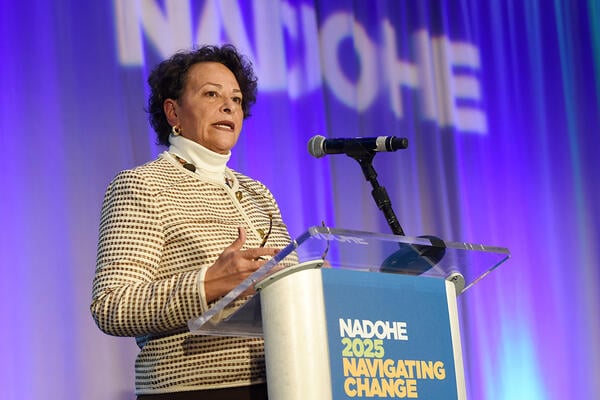
    Paulette Granberry Russell is stepping down as president of the National Association of Diversity Officers in Higher Education after a dramatic and unpredictable five years at the helm.

    She represented campus diversity professionals amid the national racial reckoning that accompanied the Black Lives Matter movement, and then through the dizzying years that followed as anti-DEI laws swept the country. She also spent 22 years as a diversity professional at Michigan State University.

    Granberry Russell told Inside Higher Ed she never planned to stay at NADOHE longer than five years, so she’s ready to move on and facilitate a “smooth transition and handoff.”

    But what a tenure it’s been.

    She spoke with Inside Higher Ed about how she navigated the headwinds facing diversity professionals and the future of diversity, equity and inclusion work on campuses. The conversation has been edited for length and clarity.

    Q: Over the course of your term, from 2020 to 2025, the landscape for diversity professionals in higher education radically shifted. What has it been like for you to represent DEI professionals then and now?

    A: When I came into the role, my goals were to do a few things, which, not only were intended to build on our past successes, but also [to] develop new initiatives that would enhance a few areas, [including] increasing our membership but also providing our support for them. It included, for example, enhancing our industry influence but also sustainability of the organization.

    I came into the role in March of 2020, and what happened in March of 2020? The pandemic, which altered much of what was going on in higher education and how we were doing our work, whether that was remotely, but also with threats in terms of both student experiences but also student support. And then in May of 2020, the murder of George Floyd, and all of the ways in which our institutions were reacting and responding and certain commitments were made to enhance antiracism efforts on our campuses.

    When I think about my first few months, it was something very different than what I anticipated. And I’m certain that’s true for higher education as well. I lived in this state of shifting priorities, having to think about ways to best support members who were having to adjust to significant shifts on their campuses. We were also dealing with significant challenges around freedom of speech and disruption on our campuses prior to these more recent experiences.

    And the politics are very different. When you shift from an environment of enhanced commitment built on an understanding that our campuses had to deal with issues around race and expanding opportunities more broadly across identity to now pushback—it was causing quite a shift in equilibrium. And that’s true for our members as well as the organization. And because of the evolution of diversity, equity and inclusion in higher education historically, as painful as a lot of this was, I believe we were better prepared than we understood ourselves to be.

    Q: You touched on how you started at NADOHE in this moment in 2020, when campuses made commitments and investments in thinking about race and racial inequities, and now campuses are rolling back so much of those efforts in response to anti-DEI legislation. How did these policy shifts change NADOHE’s work and change your work as its leader? How did you have to pivot?

    A: Our successes, I think, resulted in some of the pushback. The pushback was evolving. Expanding on opportunities [created by diversity initiatives] beyond race, so that people understood that diversity was more inclusive than they initially understood it to be—we did not do as good a job as we could have and should have.

    But [we] are beginning to do [it] now, in broadening people’s understanding that diversity is and should be interpreted very broadly. I think that the narrative was hijacked, meaning it was easy to unfortunately define diversity narrowly on the basis of race, gender and sexuality. And others used that narrative to create fear and apprehension that somehow others were being advantaged, versus understanding that we all have benefited from the ways in which we were adjusting our efforts on campus to broaden access, to broaden opportunities, to increase equitable outcomes, understanding that [it’s] not one-size-fits-all, and we had to tailor and adjust our efforts to accommodate the broad range of interests and identities that presented on our campuses and have always presented on our campuses. What we failed to do well was messaging both the communities impacted by our work and the work that was being done to expand opportunities as well.

    Q: How did the backlash shift your priorities, if at all?

    A: When we think about the early challenges, some [opponents] would point to critical race theory. I don’t know that they necessarily understood it very well, and [they] were having a difficult time messaging it. But it was easier to talk about diversity, because for many people, that conjures up issues around race, it harkens back to earlier views of affirmative action and I think it became an easier message to divide higher ed both internally as well as externally.

    It was important for NADOHE to emphasize—whether it was around academic freedom, First Amendment rights and freedom of speech and freedom of expression—that diversity, equity and inclusion are embedded in those. Freedom of expression cannot be sanitized. Our research, for example, or our curriculum is going to touch on issues that may impact communities broadly—and diverse, marginalized, underserved communities. And the work that we do in higher education as diversity leaders requires evidence-based research that informs our work. In the absence of that, you’re guessing at strategies and interventions that will support all students.

    This work is not going to go away. We’re not going to go back to a time when opportunities were constrained, when fairness did not extend to certain communities. That’s unacceptable.”

    —Paulette Granberry Russell

    And so, I don’t know that it was as much a shift in our priorities as much as it was helping higher ed internally, as well as audiences outside of higher ed, to understand that access and opportunity are not limited to any one demographic or a few demographics. If there was a shift in priorities, it was hopefully helping broader audiences understand that there’s nothing to fear, especially in the ways that diversity, equity, inclusion was being demonized. This work is not intended to grant preferential treatment to some and deny others opportunities.

    Q: So, you found yourself having to do a lot of explaining about what’s actually meant when people say “DEI” in a higher ed context.

    A: That’s right. And it’s also saying to folks, don’t use the acronym. Because the acronym, unfortunately, supported a very narrow way of defining efforts.

    Diversity is not defined narrowly. Equity is intended to reduce barriers that may result in differential impact, and those differential impacts are not limited to any one category. Inclusion doesn’t happen just naturally. We know individuals feeling included allows them to be themselves but also allows them to be more successful. If I don’t feel like I belong, what do I do? I tend to retreat, or I don’t access the resources that are there, resources that may benefit me, resources that are accessible to all, with an understanding that, again, we’re not monolithic. It is helping people differently understand, and hopefully better understand, that there are no threats here. Diversity on our campuses is a reality, period. And it’s not going to change, certainly not as long as organizations like NADOHE are here to defend access and opportunities.

    Changes in nomenclature happen. How we define our work, how we label our work, how we tag our work has always changed. If we think historically, going back 20, 30 years, we talked about affirmative action. We talked about multiculturalism. We talked about diversity. We talked about equal opportunity. We talk about fairness. We talk about equity. We talk about belonging. We talk about inclusion. Terminology evolves over time, given how the work itself evolves.

    Q: As campuses close centers associated with DEI and get rid of diversity roles, what do you see as the next phase of the work? How do campus diversity professionals move forward from here? And what does the DEI movement look like now and into the future?

    A: At least for this moment in time, we need to more closely scrutinize the systems that have been designed that have resulted in barriers to success. And how do we redesign, or how do we begin to design systems that differently support our campuses?

    There’s no single office or individual that can do this work alone. Certainly, in my own career at an institution that was a large public land-grant with over 40,000 students at that time and 14,000 faculty and staff, there was no way that a person with two staff was going to be able to dramatically impact change. [Change comes from] working with others and understanding that it’s going to take what I would call a whole institution approach, which means that our leadership, our policies, budget, people, culture have to be aligned. That also means that we have to take a look at the policies, practices, procedures that we have in place that may be having differential impacts, and how do we make adjustments in those? Not to grant preferential treatment, not to discriminate, but to say, can we design systems that work better?

    We’re talking about a systems approach for structural change. When I say a systems approach, this is going to be far more extensive than I think many of us are prepared to do, but I think that it’s the future. [In the past], unfortunately, we didn’t [always] look at connections between the needs of our students, the capacity of faculty to meet those needs, the capacity of staff to meet those needs and connecting our students to potential employers. Things were very siloed. Things are still very siloed. We have to think about the life cycle of a student. And we do that, but it’s not that we are always very deliberate in how we do it.

    When I grew up as a child, the expectation was that I would go to college, but my family by all definitions was very low income. [When] I got to my undergraduate experience, there were no tools in the way that there are now. There were no interventions. There were no programs that I could access that connected me to all of the resources that would allow me to be successful. I was a low-income Black female who arrived on a campus with no prior experience, not knowing how to navigate the space, not knowing where the resources were, not knowing how to fund my education. I was a person with a dream and a family that really wanted me to be successful, but they didn’t have the tools to provide that. It’s a very different world we live in today.

    [The goal is] helping that student understand where the resources are, and then helping faculty understand the differences of those students that come into your classroom, ways that you as faculty can support them, connecting those faculty with the advisory services that those students might need. We have to design [systems] in ways that reduce barriers, that acknowledge the differences that exist and with the goal of those individuals being successful [and] reducing the barriers for faculty to be successful.

    Q: After leaving NADOHE, what’s next for you?

    A: My entire trajectory, my entire life, I have always been this person who believed in fairness. I always believed in opportunities. I’m always that person who fought for not only myself, but for others to be treated fairly, because I grew up in a family where my history included ancestors who were formerly enslaved.

    At 16 years old, I decided I wanted to increase participation in voting. In 12th grade, I remember I had a speech class, and I was that person giving speeches on the slaughtering of baby seals. I was the person who was giving speeches on sexuality and treating people differently based on how they identified. I was that person who gave speeches on the Black Power movement, civil rights, Martin Luther King. And as I reflect now, as I transition, I’m not going to be any different than what I have always been. I will find new ways to [apply] my experiences and my advocacy. Because I have no choice. I realized that about myself.

    My time with NADOHE has been to build on the successes of my predecessors. I believe that I have done that. I achieved the goals that I set out to achieve, both for myself and for the organization, whether that is increasing our membership, our influence within higher ed [and] beyond higher ed. We’ve done that.

    This work is not going to go away. We’re not going to go back to a time when opportunities were constrained, when fairness did not extend to certain communities. We’re not going back to a time when discrimination on the basis of identity was lawful, certainly in the context of race, gender, sexuality, sexual orientation. That’s unacceptable. We’re not going back.

    My next move is, I’m going to breathe. I’m going to take a little bit of time for myself. But I know I will always find my way back to what I have always been committed to, that I want people to be treated fairly. I want people to have opportunities.

    Q: Whoever takes over your position is going to face significant headwinds. What would be your advice to them?

    A: Bring your passion. Bring your commitment. Coming into this role, it’s going to be exhausting, but you have to decide that there’s no other way forward. Too many lives depend on it. This country, our democracy, depends on it.

    Source link

  • Minor in Holistic Wellness Advances Student Career Wellness

    Minor in Holistic Wellness Advances Student Career Wellness

    Most, if not all, colleges and universities provide mental health support and wellness resources to encourage resiliency and thriving among students, who report high rates of mental health concerns.

    At Rutgers University at New Brunswick, staff are taking health education one step further, offering a new minor in holistic wellness to support students’ personal well-being as well as to provide practical skills so they can share well-being principles in their workplaces.

    The minor, developed by ScarletWell, the university’s well-being division, is open to any student on campus. It is designed to empower a new generation of workers who demonstrate wellness in all dimensions of their lives.

    What’s the need: One of the key features of the holistic wellness minor is that it expands education beyond personal well-being into teaching and creating a culture of wellness, said ScarletWell director Peggy Swarbrick. Included in the learning outcomes are an understanding of policies that foster wellness, wellness communication and program development.

    “These skills will make Rutgers students more attractive for jobs, regardless of their career or discipline of focus, because they will be able to work with leadership to improve sense of community and belonging and overall health of the workforce,” ScarletWell leaders wrote in the minor proposal to administrators.

    Burnout is a frequent concern among American workers and can be a threat to both student and worker retention. One survey published earlier this year found that 66 percent of American employees say they’re experiencing some sort of burnout; young adults (ages 18 to 24) were even more likely to say they’re burned out (81 percent).

    Providing wellness education is one way to support student success and give workers the tools they need to be impactful in their roles, Swarbrick noted.

    In addition, wellness as an industry has grown, meaning more sectors—including schools and police departments—are looking to hire individuals with a focus on organizational wellness, said chief wellness officer Josh Langberg. More employers are also seeking individuals with a background in wellness.

    Data from the U.S. Bureau of Labor Statistics shows wellness-focused jobs are expected to grow at a faster pace over the next decade than the current 5 percent average for all workers.

    What’s involved: Any student in any major at Rutgers’s New Brunswick campus can enroll in the 18-credit minor. Students complete three core courses that provide a foundational understanding of well-being as well as a range of skills and strategies courses, which focus on practical applications of wellness, including exercise, journaling or other self-regulation methods.

    ScarletWell staff helped develop the program, but the minor is housed in the school of environmental and biological sciences. Students complete courses from a variety of disciplines including the arts, nutrition, sociology and horticulture.

    This is the first academic program at Rutgers to have “wellness” in the title. It’s distinct from the offerings of other institutions in the state because of its holistic focus, Langberg noted.

    What’s next: The minor was approved in spring 2025 and soft launched this fall with the course Wellness Learning Community, which enrolled a range of students across disciplines at Rutgers. The course teaches students the eight dimensions of wellness—physical, social, intellectual, spiritual, emotional, financial, environmental and occupational wellness—developed by Swarbrick, as well as how to reflect on their own definitions of wellness and how to apply what they’ve learned to their future occupations.

    Students were also introduced to various resources on campus including Harvest, an on-campus dining option that focuses on sustainability, economic responsibility and reducing food waste.

    Initial feedback from students indicated they valued the course content and wished they had taken it sooner in their academic careers, said Amy Spagnolo, senior program coordinator of ScarletWell. Students also said they appreciated being in classes outside of their disciplines with peers from other majors across campus.

    Swarbrick hopes to enroll between 40 and 60 students in the minor. So far, the program has grown through word of mouth.

    In addition to the minor, students and staff can engage in digital badging to be credentialed as a Wellness Champion or peer support leader. Since the program launched last year, 60 staff and faculty have participated in the peer-support program.

    Do you have a wellness intervention that might help others promote student success? Tell us about it.

    Source link