Author: admin

  • Collective Punishment, Early Decision Edition (opinion)

    Collective Punishment, Early Decision Edition (opinion)

    Tulane University’s admissions office has banned students from four high schools from applying to Tulane through early decision this fall, according to reporting from The New York Times. Though three of the schools have not been publicly identified, the one-year ban (or “suspension”) for Colorado Academy comes after a student from that school backed out of the early-decision agreement they signed when they applied to Tulane last year.

    For those who aren’t card-carrying college admission geeks like I am, early decision is an application option and enrollment management strategy in which students apply earlier and promise to enroll if admitted, in exchange for receiving an earlier decision offer. The binding nature of early decision means that a student can apply to only one college through early decision.

    In most cases students applying through early decision are asked, along with a parent and their school counselor, to sign an early-decision agreement attesting to their understanding of the commitment to enroll if admitted. Early decision is in no way legally binding, but colleges take the early-decision commitment seriously and are appalled and disgusted when students back out of the commitment. The one agreed-upon reason for backing out of an early-decision commitment is when an institution can’t meet a student’s financial need (as determined by the college’s financial aid formula, not what a family thinks it can pay).

    I have had admission deans tell me that they would hold it against a school whose students did not follow through on the early-decision commitment, but Tulane is the first college I’ve seen publicly penalize schools. The Tulane ban raises some interesting and thorny ethical questions.

    The most obvious is whether it is permissible to punish students in the Class of 2026 for offenses committed by students in the Class of 2025. Retribution may be fashionable these days, but punishing the innocent because you have no way to punish the guilty is not retribution, just wrong.

    But that may be just me. The National Association for College Admission Counseling has an “Ethical Dilemmas in College Admission” page on its website that includes a hypothetical case study in which a student wants to back out of an early-decision commitment. Among the suggested advice for counselors is to caution the student and parents that withdrawing could have negative consequences for future applicants from the school. Even if that might be the case, that’s terrible advice from NACAC, making it seem like colleges punishing future applicants is acceptable and normal.

    At least Tulane is being transparent with its early-decision ban for the schools. As bad as that is, there is a scenario that would be worse, if Tulane ostensibly welcomed early-decision applications from the four schools when it had no intention of admitting any of them.

    The Times article didn’t provide any details about the circumstances leading up to the ban for the four schools, but Tulane’s position seems to be, as the Times paraphrased it, that the schools “failed to uphold the expectations of the early decision agreement.” Let’s examine that claim a little more closely.

    What is a school’s responsibility in advising students wanting to apply early decision? As a counselor, I always advised students and parents that it was a binding commitment, not to be taken lightly. I don’t remember any of my students backing out of an early-decision commitment, but on several occasions I had students who told me on Friday they planned to apply early decision to one college and then a different college on Monday. My response was that they were not ready to apply early decision at all if their thinking was that fluid.

    It’s hard for me to imagine how the schools would have failed in their responsibilities. The counselor part of the early-decision agreement states, “I have advised the student to abide by the early decision commitment outlined above.” As long as they have done that, are they responsible for policing the student’s actions? The school could withhold sending transcripts to other colleges, but in today’s litigious environment, it could face legal action from parents for doing so. I have learned that parents who are lawyers are especially skeptical of the early-decision commitment. If the student wanted to renege on early decision, I would require the student to inform the college. An applicant owes the college that courtesy. Beyond that, schools can’t be expected to enforce early decision.

    There are several other issues that deserve scrutiny. One is Tulane’s claim in a statement to the Times that “A last-minute withdrawal without explanation unfairly impacts other applicants who may have missed opportunities due to the limited number of early-decision offers a university can make.” Excuse me, my BS detector is going off. Tulane has no restriction that I am aware of in the number of students it can admit through early decision, as suggested by the fact that, in recent years, it’s admitted more than 60 percent of its freshman class using early decision, and it has other opportunities to make up for any loss through early decision 2, early action and regular decision.

    There is also an interesting philosophical question about the nature of the early-decision binding commitment. At what point does the binding commitment kick in? Or, more to the point, when does Tulane believe that the commitment is binding?

    The common understanding across the world of college admission is that students take on the binding commitment either as soon as they sign the early-decision agreement, or at least as soon as they are accepted. Tulane’s application instructions state that early decision is binding and that students are expected to withdraw all other applications once accepted and issued a financial aid offer, but there are two other points in the same instructions that bring into question whether Tulane really believes that students are committed as soon as accepted.

    The first bullet point in Tulane’s instructions for early decision defines it as an “application timeline for students whose first choice is Tulane and who are prepared to enroll soon after (italics mine) being admitted and receiving a financial aid offer.” The use of the phrase “soon after” suggests that there is a period of time after acceptance when the student is not yet committed.

    In addition, Tulane expects accepted early-decision applicants to submit a $1,000 enrollment deposit by Jan. 15. Asking for a deposit is not unique to Tulane, but if the student is committed to attend Tulane as soon as they sign the early-decision agreement or upon acceptance, why require an enrollment deposit? If a student is accepted early decision but doesn’t then make the deposit, have they broken the commitment or does that commitment only kick in with the deposit? Am I the only one who sees a contradiction here? (The answer may well be yes, and it wouldn’t be the first time.)

    The broader issue here has to do with early decision itself. Early decision has been around since the 1950s, and it’s controversial. The early-decision “bargain” can be argued to benefit both colleges and students, but it is far more beneficial to institutions as a way to manage enrollment. It doesn’t work well for students for whom financial aid is essential or those who come from schools without savvy college counselors who understand the early-decision game.

    Tulane is the poster child for how colleges and universities use early decision to manage both enrollment and prestige. Its admit rate has declined precipitously in recent years largely through strategic use of early decision. According to its most recent Common Data Set, about 63 percent of the freshman class was admitted through early decision (that’s assuming a 100 percent yield rate for early-decision admits).

    That may actually understate the impact of early decision. Another 20 percent of the class was admitted off the wait list (the CDS shows the number of students admitted off the wait list but does not break it down in terms of enrollments, but there are universities that only admit students off the wait list if they know they will enroll, almost a form of “early decision 3”).

    The heavy use of early decision means that there is a huge variance in the admit rates for early decision and other admissions plans at Tulane (it also has nonbinding early action). According to the Common Data Set, the admit rate for early decision was 59 percent, compared with 11 percent for all other options. That’s not new. A 2022 Inside Higher Ed article reported that Tulane had admitted only 106 students in regular admission. In any case, the numbers suggest that not applying early decision is hugely disadvantageous at Tulane, which makes the ban even more punitive.

    I am trying to be sympathetic to Tulane’s hurt feelings over being dissed by students they admitted in early decision, but I would hope the university’s admissions office will take to heart the wisdom of Gilbert and Sullivan, as well as the Ramones, and let the punishment fit the crime.


    Jim Jump recently retired after 33 years as the academic dean and director of college counseling at St. Christopher’s School in Richmond, Va. He previously served as an admissions officer, philosophy instructor and women’s basketball coach at the college level and is a past president of the National Association for College Admission Counseling. He is the 2024 recipient of NACAC’s John B. Muir Excellence in Media Award.

    Source link

  • From talk to action: collaboration and shared services in higher education

    From talk to action: collaboration and shared services in higher education

    This guest blog was kindly authored by Heidi Fraser-Krauss, Chief Executive Officer at Jisc.

    The power of collaboration and shared services is now widely recognised in the higher education sector as an effective way for institutions to continue delivering outstanding student experiences, world-class teaching, and research and innovation, all against a backdrop of financial pressures. Jisc has played a leading role in driving these conversations, in partnership with UUK, KPMG and university leaders. However, it is now time to put our words into action and make collaboration the norm.

    Achieving better outcomes collectively

    Recent sector-wide initiatives, including the Transformation and Efficiency Taskforce commissioned by Universities UK, have explored opportunities for efficiency and innovation through shared services. Jisc contributed to practical strands of this work, focusing on collaboration utilising digital, data and technology. A UK-wide questionnaire inviting insights from the sector on which actions should be taken was distributed. More than 30 ideas were submitted, and three were explored in depth.

    Shared services is the first of these three. The premise is simple: through sharing, collaboration and working together (whether by pooling knowledge, sharing risk or combining scarce skills) universities can achieve better outcomes together than they could alone.

    Tools for collaboration already exist – so let’s put them to work

    The sector already has examples of institutional collaboration – demonstrating the benefits of collective effort. However, not all services lend themselves well to being shared. For example, ambitious but complex projects such as a shared student record system for the sector is not an ideal place to begin.

    We must also be careful not to assume that shared services are automatically more efficient simply by virtue of their being shared. Despite this, there are many that can be. Good examples of collaboration, involving sharing back-office functions (for example a joint out-of-hours IT service, or forming a consortium to strengthen research bids) already exist. In fact, both of these examples were highlighted by the then Secretary of State for Science, Innovation and Technology, Peter Kyle during his speech at the recent Universities UK conference.

    One of the key findings of the report, was that, although there are many shared services across the sector already, very few are used by large numbers of institutions. Many have been running for years and could achieve far greater impact if more institutions engaged with them. The lesson is clear: make better use of what already exists. An example of this is UMAL, the non-profit mutual insurer for universities and colleges across the UK.

    Plenty of questions still to be answered

    As collaboration gains momentum, important questions remain. Can processes be standardised? Can AI-enabled tools be developed jointly to avoid duplication, and could collaboration extend to industry and public sector partnerships, such as health? Examples like Cardiff’s Mental Health University Liaison Service and the Greater Manchester Universities Mental Health Service – both university–NHS collaborations –  could be replicated elsewhere. Science Parks across the UK also show how universities and industry can work successfully together.

    These are all important questions, and although we may not yet have all the answers, we shouldn’t let this get in the way of change.

    What should happen now?

    There are a number of practical steps we can take together in the very short term to make shared services a genuine force for positive change across higher education. For example, the creation of a central catalogue of existing shared services would raise awareness and uptake.

    The sector must adopt a ‘shared services first’ mindset. Leaders should consider whether proven, collaborative solutions are already available – and use them. Where duplication exists, regional mergers or the strategic transfer of services into national bodies could strengthen sustainability and reduce wasted effort.

    Government has an important role to play. Adopting the British Universities Finance Directors Group (BUFDG) proposa[CA1] ls for improving VAT treatment of cost-sharing groups could unlock further progress.

    For their part, institutions sharing data on spend and contract reviews would help to provide an evidence base for smarter sector-wide decisions. In some cases, institutions should also consider mergers or broader consolidation of services across the sector, where combining resources offers long-term efficiencies and sustainability.

    Supporting universities to collaborate

    Collaboration isn’t idealism – it’s a rational response to cost pressures, and the means to make it happen is already in our hands. We can adopt a ‘shared services first’ approach – it just needs a firm commitment from institutional leaderships to make it happen.

    At Jisc, our role remains to convene senior stakeholders, define shared negotiation objectives, and support universities to move from strategy to implementation – after all, everyone knows that actions speak louder than words.

    Recommendations

    To support a shift towards collaborative models, here are practical recommendations for institutions, sector networks, shared service operators and government.

    Individual Institutions

    • Adopt a ‘shared services first’ mindset for new requirements
      • Evaluate existing shared services before creating an in-house service or procuring a commercial solution, prioritising long term value over short term cost savings
    • Collaborate with neighbouring institutions to replicate successful models
      • Explore regional opportunities to address shared needs and challenges where shared models have proved successful
    • Reassess internal operations and consider where there are opportunities to share services
      • Evaluate any area that could benefit from a shared service, except in student recruitment

    Sector Networks and Membership Organisations

    (e.g. Universities UK, BUFDG, UCISA, regional consortia)

    • Increase awareness of existing shared services through a central shared service catalogue
      • Create and promote a catalogue of shared services structured for direct contract awards or competitive tendering.
    • Convene groups of institutions, to consider potential joint commitments to subscribe to existing shared services, increasing their scale
      • Use sector networks to bring universities together for collective commitments to shared services, leveraging procurement rules that permit direct contracting with sector-owned organisations (known as the Teckal exemption) where appropriate.

    Shared Service Operators

    (e.g. UMAL, sector-owned IT or procurement services)

    • Shared service operators should meet regularly to increase coordination
      • Establish regular meetings between sector-owned shared services to improve collaboration and avoid duplication.
      • Consider forming a UK Shared Services Council to unify efforts, similar to UK Universities Procurement Consortia (UKUPC).
    • Regional shared services should consider merging, where online working has removed the original advantage of a regional operation
      • Non-profit operators in the same niche should merge to avoid unnecessary competition and improve service delivery. Merging can create more efficient, focused providers.
    • Individual universities operating shared services should consider transferring ownership of their shared service to other organisations, but only when natural opportunities arise
      • Universities should transfer shared services to sector agencies when it aligns naturally, allowing focus on core missions.

    Government

    • Government should implement one of BUFDG’s proposed improvements to VAT Cost Sharing Groups. This would create new opportunities for shared services in areas currently considered unworkable due to an additional 20% VAT charge.

    Source link

  • How I Used the Parking Lot to Turn Quiet Rooms into Engaged Classrooms – Faculty Focus

    How I Used the Parking Lot to Turn Quiet Rooms into Engaged Classrooms – Faculty Focus

    Source link

  • How I Used the Parking Lot to Turn Quiet Rooms into Engaged Classrooms – Faculty Focus

    How I Used the Parking Lot to Turn Quiet Rooms into Engaged Classrooms – Faculty Focus

    Source link

  • Change the incentives to change the economy

    Change the incentives to change the economy

    Incentives are a delicate thing.

    As we learned from the former chief executive of UKRI, if you try to measure every single outcome, every pound spent, and direct every bit of the ecosystem toward something (whatever that something is) it’s possible to cause an enormous amount of damage. Get the input wrong, follow the wrong priority, or make a decision on a less than full picture amongst all of the complexities in an ecosystem and then enormous sums of money can be wasted.

    The underlying assumption in the public theory of research is that directing research toward a clearer end is desirable, possible, and value for money. Intuitively this makes sense. The central feature of modern economic thought is that firms should specialise within a market. In doing so they develop expertise, market advantage, and the wider economy benefits from the most innovative and efficient firms. Market competition then dictates who gets to be the most profitable firms until new firms come along and old firms die through a process of creative destruction.

    Advantages

    In business R&D forms part of the critical advantage. In theory, the firms that can make the most use of the right R&D assets (tangible and intangible) should be the most innovative, secure the greatest market share, and then grow their profits. R&D spending has natural constraints within business. A defence firm is not going to spend money on research outside of defence any more than a carpenter is going to spend money on hypersonic missiles.

    Universities do not face any such natural constraints. In fact, they have precisely the opposite incentive where to maximise income (not profitability) they should do as much research and research adjacent activity as possible. As long as a link between volume, income, and reputation exists, the rational seeking university should do as much as possible. As a secondary benefit is that it is also easier to tell staff, governments, funders, that universities will do more, not less.

    The three major constraints in universities are capital, capacity (staff and facilities), and the direction of funding bodies. If the funding incentive is toward doing more then if the government wishes to introduce greater specialisation in the sector, as set out in the post-16 white paper, it must therefore introduce some new incentives. In particular, as purely from an incentive perspective, it makes very little difference to universities whether their research is economically useful or not.

    The white paper sets out lots of things the government might do including moving teaching incentives through research, changing the REF, rewarding research potential, and encouraging universities to do fewer things better. Post white paper there have been two key research announcements that highlight the difficulty in setting out the right incentives. The funding allocations to UKRI which we will know more about in December and some mooted reforms of HEIF.

    The reform of HEIF promises to introduce new accountability statements tied to a reform of the funding formula over the next few years. The first part of the reform is that universities will be expected to demonstrate how HEIF funding is contributing to economic growth amongst other goals. There is very little knowledge exchange activity where if you squint hard enough it does not contribute to economic growth. This isn’t a strong incentive but a useful nudge toward what universities should be doing. Over time, it is possible to see how the new methodology with a greater focus on causal links and inputs could lead to a different kind of HEIF.

    Outcomes

    If the HEIF is going to be “outcomes focussed” this implies that HEIF should be more actively driving university activity toward specialisation within a local, national, and regional context. This would align closely with the white paper but HEIf is only a small portion of the overall funding research mix. Should the government think there needs to be more economic-growth align university activity, and it thinks HEIF is a tool to do that, it should consider whether it can improve the HEIF incentives with greater funding.

    The proof will be whether the changing accountability statements produce and new activity or whether universities simply account for their existing activity in a different way. Perhaps the more interesting reforms will come in 2027-28, at the earliest, where there will be a review to the funding formula to support contributions to economic growth.

    It would be an error if this was carried out in isolation and not as part of a wider look at the incentives in research. HEIF cannot move the sector toward more useful economic research ends alone and nor will it change the underlying unit of resource which encourages universities to do everything all of a time. HEIF can be a message, a guide, a statement, but without shifting funding it will not be a bigger enough incentive to move the sector.

    It would also be an error if HEIF’s accountability statements and any funding revisions flow to the same places to cover the same activity. Specialisation implies winners and losers but aggregate benefit across the sector and for the economy. The revision to funding formula could, for example, fund different kinds of economic activities differently, add regional multipliers, reward collaborations different, or any other number of useful economic objectives.

    The challenge is that however the incentives are constructed they must be coherent with the wider direction of travel set out in the white paper. The opportunity is to use research funding to reward the places doing economically interesting things that aren’t always recognised in traditional research metrics.

    Source link

  • Securing educational excellence may demand a new leadership compact

    Securing educational excellence may demand a new leadership compact

    When education leaders describe their institutions as being in “existential crisis” or on a “wartime footing,” you know that something important is happening.

    A new report, “Securing educational excellence in higher education at a time of change,” from Wonkhe and Advance HE, based on roundtable discussions with 11 institutional leaders, 15 principal fellows of Advance HE, and three student representatives held in March 2025, explores institutional interpretation of and responses to change, and asks what measures should be taken to secure educational excellence for what could be quite a different future.

    While institutions are understandably focused on managing their immediate pressures, with, in some cases, institutional survival at stake, sustainability means little without the long-term mission of inclusive, high-quality learning that prepares students for their future lives. While financial security would help, the changes higher education is navigating require a deeper consideration of how institutions make decisions, deploy expertise, and engage their communities.

    The report maps four critical tensions that leaders are navigating across the political, economic, social and technological domains: public trust versus sector autonomy; public good versus private return on investment; traditional academic community versus new student models; pace of technological change versus institutional capacity. A fifth tension emerges from this complex environment: a need for distributed leadership that allows for a deep knowledge of the issues versus clear lines of accountability for decisions. These tensions play out daily in everything that higher education institutions do.

    A wave of change

    In the political dimension, higher education is implicated in broader losses of confidence in institutions. Though not technically public services, universities occupy a distinctive position in British civic life: historically connected to the state, still partly publicly funded, yet operating with considerable autonomy. That hybrid status leaves higher education uniquely vulnerable to simultaneous public and policymaker scrutiny.

    Higher education institutions are not insulated from the broader political landscape. Student representatives in the research raised questions about institutional awareness: “Universities believe that students are exempt from the effects of public austerity…they believe we are creating a community of highly educated people, therefore they cannot fall for the tricks and stories that the media or certain political parties are trying to tell.”

    The economic tension is similarly complex. Universities are expected to deliver public benefits without reliable public funding, creating what one participant called a “competing interest” space where higher education struggles for resources against health and compulsory education. Meanwhile, students increasingly question whether their investment yields genuine value. “Students are being taught how to meet learning objectives, but they’re not being taught how to transfer the skills that they get during their time at university, or sometimes it feels like they’re not even being taught the skills that they need just by meeting the learning objectives,” one student representative observed.

    Principal fellows echoed some of this anxiety: “Students, particularly those from a widening participation background, can put generational money into getting an education which then doesn’t give them a job.” When the compact between investment and outcome seems to break down, trust may fracture, not just between students and institutions but also between society and the higher education project.

    Socially, traditional higher education campus communities are under pressure, with students increasingly time-poor, working to afford their studies, and many commuting rather than living on campus. Participants observed that many students approach higher education more transactionally – not necessarily because they’re mercenary, but possibly because they’re exhausted. As one principal fellow observed, “student” seems to have shifted from being a core identity to something people do alongside other things.

    Meanwhile, technology raises a host of strategic questions, not only in mustering the “right” response to generative AI but also in confronting how the pace of technological change reshapes the collective imaginary of how humans and machines interact in physical and digital spaces. This has implications for curriculum and pedagogy, equity and inclusion, and infrastructure and resources.

    Staff communities appear to have fractured, too. Professional services are “somewhere else in the university,” quick informal conversations have disappeared, and academics feel “fed up and tired and exhausted.” One principal fellow described what they saw as a vicious cycle: “We do not have communities in our universities anymore, and that then impacts the students as well…we don’t have engagement from the students. But also we don’t have engagement from the academics, because they’re in a mood all the time.”

    This fragmentation has strategic implications. When communities fragment, institutions may lose the collective capacity to sense problems, develop solutions, and sustain change. Everyone risks becoming reactive rather than proactive, protective rather than collaborative.

    Change as a capability

    Rather than seeking solutions or silver bullets, our conversations explored the institutional capabilities required to navigate these complex tensions and map out a sustainable way forward.

    One key insight emerging was about the diversity and richness of knowledge and expertise held within institutions that may not be routinely accessed in efforts to think about the future. Small executive teams may struggle to retain a grip on every aspect of the changing landscape or simply become bogged down in maintaining the day-to-day flow of decisions that keep institutions running. Under this kind of pressure, it might not be surprising that, as one principal fellow put it, “Leaders often talk too much and listen too little.”

    The report suggests leaders need to become curators of inclusive processes rather than authorities on every challenge. This would require the confidence to admit when situations are difficult and to seek help – a cultural shift that, if modelled from the top, could potentially reduce pressure on others to hide their struggles.

    Student representatives echoed this sense that efforts to consult or engage, if not well conceived, can sometimes be more alienating than empowering. One student leader suggested involving students in shaping the collective understanding of problems from the beginning, at which their experience and knowledge are most likely to make a meaningful contribution, rather than asking student representatives to comment on pre-developed expert solutions. The same principle could apply to higher education staff and stakeholders.

    There were also clear themes of the need for authenticity when professing an appetite for change and a pragmatic approach to resourcing it. Participants noted that institutions advertise for “innovators” and “change agents” but may not truly want them, or don’t adequately support them when they arrive. Change might require investment: stable contracts, professional development, and time for pedagogic innovation. “You can’t shift pedagogy if you don’t create time,” observed one principal fellow.

    In the technological domain, where there may be a belief that the issues are fundamentally about resourcing and retaining technical expertise, part of the question has to be about how technology reshapes staff and student experience and sustains or fragments human connection. One principal fellow observed that higher education’s “killer service” might be personal connection, not consumer-grade content production in an attention economy. However, delivering that would require investing in people, not just platforms.

    A question of purpose

    Among education leaders, there was a real recognition that higher education staff are “the most precious resource,” as one put it. Yet the changing landscape for higher education seems to be broadening the range of possible purposes for higher education, along with the range of stakeholders who feel entitled to a view about what educational excellence looks like.

    It is not hard to see how this changing dynamic can alienate academics working in disciplines who may perceive some of their core “knowledge stewardship” values and purposes as being under threat from political, economic, social, and technological changes in the external landscape driving different expectations of higher education.

    With an unknowable future, the answer is less about seeking certainties to cling to as about finding collective ways to navigate uncertainty. That might open up some uncomfortable propositions: that higher education’s purpose itself may need rearticulating; that trade-offs between competing goods must be explicitly managed; that excellent pedagogy might require resource investment even when budgets are tight; and that sustainable change may emerge more from dialogue than from executive decision-making.

    The full report repays careful reading, not just for its PEST analysis framework, which could help guide your own institutional conversations about change, but for the candour of participants grappling with genuine complexity. Higher education may face a “pivot point” – though the sector’s breadth, diversity, and expertise remain a considerable strength. Weathering the changes here right now and those on the horizon will depend to no small degree on institutional leadership capability to draw on that expertise to build a shared and collectively owned sense of educational excellence.

    This article is published in association with Advance HE. You can read and download the full Securing educational excellence at a time of change report here.

    Source link

  • George Williams urges VCs to ‘aim higher’ – Campus Review

    George Williams urges VCs to ‘aim higher’ – Campus Review

    Universities are ‘friendless and alone’, Western Sydney University vice-chancellor George Williams explained in his new essay, that warns of the dangers of fading social license.

    Please login below to view content or subscribe now.

    Membership Login

    Source link

  • Australia signs research pact with China – Campus Review

    Australia signs research pact with China – Campus Review

    Universities Australia has signed a deal with China that will encourage research collaboration and student exchanges between the two countries.

    Please login below to view content or subscribe now.

    Membership Login

    Source link

  • Ian Oppermann on skills passports – Campus Review

    Ian Oppermann on skills passports – Campus Review

    Ian Oppermann is in charge of digital ID for the federal government and an Associate Industry Professor of engineering and IT at the University of Technology Sydney.

    Please login below to view content or subscribe now.

    Membership Login

    Source link

  • North Carolina Continues to Lose Licensed Child Care Programs – The 74

    North Carolina Continues to Lose Licensed Child Care Programs – The 74


    Get stories like this delivered straight to your inbox. Sign up for The 74 Newsletter

    Members of Gov. Josh Stein’s bipartisan Task Force on Child Care and Early Education got an update on licensed child care closures during their most recent meeting.

    “Just in the month of August, we had more than twice as many programs close as open,” said Candace Witherspoon, director of the Division of Child Development and Early Education (DCDEE).

    Her statement is evidence that — despite a small uptick in the number of centers last quarter — the overall trend of licensed child care losses has continued since the end of pandemic-era stabilization grants earlier this year.

    Based on data provided by the N.C. Child Care Resource and Referral (CCR&R) Council in partnership with DCDEE, EdNC previously found that North Carolina lost 5.8% of licensed child care programs during the five years when stabilization grants were used to supplement teacher wages.

    That net loss has increased to 6.1% since the end of stabilization grants. Family child care homes (FCCHs) make up 97% of that net loss.

    Trends among licensed centers and homes

    Since February 2020, the last month of data before the COVID-19 pandemic, the number of licensed FCCHs has decreased by 23%. The number of licensed child care centers has decreased by 0.3%.

    The trend for licensed FCCHs since EdNC began tracking the data in June 2023 has been one of consistent net loss, decreasing each quarter.

    Graphic by Katie Dukes/EdNC

    There were 1,363 FCCHs in February 2020. That number was down to 1,096 in March 2025, the last data before the end of stabilization grants. Now there are 1,052 FCCHs across the state.

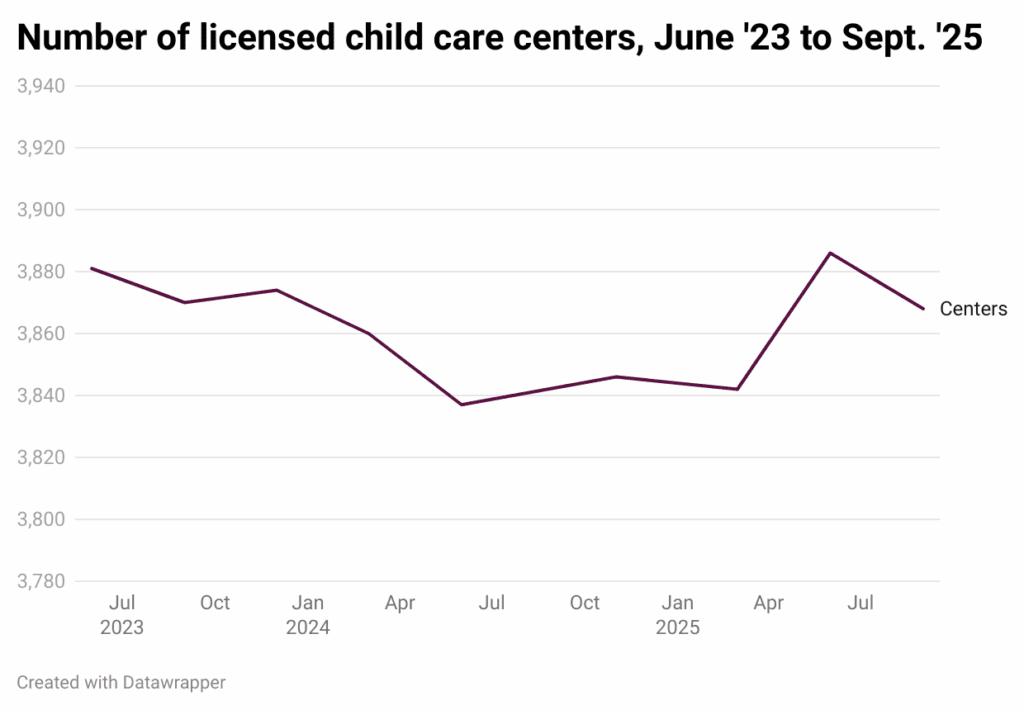
    While licensed child care centers have also experienced a net loss since February 2020, the trend has been less linear.

    Graphic by Katie Dukes/EdNC

    There were 3,879 licensed centers in February 2020. When EdNC began tracking in June 2023, the number was slightly higher at 3,881. From then on it fluctuated, with net gains in some quarters and net losses in others. There are now 3,868 licensed centers statewide.

    While the net loss of centers remains small, the effect of a single center closing is huge — especially in rural communities.

    Families on Hatteras Island are learning this firsthand. The only licensed child care program on the island is scheduled to close at the end of the year. With no licensed FCCHs and no clear way to save the sole licensed center, families are trying to figure out how to keep their businesses open and remain in their communities without access to child care.

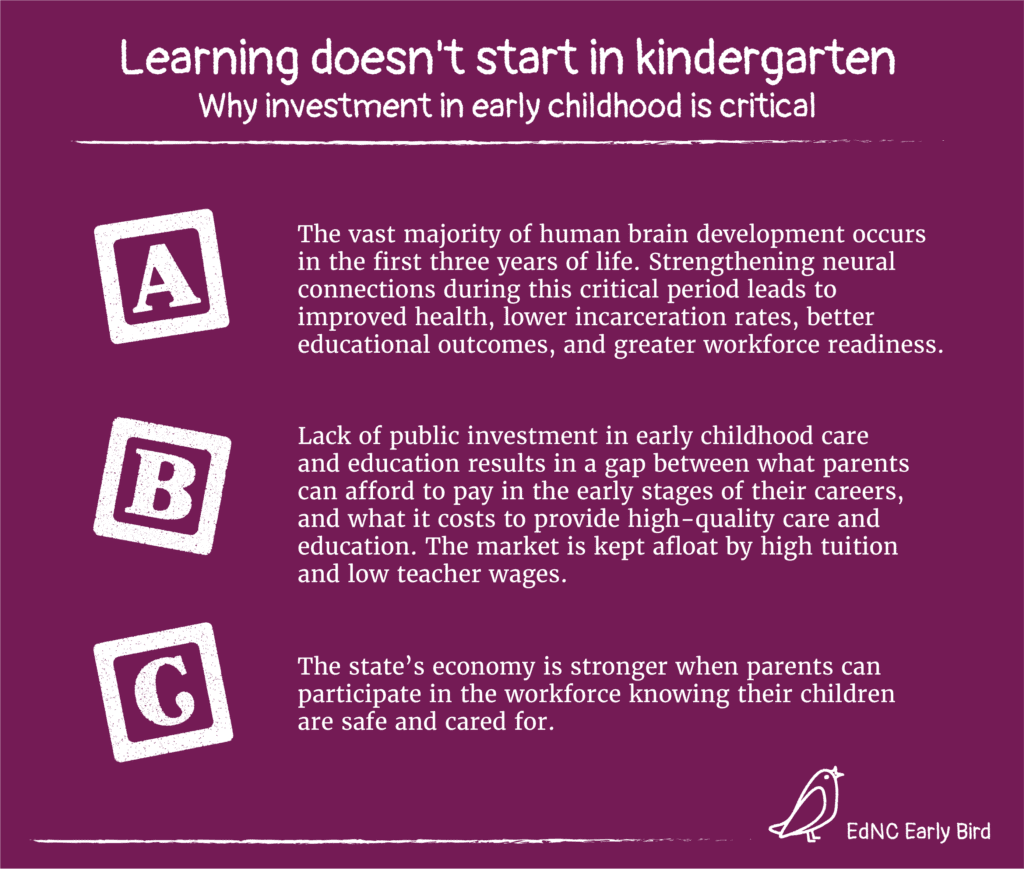
    Access to high-quality, affordable early care and learning is crucial to child and family freedom and well-being. It enables parents to participate in the workforce or continue their education without concern for the safety of their children. It also puts North Carolina’s youngest residents on a path to future success.

    Graphic by Lanie Sorrow

    Trends among subgroups

    In addition to monitoring overall licensed child care trends, EdNC zooms in on trends among three subgroups of counties each quarter.

    In the counties that make up the area covered by the Dogwood Health Trust (Avery, Buncombe, Burke, Cherokee, Clay, Graham, Haywood, Henderson, Jackson, Macon, Madison, McDowell, Mitchell, Polk, Rutherford, Swain, Transylvania, and Yancey), the number of licensed child care sites is 5% lower than before the pandemic. These counties had a net loss of eight programs from July through September 2025, the largest single-quarter decrease since EdNC began tracking.

    In the majority-Black counties (Bertie, Edgecombe, Halifax, Hertford, Northampton, Vance, Warren, and Washington), the number of licensed child care sites remained relatively stable during and after the pandemic. But in the most recent quarter, these counties had a net loss of nine programs, putting them 4% lower than before the pandemic, a sudden and dramatic shift in circumstance. As with the Dogwood counties, this represents the largest single-quarter decrease since EdNC began tracking.

    In Robeson and Swain, which both have large Indigenous populations, the number of licensed child care sites had also remained relatively stable during and after the pandemic. In the most recent quarter, for the first time since EdNC began tracking, the number of licensed child care programs in these counties has dipped just below pre-pandemic levels.


    Editor’s note: The Dogwood Health Trust supports the work of EdNC.


    This article first appeared on EdNC and is republished here under a Creative Commons Attribution-NoDerivatives 4.0 International License.


    Did you use this article in your work?

    We’d love to hear how The 74’s reporting is helping educators, researchers, and policymakers. Tell us how

    Source link