

In our recent webinar, Lessons from 2023 for a Bright 2024, panelists reflected on what was top of mind as they wrapped up 2023, including job advertising, the candidate experience during the hiring process, and HigherEd workforce trends. Attendees heard from Andy Boom (JobElephant), Ircka West (PeopleAdmin), and Lucas Del Priore (PeopleAdmin) as they shared their valuable insights—check out some key takeaways below.
Did you know that on average, 40% of job advertising spend is wasted? Andy Boom, Director of Business Development at JobElephant, noted that his team sees this budget waste frequently because customers want to “spread the net as far and wide as possible, adding multiple publications to a campaign, which might make sense—but it all depends on the specific job description.” The reality that not all job boards are created equal, and not all are going to have the right audience for every job description. JobElephant tracks every ad they post for their customers, and has seen that some publications fail to drive traffic and lack optimization. Andy’s team utilizing machine learning and AI to curate the top ten options for specific searches. By analyzing keywords, JobElephant ensures that job descriptions are matched with the boards that promise the best potential return, reducing ad spending waste.
Ircka West, Solution Engineer at PeopleAdmin, spoke about improving the candidate experience as a top trend from 2023. She emphasized the power of presentation in attracting candidates—creating excitement about the workplace begins with focusing on the candidate experience. Reflecting the candidate’s values and interests is crucial, and your team can take advantage of existing information by linking to pages that show off the institutional experience. Ircka recommended re-evaluating the application process by streamlining lengthy forms and implementing two-step application processes can encourage completion. “To get feedback on the application process, there are a few different ways,” said Ircka. “One would be to use your reporting capabilities and seeing what their actions do. What parts of the application process are they stopping at? Where are you losing them in the process? That’s a more passive way to find out some answers. Another way is to remember that everyone who works at your institution went through the application process at some point. You can reach out to your staff and get feedback from what they remember.”
Lucas Del Priore, Product Manager at PeopleAdmin, spoke about the evolving landscape of workforce trends in higher education. One major trend that Lucas thought institutions should focus on is the continued normalization of hybrid and remote work, which presents a number of opportunities for growth. While hybrid work isn’t new in 2023, there are still a lot of improvements to be made with digitization and automation. “The implication is a big cultural shift of engagement, where engagement is becoming problematic for faculty and staff,” said Lucas. “The most concrete example is how to reconfigure every task and event to fit in that digital format. Not everything converts clearly, and we’re continuing to learn and understand how to implement tools that work for hybrid models and continue to encourage engagement.” In 2024, HigherEd teams should focus on institution resilience, purposeful and innovative digitization, and providing meaningful opportunities for faculty development are key strategies to navigate these changes successfully.
The world of HigherEd is becoming increasingly complex, and staying informed about the latest trends and leveraging innovative tools is essential. From optimizing job boards with JobElephant’s data-driven approach to enhancing the candidate experience and adapting to a digital workforce, there is a lot to learn from 2023 as we launch the strategies of 2024. Check out this webinar on-demand for more insights.

As 2023 comes to a close, here at PeopleAdmin, we’re looking back at some of the top resources we shared this year! From onboarding to compliance, from retention to employee development, from recruitment marketing to candidate experience, we covered so many topics. Check out some of our favorite reads below!
HigherEd hiring processes are unique for many reasons, but one key reason is the different types of positions found on campus. Position types can include faculty, staff, student workers, temporary seasonal workers, hourly workers, and more, and often, each of these categories has different requirements, approvals, forms, and hiring steps. Our customers are tackling this challenge thanks to Position Management and Applicant Tracking System, and they have some tips for others to get started. Read more!
The answer is yes! In this competitive hiring market, and with many universities facing retention challenges, onboarding is key, and digitized onboarding is the standard that organizations need to meet today. Read more from HigherEd institutions who are saying “no” to onboarding paperwork and bringing an engaging onboarding process to every new hire.
If you’re wondering what an employer brand is, you’re probably not leveraging recruitment marketing techniques to your advantage! Creating a cohesive employer brand is an important aspect of building a talent pool today. Learn more about employer branding, and check out some of our top tips to get your hiring teams to start thinking like marketers.
Your team has probably dealt with the challenge of creating effective search committees, and you might have struggled to get those committees to adopt new and efficient technology. Well, our customers have tackled that challenge too. Hear from the University of Alabama – Birmingham about how they successfully leveled up their search committee experience.
In a PeopleAdmin poll, HigherEd institutions were asked “How connected are the various systems on your campus?” 30% responded “Not connected—we have to manually enter data in multiple systems; there’s no data flow,” while 36% responded “connected but could be better.” Notably, no one chose the option: “Very connected—there are few issues that impact my team.” With interoperability still a key issue on campus, building seamless data flow and integrating your technology should be a top priority for your team. Check out some key takeaways from a webinar about interoperability, and hear from customers about how they’re leveraging integrations.
44% of HigherEd employees disagreed that they have opportunities for advancement, and 34% disagree that their institution invests in their career development. According to the Harvard Business Review, 86% of professionals would change jobs for more professional development opportunities—clearly, career growth is something today’s workers care about. For more, check out this post about the link between retention and career growth.
These are just a few of the topics that we researched and wrote about here at PeopleAdmin this year! Check out more resources on our website, and dive into our Annual Report on the State of HigherEd for an in-depth look at the challenges of 2023!


As we prepare for an upcoming year, I have to stop and think about the future of higher education. The pandemic changed our students, faculty, staff, and our campus as a whole. The Education Advisory Board (EAB) provides colleges and universities across the country with resources and ideas to help the students of the future.
I confess, I have been a complete fan of EAB and their resources for the past ten years. Their resources are at the forefront of higher education innovation.
🏛 – Dining Halls and Food Spaces
🏛 – Modern Student Housing
🏛 – Hybrid and Flexible Office Spaces
🏛 – Tech-Enabled Classrooms
🏛 – Libraries and Learning Commons
🏛 – Interdisciplinary Research Facilities
Higher education institutions should also focus on the faculty and staff as well. When I ask most of my peers if they are comfortable with the numerous changes happening across their institution, most of them are uncomfortable. We need to prepare our teams for the future of higher education.
Here’s the Millennial Professor’s Call the Action Statements for the Higher Education Industry
🌎 – Higher Education Conferences and Summits Need to Provide Trainings Focused on Artificial Intelligence (AI) for Their Attendees
🌎 – Higher Education Institutions Need to Include Faculty and Staff as Part of Their Planning Process (an Important Part)
🌎 – Higher Education Institutions Provide Wellness and Holistic Support for Faculty and Staff Who are Having Problems With Change (You Need Us and We Need Help)
🌎 – Higher Education Institutions Need to Be Comfortable with Uncommon Spaces (Flexible Office Spaces)
🌎 – Faculty Need to Embrace Collaboration Opportunities with Faculty at Their Institutions and Other Institutions
Here are some additional articles about the future of higher education:
Higher education will continue to transition in an effort to meet the needs of our current and incoming students.
For our particular university, we are striving to modify all of these items simultaneously. It is a challenge, but the changes are well worth the journey.
Here’s the challenge for this post: “In your opinion, which one of the items on the list is MOST important for your institution?”
***.
Check out my book – Retaining College Students Using Technology: A Guidebook for Student Affairs and Academic Affairs Professionals.
Remember to order copies for your team as well!
Thanks for visiting!
Sincerely,
Dr. Jennifer T. Edwards
Professor of Communication
Executive Director of the Texas Social Media Research Institute & Rural Communication Institute
This is always a popular topic, but the subject is misunderstood. I want to talk about discount rate at private colleges.
For those who always ask, no, I don’t do this for public universities. It may be helpful to compare institutions within a state, but beyond that, state funding models and the mix of resident and nonresident tuition rates make comparisons across borders mostly meaningless. And for the more knowledgeable who might wonder, I assume that all institutional aid is unfunded; that is, it’s not coming in as a revenue stream from an external source to provide funding.
Let’s do an exercise to help you understand discount: Suppose you run an ice cream store, and you have more ice cream than you can sell. You might offer a coupon, let’s say for 50% off a cone.
The cone you normally sell for $4, you now sell for $2. You just take less money for it. There is no one there to hand you two extra dollars to make up for the gap. The Department Store store down the street sells a very similar cone in its food court for $8, but offers a 75% off coupon. They decide to take $2 for the cones they sell in order to be competitive with you.
The Gourmet Ice Cream Shop around the corner sells cones for $12, because they think their ice cream is much better, their store nicer, and their location more convenient to the subway station. On occasion, they will tell the kids at the orphanage they’ll give them a free ice cream cone, but everyone else pays. And finally, Mel’s Fair Deal Ice Cream store sells ice cream cones for $2.50, but never offers coupons.
If everyone uses your coupon, your store has a discount rate of 50%, and your net revenue per cone is $2. But of course, some people will pay $4. If everyone uses the coupon at the Department Store, their net revenue per cone is also $2. But their discount rate is 75%.
The Gourmet Store is more generous with the orphans than people realize; about half of their cones are given away. So their discount rate is also 50%, but their net revenue per cone is $6. And finally, Mel’s Fair Deal Ice Cream has a discount rate of 0% and a net revenue of $2.50 per cone.
It’s important to remember that none of these stores cares where the cash comes from. It could be from the customer’s pocket, from a parent or aunt, government food stamps, or a loan they take out from the government. You count the cash, not the source of the cash.
Now, guess what? Almost all college aid is discount, much like those coupons the ice cream stores hand out. It’s simply the college agreeing to take less cash than its published tuition rate. If tuition is $40,000 and you offer a $20,000 discount or scholarship, you simply take $20,000 to educate the student, and write the rest off as an accounting transaction.
The need for higher discounts in higher education are driven by tuition prices that are too high for most people to pay. Colleges have to discount, or they’re going to have costs associated with making too much ice cream to sell that they can’t pay.
(This is the part where someone will want to comment and extend the analogy ad infinitum: Which ice cream is better? Is one really worth six times more? Why don’t you make more flavors to attract more customers instead of discounting the vanilla to bring people in? Does your cost of ice cream production get lower if you produce a lot more? Can’t you do research and optimization to figure out who should get the coupons when to maximize profit? And if so, couldn’t you lower price a lot and drive the others out of business? Couldn’t you offer the coupon to fewer people and hope more pay full price? Please don’t be that person. I’ll do a workshop for you if the price is right.)
So, to easily calculate discount, in case it’s not clear, take the amount you have to discount and divide by the published price. For a college, the discount rate is total institutional (unfunded) grant aid/total gross tuition. For average net revenue, take total gross revenue, subtract institutional (unfunded) grant aid, and divide that number by the number of students.
For instance, if your sticker tuition is $40,000 and enroll ten students, your total gross tuition is 40,000 x 10, or $400,000. If you award $100,000 in unfunded aid to make that enrollment happen, your discount rate is 100,000/400,000, or 25%. After you take the aid away from tuition, your average net revenue is (400,000 – 100,000)/10, or $30,000 per student. That’s how much cash you have to work with to do things like pay faculty, cut the grass, heat the buildings, and run the administration.
***************************
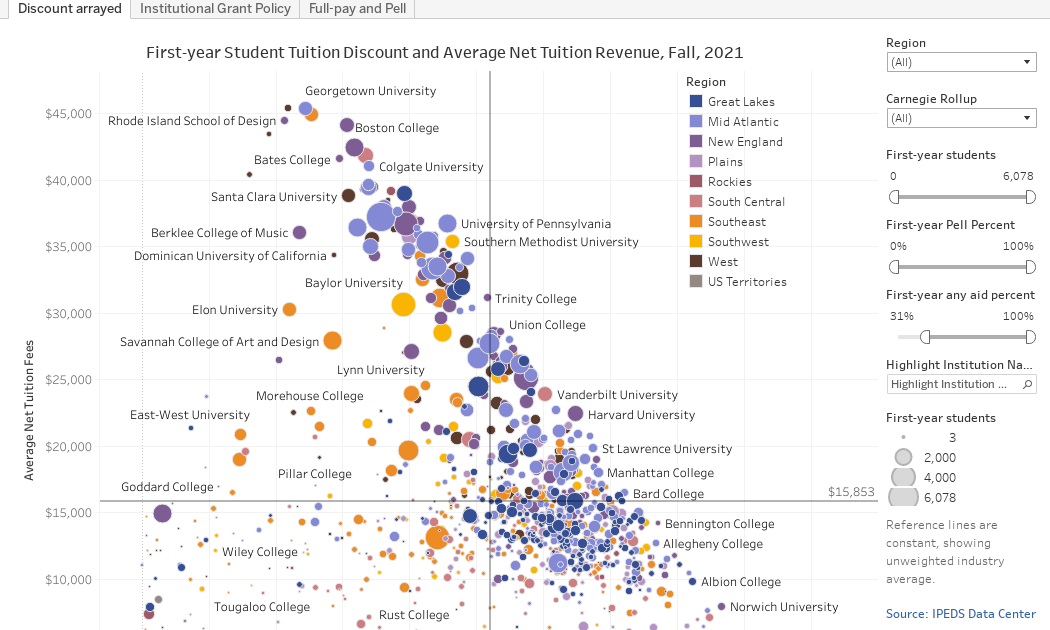
Now, below, you can dive into college discount rates, net revenue, mixes, and the shape of the industry. This data set is very rich, and I may do another angle on this topic later. But for now:
Discount arrayed (the first view using the tabs across the top) arrays about 950 four-year, traditional, private colleges. I’ve removed lots of religious seminaries, some very small institutions, and, frankly, some suspect data from this for the sake of clarity. This is IPEDS data so it’s reliable, but never perfect.
Each college is a dot, colored by region and sized by freshman enrollment relative to the set displayed. The view shows discount rate on the x-axis, and average net revenue on the y-axis.
You can use the filters at right to limit the set further. You can’t break anything, and you can reset the view using the controls at the bottom. Try this: Use the First-year students filter to look at colleges with at least 2,000 freshmen. Then look at those colleges with fewer than 250. Interesting, no?
The reference lines are the unweighted average of all 950 institutions in the set.
Institutional grant policy shows how many colleges and how many students fall into institutional grant aid categories. Some institutions give aid to 100% of all students. The vast majority give aid to 90% or more.
And finally, the Full-pay and Pell shows two variables: The percentage of students who get no aid (full-pay students) and those who get Pell grants at the institution shown. And remember, it doesn’t matter where the cash from full-pay students comes from: That group includes some students whose parents write a check, and some who might get a Pell and whose parents take out an ill-advised PLUS loan for the cost of attendance.
The point? Discount rate is important for similar institutions in the same region, but as thing unto itself, it’s kind of meaningless. Net revenue is more important, for the most part, but at some institutions where undergraduate education can almost be called a sideline business, even net revenue is not important as it might seem.
Recent Product Highlights
In December, PeopleAdmin rolled out new features and updates to support effective academic workflows, enhance integrations, and make teams across campus more efficient.
Here are highlights of what’s new:
Faculty Information System:
Marketplace of Connectors:

by CUPA-HR | December 12, 2023
Each month, CUPA-HR General Counsel Ira Shepard provides an overview of several labor and employment law cases and regulatory actions with implications for the higher ed workplace. Here’s the latest from Ira.
The University of California may be the first public institution to challenge whether the 1986 Immigration Reform and Control Act (IRCA) applies to state entities, including public colleges and universities. The IRCA prohibits U. S. employers from hiring undocumented workers.
On November 20, 2023, the University of California postponed plans to go forward with a self-imposed deadline of November 30, 2023, to initiate a plan to hire undocumented workers. The university has decided to study the issue further before deciding on a specific course of action. The Supreme Court has dealt with the constitutionality of federal regulation of state employers on multiple occasions in the past, having come down on both sides of the issue. We will follow developments in this area as they unfold.
Collin College in Texas prevailed in partial summary judgement against a former professor who sued alleging First Amendment free speech retaliation in the non-renewal of his teaching contract. He claimed his contract was terminated because of his outspoken views as a private citizen on public issues including race relations in Dallas, Confederate monuments and his criticism of the college’s COVID-19 policies.
The court granted part of the college’s motion to dismiss because the college’s policies were not facially unconstitutional. However, the federal court denied each side’s motions for summary judgement on the professor’s claims that the college’s policies were overboard in their restriction of his speech, holding that the issue should be reserved for decision until factual questions are resolved (Phillips v. Collin Community College District (E.D. Tex. No. 22-cv-00184, 11/4/23)).
A 78-year-old law professor has sued his university employer claiming age-based salary discrimination. The professor, who is tenured and taught at the law school for 42 years, claims he has been consistently paid substantially less than “significantly younger, less experienced and less tenured” comparators (Postlewaite v. Northwestern University (N.D. Ill. No 1:23-cv-15729, Comp filed 11/7/23)).
The professor claims to be “a preeminent scholar” in the field of tax law and started his law school’s lucrative Master of Laws in Taxation program, which he claims has been the school’s “highest ranked specialty department” for 17 of the last 19 years. The professor alleges that he has been awarded lower base-salary increases than his younger counterparts. He further alleges that for the academic year 2022-23, his salary was $7,000 less than the 50th percentile and $55,000 less than the 75th percentile, even though those percentiles equated to 20 and 32 years, respectively, of total teaching while he has completed 49 years of total legal academic teaching.
The lawsuit was filed in federal court and alleges violation of the federal Age Discrimination in Employment Act and the Illinois Human Rights Act.
The Supreme Court declined to review a 4th U.S. Circuit Court of Appeals case in which the 4th Circuit upheld the dismissal of a driver’s disability accommodation request. The driver requested that he be allowed to drive a smaller truck with softer suspension to accommodate his hip and back bursitis disability, which caused him severe pain (Hannah v. United Parcel Service (Case No. 23-264 US Sup Ct, cert den. 11/6/23)).
The 4th Circuit decision, which the Supreme Court let stand, concluded that the employee’s request for an accommodation was not reasonable because the request altered the “essential elements” of the employee’s job. The court concluded that if the driver was given the accommodation to drive a smaller truck, he would not be able to complete the daily work load requirement of his existing driver position.
The 5th U.S. Circuit Court of Appeals overturned an NLRB decision holding that Tesla violated the NLRA when it required its production employees to wear black Tesla-monogrammed uniform work shirts and did not allow production workers to wear black union-insignia work shirts. The decision of the three-judge panel was unanimous in overturning the NLRB ruling against Tesla (Tesla v. NLRB (5th Cir. No. 22-60493 11/14/23)).
While Tesla had banned the wearing of union-insignia work shirts, it allowed production employees to wear Tesla-insignia work shirts with a union insignia pinned on the shirt. Tesla had argued unsuccessfully to the NLRB that its rule was necessary to prevent damage to cars and to help supervisors distinguish between production employees and other employees at the company’s California facility. The Court of Appeals decision allows Tesla to continue to enforce its prior policy requiring Tesla-insignia work shirts, with the employee’s option of pinning on a union insignia.
A Pennsylvania state appellate court affirmed a trial court dismissal of a former Pennsylvania State University gymnastic coach’s lawsuit. The former coach alleged defamation and violation of his employment contract when the university terminated his contract after investigating allegations that he created a hostile environment for gymnasts. The three-judge appellate panel adopted the decision of the trial court judge, concluding that the university had good cause for firing the coach and that the athletic director’s statement about prior accusations against him had not been defamatory (Thompson v. Pennsylvania State University (Case no. 1460 MDA 2022, 11/28/23)).
The appeals court ruled that the gymnastic coach’s high profile in collegiate sports made him a limited public figure and that the university’s reaction to allegations of mistreatment of athletes were matters of public concern. That meant that the plaintiff must show “actual malice” in order to prove defamation in these circumstances. The appellate court concluded that the university’s actions did not rise to the level of “actual malice.”
by CUPA-HR | December 12, 2023
On December 6, the Biden administration released the Fall 2023 Unified Agenda of Regulatory and Deregulatory Actions, providing the public with an update on the regulatory and deregulatory activities under development across approximately 67 federal departments, agencies and commissions. This release is the second and final regulatory agenda for 2023, and it sets target dates for upcoming regulatory actions mainly for the first half of 2024.
CUPA-HR has highlighted the following items from the Fall 2023 Regulatory Agenda for members to be aware of as we enter the new year. As a reminder, these target dates are not a guarantee, but they provide insight into when we can possibly expect the regulations to be published. CUPA-HR’s government relations team will continue to monitor for any updates on the following regulations and others that may impact the higher education space.
According to the Fall 2023 Regulatory Agenda, the Department of Labor (DOL)’s Wage and Hour Division (WHD) has targeted April 2024 for release of the final rule to update the Fair Labor Standards Act’s overtime pay regulations. The final rule seeks to increase the minimum salary threshold required for white-collar professionals to maintain exempt status under the FLSA.
On September 8, WHD released a Notice of Proposed Rulemaking (NPRM) to update the salary threshold. The NPRM increases the minimum salary threshold from its current level of $35,568 per year ($684 per week) to $60,209 annually ($1,158 per week), which amounts to a nearly 70% increase.* Additionally, WHD proposes to automatically increase the salary level every three years by tying the threshold to the 35th percentile of full-time salaried wages in the lowest wage census region. DOL indicated in the proposed rule that it is considering implementing an effective date in the final rule that could come as soon as 60 days after the final rule is published to the public.
CUPA-HR was joined by 49 other higher education associations in submitting comments in response to the NPRM. In our comments, we raised concerns with the timing of this increase, the size of the proposed increase, the implementation of automatic updates, and the timeline for regulatory compliance that WHD anticipates. Our comments were informed by a CUPA-HR member survey, in which over 300 members provided feedback on their concerns with and thoughts about the proposal. For ongoing updates, visit CUPA-HR’s FLSA Overtime page.
The Fall 2023 Regulatory Agenda indicates that WHD anticipated releasing the FLSA independent contractor rule in November 2023. The final rule has been at the White House Office of Information and Regulatory Affairs (OIRA) for review since September 28, 2023, and once the agency finishes its review, the rule will be published.
On October 13, 2022, the DOL published an NPRM to rescind the current method for determining independent contractor status under the FLSA. The current test, finalized by the Trump administration in 2021, has two core factors of control and investment with three additional factors (integration, skill and permanency) that are relevant only if those core factors are in disagreement. The Biden rule proposes a return to a “totality-of-the-circumstances analysis” of multiple factors in an economic reality test, including the following six factors, which are equally weighted with no core provisions:
The regulatory agenda indicates that DOL’s Employment and Training Administration (ETA) aimed to issue a Request for Information (RFI) in November 2023. According to the notice in the agenda, ETA is seeking input from the public “on whether Schedule A serves as an effective tool for addressing current labor shortages, and how the Department may create a timely, coherent and transparent methodology for identifying STEM occupations that are experiencing labor shortages in keeping with its requirements under the Immigration and Nationality Act … to ensure the employment of foreign nationals does not displace U.S. workers or adversely affect their wages and working conditions.”
The RFI was sent to OIRA for review before publication on November 11, 2023, and will likely be released to the public soon.
Regulations to Implement the Pregnant Workers Fairness Act
In December 2023, the Equal Employment Opportunity Commission (EEOC) plans to issue a final rule to implement the Pregnant Workers Fairness Act (PWFA). The rule will create a framework for the EEOC on how to enforce protections granted to pregnant workers under the PWFA. For a detailed analysis of the proposed rule on implementing the PWFA, please see CUPA-HR’s blog post.
In December 2022, the PWFA was signed into law through the Consolidated Appropriations Act of 2023. The law establishes employer obligations to provide reasonable accommodations to pregnant employees so long as such accommodations do not cause an undue hardship on the business, and makes it unlawful to take adverse action against a qualified employee requesting or using such reasonable accommodations. The requirements of the law apply only to businesses with 15 or more employees.
Unlike the other regulations with target dates, the PWFA final rule has a statutory deadline for publication, which is December 29, 2023. Given this upcoming deadline, we will likely see the EEOC publish this rule soon.
According to the regulatory agenda, the Department of Education (ED) anticipates releasing the highly anticipated Title IX final rule in March 2024. The rulemaking would finalize the June 2022 NPRM to roll back and replace the Trump administration’s 2020 regulations while simultaneously expanding protections against sex-based discrimination to cover sexual orientation, gender identity, and pregnancy or related conditions.
CUPA-HR filed comments in September 2022 in response to the NPRM. In our comments, we brought attention to the possible impact the proposed regulations could have on how higher education institutions address employment discrimination.
The new March target deadline marks the third time ED has delayed the issuance of the Title IX final rule. The rule was originally targeted for release in May 2023, but ED subsequently pushed the target date back to October 2023 via a blog post, when it became clear that the department would not meet the May timeline. Since ED missed the October timeline, they have faced increased pressure from Congressional Democrats and other advocacy groups to publish the final rule as soon as possible. While it’s not a guarantee ED will be able to publish the final rule in March 2024, the increased pressure will certainly motivate the department to move quickly.
CUPA-HR plans to hold a webinar to inform members of the final rule’s new requirements once the final rule has been published. Details to come.
Similar to the Title IX final rule above, ED plans to issue a final rule on student eligibility in athletic programs under Title IX in March 2024. The rule would finalize the NPRM that was released by the department in April 2023.
Under the NPRM, schools that receive federal funding would not be permitted to adopt or apply a “one-size-fits-all” ban on transgender students participating on teams consistent with their gender identity. Instead, the proposal allows schools the flexibility to develop team eligibility criteria that serve important educational objectives, such as fairness in competition and preventing sports-related injuries. The department further explains that the eligibility criteria must take into account the sport, level of competition, and grade or education level of students participating, and the criteria would have to minimize harm to students whose opportunity to participate on a team consistent with their gender identity would be limited or denied.
The NPRM received over 150,000 comments addressing support for and concerns with the proposal. ED must review all comments before issuing a final rule to implement these regulations, which is the likely cause of delay for both this rulemaking and the broader Title IX final rule.
On October 23, the Department of Homeland Security’s U.S. Citizenship and Immigration Services (USCIS) issued a proposed rule that aims to improve the H-1B program by simplifying the application process, increasing the program’s efficiency, offering more advantages and flexibilities to both petitioners and beneficiaries, and strengthening the program’s integrity measures.
Prompted by challenges with the H-1B visa lottery, USCIS has prioritized a proposed rule to address the system’s integrity. The proposed rule is aimed at strengthening the lottery registration process and preventing fraud, and it makes critical revisions to underlying H-1B regulations. For a detailed summary of what the H-1B proposal includes, see CUPA-HR’s blog post.
The NPRM is open for public comment until December 22, 2023. The Fall 2023 Regulatory Agenda included the regulations, but it did not provide a timeline for issuing the final rule, likely because the comment period is still open for the NPRM.
In April 2024, USCIS anticipates issuing a final rule to adjust the fees charged by the agency for immigration and naturalization benefit requests.
USCIS published an NPRM on this issue in January 2023. The comprehensive proposal has implications for both employment-based and family-based filings, but certain provisions would have significant impacts for higher education employers. Specifically, the proposed rule includes a provision to fund the Asylum Program with employer petition fees, which would be a $600 fee paid by any employers who file either a Form I-129, Petition for a Nonimmigrant Worker, or Form I-140, Immigrant Petition for Alien Worker. Additionally, the proposed rule seeks to increase almost all employment-based and employment-based “adjacent” filing fees. For more information on the details of this proposed rule, see CUPA-HR’s blog post.
On March 13, 2023, CUPA-HR joined the American Council on Education’s comments in response to the NPRM. The comments address higher ed-specific concerns with the proposal to increase fees for immigration and naturalization benefit requests, including concerns about the impact the increased fees will have on international scholars and institutions’ ability to hire nonimmigrant workers, including H-1B workers.
U.S. Citizenship and Immigration Services — Petition for Immigrant Worker Reforms
The regulatory agenda shows that USCIS plans to issue an NPRM in August 2024 that will “amend its regulations governing employment-based immigrant petitions in the first, second and third preference classifications.” According to the posting, the proposed rule would “codify current policy guidance and implement administrative decisions regarding successorship-in-interest and ability to pay; update provisions governing extraordinary ability and outstanding professors and researchers; modernize outdated provisions for individuals of extraordinary ability and outstanding professors and researchers; … implement reforms to ensure the integrity of the I-140 program; and correct errors and omissions.”
U.S. Citizenship and Immigration Services — Modernizing Regulations Governing Nonimmigrant Workers
In October 2024, USCIS plans to issue an NPRM to update employment authorization rules for dependent spouses of certain nonimmigrants and to increase flexibilities for nonimmigrant workers. CUPA-HR plans to monitor for any updates to this rule as it may apply to H-1B or other relevant nonimmigrant visas used by institutions.
In February 2024, the Department of State plans to begin a pilot program to “resume domestic visa renewal for qualified H-1B nonimmigrant visa applicants who meet certain requirements.” The department will issue a notice in the Federal Register that will describe pilot program participation requirements and will provide “information on how those falling within the bounds of the pilot program may apply for domestic visa renewal.” The pilot program has been at OIRA since October 17, meaning the pilot notice could be published sooner than anticipated.
* The discrepancy between our figure of $60,209 and the DOL’s preamble figure of $55,068 arises from DOL’s own projections based on anticipated wage growth. The DOL’s proposed rule is rooted in 2022 data (yielding the $55,068 figure), but a footnote in the NPRM confirms that the salary threshold will definitely change by the time the final rule is issued to reflect the most recent data. Our comments, aiming to respond to the most probable salary threshold at the time a final rule is released, references the DOL’s projected figure for Q1 2024, which is $60,209. We do not believe DOL will be able to issue a final rule before Q1 2024, so we are incorporating this projected figure into our response to the NPRM. In essence, our goal is to provide members with a clearer picture of the likely salary figure when the final rule comes into play.