Author: admin

  • Teach For America Partners with Aspen Institute to Add Policy Training for Rural Educators

    Teach For America Partners with Aspen Institute to Add Policy Training for Rural Educators

    A Teach for America teacher works with a student. Teach for AmericaTeach For America has partnered with the Aspen Institute’s Policy Academy to expand leadership training for rural educators.

    The collaboration adds a four-part policy impact series to TFA’s Rural School Leadership Academy, a yearlong fellowship now in its 13th year. The new curriculum aims to help rural educators influence education policy at the state and national levels while addressing challenges in their local schools.

    Seventy fellows will participate in the policy training this year, learning to connect classroom issues to district and state-level decision-making. Past participants requested more tools to influence the systems affecting rural students, according to TFA.

    “RSLA was created to walk alongside those leaders—helping them grow, connect, and see what’s possible,” said Casey DeFord, managing director of alumni career advancement and field integration at Teach For America. “Our partnership with the Aspen Institute will deepen RSLA’s impact by equipping fellows with the policy skills needed to drive lasting change.”

    The Rural School Leadership Academy selects a cohort of educators annually to receive career development through virtual learning, in-person gatherings, school visits and personalized coaching. The program serves educators at various career stages, from aspiring leaders to experienced principals.

    Betsy Cooper, director of the Aspen Policy Academy, said rural educators bring valuable expertise to policymaking.

    “This partnership will enable educators to address unique challenges in their schools through policy entrepreneurship,” Cooper said.

    Participants who complete the program will receive a co-branded certificate from both organizations.

    Source link

  • When a company’s enviro claims sound convincing …

    When a company’s enviro claims sound convincing …

    Many companies contribute to the climate crisis and make a profit doing so. As consumers and governments pressure them to reduce their carbon emissions, they look for ways to make themselves appear environmentally friendly. This is called green marketing.

    As a journalist, you need to learn to spot what a business really means by its green marketing.

    Greenwashing is when a brand makes itself seem more sustainable than it really is, as a way to get consumers to buy their product. For example, let’s look at fashion, an industry that is responsible for between 2 and 8% of global greenhouse gas emissions.

    In the absence of environmental legislation around the fashion industry a business might get themselves certified under a sustainability certification scheme — these are standards developed by governments or industry groups or NGOs to measure such things as energy efficiency or processes that are low carbon or carbon neutral. There are more than 100 different such certification programs.

    Companies tout these certifications. But a 2022 study by the Changing Markets Foundation (CMF) found that the standards set by the majority of the 10 or more popular certification initiatives for the fashion industry aren’t difficult to meet and lack accountability.

    Artificial claims about sustainability

    Fast fashion relies on cheap synthetic fibers, which are produced from fossil fuels such as oil and gas. And while you might assume that clothing with labels such as “eco” or “sustainable” might have fewer synthetics, you’d unfortunately be wrong.

    Another study by CMF found that H&M’s “conscious” clothing range, for example, contained 72% synthetics — which was higher than the percentage in their main collection (61%). And it’s not just H&M. While the same study found that 39% of products made some kind of green claim, almost 60% of these claims did not match the guidelines set out by the UK Competition and Markets Authority.

    The same is happening in the meat and dairy industry. Companies say they are reducing their environmental footprint by engaging in “regenerative agriculture”, a farming approach that aims to restore and improve ecosystem health. They argue that it reduces greenhouse gas emissions and helps store carbon in the soil.

    But relying on carbon storing in soil is not enough. An article in Nature Communications found that around 135 gigatonnes of stored carbon would be required to offset the emissions that come from the agriculture sector. This is roughly equivalent to the amount of carbon lost due to agriculture over the past 12,000 years, according to CMF.

    But companies grab onto these empty promises, perhaps knowing that the general public might only see regenerative agriculture and other “green narratives” as promising.

    Look for real solutions to climate change.

    For example, Nestlé tells their customers that it is addressing the carbon footprint of the agriculture industry by supporting regenerative agriculture, stating on its website that in 2024, some 21% of the ingredients they source come from farmers adopting regenerative agriculture practices.

    When you understand that regenerative agriculture is not the solution it has been made out to be, only then can you see through Nestlé’s branding.

    So how can you spot greenwashing?

    Let’s say you saw a press release from a company in an industry that has historically relied heavily on fossil fuels. It tells its readers that it plans to be carbon neutral by a certain date, or that it’s using recycled materials for a large portion of its production, or that its future is “green”.

    You might first wonder, is this an example of how companies are moving away from fossil fuels and towards a green future? How can you tell?

    1. Be skeptical.

    When something has to tell you that it is green, it might not be. Start your investigation right there.

    For example, if you were looking at Nestlé’s regenerative agriculture campaign, you would need to find out what regenerative agriculture is and how much it is indeed reducing greenhouse gas emissions. You can do this by starting with a good Google search: e.g “regenerative agriculture and greenhouse gas emissions”.

    Once you click on a number of articles that report on this topic, you’ll be able to read about the different studies and data into the topic. Follow the sources used when an article cites a study or data. The article should hyperlink or list the sources. But those hyperlinks might take you to other secondary sources — other articles that cited the same data.

    For example, an article might cite this statistic: sustainability certifications increase consumer willingness to pay by approximately 7% on average. The article might cite as the source this study published in the journal Nature. But that article isn’t the original source of that data. It came from a 2014 study published in the Journal of Retailing.

    So try to find the primary source and see how credible or reputable it is. Who conducted the research in the first place?

    If you wanted to find out what H&M’s “conscious” range really meant, you would start by looking at H&M’s website and reports to look further into their claims. Then, follow those claims.

    2. Research the wider industry.

    Whether you’re reporting on fashion, agriculture or any other industry, look into where its emissions are coming from, which companies are claiming what and what the evidence says needs to be done in order for these industries to reduce their emissions.

    Providing context is important. What percentage of global greenhouse gas emissions is this industry responsible for? Is it getting better or worse? What legislation is in place to reduce emissions from these industries? In order for you and your audience to understand the greenwashing of any company, this background information is vital.

    3. Go straight to the company.

    Once you’ve conducted some initial research, follow up with the company if you are using it as an example or focus for your article. On Nestlé’s website, for example, you can find contact details for their communications, media or PR department. Send them an email saying something like the following:

    “I am writing an article on regenerative agriculture and I’ve found some studies that show that soil sequestration through these practices are in fact not enough to be a real climate solution. Can you please provide me with a comment on what Nestlé thinks about this?”

    They might not answer, but that also says a lot. If they don’t reply to you after one or two follow-up emails, you might try calling them.

    If you try several times and in different ways to contact them and they failed to respond, you can state that in your article. That way your readers know you made the effort.

    Claims from corporations that they are doing all they can to help the planet are easy to make. But if we really want to slow down climate change, significant efforts have to be made. And it is the role of journalists to hold companies to account for the claims they make.


    Questions to consider:

    1. What is “greenwashing”

    2. What is one example of greenwashing?

    3. What criteria do you use when deciding whether to buy a company’s product?


    Source link

  • 3 strategies to boost student reading fluency this school year

    3 strategies to boost student reading fluency this school year

    Key points:

    With the new school year now rolling, teachers and school leaders are likely being hit with a hard truth: Many students are not proficient in reading.

    This, of course, presents challenges for students as they struggle to read new texts and apply what they are learning across all subject areas, as well as for educators who are diligently working to support students’ reading fluency and overall academic progress. 

    Understanding the common challenges students face with reading–and knowing which instructional strategies best support their growth–can help educators more effectively get students to where they need to be this school year.

    Understanding the science of learning

    Many districts across the country have invested in evidence-based curricula grounded in the science of reading to strengthen how foundational skills such as decoding and word recognition are taught. However, for many students, especially those receiving Tier 2 and Tier 3 interventions, this has not been enough to help them develop the automatic word recognition needed to become fluent, confident readers.

    This is why coupling the science of reading with the science of learning is so important when it comes to reading proficiency. Simply stated, the science of learning is how students learn. It identifies the conditions needed for students to build automaticity and fluency in complex skills, and it includes principles such as interleaving, spacing practice, varying tasks, highlighting contrasts, rehearsal, review, and immediate feedback–all of which are essential for helping students consolidate and generalize their reading skills.

    When these principles are intentionally combined with the science of reading’s structured literacy principles, students are able to both acquire new knowledge and retain, retrieve, and apply it fluently in new contexts.

    Implementing instructional best practices

    The three best practices below not only support the use of the science of learning and the science of reading, but they give educators the data and information needed to help set students up for reading success this school year and beyond. 

    Screen all students. It is important to identify the specific strengths and weaknesses of each student as early as possible so that educators can personalize their instruction accordingly.

    Some students, even those in upper elementary and middle school, may still lack foundational skills, such as decoding and automatic word recognition, which in turn negatively impact fluency and comprehension. Using online screeners that focus on decoding skills, as well as automatic word recognition, can help educators more quickly understand each student’s needs so they can efficiently put targeted interventions in place to help.

    Online screening data also helps educators more effectively communicate with parents, as well as with a student’s intervention team, in a succinct and timely way.

    Provide personalized structured, systematic practice. This type of practice has been shown to help close gaps in students’ foundational skills so they can successfully transfer their decoding and automatic word recognition skills to fluency. The use of technology and online programs can optimize the personalization needed for students while providing valuable insights for teachers.

    Of course, when it comes to personalizing practice, technology should always enhance–not replace–the role of the teacher. Technology can help differentiate the questions and lessons students receive, track students’ progress, and engage students in a non-evaluative learning environment. However, the personal attention and direction given by a teacher is always the most essential aid, especially for struggling readers. 

    Monitor progress on oral reading. Practicing reading aloud is important for developing fluency, although it can be very personal and difficult for many struggling learners. Students may get nervous, embarrassed, or lose their confidence. As such, the importance of a teacher’s responsiveness and ongoing connection while monitoring the progress of a student cannot be overstated.

    When teachers establish the conditions for a safe and trusted environment, where errors can occur without judgment, students are much more motivated to engage and read aloud. To encourage this reading, teachers can interleave passages of different lengths and difficulty levels, or revisit the same text over time to provide students with spaced opportunities for practice and retrieval. By providing immediate and constructive feedback, teachers can also help students self-correct and refine their skills in real time.

    Having a measurable impact

    All students can become strong, proficient readers when they are given the right tools, instruction, and support grounded in both the science of learning and the science of reading. For educators, this includes screening effectively, providing structured and personalized practice, and creating environments where students feel comfortable learning and practicing skills and confident reading aloud.

    By implementing these best practices, which take into account both what students need to learn and how they learn best, educators can and will make a measurable difference in students’ reading growth this school year.

    Latest posts by eSchool Media Contributors (see all)

    Source link

  • Ireland sees 38% surge in Indian student interest: student perception study 2025

    Ireland sees 38% surge in Indian student interest: student perception study 2025

    The study, which surveyed students, parents, and counsellors across India, highlights how Ireland’s mix of academic excellence, affordability, safety, and employability is reshaping perceptions and driving enrolments.

    Ireland’s rise as a destination

    The report shows that while India continues to lead globally in outbound student mobility, sending more than 760,000 students abroad in 2024, Ireland’s growth has been particularly striking. From just 700 Indian students in 2013, enrolments crossed 9,000 in 2023/24 a 120% increase in five years. Even in 2024, when overall outbound mobility dipped by nearly 15%, interest in Ireland grew by 38%.

    What makes this growth significant is that it is not driven by marketing or advertising alone, but by the trust created through authentic student experiences, alumni voices, and counsellor guidance. Families see Ireland as a country that delivers not just degrees, but outcomes.

    Key highlights from the student perception study 2025

    • India leads in global outbound mobility: 7.6 lakh Indian students went abroad in 2024, compared to 2.6 lakh in 2020.
    • Ireland’s rapid growth: Indian enrolments rose from 700 in 2013 to over 9,000 in 2023/24 a 120% jump in five years.
    • Academic excellence: Six Irish universities now rank among the world’s top 500.
    • Affordable pathways: Tuition and living costs are 30-40% lower than in the US or UK; one-year Master’s programs add time and cost efficiency.
    • Employability outcomes: 80% of graduates secure employment within nine months; 1,800+ global companies including Google, Microsoft, Apple, and Pfizer offer strong career pathways.
    • Safety and community: Ireland ranks as the world’s third safest country, with over 60,000 Indians already settled.
    • Tier II/III interest rising: Students from Coimbatore, Guwahati, and Kochi are increasingly choosing Ireland, aided by education loans and growing awareness.

    A new student mindset

    The report underscores a fundamental shift: Indian students are increasingly outcome-oriented. Decisions are now guided by employability, post-study work opportunities, affordability, and return on investment, rather than prestige alone.

    Peer and alumni referrals, counsellor guidance, and authentic word-of-mouth are the strongest drivers of choice. Ireland’s reputation in STEM, AI, sustainability, data science, and cybersecurity is particularly resonant with this new generation of aspirants.

    Decisions are now guided by employability, post-study work opportunities, affordability, and return on investment, rather than prestige alone

    This aligns with India’s own reforms under the National Education Policy (NEP) and UGC guidelines, which are actively encouraging student exchange, internationalisation, and the establishment of foreign campuses within India. Together, they signal a new era where India is not just an outbound source market but also a global partner in talent and education.

    Why Ireland matters

    Ireland’s rise as a destination of choice reflects more than just academic strength. It represents trust – the trust of students who see real employability outcomes, of parents who value safety and affordability, and of institutions worldwide who view India as a critical partner in shaping global education.

    As global higher education undergoes transformation, Ireland’s expanding reputation, student-first approach, and strong industry linkages position it uniquely. It is not a “Plan B” market; it is becoming a first-choice destination for Indian students.

    For families making one of the most important decisions of their lives, the message is clear: Ireland is where ambition meets opportunity.

    About the author: Aritra Ghosal is the Founder & CEO of OneStep Global, a market entry firm specialising in higher education. With deep expertise in student mobility and institutional strategy, he has worked with global universities to expand their presence across Asia. Under his leadership, OneStep Global has partnered with leading institutions to build authentic student connections, support internationalisation, and shape the future of global education.

    Source link

  • Education Department ordered to reinstate mental health grants

    Education Department ordered to reinstate mental health grants

    Dive Brief:

    • The U.S. Department of Education must reinstate, for now, canceled federal grants for student mental health services due to “numerous irreparable harms flowing from the discontinuation decisions,” according to an Oct. 27 order by a federal judge.
    • Sixteen states sued the Education Department in late June after the Trump administration in April canceled the multi-year congressionally approved funding for the School-Based Mental Health Services Grant Program and the Mental Health Service Professional Demonstration Grant. The order only applies to about 50 colleges, school districts and nonprofit entities who received the grants in the plaintiff states.
    • In the order, the judge said grant discontinuations were likely “arbitrary and capricious” because they were not renewed based on individual reasons, but rather were discontinued with a generic message saying that the grants “were not in the best interests of the federal government.”

    Dive Insight:

    On Tuesday, an Education Department spokesperson said the agency stands by its grant decisions and will appeal the order. 

    The Education Department announced in September that their new $270 million grant competition is accepting applications to use the federal funds from the two programs that were canceled in April. The department issued new priorities prohibiting the mental health grant money to be used for “promoting or endorsing gender ideology, political activism, racial stereotyping, or hostile environments for students of particular races.”

    The Education Department spokesperson, in a Tuesday email, said, “Our new competition is strengthening the mental health grant programs in contrast to the Biden Administration’s approach that used these programs to promote divisive ideologies based on race and sex.” 

    Some education organizations said they were concerned that the new competition focuses only on school psychologists and does not include school counselors and social workers who also provide student mental health supports.

    The canceled grants, which were set to expire on Dec. 31, were focused on increasing the pipeline of credentialed school-based mental health professionals working in rural and underserved areas and providing direct services to students in high-needs schools, according to court documents. Court records said that the Education Department valued the canceled grants at about $1 billion. 

    Addressing the discontinuation of the grants, Judge Kymberly Evanson in the U.S. District Court Western District of Washington said in the order that there was no evidence the Education Department “considered any relevant data pertaining to the Grants at issue,” leaving it difficult to determine “whether the Department’s decision bears a rational connection to the facts.”

    Kelly Vaillancourt Strobach, director of policy and advocacy for the National Association of School Psychologists, called the ruling “a win for children, families, and educators across the country.” 

    Vaillancourt Strobach said in an email Tuesday that the grants “have proven essential in addressing nationwide shortages of school psychologists and other school mental health professionals.”

    Source link

  • Test yourself on the past week’s K-12 news

    Test yourself on the past week’s K-12 news

    From a judge’s order to reinstate Education Department grants to calls for virtual schooling amid ICE raids, what did you learn from our recent stories?

    Source link

  • Tense board relationships fuel high superintendent turnover

    Tense board relationships fuel high superintendent turnover

    Since the COVID-19 pandemic, high superintendent turnover rates have not let up — and that’s not surprising, said Wendy Birhanzel, a district leader in Colorado. 

    Nearly a quarter (23%) of the 500 largest districts experienced a change in their superintendency between July 1, 2024 and July 1, 2025, according to a September report by ILO Group, a national education strategy and policy firm. This turnover is up from last year’s survey results showing a 20% rate and a notable uptick from pre-pandemic averages ranging from 14% to 16%, ILO Group found.

    The job of a superintendent “became a very different role” after COVID-19 shuttered school buildings nationwide in March 2020, said Birhanzel, who is in her seventh year as superintendent at Harrison School District 2 in Colorado Springs, Colorado. “Education is very politicized right now, and can be a little tricky to navigate from all the different sides of everyone in their opinions.”

    Birhanzel said she mentors superintendents in Colorado and throughout the country, and she finds many saying they are “overwhelmed by the constant pressure” from their school boards, students’ families or school staff who are unhappy with the district. 

    While it’s difficult to pinpoint the exact cause of high superintendent turnover nationwide, one underlying reason may be the “real tension” that’s emerged in communities since the pandemic, said Julia Rafal-Baer, CEO of ILO Group and Women Leading Ed, a national network for women education leaders. 

    From controversial COVID-19 policies to rules on screens and devices and growing district enrollment and financial challenges, she said, things have “come to a head” and landed on district leaders. 

    Moreover, the superintendency is one of the most influential roles in K-12 as it directly impacts high-level strategy as well as the teacher workforce and their working conditions, Rafal-Baer said. 

    “And yet we are paying less attention to the fact that the churn [in the superintendency] that we thought would be temporary is our new normal, and it’s straining our districts when students need that kind of steady, effective leadership,” she said.

    Many districts typically outline a five-year strategic plan with set missions and goals that then acts as a blueprint for the system’s needs, said Dennis Willingham,  superintendent at Walker County School District in Jasper, Alabama. 

    Superintendent turnover is concerning because that means district leaders are likely not staying long enough to execute those five-year strategies effectively, he said. 

    Then when a new superintendent steps into the role, they may want to take the district into a totally different direction, Willingham said, which can be discouraging and confusing to school communities. 

    Birhanzel also noted that superintendent turnover can lead to “a domino effect” with more district turnover in other roles like administrators, principals, teachers and even bus drivers. “It goes deeper than just one position,” she said. 

    Despite the high turnover, just one-third of superintendent roles are held by women, according to ILO Group data. Even with year-over-year improvement, parity between men and women won’t be reached until 2054 if the current pace continues, the firm said.  

    What can be done?

    Willingham and Birhanzel agreed that much of the pressure put on superintendents stems from disagreements or tension with their school boards. While both superintendents reported good relationships with their boards, they said they recognized that the positive dynamic they experience can be rare. 

    Pressure from strained school board relationships “takes away the focus” from the school system and “also the joy of being a superintendent,” Willingham said.

    Source link

  • Higher Education Inquirer : The US Government Shutdown: “Let Them Eat Cheese”

    Higher Education Inquirer : The US Government Shutdown: “Let Them Eat Cheese”

    The stock market is up. Politicians beam on cable news about “economic resilience.” But on the ground, the picture looks very different. Jobs are scarce or unstable, rents keep rising, and food insecurity is back to 1980s levels. The government shutdown has hit federal workers, SNAP recipients, and service programs for the poor and disabled. And what does Washington offer the hungry? Cheese—literally and metaphorically.

    Government cheese once symbolized a broken welfare system—a processed product handed out to the desperate while politicians preached self-reliance. Today’s version is digital and disembodied: food banks filled with castoffs, online portals for benefits that don’t come, “relief” programs that require a master’s degree to navigate. People are told to be grateful while they wait in line for what little is left.

    Meanwhile, the headlines celebrate record-breaking stock prices and defense contracts. Billions flow abroad to Argentina, Ukraine, and Israel—especially Israel, where U.S. aid underwrites weapons used in what many describe as genocide in Palestine. Corporate media downplay it, politicians justify it, and dissenters are told they’re unpatriotic.

    In the U.S., the old cry of “personal responsibility” masks the reality of neoliberal economics—a system that privatizes profit and socializes pain. When the government shuts down, it’s the poor who feel it first. The “educated underclass”—graduates burdened by debt, adjuncts working without benefits, laid-off professionals—are just a few missed paychecks away from standing in the same line for government cheese.

    Yet many Americans don’t see who the real enemy is. They turn on one another—Democrats versus Republicans, urban versus rural, native-born versus immigrant—while the architects of austerity watch from gated communities. The spectacle distracts from the structural theft: trillions transferred upward, democracy traded for debt, justice sold to the highest bidder.

    “Let them eat cheese” is no longer a historical joke. It’s the bipartisan message of a political class that rewards Wall Street while abandoning Main Street. And as long as the public stays divided, hungry, and distracted, the pantry of power remains locked.


    Sources

    • U.S. Department of Agriculture (USDA). “Household Food Insecurity in the United States in 2024.”

    • Gary Roth. The Educated Underclass. 

    • Congressional Budget Office (CBO). “Economic Effects of a Government Shutdown.”

    • Federal Reserve Bank of St. Louis. “Wealth Inequality and Stock Market Concentration.”

    • The Intercept. “How U.S. Weapons and Aid Fuel the Assault on Gaza.”

    • Associated Press. “Food Banks Report Record Demand Amid Inflation.”

    • Jacobin Magazine. “Neoliberalism and the Return of American Austerity.”

    • Reuters. “U.S. Sends Billions in Loans and Aid to Argentina.”

    • Economic Policy Institute (EPI). “Wage Stagnation and the Cost of Living Crisis.”

    Source link

  • Higher Ed Tech Leaders Pursue Consolidation and Savings

    Higher Ed Tech Leaders Pursue Consolidation and Savings

    NASHVILLE, Tenn.—Talk of what’s possible with AI permeated conversations this week among the 7,000 attendees at Educause, the sector’s leading education-technology conference. But amid the product demos, corporate swag and new feature launches, higher ed’s technology and data leaders expressed caution about investing in new tech. 

    They said that budget constraints, economic uncertainty and understaffed technology teams were forcing them to seek a clear return on investment in new tools rather than quick-fix purchases. And as tech leaders look to the coming year, they say the human side of data, cybersecurity and AI will be the focus of their work.

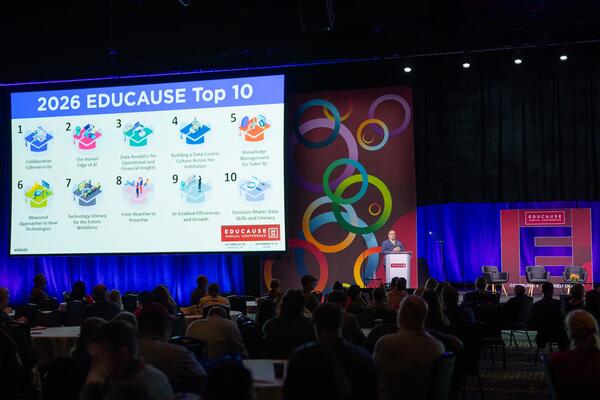
    Educause researchers at the event announced the 2026 Educause Top 10, a list of key focus areas they compiled based on interviews with leaders, expert panel recommendations and a survey of technology leaders at 450 institutions. The results underline how uncertainty around federal funding, economic instability and political upheaval is making it hard for leaders to plan.

    The 2026 Educause Top 10

    1. Collaborative Cybersecurity
    2. The Human Edge of AI
    3. Data Analytics for Operational and Financial Insights
    4. Building a Data-Centric Culture Across the Institution
    5. Knowledge Management for Safer AI
    6. Measure Approaches to New Technologies
    7. Technology Literacy for the Future Workforce
    8. From Reactive to Proactive
    9. AI-Enabled Efficiencies and Growth
    10. Decision-Maker Data Skills and Literacy

    For example, No. 6 on the list is “Measured Approaches to New Technologies.” Leaders say they intend to “make better technology investment decisions (or choosing not to invest) through clear cost, ROI and legacy systems assessments.”

    Presenting the top 10 in a cavernous ballroom in the Music City conference center, Mark McCormack, senior director of research and insights at Educause, said leaders feel pressure to make smart investments and stay on top of rapid advancements in technology. “The technology marketplace is evolving so quickly and institutions feel a pressure to keep up, but that pressure to keep up can lead to less optimal approaches to technology purchasing and implementation,” he said.

    “From some of our other Educuase research we know that quick fixes and reactive purchases often lead to technical debt and poor interoperability and additional strains on our technology teams,” he added. “That’s just not sustainable, especially with our tight budgets and our capacity, so we need to make decisions based on a clear understanding of cost and value.”

    No. 3 on the list, “Data Analytics for Operational and Financial Insights,” indicated technology leaders will respond to intensifying financial pressures through better data analysis. “Cuts to federal funding, enrollment trends, public skepticism about the value of a degree—so many of us are feeling that weight right now, and in this kind of environment our institutions are turning to data as a guide to help them navigate some complicated decisions,” McCormack said.

    Data can also help colleges identify priority areas for investment, such as enrollment targets, compliance requirements or areas of programmatic growth, he noted. “But our data can also guide conversations about where to scale back, and we need to be able to distinguish between high-impact priorities and areas that may no longer align with the institution’s direction.”

    Commenting on the top 10, Brandon Rich, director of AI enablement at the University of Notre Dame, said his institution is using AI to navigate tight budgets. “With the budget challenges we face, we see AI as a possible way to move forward and create efficiencies,” he said during a mainstage panel.

    Speaking with Inside Higher Ed, Nicole Engelbert, vice president of product strategy for student systems at Oracle, said colleges are reviewing their tech ecosystems more critically. “Institutions are looking to streamline, consolidate, shop their closet, because any dollar spent on extraneous technology is a dollar that isn’t going to be spent for research, student aid, recruitment, classes, faculty—all the things that make an institution healthy and vibrant,” she said.

    She expects the current political and economic climate will dissuade institutions from taking on expensive, transformational projects. “Making big changes on your payroll, on your general ledger, on your student enrollment takes huge amounts of psychic energy from a large population, and that population right now is very weary. They’re exhausted by the last year,” she said.

    One silver lining of higher ed’s financial uncertainty could be a shift toward more tactical forward planning, Engelbert said. “I hope there’s this new period where we look at transformation projects or technology projects more strategically, more critically,” she said.

    Collective Will, Individual Capabilities

    Other priorities on the Educause top 10 look similar to those from previous years: Improved cybersecurity, better data and data governance, and harnessing the power of AI are issues that have appeared on the list for the past five years.

    But Educause researchers say this year’s study shows leaders’ focus has shifted from infrastructure and platforms to the humans working with these systems. They break the list into two themes: collective will—connecting resources and knowledge across departments to “shape a shared institutionwide perspective”—and individual capabilities, or training and empowering people to realize the “net benefits” of the technologies and data on campus.

    “The thing that we saw that was very different is that … even as technology is skyrocketing, changing everything we do, we as higher education need to remember our humanity and lead with that because that’s what makes us resilient,” said Crista Copp, vice president of research at Educause.

    No. 1 on the list is “Collaborative Cybersecurity,” reflecting institutions’ urgency to safeguard their expanding digital borders.

    “The ecosystem is becoming a lot more distributed across devices and locations. That person who’s using their device logging in to that system from, you know, a coffee shop or wherever, they’re becoming more and more important to be educated and equipped to do that safely,” McCormack told Inside Higher Ed.

    “The other thing that did come up is an acknowledgment that as our tools are becoming more sophisticated … those threat actors are becoming more sophisticated as well.”

    Institutional data and how it is managed will also be a priority for technology leaders in 2026, according to the list. “Data Analytics for Operational and Financial Insights” is No. 3, “Building a Data-Centric Culture Across the Institution” is No. 4, and “Decision-Maker Data Skills and Literacy” comes in at No. 10.

    Copp said these issues suggest institutions will be tackling data from different angles. “It’s this triad of ‘Oh my gosh, we have all this information. And we don’t have it organized properly. We don’t know how to interpret it properly. And then we don’t know what to do with it,” she said. “I found it really interesting that … we saw three sides of the same thing.”

    AI-related issues also appear three times on the list: “The Human Edge of AI” at No. 2, “Knowledge Management for Safer AI” at No. 5 and “AI-Enabled Efficiencies and Growth” at No. 9. The growing focus on improving AI across institutions also represents a shift in what’s needed in the higher education workforce.

    “I think everyone, regardless if you’re in higher education or not, [is] facing workforce changes. And part of that is, who do we want to be? And we need to define [that],” she said. “No. 2 [on the list] … is the human edge of AI and it’s, ‘Although we expect you to use AI, we want you to come as a person first, because that’s what education is all about.’”


    Source link