Onboarding programs consisting of a brief history lesson about the institution and instructions for how to get a parking pass aren’t likely to inspire new hires. Here are three elements of onboarding programs that go beyond the basics to create a deeper understanding of campus culture and a sense of belonging.
Orient New Hires to Higher Education
Learning industry-specific skills and knowledge is essential for employees to thrive in their workplaces. Higher education is no different. New hires must quickly get up to speed on how their departments function within the context of their institution and its mission. This can be overwhelming for anyone, especially someone new to higher education.
To address this learning curve, CUPA-HR created Understanding Higher Ed Course 1 — An Overview of Higher Education for All Employees. The course is designed to help all higher ed employees understand different types of institutions, terminology, cultural hallmarks of the higher ed work environment, the basics of higher ed funding, and key soft skills that support success in the workplace.
Create a Sense of Belonging
A crucial aspect of the workplace that can’t be captured in a new-hire orientation video is the sense of belonging employees experience. And if staff members work remotely, opportunities to connect with coworkers and build community may be even more difficult to achieve.
To overcome these challenges, the University of Florida’s Academic and Professional Assembly (APA), led by several HR employees, reconsidered their approach to onboarding. Through their Warm Welcome experience they helped create a campus culture that fosters a sense of belonging for new staff. The APA helps spark campus connections by hosting welcome events and small groups where new hires can interact with high-level leaders. During these events, leaders share personal stories and insights about leadership, diversity and inclusion and the value that staff bring in the pursuit of the university’s many goals. This storytelling approach draws out leaders’ personalities, camaraderie, sense of humor and transparency, and allows staff to see the “human” aspect of a large institution. Read more about UF’s Warm Welcome experience to learn how to design a warm welcome experience for your staff.
Partner With Other Departments
Onboarding shouldn’t fall solely on HR’s shoulders. Support from many areas of the institution is critical for a successful onboarding program. Additionally, shared responsibility for onboarding can positively affect organizational culture, departmental buy-in and employee retention. Presenters from the University of Colorado Boulder shared their strategic partner model in a 2019 CUPA-HR on-demand webinar “Onboarding: A Strategic Partner Model for Bringing About Cultural Change.” Watch the webinar recording to learn more about UC Boulder’s model to increase employee engagement, retention and productivity while keeping the focus on institutional goals.
There are many reasons employees are drawn to work at an institution, and a successful onboarding program shows them why they should stay.
On September 12, CUPA-HR submitted comments in response to the Department of Education (DOE)’s Notice of Proposed Rulemaking (NPRM) to amend Title IX. The NPRM seeks to rollback and replace the Trump administration’s 2020 Title IX rule, specifically with respect to its grievance procedures, and establish expanded protections against sex-based discrimination to cover sexual orientation, gender identity and pregnancy or related conditions.
CUPA-HR filed comments to bring attention to the possible impact the proposed regulations could have on how higher education institutions address employment discrimination. In our comments, we highlight the two sets of grievance procedures promulgated by the proposal: procedures used for cases involving employee-on-employee sex-based harassment (section 106.45) and procedures used for sex-based harassment involving an employee and student, regardless of whether the employee involved is the complainant or respondent (section 106.46). Our comments argue that such procedures in cases where the employee is a respondent may be unnecessarily prescriptive and will interfere with existing obligations, policies and procedures already utilized by institutions that are required to handle such incidents of sex-based employment discrimination under Title VII of the Civil Rights Act of 1964 (Title VII) and state and local employment laws.
In light of our concerns, our comments ask the DOE to exempt any sex-based harassment of employee respondents against a student complainant from the section 106.46 requirements, and to exempt all sex-based harassment claims where an employee is the respondent, regardless of whether the complainant is a student or an employee, from the section 106.45 requirements. These comments directly align with the concerns and requests written in the American Council on Education’s comments, which CUPA-HR also signed on to.
Finally, our comments suggest that the DOE consult with other federal agencies with jurisdiction over discrimination law, including the Equal Employment Opportunity Commission to rationalize the requirements instituted by the Title IX regulations and Title VII, and to issue joint guidance on how to minimize potential conflicts between the obligations to claimants under Title VII and respondents under Title IX.
The DOE received over 200,000 comments in response to the NPRM, which they must now review prior to issuing a final rule to implement their changes. It is therefore unclear when we can expect the final rule and effective date of the new regulations. CUPA-HR will keep members apprised of any updates on the Title IX regulations.
Informational interviews can help your journey from PhD to Life
Jennifer Polk, PhD has been helping PhDs get clear on their career path since 2013. You may have read her articles on University Affairs, Inside Higher Ed, and The Chronicle of Higher Education. If you’re on #AcademicTwitter, you’ve seen her tweets @FromPhDtoLife.
Jen is an expert at helping grad students and people with doctorates confidently market themselves for the jobs they actually want.
What are informational interviews? And, how can they help your transition from academia? It’s all in this interview with career coach, Dr. Jennifer Polk.
Dr. Jennifer Polk, I’m so excited that you’re here to talk with me. Would you mind introducing yourself for everyone?
Jen: Sure, yeah. Thanks for having me!
So feel free to call me Jen, everyone. Dr. Polk if you want to be formal, but Jen is perfectly fine.
The short version is that I help PhDs get clear on their career path so they can confidently market themselves for jobs they actually want. Typically, that means outside of academia. But I’ve worked with everyone, on all the things.
I have a PhD myself in history. I got that 10 years ago. These days, I’m self-employed. And it’s cool. It’s good work to be able to help people figure out what’s next, and get there. It’s very empowering.
Jennifer: That’s great! Thanks for sharing that with me.
Now, I know that it’s really hard to kind of imagine what life might be like outside of the academy for many professors who’ve been in for a long time. But also for graduate students who are going through and really trying to figure out what their next steps are. It’s something that’s affecting everyone, no matter where you are in your academic career.
There may be a good opportunity for you outside of academia. Jen is someone that can help with that.
Jennifer: There’s a way that people can learn more about jobs outside of academia, and that’s through informational interviews. That’s kind of a jargon-y word. What is an informational interview?
Jen: That was a great prompt. Yes, check marks to all of what you said. Totally.
Informational interviews. If you haven’t heard this term before, it might sound very strange. It’s not very eloquent, right? But just know that it is a super common term. Even if you haven’t come across it before, it’s really common. It’s not just corporate. It’s common everywhere.
All it means is having a conversation with somebody who works in a job, a field, for an employer, or who has in the past that interests you. The specifics of that conversation depends on what you want to learn.
This is a learning experience. Sometimes people get the idea that this form of networking–yeah, an informational interview like it is a form of networking–but it’s not really about you. In fact, it is not about you pitching your services or you asking for a job. It’s a learning experience.
I want to emphasize that it is a community building experience. Do you want to be in community with this person and people like them?That’s a short answer to what [an informational interview] is. Just conversating with somebody else.
Jennifer: I love that. I think that so many people have a fear or anxiety about informational interviews. Maybe that’s because they don’t know what it is. It sounds like an info interview is a conversation you have with someone to learn more about their job, or their field. And learn more about them to see if they’re someone that you want to stay connected with, or maybe you want to do a job like that. Or, maybe you don’t. And that’s good information too. Thank you so much for clearing up that definition for everyone.
Jennifer: What advice do you have for those people who are feeling really anxious, or scared, or nervous about approaching an informational interview?
Jen: First off, what you described, Jennifer, is really common. If you are feeling that, welcome. You’re in really excellent company. I’ve been there, and so many of my clients, and the PhDs that interact with grad students, PhDs, all of the above have experienced that. It’s totally normal, common.
Those feelings can be what prevent folks from taking the leap into doing informational interviews. You’re in really good company there.
I’m not answering a question directly, but I will say that once folks start doing informational interviews, it’s like a light goes off. Everything changes. It’s really incredible. I think there’s so many different reasons for that. But I really encourage you to do it. Just take one step at a time. This is not the only way to do it. This is not like the way that is necessarily going to be right for you. But for example, it could be that you decide to do one informational interview with a person that you already know and trust.
Jennifer: Oooh.
Jen: Maybe they’re from your personal life, or family, or you worked with them years ago. So you don’t sort of already know everything about them in terms of their career, and their job, but you know there’s some level of comfort and trust. You say, “Okay.” Maybe you send them a text, or an email, Facebook message, whatever it is:
“Hey, can we have a chat about your job? Because I’m thinking about what I want to do next, and I’m confused about what some options are. You work as a project manager. That’s something that intrigues me. Can we just have a convo so I can learn more about that?”
This is relatively low stakes. That first step is important. Then you take another step after that. Right? This doesn’t have to be this big overwhelming kind of campaign that you go on. Just do it once. Send that one email, send that one message. That’s the first step.
Jennifer: So just sending that first message, and maybe reaching out to someone who you already know, who you’re already familiar with. That can be a really good idea for people who are feeling uncomfortable, or nervous, or anxious about that process. I love that idea, and I think that that would make it so much less anxiety provoking for me. Like, “Oh, you know, I do have people that I could reach out to about that kind of thing. I can have a conversation with that friend that I haven’t talked to in a few years.” I’m sure they wouldn’t be upset to hear about it. If they don’t have time, that’s okay! But I can reach out. That’s pretty low stakes for me, so I really like that.
Jennifer: When people are reaching out for the first time, is there something that holds them back from actually reaching out? Is there something that’s like preventing them from doing that step?
Jen: Yeah, to generalize, I think that folks can get in their heads. Shocking, right? Of course [sarcastically]. And they worry about things that are just way too many steps in the future.
I always like to remind myself, and you know sometimes others is appropriate: that is a later problem. So, first off, don’t get in your head too much.
I think what you said, that if they don’t respond, if they don’t have time, that’s not personal. That’s also a really important reminder. You can send the email. Whether they respond or not is not necessarily about you. Maybe they never checked LinkedIn. Maybe their parent just died. Maybe they don’t have any child care in a pandemic. You don’t know what’s going on, right?
Jennifer: Yeah.
Jen: You know, decide not to take it personally. I will say that when you send that first message, your job is not done until you’ve sent the follow-up. I think that’s really, really important advice.
My inbox is a mess, always. You know, direct messages [DMs] on Twitter or LinkedIn, there’s no kind of way to like Mark As Read, or file it into different folders. These things are just messy by nature. Not everyone is really skilled at managing their inbox. So, your job is not done until you’ve followed up. If you need to.
Jennifer: That is such great advice. You know, I did this kind of workshop at the beginning of the pandemic that was all about How to Stay Connected During Social Distancing. During that workshop I taught people that you have to assume that people are busy, or that they’re too swamped with things in their own life to hear you the first time.
That follow-up is not just a courtesy for them, but for yourself, because you do want to be heard. Right? Otherwise, you probably wouldn’t have reached out in the first place. Sending that follow-up is a good thing to do for yourself as well as the people who are around you.
And assuming that people might not have time, or that their schedules might change, is going to set you up for not being disappointed. Just expect something to come up. And then if it does, you can be flexible with it. This is kind of a low stakes thing for you. You’re reaching out, and it’s okay if they’re too busy on the other end. Most of the time, they’ll tell you if they have the capacity to do so.
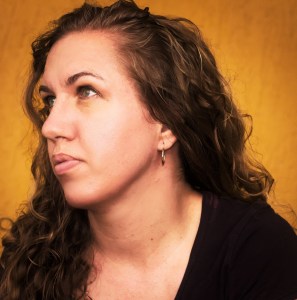
Jen Polk, photo by Nadalie Bardowell
Jennifer: One thing that I want to be sure to ask about is can an informational interview help you get a job? Does that get me a job if I do those? What is the correlation between informational interviews and careers?
Jen: That’s a great question. So how are these two things connected? I already said don’t think of an informational interview as a way for you to ask for a job or pitch yourself to an employer. But it does happen.
The outcome of informational interviews are unknown at the outset. And I have heard the stories. These are true stories that sometimes happen to folks where they do an informational interview and all of a sudden the person that they’re interviewing says
“Hey, you wanna join the team?”
“There’s an open position I think you’d be great for.”
“Hold up, something is coming through. I’ll message you when that happens.”
This absolutely does happen. That can happen in your first informational interview, or your 150th. Purposefully, that’s a big number, I know. So, it definitely does happen.
I would say you can be open to that. But that is probably not gonna happen to you. Especially, I would say, if you’re switching sectors potentially.
Jennifer: Okay.
Jen: That doesn’t mean there’s no connection. Learning really is important. Learning is important for you so that you
Can make better decisions about what you want
Have more of the information about what this job title is all about
What is this job ad actually mean when it’s translated through an actual person who’s doing it
Is this employer actually toxic? Based on the job ad, you’re not sure, you know. The learning piece is really important for you to make good decisions.
The learning piece also helps you craft stronger application materials because you get a sense from communicating interacting with that person more about
What that employer cares about
What that field is actually really about
What kind of stories they find compelling
You can write better cover letters, you can write better resumes, and application materials. These are kind of indirect connections.
A lot of the time when folks are thinking surface level, they will think, “Well, my informational interviews did not lead to a job.”
Yes, they didn’t lead to a job directly. But then when you asked, what was the value of informational interviews?
“Oh, well I learned that there was a whole field I never heard about.”
“This new company that you know was doing exactly what I wanted.”
“There was this this job title that I thought was totally something different, but actually was exactly what I was looking for.”
Et cetera, et cetera, et cetera. So indirect, very important.
They are very self-affirming for a lot of people. They boost the confidence of people doing informational interviews. I’m not promising that, but that really is often an outcome, an unanticipated bonus. It is confidence boosting for a lot of people. It is affirming to have somebody give you some of their time, to give you advice. That is a gift, right? It’s a nice thing that they respect you. They take you seriously. They want to help you. That’s nice.
Am I making sense? Like it’s good. And that helps your job search.
Jennifer: Oh, yeah. I think that that confidence thing is something.
If you’re one of those people who’s nervous or anxious about it, and you know that not only doing this can help you
With your career
Make better decisions
Network
Meet more people
Boost your confidence by practicing more and reaching out to more people that you admire
I mean that, that’s great. That is some incentive to actually try an informational interview if you’ve maybe been on the fence. So, I love that.
Jen: Yeah, now you’ve got this new person kind of on your team.
Jennifer: I love that idea, having someone on your team was kind of true. The more I learn about someone, the more I want to root for them. The more I want to cheer them on. If I’m gonna sit there and talk with someone for half an hour in a way that’s helping them, I’m also feeling like I have a little bit of a stake in their outcome. Like I want them to do well.
If you’re feeling that anxiety, remember that that’s someone who’s trying to help you, who kind of wants to be on your team. You can let them by reaching out. I love that.
Jennifer: How do you find people to do informational interviews with? How can people get started? I know you said that you can reach out to a friend or a family member, but what about people you don’t know?
Jen: Yeah, all of the above. Really everywhere. Some examples are in-person conferences. These as someone put it to me on Twitter today, “organic conversations.” So, after the panel, in the hallway. Right, totally cool.
So from your professional life:
People that you’ve worked with in the past
Other professors in your department
Other grad students that you know have already graduated and gone off to work in industry
Anybody that you’ve interacted with professionally over the years is fair game
Social media.
LinkedIn is kind of an obvious one. It’s a great one. These people can be total strangers, but I think it’s really helpful in terms of actually making the connection, and by that I mean like actually having the conversation, and not just sending the message. It’s helpful if there is some sort of connection already there (i.e. you have a person in common, you went to the same undergraduate institution).
Twitter. People you follow, people that follow you back, are you communicating in the same thread? All of the above really matters.
You can also just find people randomly online. Somebody was
On a YouTube channel
Participated in a podcast
Wrote a blog post that you admire
I did that for one of the folks I did an informational interview with 10 years ago: a woman who wrote a blog post about AltAc career transitions. I looked her up. She was in Toronto. I’m in Toronto. She had an English PhD. I’m a history PhD. I was like well, there’s some connections there. So, I sent her an email. And not so far into the future we met in person.
Jennifer: I love that!
Jennifer: I have a question. You said something a while back zero, to your first interview, to like 150 interviews. How many info interviews have you done?
Jen: Oh, boy. I don’t know.
Jennifer: [Laughs.] It’s a big number.
Jen: Well, I probably haven’t done that many. And, not all of the conversations I’ve had that are informational interview-like were seen in that light at the time, if that makes sense.
Jennifer: Even though it was doing the actions of informational interviews, it wasn’t necessarily considered an informational interview at the time.
Jen: Yeah. Informational interview is a form of networking, but it’s a form of networking where you as the person doing the interviewing–doesn’t always happen this way in reality–but all you need to do is prepare a list of questions and ask.
In that way, there is less kind of back and forth versus ‘networking more proper,’ if I can make that distinction, which is really meant to be a real true back and forth where both parties are sharing.
I am not suggesting that in an informational interview situation you’re not being helpful, and there’s no back and forth. Just, if you’re feeling nervous about it, remember all you need to do is go in as a researcher with a list of questions. I say that to hopefully take the pressure off.
So why did I say 150?
Jennifer: Yeah.
Jen: There was a reason I picked that number. A client that I had last year, over the summer and fall, now it’s the summer again, so about a year ago. She did 150 informational interviews. She told me this subsequently. And that was a choice that she made. You know, there’s reasons why that suited her personality, why that suited her job search, we could talk more about that. The opportunities that she pursued came directly out of that and not out of her applying to jobs. So the jobs that she ended up getting, she took a couple of part-time contracts with startups and small organizations…
Jennifer: Wow.
Jen: Those came directly out of informational interviews. And never did she apply formally for a position.
Jennifer: That’s amazing.
Jen: Now, that is one example. There are many, many examples. But that is one true real life example.
Jennifer: Oh, that’s great. 150 interviews helped that particular person because it matched their personality to do a lot of them. And it helped them find the career path that they were interested in. So that’s very cool.
What if you’re like, “Oh my god, 150 is nowhere near what I’m capable of. I can do like five informational interviews?”
Jen: Yeah, I think five is a great number.
Let me talk about my process when I advise PhDs on the job search. And when I say PhDs I mean people that have a PhD, people that don’t have a PhD but sort of you know relate, grad students, all of the above.
The process that I would recommend is first to kind of get right in your mind about what is going on. So I call that Prep.
And then you go into Focus. And this Focus section is you want to focus on yourself. That’s basically self-reflection, right? What do you want? What do you need? What do you have already?
Then, the third step is Identify. Identify some possibilities. That’s when you do research. A big part of that research is probably going to be informational interviews. But that’s not the only type of research you’re doing.
If you have limited capacity for informational interviews, at least right now, you can really emphasize the other types of research. But you’re going to do it strategically. You’re going to get your mind right. You’re going to focus on yourself.
And then you’re gonna say, okay, based on what I’ve learned about myself, what are the types of jobs that I want to do some research on by reading
Job ads
Company websites
Blogs
Listening to podcasts
To learn more about whether these things would align with what I know about myself.
Jennifer: Right.
Jen: Then you’d be very selective, “Okay, so it seems like project management is a role that is really going to suit me. Or, instructional designer.” Let’s say, “Those are the two that I’m really thinking. I haven’t really talked to anybody yet about them.”
Then, “Okay, let me go and talk to five people. Maybe three for one, and two for the other. And see you know, if I’m on the right track.” And maybe you are. Maybe you’re not, right? Maybe you need to pivot a bit. Maybe you decide, “Well, it’s not instructional designer. It’s more educational developer I’m going for, which is slightly different.”
Maybe at that point you decide you want to do more informational interviews. But the first five were really helpful in narrowing and pivoting. Does that make sense?
Jennifer: That makes so much sense. I absolutely love that. It sounds like having that process, having that kind of approach really helps people who are going through this.
Jennifer: Can you tell me a little bit more about your program? I’m sure people who are listening want to hear about it because it might be right for them.
Jen: Yeah, thanks for asking. Let me finish the steps here. So yeah: Prep, Focus, Identify. Right? That’s where you really want to narrow down like, “Okay, this is what I’m going for.” So this person has decided on educational developer, right?
Then step four is Market. I use that term purposefully: Market to employers. That’s when you want to write your resume and worry about your LinkedIn profile, or not, depending on your job search.
Jennifer: I bet some people are really surprised right now. They’re like, “I thought I needed my resume first.”
Jen: No.
Jennifer: People, you really need this program because this is telling you that you might be putting your energy into the wrong places at the wrong time. Oh, I love that, Jen.
Jen: Yeah, exactly. Thank you for saying that. So, do those things last, folks.
Jennifer: Wow, yeah.
Jen: Don’t skip the earlier stuff. That’s what I found. That’s why I built it this way.
So what is my program? So I have a PhD Career Clarity program. This is a paid program. It’s 12 months access. That doesn’t mean that it takes 12 months, but you’ve got 12 months because you know everyone’s life is different. And job searches can take time depending on you.
It’s basically an online course, self-paced. You go at the pace you want. It’ll take you through all of those four steps from “I don’t know if I even I’m ready to job search or want to,” all the way to interviewing for positions.
But let me say, if you’re thinking about it, or you’re not even yet thinking about it but you’re curious, I do have a free training for PhDs.
Jennifer: If you’re even thinking that you know a program like that might be helpful for you, want to get that group coaching in then be sure to sign up because that free workshop is going to give you more information about it. And it’s going to tell you some of those myths that might be holding you back from really getting clarity on your career, what you want to do next.
This is your life, right? This is important. It’s a big decision to figure out what kind of path you want to go down. This is a great program that can help you get there. I can vouch for that because my fiancé needed this program to help and figure out his next steps. He’s been in it for months now, and found it really helpful.
Jennifer: What’s a really good informational interview question that I should add to that list?
Jen: Kind of taking a step back from your question: what to ask you can Google the stuff and get lots of different lists. There’s value in that. Take a quick scan of what people say.
But ultimately, you want to go through: what do you actually want to learn from this person? What do you want to learn from them right now? Really do that introspection to decide what is most important.
Why do I say that? I had a client a couple of years back. He came to me and had already done a bunch of informational interviews, probably a dozen or two of them. And it just wasn’t working.
I was surprised, but it turned out, and this was his insight, that he’d done informational interviews because that was a task that had been suggested to him as a thing that he needed to do. So he went out and did it, but he never actually really cared about the people and the career paths that he was learning about.
He didn’t care, right? So it was really just a road exercise for him. Aha, okay. Once he determined, “Well actually, I really am interested in this. And this person is really cool because…” That like additional energy and interest, then the informational interviews just were totally mind expanding.
What is a good question to ask in informational interviews? It really is going to depend, classic academic answer, on what you really want to know.
Sometimes folks, I think there’s a real skill in asking questions. You might not be as skilled at it yet as you can become to be.
One tip is that sometimes you might think, “Well, I’ll just ask this person what their salary is.” But you’re like, that’s kind of inappropriate, but I want to know what I can expect to make. Aha, well then that’s the question you want to ask.
Instead of asking the person how much money do you make? Or, how much money did you make when you first entered this field? Which is the first question a lot of folks think to ask, what do you actually want to know:
How much money could I expect to make?
What is a reasonable range for somebody with my background in experience pivoting into this role?
Jennifer: That is a great question. Making it about yourself really helps take that kind of pressure off someone to talk about their own salary.
Jen: Exactly.
Jennifer: They may open up about it anyway. They may be totally fine talking about financial things. But putting the onus on you, making it about yourself, seems so much nicer. I like that. I’d feel much more comfortable with that.
Jen: A similar piece of advice to that is sometimes you think, well let me ask this person about something specific to them. Or, specific to their team, or employer. When actually what you really want to know is the trends in that sector or field in general. Does that make sense?
Jennifer: It does.
Jen: Right. I mean maybe you do want to know about that company specifically, but typically you probably don’t.
So instead of: What are the parental leave provisions on your team?
What you really want to know is: What are the parental leave trends that you’re seeing in this industry in general?
Jen: Oh that is some next level thinking. My fiancé has been doing informational interviews and learning from all these people. He’s definitely getting some great insights. But thinking about the trends, thinking about how it’s affecting more than just the individual, is a bigger approach. Wow.
We’re all researchers, right? We’ve all done that in our work. But researching your field, researching what you want to do next, is not something that people are always thinking about putting energy into. But it can really pay off. I just love that informational interviews can really help people experience some of that excitement, be warned about some toxic workplaces, I mean get the information that they need to actually make decisions for themselves. So that’s my favorite thing about it.
Jennifer: Is there anything else you’d like to add about informational interviews before we wrap up?
Jen: Let me repeat something I said earlier. That this is a real sticking point for a lot of folks. That they get stuck. And even folks in my program.
In the program, it’s a self-paced online course, but I’ve got regular live small group meetings over Zoom. Sometimes folks come and I ask, have you done informational interviews yet? It’s like, “No, not yet. I’ve skipped ahead.” It’s like, “Thank you. Well let’s talk about that.” Right? Don’t skip this stage. There’s different approaches, different strategies for every specific person, of course. And we can talk about that.
I think: Just do it. You can talk about why and how, et cetera. But ultimately, just do some.
Jennifer: Yeah! And if you do it, you can build some confidence. You can do some networking. You can really get comfortable talking about yourself, and asking people questions. You can get better at asking questions. There sounds like so many benefits, it’s kind of like well you definitely should be doing this. But also you’re gonna benefit from it too.
And you can email me [email protected]. I’m happy to get your messages. And follow up if I ignore you.
Jennifer: That’s right, follow up! Be sure to follow up.
Well thank you so much for listening to this interview. Be sure to like this interview. And subscribe to The Social Academic so you don’t miss the next one. Jen, thank you so much for joining me!
Jen: Yeah, you’re welcome. It’s always fun to chat. I’ll be back in a year or two, right? No pressure!
Jennifer Polk, PhD, is a career coach and educator. She regularly facilitates professional development workshops and delivers presentations for students and postdocs. Her University Affairs blog was a three-time gold winner from the Canadian Online Publishing Awards. Jen’s essays have also appeared in Inside Higher Ed, the Chronicle of Higher Education, the Globe and Mail, Academic Matters, as well as in three books.
More recently, she was an expert panelist for the 2021 Canadian Council of Academies report, Degrees of Success, on the challenges PhDs face transitioning to employment. In addition, Jen currently serves on the board of directors for CAGS, the Canadian Association for Graduate Studies. She earned her PhD in history from the University of Toronto. Find Jen online at From PhD to Life.
It’s been ages since I updated my blog. I guess having two kids has prioritized my time just a bit.
The last post on this blog was back in 2019 when I wrote about our move from the United Kingdom to the United States.
And then the pandemic struck a year after we had moved.
One of these days I’ll get around to writing something about my move from being a freelance consultant (9 years!) to being a vice president for two different edtech companies and then leaving my last role in order to be a full-time parent to my two kids.
But this post is really more about our news from 2022…when we moved to the Netherlands.
3 countries in 3 years. Just a quick update. Nothing fancy or in-depth. Back to part-time freelancing for me whilst Gillian is full-time freelancing with her writing business.
We’re learning Dutch and making friends from around the world who have settled in the Randstad. With more than 1,500 miles (2400+ km) on the bakfiets (Dutch cargo bike), we are cycling daily and enjoying life.
Each month, CUPA-HR General Counsel Ira Shepard provides an overview of several labor and employment law cases and regulatory actions with implications for the higher ed workplace. Here’s the latest from Ira.
University Football Coach’s First Amendment Retaliatory Discharge Claim For Posting “All Lives Matter” Sign On His Office Door Proceeds
A federal district court judge recently denied a University of Illinois motion to dismiss its former offensive coordinator’s claim that his retaliatory termination was in violation of his First Amendment rights by posting a handwritten note on his office door stating “All lives matter to our lord and savior Jesus Christ.” The federal judge ruled that the former coach was not acting within his official duties when he posted the note. The judge concluded that the plaintiff was not paid by the university to decorate his office door, but rather was paid to coach football. Therefore, the note expressed his personal views (Beathard v. Lyons (C.D. Ill,. No, 21-cv-01352, 8/11/22)).
The court ruled that it is premature to decide whether the university can justify the termination because “there is not enough information to properly weigh” the interests of the university against that of the public employee in this matter. The plaintiff alleges that someone posted a general statement without his permission that supported Black athletes at the university in the wake of George Floyd’s death. He claims to have taken down the note and posted his own handwritten note. According to the complaint, his note upset some players who boycotted practice. CUPA-HR will follow developments in this case.
Federal Appellate Court Holds That Gender Dysphoria Is a Disability Covered Under the ADA
The Fourth Circuit Court of Appeals (covering Maryland, Virginia, West Virginia, North Carolina and South Carolina) recently became the first federal appellate court to rule that gender dysphoria is a disability covered under the Americans with Disabilities Act (ADA). The 33-page majority decision was accompanied by a 21-page dissent. The appellate panel ruled 2-to-1 that gender dysphoria is covered under the ADA (Williams v. Kincaid (4th Cir. 21-2030. 8/16/22)).
The ADA contains a statutory provision excluding gender identity disorders from coverage under the ADA. The appellate court noted that the American Psychiatric Association (APA) removed gender identity disorders from its diagnostic manual nearly a decade ago. Gender identity disorders had referred to a condition of identifying as a different gender. The APA replaced the gender identity disorder diagnosis with the more modern diagnosis of gender dysphoria. Gender dysphoria is currently contained in the APA’s diagnostic manual and is a “clinically significant distress or impairment related to a strong desire to be another gender.” The APA says that the condition can interfere with an individual’s social life, their ability to do their job and other daily functions.
The appellate court concluded that the “plain meaning” of the ADA’s exclusion of gender identity disorders as “it was understood at the time of enactment” does not then or now exclude gender dysphoria from ADA coverage. The court concluded that “the obsolete definition focused on cross gender identification; the modern one on clinically significant distress.” The dissent disagreed stating that “Judicially modifying the meaning of a statute because of society’s changing attitudes not only invades the province reserved for legislature, it turns the statute into a moving target.”
Transgender Class Against the State of West Virginia Alleging State’s Denial of Gender-Affirming Care Violates Obama Care Statute Prevails in Trial Court
A class of more than 600 transgender Medicaid participants prevailed in federal court against the state of West Virginia where a federal judge held that the state’s denial of gender-affirming care violated the federal anti-discrimination provisions of the Obama Care statute and the U.S. Constitution (Fain et al v. Crouch et al (3:20- cv-00740 S.D. W.Va.. 8/2/22)). The case may have applicability to other state medical and health plans.
The court recognized that often the same procedure is used to treat a variety of cases and it is unlawfully discriminatory to deny transgender patients similar treatment given to non-transgender patients.
Court of Appeals Approves NLRB Order for Private Employer to Pay Union Legal Fees Incurred in Collective Bargaining Process
In a case applicable to private colleges and universities which are subject to National Labor Relations Board (NLRB) jurisdiction, the U.S. Court of Appeals for the Ninth Circuit (covering California, Oregon, Washington, Montana, Idaho, Nevada and Arizona) affirmed an NLRB decision ordering an employer to pay its union’s legal fees incurred in the collective bargaining process (NLRB v. Ampersand Publishing (9th Cir. No. 21-71060, 8/11/22)).
The Ninth Circuit concluded that although the NLRB lacks jurisdiction to award attorney fees as a remedy in the litigation context, it is fully within their authority to award such a remedy in the collective bargaining context. In this case, the union filed unfair labor practice charges alleging the employer’s refusal to bargain. The union claimed it had to incur extra attorney fees as part of the bargaining process because of the employers violation. The court rejected the employer’s argument that the legal fees were akin to litigation costs because of the unfair labor practice charges filed with the NLRB. The NLRB disagreed and attributed the attorney fees of $42,000 to the collective bargaining process. The case involved the Santa Barbara News Press as the employer and a local teamster affiliate that has incurred the legal fees.
IRS Initiates Pilot Program Allowing Workplace Employee Benefit Plans to Correct Errors Before Formal Audits Commence
Under a new pilot program, the Internal Revenue Service (IRS) will allow workplace benefit plans to correct errors before investigators formally commence an audit. As part of a new pilot project, about 100 U.S. workplace benefit plans, including retirement plans, have received letters from the IRS since June allowing selected plans a 90-day window to correct mistakes in plan design, administration or documentation before regulators launch formal audits or close out case files.
Self-identified corrections of this sort are not new to the IRS, however, before this pilot they were only available to employers who had not been targeted by an audit.
Federal Judge Blocks Florida Workplace Bias Training Restrictions
A federal district court judge approved a preliminary injunction barring the enforcement of a Florida statute which restricts workplace bias training from teaching about unconscious bias. The Florida statute known as the Individual Freedom Act (IFA) bars employers from endorsing various race, sex and ethnicity-based concepts during workplace training.
The plaintiffs are a coalition of employers and diversity and inclusion specialists who conduct workplace training. The judge ruled that the Florida statute likely violates the First and Fourteenth Amendments and that the plaintiffs will incur irreparable harm if the IFA is allowed to be enforced (Honeyfund.com Inc. et al v. Ron DeSantis et al (Case no. 4:22-cv-00227. N.D. Fla., 8/18/22)).
Accountability and time management are valuable skills in graduate school
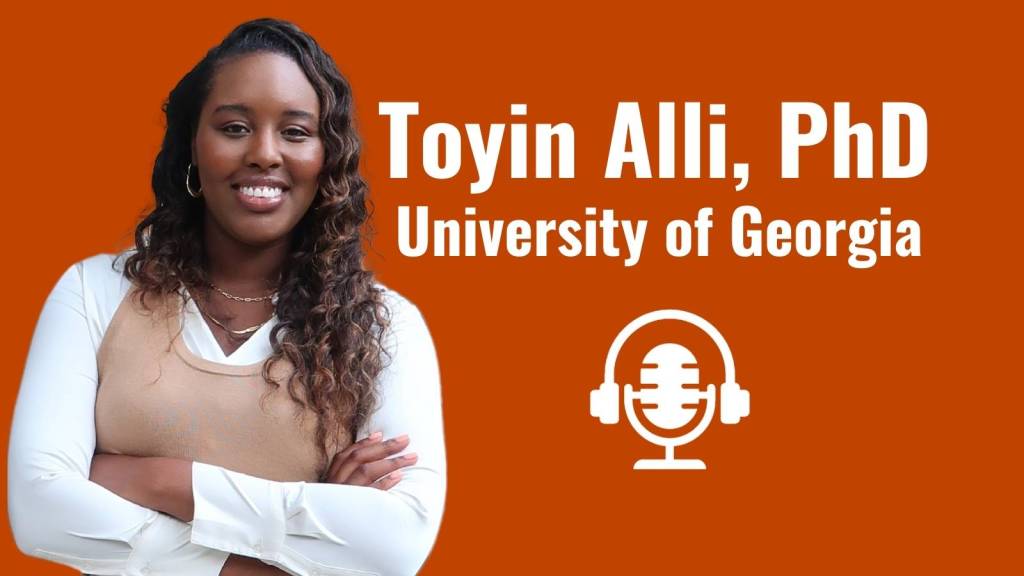
Toyin Alli, PhD of the University of Georgia helps students inside and out of the classroom. She loves teaching math, it’s her dream job. She’s also making greater impact with her business, The Academic Society LLC, which helps students succeed in grad school.
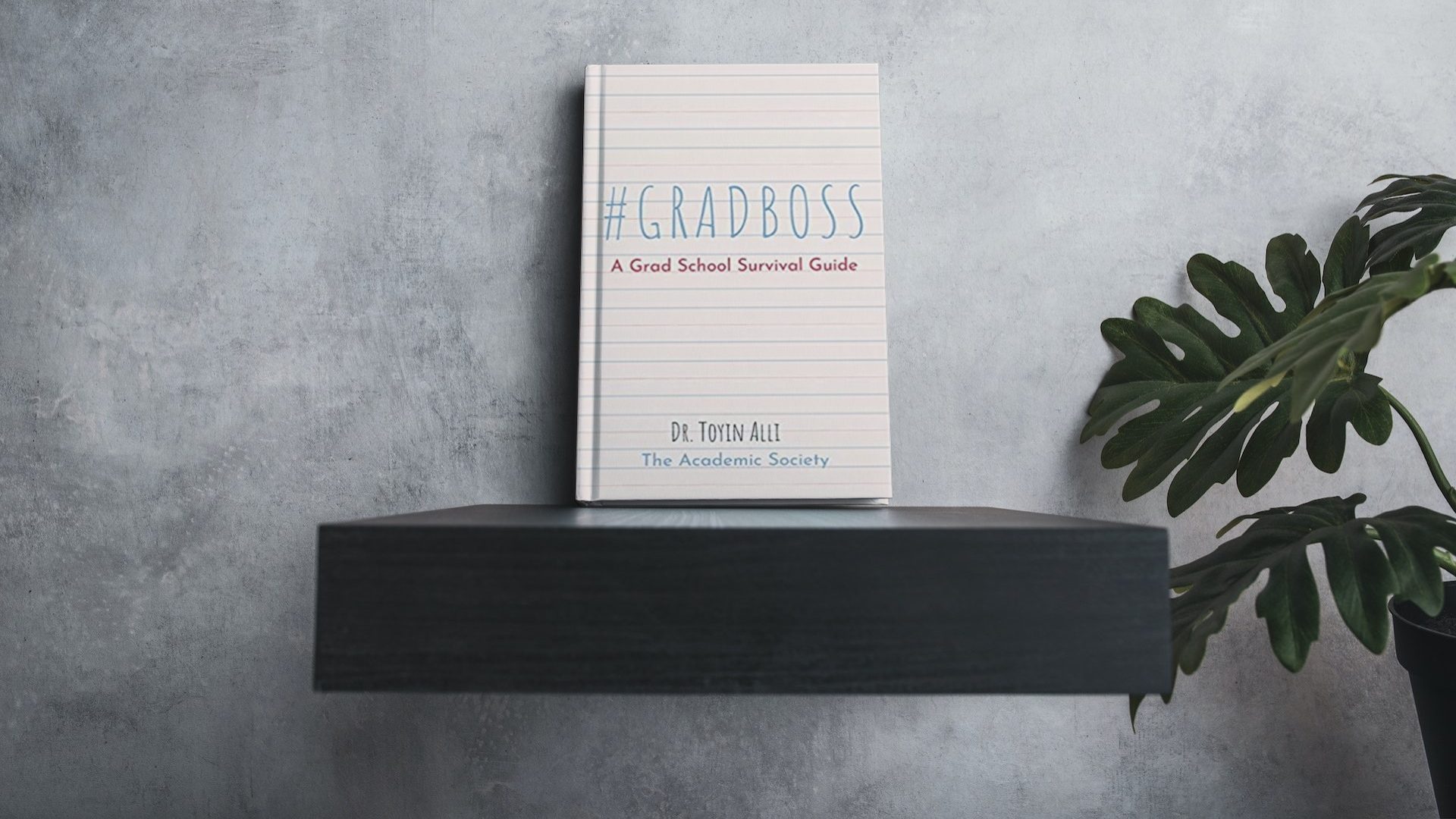
In this featured interview, Toyin talks about her book, #GradBoss: A Grad School Survival Guide. Inspired by graduate students in her Facebook community, Toyin wrote this handbook in 6 weeks during coworking sessions! The book is packed full of advice and stories about grad school.
We also talk about YouTube, and Toyin’s love for teaching.
Jennifer: Hi everyone. This is Jennifer van Alstyne. Welcome to The Social Academic.
Today, I’m talking with Dr. Toyin Alli, a senior lecturer at the University of Georgia. Toyin, I’m so excited to have you on The Social Academic, and to feature you. Would you mind introducing yourself?
Toyin: So I am Toyin Alli. I’m so excited to be here. Thank you for inviting me.
I am a senior lecturer at the University of Georgia. I’m a teaching faculty member, so I do a lot of teaching, meet with a lot of students.
My go-to is those introductory level math classes where I can show students who believe that they’re not good at math, that they can be great at math.
Jennifer: That would be me [raises hand laughing].
Toyin: And they can enjoy it. That’s my personal challenge I have every semester.
On top of being a senior lecturer, I also run my own business called The Academic Society, where I help graduate students with time management and productivity. I also have a consultancy where I help other academics with their businesses. And setting up systems so that they can have a semester approved business that runs while they’re super busy in the semester.
Jennifer: Oh, my gosh, that is so much stuff. It’s amazing that you’re making it all work. You’re a teacher. You’re helping graduate students actually navigate their time in grad school. And you’re helping other academics who are wanting to start businesses like yours.
You must be good at time management, otherwise you wouldn’t have time for it all. I think it’s great that you’re helping other people with that too.
Jennifer: I love how open you are in your bio on your website about how grad school kicked your butt. And how time management and productivity made such a difference for you. I’d love for you to talk more about that and maybe your book, #GradBoss.
Toyin: Graduate school is definitely an interesting experience and journey. A lot of people have negative thoughts associated with grad school.
Once I really got the hang of grad school, it actually became great. I ended up having a great experience in grad school, which a lot of people do not.
What I found was, it’s really like that underlying soft skill that makes grad school so different. It’s the time management and productivity skills that we aren’t taught grad school, but we’re expected to just do. Those time management and productivity skills, they’re underlying everything. Those are the things that help you actually have time to do your research while you’re
Teaching classes
Taking classes
Going to seminars
Presenting
All that stuff
What I found from graduate students–and even myself when I was a graduate student– it’s very overwhelming. And there’s a lot to do. It’s hard to figure out what to do first. When you’re struggling to figure out what to do first, it kind of just paralyzes you. You kind of do nothing, and that’s where the procrastination happens. That’s where the burnout happens. I really like to jump in and help students figure out what to do first, and how to manage all of that.
When I started graduate school, I thought I was pretty prepared [laughs], because I did undergraduate research. My mom has a PhD. She told me about grad school. But something about experiencing it was just completely different. I had to learn that my undergraduate study habits were just not going to suffice in grad school.
I learned that other students were actually spending time before class doing readings [laughs], and that’s not something I ever had to do in undergrad. It was learning how to make time for those things that I’m not used to putting in my schedule, figuring out what my priorities should be as a grad student. Once I figured that out, and once I figured out how to learn math–which is funny–that’s when I really got a handle on grad school.
In my 1st semester of grad school, I took a class called Topology. It was something that I had never even heard of in undergraduate school. That class was just so foreign to me. I didn’t do the best. I’m sure I would have passed the class, but my professor ended up giving me an Incomplete [grade].
Next semester, in the Spring, I had to meet with him every single week and prove theorems on the board from that class. Every single week. There were tears involved. But in that process, I learned, “Oh, this is how you learned math.” From then on, I knew exactly how much time I needed to spend in my classes. I knew what I needed to do to actually understand what was going on, how much time I needed to allot for my homework.
Once I figured that out, I feel like everything was just unlocked for me. While grad school was still a lot of work, I enjoyed the experience.
Jennifer: I think that it’s really interesting because I see a lot of people on social media especially, talking about how they wish they had parents who went to grad school and who’d experienced some of that. Or, maybe who were academics themselves, to be able to highlight some of that hidden curriculum once you get to grad school. It’s the things that most people just don’t know about grad school.
What I’m hearing from you is that even though your mom had a PhD, there were still a lot of things that you had to learn. That you had to teach yourself and you had to figure out how to do. And it sounds like that one-on-one attention from the professor who gave you that Incomplete provided you some of those resources to be able to replicate that in other areas of your grad school life. It’s a really interesting story. So thank you so much for sharing that with me.
Is that something you talk about in your book, #GradBoss?
Toyin: Oh, yeah. So I have a book called #GradBoss: A Grad School Survival Guide where I share my experiences in grad school: the things I learned, the failures that I went through in grad school. As well as the 10 things that you should know before going to grad school (and even after you started grad school).
Things to remind yourself about:
Time management
How to make friends
Imposter syndrome
Failure in grad school
I talk about all of that in the book. And I also share my stories as well as other grad student stories.
Jennifer: Oh, that’s great. I think that book would be so helpful for people. I wish that I had it when I was in grad school, because I felt like a lot of the areas you just talked about were things that I struggled with. Or, maybe I had more anxiety about that than I thought my friends did. Having a guide or some kind of handbook would have been so helpful for me. If you’re a grad student reading this, please get #GradBoss.
Now, when did you write that book? What inspired you to actually put words on paper?
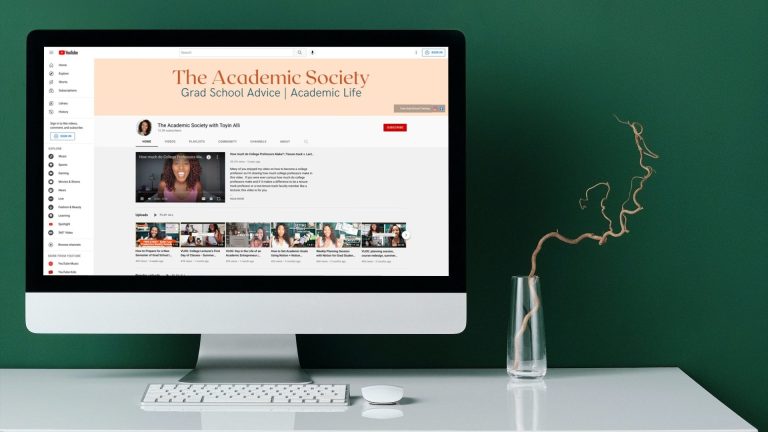
Toyin: I have a YouTube channel called The Academic Society with Toyin Alli, and I have been sharing videos about time management and grad school stories, things like that.
I also had a community on Facebook for graduate students under the same name, where I help graduate students. Something I learned about grad students is they’re reading all the time.
Jennifer: Mmhmm [affirmative]. [Laughs.]
Toyin: I’m a mathematician. And I will say the reading was very minimal. It was mostly practicing problems, working things out. When I got to the research portion, then I would read papers. But math papers are so short, like 6-7 pages. They’re very short. Yeah, [laughs].
Jennifer: That’s short! Yeah.
Toyin: When talking to all these grad students, they’re telling me how much they’re reading. And I’m creating video content. I was like, “I should probably try to meet them where they are.” They’re already reading. Maybe I could put my knowledge into a book.
So I posted in my Facebook group, “Hey, I’m thinking about writing a book about surviving grad school. Does that sound like a good idea? Would you read it? And what would you want me to talk about?”
And they’re all like, “Oh my goodness. Yes, I would love a book. Here are the things I want you to talk about.” They listed about 10 things, and those became the 10 chapters in my book.
Jennifer: So that was really inspired by the people who you were already working with, who were already in your community, and who already needed your help. And they actually helped outline the topics and ideas that you wrote in the book.
I love that! I love that it was inspired by social media. That’s so cool.
Toyin: I know!
I realize I didn’t answer your question. When did I write it? I believe it was the summer of 2018. Or maybe it was the summer of 2019.
But something that I talk a lot about for grad students in grad school is you don’t want to do this alone. You don’t want to be isolated. And it really helps to have accountability. I’ve noticed that the difference between making a plan and actually following through is the accountability.
Jennifer: Mmhmm [affirmative].
Toyin: Whenever I set to do a task, I’m going to try to build in the accountability.
I’d never written a book before. I’m not a writer. I don’t call my myself a writer even though I guess I am because I wrote a book.
Jennifer: Yeah, you’re a writer!
Toyin: But I was like, the only way I’m gonna do this is if I have people along for the journey. I had this program that’s now called Focus, but at the time it was called Productivity Accelerator. I was like, “Anybody doing some writing over the summer? Anybody working on their thesis, dissertation writing, publishing papers? Do you wanna write with me?”
I actually got grad students involved. We would sit on Zoom for hours each day. We would talk about our goals. We would use the Pomodoro technique and write for about 45 minutes, chat, write for another 45 minutes.
I wrote the whole book in about 6 weeks in the summer, mostly with other graduate students.
Jennifer: Wow! In those coworking writing sessions. That is awesome. And Pomodoros that was something that works for you. And they worked for everyone else because everyone can follow this same kind of timeline doing these smaller, shorter tasks.
Wow, that’s so cool. And you got it done in only 6 months, that’s amazing!
Toyin: Six weeks!
Jennifer: What? Six weeks, is that what you said? [Laughs], I lengthened that. That’s incredible. So six weeks brought you #GradBoss, and that was inspired by graduate students who were in your community. And written with graduate students in that same kind of virtual space and while you’re talking about your goals and everything in six weeks. That is such a cool story. I’m glad I asked about that.
Jennifer: You talked a little bit about how social media is something you use for your community, but what does your online presence look like? Like what social media platforms are you on? Do you have a website? What is your online presence?
Toyin: Yes, I do have a website. I started with the website, as a home base for my brand. That’s where I would put my blog posts back when I was writing regular blog posts. I would create freebies or lead magnets–I would create some type of value for my audience in exchange for their email address. I would say my website and my email newsletter, those were what I built up first.
Then I remembered a dream that I had back when I started grad school. I started grad school in 2016. I loved YouTube. YouTube was everything for me. I watched all kinds of videos, learned about
How to do my hair
My makeup
What to wear
All of the things
When I first started grad school, I was like, “I really wanna be a YouTuber.” But I had this YouTube channel called YouTube University, where it would just be me trying to follow YouTube tutorials and do things. But then my mom shared my videos to everyone she knew, and I got so embarrassed. I was like, “No, I’m not doing this again.”
Jennifer: That’s so funny. She probably shared them cuz she was really proud of you. You were like, “No mom, what are you doing?” [Laughs].
Toyin: What’s funny is I have a YouTube channel now. I think the difference is my YouTube channel now is something that I believe in. I would push past being embarrassed because I know that what I’m telling people would actually be helpful for them. Being able to help someone overcomes that feeling of wanting to shrink and hide. I’m a very introverted and shy person, [laughs]. You wouldn’t guess that I have a YouTube channel.
After I started my website and newsletter, I was like let me do this YouTube thing. About 6 months later in 2017, I started my YouTube channel. I would post a YouTube video every single week. That is where I’m the most consistent.
Then, I occasionally post on Instagram.
Jennifer: I love that. It sounds like all of the places that you’ve brought yourself into that online space have been reactionary in the sense that you wanted a place to host your brand, to hold your blog posts. Then you wanted a YouTube channel because you wanted to explore that. Then you created a YouTube channel that was for a specific audience.
It seems very much like an organic process of finding new places that you wanted to spend time and create content for. And very audience driven as well, like you wanted to create things for specific people, is that right?
Toyin: Oh yeah. Definitely very audience driven.
At first as a mathematician, I assumed that I could only help graduate students who were like math or science, because that’s what I knew. I didn’t go to grad school for English, or humanities, social sciences. I didn’t really know about those programs. But when I was making my videos and blog posts for the STEM students, I had people in the humanities and social sciences saying, “Oh my gosh, this is so helpful. I wish I knew this.”
What people were wanting to learn from me was not discipline specific. It was about time management. It was about organization. It was about productivity. Those principles can be used anywhere. Now, I always encourage students to figure out what works for them and just leave everything else that doesn’t work. Some things I say may work best for mathematicians, but you can probably tweak it to work for a psychologist.
Yeah, I very much just followed what my audience wanted from me. It wasn’t just grad school in general, it was time management and productivity.
Then as I grew my business, people started asking, “Well, how are you doing this business thing and being a lecturer at the same time?” So here I am, business consultant for academics. It’s just naturally progressed as my audience grew.
Jennifer: Oh, I just love that. It sounds like maybe YouTube was your favorite social media platform. It’s something that you were watching a lot and then you created a channel because you enjoyed creating videos for, is that right?
Toyin: Very much so, yes.
Jennifer: What do you like most of about YouTube? You said you were getting makeup tutorials and all sorts of stuff you were learning. Was learning an important aspect of watching YouTube videos for you?
Toyin: Yeah, I think so. I think because I’m very much an introvert. But I’m also an Enneagram 5. If you know Enneagram 5’s, we’re investigators. We love information. We like to know all the information. Whenever I’m learning something, I am just feeling joy.
My friends make fun of me because I will sit and watch these video essays that people do on YouTube. I don’t know if you’ve seen them, but they’re like 2-8 hour videos on YouTube where they deep dive, have thesis statements about pop culture.
Jennifer: What?!
Toyin: Yes. I recently watched one on the Vampire Diaries. Like nothing even serious. But they deep dive into each of the characters, into the storylines, and different seasons. What made them work? I’m just fascinated by that.
Jennifer: Teenage me would’ve been mind-blown over this because I loved L.J. Smith books when I was in middle school and high school. This was before they were re-released, before the Vampire Diaries was a TV show. So middle school me would’ve been all over the 8 hour video discussion of that. That’s so great. I didn’t know there were such long videos on YouTube.
My interviews are like 40 minutes to an hour max. That seems really long. I worry, “Oh my gosh, no one’s gonna watch the entire thing.” But people do. And then they email me and they’re like “This was so helpful!”
Now I’m hearing that even longer videos are performing well. That people are creating this new type of essay, like video essay content. That’s so fascinating.
Toyin: I love it. I love it so much.
The long ones I do it takes me a few days to watch it all, but I always go back. It’s almost like getting a peek into someone else’s brain, watching YouTube videos and how they format the video, how they choose to share the information. I just find that fascinating. I find it somehow easy for me to just sit in front of a camera and share my thoughts. Cause it’s still being introverted–I’m in a room alone talking.
Jennifer: Yeah.
Toyin: But I don’t know. I feel like my video presence is nice. People respond well to me on video. I enjoy consuming that type of content.
Jennifer: Yeah, that’s really interesting. I talk with professors often about encouraging them to do a little video for their website. Or, a little video for social media. When I was watching 15 Minutes of Shame, the documentary about Monica Lewinsky on HBO Max, one of the professors who was interviewed said that even seeing someone’s facial expressions for a few seconds makes a difference for how people understand us as people. How they can connect with us emotionally because of those facial expressions. And how before that, people don’t seem like real people. So I’m always telling people, even if you can do a short video where you’re just saying hi, it can make a really big difference for people who are coming to meet you.
What it sounds like is that even though you’re an introverted person, kind of like me, that being on video ended up being something that was comfortable for you. Maybe not incredibly comfortable at the beginning if you were embarrassed with your mom sharing those videos. But eventually you found the comfort level that encouraged you to create more content for your audience, and create that channel. I love that you shared all that with me. Even your anxiety in the beginning, when you first created the YouTube University channel.
Online presence, a way to impact more than just my school
Jennifer: Now, you’re a lecturer. You’re helping grad students, new faculty members with your side business. Why is sharing your message online important to you? Why is it helpful for you?
Toyin: Yeah, I think it’s just a way to impact more than just my school.
Jennifer: Mmhmm [affirmative].
Toyin: When I’m teaching, in my school, we have a big research university. But I’m part of the small class size initiative. Most of my classes have 19 students or less. I’m reaching very few students at a time, which is great for teaching. But there’s a world of people who have no idea about what grad school is all about.
Being able to hear as many stories about grad school as possible has to be helpful. I’m happy to share my perspective as a woman, as a black woman, as a black woman who’s a mathematician. Like what was that experience like for me?
I think people find comfort in hearing just different perspectives on things, and not just the one perspective on things.
Jennifer: Absolutely. I think that seeing different perspectives, especially for graduate students who are just coming into their programs…Seeing someone who looks like you, who has the success and the confidence that you have to run these multiple businesses, and be teaching, and doing all the things, and having this book.
Seeing that it is possible makes a big difference for graduate students. Seeing someone who looks like you in that space, probably makes them feel much more comfortable. I know I would have felt more comfortable learning from someone like you. Absolutely.
Toyin: Thank you. Yeah. Even my students in the classroom, they appreciate me being there. I’ll get emails from students like, “You’re the 1st black professor I’ve had,” or, “You’re the 1st black math teacher I’ve ever had.”
And I was like, “Wow.” I think it is important that I’m there, like it exists. And if you wanna do it too, you can.
Jennifer: That’s why you still teach. Right? You have a successful business, but you want to still teach. Why is teaching important to you?
Toyin: Oh my gosh. I love it so much. It is literally my dream job. I feel so much joy and so much fulfillment from teaching. I can’t imagine doing anything else.
It’s very interesting that you say that because I do have a business that is profitable. I was speaking to my accountant and she was like, “So, when are you gonna quit your job? Because do you think if you taught less, you would make more with your business?” I was like, “Probably, but I love it.”
Part of the reason for my business consultancy is we’ve worked so hard to become academics, to get the PhD, to get the master’s degree. It took a lot of sacrifice to do that. On the other side of it, I want to actually enjoy the life that I work for. What I see a lot with academics is they get their job, and then it’s just like grad school 2.0. They’re just like working, working, working. Living just for academia, and not for yourself.
I feel very blessed to have chosen a career that fulfills me and makes me happy. It doesn’t really feel super draining. It doesn’t feel like, “Oh my gosh, I can’t wait to get away.” It’s something that I’m excited to do every single day.
But I also have this other life that’s outside of academia. That actually fuels me and makes me even more excited to go back to the classroom.
Jennifer: Ooh, I can hear your enthusiasm. I can sense it in your voice. And in your face, I mean, you look so happy talking about it. I can tell that you told your accountant, “No, I’m not quitting my job, I’m happy as a teacher.” I think that that’s amazing and your students get so much out of it. That’s excellent.
Now tell me more about The Academic Society. How can graduate students who are listening to this get involved? How can they get some help with their productivity and their time management?
Toyin: The first place I like to send people is the YouTube channel. You can go to The Academic Society with Toyin Alli. Just type in The Academic Society, you’ll find it. And I have playlists about time management, about my teaching blogs, and all of that.
Jennifer: Oh my gosh, incoming grad students, sign up for that. It’s going to be super helpful.
Toyin: Yes. And it’s basically, I’ve noticed, you know, there are some things that students don’t realize about academia and about grad school.
Jennifer: Mmhmm [affirmative].
Toyin: I wanna let them know what it is before they get started so they can prepare themselves. Signing for anything on my website is a way to get involved with the newsletter.
Then also joining my community on Facebook. If you’re on Facebook, I have a Facebook group called The Academic Society for grad students. Students are in there asking questions, chatting it up, meeting new people inside of that group every single day.
Jennifer: Oh, I love that. I will include the links so people can be sure to join your Facebook group, sign up for your mailing list, and check out those YouTube videos. I think it’s gonna be so helpful for graduate students. And that’s incoming graduate students, and if you’re in grad school and you know you can benefit from some of these skills, be sure to check out those videos. I know it will help you.
Understand why you do the things you do
Jennifer: Toyin, is there anything else you’d like to add before we wrap up?
Toyin: I would just like to say, it’s super important to understand why you’re doing the things you’re doing. Because that fuels you. It gives you the motivation.
I heard someone say, “I just wanna go to grad school so I can get those three letters, PhD.”
I was like, “Uh-oh, that’s not enough.” Grad school is a lot, and you’re gonna need something a little bit more than just wanting fancy letters behind your name. There’s a reason why you wanna do this.
I always encouraged students to get deeply connected to why they want to do this. Why they wanna go to grad school. Why they wanna be an academic. And to talk about it with others because it’s a great connection point. It can help motivate you and fuel you to help you keep going when it gets tough.
Jennifer: It sounds like it can help you make more informed decisions. No one’s telling you not to go to grad school or to do a different program or to, to get better with your goals. But talking to other people can encourage you in new ways that you might not have even thought of yet.
I know that talking with other people in grad school was massively helpful for me. I met a lot of people online who helped me not only choose what classes were gonna be most beneficial, but they helped me with actually talking to professors and standing up for myself when I needed it.
If I didn’t have community and grad school, I definitely would not have been as successful. And I wish that I had the productivity and time management skills that you were teaching, because I think that could’ve been really helpful to me. I am a procrastinator and I know it [laughs].
That kind of action based and accountability based thing that you were talking about grad students, if you’re listening, sign up for that mailing list and check out those videos, because it’s going to be so helpful for you. Be sure to get your copy of #GradBoss. Pick up your copy of that handbook to help you get through that first year of graduate school.
Toyin, I’m so glad you joined me for this interview. How can people get in touch with you afterwards? What’s your handle on social media?
Toyin: I am on Instagram @TheAcademicSociety_. That’s where all the grad school stuff is. But if you are already an academic and possibly thinking about having your own business, I talk about more personal stuff and more business-y stuff @DrToyinAlli.
Jennifer: Great! Thanks for sharing that with me Toyin, and have a great rest of your day. This has been an awesome interview.
Toyin Alli (@TheAcademicSociety_) is a McNair Scholar who received her PhD in Mathematics from the University of Alabama. She is now a full time Senior Lecturer at the University of Georgia. Toyin started The Academic Society LLC to help graduate students succeed in grad school through time management, productivity, and self-care. She reaches thousands of grad students through her digital programs, online social platforms, YouTube channel, and website.
September 6, 2022 by Dean Hoke – The percentage of students without a post-secondary degree in the United States has been a widespread concern for decades. Employment at a decent working wage did exist for those who did not have a degree however that world is quickly changing. This topic has been of interest to me for over 50 years because I am one of those who dropped out of college.
I started attending university in the Fall of 1968 and it took me until June 1975 to complete my bachelor’s degree. I attended two universities and dropped out twice before coming back and finishing. I thought in early 1969 when I left the university, I didn’t have the academic ability to get a degree and my university advisor certainly was not supportive and suggested I should go sign up for military service that day.
I did go back to another smaller university six months later and though I had pauses due to those challenges everyone has in life I finished with a bachelor’s degree six years later. Upon graduation, I started immediately after commencement at a small university in Kentucky as an admissions officer and completed my master’s in a relativity short amount of time while working.
With that in mind, I have always wondered how we get dropouts back to school and finish their degree. Employers, government, and adults all believe it’s needed, and it has financial benefits for all. Yet nearly 40 million people from the age of 18-64 started higher education and did not complete one degree. I am presenting my initial thoughts and I would ask for your thoughts on how to address this question.
US Labor Market
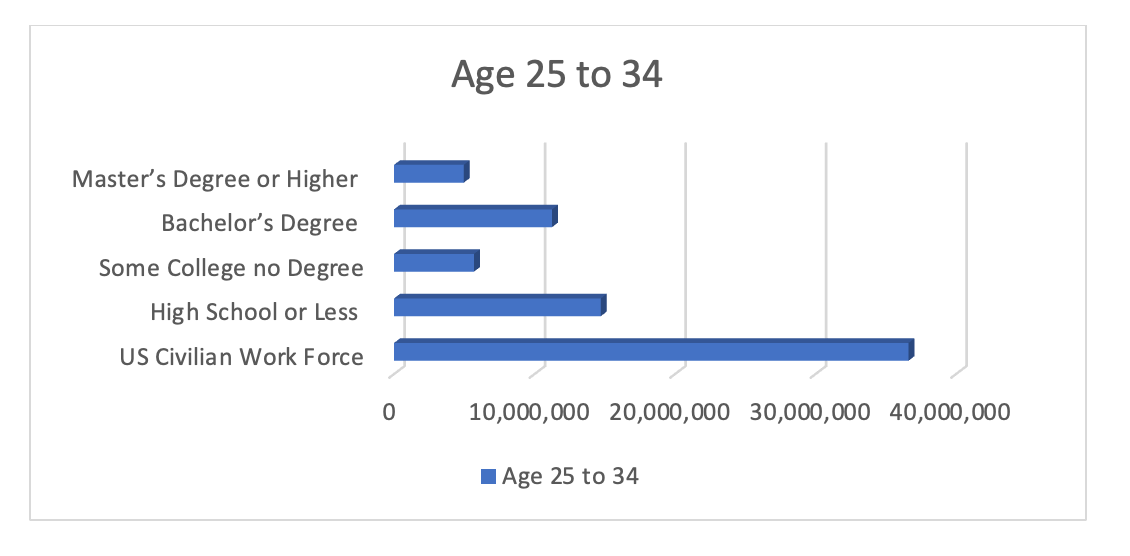
According to the Federal Reserve Bank of Saint Louis, the US Civilian Work Force from 25-34 as of June 2022 has the following educational attainment
The Harsh Facts on College Dropouts
American higher education overall has 39 million people with Some College, No Credential (SCNC) as of July 2020 according to the National Student Clearinghouse Research Center. The most recent study dated 2017 shows the following:
30% of first-year students drop out before their second year of college.
58.5% of students who started in community college after 6 years have not obtained any degree or certificate (1,071,720 students from students starting in 2011)
32.6% of students who started at a four-year institution after 6 years have not obtained any degree or certificate. (730,556 students starting in 2011)
More than two-thirds of college dropouts are low-income students, with family-adjusted gross income (AGI) under $50,000.
Full-time employment reduces graduation rates.Students who work a full-time job during the school year are half as likely to graduate with a bachelor’s degree, as compared with students who work 12 hours or less a week. Every additional hour of work beyond 12 hours a week reduces graduation rates. Working a full-time job takes too much time away from academics.
The reasons why are not surprising but still distressing.
Source: Hanson, Melanie. “College Dropout Rates” EducationData.org, June 17, 2022,
Economic Impact
According to the 2020 US Bureau of Labor Statistics, the average wage earned by a person by education level looks like this.
One statistic that stands out is the percentage of the income difference between a 4-year degree vs a person with a two-year degree person is $19,288 a 38.5% increase.
As the United States’ employment needs quickly change, industry and government have a pressing need for more qualified workers. In the publication HR Drive titled“Employers are hiring, but 80% say they can’t find skilled candidates”More than 82% of employers said they’re actively hiring, despite predictions of an economic downturn, according to a survey of 150 HR leaders by Challenger, Gray & Christmas, Inc. 80% of the respondents, however, reported having difficulty finding workers, with 70% identifying skills shortages as the reason.
It is further reported that 43% of Challenger’s respondents reported that, although they have enough applicants, those applicants do not have the needed skills. Another 43% said they do not receive enough applicants, with 27% noting that candidates who do apply are not qualified. “The labor market remains tight and employers are reporting skills shortages in almost every area, including in STEM, data analytics, human resources, finance, and operations.
During the next decade, the need for people with advanced credentials will continue to rise. Corporations have made it clear there is a need for more qualified workers whether it’s via a traditional degree such as a bachelor’s or micro-credentials/badges which verify customized skills. A report by McKinsey projected that more than 100 million workers will need to find a different occupation by 2030. In the United States, for instance, customer service and food service jobs could fall by 4.3 million, while transportation jobs could grow by nearly 800,000. Demand for workers in healthcare and STEM occupations may grow more than before the pandemic.
Organizations use different techniques for reimbursing student employees. The most common include:
Tuition assistance/reimbursement (63%)
In-house training seminars (61%)
Attendance at educational conferences (51%)
Continuing education courses (50%)
Coverage for licensing courses and exams (44%)
Personal development courses (35%)
Looking at tuition assistance the concept by employers is not new and many have had some sort of program in place for well over 10 years.
The Society for Human Resource Management survey reports tuition assistance programs are an attractive recruiting measure, and most employees are aware of the basic benefit. However, less than 5% percent of employees participate. Of those who participate in the tuition assistance program more than 4 in 10 who are using the benefit to attend graduate school.
Large corporations such as Starbucks, Target, Walmart, and others have all implemented go-back-to-school incentive programs using various higher institutions schools with an emphasis on online degree institutions.
Example One – Starbucks
Starbucks was one of the early adopters. In 2014, Starbucks and Arizona State University (ASU) introduced the Starbucks College Achievement Plan (SCAP), which provided Starbucks’ U.S. employees the opportunity to earn their first-time bachelor’s degree with the company paying for 100% of their tuition.
in 2021, Starbucks modified the tuition reimbursement benefit by paying all tuition and fees up front, as opposed to reimbursing employees for their out-of-pocket costs later.
More than 20,000 Starbucks employees are currently participating in SCAP.
The number of employees finishing their undergraduate degrees through SCAP will reach over 8,500, with Starbucks setting a goal of 25,000 graduates by 2025.
There are more than one hundred different degree programs offered through the SCAP program, and Starbucks has employees enrolled in all of them.
Almost 20% of people who apply to work for Starbucks say that SCAP is a major reason for their decision.
SCAP scholars are retained by Starbucks for a 50% longer period than non-participants, and they are promoted at nearly three times the rate of those employees who do not participate
Example Two – Walmart
In July 2021 Walmart announced it will pay for full college tuition and book costs at some schools for its US workers, the latest effort by the largest private employer in the country to sweeten its benefits as it seeks to attract and retain talent in a tight job market.
The program includes 10 academic partners ranging from the University of Arizona to Southern New Hampshire University. Participants must remain part-time or full-time employees at Walmart to be eligible. They have recently dropped a previous $ 1-a-day fee paid by Walmart and Sam’s Club workers who want to earn a degree and will begin to cover the costs of their books.
Example Three – Target
Target in August 2021 announced a fund to support educational courses for its employees. It is similar to the Walmart program. Available to 340,000 full-time and part-time workers.
Cover the full cost of select undergraduate degrees, certificates, and certifications for its 340,000 U.S.-based workers.
Pay up to $10,000 each year for master’s programs at those institutions.
Allow participants to attend one of 40 partner institutions.
Invest more than $200 million within the next four years in the program
However, one of the issues employees are challenged by is tuition remission vs tuition assistance. It is difficult and a deterrent to potential participants to upfront costs.
Researchers who have studied tuition benefits, including Jaime S. Fall, director of UpSkill America at the Aspen Institute, and Kevin Martin, chief research officer at the Institute for Corporate Productivity, believe that frontline workers might be more likely to participate in these programs if companies moved from “tuition reimbursement” to “tuition assistance” models, where employers pay their portion of education costs upfront. Many lower-income employees—or workers of any kind—can’t afford to float tuition costs for several months while they wait to be reimbursed.
Despite these new and innovative programs, we still have millions who are not going back to school. While 80% of employees are positive about these benefits only 40% have made any investigation and only 2% have taken advantage.
Student Barriers include
Restricted options by degree, college choice, net cost, upfront payment before receiving reimbursement
Lack of knowledge of grants and loans by employers, government, and schools.
Student personal issues (living life and family issues)
Childcare options and cost
Fear of failure,
School too far away
The older you get the less likely you will return to school
Paths to Explore by Higher Education, Corporate, and Government
Each sector is aware of the challenge and trying different approaches to get students dropouts and get a degree.
Higher Education
Private and state-supported regional universities are an asset underutilized
Further development and refinement of quality online degree programs to encourage re-enrollment
Developing stronger retention programs to reduce the percentage of college dropouts
Expansion of Teaching and Learning Centers for their communities
Evening and weekend on-campus programs
Academic credit for life experience
More student-friendly transfer of credits to a new school
Easier for students with outstanding bills to send an academic transcript
Corporate
More generous funding for employees to return to school. Going above the $5,200 a year tax deduction
The movement to paying tuition in advance by the employer rather than paying tuition in advance by the student
Increasing the number of majors a company will financially support
Opening the door for employees to have a selection of more universities including accredited private institutions
An example is the IBM apprentice program which aims to hire more than 400 trainees each year, from software development to data science to human resources. The current estimated cost to the company is $65 million since 2018.
Improvement in communicating and encouraging employees to return to school
Government
Increased priority in developing joint partnerships that incentives employment and encourage dropouts to return to school
Increase current state and federal student grants program
Establish no-interest loans to encourage students who have previously dropped out to return to complete their undergraduate degree
Let me expand on the role of partnerships between government, Corporate and higher education. The development of regional partnerships between government, industry, and higher education is not necessarily new. It has been used with tier one institutions such as Ohio State, the State of Ohio, and local government to entice Intel to establish a major tech center in Central Ohio.
Another recent bi-partisan proposal was introduced in August, by Rep. Jim Costa (D–Fresno) and co-sponsored by Rep. Bruce Westerman, an Arizona Republican. The bill is aimed toward four-year regional public universities in distressed areas that could receive federal grants of up to $50 million for economic and community development efforts under newly introduced bipartisan legislation.
In a press conference at Fresno State to unveil new legislation that he will put forward to Congress that would benefit up to 174 universities, Congressman Costa stated “Universities like Fresno State and many universities throughout California, but throughout the country, support community development. “They represent constituencies where we have distressed communities. They support the workforce, leading to faster employment growth, along with a higher per capita income.”
Robert Maxim, a senior research associate at Brookings, a think tank based in Washington, D.C. is an advocate of this type of partnership. “There are way more regional public universities in the U.S. than there are R-1s, our view is that they are really good anchor institutions to route federal investment through. They are a set of institutions that have been historically neglected and deserve a bit more attention and support from the federal government.”
Conclusion
I believe we need to prioritize on the group with the best chance of returning and obtaining a degree, the 25-34 age group with some college but no degree. This is 5.7 million of the overall 39 million who started college but did not finish. While we should make available any current or new programs that encourage people to return to school the 25-34-year-olds are the most likely to go back.
The United States should emphasize the wider use of partnership programs with government and industry teaming up with state regional higher education institutions and local small town and private colleges and universities would be a valuable asset to all parties. These schools are scattered in smaller cities across America. Both regional state institutions and private schools come from the applied teaching traditions Many are in small towns and rural areas in which employees who wish to return for a degree have few options. The question of cost certainly exists but I believe some form of government/industry/university partnership can effectively address the cost issues. They have space and teaching knowledge and the ability to customize local solutions.
One final thought and that is the question of will. While cost is a significant issue government, industry and schools must work in unison to get students to return and complete their education. We must remember these are second or in some cases third-chance students. They have failed in their attempts for various reasons. However, these students must overcome the fear of failure. We must find ways to support and encourage these students to take that leap of faith and believe they can graduate.
Postscript:
Graduation day 1975
I have been asked why did I go back? I worked in a factory and my parent’s deli for 6 months I felt I needed someone to test me and determine what I should do for the rest of my life. I went to the state employment bureau in my hometown to be skills tested to learn what I was best suited for. After the tests, I sat down with a lady who read the results. She told me with a smile that scared me I needed to go back to college and get a degree. Seeing I was somewhat shocked by her recommendation she stated the test revealed my hand/eye coordination was horrible and if I worked in a factory as my father did, I would seriously hurt myself. I asked her about joining the military and she commented if you went into the military, it better be an officer working behind the lines in military intelligence because I was unlikely to be much of a decent front-line soldier. As you can see, I graduated, and my proud parents were there for the event. I later in my life suspected the lady at the employment bureau was trying to give me a slap of reality to grow up and use my brain.
Dean Hoke is Co-Founder and Managing Partner Edu Alliance a higher education consulting firm located in Bloomington, Indiana and Abu Dhabi, United Arab Emirates. Dean received his Bachelor of Arts degree from Urbana University in Ohio, his Master of Science in Community Development from The University of Louisville, and a graduate of the Wharton School of Business Executive Management program. Since 1975 Dean has worked in the higher education and broadcasting industry, serving in senior leadership roles specializing in marketing, communications, partnerships, online learning and fund raising.
He currently serves as Chairperson Elect of the American Association of University Administrators , Franklin University and is Co-Host of the Podcast series Higher Ed Without Borders . Dean is actively engaged in consulting projects in international education, branding, business intelligence, and online learning leading projects in the United States, the Middle East, Africa, and Asia. Dean resides in Bloomington, Indiana
This blog post was contributed by Maureen De Armond, Executive Director, Human Resources at Drake University.
In higher education, we must plan for many worst-case scenarios, including tornados, fires, active-shooter situations, and, as we now know, pandemics. Among this wide range of difficult scenarios that could present themselves on our campuses at any time, suicide is one that deserves more attention and discussion.
Like other scenarios, suicide prevention and planning should contain at least these components: awareness and prevention at the front end; crisis-response protocols to deploy in the moment; and post-incident support and debriefing.
Here are four ways HR can take the lead on awareness and prevention efforts:
Normalize Mental Health Conversations
HR can set the example in normalizing conversations about mental health. From new employee orientation to leadership trainings to trainings offered during open enrollment, make mental health as normal a topic to discuss as being sick with the flu or needing rehab due to an injured back. We know that mental health carries a stigma; openly discussing mental health helps chip away at that stigma.
Coordinate Messaging
Tailor communications to your institution’s practices and use more than one channel for communication. If your institution sends newsletters, plan articles for each week of September. Consider emails as well. Be sure to provide your leadership teams with prepared messages and information they can share with their teams. Point them to helplines, training opportunities, reminders about EAPs, and tips for what to do and where to go if they or someone they know is having mental health crisis.
Collaborative messaging sent from campus and community partners can also create a widespread impact. Consider reaching out to student services, the provost’s office, Title IX/Equal Opportunity, campus safety, student senate, faculty senate, student counseling, faculty subject matter experts, and your institution’s employee assistance program (EAP) providers and health plan partners to team up on mental health messaging throughout the month.
Train, Train, Train
Offer learning and development opportunities that focus on mental health awareness as well as suicide prevention. This fall semester, Drake University is offering Question, Persuade and Refer suicide prevention training in addition to Mental Health First Aid for Higher Education for faculty and staff. Faculty partners are facilitating these sessions. We’ve found that having faculty-led sessions can help attract faculty attendees, leverage internal expertise and offer faculty additional forms of service to the institution.
Inventory Resources, Benefits and Policies
Take a fresh look at your well-being/wellness programming. Does it appropriately address mental health? Explore what resources and trainings may be available through your existing EAP contracts. Does your health plan offer virtual doctor’s visits for mental health care? If so, shine a spotlight on those resources. Making mental health care as accessible as possible may mean more people will consider using it. Review sick, personal and other paid-time-off leave policies to ensure mental health is clearly addressed. This includes handbook and web language, too.
While suicide awareness and prevention shouldn’t be a once-a-year conversation, September is a great month for HR to demonstrate leadership in normalizing conversations about mental health and suicide prevention and planning.
Ready to kickstart your next academic journal article?
Dr. Lisa Munro joins me to talk about academic writing. Did you know there’s a writing community online waiting for you? Social media isn’t just for sharing your article once it’s published. Share more of the writing process. Find support to get your writing done. And, meet collaborators online.
Lisa is a historian who leads workshops and writing retreats for academics. Journal article writing doesn’t come naturally to many people. You may feel like you don’t know what you’re doing. People can feel a lot of shame about their writing.
Lisa says, “Academic publishing is like a secret club with weird archaic rules that no one tells you about.” Now she helps people get their journal article written to make progress on their publication goals.
We also discuss adoption, a topic Lisa has been talking about on Twitter for years. Adoption is political. And it’s more complicated than people think. Both Lisa and I are adoptees. Talking about the things you’re interested in, what you’re passionate about, is an effective way to find your audience on social media.
Jennifer: Hi everyone, this is Jennifer van Alstyne, and welcome back to The Social Academic featured interview series. Today, I’m talking with Dr. Lisa Munro. We’re gonna be talking about writing and community online.
Lisa, would you please introduce yourself for everyone?
Lisa: Hello. I’m so excited to be here and thanks so much for inviting me to do this.
I’m Lisa Munro. I am an academic…I’m sort of, well, it’s complicated. You know how Facebook used to have those options? Like it’s complicated.
It’s still complicated, but I am a historian. I have a PhD from University of Arizona. And now I’m doing writing support for people, for other academics. Frequently, they are not getting that kind of help and support through their institutions. So that’s me.
Jennifer: Right.
Lisa: So that has been what I’ve been devoting myself to for the last couple of years.
Before that I was directing study abroad programs and I’m still working with some short term study abroad programs that come to where I live, my part of the world, which is Mérida, Yucatán of Mexico, so I’m still doing a little bit of that work as well.
A private community for academic writers (not on Facebook)
Jennifer: Well, I’m delighted that you came on to talk with me today about that work that you’re doing with academics who need to write their articles. Because finding that community online is something that I really encourage people to reach out to for social media.
But I also find that when they’re ready to, they’re like, “Oh yeah, I wanna join Twitter to share my publications.” And I always encourage people to talk about more of that process, to talk about more of the writing process.
And one of the reasons that I really wanted to have you on is because you have a writing community where people are connected online and they’re talking and conversing and cheering each other on. I would love to hear more about your writing community.
Lisa: Yeah. I was doing editing for a while and editing is very solitary. It’s kind of you and somebody’s work and there’s not a whole lot of community engagement there.
But I started shifting towards more towards how do people get writing done? I found that that was really where people needed help.
What I had originally envisioned in my dreams was I thought I would be like giving people advice about like the passive voice and like how to use better verbs. I thought I would be doing that kind of work.
And as it turns out, what people really needed, they needed to feel better about themselves as writers. And as people. That’s what they really needed to do their best work. Frequently, when they didn’t feel very good about themselves as writers and as people, their writing output, their productivity, absolutely ground to a halt.
Jennifer: Hmm.
Lisa: And so when people stop writing, frequently what happens is they start getting caught in these cycles of shame and fear. It’s very hard to get going again because the less you write, the more shame you have about the fact that you’re not writing.
And then you feel horrible and guilty. And then you have a lot of fear about starting writing again. So you don’t do writing. So now you’re just like circling back and forth and back and forth. It’s a really crappy cycle.
People feel a lot of shame around that. And when they start feeling a lot of shame around that, the first thing that usually goes, is they stop talking to people about that struggle.
It’s like, who do you really talk to in your life about your writing struggles? Frequently, people have partners who might not be academics, so maybe they don’t understand. But maybe, you know, your colleagues have their own writing struggles, you know, are they gonna listen to yours? Maybe they will, maybe they won’t. It’s like, there’s very precious few spaces where people can really talk about their writing struggles. And dealing with issues of shame and issues of fear and how those things have impacted the writing processes.
And so, my thing is, well, let’s talk about it. Let’s talk about your shame around writing. And let’s talk about my shame around writing. And together, like, it’s kind of okay.
Like if I’m experiencing what you’re experiencing and we can kind of see each other, maybe we’re in different boats, but we can see each other. All of a sudden, like people feel less alone.
Oh, you’re struggling too. I’m struggling. Wow. Like, it seems like this is a common thing. And people start feeling less alone. People start talking more about their experience. And it helps people to get going.
I’m very interested in creating those kinds of spaces where people can talk about their writing. Where they can get out of these shame and fear cycles. And they can start working towards what I would consider sustainable and joyful writing practices.
Jennifer: Thank you for sharing that. It sounds like you really wanted to create a kind of safe space where that conversation could be open.
Now, why did you choose to have a private community and not put it on like, Facebook, which is what a lot of people choose?
Lisa: Oh my god, I have complicated feelings about Facebook too.
Jennifer: Good.
Lisa: I don’t love Facebook. I think they’re kind of a terrible company. I don’t trust them at all. I feel like social media has been so… Well, I’m not gonna derail…
Jennifer: Don’t, just say it, say it.
Lisa: …this conversation. But social media has been so instrumental in becoming toxic soup.
Jennifer: Mm.
Lisa: I mean, there’s so much toxicity on social media right now. There is so much disinformation, misinformation.
Jennifer: Yes.
Lisa: And then Facebook has not been a good corporate citizen. Their whole business model is based on selling your data and I really felt uncomfortable with that. That is not what I wanted to do. That doesn’t feel safe to me. That doesn’t feel like a safe space.
I’m in some Facebook groups still. I haven’t quite deleted [Facebook] yet for like the two people I know who just won’t be on any other platform. And I love those people, I really do. But ah, get a different platform.
Even in the Facebook groups I’m in, I always feel like people are watching you, people are spying. And it’s like, is this really private? We’re not, “Oh, crap, my privacy settings were wrong and now it’s all over the internet.” You know, it doesn’t feel safe.
There’s been some recent stories in the news about Facebook selling some very personal information about its users. I think that’s awful.
Jennifer: Facebook has shared some very personal information, including direct messages, like what people think of as private conversations with legal authorities.
Lisa: Yes.
Jennifer: That’s really important to be aware of. If you’re on Facebook, thinking about your privacy and how your comfort level is with that, is super important.
Lisa: Yes. Absolutely.
Jennifer: So I am glad you brought that up, Lisa.
Lisa: Okay, good.
Jennifer: Yeah.
Lisa: I was hoping that wasn’t like a total, like, total derailment…
Jennifer: No, no, no.
Lisa: Because I think it’s different, like Twitter, right? Anything you put out there is public, and you know that.
Jennifer: Right.
Lisa: You’re like, okay, I’m gonna put this out to the world. Everybody and their dog can see it. And you know that.
And so like that really, I think, conditions like what you share. Some people are out there pouring their heart out, but most people feel like Facebook is maybe the place to do that because people have these ideas that that is a private space. And it’s not.
Jennifer: That’s right.
Lisa: I have bad feelings about Facebook. So, I decided I didn’t wanna do that. And also advertising which is a part of selling your data. I mean, it’s like you start looking for vacuum cleaners on Amazon and then all of a sudden, like all these vacuum cleaners are in your Facebook feed. And you’re like, wait, what? What just happened there? Oh, right, that works so fast.
Jennifer: It does.
Lisa: Yeah, I mean, tremendous.
I wanted to create a safe space and be like, okay, like look, I don’t want advertising, I want it to be people connecting to people. And without fear that Facebook is going to sell their data.
So I ended up on Mighty Networks. That was the platform I chose to do that. And I’ve been really satisfied with that.
There is no advertising. Why? Because I pay for it like a normal consumer. Right? Like that’s how that’s supposed to work. This whole freemium model that we’ve all gotten used to…I hear, “Okay, I’ll let you sell my data if I get to use your products.” I much prefer sort of traditional consumer models where I pay you money and you sell me a service. I feel like that’s just a better way for these things to work.
So I created a Mighty Networks. And it’s still going. I feel like I did that in 2019 so it’s been going on for almost three years now.
Jennifer: Yeah, that’s a long time.
Lisa: Something like that, yeah. That’s a long time and people come and go. Engagement goes up, engagement goes down.
Like right now people are super burned out. You know I get that. I think eventually engagement’s gonna pick back up again because these things are cyclical. So that’s what I’m doing.
It’s really all about like daily account, for me, it’s about daily accountability because I think it’s important to provide a space for people to check in. What’d you do today? What writing did you do today?
And the only rule is that you can’t talk about the writing that you didn’t do. That you meant to do and didn’t, because that, you know, now you’re back in shame and fear cycles.
Jennifer: Right.
Lisa: That doesn’t help, but talk about what you did do. “Oh my god, I wrote a sentence today.” Fantastic. Like if that’s your writing win, like I am here for that, and I am gonna cheer you on. Wonderful.
You published your book? Fabulous. Likewise, I am here for that. I am gonna cheer you on.
Whatever your accomplishment is, I wanna hear about it.
The more we talk about what feels good in writing, what we have achieved, what we have done, we start getting away from these models of like,
“Oh my god, you know, have I written enough?”
“Am I enough?”
“Is this enough?”
“Am I good enough?”
We start getting away from those kind of shame based models and closer to writing that does feel good.
When writing feels good, you’re apt to do more of it. Because you’re enjoying the process of doing that. So that’s really my revolution.
Jennifer: So it sounds like the process of talking about writing in that group setting really helps people actually perform the practices that are needed to get the writing done.
It also sounds like people are able to make these kind of lasting relationships with each other, through the group, through your writing retreats and your other offerings.
I think that what you said to me one time is that some of your people were so close that they were sending like cards to each other in the mail.
Lisa: Oh, they totally were.
It was amazing. I mean, there was like one Christmas where like people were sending Christmas cards to each other and it was like, oh my god, like, look at this!
Oh, and the other thing that happened recently, two people I’ve worked with in the past who have both been on my writing retreat, who kind of lived close to each other, they got together and had lunch. I mean, it’s fabulous. I love when that kind of connection happens.
I’ve worked with writers who end up finding mentors. So there’s been some mentoring that have come out of different writing initiatives I’ve done.
Co-authoring! Unlikely people who are like, “Hey, like it would be really fun to write something with you,” and then they do. That’s amazing.
Yeah, so there are actual, genuine connections that come out of this. I don’t know if anything is gonna really replace like face to face interactions with people. But in the meantime, now that we’re sort of a geographically dispersed people…You know, people are all over the world looking for community, looking for connection.
Jennifer: Yes.
Lisa: It’s the magic of the internet that’s going to bring us together and allow us to do that.
You can create meaningful relationships online, even with people you don’t really know.
I open my Twitter in the morning and I’m like, oh, here are all my pocket friends.
Lisa was an early user of Twitter
Jennifer: That was actually my next question. I’m curious, what does your online presence look like? What’s your favorite social media platform? ‘Cause I’m pretty sure it’s not Facebook.
Lisa: It’s not Facebook. Yes, it’s not Facebook. My favorite social media platform is Twitter.
I don’t remember when Twitter started, but I was a fairly early adopter of Twitter.
Jennifer: Okay.
Lisa: Just because it seemed to be like what people were doing. And it seemed like edgy and cool at the time. I think that was in 2009.
Jennifer: Okay. That’s early.
Lisa: It was early. Nobody was talking about anything really interesting.
Now people are using it for all kinds of really interesting purposes. It’s just kind of grown and grown.
My audience has grown. People ask me sometimes about growing a following on Twitter, how do you get followers?
Jennifer: Yeah.
Lisa: And I tell people like, talk about what you care about. Your people will find you. And you’ll find your people. But you have to be willing to talk about what you’re really passionate about, what you’re really interested in.
I hear people be really dismissive of Twitter, “Oh, it’s all about like what people had on their bagels.”
I’m like, well, you know, if you’re not interested in people’s bagels, then
A, don’t talk about bagels and,
B, don’t follow people who talk about bagels.
It’s okay if those are not your people, those are not your people. But if you’re interested in talking about bigger things…
If you’re interested in talking about, I don’t know, global politics…
If you’re interested in talking about social movements…
If you’re interested in talking about domestic violence…
If you’re interested in talking about, I mean, just a huge number of topics come out on Twitter.
And you can follow people who are talking about things you care about. And then you get to contribute to those conversations as well.
Jennifer: You’ve been on Twitter for so long that you’ve really seen that kind of evolution over time. You’ve seen these kind of conversations develop and participated in them yourself.
You also start conversations about somewhat controversial topics. I know adoption is very important to you, something you talk about on Twitter prolifically, and it’s important to me as well. We are both adoptees and so this is one thing that I wanted to talk with you about today.
Why do you choose to talk about adoption on Twitter? What kind of responses have you seen to it?
Lisa: Yeah. Everybody has to have an unpopular opinion, and these are my unpopular opinions.
I was very interested in talking about that more because I didn’t have people in my immediate circles, like my actual physical circles who were talking about that. It was very isolating.
There’s something very powerful about finding people who are having those same conversations. When I started feeling like I was this lone person having these thoughts. “Oh my god, like, who else is having these thoughts? Oh, wow. There’s a bunch of people on Twitter having these thoughts.”
TikTok also is having a moment in terms of adoptees talking about their experiences. I am not a TikTok adopter yet. I feel like I’m too old.
Jennifer: I don’t think that’s true. But I’m not on TikTok either, so.
Lisa: I know. People are like, “Oh my god, but the cat videos are really good.” I’m like, okay, well maybe I’ll be there someday. But yeah.
I talk about adoption a lot because I want people to know that it’s more complicated than people think.
People oftentimes think about adoption as an unqualified social good. People kind of uncritically think, “Oh, well, you know, it’s kind of a win, win, win for everybody.”
I want people to know it’s more complicated than that. That there is some real things that we should think about.
Adoption intersects with everything. Absolutely everything. It intersects with
Race
Class
Gender
Disabilities
Sexuality
Indigenous rights
It intersects with everything.
Just wanted to say that if you’re feeling disoriented because your assumptions about adoption as an unqualified social good have been suddenly disrupted, it’s normal to feel like the rug has been pulled out from under you. Welcome.
We’ll see like what our kind of reaction there is Supreme Court has to say about that. I’m not super optimistic, but that’s a really big. We should care about those things. And that really gets to the heart of things like tribal sovereignty.
Also thinking about not just like my own experience as an adopted person…But then also thinking about, there are child removals happening every day in courtrooms all across the nation. They get less press, but they are still happening and they’re happening predominantly to black families. We should care about that.
Adoption to me like has all of these really big social issues that are embedded in it. I feel like I have a really, I don’t wanna say unique perspective ’cause like there’s nothing particularly unique about my perspective. But that I have something to say about that.
Jennifer: You have a platform and an audience who’s also curious about learning more about it too.
I notice that the people who follow you do engage in those conversations and they do engage in the things that you share about it. And oftentimes they’re maybe a little surprised by something, but they’re open to it.
Introducing that kind of conversation now when it’s become so important, because adoption is being touted as this solution to abortion in the United States, bringing up this conversation on social media, in that public space, it’s like activist work.
Lisa: Yes.
Abortion and adoption have very little to do with each other but I’m over here screaming into the void about adoption politics because I want people to understand how utterly inappropriate it is to suggest adoption as a “solution” (as if one were needed) to abortion.
Jennifer: I really appreciate it as an adoptee myself. I was adopted from Peru in the 80s, which was before they had regulations. There were over 700 babies adopted from Peru annually. When they put regulations in, that number dropped down to 70 per year. It was a massive difference when governmental agencies do step in and start regulating something. There are lots of issues with adoption.
Lisa: Absolutely.
Jennifer: I did not have the most supportive adoptive parents. I will be honest and say that they both each told me separately that they regretted adopting me.
Lisa: Oh. I’m so sorry.
Lisa: And they both passed away because they were quite a bit older. They both passed away before I went to college. I struggled a lot.
It was actually through social media that my birth family from Peru, contacted me again and found me.
Lisa: Wow.
Jennifer: They reached out to me and they were like, “We wanna talk to you. We want to be your family.”
Lisa: Oh, amazing.
Jennifer: It was lovely. But even that was a little scary for me, it took to getting used to.
Lisa: Yeah.
Jennifer: When I was a kid, if you ask me if I regretted being adopted or anything, there’s no way I would say no.
Lisa: Yes.
Jennifer: There’s no way I would say anything other than, “I’m so happy to be here.”
Lisa: Yes.
Jennifer: But the truth was, it was really hard.
Lisa: Yeah, absolutely. I said something the other day. It’s really weird that we assume that the way we feel about adoption at like age 8 is the way we’re gonna feel about it our whole lives.
Jennifer: Right. Yes.
When I hear adoptive parents tell me their children are FINE and that they don’t care about adoption or their birth families (often expressed with relief), I want to remind them that our feelings about adoption often change over time.
Lisa: People’s feelings change. For me, when I searched and found birth family my perspective changed radically. I was like, “Oh, wow. Like this thing, this thing that we’re all so excited about, has some really dirty history.”
Jennifer: Yeah.
Lisa: It has some really sad history.
Jennifer: Yes.
Lisa: I was a Peace Corps volunteer in 2004 to 2006, and that’s when the Guatemalan Adoption Program was in full swing.
Massive numbers of children were leaving the country. And so whenever I would go to the airport, it was like, there were 3 Guatemalan babies on my flights with their new white adopted parents. Then every time I came back to Guatemala, I made a couple trips home during my service. Yeah, there were like 3 couples at the gate waiting to go to Guatemala and they had all the baby stuff and no baby. And I was like, oh, I know what you’re doing.
It was just the scale of it was so shocking. This is a country, and Peru shares some of this history, that had been absolutely torn apart by war and by genocide and all kinds of really terrible things.
Jennifer: Yes.
Lisa: And who is going to rebuild that? Children are people’s futures. And here was this massive flood of children out of the country. It was just really, really shocking to me.
Jennifer: Hmm. Oef.
That’s why it’s so important to talk about these things online. And I’m really glad that you’re always sharing books and articles where people can learn more.
I know that I’ve learned more myself from it and it’s helped me kind of process my own thoughts and feelings about adoption.
Lisa: Yeah.
Jennifer: I’m in my thirties, like it takes time to sit down and think about these things and kind of go through what we think personally. And then to better understand the cultural, sociological, and all of the implications of it and it lasts for a lifetime.
Lisa Munro’s future book and the politics of adoption
Lisa: So that’s gonna eventually be my book. Because everything I talk about on Twitter, that’s eventually gonna be my book.
Jennifer: Really?
Lisa: It can’t be my book right now.
Jennifer: Okay.
Lisa: But it’s eventually gonna be my book. So yeah, it just really come-
Jennifer: Well, sign me up to be an early reader because I wanna read that book.
Lisa: Thank you. I really wanna write that book. You know, people say, “Write what you wanna read.” That’s what I wanna read.
Jennifer: Yeah.
Lisa: Yeah.
Jennifer: Now a lot of the professors that I talk to feel really anxious, or scared, or fear about posting about something online that they know that other people might not react to well.
I know that there’s got to be some people out there that are super pro-adoption that don’t like what you say. What kind of reaction have you had to that?
Lisa: Yeah, I get a lot of defensiveness from adoptive parents.
Part of that I think is because nobody wants to think of themselves as complicit in a system that really hurts children. None of us wanna be a part of that. And yet we’re all kind of implicated in that.
I often say we’re all part of that because we’re always creating ideas about families, about children. About who gets to have children. Who doesn’t get to have children. Who should have children. Who shouldn’t. And why, and how.
And so we’re all kind of participating in creating those ideas. It’s not just the idea that adoption somehow just involves like adoptive parents, birth parents, and adoptees. I think is one of the biggest lies out there.
Jennifer: Right.
Lisa: We’re all creating those ideas, because ultimately we’re all collaborating whether it’s conscious or not. We’re all collaborating in the idea that some people shouldn’t have children.
Jennifer: That’s true.
Lisa: And some people are deserving of other people’s children.
Oftentimes adoptive parents will push back on me and they will say, you know, “Adoption is just another way to build a family.”
To which I say, “No, it’s a deeply political decision.”
Jennifer: Hmm.
Lisa: I mean, you are making a choice there, that somebody doesn’t get to have their child. Somebody shouldn’t have their child. That’s essentially what that means.
And that’s an unpopular opinion.
So I do a lot of muting because people, you know, people get nasty.
Jennifer: Yeah.
Lisa: I do a lot of muting. “Okay, you can still follow me and learn, but I’m not going to engage with that, I’m not interested in that.”
I do a lot of blocking if people are really obnoxious.
But I hope people keep following and keep thinking. Because a lot of people have told me like, “Wow, I was really kind of resistant to what you said at first. It didn’t make sense to me. I didn’t understand. But you know, I kept engaging with your tweets and kept reading. And I’ve really learned a lot from you.” I’m like, okay, like that seems really great to me.
The ideal would be when people feel kind of defensive that they would ask genuinely curiously. That they would approach with genuine curiosity and not with sort of ‘gotcha’ agendas or with some really toxic stuff that they’re still carrying around.
Jennifer: Yeah.
Lisa: A lot of adoptive parents are dealing with their own traumas.
Jennifer: Right.
Lisa: In my circle, we often say, “Adoptions cures childlessness, but it’s not gonna cure infertility.” It’s not the same to have somebody else’s child.
Jennifer: Right, right.
Lisa: It’s not the same to raise somebody else’s child.
That can’t fix that very deep grief when having your own child doesn’t work out for you. And that is very sad.
Jennifer: Right.
Lisa: But having somebody else’s child doesn’t fix that either. I think a lot of adopted people feel like they were adopted to fix those problems.
It never really works for either adoptive parents or adoptees to be emotional airbags.
Jennifer: Okay. It sounds like you do get negative reactions.
For most of them, you mute people because you just don’t wanna see that. But they’re welcome to still follow you and engage in your Tweets.
Lisa: Yup.
Jennifer: For other people, you do block them because it’s a way to protect yourself and your audience.
But you do respond to questions. I love that. You do respond to people who are genuinely curious and wanna engage in a conversation.
Lisa: I do. Yeah. Exactly. Like somebody said to me the other day, “Oh my gosh, but what could be so wrong about giving a child loving home?”
And I was like, okay, well let’s think about this. Let’s start thinking about this a little bit critically. Like,
Who’s relinquishing children?
Why are they relinquishing children?
Who’s adopting those children?
Why are they adopting those children?
What’s that process like?
What’s supposed to be the ultimate outcome?
Who’s benefiting, and who’s not?
These are sort of basic critical thinking questions I used to teach undergraduates. How to make these same basic critical thinking questions. But somehow adoption has been exempt from critical thinking for a long time.
Jennifer: I agree.
Lisa: And I really aim to change that.
Jennifer: Oh, yay, I’m glad we talked about this. I feel like even though we were here to talk about writing community, talking about the things that you’re interested in, the things that you’re passionate about on Twitter can really make a difference for how connected people feel with you.
Lisa: Yeah.
Jennifer: For how long they stay connected with you and for how much they actually share what you’re saying. So I really appreciate that.
Academic journal article writing workshop starts September 6
Jennifer: Now back to article writing for academics, that’s listening to this, right?
Lisa: Yes.
Jennifer: I really want them to be able to benefit from help from you, from your groups, from your workshops.
What do you have coming up that they can get involved in?
Lisa: I have something great coming up. One of the best things I do is a journal article writing workshop, Kickstart Your Journal Article. I love the metaphor of like kick starting a motorcycle, right?
Because well one, people are not learning how to do this. I mean, imagine in corporate America, if you had something that was like a major part of your job and yet you received no training in it. That just makes no sense.
Frequently, for academics, writing is currency, right? Writing is what gets you citations which gets you jobs, which gets you promotions, etc.
Jennifer: Yeah.
Lisa: People don’t learn how to write. I don’t remember ever getting explicit writing instruction in graduate school. I don’t remember. I know we had a Writing Center, but I don’t know that anybody…Not to dis on writing center people because they do an absolute tremendous job. But that wasn’t quite the help I needed at the time I think.
Jennifer: Yeah. You needed a different type of professional development for your writing.
Lisa: Yep. Yep.
Jennifer: Not that kind of one-on-one individuated support, but like: how to write.
Lisa: Yep. Exactly. There’s a lot of grad school that’s like, “Well, you know, you’ll figure it out.” I think that’s a crappy system.
Jennifer: Yeah.
Lisa: I don’t think we should be doing things that way. We should be teaching people how to do things, not assuming they’ll figure it out eventually.
Jennifer: Especially when it’s such a big part of their future career.
Lisa: A huge part, and yet you’re supposed to just figure it out.
A lot of novice authors I know, they’ve tried to figure it out on their own. They’ve written articles that aren’t very good. They get rejected. They aren’t sure how to deal with reviewer comments. So then they like trash the whole article. Or never send it out again.
Jennifer: So there’s issues with the whole process. Not just getting started writing, but when you’re not actually taught how to do the whole process, you can run into problems at every step of the way.
Lisa: Absolutely. Absolutely. And academia is full of secret handshakes. You have to know how to do the thing. There’s a lot of unspoken rules.
Jennifer: Right. That’s true.
Lisa: So, you’re a person who’s like trying to figure out how to write a journal article and you know you need to learn the secret handshake, but you’re not like quite sure what it is. You’re like, does it start like this? Or is it like backwards? Or do we high five first? Like, how do we, what do we do? And no one will tell you.
I will tell you.
That’s my other thing is really come and learn how to do this. A lot of people have told me that this is the best professional development thing they’ve ever done.
Jennifer: Wow.
Lisa: And not only has it allowed them to write articles…Now like I’ve been doing this long enough now I’m starting to kind of hear back on people’s articles and people are like, “Hey, I got an R&R [Revise & Resubmit],” and, “My article got accepted here.”
And I’m like, well of course it did ’cause you’re brilliant.
But that also, what I teach people also trickles down into their teaching. They’re like, “Oh my gosh, you know, you remember that week in which we talked about how to give really good feedback? Well, I used that with my undergraduates and we got fantastic feedback and everybody felt really good about it.” And you’re like, okay, like, fantastic.
Like we just have to learn to do this a little better. When you don’t know how to give feedback, that’s when you become Reviewer #2. And that doesn’t help anyone.
I think we can do a lot better. And so I aim to do a lot better.
So I’m giving a 12 week workshop actually, and there’s a couple other weeks built in there. There’s a break because everybody needs one, and then an introductory session. So it turns out to be 14 weeks, so it’s like a semester.
We meet every single week and talk about your writing. We talk about different aspects of your writing, this is all based on Wendy Belcher’s fantastic workbook, Writing Your Journal Article in 12 Weeks.
A lot of people have told me like, “Oh my gosh, like the thing that was so valuable to me was that I just had a place to come and talk about my writing.” Like, “Oh, I’m really struggling with this,” or “I don’t really understand this part.” Or, “Oh my gosh, like I read this part and suddenly my mind was blown and I made a ton of progress.” Like, fantastic, let’s talk about all of that.
Jennifer: And just for anyone who’s curious, you and Wendy know each other, is that right?
Lisa: Yeah. Yeah, absolutely. Yep, absolutely. And it’s really fun that she’s on Twitter because you can like tweet her questions about article writing or like, “Oh my gosh, I submitted my article!” And she’s super excited too so.
Jennifer: Yay. Oh, I love that.
Lisa: Yeah.
Jennifer: So there’s writing community on Twitter. There’s writing community on all social media platforms, but if you’re looking for that accountability and that writing community, you can join Lisa’s private Mighty Networks community.
And if you’re looking for the support to actually kickstart your journal article, you should join her workshop .
Lisa: Yeah. It’s a lot of fun. One recent person in my cohort, said you know, “Lisa, I’m never gonna love writing, it’s hard for me, but because of your workshop, I hate writing less.” And I was like, that’s victory!
Jennifer: That’s good. Yeah.
Lisa: I’ll take it. Yep, absolutely. That’s a win. That’s a total win.
Now, Lisa, for people who want to get in touch with you, who would like to follow you on social media, how should they do that?
Lisa: Yeah, I’m kind of email averse. I’m like the adult who doesn’t know how to email. Hit me up on Twitter. That’s the absolute fastest way to get a response from me. If I could just tweet everyone who wants to email me, it would be amazing. So I’m on Twitter, I’m @LLMunro.
Jennifer: Perfect. Well, Lisa, it’s been so wonderful to have you on to talk about writing community, to talk about your Mighty Networks, especially how you don’t like Facebook.
And also to get into our conversation about adoption and why talking about it online is so important. And why others should consider talking about the things that they’re passionate about, that they find important online too. Thank you so much for sharing that with me. Is there anything you’d like to add before we wrap up?
Lisa: No, I think that’s it. I’m really excited I got to be here today and talk to you, this has been a real joy.
Jennifer: Oh great. Well, Lisa, thank you so much. Have a great rest of your day.
Lisa Munro (@LLMunro) is an independent historian who helps fellow scholars create sustainable and joyful writing practices. She supports novice authors and early career researchers to get their ideas out into the world through writing retreats, workshops, and kind, constructive, and actionable feedback. Her own academic work examines informal imperialism in Latin America. She lives and works in Mérida, Yucatán, Mexico and also helps faculty plan short-term study abroad trips to Yucatán.
One can define reality as the world or the state of things as they actually exist, as opposed to an idealistic or notional idea of them.
Currently there are two ways science attempts to explain and define the reality of our universe. The first is Quantum mechanics or the branch of physics defines its evolution in terms of the probabilities associated with the wave function. The other is the deterministic environment of Relativity which defines it in terms of a physical interaction between space and time.
Specifically, Relativity would define the observable positions of particles in terms of where the point defining their center of mass is located.
While quantum mechanics uses the mathematical interpretation of the wave function to define the most probable position of a particle when observed.
Since we all live in the same world you would expect the probabilistic approach of quantum mechanics to be compatible with the deterministic one of Einstein. Unfortunately, they define two different worlds which appear to be incompatible. One defines existence in terms of the probabilities while the other defines it in terms of the deterministic of properties of space and time.
However, to show why those probabilities appear to be incompatible with Relativity’s determinism even though they are NOT it will be necessary to explain the evolution of quantum environment in terms of a deterministic interaction between the components of a space-time environment.
For example, when we role dice in a casino most of us realize the probability of a six appearing is related to or is caused by its physical interaction with properties of the table in the casino where it is rolled. Putting it another way what defines the fact that six appears is NOT the probability of getting one but the interaction of the dice with the table and the casino it occupies.
This suggests to show the “reality” behind the wave function one MUST explain how its environment evolves in terms of how the physical components of space-time interact to define a particles position.
The fact that Relativity defines evolution of space-time in terms of the energy propagated by electromagnetic wave while Quantum Mechanics defines it in terms of the mathematical evolution of the wave function give us a starting point. This is because it suggests the evolution in both is defined in define by a wave.
To define the position of a particle in terms of the deterministic properties of Relativity one can use the science of wave mechanics along with the fact Relativity tells us an electromagnetic wave move continuously through space-time unless it is prevented from doing so by someone observing or something interacting with it. This would result in its energy being confined to three-dimensional space. The science of wave mechanic also tells us the three-dimensional “walls” of this confinement will result in its energy being reflected back on itself thereby creating a resonant or standing wave in three-dimensional space. This would cause its wave energy to COLLAPSE and be concentrated at the point in space were a particle would be found. Additionally, wave mechanics also tells us the energy of a resonant system, such as a standing wave can only take on the discrete or quantized values associated with its fundamental or a harmonic of its fundamental frequency. This means a particle would occupy an extended volume of space defined by the wavelength of its standing wave.
Putting it another way what defines the fact that a particle appears where it does is NOT determined by the probabilities associated with the wave function but a deterministic interaction of an electromagnetic wave with the physical properties of space-time.
(NOTE We will use a particles position to make the connection between the probabilities of Quantum mechanics and the determinism of Relativity but the same logic will apply to all conjugate pairs.)
However, the probabilistic interpretation of the wave function is defines its reality because it use a mathematical point to represent a position of a particle which it randomly places with respect to the center of a particle. Therefore, the randomness of where that point is with respect to a particle’s center will result in its position, when observed to be randomly distributed in space. This means one must define its position in terms of probabilities to average the deviations that are caused by that random placement.
Yet as was mentioned earlier Reality defines the position of particles in terms of where the point defining their center of mass is located. Therefore, because similar to quantum mechanics Relativity cannot precisely determine where that point is located it would also have to define their exact position in terms of probabilities.
However, the large number of particles in objects such as a moon or planet would result in averaging out the deviation of the position of each their individual particles it appears to be deterministic.
But the same logic would apply to a quantum environment because its probabilistic deviations of a particle’s position would average out making the position of large objects such as the mom and planets appear to be deterministic.
This suggests the reason our universe appears indeterminate on a quantum scale while being deterministic on a macroscopic level is because similar to Relativity those deviations would be averaged out by the large number of particles in objects like the moon and planets.
As was mentioned earlier one can define reality as the world or the state of things as they actually exist, as opposed to an idealistic or notional idea of them.
Therefore, as was shown above one can define the Reality of the probabilistic world of quantum mechanics and the deterministic one of Relativity by assuming actual existence of an electromagnetic wave whose evolution can be defined by the notional idea of the wave function.