Author: admin

  • HR and the Courts – CUPA-HR

    HR and the Courts – CUPA-HR

    by CUPA-HR | March 9, 2022

    Each month, CUPA-HR General Counsel Ira Shepard provides an overview of several labor and employment law cases and regulatory actions with implications for the higher ed workplace. Here’s the latest from Ira.

    National College Players Association Files Unfair Labor Practice Charges Against the NCAA and Multiple Public and Private Colleges, Asserting College Basketball and Football Players Are Employees Under the NLRA

    The National College Players Association (NCPA), a non-profit advocacy group, has filed unfair labor practice charges with the National Labor Relations Board (NLRB) asserting that private and public universities, USC and UCLA, as well as the National Collegiate Athletic Association (NCAA) and the Pac-12 conference as joint employers have violated the National Labor Relations Act (NLRA) in refusing to treat college basketball and football players as employees. The NCPA hopes to convince the NLRB to rule that all division college basketball and football players at public and private colleges and universities are employees with collective bargaining rights.

    The current NLRB general counsel has stated publicly that she believes that student-athletes at private colleges and universities are employees subject to coverage under the NLRB. Nonetheless, the NLRB with jurisdiction over private colleges and universities has not yet ruled on the issue. The NCPA asserts that public colleges and universities will be covered because they are joint employers with the NCAA and the Pac-12 conference, both of which are private organizations subject to NLRB jurisdiction. This joint employer argument has not been ruled on by the NLRB in the past.

    U.S. Court of Appeals to Consider Whether Student-Athletes Are Employees Under the FLSA and Must Be Paid Minimum Wage and Overtime 

    Apart from the action described above concerning whether student-athletes are employees under the NLRA and therefore subject to unionization and mandatory collective bargaining, the U.S. Court of Appeals for the Third Circuit (covering Pennsylvania, New Jersey, Delaware and Maryland) will hear an appeal by colleges that the lawsuit by student-athletes seeking coverage under the Fair Labor Standards Act (FLSA) and minimum wage and overtime payments should not go to trial, but rather should be dismissed under current precedent. The lawsuit was filed in Pennsylvania against the NCAA and several Division-I colleges.

    The federal trial court judge denied the NCAA’s and college’s motion for summary judgment and ordered that the case proceed to trial. The NCAA and colleges argued that the trial court judge’s decision contradicted the decision of the Seventh Circuit Court of Appeals (covering Wisconsin, Illinois and Indiana) and a California state court case ruling that the student-athletes are not employees under the FLSA (Johnson et, al v. NCAA et al (3rd Cir., Case no. 22-8003, 2/4/22)).

    Gymnastics Coach Claims Gender Bias and Sex Stereotype That Female Coaches Are Not Expected to Be As Aggressive as Their Male Counterparts as Reasons For Her Termination  

    A former Towson University gymnastics coach was terminated after the university received complaints from gymnastics team members claiming that her coaching techniques were discriminatory against Black team members, that she bullied team members into competing while injured and that she did not adequately feed the team. The coach claimed that the termination resulted from the sex stereotype that female coaches are not expected to be as aggressive as their male counterparts.

    The university countered that her discharge resulted from valid complaints by team members. The university also argued that it is the coach who is guilty of sex stereotyping with regard to her defense that female athletes are more likely to complain about her coaching practices than male athletes. The university also responded to the coach’s claim of pregnancy discrimination, arguing that the coach never explicitly advised the university that she was pregnant. The coach claimed that she was visibly pregnant at her last meeting with the university. The case is pending in federal district court in Maryland (May v. Towson University (Case no. 1:21-cv-02229, D. Md.)).

    Federal Court Rules School District Likely Violated Constitutional Rights of Three Paraprofessionals Who Were Prohibited From Wearing Black Lives Matter and Other Anti-Racism Messaging 

    A federal district court trial judge ruled in favor of three paraprofessional employees who were prohibited by their school district from wearing masks and other clothing with Black Lives Matter and other anti-racism messaging. The judge ruled that the school board’s actions “likely” violated First Amendment free speech rights (Fuller et al v. Warren County Educational Service Center et al (2022 BL 48702, S.D. Ohio 2/14/22)).

    The judge ruled that the school district must immediately lift its ban on any such controversial social or political messaging while the case is litigated further. The judge ruled that the employees’ messaging addresses a matter of public concern and they “spoke” as private citizens by making statements on Black Lives Matter and other related issues that are not within their job duties. The judge concluded that the school district did not demonstrate that the wearing of the material would disrupt school operations. While avoiding an emotional or violent outburst by a sensitive student body would justify the ban, the school district did not prove the likelihood of such a development. The judge also concluded that there was no evidence supporting the school district’s concerns, making them purely conjectural and outweighed by the free speech rights of the employees.

    Professor Files ADA and Rehab Act Discrimination Case Alleging His Heightened COVID-19 Risk Is a Disability and He Was Unfairly Denied a Reasonable Accommodation to Continue Teaching Remotely

    A former science professor at Georgia Military College sued the college’s board of directors in federal court after he was put on an unpaid suspension and ultimately terminated following the alleged denial of his accommodation request that would allow him to teach his classes remotely based on his doctor’s advice that he was of high risk for COVID-19 because of numerous conditions, including Crohn’s disease, kidney failure and anemia. The professor asked that he be allowed to continue teaching remotely as he had allegedly done for six months before the college asked most professors to resume teaching in person. The professor alleges that other professors were allowed to continue teaching remotely in small class situations, but he was denied his request because his class was very large due to the popularity of his teaching (Fields v. Board of Trustees of Georgia Military College and Georgia Military Prep School (M. Dist. Ga. 5-22-cv-00074)).

    The professor claimed that he was a former recipient of a teaching excellence award at the school and was treated “dismissively” in his denial of his accommodation request. He also claims he was allowed to teach remotely due to his disabilities in 2016, prior to the pandemic, and that is when he received the teaching excellence award. The college claimed it responded to his accommodation request by offering him two alternatives: return to teaching in person or take an unpaid leave of absence. The professor is seeking back pay, loss of employment benefits and three to five years of front pay. The professor claims job reinstatement is not feasible in these circumstances.



    Source link

  • National Women’s History Month: Past and Present Higher Ed HR Trailblazers – CUPA-HR

    National Women’s History Month: Past and Present Higher Ed HR Trailblazers – CUPA-HR

    by CUPA-HR | March 2, 2022

    National Women’s History Month celebrates the contributions and achievements women have made throughout U.S. history. CUPA-HR is fortunate to have had many smart and dedicated women serve on its national, regional and chapter boards and on various committees. In addition to providing leadership at work, they have volunteered their time and shared their know-how — lighting the way for other women in the field.

    To celebrate the month, we’re spotlighting some of the many leaders who have transformed higher ed HR and CUPA-HR. Sure to inspire, these articles and podcast episodes offer unique perspectives of higher ed HR, career journeys, struggles, successes and everything in between.

    Looking Back to Move Forward

    Blazing a Trail: Women Who Paved the Way in Higher Ed HR, from a 2014 issue of Higher Ed HR Magazine, features five CUPA-HR leaders who began their higher ed HR careers in a very different era — when HR was still “personnel,” men dominated the profession and the nature of the work was strictly focused on policies and procedures. These women rose to leadership positions, not only in their departments, but across their institutions. Read about their challenges, their regrets, their successes and a few war stories to boot.

    More Stories That Inspire

    CUPA-HR Conversations: Higher Ed HR Turns 75 Podcast features higher ed HR leaders and past CUPA-HR national board chairs who have left their mark on both the association and the profession.

    • In Episode 2: Growing Through Change, Allison Vaillancourt reflects on some professional advice she received from a CUPA-HR peer that changed her entire approach to HR and helped advance her career and secure several leadership positions.
    • Lynn Bynum shares how CUPA-HR helped her make the transition from the corporate world to higher ed HR, and Lauren Turner offers insights into how HR can become a recognized leader within the institution and help others become better leaders in Episode 4: Model Behavior.
    • Jane Federowicz reflects on her unexpected path to HR, starting out as her institution’s accountant and ending up being asked to create an HR department, in Episode 6: When Opportunity Knocks.
    • In Episode 7: Lifelong Learning, Barbara Carroll dives into some experiences she never thought she would have as an HR leader, including serving on CUPA-HR’s Public Policy Committee and providing a higher ed perspective to a room full of senators and congressional representatives, and Linda Lulli discusses the importance of being a lifelong learner in the HR profession and how to be adaptable and resilient.

    Time-Out With Tammi & Tyler is a podcast that explores how higher ed HR careers evolve by interviewing professionals at the top of their HR game, sharing advice they would give professionals climbing the higher ed HR ladder.

    • In Episode 1, Donna Popovich offers advice for early-career professionals.
    • Sheraine Gilliam walks through her story of persistence, networking and how to turn negative situations into opportunities for growth in Episode 3.
    • In Episode 5, Clarity White describes how her Wildfire program experience helped advance her HR career.

    Related resources:

    21-Day Challenge: Focus on Women (First two weeks of the challenge)


    Source link

  • New Report on the Representation of Women and Racial/Ethnic Minorities in the Workforce of Minority-Serving Institutions – CUPA-HR

    New Report on the Representation of Women and Racial/Ethnic Minorities in the Workforce of Minority-Serving Institutions – CUPA-HR

    by CUPA-HR | February 23, 2022

    Minority-serving institutions (MSIs) play an important role in ensuring students from underrepresented races and ethnicities receive a quality education.

    While there is an abundance of research on students who attend MSIs, little research has examined the MSI workforce, specifically, how the racial/ethnic representation of faculty, administrator, professional and staff reflects the student populations being served.

    The latest CUPA-HR report, The Representation of Women and Racial/Ethnic Minorities in the Workforce of Minority-Serving Higher Education Institutions targets this gap by providing an overview of MSI representation among all U.S. higher ed institutions and showing their geographic spread across the country; providing a closer examination of racial/ethnic and gender composition of faculty, administrators, professionals and non-exempt staff; and assessing how well the racial/ethnic composition of the higher ed workforce at MSIs reflects their student populations and matches the minority-serving mission of the institutions.

    Key findings from the report:

    • MSIs have higher racial/ethnic minority representation among their workforce than non-MSIs.
    • HBCUs have the highest representation of racial/ethnic minority employees.
    • Overall, the representation of racial/ethnic minority faculty at MSIs does not match the representation in students.
    • Overall, administrators, professionals, and staff at MSIs have similar racial/ethnic minority representation when compared to students.

    For more findings on the representation of women and racial/ethnic minorities in the workforce at MSIs, read the full report.


    Source link

  • National College Players Association Files Charges Seeking Employee Status for Student-Athletes – CUPA-HR

    National College Players Association Files Charges Seeking Employee Status for Student-Athletes – CUPA-HR

    by CUPA-HR | February 17, 2022

    On February 8, the National College Players Association (NCPA), an advocacy association for college athletes, filed unfair labor practice charges with the National Labor Relations Board (NLRB) against the University of Southern California, the University of California, Los Angeles (UCLA), the Pac-12 Conference and the National Collegiate Athletic Association (NCAA).

    The charges allege that the employers have violated the National Labor Relations Act (NLRA) by “repeatedly misclassifying employees as ‘student-athlete’ nonemployees” and “by maintaining unlawful rules and policies in its handbook, including restricting communications with third parties.” The charges mark the launch of the NCPA’s #JforJustice campaign and aim “to affirm college athlete employee status for every [Football Bowl Subdivision (FBS)] football player and Division I basketball player at every public and private university in the nation,” per an NCPA statement.

    This is the latest development regarding issues surrounding employment status of student-athletes since NLRB General Counsel Abruzzo issued a memorandum last September stating her position that student-athletes are employees under the NLRA and are therefore afforded all statutory protections as prescribed under the law. In that memo, Abruzzo stated that it was her intent to “educate the public, especially Players at Academic Institutions, colleges and universities, athletic conferences and the NCAA” about her position in future appropriate cases.

    The NCPA charges potentially provide Abruzzo with a case she can present to the NLRB to consider granting collective bargaining rights to college athletes. In 2015, the last time the NLRB considered the issue, it declined to assert jurisdiction over Northwestern football players, as doing so “would not promote labor stability [because the] board does not have jurisdiction over state-run colleges and universities” that make up the majority of the FBS. The NCPA charge seeks to overcome this jurisdictional obstacle by including the privately-held Pac-12 and NCAA as joint employers of UCLA’s athletes — a theory of liability Abruzzo said she would consider applying in appropriate circumstances.

    Now that the charges have been filed, an NLRB regional director will review the case and determine whether formal action should be taken and presented to an administrative law judge, which would preside over a trial and issue a decision that could ultimately be taken up by the five-member board.

    CUPA-HR will be paying close attention to this case and provide members updates as it progresses.


    Source link

  • Diversity and Inclusion Start With the Hiring Process: Two Institutions Getting It Right – CUPA-HR

    Diversity and Inclusion Start With the Hiring Process: Two Institutions Getting It Right – CUPA-HR

    by Jill Thompson | February 16, 2022

    For institutions to become diverse, equitable and inclusive workplaces for faculty and staff, HR must take a critical look at current hiring processes and analyze not only who’s being hired, but who’s doing the hiring. Are search committee members trained in DEI issues and prepared to conduct interviews in a way that exemplifies the institution’s commitment to DEI?

    As we wrap up the first two weeks of the 21-Day Equity Habit Building Challenge: Less Talk, More Action, we’re calling attention to inspiring higher ed hiring initiatives and resources from two institutions. HR pros will want to bookmark these resources to help them think through small adjustments or total redesigns of their institution’s hiring processes and DEI training for search committees.

    UC Davis’ Guide for Hiring Managers

    To helping hiring managers develop skills related to diversity and inclusion, UC Davis’ HR team created a guide to attracting, selecting and hiring diverse talent. The guide lists ways the institution can improve its reach for open positions and the diversity of candidates, as well as tips for incorporating inclusive language, targeting outreach, selecting recruitment panels, developing interview questions and making accommodations for applicants with accessibility issues.

    Oakland University’s Diversity Advocate Program

    Oakland University’s Diversity Advocate (DA) faculty hiring program was highlighted in-depth in the Fall 2021 issue of Higher Ed HR Magazine. The goal of the program is to mitigate bias in the hiring process. At one of the 21-Day Challenge Town Halls, OU’s team discussed the advantages of applying its DA model to the hiring process, namely ensuring equity doesn’t fall between the cracks by designating a DA to be an attentive participant in the search process.

    While Oakland University created the DA program for faculty hiring, they have gone on to create the Diversity Equity Advocate (DEA) program aimed at staff hiring. Although the DEA program is still considered a pilot program, it’s a great example of how Oakland University is shaking up search committees to achieve a more diverse workforce.

    Search committees are one of the first points of contact for job candidates. It’s imperative that these committees are prepared and trained to conduct inclusive interviews with diverse candidates and to bring issues of equity to the forefront. HR practitioners can use the resources listed here to spark ideas and action within their institutions.

    Haven’t joined in on the latest 21-day challenge yet? There are still two weeks left! 21-Day Challenges are open to CUPA-HR members only.

    Check out these articles to see how other institutions are promoting diverse, equitable and inclusive hiring practices:

    Embedding Racial Equity Into HR Practices

    The Equity Case for Competency-Based Hiring

    Breaking Down Hiring Barriers for Veterans: The Journey to Becoming a Military-Friendly Employer

    Hiring Heroes: Providing Employment Opportunities for Military Veterans

    How Two Universities Are Building Community Partnerships to Strengthen Local Hiring

    Removing Hiring Barriers for the Disability Community

    Examining Implicit Bias and Its Effect on Hiring and Inclusiveness

    e-Learning Courses:

    Building a Successful, More Inclusive Search (Individual)

    Building a Successful, More Inclusive Search (Group)


    Source link

  • Take a Break With These Meditation Resources – CUPA-HR

    Take a Break With These Meditation Resources – CUPA-HR

    by Melissa Fuesting | February 9, 2022

    Meditation is an umbrella term for achieving an intense level of focus. Humans have been meditating in various ways for thousands of years, and research suggests there’s good reason why. Meditation can increase concentration, reduce stress, reduce anxiety and depression, improve physical health and help us become more resilient in our personal and professional lives.

    If you’d like to dip your toe into meditation, try one of the free resources below. Don’t be afraid to try a few different approaches — some methods might click with you better than others. If meditation intimidates you, try starting with guided imagery meditation or a physical form of meditation like yoga or tai chi.

    Mantra Meditation

    Create deep focus by continuously chanting or mentally repeating a word or phrase.

    Guided Meditation

    Create deep focus by using as many of your five senses as possible to anchor yourself in the moment.

    Mindfulness Meditation

    Create deep focus by increasing your awareness of the moment. This method of meditation usually involves focusing on your breath.

    Physical Forms of Meditation

    Check out this blog post and on-demand webinar for more practical steps HR pros can take to build resilience into work and life. 


    Source link

  • HR and the Courts – CUPA-HR

    HR and the Courts – CUPA-HR

    by CUPA-HR | February 9, 2022

    Each month, CUPA-HR General Counsel Ira Shepard provides an overview of several labor and employment law cases and regulatory actions with implications for the higher ed workplace. Here’s the latest from Ira.

    U.S. Supreme Court to Review Harvard and UNC Affirmative Action Admission Policies In Consolidated Case 

    The U.S. Supreme Court agreed to hear and review two cases challenging the affirmative action admissions policies at Harvard University and the University of North Carolina. The Supreme Court will hear an hour of argument over both court of appeals decisions, which have concluded that the respective affirmative action plans were legal. In the past, the Supreme Court has consistently ruled that college and university admission related affirmative action plans were legal since 1978 in the Bakke decision.

    The composition of the Supreme Court has changed significantly since the last time it ruled that affirmative action in college admissions was legal in 2018 in the University of Texas at Austin case. The argument will be heard in the October 2022 term with a decision likely to be made in 2023. CUPA-HR will follow and report on future developments.

    Court of Appeals Allows a Former Teaching Assistant’s Complaint Alleging Male Bias In Title IX Investigation to Proceed 

    The Ninth Circuit Court of Appeals (covering California, Oregon, Washington, Nevada, Idaho, Montana and Arizona) ruled that a former Chinese national teaching assistant — who lost his job and student visa to stay in the U.S. after a Title IX investigation found that he was in violation of the school’s dating guidelines — can proceed with his own Title IX suit against the university, alleging that the investigation was biased against him as a male (Doe v. University of California (9th Cir. No. 20-55831. 1/11/22)). The plaintiff, who had prevailed in a state court proceeding challenging the disciplinary decision, nonetheless lost his housing, job, student visa and the ability to complete his doctorate.

    The plaintiff had broken off his engagement to a student who he was dating after learning she had been unfaithful to him. She came unannounced to his office, confronted him and blocked his exit when he said he had to leave to teach a class. The plaintiff eventually got around the student to leave, but the student called the campus police claiming that he pushed her and grabbed her arm, and she filed a Title IX complaint. During the investigation, an investigator told the plaintiff, “No female had ever fabricated allegations against a former boyfriend in a Title IX setting.” The plaintiff also alleged that during the two-year time period, the overwhelming majority of Title IX claims were against males and that no female was ever given a two-year suspension in circumstances like his. The court of appeals concluded that given these facts, the plaintiff’s claims should proceed to trial.

    NLRB General Counsel Reiterates Call for NLRB to Issue Make-Whole Remedies, Including Emotional Distress Damages for Employer Unfair Labor Practice Violations

    Jennifer Abruzzo, the Biden administration appointee as general counsel to the National Labor Relations Board (NLRB), has reiterated her request that the NLRB expand its remedy policies for employer violations of the National Labor Relations Act’s unfair labor practice provisions, including discrimination against union members, to include “make-whole” remedies, which would include emotional distress damages. The general counsel announced her initial request in September 2021. Abruzzo followed up the September 2021 request in a legal brief filed with the NLRB on January 10, 2022 arguing that the NLRB remedies are “feeble” and allow employer’s to violate the Act because it is cheaper do so without facing the consequence of make-whole remedies.

    Current NLRB remedies are limited to employment reinstatement, back pay awards and posting of notices that the employer violated the Act. Business groups filed a brief on January 10, 2022, which also opposes the general counsel’s request, arguing that the NLRB lacks authority under the Act to impose make-whole remedies. CUPA-HR will follow this litigation and report the result in a future blog post.

    U.S. Supreme Court Will Hear Football Coach’s First Amendment Claim of Protected Mid-Field Prayer Denied By the Ninth Circuit Court of Appeals 

    The U.S. Supreme Court has granted certiorari (cert) and will hear an appeal of a Washington state football coach whose claim to a First Amendment right to kneel and pray at the 50-yard line after each game was denied by the Ninth Circuit (covering California, Oregon, Washington, Arizona, Nevada, Montana and Idaho) (Kennedy v. Bremerton School District (U.S. No. 21-418, cert granted 1/14/22)). The Bremerton School District suspended the coach after he refused to cease his weekly ritual of kneeling and praying at the 50-yard line after each game. The Ninth Circuit denied the First Amendment claim, holding that the coach’s public statements about his prayer activities belied his argument that is was a private religious act and evidenced his attempts to proselytize his religious beliefs. As such, allowing it to continue would violate the school district’s/government’s duty not to support any particular religion.

    The coach argued that the decision, if left standing, would virtually transform speech of a public employee into government speech, lacking any First Amendment protection. The school district argued against cert, claiming that it had given the coach an accommodation to pray before or after the game in the press box or anywhere else where he would not be surrounded by his team. The coach insisted on being able to pray at mid-field before the team and spectators had cleared the field. CUPA-HR will follow this case and report on the ultimate decision.

    COVID-19 Spousal Death May Be a Way Around Workers’ Compensation Defense to Employer Liability for Some COVID-19 Cases Contracted at Work 

    A California appellate court recently refused to dismiss a case filed by an employee who claimed her husband contracted and died of COVID-19, which she contracted from working on the employer’s assembly line (See’s Candies, Inc. v. Superior Court of L.A. County (2021 BL 485084, Cal. Ct. App. 2nd Dist. No. B312241,12/21/21)). The appeals court rejected the company’s argument that the husband’s death was a “derivative” injury of the employee’s injury/illness contracted at work and therefore barred by the workers’ compensation prohibition of individual lawsuits. This is a new area of the law and the cases popping up elsewhere may come to a different result. CUPA-HR will follow the issue as case law develops.

    U.S. Union Membership Among American Workers Declines to Record Low in 2021

    The percentage of American workers who are union members declined to 10.3 percent in 2021 to match its record low percentage of 2019. While union membership increased in 2020, the percentage dropped 0.5 percent in 2021 to the 2019 percentage according to the U.S. Department of Labor’s Bureau of Labor Statistics. In 2021, the number of union members declined to 14 million while the number of overall workers increased. The percentage of American workers who are union members has declined significantly since 1984 when approximately 20 percent of the U. S. workforce was unionized.


    Source link

  • Asking Students to *Really* Read Each Other’s Writing | A Conversation with Timothy Oleksiak

    Asking Students to *Really* Read Each Other’s Writing | A Conversation with Timothy Oleksiak

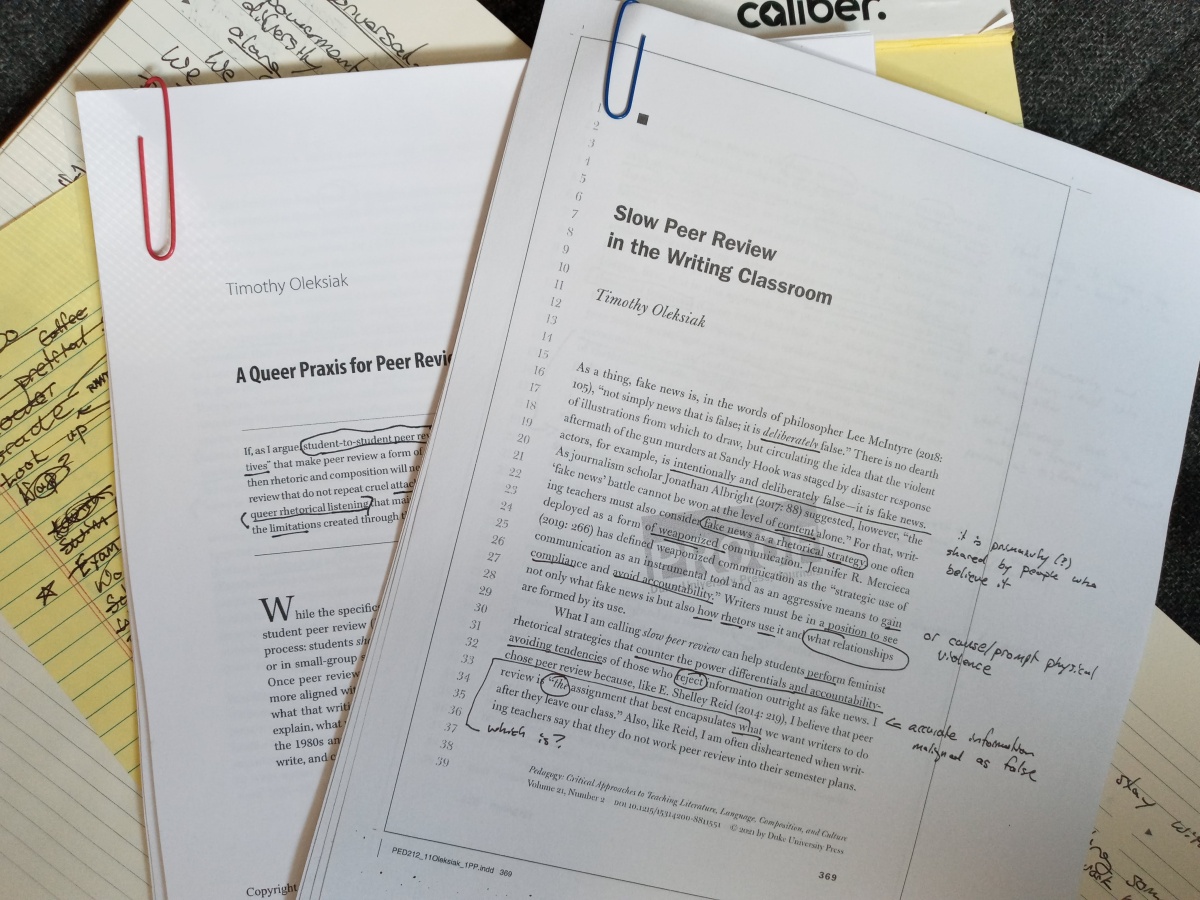
    I spoke with Dr. Timothy Oleksiak, Assistant Professor of English at the University of Massachusetts—Boston, about two of his essays, “A Queer Praxis for Peer Review” and “Slow Peer Review in the Writing Classroom,” recently out in College Composition and Communication and Pedagogy. In these essays, they present theory and practice for a pedagogical practice they call slow peer review, a different way to approach that classical strategy of writing classes, student-to-student peer review, where students swap drafts and give each other feedback on how to improve them. Slow peer review does have students swap drafts but asks them to spend a lot more time with the drafts than usual, reading them very carefully and thinking about them deeply. Slow peer review then asks students to respond in different and more in depth ways than just giving the writer suggestions. I found the essays really compelling, opening up so many questions with relevance far beyond this specific practice and far beyond even just the teaching of writing.

    In our conversation, which you can watch below, we discuss opera, “the improvement imperative” (i.e., there are more things to do in a writing classroom than help students write better, even as that remains a key goal), and the concept of “cruel optimism” (which refers, in this case, to an unhealthy attachment to certain teaching strategies that aren’t working and won’t suddenly start working through being tweaked). We also discuss the ways in which writers and readers of drafts both participate in “worldmaking.” The idea here is that each draft someone writes envisions a world in which some are included while others are not, and peer reviewers can help writers imagine more clearly what sort of world they’ve built. We also discuss what all of this has to do with queer theory. Lastly, I asked Timothy whether this peer review pedagogy isn’t actually a reading pedagogy. While he’s not so sure, he does have students “read the drafts five different times” and directs students to consider such questions as “What does it mean to be fully human in this world?” (i.e., in the world of the draft being read). Those seem like scaffolds for deep reading to me. At any rate, whatever else this pedagogy does, it does ask students to really read each other’s writing. And that feels extraordinarily valuable to me.

    Source link

  • CUPA-HR Submits Letter to DOL Requesting Stakeholder Meetings Prior to Anticipated Overtime Proposed Rule – CUPA-HR

    CUPA-HR Submits Letter to DOL Requesting Stakeholder Meetings Prior to Anticipated Overtime Proposed Rule – CUPA-HR

    by CUPA-HR | February 8, 2022

    On February 8, CUPA-HR and 14 higher education organizations sent a letter to the Department of Labor (DOL) Wage and Hour Division (WHD)’s Acting Administrator Jessica Looman requesting that the agency engage in stakeholder meetings with the higher education community during the initial stages of the rulemaking process for the anticipated overtime rule.

    In December 2021, the DOL announced in its Fall Regulatory Agenda that it plans to issue a Notice of Proposed Rulemaking (NPRM) this April to update the salary level to qualify for the executive, administrative and professional employee exemptions (collectively known as “white collar” or “EAP” exemptions) to the Fair Labor Standard Act’s overtime pay requirements. In 2015, the Obama administration’s DOL proposed an increase to the threshold of over 100 percent from $23,660 to $50,440 per year. After the comment period ended, the DOL issued a final rule in 2016 that would have increased the level to $47,476. The rule was stayed and then overturned by a federal court in 2017; however the Trump administration DOL reevaluated the rule in light of the litigation and issued a new rule in 2019 that increased the salary threshold starting January 1, 2020, to $35,568 per year.

    While the DOL has not publicly stated the salary threshold increase it is considering for the April NPRM, members of Congress and advocates have recommended that the Biden administration DOL increase the threshold by over 100 percent to at least to $82,732 by 2026.

    Given the likelihood that the DOL is feeling significant pressure from certain stakeholders to pursue a robust increase, CUPA-HR drafted the letter highlighting higher education’s significant involvement with DOL’s prior rulemakings in 2016 and 2019 and the particular concerns institutions harbored with the 100 percent increase to the salary threshold in 2016. It further explains that due to the pandemic-related workforce changes across colleges and universities, the DOL must hold stakeholder meetings with our community before issuing the anticipated overtime NPRM — as was done in 2004, 2014 to 2015, and 2019.

    CUPA-HR will keep members apprised of any actions taken by the DOL as it moves forward with the overtime rule.


    Source link

  • White House Announces Actions to Attract STEM Talent – CUPA-HR

    White House Announces Actions to Attract STEM Talent – CUPA-HR

    by CUPA-HR | February 7, 2022

    On January 21, President Biden announced several agency programs at the Department of State (DOS) and Department of Homeland Security (DHS) to help international STEM students and researchers access certain non-immigrant visas to allow them to study and work in the United States. The programs aim to admit and retain more international scholars to help advance STEM competitiveness in the U.S.

    Department of State

    The first announced program was DOS’s Early Career STEM Research Initiative. The initiative will facilitate engagement between J-1 visa recipients coming to the U.S. to participate in STEM research with host organizations, including businesses. Additionally, the department also announced new guidance to allow J-1 visa recipients in STEM fields to obtain up to 36 months of optional practical training. According to the announcement, the guidance will be applicable for exchange students in the 2021-2022 and 2022-2023 academic years, so long as the students meet certain academic training requirements.

    Department of Homeland Security

    Of significance, the president’s announcement also included a decision by DHS to add 22 new fields of study in the STEM Optional Practical Training (OPT) program through the Student and Exchange Visitor Program (SEVP). The program permits F-1 students earning bachelors, masters and doctorate degrees in certain STEM fields to remain in the United States for up to 36 months to complete OPT after earning their degrees. DHS issued a notice in the Federal Register announcing the specific fields of study added to the designated list of STEM fields.

    Additionally, the United States Customs and Immigration Services (USCIS) issued guidance “to clarify how USCIS evaluates evidence to determine eligibility for O-1A non-immigrants of extraordinary ability, with a focus on persons in science, technology, engineering or mathematics (STEM) fields, as well as how USCIS determines whether an O-1 beneficiary’s prospective work is within the beneficiary’s area of extraordinary ability or achievement.”

    CUPA-HR will keep members apprised of any further updates to these programs and any additional policies and guidance documents impacting student visas as released by President Biden and Congress.


    Source link