For most law professors
I have known, life is an extended negotiation to advance one’s self interest. They
are their own clients. Their constant obsession about where they rank means a
complete lack of humility and the use of certain devices. The most common device
is to show no weakness. This leads to a number of things. One is to never seen to care very much about something, at least publicly. To show you really want
something is to reveal a weakness. For example, when I was chair of the appointments
committee, I asked members of
the committee who wanted to go to the meat market. This duty is something that
is usually coveted by mid or early career professors. No one said he or she wanted to go in the meeting. In a few hours after
that, every member of the committee called me privately to say they were
“willing to go.”
This leads to the
volunteer scam. Law professors never want to demand to do something — — they
volunteer. When you volunteer it is not like you wanted something but you were willing
to help out. Helping out, in this life long negotiation, means you are owed.
For example, one of the plums of my teaching career was to be appointed to
summer abroad teaching program. One year the person who was set to go could not
go at the last minute. I called the person running the program to see if I
could go instead. I was informed it would not be necessary because the head of
the program had “volunteered” to take on the assignment himself.
Another part of not
showing weakness is to try to get others to do work that might expose your own
weakness. This means office to office visits and indirection. Let’s say you
think someone who has been appointed to chair a committee is an awful choice.
You would go office to offices saying something like “what did you think of
those committee assignments.” In other words, you throw out the bait and see if
anyone bites. Eventually, you might find some people saying they were
disappointed and then you roam the halls saying to others “I heard that
several people are upset with that committee assignment.” You say “several” even if it is one. Note, you do not say
you are upset but that others are. You, of course, just want to be fair.
There are also ways of
disagreeing. Suppose Jack at a faculty meeting proposes that teachers have more
office hours than currently required. You hate the idea but you do not raise
your hand and say so. Instead you say something like “It’s wonderful to be
available to students but I have “concerns” about Jack’s proposal or “if gives
me pause.” These are ways of saying “that is the dumbest thing I have every
heard”
No matter what, you
are too busy. You have students, exams to write, phone calls to return, and
papers to grade. In reality you may be on Amazon looking for a new toaster or
frying pan. You may take a nap. But you never admit to anything other than
being overwhelmed with how much work you have.
Being sneaky is
important. You do not write down what you could say. If it is written down you
have accountability. If you say it, then if it
is passed along you can claim you were misunderstood or taken out of
context.
Working the students
for high teaching evaluations. You can do this by being funny or radiating your
deep concern for their well-being. It does not hurt to bring cookies when their
evaluations of you are distributed. One neat ploy a colleague freely admitted
was designed to help is evaluations was passing out his own evaluation form
before the official. This communicate that you value the opinion of the
students and more or less lets them vent if they are inclined to as a way of
lowering the chance they will unload on you on the official evaluations.
Information among law
faculty is power. If you have it, you can dispense it in the way that best
serves your ends. It may be rumor, it maybe something that has very little
foundation. Important things are generally bad news about someone else – their
article got rejected, they failed an interview at another school, the Provost
is angry with the Dean. You can use the information as currency and you spend it
to get what you want – usually that is a reaction that advances whatever is in
your self interest.
Law professors call
what they do “scholarship.” It almost never is. You could count on one had the
number of times a law professor actually tries to find the answer to an
important question. Instead, consistent with their training they are advocates
for their own notions of what should be. Their research skills are limited and
the idea of putting anything to an empirical test is frightening to them. You might compare this with seeing a doctor. Usually you tell the doctor the symptoms and he or she tries to match with with a cause, Suppose instead you walked into the doctor and he or she said “you have typhoid fever” and then ignored every thing you said except those things that were consistent with typhoid fever. That’s legal scholarship.

Foreign
Programs
One
way mid and lower level law schools compete with each other is by offering
foreign opportunities. In some cases the students can spend a semester studying
at a law school in France or Italy or Germany. They get a semester worth of
credit for traveling and drinking for 3 months. These are programs for the well
to do, of course because there are airfares, apartments to rent, etc. Nevertheless, they can be rewarding and informative.
On the other hand, summer abroad programs are a bit of a scam. These are essentially law schools acting as
travel agencies. The idea is that a couple of professors travel to Paris,
London, Rome or where ever and take 15 or twenty students with them. Then the
students hang out with each other, drink, travel, and spend a modest amount of
time in the classroom. They, of course,
pay extra for this and that extra is what covers the housing and expenses of
their teachers. In short, the students subsidize the summer vacation of the
profs and they, in turn, get academic credit. Their actual emersion in local
culture is kept to a minimum as they search out the closest McDonalds.
Now
that you know the background, you should know that one of the committees I am
chair of is the “Programs Committee”. A
summer program has to be OKed by the programs committee and then voted on by
the faculty. Very often it is a fait accompli. For example, one year at a mid summer faculty meeting 17 members
of the 60 person faculty voted by 9 to 8 to have a summer program in France.
Unusually only 2 faculty can go at a time but most deans also feel it is their duty to stop by, at the school’s expense, for a few days. And sometimes,
someone from the Programs Committee is also “obligated to go.” In the case of
the France program all 9 yes voters went at some point over the next three
years although at times the enrollment dwindled to 12 which was not enough to
cover their expenses.
Here
is the proposal the Programs Committee considered last October for
implementation next summer. I’ve inserted some information in brackets to help
you understand:
Re: Summer Program in Italy
Date: February 12, 2007
Supreme Senior Vice President of
Foreign Programs, Hugo Valencia and I [Chadsworth Feldman] are happy to propose
a new study abroad opportunity for our students. The details are as follows:
A. Location:
Three weeks in Rome, three weeks in
Florence.
B. Expected enrollment and student
costs.
For the first year, expected
enrollment is 30 but the actual enrollment can exceed this. The program has no
upper limit on enrollment. The initial tuition is $3,000 per student. This
includes all housing and transportation, to the extent those are necessary.
C. Need and
Opportunities
This program will complement our
other excellent foreign study opportunities. Many of our students have
expressed a desire to study in Italy and to learn Italian law. Many of our
colleagues have connections with scholars in Italy and would gain a great deal
with respect to their work in comparative law. It is critical that we have a
presence in Italy.
Several members of our faculty will
be invited to travel to Rome or Florence to serve as guest lecturers and to
attend graduation ceremonies at the end of the term.
D. Staffing.
Professor Feldman is the Director of
the Program and will go each year. In addition to the director, one other full
time professor will travel to the site. Two assistants will accompany the
professors. These will be the spouses of the professors as long as they accept
no salary. Of course, all their expenses will be paid. After the initial year, it is anticipated
that the position of professor will be circulated among the faculty.
E. Students Activities
Students will earn six credit hours.
In addition, they will be taken on several tours of important Italian sites.
F. Budget:
Airfare for Professors and
assistants: $10,000
Housing: $80,000
G. Impact
This program will put us in the first
tier of foreign program offering schools. The net cost to the School, other
than trips of guest lecturers, is zero. The two professors involved will be
paid the usual stipend for summer teaching.
Nothing seemed unusual about the program although
everyone knew it was the usual faculty boondoggle. The Committee approved it
and then then faculty. Then things started to unravel. By December several
students had put down their deposits. Over the next few months some issues came
to light. Two stood out. One was that Hugo and Chad, with spouses, had already,
with the Dean’s permission and on the law school’s dime, spend 10 days in Italy
scouting out, as they put it, suitable restaurants, clubs, spas, and coastal
areas for the program. Ok, it’s like what we call in the trade convercationing.
That is you are paid for a business trip but you are really taking a vacation
while checking off the boxes to make it seem like business.
The
second matter had to do with the budget. Usually there is a host institution
that provides a low fee some classroom
space. My curiosity piqued, I asked Chad
about this. He seemed a little sheepish but something you never do as a law
professor is show weakness or admit wrongdoing. His answer. “That is the beauty
of the Program. It will all be conducted by Zoom with the students staying at
home. Hugo and I will Zoom not just classroom activities but dining out,
clubbing, sight seeing, the works. It will be exactly like they are there.” He
went on. “I am sure it will be appealing to the students since they can stay in
the comfort of their homes and not worry about finding housing, eating in
strange places where no one understands a word they are saying.” Finally, “If
there are technological problems we will send them postcards.”
I
was reeling from this revelation when I got back to my office. None of this was
revealed when the programs committee met or at the faculty meeting. Everyone
was too busy, I suppose, booking passage to Italy for some year in the future.
When I got back to my office, there was a phone message to call Linda James. I
knew I had a student in my class named Tom James but I did not make the
connection. I called and she told me that she had tried to reach Professor
Feldman but he was not in. The secretary had directed her to me since I was
chair of the programs committee and she had a question about the program since
her son James was going. She started by saying how excited James was and how she
and her husband planned to meet James for the portion of the course in Rome.
Her
question was what types of things should James bring – clothing, dressy or not,
extra notebooks, computer, and so on. I lied, I told her that I did not know. I
did chair the committee that had approved the program but that she needed to
talk to Professor Feldman. I assumed she did eventually because I the next day
I received the following email from Chad:
Today Tom James’ mother called and asked what sort of
things he should bring from his summer in Italy. I told her that the students
were not actually going to Italy. She asked what the $3000 is for and I said
“expenses.” Then she pressed me and asked about the $80,000 for
faculty. I told her that was the going rate for appropriate housing for the
Professors and any guest lecturers who might join us. She seemed miffed about
no students going. Isn’t that just perfect!!! You try to do something for the
students and you get in hot water for it.
Later the same day:
So far two more sets of parents have contacted me. It seems to
have come as a surprise to them that the Summer Program in Italy does not
involve their dear children actually traveling to Italy. Hugo and I designed
the whole program on the theory that he and I and our spouses would go to Italy
and show the lectures and sights by Zoom (or postcard). We would do the heavy
lifting and the students would have time to study. Do they not get it.
In any case the
“program” ran for one summer only. The
revenue did not begin to cover the expenses which the law school ended up
eating. I suppose it was a success because I received the following email from
Chad:
Here is the great news. I am writing from Rome. Yes,
the summer program is in tact and Hugo, Marvel, Caroline and I are here working
hard for the students. It is true we are down to 5 students and it is true that
those five did not actually make the trip to Italy but we are working hard.
As you know, some of the students were upset that the
Summer in Italy program did not actually mean they were going to Italy — only
the professors. Some parents were quite rude and the initial enrollment dwindled
to 5. Good riddance I say. Those students obviously were not cut out for
foreign travel. The Law School decided we had to operate the program anyway
because the American Association of Law Schools had already purchased 30
tickets for a team to come and inspect the program.
We are doing our best for the five students. Each week
we send a postcard with some interesting fact about Italian law. In the
interest of giving the students what they want, we have decided not to
administer a final exam.
As for me, being a dedicated teacher of young people
is its own reward.


Law professors are evaluated to determine if they should be tenured. Supposedly you must excel in scholarship, teaching, and service. You would think that if someone actually excelled at all three, he or she would be hired away by better law schools. Very few are. Why? Because in actuality there are three requirements:
1.
write something – anything would do,
2.
be politically correct, (or very quiet),
3,
be acceptable socially.
(4.
I have also heard isolated inane standards like “she is a good mother.” but these usually do not count.)
As noted, decent teaching is supposed to count but I have seen many instances in which awful
teaching was explained away as actually an indication of good teaching. To
determine a candidate’s teaching there
are class visitations by 2 or 3 professors and the students fill out anonymous
evaluation forms at the end of the semester. Not wanting to offend someone who
may get life time employment if they meet the above “standards” the visitors
uniformly say the teacher was brilliant, engaging, showed respect for the
students and so on. One has to keep in mind that the professor knows in advance
who is coming and when. Not to be well prepared and energetic those days would
mean you are an idiot. Still, there are some who go one step beyond. For
example, at one point several students asked me why their professor gave the
same lecture day after day. As it turns out these were the days when there were class visitation, and I suppose he had the one lecture down perfectly.
The
students fill out evaluations at the end of each semester. These are pretty
much ignored whether high or low if one passes the three part test above. On
the other hand, if they are low to average, they become the hammer to justify
getting rid of the candidate who fails the three part test. But even here, many
professors do not want to leave student evaluations to chance. I have seen
professors going into classes with the forms the students must fill out in one
hand and platters of cookies or boxes of pizza in the other. Sometimes the
bribes are so shameful that even the students know what is up but this does not
discourage them accepting the bribe. One professor would sponsor a softball
game in the afternoon for his class followed by cocktails at a local pub. The
tab could run in excess of $1000 dollars. There are far more subtle bribes like
not calling on students and appearing to be deeply concerned about their
welfare when you could not care less. One very subtle effort involves handing out your own evaluations a day
or two before the official ones. A colleague who does this says it takes the
sting out of what the students may say on the official evaluations and illustrates how seriously he or she takes teaching.
Faculty
who are able to turn evaluations into popularity polls take high evaluations to
mean they are good teachers. Yet, the vast majority of studies find that there
is no correlation between student evaluations and student learning. In fact, some
find students of the highly rated professors actually learn less than those who
have professors rated lower. Actually no one knows what student evaluations
indicate. One interesting study showed students very short silent movies of
teacher and asked them to evaluate them. After the course, they also filled
out evaluations and they were about the same as the first set. One
interpretation was that the students were responding to body language and
facial expressions as much as anything else.
If
the whole evaluation of teaching process is a joke it stands right beside the
evaluation of scholarship. I am pretty sure if someone wrote nothing, not even
doodles in napkins at Starbucks he or she would not get tenure. I am just as
sure that a person who writes next to nothing but satisfies the three part test
described above will be tenured. There are two things at work here. Letters are
sent out to experts in the field. It’s a small honor or form of recognition to
be asked to review someone’s scholarship. Like many things in the law professor
world, it is something people want to be asked to do but pretend that it is
burdensome. And, it is actually burdensome to those who are popular reviewers.
Who are the popular reviewers? Typically, they are people who write positive
reviews. Who are the unpopular reviewers? Reviewers who are honest. The popular
ones use terms like “rising star,” “insightful,” “major contribution,” etc. The
unpopular ones are not afraid to say unoriginal, not carefully researched, a
repetition of his or her earlier work.
It
is not a stretch to say there is something of a market for letters. Tenure and
promotion committees want positive reviews for those passing the three part test.
If someone fails the three part test they would prefer negative reviews. But
negative reviews are hard to come by. Why? Because if you write negative reviews you may not be asked again
and, remember, being asked is a feather in your cap.
There
s a second factor in this letter solicitation process. What happens if someone
passes the three part test and a negative letter slips through. The negative
letter is either ignored or is subject to scrutiny with the result being that is is rejected. Let’s take the case of a professor who I believe had the most expensive
education available in American – Exeter, Princeton, Harvard — a nice
enough guy who fits in the category discussed later of law professors who
really do not want to be law professors so they change the job. He passed the
three part test. In fact, one colleague noted how upsetting it would be
socially if he were denied tenured. His specialty was writing about meditation. A negative letter came in observing that one of his articles was in large part the same as an earlier
article the reviewer had been asked to review for promotion. In this case, the faculty ignored
the letter. The recycling of an idea was not addressed. In some cases, the
treachery is especially extreme. We call the collection of review letters a “packet.”
I have seen packets that included quite negative reviews and the committee
making a recommendation to the faculty has said “all the letters were positive”
and no one uttered a word because the three part test was passed with flying
colors.
Remember,
these are law professors so they will often game the system. They may tell the
committee doing the evaluations who not to ask for a letter and who to ask for
a letter. It can get pretty extreme. One well know professor/politician was
said to have mailed drafts of an article to possible reviewers before hand to make
sure when the reviewer received the manuscript to review they would, in effect,
be reviewing themselves.

Actually I cannot give you the rankings other than to say it would look nothing like the elitist, manipulation-prone ranking of US News. These are, however, the factors that would go into a true ranking of law schools.
1. Percentage of class with less than 160 LSAT score. Why? Dolts can and do teach students with over 160 scores. That does not take any real teaching ability. Those students will get it. Teaching them is like teaching native German speakers how to speak German.
2. Percentage of students with below 160 who pass the bar. This is the real measure of teaching effectiveness because those students may actually need teaching expertise.
3. Number of citations by courts of scholarly works per faculty member. In a prior study a colleague and I demonstrated that citations by other law professors are irrelevant. They generally do not rely on anything but factual assertions and rarely engage the thoughts of the works they cite. Let’s face it. If courts do not cite your work, you are wasting your time and writing for a very small and irrelevant audience.
4. Percentage of students who are first in family college graduates. These people are likely to have a different perspective on virtually everything than the entitled ones, Want to have lively class discussion? Admit these people.
5. Percentage of faculty who did not graduate from top 15 law schools. Quite honestly, in 42 years of law teaching, the most poorly educated and laziest people I have met came from elite undergraduate and law schools. I could name names but that would take 5 blogs. They are the grade grubbers who focused on one thing — what is on the test. Want some diversity away from the same old name dropping dolts, expand your hiring horizons.
6. Number of African-American faculty. I know there are all kinds of minorities these days but none come close to this group in terms of having been kicked around, discriminated against, and pushed aside. Want you students to be more well rounded, better able to interact with diverse clients, then hire these people.
7. Percentage of financial aid distributed on the basis of need. Yes, this is different from the School were I taught which engaged in a bidding war for high LSATs.
8. Percentage of graduates who opt for public interest employment. Hopefully, 3 years of exposure to law school and the way law is consistently applied to favor the haves would encourage some students to, at least for some period of time, do the right thing.
I’m very excited to be attending the upcoming The PIE Live TNE & Tech event March 22-26, 2021.
I’m a big fan of the work of our colleagues at The PIE News in advancing international education. Information and registration is available at https://thepielive.com/tneandtech/en/page/thepielive. If you are unable to attend The PIE Live you can follow the backchannel on Twitter via #PIELive21.
Note: I received free registration for this event but I receive no other compensation.

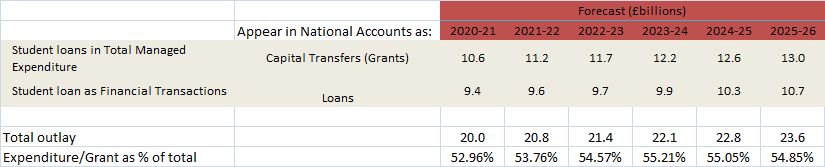
I have constructed the table above from forecasts for Total Managed Expenditure and Financial Transactions taken from the Office for Budgetary Responsibility’s latest publication (it accompanied Wednesday’s Budget).
It shows how newly issued student loans are now split into two components for the purposes of presentation in the National Accounts. The portion of loans that are expected to be repaid are classed as “financial transactions”, while the portion expected to be written off is recorded as capital expenditure. The latter scores in “public sector investment”, which was adopted as a new fiscal target prior to the pandemic (net investment cannot exceed 3% of national income), though the rules are currently under review.
We can see that student loan outlay is expected to reach £20billion in the year to March 2021, rising to £23.6billion in five years’ time.
The majority of new outlay is now expected to be written off and that share rises over the forecast period.
By 2025/26 repayments on all existing loans are projected to re000000000000000ach nearly £5billion per year. (This figure has improved since the sale programme for post-2012 loans was abandoned, since the treasury now gets the receipts that would have gone to private purchasers).
As mentioned in recent posts on here, the Department for Education only currently has an allocation of £4billion to cover the capital transfer / grant element of new loans and so it has to be granted large additional budgetary supplements each year. This situation has dragged on as the planned spending review has been postponed. We can now expect developments in the Autumn.

Last week’s Supplementary Estimates contained another note of interest for student loans.
Under “Note K: Contingent Liabilities” (p. 90) we find that a fifth contingent liability has been added to those associated with the now abandoned sale of student loans.
The sale of student loans necessitated warranties and indemnities to secure interest and obtain value
for money from investors. These contingent liabilities are in respect of:…
e) New EU Securitisation Regulations (Possible CL [contingent liability] in due course). UKGI [UK Government and Investment] are seeking legal counsel to review the implications of new EU securitisation reporting requirements from 2019. Credit granting criteria are being assessed for student loans which may generate legal challenge and we will continue to work with UKGI to update as more information and analysis becomes available.
If any reader can explain what the issues may be here, I would be very grateful.
The original four contingent liabilities are discussed here. These, along with the fifth, are still classed as “unquantifiable”.
There were also issues around whether the Special Purpose Vehicles for the securitisations were sufficiently independent of government so as to constitute a genuine sale (and thereby transfer the loans off the government’s balance sheet).
The wording above though suggests that the lack of “credit” checks on student loans may be the issue.