Author: admin

  • The global free speech recession

    The global free speech recession

    This essay was originally published in The Dispatch on Oct. 28, 2025.


    Since Charlie Kirk’s murder, the Trump administration has launched a blitzkrieg against Americans’ free speech rights. The scale and speed are dizzying — and they jeopardize the United States’ credibility as the world’s leading defender of free expression as other democracies continue to falter.

    The administration’s most alarming actions blur the distinction between protected and unprotected speech as well as words and violence. Right after the Kirk tragedy, Attorney General Pam Bondi said: “We will absolutely target you, go after you, if you are targeting anyone with hate speech.” Bondi later walked this statement back, saying that “Hate speech that crosses the line into threats of violence is NOT protected by the First Amendment.” But since then, the administration has only continued to conflate protected speech with violence.

    Why everything Pam Bondi said about ‘hate speech’ is wrong

    The nation’s top law enforcement officer doesn’t understand there is no hate-speech exception to the First Amendment — and that’s scary.


    Read More

    On Sept. 25, the White House released a national security memo on “Countering Domestic Terrorism and Organized Political Violence.” Inside it lies this passage:

    Common threads animating this violent conduct include anti-Americanism, anti-capitalism, and anti-Christianity; support for the overthrow of the United States Government; extremism on migration, race, and gender; and hostility towards those who hold traditional American views on family, religion, and morality.

    There’s little subtlety here. The White House has flagged Americans it considers anti-American, anti-capitalist, or anti-Christian — none of which the memo defines — as potential national security threats. The president’s memo asserts a vast left-wing conspiracy to incite political violence and then directs the National Joint Terrorism Task Force and its local offices to “investigate all participants in these criminal and terroristic conspiracies.”

    This guilt-by-association tactic is absolutely chilling in a free society. Being critical of America, capitalism, and Christianity shouldn’t put you on the feds’ radar because all those viewpoints are protected speech. A federal investigation should only occur when there’s reasonable evidence that some person or group — regardless of their constitutionally protected beliefs and opinions — has crossed the line into criminality. By the memo’s logic, the president’s own Make America Great Again movement could have been investigated after the political violence that erupted on Jan. 6. The message conveyed here is simple: Watch what you say. Or else.

    And if you’re a noncitizen legally in the country, that message goes doubly for you. Two weeks ago, the State Department revoked six foreigners’ visas for their social media posts about Kirk’s murder. According to the State Department on X, it will “continue to identify visa holders who celebrated the heinous assassination of Charlie Kirk.” This continues the administration’s crusade against noncitizens who engage in expression that the government doesn’t like. But the First Amendment protects the free speech rights of anyone on American soil, as the Supreme Court made clear in 1945’s Bridges v. Wixon. (Full disclosure: the Foundation for Individual Rights and Expression, my employer, is currently suing Secretary of State Marco Rubio to challenge two federal provisions that give the secretary the power to deport noncitizens for their protected speech.)

    Why FIRE is suing Secretary of State Rubio — and what our critics get wrong about noncitizens’ rights

    FIRE is suing Secretary of State Rubio to defend the First Amendment rights of legal immigrants threatened with deportation simply for speaking their minds.


    Read More

    The administration has intensified its prolific jawboning, too, turning the screws on the private sector, particularly the media, to achieve what it does not have the constitutional power to do itself. The most infamous example of this occurred when Federal Communications Commission Chairman Brendan Carr pressured Disney and ABC to cancel Jimmy Kimmel Live. Soon after, ABC indefinitely suspended Kimmel, though he was back on air after a week. Then in mid-October, Bondi leaned on Facebook to remove a group page that allowed users to track where ICE agents were in Chicago, much like Waze alerts you to speed traps. Like it or not, this is constitutionally protected speech. Telling folks the location of law enforcement isn’t a crime, and the creators and users of the page are registering their dissent to the government’s immigration policies.

    During the Biden administration, President Trump and conservative Americans understood the perniciousness of jawboning. They rightly pointed to the behind-the-scenes pressure the Biden administration exerted on social media companies to suppress stories they deemed as mis- or disinformation. This included Hunter Biden’s laptop, the efficacy of the COVID-19 vaccines, or the lab-leak theory of COVID-19’s origins. Yet now that Trump is back in power, the feeling is that “the left” is getting their just deserts. Politics is triumphing over principle — remember Trump’s promise to “bring back” free speech and his executive order restoring free speech and ending federal censorship once and for all — as America’s culture of free expression deteriorates more and more.

    But the Trump administration’s deliberate and focused attacks on free expression don’t just impact America, they reverberate globally. Across the democratic world, a free speech recession continues to worsen. Rather than defend this foundational human right at home and abroad, the U.S. government is abdicating that responsibility and undermining the legitimacy of free speech in an increasingly illiberal and authoritarian world.


    Two years ago, The Future of Free Speech, a nonpartisan think tank at Vanderbilt University, released a report, “The Free Speech Recession Hits Home.” The report analyzed free speech developments in 22 democracies between 2015 and 2022. It found something alarming: “Over 75 percent of the developments discussed are speech restrictive.”

    Recent examples from the United States’ closest allies are illustrative of these societies’ splintering belief in free speech as a critical right in a democracy.

    This fall, Canada’s Quebec province will consider a bill to ban prayer in public. Secularism Minister Jean-François Roberge said the bill would be introduced as part of his mandate “to strengthen secularism.” Religious expression, of course, is a form of free expression, but Roberge believes it shouldn’t be public. “Seeing people praying in the streets, in public parks, is not something we want in Quebec,” he said. He added: “When we want to pray, we go to a church, we go to a mosque, but not in public places. And, yes, we will look at the means where we can act legally or otherwise.”

    In Germany last year, a 64-year-old man had his flat searched and tablet seized because of alleged “antisemitic” posts as well as one calling a German politician a “professional idiot.” Under German law, it’s not only a crime to insult a politician, the penalties are more severe than criticizing a German pleb, in perfect Animal Farm style. Also in 2024, American expat C.J. Hopkins was charged with disseminating propaganda for criticizing Germany’s COVID-19 response on X by superimposing a barely visible white swastika on top of a white medical mask.

    So to Speak Podcast Transcript: CJ Hopkins compared modern Germany to Nazi Germany. Now he’s standing trial.

    J Hopkins is an American playwright, novelist, and political satirist. He moved to Germany in 2004.


    Read More

    This is a feature, not a bug, of Germany’s repressive speech climate. During a 60 Minutes story from last February, when correspondent Sharyn Alfonsi asked three prosecutors if it was a crime in Germany to insult someone, they confirmed it was. The punishment could even be worse when posted online “because in internet, it stays there,” said one prosecutor. Germany’s federal police, the BKA, also organize “action days” — including investigations, raids, interrogations, and seizures — to crack down on hate speech and insulting politicians online. In June, the BKA launched its 12th day of action, which included a total of 180 “police measures.” Herbert Reul, an interior minister for the German state of North Rhine-Westphalia, summed it up best, telling a German news agency, “Digital arsonists must not be allowed to hide behind their phones or computers.”

    In France, President Emmanuel Macron took thin-skinned to extraordinary heights when he sued a billboard owner in 2021 for using some of his inventory to depict the French president dressed up like Adolf Hitler to protest France’s pandemic policies. The business owner, Michel-Ange Flori, told Reuters: “I caricature. People may or may not like it but it is all the same, caricature will remain caricature.” A French court disagreed, slapping Flori with a fine of 10,000 euros. In response, Flori’s lawyer said “the right to caricature has been violated” in France, adding, “The president, so quick to defend freedom of expression … considers that it stops at his own august person.”

    But the most depressing accomplice in the West’s retreat from free speech is, without a doubt, our neighbor across the pond. In April, the Times of London reported a shocking statistic. Analyzing custody data, the newspaper reported that police in the United Kingdom arrested more than 24,000 people from 2022 through 2023 for sending “grossly offensive” messages or sharing posts considered “indecent,” “obscene,” or of a “menacing character” on social media.

    The most recent and infamous case of this is Irish comedy writer Graham Linehan. In early September, five armed police officers arrested the writer after he disembarked a flight from the United States to Heathrow. Linehan’s offense: mean tweets about transgender people, which the Metropolitan Police said incited violence. Linehan posted the tweets in April — four and a half months before his arrest — demonstrating the absurdity of the inciting-violence rationale. Last week, both Linehan and Londoners received good news: The Metropolitan Police announced they dropped the investigation into Linehan and said it would no longer investigate “non-crime hate incidents.” That’s the right approach, of course, but that’s only one police force across the entire kingdom. It also doesn’t undo the ordeal Linehan went through, which is why he intends to sue the Metropolitan police for wrongful arrest.

    The U.K.’s crackdown on speech, however, isn’t contained to online discourse. Since July, more than 2,000 people have been arrested for expressing support for Palestine Action, a pro-Palestinian direct action network. In July, Parliament deemed the group a terrorist organization and banned it after two members broke into a military base and damaged two planes.

    In early September, London’s Metropolitan Police arrested nearly 900 protesters for peacefully protesting the ban. A month later, police arrested nearly 500 more people for demonstrating in support of Palestine Action in Trafalgar Square. The reason for their arrest is eye-widening: They held up a sign that read, “I oppose genocide, I support Palestine Action.” Police even took in a man who held up a magazine cover about these arrests.

    Diane Afhim, a 69-year-old protester, said it best during the September arrests: “I feel that justice is not working if people are being arrested for holding a sign. This is not my Britain.”

    Late last month, another disconcerting story came out of the U.K., when a judge handed down a suspended sentence to Moussa Kadri, sparing him jail. Back in February, Kadri attacked a protester, Hamit Coskun, with a knife for burning the Quran outside of the Turkish consulate in London.

    “The court is effectively saying that if you attack a blasphemer with a knife, … you won’t have to spend a day behind bars,” said Lord Young of Acton, general secretary of the Free Speech Union, in reaction to Kadri’s suspended sentence.

    In Quran burning conviction, UK judge uses violence against defendant as evidence of his guilt

    UK judge cites violence against Quran-burning protester as proof of his guilt, Brazil sentences comedian to over eight years for telling jokes, and France targets porn.


    Read More

    But things get worse. Back in June, a court found Coskun, the victim of Kadri’s knife attack, guilty of a religiously aggravated public order offense and ordered him to pay a fine. “Your actions in burning the Quran where you did were highly provocative,” the judge said, “and your actions were accompanied by bad language in some cases directed toward the religion and were motivated at least in part by hatred of followers of the religion.” Most alarming was the judge’s finding that the violent attack on Coskun was evidence of Coskun’s guilt. You read that right.

    Fortunately, Coskun won his appeal this month. On Oct. 10, Coskun’s conviction was overturned by a judge who reminded Britons that they have no blasphemy law on the books.

    “Burning a Koran may be an act that many Muslims find desperately upsetting and offensive,” Justice Joel Bennathan said. “The criminal law, however, is not a mechanism that seeks to avoid people being upset, even grievously upset. The right to freedom of expression, if it is a right worth having, must include the right to express views that offend, shock or disturb.”

    While the courts finally got it right, Coskun never should have had to go through this nightmare in the first place.


    The despots of the world must relish the propaganda value of this Western backsliding on free expression.

    If they attack the press, they can point to what Trump is doing in the United States as justification. Throw a critic in jail? They can bring up Macron’s lawsuit for caricaturing him in France. Punish a religious dissenter? Well, there’s the curious case of Hamit Coskun in London. Repress the supporters of a disfavored group? They can point to the UK arrests of Palestine Action protesters. These illiberal actions are gifts to the world’s dictators — the Putins, the Erdogans, the Xis of the world — demonstrating that when push comes to shove, the world’s democracies will crack down on speech they don’t like, too.

    Just look at the unjust trial of media mogul Jimmy Lai in Hong Kong, where a judge in the case cited censorship in the U.S. and UK to justify the proceedings against Lai. “People who were freely expressing their views on Palestine, they were arrested in England … [and] in the U.S.,” Judge Esther Toh said in August. “It’s easy to say ‘la-di-da, it’s not illegal,’ but it’s not an absolute. Each country’s government has a different limit on freedom of expression.”

    But it doesn’t need to be this way.

    It’s a cruel irony that America’s dedication to free speech is slipping as we prepare to celebrate this nation’s 250th birthday. But it’s an opportunity, too. An opportunity to recommit to what makes the American experiment so special: our ability to settle our differences through dialogue and the ballot box, rather than dehumanization and the bullet. America is still the last best hope of earth, that shining city upon the hill, if we’ll fight for it.

    Even as America’s culture of free speech withers, the First Amendment fortunately still gives this country the world’s strongest constitutional protection for speech. But culture matters. Woe to us if we indulge our worst impulses and welcome in the ravenous, all-consuming spirits of censorship and violence and turn our back on what truly makes America exceptional.

    As Judge Learned Hand wrote back in 1944: “Liberty lies in the hearts of men and women; when it dies there, no constitution, no law, no court can even do much to help it. While it lies there it needs no constitution, no law, no court to save it.”

    There would be no greater tragedy than if free speech dies here by our own hands, to the delight of despots everywhere.

    Source link

  • Podcast: Public attitudes, housing, employability

    Podcast: Public attitudes, housing, employability

    This week on the podcast we discuss fresh polling on public attitudes to UK universities, which shows how a widening graduate/non-graduate divide and sharper political splits are fuelling worries about degree quality and whether universities are focused on the country’s interests.

    Plus we discuss the housing crunch – the new Renters’ Rights Act, warnings on missed housebuilding targets, and what a forthcoming statement of expectations on student accommodation could require of providers working with local authorities. And we explore employability insights from new research – the language gap between university “attributes” and real job adverts, and how to recognise skills students gain beyond the curriculum.

    With Ben Ward, CEO at the University of Manchester Students’ Union, Johnny Rich, Chief Executive at the Engineering Professors’ Council and Push, Livia Scott, Associate Editor at Wonkhe and presented by Jim Dickinson, Associate Editor at Wonkhe.

    Student accommodation – a tale of two cities, and 2point4 students

    The Renters’ Rights Act is out of the oven, but the student housing market is still cooked

    Shared Institutions: The public’s view on the role of universities in national and local life / More in Common and UCL Policy Lab

    AGCAS: Uncovering Skills

    Employability: degrees of value / Johnny Rich

    Research Plus

    You can subscribe to the podcast on Apple Podcasts, YouTube Music, Spotify, Acast, Amazon Music, Deezer, RadioPublic, Podchaser, Castbox, Player FM, Stitcher, TuneIn, Luminary or via your favourite app with the RSS feed.

    Source link

  • How districts can avoid 4 hidden costs of outdated facilities systems

    How districts can avoid 4 hidden costs of outdated facilities systems

    Key points:

    School leaders are under constant pressure to stretch every dollar further, yet many districts are losing money in ways they may not even realize. The culprit? Outdated facilities processes that quietly chip away at resources, frustrate staff, and create ripple effects across learning environments. From scheduling mishaps to maintenance backlogs, these hidden costs can add up fast, and too often it’s students who pay the price. 

    The good news is that with a few strategic shifts, districts can effectively manage their facilities and redirect resources to where they are needed most. Here are four of the most common hidden costs–and how forward-thinking school districts are avoiding them. 

    How outdated facilities processes waste staff time in K–12 districts

    It’s a familiar scene: a sticky note on a desk, a hallway conversation, and a string of emails trying to confirm who’s handling what. These outdated processes don’t just frustrate staff; they silently erode hours that could be spent on higher-value work. Facilities teams are already stretched thin, and every minute lost to chasing approvals or digging through piles of emails is time stolen from managing the day-to-day operations that keep schools running.  

    centralized, intuitive facilities management software platform changes everything. Staff and community members can submit requests in one place, while automated, trackable systems ensure approvals move forward without constant follow-up. Events sync directly with Outlook or Google calendars, reducing conflicts before they happen. Work orders can be submitted, assigned, and tracked digitally, with mobile access that lets staff update tickets on the go. Real-time dashboards offer visibility into labor, inventory, and preventive maintenance, while asset history and performance data enable leaders to plan more effectively for the long term. Reports for leadership, audits, and compliance can be generated instantly, saving hours of manual tracking. 

    The result? Districts have seen a 50-75 percent reduction in scheduling workload, stronger cross-department collaboration, and more time for the work that truly moves schools forward.

    Using preventive maintenance to avoid emergency repairs and extend asset life

    When maintenance is handled reactively, small problems almost always snowball into costly crises. A leaking pipe left unchecked can become a flooded classroom and a ruined ceiling. A skipped HVAC inspection may lead to a midyear system failure, forcing schools to close or scramble for portable units. 

    These emergencies don’t just drain budgets; they disrupt instruction, create safety hazards, and erode trust with families. A more proactive approach changes the narrative. With preventive maintenance embedded into a facilities management software platform, districts can automate recurring schedules, ensure tasks are assigned to the right technicians, and attach critical resources, such as floor plans or safety notes, to each task. Schools can prioritize work orders, monitor labor hours and expenses, and generate reports on upcoming maintenance to plan ahead. 

    Restoring systems before they fail extends asset life and smooths operational continuity. This keeps classrooms open, budgets predictable, and leaders prepared, rather than reactive. 

    Maximizing ROI by streamlining school space rentals

    Gymnasiums, fields, and auditoriums are among a district’s most valuable community resources, yet too often they sit idle simply because scheduling is complicated and chaotic. Paper forms, informal approvals, and scattered communication mean opportunities slip through the cracks.

    When users can submit requests through a single, digital system, scheduling becomes transparent, trackable, and far easier to manage. A unified dashboard prevents conflicts, streamlines approvals, and reduces the back-and-forth that often slows the process. 

    The payoff isn’t just smoother operations; districts can see increased ROI through easier billing, clearer reporting, and more consistent use of unused spaces. 

    Why schools need facilities data to make smarter budget decisions

    Without reliable facilities data, school leaders are forced to make critical budget and operational decisions in the dark. Which schools need additional staffing? Which classrooms, gyms, or labs are underused? Which capital projects should take priority, and which should wait? Operating on guesswork not only risks inefficient spending, but it also limits a district’s ability to demonstrate ROI or justify future investments. 

    A clear, centralized view of facilities usage and costs creates a strong foundation for strategic decision-making. This visibility can provide instant insights into patterns and trends. Districts can allocate resources more strategically, optimize staffing, and prioritize projects based on evidence rather than intuition. This level of insight also strengthens accountability, enabling schools to share transparent reports with boards, staff, and other key stakeholders, thereby building trust while ensuring that every dollar works harder. 

    Facilities may not always be the first thing that comes to mind when people think about student success, but the way schools manage their spaces, systems, and resources has a direct impact on learning. By moving away from outdated, manual processes and embracing smarter, data-driven facilities management, districts can unlock hidden savings, prevent costly breakdowns, and optimize the use of every asset. 

    Latest posts by eSchool Media Contributors (see all)

    Source link

  • The legal debate over Trump’s Title VI campus crackdown

    The legal debate over Trump’s Title VI campus crackdown

    The September ruling in Harvard University’s favor restoring roughly $2.2 billion in federal funding struck a short-term blow against the Trump administration’s use of civil rights investigations against universities. 

    The administration pulled the funding in April after Harvard rejected a series of sweeping demands, claiming it was suspending the funds because the university hadn’t adequately protected students from antisemitism. 

    In June, the U.S. Department of Health and Human Services’ civil rights office formally accused the university of violating Title VI, which bars discrimination on the basis of race, color or national origin in programs or activities receiving federal funding. 

    Yet in her 84-page order, U.S. District Judge Allison Burroughs found that none of the federal government’s grant termination letters specified how Harvard failed to respond to any acts of antisemitism in violation of Title VI. 

    “A review of the administrative record makes it difficult to conclude anything other than that Defendants used antisemitism as a smokescreen for a targeted, ideologically-motivated assault on this country’s premier universities,” Burroughs wrote. “Further, their actions have jeopardized decades of research.”

    Harvard isn’t the only university facing Title VI accusations. The Trump administration is seeking $1.2 billion from the University of California, Los Angelesplus an overhaul of its campus practices — after the U.S. Department of Justice accused the institution of violating Title VI. In both UCLA and Harvard’s cases, the Trump administration cited pro-Palestinian campus demonstrations and claims of antisemitism in its notices of violations. 

    The Justice Department didn’t make an official available for an interview. 

    These types of developments have set off a high stakes debate among legal experts about whether the Trump administration is weaponizing Title VI. 

    They trouble Jodie Ferise, a partner in the higher education practice at the Indiana law firm of Church Church Hittle and Antrim, who previously served as vice president and general counsel for the Independent Colleges of Indiana.

    “Discrimination was always a disqualifier for federal funds, but when it’s just a pretext to bend higher education to the federal government’s will, that’s a problem,” Ferise said. “To sweep every single grant off the table seems more like extortion. Nothing about it is designed to make higher education better.”

    In the Harvard ruling, Burroughs wrote that the administration failed to take the proper steps before pulling federal funding. 

    Title VI requires the federal government to notify an institution of its alleged violation and determine that it can’t come into compliance voluntarily before ending financial assistance to the university, the judge explained. Even then, the agency may terminate the funding only after the university has been given the opportunity for a hearing.

    Burroughs concluded, “It is undisputed that Defendants did not comply with these requirements before issuing the Freeze Orders or Termination Letters.”

    However, experts who spoke with Higher Ed Dive agree that Burroughs’ ruling is far from the last word on the issue. That case could eventually be headed to the U.S. Supreme Court, as the Trump administration vowed to appeal, though a settlement is not impossible. 

    Is the Trump administration using Title VI legitimately?

    The Trump administration has warned dozens of colleges of potential Title VI violations. In March, the U.S. Department of Education’s Office for Civil Rights sent letters to 60 institutions of higher education warning them of potential enforcement actions if they failed to comply with Title VI to protect Jewish students.

    “What’s been happening is not so much expanding Title VI as implementing it properly so there’s no double standard. For many years, Jewish students’ rights were not being protected,” said Kenneth Marcus, the founder and CEO of the Louis D. Brandeis Center for Human Rights Under Law, a research and legal advocacy group aiming to combat antisemitism.

    As an official in the George W. Bush administration and the first Trump administration, Marcus also strongly advocated for the use of Title VI to protect students who were harassed because of their ancestry, such as ethnic and religious characteristics.

    Source link

  • Ambow Education Pushes AI Agenda Abroad While Raising Red Flags in the U.S.

    Ambow Education Pushes AI Agenda Abroad While Raising Red Flags in the U.S.

    Ambow Education, once linked to the Chinese Communist Party (CCP), is aggressively exporting its AI-driven education platform, HybriU™, to global markets—even as its footprint in the United States remains small and opaque. The company’s international ambitions raise questions about transparency, governance, and potential political influence.

    Ambow’s recent partnership with Bamboo System Technology aims to scale HybriU’s AI-education ecosystem across Southeast Asia, touting a deeper technology stack and expanded distribution. Yet outside China, Ambow’s record is spotty, and critics warn that the firm’s rapid expansion may outpace oversight or educational rigor.

    In the U.S., Ambow reportedly explored a partnership with Colorado State University (CSU), though details remain murky. Engagements like these, combined with its involvement with specialized institutions such as the NewSchool of Architecture and Design, suggest a strategy of targeting schools where oversight may be limited and innovation promises can be oversold.

    Despite these global ambitions, Ambow’s American presence is modest: a small office tucked in Cupertino, California, suggesting that the company may be testing the waters in the U.S. market rather than committing to a major operational footprint.

    For U.S. institutions, Ambow’s history—including prior CCP ties—and its small domestic footprint present a cautionary tale: a company that combines ambitious AI promises with a murky past and minimal transparency. Ambow’s expansion illustrates a growing challenge in higher education: navigating partnerships with foreign edtech firms while safeguarding institutional integrity, regulatory compliance, and academic quality.

    Sources: Ambow Education press releases, Bamboo System Technology announcements, Higher Education Inquirer reporting, corporate filings.

    Source link

  • Does ‘less is more’ apply to tech companies?

    Does ‘less is more’ apply to tech companies?

    On 20 October 2025, an Amazon Web Services daylong outage left millions of people around the world unable to communicate electronically and hurt the operations of more than 1,000 companies. 

    Snapchat, Canva, Slack and Reddit were rendered useless while the businesses of gaming platforms Fortnight and Roblox, bankers Lloyds and Halifax and U.S. airlines Delta and United were disrupted. Media companies including the New York Times, the Wall Street Journal and Disney were also impacted.

    Amazon Web Service, or AWS, handles the backbone work of tools and computers allowing about 37% of the internet to work. It is the dominant player for cloud servers but the alternatives are equally large giants — Microsoft’s Azure and Google’s Cloud Platform. 

    The outage prompted European officials to call for plans for digital sovereignty and less reliance on U.S. behemoths. It was also a wakeup call to internet users worldwide of the fragility of the infrastructure and how much they rely on digital technology for everyday work and personal tasks from ordering coffee and communicating with colleagues to checking in airline flights and home security cameras to playing games, doing homework and shopping online.

    And it shined a light on how much the technology we rely on is controlled by oligopolies. Many people are familiar with the idea of a monopoly. That’s where one company or entity controls the market for a specific product or service and no competition is allowed. An oligopoly is a market structure when a small number of large firms dominate an industry, limiting competition. 

    Who controls the technology we use?

    What happened with the glitch at AWS showed the dangers of too much control in too few hands, but are there benefits we get from monopolies and oligopolies? How does competition — or the lack of it — affect what we consume? 

    A monopoly allows the company or entity to control the quality and prices of the product and services but the lack of competition might lead to less incentives to improve the product and prices might continually rise. 

    An example of a monopoly might be your local city or town provider of water, gas or electricity. The United States Postal Service is protected by U.S. law to be a protected monopoly to handle and deliver non-urgent letters.

    With oligopolies there is some competition, but consumers have a smaller choice and the major players rely on each other since one company’s actions could impact the others. An example of an oligopoly could be the airlines in your country where a few airlines largely control domestic and international flights. 

    Oligopolies generally emerge in industries with large start-up costs and strict legislation, allowing the oligopolies to keep prices high with virtually no new competition. 

    Benefits to concentrated ownership

    On the plus side, oligopolies tend to bring stability to their markets. An example of an oligopoly is OPEC, the Organization of Petroleum Exporting Countries, where 12 member countries each hold substantial market share in the supply of oil and control oil prices by raising or lowering output.

    When there is direct competition in business, companies selling similar products or services vie for more sales and share of the market, and profit by marketing their products on price, quality and promotions. This can lead to more innovation for product or services improvement and more company efficiencies to spur customer demand. But on the negative side, price wars may erupt and there could be consumer confusion over different brands. For example, Coca-Cola and Pepsi are direct competitors.

    University of California San Diego Economics Professor Marc Muendler noted that while the AWS outage negatively impacted people and businesses globally, it would be difficult for corporate clients to unwind from it, let alone find an immediate replacement because AWS offers a customized service specific to contracts.

    “Switching costs can be immense,” Muendler added.

    Muendler said for other oligopolies such as gas suppliers, airlines or even yogurt makers, prices might become somewhat elevated if the number of players is too small. An extreme might be duopolies, where two companies dominate sales of a product or service, such as when ski resorts are owned largely by two companies and can keep ski lift ticket prices high, he said.

    When big providers start having problems, that gives smaller players an opportunity.

    “It will always be hard to be the runner-up in a market with scale economies, where first movers get ahead fast,” he said. “[But] there’s a large segment of retail stores that don’t have specific contracts [with AWS]. That might be a market segment for a new competitor serving smaller customers, and then scale up.”

    Muendler said AWS clients should know they have a single supplier and be aware of the risks. 

    “I don’t see this market as easily reformable,” he said. “A big unanswered question is: How do we build resilience into our supply chains? There have been lots of disruptions to the global economy in the past 10–15 years. How do we incentivize companies that need specialized suppliers to also have redundancies,” or backup plans?


    Questions to consider:

    1. Identify a company, utility or other entity in your town or city. Is it a monopoly, oligopoly or does it compete directly with others? 

    2. What are the pluses or minuses for your family as consumers of its product or services?

    3. What are the key differences for an employee who works at a monopoly vs. oligopoly vs. direct competitors? 


    Source link

  • 4 Weeks Into Shutdown, Colleges, Students Running Out of Options

    4 Weeks Into Shutdown, Colleges, Students Running Out of Options

    The government has been shut down for a month and Congress remains locked in a stalemate. Students are going hungry, veterans have been deserted and vital research has been left in the lurch. The longer the shutdown drags on, the more harm it will do to higher education.

    Most urgently, the USDA will not use emergency funds to help cover the costs of the Supplement Nutrition Assistance Program. More than a million college students who rely on SNAP for their basic needs won’t have that support starting Saturday. Mark Huelsman, the director of policy and advocacy at the Hope Center for Student Basic Needs, said the situation will force students and colleges into “an impossible situation” and could lead to many students dropping out.

    The crisis extends beyond food insecurity into student support programs, with the shutdown throwing veterans’ education into limbo. Nobody is answering the GI Bill hotline that thousands of veterans use each month to get information on tuition, eligibility and housing allowances. Staff at Veterans Affairs regional offices are furloughed, putting an end to career counseling and delaying GI Bill claims.

    As direct services to students falter, colleges are moving into mitigation mode. Gap funds, meant to serve institutions in these circumstances, are dwindling. Inside Higher Ed reported last week that institutions are limiting travel, research and job offers in order to preserve cash while hundreds of millions in research funds are on pause. A training program funded by a grant from the Labor Department is on hold because a federal program officer isn’t at work to approve the next tranche of cash.

    Ironically, part of Democrats’ resistance to reopening the government is serving to protect higher ed funding. Democrats are trying to prevent Republicans from clawing back approved funding through the rescissions process, like they did this summer with grants to public broadcasting and USAID. The risk to education funds that don’t align with the White House’s priorities is real. In a potentially illegal move of impoundment, the Department of Education has canceled or rejected funding for at least 100 TRIO programs affecting more than 43,000 disadvantaged students. Last month it reallocated $132 million in funds away from minority-serving institutions to historically Black colleges and universities and tribal colleges.

    Meanwhile, the Trump administration—never one to let a good crisis go to waste—is using the shutdown to further gut the Education Department. Most of the department has been furloughed, and 10 days into the shutdown the administration fired nearly 500 more Education Department staff. A federal judge indefinitely blocked the layoffs this week, but the administration will likely challenge the ruling. If the cuts happen, the department will have fewer than half the employees it started with in January. The offices that handle civil rights complaints, TRIO funding and special education will be decimated.

    The staff cuts set the stage for Education Secretary Linda McMahon to reiterate her plans to shutter the department. In a post on X two weeks into the shutdown, she said the fact that millions of American students are still going to school, teachers are getting paid and schools are operating as normal during the shutdown “confirms what the President has said: the federal Department of Education is unnecessary, and we should return education to the states.”

    “The Department has taken additional steps to better reach American students and families and root out the education bureaucracy that has burdened states and educators with unnecessary oversight,” she added.

    Policy experts predict the shutdown will end around mid-November, when enough people feel the pain of not getting a paycheck and start to complain to their senators and representatives. But colleges won’t pick up where they left off. A significant pause in funding derails education journeys for disadvantaged students and throttles valuable scientific research. Subject matter expertise and human resources will be lost through Education Department staffing cuts. Already on the defense after nearly a year of attacks on DEI, academic freedom and research funding by the administration, higher ed will struggle to recover from yet another blow.

    Source link

  • How One Big Beautiful Bill Act Threatens Student Success

    How One Big Beautiful Bill Act Threatens Student Success

    Nearly 60 percent of all college students in the U.S. experience at least one form of basic needs insecurity, lacking stable housing and/or consistent access to food, according to national surveys.

    The One Big Beautiful Bill Act, which Congress passed in July, creates sweeping changes to higher education—including a new tax rate for university endowments and accountability metrics for student income levels after graduation. It also directly impacts college students, threatening their access to food assistance programs and their ability to pay for college, which experts warn could hamper their persistence and completion.

    Policy and higher education leaders convened during an Oct. 28 webinar hosted by the Hope Center for Student Basic Needs at Temple University to discuss how the new legislation threatens student financial wellness and success.

    “We are very, very worried that student basic needs insecurity will be increasing dramatically over the next few years,” said Bryce McKibben, senior director of policy and advocacy at the Hope Center.

    For current students, experts outlined three major shifts in federal financial supports.

    1. Cuts to SNAP Funding

    OBBBA includes $186 billion in cuts to the Supplemental Nutrition Assistance Program, which provides support obtaining food for nearly three million young adults, according to U.S. Census data. The bill places more requirements on SNAP recipients; at present, all funding for SNAP is at risk due to the government shutdown. Some states expect to run out of SNAP dollars as early as Nov. 1.

    “[SNAP] is our first line of defense against hunger. It reduces health care–related issues and it bolsters local economies,” said Gina Plata-Nino, interim director of the SNAP, Food Research & Action Center. “It also provides jobs; it provides federal income taxes. And all of this is going to be threatened.”

    Under the bill, all adults ages 18 to 64 must demonstrate they work at least 20 hours per week to be eligible for SNAP, Plata-Nino said.

    Approximately one in four college students experience food insecurity. SNAP resources are largely underutilized by college students, in part because of complicated enrollment processes. Instead, many rely on campus pantries, which are mostly privately funded by individual donors or campus budgets. Plato-Nino anticipates the changes to SNAP will impact funding and capacity for higher education institutions to provide resources, “because now they have to focus on these issues,” she said.

    The federal cuts could cause further damage to an already fragile system.

    “We have a threadbare social safety net that really hits students when they can least afford to meet what are pretty acute and deep costs as they’re trying to get through their degree program,” said Mark Huelsman, director of policy and advocacy at the Hope Center.

    Many colleges and universities expanded emergency grant funding for students during the COVID-19 pandemic to address sudden expenses that could threaten a student’s ability to remain enrolled. While supplemental funding can help ease this gap, it’s not sufficient, Huelsman said.

    “Campuses don’t often have the resources to help students meet what can be an acute financial emergency,” Huelsman said.

    An August 2025 Student Voice survey by Inside Higher Ed and Generation Lab found that 64 percent of respondents said they didn’t know whether their college provides emergency financial aid, and an additional 4 percent indicated that resource was not available at their institution. Only 12 percent of respondents said they knew how to apply for emergency aid at their college.

    2. Changes to Pell Grants

    The reconciliation bill also includes a variety of changes to student eligibility for the federal Pell Grant program, which provides financial aid to low-income students.

    Over one-third of Student Voice respondents indicated paying for college was a top source of stress while enrolled, second only to balancing family, academic, work and personal responsibilities.

    For the academic year 2026–27, those with a student aid index (SAI) over $14,790, as identified by the FAFSA, are no longer eligible for Pell Grants. Similarly, students who receive scholarships that meet the full cost of attendance (including books, housing, food, tuition and fees) are not eligible for Pell, regardless of their SAI.

    “We anticipate that this will affect a very small number of students,” said Jessica Thompson, senior vice president at the Institute for College Access and Success. “But this remains to be seen how this takes effect and what it looks like on the ground.”

    3. Limits on Graduate and Parent Borrowing

    OBBBA caps loans on professional degree programs (which include medical, law, veterinary and dentistry programs, among others) at $200,000, and other graduate programs at $100,000. It also eliminates Grad PLUS loans, which are unsubsidized federal loans with no borrowing limits. Students currently enrolled can borrow from Grad PLUS for three academic years or the remainder of their credential program, whichever is shorter.

    While these limits can be beneficial for keeping student borrowing down, there may be unintended consequences regarding who can access the programs, Thompson said. For example, students who enroll at historically Black colleges and universities or minority-serving institutions are more likely to utilize Parent PLUS loans to pay for college.

    “This has been a really big lifeline for accessing credit in order to cover college costs for people’s children, and there will be a disproportionate impact on these new caps on those types of institutions,” Thompson said.

    Thompson also noted that a lack of federal loan opportunities for graduate and professional students may cause a rise in private loan borrowing, which often has higher interest rates and fewer protections for borrowers.

    “We want to keep a really close eye on what it means for the availability of programs in general … but also access and looking at increasingly less diverse pipelines in terms of historically marginalized populations being able to access graduate and professional programs,” Thompson said.

    Similar to SNAP cuts, Thompson anticipates the loan caps will add significant financial pressure on colleges and universities due to loss of revenue and enrollment.

    Source link

  • More College Leaders Speak Out Against Trump’s Compact

    More College Leaders Speak Out Against Trump’s Compact

    More universities are signaling opposition to the Trump administration’s compact for higher education, which would require institutions to make changes to their policies and practices in order to receive an unspecified edge in grant funding.

    In comments to faculty groups and student journalists, a handful of university leaders have made clear that they won’t sign on to the compact in its current form. But those comments don’t amount to a formal rejection of the agreement, several university spokespeople told Inside Higher Ed. Each said that because their institution hasn’t been formally asked to sign, they haven’t officially considered the administration’s proposal.

    For instance, at Miami University in Ohio, Provost Chris Makaroff told the University Senate that “right now, there is no appetite to even consider joining it,” according to the Miami Student.

    “The administration is totally against it in every way possible, and probably the only way that it would possibly go through is if somehow or another, they threaten to cut off all funding to the university,” Makaroff added.

    When asked about those comments and whether that constituted a rejection, Seth Bauguess, the university’s senior director of communications, noted that Miami wasn’t part of the first group of universities asked to sign, so “therefore we have not formally considered it.”

    When the administration initially invited nine universities to give feedback on the document, Trump officials sent each institution a signed cover letter and a copy of the agreement. Another three universities were invited to an Oct. 17 White House meeting to discuss the compact.

    Beyond those overtures, President Donald Trump wrote on social media platform he owns, Truth Social, that universities that prefer to “return to the pursuit of Truth and Achievement” are “invited to enter into a forward looking Agreement with the Federal Government to help bring about the Golden Age of Academic Excellence in Higher Education.” Officials, speaking on condition of anonymity, told media outlets that the post was an invitation to all colleges to sign on to the compact.

    So far, nearly a dozen universities have publicly rejected the deal, and White House officials are reportedly planning to update the document in response to the feedback from universities. Only New College of Florida has said that it’s ready to sign, though it hasn’t yet been formally asked. The White House hasn’t said how interested universities can join, but officials have threatened the federal funding of institutions that don’t sign the compact.

    Jon Fansmith, senior vice president for government relations and national engagement at the American Council on Education, said the mixed messages from universities likely stem from “the general confusion around how the administration is handling this.”

    “Even the statement by New College raises the question of how would anyone actually sign up if they wanted to?” he said, adding that the compact’s terms don’t appear to be final and there’s no form or website where colleges and universities can go to sign it.

    Fansmith said he’s not surprised that some campus leaders are seeking to make their concerns clear while not definitively turning down something they haven’t been offered.

    “Why pick an unnecessary fight?” he said.

    The growing cohort of presidents and leaders speaking out about the compact includes Arizona State University president Michael Crow, who told the State Press on Oct. 24 that the compact is no “longer a viable thing” and that he’s “been trying to guide people in a different direction.”

    Crow was invited to the Oct. 17 White House meeting to discuss the compact, which also included representatives from Dartmouth College, the University of Arizona, the University of Kansas, the University of Texas at Austin, the University of Virginia, Vanderbilt University and Washington University in St. Louis. After that meeting, an ASU spokesperson said the university was engaging in dialogue with Trump’s team.

    After the State Press published its interview with Crow, Inside Higher Ed followed up to see if “no longer a viable thing” meant “no.”

    “It’s important to note that ASU has not been asked to sign the Compact for Academic Excellence in Higher Education,” an ASU spokesperson responded. “So we can’t be ‘reviewing’ or ‘negotiating’ or ‘weighing’ it. ASU has long been a voice for change in higher education, something the university has been pushing for more than 20 years. If the administration looks for new and innovative approaches to serve the needs of the country, ASU is likely one to be consulted. President Crow is happy to share his vision for the future of higher education with anyone, if asked, whether they’re students, parents, alums, members of the public, or the administration.”

    But some universities, including Emory and Syracuse, have chosen to reject the compact before receiving a formal ask. And on Thursday, University of Kansas provost Barbara Bichelmeyer told The Kansan, “Fundamentally, there’s no way, with the compact as it is written and sent out to other institutions, that KU could sign that.”

    Bichelmeyer also noted that KU wasn’t asked to sign the compact.

    Brendan Cantwell, a higher education professor at Michigan State University, said there’s no reason for colleges to say no at this moment.

    “The basic tenet of college administration is don’t make a decision until you have to,” he said. “No one is forcing their hand right now … and they don’t want to antagonize the administration, particular donors or state officials. If I wasn’t explicitly invited, I wouldn’t explicitly decline to participate.”

    Cantwell added that the president’s social media post and other communications from Trump officials have created a lot of ambiguity, and institutions are using that to their advantage.

    “What the president has said, by saying that anyone can apply, but not specifically inviting anyone beyond the 12, has created an opportunity for campuses to message ‘no’ to students and ‘not yes’ to everyone else,” he said.

    Source link

  • College Student Mental Health Remains a Wicked Problem

    College Student Mental Health Remains a Wicked Problem

    Just 27 percent of undergraduates describe their mental health as above average or excellent, according to new data from Inside Higher Ed’s main annual Student Voice survey of more than 5,000 undergraduates at two- and four-year institutions.

    Another 44 percent of students rate their mental health as average on a five-point scale. The remainder, 29 percent, rate it as below average or poor. 

    In last year’s main Student Voice survey, 42 percent of respondents rated their mental health as good or excellent, suggesting a year-over-year decline in students feeling positive about their mental health. This doesn’t translate to more students rating their mental health negatively this year, however, as this share stayed about the same. Rather, more students in this year’s sample rate their mental health as average (2025’s 44 percent versus 29 percent in 2024). 

    About the Survey

    Student Voice is an ongoing survey and reporting series that seeks to elevate the student perspective in institutional student success efforts and in broader conversations about college.

    Look out for future reporting on the main annual survey of our 2025–26 cycle, Student Voice: Amplified. Check out what students have already said about trust, artificial intelligence and academics, cost of attendance, and campus climate.

    Some 5,065 students from 260 two- and four-year institutions, public and private nonprofit, responded to this main annual survey about student success, conducted in August. Explore the data captured by our survey partner Generation Lab here and here. The margin of error is plus or minus one percentage point.

    The story is similar regarding ratings of overall well-being. In 2024, 52 percent of students described their overall well-being as good or excellent. This year, 33 percent say it’s above average or excellent. Yet because last year’s survey included slightly different categories (excellent, good, average, fair and poor, instead of excellent, above average, average, below average and poor), it’s impossible to make direct comparisons. 

    How does this relate to other national data? The 2024-2025 Healthy Minds Study found that students self-reported lower rates of moderate to severe depressive symptoms, anxiety and more for the third year in a row—what one co-investigator described as “a promising counter-narrative to what seems like constant headlines around young people’s struggles with mental health.” However, the same study found that students’ sense of “flourishing,” including self-esteem, purpose and optimism, declined slightly from the previous year. So while fewer students may be experiencing serious mental health problems, others may be moving toward the middle from a space of thriving.

    Inside Higher Ed’s leadership surveys this year—including the forthcoming Survey of College and University Student Success Administrators—also documented a gap between how well leaders think their institutions have responded to what’s been called the student mental health crisis and whether they think undergraduate mental health is actually improving. In Inside Higher Ed’s annual survey of provosts with Hanover Research, for example, 69 percent said their institution has been effective in responding to student mental health concerns, but only 40 percent said undergraduate health on their campus is on the upswing.

    Provosts also ranked mental health as the No. 1 campus threat to student safety and well-being (80 percent said it’s a top risk), followed by personal stress (66 percent), academic stress (51 percent) and food and housing insecurity (42 percent). Those were all far ahead of risks such as physical security threats (2 percent) or alcohol and substance use issues (13 percent).

    Among community college provosts, in particular, food and housing insecurity was the leading concern, with 86 percent naming it a top risk.

    Financial insecurity can impact mental health, and both factors can affect academic success. Among 2025 Student Voice respondents who have ever seriously considered stopping out of college (n=1,204), for instance, 43 percent describe their mental health as below average or poor. Among those who have never considered stopping out (n=3,304), the rate is just 23 percent. And among the smaller group of students who have stopped out for a semester or more but re-enrolled (n=557), 40 percent say their mental health is below average or poor, underscoring that returnees remain an at-risk group for completion.

    Similarly, 43 percent of students who have seriously considered stopping out rate their financial well-being as below average or poor, versus 23 percent among students who’ve never considered stopping out—the same split as the previous finding on mental health.

    The association between students’ confidence in their financial literacy and their risk of dropping out is weaker, supporting the case for tangible basic needs support: Some 25 percent of respondents who have considered stopping out rate their financial literacy as below average or poor, compared to 15 percent of those who have not considered stopping out.

    Angela K. Johnson, vice president for enrollment management at Cuyahoga Community College in Ohio, said her institution continuously seeks feedback from students about how their financial stability and other aspects of well-being intersect.

    “What students are saying by ‘financial’ is very specific around being unhoused, food insecurity,” she said. “And part of the mental health piece is also not having the medical insurance support to cover some of those ongoing services. We do offer some of them in our counseling and psychological services department, but we only offer so many.”

    All this bears on enrollment and persistence, Johnson said, “but it really is a student psychological safety problem, a question of how they’re trying to manage their psychological safety without their basic needs being met.”

    A ‘Top-of-Mind Issue’

    Tri-C, as Johnson’s college is called, takes a multipronged approach to student wellness, including via an app called Help Is Here, resource awareness efforts that target even dual-enrollment students and comprehensive basic needs support: Think food pantries situated near dining services, housing transition coordination, childcare referrals, utility assistance, emergency funds and more.

    Faculty training is another focus. “Sometimes you see a student sleeping in your class, but it’s not because the class is boring. They may have been sleeping in their car last night,” Johnson said. “They may not have had a good meal today.”

    Political uncertainty may also be impacting student wellness. The American Council on Education hosted a webinar earlier this year addressing what leaders should be thinking about with respect to “these uncertain times around student well-being,” said Hollie Chessman, a director and principal program officer at ACE. “We talked about identity, different identity-based groups and how the safe spaces and places are not as prevalent on campuses anymore, based on current legislation. So some of that is going to be impacting the mental health and well-being of our students with traditionally underrepresented backgrounds.”

    Previously released results from this year’s Student Voice survey indicate that most students, 73 percent, still believe that most or nearly all of their peers feel welcomed, valued and supported on campus. That’s up slightly from last year’s 67 percent. But 32 percent of students in 2025 report that recent federal actions to limit diversity, equity and inclusion efforts have negatively impacted their experience at college. This increases to 37 percent among Asian American and Pacific Islander and Hispanic students, 40 percent among Black students and 41 percent among students of other races. It decreases among white students, to 26 percent. Some 65 percent of nonbinary students (n=209) report negative impacts. For international students (n=203), the rate is 34 percent.

    The Student Voice survey doesn’t reveal any key differences among students’ self-ratings of mental health by race. Regarding gender, 63 percent of nonbinary students report below average or poor mental health, more than double the overall rate of 29 percent. In last year’s survey, 59 percent of nonbinary students reported fair or poor mental health.

    In a recent ACE pulse survey of senior campus leaders, two in three reported moderate or extreme concern about student mental health and well-being. (Other top concerns were the value of college, long-term financial viability and generative artificial intelligence.)

    “This is a top-of-mind issue, and it has been a top-of-mind issue for college and university presidents” since even before the pandemic, Chessman said. “And student health and well-being is a systemic issue, right? It’s not just addressed by a singular program or a counseling session. It’s a systemic issue that permeates.”

    In Inside Higher Ed’s provosts’ survey, the top actions these leaders reported taking to promote mental health on their campus in the last year are: emphasizing the importance of social connection and/or creating new opportunities for campus involvement (76 percent) and investing in wellness facilities and/or services to promote overall well-being (59 percent).

    Despite the complexity of the issue, Chessman said, many campuses are making strides in supporting student well-being—including by identifying students who aren’t thriving “and then working in interventions to help those students.” Gatekeeper training, or baseline training for faculty and staff to recognize signs of student distress, is another strategy, as is making sure faculty and staff members can connect students to support resources, groups and peers.

    “One of the big things that we have to emphasize is that it is a campuswide issue,” Chessman reiterated.

    More on Health and Wellness

    Other findings on student health and wellness from this newest round of Student Voice results show:

    1. Mental health is just one area of wellness in which many students are struggling.

    Asked to rate various dimensions of their health and wellness at college, students are most likely to rate their academic fit as above average or excellent, at 38 percent. Sense of social belonging (among other areas) is weaker, with 27 percent of students rating theirs above average or excellent. One clear opportunity area for colleges: promoting healthy sleep habits, since 44 percent of students describe their own as below average or poor. (Another recent study linked poor sleep among students to loneliness.)

    1. Many students report using unhealthy strategies to cope with stress, and students at risk of stopping out may be most vulnerable.

    As for how students deal with stress at college, 56 percent report a mix of healthy strategies (such as exercising, talking to family and friends, and prioritizing sleep) and unhealthy ones (such as substance use, avoidance of responsibilities and social withdrawal). But students who have seriously considered stopping out, and those who have stopped out but re-enrolled, are less likely than those who haven’t considered leaving college to rely on mostly healthy and effective strategies.

    1. Most students approve of their institution’s efforts to make key student services available and accessible.

    Despite the persistent wellness challenge, most students rate as good or excellent their institution’s efforts to make health, financial aid, student life and other services accessible and convenient. In good news for community colleges’ efforts, two-year students are a bit more likely than their four-year peers to rate these efforts as good or excellent, at 68 percent versus 62 percent.

    ‘It’s Easy to Feel Isolated’

    The Jed Foundation, which promotes emotional health and suicide prevention among teens and young adults, advocates a comprehensive approach to well-being based on seven domains:

    • Foster life skills
    • Promote connectedness and positive culture
    • Recognize and respond to distress
    • Reduce barriers to help-seeking
    • Ensure access to effective mental health care
    • Establish systems of crisis management
    • Reduce access to lethal means

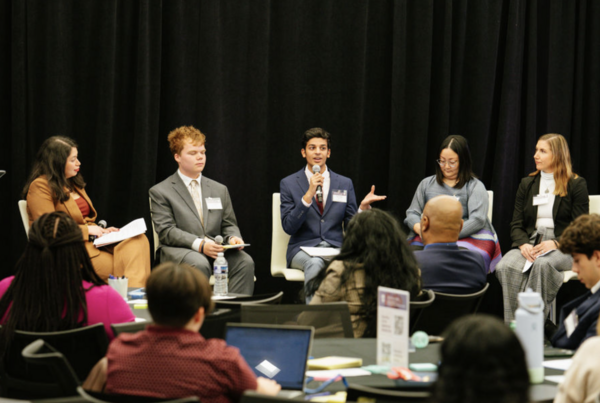
    At JED’s annual policy summit in Washington, D.C., this month, advocates focused on sustaining the progress that has been made on mental health, as well as on the growing influence of artificial intelligence and the role of local, state and federal legislation on mental health in the digital age. Rohan Satija, a 17-year-old first-year student at the University of Texas at Austin who spoke at the event, told Inside Higher Ed in an interview that his mental health journey began in elementary school, when his family emigrated from New Zealand to Texas.

    “Just being in a completely new environment and being surrounded by a completely new group of people, I struggled with my mental health, and because of bullying and isolation at school, I struggled with anxiety and panic attacks,” he said.

    Satija found comfort in books and storytelling filled with “characters whom I could relate to. I read about them winning in their stories, and it showed me that I could win in my own story.”

    Satija eventually realized these stories were teaching lessons about resilience, courage and empathy—lessons he put into action when he founded a nonprofit to address book deserts in low-income and otherwise marginalized communities in Texas. Later, he founded the Vibrant Voices Project for incarcerated youth, “helping them convert their mental health struggles into powerful monologues they can perform for each other.”

    Currently a youth advocacy coalition fellow at JED, Satija said that college so far presents a challenge to student mental health in its “constant pressure to perform in all facets, including academically and socially and personally. I’ve seen many of my peers that have entered college with me, and a lot of us expect freedom and growth but get quickly bogged down with how overwhelming it can be to balance coursework, jobs, living away from your family and still achieving.”

    Students speak on a panel and the annual JED policy summit.

    Rohan Satija, center, speaks at JED’s annual policy summit in Washington earlier this month.

    He added, “This competitive environment can make small setbacks feel like failures, and I’d say perfectionism can often become kind of like a silent standard.”

    Another major challenge? Loneliness and disconnection. “Even though campuses are full of people, it’s easy to feel isolated, especially as a new student, and even further, especially as a first-generation student, an immigrant or anyone far from home.”

    While many students are of course excited for the transition to adulthood and “finally being free for the first time,” he explained, “it comes with a lot of invisible losses, including losing the comfort of your family and a stable routine … So I think without intentional efforts to build connection in your new college campus, a lot of students feel that their sense of belonging can erode pretty quickly.”

    In this light, Satija praised UT Austin’s club culture, noting that some of the extracurricular groups he’s joined assign a “big,” or student mentor, to each new student, or “little,” driving connection and institutional knowledge-sharing. Faculty members are also good at sharing information about mental health resources, he said, including through the learning management system.

    And in terms of proactive approaches to overall wellness, the campus’s Longhorn Wellness Center is effective in that it “doesn’t promote itself as this big, like, crisis response space: ‘Oh, we’re here to improve your mental health. We’re here to make your best self,’ or anything like that,” he said. “It literally just promotes itself as a chill space for student wellness. They’re always talking about their massage chairs.”

    “That gets students in the door, yeah?” Satija said.

    This independent editorial project is produced with the Generation Lab and supported by the Gates Foundation.

    Source link