With two New Jersey campuses, three unique and specialized concentrations, and several student activities to impart knowledge and expertise, Felician College and the Communications Department bring a fresh view of what a major in communications can offer. Founded in 1942, Felician College is one of the few Franciscan colleges in the country and strives to embody Franciscan values in all they do. With a student population of approximately 2,300 students, international students studying at Felician College can expect an individualized experience with focus and support. Providing a liberal arts education, students have the opportunity to study outside of their major and concentration to develop further critical thinking skills and to enhance experience and knowledge.
Journalism/Media
Three concentrations—”pathways to engage the world”—are available for the students. The first is journalism/media. In this concentration, international students will have the opportunity to explore roles the media plays in the world as well as the development, production and distribution of print, broadcast and internet journalism.
Digital Video
The second concentration is digital video. This concentration is unique as it is not offered in all communications departments. With a digital video concentration, students can understand the technology of visual storytelling and will learn how to write, produce, tape and edit their own videos. These videos can be fiction or non-fiction. With classes such as screenwriting, video-making and directing, students in the digital video concentration will employ hands-on experience.
Theatre Arts
Under production is a theatre arts concentration which will focus on playwriting, directing, theater management, acting and more. Students will also have the option of registering for a joint minor in Theater Studies offered by the communications and language departments. These students will engage not only in theater courses, but also in the history and art of theater by combining hands-on experience with in-depth studies.
Joy, peace, respect, service, diversity, reverence, and compassion all express the Franciscan values of Felician College. When deciding where to study communications, students searching for a college with Franciscan values and unique concentration options should consider Felician College. Its small size enables students to receive undivided attention and the resources available allow students to dream, create, and share.
Each year, I look forward to reviewing the results of Jane Hart’s Top 100 Tools for Learning and to submitting my votes for a personal Top Tools for Learning list. I haven’t quite been writing up my list every single year (missed 2020 and 2023), but I did submit a top 10 list in 2015, 2016, 2017, 2018, 2019, 2021, and 2022. I avoid looking at the prior year’s lists until I have identified my votes for current year.
My 2024 Top Tools for Learning
Below are my top 10 Tools for Learning for 2024. The biggest change in my learning tools involves using social media less, most specifically that service that used to have an association with a blue bird and can most closely be associated with a cesspool these days.
Overcast
This podcast catcher is a daily part of my life and learning. Overcast has key features like smart speed and voice boost, which you can have for free with some non-intrusive ad placements, or pay a small fee for a pro subscription and have them hidden from view. Overcast received a major design overhaul in March of 2022, which led me to reorganize my podcast playlists to take full advantage of the new features.
Unread
While Overcast is for the spoken word, Unread is primarily for written pieces. Powered by real simple syndication (RSS), Unread presents me headlines of unread stories across all sorts of categories, which I can tap (on my iPad) to read, or scroll past to automatically mark as read. I use Unread in conjunction with Inoreader, which is a robust RSS aggregator that can either be used as an RSS reader, as well, or can be used in conjunction with an RSS reader, such as Unread.
LinkedIn
The biggest change from prior year’s surveys has to do with social media. The bird app just isn’t like it used to be. I’ve found most of my professional learning via social media takes place on LinkedIn these days. If you’re on LinkedIn, please follow me and the Teaching in Higher Ed page.
YouTube
Once I found out that I could subscribe to new YouTube videos on my RSS reader, Inoreader, it changed how often I watch YouTube videos. That, plus subscribing to YouTube Premium, which means we get ad-free viewing as a family, makes me spending a lot more time with YouTube. I even have my own YouTube channel, which I occasionally post videos on, most recently about my course redesign and use of LiaScript.
Loom
The expression tells us that it is better to show than tell in many contexts. Loom is a simple screen casting tool. Record what’s on your screen (with or without your face included via your web cam) and as soon as you press stop, there’s a link that automatically gets copied to your computer’s clipboard which is now ready to paste anywhere you want. I use Loom for simple explanations, to have asynchronous conversations with colleagues and students, to record how-to videos, and to invite students to share what they’re learning. If you verify your Loom account as an educator, you get the pro features for free.
Kindle App
I primarily read digitally and find the Kindle iPad app to be the easiest route for reading. I read more, in total, when I am disciplined about using the Kindle hardware, but wind up grabbing my iPad most nights.
Readwise
It is so easy to highlight sections of what I’m reading on the Kindle app and have those highlights sync over to a service called Readwise. The service “makes it easy to revisit and learn from your ebook and article highlights.
Canva
My use of the graphic design website Canva has evolved over the years. I started by using it to create graphics and printable signs for classes. Now I also use it to create presentations (which can include embedded content, slides, videos, etc.). For some presentations I’m doing in the coming weeks, I’m experimenting with using Beautiful.ai for my presentations. I still think Canva is great, but am having fun trying something new.
Raindrop.io
Probably more than any other app, I use Raindrop on a daily basis. It is a digital bookmarking tool. I wrote about how I use Raindrop in late 2020. I continue to see daily benefits with having such a simple-yet-robust way of making sense of all the information coming at me on a daily basis.
Craft
I don’t change my core productivity apps very often. In the case of Craft, once I made the switch, I never looked back. This app has both date-based and topic-based note-taking, as well as individual and collaborative features. From their website: “Craft is where people go to ideate, organize, and share their best work.”
Those are my top ten for the year, not in any particular order. The first draft of this post had eleven items, since I lost count as I was going. I wind up using Zoom as so much a part of almost every day, it winds up getting forgotten, given its ubiquity in my life. I’m leaving it on this post, even though it takes me over my count of ten.
Zoom
I use Zoom so often that one of the years, I entirely left it off of my top ten listing, because it is just always there. Recent enhancements I have grown to appreciate are the built-in timer app, the AI transcripts and summaries, and that you can present slides while people are in breakout rooms.
Your Turn
Would you like to submit a vote with your Top Tools for Learning? You can fill out a form, write a blog post, or even share your picks on Twitter. The 2024 voting will continue through Friday, August 30, 2024 and the results will be posted by Monday, September 2, 2024.
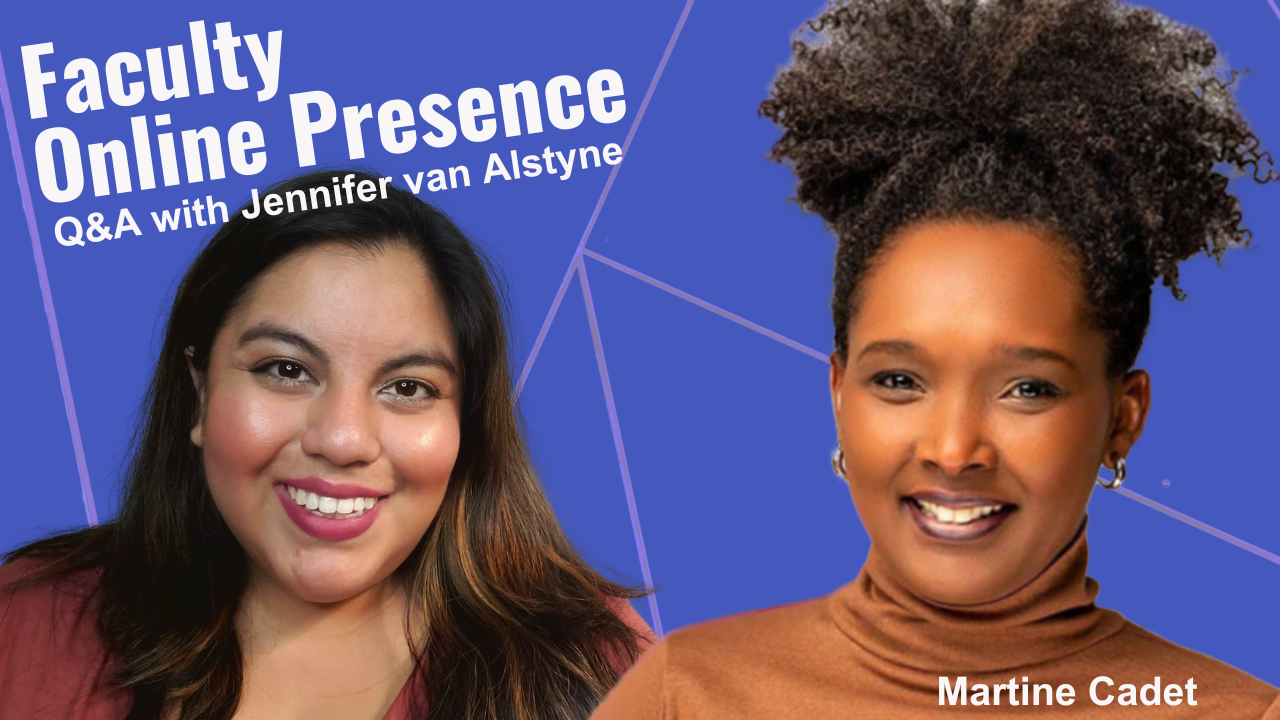
Martine Cadet interviews me about faculty online presence for the professional development workshop she’s hosting at her university. What is faculty online presence? How can a personal academic website help professors and the people they care about? Let’s talk about your digital footprint as an academic.
Jennifer: Hi everyone, this is Jennifer van Alstyne of The Social Academic. Today I have a special guest who’s actually going to be interviewing me, Martine Cadet.
I’m so excited we’re recording this video as part of a faculty development workshop that you’re doing for your university. So let’s chat about online presence for academics. I’m happy to answer your questions.
Martine: I love it. Thank you so much, Jennifer, for taking the time to meet with me. It’s such an important topic, right? Being digital today is like, you know, brushing your teeth every day. It’s like a no brainer. Everybody has their phones and laptops.
I’m an adjunct professor, and I have found that several of my peers are not actually active digitally. And one of the things that came up is having a website. Mind you, digital marketing includes social media for sure, but it also includes that digital presence online overall websites and blogs and conversations like this on channels and podcasts and so on.
Today, I’m so excited to tap into your expertise in this area of building an academic website. I’m, I’m so excited. And so I have four questions that I truly believe will help any, you know, academic person to identify how important it is to explore having a website or perhaps if they already have one, to continue to maintain it and make it better. And so I’d love to dive in. If you’re ready, let me know, Jennifer, because I can’t wait to hear your expertise.
Jennifer: I am ready.
Martine: Wonderful. And so to get started, I wanted to ask you, Jennifer, can you explain the concept of a scholarly website and why it’s important for faculty to have one, even if they already have a strong presence on social media, why should they even look into kicking off a website and or maintaining one?
Jennifer: That is such a great question. I feel like so many faculty want a website. They’re not really sure if it’s for them, or they think that they don’t want a website, but actually it would really meet all of their professional goals. So let’s chat about it. What is a personal academic website? Well, it’s a place online that you own, that you control, where you can share things like your academic bio, a photo of you, and links to anywhere else that you’re online, whether it’s your faculty profile, your social media accounts.
The thing I love about personal websites for professors is that they can grow as big as you need them to be. They can change their shape and what they hold in terms of the contents and what you wanna share over time. So if you just want a one page personal website that has what we talked about, your bio, your headshot and contact links, that’s great. That’s a perfect place to start from.
But some of the professors that I work with have really extensive needs for their website. They’re trying to reach new audiences. They’re trying to communicate with their current collaborators, you know, attract research funders, share their publications, and really be helpful for their students. There is a teaching aspect to this that I think a lot of people don’t realize that they can have with their personal website. So a personal website can be anything you want it to be. And that’s the beautiful thing.
Professors, if you’ve been thinking about a website for yourself, I want you to know you can have one. You could definitely create your own personal website, or you can hire a professional to create one for you. But it can be up in as little as an hour with a service like Owlstown from my friend, Dr. Ian Li, that is an academic website builder that really supports you to make this a reality like today.
But for some people, you know, it takes a lot longer than that. I don’t want you to think it needs to go up fast or it needs to take a long time to be a good website. You can have the website that you want and that you need for your academic life.
Martine: I love that. And so having a website, the takeaway here, I’m getting right, Jennifer, you can be on social media, but it’s like this added bonus for you, right? To do all those things that you wanna do, that you share, sharing your research, engaging with your students, and so on and so forth.
Let’s talk about that content creation a little bit more. You touched on different aspects of the website that could have the content, either the bio and you know, information about your social and whatnot.
But let’s dive in for one that’s just starting out. Let’s just say I’m a faculty. I wanna do a website. I don’t have one. Can we briefly go back to that content creation and perhaps the resource that you shared is actually a template that’s prompting faculty to include that content. Like can you walk us through the most important content pieces as we get started? That should be there.
Jennifer: Definitely. So, yes, the tool that I mentioned, Owlstown does walk you through all of these steps. So if you have pieces and parts of your academic life, you’re not sure how to bring them together, it’s a step-by-step process that will guide you through that. I want you to know that it is very supportive.
But for anyone who’s looking to build a website outside of Owlstown, or who is gonna be working with a professional to make your website, let’s talk about the content that you need. Definitely a bio that’s the most important thing that you can put on your personal academic website. And you want your bio not to be the standard academic bio that you have. Maybe on your faculty profile, it needs to do a little bit more work because the people who see your academic bio are other academics. There are people who are probably seeing you at a conference, who are gonna be talking with you about your research. But people who come across your personal academic website might be from a variety of fields or countries. They may need a little bit more support to understand who you are, what you do, and the things that you value and care about most as a professor. So I want you to take some time and be introspective when you’re writing that bio to, to really help you make it feel like you, but also communicate with that wider audience. I want the media, the public, and your friends and family to also be able to understand you and connect with what you do based on what you share there. So academic bio is the number one thing that you’ll want to gather.
You’ll also want a headshot, a photo of you. Now, that can be a little bit tricky for some people. You know, I just did my first professional photo shoot. I had an amazing photographer for my engagement photos. And it was so much fun. If you can afford or want to work with a professional photographer, I highly recommend it. It was an amazing experience.
But for the longest time, I have only used selfies on my personal academic website. So I don’t want you to think you have to go out and spend money. You can take your phone and go take some selfies. You can ask a friend or a colleague to take some photos of you. I’ve actually done that for friends, for their first books and for a grant award. Things like, I love taking photos of other people. So I want you to know, you probably have someone in your life who’s willing to take a photo of you too.
There’s lots of opportunities to work with the people around you to create content, but sometimes a selfie is the easiest thing to do. Prop it up on some books. Take that photo with a timer and just call it a day. If you can get your photo and your bio, you can have a personal academic website. You don’t really need anything more than that.
Definitely gather your social media links if you have them. But the truth is, a lot of people with personal websites, maybe not on social media, or maybe they’re not super active on social media or that account that they made, they haven’t actually touched it in like four years. That’s okay.
That’s one of the things I love about personal academic websites. It’s this great tool to help share your online presence and the things that you care about, even when you’re sleeping, even when you’re not active on social media, even when you’re traveling for conferences or grants and you don’t have time to check your phone or don’t want to because you’re so focused on what you’re doing at hand. I want you to have those privileges. And when you have a personal website, it’s doing that work for you even when you’re not working. So I really love that.
Now, in terms of growing the site, there is more content to gather and some of that content, in fact, most of it is probably in your curriculum vitae (CV). So updating your CV and then seeing the different pieces of your life that feel important to you, whether it’s publications, speaking engagements, media mentions, or actually talking about your students and mentees and the people that you collaborate closely with that information. You’ve probably already done the hard work of gathering quite a bit of it. And so placing it on your personal academic website just from your CV, is an improvement.
Now, if you can also go in and add things like abstracts for your talks or publications, links to maybe the conference program or a video of that speaking engagement, if there is one. These are all ways to enhance your website, but I don’t want you to feel like if you don’t have these right at the start that you can’t hit publish, you totally can. Your website can grow with you over time.
Martine: Wonderful tips. My goodness, Jennifer. So good. I love the tip about the selfie. So good. ’cause I know as a faculty, we’re so busy, right? With our work and it, it’s so refreshing to hear the tips that you gave about, you know, reach out to a colleague to take your picture, take a selfie. It’s okay. Right?
I wanna hone back into the statement that you made that I love so much for my next question, when you said, let the website do the work for you, right? And I wanna go back to that.
You mentioned that a website has the added value here for us faculty is to be able to engage with our students, other faculty members and beyond. But how do we get them to come and to see it? Let’s talk about that engagement, right? Yeah. This whole SEO, you know, search engine optimization and website, it kind of scares me. What are your tips with that?
Jennifer: That’s a great question, actually. It reminds me of a conversation I had with a client just last week. We were looking over his new website together. It was a redesign from an existing personal academic website that he already has. And we’re right at the end of this project. And so there’s always this like, “Ooh, like is this gonna do everything I need” kind of feeling? And he said, “My current website doesn’t get a lot of views. Like, is this going to reach people?” And the answer is yes. If you do the work to share it, if you make it available, if you mention it to people, people are gonna come regardless of if they’re Googling you or not. You are someone who is on campus meeting people all the time. You have students coming to your classes. You have students considering your classes. You have people considering your talk for, you know, programs and conferences that they’re running. You have people who are thinking about potentially reaching out and working with you. But when you have that online presence, it’s doing a lot of that kind of in-person work with you.
It’s not like you don’t exist as a person anymore. You have an online presence, but your online presence enhances what people can learn about you even when you’re sleeping, even when you’re not in the room. And this is really important for scholars who, you know, maybe don’t have the funds to travel all the time. Or, who really need their work to reach people beyond their university, beyond their state, or even their country.
Online presence is something that can spark further conversations. But the first step is always being willing to share it yourself first. So places like your email signature, your social media profiles, your faculty profile, making sure that you mention your bio in, or excuse me, you mention your website, URL when you’re sharing your bio with event organizers and with other people who mention you in the media, you have agency and helping people find your website because they’re going to be searching your name and finding your website without you too.
But I want you to remember, like you, you shouldn’t hide your website once you’ve created it. There’s no reason to feel embarrassed or anxious. It’s not self-promotion. It’s actually helping people because when they’re on your website, they don’t have to be there. It’s not like social media where they’re scrolling and like they’re forced to, you know, take a quick look at what you share.
A website is exploratory. It sparks curiosity and it’s an invitation for people to learn more about you for the things that they wanna learn. And they can click off at any time. So I don’t want you to feel icky or negative about sharing your website. But sharing your website is definitely the first step. Google and other search engines, they’re gonna crawl your website. They’re going to start serving it in search results when people Google your name, potentially when people Google topics about your research. So that’s gonna do the work too. There are multiple ways that people can find you and your website, and I want you to know that you have responsibility, but also online that’s gonna do a lot of the work for you.
My favorite part about having an online presence with a personal academic website is it facilitates word of mouth references and collaborations. So if you have a collaborator who has an upcoming graduate student who’s interested in the same research as you, they’re looking for a postdoctoral position next year, that person can easily share your personal academic website with a really great potential applicant for your postdoc position. It facilitates that word of mouth connection that people have. It helps ’em better be able to share who you are and what you care about with other people who they think might be a really great fit to connect with you. So I really love that. It’s just, it’s yourself, it’s the people around you and it’s all of those kind of benefits of being online. So search engines can find you that can help share your website.
Martine: Oh, so good. You know what I love the most in all of this, the biggest takeaway that I’m taking from you here is this mindset shift that you shared about your website is not to be yourself promotional tool. It’s more about presenting yourself so you could help people.
Yeah, like when you said that, I’m like, “oh my gosh, that makes so much more sense,” right? Because then I feel more at ease to share what it is that I can help others do, right? I love this mindset statement that you shared such great nuggets. I wish I could be with you forever.
I have one more question for you, Jennifer. And that’s the big one in regards to what you shared that you said the online world is here and it’s here to stay. And it’s evolving, evolving very, very fast. I mean, two decades ago it wasn’t even half of what it is today.
And so my last question to you, Jennifer, as this whole digital landscape grows every day, what would you recommend a faculty to make sure that they keep in mind to ensure that their website remains relevant and that, you know, they, they update it? Because again, two decades ago it was a completely different experience and who knows what it’s gonna be next year, two years from now? What are your suggestions based on how you see the digital landscape is evolving to ensure that we do if we have a website?
Jennifer: Yeah, that is a great question because I wanna protect your futures too. Like, I’m not gonna give you information or guidance that’s gonna steer you down the wrong path and be a waste of your time. I like personal academic websites for professors because it is lasting. It’s not gonna disappear like if a social media platform no longer exists.
Your website not going to go away if you stop using it or stop having time or attention for it. At minimum, I recommend updating the content once a year. So if you can put a reminder in your calendar to, on that date every year you spend an hour looking through your website pages, just making a list,
what needs to be changed
what needs to be added
what needs to go away because it’s no longer relevant
If you can do that once a year, your website is gonna be doing far better than the vast majority of personal websites because most go un updated.
You know, most people, like, once they create it, it’s there and they’re like, I did the work. But the truth is that Google search engines and the people who are coming to your website, they need new and relevant information. They need to know who you are, what you care about, and the work that you’re doing now and the people that you want to be working with in the future. So taking that time for an annual update for sure.
My second tip is really just being open. I mean, things are going to change over time. I had an amazing guest on The Social Academic just last month that was totally focused on augmented reality, virtual reality, gamification, and all these cool things in the classroom. I know that the way that professors communicate about who they are and what they do, that’s gonna change over time too.
But I’ve met so many people on social media who just say, I’m not gonna join because I don’t know what it’s gonna look like 10 years from now. People are looking for you today. They’re not caring about what you’re gonna be doing in eight years unless they care about you now. You have that opportunity to start reaching people this year, this week, this month.
I want you to have all of that time to be reaching the people who actually care, the people who you want to be having conversations with, the people who you want to be collaborating with, the students who you want in your courses. You have more agency in what you share about yourself online than you might expect.
A lot of people don’t realize they can meet so many goals with their personal academic website, but just being open to having one. Being open that your website may and probably will change in the future because you are gonna change in the future. And your needs and your interests are gonna change in the future.
That’s the best thing that you can do. Be adaptable. Be open to new ideas and open to change if something new that you’re interested in exploring comes up. I think if you do that, you’re gonna be golden. You’re gonna be in such a good place with your online presence, not just now, but long-term. I’m excited for you.
Martine: That’s wonderful. I love this tip about, just check it once a year, pick a time and I’m guessing it could be any time of the year. If you wanna do it right at the end of the year or perhaps over the summer. If you have that break in between semesters and you’re just getting ready for the next semester, like maybe that’s the time. I love that. And it’s so relevant. It makes sense.
This is great, Jennifer. I am so, so grateful for this conversation and I know my peers are gonna be excited to hear all the tips that you shared with us today from why having a website is important as a academic faculty, personal academic website is important from that point to what’s the content creation, how do you make sure that it’s engaging and does the work for itself and truly looking out for the future of it?
My goodness, you gave us everything. And now I’m like, okay, I’m going to do what you’re doing right now watching. Go to the description here and, and click, click, click. Because I understand how exciting it feels to be hearing such information.
Like you said, Jennifer, having an online presence is going to really, really bring a reach of things that you never could have ever imagined. I couldn’t agree more. And so thank you again for this wonderful conversation. Jennifer, you’re amazing.
Jennifer: Thank you. I have loved these questions and I hope that your faculty find it super helpful.
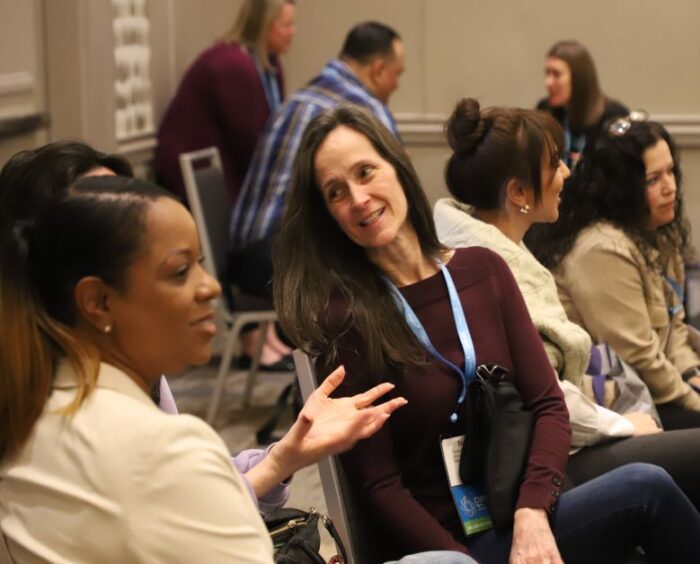
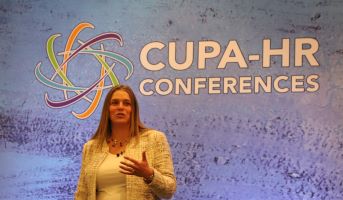
“Wherever we go, we are CUPA-HR.” That’s what CUPA-HR President Andy Brantley reminded members at the recent Spring Conference in Minneapolis. Though institutions differ in mission and scope and despite daily crises that threaten to divert attention from long-term goals, CUPA-HR members live their values every day.
The keynote speakers struck a similar theme, encouraging attendees to align their internal values with work, tapping into courage, care and a sense of calling.
The Courage to Embrace Failure
In her opening keynote, Kris McGuigan, an author, executive coach and corporate trainer, emphasized the power of authenticity in helping to overcome fear. At some point in our lives, we have all allowed our fears — including of failure, inadequacy and uncertainty — to dictate our future. “How often do we identify that a path is not serving us, but we stay the course, we cling to the status quo?” But clinging to the status quo out of fear can lead to apathy and disengagement. This lack of motivation and confidence can be tied to the engagement crisis at work.
Facing Down Fear of Failure
McGuigan believes courageously embracing failure can help move employees past apathy and disengagement. One way to start embracing failure is by taking a cue from tech. In their relentless testing and pushing out new releases, tech adopts a model of “perpetual beta.” This allows for constant innovation, with failure built into the model. If something doesn’t work, it’s scrapped and fixed — think of your smart phone’s frequent software updates. McGuigan asked, how can higher ed leaders bring this model of embracing failure to their teams?
Takeaway: Having the courage to embrace failure can increase engagement and satisfaction and decrease apathy and disengagement.
Creating a Caring Campus
In his keynote, Dr. Kevin R. McClure, Murphy distinguished scholar of education and associate professor of higher education at the University of North Carolina Wilmington, drew from his forthcoming book, The Caring University, for which he interviewed staff, faculty and administrators. What he found will likely sound familiar. Higher ed employees were working tirelessly and generously, and frequently sacrificed their physical and mental health for their jobs. Consistent with CUPA-HR’s findings, McClure cited higher ed employees’ primary concerns as overwork, inadequate compensation, lack of recognition for their contributions, and lack of career pathways, among others.
The Work “Just Kept Coming”
McClure interviewed one higher ed staff member who said the work “just kept coming.” Her campus leaders talked about care, but there was no structural change to her workload, so she started looking for a new job. Many of his interviewees felt they were required to be superhuman — a worker without a body or personal life — who “exists only for the job.”
Structural changes are needed in policies and procedures, he emphasized. What happens when practices like service awards and merit pay reward only ideal workers and not real people, or when leave policies don’t account for people’s caregiving or health needs? Employees will disengage and look for jobs elsewhere. HR has a crucial role to play in transforming the workforce, he says, and institutions need to empower HR as experts.
Takeaway: Structural change is urgently needed to transform higher education into a workplace that values the well-being of its employees.
Living your Calling Through Job Crafting
In the closing keynote, Dr. Amy Wrzesniewski shared insights into what makes work meaningful for the individual. In her research, Wrzesniewski, who is William and Jacalyn Egan professor at the Wharton School of the University of Pennsylvania, identifies three main ways people understand their work: as a job, career or calling.
Out of these, it is people who see their work as a calling who are more satisfied with the work and with their lives, tending to be absent less and engaged more. So how do people come to treat their work as a calling? That’s where “job crafting” comes in.
Finding Purpose in Work
Wrzesniewski interviewed members of a cleaning crew in a university hospital. This work is often stigmatized as non-meaningful, but employees who found a calling in the work were engaged in job crafting, often doing a different job than their job description, while still completing their required duties. For example, one cleaning crew member said that she tailored the cleaning schedule around patients who might be sensitive to the smell of cleaning chemicals. She made a tangible difference in the lives of others, even though she risked getting written up for doing so.
Wrzesniewski argues job crafting has several benefits. It can increase satisfaction and commitment to the job, intensify happiness at work, boost job mobility, and even maintain or increase performance.
Takeaway: Job crafting — the practice of living out your values by making work your own — can help make a work a calling, not just a job.
New research from CUPA-HR on the state of the faculty workforce in higher education shows that despite some growth in representation among tenure-track women and faculty of color in new hires, advancement to higher faculty ranks remains a barrier. What’s more, these promotion gaps are found in every faculty discipline.
CUPA-HR’s research team analyzed data from the Faculty in Higher Education Survey, a comprehensive data source that collects salary and demographic data by tenure status, rank, and faculty discipline, to evaluate representation and pay equity for women and faculty of color from 2016-17 to 2022-23.
In addition to the finding that women and faculty of color are not being promoted to senior faculty ranks at the same rate as White men, the data also show that women, Black, and Hispanic or Latina/o faculty are better represented in non-tenure-track than in tenure-track positions, and that pay gaps in non-tenure-track positions persist for these groups. Combined with the fact that these groups are less likely to be promoted to higher ranks in tenure-track positions, the result is that a substantial segment of faculty, primarily women and people of color, are employed in positions that pay lower salaries throughout their careers.
Other Findings
Tenure-track faculty positions are on the decline. There has been a decline in tenure-track positions and a corresponding increase in non-tenure-track positions over the past seven years. In 2016-17, tenure-track roles accounted for 73% of faculty, but by 2022-23, this proportion fell to 66%, with a marked increase in non-tenure-track positions over the last two years. Additionally, the percentage of new tenure-track assistant professor hires dropped in recent years, indicating a trend toward more new non-tenure-track hires.
The representation of women and people of color in tenure-track faculty positions is increasing, yet challenges remain. There was a notable increase in the representation of tenure-track (TT) women and faculty of color from 2016-17 to 2022-23. In 2022-23, more than one-fourth (26%) of TT faculty were people of color. This marks a 28% increase over the span of seven years, compared to 2016-17, when faculty of color constituted closer to one-fifth (21%) of all TT faculty. However, the growth in racial/ethnic representation still lags when compared to the demographic composition of U.S. doctoral degree holders. Further, despite strides toward pay equity for tenure-track faculty of color, White women in tenure-track positions still face persistent pay gaps in 2022-23.
The three answers to the question in the title, in case you want to cut to the chase, are “Yes,” “No,” and “Maybe but we really can’t tell for certain.”
This has been a point of discussion for some time. The completely neutral publication Southern Living, with absolutely nothing to gain from publishing this piece, for instance, was convinced it was true back in 2022.
The American Thinker had similar observations, but made it about politics in this piece. And finally, among the articles I’ve seen, at least, is this one, in The Free Press where the money quote is “Even if I could have gotten into Harvard, I wouldn’t have gone,” an observation which seems like it was made for a gif.
There are a lot of anecdotes in these articles, of course, and we all know that three anecdotes are more than enough to build a story upon: My lawyer’s neighbor’s son’s girlfriend is going to Alabama because she liked the rush videos, for instance, can be the basis for a whole research paper in sociology. Or, of course, an article in a publication that pays by the word.
I have a stubborn old-fashioned preference for data, however. And–just to spoil the fun–even data won’t tell us everything we need to know to answer the question. But it’s a good start, and it’s perhaps a bit more robust than political hit pieces described as documenting societal trends.
And good news for all of you who don’t like to interact with Tableau visualizations: This one is just pictures.
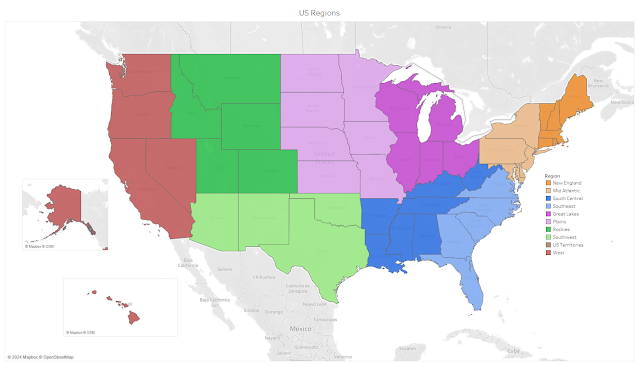
First, let’s take a look at the shape of the market to have a place where we can put our feet down. We’ll start with WICHE data, which I’ve found to be very reliable, but of course imperfect, showing high school graduates over time, with years after 2019 being projections. For all of these views, I’ve broken things out by my own state regions, colored on this map. (Click it or any image to view larger).
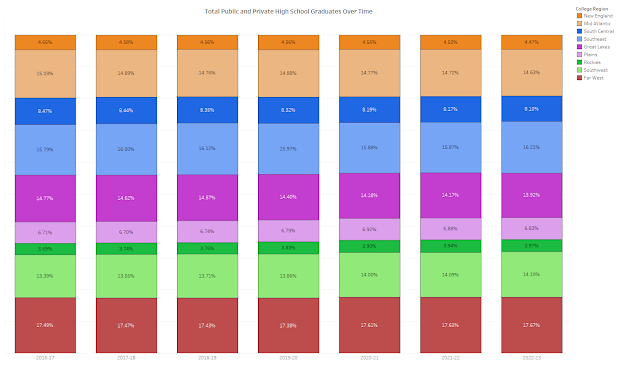
Here is the breakdown of high school graduates by these regions, showing the percentage of total in each year. Columns total to 100% in each year.
If you know anything at all about higher education data, you already see a problem as we try to establish some framework: Each state and each region has different college going patterns. In wealthier states, and states with higher educational attainment among parents, college-going rates are higher. Within states, there are differences too: About 8% of all college students in the US attend community colleges in California, for instance, and almost all of those students are California residents.
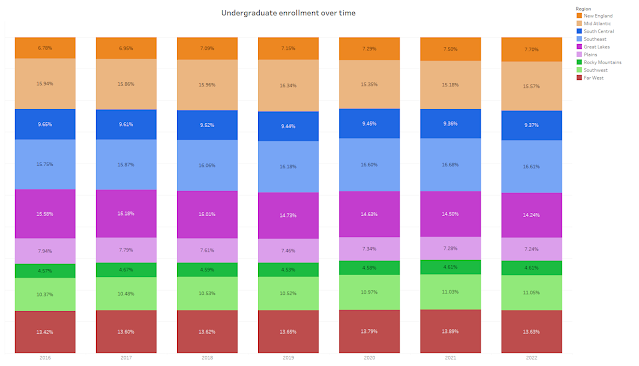
Now, let’s take a look at undergraduate enrollment over this same period. Because much of the national discussion is focused on first-time freshmen, I’ve limited this enrollment set to only those traditional, four-year institutions that enroll undergraduates and accept freshmen. I’ll just call this The Filter Set going forward.
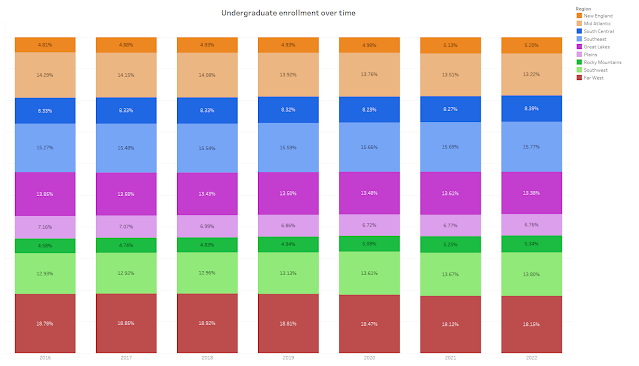
You’ll probably notice that the patterns are about the same, but you see the effect of the California Community Colleges here: Many more students don’t attend four-year colleges in the state, which makes it different from other parts of the country. For reference, here is the same visualization showing all undergraduate enrollment in all institutions (not just in The Filter Set). You’ll note the re-balancing, which is a function of the vast majority of college students going to college close to home.
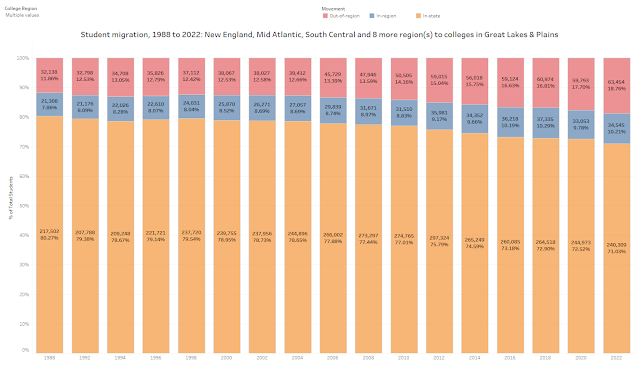
Here is the historical pattern of first-year student migration, from 1988 to 2022. As you can see, about seven of ten students stay in their own state for college, which means the number of students who cross state lines is small, making even big swings in those patterns hard to measure and describe as meaningful. It’s also interesting to note that more students today are more mobile than in the past, for a lot of reasons I won’t go into here, but as always, you can start the finger pointing with Ronald Reagan.
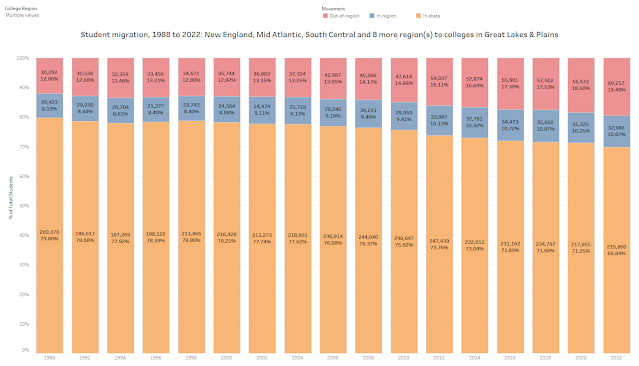
For the sake of clarity (or confusion) here is the same data for The Filter Set. Similar pattern, slightly different numbers. More students cross state lines to attend these institutions with wider draws.
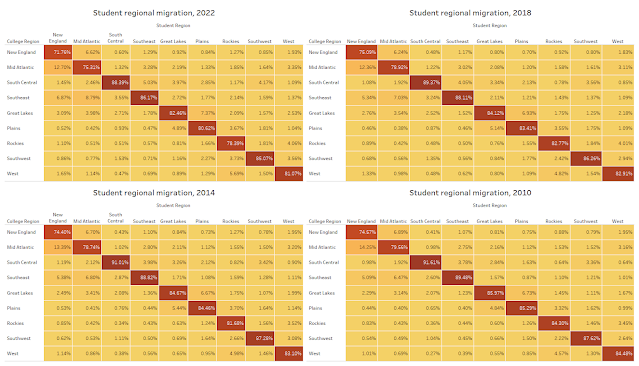
And if you want to break it out a little bit, here is a view over time of The Filter Set and the migration patterns between regions in 2010, 2014, 2018, and 2022.
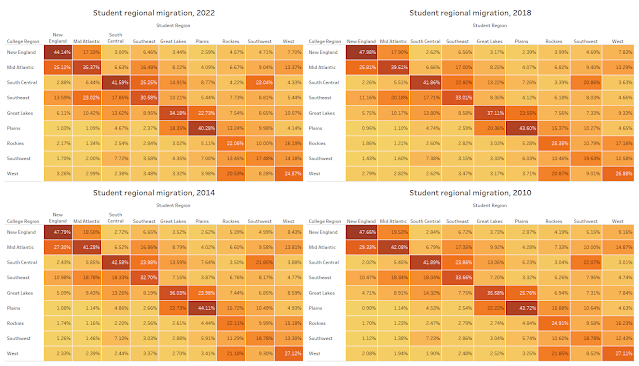
And this data shows only those students who left their home state and who attended one of the colleges in the Filter Set, to help amplify the migration patterns.
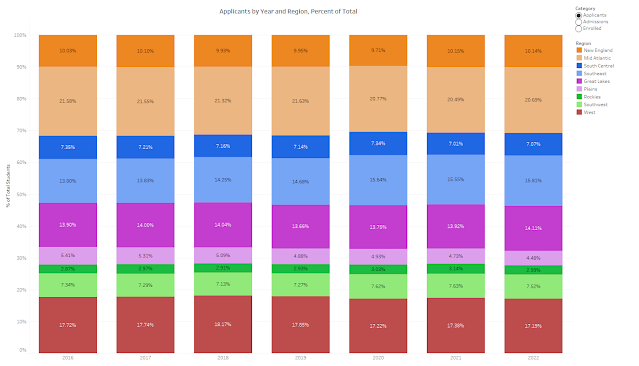
Over time, the percentage of first-year applications submitted has grown in the Southeast, but not the Southcentral region. Actually, what’s remarkable about this chart is the consistency over time.
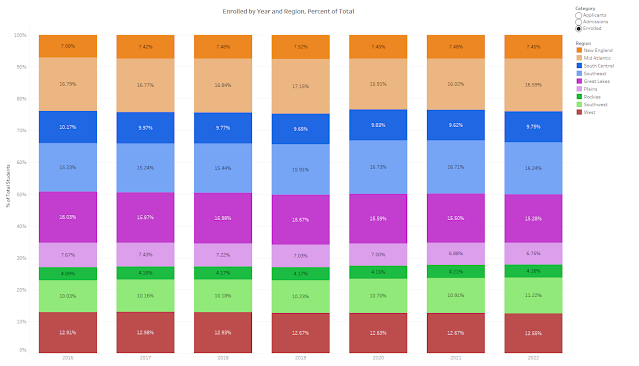
The breakouts of enrolling first-year students by region? Also stable and showing similar patterns.
So, maybe there is a slight trend along the margins of college attendance. But what’s causing it? Most social scientists (going out on a limb here) would say it’s probably best when researching a problem like this to dive more deeply than interviews with a dozen students who fit the pattern you’re trying to demonstrate. What I see in the overall patterns appears to follow population shifts, which is probably the biggest “duh” of all: If population in the Southeast is growing, you’d expect college enrollment to grow as well.
But let’s discount that obvious answer for a moment.
Why would students be applying to more southern locations? Well, first, they’re easier to get into, in general.
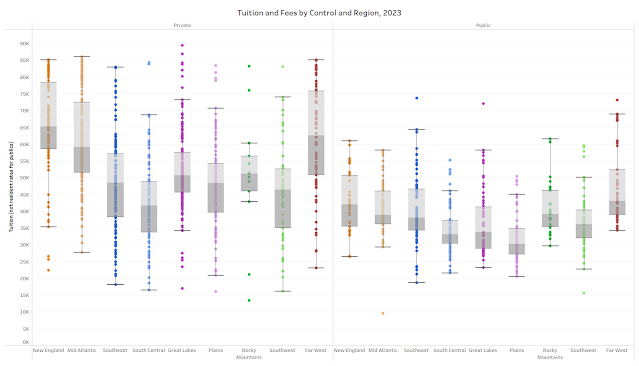
For another thing, they cost a lot less, on average, based on sticker price. Each dot represents one college, and the gray boxes cover the middle 50%, with the divider between dark gray and light gray showing the median. You can see that for both public and (especially) private colleges, tuition seems to be much lower than other places. I’ve not tried to normalize this by Carnegie type or selectivity, to be clear.
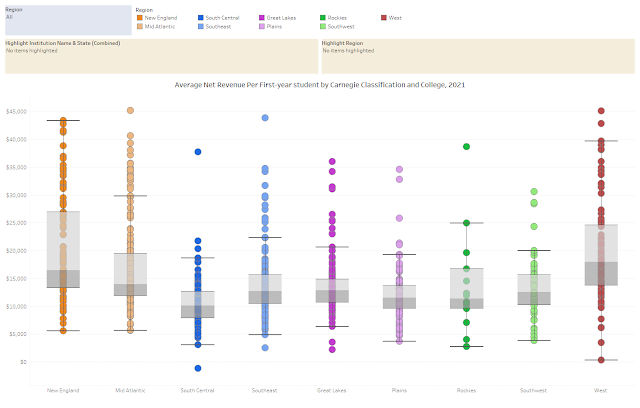
Private colleges in the south net a lot less cash per freshman, too. This does not always mean students pay less, but it’s a pretty sure bet in general it costs less after aid to go south as well. (I only calculate this for private institutions because discount rates at publics are fairly meaningless given different tuition levels and state funding models, in case you were wondering.)
But the publics do a pretty good job of funding nonresidents, too. They recruit hard and roll out the welcome mat for students, especially on price.
We don’t have 2023 data yet, and we won’t have 2024 data for about another 18 months, at least, so maybe we’ll wake up one morning and find that these small sample size stories are dead-on. But I seriously doubt it. For every student fleeing the north because of The Woke, there is probably a student fleeing the less Woke states below the Mason-Dixon Line.
And yet, we know many–perhaps most–17-year-olds are afflicted with still-undeveloped prefrontal cortices that might keep them from being political, rational, and/or sophisticated when it comes to college choice.
The answer to the headline? You probably already knew the answer, didn’t you? The lesson is that media pundits who look at a little bit of data and talk to a few people to confirm their perspectives often shape the narrative, which gets stuck in the collective consciousness of the American conversation. It’s not something I can fix. Maybe you can make a little dent if you share this with people.
But it’s important, when we see increasing criticism of our institutions, and increased turmoil on campuses, that we–the people who work in higher education–provide the balanced and rational perspective we so often claim to impart to our graduates.
On April 23, the Department of Labor (DOL) issued the highly anticipated final rule to alter the overtime pay regulations under the Fair Labor Standards Act (FLSA). The rule increases the minimum salary threshold to $43,888 on July 1, 2024, and then to $58,656 on January 1, 2025. The rule also implements automatic updates to the threshold that will occur every three years. Institutions will need to make all necessary adjustments by July 1, 2024, in order to be in compliance with the final rule.
The department clarified that the first increase updates the minimum salary threshold using the department’s current methodology, which was used in the 2019 Trump-era overtime rulemaking to set the current standard of $35,568. The second increase then implements the department’s new preferred methodology, which sets the minimum salary threshold to the 35th percentile of weekly earnings of full-time salaried workers in the lowest wage census region. This phased-in implementation will likely impact how litigation challenging the rule is both pursued and decided over the next six months.
In September 2023, DOL issued its proposed rule to update the minimum salary threshold, which sought to increase the threshold from its current level of $35,568 annually to $60,209 — a nearly 70% increase. The proposed rule also sought to implement triennial automatic updates based on the 35th percentile.
CUPA-HR submitted comments in response to the proposed rule and participated in a meeting with DOL and officials from the White House Office of Information and Regulatory Affairs (OIRA) to express our concerns with the proposal. In both the comments and OIRA meeting, CUPA-HR made the four following recommendations for DOL to consider before issuing their final rule:
DOL should not update the salary threshold at this time.
DOL should lower the proposed minimum salary threshold and account for room and board.
DOL should not implement automatic updates to the salary threshold.
DOL should extend the effective date of any final rule implementing a higher salary threshold.
Lawsuits challenging the final rule are forthcoming. In the meantime, CUPA-HR will be hosting a webinar on May 8 covering the provisions of the final rule and its impact on higher education. Registration is open and free to all.
Two quick additions/clarifications to this: The definition of full-pays is those students who receive no institutional funds. EM people don’t care where the cash comes from, only the discount. Second, yes, I know some institutions use endowments to pay for institutional aid. That percentage is likely very small, although concentrated at a few institutions.
Before we begin, here is what this post does not do:
It will generally not tell you where you can get low tuition, with a very few exceptions. And when it does, it won’t be at one of “those” colleges.
It will not tell you which colleges are likely to close soon, although after the fact, you can probably find a closed college and say, “Aha! Right where I expected it would be!”
It will not show you net costs to students.
It will not adjust for things like church support, enormous endowments, or the cost of living in that high-priced city where Excellence College or Superior University is located.
Got it? Good.
This will show you the discount rate on first-year students at about 1,000 four-year, private, not-for-profit colleges in 2021-22. Discount as I define it is the total unfunded institutional financial aid divided by the total charged (gross) tuition and fees. A university that charges (published tuition and fees times the number of students) $10,000,000 and awards $4,000,000 in aid has a discount rate of 40%. At most colleges, this discount is simply an accounting transaction, much like a coupon to save a dollar on a sandwich at Subway. That, of course, is a gross over-simplification of the “what” of discounting, and it doesn’t touch the “why” of discounting at all. But if you want an explanation, I’ll gladly talk to your trustees for a reasonable fee.
And there is a difference between discount and net revenue, although at any given tuition charge, the two are perfectly related. Unfortunately, as you’ll soon, see, colleges all set their own tuition. To wit:
A college charging $50,000 with a 20% discount has net revenue (the cash you can spend) of $40,000 per student.
That same college with a 50% discount has just $25,000 per student.
A college charging $30,000 with a 10% discount has $27,000 per student.
That same college with a 40% discount has $18,000 per student.
As a college, you don’t care where the cash comes from: Pell grants, state grants, loans, or the student’s family. This means, hypothetically, a student with low institutional aid might pay less than one with more aid. Confused? Good.
If you use this with your trustees to explain your own college’s market position, consider supporting my costs of time, hosting and software by buying me a coffee. Just click here to do so. If you counsel high school students, or your a parent of a prospective college student, must keep reading and don’t feel any obligation at all.
Here is the data, in three views. The first two are box and whisker plots, where half of the colleges fall inside the gray box on each column to show you the middle 50%.
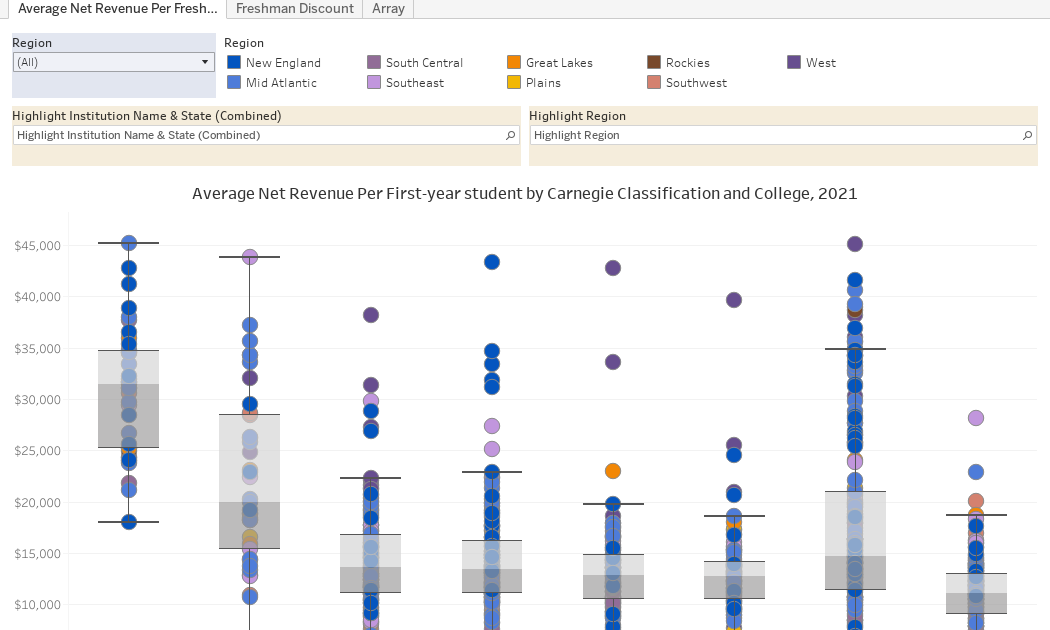
The first view shows net revenue per freshman student, arrayed by the institution’s Carnegie type. Use the controls to filter region, highlight region, or highlight an individual college. To do the latter, type any part of the name in the box, hit enter, and select from the options. Hover over dots for details; each dot is a college.
The second view is identical, but it shows discount rate, the number people obsess over while missing the more important net revenue figure.
The third view shows those two values arrayed, with the same highlighters, allowing you to filter on Carnegie type, or even the percentage of the students who are full-pay (that is, they get no institutional aid at all.)
You’ll soon see that discount and net revenue don’t seem to be big issues at the big name, strongly endowed institutions. That’s because, at many of these places, undergraduate education is essentially a sideline business, and only a minor source of revenue. The money they bring in (or don’t) on this presumably core function of the university is managed to best optimize to reputation or selectivity, or other factors (including, sometimes, mission).
Note that I’ve done my best to remove some outliers with wild data that throw the charts off. Many of these are colleges I have never heard of, and they’re tiny. Others are places with strong religious missions (like Yeshivas or Seminaries) that may be externally funded in ways this can’t account for.
On April 19, the Department of Education (ED) released the text of the highly anticipated Title IX final rule. The final rule expands protections against sex-based discrimination to cover sexual orientation, gender identity, and pregnancy or related conditions. The rule also revokes both the Trump administration’s ban on campuses using a single person to investigate and adjudicate Title IX complaints and the Trump mandate regarding cross-examination of complainants. Institutions will need to be in compliance with the final rule by August 1, 2024.
Background
The ED released the text of the proposed rule on June 23, 2022, though the Federal Register did not officially publish the proposal until several weeks later on July 12, 2022. The agency received over 240,000 comments in response, including CUPA-HR comments seeking clarification on the overlaps between the ED’s proposal with institutions’ existing obligations to address employment discrimination. CUPA-HR also joined comments led by the American Council on Education.
Noteworthy Provisions of the Final Rule
As discussed above, the final rule defines “sex-based harassment” as a form of sex discrimination that includes sexual harassment and harassment based on sex stereotypes, sex characteristics, sexual orientation, gender identity, or pregnancy or related conditions. The term “pregnancy or related conditions” is further defined in the final rule to include pregnancy, childbirth, termination of pregnancy, lactation, and all related medical conditions and recovery.
Additionally, as first introduced in the proposed rule, the final rule establishes new grievance procedures for sex-based harassment complaints. Specifically, the final rule requires institutions to apply two separate grievance procedures for sex-based harassment complaints depending on whether or not students are involved. The first section (§106.45) applies to any complaint of sex discrimination on campus, including employee-to-employee sex-based harassment complaints. The second section (§ 106.46) only applies when a student is involved as either the complainant or respondent (or both), regardless of whether the matter also involves employees. Notably, the second set of procedures also applies where a student is also an employee. The new rules also allow for certain complaints to move through an informal resolution process separate from the grievance procedures listed above if both parties agree to choose to move forward with that process.
The final rule also imposes several training requirements, which the ED also included in the proposed rule. Under the rule, institutions must train all employees on the institution’s obligation to address sex discrimination under Title IX, the scope of conduct that constitutes sex discrimination under the law, and the notification and information requirements that applicable employees must follow upon learning about instances of sex-based harassment. Additionally, institutions must train individuals who serve as investigators, decisionmakers, and others responsible for implementing an institution’s grievance procedures on the institution’s grievance procedures and how to serve impartially through the grievance procedures. Facilitators of the informal resolution process must be trained on the rules and practices of an institution’s informal resolution process, and the institution must train individuals serving as Title IX coordinators on the requirements of their specific responsibilities throughout the notification, information, and grievance procedure processes as required by Title IX.
Finally, the rule clarifies that when responding to retaliation, institutions must undergo all procedures for notifying and informing involved parties of their obligations under Title IX and initiate the appropriate grievance procedures.
Looking Forward
CUPA-HR’s government relations team is going through the 1,577-page final rule and will provide more information on the rule as needed through CUPA-HR’s blog. Additionally, CUPA-HR will host a webinar to cover the final rule on April 30. Registration is now open and is free for all to attend.
On April 15, 2024, the Equal Employment Opportunity Commission issued its long-awaited final regulations and interpretative guidance on the implementation of the Pregnant Workers Fairness Act (PWFA). The EEOC states in its press release that the final rule is intended to offer “important clarity that will allow pregnant workers the ability to work and maintain a healthy pregnancy and help employers understand their duties under the law.” It provides guidance to employers and workers “about who is covered, the types of limitations and medical conditions covered, and how individuals can request reasonable accommodations.” The regulations will be published in the Federal Register on April 19 and go into effect 60 days later.
The PWFA, which was signed into law in December 2022, requires most employers with 15 or more employees “to provide reasonable accommodations to a qualified employee’s or applicant’s known limitations related to, affected by, or arising out of pregnancy, childbirth, or related medical conditions, absent undue hardship on the operation of the business of the covered entity.” It passed Congress with strong bipartisan support.
Known Limitations
Under the regulation, “limitations” include both physical and mental conditions related to, affected by, or arising out of pregnancy, childbirth, or related medical conditions. The regulations specify that the definition of a limitation “shall be construed broadly to the maximum extent permitted by the PWFA.” A limitation “may be a modest, minor, and/or episodic impediment or problem” and can be related to current or past pregnancies, potential or intended pregnancies, and labor and childbirth.
The examples of limitations provided in the rule include miscarriage or stillbirth, migraines, lactation, postpartum depression, and pregnancy-related episodic conditions, such as morning sickness, but the list is not intended to be exhaustive. The limitation may be “a need or a problem related to maintaining [the worker’s] health or the health of the pregnancy,” and it “need not be caused solely, originally, or substantially by pregnancy or childbirth.” Related medical conditions can include conditions that existed before pregnancy or childbirth but are exacerbated by the pregnancy or childbirth.
The employee or their representative must communicate the limitation to the employer to receive a reasonable accommodation. The employee and employer should engage in an interactive process to determine if a worker’s limitation qualifies for a reasonable accommodation and the appropriate accommodation.
Reasonable Accommodations
Under the final rule, “reasonable accommodations” have the same definition as under the Americans with Disabilities Act. They include modifications or adjustments to the application process, to the work environment or how the work is performed, and that allow the employee to enjoy equal benefits and privileges of employment as are enjoyed by similarly situated employees without known limitations. It also includes modifications or adjustments to allow a covered employee to temporarily suspend one or more essential functions of the job.
The rule provides several examples of reasonable accommodations that may be appropriate under the act. These include but are not limited to additional breaks, allowing the worker to sit while they work, temporary reassignment or suspension of certain job duties, telework, or time off to recover. Leave can be requested even if the employer does not offer leave as an employee benefit, the employee is not eligible for the employer’s leave policy, or the employee has used up their allotted leave under the employer’s policy.
Reasonable accommodations are limited to the individual who has a PWFA-covered limitation; it does not extend to an individual who is associated with someone with a qualifying limitation or someone with a limitation related to, affected by, or arising out of someone else’s pregnancy, childbirth, or related medical condition. The regulations specifically clarify that “time for bonding or time for childcare” are not covered by the PWFA.
Undue Hardship
The rule explains that an employer does not have to provide a reasonable accommodation if it would cause an “undue hardship,” or a significant difficulty or expense. The rule includes a variety of factors that should be considered when determining if a reasonable accommodation would impose an undue hardship, including the nature and net cost of the accommodation; the overall financial resources of the facility or covered entity; the type of operations of the covered entity; and the impact of the accommodation on operations, including on the ability of other employees to perform their duties or the facility’s ability to conduct business.
The rule provides several factors to consider when analyzing whether an accommodation involving the temporary suspension of essential functions of the position qualifies as an undue hardship. These include the length of time the employee will not be able to perform the essential function; whether there is work for the employee to accomplish; the nature of the essential function; the employer’s history of providing temporary suspensions to other, similarly situated employees; whether other employees can perform the functions; and whether the essential functions can be postponed.
Other Provisions
The rule also encourages “early and frequent communication between employers and workers” in order “to raise and resolve requests for reasonable accommodation in a timely manner.” Employers are also instructed that they are not required to request supporting documentation when an employee asks for a reasonable accommodation; they should only do so when it is reasonable under the circumstances.
Controversies Surrounding the Regulations
While the PWFA was passed by Congress with strong bipartisan support, the EEOC has faced significant pushback about the implementing regulations.
The EEOC’s delay in issuing these regulations caused considerable frustration from employers. The PWFA went into effect in June 2023, which was when employers were required to comply with the law and the EEOC began accepting claims of discrimination under the act. Without the implementing regulations, however, employers had no certainty as to how to comply, leaving them exposed to potential liability.
The most significant criticism stemmed from the regulation’s implications around abortion. In fact, of the nearly 100,000 comments the EEOC received in response to its notice of proposed rulemaking on the regulations, over 96,000 discussed the regulation’s inclusion of abortion. The final rule clarifies that “having or choosing not to have an abortion” qualifies as a medical condition under the regulations. Several Republican members of Congress accused the EEOC of using the regulations to further the Biden administration’s pro-choice agenda. EEOC Chair Charlotte Burrows, however, defended the language, saying it is consistent with legal precedent and the agency’s interpretations of other civil rights statutes under their jurisdiction. The regulation clarifies that employers will not be required to pay for abortions or travel-related expenses for an employee to obtain an abortion. The EEOC specifies they expect the most likely accommodation related to abortion will be leave to attend a medical appointment or recover from a procedure. Several conservative organizations are threatening legal action against the final rule.
Litigation Challenging the PWFA
On February 27, 2024, a federal district court in Texas ruled that the House of Representatives lacked a quorum when it passed the PWFA, because over 200 representatives voted by proxy. The Constitution required that a quorum be present for the House to conduct business, but in response to the COVID-19 pandemic, the House allowed for proxy voting. The court found Congress violated the Constitution when it passed the law and blocked enforcement of the act against the state of Texas and its agencies. The law is in effect elsewhere in the United States, but other legal challenges may follow Texas’s approach.