It’s hard to believe, but this website has existed since 2010. While I’ve only been involved since 2015, I’ve seen the site grow tremendously in that time. The website now sees over 200,000 visitors per month, and we continue to publish a new article each week.
Have you ever wondered how we keep up with such a large, long-standing site? Our process has certainly evolved over time. When I started at the company, we used Trello to keep track of everything. Later, we moved to Asana, then Todoist. And since around 2021, we’ve been using Notion.
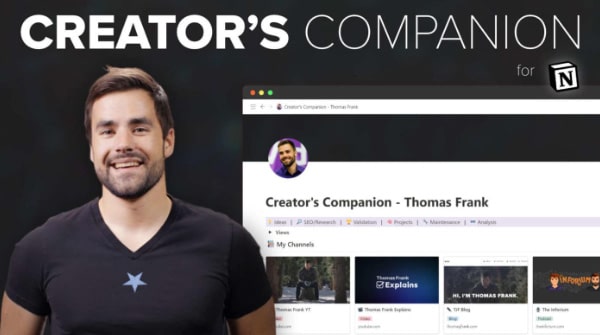
Of all the systems we’ve used, our Notion setup is the most heavily customized for our needs. Known as Creator’s Companion, the system is the brainchild of Thomas Frank (with significant contributions from Martin Boehme).
While Thomas designed this new system primarily to manage our YouTube channel, it’s also proved immensely useful for managing this website. Recognizing this, I thought it would be interesting to show how we use Notion to direct our monthly content production.
I’ll start with a look at how we come up with article ideas. From there, I’ll move into the process of using Notion to help research, write, and edit an article. Finally, I’ll show you the role Notion plays in our post-publish tasks.
If you’re looking for a better way to manage your growing website, this article is for you.
Step 1: Idea Generation
Around the end of each month, I meet with Martin (our director of operations) to brainstorm article topics.
During the meeting, I record promising topics in the “Ideas” section of our team’s Notion. I also use this area to record any article ideas I come up with outside of meetings.
From there, we develop the article ideas further and decide which ones will be the best fit for our audience. We do this through a combination of keyword research (using Ahrefs) and intuition.
With the topics decided, I can move on to the next step: planning the month’s content.
Step 2: Planning and Deadlines
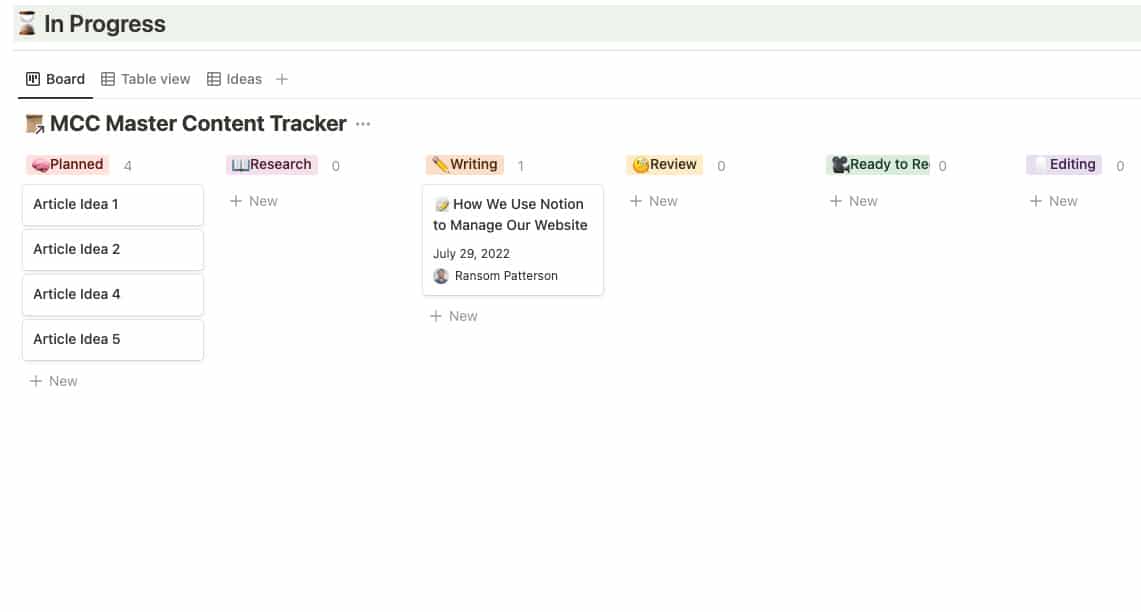
Once Martin and I have picked the article topics for the month, I move each article’s card from the “Ideas” to the “Planned” section in Notion:
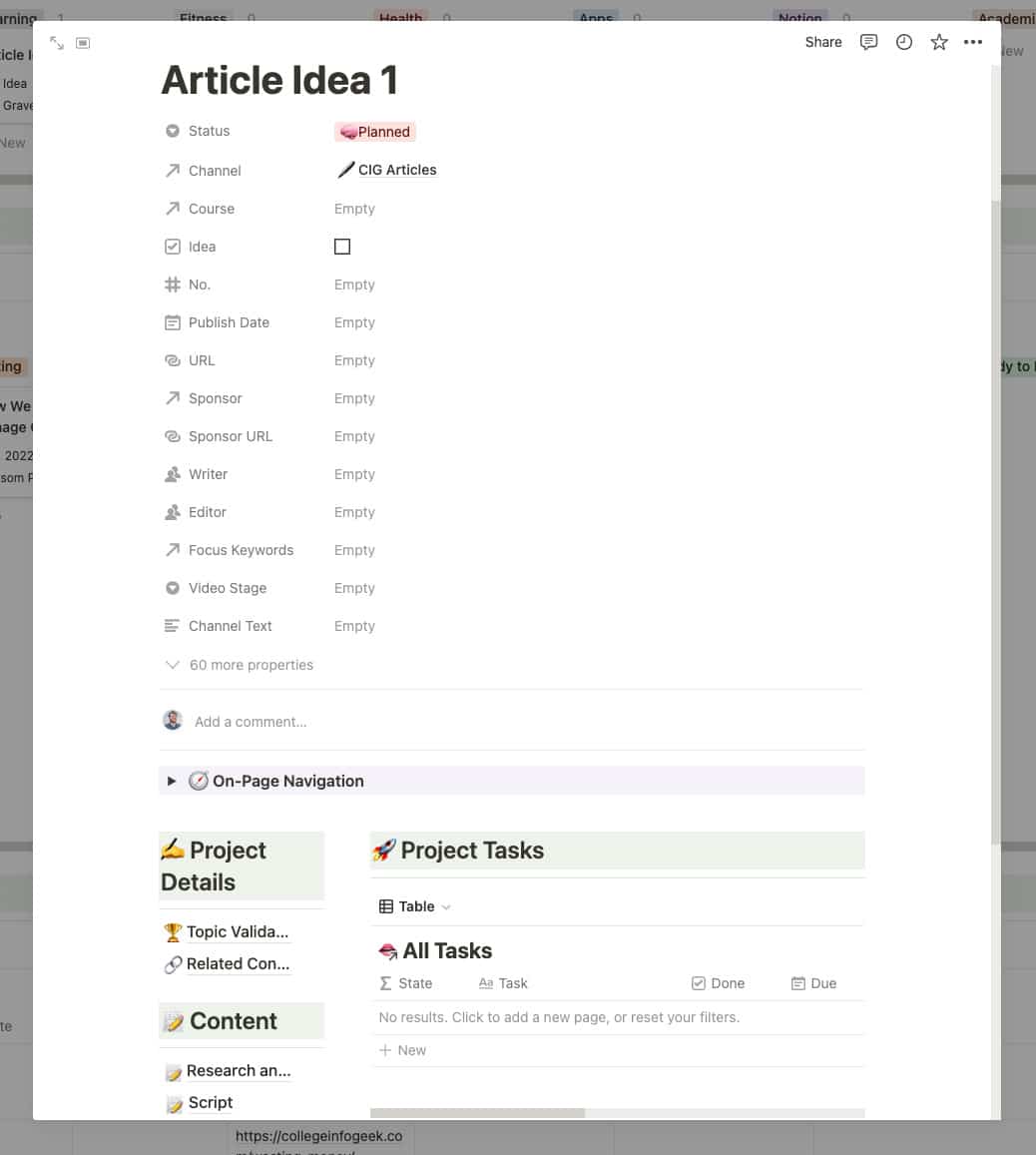
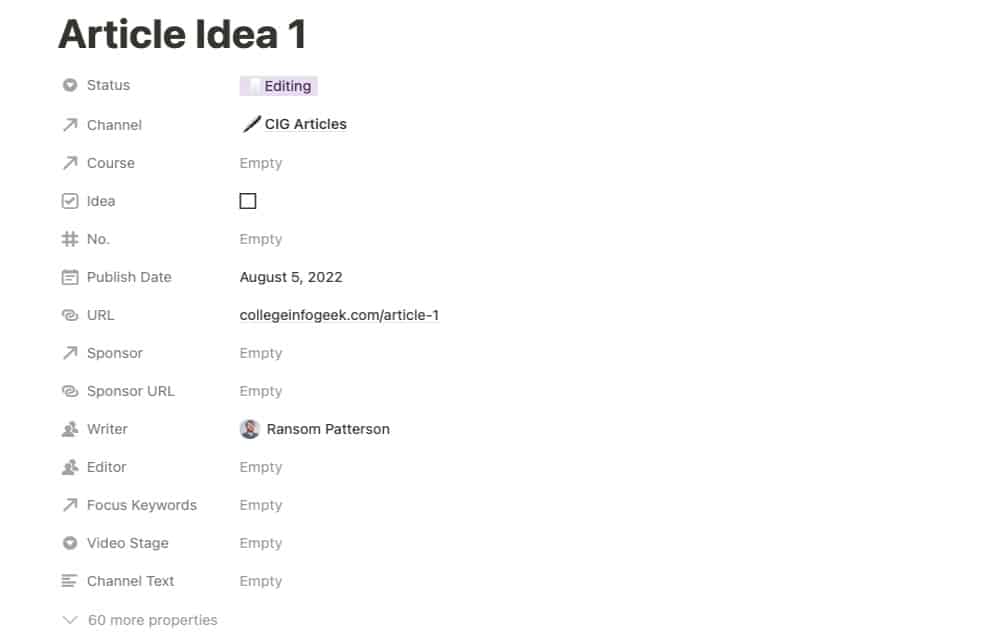
I then go into each article’s card and choose the “CIG Article” template. This automatically creates several sections that I’ll use going forward, including an area for research and another for tasks related to the article:
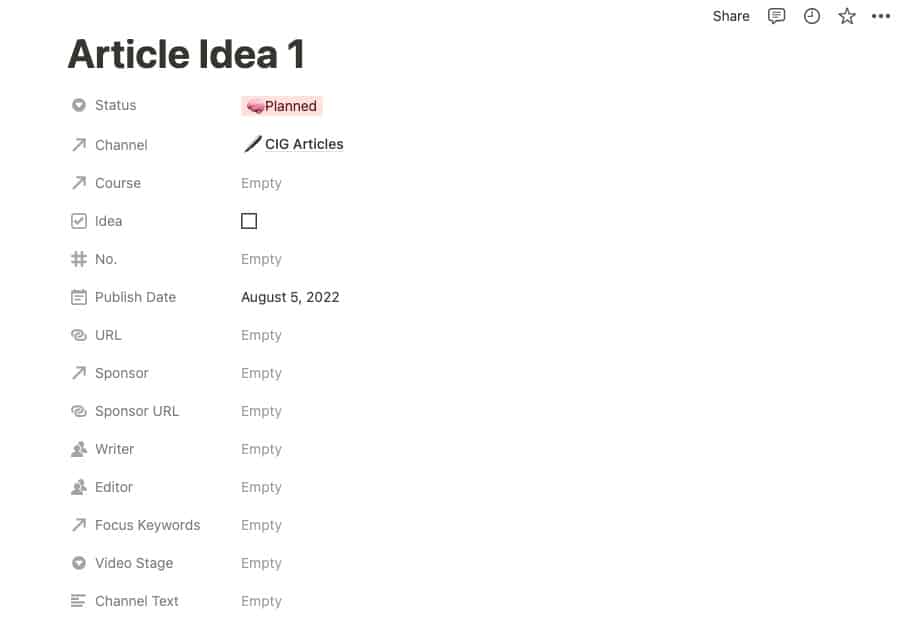
After I’ve applied the article template, I choose a publication date. This is my deadline going forward:
Once I’ve picked a publish date, I can move on to the next step: assigning article tasks to other team members.
Step 3: Assigning Article Tasks
Every article we publish also gets shared on our Twitter and Pinterest accounts. But before I can share the posts on social media, I need corresponding share images. This is where our designer Ashley comes in.
To let Ashley know which share images she needs to create, I assign a task in Notion called “Create share images.”
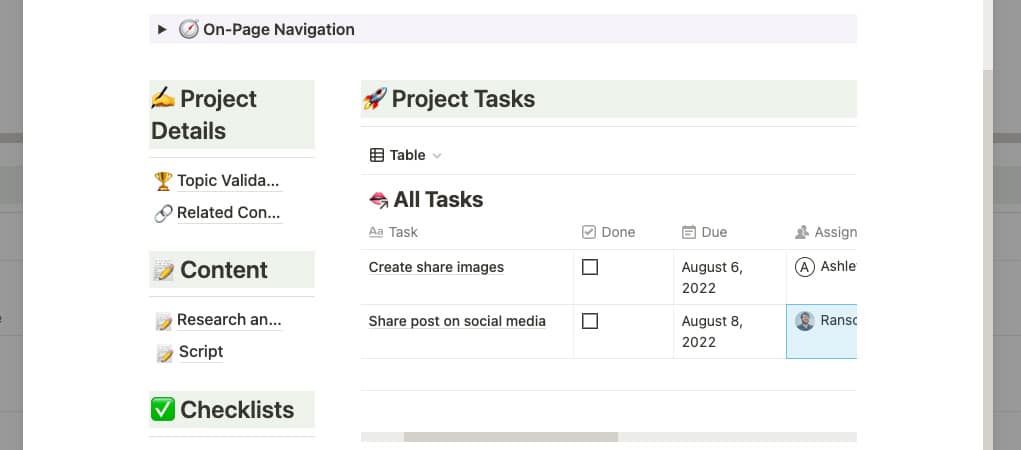
Since the article template includes a “Tasks” section, this is a quick process. All I have to do is name the task, set a due date, and then assign it to Ashley.
After I assign the image creation task to Ashley, I assign myself a task to share the post on social media.
The result looks like this:
After I’ve assigned the tasks for each article, I move on to the next (and longest) process: research, writing, and editing.
Step 4: Keeping the Articles on Track with Notion
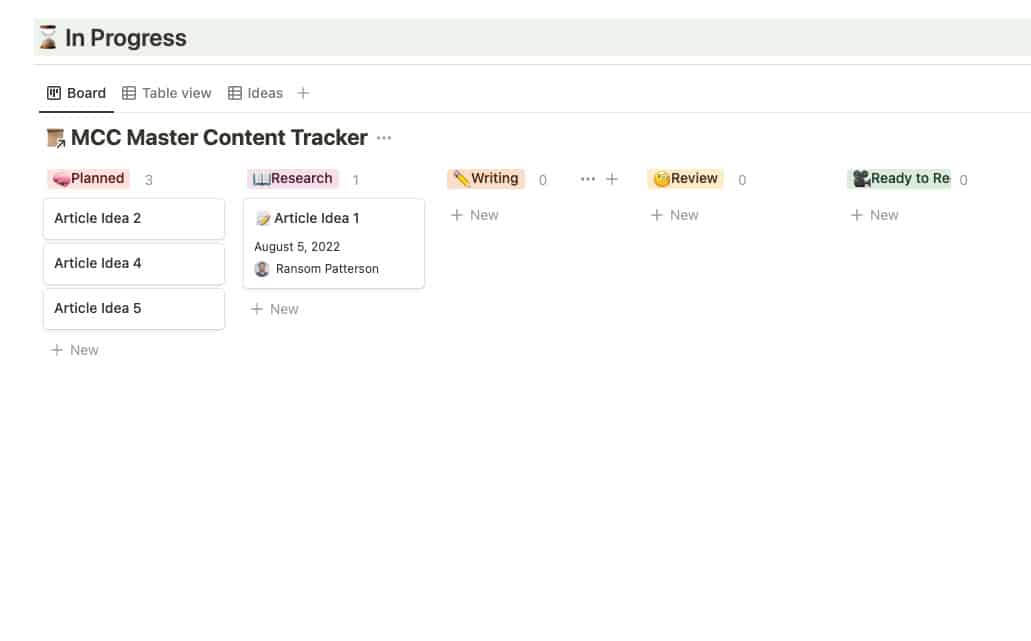
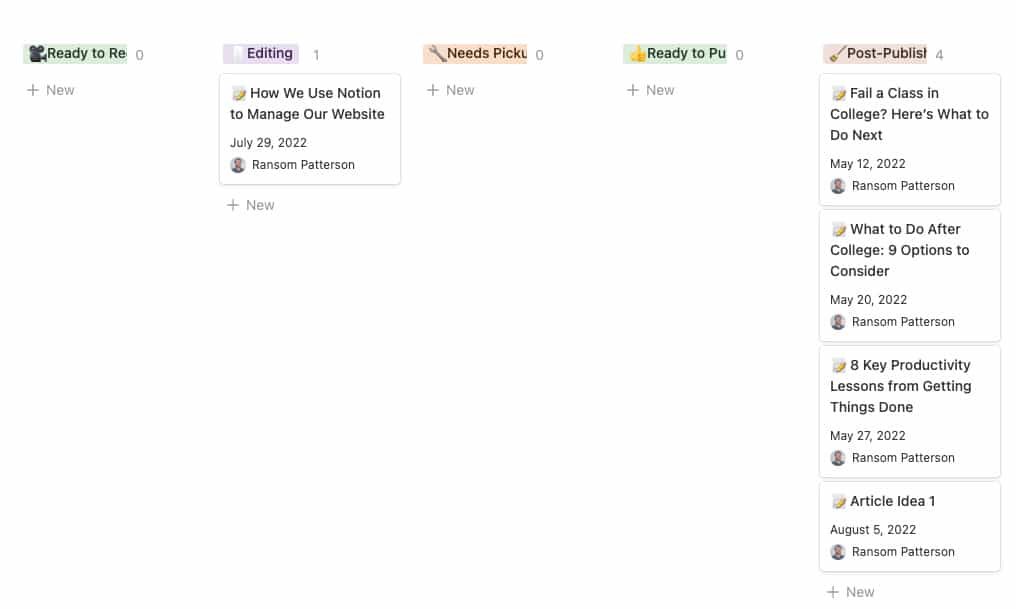
Each Monday, I check Notion to find the article that’s due at the end of the week. I then move that article’s card to the “Research” section in Notion:
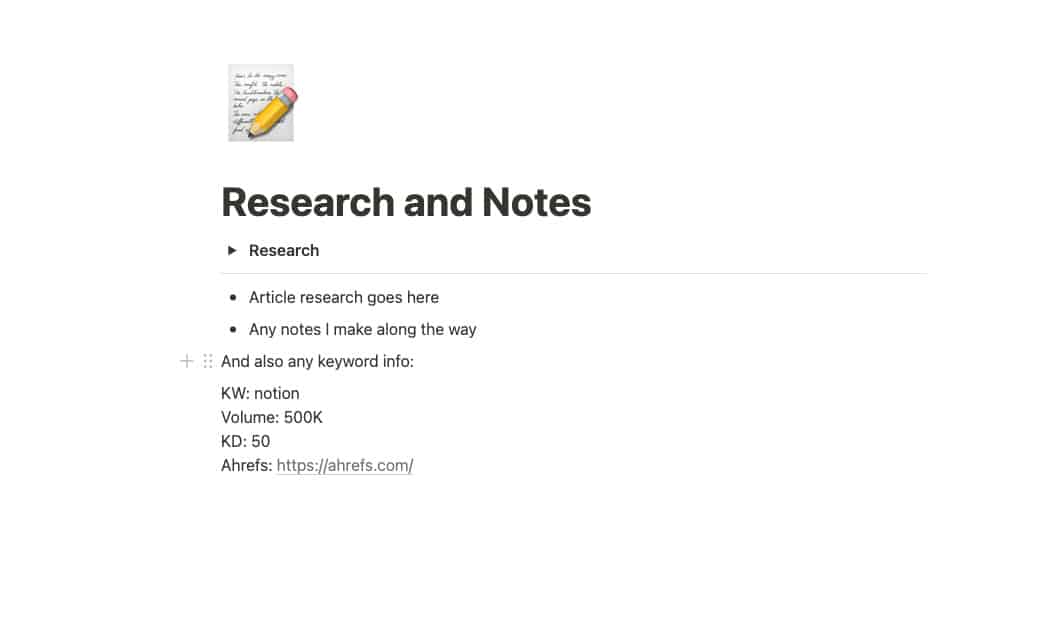
The research process typically takes me a couple of days, though sometimes longer if the article topic is especially technical. As I research, I record all my notes inside the “Research/Outline” section of the article’s card in Notion.
These notes include info for the article and any keyword research data I’ve gotten from Ahrefs:
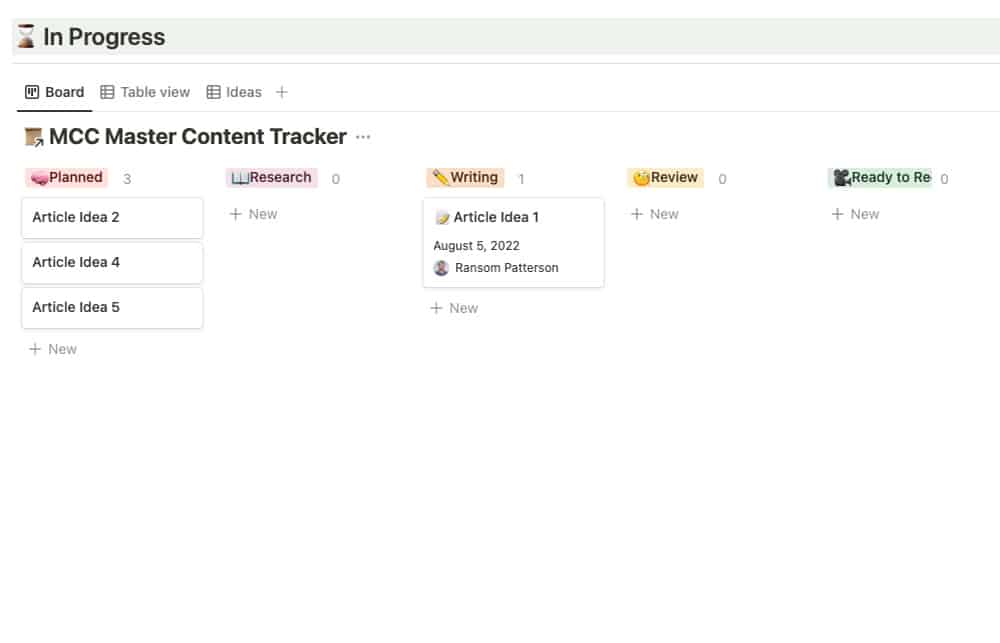
After I’ve finished the research phase, I move the article’s card to the “Writing” column. And then I write the article, which typically takes a couple of additional days:
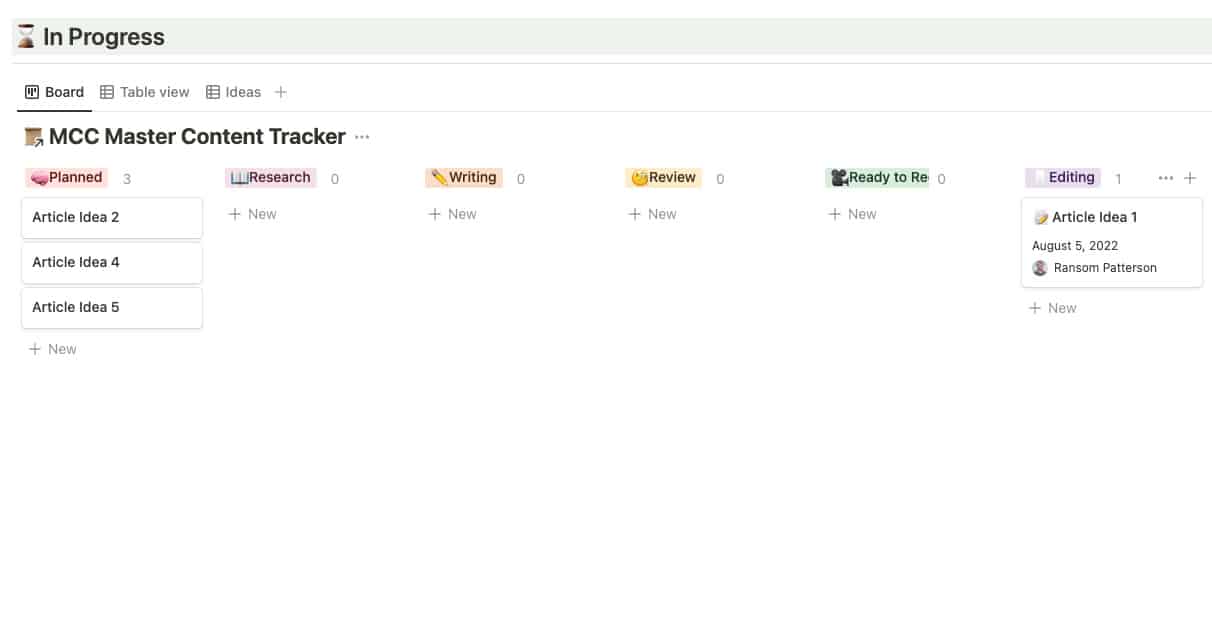
When the writing is over, I move the article card to the “Editing” column:
Since I edit the articles myself, this is mostly for my reference. But if I were managing a team of writers, I could use this Notion column to quickly see, at a glance, which articles were ready for me to edit.
Tracking my progress in Notion this way also lets my manager see that everything’s on track without having to exchange emails or Slack messages.
When the edits are done, I publish the article. Then, I paste the link to the live article in the URL field of the article’s Notion card:
With that done, it’s on to the final set of tasks.
Step 5: Post-Publish Tasks
Now, I move the article card to the “Post-Publish Checklist” column:
Unlike videos, which have an extensive list of post-publish tasks, the checklist for articles is short. It consists of the two tasks I mentioned earlier: creating the share images and sharing the post on social media.
After Ashley creates the share images, she uploads them to Google Drive. I then download the images, upload them to Buffer, and share the post on Twitter and Pinterest.
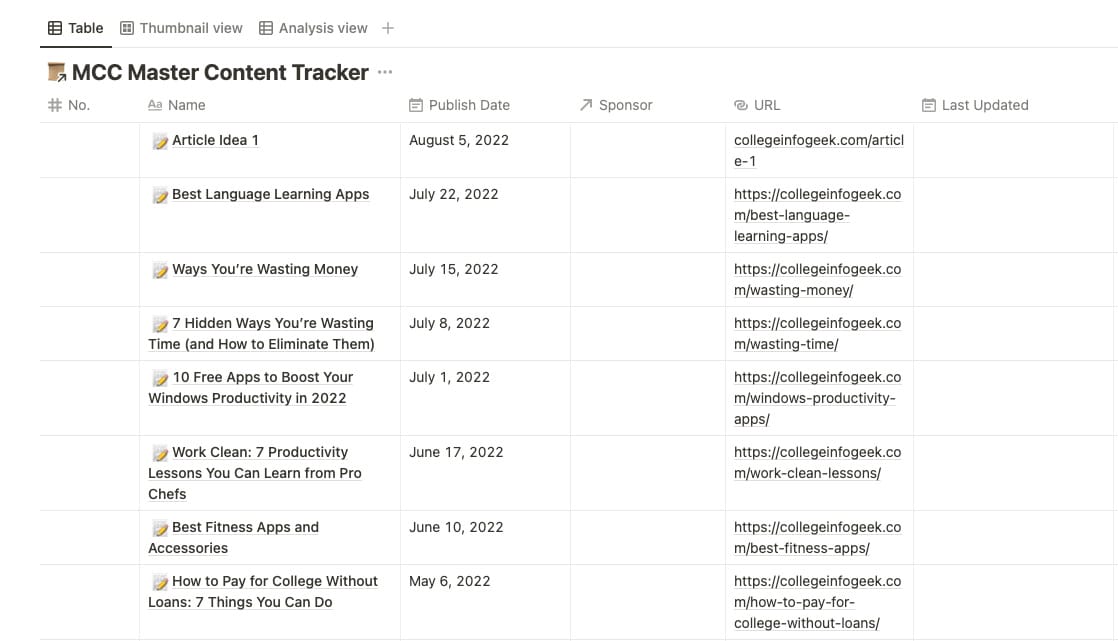
Finally, I move the article’s card to the “Completed” column. This archives all information related to the article in a different area of our team’s Notion:
I repeat the above process each week until a new month rolls around. And then it’s back to the brainstorming phase.
Improve Your Content Production Process with Creator’s Companion
I hope this article has shed some light on how to better manage your blog using Notion.
If you’re interested in using the system I discuss in this article to handle your content production, you can learn more about it below:
Tired of juggling note-taking apps, to-do lists, and spreadsheets while making YouTube videos and blog posts? Me too.
Creator’s Companion is the exact system my team and I use to run my 2-million-subscriber YouTube channel, the blog you’re currently reading, and all my other channels and social media profiles.
We earn a commission if you click this link and make a purchase at no additional cost to you.
On July 15, a federal judge from the U.S. District Court of the Eastern District of Tennessee issued a preliminary injunction blocking enforcement of the Department of Education’s Title IX guidance that prohibits discrimination on the basis of gender identity and sexual orientation. Specifically, the ruling blocks enforcement of a June 2021 Notice of Interpretation issued by the department’s Office for Civil Rights (OCR) in light of the Supreme Court’s 2020 decision in Bostock v. Clayton County and President Biden’s Executive Order, “Guaranteeing an Educational Environment Free from Discrimination on the Basis of Sex, Including Sexual Orientation and Gender Identity.”
Twenty Republican-controlled states, led by their attorneys general, were listed as plaintiffs on the case, arguing that the department’s guidance should not be enforced by the agency as it did not go through the notice-and-comment rulemaking process and is not codified law. They claimed that the department’s enforcement of the guidance also puts states at risk of losing significant federal funding if they do not comply with the guidance. The Eastern District of Tennessee judge ruled in favor of the plaintiffs, issuing the preliminary injunction while stating that the guidance interferes with states’ abilities to enforce their own laws that prohibit transgender students from participating on sports teams or using restrooms that align with their gender identity.
As it currently stands, the injunction applies only to the 20 states listed as plaintiffs in the case, potentially impacting the policies of colleges and universities in those states. Notably, the injunction does not impact the recently issued Title IX proposed regulations that are currently undergoing a 60-day notice-and-comment period. If the Title IX regulations are codified into law, however, they may face similar legal challenges.
CUPA-HR will continue to monitor this issue and keep members apprised of any developments related to Title IX.
One of my favorite grocery stores is H-E-B. Seriously, after our major grocery store in Carthage, Texas (a very rural area in East Texas) left a sizable gap in the strip center between Wal-Mart and Eckerd’s (CVS Pharmacy), we were pleased when H-E-B moved into the grocery store space that was vacant for 10+ years. It opened in the late 1990s and the city has shown their love for H-E-B since that time. It greatly contributes to the health of the region.
One of my cousins works for H-E-B and she absolutely loves the company. Even when she travels, she is all about visiting the nearest H-E-B store. Talk about H-E-B-based travel, that is her favorite thing!
H-E-B, like other stores, had to pivot during the pandemic. In fact, our local H-E-B store in Carthage, Texas was very proactive in implementing measures to keep their team members and shoppers safe. They enabled only a certain amount of people to enter the store at one time, etc.
Earlier this month, I saw this amazing webinar focused on how the H-E-B organization reflected on how they changed procedures during the pandemic and other aspects of their store.
So, take a BIG bite of this webinar and reflect in the comment box below about how your local grocery stores pivoted (or did not pivot) during the pandemic.
Thanks for visiting! Sincerely, Dr. Jennifer T. Edwards Professor of Communication
Executive Director of the Texas Social Media Research Institute & Rural Communication Institute
If you’ve ever tried to learn a new language, you know that it’s far from easy or straightforward.
Fortunately, we have a lot more language learning tools available than our ancestors (who basically just had books and other humans to learn from).
Indeed, we have an overwhelming number of resources available. Hardly a day goes by without me hearing about a new language learning app that promises to revolutionize the learning process or offer a quick path to fluency.
But no matter how great (or how expensive) the app you use, gaining fluency in a language requires lots of study and practice. You can do things to make your study time more effective or even more fun, but there’s no substitute for putting in the hours.
Having said that, language learning apps can play an important role in your journey to fluency. And not all of them are created equal.
In this article, we take a look at six of the best. Whether you’re looking to practice vocab or find a private teacher, there’s an app for you on this list.
Overview: The best free app for learning the basics of a wide variety of languages.
Price: Free (with ads). For $6.99 / month, you can remove ads and unlock additional practice options.
Platforms: Android, iOS, Web
If you’ve looked into learning a language at all, you’ve probably come across Duolingo. The app launched in 2011, and it’s continued to grow ever since.
Of all the apps on this list, Duolingo offers the most learning content for free. It combines listening practice, vocabulary lessons, grammar info, and even speaking practice. And as long as you don’t mind a few ads, you get all of this without paying a dime.
Duolingo also boasts a vast number of languages. Currently, you can use the app to learn:
Arabic
Czech
Danish
Dutch
Esperanto
Finnish
French
German
Greek
Haitian Creole
Hawaiian
Hebrew
High Valyrian
Hindi
Hungarian
Indonesian
Irish
Italian
Japanese
Klingon
Korean
Latin
Mandarin Chinese
Navajo
Norwegian
Polish
Portuguese
Romanian
Russian
Scottish Gaelic
Spanish
Swahili
Swedish
Turkish
Ukrainian
Vietnamese
Welsh
Yiddish
What’s more, Duolingo lets you learn languages you won’t find in other language learning apps:
There are languages with a small number of speakers, such as Yiddish and Navajo.
There are dead languages such as Latin.
And there are even fictional languages such as Klingon and High Valyrian.
If you’re trying to learn any of these languages, Duolingo is the place to begin.
The only downside of Duolingo is its focus on translation. Even when you reach higher levels, the app continues to present lessons in English. This can impede your ability to learn to think in the language you’re learning.
But if you’re a complete beginner, Duolingo is still a great place to start your language learning journey (especially since it’s free).
Overview: A fantastic app for learning vocabulary in several widely-spoken languages.
Price: $9.99 / month after a 14-day free trial
Platforms: Android, iOS, Web
Many language courses focus too much on grammar in the beginning. And while grammar is important for learning to speak, vocabulary is far more important for communicating.
If you know a bit of vocabulary, you can make yourself understood (even if you sound a bit childlike in the process). The same is not true if you know grammar but lack essential vocab.
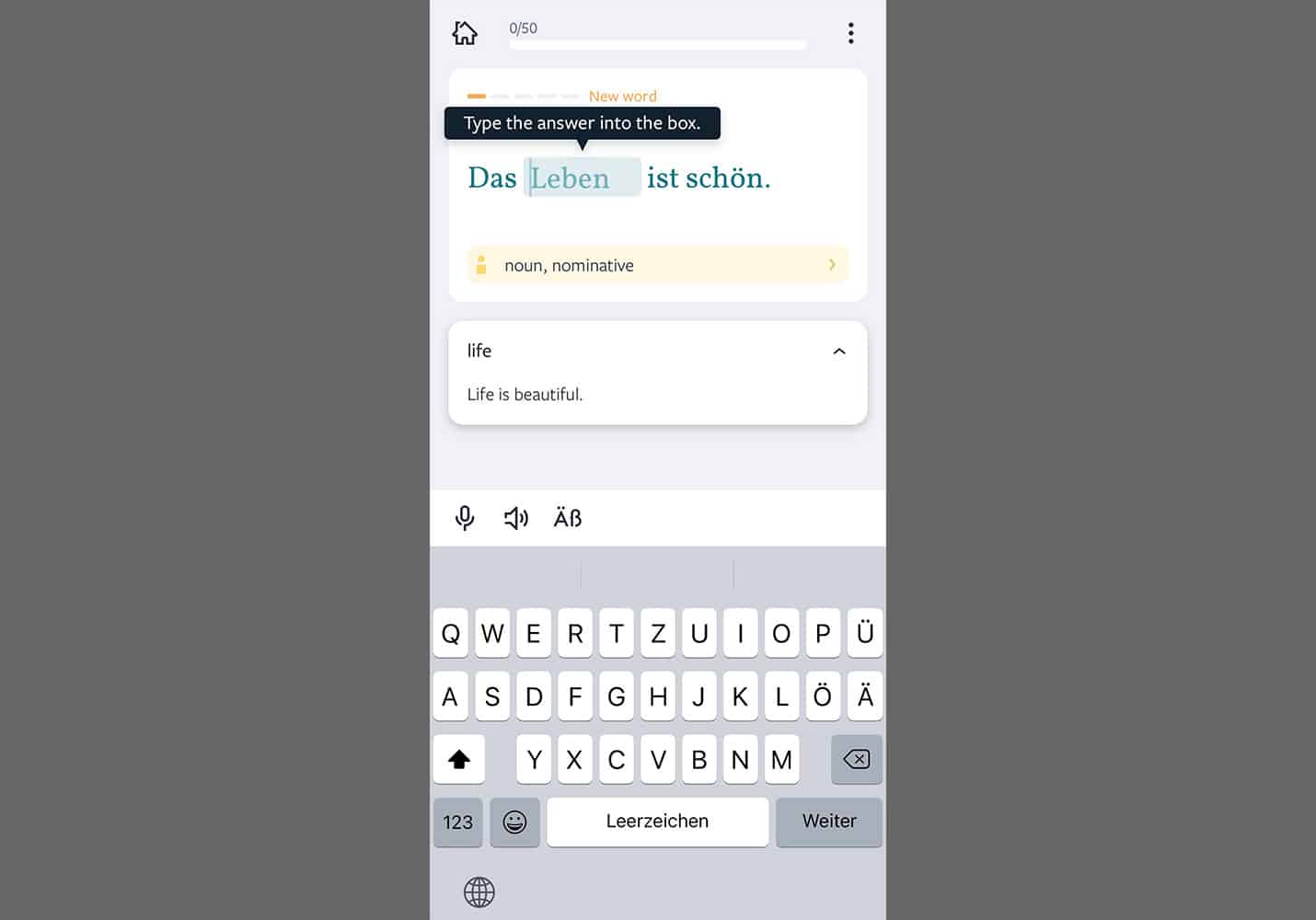
Recognizing this, Lingvist focuses on vocabulary. The app starts by teaching you the most common words in the language you’re learning. The goal is to learn vocab that covers “80% of everyday scenarios.” This way, you don’t waste your time learning words you’re unlikely to use.
Lingvist also uses spaced repetition to help you learn more efficiently. The app quizzes you on words right before you’re about to forget them, which is the most optimal way to memorize information.
Plus, Lingvist will focus on the words you struggle with, not wasting your time reviewing vocabulary you already know. If you’ve used a flashcard app such as Anki, this approach will be familiar.
The only disadvantage of Lingvist is its limited selection of languages. Currently, the app supports:
Dutch
French
German
Italian
Portuguese
Russian
Spanish (Castilian & Latin American)
If you’re learning one of these languages, Lingvist is a great option. But prospective learners of other languages will need to look elsewhere.
Overview: The best app for learning to pronounce, spell, and think in another language.
Price: $9.99 / month after a 14-day free trial. Live coaching is available for an additional fee (select languages only).
Platforms: Android, iOS
Full disclosure: I backed the original Fluent Forever app project on Kickstarter, and I currently use the app. However, I don’t receive any compensation for mentioning it.
Do you want to be mistaken for a native speaker? If so, mastering pronunciation in your target language is essential.
Proper pronunciation will also improve your listening comprehension, making it far easier to communicate with native speakers and enjoy media in the language you’re learning.
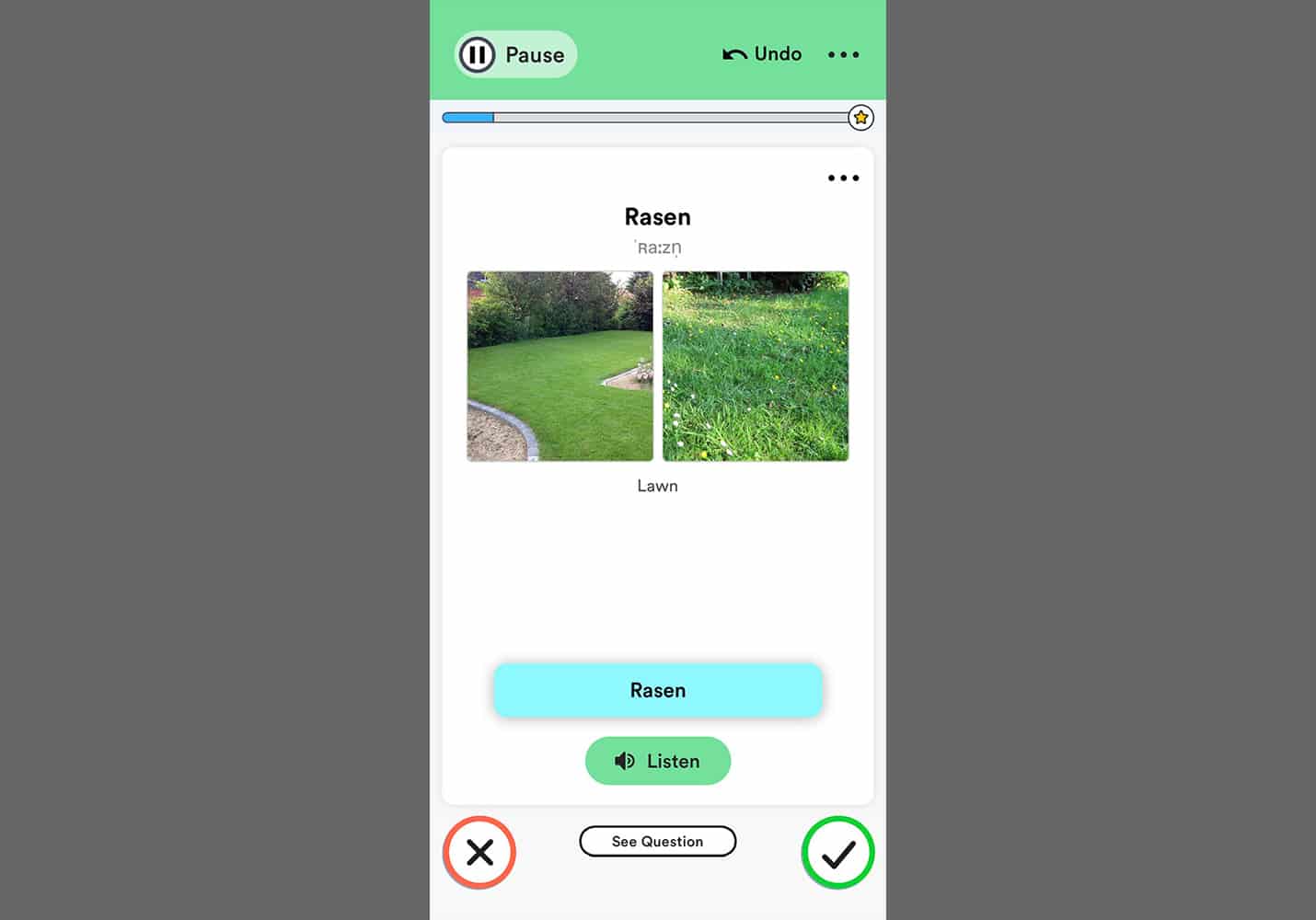
Recognizing this, Fluent Forever focuses on teaching you to pronounce (and spell) your target language first. Only once you’ve mastered these basics do you move on to learning vocabulary and grammar. This approach is based on a method that founder and polyglot Gabriel Wyner developed in his book Fluent Forever.
In addition to teaching you pronunciation and spelling, Fluent Forever uses a frequency-based approach to learning vocabulary. That is, you learn the most common words first.
The app also steers you away from translation and teaches you to think in the language you’re learning. It does this with picture-based flashcards that you create yourself. Making the language more personal in this way improves your learning and retention.
Fluent Forever currently supports the following languages:
Dutch
French
German
Italian
Japanese
Korean
Mandarin Chinese
Portuguese (Brazilian)
Russian
Spanish (Latin American & Castilian)
In addition to the app-based learning, Fluent Forever also offers live coaching with professional teachers (for an additional monthly fee).
Coaching is only available in select languages as of this writing, but the developers are working to expand coaching options based on user interest.
Overview: An app that lets you find language teachers for one-on-one, online lessons.
Price: Varies (each teacher sets their own rate).
Platforms: Android, iOS, Web
Traditionally, live language lessons were prohibitively expensive. But thanks to the power of the internet and video chat platforms, one-on-one lessons are now cheaper and more accessible than ever before.
iTalki has played a big part in this language education revolution.
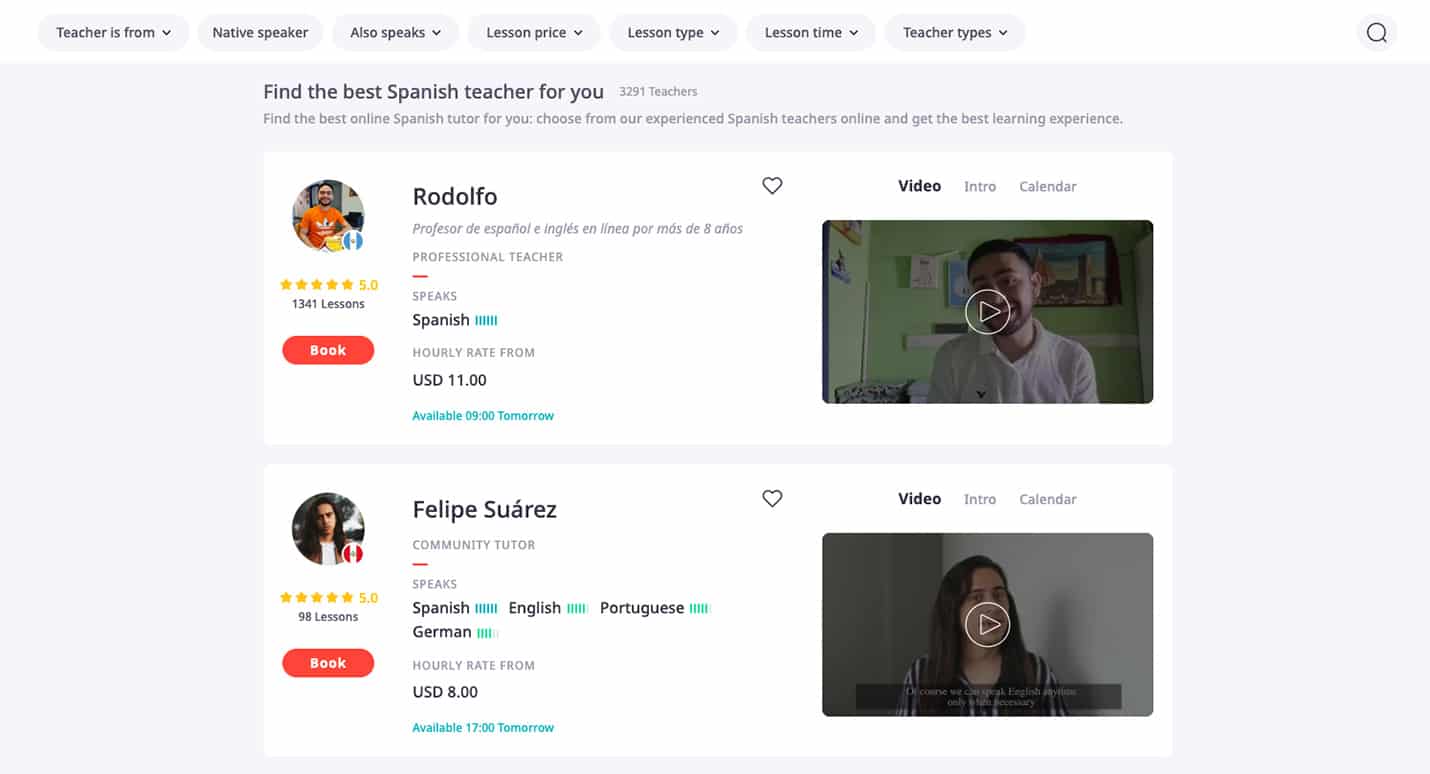
Unlike the other apps on this list, iTalki doesn’t offer language lessons itself. Instead, it’s a place to find and book lessons with live teachers. Teachers on iTalki range from “community tutors” without formal training to professional instructors with decades of experience.
To find a teacher on iTalki, all you have to do is sign up for an account. Then, you can filter prospective teachers based on language, price, and even level of experience. From there, you can typically book a trial lesson for a small fee. This helps you and the teacher decide if you’ll work well together.
The cost of lessons on iTalki varies. Each teacher sets their own rate, and some offer discounts for purchasing multiple lessons in advance. Currency exchange rates and differences in cost of living also mean that some teachers will be cheaper than others.
iTalki claims to offer lessons in over 150 languages. More popular/widely spoken languages will tend to have more teachers available. Still, it’s possible to find teachers of obscure or even endangered languages such as Irish Gaelic or Aramaic.
Overview: A community-driven Q&A platform for language learners.
Price: Free (limited features). For $4.49 / month, you can remove ads, search for questions, and play an unlimited number of audio/video answers.
Platforms: Android, iOS, Web
Apps like Duolingo, Fluent Forever, and Lingvist are great for learning the basics of a language. Eventually, however, you’ll have questions about your target language that these platforms just can’t answer.
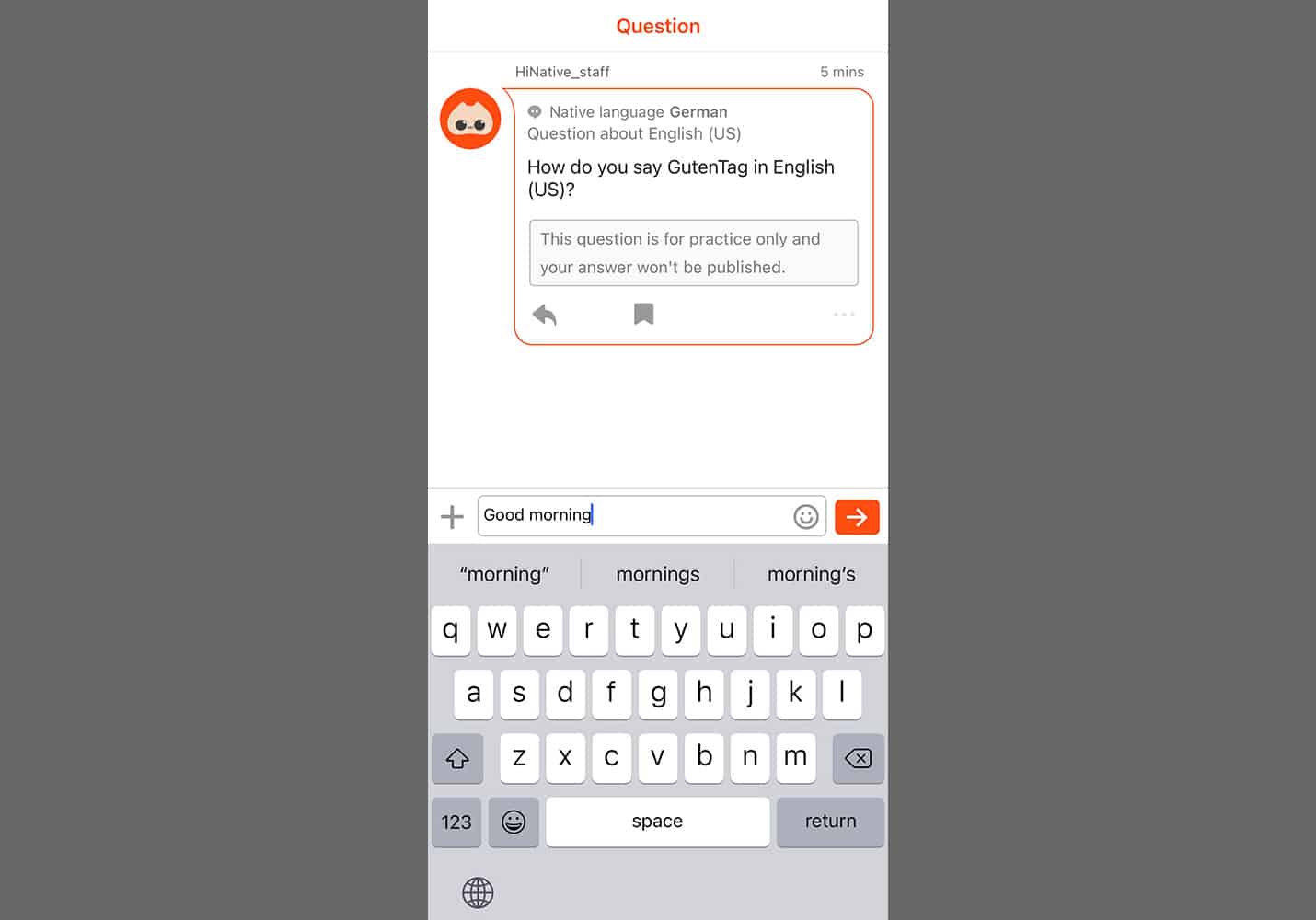
In this case, your best option is to ask a teacher. But hiring a teacher can be expensive (and excessive for one-off questions). As an alternative, consider HiNative. This platform lets you post questions about a language and get answers from native speakers.
For instance, let’s say you’re unsure about the meaning of a particular slang term. HiNative is the perfect place to post your question and get answers you’d never find in a textbook.
Even better, you can ask most questions for free (though you can pay to boost the visibility of your questions and get a response faster).
In addition to posting questions about vocabulary and grammar, you can also get feedback on your writing or even your pronunciation.
Just be sure to take some time to answer questions about your native language. HiNative is a community-driven platform, after all, and it only works if all users contribute.
HiNative currently supports over 110 languages. Though, as with iTalki, more widely spoken or popular languages will tend to have more contributors.
Overview: The best app for learning to read Japanese.
Price: $9 / month. A lifetime subscription is also available for a one-time payment of $299.
Platforms: Web
This last app comes courtesy of a suggestion from Martin (our operations lead, web developer, and an avid Japanese learner).
WankiKani addresses one of the biggest challenges for students of Japanese: reading. Japanese uses a writing system unlike any other, and it’s notoriously difficult and confusing. That is, until you start using WaniKani.
The app combines mnemonics and spaced repetition to teach you 2,000 kanji and 6,000 vocabulary words in just over a year. Even better, the first three levels of learning in the app are free (no ads, time limits, or other restrictions).
Great as all of this is, be aware that WaniKani is not a resource for learning to speak Japanese. For that, Martin recommends iTalki or Duolingo (particularly Duolingo Stories, which focus on listening skills).
Finally, WaniKani typically does a New Year’s sale on their lifetime membership. This can save you a fair bit of money if you plan to stick with the app long-term.
Language Learning Apps Are Only the Beginning
If you’re learning a new language, the apps on this list are a great place to start.
However, an app can only get you so far. To truly learn a language, you need to spend lots of time practicing and ultimately using it. Fortunately, this process is a lot of fun once you’re past the beginner stage.
New research from CUPA-HR shows that higher education institutions are in the midst of a talent crisis, as many staff, professionals and administrators are considering other employment opportunities due to dissatisfaction with their pay, their opportunities for advancement, their institutions’ remote and flex work policies, and more.
The newly published research report, The CUPA-HR 2022 Higher Education Employee Retention Survey: Initial Results, provides an overview of what proportion of the higher ed workforce is at risk for leaving, why they’re considering leaving employment, and with which policies, work arrangements and benefits employees are satisfied or dissatisfied. The report includes several recommendations for addressing these issues.
Data from 3,815 higher ed employees across 949 institutions and representing 15 departments/functional areas were analyzed for this report.
Findings
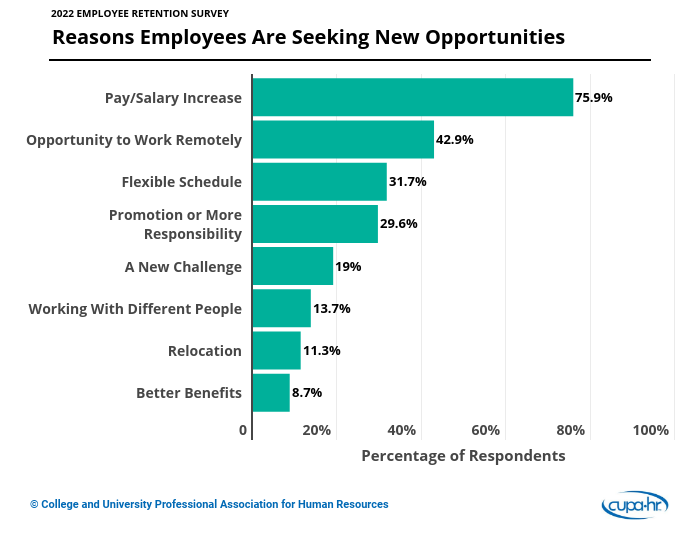
Higher ed employees are looking for other jobs, mostly because they desire a pay increase. More than half (57%) of the higher ed workforce is at least somewhat likely to look for other employment opportunities in the next 12 months. The most common reason for seeking other employment (provided by three-fourths of those likely to look for another job) is an increase in pay. Other reasons are that they desire more remote work opportunities, a more flexible schedule, and a promotion or more responsibility.
Higher ed institutions are not providing the remote work opportunities that employees want. Nearly three-fourths (71%) of employees report that most of their duties can be performed remotely, and 69% would prefer to have at least at least a partially remote work arrangement, yet 63% are working mostly or completely on-site.
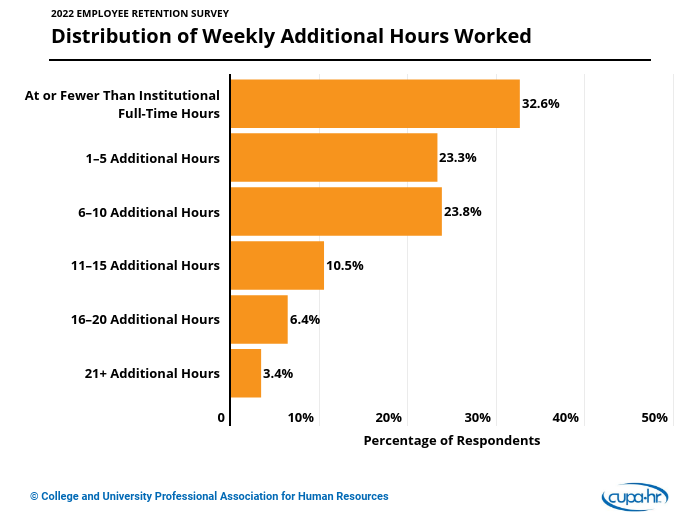
Higher ed employees are working longer and harder than ever. Two-thirds (67%) of full-time staff typically work more hours each week than what is considered full-time. Nearly two-thirds (63%) have taken on additional responsibilities of other staff who have recently left, and nearly three-fourths (73%) have taken on additional responsibilities as a direct result of the pandemic.
Higher ed employees have clear areas of satisfaction and dissatisfaction. Areas of satisfaction include benefits, relationship with supervisor, job duties, and feeling a sense of belonging. Areas of dissatisfaction include investment in career development, opportunities for advancement, fair pay, remote work policies and parental leave.
On this podcast episode of Higher Ed Without Borders co-hosted by Edu Alliance Founders Dr. Senthil Nathan and Dean Hoke speak with Dr. Jim Henderson, President of the University of Louisiana System.
Dr. James Henderson, President of the University of Louisiana System, a multi-university campus system with an enrollment of approximately 90,000 students. Prior to being appointed as President of the System, Dr. Henderson served as President of Northwestern State University. He is a native of Shreveport Louisiana. He received his Master’s in Administration from the University of West Florida, and his Doctor of Management degree from the University of Maryland – University College.
In an October 2021 newspaper article in the Acadiana Advocate, Dr. Henderson’s wife Tonia discussed her husband and love of learning. “Jim has “gone through a lot of schooling” during their marriage and he is a constant reader. He earned his master’s and doctorate while they were married. He also has routinely taken coursework where available — he oftentimes takes Massive Open Online Courses, or MOOCs — most recently one in Irish literature. “He’s always trying to learn new things,” she said.
His penchant for lifelong learning made an impact on their three children; only the youngest lives at home now. She says she gets inspired by watching him use his time so well. He allots time for work, family, and his own study.”
Senthil and Dean discussed with Dr. Henderson about the university system and his views on education and leadership.
Comments and Suggestions:
Higher Ed Without Borders would love to hear your ideas for future topics and guests. Connect with Dr. Senthil Nathan or Dean Hoke on LinkedIn. You can also visit the Edu Alliance website. To hear the entire series please subscribe to Higher Ed Without Borders on your preferred podcast platforms such as Apple, Spotify, or Google. The podcast is sponsored by Edu Alliance, an education consulting firm located in Bloomington Indiana, and Abu Dhabi, United Arab Emirates.
We assist higher education institutions worldwide on a variety of mission-critical projects. Production support was provided by White Rabbit Printing and Design.
If your organization wants to know more about how Edu Alliance can best serve you, please contact either Dean Hoke or Dr. Senthil Nathan.
CUPA-HR’s Association Leadership Program (ALP) has taken place every July for more than two decades, bringing together chapter, region, and national board members; association staff; key corporate partners; and other invited guests. After two years of meeting only virtually, these leaders were finally able to meet again in person last week.
“We’re Still Standing!”
The HR challenges of the past two years have included leading emergency COVID-19 response, exploring a new frontier of flexible work, and addressing unprecedented talent recruitment and retention challenges. Through it all, higher ed HR professionals have been on the front lines, adapting and transforming the workplace with resourcefulness, leadership and strategic insights.
To celebrate that strength and resilience, CUPA-HR president and CEO, Andy Brantley, and national board chair, Jay Stephens, kicked off the two-day meeting with Elton John’s “I’m Still Standing” playing in the background and issued an irresistible photo challenge for attendees. (Be sure to check out the photos posted to Twitter with the hashtag #cupahr22.)
Building Knowledge and Connection
The ALP’s highly interactive program included:
tips for managing chapters and developing a leadership pipeline
updates on CUPA-HR’s work on Title IX and other public policy imperatives
a practical overview of CUPA-HR’s DEI Maturity Index and new Research Center
a discussion of winning strategies for higher ed’s post-pandemic war for talent
a presentation on cultivating trauma-informed practice in higher education leadership
Beyond the programming, however, what attendees valued most about the event was the opportunity to validate their campus experiences in conversations with peers, rekindle the motivation behind their work, and take away great ideas for transforming their HR teams and their institutions in ways big and small.
Interested in Taking Your Professional Development Further?
CUPA-HR’s volunteer leaders have committed to advancing the profession and the mission of CUPA-HR. They understand the complexities of higher ed HR, and they want to enhance the knowledge and skills they need to lead their institutions into the future.
Are you ready to take that next step in developing your leadership skills, shaping the profession, and gaining one-of-a-kind access to successful practices and HR professionals from across the country? Then CUPA-HR leadership — in a chapter, at the region level, or even on the national board of directors — might be right for you. Learn more about how you can get involved.
The goal of CUPA-HR’s Emerging CUPA-HR Leaders program is to identify potential volunteer leaders who have shown exemplary leadership and initiative within higher ed HR and exhibit the desire to play an active role in advancing the profession. Invited participants have the unique opportunity to engage in problem-solving work groups and develop deep networks with peers while gaining an inside look at CUPA-HR’s operations and structure.
Throughout the program, participants are encouraged to serve the association in a leadership capacity, lending a fresh and informed perspective. Many participants have gone on to hold positions on chapter boards, region boards and CUPA-HR’s national board of directors.
The 2021-22 Cohort Curated Best Practices for CUPA-HR Chapters
Before our previous cohort of leaders embark on the next step in their professional journeys, we want to acknowledge a special project they developed over the past several months. Each year, CUPA-HR recognizes outstanding work by chapters across the country, especially in the areas of event planning and programming, engagement, chapter management and leader development. The 2021-22 Emerging CUPA-HR Leaders wanted to collect those best practices in a format that was easy to share with future chapter leaders. As a result, CUPA-HR’s Chapter Toolkit now includes recorded interviews with some of CUPA-HR’s most experienced chapter leaders passing along lessons learned and secrets to chapter success.
Many thanks to our 2021-22 Emerging CUPA-HR Leaders for their time and efforts:
Meg Arnold, Director of Organizational Development at Belmont University
Nicole Englitsch, Organizational Development Specialist at The University of Texas Rio Grande Valley
Jamee Harrington, Chief HR officer at Rogue Community College
Shannon Raum, Assistant Director of HR at Notre Dame of Maryland University
Taylor Zeilinger, HR Manager at the University of Wisconsin-Madison
The 2022-23 Cohort Will Explore New Ways to Grow the Profession
“We are excited to welcome this year’s Emerging CUPA-HR Leaders cohort,” says CUPA-HR President and Chief Executive Officer Andy Brantley. “These individuals are outstanding higher education human resources leaders who will help us lead the association into the future.”
Congratulations to the 2022-23 Emerging CUPA-HR Leaders:
Laura Good, Assistant Director of Human Resources and Benefit Systems Manager, University of Mount Union
Leslie Hardin, Vice President Human Resources, Johnson County Community College
Beth Muha, Assistant Vice President of Human Resources, American University
Allyson Mullin, Executive Director of Human Resources, Alvernia University
Krista Vaught, Assistant Director, Employee Learning and Engagement, Vanderbilt University
Angela Wurtsmith, Executive Director of Human Resources, Colorado Mountain College
Throughout the past few years we have definitely been part of a Zoom and Microsoft Team centric world. As we meet with teams and individuals, we have to account for the life that is happening on the other side of the screen. Through Zoom we have a unique opportunity to gain a glimpse into another person’s life to which we would normally not have access.
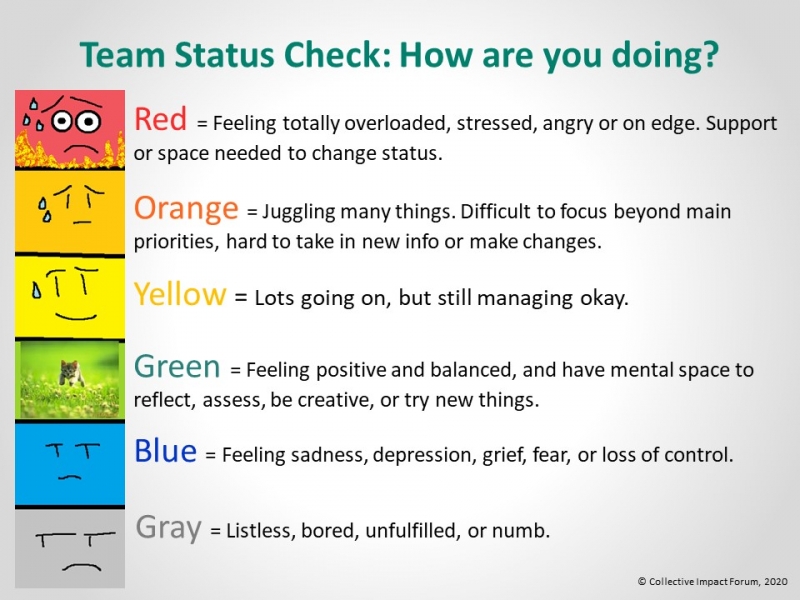
This means that we have a moral and ethnical responsibility as peers and as leaders to genuinely care about the people to which we are communicate with on Zoom. Here’s a great resource from the Collective Impact Forum (http://www.collectiveimpactforum.org).
The Team Color Check-In Tool is a communication tool to help people in virtual and face-to-face conversations have a check-in. The colors range from:
Red
Orange
Yellow
Green
Blue
Gray
If you are wondering how to apply this for your teams or classrooms, I would definitely recommend the following:
#1 – Utilize it when you meet with individuals one-on-one (BEFORE) the meeting.
#2 – Utilize it in Zoom via an anonymous poll to gauge how their audience is feeling BEFORE the meeting and providing resources at the end of the meeting (or in a follow-up email).
#3 – Send the check-in tool to your team/organization at the beginning of the week and provide workshops and support throughout the week for the team.
Respond Below – How would you use the resource? Do you think teams would benefit from this resource? How would you modify it?
Thanks for reading!
Sincerely, Dr. Jennifer T. Edwards Professor of Communication
Executive Director of the Texas Social Media Research Institute & Rural Communication Institute
Chinasa Elue, PhD is an Associate Professor at Kennesaw State University where her focus is Educational Leadership and Higher Education. She is also an entrepreneur. Her company, True Titans Consulting is helping leaders and organizations with grief and trauma.
How do you express grief, express loss, online? In this interview, Chinasa gets personal about the loss of her mother. Dr. Elue knows that we’ve been experiencing collective grief.
Welcome to the featured interview series on The Social Academic blog. You can read, watch, or listen to the interviews shared here.
Jennifer: Hi everyone. My name is Jennifer van Alstyne. Welcome to the new season of The Social Academic. I’m here with Dr. Chinasa Elue, an associate professor of educational leadership and higher education at Kennesaw State University.
Chinasa, I’m so happy to talk with you today. Would you please introduce yourself? Let everyone know a little bit about you.
Chinasa: Absolutely. And so thank you so much for having me here today, Jennifer, I’m excited to be here and chat with you as well.
My name is Chinasa Elue. As you mentioned, I’m a professor at Kennesaw State University, but I’m also an entrepreneur. I run my own coaching and consulting business where I am supporting organizational leaders lead with more trauma informed practices in the workplace.
A lot of this work stems from our research around grief, leadership and trauma informed practices in organizational settings. I’m excited to be doing this work. It’s truly an honor to be able to leave such important work in this context that we’ve been navigating these past couple of years. Thank you.
Jennifer: Yeah, thank you for introducing that and letting people know about your business. And I think that’s so important. One of the reasons that I want to highlight professors like yourself on the show is to show that people are doing more than just their faculty work. People are helping the world in different ways.
Journey into the professoriate
Having an online presence is something that becomes a part of that system for helping people. That’s one of the things that I wanted to talk with you about today.
Now, since most of the people who are listening to this are professors themselves, can you tell me a little bit more about your higher ed life?
Chinasa: Absolutely. So in terms of my journey into the professoriate is really interesting because in a lot of ways, when I was finishing my graduate program, I thought I was going to go into higher education administration. I thought I was going to work as the Dean of Students or something of that nature.
But as you know, along the way, I had some really amazing mentors who really encouraged me to pursue a faculty life. They talked about the importance of impact in the field more systemic ways. I applied to many jobs and I was able to land my first gig right out of graduate school teaching.
I think being a professor…It’s a journey in and of itself, right?
There are a lot of ins and outs of this thing that I’ve learned over time. I’m getting ready to enter into my 8th year of teaching. I can’t even believe I’m saying that, but yeah, 8 years of teaching as a professor.
It’s been an interesting journey. That’s the best way I can put it, because there are a lot of reasons why I’ve chosen to navigate my career in the ways that I have. Especially with my experiences and academe in general as a woman of color.
That shaped and informed why I chose to not only be a professor, but also be an entrepreneur because I recognize the importance of having more systemic impact outside of my 9-to-5 job.
I think it’s important to think about to what extent can you really enact change or have a more positive force in that context. I realized that for me, it needed to step outside of the ivory tower and look different in a lot of ways.
Finding your voice on social media
Jennifer: It sounds like you realize that you could help more, that you have that ability and that you knew that you needed to do something. Like you needed to give more of yourself into a different area.
That’s something that an online presence is so helpful for, because we can’t always communicate with everyone all the time. Right? There’s not people around like introducing themselves, “Hi, let me learn more about you.” But there are online. There are people who are looking for help in different areas.
There are also professors who are looking to connect with other professors, you know, working in higher education. And I think that that online presence can be really beneficial in that, in that kind of system of communication.
So what does your online presence look like? What are some of the things that you do to have an online presence?
Chinasa: You know, it’s so interesting when we talk about online presence as a professor, right? In a lot of ways, I see a lot of faculty on Twitter. I think that’s the place of choice in a lot of ways where we’re able to share ideas more broadly.
But I also know at the same time, one of my own pieces with building my online presence is also honing in on my voice and how I wanted to communicate information and in what ways I wanted to share that. And also letting my personality shine. Right?
I think in a lot of ways, it’s very easy to be kind of cut and dry. Being very professional, which I am, but I’m also in a lot of ways, I bring in a lot of humor.
And so what I like to do online, I don’t mind sharing. If it’s Twitter is more professional or whatnot, sharing
Research updates
Recent awards
Accolades
Conversations that are going on locally and in the world at large
But Instagram is kind of where I have a little bit more fun. I share a little bit more personally in that space.
I also have my own YouTube channel where I’ve done videos and those kinds of have a humorous bent to them as well. Humorous but also informative at the same time. I’ve done a lot of work around career coaching and supporting professionals in various spaces professionally. I wanted to bring some humor into a space of times that can be very dry.
And oftentimes where we also have a lot of traumatic experiences in our respective industries that we may not talk about, but I want it to highlight it and make it a little bit more light and palatable so that we can have more systemic conversations.
My preference just looks different depending on the platform, to be honest.
Jennifer: I really like that. I think that it makes a lot of sense to have different audiences, but also different types of content that you share on each platform. And it really is based on your goals.
Free online presence workshop
Get started for in this virtual choose your own adventure workshop for professors, researchers, and graduate students.
It sounds like you have fun on Instagram. You share those kinds of motivational and short videos on YouTube. That can really help people connect with you. And then the more professional side is on Twitter. Is that right?
Chinasa: Yes. Correct.
How much do you share about yourself online?
Jennifer: Well, I think that it’s really important for people to recognize what they’re interested in in terms of
where they want to share
what they want to share
how much they want to share
So that’s my next question. How much do you share online about yourself?
Chinasa: I think I share what I feel comfortable sharing. Right? I don’t use online as my journal entry point.
Jennifer: Yeah.
Chinasa: I don’t come in there to narrate my initial reactions to anything.
I talk about this often when I’m talking to friends or colleagues that whenever there’s a hot button topic, where there is a decision or a case or an event that’s happened…
A lot of times, people will flock online to share their initial reactions or emotions.
Jennifer: They love to do that. It’s like a gut reaction to go and talk about your feelings about something. For sure.
Chinasa: Yeah! But I realized that that in a lot of ways it doesn’t serve me well, personally. That I need time to be in community with people that I talked to more systemically and consistently to really process the events.
Because a lot of times it’s something that’s near and dear to your heart, right? These are some really hot topics that are going to impact me, my children, my family for generations to come.
I realized in a lot of ways, I don’t want to just contribute a hot bite and not then take action.
My reaction is just to not necessarily go online, but to pick up a phone and get in touch with someone where I can process more systemically. And then, make a post that I think could contribute in a more meaningful way.
It just serves me better. And I think in a lot of ways, I don’t want people to come to me and try and take a sound bite without knowing the true impact that this is going to have long-term. So I process, and then I share within reason in terms of what I feel comfortable sharing.
Sometimes I don’t [post]. Sometimes I write a blog. Sometimes it drives me to do research, or to do an article, or something else. Right? But I am more intentional about not emoting outwardly first, but being more reflective in nature.
Jennifer: Oooh, I really like what you said about how that time to reflect and to actually talk with people who you’re close with about the experiences and the things that are happening. It really allows you to focus your energy in your reaction to that. Either, either it goes into social media, but it has all these other options too, which a lot of people don’t consider when they have a gut reaction to something that they’ve experienced.
I like that, you know, that could be channeled into research or into a blog post, like into these different forms of reaction. So I really like that. Thank you for sharing that.
Chinasa: Absolutely.
We are walking through collective trauma
Jennifer: Now, one of the things that you talked about is that you share things that you feel comfortable with online.
And I know that grief is something that we’ve all been dealing with collectively recently, but you yourself have lost your mother. That’s something that you’ve been able to talk about online and even connect with people about. Can you tell me a little bit about that?
Chinasa: You know, I never thought that I would be doing research on grief. That wasn’t my initial mo (modus operandi) when I came into the professoriate at all. I was initially studying issues of access and equity to higher ed.
I lost my mom in may of 2019. And when I lost her, that was the first time I’ve lost someone so close in proximity to me. The loss in and of itself was so debilitating in ways I can’t even describe to be honest.
So when I think about being in that space a year before we knew a pandemic was looming ahead. Right? Losing my mom, and having young children at the same time and figuring out how to navigate being a faculty member and being all the other things that I do on a daily basis…It was a really trying time to be frank.
Coming into the pandemic it was almost like I had an awakening of sorts. Right? We started to see loss on a massive scale in the midst of our racial reckoning in this country that’s still ongoing [United States], the social political climate that has continued to traverse even until now.
I recognized that what we’re walking through at the time was collective trauma and collective grief.
I felt a prompting to begin to ask some deeper questions. As a higher ed researcher, I wanted to know how are institutional leaders responding to loss right now? Because I know how debilitating the was for me before a pandemic, before all of the other factors were there, to navigate that.
But let’s say you lost someone due to COVID. Right? And maybe, perhaps you’re a person of color or any other dimension of your identity that’s been impacted by any number of it. You name the headline, it’s present today. Okay?
Based on where you’re socialized in this world and in this country specifically, it really impacts how you’re able to show up every day.
People are quick to move back to a normal or ‘a new normal,’ which is what we keep hearing now that the pandemic is over, which I beg to differ, honestly, but we’re here.
In a lot of ways, if you lost someone during these past 2.5 to 3 years, and then have to face any number of events…The ways in which you’ve had to navigate and cope have had to vary based on who you are in this country.
How are organizational leaders responding to grief?
Chinasa: I wanted to know how leaders, especially as a higher ed scholar, how are leaders responding?
How are you providing space to
with your faculty, staff and students who have experienced traumatic loss? Who are showing up on your campus and they’re not the same person they were before the pandemic, right?
These are not the same people that are returning back to us. And so when I think about grief now in this context, I think we’ve been in prolonged grief. There’s been just so much that has gone on, and it’s been such a trying season to be in right now where we are trying to figure out how to pick up our feet and move forward. But at the same time, we keep getting knocked down every step that we take. Right?
And so in this context, it’s more so okay, how do we continue to create spaces that allow us the opportunities to process the ongoing traumatic onslaught of grief that we’re seeing unfold day in and day out. There is no reprieve right now.
The conversations have to look different.
The events that we’re hosting the organizations that we’re building have to look different because we have to be more intentional about how we are creating spaces for people to show up in their true authenticity, but still be able to thrive.
And to not care about the bottom line, but to honestly care about the individual 1st –before you care about the deadline, the project, the goal at hand. But to know that these are real people that need a real leader to recognize them for the totality of their humanity. They want you to see them.
I think one big piece about The Great Resignation that we’re noticing right now is that people are leaving because they want more, they desire more. They realize that they’re worthy of more.
If leaders wake up to the fact that your employees, your colleagues don’t want to be seen as a bottom line item, they want to be seen as a human being who has been experiencing trauma and loss. Then you have to respond differently. Because if you don’t, this is going to be an ongoing situation that we see for many years to come.
Jennifer: Hm. That was a lot. What it sounds like is that your own grief helped prompt this research that is hopefully going to make this bigger impact on universities around the world and on organizations too. I mean, trauma is something that every company and every organization is dealing with because people are collectively grieving. You’re right.
Talking about the loss of her mom on social media
Jennifer: Now what does that look like with social media for you? Like, you’ve been able to talk about some of your grief on social media. And I’m curious how that’s been. What have people’s reactions been? Have you been able to make connections based on that shared grief?
Chinasa: Absolutely. I think social media, you know, it’s the catch 22 with it, right? It’s a great connector in a lot of ways. You’re able to build a community and networks in that vein. It could be a big detractor at the same time with differing opinions. And then the armchair bullies that show up every now and then, right?
Jennifer: Oh, yeah.
Chinasa: Yeah. For me, personally, I’ve been able to talk about grief in a very authentic and raw way.
I don’t shy away from it because grief is, in my opinion, the final act of love. We’ve loved people deeply. And so we’re going to grieve them deeply. And grieving looks different for any person. For me, I’ve chosen to be more public and sharing my emotions and how I’ve been processing things.
don’t run to Instagram or Twitter as my journal to share. But I share things that I’ve processed through
Events
Milestones
Holidays (i.e. Mother’s Day)
Cooking my mom’s favorite recipe
I’m just remembering those times. I have no issue sharing a picture of her because she’s so near and dear to me, I think about her every day. I think in a lot of ways, I also use social media as a way to memorialize her. To let people know that she was here because it’s very easy to want to power ahead, but that person still lives in a very present part in my heart. My mom does for me, right?
And I think for those who are experiencing loss and being able to share my experiences online and saying that it’s okay. That it is three years later and I’m still grieving. Right? That there’s no timeframe here that you have to give yourself the grace and the space you’d need to
Process
Emote
Take your time
Slow down as needed
And I think it’s a space to gain encouragement when you’re walking through something similar and to connect with others who are on the same path.
Because I’ve been able to make those connections with others who have lost parents, who’ve lost, loved ones who understand and who send me messages, or we connect offline and are able to talk more systemically.
I think that’s a big piece there with leveraging social media when you have different events happen. You can use your online presence to have more personal conversations that are meaningful to you. And also, still have impact by providing encouragement and space to have dialogue that may not exist outside of those online virtual walls. And so I appreciate that about social media for that, for sure.
Jennifer: Chinasa I really appreciate that. And for anyone who’s listening, who is experiencing grief right now, but maybe you’re not so sure how much you want to post about it online, or if you want to reach out to people that way. Remember that you can also use direct messages and actually have those kinds of private conversations about this through social media as well.
So there are many options for talking about grief, but it sounds like Chinasa has gotten a pretty positive response from being able to open up about her mom and the grief that she’s felt online.
Chinasa: Absolutely. And I think in a lot of ways, people are like, well, nobody wants to hear about this anymore. She’s been gone for some while. Right? Like we sometimes get in our own heads and feel like we need to emote or share for other people.
But I put that to the shelf. I think you have to just come out. A big piece of me sharing is also me being honest and authentic. I don’t show up every day just smiling, like the world is glorious and good.
Like it is, right? Some days.
But there are days where I’m really in the pits with grief. And I might feel that to share so that people understand that this is a process. You don’t have to beat yourself up if you don’t feel like you are where you thought you would be a year from now, two years from now.
I think in a lot of ways, it’s great to serve as a possibility model for others who are probably in the beginning stages or midway through who are wondering, will it get better again? Or what does this look like?
You know, we all grieve differently. Right? All I can do is model my process.
I may share more than another person, but I think in a lot of ways that sharing does open up the doors for more prolonged conversations that I think honestly needs to happen more, especially when we think about people die every day. Every day.
And if we can’t talk about death, which is a natural part of life, then when will the conversation ever happen? If we can’t talk about it at work, we can’t talk about it at home, or with our friends or loved ones. Like we have to talk about it because we will all unfortunately experience this.
I think the online community provides a great outlet to have a space to do it.
Jennifer: I’ve lost both my parents. I think the grief has been a long journey. My mom died about 20 years ago and my dad 15 years ago. And I’m still processing it.
Chinasa: Yes.
Jennifer: It doesn’t go away. It doesn’t stop. And being able to talk about it has been something that has been so healing for me.
I think the only reason I haven’t done it online is because so many of the people who knew them have also passed. They were quite a bit older when they adopted me.
And so I think that kind of like public remembrance, that public memorial that you say is part of some of the posts that you do, it’s just so beautiful. I love that. I’ve seen that before, but I don’t think I’ve ever heard anyone talk about what that feels like for them. And what posting about, you know, your mom’s cookies makes it feel like when you post. And so I really liked that. Thank you.
Chinasa helps people who are experiencing grief
Jennifer: Now, tell me a little bit more about your business because your business is now helping some people who are experiencing trauma. Both individuals and organizations, is that right?
Chinasa: Yes. I’m so excited about the work that I’m doing right now with organizations. I’ve had the opportunity to be able to talk more in detail with leaders who are looking for ways to perhaps set the stage for these conversations that I’m talking about right now.
I think if I were to say the most rewarding part of being an entrepreneur in this space, academic entrepreneur of this kind, I think in a lot of ways is being able to leverage your research to do the work. But then also to realize that there are more practical ways to implement it across different organizations and systems. The entrepreneurial route has been very affirming in a lot of ways and very encouraging to me to be able to step out and do this more systemically.
I offer talks to different organizations based on what their needs are, how they want to engage in the conversation.
I’m open and transparent. I bring the research with me. I’m sharing with them real time data because I think at times people need to know. They need to know the statistics. They need to know the experiences of others.
And then they also need to provide the space for those within their organizations to now begin to talk about, well, how do we perhaps cultivate something like this for ourselves? I appreciate that space to be able to do this work in this context.
In the same vein, I also offer grief coaching and grief circles. [Laughs]. I’m laughing because I never thought I would offer that. I never thought that I would be in the space or the head space to do it.
But it was so ironic. At the height of the pandemic, a good friend of mine asked me to start leading grief circles for her organization.
I hesitated at first because you know, in a lot of ways, as an academic, you feel like you need to have all the certifications and credentials under your belt.
In order to step out and do it, but I’ll be frank and say, I started to do it and engage in the work and it has been some of the most eyeopening and rewarding components of what I’ve been able to do since.
To be frank, it’s an absolute honor to be able to support people in this capacity. It’s a tough space to be in. It is a hard place to, you know, step outside of oneself and make yourself available to support others in their journey. But at the same time, it has been absolutely rewarding to see people find what they need in that space at the same time.
I don’t come to it as the guru or the person that’s bringing everything. I come to it as a supportive guide to help people, as they’re thinking through and navigating their own loss. And to think about perhaps how they may begin to forge a path way forward.
A lot of times we just feel stuck. We feel stuck. We don’t think we are going to ever be able to pick up our feet and move one in front of the other.
But when you’re in spaces, when you choose to not isolate, and you get into community with people, I think that is where we’re able to begin to make some semblance of meaning from the gravity of it all.
It’s a lot, but we have to find ways to just think about how may I perhaps begin to move forward. Not necessarily leaving the person in the past by carrying them with you in your heart. And doing things that are intentionally honoring them in yourself along the way.
Jennifer: Oh, that’s beautiful.
I’m so glad that we talked about this because so many people are grieving right now and holding it in. And just trying to stay strong for themselves, for their families to keep moving forward.
And sometimes you just can’t. Sometimes moving forward is just not something you can do on your own. And it’s not something that your family can help you do. Sometimes they don’t have that capacity. Sometimes you don’t have that capacity. But there is help out there. There are ways that you can move forward by working with other people by finding that community. And maybe by hiring Dr. Chinasa Elue as your trauma coach.
I know that I would need something like that. Now that I know that it exists, I wish I had that when I was younger. And I think other people will be glad to have heard you talk about it as well.
Chinasa: Thank you.
Be yourself online
Jennifer: Well, this has been a wonderful conversation. Is there anything else you’d like to add about online presence, about your work, before we wrap up?
Chinasa: I would just say for those who are kind of on the edge of finding their voice online or putting themselves out there. I would just say it’s trial and error. Right? Don’t make it such a high stakes thing.
In a lot of ways, it does take time to find your voice. You’re going to mess up. You might say things…We always worried about getting canceled and the whole nine.
We have to think about perhaps how we might engage in conversations. Like I mentioned beforehand, when there’s a hot button issue that is on the docket for the day. Pick any day, there’s always something new, right? Thinking about our online behaviors is key before we begin to engage in those conversations.
What might we say that contributes in a meaningful way? I don’t like to fan the flame perhaps, but I do like to contribute in ways that provide solutions in a more sustainable way towards action. I think thinking about how you want to engage is key.
And then we think about who you are as a person. We’re not static people, right? There’s depth and range to who we are individually. Let your personality shine forth. That’s the secret sauce. Be yourself.
I think I’ve gotten really comfortable in my skin. I share what I share because it’s who I am, right? And it may not be everybody’s jam, but for me, my jam is just fine. And that’s just the way I choose to present myself.
So if someone is thinking about perhaps ways to express themselves online. I would just say lean into you. Do you. Okay? They can’t go wrong.
Jennifer: Oh, I love that.
Chinasa: Yeah, you can’t go wrong.
Jennifer: Just be you.
Well thank you so much! Be sure to share this interview with your friends.
Dr. Chinasa Elue is a professor, speaker, coach, and the CEO and Founder of True Titans Consulting Group. She is an expert on grief leadership in higher education and trauma-informed practices in organizational settings. She supports leaders in moving forward to make impactful change in the midst of uncertainty with empathy and care. She provides strategic coaching and consulting that opens the doors to transformation through policy and practice. She hosts Grieving in Color, a podcast that explores the various ways we navigate our experiences with grief and loss and a place where we find the courage to intentionally heal in our daily lives.
Dr. Elue is an Associate Professor of Educational Leadership and Higher Education at Kennesaw State University. She leads the Research Lab for the Study of Emotional Intelligence, Leadership Effectiveness, and Well-Being of Educational Leaders.
Connect with Chinasa on social media @DrChinasaElue.