Over the summer, I always think about how the fall courses will be better. I always strive to make my courses at least 5% better than the courses the semester before. Course evaluations are important and I want to make sure the students have a great experience, but I also want to have a great experience teaching in the course as well.
This means that I write down ideas as I read blog posts, listen to videos, and also as I listen to local/regional/and national news. So, I get EXCITED to introduce myself to a new group of students!
This year, I decided to pre-record TWO videos introducing myself to the students. Here’s the video (Part 1/2) that I plan to send the students in the fall semester. This videos is based on the questions that I requested from via an email survey in the summer.
Genial.ly is a presentation creation platform that offers a wide range of possibilities for what teachers and students can create. From excellent templates to interactive visuals, there are some really fun and exciting ways to easily create visuals of all kinds. Plus, it’s a freemium resource, so teachers and students can get started creating completely for free. Continue reading on our Review’s Page.
Schools play a critical role in helping to prevent and control the spread of infectious diseases within communities. With the outbreak of the novel coronavirus disease (COVID-19), there has been discussion on how to open public areas safely, specifically schools. As world organizations work to find a vaccine, communities must take steps to protect at-risk individuals and reduce the impacts of the outbreak.
It is important to take the necessary precautions to prevent the potential spread of COVID-19 in school settings. To effectively mitigate the spread, administrators will need to provide clear and actionable prevention guidelines to students, parents, and staff. Below we’ve provided facts, resources, and suggestions for how to minimize the disruption of learning while protecting students and staff during this outbreak.
What is COVID-19 and How Does it Spread in Schools?
COVID-19 is a disease caused by a new strain of coronavirus. The most common symptoms can include fever, cough, and shortness of breath—though some may carry the disease without showing any signs.
The virus can spread through direct contact with respiratory droplets (from a cough or sneeze) from an infected person. COVID-19 can also infect individuals who touch their faces (e.g., eyes, nose, mouth) after touching surfaces contaminated with the virus.
Prevention of COVID-19 in Public Spaces
Like all other respiratory infections (the flu or common cold), it takes the coordination of organizations and the community to slow the spread of diseases. The recommendations below should be followed by all those in the community, including offices, restaurants, government buildings, and more.
Encourage the community to follow these measures:
Stay home when sick
Cover mouth and nose when coughing or sneezing
Dispose of tissues immediately after use
Wash hands often with soap and water
Clean frequently touched surfaces and objects
Additional recommendations may be encouraged. Be sure to follow public health officials to stay up to date on the latest measures. Learn more here.
Guidance for COVID-19 Prevention and Control in Schools
Even if schools are not opening for in-classroom learning this fall, staff and students may still need to access the school facilities to participate in lunch programs, collect technology equipment, or gather other assets. Administrators will need to have guidelines to ensure safe reopenings or access to schools for all who enter. Below are suggestions and guidelines to keep in mind when implementing safe school operations during COVID-19.
Screen Volunteers and Visitors
Monitor the health of those coming in and out of your school before they enter your facility. Administrators can implement technology like KeepnTrack to take a proactive approach to prevent and control the spread of COVID-19 by vetting every individual who enters their facility. Administrators can ask a series of questions to determine if an individual’s symptoms or exposure is a threat.
Administrators should make the school’s guidelines for preventing and controlling the spread of the virus accessible to parents and students. School community members should be encouraged to alert school and healthcare authorities and keep their children at home if someone in their household is diagnosed with COVID-19.
Parent-teacher committees and other school volunteers can also help with the sharing of information and guidelines.
Monitor Absenteeism and Track for Patterns
Develop a monitoring system to track student and staff absences and compare usual absenteeism patterns at the school. If unusual patterns are found, alert local health authorities about significant increases in student and staff absenteeism due to respiratory illness.
Now is the time to develop new school policies regarding attendance or sick leave that encourages students and staff to stay home when sick or caring for sick family members. Be sure to put in place alternative options for students who are at home sick or covering critical job functions or positions. Be sure to plan for possible academic learning changes or alterations when it comes to breaks or exams.
Grants for Prevention and Control
Congress set aside approximately $13.2 billion of the $30.75 billion allotted to the Education Stabilization Fund through the CARES Act for the Elementary and Secondary School Emergency Relief Fund (ESSER Fund). The Department will award these grants to state educational agencies (SEAs) to provide local educational agencies (LEAs), including charter schools that are LEAs, with emergency relief funds to address the impact that COVID-19 has had, and continues to have, on elementary and secondary schools across the nation.
ESSER federal funding through the CARES (Coronavirus Aid, Relief and Economic Securities) Act intends to help your schools address the needs of your students with disabilities, English learners, and at-risk students, by providing resources to implement solutions that positively impact these populations.
This is the final Student Blogging Challenge post until we start again in October 2020.
We know many of you have been working on the challenge during very unsettled times. Well done!
It’s time to reflect and celebrate.
Week Seven Recap
Many students are enjoying sharing posts about emojis.
You can find all the submitted tasks here (or click on the week 7 box on the sidebar).
Here’s just a handful of excellent work we spotted recently:
Tushilfrom New Zealand made a unique basketball emoji and has a guessing game.
Lainiefrom Australia invites you to guess the movies from the emoji clues.
Oliviashared some interesting details about break time in New Zealand.
Eleanorfrom the USA made an emoji story using the prompts from Byrdseed.
Livwrote an amazing poem about her school in New Zealand.
Ervinsfrom Latvia came up with some emoji maths. Can you guess the answers?
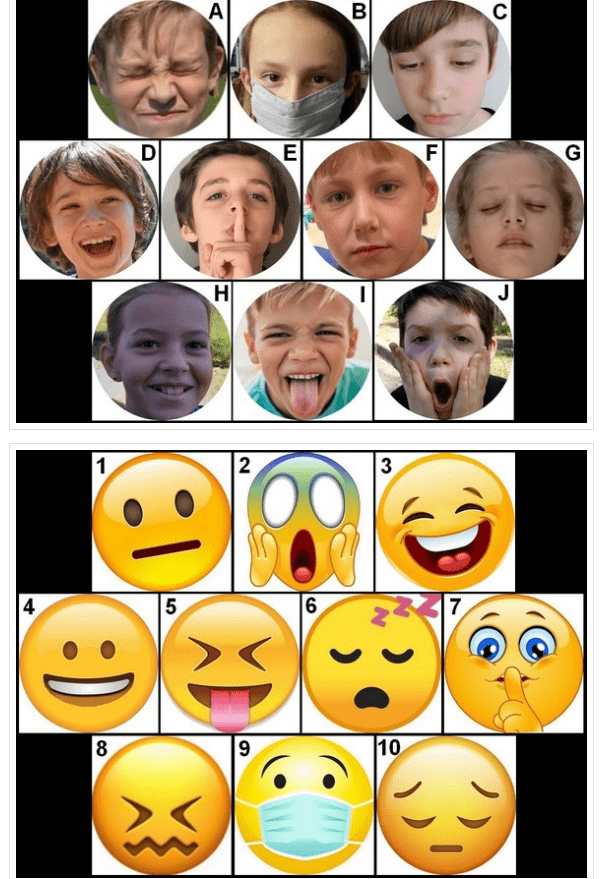
Serge Galligani’s class in France came up with a fun idea. The students turned their faces into emojis. Can you guess the answers?
Reminders
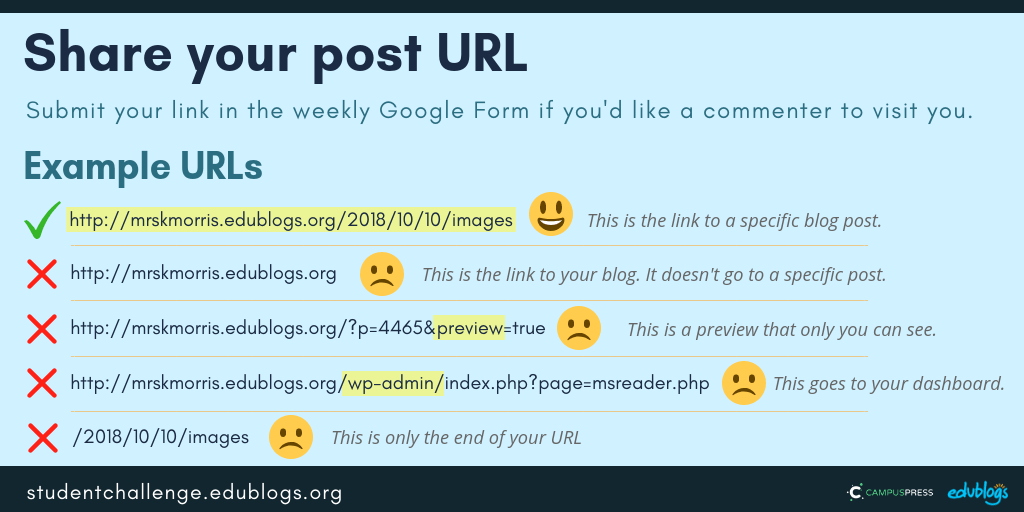
The forms for weeks 1-6 are closed. If you’re catching up you can submit your tasks from weeks 1-6 in the week eight Google Form in this post. All Google Forms will close May 24th.
If you’d like to join us again for the next challenge in October 2020, make sure you’re on our mailing list. You’ll get an email in September when registrations are open. Otherwise, check this blog in September for all the news.
Follow The Edublogger — If you’re not already receiving the email newsletter from Edublogs, maybe you’d like to sign up? I send out an email regularly sharing the latest blog post.
Thank You
The Student Blogging Challenge is a real team effort. We couldn’t do it without the support of our wonderful volunteers.
Many of our volunteers and participants have worked on the challenge during difficult circumstances. We admire your efforts immensely.
To Sue Wyatt…
Miss W/Tasteach/Sue Wyatt works tirelessly behind the scenes to help our commenting team, support participants, and keep our spreadsheets up to date. We appreciate you, Sue!
To Marg Grosfield…
Marg is a special commenter who does a wonderful job behind the scenes helping with the spreadsheets. Marg generously volunteers her time to ensure everyone is looked after. Thank you, Marg!
To our commenters…
Another big thank you goes to our team of commenters who provided an authentic audience for our students and classes each week. Your comments really helped our students with their confidence and motivation. We hope you’ll return again as a commenter in October.
To our participants…
It has been fantastic to see such enthusiastic participation from our students and teachers despite difficult circumstances! I hope you’ve all learned a lot and made some connections.
Spread the word about the next Student Blogging Challenge!
Summary Of The Student Blogging Challenge
We had a good number of registrations for this Student Blogging Challenger, however, participation was naturally down due to over 90% of the world’s student population being affected by school closures.
Let’s look at STUBC by the numbers…
Number of registered individual students: 1043
Number of registered classes: 111
Number of countries represented: 24
Number of tasks submitted
These are the edited numbers after incorrect and duplicate URLs were removed.
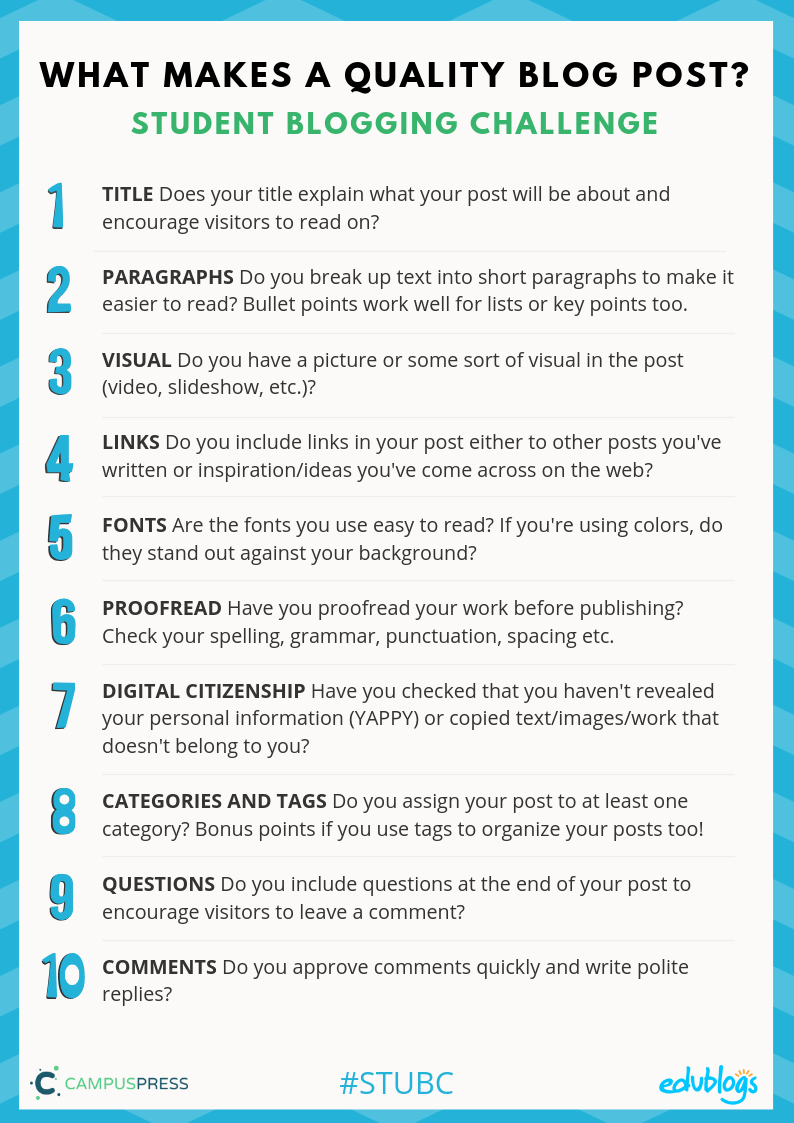
What Makes A Quality Blog Post?
I hope you’ve learned a lot throughout the Student Blogging Challenge! Perhaps if you look back to your posts from a few weeks ago you can see that you’ve improved.
To wrap all our learning up, I invite you to take a look at this poster. It goes over some of the essential ingredients of a quality blog post. You might have your own ideas too!
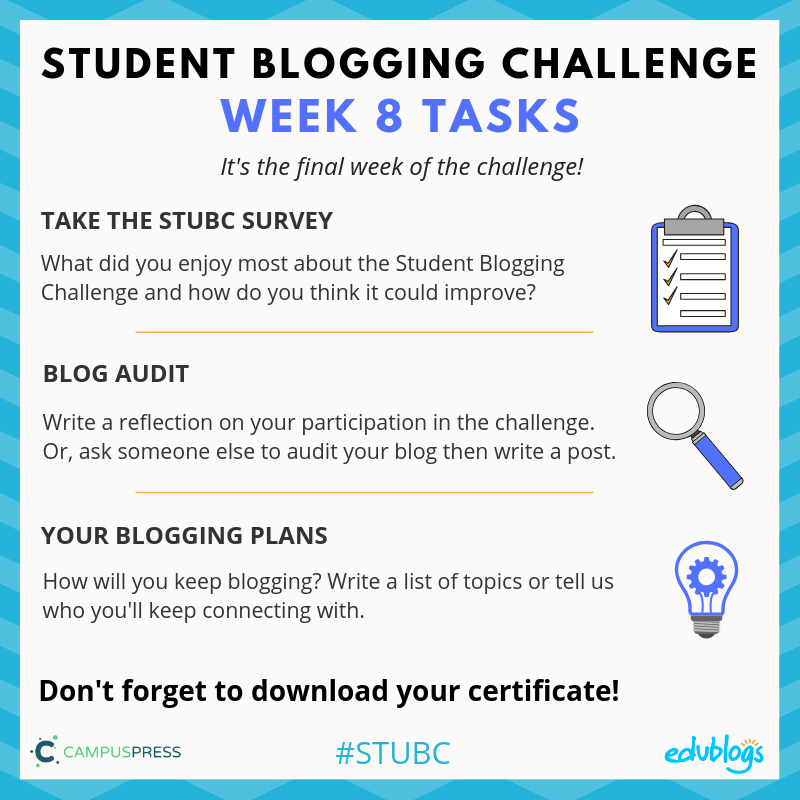
This week there are 3 tasks to complete. If you don’t have time to write a post, please just spend 5 minutes completing our survey. We’d really appreciate it!
Option One: Write a post on your blog reflecting on your participation in the challenge.
These are the sorts of prompts you could answer in your post:
How many weeks of the challenge did you participate in?
How many posts did you write in the 8 week period?
How many comments did you receive from classmates, teachers, or other visitors?
Which post did you enjoy writing the most and why?
Which web tools did you use to show creativity on your blog?
What are your plans for your blog now? Will you keep posting?
Option Two: Ask a friend or family member who might not have read your blog to do an audit.
Send them your blog URL and ask them some questions. For example:
What were your first impressions of my blog?
What captured your attention?
What distracted you on the blog?
What suggestions can you give me to improve my blog?
Task 3: Your Blogging Plans
While the Student Blogging Challenge is coming to an end, we hope this is not the end of your blogging journey. We encourage you to keep blogging and connecting. To do this well, you might need a plan.
Write a post about how you plan to keep blogging:
Perhaps you’d like to publish a list of ideas you have for future blog post topics.
Or, you could ask your readers for suggestions on what they’d like you to write about on your blog. You could even run a poll.
Write about anyone you have connected with throughout the challenge that you’d like to stay in touch with. Are there any blogs you’ll keep reading and commenting on?
Blog post ideas for students:
More advanced bloggers and teachers might enjoy these two posts on The Edublogger:
If you’re working as a class on this activity, perhaps students could contribute post ideas which the teacher compiles. Readers could be invited to comment or vote.
Student Certificates
Congratulations on completing the Student Blogging Challenge!
Download a certificate to celebrate your achievement.
Note for commenters: I’ll email you about accessing your certificate during the week.
Student life (ronak sharma): Laste part of student life
Laste part of student life
Student life will exhaust the hell out of you but it will also convert coal into a diamond. Study hard, work hard but also party a little bit to clear your head. Workaholics may achieve success in life but they never receive the happiness they yearn for. Because money and recognition is not everything. Family is also important. Make sure to give time to your family so that you don’t miss out on their love and attention. In surmise, I would like to say that student life is a life full of ups and downs. It is actually a rollercoaster ride where there is no end to thrill and fun you experience. But with that comes
Though the life of a student is free of all anxieties yet a student has a hard life. He has to work intensively and incessantly to bring his grades up. And keeping up a social life along with your grades is a tough task, might I say. But with time and practice, students learn to juggle everything along with handling the pressure that comes with multi tasking. Students are expected to keep up good grades and if they fail to do so, they are tagged as failures which are pathetic. You never know the circumstances they are facing. Interest areas also matter a lot for students. Some are passionate towards studies, some love sports, some pursue art and craft as their forte and some just want to become musicians or dancers. For the matter of fact, you can be anything you want to be. But just don’t give in to society’s expectations of becoming a doctor or engineer if you don’t want to be one. Follow your passion. Follow that spark which ignites the fire in your heart.
Why every school needs a Head of Remote Learning (and yes, we should talk about this during a crisis)
Most schools are facing multiple transformations. These range from digital transformation, to future-skills transformation, to the most important and urgent right now, which is distant-teaching and learning transformation.
Whilst the corporate world has innovated with new roles from chief digital officers to agile coaches to futurists to attempt to capture value from these transformations — the roles we have in schools are still operating within the legacy mindset and systems, ranging from Math teacher, English teacher, PE teacher, and Art teacher, representing probably 90% of the roles that exist in any school.
Leaving the titles aside, if we look at it from a skillset point of view, we know ‘subject’ teachers are more than the purveyors of subject knowledge. They are counselors, data analysts, advisors, experimenters, storytellers, investors (with their time), relationship builders, technologists, and today they are required to be remote teaching specialists.
Teachers are more than the purveyors of subject knowledge. They are counselors, data analysts, advisors, experimenters, storytellers, investors (with their time), relationship builders, technologists, and now they are required to be remote teaching specialists.
There’s never been a better case to be made for a Head of Remote Learning in schools and districts.
With 70,000 students told to stay at home and over half the schools closed across the country as of March 18, 2020, for COVID19 prevention measures. With some schools potentially not opening until after summer break, teachers are scrambling to remotely continue the academic learning for students.
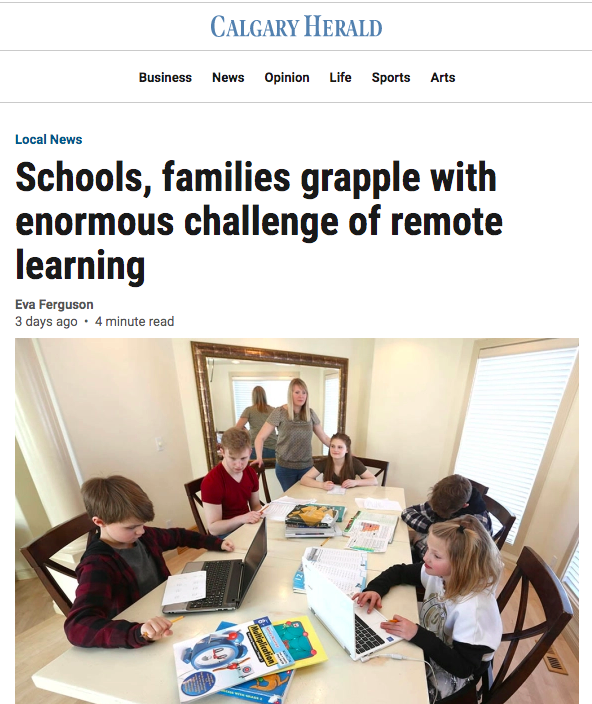
Headlines like this one from the Calgary Herald describe the last-minute scramble.
Before we go on, it’s important to state that this role can be taken on by more than one person in any school, and needn’t have to be a full-time role in the initial instance. First, by experimenting and creating value in the role, it can be used to justify the hiring-case to the wider district to fund this position.
First, let’s discuss why this role is a must-have.
Aside from once-in-a-lifetime (we hope) global pandemics, there are many reasons why schools should now have a remote learning role. Just take examples from the past two years, when schools closed for fires in California and the polar vortex in Wisconsin. Each region has different susceptibilities that threaten the continuation of the education of our children for periods of time.
Remote learning doesn’t only have to occur for school-wide closures. Take, for example, the student with lice or Strep throat who’s out of class for a week who undergoes significant stress on top of their illness due to the difficulty of catching up on missed learning. What if some of those absent days can instead be counted due to remote learning plans?
Never has there been a better time for remote learning than now. The confluence of fast internet capability and quality education technologies, both curricular and administrative, leads to the power to produce high-quality Remote Learning experiences. The considerations of equitable access, student (and home) privacy, screen-time, routine and movement management, and social isolation all need to be addressed. We can look to online high schools, like Stanford K-12 online schools and homeschooling experts, that likely have addressed many of these challenges as a starting point.
March 19th’s article in Politico describes how lack of planning has led to last-minute efforts like how a “school sent home a paper survey Friday for parents to asses their technological access and received 114 responses — 92 percent have smartphones and 94 percent have internet access, but only 58 percent have computers and laptops. There are six different languages spoken at the school, with more than 60 percent of families on the poverty line.” Having someone who is responsible for processing this data in advance would result in better outcomes for the community.
The role of Head of Remote Learning is essential for bridging the gap between school and home. A gap that has existed since the invention of schools. The role includes 3 focus areas, to ultimately create shared-knowledge, skills, mindsets, and behaviors between teachers and teachers, between teachers and parents, and between teachers and children.
Between teachers and teachers
Professional development of teachers to convert to remote learning, including training on the various product platforms and how to integrate technology into learning design, such as with the SAMR Model.
Communication guidelines and templates to make life easier for all teachers to convert to remote learning plans rather than each teacher inventing their own solutions.
Sourcing of products to fulfill the role of communication, curriculum continuity, and emotional support.
Implementation plan for administrators, teachers, students, and parents, whether it’s for a single student or the whole school.
Between teachers and parents
Parent support for difficult conversations with their children to ease anxieties by sharing resources and discussion questions.
Equipment planning, including devices and Wi-Fi hotspots for students’ homes. Why? 10% of students in the U.S. don’t have internet access at home. In these circumstances, the burden falls on parents who aren’t able or confident to take up their child’s education — things have changed so much since we were at school.
Equip parents with the resources to effectively use educational technology, not just to supplement curriculum learning, but also as a way to engage kids in subjects beyond the classroom.
Between teachers and students
There are endless technology options that need to be experimented on, and where there is efficacy of the use-cases they then need to be scaled fast. Creative new technologies that can enhance the learner’s journey, include audio learning tools for connection, communication, and learning. For example, remote learning plans may include podcast tools for students to submit work to teachers and interactive voice technology apps, like Ask My Kid, with social-emotional support, movement breaks, and short academic practice sessions. Unlike most remote learning technology, audio technologies can be screen-free, helping parents stay within the American Pediatric Association’s screen time guidelines.
Show students how to use educational technology to become resilient, independent learners who are capable of organizing their own learning and educational objectives.
A final benefit of remote learning is that they facilitate increased connection to the home. Healthy levels of parent engagement in their child’s education have long been coveted by educators. With children at home, whether due to sickness or catastrophic events, parents can reliably feel connected, and even contribute to the learning, with good remote learning plans.
The most important part of this role is becoming an expert in keeping students calm and on-track. There are sudden isolation and disconnection from classmates, disruption of precious routines, uncertain parents, and distracting home learning environments. Direct daily communication and connection through hearing the teacher’s voice are essential. Students need to know the plan each day and hear it from their own teacher.
Learning in social environments is critical. There will never be a complete substitute for physical togetherness, from the informal play at recess to the smell of the art room and science lab, but quality remote learning plans will only add resilience to our system of education. The role of Head of Remote Learning is central to strengthening the resilience of our schools and the continuity of learning for our children.
Before you go, there are 3 immediate next steps:
If you found value in this article, we would love for you to share with your network to start a robust conversation and spread this thinking.
Everyone is time-poor and dealing with massive change right now. It is natural to think that this conversation should be put on hold, but now is the right time to start documenting what’s difficult so we can define this role with more fidelity when students return to school.
We are working with school, district, and foundation leaders to onboard the Head of Remote Learning role into the education system. Please reach out to us if you are interested to learn more at [email protected].
by Dr. Aparna Ramanathan, CEO and Co-Founder, AskMyClass
Aparna Ramanathan is the CEO and co-founder of AskMyClass. Aparna worked for over a decade as a medical doctor in Australia. After moving to the U.S., she coached professional women in practical stress management techniques, using a data-driven approach. That work led to the development of the first mental health games and programs using voice technology for parents and then the classroom — which lead to the founding of AskMyClass, a Silicon Valley-based Y Combinator-backed startup that creates classroom-specific activities to help students build essential social-emotional skills while increasing their classroom engagement.
The Digital Learning News is a monthly newsletter from DET Digital Learning Services. Subscribe here to keep up to date with professional learning, software and resources to support you in your classroom.
You can also find teaching ideas, materials and safety for using digital technologies in the classroom at the DET Digital Learning web page.
Microsoft are accepting expressions of interest for their free Microsoft Education Tune-Up program for Terms 1 and 2, 2020. Their team of Education experts are on hand to meet with your school. Through a series of workshops and meetings we will deliver a comprehensive and bespoke strategy which leverages their Education Transformation Framework.
Uncover answers to questions your school may be asking:
Are our school leaders and teachers equipped to deliver 21st Century learning skills for students in an rapidly-changing world?
Are we managing and deploying our devices and apps in an efficient and cost-effective manner?
Are we best leveraging technology to make our school a more equitable and inclusive institution?
Are we getting the most out of our existing Office 365 technology?
This unique service capitalises on decades of research, global best practice and real evidence to help deliver a strategy tailored to your school’s needs.
There are limited spaces available for this exclusive program, so reach out now to arrange a meeting with your school’s leadership team.
About The Team
A Technology Solutions Professional will offer guidance & support to help you; assess your technical readiness; optimise your Office 365 tenant; build your ICT team capacity; recommendations on the right Microsoft partner.
A Learning Delivery Specialist who will help you see the potential of the Microsoft Education solutions; assist you to build a PD strategy to better reach curriculum outcomes and transform classroom time.
Microsoft Offer / School Commitment
A move toward Office 365 and/or Windows 10 as the major platform in your school;
2x term duration;
A technical readiness assessment;
Build a focused PD strategy with the LDS;
Key stakeholder attendance (incl. Principal or AP) at the Transforming Education Leadership 1-day workshop;
ICT Team to attend an M365 for IT Pros 1-day workshop and work directly with our TSP to build their capacity;
Your Learning Support/Inclusivity team to attend 1-day Inclusive Classroom workshop;
2+ teachers released for 2 days to be certified as MIE Trainers;
Monthly virtual meetings with our team and other schools successfully implementing these tools.
Find out more and register your interest by emailing [email protected]
When students arrive in college, faculty often make the assumption that they know how to read for comprehension and retention. Unfortunately, and for a variety of reasons, many students are not well versed in how to read for class. In today post, I want to share an excerpt from my book, Teaching for Learning, about how you can use SQ3R to help college students read.
Photo credit: Marketa
SQ3R
Overview
The SQ3R activity provides a framework for students to better comprehend and retain information from readings assigned for class. Students often read course readings as they would any other text: start at page 1 and read to the end without framing the content, thinking critically about the content, and engaging the content. This IDEA offers a more systematic approach to better study the material while reading (Artis, 2008).
SQ3R is a five-step process: survey, question, read, recite, and review. The activity helps students engage with material and improve their processing of the information through framing and reflection. Although the use of these five steps take longer than simply reading a text, the advantages of improved understanding and recall are beneficial for students and they improve the teaching experience.
Guiding Principles
SQ3R is built on the foundation of an information processing theory of learning (Newell & Simon, 1972; Tadlock, 1978). This theory suggests that people structure and organize information into systems of meaning. The limitations of learning are frequently attributed to limits on the ability to organize information and by encoding information in a way that facilitates recall. By providing a framework to organize new knowledge, SQ3R helps students develop understanding faster and more efficiently.
The activity also makes use of the ways the brain stores and retrieves information using short and long-term recall. The framework of SQ3R encourages students to slow down and spend time on information which activates the processing strengths of particularly long-term memory. By asking questions and encouraging recitation, SQ3R allows students to better store and recall information from course readings.
Preparation
Most frequently, the SQ3R activity is completed by the student outside of class as part of assigned readings. Prior to assigning SQ3R, provide the framework for students and also explain why the activity proves useful. Students often complain that this process increases the time it takes to complete the reading and in doing so they often fail to see the value. Providing an understanding of why it works based on the guiding principles above can help students know the value and use the activity (Tadlock, 1978).
Process
Explain the framework of the activity in the class and assign (or suggest) students use it on the readings for homework. The following steps explain the process of the activity.
Survey helps students gather the basic structure of the topic presented in the reading including reading the title, headings, graphics, and any text called out such as definitions or objectives.
Question involves turning headings and other main ideas identified in the survey stage into question. Students should then seek answers to the questions as they read.
In the Read stage, students read the text to capture the main ideas as identified in the survey and question stages. The goal is to write down the answers to the questions raised by filling in the main ideas without getting too bogged down by the details.
Next, students Recite material, which assists with concentration and recall. Students look at each of the questions of a section and attempt to answer the question (while covering up their notes).
The Review step allows the students to consolidate learning and comprehension by reviewing each of the questions and answers.
Pro-tips
Many students have never been taught how to read texts or study content rich material. This activity presents a great strategy to help students by providing a versatile framework to use while reading. Many instructors find it helpful to walk students through how to complete the steps in class. Taking the time to model the process in class can improve students’ use of the activity and improve their reading comprehension as a result.
There are many different variations that have grown out of SQ3R such as, SQ4R (survey, question, read, recite, wRite, and review) (Pauk, 1984), PQ4R (preview, question, read, reflect, recite, and review), and FAIRER (facts, ask questions, identify major/minor details, read, evaluate comprehension, and review) (Lei, Rhinehart, Howard, & Cho, 2010). Fundamentally, these all provide frameworks for self-regulation of reading. You can use any variation of this system, as the goal is to provide a way for students to work through a framework to organize and comprehend new information.
One of the more difficult, yet important, aspects of the SQ3R activity is developing good questions. Students often can easily turn headings and other readily identifiable major points into questions, but struggle with developing good topic spanning questions. As part of other class activities and in debriefing this activity, help students develop good questions. You may do this by sharing good questions raised by classmates or by providing some starter questions early in the course you identified. Helping students learn to ask questions can assist students in your class and throughout their education.



 The Student Blogging Challenge is a real team effort. We couldn’t do it without the support of our wonderful volunteers.