How well did you keep up with this week’s developments in K-12 education? To find out, take our five-question quiz below. Then, share your score by tagging us on social media with #K12DivePopQuiz.
Author: admin
-

Test yourself on the past week’s K-12 news
This audio is auto-generated. Please let us know if you have feedback. -

10 ways to strengthen family-school partnerships and support learning
This audio is auto-generated. Please let us know if you have feedback.Clear family-school communications and robust supports for students with learning differences are just a few ways education systems can improve family-school connections to support student outcomes, nonprofit Learning Heroes said in a report released Tuesday.
One of the biggest barriers to family-school partnerships is what the report calls a “perception gap,” or when families believe their child is performing at higher academic levels than what’s really occurring.
In fact, about 88% of parents in a 2023 survey said they thought their child was at or above grade level in math and reading. In reality, the actual share of children performing at this level is closer to 30%, as shown by 8th grade performance on the 2024 National Assessment of Educational Progress.
Although parents carry significant influence over their child’s education, they can’t help fix a problem they don’t know exists, the report said.
“Parents today have unprecedented voice and choice in their children’s education, yet, too often, lack the information to make confident, informed decisions,” said Bibb Hubbard, founder and CEO of Learning Heroes, in a Tuesday statement.
The organization used 10 years of research on family-school partnerships to inform best practices that improve these relationships with the aim of driving student success.
“With a decade of insights from parents, students, teachers, and principals, we have a clearer roadmap for creating schools and communities that work in true partnership with families and help every child thrive,” Hubbard said.
The Learning Heroes report offered these 10 suggestions for strengthening family-school partnerships.
Give parents accurate information on student performance
When parents know their child needs support, they are more likely to seek academic supports, such as tutoring and summer math or reading programs. They are also more likely to prioritize school attendance.
The report highlights state-level efforts in Texas, Arkansas and Virginia to provide parents videos, tools, and guides to bolster understanding of student grades and test scores. This also allows for comparisons with students across the state to help parents gauge their child’s college or career readiness.
Share multiple points of learning data
Results from annual state tests and other standardized or formative assessments can give families a fuller picture of their child’s strengths and needs.
Some 79% of parents said their children earn Bs and better, the report said, leading most parents to think their child is performing on grade level. However, report cards can include factors other than academic achievement, such as classroom participation, effort and completion of assignments, that don’t necessarily comport with grade-level performance.
“As it stands, too many report cards are still sending false signals, and many families, trusting the information they’ve been given, simply aren’t aware that their students may be behind,” the report said.
Provide parents access to information
Ensuring parents are aware of their child’s progress — not just through a quarterly report card, but through conversations with teachers and other means — can help parents take action to help their child improve.
Allow teachers time to connect with parents
Schools should prioritize parent-teacher teams by safeguarding the time teachers need to communicate with parents, as well as needed preparation time. One example is to allow one-to-one conversations between parents and teachers at back to school nights.
For instance, Prodeo Academy, a charter network in the Twin Cities area of Minnesota, serving about 1,000 students, prioritized candid conversations, data-sharing and family-teacher conferences during the 2023-24 school year. These activities resulted in a notable increase among parents who recognized their child wasn’t working at grade level, the report said.
Avoid family engagement as a standalone goal
Integrating family engagement into overall school strategies for attendance, literacy and math achievement and other priorities will help educators and parents connect this effort to overall school outcomes.
For example, home visits can improve attendance, and student action plans created jointly by teachers and parents could help boost achievement.
Provide pathways to postsecondary success
Whether students attend college or go right into the workplace after high school graduation, schools should guide parents and students about the opportunities available. Access to Advanced Placement courses, dual enrollment, career awareness experiences and career and technical education can all help students discover their passions and start planning for their futures.
Don’t ignore social and emotional growth
About three-fourths of parents said it was “absolutely essential” or “very important” that their child’s school has high expectations for social and emotional development. That’s nearly as many — 80% — who said the same for learning and academic progress.
The report highlights the Collaborative for Academic, Social, and Emotional Learning’s Guide to Schoolwide SEL, which includes strategies for family-school partnerships to support social-emotional learning practices. Strategies include helping parents understand what SEL is and setting a positive tone by communicating with families early in the school year.
Build teamwork to address student learning differences
Although nearly 1 in 5 students have a learning difference like dyslexia or dyscalculia, only 20% of parents of a child with a learning difference say it’s very easy to navigate the diagnosis process.
By communicating regularly and providing helpful resources, schools can help alleviate parents’ anxieties, which can get in the way of identifying and accepting a learning difference and getting the needed services.
Stop talking in ‘edu-jargon’
Terms used in the education field, such as “self-regulation,” “executive functioning” and “growth mindset,” may not be recognizable or may even be misunderstood by parents. Instead, educators should use terms understandable for families.
For instance, rather than saying “resilience,” educators could talk about how schools help students “overcome challenges” or “keep trying when things are hard.”
Having clear, accessible communications can help foster trust and collaborations with parents, the report said.
Create family engagement at all grade levels
Family engagement remains important in the middle and high school years as students become more independent. In fact, family engagement in middle and high school years is essential to helping teens feel seen, supported and motivated, the report said.
This involvement is critical for supporting school attendance, and school leaders should work with parents in all grades to remove barriers to regular attendance.
-

70% of Americans say feds shouldn’t control admissions, curriculum
This audio is auto-generated. Please let us know if you have feedback.Dive Brief:
- Most polled Americans, 70%, disagreed that the federal government should control “admissions, faculty hiring, and curriculum at U.S. colleges and universities to ensure they do not teach inappropriate material,” according to a survey released Wednesday by the Public Religion Research Institute.
- The majority of Americans across political parties — 84% of Democrats, 75% of independents and 58% of Republicans — disagreed with federal control over these elements of college operations.
- The poll’s results come as the Trump administration seeks to exert control over college workings, including in its recent offer of priority for federal research funding in exchange for making sweeping policy changes aligned with the government’s priorities.
Dive Insight:
The poll from the nonpartisan PRRI isn’t the first survey to suggest that large swaths of Americans disagree with the Trump administration’s approach to higher education policy.
Slightly more than half of Americans, 56%, said they disapproved of how President Donald Trump was handling higher education-related issues, a May poll from The Associated Press and NORC at the University of Chicago found.
However, the AP-NORC poll found a stark political divide, with 90% of Democrats disapproving of Trump’s approach and 83% of Republicans approving of it.
More specifically, 73% of Democrats said at the time that they disapproved of the withholding of colleges’ federal funds for not complying with the government’s political goals. Conversely, 51% of Republicans approved of that approach.
Another poll — this one of Jewish Americans conducted by Ipsos and researchers from the University of Rochester and the University of California — found in September that 58% said they disagree with the Trump administration pausing or canceling vast sums of federal research funding to Harvard University and the University of California, Los Angeles.
In both cases, the Trump administration has accused the universities of not doing enough to address antisemitism on campus and demanded sweeping policy changes. However, federal judges have largely blocked the government’s attempted suspension of their research funding.
In the Ipsos poll, 72% of Jewish Americans said they were concerned about antisemitism on college campuses. But the same share said they believed the Trump administration was “using antisemitism as an excuse to penalize and tax college campuses.”
The Trump administration has so far cut deals with four colleges: three Ivy League institutions and, most recently, the University of Virginia, the first public institution to strike such an agreement.
More deals could be coming down the pike.
Earlier this month, the Trump administration offered priority research funding to nine colleges if they signed a compact dictating certain policies impacting their tuition, admissions and academics. Those provisions spanned from adopting a five-year tuition freeze to potentially dissolving campus units that “purposefully punish” and “belittle” conservative ideas.
While most of the colleges rejected the compact, Trump appeared to open up the deal to any interested institution. Additionally, two of the initial nine colleges — the University of Texas at Austin and Vanderbilt University — haven’t yet said publicly if they will sign or reject the compact.
Vanderbilt Chancellor Daniel Diermeier said he would provide feedback on the compact, adding that he looked forward to “continuing the conversation,” according to The Vanderbilt Hustler.
Meanwhile, UT-Austin officials have been silent on the compact lately, though the chair of the UT System initially said it was “honored” its flagship received the proposal.
-

The changing rhythm of international student payments
International education was growing. The United States hosted over 1.1 million international students in 2023/24, an all-time high and up 7% on the previous period. Graduate enrolments and OPT participation also reached record levels.
However, due to an unpredictable macro-environment, forecasts indicate that the US could expect a decrease of up to 40% in new international student enrolments this year, resulting in a potential loss of USD$7 billion to the US economy.
At the same time, budgets are tight. The loss of international student revenue can affect institutions in the U.S. Along with these losses, there are cuts in federal grants, with over 4,000 grants reduced to fewer than 600 institutions across the 50 states.
The result is an education sector that needs reliable revenue and an improved student financial experience.
Why instalments are becoming the default
Students are funding their degrees from multiple sources while managing the rising costs of living. In TouchNet’s 2025 Student Financial Experience Report, 55 percent of US students juggle three or more funding sources, 82 percent say financial tasks require moderate to high effort, and half of the international students surveyed stated that positive payment experiences with institutions had a positive effect on them.
That illustrates the importance of offering students flexible, self-service tools. By streamlining payment processes, offering alternative payment methods, and, most importantly, providing payment flexibility, those financial tasks that cause students stress can be alleviated. In turn, those positive experiences will lead to better-engaged students, who can worry about their financial standings a little bit less.
Apart from providing financial security and a positive experience to students, payment plans are crucial to an institution’s survival. International students contributed an estimated USD$43.8bn to the US economy in 2023/24. Protecting that value means eliminating friction from the invoicing, payment, and reconciliation processes across borders and currencies.
From annual to monthly payments: what institutions gain
Moving from one or two large value annual due dates to monthly, quarterly, or term-aligned schedules spreads risk for students in a turbulent macroeconomic environment and smooths cash flow for institutions.
That shift helps students plan around scholarship disbursements, loans, family support, and part-time work, while giving bursar teams earlier visibility of potential issues.
The outcome is higher on-time payment rates, fewer past-due balances, and a better student experience.
What to demand from a payments partner
If you are rethinking fee schedules, the partner you choose matters.
- Look for providers that offer multiple payment options for annual payments and instalment payments. Whether it’s credit or debit cards, bank transfers, or alternative regional payment methods, ensure that the provider you choose offers a wide range of payment options.
This way, students who need to pay you can complete the financial transaction in the most convenient way for them. A bonus is when the provider uses local payment rails to complete the transaction, helping you benefit from reduced intermediary fees.
- Seek partners that can provide complete visibility of payments for both students and institutions. This will help to reduce your admin time. By maintaining a comprehensive record of student payment history, you can easily verify a student’s financial standing without having to search through paperwork.
On the other hand, students and parents (or anyone paying the tuition) can view the status of their payments, balances, sign up for payment plans, and check their standings without needing to raise support tickets.
- Make sure a prospective provider can facilitate fast refunds and handle automated reconciliation. Linking in with the full record of payment history, any provider you onboard should be able to initiate refunds promptly and return funds to the originating account. Not only is that required from a regulatory standpoint, but with the rise in education payment-related fraud, it may save you multiple thousands of dollars in the long run.
Furthermore, if a student drops out of their course six months into their first year and has made seven payments for their tuition, it should be a simple process to refund them any amount they’re due. Choose a provider with capabilities to do so to save your team headaches.
How TransferMate helps you make monthly instalments work
TransferMate’s education solutions were built for the new reality we’re living through. Providing choice across instalments and payment methods is at the forefront of our platform, and is specifically designed to meet institutional control requirements and student expectations.
Here’s what you can expect from our integration:
- Multiple instalment options out of the box: Offer students monthly schedules that they can opt into. Plans can be paid for across multiple cards, bank transfers, or local payment methods, with clear due-date reminders.
- Recurring card payments for student housing: Students can sign up once for automated recurring card payments on their housing fees. This reduces missed payments, lowers the administrative load for teams, and provides students with predictable outgoings throughout the year.
- API Client Dashboards: Finance and student accounts teams with embedded solutions from TransferMate can see payment histories and statuses per student, country, currency, or programme. This surfaces issues earlier and supports more innovative outreach to at-risk cohorts. As analytics deepen, you can monitor instalment adoption and on-time performance by segment.
- Virtual Accounts and refunds: With our Global Account solution, you can accept and hold funds in multiple currencies, route payments over local rails, and issue refunds quickly without breaking reconciliation. And as a plus, you can convert currencies and make payments in those local currencies for any inter-campus requirements, scholarship, or guest lecturer fees.
- Beneficiary Portal: Through our beneficiary portal, users can invite students, agents, and research partners to provide their bank details aligned to your reference fields (such as student ID, program code, etc). Instead of your team collecting sensitive bank details via email or phone, you can invite the beneficiary with a secure portal link, allowing them to complete the form in minutes. This results in fewer data errors, fewer returns, and faster payment processing for scholarship, bursary, commission, or refund payments.
- Compliance and transparency. TransferMate operates the largest globally licensed fintech payments infrastructure, featuring end-to-end tracking that allows students and institutions to see when funds are sent and received. As we own our infrastructure, we offer preferential foreign exchange rates and zero transaction fees. Clients save real time and money, with one institution having increased the college’s revenue by about 3%, purely on the savings made on bank and credit card charges.
The strategy that pays back
The plain facts are simple, even if it is a hard truth to swallow.
Institutions do not control the macro environment.
But what you do control is how easy it is for students to enrol and pay. The sector is moving from annual lump sums to monthly and quarterly instalments because it improves affordability, supports retention, and strengthens cash flow.
Being part of that movement is as easy as reaching out to a payments partner and getting started.
Want to learn more about how TransferMate configures instalment options for your institution? Get in touch with our team today.

About the author: Thomas Butler is head of education at TransferMate, driving innovation in payment solutions for the education sector. He leads teams focused on developing seamless, secure systems that simplify how institutions, platforms, and students send and receive international payments. Under his guidance, TransferMate powers collections in over 140 currencies across more than 200 countries, with fully regulated infrastructure and integrations via APIs, white-label platforms, and embedded solutions. Thomas works with both educational institutions and software partners to reduce bank fees, improve FX rates, automate reconciliation, cut administration, and enhance transparency, all to improve the payment experience and financial operations in education globally.
- Look for providers that offer multiple payment options for annual payments and instalment payments. Whether it’s credit or debit cards, bank transfers, or alternative regional payment methods, ensure that the provider you choose offers a wide range of payment options.
-

ASU Receives $50M Gift to Develop Energy Institute
Arizona State University has received a $50 million donation to launch the Global Institute for the Future of Energy, a collaboration between its Julie Ann Wrigley Global Futures Laboratory and the Thunderbird School of Global Management that seeks to promote education and innovation regarding energy production and use.
The gift comes from Bob Zorich, who earned his master’s degree in international management in 1974 from Thunderbird’s predecessor, the American Graduate School of International Management.
“ASU has long been a pioneer in building bold, pragmatic solutions for the future,” said Zorich, founder and managing partner of the Texas-based private equity firm EnCap Investments. “President Michael Crow has taken a visionary and action-oriented approach to positioning the university as a leading center for research, educational excellence and global influence. For these reasons, I was excited to fund the formation of this energy institute at ASU because of the university’s unique ability to scale and reach a global audience.”
Zorich’s gift will help the institute recruit a chair and staff and start developing curriculum for students, executives and the public. In the second year, the institute aims to launch a fellowship and executive-in-residence program, as well as a series of public programs, including lectures, summer camps and a global energy conference.
In addition, some of the funds will support Energy Switch, a point-counterpoint show on Arizona PBS that brings together experts from government, NGOs, academe and industry to debate energy-related topics.
“Energy is central to nearly every facet of our daily lives, and we have to prepare now for an evolving energy future,” Crow said in a statement. “With the rapid growth of AI and other fast-moving innovations, we have a responsibility to ready the next generation of energy leaders and solutions. Bob Zorich’s visionary investment will empower our global understanding of energy, our vital literacy and how we can work together to develop the best paths forward.”
-

Reading Between the Lines on Compact Responses
Multiple universities have rejected President Trump’s proposed Compact for Academic Excellence in Higher Education, but they have taken different approaches to turning down the commander in chief. Some have declined pointedly, while others struck a more delicate balancing act.
To be sure, leaders of the institutions invited to sign the compact have found themselves squeezed by both internal and external forces, under pressure from the federal government to approve the deal and from faculty and other campus constituents to reject it. Both public and private universities have also faced political pressure from state lawmakers, who in some cases urged them to sign and in others have threatened to strip funding if they do.
Most of the nine universities originally invited to join the compact rejected it on or before the Oct. 20 deadline to provide feedback—well ahead of Nov. 21, the final date for making a decision. Their responses, released to the public, ranged from pointed to demure; in some cases, institutional leaders emphasized their core values in rebutting the proposal, which promised to grant preferential treatment in exchange for freezing tuition, capping international enrollment and suppressing criticism of conservatives, among other demands from the U.S. Department of Education.
The Road to ‘No’
Here are links to each institution’s response, in the order in which they were posted publicly:
Together these statements offer insights into how institutions are responding to an unprecedented demand from the federal government: that they subscribe to President Trump’s culturally conservative vision of higher education in exchange for financial gain.
Key Themes
Experts note that while most institutions declined the deal, some statements stood out more than others.
Brian Rosenberg, president emeritus of Macalester College, highlighted the Massachusetts Institute of Technology’s statement as the clearest rejection. Unlike some of the other responses, it doesn’t promise future engagement on the federal government’s concerns and is a clear, resounding no based on MIT’s principles, he said.
The first to reject the compact, MIT president Sally Kornbluth highlighted areas of agreement, such as an emphasis on merit in hiring, admissions and more, but she also argued that the proposal was “inconsistent with our core belief that scientific funding should be based on scientific merit alone.”
Lisa Corrigan, a communications professor at the University of Arkansas and an expert on rhetoric and political communication, flagged the University of Southern California’s statement as a notable response. She pointed out that while USC highlighted its commitment to promoting civil discourse, as many others did, it also emphasized its “commitment to ROTC and veterans.” (Brown and Arizona were the only other institutions to mention veterans in their responses.)
“I thought USC really did a strong job in articulating exactly what values they are using to guide their decision-making in rejecting the compact,” Corrigan told Inside Higher Ed.
Erin Hennessy, vice president at TVP Communications, flagged both the Dartmouth and Penn statements as notable for different reasons. With Dartmouth, Hennessy said she was struck by the brevity of the statement, which clocked in at about 230 words. And for Penn, she pointed out that it was the only university that did not share the rejection letter it sent to Education Secretary Linda McMahon along with its public statement. Every other institution that rejected the deal posted both a statement and the letter.
(Asked for a copy of its response to the Department of Education, Penn declined to provide it.)
Experts noted a number of other observations from the collective letters and accompanying statements—including how many presidents emphasized merit, which is mentioned in every response except Dartmouth’s. Altogether the word “merit” appears 15 times in the nine published university responses, and “meritocracy” is cited once.
Hennessy posited that the focus on that specific word is an attempt to “push back on the perception of certain folks in the MAGA sphere that believe any program, or any consideration of race or class or ethnic background, is diametrically in conflict with the concept of merit.”
Rosenberg suggested that universities are trying to turn the government’s argument against it. By emphasizing merit, universities are seizing on a “logical inconsistency in the position of the federal government,” he said. While the Trump administration is demanding merit in admissions, hiring and other areas, it also has signaled a willingness to provide preferential treatment on federal research funding based not on merit but a willingness to conform to political priorities.
Many of the responses also mentioned institutional neutrality policies.
USC, Virginia, Vanderbilt and WashU all cited the concept, though only USC and Virginia submitted clear rejections; WashU sent a mixed message, and Vanderbilt has committed only to offering feedback on the proposal. Dartmouth, which also has an institutional neutrality policy, did not mention it.
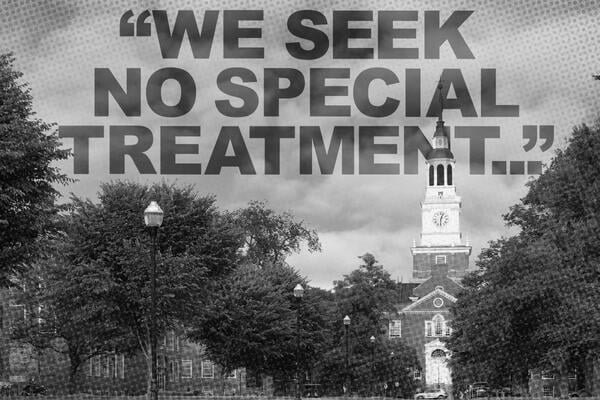
Both Arizona and Virginia used a similar turn of phrase to reject the compact’s promise of preferential status in exchange for signing, with officials writing, “We seek no special treatment” in connection to advancing their missions.
One word, however, is notably absent among all the responses: Trump. And only Dartmouth referenced political affiliation in its response to the federal government. President Sian Beilock wrote that she did not believe “the involvement of the government through a compact—whether it is a Republican- or Democratic-led White House—is the right way to focus America’s leading colleges and universities on their teaching and research mission.”
WashU’s Muddled Messaging
Though Washington University in St. Louis agreed to provide feedback to the federal government, administrators also appeared to tacitly reject the compact proposal. The university’s initial statement on Monday noted concerns about the compact but stopped short of an outright rejection; Chancellor Andrew Martin wrote that providing feedback does not mean “we have endorsed or signed on” to the proposal.
But in a Tuesday email to faculty members, Martin wrote he “can confirm that we won’t sign the proposed Compact for Academic Excellence in Higher Education … or any document that undermines our mission or our core values.” Martin added WashU will provide feedback, emphasizing the importance of “having our voice at the table for these potentially consequential conversations.”
WashU, however, has been reluctant to publicly call that a rejection.
Asked by Inside Higher Ed about the authenticity of the email, first published by another news outlet, and whether it amounts to a rejection, a university spokesperson only confirmed it was official.
Corrigan suggested that both WashU and Vanderbilt are trying to buy time “to see which universities are going to be in the next round, if any.” She added, “They want the opportunity to return to the conversation when there’s more political cover for them to potentially say no.”
Institutional Silence
While most universities invited to join the compact responded publicly by the deadline, both the University of Texas at Austin and the University of Kansas have remained silent on the matter.
Neither has issued publicly shared feedback or other statements about the compact, though University of Texas system board leadership initially responded positively to the invitation to join.
“For institutions that haven’t responded publicly yet, the questions I would be asking are, is there division between the president and the board on how to move forward on this? Is there division between the president and the faculty on how to move forward on this?” Hennessy said.
To her, that silence signals that internal negotiations are likely at play, potentially involving debates over strategy, language and other points. She believes nonresponders are more likely to sign the compact and may be “trying to figure out how to make a yes more palatable” to critics.
Rosenberg suggests there are likely legal concerns being discussed.
“Like virtually everything else coming out of the government right now, it’s going to face a legal challenge once someone signs, because the limitations on free speech for members of the community are pretty severe,” he said. “Once someone signs, it’s going to end up in the courts.”

-

“The Myth of Political Correctness,” 30 Years Later
On Oct. 24, 1995, Duke University Press published my first book, The Myth of Political Correctness: The Conservative Attack on Higher Education. Looking back 30 years at my book, it can be dispiriting to see how everything today seems the same, only worse. “Political correctness” has been replaced by “woke” as the smear of the moment, but otherwise almost every word of my book could be republished today, with a thousand new examples to buttress every point.
Sometimes the title of the book confused people who mix up a “myth” with a “lie.” As I noted 10 years ago, “When I called political correctness a ‘myth,’ I was never denying the fact that some leftists are intolerant jerks, and sometimes their appalling calls for censorship are successful. My point was that even though political correctness exists, the ‘myth’ about it was the story that leftists controlled college campuses, imposing their evil whims like a ‘new McCarthyism’ or ‘China during the Cultural Revolution.’ In reality, then and now, the far greater threat to freedom on campus came from those on the right seeking to suppress opposing views.”
I had been inspired to write the book by Dinesh D’Souza; I reviewed his best-selling 1991 book, Illiberal Education, for my column in the Daily Illini at the University of Illinois at Urbana-Champaign. If D’Souza, a recent college graduate, could publish such a terrible book full of misinformation, then surely I could write a better book. So I did.
But the publishing market was much more interested in the endless parade of conservatives bemoaning the “PC police” and “tenured radicals” than a refutation of these flawed arguments. My book, which I started to write as a graduate student in the Committee on Social Thought at the University of Chicago (home to Saul Bellow, Allan Bloom and Edward Shils), was rejected by more than 50 publishers before I was able to persuade Stanley Fish (whom I had encountered as the editor of Democratic Culture, the newsletter of Gerald Graff and Gregory Jay’s Teachers for a Democratic Culture) to publish it at Duke. My editor (and now also an Inside Higher Ed columnist) was Rachel Toor, who helped to make some sense of my ideas.
In the end, my book failed to shift the debate about academic freedom—not because it was wrong or the facts were refuted, but because it was ignored. From my perspective, I was correct about everything and nobody learned anything from me. And I’ve been writing essentially the same thesis, over and over again, in a second book and essays and hundreds of blog posts.
Looking back at my first book, I think its claims have been proven largely correct over the past three decades (but I might be biased). At the core of the book were the chapters on the “Myth of PC” (examining how many of the leading anecdotes about repression often weren’t accurate) and “Conservative Correctness” (showing the many examples of repression from the right that were ignored by the media and campus critics of PC).
The remaining chapters also still seem on target: “The Cult of Western Culture” (why multiculturalism isn’t taking over colleges and silencing traditional works, and Shakespeare isn’t being banned); “The Myth of Speech Codes” (colleges have always had speech codes, often worse ones using the arbitrary authority of a dean, and what we need are codes that protect free speech); “The Myth of Sexual Correctness” (sexual assault is a serious problem, and feminists often face suppression); and “The Myth of Reverse Discrimination” (white men are not the victims of campus oppression and the “fairy tale of equal opportunity” is false)
Michael Hobbes did an excellent episode of You’re Wrong About in 2021 on political correctness that featured some of the ideas from my book. My position, then and now, is more nuanced than Hobbes’s view of PC as a pure right-wing moral panic. The panic was there, but so were real cases of repression—on both the left and the right.
The cartoonish right-wing belief that colleges had become Maoist institutions of oppression against conservatives prompted too many on the left (and the center) to counter that everything was fine on campus. In truth, free expression has been in serious danger, both against conservatives who were sometimes censored and against leftists who also faced repression. As bad as things seemed in 1995, the repression is far worse today and clearly aimed at the left—and yet the delusions about the PC police on campus are more widespread than ever.
Even in the face of the worst campus repression in American history, many conservatives continue to recite the old, tired myth of political correctness and leftist control of higher education—a myth repeated so often for so long has become a truth in the minds of many.
The worst strategic mistake progressives made in the past three decades was to abandon the cause of free speech. Too many leftists believed in the myth of political correctness; they heard the complaints about free speech and accepted the right-wing argument that only conservatives were being silenced and concluded that free speech was a right-wing plot. They imagined that tenured radicals controlled colleges because everybody said so, and so they clung to the delusion that they could support censorship and it wouldn’t be used against them.
When conservatives demanded free speech on campus, the left should have vigorously agreed and established strong protections for free expression on campus. Instead, they let the right win a propaganda war by pretending to be battling for free speech against the social justice warriors. And they lost the opportunity to make free speech a core principle established in higher education.
The war on political correctness succeeded because the enemies it targeted were weak, disorganized leftists who were not, in fact, plotting to destroy conservatives. By contrast, today the right wants to demolish higher education like it’s the East Wing of the White House, and it is willing to use its vast power to do that.
As bad as the skepticism on the left about free speech was, the right’s abandonment of free speech is much worse, both in the degree of rejection and in the impact it has on campuses. It didn’t matter if a leftist argued against free speech because they had essentially no power, on campus or off, to impose their ideas. They had no legislators joining their demands and no donors threatening to turn off the campus money spigot.
Critics of PC had many advantages on their side: Enormous money poured into building organizations and ideas that built the myth of PC, funding groups like the Federalist Society and the National Association of Scholars, and paying individual authors such as Bloom and D’Souza to write and publicize their books. A new media ecosystem of talk radio and the internet spread the myth of PC. And the war on PC recruited principled liberals and even progressives who objected to the excesses of the left.
It will be difficult for progressives to build anything similar. Wealthy donors tend to fund conservative groups, or prefer to put their names on fancy campus buildings. Universities are anxious to create free speech centers, but usually only the kind that conservatives support.
Few conservatives are willing to speak out against the Trump regime. And many centrists and liberals who have spent a generation obsessing about the PC police find it difficult to suddenly turn around and recognize the repression from the right that they’ve been ignoring for decades. A letter condemning the Trump administration’s compact signed by principled conservatives such as Robert George and Keith Whittington is a good start toward building an ideological coalition against right-wing censorship that matches what the right did against the “PC police.”
Today, we face the worst attack on academic freedom in American history, one that combines the overwhelming external power of state and federal governments, used for the first time to target free speech, and the internal power of a campus bureaucracy devoted to suppressing controversy.
Unlike political correctness—which often relied upon exaggerated accounts of dubious examples with marginal injustices—there are so many clear-cut cases of terrible repression and extreme violations of due process and academic freedom that it’s difficult for anyone to keep track of them all. The litigation strategy developed by the right of suing every censor is an important step. Telling and retelling the stories of campus censorship today is critical. So is organizing events, on and off campus, about the repression happening today, and challenging those on the right who defend their side’s censorship.
It’s not easy to find solutions when faced with this extraordinary censorship, with unprecedented dismissals and restrictions on speech. But the right-wing attack on political correctness, now over three decades old, offers liberals and progressives a guidebook for how to do it. Quote their words. Demand their reforms. Agree with them and confront their hypocrisy when they reject every free speech policy they’ve been demanding for the past three decades.
The myth of political correctness is still alive 30 years later, invoked to deny and justify the repression from the right. Understanding how the culture wars brought us to this point of authoritarianism is essential to leading us toward the goals of academic freedom and free expression on campus.
-

A Study Abroad Life Design Course for Transfers
For many college students, connecting their interests to career and life goals can be a challenge. Transfer students may find it especially difficult because they lack familiarity with the campus resources available to help them make those connections. A course at the University of Minnesota Carlson School of Management aims to help these students chart their path, in part by sending them on an international trip.
The Design Your Life in a Global Context course encourages transfer students to apply design thinking principles to their college career and beyond and organizes a short study abroad trip led by a faculty member. The experience, mostly paid for by the institution, breaks down barriers to the students’ participation and aims to boost their feelings of belonging at the university.
The background: Since 2022, all students in the Carlson School of Management undergraduate program have been required to complete an international experience. The goal is to motivate them to be globally competent, to support their development as business leaders and to create collaboration with international colleagues, according to the school’s website.
Study abroad experiences have been tied to personal and professional development. A recent survey of study abroad alumni by the Forum on Education Abroad found that 42 percent of respondents indicated studying in another country helped them get their first job.
For U of M’s business school students, these experiences are made possible by funding from the Carlson Family Foundation, which provides scholarships through the Carlson Global Institute and the Learning Abroad Center.
In addition to Design Your Life in a Global Context, the university offers Design Your Career in Global Context, which sends students on a similar short study abroad experience.
The framework: Design Your Life in a Global Context meets once a week throughout the fall semester and then culminates in a 10-day trip to Japan, a country instructor Lisa Novak selected because of its unique focus on work-life balance and well-being.
“If you’re familiar with the concepts of ikigai, it’s all about finding one’s purpose and aligning what you love, what the world needs, what you’re good at and what you can be paid for,” said Novak, director of student engagement and development at the Carlson School. “We’re going to be learning about this concept while we’re abroad.”
Because transfer students, like first-year students, can face challenges acclimating to their new campus and connecting with peers, the class is designed in part to provide them with resources and instill a sense of belonging within their cohort.
In addition, the course helps students apply life design principles to their whole lives, modeled after Stanford University’s design thinking framework.
“Through the class, we equip students with the tools and strategies to design their college and career experience that aligns with their values, interests, strengths, needs and goals,” Novak said.
Going abroad: During the 10-day trip, students explore Tokyo and Okinawa.
They visit Gallup’s Tokyo office to learn about the Clifton strengths assessment and the research the organization is doing in Japan. In Okinawa, students learn from residents living in a “blue zone,” an area of the world where people live the longest and have the fewest health complications.
“We learn about some of the factors that contribute to longevity in that area of the world and then connect that back to designing one’s life and a life of purpose,” Novak said.
In addition to class content, the trip offers students an opportunity to participate in intercultural learning and experience international travel that may be unfamiliar.
Before they leave for Japan, Novak and her colleagues from the Carlson Global Institute support students with travel logistics, including securing a passport, creating a packing list and navigating currency exchange.
“I also bring in different food from the area,” Novak said. “We call it ‘taste of Japan.’ I have different candy or snacks from Japan and they get to experience the culture a little bit in that way and get excited about what we’re doing.”
Novak also leads guided reflections with students before, during and after the trip to help them make sense of their travels and how the experience could shape their worldview.
“I just hope that they recognize that the world and business are increasingly global and connected,” Novak said. “Being able to navigate difference and build connections and have conversations with people that are so different than you is a powerful learning experience.”
-

Rethinking Leadership Development in Higher Ed (opinion)
Higher education is in the midst of a crisis of confidence that has long been building. In this time of volatility, complexity and uncertainty, the steady hand of leaders matters more than ever. Yet academia does—at best—a very uneven job of preparing academic leaders for steady-state leadership, much less for times when the paradigm is shifting. This moment is creating an opportunity to reconsider how we prepare leaders for what will come next.
Why Is Leadership So Uneven in Higher Ed?
A primary reason lies in how we select and develop leaders. In academia, searches for department chair, dean and provost often emphasize top-level scholarly and research credentials and only secondarily consider an individual’s experience, perspective and ability to influence and motivate others to support shared missions. Academics in general do not respond well to directives: They expect to be persuaded, not commanded. Additionally, it is often only after being hired that those in formal positions of authority are provided with leadership-development opportunities to help foster those interpersonal skills—too late for foundational growth.
These approaches to recruiting formal leaders are rooted in flawed assumptions about how leadership works. True leadership is not about commanding compliance but about shaping unit culture through influence. Many leaders fail by not understanding the difference. An effective leader is a person of strong character who can build trusting relationships with others; these skills take time to develop and usually take root even before a person assumes a leadership role.
Another important reason that leadership in higher ed is uneven arises from conceptualizing leadership as a “heroic” individual endeavor. The same skills that help a formal leader to be successful—such as understanding the alignment of their actions with the unit’s mission; strong communication skills, including listening; the ability to navigate conflict, negotiation and conflict resolution; and formulating and articulating clear collective goals— are equally crucial for others to exercise to be fully engaged participants.
Leaders with formal roles and titles play a crucial role in promoting a productive and collegial culture. At the same time, they do not do so alone: It is equally important that participants who are not in formal administrative roles are also seen (and see themselves) as central in shaping these environments, and that they are aware of how their own actions and interpersonal dynamics contribute to their working and learning experiences.
In short, leadership responsibility is not limited to administrators. There are layers of formal leadership roles embedded inside departments and schools, visible whenever faculty members and staff take on responsibilities for shared governance and advisory roles; lead team research or manage grant portfolios; and select (hire), supervise, evaluate and mentor colleagues and other early-career individuals. These faculty and staff are leaders, too, whether or not they see, accept or internalize those roles.
When leadership is viewed simply as an individual attribute rather than a process that emerges from the relationships among people in teams, organizations miss the opportunity to develop cultures of excellence that support integrity, trust and collaboration at all levels. Thus, we argue that leadership ought to be understood as an ongoing process of character development and a responsibility shared by all members of an organization—not something that can be addressed in a one-off workshop, but as an integral dimension of the work.
The Foundations of Leadership: Influence Before Authority
Rather than framing leadership as something only people with formal authority do, a more productive model is to view leadership as influence. By influence we mean modeling the behaviors we seek to share and promote in our groups so that we can better shape the way we solve problems collectively. Leadership is not in essence a position; it is contributing to an ongoing process of shaping culture, norms and behavior within a unit.
Social psychology shows that we influence each other constantly. The more time we spend with people, the more we become like them and vice versa. This means that bad habits can spread as easily as good ones. When everyone is given an opportunity to develop good habits, they are more likely to spread throughout the community. Our character affects how we influence others. We are much more likely to be influenced by a person who demonstrates integrity and curiosity than we are by someone who is demanding and unwilling to listen.
Here are some areas of practice for developing better influence:
- Self-awareness and self-management: Focusing on oneself first helps individuals identify their strengths and areas for growth, while encouraging them to recognize and respect their roles and responsibilities in the current situation. Understanding oneself, one’s values, habits and motivations, is foundational to recognizing how we affect and are affected by those around us.
- Conflict resolution: Healthy debate is foundational to innovation and growth. Developing strong conflict-resolution skills contributes to increased perspective-taking, depersonalizing disagreement and yielding more effective discussion and problem solving.
- Decision-making: Understanding how we make decisions, and more importantly how heuristics influence and bias our decision-making, can help people slow down to make more ethical and effective decisions.
Opportunities for influence are available to everyone, not just those in formal leadership roles. Early-career faculty, staff and students can cultivate influence by setting examples for collaboration, through ethical behavior and by contributing to collective problem-solving. Leadership is not centrally about having authority over others; it is about shaping an environment in which ethical decision-making, respect and shared purpose flourish.
Reimagining Leader Development in Higher Ed
Now more than ever, individuals need support in managing their careers with integrity and purpose—aligning their personal values and goals with those of their institutions. Leadership development should not be viewed as a costly add-on. In fact, it can be integrated into the everyday fabric of academic life through accessible and scalable methods, including:
- Peer-learning cohorts that provide space for discussion and reflection on leadership challenges.
- Guided personal reflections on workplace dynamics, communication and decision-making.
- Structured mentoring programs that cultivate leadership skills through real-world interactions.
- Deliberative conversations around such themes as research ethics, authorship and collaboration to build trust and integrity within teams.
- Conflict-resolution training embedded in routine professional development activities.
Our experience at the National Center for Principled Leadership and Research Ethics shows that even modest efforts—like those above—can spark essential conversations between mentors and mentees, improve communication, and positively influence both unit climate and individual well-being. To support this work, we offer a free Leadership Collection—an online collection of tools, readings and practical exercises for anyone seeking to lead more effectively, regardless of their title or career stage.
When leadership development is embraced as a core part of academic life—not just a formal program or a luxury for a few—it can become a catalyst for healthier, more purpose-driven institutions.
Conclusion: Leadership Development as a Cultural Foundation
Reserving leadership-development programming only for when people reach formal leadership roles is a missed opportunity to develop broader and more inclusive working cultures. Such cultures emerge from the relationships among the members of a group. Building better relationships starts with personal growth, self-awareness and emotional intelligence for each member. Taking responsibility for one’s own professional growth and for one’s influence on others is also an important kind of leadership.
True leadership, therefore, is not about directing others but about fostering environments in which good habits, strong ethics and meaningful engagement flourish. If universities want to build sustainable cultures of excellence, in which leadership is no longer an individual endeavor but a shared commitment to collaboration, they should start embedding it in professional development and routine practice for all. As uncertainty prevails, budgets are cut and people are navigating deep change, now is the moment to reconsider how we shape leaders in higher education.
-

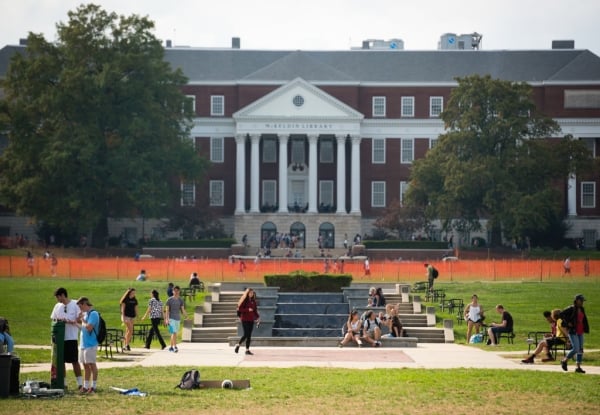
U of Md. Criticized for Charging Turning Point Security Fee
University officials said the fee is routine and that they have required the same of other student organizations.
Sarah L. Voisin/The Washington Post via Getty Images
University of Maryland officials are facing backlash for requiring the campus chapter of a conservative student organization to pay what chapter leaders called a “viewpoint discriminatory” security fee for an event on Wednesday, CBS News reported.
While university police staffed the event free of charge, officials required the chapter to hire its own security to conduct entrance screenings. The event, titled Fighting Like Charlie, featured Daily Wire senior editor Cabot Phillips and was held just over a month after Charlie Kirk, the founder of Turning Point USA, was shot and killed during an event at Utah Valley University.
“It’s basically saying anybody, if they want to threaten our chapter or threaten us because of our viewpoints and our speech, then the university, in turn, is going to impose financial burdens on us, or else we can’t have our events,” University of Maryland senior Connor Clayton, communications chair for the campus Turning Point USA chapter, told CBS News. “That is a very dangerous precedent to put on a Turning Point chapter.”
University officials said the fee is routine and that they have required the same of other student organizations that host similar guest speaker events on campus, regardless of the speaker or message.
The Leadership Institute, a Virginia-based nonprofit that trains conservative activists and leaders, ultimately paid the fee—which amounted to $148—on behalf of the chapter. The event proceeded as planned, according to posts on the chapter’s Instagram account.