Author: admin

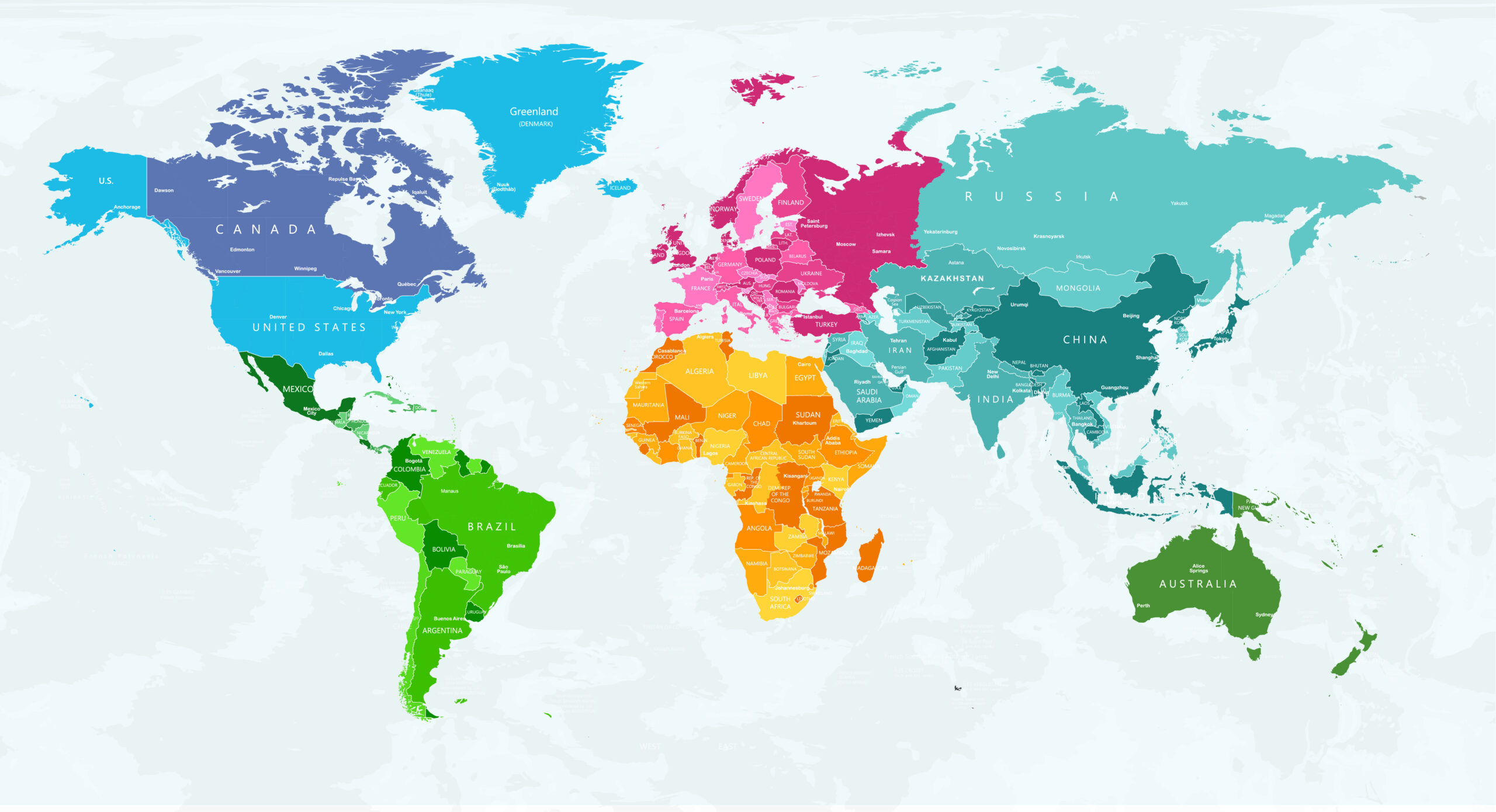
  • HEPI / Kaplan 2025 Soft-Power Index: Harvard and Oxford top the tree

    HEPI / Kaplan 2025 Soft-Power Index: Harvard and Oxford top the tree

    • The HEPI / Kaplan Soft-Power Index looks at the number of very senior world leaders (monarchs, presidents and prime ministers) who studied at a higher level in another country.
    • Countries that have educated a significant proportion of the world’s most senior leaders are thought to benefit from a boost to their ‘soft power’.
    • The results for the leading two countries, the US and the UK, are broadly comparable to those for recent years but other countries, like France and Germany, fare worse than in past years while Russia and India have improved their position.
    • For the first time, the results are being published according to the institution that world leaders studied at. Harvard University and the University of Oxford lead the pack, with Sandhurst, the University of Cambridge, the LSE and the University of Manchester making up the rest of the top 6.

    When launching the Soft Power Council in early 2025, the UK’s then Foreign Secretary, the Rt Hon. David Lammy MP, said, ‘Soft power is fundamental to the UK’s impact and reputation around the world. I am often struck by the enormous love and respect which our music, sport, education and institutions generate on every continent.’ The HEPI / Kaplan Soft-Power Index offers one way to measure the extent of this soft power.

    In 2025, the United States remains comfortably in first place, as their higher education institutions have educated 66 senior world leaders, which is only slightly lower than the US total for 2024 (68). The UK remains in a comfortable second place, having educated 59 world leaders. France performs less well than in the past but stays in third place, with 23 leaders.

    The Index is based on a snapshot of world leaders for early August 2025. Changes since then are not reflected in the data. The Index should not be regarded as the only way to measure soft power and should be used alongside other sources of information.

    Since the Soft-Power Index was launched in 2017, 81 (42%) of the countries in the world have had at least one very senior leader educated at a higher level in the UK. The Index is regularly quoted by UK Government Ministers – for example, last year’s results featured in this week’s Post-16 Education and Skills white paper.

    World leaders educated in countries other than their own

    For the first time this year, the results are also being published according to the institution that the leaders attended, with Harvard (15) and Oxford (12) topping the tree.

    Harvard alone has educated more senior world leaders than all higher education institutions in Russia (13). Harvard has also educated more senior world leaders than Italy (5), Spain (5) and Germany (4) combined.

    Key findings

    • The strong performance of the United States represents the country’s second best ever total (equal with 2022 but slightly down on 2024).
    • In terms of absolute score, the United Kingdom matches the best it has done since the Index began in 2017 (59), equalising the record that was also hit in 2019 and 2021.
    • France fares worse than in the past, with a big drop-off of 17 since 2019 from 40 to 23, but retains third place.
    • Russia posts its best performance, with 13 world leaders educated there, beating its previous high of 11 in 2022.
    • Australia (9, +2) remains in fifth place, while Switzerland is in sixth place (7, +1).
    • India scores its best ever performance. In 2022, only two serving very senior leaders had been educated to a higher level in India; in 2025, five had been – this is the same total as for Spain and also Italy.
    • Germany drops out of the top 10 for the first time, having educated just four serving world leaders, the same number as Canada, Germany, Morocco, the Netherlands and South Africa – and the same number as for the LSE alone.
    • The higher education institution that has educated the most current world leaders while they were international students is Harvard University (15), closely followed by the University of Oxford (13).
    • Five of the six best-performing institutions are situated in the UK, meaning world leaders educated in the UK tend to have been concentrated in a smaller number of institutions. While Harvard is the only US institution to have educated more than three serving world leaders, the UK has five institutions that have educated more than three: Oxford (13); Sandhurst (8); Manchester (6); Cambridge (5); and the LSE (4).

    Institutions attended by very senior world leaders

    Ranking Higher education institution Number of world leaders
    1 Harvard 15
    2 Oxford 12
    3 Sandhurst 8
    4 Manchester 6
    5 Cambridge 5
    6 LSE 4
    7= Boston 3
    7= Bristol 3
    7= George Washington 3
    7= New York 3
    7= Pennsylvania 3
    7= UCL 3
    7= US Army Command and Staff College 3

    The 15 world leaders educated at Harvard are: i) the Prime Minister of Bhutan (Tshering Tobgay); ii) the President of Botswana (Duma Boko); iii) the Prime Minister of Canada (Mark Carney); iv) the King of Denmark (Frederik X); v) the President of Ecuador (Daniel Noboa); vi) the Prime Minister of Greece (Kyriakos Mitsotakis); vii) the Prime Minister of Israel (Benjamin Netanyahu); viii) the Prime Minister of Jordan (Jafar Hassan); ix) the Prime Minister of Lebanon (Nawaf Salam); x) the Prime Minister of Luxembourg (Luc Frieden); xi) the President of Moldova (Maia Sandu); xii) the Chief Minister of Sierra Leone (David Moinina Sengeh); xiii) the President of Singapore (Tharman Shanmugaratnam); xiv) the Prime Minister of Singapore (Lawrence Wong); and xv) the Prime Minister of South Korea (Kim Min-seok).

    The 12 world leaders educated at the University of Oxford are: i) the King of Belgium (Philippe); ii) the King of Bhutan (Jigme Khesar Namgyel Wangchuck); iii) the Prime Minister of Canada (Mark Carney); iv) the President of East Timor (José Ramos-Horta); v) the Prime Minister of Hungary (Viktor Orbán); vi) the Emperor of Japan (Naruhito); vii) the King of Jordan (Abdullah II); viii) the President of Montenegro (Jakov Milatović); ix) the King of Norway (Harald V); x) the Sultan and Prime Minister of Oman (Haitham bin Tariq); xi) the President of the Philippines (Bongbong Marcos); and xii) the Prime Minister of the Solomon Islands (Jeremiah Manele). 

    Nick Hillman OBE, the Director of HEPI, said:

    International students bring enormous benefits to the UK. They all spend money while they are here and some then contribute to the UK labour market after studying. The diplomatic benefits are less well understood even though they can be equally important. In 2025, over a quarter of the countries around the world have a very senior leader educated in the UK, which amounts to tremendous soft power.

    The current UK Government have established a Soft Power Council and promised a new education exports strategy. These are welcome, but they are counterbalanced by the incoming levy on international students, huge dollops of negative rhetoric and excessive visa costs.

    Recent new obstacles standing in the way of people wanting to study in Australia, Canada and the United States provide an opportunity for the UK to steal a march on our main competitors. We are at risk of squandering this opportunity.

    Linda Cowan, Managing Director of Kaplan International Pathways, said:

    It is fantastic to see how many of our best known universities are educating foreign leaders. This year’s list also highlights the growing diversity and range of institutions contributing to the UK’s soft power, including Cranfield, Leicester, Liverpool and Westminster.

    Another trend to watch is the expansion of transnational campuses of British universities abroad, such as in India and the UAE. These initiatives have the potential to further enhance the UK’s soft power by extending the reach of our higher education sector beyond students coming to the UK – a development to watch going forward.

    Professor Irene Tracey, Vice-Chancellor of the University of Oxford, said:

    That so many world leaders have studied at Oxford speaks to the transformative power of education — to shape ideas, deepen understanding, and inspire service on the global stage.

    Professor Duncan Ivison, the President and Vice-Chancellor of the University of Manchester, said:

    If soft power is fundamental to the UK’s impact and reputation around the world, then so too are the UK’s outstanding universities.

    The HEPI / Kaplan Soft-Power Index makes clear just how important international students are to the UK’s global influence – both now and into the future. Extraordinary future leaders get their start at many of our universities and retain a deep affection for our country long after. And yet the Government is, at the same time, putting up obstacles to welcoming future international students to the UK with a proposed international levy, higher visa costs and reducing the graduate visa route.

    We have a once in a lifetime opportunity to make the UK the global destination for the best and the brightest in the world given what is happening elsewhere – and especially in the US and Canada. Let’s not blow it.

    The 59 leaders educated in the UK lead 55 countries (as a small number of places – Bahrain, Luxembourg, Namibia and the United Arab Emirates have two very senior leaders educated in the UK). Changes affecting the UK list for 2025 are outlined in the table below. They include:

    • The Rt Hon. Mark Carney, the Prime Minister of Canada since early 2025, studied Economics at the University of Oxford.
    • Taye Atske Selassie, the President of Ethiopia since late 2024, studied International Relations and Strategic Studies at Lancaster University.
    • The President, Netumbo Nandi-Ndaitwah, and Prime Minister, Elijah Ngurare, of Namibia, who have both been in post since early 2025, studied in the UK – the Namibian President studied at Glasgow Caledonian University as well as Keele University and the Prime Minister studied at University of Dundee.
    • The Prime Minister of Rwanda since July 2025, Justin Nsengiyumva, studied Economics at the University of Leicester. 
    • The Prime Minister of Sri Lanka since autumn 2024, Harini Amarasuriya, studied Social Anthropology at the University of Edinburgh.

    Click here to download a table showing all the countries with at least one senior leader educated in the UK for the whole period from 2017 to 2025.

    The 66 world leaders from 58 countries educated in the United States head the following countries:

    Bahrain (2); Bangladesh; Belgium; Belize; Bhutan (2); Botswana; Bulgaria; Cambodia; Canada; Costa Rica; Denmark; Dominica; Dominican Republic; East Timor; Ecuador; Egypt; Finland; Greece; Guinea-Bissau; Guyana; Haiti (2); Iceland (2); Ireland; Israel (2); Ivory Coast; Jordan (2); Kuwait; Latvia; Lebanon; Liberia; Luxembourg; Malawi; Malaysia; Marshall Islands; Micronesia; Moldova; Monaco; Montenegro; Namibia; Nigeria; Palau; Palestine; Panama; Paraguay; Philippines; Rwanda; Saint Kitts and Nevis; Sierra Leone (2); Singapore (2); Slovenia; Somalia; South Korea; Spain; Sudan; Switzerland; Togo; Tonga; and Vatican City.

    Notes for Editors

    1. Leaders are defined as heads of state and heads of government (monarchs, presidents and prime ministers). Countries often have more than one (such as a president or monarch and a prime minister).

    2. Countries are included if they are members of, or observers at, the United Nations, currently numbering 195 places. Palestine is therefore included but Northern Cyprus, for example, is not.

    3. The HEPI / Kaplan Soft-Power Index is a measure of tertiary education. This is defined broadly but distance learning and transnational education are excluded for the soft-power benefits are thought to be less.

    4. Leaders change throughout the year, so we provide a snapshot for August 2025. For example, the fieldwork was undertaken prior to the recent change of leadership in Thailand.

    5. Each country is treated equally and we do not claim each individual result provides good evidence of positive soft power. No one is excluded on moral grounds. 

    6. Some people are educated in more than one other country and they can therefore count towards the totals for more than one country.

    7. While we use multiple sources to obtain information, the educational background of some national leaders is opaque. HEPI welcomes feedback that would enable us to build up a more complete picture.

    8. When new information comes to light, we update the figures. So there are some slight differences in the figures provided here for earlier years compared with what we have published in the past. For example, in the preparation of the 2025 numbers, we found new information that reduced the recent past total for the US (as we discovered two leaders were distance learners rather than in-person learners).

    9. King Charles III’s higher education was delivered in the UK (at the University of Cambridge), the country where he was born and lives, and he is head of state of other countries in part by virtue of his position in the UK. So we have opted to exclude this information. This matches how we treat the President of France, Emmanuel Macron, who is one of the heads of state (Co-Prince) of Andorra.

    10. The University of the West Indies (UWI) serves 18 countries and territories in the Caribbean. Attempting to unpick the place of study for those world leaders who studied at the UWI is beyond the scope of this study. Therefore, we have assumed that each one studied in their home nation. This is the same practice as followed in earlier years.

    Source link

  • UVA Settles With Justice Department

    UVA Settles With Justice Department

    Jabin Botsford/The Washington Post via Getty Images

    The University of Virginia has reached a settlement agreement with the Department of Justice that will pause pending investigations in exchange for assurances from the public flagship that it will not engage in unlawful practices around admissions, hiring, programming and more.

    The DOJ announced the settlement in a Wednesday afternoon news release.

    As part of the deal, UVA agreed to follow a July memo from U.S. Attorney General Pam Bondi that bars the use of race in hiring and admissions practices as well as scholarship programs. UVA will be required to provide “relevant information and data” to the DOJ, according to the news release.

    While the recent investigations into allegedly illegal diversity, equity and inclusion programs have been paused, that doesn’t mean those probes have been altogether closed. However, the DOJ will close the investigation “if UVA completes its planned reforms prohibiting DEI,” officials said.

    “This notable agreement with the University of Virginia will protect students and faculty from unlawful discrimination, ensuring that equal opportunity and fairness are restored,” Assistant Attorney General Harmeet K. Dhillon of the DOJ’s Civil Rights Division, and a UVA alum, said in a statement. “We appreciate the progress that the university has made in combatting antisemitism and racial bias, and other American universities should be on alert that the Justice Department will ensure that our federal civil rights laws are enforced for every American, without exception.”

    The settlement comes nearly four months after former UVA president James Ryan stepped down abruptly, reportedly under DOJ pressure to resign as part of an effort to resolve investigations.

    UVA officials released a statement as well as the text of the agreement on Wednesday.

    “We intend to continue our thorough review of our practices and policies to ensure that we are complying with all federal laws,” Interim President Paul Mahoney wrote. “We will also redouble our commitment to the principles of academic freedom, ideological diversity, free expression, and the unyielding pursuit of ‘truth, wherever it may lead,’ as Thomas Jefferson put it. Through this process, we will do everything we can to assure our community, our partners in state and federal government, and the public that we are worthy of the trust they place in us and the resources they provide us to advance our education, research, and patient care mission.”

    Education Secretary Linda McMahon called the deal “transformative” in a post on X.

    “The Trump Administration is not backing down in our efforts to root out DEI and illegal race preferencing on our nation’s campuses,” McMahon wrote. “A renewed commitment to merit is a critical step for our institutions to once again become beacons of truth-seeking and excellence.”

    UVA is one of several institutions to reach an agreement with the Trump administration in recent months, but the first public university to do so. Previously Columbia University, the University of Pennsylvania and Brown University all agreed to deals with the federal government after the Trump administration froze federal research funding over alleged civil rights violations.

    While UVA reached a settlement with the federal government, it has rejected other proposals such as the “Compact for Academic Excellence in Higher Education,” which would have required institutions to agree to tuition freezes, caps on international students and campuswide assessments of viewpoint diversity, among other demands, in order to receive preferential treatment for federal research funding. UVA was one of nine institutions originally asked to join the compact, though none of the original group, nor others invited later, have announced they will sign the proposal.

    Source link

  • High-profile comedians paid handsomely to not offend Saudi royals at Riyadh comedy fest

    High-profile comedians paid handsomely to not offend Saudi royals at Riyadh comedy fest

    Last year, FIRE launched the Free Speech Dispatch, a regular series covering new and continuing censorship trends and challenges around the world. Our goal is to help readers better understand the global context of free expression. Want to make sure you don’t miss an update? Sign up for our newsletter.


    Saudi government takes short break from jailing and torturing critics to host Riyadh Comedy Fest

    Comedy’s greatest asset is its ability to use just laughter to take the powerful down a peg. But what took place in Saudi Arabia earlier this month wasn’t so funny.

    Over 50 well-known comedians including Bill Burr, Kevin Hart, and Dave Chappelle all performed in recent weeks at the Riyadh Comedy Festival, despite criticism from some fellow comics who were also invited — and offered large sums to perform — but said no. One of those comedians, Atsuko Okatsuka, shared a reason why she chose to reject the offer: It came with very restrictive strings attached.

    A contract Okatsuka posted on social media said participants couldn’t make jokes that degrade, embarrass, or ridicule the Kingdom of Saudi Arabia, its leadership and public figures, “the Saudi royal family and legal system,” and “any religion” or “religious figure.”

    Saudi Arabia’s General Entertainment Authority certainly looks to have enforced the rules. Two comedians were dropped from the lineup after making comments about how they were still willing to accept the money despite the country’s extensive human rights violations, because in doing so they acknowledged said violations. That’s a no-no. Jim Jefferies was cut after saying on a podcast, “One reporter was killed by the government — unfortunate, but not a fucking hill that I’m gonna die on.” Similarly, Tim Dillon, while on a podcast responding to critics of his participation, was removed for the comment, “So what if they have slaves, they’re paying me enough to look the other way.”

    And even though Saudi Arabia has tortured and imprisoned government critics — including American citizens — and brutally executed journalist Jamal Khashoggi just for engaging in the kind of speech that these comedians were paid handsomely to avoid, some of the performers are still singing the praises of the event. Burr said the “royals loved the show” (the one at which they were contractually exempt from mockery) and “to their credit,” they negotiated the speech restrictions down to “Don’t make fun of royals [and] religion.”

    Chappelle, too, said on stage that “in America, they say that if you talk about Charlie Kirk, that you’ll get canceled,” and that it’s “easier to talk here than it is in America.” Chappelle isn’t wrong that comments about Kirk in the aftermath of his assassination led to a disturbing trend of firings and punishments across the country bolstered by threats and demands from lawmakers, one FIRE is working to combat. And he’s right to be worried about the state of free speech in the United States. I certainly am.

    No, canceling Chappelle is not a ‘win for free speech’

    If we don’t push back against this trend, our society may soon find itself with fewer artists willing to push boundaries and fewer outlets for authentic artistic expression.


    Read More

    But I’d encourage Chappelle, who made a significant amount of money directly from the government which he was forbidden to criticize at his show, to speak to the country’s journalists, apostates, women’s rights activists, writers, and teachers about his assertion that Saudi Arabia is a freer place to speak. That might be difficult, though, since so many have been imprisoned or even executed by authorities.

    UK judge backs ‘right to offend’ in reversal of Quran burning conviction

    In one of the more disturbing free speech stories of this summer, I wrote in June about a Westminster Magistrates’ Court guilty finding against asylum seeker Hamit Coskun for publicly burning a Quran in London. Most alarming was the judge’s justification for the religiously aggravated public order offense conviction. The “disorderly” nature of Coskun’s protest, he asserted, “is no better illustrated than by the fact that it led to serious public disorder involving him being assaulted by two different people.” Not great.

    But this month, his conviction was overturned, a much-needed win both for Coskun and for the UK’s flailing speech rights. Justice Joel Nathan Bennathan said that, though Quran burning is deeply offensive to many, free expression “must include the right to express views that offend, shock or disturb.”

    In Quran burning conviction, UK judge uses violence against defendant as evidence of his guilt

    UK judge cites violence against Quran-burning protester as proof of his guilt, Brazil sentences comedian to over eight years for telling jokes, and France targets porn.


    Read More

    Dropped Graham Linehan case may signal UK policing shift

    And Graham Linehan — the target of a high-profile arrest at Heathrow Airport for a series of posts on X, including one where he said if “a trans-identified male is in a female-only space…call the cops, and if all else fails, punch him in the balls” — says he’s now in the clear. Linehan, a comedy writer, wrote on X that “police have informed my lawyers that I face no further action in respect of the arrest at Heathrow in September,” but he intends to pursue legal action for wrongful arrest.

    There’s more: In the wake of the dropped charges against Linehan, the UK’s Metropolitan Police said they “will no longer investigate non-crime hate incidents” to “provide clearer direction for officers, reduce ambiguity and enable them to focus on matters that meet the threshold for criminal investigations.”

    Other speech news out of the UK hasn’t been so rosy

    • Imgur is no longer available in the UK after the company decided to block users in the country from its services following a threat of fines from the Information Commissioner’s Office. But the ICO says that’s not the end of the story. “We have been clear that exiting the UK does not allow an organisation to avoid responsibility for any prior infringement of data protection law, and our investigation remains ongoing,” interim executive director Tim Capel warned.
    • The UK is still trying to undermine Apple’s encryption, despite some reports that the government backed off this summer. The UK Home Office is reportedly pushing yet again for access to UK Apple users’ iCloud backups.
    • Anti-abortion activist Rose Docherty was arrested late last month for violating Scotland’s Safe Access Zones Act by holding a sign that read “Coercion is a crime, here to talk, only if you want” outside Queen Elizabeth University Hospital. This is Docherty’s second arrest under the law. She received a warning after the first.
    • It’s unclear if he will ultimately be charged, but a North Yorkshire blogger and activist was arrested last month under the UK’s Public Order Act for allegedly stirring racial hatred on social media. Police visited his home, and then took him in for questioning late at night, for posting on X an image of the Palestinian flag overlaid with the message, “F-ck Palestine. F-ck Hamas. F-ck Islam. Want to protest? F-ck off to Muslim country & protest.”
    • An Oxford student was arrested and suspended from his university for comments he made at a rally in London this month. Metropolitan Police arrested him for inciting racial hatred for sharing a chant he said he had been workshopping: “Gaza, Gaza make us proud, put the Zios in the ground.”
    • Mass arrests of protesters against the ban on activist group Palestine Action continue. In the first weekend of this month alone, nearly 500 protesters were taken in for “supporting a proscribed organisation.” This is how far the crackdown has extended: A man who held up a magazine cover with reporting about the arrests of people holding up “I oppose genocide. I support Palestine Action.” signs was also arrested on the same charges under the Terrorism Act 2000. And a woman claims she was arrested in London for holding up a sign that doesn’t express support for the group but instead said, “I do not support the proscription of Palestine Action.”
    • Restrictions on protests over the Palestine Action ban are likely to grow. Home Secretary Shabana Mahmood announced that police will be given broadened authority to take into account the “cumulative impact of frequent protests” when placing conditions on demonstrations. Mahmood said the right to protest “must be balanced with the freedom of their neighbors to live their lives without fear.”
    • And that’s not all. Prime Minister Keir Starmer suggested Mahmood will “look more broadly at what other powers are available,” specifically “in relation to some of the chants that are going on at some of these protests.” Starmer is presumably referring to chants of “From the river to the sea, Palestine will be free,” which have been criminalized in some nations.

    Tunisia sentenced a man, now pardoned, to death for criticizing the president

    Censorship doesn’t get more extreme than this: A Tunisian court sentenced a man to die this month, just for Facebook posts about President Kais Saied. He was released after pressure from human rights groups secured a presidential pardon from Saied, but the initial sentence alone is deeply shocking. And it will no doubt be a warning to other government critics within Tunisia that severe punishment may await them — but whether they can count on a pardon is less certain.

    AI-altered horror, a campaign against negativity, and more censorship news out of China

    • A film censorship first? Cuts and deletions from movies and other media to gain approval for release in China are certainly nothing new, but this may be: the likely use of AI to change the content of a film. The depiction of a same-sex wedding in horror movie Together, featuring Dave Franco and Alison Brie, was edited so that one of the two men being married was altered into a woman. To its credit, the film’s global distributor Neon said it “does not approve” of the Chinese distributor’s changes and “demanded they cease distributing this altered version.”
    • Cui Jianchun, from the Hong Kong office of China’s foreign ministry, met with new U.S. Consul General to Hong Kong and Macau Julie Eadeh to scold her for associating with pro-democracy activists and provide a list of “four don’ts.” She was warned “not to meet people she ‘shouldn’t meet with,’ not to collude with ‘anti-China forces,’ not to assist or fund activities that might undermine the city’s stability and not to interfere with national security cases in Hong Kong.”
    • China’s Cyberspace Administration is warning social media platforms: Limit negative posts, or else. It’s part of a new campaign from the government to crack down on online comments that “excessively exaggerate negative and pessimistic sentiments.” High on the list of targets will be posts, primarily from the country’s youth, expressing dour feelings about their present and future prospects.

    China’s censorship goes global — from secret police stations to video games

    2025 is off to a repressive start, from secret police stations in New York to persecution in Russia, Kenya, and more.


    Read More

    • Journalist Zhang Zhan, already jailed once for her early reporting on what would become the Covid-19 pandemic, has been sentenced to four years in prison for “picking quarrels and provoking trouble,” a charge commonly used to punish government critics. Her newest conviction is based on her human rights activism.
    • A massive leak has shed light on the workings of China’s Great Firewall, including its disturbing spread to other nations. The files show that Chinese tech company Geedge Networks “has provided entire network censorship and surveillance systems to internet service providers in countries including Myanmar, Pakistan, Kazakhstan, and Ethiopia, as well as some unnamed countries, essentially replicating China’s model of digital authoritarianism on a global scale.”
    • Exiled Hong Kong activist Nathan Law was not permitted entry to Singapore, a rejection he says is politically motivated. In a statement, a spokesperson for Singapore’s government “noted that Hong Kong police have issued a warrant for Law’s arrest under the city’s National Security Law.”

    Blasphemy can be a matter of life and death

    Moroccan feminist Ibtissame Lachgar found no relief this month against the blasphemy charge against her, and her 30-month sentence was upheld despite her lawyers’ objections that imprisonment would put her at risk of amputation because of her cancer diagnosis. Lachgar had posted a photo of herself wearing an “Allah is lesbian” shirt with the caption that “like any religious ideology,” Islam is “fascist, phallocratic and misogynistic.” Prosecutors aren’t satisfied with the current sentence and are pushing for an even longer jail term, citing the “spiritual well-being of Moroccans.”

    Apurbo Pal, a student at Bangladesh’s North South University, was taken by police after a mob violently assaulted him over viral Facebook posts accusing him of “insulting the Quran.” Pal had to be taken to the hospital, and he is likely to face charges.

    And in Nigeria, home to both some of the worst mob violence against and aggressive prosecutions of blasphemers, the Supreme Court is hearing the appeal of musician Yahaya Sharif-Aminu, originally sentenced to death for sharing blasphemous lyrics in a WhatsApp group. Advocates are closely watching the case, as the decision could be significant — for good or ill. A lawyer for the Kano State government, which is pursuing the charges against Sharif-Aminu, said he “made blasphemous statements against the Holy Prophet, which the government of Kano State will not condone” and if the lower court’s ruling is upheld, “we will execute him publicly.”

    Thai police arrest Australian writer over Malaysian government’s defamation claims

    Australian scholar, writer, and Thailand resident Murray Hunter is alleging transnational repression after his arrest at Suvarnabhumi Airport in Bangkok. Thai authorities detained him on defamation charges that Hunter says originate from the Malaysian government. Case documents viewed by the Associated Press identified the Malaysian Communications and Multimedia Commission “as the victim in the case but said the complainant was a person staying at a hotel in Bangkok whom it did not name.” He spent a night in prison and must appear in court next month. Hunter warned, “If this can happen to me, any journalists now, where a body in another country makes a complaint against them to the Thai police, could have the same consequences and be picked off a flight and put in a lockup.”

    The latest in tech and media

    • Australia’s eSafety Commissioner, the online safety regulator FIRE has covered before, ordered X and Meta to take down three videos depicting killings or face severe fines. Platforms that fail to take the videos — which show the stabbing of Iryna Zarutska in North Carolina, Charlie Kirk’s assassination, and the beheading of a man in Dallas — face “threats of fines of $825,000 per day for each offending post.”
    • The Karnataka High Court rejected X’s legal challenge against the Indian government’s use of a central online tool to order content takedowns, one X called a “censorship portal.” The judge ruling in the case defended the portal, calling it a “public good,” and said social media sites can’t be “left in a state of anarchic freedom.”
    • The Turkish Radio and Television Supreme Council is on the hunt to defend what it deems “family values,” and streaming services are paying the price. Streamers including Netflix, Disney+, Prime Video, and more were issued fines for offering films that allegedly “promote homosexuality,” “disregard family values,” and “conflict with the shared values of society.” All of the films the council objected to were removed from streaming in the country.

    Source link

  • UGC to Boost Engagement and Trust in Higher Education

    UGC to Boost Engagement and Trust in Higher Education

    Reading Time: 14 minutes

    Student recruitment has never been more competitive, or more personal. The institutions standing out right now aren’t the ones shouting the loudest; they’re the ones showing the most truth. That’s where authenticity comes in.

    Prospective students want to see real stories from real people, not polished marketing copy or staged photos. They want to hear from the student who filmed a late-night study session, the alum who just landed their first job, or the professor who shares genuine classroom moments. That’s the power of user-generated content (UGC). It turns your community into your most credible storytellers.

    In this guide, we’ll look at what authentic content really means, why it works, how to build it into your strategy, and how to measure its impact. Along the way, you’ll see examples of schools already doing it well and learn simple ways to kickstart your own approach.

    If your goal is to humanize your brand and connect with Gen Z on a deeper level, authenticity isn’t a trend. It’s the foundation. Let’s get into it.

    Struggling with enrollment?

    Our expert digital marketing services can help you attract and enroll more students!

    What Is User-Generated Content (UGC) in Higher Education Marketing

    User-Generated Content (UGC) is any material created by people outside your marketing team: students, alumni, faculty, or even parents. It includes everything from TikToks and Instagram stories to blog posts, reviews, and testimonial videos. What makes UGC powerful is its honesty. It’s not scripted or staged; it’s content created by individuals sharing their own experiences. That authenticity lends it credibility that traditional marketing can’t replicate.

    Authentic content, on the other hand, goes beyond UGC. It’s any content that feels real, relatable, and trustworthy, even if your institution produces it. A student-led vlog created by your admissions team, a behind-the-scenes video from orientation week, or an unfiltered faculty Q&A on LinkedIn can all count as authentic content. The goal is to showcase genuine stories without the hard sell.

    Here’s the distinction: UGC is always created by your community, while authentic content can come from anyone, as long as it feels natural and transparent. The most effective education marketers use both. Inviting their audiences to create, while also producing school-made content that keeps the same raw, human touch. Together, they tell a believable story that draws students in and builds lasting trust.

    What Is Authentic Storytelling in Higher Education Marketing?

    Authenticity is the backbone of modern education marketing. Students trust people more than institutions, and they can spot inauthenticity instantly, especially Gen Z, who’ve grown up spotting inauthenticity from miles away. Research shows people are about 2.4× more likely to say UGC feels authentic than brand-created content. That difference matters: authentic stories make prospects stop scrolling, listen, and believe.

    Authenticity also builds emotional connection. Gen Z and Millennials want to see themselves in your content, to think, “That could be me at that school.” A student-run TikTok showing dorm life or a grad’s blog about their first job after graduation brings that feeling to life. It’s no surprise that social is now a default research channel. The vast majority of students use social media to research colleges, and peer-created posts carry even more sway.

    The impact extends to engagement. Across benchmarks, UGC often delivers meaningfully higher social engagement and can drive up to ~4× higher CTR in ads. And over time, that engagement builds trust: 81% of consumers trust UGC more than branded content. In a high-stakes decision like education, that trust can make all the difference.

    Benefits of UGC in Campaigns

    Incorporating user-generated content (UGC) into your marketing mix delivers tangible gains in both performance and perception. The first, and often most noticeable, benefit is higher engagement. According to industry data, social campaigns featuring UGC see up to 50% higher engagement, while ads with UGC achieve 4× higher click-through rates (CTR) than standard creative. The reason is simple: real photos and videos from students feel relatable. Prospects engage with them more readily than with polished brand assets. The August 2025 HEM webinar confirmed this pattern, showing that UGC consistently lifted social engagement by 50% and CTRs by a factor of four.

    UGC also stretches your marketing budget. Instead of producing every asset in-house, you can tap into the creativity of your student community. UGC can reduce content production costs by shifting more creation to students and alumni, and in paid campaigns, CPC/CPL are often lower when UGC is used.

    Beyond performance metrics, UGC builds credibility. It’s a living form of social proof, real students sharing their experiences in their own words. That authenticity creates trust and fosters community pride. When students and alumni contribute content, they become advocates, helping schools turn everyday stories into powerful recruitment tools that attract, engage, and convert.

    Best Practices for Implementing UGC

    Launching a user-generated content (UGC) initiative takes planning and structure. Here’s how to build a sustainable, effective framework that keeps authenticity at the heart of your strategy.

    1. Make UGC a Core Content Pillar: Treat UGC as a foundational part of your marketing plan, not an add-on. Include it in your annual content calendar alongside official updates, blogs, and campaigns. Schools that do this well, like the University of Glasgow’s #TeamUofG campaign, consistently weave student voices into their newsletters, social feeds, and websites, making authenticity a constant thread, not a seasonal feature.
    2. Align with Enrollment Cycles: Timing matters. Match UGC themes with where prospects are in the funnel. Early awareness? Share student life and orientation highlights. Decision season? Spotlight testimonials and day-in-the-life videos. Seasonal UGC enrollment marketing tactics, like winter study sessions or graduation snapshots, keep your school top of mind year-round.
    3. Assign Ownership and Collaboration: Even though UGC is created externally, internal management is key. Assign a small cross-functional team, including marketing, admissions, and communications, to coordinate, moderate, and track results. Admissions can identify standout students to act as ambassadors, while marketing supports them with creative direction.
    4. Guide Contributors Without Scripted Control: Students thrive with light structure. Provide a short framework—Hook → Introduction → Key Message → Call-to-Action. To help them share meaningful stories that align with your brand. Offer practical production tips: use natural light, steady shots, and clear audio. Authentic doesn’t mean low quality.
    5. Protect Participants and Your Brand: Always secure written permission before reposting UGC, especially when featuring minors. Create clear content-use policies, moderate posts regularly, and track your branded hashtags with social listening tools. This ensures alignment with your school’s tone and values.
    6. Prioritize Diversity and Inclusion: Feature a range of student perspectives, including international, mature, online, and graduate learners. Authentic storytelling thrives on variety. Prospects should be able to see themselves reflected in your content.

    Examples of Real UGC Applications in School Marketing

    To inspire your own strategy, let’s look at the many ways schools are using UGC and authentic storytelling to strengthen engagement and humanize their brands. Across the education sector, institutions are experimenting with creative formats that empower students, faculty, alumni, and even parents to share their real experiences.

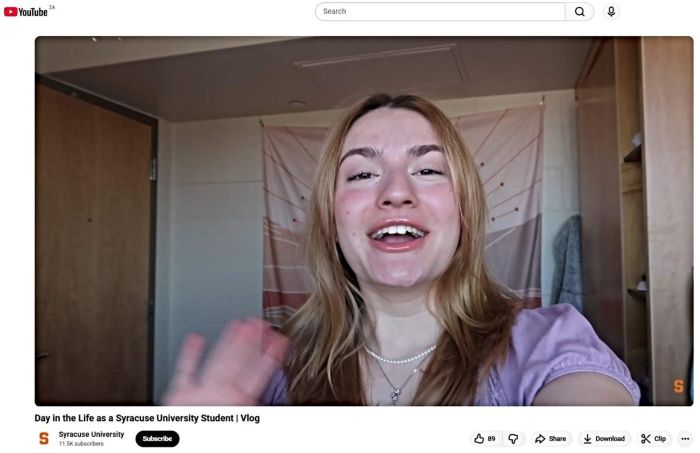
    Example: Syracuse University, Student Vlog on YouTube. A Syracuse student’s “Day in the Life” YouTube vlog offers an unscripted, immersive look into campus life: lectures, study sessions, and community activities. YouTube’s longer format allows for deeper storytelling and helps prospective students experience the campus virtually.

    HEM 1HEM 1

    Syracuse University, Student Vlog on YouTube

    Student “Day in the Life” Takeovers
    One of the most effective UGC formats is the student takeover, where a student documents a typical day on campus through Instagram or TikTok. These videos often follow an unscripted, narrative flow, showing classes, dorm life, study sessions, and social activities from morning to night. Schools typically host these takeovers on official channels or promote student posts through hashtags. This format resonates because it offers an unfiltered look at campus life and helps prospective students picture themselves in that environment.

    Example: Stanford University, UGC Nature Reel Stanford University curated a student-shot Instagram Reel featuring the aurora borealis over Pinnacles National Park. The video, captured entirely by a student, embodies the spirit of authentic storytelling, showing beauty, wonder, and student life through the lens of a real experience.

    HEM 2HEM 2

    Stanford University: UGC Nature Reel 

    Behind-the-Scenes of Events
    UGC thrives on authenticity, and few things feel more genuine than spontaneous moments from student events. Encouraging students to share behind-the-scenes perspectives from orientations, club fairs, or sports games helps outsiders experience the energy and community spirit that define your school. These candid glimpses make institutional content more approachable and emotionally engaging.

    Faculty or Staff Takeovers and Reflections
    Authentic content doesn’t have to come solely from students. Faculty and staff can also contribute by sharing casual reflections or quick videos about their daily work. A professor might record a short lab update, while an admissions officer could post a quick tour from a college fair. These snapshots add a human touch to your education marketing strategies by showing the passion, personality, and commitment that drive your institution.

    Student-Run Q&As and AMAs
    Interactive Q&A sessions, where current students answer prospective students’ questions live on Instagram or through social threads, are among the most effective UGC formats. This setup offers unfiltered, peer-to-peer insights that prospects trust. When real students respond in their own voices, it builds transparency and community, turning your social platforms into spaces for genuine connection.

    Social Media Contests and Hashtag Campaigns
    Encouraging students to create around shared prompts or themes is another great UGC driver. Campaigns like “Show your campus pride” or “Dorm room decor challenge” can generate dozens of authentic submissions in a short time. Just ensure clear rules and creator permissions (and parent consent for minors) so you can safely feature the best entries across your platforms. These initiatives not only supply fresh content but also boost engagement and school spirit.

    Testimonials from Parents and Alumni
    UGC isn’t limited to current students. Parents and alumni can offer powerful, credible perspectives through short testimonial videos or written stories. Sharing how a parent watched their child grow or how an alumnus found career success can feel more authentic than any scripted message, and often connects strongly with audiences considering your programs.

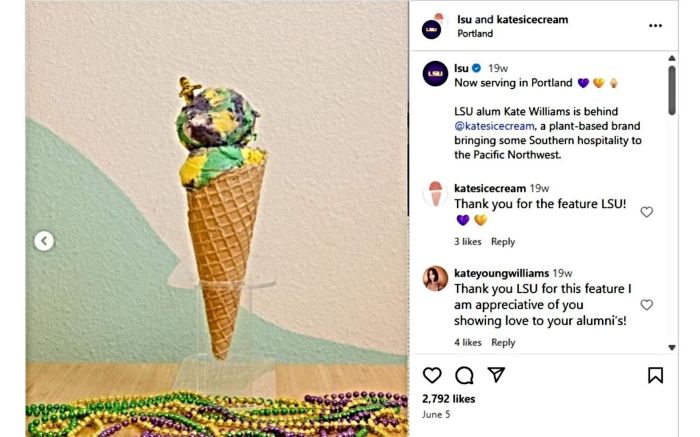
    Example: Louisiana State University, Alumni-Submitted Carousel LSU showcased an alumna’s entrepreneurial journey through a carousel post featuring her photos and story. The alumni-submitted visuals celebrate post-graduation success while reinforcing a sense of lifelong belonging, transforming alumni into ambassadors for the LSU brand.

    HEM 3HEM 3

    Louisiana State University Alumni Carousel

    Fun Trends and Challenges
    Participating in lighthearted social trends can also create strong UGC moments. Whether it’s a campus meme, a TikTok challenge, or a humorous group video, joining or amplifying these moments signals that your institution is lively, student-centered, and culturally aware. These pieces of content not only entertain but also reinforce your brand’s relatability and spirit.

    Using Podcasts to Showcase Authenticity

    Podcasts have become one of the most powerful tools for education marketers looking to connect with audiences through genuine, long-form storytelling. Unlike short-form social media content, podcasts allow room for nuance, emotion, and conversation, making them ideal for showcasing the real voices and experiences that define your school community. Whether you’re featuring students, faculty, or alumni, the format gives your audience something they crave: authenticity.

    Set a Clear Purpose and Goals
    Before launching a podcast, clarify its purpose. 

    What role will it play in your marketing strategy? 

    Is it meant to support recruitment by spotlighting programs and student experiences? 

    To engage current students through campus discussions? 

    To deepen alumni connections with nostalgia and advice? 

    Each episode can have a distinct focus, but your overall series should align with strategic objectives. Identify your audience: prospective students, parents, current students, or alumni, and craft episodes that meet their needs. A school emphasizing innovation might produce a series around student research and campus projects, while one focused on student life could highlight real stories about growth, belonging, and discovery.

    Plan Your Content Strategy
    Successful podcasts rely on structure and consistency. Choose a defined theme or niche rather than covering every topic under the sun. Themes like Student Voices: First-Year Journeys or Faculty Conversations: Research That Matters help listeners know what to expect. Pre-plan your first 8–10 episodes to maintain a steady release rhythm. 

    Aim for a predictable cadence (biweekly or monthly) so listeners know when to expect new episodes. Formats can vary: student interviews, faculty discussions, narrative storytelling, or on-site event recordings. Involving student co-hosts or interviewers adds natural authenticity and relatability, bridging the gap between your institution and prospective students.

    Focus on Storytelling and Value
    Every episode should deliver something meaningful. Encourage guests to share honest stories, not scripted talking points. A student might recount a defining academic challenge; a professor might discuss what inspires their teaching; an alum could describe their career journey post-graduation. 

    Let conversations unfold naturally; even small moments of humor or vulnerability can make an episode memorable. Strive to balance emotional connection and practical value, offering listeners insight, inspiration, or tangible takeaways.

    Feature Diverse Voices
    Authenticity thrives on diversity. Feature a wide range of speakers—students from different backgrounds, professors across disciplines, and staff who shape campus life behind the scenes. Mixing perspectives gives your audience a fuller, more human picture of your institution. Episodes could spotlight student-led initiatives, faculty research, or stories that reflect different aspects of campus life, from residence halls to community outreach.

    Production and Promotion
    Good audio quality matters. Use a reliable microphone, record in a quiet space, and lightly edit to maintain clarity while preserving natural conversation flow. Publish episodes consistently and promote them across channels, email newsletters, your website, and social media. Short audiograms or quote graphics can extend your podcast’s reach while reinforcing its authentic tone.

    Example: Higher Ed Storytelling University Podcast. The Higher Ed Storytelling University podcast features marketers, educators, and students discussing authenticity, narrative strategy, and digital storytelling. This example illustrates how schools and industry experts are using long-form audio to humanize their messaging and reach broader audiences.

    HEM 4HEM 4

    Higher Ed Storytelling University Podcast

    Tools, Platforms, and Quick Wins for UGC

    Building a successful user-generated content (UGC) strategy doesn’t require starting from scratch. With the right tools and a few well-planned quick wins, your institution can begin collecting and showcasing authentic stories almost immediately. Below are practical tools and easy-to-implement tactics that can help you get started.

    UGC Creation and Curation Tools

    • Canva: A go-to tool for both marketing teams and students. Canva makes it easy to design branded graphics, quote cards, and short visuals using preset templates. Students can create Instagram takeover intros, testimonial cards, or club event spotlights, all while staying on-brand thanks to shared school colors and fonts.
    • CapCut: A free, mobile-friendly video editing app perfect for short-form social content. Encourage students to use it to trim clips, add subtitles, and polish their footage before submission. Subtitles, in particular, improve accessibility and help engagement since many viewers watch videos without sound.
    • Later or Buffer: Social media scheduling platforms like these help teams plan and publish UGC consistently. For example, you can schedule weekly “Student Spotlight” features or testimonial series, keeping your feeds active with minimal daily effort.
    • TINT or Tagboard: These UGC management tools collect content tagged with your campaign hashtags across multiple platforms into one dashboard. They also help you request permissions, filter submissions, and display curated UGC feeds on your website (such as a live “#CampusLife” wall on your admissions page).

    Quick Wins to Kickstart UGC

    1. Identify 3 Student Storytellers: Start small. Find three enthusiastic students, perhaps a club leader, athlete, or international student, and invite them to share their stories through takeovers, vlogs, or blog posts. Their content will serve as authentic examples and inspire others to participate.
    2. Launch a Branded Hashtag: Create a memorable, campaign-specific hashtag like #[YourSchool]Life or #Future[YourMascot] and start promoting it immediately. Add it to your bios, marketing emails, and on-campus signage. Repost tagged content regularly to reward engagement and grow participation.
    3. Pilot an Authentic Video Post: Experiment with one short, genuine video on Instagram or TikTok. Try a student Q&A, a “what I wish I knew” segment, or a move-in day recap. Compare engagement metrics with your usual posts. You’ll often find authentic, lightly produced clips outperform polished ads.
    4. Amplify Existing UGC: Look for what’s already out there. Students are likely tagging your school in posts or videos. Engage with those by resharing or commenting, signaling that you value authentic voices.
    5. Offer Student Club Consultations: Provide quick content workshops or audits for student groups. Helping them improve their storytelling or branding indirectly elevates the quality of UGC being created across campus.

    Measuring the Impact of UGC

    Just like any other marketing initiative, your user-generated content (UGC) strategy needs to be measured to prove its value and refine future campaigns. The impact of UGC goes beyond clicks and likes. It touches trust, community sentiment, and enrollment. That’s why it’s important to measure both quantitative and qualitative outcomes. Here’s how to assess what’s working and why.

    1. Track Engagement and Reach
      Start with the fundamentals: likes, comments, shares, saves, and views. Compare these against your institution’s regular branded posts. UGC often performs better, signaling a stronger connection and authenticity. Also track reach and impressions—are your hashtags expanding visibility? If your student takeover generates thousands of views and dozens of replies, that’s evidence of increased awareness and interest at the top of the funnel.
    2. Monitor Cost Efficiency
      If UGC is part of paid campaigns, track cost per click (CPC) and cost per lead (CPL). Ads using student-generated content tend to have higher click-through rates and lower costs because they appear more genuine. Run A/B tests: one glossy ad versus one featuring a real student photo. If the authentic ad drives more engagement at a lower cost, you’ve got clear ROI data to share with stakeholders.
    3. Measure Conversions and ROI
      Track what happens after engagement. Did a UGC-driven post increase form submissions or event sign-ups? Ask applicants how they heard about your school. If they mention your social media or specific student stories, that’s qualitative proof of impact. You can also calculate Return on Ad Spend (ROAS) by comparing tuition value or lead generation to ad spend, or use proxy metrics like cost-per-application to show improved performance. Learn more in HEM’s social media playbook.
    4. Gather Feedback from Students and Staff
      Numbers don’t tell the whole story. Collect feedback from your community through surveys or informal polls. Ask whether students feel represented in your content or whether prospective students found your UGC helpful. Anecdotal comments, like “Your Instagram takeovers made me want to apply,” are qualitative gold and demonstrate the emotional impact of authenticity.
    5. Track Sentiment and Community Growth
      Pay attention to the tone of comments and discussions. Are people tagging friends or expressing excitement? Positive sentiment indicates your content resonates. Also, monitor the growth of branded hashtags and organic posts. If more students are tagging your school or sharing their own stories without prompting, your UGC strategy is inspiring real advocacy.
    6. Build a UGC Dashboard
      Bring it all together with a simple dashboard that tracks UGC performance quarterly, engagement rates, CPC/CPL trends, sentiment highlights, and standout examples. This helps visualize the tangible outcomes of authenticity-driven marketing and makes it easier to communicate results to leadership.

    Example: University of Tennessee, Knoxville
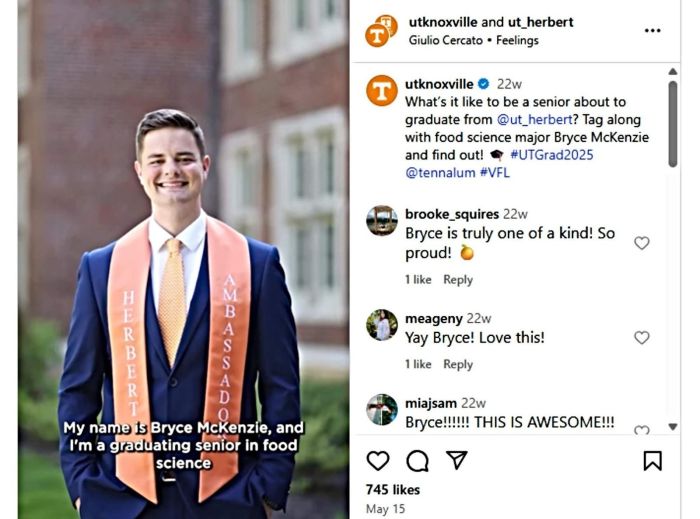
    A University of Tennessee senior’s “Day in the Life” video exemplifies how authentic, student-produced content can outperform traditional marketing posts. The Reel’s organic engagement, thousands of views, and high interaction highlight the measurable impact of relatability on social media reach and engagement.

    HEM 5HEM 5

    University of Tennessee, Knoxville: “Day in the Life” Reel

    Embrace Authenticity with HEM’s Expertise

    Authenticity in marketing is the foundation of meaningful connection. By weaving user-generated and authentic content into your strategy, your institution can foster trust, spark engagement, and inspire real relationships with students and families. Throughout this guide, we’ve explored how to define UGC, why it works, and how to implement it strategically through proven best practices and simple quick wins. The takeaway is clear: campaigns that feel real outperform those that feel rehearsed.

    Of course, launching an authenticity-driven strategy takes more than good intentions. It demands planning, creativity, and a partner who understands how to balance storytelling with measurable results. That’s where Higher Education Marketing (HEM) comes in. Our team has helped colleges and universities around the world capture genuine student stories and transform them into powerful digital campaigns. Whether you’re planning a branded hashtag initiative, building a library of student video testimonials, or training student ambassadors and UGC programmes to create engaging social content, HEM can guide you every step of the way.

    Authentic voices are your greatest marketing asset, and with HEM’s expertise, you can amplify them strategically. Reach out today for a free UGC strategy consultation and discover how genuine stories can drive real enrollment results. Let’s build trust, engagement, and community authentically.

    Struggling with enrollment?

    Our expert digital marketing services can help you attract and enroll more students!

    Frequently Asked Questions 

    Question: What Is User-Generated Content (UGC) in Higher Education Marketing

    Answer: User-Generated Content (UGC) is any material created by people outside your marketing team: students, alumni, faculty, or even parents. It includes everything from TikToks and Instagram stories to blog posts, reviews, and testimonial videos.

    Question: What Is Authentic Storytelling in Higher Education Marketing?

    Answer: Authenticity is the backbone of modern education marketing. Students trust people more than institutions, and they can spot inauthenticity instantly, especially Gen Z, who’ve grown up spotting inauthenticity from miles away.


    Source link

  • Planning with Purpose: Designing Certificate Programs That Align with Market and Mission

    Planning with Purpose: Designing Certificate Programs That Align with Market and Mission

    Higher education is seeing a surge of interest in non-degree credentials. Learners are seeking faster, more affordable pathways to workforce advancement. Employers are increasingly open to (and in some cases requesting) alternatives to traditional degrees. And with new federal policy expanding Pell Grant eligibility to non-degree programs, institutions are feeling the urgency to act.

    But not all certificate programs are created equal. And while the trend line is clear, the strategy behind how institutions respond is anything but. This moment presents an opportunity, but only for those willing to plan with purpose and set realistic expectations.

    What’s driving demand for short-term credentials?

    Recent data underscores a clear increase in interest:

    • Undergraduate certificate enrollment grew 33% and graduate certificate enrollment grew 21% from Fall 2020 to Fall 2024, according to National Student Clearinghouse data.
    • Google search volume for certificates has increased 19% from 2020 to 2025, according to Google Trends data.

    Today’s learners are drawn to programs that offer accelerated timelines, reduced costs, and clear pathways to meaningful career outcomes. Many working adults are looking to upskill or pivot careers, and a certificate can be a more practical option than a full degree.

    On the employer side, organizations want proof of skills and are increasingly willing to collaborate with institutions on curriculum design. In fact, according to a 2022 employer survey from Collegis and UPCEA, 68% of respondents said they would be interested in teaming up with an institution to develop non-degree credentials to benefit their workforce.

    Certificates are a piece of the puzzle — not the whole strategy

    Despite the interest, many institutions struggle to meet enrollment goals for certificate programs. Strong market trends do not automatically translate into high enrollment volume. The reality is that most certificates serve niche audiences and deliver modest numbers. When treated as stand-alone growth drivers, they often fall short.

    The institutions that see the most strategic value from certificates do so by positioning them within a larger enrollment and academic ecosystem. For example, we’ve helped our partner institutions find success in using certificate interest as a marketing funnel to drive engagement in related master’s programs. Once a prospective student engages, enrollment teams can advise them on the best fit for their career goals, which, for some students, is enrolling in the full degree program.

    Ready for a Smarter Way Forward?

    Higher ed is hard — but you don’t have to figure it out alone. We can help you transform challenges into opportunities.

    What a strategic certificate model looks like

    A certificate program with purpose isn’t just a set of courses — it’s a product with clear value to both learners and the institution. Key elements of a strategic approach include:

    1. Workforce alignment: Programs must be rooted in real-time labor market data. What skills are employers seeking? Which certifications are valued? Aligning with reputable industry certifications is a proven way to ensure relevance and employer recognition.
    2. Accessibility: Pricing should reflect the certificate’s value relative to degree programs, and eligibility for financial aid must be prioritized. Lack of aid is a significant barrier to enrollment for many prospective learners.
    3. Laddering and stackability: Certificates should not be terminal unless intentionally designed that way. They should stack into larger degree pathways or offer alumni incentives for continuing their education.
    4. Delivery speed and flexibility: Busy adult learners expect quick starts, clear outcomes, and minimal red tape. Institutions need streamlined onboarding and agile curriculum design.
    5. Internal collaboration: Designing certificates in isolation often leads to friction. Academic, enrollment, and marketing teams must be aligned on purpose, target audience, and outcomes.
    6. Employer engagement: Employers want to be part of the development process and seek assurance that certificate programs teach the skills they need. Their involvement enhances the recognition and credibility of the credential.

    The role of institutions: Balance mission with market

    Certificate programs are not a shortcut to growth. But they can be a smart strategic lever when grounded in data and designed to complement an institution’s broader mission. They offer colleges and universities an opportunity to:

    • Expand access to underserved learners
    • Respond more nimbly to labor market shifts
    • Strengthen ties with regional employers
    • Drive awareness and enrollment for degree programs

    The key is alignment. When certificate offerings reflect both market demand and institutional mission, they can play a powerful role in expanding reach and impact.

    Plan with purpose, execute with intent

    Certificates are more than just a trending credential. They’re a tool to serve learners in new ways. But institutions must resist the urge to chase quick wins. Success requires thoughtful design, realistic expectations, and cross-functional collaboration.

    With the right foundation, certificate programs can do more than fill a gap. They can open doors for learners, employers, and institutions alike. Collegis supports this effort with integrated services in market research, instructional design, and portfolio development — empowering institutions to make informed, mission-aligned decisions that deliver impact.

    Innovation Starts Here

    Higher ed is evolving — don’t get left behind. Explore how Collegis can help your institution thrive.

    Source link

  • Can regulation cope with a unified tertiary system in Wales?

    Can regulation cope with a unified tertiary system in Wales?

    Medr’s second consultation on its regulatory framework reminds us both of the comparatively small size of the Welsh tertiary sector, and the sheer ambition – and complexity – of bringing FE, HE, apprenticeships and ACL under one roof.

    Back in May, Medr (the official name for the Commission for Tertiary Education and Research in Wales) launched its first consultation on the new regulatory system required by the Tertiary Education and Research Wales Act 2022.

    At that stage the sector’s message was that it was too prescriptive, too burdensome, and insufficiently clear about what was mandatory versus advisory.

    Now, five months later, Medr has returned with a second consultation that it says addresses those concerns. The documents – running to well over 100 pages across the main consultation text and six annexes – set out pretty much the complete regulatory framework that will govern tertiary education in Wales from August 2026.

    It’s much more than a minor technical exercise – it’s the most ambitious attempt to create a unified regulatory system across further education, higher education, apprenticeships, adult community learning and maintained school sixth forms that the UK has yet seen.

    As well as that, it’s trying to be both a funder and a regulator; to be responsive to providers while putting students at the centre; and to avoid some of the mistakes that it has seen the Office for Students (OfS) make in England.

    Listening and responding

    If nothing else, it’s refreshing to see a sector body listening to consultation responses. Respondents wanted clearer signposts about what constitutes a compliance requirement versus advisory guidance, and worried about cumulative burden when several conditions and processes come together.

    They also asked for alignment with existing quality regimes from Estyn and the Quality Assurance Agency, and flagged concerns about whether certain oversight might risk universities’ status as non-profit institutions serving households (NPISH) – a technical thing, but one with significant implications for institutional autonomy.

    Medr’s response has been to restructure the conditions more clearly. Each now distinguishes between the condition itself (what must be met), compliance requirements that evidence the condition, and guidance (which providers must consider but may approach differently if they can justify that choice).

    It has also adopted a “make once, use many” approach to information, promising to rely on evidence already provided to Estyn, QAA or other bodies wherever it fits their purpose. And it has aligned annual planning and assurance points with sector cycles “wherever possible.”

    The question, of course, is whether this constitutes genuine simplification or merely better-organised complexity. Medr is establishing conditions of registration for higher education providers (replacing Fee and Access Plans), conditions of funding for FE colleges and others, and creating a unified quality framework and learner engagement code that applies across all tertiary education.

    The conditions themselves

    Some conditions apply universally. Others apply only to registered providers, or only to funded providers, or only to specific types of provision. As we’ve seen in England, the framework includes initial and ongoing conditions of registration for higher education providers (in both the “core” and “alternative” categories), plus conditions of funding that apply more broadly.

    Financial sustainability requires providers to have “strategies in place to ensure that they are financially sustainable” – which means remaining viable in the short term (one to two years), sustainable over the medium term (three to five years), and maintaining sufficient resources to honour commitments to learners. The supplementary detail includes a financial commitments threshold mechanism based on EBITDA ratios.

    Providers exceeding certain multiples will need to request review of governance by Medr before entering new financial commitments. That’s standard regulatory practice – OfS has equivalent arrangements in England – but it represents new formal oversight for Welsh institutions.

    Critically, Medr says its role is “to review and form an opinion on the robustness of governance over proposed new commitments, not to authorise or veto a decision that belongs to your governing body.” That’s some careful wording – but whether it will prove sufficient in practice (both in detail and in timeliness) when providers are required to seek approval before major financial decisions remains to be seen.

    Governance and management is where the sector seems to have secured some wins. The language around financial commitments has been softened from “approval” to “review.” The condition now focuses on outcomes – “integrity, transparency, strong internal control, effective assurance, and a culture that allows challenge and learning” – rather than prescribing structures.

    And for those worried about burden, registered higher education providers will no longer be required to provide governing body composition, annual returns of serious incidents, individual internal audit reports, or several other elements currently required under Fee and Access Plans. That is a reduction – but won’t make a lot of difference to anyone other than the person stiffed with gathering the sheaf of stuff to send in.

    Quality draws on the Quality Framework (Annex C) and requires providers to demonstrate their provision is of good quality and that they engage with continuous improvement. The minimum compliance requirements, evidenced through annual assurance returns, include compliance with the Learner Engagement Code, using learner survey outcomes in quality assurance, governing body oversight of quality strategies, regular self-evaluation, active engagement in external quality assessment (Estyn inspection and/or QAA review), continuous improvement planning, and a professional learning and development strategy.

    The framework promises that Medr will “use information from existing reviews and inspections, such as by Estyn and QAA” and “aim not to duplicate existing quality processes.” Notably, Medr has punted the consultation on performance indicators to 2027, so providers won’t know what quantitative measures they’ll be assessed against until the system is already live.

    Staff and learner welfare sets out requirements for effective arrangements to support and promote welfare, encompassing both “wellbeing” (emotional wellbeing and mental health) and “safety” (freedom from harassment, misconduct, violence including sexual violence, and hate crime). Providers will have to conduct an annual welfare self-evaluation and submit an annual welfare action plan to Medr. This represents new formal reporting – even if the underlying activity isn’t new.

    The Welsh language condition requires providers to take “all reasonable steps” to promote greater use of Welsh, increase demand for Welsh-medium provision, and (where appropriate) encourage research and innovation activities supporting the Welsh language. Providers must publish a Welsh Language Strategy setting out how they’ll achieve it, with measurable outcomes over a five-year rolling period with annual milestones. For providers subject to Welsh Language Standards under the Welsh Language (Wales) Measure 2011, compliance with those standards provides baseline assurance. Others must work with the Welsh Language Commissioner through the Cynnig Cymraeg.

    Learner protection plans will be required when Medr gives notice – typically triggered by reportable events, course closures, campus closures, or significant changes to provision. The guidance (in the supplementary detail from page 86 onwards) is clear about what does and doesn’t require a plan. Portfolio review and planned teach-out? Generally fine, provided learners are supported. Closing a course mid-year with no teach-out option? Plan required. Whether this offers the sort of protection that students need – especially when changes are made to courses to reduce costs – will doubtless come up in the consultation.

    And then there’s the Learner Engagement Code, set out in Annex D. This is where student representative bodies may feel especially disappointed. The Code is principles-based rather than rights-based, setting out nine principles (embedded, valued, understood, inclusive, bilingual, individual and collective, impactful, resourced, evaluated) – but creates no specific entitlements or rights for students or students’ unions.

    The principles themselves are worthy enough – learners should have opportunities to engage in decision-making, they should be listened to, routes for engagement should be clear, opportunities should reflect diverse needs, learners can engage through Welsh, collective voice should be supported, engagement should lead to visible impact, it should be resourced, and it should be evaluated. But it does all feel a bit vague.

    Providers will have to submit annual assurance that they comply with the Code, accompanied by evidence such as “analysis of feedback from learners on their experience of engagement” and “examples of decisions made as a result of learner feedback.” But the bar for compliance appears relatively low. As long as providers can show they’re doing something in each area, they’re likely to be deemed compliant. For SUs hoping for statutory backing for their role and resources, this will feel like a missed opportunity.

    Equality of opportunity is more substantial. The condition requires providers to deliver measurable outcomes across participation, retention, academic success, progression, and (where appropriate) participation in postgraduate study and research. The supplementary detail (from page 105) sets out that providers must conduct ongoing self-evaluation to identify barriers to equality of opportunity, then develop measurable outcomes over a five-year rolling period with annual milestones.

    Interestingly, there’s a transition period – in 2026-27, HE providers with Fee and Access Plans need only provide a statement confirming continued commitments. Full compliance – including submission of measurable outcomes – isn’t required until 2027-28, with the first progress reports due in 2028-29. That’s a sensible approach given the sector’s starting points vary considerably, but it does mean the condition won’t bite with full force for three years.

    Monitoring and intervention

    At the core of the monitoring approach is an Annual Assurance Return – where the provider’s governing body self-declares compliance across all applicable conditions, supported by evidence. This is supplemented by learner surveys, Estyn/QAA reviews, public information monitoring, complaints monitoring, reportable events, data monitoring, independent assurance, engagement activities and self-evaluation.

    The reportable events process distinguishes between serious incidents (to be reported within 10 working days) and notifiable events (reported monthly or at specified intervals). There’s 17 categories of serious incidents, from loss of degree awarding powers to safeguarding failures to financial irregularities over £50,000 or two per cent of turnover (whichever is lower). A table lists notifiable events including senior staff appointments and departures, changes to validation arrangements, and delays to financial returns. It’s a consolidation of existing requirements rather than wholesale innovation, but it’s now formalised across the tertiary sector rather than just HE.

    Medr’s Statement of Intervention Powers (Annex A) sets out escalation from low-level intervention (advice and assistance, reviews) through mid-level intervention (specific registration conditions, enhanced monitoring) to serious “directive” intervention (formal directions) and ultimately de-registration. The document includes helpful flowcharts showing the process for each intervention type, complete with timescales and decision review mechanisms. Providers can also apply for a review by an independent Decision Reviewer appointed by Welsh Ministers – a safeguard that universities dream of in England.

    Also refreshingly, Medr commits to operating “to practical turnaround times” when reviewing financial commitments, with the process “progressing in tandem with your own processes.” A six-week timeline is suggested for complex financing options – although whether this proves workable in practice will depend on Medr’s capacity and responsiveness.

    Quality

    The Quality Framework (Annex C) deserves separate attention because it’s genuinely attempting something ambitious – a coherent approach to quality across FE, HE, apprenticeships, ACL and sixth forms that recognises existing inspection/review arrangements rather than duplicating them.

    The framework has seven “pillars” – learner engagement, learner voice, engagement of the governing body, self-evaluation, externality, continuous improvement and professional learning and development. Each pillar sets out what Medr will do and what providers must demonstrate. Providers will be judged compliant if they achieve “satisfactory external quality assessment outcomes,” have “acceptable performance data,” and are not considered by Medr to demonstrate “a risk to the quality of education.”

    The promise is that:

    …Medr will work with providers and with bodies carrying out external quality assessment to ensure that such assessment is robust, evidence-based, proportionate and timely; adds value for providers and has impact in driving improvement.

    In other words, Estyn inspections and QAA reviews should suffice, with Medr using those outcomes rather than conducting its own assessments. But there’s a caveat:

    “Medr has asked Estyn and QAA to consider opportunities for greater alignment between current external quality assessment methodologies, and in particular whether there could be simplification for providers who are subject to multiple assessments.

    So is the coordination real or aspirational? The answer appears to be somewhere in between. The framework acknowledges that by 2027, Medr expects to have reviewed data collection arrangements and consulted on performance indicators and use of benchmarking and thresholds. Until that consultation happens, it’s not entirely clear what “acceptable performance data” means beyond existing Estyn/QAA judgements. And the promise of “greater alignment” between inspection methodologies is a promise, not a done deal.

    A tight timeline

    The key dates bear noting because they’re tight:

    • April 2026: Applications to the register open
    • August 2026: Register launches; most conditions come into effect
    • August 2027: Remaining conditions (Equality of Opportunity and Fee Limits for registered providers) come into full effect; apprenticeship providers fully subject to conditions of funding

    After all these years, we seem to be looking at some exit acceleration. It gives providers approximately six months from the consultation closing (17 December 2025) to the application process opening. Final versions of the conditions and guidance presumably need to be published early 2026 to allow preparation time. And all of this is happening against the backdrop of Senedd elections in 2026 – where polls suggest that some strategic guidance could be dropped on the new body fairly sharpish.

    And some elements remain unresolved or punted forward. The performance indicators consultation promised for 2027 means providers won’t know the quantitative measures against which they’ll be assessed until the system is live. Medr says it will “consult on its approach to defining ‘good’ learner outcomes” as part of a “coherent, over-arching approach” – but that’s after registration and implementation have begun.

    Validation arrangements are addressed (providers must ensure arrangements are effective in enabling them to satisfy themselves about quality), but the consultation asks explicitly whether the condition “could be usefully extended into broader advice or guidance for tertiary partnerships, including sub-contractual arrangements.” That suggests Medr has been reading some of England’s horror stories and recognises the area needs further work.

    And underlying everything is the question of capacity – both Medr’s capacity to operate this system effectively from day one, and providers’ capacity to meet the requirements while managing their existing obligations. The promise of reduced burden through alignment and reuse of evidence is welcome.

    But a unified regulatory system covering everything from research-intensive universities to community-based adult learning requires Medr to develop expertise and processes across an extraordinary range of provision types. Whether the organisation will be ready by August 2026 is an open question.

    For providers, the choice is whether to engage substantively with this consultation knowing that the broad architecture is set by legislation, or to focus energy on preparing for implementation. For Welsh ministers, the challenge is whether this genuinely lighter-touch, more coherent approach than England’s increasingly discredited OfS regime can be delivered without compromising quality or institutional autonomy.

    And for students – especially those whose representative structures were hoping for statutory backing – there’s a question about whether principles-based engagement without rights amounts to meaningful participation or regulatory box-ticking.

    In England, some observers will watch with interest to see whether Wales has found a way to regulate tertiary education proportionately and coherently. Others will see in these documents a reminder that unified systems, however well-intentioned, require enormous complexity to accommodate the genuine diversity of the sector. The consultation responses, due by 17 December, will expose which interpretation the Welsh sector favours.

    Source link

  • Why do people worry about inflation?

    Why do people worry about inflation?

    That’s why central banks have gone to extraordinary lengths in the past decade to banish the specter of deflation. They’ve succeeded. Indeed, stock markets have been rattled by evidence that inflation is stirring in the United States, which might prompt the Federal Reserve to raise interest rates more rapidly than previously thought.

    (On Wednesday, the U.S. government reported that consumer prices rose by 0.5 percent in January, more than expected. “Core” prices excluding volatile food and energy costs marked the biggest monthly gain in a year.)

    But the chances of inflation getting out of control are small.

    First, companies operate globally, so if manufacturing costs rise too high in the United States, they will shift production to cheaper locations overseas.

    Second, there is still slack in the U.S. jobs market because many people who gave up looking for work after the crisis could be lured back into employment, capping wages.

    Third, there is no reason to believe the Fed — or financial markets for that matter — would allow the money supply to spiral out of control.

    The United States is no Venezuela.

    Prices rise and fall all the time in response to factors such as changing consumer tastes and technological innovation. Medical care costs a lot more than in the past, computers a lot less. But a generalized rise in prices across the economy — which is the definition of inflation — is possible only if a country’s central bank prints too much money.

    That’s what’s happened in Venezuela, where the money supply has increased by 4,000 percent in the past two years. The result is hyperinflation, forecast by the International Monetary Fund to reach 13,000 percent this year. Goldilocks’s oatmeal is nearly doubling in price every month. Poverty is rife because wages lag price rises. The economy is on its knees.

    The United States is no Venezuela. Evidence of a pick-up in wages is good news in fact, considering that workers have been taking home less and less of the economic pie in recent years, while the suppliers of capital have benefited handsomely.

    It’s possible that the recently enacted package of U.S. tax cuts and spending increases will cause the economy to run a bit too hot, pushing up prices a bit. But of the many problems facing the U.S. economy, runaway inflation is not one of them.

    In 1981, then Fed Chairman Paul Volcker had to raise short-term U.S. interest rates to 20 percent to crush inflation. History will not need to repeat itself.


    Questions to consider:

    1. What “ripple effect” could a rise in consumer prices cause?

    2. How can inflation be good?

    3. When prices go up significantly, what might you or your family not buy?


    Source link

  • Do screens help or hurt K-8 learning? Lessons from the UK’s OPAL program

    Do screens help or hurt K-8 learning? Lessons from the UK’s OPAL program

    Key points:

    When our leadership team at Firthmoor Primary met with an OPAL (Outdoor Play and Learning) representative, one message came through clearly: “Play isn’t a break from learning, it is learning.”

    As she flipped through slides, we saw examples from other schools where playgrounds were transformed into hubs of creativity. There were “play stations” where children could build, imagine, and collaborate. One that stood out for me was the simple addition of a music station, where children could dance to songs during break time, turning recess into an outlet for joy, self-expression, and community.

    The OPAL program is not about giving children “more time off.” It’s about making play purposeful, inclusive, and developmental. At Firthmoor, our head teacher has made OPAL part of the long-term school plan, ensuring that playtime builds creativity, resilience, and social skills just as much as lessons in the classroom.

    After seeing these OPAL examples, I couldn’t help but think about how different this vision is from what dominates the conversation in so many schools: technology. While OPAL emphasizes unstructured play, movement, and creativity, most education systems, both in the UK and abroad, are under pressure to adopt more edtech. The argument is that early access to screens helps children personalize their learning, build digital fluency, and prepare for a future where tech skills are essential.

    But what happens when those two philosophies collide?

    On one side, programs like OPAL remind us that children need hands-on experiences, imagination, and social connection–skills that can’t be replaced by a tablet. On the other, schools around the world are racing to keep pace with the digital age.

    Even in Silicon Valley, where tech innovation is born, schools like the Waldorf School of the Peninsula have chosen to go screen-free in early years. Their reasoning echoes OPAL’s ethos: Creativity and deep human interaction lay stronger cognitive and emotional foundations than any app can provide.

    Research supports this caution. The Royal College of Paediatrics and Child Health advises parents and schools to carefully balance screen use with physical activity, sleep, and family interaction. And in 2023, UNESCO warned that “not all edtech improves learning outcomes, and some displace play and social interaction.” Similarly, the OECD’s 2021 report found that heavy screen use among 10-year-olds correlated with lower well-being scores, highlighting the risks of relying too heavily on devices in the early years.

    As a governor, I see both sides: the enthusiasm for digital tools that promise engagement and efficiency, and the concern for children’s well-being and readiness for lifelong learning. OPAL has made me think about what kind of foundations we want to lay before layering on technology.

    So where does this leave us? For me, the OPAL initiative at Firthmoor is a powerful reminder that education doesn’t have to be an either/or choice between tech and tradition. The real challenge is balance.

    This raises important questions for all of us in education:

    • When is the right time to introduce technology?
    • How do we balance digital fluency with the need for deep, human-centered learning?
    • Where do we draw the line between screens and play, and who gets to decide?

    This is a conversation not just for educators, but for parents, policymakers, and communities. How do we want the next generation to learn, play, and thrive?

    Latest posts by eSchool Media Contributors (see all)

    Source link

  • How rare are colleges that enroll and graduate high shares of Pell Grant students?

    How rare are colleges that enroll and graduate high shares of Pell Grant students?

    This audio is auto-generated. Please let us know if you have feedback.

    When it comes to colleges where Pell Grant recipients are at least 55% likely to graduate, there are not a whole lot throughout the U.S. In fact, nearly half of states — many of them Southern with some of the highest poverty rates in the country — don’t have any at all.

    That’s what Becca Spindel Bassett, higher education professor at the University of Arkansas, discovered in a recent analysis in which she sought to identify and map institutions of higher education that she describes as “equity engines.” 

    These are colleges where at least 34% of the students receive Pell Grants and at least 55% of those Pell Grant recipients earn a bachelor’s degree within six years.

    Out of the 1,584 public and private nonprofit four-year institutions that Bassett studied nationwide, she found only 91 — or less than 6% — that qualified for her “equity engine” distinction

    And they’re all clustered in 26 states, resulting in what Bassett calls a “spatial injustice” for low-income students who live in one of the states without any equity engines or in areas with limited access to such institutions.

    The almost eight dozen existing equity engines represent a diverse range of institutional types, including regional public universities, small Christian colleges and historically Black institutions. 

    As for whether states can invest more in colleges that are close to being equity engines — a key recommendation of Bassett’s study — it all depends.

    “It’s worth noting that over half of Equity Engines are private colleges and universities, so their relationship to the state and dependency on state funding varies,” Bassett said in an email to Higher Ed Dive.

    But improving Pell graduation rates isn’t only a question of funding models, she said. 

    Leaders at aspiring equity engines can learn best practices and approaches from these colleges and should be prepared to enact “organizational learning and change,” Bassett said. However, much is unknown about what enables colleges to become equity engines, including whether it depends on their programs and services or their policy and funding environments. 

    While Bassett’s study doesn’t answer those questions, a forthcoming book will describe how two of the colleges she identified as equity engines were able to achieve their results, she said. 

    Michael Itzkowitz, founder and president of the HEA Group, a higher ed-focused research firm and consultancy, said in an email that identifying colleges with strong graduation rates is a “good first step” because students who earn a degree “typically earn more than those who do not.” 

    However, Itzkowitz, who under former President Barack Obama served as the director of The College Scorecard — an online federal tool with various data on higher education institutions — added that it’s also critical to consider whether graduates are actually better off economically since “not all institutions and degrees are created equal.”

    “Students who earn a credential at one institution may experience wildly different outcomes if they earned the same degree elsewhere,” he said.

    David Hawkins, chief education and policy officer at the National Association for College Admission Counseling, said in an email that colleges would do well to emulate the equity engines Bassett identified, such as the University of Illinois Chicago. Bassett’s study calls the university a “major driver” of bachelor’s degree completion among Pell Grant recipients in the state, noting those students have a 58% six-year graduation rate.

    Among other things, Hawkins said, such institutions deploy a wide range of services — such as evening or online courses for working students, and transportation to campus — that have been proven to help low-income students cross the finish line.

     “From my perspective, the United States will only remain competitive if we can invest in a postsecondary infrastructure that serves all students who seek opportunity through higher education,” Hawkins said.  

    Source link

  • How interactive tech simplifies IT and supercharges learning

    How interactive tech simplifies IT and supercharges learning

    Key points:

    Today’s school IT teams juggle endless demands–secure systems, manageable devices, and tight budgets–all while supporting teachers who need tech that just works.

    That’s where interactive displays come in. Modern, OS-agnostic solutions like Promethean’s ActivPanel 10 Premium simplify IT management, integrate seamlessly with existing systems, and cut down on maintenance headaches. For schools, that means fewer compatibility issues, stronger security, and happier teachers.

    But these tools do more than make IT’s job easier–they transform teaching and learning. Touch-enabled collaboration, instant feedback, and multimedia integration turn passive lessons into dynamic, inclusive experiences that keep students engaged and help teachers do their best work.

    Built to last, interactive displays also support long-term sustainability goals and digital fluency–skills that carry from classroom to career.

    Discover how interactive technology delivers 10 powerful benefits for schools.

    Download the full report and see how interactive solutions can help your district simplify IT, elevate instruction, and create future-ready classrooms.

    Laura Ascione
    Latest posts by Laura Ascione (see all)

    Source link