Author: admin

  • Without AI “Quiet Cars,” Learning Is At Risk

    Without AI “Quiet Cars,” Learning Is At Risk

    In the late 1990s, a group of commuters would board the early-morning Amtrak train from Philadelphia to Washington, D.C. They’d sit in the first car behind the locomotive, enjoying communal, consensual silence. Eventually and with the conductor’s help, their car was officially designated as a noise-free zone. Soon after, Denise LaBencki-Fullmer, an Amtrak manager, recognized the value of a peaceful ride and institutionalized the program as the quiet car. At the request of passengers, it soon spread to a number of other commuter services.

    The educational technology sector has something to learn from the Amtrak commuters’ deliberate design of their environment. Learning requires the ability to concentrate. You need a space where you are allowed to process information, recall facts, analyze complex questions and think creatively about ideas, problems and solutions. Learning is not a smooth and easy process—in fact, it is desirable that it’s a bit difficult, because that is how we actually learn. Getting someone to do learning tasks for you, as tempting or comfortable as that might be, won’t work.

    A great deal of learning still happens online, even at colleges that value in-person teaching as much as Princeton University does. The learning management system is where our students find readings, review lecture slides and practice their skills and comprehension on homework assignments. It is also where many instructors administer assessments, both low-stakes quizzes and high-stakes exams.

    Last month, Google launched a feature called “Homework help” in Chrome—a shiny blue button right in the address bar. By engaging it, a student could prompt Google Gemini to summarize a reading or solve a quiz question in a matter of seconds. It thereby robbed the student of the learning activity that they were there to do. A few weeks later Google repositioned the feature so it is a bit less obvious (at least for now), but the question remains: What kind of AI tools should we make available to our students in learning management systems and assessment platforms?

    You might be thinking that this is a pointless question: AI is going to be everywhere—it already is. And sure, that is true. Also, if a student wants to use AI, it is easy enough to open another browser tab and ask an LLM for help. But installing the AI right in the environment in which the student is trying to learn is equivalent to sitting next to the most obnoxious cell yeller on your train ride: You can’t think your own thoughts, because the distraction is so big.

    Just as there are quiet cars on trains, there can be quiet areas of the internet. Learning management systems and assessment platforms should be one such area. That doesn’t mean that there can’t be good uses of AI in learning. Our students should know how to use AI responsibly, thoughtfully and critically, as should the faculty who teach them (I sometimes use AI in my own teaching, for instance). But we should also ask that the companies that provide us with learning technologies think critically and carefully about whether AI aids the difficult, careful work that learning requires or, in fact, removes the opportunity for it. AI is inevitable, but that doesn’t mean we can’t be intentional about how, why and where we implement it.

    I have spent the last few weeks talking with colleagues at other colleges and universities and with the partners that provide our educational technology. Everyone I have spoken with cares about education, and none of them think it’s a good idea that we implement AI in a way that so clearly pulls students out of the learning process. It is actually not unrealistic that people in the tech industry and education sector come together to make the same kind of pact that the train commuters made some 25 years ago and declare our online learning systems an AI quiet zone. We would be doing the right thing by our students if we did.

    Mona Fixdal provides strategic planning and pedagogical leadership for Princeton University’s suite of teaching and learning technologies as well its online learning program. She has a Ph.D. in political science from the University of Oslo and is the author of Just Peace: How Wars Should End and a number of chapters and articles on postwar justice and third-party mediation.

    Source link

  • Defunding Level 7 apprenticeships will undermine widening participation efforts in Higher Education

    Defunding Level 7 apprenticeships will undermine widening participation efforts in Higher Education

    This blog was kindly authored by Professor Abigail Marks, Associate Dean of Research, Newcastle University Business School, and member of the Chartered Association of Business Schools Policy Committee.

    From January 2026, public funding for the vast majority of Level 7 apprenticeships in England will be withdrawn for learners aged 22 and over. Funding will remain for those aged 16 to 21, alongside narrow exceptions for care leavers and learners with Education, Health and Care Plans. Current apprentices will continue to be supported. Ministers present the change as a rebalancing of spending toward younger learners and lower levels, where they argue returns are higher and budgets are more constrained.

    At first sight, this decision looks like a simple trade-off: concentrating scarce resources on school-leavers and early career entrants, while expecting employers to bear the costs of advanced, Master’s-level training. For business schools, however, particularly those that have invested in Level 7 pathways, such as the Senior Leader Apprenticeship, the implications for widening participation are likely to be profound. The Senior Leader Apprenticeship is often integrated with an MBA or Executive MBA. Alongside this, many institutions align Level 7 apprenticeships with specialist MSc degrees, often with embedded professional accreditation. In essence, Level 7 apprenticeships in business schools provide structured, work-based routes into advanced leadership and management education, usually culminating in an MBA or MSc.

    Why Level 7 apprenticeships matter for widening participation

    Since the apprenticeship levy was introduced in 2017, Level 7 programmes have provided business schools with a powerful route to widen participation, particularly among groups that have been historically excluded from postgraduate education. According to the Department for Education’s 2023 Apprenticeship Evaluation, almost half (48 per cent) of Level 7 apprentices are first-generation students, with neither parent having attended university, and around one in five live in the most deprived areas of the country. Analysis by the Chartered Association of Business Schools shows that in 2022/23, a quarter of business and management Level 7 apprentices held no prior degree qualification before starting, with a small minority having no formal qualifications at all. The age profile further underscores the differences between these learners and conventional Master’s students, with 88 per cent of business and management Level 7 apprentices aged over 31, indicating that these programmes primarily serve mature learners and career changers rather than recent graduates.

    This picture contrasts sharply with the traditional MBA market, both in the UK and internationally. Research on MBA demographics from the Association of MBAs in 2023 highlights that students are typically in their late twenties to early thirties, often already possessing a strong undergraduate degree and professional background, and participation is skewed toward those with access to significant financial resources. An Office for Students analysis of Higher Education Statistics Agency data shows that conventional graduate business and management entrants are disproportionately from higher socio-economic backgrounds, with lower representation from disadvantaged areas compared to undergraduate cohorts. In practice, this means that the subsidised Level 7 apprenticeship route has been one of the few mechanisms allowing those without financial capital, prior academic credentials, or family background in higher education to gain access to advanced management education in business schools.

    The economic and societal cost of defunding Level 7

    Employer behaviour is likely to shift in predictable ways once the subsidy is removed. Some large levy-paying firms may continue to sponsor a limited number of Level 7 places, but many smaller employers, as well as organisations in the public and third sectors, will struggle to justify the full cost. Data from the Chartered Management Institute suggests that 60 per cent of Level 7 management apprentices are in public services such as the NHS, social care, and local government. Less than 10 per cent are in FTSE 350 companies. Consequently, there is a risk of further narrowing provision to those already in advantaged positions.

    The progression ladder is also threatened. Level 7 apprenticeships have been a natural progression for people who began at Levels 3 to 5, building their qualifications as they moved into supervisory roles. Closing the door at this point reinforces the glass ceiling for those seeking to rise from technical or frontline work into leadership. With data from the Department for Education reported in FE Week reporting that 89 per cent of Level 7 apprentices are currently aged over 22, the vast majority of those who have benefited from these opportunities will be excluded from January 2026.

    The consequences extend beyond widening participation metrics. Leadership and management skills are consistently linked to firm-level productivity and the diffusion of innovation. Studies such as the World Management Survey have shown that effective management correlates strongly with higher productivity and competitiveness. Restricting adult access to advanced apprenticeships risks slowing the spread of these practices across the economy. For business schools, it reduces their ability to act as engines of regional development and knowledge transfer. At a national level, the UK’s prospects for growth depend not only on new entrants but also on upskilling the existing workforce. Apprenticeships have been one of the few proven ways of achieving this. If opportunities narrow, it is possible that firms may struggle to adopt new technologies, deliver green transitions, or address regional productivity gaps. The effects may also be felt in export performance, scale-up survival, and international competitiveness.

    The removal of public funding for adults over 21 threatens to dismantle a pathway that has enabled business schools to transform the profile of their postgraduate cohorts. Where once mature students, first-generation graduates, and learners from deprived regions could progress into Master’s-level management education, the policy shift risks returning provision in England to a preserve of the already advantaged. In contrast, our European counterparts, where degree and higher-level apprenticeships retain open access for adults, will continue to allow business schools to deliver on widening participation commitments across the life course.

    Lessons from Europe

    Germany’s dual study system has expanded, with degree-apprenticeship style programmes now making up almost five per cent of higher education enrolments. Data from the OECD shows that the proportion of young adults aged 25–34 with a tertiary degree in Germany has risen to around 40 per cent, driven partly by these integrated vocational–academic routes. Switzerland shows even more dramatic results: between 2000 and 2021, the share of 25–34-year-olds with a tertiary qualification rose from 26 to 52 per cent. Crucially, Switzerland also leads Europe in lifelong learning, with around 67.5 per cent of adults aged 25–65 participating in continuing education and training. For Swiss business schools, this creates a mature, diverse learner base and allows firms to continually upgrade leadership and management capacity. Both countries demonstrate how keeping lifelong pathways open is central to sustaining firm-level productivity, innovation, and international competitiveness.

    Conclusion

     The decision to defund most adult participation at Level 7 thus represents more than a budgetary tweak. It narrows opportunities in advanced management education and risks reversing progress in widening participation. Unless English business schools, employers, and policymakers act swiftly to design new pathways, the effect will be a return to elite provision. More worryingly, England risks falling behind international counterparts in building the leadership capacity that underpins innovation, productivity, and growth.

    Source link

  • A shuttered government was not the lesson I hoped my Texas students would learn on a trip to Washington D.C

    A shuttered government was not the lesson I hoped my Texas students would learn on a trip to Washington D.C

    After decades serving in the Marine Corps and in education, I know firsthand that servant leadership and diplomacy can and should be taught. That’s why I hoped to bring 32 high school seniors from Texas to Washington, D.C., this fall for a week of engagement and learning with top U.S. government and international leaders.  

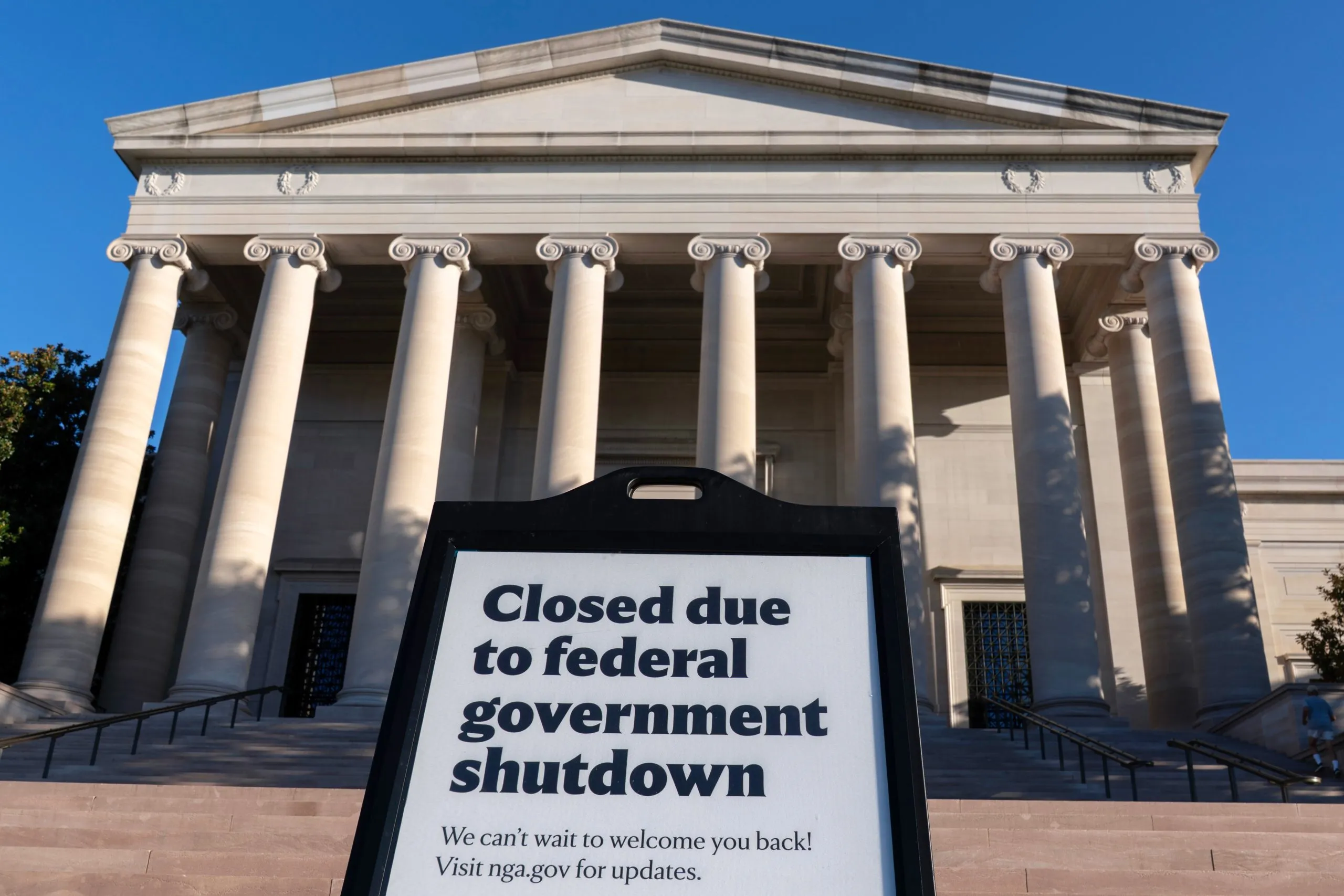
    Instead of open doors, we faced a government shutdown and had to cancel our trip. 

    The shutdown impacts government employees, members of the military and their families who are serving overseas and all Americans who depend on government being open to serve us — in businesses, schools and national parks, and through air travel and the postal service.  

    Our trip was not going to be a typical rushed tour of monuments, but a highly selective, long-anticipated capstone experience. Our plans included intensive interaction with government leaders at the Naval Academy and the Pentagon, discussions at the State Department and a leadership panel with senators and congressmembers. Our students hoped to explore potential careers and even practice their Spanish and Mandarin skills at the Mexican and Chinese embassies.  

    The students not only missed out on the opportunity to connect with these leaders and make important connections for college and career, they learned what happens when leadership and diplomacy fail — a harsh reminder that we need to teach these skills, and the principles that support them, in our schools. 

    Related: A lot goes on in classrooms from kindergarten to high school. Keep up with our free weekly newsletter on K-12 education.  

    Senior members of the military know that the DIME framework — diplomatic, informational, military and economic — should guide and support strategic objectives, particularly on the international stage. My own time in the Corps taught me the essential role of honesty and trust in conversations, negotiations and diplomacy. In civic life, this approach preserves democracy, yet the government shutdown demonstrates what happens when the mission shifts from solving problems to scoring points.  

    Our elected leaders were tasked with a mission, and the continued shutdown shows a breakdown in key aspects of governance and public service. That’s the real teachable moment of this shutdown. Democracy works when leaders can disagree without disengaging; when they can argue, compromise and keep doors open. If our future leaders can’t practice those skills, shutdowns will become less an exception and more a way of governing. 

    Students from ILTexas, a charter network serving over 26,000 students across the state, got a lesson in failed diplomacy after the government shutdown forced cancellation of their long-planned trip to the nation’s capital. Credit: Courtesy International Leadership of Texas Charter Schools

    With opposing points of view, communication is essential. Bridging language is invaluable. As the adage goes, talk to a man in a language he understands, that goes to his head. Speak in his own language, that goes to his heart. That is why, starting in kindergarten, we teach every student in our charter school network English, Spanish and Mandarin Chinese.  

    Some of our graduates will become teachers, lawyers, doctors and entrepreneurs. Others will pursue careers in public service or navigate our democracy on the international stage. All will enter a world more fractured than the one I stepped into as a Marine. 

    While our leaders struggle to find common ground, studies show that nationally, only 22 percent of eighth graders are proficient in civics, and fewer than 20 percent of American students study a foreign language. My students are exceptions, preparing to lead in three languages and through servant leadership, a philosophy that turns a position of power into a daily practice of responsibility and care for others.  

    Related: COLUMN: Students want more civics education, but far too few schools teach it 

    While my students represent our ILTexas schools, they also know they are carrying something larger: the hopes of their families, communities and even their teenage peers across the country. Some hope to utilize their multilingual skills, motivated by a desire to help the international community. Others want to be a part of the next generation of diplomats and policy thinkers who are ready to face modern challenges head-on.  

    To help them, we build good habits into the school day. Silent hallways instill respect for others. Language instruction builds empathy and an international perspective. Community service requirements (60 hours per high school student) and projects, as well as dedicated leadership courses and optional participation in our Marine Corps JROTC program give students regular chances to practice purpose over privilege. 

    Educators should prepare young people for the challenges they will inherit, whether in Washington, in our communities or on the world stage. But schools can’t carry this responsibility alone. Students are watching all of us. It’s our duty to show them a better way. 

    We owe our young people more than simply a good education. We owe them a society in which they can see these civic lessons modeled by their elected leaders, and a path to put them into practice.  

    Eddie Conger is the founder and superintendent of International Leadership of Texas, a public charter school network serving more than 26,000 students across the state, and a retired U.S. Marine Corps major. 

    Contact the opinion editor at [email protected].  

    This story about the government shutdown and students was produced by The Hechinger Report, a nonprofit, independent news organization focused on inequality and innovation in education. Sign up for Hechinger’s weekly newsletter.  

    The Hechinger Report provides in-depth, fact-based, unbiased reporting on education that is free to all readers. But that doesn’t mean it’s free to produce. Our work keeps educators and the public informed about pressing issues at schools and on campuses throughout the country. We tell the whole story, even when the details are inconvenient. Help us keep doing that.

    Join us today.

    Source link

  • At Moms for Liberty summit, parents urged to turn their grievances into lawsuits

    At Moms for Liberty summit, parents urged to turn their grievances into lawsuits

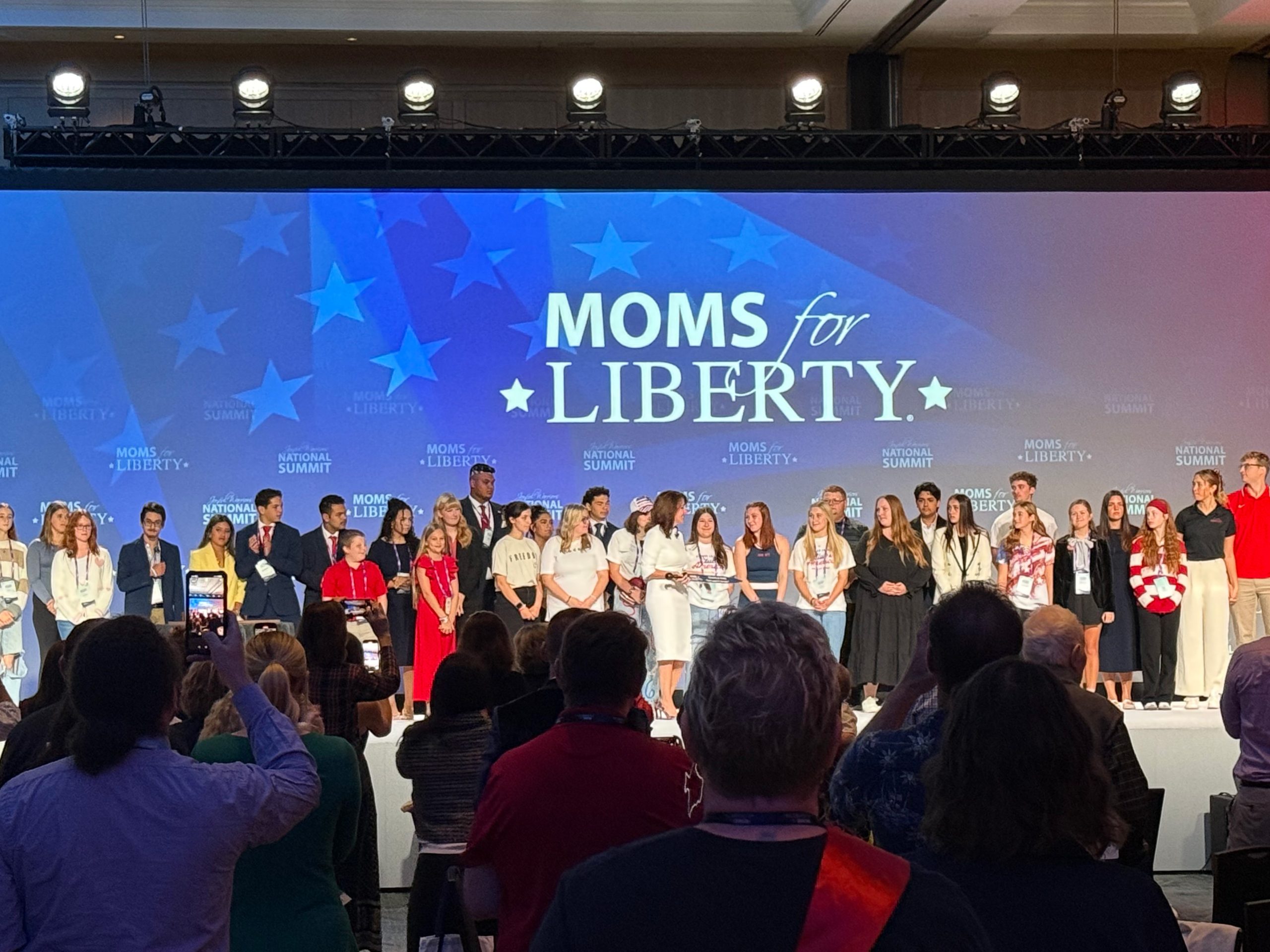
    KISSIMMEE, Fla. — It’s not a rebrand. But the Moms for Liberty group that introduced itself three years ago as a band of female “joyful warriors” shedding domestic modesty to make raucous public challenges to masks, books and curriculum, is trying to glow up.

    The group’s national summit this past weekend at a convention center outside Orlando leaned into family (read: parental rights), faith — and youth. The latter appeared to be a bid to join the cool kids who are the new face of conservatism in America (hint: young, Christian, very male), as well as a recognition of the group’s “diversity,” which includes grandparents, men and kids. 

    But even as the youth — including 20- and 30-something podcasters and social media influencers, as well as student members of the late Charlie Kirk’s Turning Point USA — brought a high-energy vibe, stalwart members got a new assignment. Where past Moms for Liberty attendees were urged to run for school board, this year they were encouraged to turn their grievances into legal challenges. 

    Moms for Liberty CEO and co-founder Tina Descovich acknowledged that while many of them had experienced backlashes as a result of running for school board or publicly challenging books, curricula and policies, they needed to continue the fight. (The more pugnacious co-founder, Tiffany Justice, is now at Heritage Action, an arm of right-wing think tank The Heritage Foundation.) 

    “You have lost family, you have lost friends, you have lost neighbors, you’ve lost jobs, you’ve lost whole careers,” she said. Yet she insisted that it was vital that they “shake off the shackles of fear and stand for truth or we are going to lose Western civilization as a whole.”

    Related: Become a lifelong learner. Subscribe to our free weekly newsletter featuring the most important stories in education. 

    The gathering held up “the free state of Florida” as an example of Republican policies to be emulated, including around school choice and parental rights. The state’s attorney general, James Uthmeier, boasted of having created a state Office of Parental Rights last spring, describing it as “a law firm for parents.” 

    He trumpeted the state’s lawsuit against Target over the “market risks” of LGBTQ+ pride-themed merchandise and encouraged parents to reach out with potential legal actions. “If you’re identifying one of these wrongs that’s violating your rights and then subjecting our kids to danger and evil, then we want to know about it,” he said. “And we’re going to bring the heat in court to shut it down.”

    Tina Descovich, CEO and co-founder of Moms for Liberty, was interviewed on Real America’s Voice, a conservative news and entertainment network that set up a remote studio outside of the Sun Ballroom at the Moms for Liberty national summit. Credit: Laura Pappano for The Hechinger Report

    The shifting legal landscape, not just in Florida but nationally, had speakers gushing about the opportunity to file new challenges, particularly in the wake of the Supreme Court decision in Mahmoud v. Taylor in June. It gives parents broad power to object to school materials, including with LGBTQ+ themes, and the right to remove their children from public school on days when such materials are discussed. 

    “This is where we need to take that big Supreme Court victory and start fleshing it out,” said Matt Sharp, senior counsel at Alliance Defending Freedom, a Christian law firm. He added that they were “needing warriors, joyful warriors, to file cases to start putting meat on the bones of what that does.” 

    The directive to file suit was not just around opt-out policies, which were the basis for the Mahmoud case. (Moms for Liberty has opt-out forms and instructions on its website.) Rather, attendees were also urged to file lawsuits in support of school prayer; against school policies that let students use different names and pronouns without parental consent (what Moms for Liberty terms “secret transitions”); and to give parents access to surveys students take at school, including around mental health.

    “We need people willing to stand up legally and be, you know, named plaintiffs,” Kimberly S. Hermann, president of the Southeastern Legal Foundation, a conservative policy group, said on a panel featuring two moms who sued their school districts. Winning a lawsuit or even just bringing one in one state, said Hermann, can get other school districts and states to adopt policies, presumably to avoid lawsuits themselves. 

    “One offensive litigation can have this amazing ripple effect,” she said. She and others made clear that there is staff to provide support. The legal groups will “stand with you,” said Sharp, “whether you’re passing the law or passing the local policy all the way to litigating these cases.”

    Even as speakers criticized public schools particularly around LGBTQ+ issues, not as a form of inclusion but as foisting views into classrooms, they relished the chance to infuse their values into schools. 

    Filing these lawsuits is more than “just fighting for your role as parents,” Sharp told parents in a breakout session. “You’re ultimately fighting for your kids’ ability to be in their schools and make a difference, to be the salt and light in those classrooms with their friends and to take our message of freedom, of faith, of justice and to really spread it all across the schools.”

    Related: America’s schools and colleges are operating under two totally different sets of rules for sex discrimination 

    Overall, this year’s Moms for Liberty event lacked the obvious drama of recent years. The flood of protesters in 2023 in Philadelphia required a large police presence and barricades around the hotel, along with warnings not to wear Moms for Liberty lanyards on the streets. 

    This year, there were no protests. That was partly because the event was held in a secluded resort convention center that could accommodate 800 (larger than the 500-ish of past hotels). But the group failed to fill the venue or attract much media attention. There was on-location broadcast by Real America’s Voice, a conservative news and entertainment network, from a set outside the Sun Ballroom. (Steve Bannon interviewed Descovich on his show, “The War Room.”)

    It also didn’t draw opposition because protesters had a bigger target. Saturday saw “No Kings” rallies across the country, with thousands decrying what they see as President Donald Trump’s authoritarianism. “I forgot it was happening since they’re mostly ignored these days,” state Sen. Carlos Guillermo Smith, (D-Orlando) and a senior advisor to LGBTQ+ rights group Equality Florida, said in a text message about the Moms for Liberty event. Liz Mikitarian, founder of the national group, Stop Moms for Liberty, which is based in Florida, said the moms “are still a threat” but not worth organizing a protest against. 

    It was also a quieter affair than last year’s in Washington, D.C. There, Trump’s appearance fed a party atmosphere with Southern rock, sequined MAGA outfits and a cash bar. (This year, Trump appeared, but only in a prerecorded video message.)

    Sequined merchandise for sale at the Moms for Liberty gathering by the company Make America Sparkle Again included tops and jackets that paid tribute to Charlie Kirk, the slain founder of Turning Point USA. Credit: Laura Pappano for The Hechinger Report

    The three-day event, of course, aired familiar grievances in familiarly florid language — conservative school choice activist Corey DeAngelis railed against teacher unions over the “far-left radical agenda that they’re trying to push down children’s throats in the classroom.” Other sessions covered the expected — the alleged dangers of LGBTQ+ policies, in sports, restrooms, school curricula and books — but there was also discussion of concerns (shared on left and right) over youth screen use, online predators and artificial intelligence.

    The event made room for MAHA, the Make America Healthy Again movement led by Robert F. Kennedy Jr., the secretary of Health and Human Services. Descovich interviewed Dr. Joseph Ladapo, the Florida surgeon general who is working to eliminate all vaccine mandates for the state’s schoolchildren.

    But the move by Moms for Liberty to attract young conservatives elevated the energy in the room. It was apparent not only in a tribute to Kirk, the slain founder of Turning Point USA, which trains young conservatives on high school and college campuses. About 40 Florida TPUSA members took the ballroom stage to accept the “Liberty Sword,” the group’s highest honor, posthumously awarded to Kirk. 

    Related: Red school boards in a blue state asked Trump for help — and got it

    It also showed up in a breakout session of mostly conservative social media influencers and podcasters who offered tips on using humor and handling online trolls: Lydia Shaffer (aka the Conservative Barbie 2.0), Alex Stein, Gates Garcia, Kaitlin Bennett, Angela Belcamino (known as “The Bold Lib,” who said she was surprised to have been invited), and Jayme Franklin, who in addition to her podcast is the Gen Z founder of The Conservateur, a conservative lifestyle brand that The New Yorker called “Vogue, But for Trumpers.”

    They have built huge followings based on their compulsion to provoke. “We need to go back to biblical values of what it means to be a real man and what it means to be a real woman,” urged Franklin. “People want that guidance, and that needs to begin at church. We need to push people back into the pews.”

    Their inclusion, like that of conservative commentator Benny Johnson, who moderated a panel, “Fathers: The Defenders of the Family,” appeared to recognize a need to expand the base — and be edgier. Johnson charged out on stage and trumpeted that “God’s first commandment to us was, ‘Go, be fruitful, multiply.’ Go make babies!!!!” He quipped that “right-wing moms, they’re happier, right?” and asked the crowd, “Any trad wife moms out there?”

    The phrase is shorthand for a woman who embraces a traditional domestic role, often with an emphasis on fashion and style. Johnson — who credited Kirk for prodding him to find Jesus, get married and become a father (he has four children) — argued that Republicans, especially those in Gen Z, should embrace the traditional nuclear family identity as a winning political move.

    “We are the party of parents. We are the party of children,” he said, adding that traditional values were already dominating culture and politics. “We live in a center-right country. And I’m tired of pretending that we don’t,” he said, and showed a map of red and blue votes in the 2024 presidential election. “This is the shift. You live in a red kingdom.”

    Contact editor Caroline Preston at 212-870-8965, via Signal at CarolineP.83 or on email at [email protected].  

    This story about Moms for Liberty was produced by The Hechinger Report, a nonprofit, independent news organization focused on inequality and innovation in education. Sign up for the Hechinger newsletter.

    The Hechinger Report provides in-depth, fact-based, unbiased reporting on education that is free to all readers. But that doesn’t mean it’s free to produce. Our work keeps educators and the public informed about pressing issues at schools and on campuses throughout the country. We tell the whole story, even when the details are inconvenient. Help us keep doing that.

    Join us today.

    Source link

  • Podcast: Skills White Paper special

    Podcast: Skills White Paper special

    This week on the podcast we get across the Westminster government’s post-16 white paper – its headline target of two-thirds of young people in higher-level learning by 25, the plan to index the undergraduate fee cap to inflation (with TEF-linked eligibility), the maintenance package holding to the status quo, and a push for institutional specialisation via research funding alongside changes to access, participation, and regulation.

    We ask whether these levers add up – will automatic indexation and selective controls actually stabilise university finances while widening opportunity, or do TEF-conditioned fee rises, classroom-based foundation year limits, and OfS expansion risk new “cold spots”, tighter choice, and a tougher deal on student maintenance?

    Plus we discuss the proposed international student levy and quid-pro-quo on quality; tougher franchising rules and agent oversight; a “statement of expectations” on student accommodation; governance and TPS pressures; and much much more.

    With Debbie McVitty, Editor, Wonkhe, David Kernohan, Deputy Editor, Wonkhe, Jim Dickinson, Associate Editor, Wonkhe, Michael Salmon, News Editor, Wonkhe, and presented by Mark Leach, Editor-in-Chief, Wonkhe.

    What is in the post-16 education and skills white paper for higher education?

    You can subscribe to the podcast on Apple Podcasts, YouTube Music, Spotify, Acast, Amazon Music, Deezer, RadioPublic, Podchaser, Castbox, Player FM, Stitcher, TuneIn, Luminary or via your favourite app with the RSS feed.

    Source link

  • What is in the post-16 education and skills white paper for higher education?

    What is in the post-16 education and skills white paper for higher education?

    The government’s post-16 education and skills white paper is jointly fronted by the Department for Education, Department for Science, Innovation and Technology, and Department for Work and Pensions – and is accordingly ambitious in scope.

    Spanning proposals to address the number of NEET young people to widening access to postgraduate study, the plans break down into three key areas: joining up skills and employment throughout the system including through Skills England and funding reform; reforms in the further education/college sector; and reforms in the higher education sector. It’s the last of these we are concerned with here.

    The headlines

    Introducing the white paper in the House of Commons, Secretary of State for Education Bridget Phillipson announced the critical information many have been waiting for: a commitment to increase tuition fees and maintenance loans by predicted inflation for the next two years, and to legislate to make the fee increase automatic in future.

    The white paper arrives against the backdrop of the government’s new target for two-thirds under-25 participation in higher-level learning, but that target itself is fundamentally about the stuff the government has been talking about from the beginning: tackling skills shortages to support growth; and offering more, and broader, opportunities for post-16 education and training.

    Within all of that higher education emerges as a critical “strategic asset” – but nevertheless in need of reform, summed up as follows:

    Our ambition is to have a more sustainable, more specialised and more efficient sector, better aligned with the needs of the economy.

    In practice, if the government were to have its way (and that’s a big if) the outcome would be a fair bit of sector consolidation, with a more stratified sector incorporating fewer highly research-active institutions, operating within a regional ecosystem in which different types of institutions coordinate around an education offer that remains competitive in terms of subject and qualification choice, but attentive to regional skills needs.

    What’s missing, arguably, is the heavy policy lifting to make that real. As the text of the white paper suggests:

    The changes outlined here mark the beginning of a journey. We want to continue working with the sector to consider how best we can support greater specialisation in the future.

    Critically, what is not included here is anything on the pointier end of financial sustainability ie management of institutional insolvency or a special administration regime – the working assumption is that autonomous institutions will be able to identify opportunities to innovate, whether individually or in collaboration. That may be true, but while the risks of specialisation outweigh the prospective rewards, the government can encourage all it wants, but institutions will most likely continue to recruit to the courses that they believe there is a market for.

    What there does appear to be is a generalised vote of confidence in the Office for Students (OfS) – no proposals to tear up the Higher Education and Research Act here. In fact, when the parliamentary schedule allows, OfS is set to get more powers, particularly to crack down on low quality – and will now become the regulator for all provision at level 4 and above. Critically, OfS’ definition of quality will be given teeth both in the form of permission – or otherwise – to increase fees or issue restrictions on growth in student numbers.

    All together now

    In terms of strategic ambition, there are five objectives for the sector: economic growth, a high quality experience, national capability via specific research and skills development, regional impact, and an increase in international standing. International, these translate into global standing, nationally to government goals on growth, security and skills, regionally to meeting skills needs through collaboration, and at provider level, to specialisation and efficiency.

    Providers are challenged to:

    specialise in areas of strength within a more collaborative system, with clearer roles for teaching- and research-intensive institutions with areas of specialist advantage, and stronger access and participation.

    The argument is that too many providers are trying to sustain too broad a base of offering to the same student demographics rather than focusing on their core strengths. From the outset, however, it is clarified that higher education providers are autonomous and “it is not for government to impose these changes.” So institutions will be encouraged to innovate, to specialise and to collaborate rather than obliged to, with OfS tasked with working out what might help.

    The sting in the tail, however, is that the government intends to use research funding to drive some of this differentiation in the form of a “more strategic distribution of research activity,” which essentially means concentrating research funding which will have the knock-on impact that those who lose out will be obliged to revise their business models.

    In theory this could mean greater efficiency in the research system with better cost recovery, and more sharing of grants, facilities, and equipment. The idea here is because of the close relationship between research and teaching specialisation in one will drive specialisation in the other. And, just to be sure, providers are asked to align incentives for academics for research excellence and teaching excellence and to diversify recognition for research performance to include mentoring, peer review, commercialisation activities and public engagement.

    Sustainable footing

    That commitment to inflationary fee and maintenance loan rises – baked in for the first two years, with the intent to make it automatic in the longer term via legislation when parliamentary time allows – covers all provision with the exception of classroom-based foundation years – these will stick at £5,670 through 2026–27 and 2027–28 at least.

    There’s a big caveat – future fee uplifts will be conditional on providers achieving a “higher quality threshold” via the OfS’ quality regime. This isn’t spelled out, but it is reasonable to assume given the recent consultation that this might be new TEF silver and gold.

    The long-standing debate on full cost recovery appears to be tilting in support of costs, which the paper recognises “may result in funding a lower volume of research but at a more sustainable level.” The ask for providers here is effective collaboration and shared resources (again), and a commitment to to cost grants accurately. There’s a wider interest in improving research grant cost recovery alongside this – mostly stuff we already know about (equipment funded at 80 per cent of costs, a higher capital equipment threshold, confirmation that matched funding from providers is not required for UKRI) but there’s also wider research into costs (including on the sustainability of PhD programmes) underway.

    Dual support will remain (QR funding will stay), but there will be a modification of what the government expects in return – the idea for research generally is to stick to three priorities: curiosity-driven, delivering government priorities (missions, the industrial strategy), and targeted commercialisation and scale up support. There’s more on streamlining bureaucracy, including improvements to the way the Transparent Approach to Costing (TRAC) is used for assurance.

    A single line says the government will seek to “better understand concerns” about the Teacher’s Pension Scheme, which is used in providers formerly in local government control and where costs are rising well beyond the capacity of institutions to address them (which the government already knows).

    But again, there’s pro for the quid, in the form of expectations of higher education institutions to deliver efficiency.

    We knew that government was worried about HE governance and its general capability to deliver strategic change and sustainable operating models, and so the white paper confirms, with signals that OfS will consult on strengthening its condition of registration on governance, and endorsement of the current Committee of University Chairs governance review, which will strengthen its (voluntary) Code of Governance.

    There’s a note of thanks to the UUK Efficiency and Transformation Taskforce, endorsement of plans to develop an efficiency maturity model, and a wish to see more visibility for good collaboration practice (hats off to N8 and the Midlands Innovation partnership).

    In turn, the government will help make the Student Loans Company more efficient, foster closer relationships between OfS and UKRI on regulation and the delivery of the broader strategic aims of government, and strengthen OfS financial monitoring of the sector. OfS will be delivering a reformed regulatory framework that is focused on “driving out pockets of poor performance.”

    Access and student experience

    Much of the section on access and participation is taken up with reiterating student finance arrangement – LLE, targeted grants – but there is also a basket of other ideas and proposals, including reform to OfS’ approach to access and participation to be (even) more risk-based, consideration of patterns of PhD participation and access to postgraduate study, and notes on student accommodation, harassment, the extension of the mental health taskforce for another year with a new student support champion, and the existing funding to tackle antisemitism.

    Higher education cold spots and contextual admissions will be the main topics of conversation at a task and finish group to be chaired by University of Derby vice chancellor Kathryn Mitchell bringing together sector experts, charities, OfS, and UCAS.

    There is a recap of the details of the Lifelong Learning Entitlement, with an emphasis that available provision will expand beyond the priority areas in future. As has been widely acknowledged, this removes the distinction between full and part-time study – it will be possible to study multiple courses and modules at the same time. And there is a reminder that even if you have used up your (four year full-time) allocation, there will still be money available for priority courses.

    On that, there are some indications about the relationship between the LLE and the Growth and Skills Levy – the former will allow students to draw down loans to take modular courses at level 4 or above, particularly in FE colleges, while the latter will allow employer funding for “short courses.” Curiously, the only mention of apprenticeships is in relation to a new form of short course provision dubbed “apprenticeship units” designed to tackle critical skills shortages, tacit confirmation, perhaps, that the apprenticeship model may be too unwieldy and too challenging to scale to deliver on those critical areas at the pace required.

    Finally – first announced in 2010 – there is movement on creating an Alternative Student Finance scheme for those who are unable or unwilling to participate in the main scheme (primarily those individuals who consider themselves subject to Sharia law), which will launch “as soon as possible” after the introduction of the Lifelong Learning Entitlement (LLE) in January 2027.

    About growth

    The strategic priorities grant (which is the bits of OfS funding that currently include the stuff on high-cost subjects) will be reformed – as highlighted in the last grant letter to OfS, and with the groundwork on data collection achieved via the reforms to HESES.

    Those of a certain vintage will recall the ability for students to leave their degree with a certificate (L4) after year one and a diploma (L5) after year two – there’s a consultation pending on making student support for traditional (level 6) degrees conditional on doing something similar. A part of the hope here is allowing transferability between providers, though there is nothing on facilitating this kind of transfer (something that English higher education has traditionally struggled with). This comes alongside the established focus on levels 4 and 5 in higher technical qualifications (HTQs) – the twist here is that OfS will be able to bestow HTQ awarding powers in the same way it does degree awarding powers (or, cynically, foundation degree awarding powers) – with the designation process for HTQ courses becoming more flexible.

    Providers get “clearer expectations” around involvement in Local Skills Improvement Plans (LSIPs), which will cover technical skills needs between levels 4 and 8. This will be supported by a market-monitoring function within Skills England which will spot gaps between supply and demand nationally and locally.

    There’s a restatement of some research announcements in this bit – the protection of overall funding, access to horizon europe, and the protection of curiosity-driven research (UKRI gets a strategic objective year), work with public sector research establishments, and the increase to the maximum stipend.

    On commercialisation and scale-up, some UKRI funding will pivot towards government priorities (as in the industrial strategy) and a rethink of the way innovation funding is used to drive growth. And universities are encouraged to develop civic plans that align with their strengths and priorities.

    Finally in this section we get some lines on international standing – again this is mostly restatement of stuff like the Global Talent Visa reforms, but adding a hint of a refresh to the International Education Strategy. Recruitment must be sustainable and not put providers at undue risk, and there will be tighter enforcement of visa approvals via strengthening requirements on universities.

    Quality

    Teaching quality remains a core agenda, with the paper noting that:

    Among students who found their university experience worse than they had expected, teaching quality was among the most commonly cited reasons. Improving transparency about course quality is essential.

    The government will “consider options” to increase the capacity of OfS to conduct quality investigations, with the hoped-for outcome being that it can respond more rapidly to identified risks. Again, when parliamentary time allows, OfS will gain additional powers to intervene in cases of low quality, including imposing limitations on student numbers.

    The plans consulted on last year, which would make larger franchise providers register with OfS in order to access funding, will go ahead – while OfS will prioritise franchise investigations ahead of getting strengthened statutory powers to intervene “decisively” on this issue including stronger powers of entry, and the ability to make interim sanctions. And there’s more to come on tackling abuse of the system by recruitment agents – sharpening up access to student finance, and reinforced investigative powers for OfS.

    White papers traditionally include a section on improving applicant information, and this one is no different: the government welcomes the offer rates and historic grades on UCAS, and wants to add graduate outcomes information and completion rates from Discover Uni to what is on offer there.

    The time-honoured system of external examiners – where academics from elsewhere assure the quality and standards of provision at a provider – is up for debate, with an evidence base being built on the “effectiveness or otherwise” of this approach to feed into an OfS programme of reform that will also include employer views as part of a wider look at degree awarding powers.

    And there’s a progress 8 style measure (basically something akin to learning gain) in the offing, with the government and OfS working together on this.

    Finally in this section, a section on freedom of speech on campus summarises the changes made to the measures in the Higher Education (Freedom of Speech) Act, adding a note on the tension between these duties and a right not to be threatened, harassed, or intimidated.

    What happens now

    There’s a lot to digest in this white paper, with a lot of the proposals themselves requiring extensive action and further development – and we’ve not even covered the broader post-16 skills plans here, such as the new V levels. What’s missing though is a defined legislative agenda or timescale – indeed, this is not a traditional white paper in that it is not presented for public consultation at all. In that sense it is closer to what the Labour manifesto originally promised, which was a comprehensive post-16 education strategy, and it’s probably in that vein it should be read.

    With that in mind, it’s probably best to view the overall direction of travel as locked in – assuming this government can stick around long enough to realise some of its ambitions in practice. But there is still a great deal of work to be done to put flesh on the bones of these various proposals – and while some of these plans may go against the traditional sector grain, figuring out how to make them work in practice offers an opportunity to look again at what bits of higher education are critical to preserve – and what hitherto sacred cows can safely be allowed to slide into obscurity.

    Join the authors and the rest of Team Wonkhe at the Festival of Higher Education on 11-12 November in London where we’ll be digesting the government’s agenda for HE alongside a multitude of sector experts and commentators. Find out more and book your ticket here. 

    Source link

  • President’s Role in the Enrollment Experience

    President’s Role in the Enrollment Experience

    Why Enrollment Should Be a Shared Institutional Priority

    The future hangs in the balance as enrollment management at your institution spirals into chaos. 

    Siloed growth initiatives are relegated solely to marketing departments, which bear the full weight of institutional pressure yet lack the authority to grow enrollment throughout the entire funnel. Overburdened marketing teams bombard campus stakeholders with complex, opaque data and demand astronomical digital marketing budgets that few truly understand. It’s just easier to say no. 

    Meanwhile, admissions teams and faculty pursue divergent, often conflicting strategies to recruit students, each operating in isolation with little coordination. 

    Student success teams, critical to retaining and supporting new enrollees, are entirely excluded from strategic discussions, leaving vital continuity efforts out of the equation. 

    As these disconnected forces collide, the institution risks a catastrophic decline in enrollment, eroding its mission and future viability — an unfolding crisis in which collaboration is abandoned and the system teeters on the brink of collapse.

    This isn’t the latest thriller from your favorite streaming platform but instead a worst-case scenario of what some higher education institutions face today. The only one who can save them? You, the university president.

    The President as Chief Enrollment Champion

    It would be easy to assume that enrollment success and growth are mandates of marketing, admissions, and student support teams, as they focus on enrollment key performance indicators (KPIs), customer relationship management (CRM) systems, return on investment (ROI), lead-to-enrollment (L2E), and other such tools and metrics. For many university presidents and leaders, the details of enrollment management success are often isolated from broader priorities, such as mission, strategy, and resource allocation, even if enrollment growth is mentioned in the strategic plan. 

    Enrollment success is the lifeblood of institutional stability. The president and provost set the tone, vision, and degree of urgency around enrollment success initiatives. Without executive involvement, schools and departments compete instead of collaborating, pitting enrollment management teams against each other in a crowded market. This approach can lead to silos, missed opportunities, and uneven accountability. At worst, this approach leads to finger-pointing and a cycle of frustration and disappointment across the president’s cabinet.

    While marketing and enrollment management teams are the frontline drivers of enrollment strategies, the ultimate success of growth and student satisfaction hinges on the strategic leadership of university presidents and provosts. Effective leadership necessitates active engagement and oversight to ensure that these efforts are successfully integrated into the university’s priority initiatives. 

    Strong executive involvement signals holistic institutional commitment. This helps break down barriers that can impede enrollment success and diminish the student enrollment experience, such as disconnects between the operational teams supporting enrollment management and the academic teams safeguarding quality, reputation, and ranking. 

    Here, we discuss why the university president must champion ambitious and responsible enrollment. We explore how executive leadership can ensure that enrollment efforts are appropriately resourced; aligned under a single vision; and integrated across governance, academics, operations, and administration to achieve the most compelling metrics: exceptional student experiences and outcomes.

    Ensuring Adequate Resources and Support

    One of the key ways presidents and provosts can bolster enrollment success is by ensuring that marketing, recruitment, and student success teams are sufficiently resourced. No one expects executive leadership to be in the weeds of enrollment management operations. 

    However, having a working understanding of digital marketing and how it differs from event-driven marketing (for example, enrollment fairs or conferences) can be helpful during budget allocation conversations for marketing campaigns. 

    Equally important is ensuring that faculty and enrollment management staff have access to training and development opportunities to stay current in a rapidly evolving field, which is full of new tools and approaches, as well as a diverse ecosystem of third-party support opportunities. Faculty and staff are on the front line of student engagement. Presidents and provosts can cultivate an environment of continuous professional development focused on inclusive teaching, technology integration, and student engagement strategies. Well-supported faculty and staff are more effective in creating positive learning environments that attract and retain students. 

    Finally, presidents and provosts should invest in a process for new academic program development that assesses whether programs meet market demand and provide graduates with specific professional outcomes. 

    When components such as the above are underfunded, efforts to increase enrollment and enhance the student experience are likely to falter over time.

    Leveraging Modern Data and Analytics

    Are enrollment management staff using outdated and siloed technology systems that require significant manual work to develop basic reporting and analysis? This is a critical area for institutional-level investment and support. 

    Data-driven decision-making is essential in today’s competitive enrollment environment. Presidents and provosts should champion investments in analytics platforms that provide insights into prospective students’ behaviors and indicate their likelihood of enrollment, academic performance, and postgraduation outcomes. 

    Using this data, enrollment management and academic leadership can tailor recruitment strategies, optimize academic pathways, and identify at-risk students early, enabling targeted interventions that improve retention and graduation rates.

    Championing a Student-Centric Institutional Culture

    At the heart of enrollment and student success is a culture that prioritizes the student journey, from initial inquiry through graduation and beyond. While the traditional student journey may be well understood, that of the adult and online learner may require special analysis and support. 

    Presidents and provosts must champion this student-first culture by fostering collaboration across academic units, student services, and administrative departments, ensuring that every touchpoint enhances the student experience for all types of learners. 

    Establish Intentional Governance for Enrollment Success With Shared Performance Metrics 

    Enrollment growth and student success are inherently cross-functional. Presidents and provosts can foster collaboration by establishing formal structures with the authority to act, such as integrated enrollment planning committees or task forces that bring together academic leadership, student affairs, admissions, marketing, and technology teams. This helps align cabinet-level leaders around a unified enrollment vision. 

    These cross-functional collaborations ensure that strategies are coordinated, data-driven, and responsive to emerging trends. For example, aligning ambitious enrollment growth plans with course section scheduling and staffing planning ensures responsible outcomes, rather than having faculty leaders scramble at the last minute to find instructors to cover overfull admitted-student course sections.

    To ensure sustained focus, presidents and provosts should embed enrollment growth and student experience metrics into the university’s performance evaluations. This reinforces their importance across the institution and encourages all units to align their priorities accordingly. Shared accountability metrics should measure success from inquiry through graduation and be accessible to all teams through executive dashboards and regular reviews.

    Promoting Innovation and Building External Partnerships

    Staying competitive requires ongoing innovation and connection to the broader marketplace. Presidential and provost leadership should support the development of flexible academic pathways, such as online or hybrid programs, competency-based education, and microcredentials that appeal to diverse student populations. 

    Partnerships with industry, community organizations, and alumni can keep academic programs and curricula relevant, expand opportunities for students, and enhance the institution’s reputation. Presidents and provosts can lead efforts to establish these collaborations, opening pathways for internships, research projects, and employment while keeping a finger on the pulse of evolving industry and workforce skills needs and gaps.

    Demonstrating Visible Leadership and Accountability

    Finally, effective presidents and provosts demonstrate visible leadership by regularly communicating progress, celebrating successes, and holding units accountable for results. Transparent reporting on enrollment trends, student satisfaction, and graduation rates fosters a culture of continuous improvement. Training everyone to understand the basic KPIs that connect marketing, admissions, academics, and retention ensures that all are speaking the same language and working in partnership.

    Key Takeaways

    The strategic leadership of university presidents and provosts is essential for sustainable enrollment growth and a high-quality student enrollment experience. By actively championing student-centric culture, ensuring appropriate resourcing, fostering aligned governance and collaboration, leveraging data, and embedding metrics into institutional goals, executive leaders can create an environment where enrollment strategies are not only initiatives but also integral components of the university’s shared mission, leading to higher retention; better outcomes; and a stronger, more competitive institution.

    Increase Leadership’s Role in Your Enrollment Experience

    Archer Education partners with institutional leaders and admissions, marketing, and strategy teams to help them overcome enrollment challenges. Using tech-enabled, personalized enrollment marketing and management solutions, we can help your institution align its teams and create a strategic roadmap to sustainable growth. 

    Click here to request more information about Archer’s full-funnel engagement strategies and digital student experience technology.

    Source link

  • Arizona Rejects Compact, Others Leave Options Open

    Arizona Rejects Compact, Others Leave Options Open

    The University of Arizona is the latest institution to reject an offer to sign on to the Trump administration’s “Compact for Academic Excellence in Higher Education,” issuing its response on the same day feedback on the proposal was due.

    While some universities have rejected the compact outright, Arizona president Suresh Garimella announced the decision in a message to the campus community that sent mixed signals. “The university has not agreed to the terms outlined in the draft proposal,” Garimella wrote. He emphasized the need to preserve “principles like academic freedom, merit-based research funding, and institutional independence.”

    At the same time, he said that some of the compact’s provisions “deserve thoughtful consideration as our national higher education system could benefit from reforms that have been much too slow to develop,” noting that many were already in place at Arizona. He added that the federal government said it was “seeking constructive dialogue rather than a definitive written response.”

    Indeed, in a letter to Education Secretary Linda McMahon, Garimella indicated an openness to further engagement. “We have much common ground with the ideas your administration is advancing on changes that would benefit American higher education and our nation at large,” he wrote.

    Still, he took issue with the administration’s promise of giving signatories preferential treatment in research funding. “A federal research funding system based on anything other than merit would weaken the world’s preeminent engine for innovation, advancement of technology, and solutions to many of our nation’s most profound challenges,” he wrote to McMahon. “We seek no special treatment and believe in our ability to compete for federally funded research strictly on merit.”

    Arizona was one of nine universities the Trump administration reached out to on Oct. 1 offering preferential treatment for federal research funding if they agreed to a compact that would overhaul admissions and hiring, cap international enrollment at 15 percent, revise academic offerings, suppress criticism of conservatives, freeze tuition for five years, and more.

    Amid some rejections from the original nine, the federal government sent additional invitations earlier this month.

    Institutions initially invited to join were Brown University, Dartmouth College, the Massachusetts Institute of Technology, the University of Arizona, the University of Pennsylvania, the University of Southern California, University of Texas at Austin, the University of Virginia and Vanderbilt University. Invitations were later sent to Arizona State University, the University of Kansas and Washington University in St. Louis.

    Six of the original invitees have declined to sign: MIT was the first to reject the compact, followed by Brown, Dartmouth, Penn, USC and Virginia.

    The Trump administration has since opened the compact to any institution that wishes to join.

    As of Monday, none of the invited institutions had agreed to the deal, despite a recent push from the White House, which included a meeting with several universities last week. Institutions have until Nov. 21 to make a final decision about whether to sign, according to a letter McMahon sent with the proposal.

    Washington University in St. Louis officials indicated Monday they remain open to the idea.

    Chancellor Andrew Martin announced that the university would provide feedback, or, as he put it, “participate in a conversation about the future of higher education” with the Trump administration. Martin emphasized the importance of having “a seat at the table” for such discussions but said those talks did not equate to signing the compact.

    “It’s important for you to know that our participation in this dialogue does not mean we have endorsed or signed on to the Compact for Academic Excellence in Higher Education presented to us for feedback by the federal administration. We have not done that. In addition, this decision was not made to advantage ourselves or gain any type of preferential benefit,” Martin wrote. “We firmly believe meaningful progress will best be achieved through open, ongoing dialogue.”

    An Arizona State spokesperson also left open the option to join the compact, writing to Inside Higher Ed by email, “ASU has long been a voice for change in higher education and as President Trump’s team seeks new and innovative approaches to serve the needs of the country, ASU has engaged in dialogue and offered ideas about how to do so.”

    Vanderbilt chancellor Daniel Diermeier noted in an email to the campus community that the university intended to offer feedback on the proposal.

    “Despite reporting to the contrary, we have not been asked to accept or reject the draft compact,” Diermeier wrote. “Rather, we have been asked to provide feedback and comments as part of an ongoing dialogue, and that is our intention.”

    But other universities stayed silent on the day of the initial deadline.

    University of Texas system officials initially announced they were “honored” that the flagship was invited to join, but Austin officials did not have an update on where that invitation stands. Kansas did not respond to requests for comment.

    Source link

  • The 2026 Growth Strategy Higher Ed Needs Right Now

    The 2026 Growth Strategy Higher Ed Needs Right Now

    Why Playing It Safe Is the Riskiest Strategy 

    The convergence of changing demographics, economic volatility and the relentless disruption of AI presents every leader with a stark choice: drive transformative growth or manage a legacy of decline. The choice is yours.

    The era of steady traditional enrollment is over. Beginning in 2026, most institutions will confront a lasting decline in their core undergraduate market. At the same time, public faith in higher education’s value is weakening, leaving institutions to rebuild trust through proof, not promises.

    Findings from EducationDynamics’ 2026 Landscape of Higher Education Report highlight a critical truth: volatility is the new normal and transformation is no longer optional.

    Growth in this new era demands more than adaptation—it demands reinvention. Institutions must lead with strategy, act with urgency and build around the Modern Learner. Because in a market defined by disruption, there are only two paths forward: reinvent or risk irrelevance.

    Key Takeaway #1: An Unstable Economic and Employment Landscape 

    Economic volatility is rising as job creation slows, and uncertainty spreads. The workforce is growing more cautious than ambitious, and in this climate, the traditional promise of a college degree is under siege.

    College graduates still enjoy higher employment rates, yet public faith in that value is eroding. The perception gap is widening, and institutions can no longer rely on reputation alone to carry their story.

    This is the moment to lead with proof, not platitude.

    Institutions must demonstrate return on investment with clarity and consistency. Publish outcomes data. Showcase alumni success. Connect every program to real career mobility. This isn’t just about convincing students, it’s about rebuilding trust across the entire ecosystem of alumni, employers, policymakers and the public.

    In today’s economy, outcomes are the new currency of reputation. The institutions that clearly and consistently prove their value will be the ones that grow.

    Key Takeaway #2: A Radically Transformed Enrollment Environment 

    Institutions now operate in a fundamentally different enrollment landscape. The long-anticipated demographic cliff is no longer a future threat; it’s here. The 2025 cycle marked the high-water mark for traditional-aged undergraduates. From 2026 on, institutions will face a sustained and irreversible decline in their core market. 

    But this doesn’t have to be a crisis. It’s an opportunity to pivot and capture where growth has moved. The new lifeblood of higher education lies in: 

    • Adult learners seeking rapid reskilling in a volatile economy 
    • Dual-enrollment students accelerating their path to a degree 
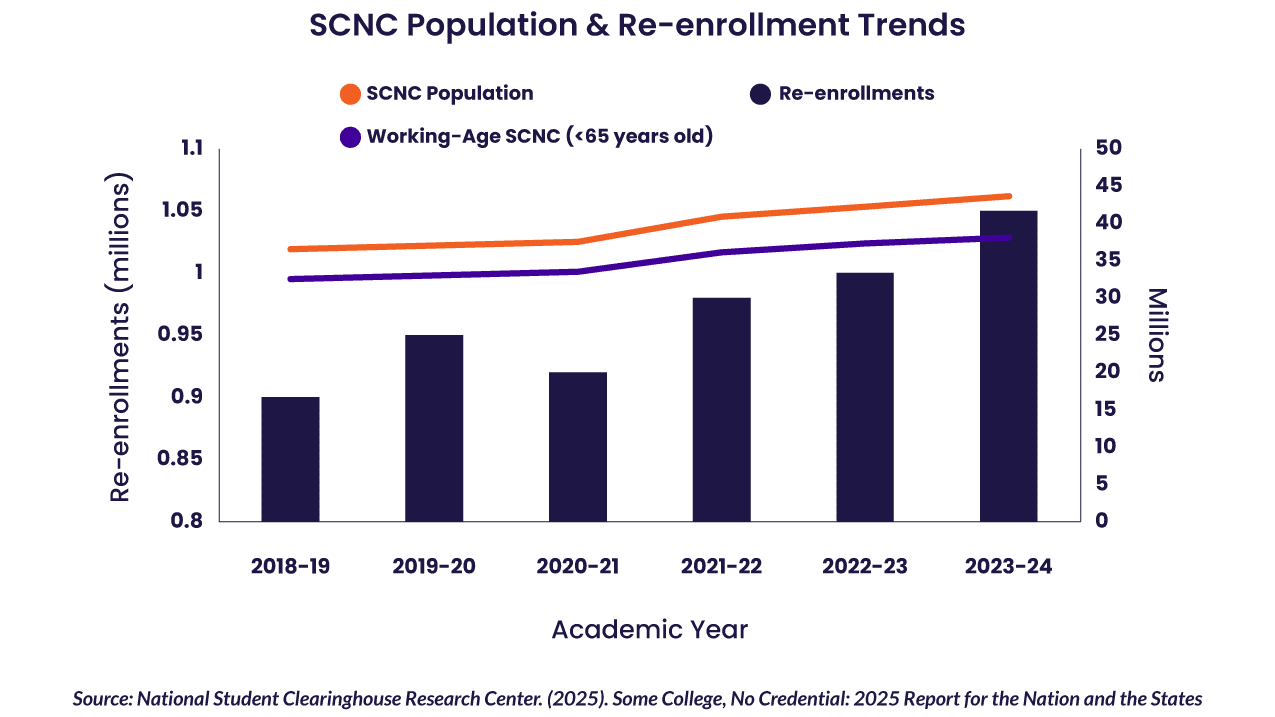
    • “Some college, no credential” learners returning to finish what they started 

    The lines between traditional and nontraditional students have disappeared. These aren’t separate segments—they’re one unified audience shaping the future of higher education.

    Leaders who continue to operate with outdated distinctions risk designing strategies for a market that no longer exists. Modern Learners value cost, convenience and career outcomes—and they expect institutions to deliver all three.

    This is the moment to retire the old playbook, embrace a new mindset and build for the learner who’s already redefining what comes next.

    Key Takeaway #3: AI Is an Unmistakable Force with Far-Reaching Implications 

    AI is accelerating change across every dimension of higher education, from how institutions engage to how graduates build careers. 

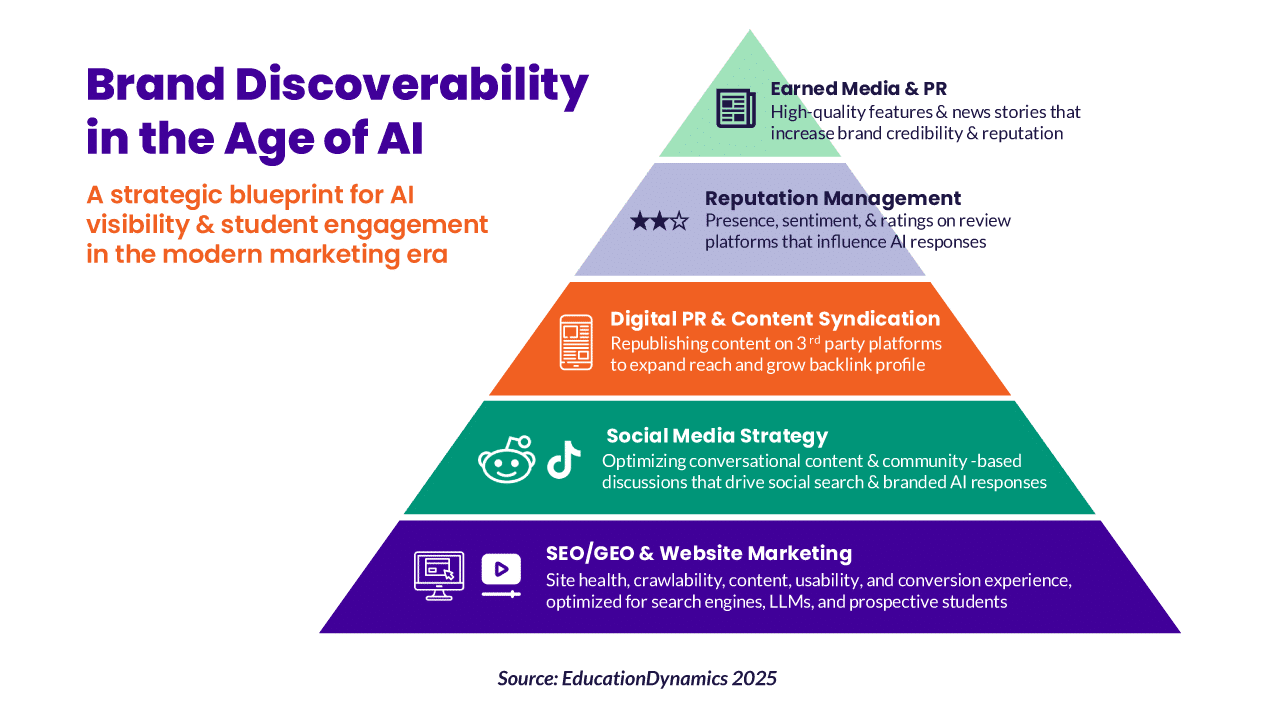
    While the technology itself isn’t new, its rapid integration is rewriting the rules. AI has fractured the traditional recruitment funnel. Modern Learners use AI-powered tools to search, compare and evaluate options before they reach an institution’s website. The student journey is now self-directed, hyper-personalized and constantly evolving, demanding that marketing and enrollment teams adapt in real time. 

    But AI’s impact extends far beyond recruitment. Its growing influence in the workforce is forcing institutions to rethink their academic mission. Institutions that lead will design education for the AI era by combining technical fluency with human-centered skills such as creativity, critical thinking and ethics. 

    Key Takeaway #4: AI Is an Unmistakable Force with Far-Reaching Implications 

    Incrementalism is now the greatest risk. In an age of constant disruption, small adjustments and siloed strategies hinder growth. The institutions that succeed will lead with clarity, agility and a unified vision centered on the Modern Learner. 

    Sustained growth demands leadership that acts decisively across three dimensions: 

    1. Align program portfolios with high-growth sectors. Move beyond tradition-bound curriculums. Invest in programs that meet labor-market demand and retire those that no longer serve a clear purpose. 
    2. Unify brand and enrollment strategies. The boundaries between undergraduate, graduate and online student populations are disappearing. Institutions must speak with one voice and focus on the three factors that drive every learner’s decision: cost, convenience and career outcomes. 
    3. Lead the conversation on value and outcomes. Public trust cannot be rebuilt through messaging alone. It must be earned through transparency, data and measurable results.

    This is the moment that will define the next decade of higher education. The difference between survival and sustainable growth hinges on decisive, informed action. Leaders must either seize this moment to shape the future or watch their institutions be defined by it. 

    From Insight to Action: Ten Strategic Imperatives for Sustainable Growth 

    The era of incremental adjustment is over. Conviction is now the currency of leadership. This moment demands bold leadership and a decisive strategy that converts disruption into a roadmap for measurable growth. 

    The EducationDynamics’ 2026 Landscape of Higher Education Report delivers that roadmap. Our Ten Strategic Imperatives are pragmatic, research-driven levers designed to help your institution build resilience and sustainable momentum for 2026 and beyond. 

    Imperative #1: Prove Outcomes. Protect Reputation.  

    Publish transparent results and illustrate career alignment to help students understand program value. 

    Imperative #2: Market ROI Relentlessly. 

    Lead with affordability and clearly communicate a projected and proven return on investment. 

    Imperative #3: Capture the Dual Enrollment Surge.   

    Build structured high school-to-degree pipelines. 

    Imperative #4: Own the Adult Learner Market.

    Offer flexible, online and stackable options with the support working learners need to balance their multiple priorities. 

    Imperative #5: Prioritize Accessibility through the Three C’s.  

    Deliver education that meets learners on cost, convenience and career outcomes. 

    Imperative #6: Lead in Responsible AI Adoption.  

    Optimize marketing for AI discoverability and AI powered platforms, while Integrating AI into advising, engagement and instruction. 

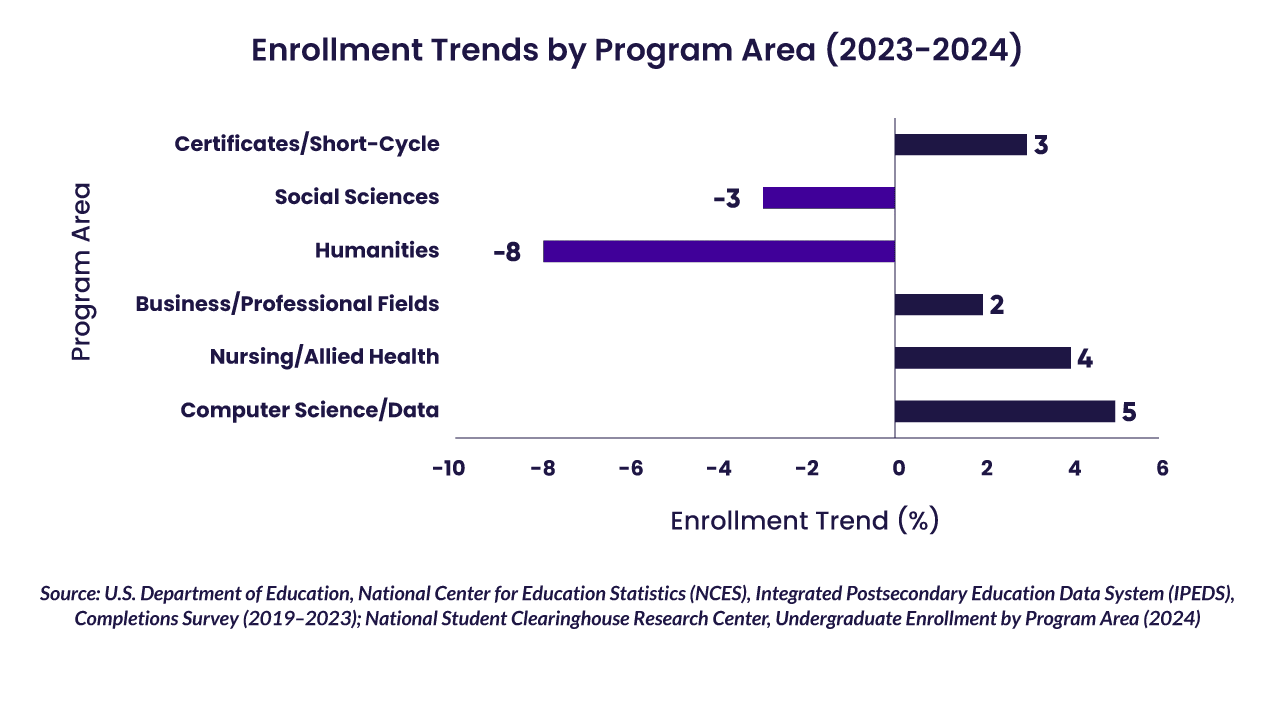
    Imperative #7: Reinvent Vulnerable Disciplines.  

    Reframe liberal arts around adaptability and skills attainment. 

    Imperative #8: Re-engage the Stopped-Out Majority. 

    Convert the 43 million with some college, no credentials into completers through credit recovery, tailored pathways and adult-first design. 

    Imperative #9: Stack Credentials into Careers.  

    Link short-term certificates to degree pathways. 

    imperative #10: Advocate for Policy Stability. 

    Simplify aid communication and push for predictable funding. 

    Together, these imperatives form a blueprint for how higher education can evolve from reactive adaptation to proactive growth. 

    Transform Disruption into Growth

    The time for caution has passed. Those who hesitate or fail to act with purpose will fall behind in a marketplace that does not wait. 

    At EducationDynamics, we partner with colleges and universities prepared to lead this transformation—those who understand that meeting the Modern Learner where they are is not just an enrollment strategy but the new mission of higher education. 

    For deeper insights and actionable strategies, download the full 2026 Landscape of Higher Education Report and learn how your institution can stay ahead of the curve. 

    Source link

  • The Supreme Court should strike down Colorado’s ban on ‘conversion therapy.’ Here’s why.

    The Supreme Court should strike down Colorado’s ban on ‘conversion therapy.’ Here’s why.

    Last week, the Supreme Court heard oral argument in Chiles v. Salazar, a First Amendment challenge to Colorado’s ban on “conversion therapy” — that is, counseling intended to change their gender identity or attraction to someone of the same sex. The case has attracted widespread attention because conversion therapy is deeply controversial. But the Court’s decision is poised to have significant consequences far beyond the practice — so to protect free expression, the Court should find the law unconstitutional.  

    That’s because Chiles hinges on one of the central questions in First Amendment jurisprudence: When do words become functionally indistinguishable from conduct? 

    The First Amendment broadly protects speech, including expressive actions like holding a sign or marching in a protest. But conduct — assault, for example, or drunk driving — is fair game for the government to regulate and/or criminalize. When speech is inextricably linked to certain conduct, it may lose First Amendment protection. 

    The classic example is incitement — speech intended to and likely to result in imminent lawless action. Because the words are so closely tied to the immediate crime that’s all but certain to result, incitement isn’t protected by the First Amendment. That’s a high bar to meet, because we Americans value freedom of speech and are rightly wary of government control. 

    In defense of fiery words

    In the wake of political violence, calls to criminalize rhetoric are growing louder. But Brandenburg v. Ohio set the bar — and it’s a high one.


    Read More

    But deciding exactly where to draw the line between speech and conduct can be sharply contested — as in Kaley Chiles’ case. 

    Conversion therapy has a longpainful history. For many years, being anything other than “straight” was socially taboo and widely criminalized; until 1974, homosexuality was listed in the Diagnostic and Statistical Manual of Mental Disorders. Attempts to “cure” people of their sexuality or gender identity were widespread and took a variety of forms, including the use of electric shocks or chemicals. Now, groups like the American Psychiatric Association, the American Counseling Association, and the American Medical Association oppose conversion therapy, linking it to negative mental health outcomes and even suicide. And today Colorado is one of 27 states that ban counselors from engaging in conversion therapy with minors. 

    But let’s say some conversion therapy doesn’t include shock treatments, medicine, or any physical conduct. Suppose instead it consists solely of a counselor and a client talking to each other. It would still be prohibited by Colorado’s law, which bans counselors from any practice that “attempts or purports to change an individual’s sexual orientation or gender identity, including efforts to change behaviors or gender expressions or to eliminate or reduce sexual or romantic attraction or feelings toward individuals of the same sex.” And the prohibition includes situations where individuals seek out such advice.

    That’s why Kaley Chiles, a counselor in Colorado, filed a First Amendment challenge to the law in September 2022. Chiles alleged the law prevented her from providing “licensed, ethical, and professional counseling that honors her clients’ autonomy and right to self-determination,” explaining that “speech is the only tool” she uses in her counseling. Consequently, she argued, banning her speech-only counseling violates the First Amendment.

    A federal district court disagreed. Rejecting Chiles’ challenge, the district court held the ban was a “public health law” that “regulates professional conduct rather than speech.” In other words, Chiles’ conversation was more than just talk, but rather treatment, and thus the law’s impact on Chiles’ ability to communicate with clients was “incidental to the professional conduct it regulates.” 

    Talk therapy is speech. And when the government prohibits speech because it doesn’t like the views being expressed, it violates the First Amendment.

    Chiles appealed to the U.S. Court of Appeals for the Tenth Circuit, arguing the district court got it wrong by treating her counseling as “medical treatment” instead of “a client-directed conversation consisting entirely of speech.” But the Tenth Circuit affirmed the district court. It concluded that Colorado’s law “does not regulate expression,” but rather “the provision of a therapeutic modality — carried out through use of verbal language — by a licensed practitioner authorized by Colorado to care for patients.” 

    Can a College that Protects Free Speech be ‘Gay-Friendly’?

    There’s no need to sacrifice free speech for a campus to be accepting of LGBT students.


    Read More

    So Chiles sought review by the Supreme Court of the United States. She asked the Court to resolve the split between the circuit courts of appeal — with the Ninth and now Tenth Circuits treating conversion therapy bans as permissible regulations of professional speech, and the Eleventh Circuit on the other side. (A 2014 Third Circuit case involving New Jersey’s ban on conversion therapy rejected the “counter-intuitive conclusion” that a counselor’s talk therapy with clients constitutes “conduct.”) 

    At base, Chiles asked the Court to separate regulable conduct from protected speech. The Court agreed to hear her case — and at oral argument last week, the justices focused on exactly that question.

    In response to a question from Justice Jackson, for example, exploring what differentiates Chiles from “a medical professional who has exactly the same goals, exactly the same interests, and would just be prescribing medication for that rather than her talking with the client,” James Campbell, Chiles’ counsel, replied: “Because this involves a conversation,” not conduct. If the “treatment” at issue “consists only of speech, then it doesn’t trigger the speech-incidental-to-conduct doctrine.” 

    Campbell emphasized that Chiles’ therapy is different from medical practices involving conduct, characterizing her interactions with clients as “an ongoing, active dialogue where she’s helping them to explore their goals, and that absolutely has to be protected by the First Amendment.” That’s an important point. And it’s worth emphasizing that Chiles’ clients seek out her help; there’s no deception involved. As Chiles put it in her complaint, she “sits down with her clients and talks to them about their goals, objectives, religious or spiritual beliefs, values, desires, and identity to help them (1) explore and understand their feelings and (2) formulate methods of counseling that will most benefit them.”

    When Justice Kagan and Chief Justice Roberts pressed Campbell on the same point, he readily granted that if Chiles’ practice involved more than talk therapy — “administering drugs, performing procedures, conducting examinations” — the analysis would be different. If Chiles’ speech was “describing how to take the medication,” for example, it would properly be considered incidental to the conduct of prescribing medication. 

    But Colorado’s law regulates Chiles’ speech — and as some justices noted, it does so on the basis of viewpoint. Treating speech differently on the basis of viewpoint is anathema to the First Amendment, which bars the government from placing a thumb on the scale in favor of certain beliefs while punishing others. 

    In an exchange with Shannon Stevenson, Colorado’s solicitor general, Justice Alito argued the law applies unequally, sketching out a hypothetical to illustrate his point: 

    So, in the first situation, an adolescent male comes to a licensed therapist and says he’s attracted to other males, but he feels uneasy and guilty with those feelings, he wants to end or lessen them, and he asks for the therapist’s help in doing so. 

    The other situation is a similar adolescent male comes to a licensed therapist, says he’s attracted to other males, feels uneasy and guilty about those feelings, and he wants the therapist’s help so he will feel comfortable as a gay young man. 

    It seems to me . . . your statute dictates opposite results in those two situations based on the view — based on the viewpoint expressed. One viewpoint is the viewpoint that a minor should be able to obtain talk therapy to overcome same-sex attraction if that’s what he — or he or she wants. And the other is the viewpoint that the minor should not be able to obtain talk therapy to overcome same-sex attraction even if that is what he or she wants.

    “Looks like blatant viewpoint discrimination,” concluded the justice. 

    Justice Kagan echoed Justice Alito’s concern. “If a doctor says, I know you identify as gay and I’m going to help you accept that, and another doctor says, I know you identify as gay and I’m going to help you to change that, and one of those is permissible and the other is not,” she suggested, “that seems like viewpoint discrimination in the way we would normally understand viewpoint discrimination.” 

    Relatedly, Justice Barrett and Justice Gorsuch pressed Stevenson on whether other states could pass a “mirror image” law that, as Justice Gorsuch put it, “prohibits any attempt to affirm changes of gender identity or sexual orientation.” In response to questioning from Justice Gorsuch, Stevenson conceded that under Colorado’s position, a state in the 1970s would not have violated the First Amendment by passing a law prohibiting a “regulated licensed professional from affirming homosexuality.” And Justice Barrett asked whether a state could simply “pick a side” after Stevenson argued Colorado’s law should receive less judicial scrutiny than a hypothetical mirror image law would receive. “Counsel, it’s pretty important that I think about how this would apply to cases down the road,” said Justice Barrett. 

    No gay rights without free expression

    FIRE’s latest rankings show alarming support for censorship among LGBT students. But as Kirchick explains, there would be no LGBT rights without free speech.


    Read More

    Justice Barrett’s focus on the possible ramifications of the Court’s ruling is apt, because Chiles’ case raises an even bigger question than whether bans on conversion therapy are constitutional. It asks the Court to draw a clearer line delineating conduct and speech in the professional context. That’s important, because both Colorado’s law and the lower courts’ rulings blur that line in ways that are ripe for abuse. 

    To be sure, attempts to recast protected speech as punishable conduct are evergreen, and this is not unfamiliar territory for the Supreme Court. Back in 2018, the Court warned that “regulating the content of professionals’ speech ‘pose[s] the inherent risk that the Government seeks not to advance a legitimate regulatory goal, but to suppress unpopular ideas or information.’” And some lower courts have rightly rejected exactly government attempts to do just that. 

    In 2002, for example, the Ninth Circuit blocked enforcement of a federal government policy threatening doctors who discussed medical marijuana with their patients with the loss of the ability to prescribe drugs. As the Ninth Circuit noted, doctors “must be able to speak frankly and openly to patients,” and restrictions on their ability to do so “strike at core First Amendment interests of doctors and patients.” 

    And just two years ago, a federal district court ruled a California law that defined “unprofessional conduct” for doctors to include efforts to “disseminate misinformation or disinformation related to COVID-19” to be likely unconstitutional. The court found the law’s terms were impermissibly vague — noting, for example, that the state was unable to demonstrate that “‘scientific consensus’ has any established technical meaning.”  

    But if the Supreme Court upholds Colorado’s law, these rulings could be in doubt. A win for Colorado would embolden government actors to impose broad viewpoint-based restrictions on a wide variety of professional speech disguised as regulations on “conduct.”

    Your right to talk freely with your counselor or your doctor shouldn’t depend on what state you’re in.

    That possibility should worry everyone, no matter your views on conversion therapy. As several justices pointed out during oral argument, this government power could just as easily be wielded in ways that proponents of conversion therapy bans would find objectionable. As Reason senior editor Elizabeth Nolan Brown noted, a ruling upholding Colorado’s law would “pave the way for talk therapy restrictions based on conservative views of sexuality and gender, too.” 

    She’s right. It’s too easy to imagine a red-and-blue patchwork of state bans barring counselors from either conversion therapy, on one side, or gender affirmation, on the other. Same for conversations about abortion — or vaccines, or marijuana, or assisted suicide, or any number of culture war flashpoints. But your right to talk freely with your counselor or your doctor shouldn’t depend on what state you’re in. The government shouldn’t be able to rule some subjects out of bounds, impeding professionals’ ability to meet a client’s individual needs. 

    It’s important to remember that new, viewpoint-based laws aren’t necessary for imposing consequences against professionals who harm their clients. That’s what licensure, standards of care, and malpractice suits are for. If a professional in Colorado or California engages in professional misconduct, they may properly be punished.

    But talk therapy is speech. And when the government prohibits speech because it doesn’t like the views being expressed, it violates the First Amendment. The Court should strike down Colorado’s law.

    Source link