Author: admin

  • Neurodiverse leadership is a quality issue for universities, not a side project 

    Neurodiverse leadership is a quality issue for universities, not a side project 

    Author:
    Imran Mir

    Published:

    This guest blog was kindly authored by Imran Mir, Campus Head and Programme Lead, Apex College Leicester 

    Leadership in higher education is often measured by indicators such as retention rates, research outputs and league table positions. These are important, but leadership is far deeper than numbers. Growing up with autism and then becoming a leader in higher education has shaped how I approach leadership. Being neurodiverse means I see situations differently, notice patterns others may miss, and feel deep empathy with students and colleagues who are often invisible in our systems. 
     
    This is why neurodiverse leadership must be treated as a quality issue. Universities are rightly talking more about inclusive curriculum design and student support, but these conversations rarely extend to who sits at the decision-making table. Representation in leadership is not about tokenism. It is about ensuring the sector benefits from different ways of thinking, which is vital for quality, resilience and innovation.

    Why neurodiverse leadership matters

    According to the University of Edinburgh 2024, in the UK, one in seven people are neurodiverse. Advance HE 2024 report shows leadership teams in higher education remain overwhelmingly homogenous. This lack of representation is not just an issue of fairness, it is also a missed opportunity for innovation. Research by Deloitte 2017 shows that neurodiverse teams can be up to 30 per cent more productive in tasks requiring creativity and pattern recognition. Universities are currently facing challenges in relation to funding and digital disruption, and they will need this kind of productivity and resilience more than ever. 
     
    Further, Made By Dyslexia 2023 claims that one in five people are dyslexic, many of whom bring excellent problem-solving and communication skills. These strengths align with what is expected in leadership roles, where complex challenges and clear communication are requirements. Yet recruitment and promotion processes can often filter out people who think or communicate differently. 
     
    Austin & Pisano, 2017 adds that neurodiverse leaders frequently demonstrate empathy and adaptability. These qualities are imperative in higher education as institutions are trying their best to meet diverse student needs, respond to rapid change and rebuild trust in their systems. Without neurodiverse leadership, universities risk reinforcing the very barriers which they are trying to eradicate. 

    Lessons for higher education leaders

    From my own experience, I have learned three lessons that apply directly to leadership in higher education. 
     
    The first lesson is the power of clarity. Neurodiverse staff and students excel when expectations are clear. As a leader, I have seen first-hand that communicating with clarity in strategy documents, policies and day-to-day interactions builds trust in the academic institution. Research on organisational effectiveness suggests that clear communication consistently improves outcomes across diverse teams  
     
    The second lesson is valuing flexibility. Traditional recruitment, professional development and promotion systems seem to reward conformity. This is a missed opportunity because neurodiverse teams will bring innovation and productivity benefits. Strong leaders can change this by adopting flexible approaches such as task-based interviews, blended assessments that combine written, oral and practical elements, and CPD which takes into consideration various communication styles. 

    The third lesson is role modelling openness. For years I believed that revealing my autism would be seen as a weakness. In reality, sharing my story has made me a stronger leader. It has encouraged colleagues to be open about their own experiences and helped students feel less isolated. Austin & Pisano 2017 show that when leaders model vulnerability and authenticity, it strengthens organisational culture and increases trust across teams. 

    A quality issue, not a side project

    These lessons outline why neurodiverse leadership should not be viewed as a side project. Quality frameworks such as the Office for Students’ conditions and the QAA Quality Code are built on assumptions of fairness, reliability and inclusivity. If leadership itself is not inclusive, then the credibility of these frameworks is undermined. If the voices of the one-in-seven neurodiverse people are not present in leadership, then universities are failing to reflect the diversity of the communities they are trying to serve.  
     
    Neurodiverse leadership will strengthen governance, enhances decision-making and ensures policies reflect the diversity of the student body. It is a direct contributor to educational quality, not an optional extra.

    Conclusion

    As someone working in higher education, I know these lessons are transferable across the sector. But they feel especially urgent now, as universities face funding pressures, digital disruption and growing student expectations. In such times, leaders who think differently are not optional. They are essential. 
     
    Neurodiverse leadership is not about meeting quotas. It is about strengthening quality. The sector cannot afford to waste talent or exclude perspectives that could help it adapt and thrive. If universities want to remain resilient, they must recognise that diversity of thought at the leadership table is just as important as diversity in the classroom. At its heart, this is about shaping the future of higher education in a way that is inclusive, innovative and sustainable. 

    Source link

  • What is Civic Courage? A Conversation for Faculty and Educators with Dr. Brielle Harbin

    What is Civic Courage? A Conversation for Faculty and Educators with Dr. Brielle Harbin

    Dr. Brielle Harbin helps educators prepare to practice civic courage. She supports faculty and leaders that it’s okay to feel discomfort. Learn why it’s necessary to practice ‘civic courage,’ a term she coined.

    Discomfort and difference is a natural part of the learning process. Dr. Brielle Harbin found ‘civic courage’ better emphasizes the importance of embracing that discomfort instead of minimizing or avoiding it.

    Yes, it feels safer to retreat from discomfort, feelings like:

    • Racing heartbeat
    • Your body tensing up
    • A feeling in your stomach
    • Rolling your eyes
    • A tinge of irritation

    Dr. Brielle Harbin says, “You have to acknowledge the idea that it actually feels safer to retreat, but decide to not do it anyway.”

    When people embrace the power of connection, when we share our ideas and engage in conversations, we can help more people. I’m delighted to share this conversation about civic courage with you. This is The Social Academic podcast with Jennifer van Alstyne. Thank you!

    0:00 Dr. Brielle Harbin on Civic Courage for Educators
    1:37 Dr. Harbin’s Path to Empowering Educators and Recognizing Burnout
    6:04 Coining Civic Courage: Leaning into Discomfort for Growth
    10:02 Building Community Through Substack (Notes From A Work Friend)
    15:57 The Power of One: Amplifying Voices and Serving Others Online
    26:32 Developing Civic Courage: A Journey of Worthiness and Unlearning
    30:42 Embracing Authenticity and Engaging with Dr. Brielle Harbin

    Subscribe to The Social Academic blog.

    The form above subscribes you to new posts published on The Social Academic blog.
    Want emails from Jennifer on building your online presence? Subscribe to her email list.
    Looking for the podcast? Subscribe on Spotify.
    Prefer to watch videos? Subscribe on YouTube.

    A full text version of this episode will be added here in the next 1-2 weeks.

    Bio

    Photo by Stacy Godfrey

    Dr. Brielle Harbin is a political scientist, award-winning educator, and keynote strategist who helps colleges and faculty cultivate civic courage and sustainable academic systems. As the founder of Your Cooperative Colleague LLC, Brielle partners with higher education leaders to move their institutions from compliance and burnout toward belonging, creativity, and care. Her work centers nervous-system-aligned writing, ethical leadership, and faculty well-being as catalysts for innovation.

    Through her flagship programs—Faculty Writing Rituals Unlocked, Steady Strides, and Steady in the Storm—she helps educators build restorative, purpose-driven writing practices that last beyond the semester.

    A former tenured associate professor and public scholar, Brielle’s research and consulting focus on civic courage as a framework for leading change inside systems not built for everyone’s thriving. Her weekly newsletter, Notes From a Work Friend, offers practical and soulful reflections for faculty navigating the realities of academic life.

    You can learn more about her work at YourCooperativeColleague.com

    Or, on Substack at NotesFromAWorkFriend.substack.com

    Source link

  • Supporting the Supporters: Promoting Educators’ Mental Health – Faculty Focus

    Supporting the Supporters: Promoting Educators’ Mental Health – Faculty Focus

    Source link

  • Supporting the Supporters: Promoting Educators’ Mental Health – Faculty Focus

    Supporting the Supporters: Promoting Educators’ Mental Health – Faculty Focus

    Source link

  • Expert council on governance reports – Campus Review

    Expert council on governance reports – Campus Review

    Universities will be required to justify how much is spent on consultants and disclose whether vice-chancellors are drawing multiple incomes as recommended by a governance committee on Saturday.

    Please login below to view content or subscribe now.

    Membership Login

    Source link

  • Canberra finds staff underpaid $1.5m – Campus Review

    Canberra finds staff underpaid $1.5m – Campus Review

    The University of Canberra will review casual academic staff payslips after it found professional employees have been underpaid over $1.5 million over six years.

    Please login below to view content or subscribe now.

    Membership Login

    Source link

  • Staff opinion of using AI – Campus Review

    Staff opinion of using AI – Campus Review

    To continue onto Campus Review, please select your institution.

    Source link

  • Subcontractual higher education beyond the headlines

    Subcontractual higher education beyond the headlines

    We’ve written a lot about subcontractual provision on Wonkhe, and it is fair to say that very little of it has been positive.

    What’s repeatedly hit the headlines, here and elsewhere, are the providers that teach large numbers of students in circumstances that have sparked concerns about teaching quality, academic standards, and indeed financial probity or even ethics.

    There are a fair number of students that are getting a very bad deal out of subcontractual agreements and, although we’ve been screaming about this for several years, it is good to finally see the beginnings of some action.

    Student number tools

    The long-awaited release of OfS data is not perfect – there’s lots that we’d love to see that does not appear to have been delivered. One of these is proper student numbers: it should be possible to see data on how many students are studying at each subcontracted provider at the last census point.

    Instead, we are scrabbling around with denominators and suppressions trying to build a picture of this part of the sector that is both heavily caveated and three years out of date. This isn’t good enough.

    And it is a shame. Because as well as the horror show, the data we do have offers a glimpse of a little known corner of higher education that arguably deserves to be celebrated.

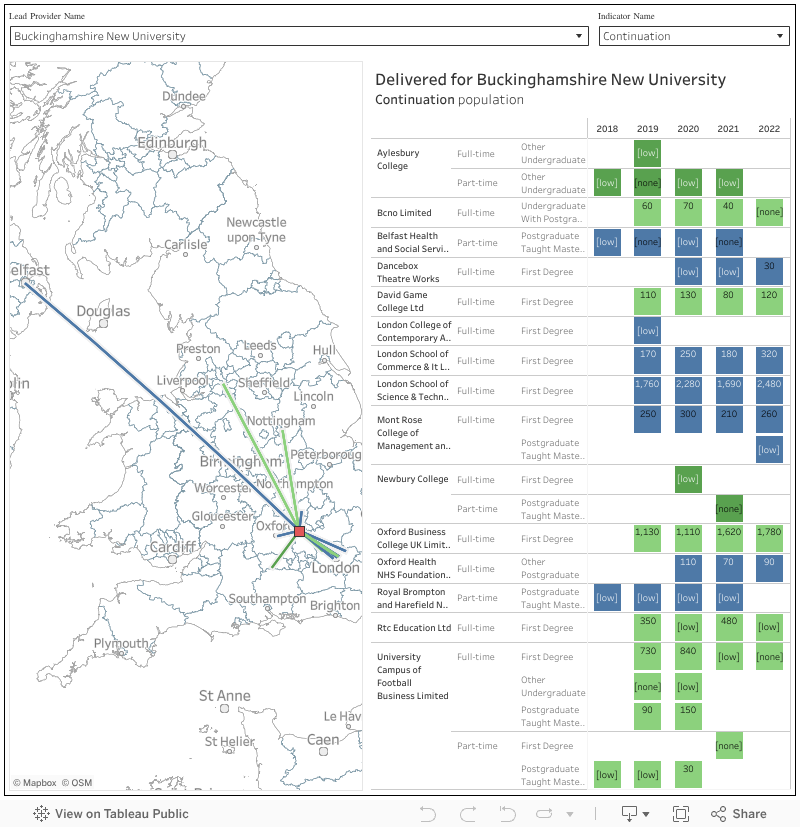
    I’ve developed some new visualisations to help you explore the data – these add substantial new features to what I have previously published. Both these dashboards work in broadly the same way – the first allows you to examine relationships at delivery providers, the second at lead providers. You choose your provider of interest at the top left, which shows the various relationships on a map on the left hand side. On the right you can see denominator numbers for each year of data – you can use the filter at the top right to see information about the total number of students who might be continuing, completing, or progressing in a given year.

    Each row on the right hand side shows a combination of provider (lead provider on the first dashboard, delivery provider on the second), mode, and level – with denominators and suppression codes available in the coloured squares on the right. The suppression codes are as follows:

    • [DQ]: information suppressed due to low data quality from the 2022-23 collection
    • [low]: There are more than 2 but fewer than 23 students in the denominator
    • [none]: There are 2 students or fewer in the denominator
    • [DP]: Data redacted for reasons of data protection
    • [DPL]: Data redacted for reasons of data protection (very low numbers,
    • [DPH]: Data redacted for reasons of data protection (within 2 of the denominator)
    • [RR] below threshold response rate (for progression)
    • [BK] no benchmarks (the benchmark includes at least 50 per cent of the provider’s students)

    You can see available indicators (including upper and lower confidence intervals at 95%), benchmarks, and numeric thresholds by mousing over one of the coloured squares. The filled circle is the indicator, the outline diamond is the benchmark, and the cross is the threshold.

    [Full screen]

    [Full screen]

    A typology

    It’s worth noting the range of providers that are subcontracted to deliver higher education for others. There were an astonishing 681 of these between 2014 and 2022.

    A third of those active in delivering provision for others (227) are registered with the Office for Students in their own right. Fifty-nine of these are recognisable as universities or other established higher education providers – including 14 in the Russell Group.

    Why would that happen? In some cases, a provider may not have had the degree awarding powers necessary for research degrees, so would partner with another university to deliver particular courses. In other cases, the peculiarities of this data mean that apprenticeship arrangements are shown with the university partner. There’s also some examples of two universities working together to deliver a single programme.

    We also find many examples of longstanding collaborations between universities and teaching organisations in the arts. Numerous independent schools of dance, drama, and music have offered higher education qualifications with the support of a university – the Bird School’s relationship with the Doreen Bird College of Performing Arts began in 1997. Italia Conti used to have an arrangement with the University of East London, it now works with the University of Chichester.

    There are 135 organisations delivering apprenticeships in a relationship with an OfS-registered higher education provider. Universities often offer end point assessment and administrative support to employers and others who offer apprenticeships between level 4 and level 7.

    Two large providers – Navitas and QA – offer foundation courses and accredited year one courses for international students at UK universities: QA also offers a range of programmes aimed at home undergraduates. We could also add Into as a smaller example. This dataset probably isn’t the best place to see this (QA is shown as multiple, linked, organisations) but this is a huge area of provision

    Seventy-four subcontracted providers are schools, or school centred initial teacher training (SCITT) organisations. As teacher training has gradually moved closer to the classroom and away from the lecture hall, many schools offer opportunities to gain the industry-standard Postgraduate Certificate in Education (PGCE), which is the main route to qualified teacher status. A PGCE is a postgraduate qualification and is thus only awarded by organisations with postgraduate degree awarding powers.

    In total there are 144 providers subcontracted to deliver PGCE (initial teacher training) courses, primarily schools, local councils, and further education colleges (FECs). There are 166 FECs involved in subcontracted delivery – and this extends far beyond teacher training. Most large FECs have a university centre or similar, offering a range of foundation and undergraduate courses often (but not always) in vocational subjects. The Newcastle College Group used its experience of delivering postgraduate taught masters courses for Canterbury Christ Church University to successfully apply for postgraduate degree awarding powers – the first FEC to do so.

    We find 23 NHS organisations represented within the data. Any provider delivering medical, medical related, or healthcare subjects will have a relationship with one or more NHS foundation trust – as a means to offer student placements, and bring clinical expertise into teaching. This is generally an accreditation requirement. But in many cases, the relationship extends to the university awarding credit or qualifications for the learning and training that NHS staff do. The Oxford Health NHS Foundation Trust works with multiple providers (the University of Oxford, Oxford Brookes University, and Buckinghamshire New University), to offer postgraduate apprenticeships in clinical and non-clinical roles.

    Nine police organisations (either constabularies or police and crime commissioners) have subcontractual relationships with registered higher education providers. Teesside University works with the Chief Constable of Cleveland to offer an undergraduate apprenticeship for prospective police officers.

    All three of the UKs armed forces have subcontractual relationships with higher education providers. The British Army currently works with the University of Reading to offer undergraduate and postgraduate degrees in leadership and strategic studies – in the past it has offered a range of qualifications from Bournemouth University. Kingston University has a relationship with the Royal Navy, currently offering an MSc in Technology (Maritime Operations) undertaken entirely in the workplace.

    Ecosystem

    When I talk to people about franchise and partnership arrangements, most (perhaps thinking of the examples that make the mainstream press) ask me whether it would not be easier to simply ban such arrangements. After all, it is very difficult to see any benefit from the possibly fraudulent and often low quality behavior that is plastered all over The Times on a regular basis.

    As I think the data demonstrates, a straight-ahead ban would be hugely damaging – swathes of national priorities and achievements (from NHS staff development, to offering higher education in “cold spots”, to the quality of performances on London’s West End) would be adversely affected. But the same could be said for increases in regulatory overheads.

    There are a handful of very large providers (I’d start with Global Banking School, Elizabeth School of London, Navitas, QA, Into, London School of Science and Technology, and a few others – and from the data you’d have included Oxford Business Colleges) that are, effectively, university-like in size and scope. It is very difficult to understand why these are not registered providers given the scale of their operations (GBS, Into, and Navitas already are) and this does seem to be the right direction of travel.

    There are a clutch of medium-sized delivery providers, often in a single long-standing relationship with a higher education institution. Often, these are nano-specialisms, particularly in the creative arts or in locally important industries. In many of these cases oversight on quality and standards from the lead provider has been proven over a number of years to work well – and there seems little benefit to changing this arrangement. I would hope for this group – as is likely to happen for the FECs, SCITTs, NHS, police, and armed forces – that a change to regulatory oversight only happens where there is an issue identified.

    There is also a long tail of very small arrangements, often linked to apprenticeships (and regulated accordingly). For others at this end of the scale it is difficult to imagine OfS having the time or the capacity to regulate, so almost by default oversight remains with the lead partners. I know I say this in nearly every article, but at this end it feels like we need some kind of regular review of the way quality processes work for external providers within lead providers – we need to be sure lead providers are able to do what can be a very difficult job and do it well.

    Source link

  • How higher education became a get rich quick scheme

    How higher education became a get rich quick scheme

    Sometimes, the problem with both media coverage and regulation is that critique of a part of the sector taints it all.

    When ministers or media outlets find sharp practice in recruitment or failings in student support, everything from OfS Insight Briefs to Sunday Times splashes can feel like the whole class being kept in for lunch when you weren’t making any noise.

    So has been the case for franchising. A specific group of universities has been subcontracting out to a specific group of private colleges in recent years – a group which has rightly picked up attention from the media, the National Audit Office (NAO), the Public Accounts Committee (PAC), the Office for Students (OfS), the Student Loans Company (SLC) and the Department for Education (DfE).

    Independent HE, for example, have argued elsewhere on the site that while they strongly support a tougher regime around franchising, the proposed approach of requiring only larger providers (300+ students) to register would be insufficient – missing many bad actors while creating administrative bottlenecks and failing to hold lead providers properly accountable for their partners. Instead, they advocate for universal basic registration for all teaching providers.

    Now, following last week’s long-awaited publication of data on subcontractual partnerships from OfS, we’re pretty confident that it’s possible to isolate and identify a specific subset of undergraduate providers in the English sector.

    Its defining characteristics are that its providers are privately owned, are (very much) for-profit, deliver non-specialist courses principally in Business and Management, and have been (very) rapidly expanding in recent years.

    Last year OfS said that in some cases there has been an “exponential growth” in student numbers in subcontractual partnerships over the last few years, with some lead providers now teaching more students through these arrangements than directly on their own campuses.

    It said that among other potential concerns, this raises questions about the direction of travel for the lead provider’s own strategic identity, aims and objectives.

    Our definition of a specific sub-sector is not perfect. There are a number of providers whose wholly-owned or directly-delivered satellite campus operations share some of those characteristics. Student numbers have not been formally published, and as ever there is lag in the data in general.

    In 2023-24, OfS’ student characteristics data dashboard shows that there were 101,950 students enrolled overall on subcontracted Business and Management courses – up from just 5,630 a decade ago.

    And if we derive from full-time, first degree continuation statistics, aggregate where companies are owned by the same parent, and attach those characteristics to partnerships where the entrant population was 100 or more in 2023-24, we can see 16 providers that enrolled over 40,000 FT FD entrants in 2022.

    Below threshold

    Aggregating both multiple providers in a group, and this sub set in general, is not an exact science. For each partnership between a university and private college, OfS has only published a denominator population rounded to 5 – which makes precision impossible. But we can estimate this sub group’s outcomes “performance” by implying a numerator from the percentages, and recompiling the numbers.

    The result is not stellar. In OfS’ press release to accompany the data, we learned that 77 per cent of FT FD subcontracted students continued courses into a second year, compared to 88 per cent in the sector as a whole. Against a regulatory minimum of 80 per cent, this group of providers averaged just 70 per cent.

    We learned that 74 per cent of subcontracted students completed their course, compared to 87 per cent for the sector as a whole and a regulatory minimum of 75 per cent. This subgroup scored just 70 per cent.

    The further out that a metric is from when students start, the longer it takes to pick up results – a real regulatory issue in a subsector that is expanding so rapidly. But when we look at progression to a graduate job or further study, it’s 71 per cent for the sector as a whole, 57 per cent of subcontracted students, and just 53 per cent of this subsector – against a regulatory minimum of 60 per cent.

    These providers are almost certainly inflating the sector’s performance on access – especially for those who are doing the franchising-to – access and participation stats are not (yet) split by partnership. But they are also dragging down the sector’s performance on outcomes, and giving subcontracting a bad name – all three of the key metrics would likely be above threshold if this group was removed.

    More importantly, if we follow OfS’ logic on outcomes and thresholds – that the figures are signals of whether students have the potential to succeed on the course, and receive good teaching and support through their studies – the group has been expanding yet failing.

    One area, though, where the group is not failing, is on financial performance.

    Healthy profits

    In 2023, the Russell Group estimated that in 2022/23, English universities on average supplemented the cost of educating each UK undergraduate student by £2,500 per year, with all subjects now making a loss on average.

    Not so much here in this sub sector. Because most of the 18 providers are not on the OfS register, the format (and even visibility) of annual accounts is uneven. Financial years and levels of disclosure differ, some are showing on Companies House as posting accounts late, and in many cases some of the income from fees moves up into a parent company in a way that prevents proper transparency.

    But on the basis that the bulk of their income is tuition fees after any franchising fee retained by the university passing on the SLC money that it gets, and assuming that “cost of sales” usually covers the provision of education rather than administrative expenses that are often dominated by acquisition costs, we can calculate a gross profit for the latest year that figures are available for.

    Below that line often huge dividends, director remuneration, domestic agent fees and the costs of renting space or borrowing from a parent co deflate the final profit figures. But in gross terms, notwithstanding that some of the group were micro-entities and exempt at last accounts publication, the group in scope posted gross profits of £504m on an income of £815m.

    Company Period end Turnover (£) Gross profit (£) Note
    Cecos Computing International Limited 31 Mar 2024 £ 20,269,818 £ 9,916,813
    Elizabeth School of London Limited 31 Aug 2024 £ 74,947,093 £ 46,856,529
    Fairfield School of Business Ltd 31 Aug 2024 £ 10,463,430 £ 7,254,024
    Global Banking School Limited 29 Feb 2024 £ 233,566,242 £ 128,068,724
    LCA (Education LTD + London LTD) 31 Dec 2024 £ 70,068,058 £ 36,388,054
    Ld Training Services Limited 31 Aug 2024 £ 10,185,134 £ 9,460,083
    London College of Contemporary Arts Ltd 31 May 2024 £ 25,360,932 £ 17,223,552
    London PT College Limited Not disclosed in abridged filings
    London School of Commerce & IT Limited 31 Mar 2024 £ 6,385,138 £ 3,434,817
    London School of Science & Technology Limited 30 Jun 2024 (15months) £ 83,771,009 £ 62,903,105 Group figures as filed
    Mont Rose College of Management and Sciences Limited 31 Aug 2024 £ 9,904,941 £ 8,489,293
    Navitas UK Holdings Limited (group) 30 Jun 2024 £ 57,222,133 £ 27,004,304
    Oxford Business College UK Limited 31 Aug 2023 £ 49,734,100 £ 31,030,795
    QAHE (LM+NU+UR) Limited 31 May 2024 £ 60,800,000 £ 34,400,000
    St. Piran’s School (GB) Limited 31 Dec 2024 £ 72,470,964 £ 59,211,778
    UK College of Business and Computing Ltd 31 Jul 2024 £ 18,032,506 £ 14,196,396
    Waltham International College Limited 31 Jul 2024 £ 12,127,614 £ 8,118,100
    TOTAL £ 815,309,112 £ 503,956,367

    Figures like that should push any sensible policymaker into windfall tax territory – or at the very least taking some of that profit and using it to relieve students burdened by a lifetime of debt of some of the balance. But more broadly, perhaps policymakers should take a step back and ask whether what’s being facilitated here should be.

    Avoiding scandals

    Ever since I was sent a photo back in 2022 of a domestic agent’s pull-up banner in a London shopping centre inviting students to claim their £15,000 in maintenance support, we’ve been trying to get to the bottom of what’s been happening with franchising.

    There’s a compelling reason for that. Franchising scandals over the last decade caused huge reputational damage for the sector and created an enormous regulatory distraction. When HEFCE and the Department for Education were spending their time devising ways to crack down on sharp practice, they weren’t focusing on improving the sector. The opportunity costs of franchising scandals are significant.

    We could see what was coming – a repeat of the problem. The Office for Students, already stretched, would end up spending much of its time attempting to regulate the rapid expansion. There was real danger of further reputational damage for the sector.

    What we’ve found are highly litigious providers, and real difficulty in getting the data we needed. We wanted to see who these rapidly expanding private companies were – companies specialising in “widening access” students, and lead providers appearing in graphs showing students claiming maintenance loans without fee loans.

    And from a student perspective, one of the issues has long been that if they want to find out what the outcomes would be like, they can’t really tell.

    This matters because almost all higher education advertising says “here’s what this has been like in the past, and so here’s what might happen to you.” The big problem was that when they apply to those providers, they are often told about the franchising provider’s outcomes – not the franchisee provider’s. They hear about the university’s figures for business studies, but can’t see the actual provider’s numbers.

    Franchise partners change frequently, and course names change often. The historical data needed to support statistics on Discover Uni simply aren’t available. Given that providers often have franchising deals with multiple universities, it can’t be unreasonable to ask how well these colleges perform on continuation, completion and graduate employment – especially when so much advertising focuses on careers and improving life chances, while obscuring debt.

    In OfS’ words:

    This [data] will be useful for prospective students, lead providers responsible for registering the students, and institutions responsible for teaching students on these courses.

    Even if the regulation was tightened, the incentives for the latter two of the parties on that list may be too strong to ever aspire beyond minimums. And for students – who have characteristics that are least frequently associated with an “informed actors in a choice market” ideal, even OfS’ data doesn’t show each of the franchised-to providers in aggregate.

    Why?

    This leaves us with a simple question. If the problem is non-specialist franchised provision – which certainly appears to be the case – why is the Department for Education funding it?

    It’s not provision that’s otherwise unavailable. It’s not serving some niche that doesn’t already exist. Students with talent, drive and aspiration would still access traditional universities. Students unsuitable for full-time study would pursue other routes. Students who need more support would have more money spent on them if it wasn’t being delivered to the bottom line in profit.

    This is, lest we forget, a part of the sector where expectations on harassment and sexual misconduct, or free speech, or charter work on mental health or fair admissions, are established only in part and often only in theory – and where student protection in the event of course, campus or provider closure is even thinner than it is elsewhere. Why are these risks concentrated on some of the least advantaged students in the sector?

    There are now real risks in contraction. Already some of the providers on the list have closed campuses and shuttered courses. Have reportable events been made? Are students being compensated for any breach of contract? And what happens if any of these companies just collapse – when the lead provider is often hundreds of miles away? These are tasks the government needs to take on.

    There are risks to allowing franchising, risks to allowing private providers to access the loan book, and risks to having no student number caps. In the last decade, the view was that the potential rewards were greater than risks. But notwithstanding the need to contract with care, it simply cannot be true that the world would be worse if these providers didn’t exist.

    Many things could be done. We’ve made proposals over on the Post-18 Project on different ways to regulate and restrict what’s happening here that draw on valuable lessons from colleagues in FE. But at the simple core, it comes down to this – why does DfE think it’s worth the risk to keep open the student loan book to private providers through franchise agreements for non-specialist subject higher education?

    The faster the government changes course, the faster all of us can turn our attention to improving higher education’s contribution to society and economic growth – rather than chasing around owners of colleges who, collectively, are getting rich off outcomes which OfS says are unacceptably poor.


    Source link

  • Five myths: Higher education at this weekend’s Battle of Ideas

    Five myths: Higher education at this weekend’s Battle of Ideas

    • HEPI Director, Nick Hillman OBE, spent some of his weekend listening to, and participating in, discussions about higher education at the Battle of Ideas at Church House in Westminster.
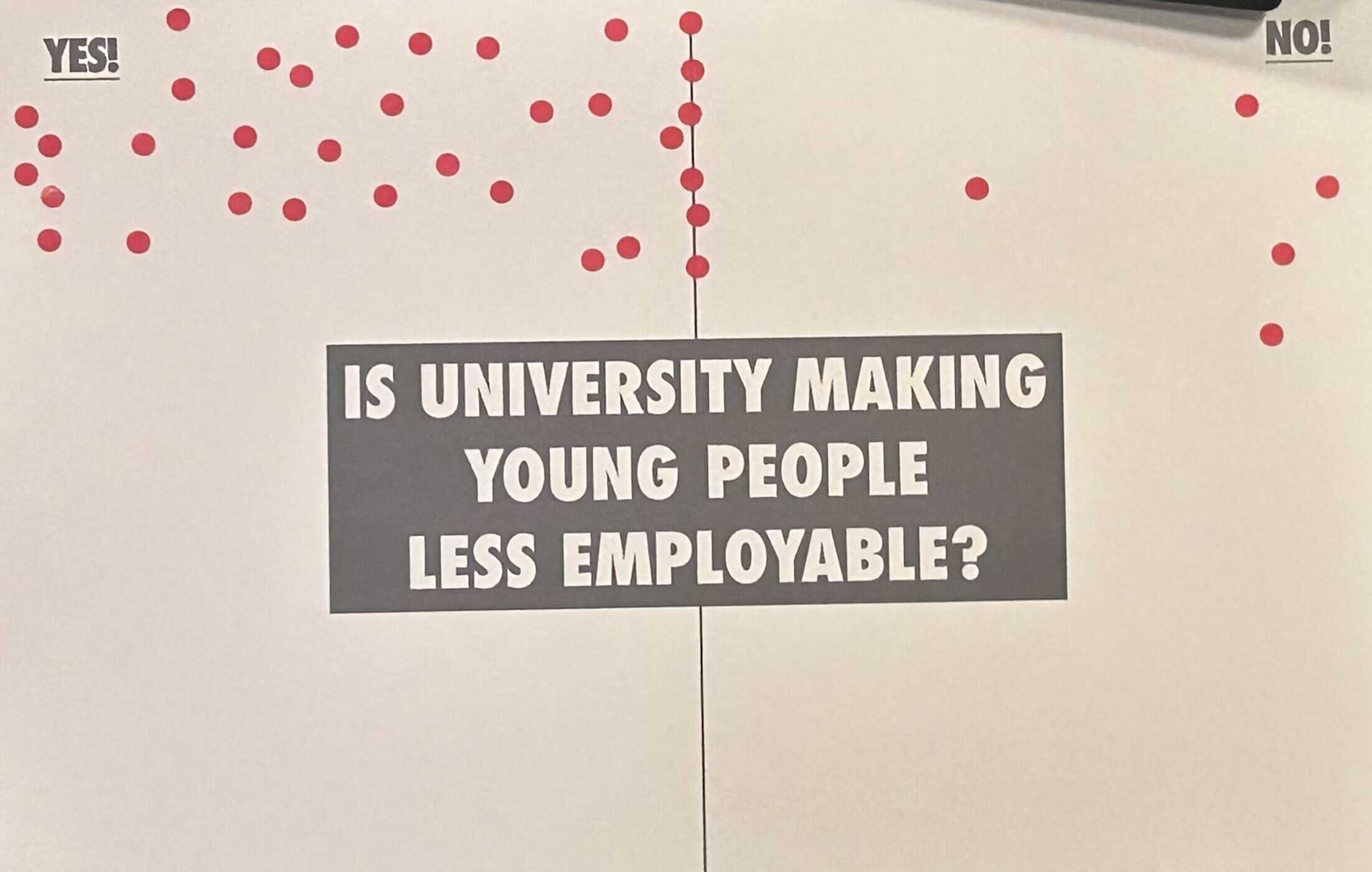
    • Here are his remarks from a debate on whether we are now in ‘The Era of the Downwardly Mobile Graduate’.

    Thanks for inviting me to speak. I agreed to do so for two reasons. First, the Battle of Ideas is a wonderful grassroots event. Secondly, Claire Fox invited me to speak immediately after the murder of Charlie Kirk. My daughter is keen on telling me where Charlie Kirk was misguided but, whether she is right or wrong, universities should be places where free and fervent debate thrives; not places where discussion gets closed down with a bullet. That should not need saying but, sadly, of course it does.

    Last night, I went to a gig in Oxford by the fabulous band EMF – I first saw them as a fresher 35 years ago and, yes, they are still going. As you doubtless know, their most famous song is ‘Unbelievable’. And most of what we have heard, and are going to hear, is exactly that: unbelievable. Not in the ‘incroyable’ sense of the word, but in the sense that the claims are simply not true.

    Let me explain in my few minutes why pretty much every point in the advertising blurb for this event is a myth.

    Myth 1

    We are told there are millions upon millions of people in ‘non-graduate roles’. But this relies on weird and poorly understood definitions of what graduate jobs are. Official definitions obviously rely on jobs being categorised into graduate and non-graduate.

    My favourite critique of what this means comes from an – admittedly – old article by Peter Brant (on Wonkhe), which looked at the official classification from a few years ago, writing:

    A civil servant who was promoted from an Executive Officer to a Higher Executive Officer would be moving from a graduate job to a non-graduate job. Managing an off-licence is a graduate job, managing a pub or a wine bar is a non-graduate job. A singer is a graduate role, a dancer is a non-graduate role. A clown is a graduate job, the manager of a circus is a non-graduate job. And – my personal favourite – a rag-and-bone man is a graduate job, an antiques dealer is a non-graduate job. The list goes on and on.

    Myth 2

    Myth number 2 is the idea that graduates ‘face grim prospects’. The OECD’s new Education at a Glance, which is an annual compendium of global education facts, shows this to be untrue.

    Unemployment is much lower among UK graduates than among non-graduates – irrespective of subject area studied. Indeed, unemployment is much lower among UK graduates than graduates in other developed countries too.

    OECD data, Education at a Glance https://www.hepi.ac.uk/events/launch-of-oecds-flagship-report-education-at-a-glance-2025-hosted-by-hepi-on-tuesday-9-september-2025/

    There isn’t time to go into the huge other benefits of higher education but they include better physical and better mental health.

    The OECD also show the UK does have a problem of low incomes. But this is not among graduates, where our outcomes are positive and comparable with those in other countries. We are literally at the bottom of the OECD league when it comes to earnings for people who have left school with low or no qualifications. They are the people being most let down.

    Myth 3

    The third myth in the blurb for today is that AI will remove the need for employers to recruit people with higher level skills. This is just a revamped version of John Maynard Keynes’s nonsense prediction that people at the end of this current decade would in future work for just 15-hours a week.

    We published a collection of essays on AI last week. Perhaps the most thought-provoking one was by Professor Rose Luckin of the UCL Knowledge Lab. She argues persuasively that:

    The AI revolution represents a pivotal moment where humans need to become more intelligent, not less, as we develop increasingly sophisticated tools.

    Do come to our webinar on the back of the report early next month.

    Myth 4

    The fourth myth is that there are multiple really good alternative options to higher education. Ministers of different stripes have been telling us for years that there is about to be a huge expansion of apprenticeships for young people. Meanwhile, your children and mine are being pumped full of information about why they should do an apprenticeship rather than traditional higher education.

    Yet the number of degree apprenticeships for school leaver is tiny, the number of apprenticeships has fallen since the Apprenticeship Levy was introduced and all those people who worry about university drop-outs should take a look at the high non-continuation rate for apprenticeships.

    Apprenticeships don’t just happen because Keir Starmer or Kemi Badenoch say they should. Apprenticeships are jobs with training attached and the state of the labour market and the regulation of apprenticeships, not to mention the structure of the British economy, are not conducive to big increases in supply.

    Myth 5

    The final myth is the idea that there are tonnes of ‘disaffected university leavers’. Of course, higher education does not work out for all those who go all of the time. Indeed, we have shown in work with the University of Bristol that a high proportion of graduates would make a different choice, such as a different course and / or institution, if they were going back in time.

    However, whether they chose exactly the right course or not, in our new work with King’s College Policy Institute, we show shows that a mere 8% of graduates regret their decision to enter higher education. Meanwhile other work shows younger graduates might have even lower regret rates than that.

    Source link