Author: admin

  • Science of Reading Training, Practice Vary, New Research Finds – The 74

    Science of Reading Training, Practice Vary, New Research Finds – The 74


    Get stories like this delivered straight to your inbox. Sign up for The 74 Newsletter

    North Carolina is one of several states that have passed legislation in recent years to align classroom reading instruction with the research on how children learn to read. But ensuring all students have access to research-backed instruction is a marathon, not a sprint, said education leaders and researchers from across the country on a webinar from the Hunt Institute last Wednesday.

    Though implementation of the state’s reading legislation has been ongoing since 2021, more resources and comprehensive support are needed to ensure teaching practice and reading proficiency are improved, webinar panelists said.

    “The goal should be to transition from the science of reading into the science of teaching reading,” said Paola Pilonieta, professor at the University of North Carolina at Charlotte who was part of a team that studied North Carolina’s implementation of its 2021 Excellent Public Schools Act.

    That legislation mandates instruction to be aligned with “the science of reading,” the research that says learning to read involves “the acquisition of language (phonology, syntax, semantics, morphology, and pragmatics), and skills of phonemic awareness, accurate and efficient work identification (fluency), spelling, vocabulary, and comprehension.”

    The legislature allocated more than $114 million to train pre-K to fifth grade teachers and other educators in the science of reading through a professional development tool called the Language Essentials for Teachers of Reading and Spelling (LETRS). More than 44,000 teachers had completed the training as of June 2024.

    Third graders saw a two-point drop, from 49% to 47%, in reading proficiency from the 2023-24 to 2024-25 school year on literacy assessments. It was the first decline in this measure since LETRS training began. First graders’ results on formative assessments held steady at 70% proficiency and second graders saw a small increase, from 65% to 66%.

    “LETRS was the first step in transforming teacher practice and improving student outcomes,” Pilonieta said. “To continue to make growth in reading, teachers need targeted ongoing support in the form of coaching, for example, to ensure effective implementation of evidence-based literacy instruction.”

    Teachers’ feelings on the training

    Pilonieta was part of a team at UNC-Charlotte and the Education Policy Initiative at Carolina (EPIC) at UNC-Chapel Hill that studied teachers’ perception of the LETRS training and districts’ implementation of that training. The team also studied teachers’ knowledge of research-backed literacy practices and how they implemented those practices in small-group settings after the training.

    They asked about these experiences through a survey completed by 4,035 teachers across the state from spring 2023 to winter 2024, and 51 hour-long focus groups with 113 participants.

    Requiring training on top of an already stressful job can be a heavy lift, Pilonieta said. LETRS training looked different across districts, the research team found. Some teachers received stipends to complete the training or were compensated with time off, and some were not. Some had opportunities to collaborate with fellow educators during the training; some did not.

    “These differences in support influenced whether teachers felt supported during the training, overwhelmed, or ignored,” Pilonieta said.

    Teachers did perceive the content of the LETRS training to be helpful in some ways and had concerns in others, according to survey respondents.

    Teachers holding various roles found the content valuable in learning about how the brain works, phonics, and comprehension.

    They cited issues, however, with the training’s applicability to varied roles, limited differentiation based on teachers’ background knowledge and experience, redundancy, and a general limited amount of time to engage with the training’s content.

    Varied support from administrators, coaches

    When asking teachers about how implementation worked at their schools, the researchers found that support from administrators and instructional coaches varied widely.

    Teachers reported that classroom visits from administrators with a focus on science of reading occurred infrequently. The main support administrators provided, according to the research, was planning time.

    “Many teachers felt that higher levels of support from coaches would be valuable to help them implement these reading practices,” Pilonieta said.

    Teachers did report shifts in their teaching practice after the training and felt those tweaks had positive outcomes on students.

    The team found other conditions impacted teachers’ implementation: schools’ use of curriculum that aligned to the concepts covered in the training, access to materials and resources, and having sufficient planning time.

    Some improvement in knowledge and practice

    Teachers performed well on assessments after completing the training, but had lower scores on a survey given later by the research team. Pilonieta said this suggests an issue with knowledge retention.

    Teachers scored between 95% to 98% across in the LETRS post-training assessment. But in the research team’s survey, scores ranged from 48% to 78%.

    Teachers with a reading license scored higher on all knowledge areas addressed in LETRS than teachers who did not.

    When the team analyzed teachers’ recorded small-group reading lessons, 73% were considered high-quality. They found consistent use of explicit instruction, which is a key component of the science of reading, as well as evidence-backed strategies related to phonemic awareness and phonics. They found limited implementation of practices on vocabulary and comprehension.

    Among the low-quality lessons, more than half were for students reading below grade level. Some “problematic practices” persisted in 17% of analyzed lessons.

    What’s next?

    The research team formed several recommendations on how to improve reading instruction and reading proficiency.

    They said ongoing professional development through education preparation programs and teacher leaders can help teachers translate knowledge to instructional change. Funding is also needed for instructional coaches to help teachers make that jump.

    Guides differentiated by grade levels would help different teachers with different needs when it comes to implementing evidence-backed strategies. And the state should incentivize teachers to pursue specialized credentials in reading instruction, the researchers said.

    Moving forward, the legislation might need more clarity on mechanisms for sustaining the implementation of the science of reading. The research team suggests a structured evaluation framework that tracks implementation, student impact, and resource distribution to inform the state’s future literacy initiatives.

    This article first appeared on EdNC and is republished here under a Creative Commons Attribution-NoDerivatives 4.0 International License.


    Get stories like these delivered straight to your inbox. Sign up for The 74 Newsletter
    Source link

  • Six States Lead Nation in Anti-DEI Legislative Push, New Report Finds

    Six States Lead Nation in Anti-DEI Legislative Push, New Report Finds

    A new policy brief from the University of Southern California reveals that six states—Texas, Missouri, Tennessee, Iowa, Oklahoma, and Indiana—have emerged as national leaders in efforts to dismantle diversity, equity, and inclusion (DEI) programs in higher education, with significant consequences for students and faculty of color.

    The report, “DEI Under Fire: Policy, Politics, and the Future of Campus Diversity,” released by USC’s Black Critical Policy Collective, analyzed legislative trends across all 50 states between August 2024 and July 2025. Researchers developed a composite scoring system based on bills introduced and laws passed, identifying states with the most aggressive anti-DEI activity.

    Texas topped the rankings with a composite score of 16, having introduced 10 bills and passed three laws restricting DEI efforts. Missouri followed with 15 bills introduced, though none passed into law. Tennessee, Iowa, Oklahoma, and Indiana rounded out the top six states, all scoring between 9 and 14 on the composite scale.

    As of July 2025, 14 states have passed a total of 20 anti-DEI laws, up from 12 states with 14 laws when data collection began in December 2024. These laws typically target four main areas: elimination of DEI offices and staff, bans on mandatory diversity training, prohibitions on diversity statements in hiring, and restrictions on identity-based preferences in admissions and employment.

    “Diversity, equity, and inclusion are not peripheral ideals. They are institutional functions—woven into the operational, cultural, and legal architecture of colleges and universities,” wrote Dr. Kendrick B. Davis, series editor for the Critical Policy Collective, in the report’s introduction. “When those functions are restricted or removed, the effects are material.”

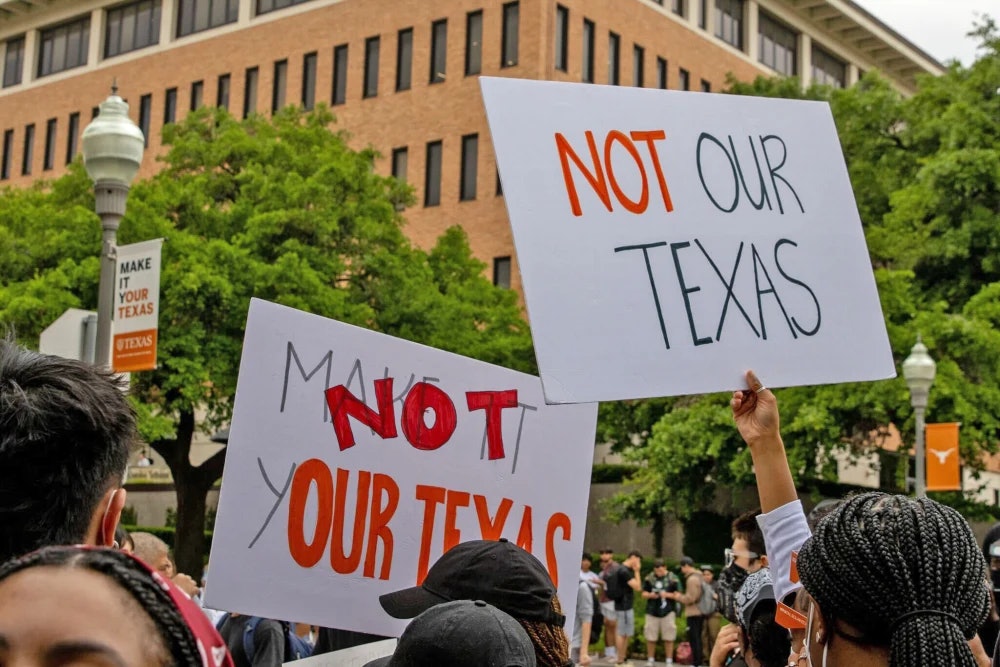
    The institutional responses have been swift and substantial. At the University of Texas System, at least 49 DEI-related employees were terminated following the passage of three bills in 2023. The system shut down its Multicultural Engagement Center and Gender & Sexuality Center at UT-Austin and eliminated funding for student identity-based organizations and scholarships for undocumented students.

    In Iowa, following Senate File 2435’s passage in May 2024, the University of Iowa eliminated its Office of Inclusive Education and Strategic Initiatives and laid off 11 DEI-related staff members. The university also removed scholarships specifically aimed at racially minoritized students, redirecting funds to support low-income students more broadly. By October 2024, Iowa’s state universities had reallocated more than $2.1 million from DEI programs.

    Indiana University announced one of the most sweeping academic restructurings in its history, planning to suspend, eliminate, or consolidate at least 43 undergraduate programs, including African American and African Diaspora Studies, Gender Studies, and multiple language programs. The changes follow passage of Senate Bills 202 and 289, which banned DEI offices and prohibited diversity statements in hiring.

    Preliminary enrollment data following the 2023 Supreme Court decision in Students for Fair Admissions v. Harvard—which effectively ended race-conscious admissions—shows declining representation of students of color at several elite institutions. At Harvard Law School, Black student enrollment in 2024 dropped to 19 first-year students, down from 43 the previous year. MIT reported a 1% decrease in the proportion of Hispanic and Black students, while UNC-Chapel Hill experienced a 5% decrease in Black, Indigenous, and people of color students overall.

    “The ongoing attacks on DEI, manifested in policy restrictions forcing institutions to comply with race-evasive policies, have significant implications for racial and ethnic diversity, student access and success, and workforce development,” the report states.

    Research shows faculty diversity benefits all students by fostering critical thinking and better preparing graduates for diverse workforces. However, DEI rollbacks make it significantly more difficult to recruit faculty of color, as institutions are now restricted from considering race in hiring decisions—a limitation reinforced by the Harvard ruling.

    The report’s authors—Mya Haynes, Glenda Palacios Quejada, Shawntae Mitchum, and Alexia Oduro—note that even private institutions like Vanderbilt University have implemented similar changes despite not being subject to state laws, “reflecting broader anxieties within the private sector about maintaining—or being seen to maintain—equity-oriented infrastructure under political scrutiny.”

    Student activism has emerged in response to the restrictions. Iowa State University students organized rallies and petitions opposing the elimination of the DEI office and restructuring of the LGBTQIA+ Center. In Alabama, university professors and students filed a lawsuit challenging the state’s DEI ban, arguing it violates First Amendment rights.

    “What is one of the things that’s sometimes difficult to see is the level of coordination between states,” Davis said in an interview. “Texas, Oklahoma, Iowa, Indiana, Tennessee, and Missouri—they’re not just a random collection. They’re a coordinated collection of states that have made some formal, some informal decisions, but what is clear through the legislation is that they share a common goal in restricting access to anything that is culturally relevant or sensitive to racially and ethnically minoritized groups in this country.” 

    Davis noted that while federal actions have dominated recent headlines, states initiated the anti-DEI movement shortly after 2020.

    “We have to remember the states started this anti-DEI, anti-critical race theory movement shortly after 2020,” he explained. “This has been a long time in the making, and I think the current federal efforts are just complementary to what states had already been doing.” The report aims to help policymakers and practitioners “get through some of the noise” and track the escalating legislative activity across multiple states, Davis said.

    The report recommends that institutions embed DEI principles within broader student success initiatives, leverage private funding where public funding is restricted, and strengthen alliances among students, faculty, staff, and community organizations to advocate for institutional accountability.

    Missouri represents a notable exception in the analysis. Despite introducing 14 bills targeting DEI—more than any state except Texas—none have passed into law. The report attributes this to intense legislative gridlock, ideological conflicts within the Republican majority, and strong opposition from educational institutions and community organizations. However, the 2025 legislative session has seen renewed efforts to advance anti-DEI policies.

    The researchers emphasize that the policy shifts carry particular consequences for Black, Latino, and Indigenous communities, who are losing access to culturally affirming resources, mentorship opportunities, and financial aid programs specifically designed to address historical inequities in higher education access.

    “If access is conditional and inclusion retractable, higher education cannot claim to serve the public,” Davis wrote.

    The report represents the third in a series examining how equity is being withdrawn across the education pipeline.


    Source link

  • Dartmouth Joins Growing List of Elite Universities Rejecting White House Academic Compact

    Dartmouth Joins Growing List of Elite Universities Rejecting White House Academic Compact

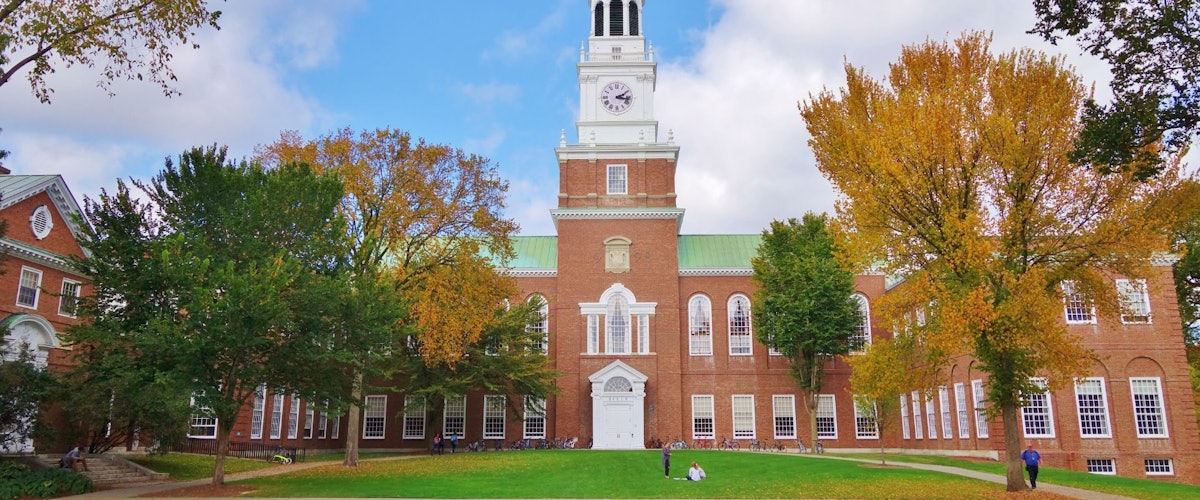
    Dartmouth CollegeFile photoDartmouth College has declined to sign the Trump administration’s “Compact for Academic Excellence in Higher Education,” becoming the latest prestigious institution to prioritize institutional autonomy over preferential federal funding access.

    In a statement released Saturday, Dartmouth President Dr. Sian Beilock firmly articulated the college’s position ahead of Monday’s deadline, emphasizing that governmental oversight—regardless of political affiliation—represents an inappropriate mechanism for directing the mission of America’s top research universities.

    “I do not believe that the involvement of the government through a compact—whether it is a Republican- or Democratic-led White House—is the right way to focus America’s leading colleges and universities on their teaching and research mission,” Beilock stated.

    The compact, extended to nine select institutions, promised enhanced access to federal research dollars in return for compliance with several administration policy mandates. These requirements included adopting the administration’s gender definitions for campus facilities and athletics, eliminating consideration of race, gender and various demographic factors from admissions decisions, and restricting international student enrollment.

    Despite rejecting the compact’s terms, Beilock expressed openness to dialogue, indicating her willingness to explore how to strengthen the traditional federal-university research partnership while maintaining higher education’s focus on academic excellence.

    The decision followed significant campus pressure, with nearly 500 Dartmouth faculty members and graduate students signing a petition advocating for rejection, according to the Valley News.

    In her statement, Beilock emphasized the fundamental principle at stake: “Universities have a responsibility to set our own academic and institutional policies, guided by our mission and values, our commitment to free expression, and our obligations under the law.”

    She framed institutional independence as essential to rebuilding public confidence across political lines and preserving American higher education’s global preeminence.

    Dartmouth’s decision aligns with rejections announced last week by peer institutions including the Massachusetts Institute of Technology, Brown University, the University of Pennsylvania and the University of Southern California, suggesting a coordinated defense of academic autonomy among elite research universities.

    Source link

  • Nearly All State Funding for Missouri School Vouchers Used for Religious Schools – The 74

    Nearly All State Funding for Missouri School Vouchers Used for Religious Schools – The 74


    Get stories like this delivered straight to your inbox. Sign up for The 74 Newsletter
    State funding of private-school vouchers is primarily being used for students attending religious institutions, with nearly 98% of funding going toward Catholic, Christian, Jewish and Islamic schools.

    This year, state lawmakers passed a budget that included a request from Gov. Mike Kehoe to supply the state-run K-12 scholarship program, MOScholars, with $50 million of general revenue. Previously, the impact to the state’s bottom line was indirect, with 100% tax-deductible donations fueling the program.

    Donations are still part of MOScholars’ funding, but the state appropriation has more than doubled the number of scholarships available.

    During the 2024-25 school year, MOScholars awarded $15.2 million in scholarships.

    In August alone, the State Treasurer’s Office received invoices for scholarships totaling $15.6 million, according to documents obtained by The Independent under Missouri’s open records laws.

    The invoice process is unique to the direct state funding of the program. The nonprofits that administer scholarships, called educational assistance organizations, were the sole keepers of scholarship funds. But now, the State Treasurer’s Office holds scholarship money derived from general revenue in an account previously only used for program marketing and administration.

    The invoices contained data on which schools MOScholars students are attending and the scholarship amount.

    Of the 2,329 scholarships awarded in August, only 59 went to students in nonreligious schools.

    This number did not surprise Democratic lawmakers, who for years have warned that state revenue was going to be siphoned into religious schools.

    “We are simply subsidizing, with tax dollars, parents who would already choose to send their kids to a private school,” state Sen. Maggie Nurrenbern, a Kansas City Democrat, told The Independent. “And now we are using public dollars to pay for schools that are not transparent whatsoever in choosing who to educate and who not.”

    Some schools have been criticized for admission requirements that push a moral standard.

    Christian Fellowship School in Columbia, which received scholarships for 63 MOScholars students in August, requires “at least one parent of enrolled students professes faith in Christ and agrees with the admission policies and the philosophy and doctrinal statements of the school,” according to its handbook

    These statements include disapproval of homosexuality.

    “The school reserves the right, within its sole discretion, to refuse admission of an applicant or to discontinue enrollment of a student,” the handbook continues.

    With around 430 K-12 students enrolled at Christian Fellowship School, according to National Center for Educational Statistics survey data, MOScholars makes up a sizable portion of its funding. But it is not the only school with a large number of scholarship recipients.

    Torah Prep School in St. Louis had 229 K-12 students during the 2023-24 school year. And in August, 197 MOScholars students received funding to attend the school. Torah Prep did not respond to a request for comment.

    The high number of students attending religious schools with MOScholars funding is somewhat incidental, somewhat by design.

    The MOScholars program allows its six educational assistance organizations to choose what scholarships they are willing to support. 

    Religious organizations stepped into the role to help connect congregants with affiliated schools. Only two of the six educational assistance organizations partner with schools unaffiliated with religion.

    The Catholic dioceses of Kansas City-St. Joseph and Springfield-Cape Girardeau run the educational assistance organization Bright Futures Fund, which administered nearly half of the scholarships awarded in August.

    The educational assistance organization Agudath Israel of Missouri focuses on Jewish education, partnering with four Jewish day schools.

    The organization’s director Hillel Anton told The Independent that students are attracted to the program for more than just religious reasons.

    “(Parents’) first and foremost concern is where their child is going to be able to be in the best learning environment,” Anton said. “And you may have a faith-based school that is fantastic and is able to provide that.”

    The demand for the program has long exceeded funding availability. Going into August, organizations had waitlists of students eligible for a scholarship but without funding secured.

    Agudath Israel of Missouri couldn’t guarantee scholarships for all of the returning students, Anton said, until the state funding was official.

    “Because a lot of the funding is done towards the end of the year… we had everyone on a wait list,” he said. “Because we didn’t know necessarily how much funding we were going to have, we weren’t awarding anyone (the funding).”

    Because the program was previously powered by 100% tax-deductible donations, the majority of funds poured in around December. But families need the money months sooner, with tuition due at the start of the school year.

    Some educational assistance organizations prefunded scholarships, dipping into their savings to front expenses in the fall. Others had schools that would accept students and wait for payment.

    The funding from the state, though, has resolved the backlog and allowed organizations to give scholarships to everyone on their wait list.

    “Everyone who qualified for a scholarship this year received one,” Ashlie Hand, Bright Futures Fund’s director of communications, told The Independent.

    Bright Futures Fund nearly doubled the number of students it serves, from 1,050 to 1,909.

    Agudath Israel of Missouri is growing, too. The new funding helped the organization expand from 175 scholarships last year to 277 this year.

    Some expect the state funding to continue next year to support this year’s windfall of scholarships. State Treasurer Vivek Malek told The Independent in May that if donations fall short, he will request state funds to support the new students through graduation.

    Missouri Independent is part of States Newsroom, a nonprofit news network supported by grants and a coalition of donors as a 501c(3) public charity. Missouri Independent maintains editorial independence. Contact Editor Jason Hancock for questions: [email protected].


    Get stories like these delivered straight to your inbox. Sign up for The 74 Newsletter

    Source link

  • Texas Study Reveals Power of Combined Accelerated Programs for College Success

    Texas Study Reveals Power of Combined Accelerated Programs for College Success

    High school students who combine dual enrollment courses with Advanced Placement or International Baccalaureate programs are significantly more likely to graduate from college and earn higher salaries in their early twenties than peers who pursue only one type of accelerated coursework, according to a new report from the Community College Research Center.

    File photoThe study, which tracked Texas high school students expected to graduate in 2015-16 and 2016-17 for six years after high school, found that 71% of students who took both dual enrollment and AP/IB courses earned a postsecondary credential within six years—including 60% who completed a bachelor’s degree. By comparison, only 10% of students who took no accelerated coursework completed any postsecondary credential.

    “Most dual enrollment students in Texas also take other accelerated courses, and those who do tend to have stronger college and earnings trajectories,” said Dr.Tatiana Velasco, CCRC senior research associate. “It’s a pattern we hadn’t fully appreciated before, which offers clues for how to expand the benefits of dual enrollment to more students.”

    The financial benefits of combining accelerated programs extend well beyond graduation. Students who took both dual enrollment and AP/IB courses earned an average of $10,306 per quarter at age 24—more than $1,300 per quarter above students who took dual enrollment alone and nearly $1,400 per quarter more than those who took only AP/IB courses.

    These advantages persisted even after researchers controlled for student demographics, test scores, and school characteristics, suggesting the combination of programs provides genuine educational value rather than simply reflecting differences in student backgrounds.

    While the study revealed promising outcomes for students combining dual enrollment with career and technical education programs, participation in this pathway remains critically low. Fewer than 5% of students combine a CTE focus—defined as taking 10 or more CTE courses—with dual enrollment.

    Yet those who do show remarkable success. By age 24, dual enrollment students with a CTE focus earned an average of $9,746 per quarter, substantially more than CTE-focused students who didn’t take dual enrollment ($8,097) and second only to the dual enrollment/AP-IB combination group.

    The findings suggest a significant missed opportunity, particularly for students seeking technical career paths who could benefit from early college exposure while building specialized skills.

    The report highlights concerning equity gaps in accelerated coursework access. Students who combine dual enrollment with AP/IB courses are less diverse than those taking AP/IB alone, raising questions about which students have opportunities to maximize the benefits of accelerated learning.

    Early college high schools present a partial solution to this challenge. These specialized schools, where students can earn an associate degree while completing high school, serve more diverse student populations than other accelerated programs. Their graduates complete associate degrees at higher rates and earn more than Texas students overall by age 21. However, early college high schools serve only 5% of Texas students statewide.

    With less than 40% of Texas students without accelerated coursework enrolling in any postsecondary institution, and only one in five Texas students taking dual enrollment, researchers see substantial room for expansion.

    The report’s authors recommend that K-12 districts and colleges work to expand dual enrollment participation while ensuring these programs complement rather than compete with AP/IB offerings. They also call for increased access to dual enrollment for CTE students and additional support structures to promote student success in college-level coursework during high school.


    Source link

  • How a San Diego Preschool Serves Kids After Trauma – The 74

    How a San Diego Preschool Serves Kids After Trauma – The 74


    Join our zero2eight Substack community for more discussion about the latest news in early care and education. Sign up now.

    Almost 20 years ago a San Diego nonprofit created a preschool to focus on the “little guys” — children who experience domestic violence and other serious traumatic events before kindergarten. 

    Today, Mi Escuelita is still going strong and it’s something of a model in showing other schools how to address childhood trauma.

    Mi Escuelita provides services for kids in a single location that for most other families would require intricate coordination among multiple health care providers, educators and social programs. 

    The children learn in a classroom that is always staffed with at least one therapist, they participate in one-on-one therapy, and join group therapy sessions. Their parents take part in special classes, too, where they learn ways to support their children.

    Researchers from UC San Diego have paid close attention to Mi Escuelita and followed how its graduates fared after leaving the preschool. The university also works with the school to evaluate outcomes from each cohort of students. Here are four takeaways from those reports.

    The kids leave ready for kindergarten

    Students who graduate from Mi Escuelia outperform or do at least well as their peers in kindergarten, according to a UC San Diego analysis of their scores in reading and math tests.

    It looked at kindergarten students in the Chula Vista Elementary School District from 2007 to 2013 and found a higher percentage of Mi Escuelita met math, reading and writing standards than the district’s general population.

    That’s not a given because research shows that children exposed to domestic violence have lower verbal ability than their peers, which can set them back in school. 

    And they do well for years

    The length of UC San Diego’s study allowed its team to follow Mi Escuelita graduates through fifth grade. The results suggested that their preschool experience helped the kids throughout their childhoods. 

    Their average scores on several standardized tests exceeded those of the general population at Chula Vista Elementary School District, especially in math.

    “Taken together, the Mi Escuelita program demonstrates clear benefits to children who may otherwise fall quickly and unsparingly behind with regard to school readiness,” the UC San Diego researchers wrote. 

    Better relationships at home

    Some families turn to Mi Escuelita in moments of distress, such as after experiencing domestic violence. The preschool provides counseling for parents and students alike, which may contribute to behavioral improvements at home.

    Over the past five years, 64% of the families in the program reported sensing fewer conflicts and 83% of them noticed an increase in closeness. 

    “Families reported that children’s communication, behavior, and listening skills improved both at home and at school,” a UC San Diego team wrote in an evaluation of student and parent surveys that spanned 2020 to 2024. 

    It takes a village

    Running Mi Escuelita costs about $1.3 million a year, a sum that nonprofit South Bay Community Services raises through a mix of donations and government funding. That cost — along with the challenge of hiring trained educators and therapists — makes the program difficult to replicate. 

    But, other schools and government agencies are watching Mi Escuelita to see what kind of services they can carry over to other venues. 

    “We can spend less later on intervention programs and alternative facilities,” said Hilaria Bauer, chief early learning services officer at Kidango, a Bay Area nonprofit childcare provider. “There will be less truancy, less big behaviors or expulsions or alternative programs, and all of those ‘fix’ initiatives if we really focus on the time in the life of a child that really makes a change.”


    Get stories like these delivered straight to your inbox. Sign up for The 74 Newsletter

    Source link

  • WEEKEND READING: Building the transatlantic cyber bridge: what ‘Careers-First’ really means for the future workforce

    WEEKEND READING: Building the transatlantic cyber bridge: what ‘Careers-First’ really means for the future workforce

    This blog was kindly authored by Professor Paul Marshall, Vice-President (Global Campus) and Pro-Vice-Chancellor (Careers & Enterprise), University of East London.

    As the UK Government prepares its long-awaited White Paper on the future of higher education, it is timely to reflect on the purpose and impact of our universities. At their best, they are not simply sites of knowledge creation – they are instruments of national capability. Few challenges illustrate that more vividly than cybersecurity.

    When I joined a panel at the CyberBay Cybersecurity Conference in Tampa earlier this month, Dr Richard Munassi, Managing Director of Tampa Bay Wave, opened with a warning that set the tone for the discussion:

    We are in a cyber war – a war waged by well-financed, state-backed criminal organisations so sophisticated that they have their own HR divisions.

    He was right. Earlier this year, Jaguar Land Rover was forced to suspend production after a ransomware attack that rippled across its global supply chain. The UK Government’s intervention – with a support package approaching £1.5 billion – made clear that cybersecurity is not an IT issue; it is economic infrastructure.

    As the sector awaits the Government’s vision for the future, one truth already stands out: higher education must not only prepare individuals for work –  it must prepare the nation for risk.

    At the University of East London (UEL), that challenge sits at the heart of our institutional strategy, Vision 2028, which seeks to transform lives through education, innovation, and enterprise. The strategy’s organising principle – Careers-First – redefines employability as capability.

    Rather than positioning careers as an outcome of study, it embeds professional practice, enterprise, and resilience into every degree and partnership. The test for every programme is simple: does it equip our students to adapt, contribute, and lead in industries defined by constant change?

    Nowhere is this approach more tangible than in cybersecurity. Our BSc Cyber Security & Networks, MSc Information Security & Digital Forensics, and Cyber Security Technical Professional Degree Apprenticeship all combine rigorous academic study with live, industry-based application. 

    Students work directly with BT, IBM, Fujitsu, and Ford, tackling real-time challenges in threat analysis, data forensics, and network defence. By the time they graduate, they are not simply work-ready — they are work-proven, having contributed to the resilience of the very sectors they will soon join.

    The results speak for themselves:

    • With Siemens UK, students tested firmware vulnerabilities in industrial systems, informing Siemens’ internal training programmes.
    • With Barclays Eagle Labs, they created a fraud-analysis dashboard now in pilot testing.
    • With NHS Digital, they developed a ransomware-simulation tool to train hospital teams in incident response.

    Each collaboration demonstrates a single idea: learning is most powerful when it changes the world beyond the classroom.

    UEL’s Institute for Connected Communities (ICC), led by Professor Julia Davidson OBE, anchors this model in research excellence and policy leadership. The ICC brings together computing, criminology, psychology, and social science to examine the human, technical, and organisational dimensions of online safety.

    Its research informs the UK Council for Internet Safety, Ofcom, UNICEF, and multiple international governments. Through projects such as Global Kids Online, ICC research directly shapes teaching, ensuring that our graduates understand not only how to secure systems, but why digital trust matters to society.

    As policymakers consider the future role of universities in the forthcoming White Paper, the ICC already provides a working example of how academic research translates into practical and regulatory impact.

    The White Paper will also need to consider how global collaboration strengthens national capability. UEL’s Global Campus model demonstrates how this can work in practice — connecting students and employers across India, Greece, Egypt, and the United States to create shared pathways for study, innovation, and employment.

    Our developing partnership with Tampa Bay Wave, framed within the UK–Florida Memorandum of Understanding (2023), offers one illustration. We are building both virtual and physical experiences that will enable UEL students to engage with Florida’s growing cybersecurity and fintech ecosystem through mentoring, live projects, and placements, while providing a London base for US start-ups entering the UK market.

    A genuine transatlantic bridge is being constructed –  designed for movement in both directions, connecting students, researchers, and entrepreneurs to co-create secure-by-design technologies and governance frameworks. It is the Careers-First model, scaled globally.

    The next phase of cybersecurity will occur where AI, data, and physical systems converge. Attacks will target intelligent infrastructure –  transport grids, hospitals and manufacturing. UEL is already embedding these challenges into its curriculum, guided by ICC research. Students design adversarial-AI tests, examine supply-chain vulnerabilities, and develop frameworks for organisational resilience.

    This approach recognises that technology evolves faster than any static syllabus. Students are therefore treated as co-creators, working alongside academics and employers to design the solutions industry will need next.

    As the UK Government prepares its White Paper, one principle should underpin the national conversation: universities are not peripheral to resilience –  they are central to it. They educate the workforce, generate the research, and sustain the partnerships that keep the nation secure.

    UEL’s Careers-First model, aligned to Vision 2028, embodies that principle. It fuses employability, enterprise, and global engagement into one coherent system of capability. Our collaboration with Tampa Bay Wave is a single, tangible expression of this –  connecting East London’s lecture theatres to innovation ecosystems across the Atlantic.

    In a global cyber war, the question is not whether universities should respond, but how fast they can. At UEL, that response is already underway –  this is what Careers-First looks like.

    Source link

  • Why Isn’t RSS More Popular By Now? – Teaching in Higher Ed

    Why Isn’t RSS More Popular By Now? – Teaching in Higher Ed

    It was a bit of a relief to have well-traveled terrain as the today’s topic in Harold Jarche’s Personal Knowledge Mastery workshop: Aggregators and RSS.

    While I still want to drop everything going on in my life right now and dive deep into the topic from two days ago (the Cynefin Framework), that just isn’t realistic. This PKMastery workshop has been a wonderful blend of ideas that challenge me, coupled with topics that I always enjoy learning more about, but am not starting from scratch with…

    RSS – Not-So-Popular

    It seems RSS could really have used some help from Galinda in the musical, Wicked, in terms of getting popular. I wish aggregators and RSS were something that the vast majority of people knew about and had incorporated into their lifelong learning and sense-making. It’s strange to me that RSS has been around such a long time, yet still isn’t very common in organizations at all.

    In case the terms (RSS and aggregators) are new to you, Common Craft’s RSS in Plain English from 18 years ago still checks out:

    The Good, the Bad, and the Ugly

    I’ve got some good news for you, some bad news, and some real ugly news.

    The good: There’s a ton of information on the internet, which has the potential to be transformative for us, as sense-making human beings.

    The bad: We can’t keep up and the quantity of information just keeps on growing, yet not enough of us know ways to harness the possibilities.

    The ugly: Some of us give up on thinking we’ll never be able to have a way of seeking, sensing, and sharing, so we resolve to just search for things at the exact moment we realize we have a specific question about something (a gap in our knowledge that we are aware of in that moment).

    What gets missed here in “the ugly” (among other things) are the questions we don’t even realize that we have… The unknown unknowns… Not to mention misinformation/disinformation, etc.

    Getting to Know RSS

    Here are some RSS-related articles that I’ve saved on my digital bookmarking tool of choice: Raindrop:

    Next, let’s take a look at how I’ve set things up to be a tap away from a world of possibilities for sense-making…

    My RSS + Aggregation Tools

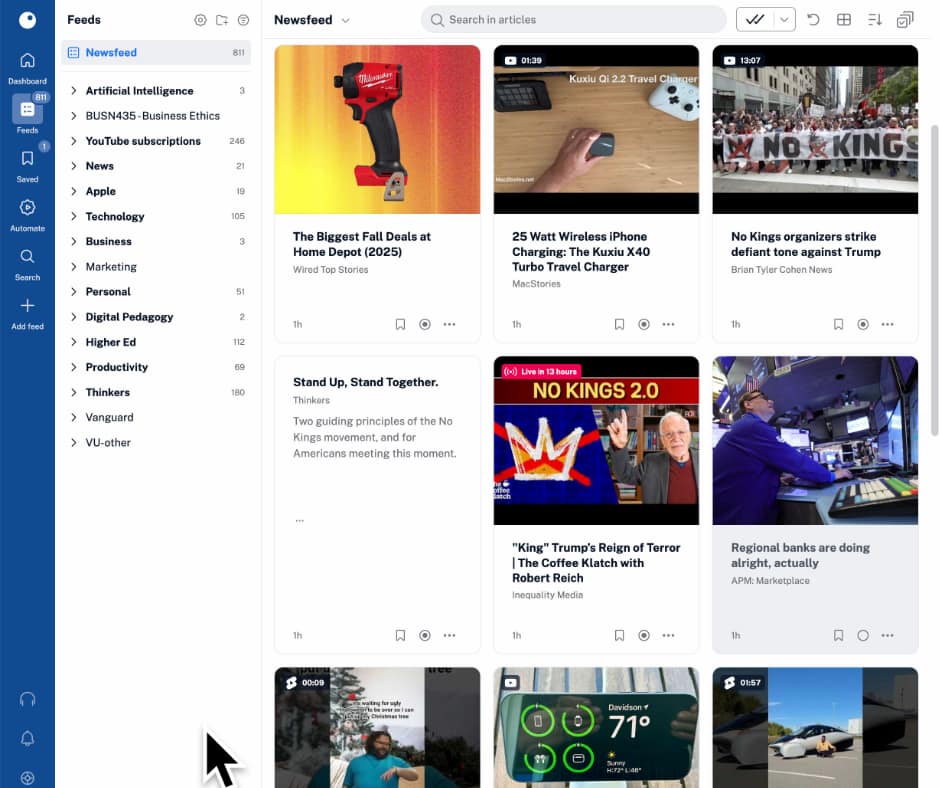
    I use Inoreader as my RSS aggregator. That means that when I discover a source (news site, blog, newsletter, YouTube channel, etc.) that I discern will serve me up potentially useful information, I add it to Inoreader inside my existing folders (e.g. News, Technology, Business, Digital Pedagogy, Higher Ed, Thinkers). Each time one of those sources (called feeds in RSS nomenclature) posts something new, it automatically shows up as an unread item on Inoreader.

    Screenshot of the Inoreader RSS website with folders on the left (AI, YouTube, News, Personal, etc.) and images/headlines on the right.

    Thats where some people stop.

    They download Inoreader’s app(s) and read their feeds on their computers or smart phones and they’re off to the races. Inoreader is both an RSS aggregator (keeping track of what feeds the user subscribes to, as well as which stories they have read/not read).

    However, I’m picky about my reading experience and have gotten particular about being able to read via my iPad and navigate everything with just one thumb.


    "Who has two thumgs and can operate Unread with just one of them? 

this guy (and me)"

Guy wearing a medical coat and a stethoscope puts both his thumbs up, which then point back at him.


    This is where you insert a joke about “who has two thumbs and can set up RSS aggregators and tools? ME.” Except that in my case, it actually only takes one thumb, using my preferred RSS reader.

    Unread = The Best RSS Reader I’ve Ever Experienced

    Those who read on iPads would be hard pressed to find a better RSS reader than Unread, especially if you want to be able to skim and scroll through headlines (you can set up Unread to automatically mark the items as read, as you scroll through them, making the navigation even easier).

    Inoreader does the work behind the scenes of keeping track of all my subscriptions and what is read/unread. The Unread app then presents me with a “window” into all that “stuff” Inoreader is keeping track of in the background. Unread “syncs” with Inoreader. I don’t have much use of an RSS reader on my Mac, preferring to do most of my RSS consumption via my iPad, but I wanted to mention that even if you had a different app/service you preferred to use on your computer, Inoreader (and other RSS aggregators) are able to keep track across different RSS readers what you’ve read/unread.

    Something Very Cool

    Harold Jarche suggested that those of us who already have an aggregator / RSS workflow to share tips. I’ve kind of done that, already, above. But I will say that through his materials, I was delighted to discover that I can set up feeds for Mastodon #hashtags.

    From Harold:

    You can also subscribe to any Mastodon feed by adding .rss to the address, e.g. mastodon.social/@harold.rss

    You can subscribe to #hashtags by appending .rss — e.g. https://mastodon.social/tags/pkmastery.rss

    The PKMastery workshop is the gift that just keeps on giving. I’m looking forward to giving that a try this weekend. So cool.

    Source link

  • Higher education data explains why digital ID is a good idea

    Higher education data explains why digital ID is a good idea

    Just before the excitement of conference season, your local Facebook group lost its collective mind. And it shows no sign of calming down.

    Given everything else that is going on, you’d think that reinforcing the joins between key government data sources and giving more visibility to the subjects of public data would be the kind of nerdy thing that the likes of me write about.

    But no. Somebody used the secret code word. ID Cards.

    Who is she and what is she to you?

    I’ve written before about the problems our government faces in reliably identifying people. Any entitlement– or permission– based system needs a clear and unambiguous way of assuring the state that a person is indeed who they claim they are, and have the attributes or documentation they claim to.

    As a nation, we are astonishingly bad at this. Any moderately serious interaction with the state requires a parade of paperwork – your passport, driving license, birth certificate, bank statement, bank card, degree certificate, and two recent utility bills showing your name and address. Just witness the furore over voter ID – to be clear a pointless idea aimed at solving a problem that the UK has never faced – and the wild collection of things that you might be allowed to pull out of your voting day pocket that do not include a student ID.

    We are not immune from this problem in higher education. I’ve been asking for years why you need to apply to a university via UCAS, and apply for funding via the Student Loans Company, via two different systems. It’s then never been clear to me why you then need to submit largely similar information to your university when you enroll.

    Sun sign

    Given that organs of the state have this amount of your personal information, it is then alarming that the only way it can work out what you earn after graduating is by either asking you directly (Graduate Outcomes) or by seeing if anyone with your name, domicile, and date of birth turns up in the Inland Revenue database.

    That latter one – administrative matching – is illustrative of the government’s current approach to identity. If it can find enough likely matches of personal information in multiple government databases it can decide (with a high degree of confidence) that records refer to the same person.

    That’s how they make LEO data. They look for National Insurance Number (NINO), forename, surname, date of birth, postcode, and sex in both HESA student records and the Department for Work and Pension’s Customer Information System (which itself links to the tax database). Keen Wonkhe readers will have spotted that NINO isn’t returned to HESA – to get this they use “fuzzy matching” with personal data from the Student Loans Company, which does. The surname thing is even wilder – they use a sound-based algorithm (SOUNDEX) to allow for flexibility on spellings.

    This kind of nonsense actually has a match rate of more than 90 per cent (though this is lower for ethnically Chinese graduates because sometimes forenames and surnames can switch depending on the cultural knowledge of whoever prepared the data).

    It’s impressive as a piece of data engineering. But given that all of this information was collected and stored by arms of the same government it is really quite poor.

    The tale of the student ID

    Another higher education example. If you were ever a student you had a student ID. It was printed on your student card, and may have turned up on various official documents too. Perhaps you imagined that every student in the UK had a student number, and that there was some kind of logic to the way that they were created, and that there was a canonical national list. You would be wrong.

    Back in the day, this would have been a HESA ID, itself created from your UCAS number and your year of entry (or your year of entry, HESA provider ID, and an internal reference number if you applied directly). Until just a few years ago, the non-UCAS alternative was in use for all students – even including the use of the old HESA provider ID rather than the more commonly used UKPRN. Why the move away from UCAS – well, UCAS had changed how they did identifiers and HESA’s systems couldn’t cope.

    You’re expecting me to say that things are far more sensible now, but no. They are not. HESA has finally fixed the UKPRN issue within a new student ID field (SID). This otherwise replicates the old system but with one important difference: it is not persistent.

    Under the old approach, the idea was you had one student number for life – if you did an undergraduate degree at Liverpool, a masters at Manchester Met, and a PhD at Royal Holloway these were all mapped to the same ID. There was even a lookup service for new providers if the student didn’t have their old number. I probably don’t even need to tell you why this is a good idea if you are interested – in policy terms – in the paths that students within their career in higher education. These days we just administratively match if we need to. Or – as in LEO – assume that the last thing a student studied was the key to or cause of their glittering or otherwise career.

    The case of the LLE

    Now I hear what you might be thinking. These are pretty terrible examples, but they are just bodges – workarounds for bad decisions made in the distant past. But we have the chance to get it right in the next couple of years.

    The design of the Lifelong Learning Entitlement means that the government needs tight and reliable information about who does what bit of learning in order that funds can be appropriately allocated. So you’d think that there would be a rock-solid, portable, unique learner number underpinning everything.

    There is not. Instead, we appear to be standardising on the Student Loans Company customer reference number. This is supposed to be portable for life, but it doesn’t appear in any other sector datasets (the “student support number” is in HESA, but that is somehow different – you get two identifiers from SLC, lucky you). SLC also holds your NINO (you need one to get funding!), and has capacity to hold another additional number of an institution’s choice, but not (routinely) your HESA student ID or your UCAS identifier.

    There’s also space to add a Unique Learner Number (ULN) but at this stage I’m too depressed to go into what a missed opportunity that is.

    Why is standardising on a customer reference number not a good idea? Well, think of all the data SLC doesn’t hold but HESA does. Think about being able to refer easily back to a school career and forward into working life on various government data. Think about how it is HESA data and not SLC data that underpins LEO. Think about the palaver I have described above and ask yourself why you wouldn’t fix it when you had the opportunity.

    Learning to love Big Brother

    I’ll be frank, I’m not crazy about how much the government knows about me – but honestly compared to people like Google, Meta, or – yikes – X (formerly twitter) it doesn’t hugely worry me.

    I’ve been a No2ID zealot in my past (any employee of those three companies could tell you that) but these days I am resigned to the fact that people need to know who I am, and I’d rather be more than 95 per cent confident that they could get it right.

    I’m no fan of filling in forms, but I am a fan of streamlined and intelligent administration.

    So why do we need ID cards? Simply because in proper countries we don’t need to go through stuff like this every time we want to know if a person that pays tax and a person that went to university are the same person. Because the current state of the art is a mess.

    Source link

  • UVA, Dartmouth Reject Trump Compact

    UVA, Dartmouth Reject Trump Compact

    The University of Virginia and Dartmouth College have become the latest higher ed institutions to publicly reject the Trump administration’s “Compact for Academic Excellence in Higher Education.” Now just three of the nine institutions that the federal government originally presented with the document have yet to announce whether they will sign.

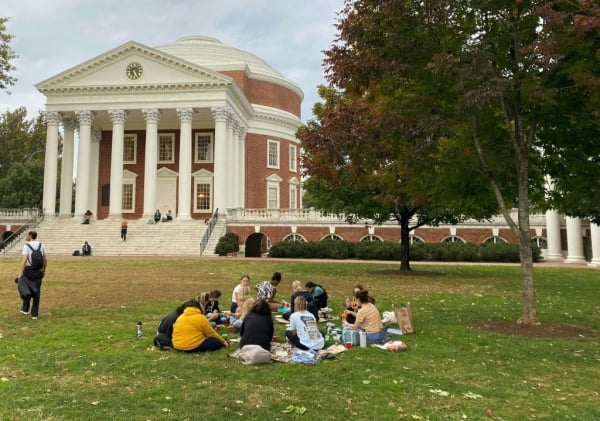
    UVA announced Friday that it opposes the offer of yet-unrevealed special funding benefits in exchange for signing the compact. The statement came the day of an on-campus demonstration urging university leaders not to sign. Dartmouth unveiled its response Saturday morning. Both rejections came despite the universities attending a meeting Friday with White House officials about the deal.

    “As I shared on the call, I do not believe that the involvement of the government through a compact—whether it is a Republican- or Democratic-led White House—is the right way to focus America’s leading colleges and universities on their teaching and research mission,” Dartmouth president Sian Leah Beilock wrote in a message to Education Secretary Linda McMahon, which the president also shared with her community.

    “Our universities have a responsibility to set our own academic and institutional policies, guided by our mission and values, our commitment to free expression, and our obligations under the law,” Beilock wrote. “Staying true to this responsibility is what will help American higher education build bipartisan public trust and continue to uphold its place as the envy of the world.”

    Beilock hasn’t been a publicly outspoken opponent of Trump; at a Heterodox Academy conference in June, she said, “It’s really a problem to say just because the administration, with many things that we all object to, is suggesting something inherently means it’s wrong.” But she also said back then that “we shouldn’t have the government telling us what to do.”

    In a message Friday to McMahon, also shared with the community, UVA interim president Paul Mahoney wrote that “the integrity of science and other academic work requires merit-based assessment of research and scholarship. A contractual arrangement predicating assessment on anything other than merit will undermine the integrity of vital, sometimes lifesaving, research and further erode confidence in American higher education.”

    The compact asks colleges to agree to overhaul or abolish departments “that purposefully punish, belittle, and even spark violence against conservative ideas,” without further defining what those terms mean. It also asks universities, among other things, to commit to not considering transgender women to be women; reject foreign applicants “who demonstrate hostility to the United States, its allies, or its values”; and freeze “effective tuition rates charged to American students for the next five years.”

    In exchange for these agreements, the White House has said signatories would “be given [funding] priority when possible as well as invitations to collaborate with the White House.” But the administration hasn’t revealed how much extra funding universities would be eligible for, and the nine-page compact doesn’t detail the potential benefits. The compact, as well as a Thursday statement from the White House, can also be read as threatening colleges’ current federal funding if they don’t sign.

    Mahoney told McMahon that his university agrees “with many of the principles outlined in the Compact, including a fair and unbiased admissions process, an affordable and academically rigorous education, a thriving marketplace of ideas, institutional neutrality, and equal treatment of students, faculty, and staff in all aspects of university operations.”

    “Indeed,” Mahoney wrote, “the University of Virginia leads in several of these areas and is committed to continuous improvement in all of them. We seek no special treatment in exchange for our pursuit of those foundational goals.”

    The decisions make UVA the fifth and Dartmouth the sixth of the nine initial institutions presented with the deal to publicly turn it down. UVA is also the first public university and first Southern institution to reject it. The Massachusetts Institute of Technology was the first of the nine to turn it down, on Oct. 10, followed by Brown University and the Universities of Pennsylvania and Southern California.

    UVA’s rejection of the compact comes after the Trump administration successfully pressured then–UVA president James Ryan to step down in June. The Justice Department had demanded he step down. The UVA Board of Visitors voted to dissolve the university’s diversity, equity and inclusion office in March, but multiple conservative alumni groups and legal entities complained that Ryan failed to eliminate DEI from all corners of campus.

    A coalition of groups opposed to the compact, including the UVA chapter of the American Association of University Professors, praised the rejection in a Friday news release.

    “Today’s events demonstrate the power of collective organizing and action to defeat tyranny,” the statement said. “We hope that we serve as an example to the other public universities that received the ‘Compact’—the University of Texas, Austin, and the University of Arizona—giving them the courage and clarity not to buckle.”

    UVA faculty groups had overwhelmingly urged university leaders to reject the compact. And hundreds of demonstrators showed up to the anticompact rally Friday on the UVA campus in Charlottesville, Cville Right Now reported.

    Alongside Arizona and UT Austin, Vanderbilt University also hasn’t revealed its decision. But after MIT announced its refusal of the compact, Trump offered it to all U.S. colleges and universities to sign.

    White House officials met Friday with some universities about the proposal. The Wall Street Journal reported that UVA, Dartmouth, Arizona, UT Austin and Vanderbilt were invited, along with universities that weren’t part of the original nine: Arizona State University, the University of Kansas and Washington University in St. Louis.

    White House spokesperson Liz Huston compared the compact in a statement to efforts from former presidents George Washington, Abraham Lincoln, Teddy Roosevelt and John F. Kennedy, who she said “called on our universities to be of greater service to the nation.”

    “President Trump has called on universities to do their part in returning America to its economic and diplomatic successes of the past: a nation of full employment, pioneering innovations that change the world, and committed to merit and hard work as the ingredients to success,” she said, adding the administration hosted “a productive call” with several universities. 

    A White House official said UVA and the other seven invited universities participated in the call.

    “They now have the baton to consider, discuss, and propose meaningful reforms, including their form and implementation, to ensure college campuses serve as laboratories of American greatness,” Huston said. 

    Source link