
This post is one of many, related to my participation in Harold Jarche’s Personal Knowledge Mastery Workshop.
The Medium: The “Smart” Phone
Shhhh… Don’t tell anyone, but our 13 year-old son will likely be getting his first “smart” phone for Christmas this year. I don’t think he has ever read my blog, so we should be good until December. As long as you cooperate with this secret surprise.
I remember reading a few years back that the average child in the United States gets a phone at the age of 11. That seemed really early to me then. By the time Christmas rolls around, he will be about a month away from turning 14, which seems awfully late.
Our son would agree.
He tells us that he and one other guy in school are the only kids without a phone at this point. This may sound like a stereotypical story of woe that young people tell their parents to let them have something. But when we discuss the subject, there’s a common theme:
What he really wants is a camera, disguised as a phone.
A primary driver for his wanting the camera and messaging functionality is his upcoming middle school Washington DC trip in the Spring. When I tossed the idea around of getting him a camera, instead, he had no interest in that, though. Dave and I have talked a lot about it and figure this is a good time for him to get a phone and we’ve started our discussions about how we want to handle that, as parents.
Dave and I talk more about these tensions in the second half of the video we recorded of us unboxing and playing with Justin Shaffer’s Alignment: A Course Design Deck.
We also link in the video’s notes to the parent resources from The Social Institute, which are recommended by the academic leadership at our kids’ school. Now, on to why I’m bringing up smart phones in this particular post.
McLuhan’s Media Tetrad
Jarche introduces those of us participating in his Personal Knowledge Mastery Workshop to McLuhan’s Media Tetrad this week. I’ve seen the diagram on Jarche’s blog, before, but never slowed myself down enough to spend time soaked in it, like I have today.
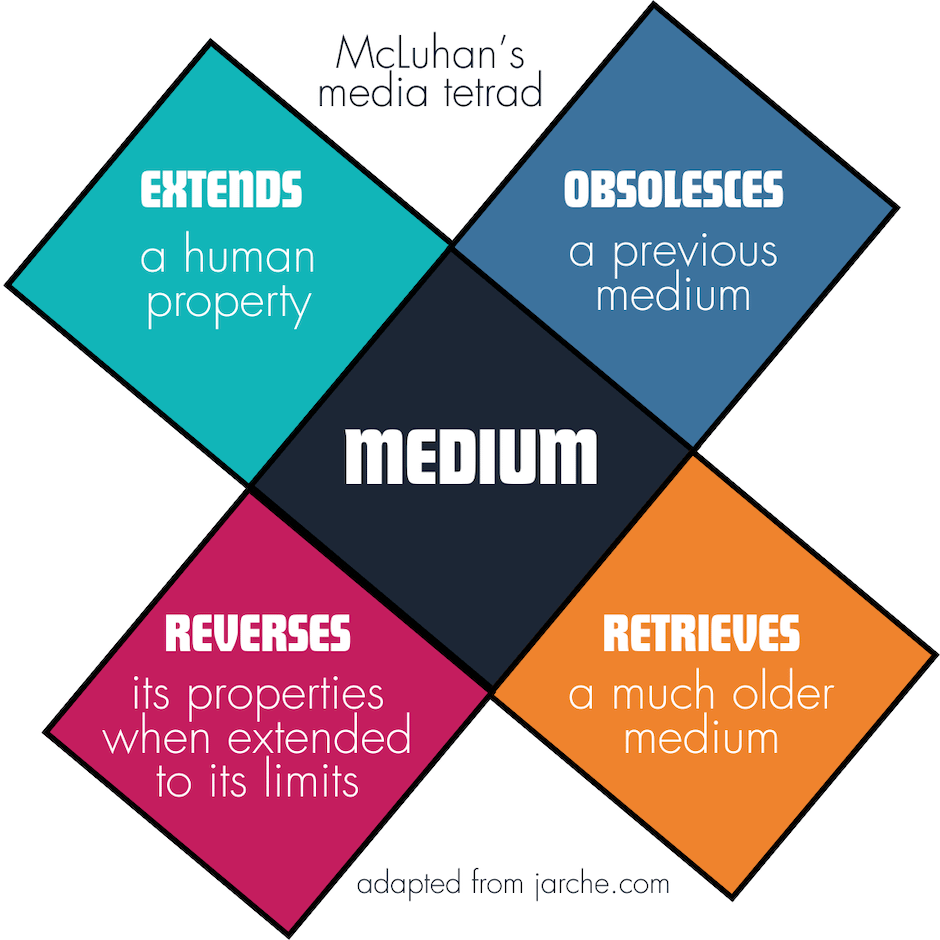
Here’s my best, novice’s understanding of the framework:
It starts with a new medium.
McLuhan posits through his Laws of Media that every new medium results in four effects. Jarche explains that under McLuhan’s laws, each new medium:
Extends a human property,
Obsolesces the previous medium (& makes it a luxury good)
Retrieves a much older medium &
Reverses its properties when pushed to its limits
When we take time to understand what happens with new media, we can put in place steps to negate or minimize the negative effects. Ample examples exist of ways that social media extends humans’ voices, while ultimately making healthy, human-to-human conversation obsolete. Then, our more tribal affiliations can kick in (Twitter, anyone?) and we reverse into “populism and demagoguery,” according to Jarche’s example.
Jarche writes:
The reversals are already evident — corporate surveillance, online orthodoxy, life as reality TV, constant outrage to sell advertising. The tetrads give us a common framework to start addressing the effects of social media pushed to their limits. Once you see these effects, you cannot un-see them.
My Example
As I mentioned earlier, I’ve selected the “smart” phone as the medium to analyze.
Here’s my attempt at the tetrad:
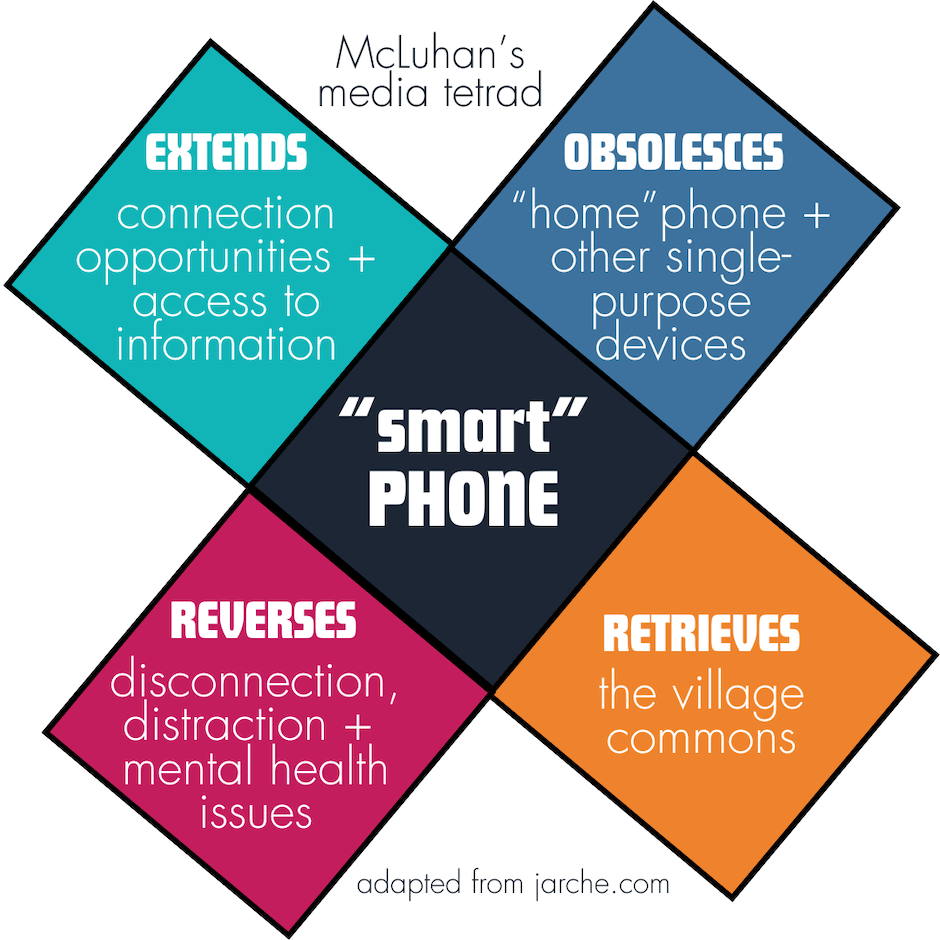
Jarche suggested that we first explore what the technology enhances and then what it obsolesces. That felt easy and hard, simultaneously. Today’s “smart” phones contain so many features that the definition of what this technology is can be blurred. Our son, for example, has understandably brought up that when adults raise concerns about phones, they can often be actually talking about social media (which he presently has zero interest in).
The “smart” phone:
- Extends: connection opportunities and access to information
- Obsolesces: “home” phone + other single-purpose devices
As Jarche predicted, these two elements of the tetrad were fairly easy to identify (though I could have chosen to go in a bunch of different directions). I can still recall what it felt like to go with my brother to a convenience store that was about two miles from our house and involved climbing down a super steep, dirt hill. The idea that I could have called my Mom to ask her to pick us up, so we could have avoided the steep hill on the way home would not have occurred to me at the time.
That’s despite the fact that we watched Star Trek as a family and they had these transporter beams that would transmit the characters in the show from the starship and a planet’s surface.

The idea of extending our home phone to one that could be carried around in my pocket (if women’s pants had pockets, that is…) would have been a welcome idea to me. Then, there are all the other single-purpose devices that the “smart” phone can take the place of, such as:
- 📞 Landline phone
- 📷 Camera
- 🎧 MP3 player
- 🗺️ GPS
- ⏰ Alarm clock
- 📺 Video player
- 💾 Disk or hard drive
- 📝 Notepad
- 🧮 Calculator
- 💡 Flashlight
- 💳 Wallet
- 🧭 Compass
- ✉️ Mail service
I could have kept going with that list for a long time and just be getting started.
Productive Struggle
Cognitive psychologists talk about how helpful productive struggle can be in the learning process. As Jarche thought we might, I had trouble with what the smart phone might retrieve a much older medium, in terms of the way I had anchored the framework with the other two components (extends and obsolesces). I then moved my focus over to the reverses portion of the tetrad and thought how it was the polar opposite (disconnection) of what it promises to extend (connection).
For the retrieves part, I kept getting stuck between two, broad ideas: the pubic square or the commons.
I considered how the promise of today’s phones as the device to connect us with others and with information winds up making loneliness more likely and seeding a potential decline in mental health. I also fixated on how the “extends, obsolesces, and reverses” descriptions I had come up with were more geared toward individuals, yet the promise of the common good is only possible when we come together in community.
I would like to learn more about the history of the public square, as well as regarding the commons in medieval and early modern Europe. I’m also intrigued to keep my learning going regarding “the commons” in digital contexts (Wikipedia, Wikis, Creative Commons, etc.). There are also a lot of places I continue to want to explore about the attention economy and surveillance capitalism.
Until next time, when I share my reflections from Jarche’s Fake News lesson. That should be fun, ehh? Nothing going on there in the world, right? 🫠