
by Rob Cuthbert
In SRHE News and Blog a series of posts is chronicling, decade by decade, the progress of SRHE since its foundation 60 years ago in 1965. As always, our memories are supported by some music of the times.
1995 was the year of the war in Bosnia and the Srebrenica massacre, the collapse of Barings Bank, and the Oklahoma Bombing. OJ Simpson was found not guilty of murder. US President Bill Clinton visited Ireland. President Nelson Mandela celebrated as South Africa won the Rugby World Cup, Blackburn Rovers won the English Premier League. Cliff Richard was knighted, Blur-v-Oasis fought the battle of Britpop, and Robbie Williams left Take That, causing heartache for millions. John Major was UK Prime Minister and saw off an internal party challenge to be re-elected as leader of the Conservative Party. It would be two years until D-Ream sang ‘Things can only get better’ as the theme tune for the election of New Labour in 1997. Microsoft released Windows 95, and Bill Gates became the world’s richest man. Media, news and communication had not yet been revolutionised by the internet.
Higher education in 1995
Higher education everywhere had been much changed in the preceding decade, not least in the UK, where the binary policy had ultimately proved vulnerable: The Polytechnic Experiment ended in 1992. Lee Harvey, the long-time editor of Quality in Higher Education, and his co-author Berit Askling (Gothenburg) argued that in retrospect:
“The 1990s has been the decade of quality in higher education. There had been mechanisms for ensuring the quality of higher education for decades prior to the 1990s, including the external examiner system in the UK and other Commonwealth countries, the American system of accreditation, and government ministerial control in much of Europe and elsewhere in the world. The 1990s, though, saw a change in the approach to higher education quality.”
In his own retrospective for the European Journal of Education on the previous decade of ‘interesting times’, Guy Neave (Twente) agreed there had been a ‘frenetic pace of adjustment’ but
“Despite all that is said about the drive towards quality, enterprise, efficiency and accountability and despite the attention lavished on devising the mechanics of their operation, this revolution in institutional efficiency has been driven by the political process.”
Europe saw institutional churn with the formation of many new university institutions – over 60 in Russia during 1985-1995 in the era of glasnost, and many others elsewhere, including Dublin City University and University of Limerick in 1989. Dublin Institute of Technology, created in 1992, would spend 24 years just waiting for the chance[1] to become a technological university. 1995 saw the establishment of Aalborg in Denmark and several new Chinese universities including Guangdong University of Technology.
UK HE in 1995
In the UK the HE participation rate had more than doubled between 1970 (8.4%) and 1990 (19.4%) and then it grew even faster, reaching 33% by 2000. At the end of 1994-1995 there were almost 950,000 full-time students in UK HE. Michael Shattock’s 1995 paper ‘British higher education in 2025’ fairly accurately predicted a 55% APR by 2025.
There had been seismic changes to UK HE in the 1980s and early 1990s. Polytechnic directors had for some years been lobbying for an escape from unduly restrictive local authority bureaucratic controls, under which many institutions had, for example, not even been allowed to hold bank accounts in their own names. Even so, the National Advisory Body for Public Sector HE (NAB), adroitly steered by its chair Christopher Ball (Warden of Keble) and chief executive John Bevan, previously Director of Education for the Inner London Education Authority, had often outmanoeuvred the University Grants Committee (UGC) led by Peter Swinnerton-Dyer (Cambridge). By developing the idea of the ‘teaching unit of resource’ NAB had arguably embarrassed the UGC into an analysis which declared that universities were slightly less expensive for teaching, and the (significant) difference was the amount spent on research – hence determining the initial size of total research funding, then called QR.
Local authorities realised too slowly that controlling large polytechnics as if they were schools was not appropriate. Their attempt to head off reforms was articulated in Management for a Purpose[2], a report on Good Management Practice (GMP) prepared under the auspices of NAB, which aimed to retain local authority strategic control of the institutions which they had, after all, created and developed. It was too little, too late. (I was joint secretary to the GMP group: I guess, now it’s time, for me to give up.) Secretary of State Kenneth Baker’s 1987 White Paper Higher Education: Meeting the Challenge was followed rapidly by the so-called ‘Great Education Reform Bill’, coming onto the statute book as the Education Reform Act 1988. The Act took the polytechnics out of local authorities, recreating them as independent higher education corporations; it dissolved the UGC and NAB and set up the Universities Funding Council (UFC) and the Polytechnics and Colleges Funding Council (PCFC). Local authorities were left high and dry and government didn’t think twice, with the inevitable progression to the Further and Higher Education Act 1992. The 1992 Act dissolved PCFC and UFC and set up Higher Education Funding Councils for England (HEFCE) and Wales (HEFCW). It also set up a new Further Education Funding Council (FEFC) for colleges reconstituted as FE corporations and dissolved the Council for National Academic Awards. The Smashing Pumpkins celebrated “the resolute urgency of now”, FE and HE had “come a long way” but Take That sensibly advised “Never forget where you’ve come here from”,
Crucially, the Act allowed polytechnics to take university titles, subject to the approval of the Privy Council, and eventually 40 institutions did so in England, Wales and Scotland. In addition Cranfield was established by Royal Charter in 1993, and the University of Manchester Institute of Science and Technology became completely autonomous in 1994. The biggest hit in 1995 actually named an HE institution and its course, as Pulp sang: “She studied sculpture at St Martin’s College”. Not its proper name, but Central St Martin’s College of Art and Design would have been tougher for Jarvis Cocker to scan. The College later became part of the University of the Arts, London.
The Conservative government was not finished yet, and the Education Act 1994 established the Teacher Training Agency and allowed students to opt out of students’ unions. Debbie McVitty for Wonkhe looked back on the 1990s through the lens of general election manifestos:
“By the end of the eighties, the higher education sector as we know it today had begun to take shape. The first Research Assessment Exercise had taken place in 1986, primarily so that the University Grants Committee could draw from an evidence base in its decision about where to allocate limited research funding resources. … a new system of quality assessment had been inaugurated in 1990 under the auspices of the Committee of Vice Chancellors and Principals (CVCP) …
Unlike Labour and the Conservatives, the Liberal Democrats have quite a lot to say about higher education in the 1992 election, pledging both to grow participation and increase flexibility”
In 1992 the Liberal Democrats also pledged to abolish student loans … but otherwise many of their ideas “would surface in subsequent HE reforms, particularly under New Labour.” Many were optimistic: “Some might say, we will find a brighter day.”
In UK HE, as elsewhere, quality was a prominent theme. David Watson wrote a famous paper for the Quality Assurance Agency (QAA) in 2006, Who Killed What in the Quality Wars?, about the 1990s battles involving HE institutions, QAA and HEFCE. Responding to Richard Harrison’s Wonkhe blog about those quality wars on 23 June 2025, Paul Greatrix blogged the next day about
“… the bringing together of the established and public sector strands of UK higher education sector following the 1992 Further and Higher Education Act. Although there was, in principle, a unified HE structure after that point, it took many more years, and a great deal of argument, to establish a joined-up approach to quality assurance. But that settlement did not last and there are still major fractures in the regime …”
It was a time, Greatrix suggested, when two became one (as the Spice Girls did not sing until 1996), but his argument was more Alanis Morrissette: “I wish nothing, but the best for you both. I’m here, to remind you of the mess you left when you went away”.
SRHE and research into higher education in 1995
SRHE’s chairs from 1985-1995 were Gareth Williams, Peter Knight, Susan Weil, John Sizer and Leslie Wagner. The Society’s administrator Rowland Eustace handed over in 1991 to Cynthia Iliffe; Heather Eggins then became Director in 1993. Cynthia Iliffe and Heather Eggins had both worked at CNAA, which facilitated a relocation of the SRHE office from the University of Surrey to CNAA’s base at 334-354 Gray’s Inn Road, London from 1991-1995. From the top floor at Gray’s Inn Road the Society then relocated to attic rooms in 3 Devonshire St, London, shared with the Council for Educational Technology.
In 1993 SRHE made its first Newer Researcher Award, to Heidi Safia Mirza (then at London South Bank). For its 30th anniversary SRHE staged a debate: ‘This House Prefers Higher Education in 1995 to 1965’, proposed by Professor Graeme Davies and Baroness Pauline Perry, and opposed by Dr Peter Knight and Christopher Price. My scant notes of the occasion do not, alas, record the outcome, but say only: “Now politics is dead on the campus. Utilitarianism rules. Nationalisation produces mediocrity. Quangos quell dissent. Arid quality debate. The dull uniformity of 1995. Some students are too poor.”, which rather suggest that the opposers (both fluent and entertaining speakers) had the better of it. Whether the past or the future won, we just had to roll with it. The debate was prefaced by two short papers from Peter Scott (then at Leeds) on ‘The Shape of Higher Education to Come’, and Gareth Williams (Lancaster) on ‘ Higher Education – the Next Thirty Years’.


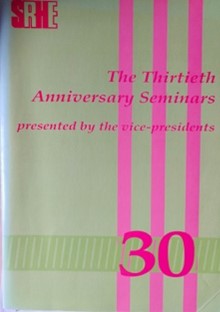
The debate was followed by a series of seminars presented by the Society’s six (!) distinguished vice-presidents, Christopher Ball, Patrick Coldstream, Malcolm Frazer, Peter Swinnerton-Dyer, Ulrich Teichler and Martin Trow, and then a concluding conference. SRHE was by 1995 perhaps passing its peak of influence on policy and management in UK HE, but was also steadily growing its reach and impact on teaching and learning. The Society staged a summer conference on ‘Changing the Student Experience’, leading to the 1995 annual conference. In those days each Conference was accompanied by an edited book of Precedings: The Student Experience was edited by Suzanne Hazelgrove (Bristol). One of the contributors and conference organisers, Phil Pilkington (Coventry), later reflected on the prominent role of SRHE in focusing attention on the student experience.
Research into higher education was still a small enough field for SRHE to produce a Register of Members’ Research Interests in 1996, including Ron Barnett (UCL) (just getting started after only his first three books), Tony Becher, Ernest Boyer, John Brennan, Sally Brown, Rob Cuthbert, Jurgen Enders, Dennis Farrington, Oliver Fulton, Mary Henkel, Maurice Kogan, Richard Mawditt, Ian McNay, David Palfreyman, Gareth Parry, John Pratt, Peter Scott (in Leeds at the time), Harold Silver, Maria Slowey, Bill Taylor, Paul Trowler, David Watson, Celia Whitchurch, Maggie Woodrow, and Mantz Yorke. SRHE members and friends, “there for you”. But storm clouds were gathering for the Society as it entered the next, financially troubled, decade.
If you’ve read this far I hope you’re enjoying the musical references, or perhaps objecting to them (Rob Gresham, Paul Greatrix, I’m looking at you). There will be two more blogs in this series – feel free to suggest musical connections with HE events in or around 2005 or 2015, just email me at [email protected]. Or if you want to write an alternative history blog, just do it.
Rob Cuthbert is editor of SRHE News and the SRHE Blog, Emeritus Professor of Higher Education Management, University of the West of England and Joint Managing Partner, Practical Academics. Email [email protected]. Twitter/X @RobCuthbert. Bluesky @robcuthbert22.bsky.social.
[1] I know this was from the 1970s, but a parody version revived it in 1995
[2]National Advisory Body (1987) Management for a purpose Report of the Good Management Practice Group London: NAB
