Category: Access & WP

  • Storytelling and arts education can drive social change

    Storytelling and arts education can drive social change

    Netflix drama Adolescence has ignited two vital national conversations.

    The rise of online misogyny among radicalised young men has seen Keir Starmer weighing in on the issue.

    There’s also been a debate surrounding disenfranchisement among boys and young men in primary, secondary and tertiary education.

    The latter has long been on the radar of policymakers, academics, and researchers. HEPI recently linked boys’ educational underattainment to a “veering towards the political extremes,” while discussions around figures like Andrew Tate have kept the former on Parliament’s agenda.

    Yet both issues remained on the margins until Adolescence – written, produced, and starring Rose Bruford College alum Stephen Graham – catalysed real-world conversations and moved us toward legislative action.

    Despite press, and policy, and parliament, the issue broke through because of storytelling.

    Power of creative arts

    Much like the Post Office scandal – exposed by Private Eye but only widely acknowledged after Mr Bates vs The Post Office (co-produced by another Rose Bruford alumus, Sara Huxley) – Adolescence shows how creative arts can achieve what policy papers often cannot: capturing public attention and driving cultural change.

    It highlights a key truth in fostering social change – the arts play a vital role.

    As a membership body representing nearly 40 per cent of creative arts students, we’re concerned by the continued perception of creative degrees as niche or non-essential – leading to disproportionate funding cuts compared to STEM.

    In reality, our graduates shape public discourse on identity, gender, and social responsibility, shifting public discourse, and ultimately contributing to public policy.

    At the same time as a devaluation of creative degrees, there’s another issue hiding in plain sight – working-class boys are falling behind in education.

    HEPI has produced compelling reports on this subject, outlining the growing gender attainment gap, particularly for boys from disadvantaged backgrounds and neurodivergent boys (although we note that some of this may be down to underdiagnosis in girls).

    Concerns in the report also raised that boys are less likely to be steered toward specific disciplines (while girls have been encouraged into STEM) and that traditional educational structures serve girls better.

    Although the authors should avoid biologically deterministic assumptions around how people learn and bear in mind that gendered socialisation probably plays a large part here – regardless of how behaviour and engagement is socially or otherwise fostered, the data shows its material impact – boys academically underperform compared to girls at every age, in almost every subject.

    Class acts

    But it is essential to be clear – the issue is not boys in general, but working class boys who are most at risk of falling behind. Discussions that flatten this into a gender-only concern risk obscuring the real and compounding impact of class-based disadvantage on educational engagement and attainment.

    This issue receives little attention in practice. A rudimentary and quick scan of Access and Participation Plans (APPs) revealed a striking omission: boys are rarely, if ever, mentioned as a specific target group.

    Even when John Blake outlined the significant scale to equality of opportunity faced by “boys from working-class communities” back in 2022, it was primarily in comparison to smaller groups who experience more intense forms of disadvantage, rather than recognising the issue of working-class boys attainment as a standalone concern.

    GuildHE Institutions like Rambert School, Northern School of Contemporary Dance and AUB are already doing vital outreach work to bring boys into the subject spaces they are underrepresented in. But again, this work often happens in isolation, without the policy recognition or funding it truly deserves.

    That’s a mistake. For many boys, especially those disengaged from traditional academic pathways, creative disciplines provide an essential space to connect, reflect, and grow. Dance, drama, music, and film help young men process difficult emotions and identities constructively.

    As our recent written submission to parliament outlined, the dance training boys took part in at Rambert School helped them in areas of life such as creative thinking, managing anger and ADHD symptoms. Arts University Bournemouth runs Being a Boy which provides a supportive space for young men to creatively and safely engage with the role of masculinity in their lives.

    Add in Prof Becky Francis’s review of the school curriculum – which argues it’s failing students outside the A-levels-to-university pipeline, disproportionately boys – and her call to value arts subjects, and we see an emerging case for education that better accounts for how many boys have been socialised to learn and engage.

    This is where creative education comes in. The arts are not just about performance or aesthetic appreciation – they are powerful tools for expression, empathy, and exploration, and a possible way to engage boys who are disenfranchised at an estimated cohort size of half a million from higher education

    While the HEPI report calls for a push to get more men into teaching, care roles, and nursing, we believe in the individual and societal benefits of encouraging boys – particularly working-class boys – into, and their contribution to, the arts.

    Some of this work is already being done by our alumnus – Stephen Graham discovered Owen Cooper, who plays Jamie Miller in Adolescence, who Cooper describes as “a normal working-class family from a normal council estate”. But there needs to be a concerted policy effort.

    That means:

    • Valuing arts and creative degrees as critical to both gendered social progress and supporting widening participation in HE for boys
    • Including boys as a key demographic in widening participation strategies in HE.
    • Supporting cross-sector collaboration between educators, policymakers, creatives, and communities to tackle today’s issues and truly value the impact creative degrees make on individuals and society.

    The success of Adolescence in sparking national debate is a wake-up call. If we want to tackle misogyny, and we must remember that Adolescence was fundamentally about violence against women and girls, as well as male disengagement in education, we need to invest in the places where empathy and identity are formed – and value how these are explored and communicated to wider society.

    Source link

  • Young people from deprived areas can’t afford to consider university

    Young people from deprived areas can’t afford to consider university

    Should the economic fortunes area you grew up in have an impact on your chances of attending university?

    There has always been a stubborn connection between 18 year old participation rates and your (UK) region of residence.

    Currently UCAS data tells us that 18 year olds living in London are more likely than not to go on to attend university, whereas in the North East just 29.9 per cent will get there.

    Can’t get there from here

    And in many parts of the UK the proportion of 18 year olds getting to university has stagnated (or even dropped over recent years), as the population of 18 year olds has expanded.

    [Full screen]

    If you are concerned about left-behind parts of the UK, this is something that should concern you. It’s widely acknowledged that graduates are key to levelling up a region, and a surprisingly large number of graduates return to their home area (at least in the short term) after graduation.

    Costs not culture?

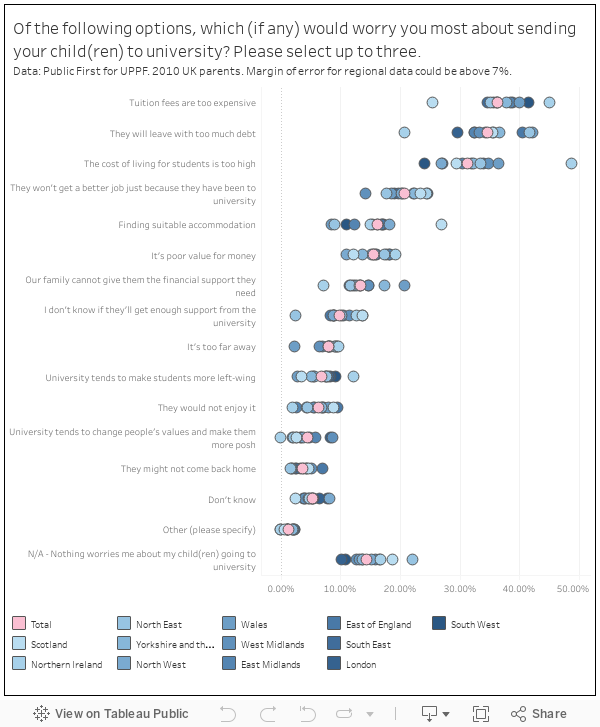
    The counter argument to that is very often cultural – the idea that going to university changes a person, and dilutes the essence of what makes (frankly) a deprived area a deprived area. Polling from Public First for the UPP Foundation (which is kicking off an inquiry into the state of widening participation in higher education) happily suggests that this is not an attitude prevalent among UK parents.

    [Full screen]

    What does worry parents is the sheer cost of study – both in terms of tuition fees (36 per cent cite this as a top three reason to be concerned about their children attending university) and living costs (31 per cent). The overall level of debt on graduation is the other big one (35 per cent).

    But that’s not to say that there are not other reasons – number four in the list is the idea that “they won’t get a better job just because they have been to university” (particularly prevalent in London), number six is “poor value for money” (an East Midlands, North East, and Northern Ireland prevalence). The size of the sample makes the regional splits difficult to draw accurate conclusions from, but the trends are interesting.

    What teachers said

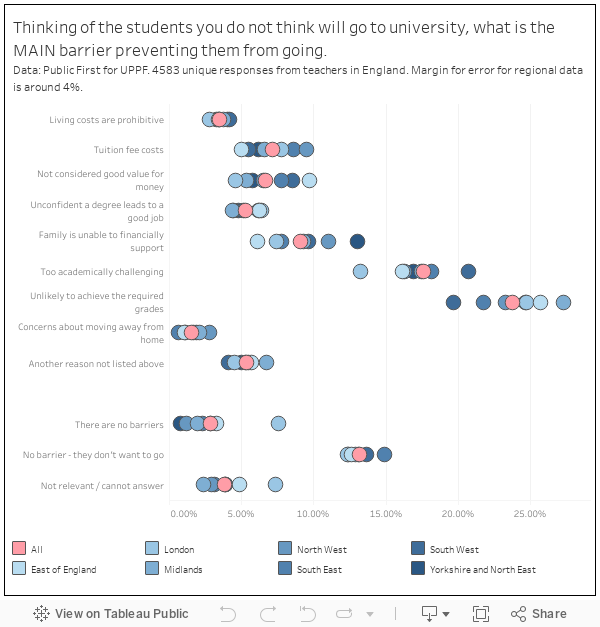
    Teachers are a primary source of information about higher education – happily UPPF also commissioned Public First to look at what teachers felt were the barriers to participation, and there are (some) regional splits.

    [Full screen]

    The question here focuses on why teachers don’t expect some pupils to go to university – we are looking across all types of schools at the top of secondary education. Here we see that the big barriers are academic – teachers tend to feel that students are unlikely to get the required grades (24 per cent) or to rise to the academic challenge (18 per cent). And this is true across all English regions.

    Notably prevalent in the North East and Yorkshire (combining two standard, ILTS1, regions) is the idea that the family will be unable to support a student. In that region this was cited by 13 per cent of teachers – enough to feel concerning, but similar to the proportion that simply don’t want to go to university (again note that the margin of error will be high with small subsamples).

    Your chances are variable

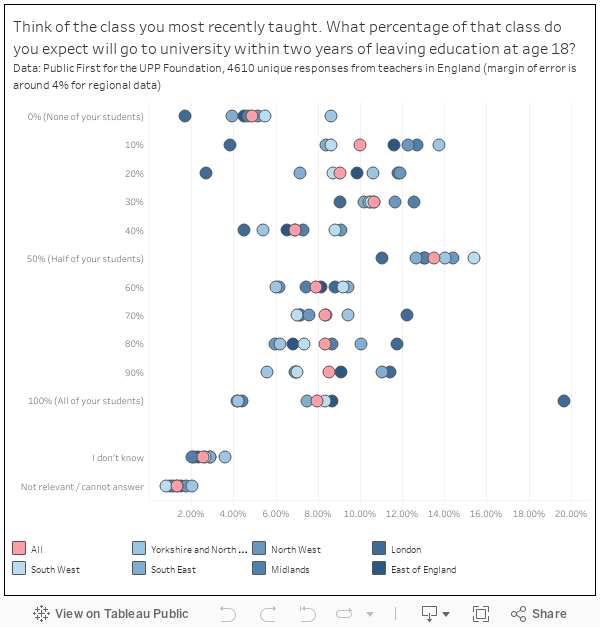
    Twenty per cent of teachers in London feel like all of the last class they taught will go on to university – just four per cent of teachers in the North West, North East, and Yorkshire had similar confidence. Indeed 14 per cent of teachers in the North East and Yorkshire felt that only 10 per cent of their class would go on to university. As you might expect, the modal answer for most regions was “about half” of pupils – the North East and Yorkshire is the only exception.

    [Full screen]

    This, then, is what access and participation in the north is up against. Attainment and capacity is an issue everywhere, and one that the access and participation regime in England attempts to address via collaboration between universities and schools – something that also contributes to aspiration.

    But aspiration and attainment count for little when parents and teachers are agreeing that for many in the UK’s most deprived areas university study simply is not affordable. And though participation among disadvantaged groups is improving – disadvantaged areas continue to struggle.

    Source link

  • The UPP Foundation is launching a new inquiry into widening participation to support the government’s opportunity mission

    The UPP Foundation is launching a new inquiry into widening participation to support the government’s opportunity mission

    Twenty-five years on from Blair’s target for 50 per cent of young people to go to higher education, the Labour Party set out a new ambition to “break down barriers to opportunity.”

    The opportunity mission articulates a multi-generational challenge: to make sure that children and young people can get on, no matter what their background; to change Britain so that a child’s future earnings are no longer limited by those of their parents; and to make Britain one of the fairest countries in the OECD. It is a fundamentally important challenge, and one that will be years in the undertaking.

    Widening participation in higher education plays a huge part in this mission, and it is for that reason that the UPP Foundation has announced a major new inquiry into the future of widening participation and student success. We have launched this inquiry by publishing a short “state of the nation” summary of the key issues in 2025. Because while success in the opportunity mission would transform the shape of British society, Labour is all too aware of the differences between the optimism of Blair’s famous 50 per cent pledge and the markedly different political and economic circumstances Keir Starmer’s government finds itself in now.

    A changed landscape

    Universities and schools face significant headwinds when it comes to dismantling the gaps students face when looking to get in and get on. The HE sector is facing well-publicised and unprecedented financial challenges, with the recent rise in fees doing nothing to alleviate pressure amid rising costs. With institutions contemplating restructuring moves and the government no closer to outlining a solution for widespread mounting deficits amid heavy fiscal weather, it is hard to see universities or the government finding much bandwidth for widening participation in the near future.

    There is also no equivalent target or metric that captures the challenge in quite the same way as Blair’s. This is understandable. Part of the reason no similar metric presents itself is because widening participation is now seen as multidimensional: not just focused on access to university, but also continuation rates, graduate outcomes, and less easily quantifiable measures of success, such as student belonging and participation in the immersive elements of the student experience.

    With the number of commuter students rising to reflect different learning patterns and pathways in a diverse student population, student living arrangements are also a major part of this puzzle. As the Secretary of State alluded to prior to the general election in an address to Universities UK, modern widening participation must reach out to more of those coming from nontraditional backgrounds, and those pursuing non-linear pathways through higher education.

    A wider view of widening participation means we need a more nuanced understanding of how access to university varies along socioeconomic, geographical and other demographic lines. As today’s report outlines, the difference in progression rates to higher education between students eligible for free school meals and their peers has widened to 20.8 per cent – the highest on record. Young people in London are significantly more likely to progress to higher education than their counterparts in the North East. The continuation gap between students from the most and least advantaged backgrounds now sits at 9.4 percentage points, having increased from 7.5 in 2016–17. As one of many charities operating in this space, we come face-to-face with the scale and scope of this disadvantage gap time and again. Equality of opportunity is still some way off.

    As well as this, some are schools struggling to do as much as others to support access to HE. Polling in our new report finds that 75 per cent of teachers in London expect at least half of their class to progress to higher education, compared to just 45 per cent in the North West and Yorkshire and the North East. Similarly, 75 per cent of teachers in Ofsted Outstanding schools thought that more than half their class would progress to HE, compared to just 35 per cent in schools rated as Requires Improvement or Inadequate.

    Although the Secretary of State said in a letter to heads of institution in November 2024 that expanding access and improving outcomes for disadvantaged students was her top reform priority in HE, the long list of challenges facing this government poses the risk that widening participation becomes a footnote to the geopolitical crisis.

    What we’re doing

    Despite the difficult environment facing both universities and the government, we think this agenda is too important to be put on the back burner. We hope our inquiry will help to establish new collective goals for widening participation and student success for the years ahead.

    The current moment provides a significant opportunity to interrogate the ways in which access and participation, student finance, student experience on campus, careers guidance, and student belonging intersect. It is in the context of this opportunity that the UPP Foundation, supported by Public First, is launching this inquiry, which aims to establish a new mission for widening participation.

    Following the introductory paper, we will publish two investigations, the first focusing on the persistent widening participation problems latent in “cold spot” areas of England, and the second exploring how the university experience differs based on students’ living arrangements and economic backgrounds, with poorer students often receiving a secondary experience that contributes to lower continuation and completion rates. Cumulatively, they will shed light on what meaningful widening participation really looks like to those who need it most, and what levers can be pulled to realise this vision.

    This inquiry comes at a crucial moment. We want to help the sector, the Office for Students and the government by setting out a series of evidence-based goals, recommendations and policies which could help make the broader vision a reality, while recognising “the art of the possible” in an era of fiscal restraint. Through these recommendations we hope to see the rhetoric of the opportunity mission and the Secretary of State start to become reality.

    Source link

  • Students can make a real difference to educational opportunity in their regions through tutoring

    Students can make a real difference to educational opportunity in their regions through tutoring

    Right now, improving access to educational opportunities for young people from disadvantaged backgrounds is high on the agenda of both universities and the UK government.

    While Labour draws up plans to break the link between background and success, universities continue to invest significant time and resources into creating and implementing widening participation initiatives. If these efforts are to be successful, it’s vital that more young people are given access to tailored tutoring support during their time in compulsory education.

    The advantage gap in achieving GCSE English and maths at age 16 is at its widest since 2011, with over half of pupils from disadvantaged backgrounds leaving school without these crucial qualifications. Missing these qualifications limits young people’s opportunities to progress in education. A 2021 study for the Nuffield Foundation primarily of the 2015 GCSE cohort found that young people who left school without GCSE English and maths are much less likely to study for a qualification higher than GCSE the following year, and even fewer pursue A levels.

    The 16-19 attainment gap persists in post-16 education. On average, young people facing economic disadvantage are over three grades behind their peers across their best three subjects by the time they leave compulsory education. The gap is even wider for those in long term poverty, at almost four grades behind.

    Tutoring has long been recognised as one of the most effective ways to boost attainment. Research by the Education Endowment Foundation suggests targeted tutoring leads to an average of five months additional progress when delivered one-to-one and four months additional progress when delivered in a small group.

    Unequal access

    Parents are aware of this benefit, with private tutoring becoming increasingly popular, according to the Sutton Trust. But low-income families are often priced out of accessing this kind of support should their child fall behind.

    This unequal access is something that was addressed by The National Tutoring Programme and the 16-19 Tuition Fund – both government-funded tutoring schemes that ran in state schools and colleges between 2020–24. These programmes were created in response to the pandemic, to help young people catch up on lost learning. During the lifetimes of these programmes, the Sutton Trust examination of the tutoring landscape found that the gap in access to tuition between poorer and wealthier families in England all but disappeared.

    A new report published this week from Public First – Past lessons, future vision: evolving state funded tutoring for the future – finds that schools and colleges have struggled to maintain tutoring beyond the end of the dedicated funding provided by these schemes. despite the strong evidence base for tutoring, its popularity among parents and government plans for tutoring to become a “permanent feature of the system” provided by these schemes.

    The report compiles lessons learned from the National Tutoring Programme and the 16-19 Tuition Fund and uses these to create a blueprint for what the future of state-funded tutoring should look like. Based on interviews and focus groups with teachers, it reveals that many school leaders see relying on Pupil Premium funding to sustain tutoring as unrealistic. Schools face competing pressures on this funding, including the need to cover gaps in their core budgets.

    Funding for tutoring programmes in colleges is even more limited. Unlike younger pupils, disadvantaged students in further education receive no equivalent to the Pupil Premium, despite still being in compulsory education. As a result, there is no dedicated funding for initiatives that could help bridge the attainment gap.

    This is particularly troubling when you consider that young people in this phase have the shortest time left in compulsory education, and that the majority of students who resit their GCSEs in English and maths – subjects that are crucial for accessing higher level study – do so in FE colleges.

    Reaping the benefits

    Tutoring programmes don’t just benefit the young people receiving much needed academic support, they also bring wider advantages to the higher education sector. By partnering with local schools and colleges to deliver tuition programmes, higher education institutions can take a leading role in advancing social mobility, delivering on their access and participation priorities, and strengthening ties with their local communities.

    These programmes also create valuable job opportunities for undergraduate and postgraduate students. At Get Further – a charity that supports students from disadvantaged backgrounds to succeed in their GCSE resits through small-group tuition – 61 per cent of our tutors in 2023–24 were students: 23 per cent postgraduate and 38 per cent undergraduate.

    When recruiting new tutors, we prioritise offering opportunities to students at our partner universities, providing them with comprehensive training and ongoing personal development. This enables them to build transferable skills in a paid role while making a meaningful contribution to widening participation, enriching both their own educational experience and that of the learners they support.

    Similarly, the University of Exeter tutoring model has had success with its literacy programme for 12-13 year olds – a scheme delivered entirely by undergraduate tutors, who are either paid for their time or earn credits towards their degree. Programmes like these provide students with the opportunity to develop skills in communication, mentoring, adaptability, and critical thinking. This is all while taking on a flexible role that fits around their studies, supports their finances and makes a positive impact on their local communities.

    Creating tutoring jobs for university students could also create a pipeline into teaching – a critically understaffed profession. In 2024, a survey of Get Further tutors revealed that 68 per cent of our tutor pool either were interested or might be interested in pursuing a career in teaching, and 67 per cent said that they were more likely to consider pursuing a career in teaching having tutored on our programme.

    Investing in tutoring isn’t just about closing the attainment gap – it’s about expanding opportunity at every stage of education. By making high-quality tuition accessible to all young people, regardless of background, we can remove barriers to higher education while also creating valuable work experience for university students.

    The Past lessons, future vision report sets out a clear blueprint for a sustainable, national tutoring programme. The evidence is compelling, the need is urgent, and the potential impact is transformative. The government must act to reinstate state funding so that this vital support remains available to those who need it most.

    In the meantime, universities have a crucial role to play. By embedding tutoring within their widening participation efforts, they can not only support young people facing disadvantage but also strengthen ties with local colleges and schools, enhance student employability, and help shape a fairer, more ambitious education system.

    Source link

  • University shouldn’t just postpone cliff edges for care experienced students

    University shouldn’t just postpone cliff edges for care experienced students

    A new report from TASO (Transforming Access and Outcomes for Students) shines a light on the barriers faced by those with experience of children’s social care entering and succeeding in higher education.

    The research points to a stark reality – inequitable access to higher education for care-experienced individuals, but also for a much larger group of people who have experienced children’s social care.

    Part of the problem is that support systems often hinge on rigid definitions like “care leaver,” leaving many students, who face similar challenges, without the help they need.

    When institutional policies fail to account for the diversity of these experiences, students are left to navigate higher education and life beyond it largely on their own.

    The report also suggests that while “care leavers” may have better access to support through Local Authorities (LAs) dedicated widening participation schemes, while those not neatly fitting into this category often fall through the cracks.

    But even if the definitions were fixed and there was more focus on “getting on” as well as getting in, what if higher education’s current offer isn’t enough to transform these students’ lives?

    Understanding diversity

    When the diversity of experience is overlooked, those needing support often miss out or don’t realise they’re entitled to it. Worse, support organisations sometimes view this diversity with suspicion.

    For example, the SLC’s rigid “estranged” or “in contact” policy fails to grasp complex family dynamics. Grey rocking – where abuse victims maintain minimal contact for safety – is ignored, leading to invasive social media monitoring and a profound lack of understanding of the complexities of family breakdowns.

    At the Unite Foundation, we provide free, year-round accommodation for care leavers and estranged students, improving outcomes by offering stability during studies and after graduation. The support gives graduates the breathing room to seek degree-relevant work instead of scrambling for immediate housing and employment.

    We understand that care and estrangement experiences vary widely. Some students enter care due to bereavement, maintain some family contact, or support younger siblings – highlighting how rigid policies fail to capture real-life complexities.

    A more nuanced approach is needed. I recently spoke with a vice chancellor who dismissed targeted support for estranged students, claiming most came from low-income, BTEC backgrounds, so existing support sufficed. But when I explained that many South Asian women – across all social classes – estrange themselves over arranged marriage disputes, he could not point to any existing support provisions that would reasonably address their needs.

    Recognising and addressing the diverse experiences of social care or estrangement is essential for creating a more equitable education system, and the TASO report helps highlight this need.

    Ongoing support

    The report makes clear that gaining access to university for those with experience of social care is only the first challenge – and there is a dire need to strengthen retention strategies.

    The authors reference a proposal previously suggested by the Social Market Foundation, where providers could receive an additional £1,000 for each care leaver they recruit. Tony Moss and I proposed a similar idea on Wonkhe a few years ago, arguing that care leavers should be included in the OfS student premium allocation formula.

    This would require some clarity around definitions and eligibility, but it would significantly help smaller and less financially robust institutions establish support systems for social care experienced students.

    And support schemes are effective. The University of York, for example, offers free accommodation to care-experienced students and has seen applications from such students triple. Similarly, the University of Cardiff acts as a legal guarantor for any student in need of one for a rental contract – without a single case of rent default in the past decade.

    An interesting aspect of the report highlights that the pathways to higher education for young people with experience in children’s social care often vary based on the type and timing of their experiences. In particular, it urges higher-tariff and more “prestigious” institutions to expand access to students from vocational pathways.

    Two years ago, while reviewing the UCAS Next Steps report, I noted that applicants from care-experienced backgrounds are 179 per cent more likely to apply for health and social care courses than their non-care-experienced peers.

    At the time, the Care-Experienced Graduates’ Decision-Making, Choices and Destinations Project offered some insight into this trend, explaining that a history in care often drives care-experienced people to altruistically pursue work such fields.

    Additionally, I suggested that the accessibility of these courses through Access to Higher Education Diplomas and the employment certainty they offer post-graduation could play significant roles.

    And I have also previously argued that care leavers have more direct contact with social workers, which exposes them to career trajectories of adults who influence them – similar to how children of lawyers are 17 times more likely to become lawyers than children of parents in other professions. So it all makes sense.

    Care-experienced people need to see all higher education options as viable – not just the ones their circumstances push them toward. If they gravitate to certain courses due to access, bursaries, community, or career pathways, we should replicate these benefits across other disciplines. TASO’s call for research-intensive universities to support care-experienced students from vocational pathways is a crucial step.

    Postponing the cliff-edge?

    Become’s End the Care Cliff report highlighted how care leavers face an abrupt transition to independence – often much earlier than peers who typically leave home around 24. This “care cliff” leaves many at risk of housing instability and homelessness, with care leavers nine times more likely to become homeless. While TASO’s recommendations help students avoid this cliff during university, what happens when support vanishes at graduation?

    The report noted that higher education can transform lives, but only if care leavers are supported to complete their degrees. But a degree alone doesn’t guarantee stability if old barriers reappear once institutional support ends.

    Social work – a field with a high representation of care-experienced students – suffers from high stress and low staff retention, with average careers lasting just five to nine years. This may reflect not just job stress but also the complex backgrounds of many staff.

    A 2022 UCAS report highlighted how support for care leavers often ends abruptly after graduation. Without ongoing help in early careers, the “care cliff” isn’t eliminated – just postponed.

    The TASO report also highlights the need for secure housing during university breaks, but the real challenge is post-graduation.

    Without family support, social care-experienced graduates often face unstable, high-cost housing that undermines career stability. While many peers live rent-free with parents, care-experienced graduates pay full rent on the same salary – assuming they’re even paid equally.

    Employers may exploit their financial inexperience, and hybrid working only widens this gap – given their living conditions often aren’t conducive to productivity.

    Beyond housing, these graduates face layered disadvantages. They’re more likely to be older, disabled, from minority backgrounds, or managing trauma-related health issues – often overlooked by employers.

    Many are also overrepresented in high-risk groups, including justice involvement and sex work, which can impact career prospects.

    Research then shows that early disadvantages persist into middle age, suggesting a need for long-term support. While the TASO report robustly addresses access and retention in higher education, it misses a crucial element – graduate careers.

    Providers should prepare social care-experienced students for the workforce. But a real focus on “getting on” must also involve pushing both central government and employers to understand their lived realities beyond graduation.

    If HE is serious about changing lives, it needs to work to eliminate the care cliff – not just delay it.

    Source link

  • Diversifying medicine by widening participation

    Diversifying medicine by widening participation

    Medicine is an elite profession, traditionally dominated by white, male, middle- or upper-class people, frequently from medical families.

    In 2014, the Medical Schools Council (MSC) created a Selection Alliance (SA), and published Selecting for Excellence (SfE), to address inequities in access to medical degrees in the UK for those from “widening participation” backgrounds.

    Fostering Potential: 10 years on from Selecting for Excellence , published in December of 2024, reports on progress made, with welcome achievements that are testament to the commitment of the community. The report rightly notes that focus on widening access has meant support for diverse students once they commence studies has been neglected.

    Recently, medical student activism – #LiveableNHSBursary , and #FixOurFunding – have highlighted the peculiar funding situation medical students find themselves in , and the financial pressures they experience during their studies.

    Fostering Potential asserts that WP needs to be reconceptualised away from a deficit framing of individuals as lacking ambition or aptitude to excel, to understanding lack of participation as the product of systemic and institutional failures around inclusion. For me, one of the main barriers to success for students from a disadvantaged socio-economic background studying medicine is the degree was designed and developed for a financially comfortable student. Its current structure excludes students from diverse backgrounds, and part of this is financial.

    The earnings gap

    One might argue that the financial hardship experienced by student medics is the temporary cost of what will become a lucrative career. However, once qualified, doctors from a lower socio-economic background will experience an average class pay gap of £3,640. This means their degree is both harder won and less remunerative.

    Current research and initiatives on financial barriers to success mostly treat money as a discernible object that can be quantified. It is a thing we either have enough of, or not; something we earn for ourselves as individuals. Hence proposed solutions tend to focus on maximising individual students’ abilities to earn alongside studies, while recognising that lack of time due to part-time work or caring responsibilities means some students cannot take advantage of extracurricular career development opportunities.

    I find this contradictory and suggest it misses a key point – money is also a relationship; it shapes our experiences of the world far beyond how much we have. It is a condition of success, not a result of it. Developing support for a student from a financially disadvantaged background should be informed by research that explicates how poverty impacts students’ opportunities to learn and exploit the advantages higher education allegedly offers.

    A student’s-eye-view

    I lead a project at Lancaster Medical School called Medicine Success, providing funds to mitigate the hidden costs of a medical degree for students from diverse backgrounds – purchasing a stethoscope, professional attire and funding the compulsory elective.

    Five years of project evaluation data reveal much about the role money plays in students’ sense of belonging and success. A student’s-eye-view of the degree reveals how unexpected its hidden costs are, how difficult it is to cover the cost of living and studying without financial support, and how choices about career development are constrained by cost. Further, the data shows students with scarce resources are keenly aware of how wealth is a vector of exclusion and inequity shaping their experience of the degree differently to their wealthier peers:

    Receiving these funds made a massive difference as it took me by surprise how much of a financial burden studying at university was. It seems that every aspect of it requires you to spend money that you don’t have and I feel at times it’s not all inclusive (2nd year, 2024)

    Their evaluations of the funding show that money transforms our lived experience of the world, and in turn, shapes our thoughts and feelings. They explain how scarcity can impact mental health and mental bandwidth, and the funding alleviates financial anxiety and paid-work commitments so they may focus on their studies.

    But it means more than just being able to afford essentials, it means being able to participate equally and with pride in their degree in comparison to their wealthier peers. This directly impacts self-esteem and addresses feelings of unworthiness or lack of belonging.

    A good example of this is the professional attire fund:

    I know professional attire might not seem serious but not having the right attire when it’s necessary leads me to overthink about how I’m dressed and feeling insecure during sessions. It’s often to the point where instead of focusing on learning I can’t help but to think about my appearance. (1st year, 2020)

    It is well-established that class can be read through a multitude of symbols. Respondents describe how their “lower” social status feels revealed through clothing, making them feel insecure in the learning environment. Students relate having their cheap and tired-looking clothes pointed out to them by peers, others worried about wearing the same outfit every day and what that said about their finances, while some feel that their patients have less respect for their opinion when they don’t present well-dressed. Meanwhile, ill-fitting clothing and shoes also interfere with the ability to focus on studies, causing pain and making long shifts additionally exhausting.

    Widening participation initiatives that focus on belonging from a social, cultural or academic skills perspective miss this crucial element – money. One student articulates a point made repeatedly by many of their peers:

    Funds like these make students like myself feel more heard and seen and gives us the opportunity to come from a lower socio-economic background and not feel as if we don’t belong here simply due to lack of finance. It gives us the confidence and the ability to work hard for what we want as we know there is always support available for students like us. (1st year, 2022)

    Recipients of Medicine Success funding attest that financial support levels the playing field with their more privileged peers in numerous, significant, and yet, subtle ways. Providing financial support is essential to make the learning environment, social activities, and career development accessible to students from all backgrounds. Belonging is in part financial; you can’t participate fully without money.

    Wider Context

    Recent reports show that the government is making a loss on student loans due to higher interest rates . This means private lending institutions are making a profit from the scheme funded by tax-payers and graduate repayments. In Why We Can’t Afford the Rich, Andrew Sayer explains that our current political system “supports rentier interests, particularly by making the 99 per cent indebted to the 1 per cent” , in which wealthy people are less likely to earn money through paid work, but accrue wealth through financial activities. The student loans scheme is one example.

    Higher education is presented as a means of social mobility, while extracting wealth into a financial sector that shores up its and its investors power. It does so by making already poor people pay to access education but without the conditions to participate fully. The promise of breaking the cycle of poverty with a university degree is so powerful that it deflects attention from what is really happening, despite extensive evidence that education has yet to prove itself as a solution to class inequalities. For these reasons, even with WP policies, HE has financial injustice embedded within it, resulting in deleterious effects on students’ mental health, degree experiences and outcomes.

    I see this as an example of “financial trauma,” defined by Chloe McKenzie as “the cumulative effect of being required to experience economic violence, financial abuse, financial shaming, and/or (chronic) financial stress to attain or sustain material safety”.

    Social mobility is a problematic term; it requires individual people to increase their position in an established hierarchy that is itself integral to maintaining socioeconomic inequality. This is why I welcome the MSC’s push to reconceptualise improving participation as a systemic issue, not one focussed on changing individuals to fit into the status quo. At the same time, we must apply this thinking to financial barriers to success, by recognising that money is far from a private issue but a matter of justice.

    Source link

  • Why do we punish low-income students for entering education?

    Why do we punish low-income students for entering education?

    Much has been written about the financial challenges many students face in going to university, and the fact that maintenance loans fall quite some way short of covering the cost of living for students.

    Much has also been written about the national trend of mature students numbers coming to university being in decline, with particular implications for certain sectors such as healthcare, where we are struggling to meet workforce need.

    These two areas of concern are quite likely related and linked to what we believe is a fundamentally unfair and regressive policy which impacts people who are in receipt of Universal Credit.

    Under the current Universal Credit (UC) system, for people who are in work, UC is reduced by 55p for every £1 earned as income.

    However, if you are entitled to receive Universal Credit and decide to go to university, for every £1 you receive in maintenance loan funding, your UC entitlement is reduced by £1 – and not by 55p as is the case for earned income.

    Make it make sense

    On the face of it, this seems highly inequitable – why should income derived from a student loan (which will, of course, need to be repaid with interest) be treated more harshly than earned income?

    Another reaction to this approach might be to ask,  “Why wouldn’t students who are eligible to receive UC simply not draw down their maintenance loan at all?”.

    Unfortunately, this option is not open to those students, because the rules around reductions to UC make clear that the pound-for-pound deductions from UC are based upon the maximum maintenance loan for which you are eligible, regardless of whether you actually take the loan.

    It is worth highlighting that, in general, full time university students are not eligible to claim Universal Credit. However, exceptions do apply, such as if you are under 21 and do not have parental support, or if you are responsible for the care of a child (the full list of eligibility criteria can be found here). In other words, students who we know are more likely to need additional support to be successful in higher education.

    The Child Poverty Action Group have dedicated information for students who are entitled to claim UC, to explain the impact of having access to a maintenance loan on their UC payments.

    In their worked example, a single mother of a 3yr old child, living in private rented accommodation, could have UC payments of £1399.60 reduced to £475.71 per month as a result of going into full time higher education and having access to a maintenance loan.

    In other words, this mother would be taking on a personal loan debt of well over £900 per month – on top of the cost of tuition fees – which would otherwise have been paid as UC if she had not decided to access education.

    We believe that this scenario may be without precedent in terms of our UC and wider benefit system, in that we know of no other situation in which someone who is entitled to claim benefits would be told that they need to take out a personal loan to replace their benefits entitlement.

    In a recent ministerial question on this issue, the government explicitly confirmed that:

    …successive Governments have held the principle that the benefit system does not normally support full-time students. Rather, they are supported by the educational maintenance system.

    This principle may have been fine when maintenance support was distributed as a grant rather than a loan, but we would argue that there is something deeply regressive about asking students from backgrounds who are already less likely to access education to forego benefit support to which they would be otherwise fully entitled.

    Breaking down barriers

    The current government has set out an ambitious set of missions to “Build a Better Britain”, which includes a mission to “Break down the barriers to opportunity at every stage”.

    We would argue strongly that the impact of having access to a maintenance loan on UC payments is an unfair and unnecessary barrier to students who wish to access higher education, and may well be a significant factor in why some mature learners are seeing university study as a less attractive option.

    Finding and fixing barriers of this kind – which could be easily addressed by allowing students who are eligible to access UC to continue doing so – would be entirely consistent with this government’s mission.

    Source link

  • Navigating the path to higher education after local authority care

    Navigating the path to higher education after local authority care

    Young people in England with experience of children’s social care face significant barriers to entering and succeeding in higher education.

    Our research at TASO – Pathways into and through higher education for young people with experience of children’s social care – conducted alongside the Rees Centre, University of Oxford, highlights significant and concerning disparities.

    For example, at the age of 22, compared with the general population, care leavers and those who have ever been in care are four times less likely to enter higher education – 14 per cent of care-experienced people versus 56 per cent of the general population. Of those care leavers who do make it into higher education, 18 per cent drop out, more than double the withdrawal rate of their peers in the general population.

    And it’s not just care leavers who experience unequal outcomes. The research looked more widely at anyone with experience of children’s social care – a group that is around 20 times larger than the care leaver population – and found stark inequalities in their access to and experience of higher education compared not only to the general population, but also compared to those eligible for free school meals. For example, “children in need” are two to three times less likely to attend higher education than the general population.

    These results suggest that the experience of children’s social care has a lasting impact on educational prospects, and that the needs of affected young people are not being met by the current support system. Although the findings are perhaps not surprising, they are still shocking. Our report aims to act as a call to action for universities, policymakers and those seeking to close equality gaps in higher education.

    Routes to an unlevel playing field

    Not only is there an uphill struggle to the higher education “playing field” for those who have been in care, once there, the playing field itself is far from level. The data shows that getting those with experience of children’s social care into university is only the first challenge to address, and the high dropout rate demonstrates that targeted work is required to improve retention and support systems.

    Care leavers – and others with experience of children’s social care – often take alternative routes to university. Over one-third (36 per cent) of care leavers take a vocational pathway, compared to just 13 per cent of the general population, and they are more likely to start university later in life rather than at the traditional age of 18. This suggests that the traditional academic pipeline does not serve them effectively, and that policymakers should aim to support these alternative pathways and set strategies for recruiting mature learners.

    Care leavers and entry rates

    There are some differences between those with experience of children’s social care overall and care leavers specifically. Although care leavers have poorer outcomes on most measures, care leavers have a relatively high entry rate at age 18/19, compared to other groups who have experienced children’s social care.

    This could be due to a higher level of support being made available for this group in the transition from post-16 settings to higher education, reinforcing the importance of targeted interventions.

    Accommodation outside of term time

    Accommodation is another crucial area where care-experienced people are at a disadvantage, often without a stable home to go to during the term breaks. We need closer collaboration between local authorities and higher education providers to ensure they are collectively meeting their duty of support to care-experienced learners, and especially care leavers where the state has a corporate-parent responsibility.

    This is one clear area where more joined-up working is needed to help ensure that care-experienced students have somewhere suitable to stay when universities close their doors outside of term time.

    The people within the statistics

    It is also important to note that many with experience of children’s social care enter higher education and thrive. As with all statistical reports, focusing on averages, however derived, risks missing the many important exceptions. That is, some individuals succeed despite the relatively long odds of doing so, and we should not interpret statistical results in a causal or absolute way.

    We hope, in particular, that Virtual School Heads – a regional role that acts as a headteacher for all children with a social worker within a particular local authority – will find the research helpful when working on the strategic goal of improving educational inclusion and participation for care-experienced children and young people.

    A call for change

    The research underscores the fact that universities – including more selective or prestigious institutions – should rethink their approach to recruiting and supporting those with experience of children’s social care.

    We outline some of the ways to support these groups – by recruiting mature learners, those from vocational pathways, and by strengthening retention strategies. One possible idea, previously suggested by the Social Market Foundation, is that providers could be offered an additional £1,000 for each care leaver they recruit as a “student premium”, beyond existing accommodation support. At TASO, we want to see higher education providers evaluating their interventions to attract and support those with experience of children’s social care, so we can start to build a picture of what works to benefit these students.

    Our report makes it clear: universities, policymakers and local authorities must work together to ensure that those with experience of children’s social care are not left behind. The challenges they face in accessing and completing higher education are not inevitable but significant and targeted support is required to change the status quo. If higher education is a vehicle for social mobility, the continued focus on underrepresented groups – including those with experience of children’s social care – is vital.

    Source link

  • Five keys to success in Evaluation Capacity Building for widening participation

    Five keys to success in Evaluation Capacity Building for widening participation

    Evaluate, evaluate, evaluate is a mantra that those engaged in widening participation in recent years will be all too familiar with.

    Over the past decade and particularly in the latest round of Access and Participation Plans (APP), the importance of evaluation and evidencing best practice have risen up the agenda, becoming integral parts of the intervention strategies that institutions are committing to in order to address inequality.

    This new focus on evaluation raises fundamental questions about the sector’s capacity to sustainably deliver high-quality, rigorous and appropriate evaluations, particularly given its other regulatory and assessment demands (e.g. REF, TEF, KEF etc.).

    For many, the more exacting standards of evidence have triggered a scramble to deliver evaluation projects, often facilitated by external organisations, consultancies and experts, often at considerable expense, to deliver what the Office for Students’ (OfS) guidance has defined as Type 2 or 3 evidence (capable of correlative or causal inference).

    The need to demonstrate impact is one we can all agree is worthy, given the importance of addressing the deep rooted and pervasive inequalities baked into the UK HE sector. It is therefore crucial that the resources available are deployed wisely and equitably.

    In the rush for higher standards, it is easy to be lured in by “success” and forget the steps necessary to embed evaluation in institutions, ensuring a plurality of voices can contribute to the conversation, leading to a wider shift in culture and practice.

    We risk, in only listening to those well placed to deliver large-scale evaluation projects and communicate the findings loudest, of overlooking a huge amount of impactful and important work.

    Feeling a part of it

    There is no quick fix. The answer lies in the sustained work of embedding evaluative practice and culture within institutions, and across teams and individuals – a culture that imbues values of learning, growth and reflection over and above accountability and league tables.

    Evaluation Capacity Building (ECB) offers a model or approach to help address these ongoing challenges. It has a rich associated literature, which for brevity’s sake we will not delve into here.

    In essence, it describes the process of improving the ability of organisations to do and use evaluation, through supporting individuals, teams and decision makers to prioritise evaluation in planning and strategy and invest time and resources into improving knowledge and competency in this area.

    The following “keys to success” are the product of what we learned while applying this approach across widening participation and student success initiatives at Lancaster University.

    Identify why

    We could not have garnered the interest of those we worked with without having a clear idea of the reasons we were taking the approach we did. Critically, this has to work both ways: “why should you bother evaluating?” and “why are we trying to build evaluation capacity?”

    Unhelpfully, evaluation has a bad reputation.

    It is very often seen by those tasked to undertake it as an imposition, driven by external agendas and accountability mandates – not helped by the jargon laden and technical nature of the discipline.

    If you don’t take the time to identify and communicate your motivations for taking this approach, you risk falling at the first hurdle. People will be hesitant to invest their time in attending your training, understanding the challenging concepts and investing their limited resources into evaluation, unless they have a good reason to do so.

    “Because I told you so” does not amount to a very convincing reason either. When identifying “why”, it is best you do so collaboratively and consider the specific needs, values and aspirations of those you are working with. To those ends, you might want to consider developing a Theory of Change for your own ECB initiative.

    Consider the context

    When developing resources or a series of interventions to support ECB at your institution, you should at all times consider the specific context in which you find yourself. There are many models, methods and resources available in the evaluation space, including those provided by organisations such as TASO, the UK Evaluation Society (UKES) or the Global Evaluation Initiative (BetterEvaluation.org), not to mention the vast literature on evaluation methods and methodologies. The possibilities are both endless and potentially overwhelming.

    To help navigate this abundance, you should use the institutional context in which you are intending to deliver ECB as your guide. For whom are you developing the resources? What are their needs? What is appropriate? What is feasible? How much time, money and expertise does this require? Who is the audience for the evaluation? Why are they choosing to evaluate their work at this time and in this way?

    In answering these and other similar questions, the “why” you identified above, will be particularly helpful. Ensuring the resources and training you provide are suitable and accessible is not easy, so don’t be perturbed if you get it wrong. The key is to be reflective and seek feedback from those you are working with.

    Surround yourself with researchers, educationalists and practitioners

    Doing and using evaluation are highly prized skills that require specific knowledge and expertise. The same applies to developing training and educational resources to support effective learning and development outcomes.

    Evaluation is difficult enough for specialists to get their heads around. Imagine how it must feel for those for whom this is not an area of expertise, nor even a primary area of responsibility. Too often the training and support available assumes high levels of knowledge and does not take the time to explain its terms.

    How do we expect someone to understand the difference between correlative and causal evidence of impact, if we haven’t explained what we mean by evaluation, evidence or impact, not to mention correlation or causation? How do we expect people to implement an experimental evaluation design, if we haven’t explained what an evaluation design is, how you might implement it or how “experimental” differs from other kinds of design and when it is or isn’t appropriate?

    So, surround yourself with researchers, educators and practitioners who have a deep understanding of their respective domains and can help you to develop accessible and appropriate resources.

    Create outlets for evaluation insight

    Publishing findings can be daunting, time-consuming and risky. For this reason, it’s a good idea to create more localised outlets for the evaluation insights being generated by the ECB work you’ve been doing. This will allow the opportunity to hone presentations, interrogate findings and refine language in a more forgiving and collaborative space.

    At Lancaster University, we launched our Social Mobility Symposium in September 2023 with this purpose in mind. It provided a space for colleagues from across the University engaged in widening participation initiatives and with interests in wider issues of social mobility and inequality to come together and share the findings they generated through evaluation and research.

    As the title suggests, the event was not purely about evaluation, which helped to engage diverse audiences with the insights arising from our capacity building work. “Evaluation by stealth,” or couching evaluative insights in discussions of subjects that have wider appeal, can be an effective way of communicating your findings. It also encourages those who have conducted the evaluations to present their results in an accessible and applied manner.

    Establish leadership buy in

    Finally, if you are planning to explore ECB as an approach to embedding and nurturing evaluation at an institutional level (i.e. beyond the level of individual interventions), then it is critical to have the buy in of senior managers, leaders and decision makers.

    Part of the why for the teams you are working with will no doubt include some approximation of the following: that your efforts will be recognised, the insights generated will inform decision making, the analyses you do will make a difference, and will be shared widely to support learning and sharing of best practice.

    As someone who is supporting capacity building endeavours you might not be able to guarantee these objectives. It is important therefore to focus equal attention on building the evaluation capacity and literacy of those who can.

    This can be challenging and difficult to control for. It depends on, among other things: the established culture and personnel in leadership positions, their receptiveness to new ideas, the flexibility and courage they have to explore new ways of doing things, and the capacity of the institution to utilise the insights generated through more diverse evaluative practices. The rewards are potentially significant, both in supporting the institution to continuously improve and meet its ongoing regulatory requirements.

    There is great potential in the field of evaluation to empower and elevate voices that are sometimes overlooked, but there is an equal and opposite risk of disempowerment and exclusion. Reductive models of evaluation, preferencing certain methods over others, risk impoverishing our understanding of the world around us and the impact we are having. It is crucial to have at our disposal a repertoire of approaches that are appropriate to the situation at hand and that fosters learning as well as value assessment.

    Done well, ECB provides a means of enriching the narrative in widening participation, as well as many other areas, though it requires a coherent institutional and sectoral approach to be truly successful.

    Source link

  • What’s next in equality of opportunity evaluation?

    What’s next in equality of opportunity evaluation?

    In the Evaluation Collective – a cross-sector group of like-minded evaluation advocates – we have reason to celebrate two related interventions.

    One is the confirmation of a TASO and HEAT helmed evaluation library – the other John Blake’s recent Office for Students (OfS) blog What’s next in equality of opportunity regulation.

    We cheer his continued focus on evaluation and collaboration (both topics close to our collective heart). In particular, we raised imaginary (in some cases…) glasses to John Blake’s observation that:

    Ours is a sector founded on knowledge creation, curation, and communication, and all the skills of enquiry, synthesis and evidence-informed practice that drive the disciplines English HE providers research and teach, should also be turned to the vital priorities of expanding the numbers of students able to enter HE, and ensuring they have the best chance to succeed once they are admitted.

    That’s a hard YES from us.

    Indeed, there’s little in our Evaluation Manifesto (April 2022) that isn’t thinking along the same lines. Our final manifesto point addresses almost exactly this:

    The Evaluation Collective believe that higher education institutions should be learning organisations which promote thinking cultures and enact iterative and meaningful change. An expansive understanding of evaluation such as ours creates a space where this learning culture can flourish. There is a need to move the sector beyond simply seeking and receiving reported impact.

    We recognise that OfS has to maintain a balance between evaluation for accountability (they are our sector regulator after all) and evaluation for enhancement and learning.

    Evaluation in the latter mode often requires different thinking, methodologies and approaches. Given the concerning reversal of progress in HE access indicated by recent data this focus on learning and enhancement of our practice seems even more crucial.

    This brings us to two further collective thoughts.

    An intervention intervention

    John Blake’s blog references comments made by the Evaluation Collective’s Chair Liz Austen at the Unlocking the Future of Fair Access event. Liz’s point, which draws on a soon to be published book chapter, is that, from some perspectives, the term intervention automatically implies an evaluation approach that is positivistic and scientific – usually associated with Type 3 causal methodologies such as randomised control trials.

    This kind of language can be uncomfortable for those of us evaluating in different modes (and even spark the occasional paradigm war). Liz argued that much of the activity we undertake to address student success outcomes, such as developing inclusive learning, teaching, curriculum and assessment approaches is often more relational, dynamic, iterative and collaborative, as we engage with students, other stakeholders and draws on previous work and thinking from other disciplinary area.

    This is quite different to what we might think of as a clinical intervention, which often involves tight scientific control of external contextual factors, closed systems and clearly defined dosage.

    We suggest, therefore, that we might need a new language and conceptual approach to how we talk and think about evaluation and what it can achieve for HE providers and the students we support.

    The other area Liz picked up concerned the burden of evaluation not only on HE providers, but also the students who are necessarily deeply integrated in our evaluation work with varying degrees of agency – from subjects from whom data is extracted at one end through to co-creators and partners in the evaluation process at the other.

    We rely on students to dedicate sufficient time and effort in our evaluation activities. To reduce this burden and ensure we’re making effective use of student input, we need better coordination of regulatory asks for evaluation, not least to help manage the evaluative burden on students/student voices – a key point also made by students Molly Pemberton and Jordan Byrne at the event.

    As it is, HE providers are currently required to develop and invest in evaluation across multiple regulatory asks (TEF, APP, B3, Quality Code etc). While this space is not becoming too crowded (the more the merrier), it will take some strategic oversight to manage what is delivered and evaluated, why and by whom and look for efficiencies. We would welcome more sector work to join up this thinking.

    Positing repositories

    We also toasted John Blake’s continued emphasis on the crucial role of evaluation in continuous improvement.

    We must understand whether metrics moving is a response to our activity; without a clear explanation as to why things are getting better, we cannot scale or replicate that impact; if a well-theorised intervention does not deliver, good evaluation can support others to re-direct their efforts.

    In support of this, the new evidence repository to house the sector’s evaluation outcomes has been confirmed, with the aim of supporting our evolving practice and improve outcomes for students. This is another toast-worthy proposal. We believe that this resource is much needed.

    Indeed, Sheffield Hallam University started its own (publicly accessible) one a few years ago. Alan Donnelly has written an illuminating blog for the Evaluation Collective reflecting on the implementation, benefits and challenges of the approach.

    The decision to commission TASO and HEAT to develop this new Higher Education Evidence Library (HEEL), does however, beg a lot of questions about how material is selected for inclusion, who makes the selection and the criteria they use. Here are a few things we hope those organisations are considering.

    The first issue is that it is not clear whether this repository is merely primarily designed to address a regulatory requirement for HE providers to publish their evaluation findings or a resource developed to respond to the sector’s knowledge needs. This comes down to clarity of purpose and a clear-eyed view of where the sector needs to develop.

    It also comes down to the kinds of resources that will be considered for inclusion. We are also concerned by the prospect of a rigid and limited selection process and believe that useful and productive knowledge is contained in a wide range of publications. We would welcome, for example, a curation approach that recognised the value of non-academic publications.

    The contribution of grey literature and less formal publications, for example, is often overlooked. Valuable learning is also contained in evaluation and research conducted in other countries, and indeed, in different academic domains within the social and health sciences.

    The potential for translating interventions across different institutional and sector contexts also depends on sharing contextual and implementation information about the target activities and programmes.

    As colleagues from the Russell Group Widening Participation Evaluation Forum recently argued on these very pages, the value of sharing evaluation outcomes increases the more we move away from reporting technical and statistical outcomes to include broader reflections and meta-evaluation considerations, the more we collectively learn as a sector the more opportunities we will see for critical friendships and collaborations.

    While institutions are committing substantial time and resources to APP implementation, we must resist overly narrowing the remit of our activities and our approach in general. Learning from failed or even poor programmes and activities (and evaluation projects!) can be invaluable in driving progress.

    Ray Pawson speaks powerfully of the way in which “nuggets” of valuable learning and knowledge can be found even when panning less promising or unsuccessful evaluation evidence. Perhaps, a pragmatic approach to knowledge generation could trump methodological criteria in the interests of sector progress?

    Utopian repositories

    Hot on the HEELs of the TASO/HEAT evaluation library collaboration announcement we have put together a wish list for what we would like to see in such a resource. We believe that a well-considered, open and dynamic evaluation and evidence repository could have a significant impact on our collective progress towards closing stubborn equality of opportunity risk gaps.

    Submission to this kind of repository could also be helpful for the professionalisation of HE-based evaluation and good for organisational and sector recognition and career progression.

    A good model for this kind of approach is the National Teaching Repository (self-upload, no gatekeeper – their tag line “Disseminating accessible ideas that work”). This approach includes a way of tracking the impact and reach of submissions by allocating them a DOI.

    This is an issue that Alan and the Sheffield Hallam Team have also cracked, with submissions appearing in scholarly indexes.

    We are also mindful of the increasingly grim economic contexts in which most HE staff are currently working. If it does its job well, a repository could help mitigate some of the current constraints and pressures on institutions. Where we continue to work in silos there is a continued risk of wasting resources, by reinventing the same intervention and evaluation wheels in isolation across a multitude of different HE providers.

    With more openness and transparency, and sharing work in progress, as well as in completion, we increase the possibility of building on each other’s work, and, hopefully, finding opportunities for collaboration and sharing the workload, in other words efficiency gains.

    Moreover, this moves us closer to solving the replication and generalisability challenges, evaluators working together across different institutions can test programmes and activities across a wider set of contexts, resulting in more flexible and generalisable outcomes.

    Sliding doors?

    There are two further challenges, which are only nominally addressed in John Blake’s blog, but which we feel could have significant influence on the sector impact of the repository of our dreams.

    First, effective knowledge management is essential – how will time-pressed practitioners find and apply relevant evidence to their contexts? The repository needs to go beyond storing evaluations to include support to help users to find what they need, when they need it, and include recommendations for implications for practice.

    Second, drawing on the development of Implementation Science in fields like medicine and public health could help maximize the repository’s impact on practice. We suggest early consultation with both sector stakeholders and experts from other fields who have successfully tackled these knowledge-to-practice challenges.

    At this point in thinking, before concrete development and implementation have taken place, we have the potential for a multitude of possible future repositories and approaches to sector evaluation. We welcome TASO and HEAT’s offer to consult with the sector over the spring as they develop their HEEL and hope to engage in a broad and wide-ranging discussion of how we can collectively design an evaluation and evidence repository that is not just about collecting together artefacts, but which could play an active role in driving impactful practice. And then we can start talking about how the repository can be evaluated.

    John Blake will be talking all things evaluation with members of the Evaluation Collective on the 11th March. Sign up to the EC membership for more details: https://evaluationcollective.wordpress.com/

    Source link