Category: Adult learning

  • As men stop going to college, women have now overtaken them in graduate and professional degrees

    As men stop going to college, women have now overtaken them in graduate and professional degrees

    by Jon Marcus, The Hechinger Report
    January 20, 2026

    WATERTOWN, Mass. — Amanda Leef remembers thinking for the first time about becoming a veterinarian when she was 4 and found a garter snake in her Michigan backyard.

    “I think every girl goes through a phase of wanting to be a vet,” Leef said.

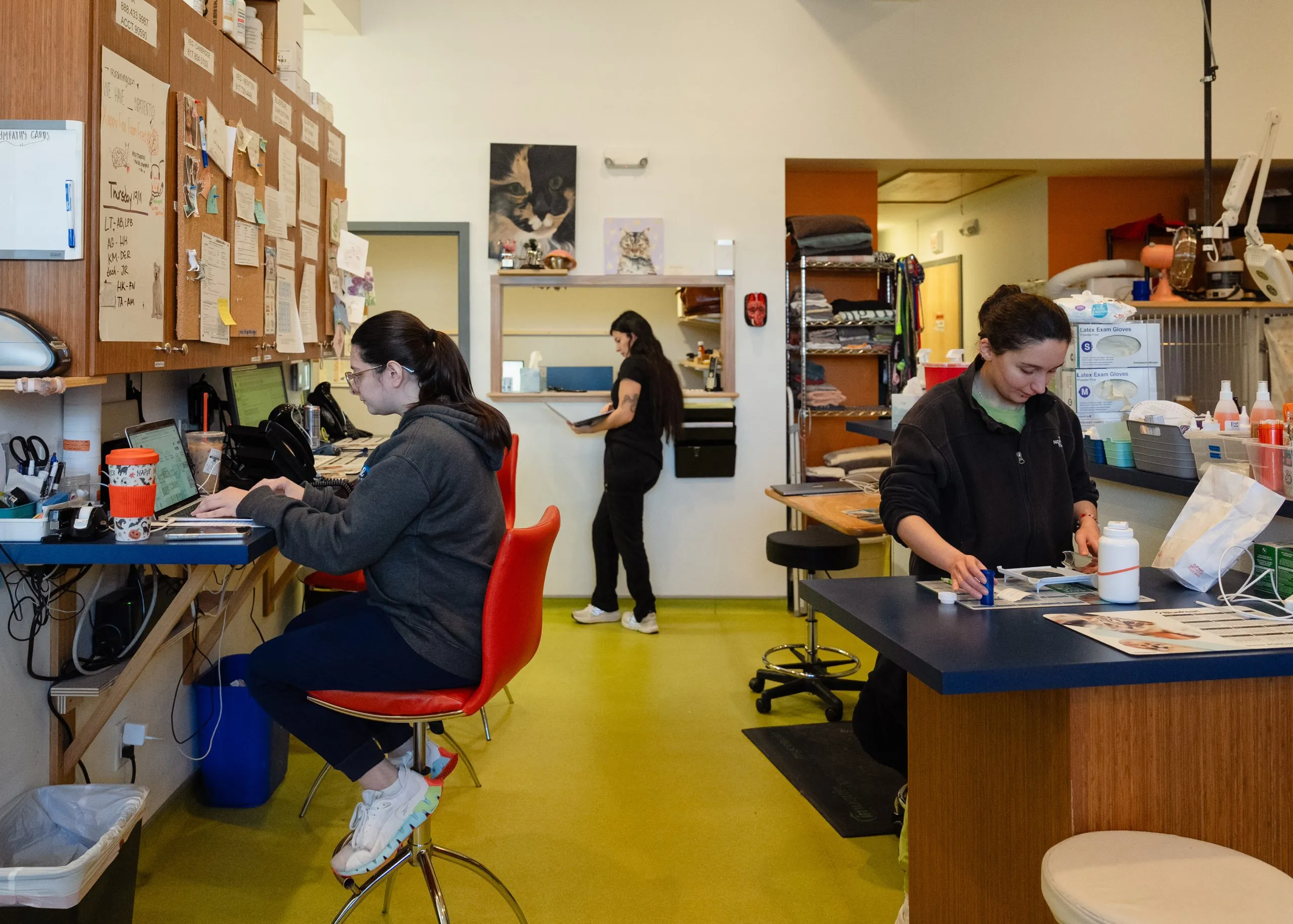
    For her, it wasn’t just a phase. Now, at 48, she co-owns her own bustling veterinary practice, Heal Veterinary Clinic, in this Boston suburb. 

    All seven veterinarians here are women. So is the large team of vet techs, and the entire rest of the 22-member medical staff.

    “In really broad generalities, I think women are more interested in the emotional and empathetic side of things than men are,” Leef said, sitting on the floor of an examination room with one of her patients, an affectionate, white-furred golden retriever named Cypress.

    For that and other reasons, women studying veterinary medicine now outnumber men by four to one

    It’s not just veterinary school. The number of women has surpassed the number of men in law school, medical school, pharmacy school, optometry school and dental school.

    Women in the United States now earn 40 percent more doctoral degrees overall, and nearly twice as many master’s degrees, as men, according to the U.S. Department of Education — a trend transforming high-end work. 

    This is no longer some distant statistical abstraction. Americans can see it when they take their pets to the vet or their kids to the dentist, need a lawyer or an eye exam, see a therapist or pick up a prescription.

    The dramatic shift in who is being trained for these fields is partly because more women are going into them. But it’s also the result of a steady slide in the number of men enrolling in graduate and professional schools. And while that may be elevating women, it’s affecting the nation’s economic competitiveness and even the point at which people get married and have children.

    “Having all students represented and engaged in graduate study ensures that we have healthy communities and families and a vital economy,” said Chevelle Newsome, president of the Council of Graduate Schools.

    Related: Interested in innovations in higher education? Subscribe to our free biweekly higher education newsletter.

    Graduate schools — including the 460 Newsome represents — have their own motive for wanting more men to enroll. They’re facing new threats from declining international enrollment, impending federal borrowing limits for graduate study and a public backlash against the high cost and uneven returns of graduate degrees.

    The main reason women have overtaken men in graduate school, however, is that more women than men are earning the undergraduate degrees required to go on to advanced study. 

    “Women certainly still see education in terms of upward mobility,” said Lisa Greenhill, chief organizational health officer at the American Association of Veterinary Medical Colleges, whose job includes trying to diversify veterinary medicine. “Men have a lot more options. They feel like they don’t have to go to a four-year program or a graduate program.”

    The number of men enrolled as undergraduates in college nationwide has dropped by nearly a quarter of a million, or 4 percent, just since 2020, the National Student Clearinghouse Research Center reports. 

    Women now account for about 60 percent of undergraduate enrollment. Nearly half of women aged 25 to 34 have bachelor’s degrees, compared to 37 percent of men, according to the Pew Research Center.

    “Men aren’t seeing higher education as valuable,” said Newsome. Many go into the trades or take other jobs straight out of high school to begin immediately earning a wage, forgoing the need to spend time in or money on college. Even men who do get undergraduate degrees may not see the value in continuing beyond them, she said.

    The effects of this have been stark and swift.

    The number of women earning law degrees passed the number of men in 2019, figures from the American Bar Association, or ABA, show; while only four of the law schools ranked among the 20 most prestigious by U.S. News & World Report had more women than men in 2016, women now outnumber men at 18 of them, according to the nonprofit law student news site JURIST. 

    Related: Trump’s attacks on DEI may hurt men in college admission

    That’s already having a real-world impact. By 2020, the ABA says, the majority of general lawyers working for the federal government were women, and by 2023, the majority of associates at law firms were.

    In medical schools, the number of women also overtook the number of men in 2019. Today, 55 percent of future doctors are women, up from 48 percent in 2015, according to the Association of American Medical Colleges, or AAMC.

    Women already make up significantly larger proportions of residents in specialties including endocrinology, pediatrics, obstetrics and gynecology, family medicine and psychiatry.

    Women also outnumber men by three to one in doctoral programs in psychology, and by nearly four to one in master’s programs, the American Psychological Association reports. They make up 55 percent of graduates of dental schools, and 72 percent in pediatric dentistry, according to the American Dental Association. 

    More than seven out of 10 students in schools of optometry are women, the Association of Schools and Colleges of Optometry says. And at pharmacy schools, women constitute two-thirds of students working toward master’s degrees and 56 percent of those seeking doctorates, statistics from the American Association of Colleges of Pharmacy show.

    There are still more men than women in doctoral and master’s degree programs in business, engineering, math and the physical sciences. But women make up substantial majorities of graduate enrollment in health sciences, public administration, education, social and behavioral sciences and biological and agricultural sciences, according to the Council of Graduate Schools.

    While this represents impressive progress for women, the declining number of men enrolling in graduate programs is bad news for universities and colleges that offer them, for some patients in the health care system and for the economy.

    That’s because the growing number of women going to graduate and professional schools can’t continue forever to outpace the decline in the number of men. Total graduate enrollment at private, nonprofit colleges and universities was already down this fall, the Clearinghouse reports. 

    Related: Football fantasy: Colleges add sports to bring men, but it doesn’t always work

    That’s a problem made worse by visa restrictions and cuts to federal research funding, which have helped reduce the number of international students coming to the United States for graduate study by 12 percent, according to the Institute of International Education. 

    New federal loan limits scheduled to take effect next year are widely expected to further eat into graduate school enrollment. The changes will cap borrowing at $100,000 for graduate students and $200,000 for those in professional programs. That’s much less than the $408,150 the AAMC says it costs to get a medical degree from a private, nonprofit university or the $297,745 from a public one. The association of medical colleges projects a national shortage of as many as 124,000 physicians by 2034.

    The price of getting a graduate degree has more than tripled since 2000, according to the Georgetown University Center on Education and the Workforce. Graduate degrees have become a critical revenue source for universities, which take in about $20 billion a year from master’s programs alone, a separate analysis, by the right-leaning think tank the American Enterprise Institute, calculates.

    Students of all genders are increasingly questioning the return on that investment. Nearly 40 percent of prospective graduate students say graduate programs that cost more than $10,000 a year are too expensive, a new survey by the enrollment management consulting firm EAB finds. Payoffs vary widely, making some graduate degrees “a potentially high-risk investment,” the Georgetown Center on Education and the Workforce has concluded. 

    The proportion of Americans 25 and older with master’s degrees or higher has fallen since 2000, from first in the world to 24th, according to the World Bank, while the percentage of those with doctoral degrees has dropped during that period from first to seventh.

    “That is a huge concern, when you think about where economies are going,” said Claudia Buchmann, an Ohio State University sociologist who studies this issue and is coauthor of the book “The Rise of Women.” “If we’re trying to compete on a global level, the fact that men’s college-going rates are so stagnant means we can’t fix this problem until we get more men.”

    Related: Even as women outpace men in graduating from college, their earnings remain stuck

    Men are, after all, half the nation’s labor force. And while some graduate degrees may not pay off, many of them do, substantially. People with advanced degrees are also much less likely to be unemployed.

    “When you think about global economic competitiveness for the United States — despite the skepticism that’s out there — education and training are still the keys to good jobs,” Buchmann said. Falling behind by that measure “is doing damage to men in this country.”

    But experts worry that the gender shift is self-perpetuating. Men may be put off by what they see as the “feminization” of professions in which they now are the minority, research by the veterinary medical colleges association concluded. 

    “I’m not seeing a national effort to say we need to change this,” Buchmann said. “If anything, the opposite is true.” 

    Graduate school leaders say the most effective efforts at reversing this trend are at the undergraduate level. “A lot of the effort from the graduate community has been to reach down and support those projects,” said Newsome, who was formerly dean of graduate studies at California State University, Sacramento. Universities also are encouraging employers to sponsor graduate education for male employees, she said.

    The effects of this widening gender divide are not just economic. New studies show that growing gender disparities in education can affect relationships. Marriage rates have fallen as levels of education rise, according to research from Iowa State University; each additional year of schooling reduces by about 4 percentage points the likelihood that someone between 25 and 34 is married. The proportion of Americans in that age bracket who are married has declined from 80 percent in 1970 to 38 percent today.

    Related: Universities and colleges search for ways to reverse the decline in the ranks of male students

    “When folks are looking for partners, there’s a desire to find someone economically comparable,” said Greenhill, of the veterinary medical colleges association. Added Buchmann, at Ohio State: “A lot of masculine norms are about being the breadwinner of the family. If the woman is the principal breadwinner, that presents not just economic challenges, but challenges to make marriages work.”

    More-educated women are also more likely to delay or forgo having children, according to separate research from the Wharton School of Business at the University of Pennsylvania.

    Back at her veterinary clinic, Amanda Leef makes the rounds, checking in on a dog getting his teeth cleaned and a pair of kittens waiting to be adopted. 

    Only one male veterinarian has ever applied to work there, Leef said. He was hired, but eventually left to go into research.

    “It does change the personality of a clinic” to be made up of only women, she said. “A staff that’s diverse is more accessible to a broader range of people. I just think the world is better with greater gender diversity.”

    Contact writer Jon Marcus at 212-678-7556, [email protected] or jpm.82 on Signal.

    This story about higher education and men was produced by The Hechinger Report, a nonprofit, independent news organization focused on inequality and innovation in education. Sign up for our higher education newsletter. Listen to our higher education podcast.

    This <a target=”_blank” href=”https://hechingerreport.org/women-far-outnumber-men-in-law-school-med-school-vet-school-and-other-professional-programs/”>article</a> first appeared on <a target=”_blank” href=”https://hechingerreport.org”>The Hechinger Report</a> and is republished here under a <a target=”_blank” href=”https://creativecommons.org/licenses/by-nc-nd/4.0/”>Creative Commons Attribution-NonCommercial-NoDerivatives 4.0 International License</a>.<img src=”https://i0.wp.com/hechingerreport.org/wp-content/uploads/2018/06/cropped-favicon.jpg?fit=150%2C150&amp;ssl=1″ style=”width:1em;height:1em;margin-left:10px;”>

    <img id=”republication-tracker-tool-source” src=”https://hechingerreport.org/?republication-pixel=true&post=114073&amp;ga4=G-03KPHXDF3H” style=”width:1px;height:1px;”><script> PARSELY = { autotrack: false, onload: function() { PARSELY.beacon.trackPageView({ url: “https://hechingerreport.org/women-far-outnumber-men-in-law-school-med-school-vet-school-and-other-professional-programs/”, urlref: window.location.href }); } } </script> <script id=”parsely-cfg” src=”//cdn.parsely.com/keys/hechingerreport.org/p.js”></script>

    Source link

  • Early childhood educator apprenticeships offer an answer to child care shortages

    Early childhood educator apprenticeships offer an answer to child care shortages

    by Nirvi Shah, The Hechinger Report
    January 7, 2026

    About six years ago, an apprentice training to be a machinist in Washington state told her supervisor she would probably have to drop out of the training program after having her baby: She couldn’t find child care that accommodated her shift.

    It was one of the first challenges Shana Peschek was tasked with solving when she became executive director of the Machinists Institute, which trains workers for jobs in the aerospace, manufacturing and automotive industries all over the state. 

    Peschek knew it was essential to do something for workers with young children.

    “That worst shift, the new hires are going to get it. The new hires are generally younger people. They have little kids or they are going to want a little kid,” Peschek said.

    “It’s beyond the cost of child care,” she said. “If they can’t find anywhere, we’re going to lose them.” 

    As Peschek worked on a way to address the situation, she also wondered how she could include apprenticeship in the solution. The answer: incorporating early educator apprenticeships into a custom-built child care center tailored to the trade union’s needs. Last month, The Hechinger Report wrote about San Francisco’s child care apprenticeship program

    “Apprenticeship is my jam,” said Peschek, who emphasized that apprenticeship is a mode of education, not limited to any specific profession. While the word apprentice is often associated with roles like machinists, it is just the term for an educational path that includes paid, on-the-job training. Early educator apprenticeships do just that, providing classes and training alongside paid work experience to help hopeful teachers earn required credentials and get full-time jobs. “I want that pathway available for our teachers and assistant teachers,” she said.

    With a combination of institute money, grants and donations, the Machinists Institute bought land and is constructing Little Wings Early Learning Academy in Everett, Washington. Its name is inspired by the local economy, which is powered in part by a nearby Boeing factory. The center will serve workers in the trade union, who will be able to send their young children for care starting as early as 4 a.m. through as late as midnight. Care will also be available on weekends, to accommodate a range of shifts. It is scheduled to open this spring.

    Machinists, maritime industry workers and other local tradespeople and apprentices will pay a discounted rate for child care, which will also be available to area residents to enroll their kids. 

    Peschek’s hopes are high, for all of the apprentices the center will involve. 

    That’s in part because of the experience some early educator apprentices have had. Apprenticeships have been a part of the trades for centuries, but they are relatively novel in education. 

    The option changed the course of Carlota Hernández de Cruz’s life. For years, with only an elementary school education from when she grew up in Mexico, she was the primary caregiver for her three children while her husband was the breadwinner. When her youngest child was still in child care, at a California Head Start program run by an area YMCA, she began working a few hours a day as a parent intern at the center. 

    She eventually encountered Pamm Shaw, who created one of the first early educator apprenticeship programs in the country for the YMCA of the East Bay, in California’s Alameda County. Shaw encouraged Hernández de Cruz to take classes and work toward becoming an early childhood teacher. 

    “I’m originally from Mexico,” Hernández de Cruz said, remembering her apprehension. “I came with zero English.” But Shaw was convincing. 

    Hernández de Cruz took classes, one or two at a time, balancing them with motherhood and homekeeping duties. Then her husband got sick and could no longer work. It took years, but she completed the courses for her associate degree. Just a few months before graduation, her husband died. 

    Hernández de Cruz, now 53, knew that although what she had accomplished was monumental, it wasn’t enough. Thanks to her apprenticeship, however, her bachelor’s degree coursework was paid for, even though it was sometimes a struggle to keep up with the requirements of online courses and lectures in English, while solo parenting and working. 

    In 2019, Hernández de Cruz earned that bachelor’s degree but turned down a job running a child care center. She wasn’t ready. When she was approached again in 2021 about a director role, at the center where she was working, she agreed. There have been ups and downs: That center closed and she was back to teaching for a while. But now she runs the Vera Casey Center, a Head Start site for infants and toddlers in Berkeley that is part of the YMCA of the East Bay.

    “I feel I can say financially I’m stable,” Hernández de Cruz said, and she said she is proud of herself and her children. Her kids grew up watching their mother work and study hard and have had opportunities she didn’t when she was younger, even though she said they all faltered, and flunked a few classes, when their father died. Her younger daughter just graduated from a nursing program and her older daughter completed a bachelor’s degree in child development and is now pursuing a master’s degree. Both daughters live at home with her, as do her parents. (Her son, she said, is still taking classes and finding his way.) “I’m stable but he’s not here with us,” Hernández de Cruz said of her husband, but “being in the classroom with kids, it helped me to heal. That’s what I feel at work. I still feel happy every day.”

    Contact Executive Editor Nirvi Shah at 212-678-3445, on Signal at NirviShah.14 or [email protected]

    Reporting on this story was supported by the Higher Ed Media Fellowship.

    This story about child care apprenticeships was produced by The Hechinger Report, a nonprofit, independent news organization focused on inequality and innovation in education. Sign up for the Hechinger newsletter.

    This <a target=”_blank” href=”https://hechingerreport.org/early-childhood-educator-apprenticeships-offer-an-answer-to-child-care-shortages/”>article</a> first appeared on <a target=”_blank” href=”https://hechingerreport.org”>The Hechinger Report</a> and is republished here under a <a target=”_blank” href=”https://creativecommons.org/licenses/by-nc-nd/4.0/”>Creative Commons Attribution-NonCommercial-NoDerivatives 4.0 International License</a>.<img src=”https://i0.wp.com/hechingerreport.org/wp-content/uploads/2018/06/cropped-favicon.jpg?fit=150%2C150&amp;ssl=1″ style=”width:1em;height:1em;margin-left:10px;”>

    <img id=”republication-tracker-tool-source” src=”https://hechingerreport.org/?republication-pixel=true&post=114241&amp;ga4=G-03KPHXDF3H” style=”width:1px;height:1px;”><script> PARSELY = { autotrack: false, onload: function() { PARSELY.beacon.trackPageView({ url: “https://hechingerreport.org/early-childhood-educator-apprenticeships-offer-an-answer-to-child-care-shortages/”, urlref: window.location.href }); } } </script> <script id=”parsely-cfg” src=”//cdn.parsely.com/keys/hechingerreport.org/p.js”></script>
    Source link

  • Amid a national shortage of nurses, nursing apprenticeships are beginning to offer a solution to the problem

    Amid a national shortage of nurses, nursing apprenticeships are beginning to offer a solution to the problem

    This story was produced in partnership with Work Shift and reprinted with permission. 

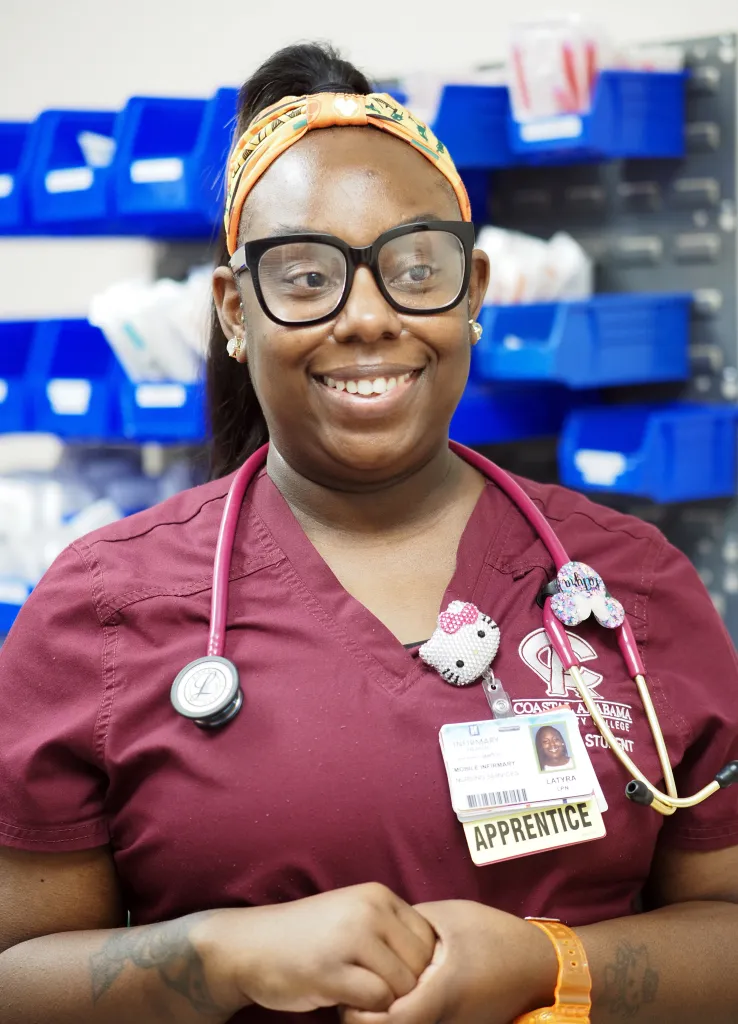
    MOBILE, Ala. — Three or four times a week, LaTyra Malone starts her day at Mobile Infirmary hospital at 6:30 a.m. For the next 12 hours, she makes her rounds and visits with patients — asking if they’re in pain, checking vitals, administering fluids. To an outside observer, she appears to be a nurse. 

    But Malone, 37, is a registered nurse apprentice. Everything she has learned how to do in her nursing classes at Coastal Alabama Community College, she can do at the hospital under the supervision of registered nurse Ondrea Berry, her journeyworker — a term typically used in the skilled trades. Unlike most nursing students who complete their required clinical hours in groups for no pay, Malone gets paid as an employee with benefits. She also gets much more personalized, hands-on learning time. 

    “It’s like having a little kid attached to your leg all day,” Berry joked. 

    For Malone, the partnership is invaluable.

    “I learn so much more one-on-one,” Malone said. “I might know the basics of disease processes or why we’re giving a certain medicine, but hearing her break it down to me helps a lot.”

    The pair work largely as a team, alternating duties to allow Malone a chance to observe and practice. By now, Malone knows the ropes pretty well: In addition to her apprenticeship training and classes, she has 16 years of experience as a certified nursing assistant and a medical assistant. And Berry, who is 25, says she benefits from the working relationship too. “There are teaching moments for both of us,” she said.

    Degreed nursing apprenticeships, like the one in Alabama, have emerged nationally as a potential solution to a thorny problem. The national nursing shortage is creeping toward crisis levels, with the demand for RNs like Berry and licensed practical nurses, or LPNs, projected to outstrip the supply for at least the next decade. At the same time, tens of thousands of people like Malone are already working in patient care in hospitals. Many aspire to be nurses — in fact, many certified nursing assistant programs sell the idea that you can start there, quickly land a job and then continue on to become a nurse. 

    But in reality, that’s a huge leap that requires an entirely different admissions process and English, math and science prerequisites that many nursing assistants don’t have. It also assumes that someone working an eight- or 12-hour shift for $18 an hour can find the time and the money for more education.

    “The sort of ‘we are excellent’ ethos in nursing might be self-defeating in that it is weeding out a lot of people who would be amazing nurses,” said Iris Palmer, director for community colleges with the education policy program at New America.

    Ondrea Berry, left, dispenses medication at Mobile Infirmary hospital while LaTyra Malone looks on. As an apprentice, Malone must be supervised by Berry at all times. Credit: Mike Kittrell for Work Shift

    Related: Interested in more news about colleges and universities? Subscribe to our free biweekly higher education newsletter.

    Several states, including Texas, North Carolina and Wisconsin, have begun growing registered apprenticeships in nursing — which have approval from the U.S. Department of Labor — to help address this problem. But no state has done quite as much as Alabama in scaling the model. 

    In 2021, the Alabama Board of Nursing worked with the state legislature to create a nursing apprenticeship license. Normally, nursing students are not licensed until after they graduate and pass a national licensure exam, and therefore they can’t be paid for their supervised clinical hours. The new apprenticeship license allows them to earn while they learn, making nursing school much more accessible for students like Malone and helping to fill critical staffing needs in hospitals.

    Since the law passed, 80 employers and 28 colleges and universities in Alabama have jointly created LPN and RN apprenticeship programs for those who are still working toward a degree. Nearly 450 apprentices — the great majority RNs — have completed the program and passed their exam, with more than 500 currently apprenticing. It’s too soon to say whether apprenticeships will solve the nursing shortage in the state, but early data shows benefits for employers and aspiring nurses alike.

    Mobile Infirmary has had over 90 nursing apprentices since the hospital’s program began in 2022, first with the LPN apprenticeship and soon after with the RN one. Graduates are required to stay at the hospital for one year after the apprenticeship ends, but most are staying beyond that. Only five have left so far, according to Stefanie Willis-Turner, the director of nursing school partnership and programs at Mobile Infirmary. 

    The hospital, like many others, already offered tuition reimbursement for employees who wanted to go back to college and move into nursing or another higher-level position. But such programs have notoriously low uptake, in part because most low-income employees can’t front the cost of tuition and also because many don’t know what steps to take.   

    “It amazed me the number of people that wanted to go back to school but didn’t really know where to get started,” Willis-Turner said. “Having a person to help guide them has really been our trigger, and that’s how we run this program.”

    LaTyra Malone is a two-time apprentice at Mobile Infirmary hospital. Last year, she worked with Ondrea Berry as a licensed practical nurse apprentice while she earned the certification. This year, she is a registered nurse apprentice. Credit: Mike Kittrell for Work Shift

    Willis-Turner played a crucial role in recruiting Malone for the apprenticeship. Malone has wanted to be a nurse since she was a teenager when she was president of her high school’s chapter of HOSA-Future Health Professionals, a global student-led organization that promotes careers in health care. But her plans to become a registered nurse were delayed when she became a mother. The financial burden plus the rigid schedules of nursing school made it difficult to make room for parenting, working and studying.

    With the apprenticeship, Malone doesn’t have to worry about paying for college, and she can provide for her family while improving her nursing skills. Her path stands in stark contrast to that of Berry, who worked at Dairy Queen throughout nursing school to pay for tuition and health insurance. Berry didn’t have kids to take care of, but she also didn’t have financial support from anyone else in her family. Her only on-the-job training in nursing school was the clinical hours, where she joined a group of students who took turns practicing new skills with just one nurse. Berry says she only attempted two IVs in that time. Malone has done so many she can’t count. 

    About 75 percent of the apprentices at Mobile Infirmary over the last three years were already working at the hospital. The rest came from surrounding medical facilities. Some even quit their jobs to transfer to Mobile Infirmary for a better chance at getting into the apprenticeship program. In addition to paying students for their work, Mobile Infirmary pays for any tuition that isn’t covered by scholarships or grants. The hospital also provides two uniforms free of charge. And students know they have a guaranteed job after they graduate and pass the nursing exam. 

    Related: Nurses are in high demand. Why can’t nursing schools keep up?

    This kind of targeted support is what makes the best apprenticeships successful in boosting individual economic mobility, its advocates say. Another key factor is the type of job an apprenticeship prepares people for. Most health care apprenticeships are for entry-level roles like CNAs, patient care technicians and medical assistants — jobs that, on average, pay $18-$20 an hour. 

    About half of states offer apprenticeships for LPNs, who make about 50 percent more than that, and half do so for RNs, whose median salaries are close to six figures, according to data from the U.S. Department of Labor. But far fewer apprentices are in those LPN and RN programs — and the majority of RN apprenticeships are for nurses who already have degrees, not for those who are still learning. That means aspiring nurses must still get all the way through the financial and logistical obstacles of nursing school before they can start to work.

    Josh Laney helped set up the different model in Alabama when he was director of the state’s Office of Apprenticeship. For a long time, he said, he bought into the “urban legend” that training more people to be certified nursing assistants, especially when they’re young, would get people onto the path to becoming nurses. 

    “The pitch was, ‘We get you the certificate and then you’re going to work at a hospital because it’s a very high-demand occupation. From there you can go on and move into nursing or whatever else you want to do,’” Laney said. “But there was no specified plan for how to do that — just a low-wage, very stressful and strenuous job.”

    The data backs that up. A 2018 study of federal Health Profession Opportunity Grants for CNA training showed that only 3 percent of those who completed the training went on to pursue further education to become an LPN or RN. Only 1 percent obtained an associate degree or above. A study in California showed slightly better odds: 22 percent of people who completed certificate programs at community colleges to become CNAs went on to get a higher-level credential in health care, but only 13 percent became registered nurses within six years.

    Because of these outcomes, Laney refused to pursue apprenticeships for CNAs in Alabama. One reason apprenticeships for CNAs and medical assistants are common, however, is that they are jobs that don’t require degrees and have fewer regulations when it comes to training. Setting up a registered apprenticeship for nurses who don’t already have a bachelor’s degree is complex and requires the work of many entities — the nursing board, colleges and employers. 

    When he went to the state board of nursing to propose LPN and RN apprenticeships, Laney was initially shut down. 

    “To their credit, they said, ‘Go away, bureaucrat! You’re not industry, you’re not the employer. You don’t really have anything to do with this,’” he recalled. “What I learned there, and what I’ve recommended to every other state who’s tried this, is let the employers carry your water. If they want it, they’ll get it done.”

    Related: How one college is tackling the rural nursing shortage 

    Laney then talked to the Alabama Hospital Association and Alabama Nursing Home Association, to reach employers. Given the shortages they had been experiencing, they bought into the idea and approached the nursing board themselves. Next, Laney’s team got community colleges on board, then universities. With the assurance that apprenticeships wouldn’t cut down on any of the required classes and clinical hours, the nursing board agreed to create the new license, following legislative approval.

    Other states embarking on nursing apprenticeships have faced similar challenges. 

    Apprenticeships aren’t a panacea. They hold promise for creating upward mobility, diversifying the profession and improving the odds a student makes it through to graduation, but they can’t solve all the knotty challenges of the nursing shortage. A lack of instructors in nursing schools — and therefore a lack of available seats for qualified students — is still one of the biggest factors. And in the apprenticeship model, every student needs one-on-one mentorship, meaning hospitals must have enough staff available and willing to work in a mentoring role for up to a year.

    Jay Prosser, executive director of the Massachusetts Nursing Council on Workforce Sustainability, knows all that. But he thinks apprenticeships will bring in more “practice-ready” nurses who are more likely to stay in the field long-term, especially those who were already working in patient care in the United States or other countries. Massachusetts is on the cusp of starting a licensed practical nurse apprenticeship with one employer and one academic partner, after working with the state nursing board and colleges for the past year. Unlike in Alabama, the nursing board didn’t need to create a new license, but rather the board judges whether educational programs meet regulations or not. 

    The Massachusetts Nursing Council on Workforce Sustainability is also creating a nursing apprenticeship network in the state, to make it easier for different institutions and programs to exchange ideas. 

    Prosser said one of the biggest barriers was making sure that the scope of practice for apprentices was clearly defined. He worked with local colleges to make sure of this. Prosser had previously worked as an assistant chief nursing officer in Birmingham, Alabama, and moved to Massachusetts in 2021 with the idea of apprenticeships already in mind. 

    Several other states have also created nursing apprenticeships for students who don’t already have a degree, but they’re limited to single institutions. In 2023, Texas began offering nursing apprenticeships for students who hadn’t already earned a degree in a collaboration between South Texas College and the Texas Workforce Commission. 

    The University of Wisconsin Health system has created a portfolio of nine registered apprenticeship programs, including an RN program launched in 2023 and a handful of other apprenticeship-style programs. Bridgett Willey, director of allied health education and career pathways, said the hospital started with entry-level apprenticeships, like medical assistants, before proposing degreed programs. 

    “There’s still kind of a myth that the colleges are going to do all this on their own,” Willey said. “Well, that’s not true. Employers have to sponsor, because we’re the ones hiring the apprentices and often supporting tuition costs, as well.”

    Related: No college degree, no problem? Not so fast

    The outcomes from the entry-level apprentice programs helped convince the health system that it was worth investing more. A three-year study showed that staff retention rates for those who participated in the hospital’s apprenticeships were 22% higher than for those who didn’t. In the two-year-old RN program, attrition is less than 10% so far — significantly lower than the attrition rate the hospital has seen with traditional students who participate in clinicals at the hospital. 

    UW Health supports efforts to scale their apprenticeship model across the state, but so far they haven’t panned out. Willey said employers are interested, but conversations often stall when questions arise about how to create more clinical capacity and find funding sources to support apprentices.

    Even so, Eric Dunker, founding executive director of the National Center for the Apprenticeship Degree, which is affiliated with Reach University, predicts that nursing apprenticeships are about to see major growth, as teaching apprenticeships did five years ago. Earlier this year, Reach University received a $1 million grant to expand apprenticeships in behavioral health, and is planning for nursing ones. The strict licensing regulations for nursing make it more complicated than scaling up teaching apprenticeships, but Dunker sees the possibility of expanding them if nursing boards, colleges and employers all come to the table, as they did in Alabama. 

    “There’s a lot of entry-level health care apprenticeships,” Dunker said. “But the key is upward mobility, which is nursing and nurse practitioners. There’s typically been a bottleneck in stacking these pathways, but that’s where you’re starting to see more states and systems become a little more creative.”

    Tyler Sturdivant, Coastal Alabama Community College’s associate dean of nursing, knows what that looks like. Figuring out the logistics of setting up an apprenticeship program was a challenge, he said, and required hiring an additional staff member to liaise between the college and hospital partners. But three years into the apprenticeship program for LPNs and RNs, the school is seeing higher completion rates than for traditional students.

    This means they’re producing more licensed nurses to fill positions and someday mentor, or even teach, other apprentices. 

    On a typical Friday morning in September at Mobile Infirmary, Malone and Berry visited a 70-year-old man who came in for a urinary tract infection that then weakened him. That day, the apprentice and journeyworker switched out his bed for one lower to the ground to reduce the fall risk, taught him how to raise the bed so he could sit upright, updated him on a plan for physical therapy and adjusted his socks for him. 

    Malone appeared comfortable and confident, taking the lead in the patient’s care while Berry assisted her. Malone says the many hours of practice she’s had through the apprenticeship has made her feel prepared for the job and ready to continue to follow her dreams. One day, she wants to become a nurse practitioner specializing in mental health.

    “I won’t feel complete until I actually become a nurse,” Malone says. “I thought I was going to be one sooner, but bumps in the road happened and I ended up having a child. If it wasn’t for the apprenticeship, I probably wouldn’t be here now.”

    Contact editor Lawrie Mifflin at 212-678-4078 or on email at [email protected].

    This story was produced in partnership with Work Shift and reprinted with permission.

    Since you made it to the bottom of this article, we have a small favor to ask. 

    We’re in the midst of our end-of-year campaign, our most important fundraising effort of the year. Thanks to NewsMatch, every dollar you give will be doubled through December 31.

    If you believe stories like the one you just finished matter, please consider pitching in what you can. This effort helps ensure our reporting and resources stay free and accessible to everyone—teachers, parents, policymakers—invested in the future of education.

    Thank you. 
    Liz Willen
    Editor in chief

    Source link

  • With preschool teachers in short supply, cities, states turn to apprenticeships 

    With preschool teachers in short supply, cities, states turn to apprenticeships 

    by Nirvi Shah, The Hechinger Report
    December 5, 2025


    SAN FRANCISCO — In a playground outside a YMCA, Mayra Aguilar rolled purple modeling dough into balls that fit easily into the palms of the toddlers sitting across from her. She helped a little girl named Wynter unclasp a bicycle helmet that she’d put on to zoom around the space on a tricycle. 

    Aguilar smiled, the sun glinting off her saucer-sized gold hoop earrings. “Say, ‘Thank you, teacher,’” Aguilar prompted Wynter, who was just shy of 3. Other toddlers crowded around Wynter and Aguilar and a big plastic bin of Crayola Dough, and Aguilar took the moment to teach another brief lesson. “Wynter, we share,” Aguilar pressed, scooting the tub between kids. “Say, ‘Can you pass it to me?’” 

    Aguilar and Wynter are both new at this. Wynter has been in the structured setting of a child care center only since mid-August. Aguilar started teaching preschoolers and toddlers, part-time, in February. 

    It has been life-changing, in different ways, for them both. Wynter, an only child, is learning to share, count and recognize her letters. Aguilar is being paid to work and earning her first college credits — building the foundation for a new career, all while learning new ways to interact with her own three kids.

    Early educators are generally in short supply, and many who attempt this work quickly quit. The pay is on par with wages at fast food restaurants and big box stores, or even less. Yet unlike some other jobs with better pay, working with small children and infants usually requires some kind of education beyond a high school diploma. Moving up the ladder and pay scale often requires a degree. 

    What’s different for Aguilar compared to so many other people trying out this profession is that she is an apprentice — a training arrangement more commonly associated with welders, machinists and pipefitters. Apprentice programs for early childhood education have been in place in different parts of the country for at least a decade, but San Francisco’s program stands out. It is unusually well, and sustainably, funded by a real estate tax voters approved in 2018. The money raised is meant to cover the cost of programs that train early childhood educators and to boost pay enough so teachers can see themselves doing it for the long term. 

    Related: Young children have unique needs and providing the right care can be a challenge. Our free early childhood education newsletter tracks the issues.

    Some policy experts see apprenticeships as a potential game changer for the early educator workforce. The layers of support they provide can keep frazzled newcomers from giving up, and required coursework may cost them nothing. “We want it to be a position people want to go into as opposed to one that puts you in poverty,” said Cheryl Horney, who oversees the Early Learning Program that employs apprentices at Wu Yee Children’s Services in San Francisco, including the site where Aguilar works.

    Aguilar, 32, is paid to work 20 hours a week at the Wu Yee Children’s Services’ Bayview Early Learning Center, tucked inside a Y in a residential neighborhood a little under a mile from San Francisco Bay. She works alongside a mentor teacher who supports and coaches her. The apprenticeship covers the online classes, designed just for her and other apprentices and taught live from City College of San Francisco, that Aguilar takes a few nights a week. She was given all the tools needed for her courses, including a laptop, which she also uses for homework and discussions with other apprentices outside of class. 

    After high school, Aguilar had tried college, a medical assistant program that she quit after a few months. That was more than 10 years ago. She hadn’t touched a computer in all that time. When she was enrolling her youngest daughter at another Wu Yee location, Aguilar saw a flyer about the apprenticeship program and applied. She is finding this work to be a far better fit: “This — I think I can do it. This, I like it.” 

    The need for more early educators is longstanding, and in recent years there’s been a push for early educators to get postsecondary training, both to support young children’s development and so the roles command higher salaries. For example, a 2007 change in federal law required at least half of teachers working in Head Start to have bachelor’s degrees in early childhood education by 2013, a goal the program met.

    Despite efforts to professionalize the workforce, salaries for those who work with young children remain low: 87 percent of U.S. jobs pay more than a preschool teacher earns on average; 98 percent pay more than what early child care workers earn. In 2022, Head Start lead teachers earned $37,685 a year on average. 

    Apprenticeships are seen as one way to disrupt that stubborn reality: Would-be teachers are paid while being trained for everything from entry-level roles that require a small number of college credits or training to jobs, like running a child care center, that require degrees and come with more responsibility and even higher pay. According to a June 2023 report from the Bipartisan Policy Center, a think tank, 35 states have some kind of early childhood educator apprenticeship program at the city, regional or state level, and more states are developing their own programs. U.S. Department of Labor data shows that more than 1,000 early educator apprentices have completed their programs since the 2021 fiscal year. Early Care & Educator Pathways to Success, which has received Labor Department grants to help set up apprenticeship programs, estimates the numbers are far larger given its work has cultivated hundreds of apprentices in 21 states, including  Alaska, California, Connecticut and Nebraska.

    These programs can be complicated to launch, however. They sometimes require painstaking work to find colleges that will provide coursework specific to local regulations and at hours that work for apprentices who may be in classrooms much of the workday as well as tending to their own children. They require money to pay the apprentices — on top of whatever it already costs to run child care centers and pay existing staff. The apprentices also typically need other layers of support: coaching, computers, sometimes child care and even meals for apprentices’ own kids as they study and take exams.

    In San Francisco, Horney advocated for her employer to set up an apprenticeship program for staffers at its 12 Head Start centers even before the tax money became available. She recalled losing teachers to chain retailers like Costco and Walgreens where they found less stressful jobs with more generous benefits. When she arrived in San Francisco to work in the classroom, with five years of experience and a bachelor’s degree, she was paid $15 an hour. “Now the lowest salary we pay is $28.67 for any sort of educator,” she said, and the wages and apprenticeships are even drawing people from other counties and stabilizing the San Francisco early educator workforce. “It has helped immensely.”

    Other parts of the country have seen success with similar initiatives.

    The YWCA Metro St. Louis in Missouri, which hasn’t had a single teacher vacancy for the last two years at the child care centers it oversees, credits its apprenticeship program. In Guilford County, North Carolina, vacancies and staff turnover were a plague until recently, but an apprenticeship program for entry-level early educators has kept new teachers on the job. 

    Elsewhere, there is hope for those kinds of results. In the Oklahoma City area, an apprenticeship program started in 2023 just yielded its first graduate, who worked in a child care center for two years and completed a 288-hour training program. Curtiss Mays, who created the program for teachers at the group of Head Start centers he oversees, was in the midst of trying to hire 11 educators just as the first apprentice earned a credential that allows her to back up other teachers. 

    “It’s a pretty major project,” Mays said. “We hope it’s the start of something really good.” Mays worked with the Oklahoma Department of Labor to set up the apprenticeship program, which he said has already pulled one person out of homelessness and is helping to lure more aspiring teachers. It will pay for education all the way through a bachelor’s degree if apprentices stick with it. 

    Apprenticeship programs can be costly to run, but bipartisan federal legislation to support them has never gained traction. (Advocates note that apprenticeships can cost far less than a traditional four-year college degree.) Labor Department money for organizations that help set up and grow early childhood educator apprenticeships helped increase the number of apprentices in so-called registered apprenticeship programs — ones that are proven and validated by the federal agency. But some of those grants were axed by the Trump administration in May. 

    In San Francisco, while setting up apprenticeships was as labor intensive as in many other places, the 2018 real estate tax provides a new and deep well of money to propel the early educator apprentice effort. The money pays for all of the things that are letting Aguilar and dozens of others in the county earn at least 12 college credits this year. In two semesters, Aguilar will have the credentials to be an associate teacher in any early education program in California. Other apprentices across San Francisco, in Head Start centers, family-owned child care programs, even some religious providers, can work toward associate or bachelor’s degrees using the new tax revenue to pay for it. 

    Related: The child care worker shortage is reaching crisis proportions nationally. Could Milwaukee provide the answer?

    Long before the ballot measure across the bay in San Francisco, Pamm Shaw dreamed up the forerunner of an early educator apprenticeship program in a moment of desperation.  

    It was over a decade ago, and Shaw, who was then working at the YMCA East Bay overseeing a collection of Head Start centers, said her agency was awarded a grant to add spaces for about 100 additional infants. Except her existing staff didn’t want to work with children younger than 3. So Shaw sent notices to the roughly 1,000 families with children enrolled in YMCA East Bay Head Start programs at the time and convinced about 20 people, largely parents of children enrolled in Head Start, to consider the role. She pulled together the training that would qualify the parents to become early educators — 12 college credits in six months.

    The education piece, Shaw realized, was a huge draw. Some of the parents had spent 10 years working toward associate degrees on their own without completing them. Giving them the chance to earn those degrees in manageable chunks — while getting paid and receiving raises relatively quickly as their education advanced — proved a powerful recruitment tool. “It changed their lives,” Shaw said. And these new teachers had their eyes opened to how what they would be doing wasn’t just babysitting. They took away lessons they used with their own children — who in turn took notice of their parents studying. “It’s actually child care,” said Shaw. “So much happens in the first year of life that you never get to see again. Never, ever, ever.” 

    It changed Shaw’s life, too, and inspired many other apprenticeship programs all over. Her role morphed into fundraising to build out the apprenticeship pipeline. The program, now baked into the YMCA of the East Bay system, reflected the overall early educator workforce: It was made up entirely of women, mostly women of color, some of them immigrants and many first-generation college students. By the time Shaw retired a few years ago, more than 500 people in the Berkeley area had completed the early educator apprenticeship program. 

    Erica Davis, a single mom, is one of its success stories. When she met Shaw, Davis said, she was relying on public assistance and jobs caring for other people’s children, while taking care of a daughter with significant medical needs, as well as her toddler-age son. Davis was at a Head Start dropping off paperwork for the family of a child in her care when an employee told Davis her young son might be eligible for Head Start too. He was, and as Davis enrolled him, she learned about Shaw’s apprenticeship program. Davis missed the first window to apply, but as she put it, “I was blowing their phone up. I needed to get in.” 

    That was 2020. By this spring, Davis will have earned her bachelor’s degree from Cal State East Bay. She works full-time at a Richmond, California, Head Start center while taking classes and supporting her kids, now in high school and elementary school. She can afford to rent a two-bedroom apartment, owns a car and no longer relies on state or federal assistance to pay bills. She’s on the dean’s list, and, she said proudly, she can squat 205. 

    “I didn’t take my education seriously,” Davis, 41, said of her younger self. “I feel like I’m playing catch-up now.” She is in her element at the YMCA of the East Bay Richmond Parkway Early Learning Center, reading to children, working on potty training and leading the kids through coloring-and-pasting exercises. She has even become an informal coach for newer apprentices. The network and family feel of these apprenticeships is some of what helps many succeed, she said. “I have a sad story, but it turned into something beautiful.”

    Related: The dark future of American child care

    While Davis said she prefers the flexibility of taking classes at her own pace, other apprentices thrive in the kind of classes Aguilar attends, with a live instructor who starts off leading students in a mindfulness exercise. That is the same approach to teaching apprentices at EDvance College in San Francisco, which works exclusively with early childhood apprentices, according to its president and CEO, Lygia Stebbing. 

    The college provides general education classes in reading, math and science for apprentices pursuing degrees, taught through an early childhood lens so it feels approachable and relevant. And every lesson can be applied nearly in real time, unlike other paths to degrees, in which in-person teaching experience comes only after many classes, Stebbing said. Before beginning classes, apprentices get a crash course in using technology, from distinguishing between a tablet and a laptop to using Google Docs and Zoom, “so they can jump right into things,” she said. A writing coach and other student support staff are available in the evenings, when apprentices are taking courses or doing homework. Because many of the apprentices are older than typical college students and may even have used up their federal Pell Grants and other financial aid taking courses without earning a degree, the college works with foundations and local government agencies to offset the cost of courses so graduates don’t end up in debt.        

    “We’ve really put the student at the center,” Stebbing said.   

    For Mayra Aguilar, her mentor teacher Jetoria Washington is a lifeline who can help her unstick an issue with any aspect of the apprenticeship — in the classes she takes or the classroom where she works. Taking courses online means she can be home with her own kids in the evenings. Earning money for the hours she spends in the classroom means she is not going into debt to earn the credential she needs to find a full-time job. The constellation of support has helped her shift from feeling in over her head to feeling ready to keep working toward a college degree.        

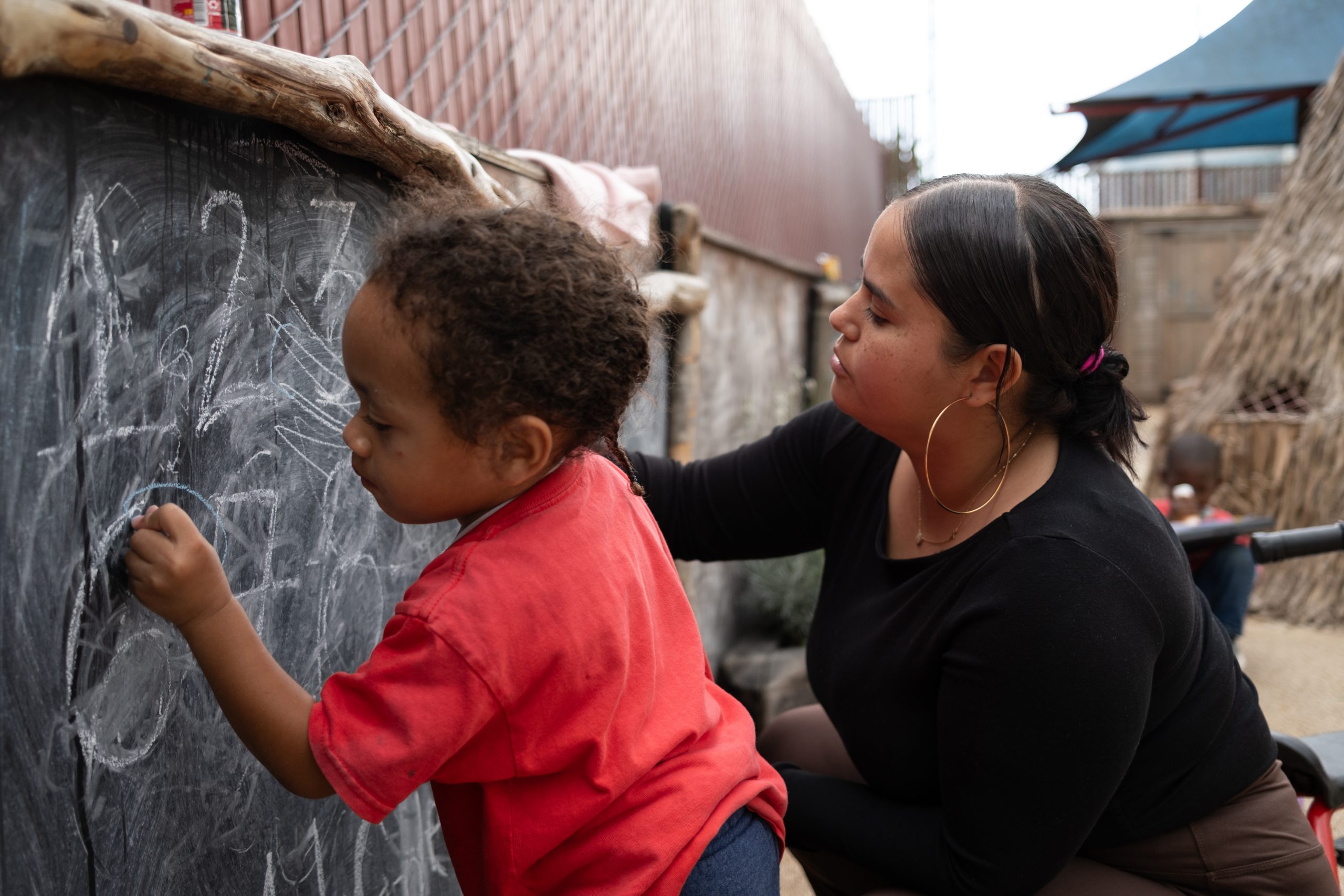
    And she is having fun. On the playground, one of the kids had the idea to trace another with sidewalk chalk, working on their pencil grip as much as they were playing. Except it wasn’t just the other kids: They traced Aguilar, too. When it was time to go back inside, powdery green and pink lines crisscrossed the back of her brown pants and black blouse. She wasn’t bothered.   

    “I love the kids,” she said. “They always make me laugh.”       

    Aguilar has even picked up skills that she uses with her own children, something many apprentices describe.        

    Now, she sometimes says to her youngest daughter, “Catch a bubble.” That’s preschool speak for “Be quiet.” When a teacher needs the toddlers’ attention, kids hear this phrase, then fill their cheeks with air.        

    Most of the time, at home and at work, a brief silence follows. Then the kids look up, ready to hear what comes next.    

    Contact staff writer Nirvi Shah at 212-678-3445, on Signal at NirviShah.14 or [email protected]

    Reporting on this story was supported by the Higher Ed Media Fellowship. 

    This story about preschool teachers was produced by The Hechinger Report, a nonprofit, independent news organization focused on inequality and innovation in education. Sign up for the Hechinger newsletter

    This <a target=”_blank” href=”https://hechingerreport.org/one-city-finding-early-educators/”>article</a> first appeared on <a target=”_blank” href=”https://hechingerreport.org”>The Hechinger Report</a> and is republished here under a <a target=”_blank” href=”https://creativecommons.org/licenses/by-nc-nd/4.0/”>Creative Commons Attribution-NonCommercial-NoDerivatives 4.0 International License</a>.<img src=”https://i0.wp.com/hechingerreport.org/wp-content/uploads/2018/06/cropped-favicon.jpg?fit=150%2C150&amp;ssl=1″ style=”width:1em;height:1em;margin-left:10px;”>

    <img id=”republication-tracker-tool-source” src=”https://hechingerreport.org/?republication-pixel=true&post=113662&amp;ga4=G-03KPHXDF3H” style=”width:1px;height:1px;”><script> PARSELY = { autotrack: false, onload: function() { PARSELY.beacon.trackPageView({ url: “https://hechingerreport.org/one-city-finding-early-educators/”, urlref: window.location.href }); } } </script> <script id=”parsely-cfg” src=”//cdn.parsely.com/keys/hechingerreport.org/p.js”></script>

    Source link

  • As the job market tightens, workers without degrees could hit a ‘paper ceiling’

    As the job market tightens, workers without degrees could hit a ‘paper ceiling’

    by Lawrence Lanahan, The Hechinger Report
    December 2, 2025

    DENVER — On a bus headed downtown, Cherri McKinney opened a compact mirror and — even as the vehicle rattled and blinding morning sun filled the window — skillfully applied eyeliner.

    McKinney is a licensed aesthetician. She went into bookkeeping after graduating from high school in 1992, then ran a waxing salon for years. Later she shifted into human resources at a homeless shelter. But stepping off the bus, she started her work day as a benefits and leave administrator for Colorado’s Department of Labor and Employment.

    She wouldn’t have made it past some hiring managers.

    “My background is kind of all over the place,” McKinney said. “You might have looked at my résumé and thought, ‘Wow, this girl doesn’t have a college education.’”

    In fact, Colorado’s state government was looking for workers just like her. In 2022, Gov. Jared Polis signed an executive order directing state agencies to embrace “skills-based hiring” — evaluating job seekers based on abilities rather than education level — and to open more positions to applicants without college diplomas. When McKinney interviewed with the state in the summer of 2024, she said, she was asked practical questions about topics like the Family Medical Leave Act, not about her academic background.

    For a decade, workforce organizations, researchers and public officials have pushed employers to stop requiring bachelor’s degrees for jobs that don’t need them. That’s a response to a hiring trend that began during the Great Recession, when job seekers vastly outnumbered open positions and employers increased their use of bachelor’s degree requirements for many jobs — like administrative assistants, construction supervisors and insurance claims clerks — that people without college diplomas had capably handled. The so-called “paper ceiling,” advocates say, locks skilled workers without degrees out of good-paying jobs. Degree requirements hurt employers, too, advocates argue, by screening out valuable talent.

    Related: Interested in more news about colleges and universities? Subscribe to our free biweekly higher education newsletter.

    In recent years, at least 26 states, along with private companies like IBM and Accenture, began stripping degree requirements and focusing hiring practices on applicants’ skills. A job seeker’s market after Covid, plus labor shortages in the public sector, boosted momentum. Seven states showed double-digit percentage increases in job listings without a degree requirement between 2019 and 2024, according to the National Governors Association. A 2022 report from labor analytics firm Burning Glass (recently renamed Lightcast) found degree requirements disappearing from private sector listings too.

    But less evidence has emerged of employers actually hiring nondegreed job seekers in substantial numbers, and a crumbling economic outlook could stall momentum. Last year, Burning Glass and Harvard Business School found that less than 1 in 700 hires in 2023 benefited from the shift to skills-based hiring. Federal layoffs and other cuts pushing more workers with degrees into the job hunt could tempt employers to return to using the bachelor’s as a filtering mechanism.

    “I think it’s a sort of do-or-die moment” for skills-based hiring, said Amanda Winters, who advises state governments on skills-based hiring at the nonprofit National Governors Association.

    Winters said the shift to hiring for skills requires time-consuming structural changes. Human resource departments must rewrite job descriptions, and hiring managers must be trained to change their approach to interviewing to assess candidates for skills, among other steps. And even then, said Winters, there’s no reason for managers not to prefer applicants with college degrees if they indeed have the skills.

    Related: Students worried about getting jobs are adding extra majors

    Colorado is trying to push employers, both public and private, to make this shift. Polis’ 2022 order devoted $700,000 and three staffers to institutionalizing skills-based hiring in state government. According to a case study by the National Governors Association and the nonprofit Opportunity@Work, the state is working with human resources departments at individual agencies, training them to rewrite job descriptions to spell out skills (for example, “active listening and interpersonal skills”). When posting a job, hiring managers are encouraged to click a box that reads: “I have considered removing the degree requirement for this role.” 

    Polis’ team also built a dashboard to track progress toward “Wildly Important Goals” related to skills-based hiring — like boosting the share of job applicants without a bachelor’s degree by 5 percent by summer 2026. State officials say about 80 percent of job classifications (categories of jobs with specific pay scales and responsibilities — for example, Human Resources Specialist III or Accountant I) now emphasize skills over degrees.

    All told, the state says, 25 percent of hires within those job classifications in 2024 — 1,588 in total — were people without degrees, roughly the same share as in 2023, when the state began collecting this information. Similar data from other states on their success in hiring skilled, nondegreed workers is scarce. State officials from Maryland and Pennsylvania, two of the first states with executive orders dropping degree requirements, said they track education levels of applicants but not of new hires. 

    To spark skills-based hiring in the private sector, the Colorado Workforce Development Council, a quasi-governmental group appointed by the governor, encourages local workforce boards to help assess employers’ needs and job seekers’ skills.

    One of those boards — Pikes Peak Workforce Center in Colorado Springs — conducts workshops for local businesses on skills-based hiring and helps them write job descriptions that emphasize skills. When a company registers for a job fair, said CEO Traci Marques, the center asks both what positions are open and which skills are needed for them.

    The center also teaches job seekers to identify their skills and show employers how they apply in different fields. A recent high school graduate who served on student council, Marques said, might discuss what that role taught them about time management, conflict resolution and event planning.

    The goal is for skills to become the lingua franca between employers and job seekers. “It’s really that matchmaking where we fit in,” Marques said.

    One new matchmaking tool is learning and employment records, or LERs. These digital records allow job seekers to verify their degrees, credentials and skills with former schools and workplaces and then share them with potential employers. Two years ago, a philanthropic coalition granted the Colorado Workforce Development Council $1.4 million to create LER systems.

    LERs are still in the early stages of development, but advocates say they could eventually allow more precise matching of employers’ needs with job seekers’ skills.

    Once nondegreed workers get in the door, employers can also see payoffs, said Cole Napper, vice president of research, innovation and talent insights at Lightcast. His research shows that workers hired for skills get promoted at almost the same rate as education-based hires and stay at their jobs longer.

    But as the labor market cools, the question now is whether people without four-year degrees will get in the door in the first place. Nationally, job growth has slowed. Maryland and Colorado froze hiring this summer for state positions.

    At a recent job fair at Pikes Peak, single mother Yvette Stanton made her way around the tables, some featuring placards that read “Skills-Based Hiring.” After a few months at a sober living facility, Stanton had lined up day care and was ready to work. She clutched a green folder with a résumé documenting certifications vouching for her skills in phlebotomy and medication administration. “When you have more certifications, there are better job opportunities,” said Stanton.

    She approached a table for the Colorado Department of Corrections. Human resources specialist Jack Zeller told her that prisons do need workers with medical certifications, and he said she could also apply to be a corrections officer. But, he said — holding out his phone to show her the job application site — she should wait until Jan. 1.

    “If the hiring freeze ends like it’s supposed to,” he said, “there’s gonna be a billion jobs going up on the website.”

    Related: Apprenticeships for high schoolers are touted as the next big thing. One state leads the way      

    Colorado works not just on the demand side, pushing employers to seek out workers based on their skills, but also on the supply side, to arm people who might not choose college with marketable skills and help them find jobs in in-demand industries.

    The Polis administration encourages high schools and community colleges to make available industry-recognized credentials — including certified nursing assistant, certified associate in project management and the CompTIA cybersecurity certification— that can earn students credits while giving them skills for better-paying jobs. The governor is also making a big bet on work-based learning opportunities in high school and community college, especially apprenticeships.

    If employers meet talented workers who lack degrees, they’ll grow more comfortable hiring for skills, said Sarah Heath, who directs career and technical education for the Colorado Community College System. “You’ve got to prove it to people to get them to buy into it,” she said.

    At Red Rocks Community College in Lakewood, a suburb of Denver, President Landon Pirius has set a goal of eventually providing a work-based learning experience to every graduate. Earlier this year, the college hired a work-based learning coordinator and an apprenticeship coordinator, and it partners with Northrop Grumman on a registered apprenticeship that lets cybersecurity students earn money while getting technical instruction and on-the-job learning.

    In his frequent discussions with regional employers, Pirius said, “the message is consistently skill-based hiring.” He added: “Our manufacturers are like, ‘I don’t even care about a degree. I just want to know that they can do X, Y, Z skills. So when you’re teaching our students, make sure you teach them these things.’”

    Colorado community colleges also see opportunities to equip students with skills in fields like aerospace, quantum computing, behavioral addiction treatment and mental health counseling, where there’s a growing demand for workers and some jobs can be handled without a four-year degree. In 2022, Colorado gave its community college system $15 million to create pathways to behavioral health careers that don’t require a Master of Social Work degree or even a B.A.

    Related: ‘Not waiting for people to save us’: 9 school districts combine forces to help students

    Colorado’s skill-based talent pipeline extends to high school. In a “Computer Science and Cybersecurity” class at Warren Tech, a high school in Lakewood, Zachary Flower teaches in-demand “soft skills” like problem solving, teamwork and communication.

    “The people who get hired are more often the ones who are better communicators,” said Flower, a software developer who was a director of software engineering and hiring manager for a travel company before he started teaching. Communication skills are half of the grade in Flower’s capstone project: Students communicate independently throughout the year with local industry sponsors, and at the end they present to a panel of engineers and developers.

    Despite the emphasis on skills-based hiring, a 2023 study projected that more than 4 in 10 job openings in Colorado from 2021 through 2031 would require at least a bachelor’s degree — the second-highest proportion of any state in the country — because many industries there, like engineering, health care and business services, require higher education, according to Georgetown University’s Center on Education and the Workforce.“But there’s still a significant amount of opportunity for people with less than a bachelor’s degree,” said Nicole Smith, chief economist at the center.

    People, in other words, like Cherri McKinney, who couldn’t afford college and didn’t want to spend four years finding her path. McKinney plans to stay in state government, where she believes she can develop more skills and advance without a college degree. Indeed, a 2023 executive order demanded that every state agency develop at least two work-based learning programs by the end of this year.

    Gov. Polis, who championed workers like McKinney, ends his second term in January 2027 and cannot run for reelection. State budgets are fragile in the Trump era. McKinney’s colleagues call often, nervous about their benefits in a time of hiring freezes and government shutdowns.

    McKinney isn’t worried.

    “When I made my first career switch from bookkeeping to aesthetics, what I realized was I am the eye of this storm,” she said. “Things swirl around me, and if I bring myself in my way that I do to my jobs, that’s what is going to create the stability for me.”

    Contact editor Caroline Preston at 212-870-8965, via Signal at CarolineP.83 or on email at [email protected].

    This story about job skills was produced by The Hechinger Report, a nonprofit, independent news organization focused on inequality and innovation in education. Sign up for the Hechinger newsletter.

    This <a target=”_blank” href=”https://hechingerreport.org/no-college-degree-no-problem-not-so-fast/”>article</a> first appeared on <a target=”_blank” href=”https://hechingerreport.org”>The Hechinger Report</a> and is republished here under a <a target=”_blank” href=”https://creativecommons.org/licenses/by-nc-nd/4.0/”>Creative Commons Attribution-NonCommercial-NoDerivatives 4.0 International License</a>.<img src=”https://i0.wp.com/hechingerreport.org/wp-content/uploads/2018/06/cropped-favicon.jpg?fit=150%2C150&amp;ssl=1″ style=”width:1em;height:1em;margin-left:10px;”>

    <img id=”republication-tracker-tool-source” src=”https://hechingerreport.org/?republication-pixel=true&post=113525&amp;ga4=G-03KPHXDF3H” style=”width:1px;height:1px;”><script> PARSELY = { autotrack: false, onload: function() { PARSELY.beacon.trackPageView({ url: “https://hechingerreport.org/no-college-degree-no-problem-not-so-fast/”, urlref: window.location.href }); } } </script> <script id=”parsely-cfg” src=”//cdn.parsely.com/keys/hechingerreport.org/p.js”></script>
    Source link

  • Student-parents belong on college campuses. So do their children

    Student-parents belong on college campuses. So do their children

    Too many student-parents never make it to graduation, in no small part because their campuses don’t adequately help them fit college into their lives — or even just fit in.

    Yet over 3 million student-parents across the nation, myself included, are pursuing higher education, seeking the intergenerational benefits that come with earning a degree. To reap them, we must overcome many obstacles, as colleges aren’t designed for students like us.

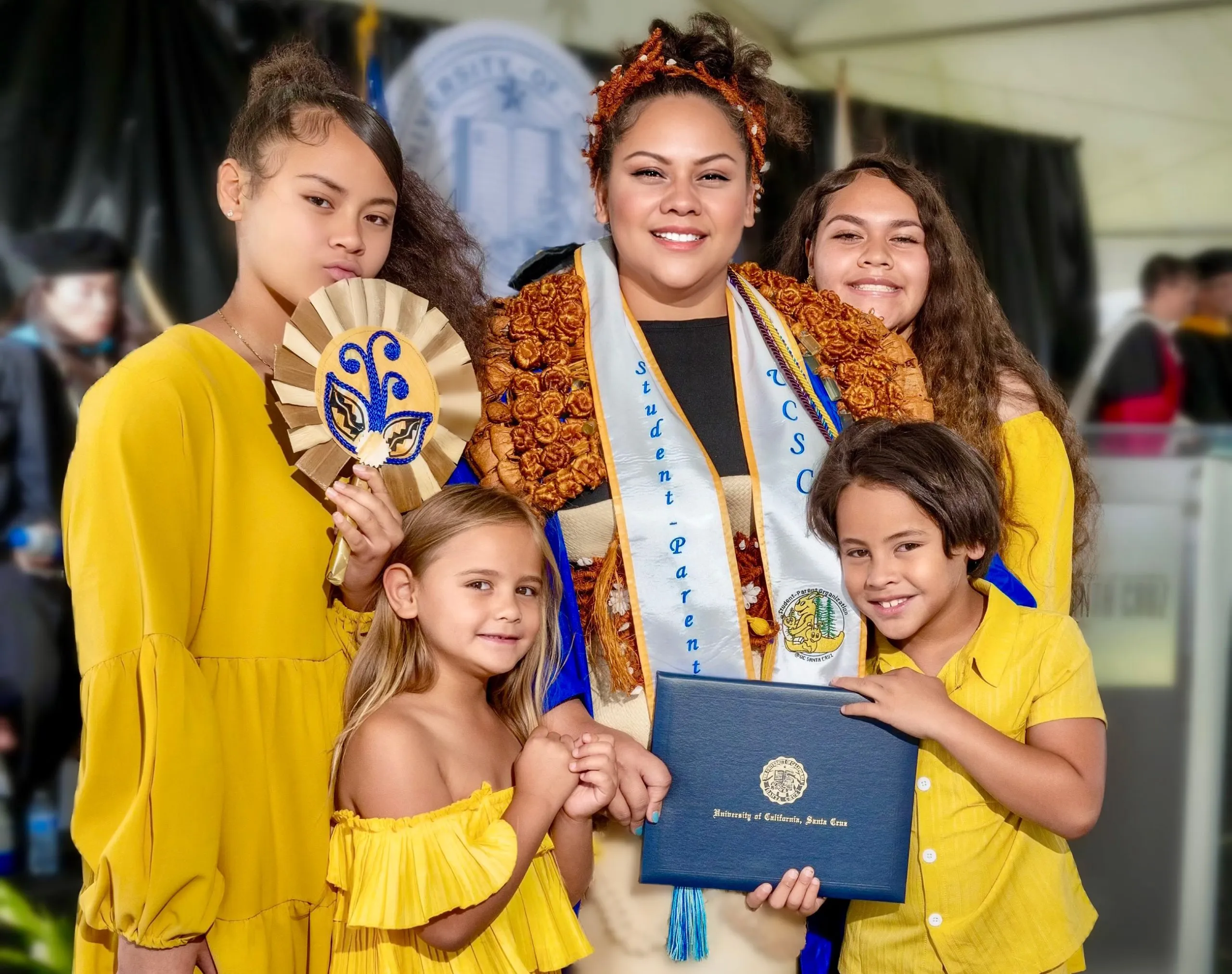
    For me, the last hurdle I had to clear was graduation itself. After years of sacrifice — not just my own, but my whole family’s — walking the stage with my four children at my graduation from the University of California, Santa Cruz was deeply important.

    The university, however, didn’t understand that or account for us. When I asked to accept my diploma with my kids, I was met with resistance, a particularly tough reminder of the work institutions have left to do to meet the needs and priorities of student-parents.

    Related: Interested in innovations in higher education? Subscribe to our free biweekly higher education newsletter.

    Earning my college degree in my late 30s was undoubtedly a major achievement, but so was going back for my bachelor’s in the first place — I didn’t even finish high school the first time around.

    After I became a mom at 20, I earned my GED, hoping it would help me support my family. Continuing my education only got harder. I started and stopped community college more times than I can count, juggling bills, jobs, custody battles and parenting.

    Finally, I transferred to UCSC, proud that I was taking this step two decades in the making and changing the trajectory of my and my family’s lives.

    However, I didn’t fully realize what my education would cost my children. Used to our tight-knit Tongan community, they felt like cultural outsiders when we moved to Santa Cruz, no longer surrounded by family, our native language or familiar foods and music.

    My children sacrificed their home and sense of belonging so that I could pursue this dream. As graduation approached, I knew I wanted to walk the stage with them. They had earned it just as much as I had.

    Yet the administration denied my request, citing the added logistical difficulties. They suggested I bring my kids to a separate, informal celebration for those of us living in family student housing instead. The offer sounded like “be invisible or settle for less.”

    I immediately started mobilizing UCSC’s Student Parent Organization, where I was president. Working with the student government, I drafted a resolution permitting student-parents to walk with their children. I reached out to alumni, administrators, fellow parents and friends for support.

    Thanks to our collective voice, the dean of students changed his mind, offered an apology and committed to changing the policy going forward for all graduating student-parents. Though my kids and I were placed at the end of the ceremony, we crossed the stage together as a family.

    That seed of inclusion will grow in them, just like it will for all the children of student-parents who walk that path in the future.

    The next year, my mentee and friend walked with her son at the UCSC commencement, this time without pushback. The university invited them to rehearsal, and on graduation day, they had VIP seats. She was one of the first to walk, not the last.

    That is the power of advocacy. It turns exclusion into inclusion. It rewrites the rules not just for one person, but for those who come after. I am proud to continue my advocacy work as a graduate student at the University of San Francisco and a member of The California Alliance for Student Parent Success.

    I have since seen institutions across California make good progress on their efforts to support student-parents, but colleges and universities nationwide must still do more. At the University at Buffalo, university police chased a graduating student across the stage when he attempted to bring his infant son with him.

    Related: A federal program helped student-parents thrive. Now it’s on life support

    These stories and the momentum building in the wake of September’s National Student Parent Month should serve as a call to higher education leaders across the country to cultivate campus climates that build trust and belonging among student-parents.

    This work should start before we even step foot on campus and continue until we graduate.

    Institutions that truly wish to serve families will ensure that the value we bring to higher education is visible. They will account for student-parents when planning campus events and weave together support networks of faculty, staff and peers who can respond to our needs.

    When we ask institutions for policies and practices to better accommodate our families, they will listen and act. They will hold themselves accountable to all of their students, parents included.

    Walking the stage with my kids was a step in the right direction, albeit an uphill climb. Let’s keep going and do better by student-parents and their families.

    Krystle Pale is a UC Santa Cruz graduate, a mother of five and a recent Advisory Committee member of The California Alliance for Student Parent Success.

    Contact the opinion editor at [email protected].

    This story about student-parents was produced by The Hechinger Report, a nonprofit, independent news organization focused on inequality and innovation in education. Sign up for Hechinger’s weekly newsletter.

    The Hechinger Report provides in-depth, fact-based, unbiased reporting on education that is free to all readers. But that doesn’t mean it’s free to produce. Our work keeps educators and the public informed about pressing issues at schools and on campuses throughout the country. We tell the whole story, even when the details are inconvenient. Help us keep doing that.

    Join us today.

    Source link

  • Cosmetology schools and other certificate programs got exemption from rules on graduates’ earning levels

    Cosmetology schools and other certificate programs got exemption from rules on graduates’ earning levels


    Remiah Ward’s shift at the SmartStyle salon inside Walmart was almost over, and she’d barely made $30 in tips from the haircuts she’d done that day. It wasn’t unusual — a year after her graduation from beauty school, tips plus minimum wage weren’t enough to cover her rent.

    She scarcely had time to eat and sleep before she had to drive back to the same Walmart in central Florida to stock shelves on the night shift. That job paid $14 an hour, but it meant she sometimes spent 18 hours a day in the same building. She worked six days a week but still struggled to catch up on bills and sleep. 

    The admissions officer at the American Institute of Beauty, where she enrolled straight out of high school, had sold her on a different dream. She would easily earn enough to pay back the $10,000 she borrowed to attend, she said she was told. Ward had no way of knowing that stylists from her school earn $20,200 a year, on average, four years after graduating. Seven years later, her debt, plus interest, is still unpaid.

    In July, Republicans in Congress pushed through policies aimed at ensuring that what happened to Ward wouldn’t happen to other Americans on the government’s dime; colleges whose graduates don’t earn at least as much as someone with a high school diploma will now risk losing access to federal student loans. But one group managed to slip through the cracks — thousands of schools like the American Institute of Beauty were exempt. 

    Remiah Ward worked two jobs while trying to make it as a hair stylist but never made enough to pay her all her bills and has had to put her dream career on hold. Credit: Courtesy Remiah Ward

    Certificate schools succeeded in getting a carve-out. The industry breathed a collective sigh of relief, and with good reason. At least 1,280 certificate-granting programs, which enrolled more than 220,000 students, would have been at risk of losing federal student loan funding if they had been included in the bill, according to a Hechinger Report analysis of federal data. [See table.] About 80% of those are for-profit programs, and 45 percent are cosmetology schools.

    “There is this very strange donut hole in accountability where workforce programs are held accountable, two-year degree programs are held accountable, but everything in between gets off without any accountability,” said Preston Cooper, a senior fellow at the conservative think tank American Enterprise Institute.

    The schools spared are known as certificate programs and, with their promise of an affordable and relatively quick path to economic security, are the fastest growing part of higher education. They usually take about a year to complete and train people to be hair-stylists, welders, medical assistants and cooks, among other jobs.

    As with traditional colleges, there are big differences in quality among certificate programs. Some hair stylists can make a middle-class living if they work in a busy salon. But for people who have to pay back hefty student loans, the low wages for stylists in the early years can be an insurmountable obstacle.

    Ward found herself facing that dilemma. When she could no longer sustain the lack of sleep from her double shifts at Walmart, she pressed pause on her styling career and took a job with Amazon, loading and unloading planes. She wasn’t ready to give up her dream career, though, so in addition to her 10-hour days moving boxes, she took part-time gigs at local hair salons. She didn’t have family to help pay rent, not to mention loan payments, so she couldn’t afford to work fulltime at a salon, which is essential to build up a regular clientele — and bigger tips. Without that, she couldn’t get much beyond minimum wage. 

    A representative from the American Institute of Beauty denied that Ward was told she would easily repay her loan.

    “No admissions representative, not at AIB or elsewhere, would ever make such a statement,” Denise Herman, general counsel and assistant vice president of AIB, said in an email. 

    The high cost of many for-profit cosmetology schools — tuition can be upward of $20,000, usually for a one-year program  — can leave former students mired in debt. In May, the government released data showing 850 colleges where at least a third of borrowers haven’t made a loan payment for 90 days or more, putting them on track to default. About 42 percent of those were for-profit cosmetology and barbering schools (including AIB).

    Brittany Mcnew says she loves working as a stylist but that her income takes a hit when traffic is slow in her salon in Bethlehem, Pennsylvania. Credit: Meredith Kolodner/The Hechinger Report

    Herman blamed the Biden administration policy that after the pandemic let borrowers forgo payments without any penalty.

    “Debtors became ‘comfortable’ not making payments,” said Herman. “AIB provides the graduate with the information graduates need to make their payments. What that graduate decides to pay, or not pay, is not influenced by AIB.”

    Under the “big beautiful bill” passed in July, two- and four-year colleges must ensure that, after four years, graduates on average make at least as much as someone in their state who has only a high school diploma. The colleges must inform students if they fail that test, and if it happens for two out of three years, the college will be ineligible to receive federal loan funds.

    Some for-profit certificate schools lobbied hard for an exemption. The American Association of Career Schools, which represents proprietary cosmetology schools, spent $120,000 lobbying the Education Department and Congress, including on the “big beautiful bill,” in the first six months of this year. At the group’s major lobbying event in April, Sen. Bill Cassidy, chairman of the Senate Health, Education, Labor and Pensions Committee, was the keynote speaker.

    Cassidy declined to answer questions about why certificate programs were excluded, but a fact sheet from his committee noted that they are already covered by something else, the gainful employment rule, which is also being challenged by the for-profit cosmetology industry.

    That federal gainful employment regulation, updated in 2023, requires in essence that graduates from career-oriented schools earn enough to be able to pay back their loans and earn more than a high school graduate. It also requires that consumers, like Ward, be given more information about how graduates from all colleges fare in the workplace.

    The rule posed an existential threat to a huge swath of cosmetology schools.

    In 2023, the American Association of Career Schools sued to block the gainful employment rule. 

    “AACS supports fair and reasonable accountability measures,” Cecil Kidd, the AACS’s executive director, said in an email. “However, we strongly object to arbitrary or discriminatory policies such as the US Department of Education’s Gainful Employment rule, which unfairly targets career schools while exempting many public and private non-profit institutions that fail to meet comparable outcomes.”

    He pointed to public comments in which AACS has argued that the rule imposes an unfair burden on cosmetology schools since stylists are predominantly women, who are more likely to have “personal commitments” that affect their earnings, and who rely on tips that are often pocketed as unreported income.

    Cameron Vandenboom is a successful hair stylist but says the high cost of her private beauty school wasn’t worth thousands of dollars in student debt: “I absolutely should have gone to community college.” Credit: Courtesy Shanna Kaye Photo

    In a twist that surprised advocates on both sides, the Education Department in May asked the court to effectively dismiss AACS’ lawsuit. 

    If the court rules in favor of the cosmetology schools, certificate programs will be free of all accountability requirements on their graduates’ earning levels, because they got the carveout in July. 

    Even if the court rules against cosmetology schools, advocates are pessimistic that the Trump administration will implement the gainful rules. The first Trump administration got rid of the original rules back in 2019 and Nicholas Kent, now the U.S. undersecretary of education, was previously the chief policy officer for Career Education Colleges and Universities, or CECU, the trade group that represents for-profit colleges, including certificate programs. He is a well-known critic of the rule.

    “I would be very surprised, if the unlikely scenario plays out that the Biden rule is upheld, that this Department of Education would just say, OK, the court has spoken,” said Jason Altmire, CECU’s executive director. “We are not opposed to accountability for certificate programs, so long as it’s fair to everybody and we have a voice in how you’re measuring programs.”  

    Altmire said CECU didn’t lobby for certificate programs to be carved out of Congress’ bill, but did argue against the earnings formula that Congress landed on. Altmire said it doesn’t take into account part-time work and the gender gap in wages.

    One objection from AACS, raised by CECU as well, is that the earnings measured don’t include tips, which are crucial to hair stylists’ income. Analyzed without including tips, 576 of 724 cosmetology schools in the Hechinger Report analysis would fail Congress’ earnings test. But even if tips were included and raised stylists’ income by 20 percent, 526 cosmetology schools would still fail.

    Earlier this year, Remiah Ward made the difficult decision to leave Florida and move to Kentucky, where the cost of living was more forgiving. She’s working from 7 p.m. to 7 a.m. at an aluminum factory for $19.50 an hour. 

    One day, she might go back to styling after her debt is paid off. Like many former beauty school students, she wishes she’d had more information when she decided to enroll.

    “They really sugar-coated it. I was 18 years old, and I needed a trade that I was already pretty good at,” said Ward, who is now 26. “Everybody thinks they’re going to make a high return, and it’s just not the reality.”

    Marina Villeneuve contributed data analysis to this story. 

    This story about cosmetology schools produced by The Hechinger Report, a nonprofit, independent news organization focused on inequality and innovation in education. Sign up for the Hechinger higher-education newsletter.

    The Hechinger Report provides in-depth, fact-based, unbiased reporting on education that is free to all readers. But that doesn’t mean it’s free to produce. Our work keeps educators and the public informed about pressing issues at schools and on campuses throughout the country. We tell the whole story, even when the details are inconvenient. Help us keep doing that.

    Join us today.

    Source link

  • Explore the earnings for graduates of beauty schools, other certificate programs

    Explore the earnings for graduates of beauty schools, other certificate programs

    Schools that train hairstylists, dental assistants and health aides will be able to keep getting federal student loan dollars even if the professionals they turn out don’t end up earning any more than a high school graduate.

    That’s because programs like those, which don’t end in a college degree, were granted an exemption from new accountability measures under President Donald Trump’s ”big, beautiful bill.” 

    A Hechinger Report analysis of federal data found at least 1,280 such certificate programs could have been at risk of their students losing access to federal student loans — but a successful lobbying effort excluded them from the accountability measures. 

    Related: Become a lifelong learner. Subscribe to our free weekly newsletter featuring the most important stories in education. 

    Under the new law, most graduates of associate, bachelor’s and graduate degree programs must earn at least as much as someone who has only a high school diploma. If programs fail to hit that benchmark for two out of three years, their students will no longer be eligible for federal student loans. (And the schools must warn students of this possibility if they miss the mark for just one year). Without that borrowing power, many students could not afford to attend. And without those students, some of the schools might not survive. 

    Using the table below, see which certificate programs might have been flagged under the Trump law if not for the exemption. If graduates of a particular program ended up earning less than adults with only a high school diploma, that program could have faced losing eligibility for federal student loans under the Trump law.

    Methodology

    What exactly does the “big, beautiful bill” call for?

    The legislation requires the Department of Education to compare earnings of working adults who have only a high school diploma to the earnings of adults four years after they complete a degree program or graduate certificate. If a postsecondary program’s graduates fail to outearn adults with only high school degrees for two out of three years, students can no longer obtain federal student loans to attend that program. 

    The law also sets up an appeals process and a way for programs to apply to regain eligibility for federal student loans.

    What data was analyzed? 

    The law directs the education secretary to use census data to calculate median earnings for working adults with only a high school degree in the state where a program is located. The Department of Education will release regulations that spell out exactly how to do that math. For example, the law does not spell out whether it will look at census data averaged out over 12 months or a longer period of time. 

    For earnings data for high school graduates, The Hechinger Report relied on calculations from the Department of Education, which were derived from the 2022 American Community Survey 5-Year Estimates Public Use Microdata Sample from the U.S. Census Bureau.

    To calculate median earnings for graduates, the law directs the Education Department to put together earnings data for a cohort of at least 30 graduates who received federal student aid for postsecondary education — which typically includes grants, loans or work-study. Graduates are excluded if they’re currently enrolled in another higher education program. If there are fewer than 30 students in a cohort, the Education Department can lump together several years of data to get to 30 students.

    To get earnings data for graduates of certificate programs, Hechinger used a federal database known as College Scorecard. We downloaded field of study data for the 2022-23 school year. From this data, The Hechinger Report extracted information about certificate programs, at their main campuses, and included only programs that had median earnings data. The federal database suppresses earnings data for small programs. That left 4,431 currently operating certificate programs. 

    How was a program determined to be at possible risk of failing the accountability measure?

    For each program, The Hechinger Report compared median graduate earnings to the high school graduate earnings data of the state where the program was located. If the graduates earned less, the program was considered to be at risk.  

    Under the law, postsecondary programs that don’t meet the earnings benchmark for one year have to inform all current students that they are at risk of losing their eligibility for federal student loans. 

    Are there any limitations to the data? 

    The “big, beautiful bill” takes online programs into account by considering whether students live in the same state where their academic program is based. Under the law, student earnings are compared with national data rather than state data when fewer than half of enrolled students live in the state where the school is located, which may be the case for online programs. 

    The Hechinger Report’s analysis instead compares every program with state earnings. That’s because the College Scorecard field of study data set is limited and only includes information about graduates employed within the same state as the institution, not whether enrolled students live in the same state as the program. In addition, College Scorecard data provides earnings data for all graduates without a breakdown for whether they receive federal aid.

    Also, the Hechinger database looks at the available median earnings of all students four years after graduation for the school year 2022-23, regardless of the number of graduates. Though College Scorecard suppresses data on smaller programs, median earnings data is available for programs with 16 or more working graduates. The “big, beautiful bill” directs the Department of Education to instead lump together years of data to create cohorts of at least 30 students.

    Contact investigative reporter Marina Villeneuve at 212-678-3430 or [email protected] or on Signal at mvilleneuve.78

    This story about beauty schools was produced by The Hechinger Report, a nonprofit, independent news organization focused on inequality and innovation in education. Sign up for the Hechinger newsletter.

    The Hechinger Report provides in-depth, fact-based, unbiased reporting on education that is free to all readers. But that doesn’t mean it’s free to produce. Our work keeps educators and the public informed about pressing issues at schools and on campuses throughout the country. We tell the whole story, even when the details are inconvenient. Help us keep doing that.

    Join us today.

    Source link

  • Student veterans, advisers say VA cuts are derailing their educations

    Student veterans, advisers say VA cuts are derailing their educations

    As the spring semester got under way in January at the University of Colorado at Colorado Springs, a dozen military veterans waited for their GI Bill student benefit checks to show up.

    Then they waited, and waited some more, until the money finally arrived — in April.

    By that time, three had left.

    Getting GI Bill benefits from the Veterans Administration, which student veterans use to pay for their tuition, textbooks and housing, already took weeks. Since federal government staffing cuts since President Donald Trump took office, it’s been taking at least three times longer, said Jeff Deickman, assistant director for veteran and military affairs at the student veteran center on that campus.

    Deickman’s counterparts at other colleges say the VA’s paperwork often has errors, causing further delays. They say some student veterans are dropping out.

    “I can spend, on bad days, three hours on the phone with the VA,” said Deickman, himself a 20-year Army veteran and a doctoral student. “They’ll only answer questions about one student at a time, so I have to hang up and start over again.”

    Nearly 600,000 veterans received a total of about $10 billion worth of GI Bill benefits last year, according to the VA.

    The start of the new administration brought big personnel cuts to both the VA and the U.S. Department of Education, which manages some student aid for veterans. Now, advocacy groups and universities and colleges that enroll large numbers of veterans are bracing for the planned layoffs and departures of nearly 30,000 VA employees and additional cuts at the Department of Education.

    Many are also concerned about the potential for reduced scrutiny of the for-profit college sector, which critics contend has taken advantage of veterans’ tuition payments without providing the promised educational benefits.

    Related: Interested in innovations in higher education? Subscribe to our free biweekly higher education newsletter.

    Veterans who are just starting to feel the effects of federal cuts, and organizations that support them, worry things will only get worse, said Barmak Nassirian, vice president for higher education policy at the advocacy group Veterans Education Success. The nonprofit has been getting calls from students anxious about confusing information they’re receiving from federal agencies, he said, and it’s been hard to get answers from the government.

    “Part of the challenge of wrapping our arms around this is the opaqueness of the whole thing. We’re sort of feeling our way around the impact,” Nassirian said.

    “The whole process” has become a mess, said one 33-year-old Navy vet in Colorado, who used a more colorful term common in the military and asked that his name not be disclosed for fear of reprisal. “It’s making a lot of us anxious.”

    Social media lays bare that anxiety — and frustration. In posts, veterans complain about stalled benefits and mistakes.

    “I just wish I could speak to someone who could help but all of the reps seem to be unable to assist and simply tell me to reapply, which I have 4x, just for another denial,” wrote one on Reddit, about attempts to have a student loan forgiven.

    Related: How Trump is changing higher education: The view from 4 campuses

    “Complete nightmare,” another Reddit poster wrote about the same process. “Delays, errors, and employees that don’t know anything. No one knows anything right now.”

    Federal law guarantees that disabled vets’ student loans will be forgiven, for instance, but veterans with total permanent disabilities have reported that their applications for their loans to be discharged were denied. One said the Department of Education followed up with a letter saying the denial was a mistake, but the agency hasn’t explained how to correct it.

    The Education Department did not respond to an interview request. The VA declined to answer even general questions about benefit delays unless provided with the names of veterans and colleges that reported problems.

    A VA spokesman, Gary Kunich, said no one had been laid off from the agency, which in fact cut 1,000 probationary employees in January and another 1,400 workers in February, though some were temporarily reinstated by a judge. It has announced plans to lay off 30,000 more by the end of September.

    Such cuts threaten to “disrupt access to veterans’ education benefits, just as even more veterans and service members may be turning to higher education and career training,” top officials at the American Council on Education, or ACE — the nation’s largest association of colleges and universities — wrote in June.

    That’s on top of existing frustrations. Veterans already struggle to get the benefits they’ve earned, college administrators and students say.

    Related: Veterans are tangled in red tape trying to get their student loans canceled as promised

    Many colleges and even some prominent veterans’ advocacy groups didn’t want to talk about this. Student Veterans of America, one of the largest advocacy groups for veteran students, did not respond to repeated interview requests. Ten of the colleges and universities that boast large veteran enrollments — including San Diego State, Georgia State, Angelo State, Arizona State and Syracuse — also did not respond or declined to answer questions.

    Veterans and advocates are concerned that ongoing Education Department cuts will erode oversight of education institutions that take GI Bill benefits but leave veterans with little in return — primarily for-profit colleges that were found guilty of, and have been punished repeatedly for, defrauding students. In some cases, those colleges suddenly closed before students could finish their degrees, but kept their tuition while leaving them with useless credits or credentials.

    Veterans are already twice as likely as other students to attend for-profit colleges, according to the Postsecondary National Policy Institute.

    While it might take years until the effects of weakened scrutiny are fully visible, Nassirian said, it already appears that staffing cuts at the divisions within the Education Department that kept an eye on for-profit colleges have led those schools to start targeting veterans again.

    “Without a doubt it is now easier for schools that want to push the envelope to get away with it,” he said. “When you have fewer cops on the beat you’re going to see higher crime. And we’re still just a nanosecond into this new environment.”

    Veterans can lose their GI Bill benefits even when a college defrauds them.

    The risk is particularly high for low-income veterans and those from diverse backgrounds, said Lindsay Church, executive director of Minority Veterans of America. Those student veterans are less likely to have parents who have experience with higher education, Church said, making them more vulnerable to fraud.

    But the most immediate problems with staffing cuts are payment delays and paperwork errors, student veterans and their advisers said.

    At Pikes Peak State College, a community college in Colorado Springs, some veterans still hadn’t received their GI Bill benefits as the semester wound down in May, said Paul DeCecco, the college’s director of military and veteran programs. Because of trouble reaching counselors at the VA, others were never able to enroll in the first place, DeCecco said.

    “Counselors are just overwhelmed and not able to respond to students in a timely manner,” he said. “Students are missing semesters as a result.”

    Related: Behind the turmoil of federal attacks on colleges, some states are going after tenure

    In the military city of San Diego, where thousands of former and current service members go to college, student veterans at Miramar College this year waited months to hear about VA work-study contracts. Previously approved within days, those contracts allow students to get paid for veteran-related jobs while attending school, said LaChaune DuHart, the school’s director of veterans affairs and military education.

    Other veterans went weeks without textbooks because of delayed VA payments, DuHart said.

    “A lot of students can’t afford to lose those benefits,” she said, describing the “rage” many student veterans expressed over the long wait times this year. “A lot of times it’s that emotional reaction that causes these students not to come back to an institution,” she said.

    Colleges routinely see student veterans quit because of benefit delays, numerous experts and administrators said, something that has gotten worse this year. Several recounted stories of veterans without degrees choosing to look for work rather than continue their education because of frustration with the VA — even though studies show that graduating from college can dramatically increase future earnings.

    Those who stayed have faced the added stress of waiting for their benefits, or not being able to get their questions answered.

    “We always tell them to be prepared for delays,” said Phillip Morris, an associate professor of education research and leadership at the University of Colorado at Colorado Springs who studies student veterans. “But if you can’t pay your rent because your benefits are not flowing the way you’re expecting them to, that’s increasing anxiety and stress that translates to the classroom.”

    Contact editor Jon Marcus at 212-678-7556 or [email protected].

    This story about student veterans was produced by The Hechinger Report, a nonprofit, independent news organization focused on inequality and innovation in education. Sign up for our higher education newsletter. Listen to our higher education podcast.

    The Hechinger Report provides in-depth, fact-based, unbiased reporting on education that is free to all readers. But that doesn’t mean it’s free to produce. Our work keeps educators and the public informed about pressing issues at schools and on campuses throughout the country. We tell the whole story, even when the details are inconvenient. Help us keep doing that.

    Join us today.

    Source link

  • Let’s remove the roadblocks to four-year STEM degrees for community college transfer students

    Let’s remove the roadblocks to four-year STEM degrees for community college transfer students

    In the nearly two years since the U.S. Supreme Court struck down race-conscious admissions, there have been repeated calls for universities to address the resulting decline in diversity by recruiting from community colleges.  

    On the surface, encouraging students to transfer from two-year colleges sounds like a terrific idea. Community colleges enroll large numbers of students who are low-income or whose parents did not attend college. Black and Latino students disproportionately start college at these institutions, whose mission for more than 50 years has been to expand access to higher education. 

    But while community colleges should be an avenue into high-value STEM degrees for students from low-income backgrounds and minoritized students, the reality is sobering: Just 2 percent of students who begin at a community college earn a STEM bachelor’s degree within six years, our recent study of transfer experiences in California found.  

    There are too many roadblocks in their way, leaving the path to STEM degrees for community college students incredibly narrow. A key barrier is the complexity of the process of transferring from a community college to a four-year institution. 

    Related: Interested in innovations in higher education? Subscribe to our free biweekly higher education newsletter. 

    Many community college students who want to transfer and major in a STEM field must contend with three major obstacles in the transfer process: 

    1. A maze of inconsistent and often opaque math requirements. We found that a student considering three or four prospective university campuses might have to take three or four different math classes just to meet a single math requirement in a given major. One campus might expect a transfer student majoring in business to take calculus, while another might ask for business calculus. Still another might strongly recommend a “calculus for life sciences” course. And sometimes an institution’s website might list different requirements than a statewide transfer site. Such inconsistencies can lengthen students’ times to degrees — especially in STEM majors, which may require five- or six-course math sequences before transfer.  

    2. Underlying math anxiety. Many students interviewed for the study told us that they had internalized negative comments from teachers, advisers and peers about their academic ability, particularly in math. This uncertainty contributed to feelings of anxiety about completing their math courses. Their predicament is especially troubling given concerns that required courses may not contribute to success in specific fields. 

    3. Course scheduling conflicts that slow students’ progress. Two required courses may meet on the same day and time, for example, or a required course could be scheduled at a time that conflicts with a student’s work schedule. In interviews, we also heard that course enrollment caps and sequential pathways in which certain courses are offered only once a year too often lengthen the time to degree for students. 

    Related: ‘Waste of time’: Community college transfers derail students 

    To help, rather than hinder, STEM students’ progress toward their college and professional goals, the transfer process needs to change significantly. First and foremost, universities need to send clear and consistent signals about what hoops community college students should be jumping through in order to transfer.  

    A student applying to three prospective campuses, for example, should not have to meet separate sets of requirements for each. 

    Community colleges and universities should also prioritize active learning strategies and proven supports to combat math anxiety. These may include providing professional learning for instructors to help them make math courses more engaging and to foster a sense of belonging. Training for counselors to advise students on requirements for STEM pathways is also important.  

    Community colleges must make their course schedules more student-centered, by offering evening and weekend courses and ensuring that courses required for specific degrees are not scheduled at overlapping times. They should also help students with unavoidable scheduling conflicts take comparable required courses at other colleges. 

    At the state level, it’s critical to adopt goals for transfer participation and completion (including STEM-specific goals) as well as comprehensive and transparent statewide agreements for math requirements by major. 

    States should also provide transfer planning tools that provide accurate and up-to-date information. For example, the AI Transfer and Articulation Infrastructure Network, led by University of California, Berkeley researchers, is using artificial intelligence technology to help institutions more efficiently identify which community college courses meet university requirements. More effective tools will increase transparency without requiring students and counselors to navigate complex and varied transfer requirements on their own. As it stands, complex, confusing and opaque math requirements limit transfer opportunities for community college students seeking STEM degrees, instead of expanding them. 

    We must untangle the transfer process, smooth pathways to high-value degrees and ensure that every student has a clear, unobstructed opportunity to pursue an education that will set them up for success. 

    Pamela Burdman is executive director of Just Equations, a California-based policy institute focused on reconceptualizing the role of math in education equity. Alexis Robin Hale is a research fellow at Just Equations and a graduate student at UCLA in Social Sciences and Comparative Education.  

    Contact the opinion editor at [email protected]. 

    This story about community college transfers was produced by The Hechinger Report, a nonprofit, independent news organization focused on inequality and innovation in education. Sign up for Hechinger’s weekly newsletter. 

    The Hechinger Report provides in-depth, fact-based, unbiased reporting on education that is free to all readers. But that doesn’t mean it’s free to produce. Our work keeps educators and the public informed about pressing issues at schools and on campuses throughout the country. We tell the whole story, even when the details are inconvenient. Help us keep doing that.

    Join us today.

    Source link