Category: Americas

  • The United States as guardian or bully

    The United States as guardian or bully

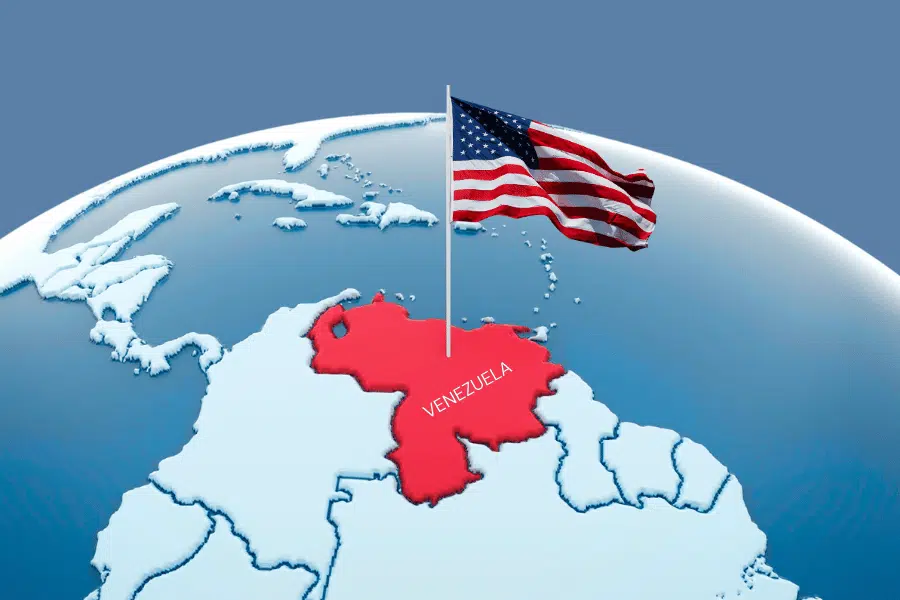
    The recent United States military incursion into Venezuela and abduction and subsequent arrest of its President Nicolás Maduro and his wife in New York is a major geopolitical event. Like all major geopolitical events, it has several components — historical, legal, political and moral.

    And like all major geopolitical events, it has very different points of view. There is no grandiose “Truth” about what happened. There are many truths and points of view.

    What can be said is that on 3 January 2026, the United States military carried out strikes on Venezuela and captured its president, Nicolás Maduro, and his wife Cilia Flores. The two were then flown to the United States where they were arrested and charged with issues related to narcoterrorism.

    The United States’ intervention in a Latin American country has historical precedents as well as current foreign policy implications.

    Under President James Monroe, the United States declared in 1823 that it was opposed to any outside colonialism in the Western Hemisphere. Now known as the Monroe Doctrine, it established what political scientists refer to as a “sphere of influence”; No foreign country could establish control of a country in the United States-dominated Western Hemisphere.

    (This was indeed one of the central issues in the 13-day October 1962 Cuban Missile Crisis when the United States established a blockade outside Cuba to stop the installation of Soviet missiles on the island.)

    The Trump Corollary

    In the latest U.S. official security strategy document — National Security Strategy 2025 — the Monroe Doctrine was presented in what has been labelled “The Trump Corollary.” In it, the government said that defending territory and the Western Hemisphere were central tasks of U.S. foreign policy and national interest. The document clearly stated that activities by extra-hemispheric powers would be considered serious threats to U.S. security.

    As such, the “Trump Corollary” of the Monroe Doctrine is the justification of the military action in Venezuela based on stopping Russian and Chinese influence in Venezuela. In addition, it can be seen as the justification for the U.S. to acquire Greenland, resume control of the Panama Canal and stop narcotics and illegal migrants coming into the United States from anywhere in the Western Hemisphere.

    But the Corollary and Doctrine are mere national strategic statements. Are they legally justified? The U.S. military operation in Venezuela has been highly criticized by international lawyers as well as United Nations officials. The United Nations Charter, of which the United States is a signatory, clearly forbids the use of force by one country against another country except in the case of self-defense and imminent threat.

    In an interview with New Yorker magazine reporter Isaac Chotiner on 3 January, Yale Law School Professor Oona Hathaway noted that when the UN Charter was written 80 years ago, it included a critical prohibition on the use of force by states. “States are not allowed to decide on their own that they want to use force against other states,” she told Chotiner. “It was meant to reinforce this relatively new idea at the time that states couldn’t just go to war whenever they wanted to.”

    Hathaway said that in the pre-UN Charter world, you could use force if you felt like drug trafficking was hurting you and come up with legal justification that that was the case. “But the whole point of the UN Charter was basically to say, ‘We’re not going to go to war for those reasons anymore’,” she said.

    The legality of an ouster

    Besides the international legal issue, there is also a domestic legal question about the Venezuelan military action. The 1973 War Powers Act was enacted to limit the power of the U.S. president to use military forces with the approval of the Congress.

    It was enacted following the Vietnam War during which the president engaged troops without Congressional approval or a formal declaration of war. The Act clearly requires the president to notify Congress before committing armed forces to military action.

    Trump did not consult with members of Congress before and during the military action in Venezuela. The political implications of the Venezuelan strikes and abduction also have international as well as domestic implications. Internationally, there is a dangerous precedent being set.

    If the United States asserts its sphere of influence in the Western Hemisphere, what is to stop the Russian Federation from claiming a similar sphere of influence in the Baltic countries of Latvia, Lithuania and Estonia as well as Ukraine?

    Similarly, what about Chinese influence in the Indo-Pacific region and especially Taiwan? If the United States claims domination in one geographic region, why can’t other powers like Russia and China do the same?

    The Westphalian system

    Within the United States, there have also been serious reservations about President Trump’s actions. That was to be expected from the opposing Democratic Party. But, several members of Trump’s Republican Party as well as loyal members of his Make America Great Again (MAGA) movement argue that Trump was elected on the slogan “Make America Great Again.” One of the pillars of that movement is a focus on internal problems instead of foreign interventions.

    Republican U.S. Representative Marjorie Taylor Greene used to be one of Trump’s staunchest supporters. On 3 January she told interviewer Kristen Walker on the NBC show “Meet the Press” that America First should mean what Trump promised on the campaign trail in 2024.

    “So my understanding of America First is strictly for the American people, not for the big donors that donate to big politicians, not for the special interests that constantly roam the halls in Washington and not foreign countries that demand their priorities put first over Americans,” Greene said.

    Other criticisms have centered on President Trump’s focus on restoring business in Venezuela for the U.S. oil industry, which has the world’s largest oil reserves. Republican U.S. Representative Thomas Massie warned that “lives of U.S. soldiers are being risked to make those oil companies (not Americans) more profitable.”

    Finally, there are moral arguments against the use of force in Venezuela as well as Trump’s threats of the use of force in Colombia, Cuba and elsewhere. There is no question that Venezuelans had suffered under the rule of Maduro; statistics show the rapid decline in the economy as well as a significant democratic deficit.

    Fundamental to today’s notion of international order is what’s known as the Westphalian system of the integrity of state sovereignty. The world has seen an order since the end of World War II and the establishment of the United Nations. That order was based on respect for the rule of law. There are other means for states to act against other states, such as sanctions, below military intervention. One country invading another goes against the basis of the Westphalian system.

    The Venezuelan strikes and abduction have set a dangerous precedent.


    Questions to consider:

    1. What is meant by the “Monroe Doctrine”?

    2. When is one country considered part of a “sphere of influence” of another country?

    3. How do you define “national security”?

    Source link

  • Ousting Venezuela’s leader was high on Trump’s to-do list

    Ousting Venezuela’s leader was high on Trump’s to-do list

    When a little known politician recently declared himself interim president of Venezuela and called for fresh elections, opponents of the sitting president, Nicolás Maduro, saw a bright future for a country mired in misery and hunger.

    But ousting Maduro has proved more difficult than expected. Optimistic assumptions have collided with a reality once summed up by the late Chinese leader Mao Zedong: “Political power grows out of the barrel of a gun.”

    Juan Guaidó, the youthful opposition figure who declared himself president on January 23, has been recognized as Venezuela’s legitimate leader by the United States and almost 50 other countries. But Maduro is still in power, backed by the country’s military and paramilitary forces. Maduro’s international backers include China, Russia, Turkey, Iran, Cuba, Bolivia and Nicaragua.

    What Guaidó and Washington administration officials had in mind sounded optimistic but not impossible.

    After Guaidó emerged as undisputed leader of an opposition long weakened by internal feuds, he brought out tens of thousands of demonstrators who denounced a government they blame for an economic collapse that has resulted in severe shortages of basic goods and services.

    Humanitarian aid and presidential power

    Displays of public anger week after week, or so the thinking went, would convince Maduro to step aside in favor of his 35-year-old challenger. A key test of the dueling presidents’ power — and the military’s ultimate loyalty — hinged on the delivery of humanitarian aid flown in by U.S. military planes in mid-February to the city of Cúcuta on Venezuela’s border with Colombia.

    Maduro said the aid was a precursor to a U.S. military invasion, blocked border crossings and dispatched troops to block convoys of trucks or people carrying supplies. In the scenario envisaged by Guaidó, the troops would refuse to intercept desperately needed aid and instead defect en masse.

    That did not happen.

    Instead, things have gone from bad to worse since the failed aid delivery. Tons of food, medicine and medical supplies remain boxed in warehouses on the Colombian side of the border.

    In March, a week-long power cut across all of Venezuela’s 23 states brought more hardship. With electricity out, scarce food rotted in refrigerators and water pumping stations stopped.

    No early end to the suffering

    One heart-breaking video showed people rushing to catch water in buckets and plastic bottles from a leak in a drainage pipe feeding into a sewer.

    Maduro blamed the blackout on saboteurs using cyber attacks and electromagnetic waves to cripple the power system, operations in an “electric war” waged by the United States.

    The opposition pointed to lack of maintenance and an infrastructure that has been crumbling for years.

    In the wake of the longest blackout in Venezuela’s history, Guaidó launched a second round of protests, but the crowds have been noticeably thinner than in the early stage of the contest between the rival presidents.

    Hopes for an early end of the country’s agony appear to be fading in Venezuela. Not so in Washington, judging from bullish statements by President Donald Trump and his secretary of state, Michael Pompeo. Trump told an enthusiastic crowd of Venezuelan exiles and Cuban-Americans in Miami last month that what he called “the ugly alliance” between the Maduro government and Cuba was coming to a rapid end.

    Soon after, Pompeo told a television interviewer he was confident that Maduro’s “days are numbered.”

    Bullish statements from Washington

    When huge crowds jammed the streets of Caracas and other cities to cheer Guaidó, some U.S. administration officials thought Maduro would soon be on the way out. That he has managed to hang on despite popular anger, international condemnation and painful American sanctions has come as a surprise to many.

    Now, the bullish statements from Trump and Pompeo bring to mind American predictions during Barack Obama’s administration concerning Syrian dictator Bashar al-Assad when he faced mass demonstrations, international condemnation and U.S. sanctions.

    In Syria, peaceful protests morphed into civil war in the summer of 2011, and the Obama team’s point man on the Middle Eastern country described Assad as “a dead man walking.” Eight years later, having prevailed in the war with the help of Russia and Iran, Syria lies in ruins, but Assad looks secure in power.

    Shortly before taking office, Trump promised that he would avoid intervention in foreign conflicts and “stop racing to topple foreign regimes.” He has largely stuck to that pledge but is making Venezuela an exception, with repeated assertions that “all options are on the table” — a Washington euphemism for military action.

    There’s no single explanation for Trump’s untypical focus on Venezuela. But it is worth noting that he made his toughest speech on the subject in Florida and that he is running for re-election in 2020. Hawkish rhetoric on Venezuela and Cuba plays well with the large Venezuelan-American and Cuban-American communities in that state.

    Florida, the country’s third most populous state, is of key importance in presidential elections. It is a so-called swing state that can go to either of the presidential candidates, often by very narrow margins.


    QUESTIONS TO CONSIDER:

    1. Can you think of a country where a long-entrenched leader recently bowed to the demands of demonstrators?

    2. Why do you think China, Russia and several other countries are standing by Maduro?

    3. The United States has a history of intervention in Latin America. Can you name some cases?


    Source link

  • A warm rapport with the “world’s coolest dictator”

    A warm rapport with the “world’s coolest dictator”

    The answer is not yet in. But since 2023, Bukele has doubled down on his project as the “world’s coolest dictator,” to quote a phrase he once used on his X profile. And he has won some high-profile admirers in the United States.

    Bukele has repeatedly renewed his March 2022 state of emergency, which suspended constitutional guarantees and by definition is temporary. It has now been extended 39 times over three continuous years since inception. Bukele’s arrest tally, according to a report by human-rights watchdog Cristosal, is now up to at least 87,000 people — more than the death toll of the country’s 12-year civil war, which ended in 1992. 

    Bukele, who is still just 44, won re-election last year after sweeping aside term-limit restraints. A constitutional reform, approved by a pliant legislature, now empowers him to seek as many future terms as he wants.  

    A new kind of leader or more of the same?

    Bukele’s embrace of digital public services, bitcoin and his tech-bro demeanor seems to suggest he wants to be thought of as a new, modern kind of leader. For all that, he is still following the path of many old-fashioned Latin American caudillos or strongmen before him.

    State surveillance and pressure on human rights groups, corruption watchdogs and journalists have ramped up this year to such an extent that Cristosal has pulled its staff out of the country. Everyone, that is, except Ruth López, its lead anti-corruption investigator, who was arrested in May and is still being held on alleged embezzlement charges.

    The Salvadoran Journalists Association has closed its offices too, and will operate from outside the country, following passage of a controversial “foreign agents” law in May which targets the finances of nongovernmental organizations receiving funds from abroad. Bukele’s government accuses many such groups of supporting MS-13. Since April 2023, the independent Salvadoran news outlet El Faro has been legally based in Costa Rica because of what it calls campaigns by the Bukele government to silence its voice.

    “Autocrats don’t tolerate alternative narratives,” it said at the time. And still, the Trump administration likes what it sees.

    Prisons and deportations

    Secretary of State Marco Rubio announced on a February visit to El Salvador that Bukele had agreed to use his CECOT mega-prison to house criminals of any nationality deported from the United States — and even to take in convicted U.S. citizens and legal residents, too.

    This proposed offshoring of part of the U.S. incarcerated population would be for a fee, Bukele clarified, that would help fund his own country’s prisons like the CECOT. 

    The United States then deported more than 200 alleged Venezuelan gang members as well as a group of alleged Salvadoran mareros to El Salvador. The Venezuelans were held at the CECOT until being sent home in a prisoner swap deal for a group of Americans held in Venezuela.

    It would be illegal to deport a U.S. citizen for a crime, as Rubio seemed to acknowledge. “We have a constitution,” he observed. That didn’t stop Homeland Security Secretary Kristi Noem from visiting the CECOT in person and using the social media platform X to threaten “criminal illegal aliens” in the United States with being sent there:

    “I toured the CECOT, El Salvador’s Terrorism Confinement Center,” she posted. “President Trump and I have a clear message to criminal illegal aliens: LEAVE NOW. If you do not leave, we will hunt you down, arrest you, and you could end up in this El Salvadoran prison.”

    A visit to the White House

    Bukele got to make a coveted visit to the White House in April. Trump praised Bukele’s mass imprisonment program, suggesting it could hold U.S. citizens next. Trump was captured telling Bukele on a live feed this: “Home-growns are next. The home-growns. You gotta build about five more places. It’s not big enough.” 

    The question is, how much of that was just grandstanding?

    Like Bukele, Trump has made clear his disdain for constitutional limitations on his power, used government resources to go after his enemies, derided the freedom of the press and talked up domestic security threats to justify heavy-handed, authoritarian policing. The United States has a stronger tradition of democracy than El Salvador, to be sure.

    Checks and balances exist. But the strongman playbook does not have too many variations. Ask Viktor Orbán in Hungary or Vladimir Putin in Russia or Nicolás Maduro in Venezuela. 

    It is not the first time El Salvador has darkly mirrored the fears and internal conflicts of the United States, be they about communism, immigrant crime or democracy. As I wrote in 2023, a straight line can be drawn from the Salvadoran military’s anticommunist violence against impoverished peasants in 1932 to the country’s bloody civil war, in which the United States backed a still atrocity-prone Salvadoran army against leftist rebels.

    The line continues from that conflict to the emergence of MS-13, whose presence in the United States drives so much of the Trump administration’s anti-immigrant rhetoric today.

    The birth of a global gang

    MS-13 members are far from being innocent victims here, though Trump and his supporters have used their crimes to smear immigrants of all kinds. But it’s important to remember that the MS-13 gang, or mara, was formed by young Salvadoran immigrants in Los Angeles. As their home country spiraled toward civil war in the late 1970s, Salvadorans who fled to the United States found themselves threatened by Mexican and other gangs.

    What started out as a weed-smoking, heavy-metal listening self-defense clique morphed in time into hardened criminals. 

    Their power grew when the U.S. government, making a highly visible statement about immigrant crime, deported members of MS-13 and other gangs to El Salvador in the mid 1990s, after the end of the civil war. Within a few years, the gangs ruled the Salvadoran streets. Violence soared in turf wars and government crackdowns. By 2015, gang-related violence made El Salvador the murder capital of the world.

    From leading the world’s murder stats, it has now gone to leading the world’s incarceration stats under Bukele. El Salvador’s proportion of the population in prison is now three times that of the United States, which is no slouch when it comes to incarcerating its people (it ranks fifth).

    Of course, Salvadorans are entitled to freely elect whomever they want as president, as are U.S. citizens. Both Bukele and Trump won their elections and are doing in office exactly what they said they would do. Yet populist authoritarians have a way of clinging to power and confusing their own needs and egos with the state. 

    They brook less contradiction and dissent over time. I, for one, hope the increasingly dystopian utopia Bukele is building in his homeland remains just a cautionary tale in El Salvador’s fraught and symbiotic relationship with the United States.

    It should not be an inspiration.


    Questions to consider:

    1. Why might some a majority of people in a country accept rule by a dictator?

    2. What is one example of the close relationship between El Salvador and the United States?

    3. Do you think that eliminating basic judicial rights can be justified in fighting crime?

    Source link

  • International Student Mobility Data Sources: A Primer

    International Student Mobility Data Sources: A Primer

    Part 1: Understanding the Types of Sources and Their Differences

    There has perhaps never been more of a need for data on globally mobile students than now. In 2024, there were about 6.9 million international students studying outside their home countries, a record high, and the number is projected to grow to more than 10 million by 2030. Nations all around the world count on global student mobility for a number of reasons: Sending nations benefit by sending some of their young people abroad for education, particularly when there is less capacity at home to absorb all demand. Many of those young people return to the benefit of the local job market with new skills and knowledge and with global experience, while others remain abroad and are able to contribute in other ways, including sending remittances. Host nations benefit in numerous ways, from the economic contributions of international students (in everything from tuition payments to spending in the local economy) to social and political benefits, including building soft power.

    At the same time, economic, political, and social trends worldwide challenge the current ecosystem of global educational mobility. Many top destinations of international students, including Canada and the United States, have developed heavily restrictive policies toward such students and toward migrants overall. The COVID-19 pandemic demonstrated that one global challenge can upend international education, even if temporarily.

    Data plays a key role in helping those who work in or touch upon international education. All players in the space—from institutional officials and service providers to policymakers and researchers—can use global and national data sources to see trends in student flows, as well as potential changes and disruptions.

    This article is the first in a two-part series exploring global student mobility data. In this first article, I will delve into considerations that apply in examining any international student data source. In the second, forthcoming article, we will examine some of the major data sources in global student mobility, both global and national, with the latter focused on the “Big Four” host countries: the United States, Canada, the United Kingdom, and Australia.

    In utilizing any global student mobility data source, it is crucial to understand some basics about each source. Here are some key questions to ask about any source and how to understand what each provides.

    Who collects the data?

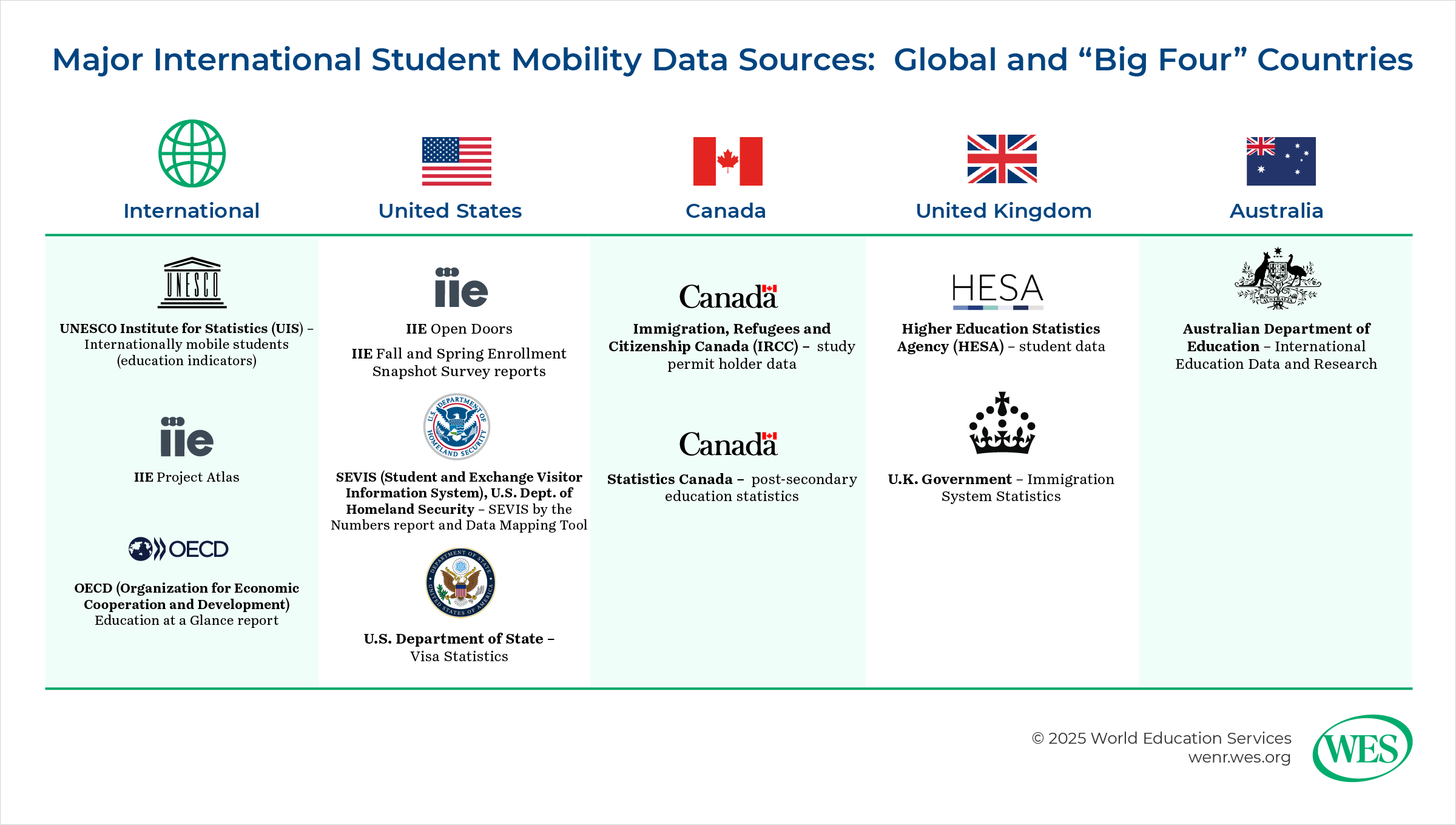
    Table displaying major international student mobility data sources for trends around the world and in the "Big Four" countries.

    There are three main types of entities that collect student mobility data at a national level:

    • Government ministries or agencies: These entities are generally mandated by law or statute to collect international student data for specific purposes. Depending on the entity’s purview, such data could include student visa or permit applications and issuances, students arriving at ports of entry (such as an airport or border crossing), enrollment in an educational institution, or students registered as working during or after completing coursework.
    • Non-governmental organizations (NGOs): Non-profit entities focused on international education or related fields such as higher education or immigration may collect international student data, sometimes with funding or support from relevant government ministries. One good example is the Institute of International Education (IIE) in the U.S., which has collected data on international students and scholars since 1948, much of that time with funding and support from the U.S. Department of State.
    • Individual institutions: Of course, individual universities and colleges usually collect data on all their students, usually with specific information on international students, sometimes by government mandate. In countries such as the U.S. and Canada, these institutions must report such data to governmental ministries. They may also choose to report to non-governmental agencies, such as IIE. Such data may or may not otherwise be publicly available.

    At the international level, the main data sources are generally an aggregation of data from national sources. There are three main efforts:

    How are the data collected?

    The method in which mobility data are collected affects the level of accuracy of such data. The sources that collect data internationally or on multiple countries, such as UNESCO Institute for Statistics (UIS) and IIE’s Project Atlas, are primarily aggregators. They collect the data from national sources, either government ministries or international education organizations, such as the British Council or the Canadian Bureau for International Education (CBIE).

    For primary data collection, there are three main methods:

    • Mandatory reporting: Certain government entities collect data by law or regulation. Data are naturally collected as part of processing and granting student visas or permits, as the S. State Department and Immigration, Refugees and Citizenship Canada (IRCC) do. In other cases, postsecondary institutions are required to track and report on their international students—from application to graduation and sometimes on to post-graduation work programs. This is the case in the U.S. through SEVIS (the Student and Exchange Visitor Information System), overseen by the U.S. Department of Homeland Security (DHS), through which deputized institutional officials track all international students. The data from this system are reported regularly by DHS. In other cases, data are collected annually, often through a survey form, as Statistics Canada does through its Postsecondary Student Information System (PSIS).
    • Census: Some non-profit organizations attempt to have all postsecondary institutions report their data, often through an online questionnaire. This is the method by which IIE obtains data for its annual Open Doors Report, which tracks both international students in the U.S. and students enrolled in U.S. institutions studying abroad short-term in other countries.
    • Survey: A survey gathers data from a sample, preferably representative, of the overall population—in this case, higher education institutions—to form inferences about the international student population. (This should not be confused with the “surveys” issued by government agencies, usually referring to a questionnaire form, typically online nowadays, through which institutions are required to report data.) This method is used in IIE’s snapshot surveys in the fall and spring of each year, intended to provide an up-to-date picture of international student enrollment as a complement to Open Doors, which reflects information on international students from the previous academic year.

    When are the data collected and reported?

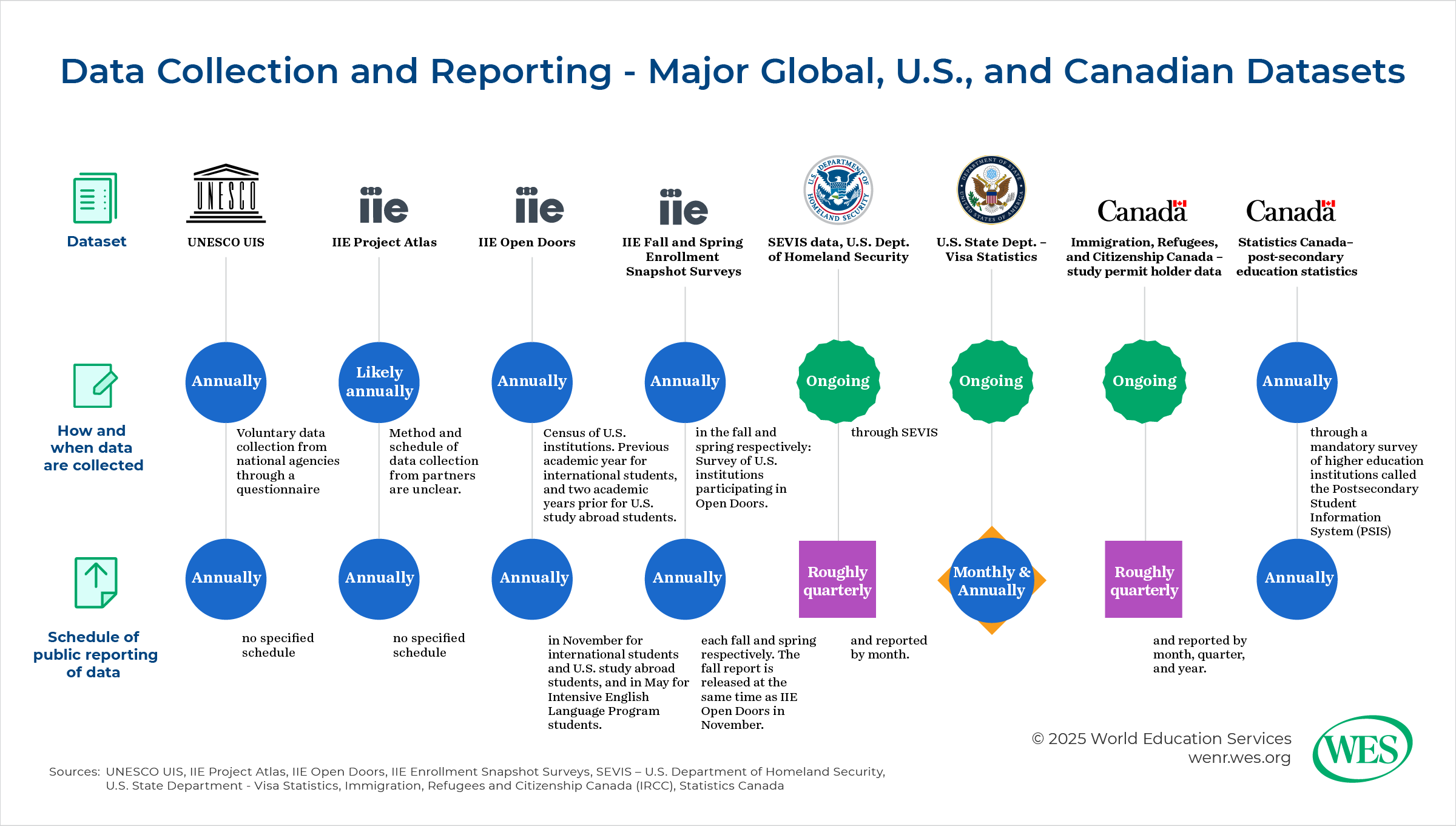
    Chart showing the data collection and reporting practices of major global, U.S., and Canadian international student datasets.

    In considering data sources, it is important to know when the data were collected and what time periods they reflect. Government data sources are typically the most up-to-date due to their mandatory nature. Data are often collected continuously in real time, such as when a student visa is approved or when an international student officially starts a course of study. However, each ministry releases data at differing intervals. Australia’s Department of Education, for example, is well known for releasing new data almost every month. USCIS and IRCC tend to release data roughly quarterly, though both provide monthly breakdowns of their data in some cases.

    Non-governmental entities generally do not collect data continuously. Instead, they may collect data annually, semiannually, or even less frequently. IIE’s Open Doors collects data annually for the previous academic year on international students and two years prior on U.S. study abroad students. The results for both are released every November.

    The international aggregated sources receive data from national sources at widely varying times. As a result, there can be gaps in data, making comparison between or among countries challenging. Some countries don’t send data at all, often due to lack of resources for doing so. Even major host countries, notably China, send little if any data to UNESCO.

    What type of student mobility data are included in the source?

    Sources collect different types of student mobility data. One such breakdown is between inbound and outbound students—that is, those whom a country hosts versus those who leave the country to go study in other countries. Most government sources, such as IRCC, focus solely on inbound students—the international students hosted within the country— due to the organizations’ mandate and ability to collect data. Non-governmental organizations, such as IIE, often attempt to capture information on outbound (or “study abroad”) students. Many international sources, such as UNESCO UIS, capture both.

    Another important breakdown addresses whether the data included degree-seekers, students studying abroad for credit back home, or those going abroad not explicitly for study but for a related purpose, such as research or internships:

    • Degree mobility: captures data on students coming into a country or going abroad for pursuit of a full degree.
    • Credit mobility: captures information on those abroad studying short-term for academic credit with their home institution, an arrangement often called “study abroad” (particularly in the U.S. and Canada) or “educational exchange.” The length of the study abroad opportunity typically can last anywhere from one year to as little as one week. Short-duration programs, such as faculty-led study tours, have become an increasingly popular option among students looking for an international experience. In most cases, the home institution is in the student’s country of origin, but that is not always the case. For example, a Vietnamese international student might be studying for a full degree in the U.S. but as part of the coursework studies in Costa Rica for one semester.
    • Non-credit mobility: captures information on those who go abroad not for credit-earning coursework but for something highly related to a degree program, such as research, fieldwork, non-credit language study, an internship, or a volunteer opportunity. This may or may not be organized through the student’s education institution, and the parameters around this type of mobility can be blurry.

    It’s important to know what each data source includes. Most governmental data sources will include both degree and credit mobility—students coming to study for a full degree or only as part of a short-term educational exchange. The dataset may or may not distinguish between these students, which is important to know if the distinction between such students is important for the data user’s purposes.

    For outbound (“study abroad”) mobility, it’s easier for organizations to track credit mobility rather than degree mobility. IIE’s Open Doors, for example, examines only credit mobility for outbound students because it collects data through U.S. institutions, which track their outbound study abroad students and help them receive appropriate credits for their work abroad once they return. There is not a similar mechanism for U.S. degree-seekers going to other countries. That said, organizations such as IIE have attempted such research in the past, even if it is not an ongoing effort. Typically, the best way to find numbers on students from a particular country seeking full degrees abroad is to use UNESCO and sort the full global data by country of origin. UNESCO can also be used to find the numbers in a specific host country, or, in some cases, it may be better to go directly to the country’s national data source if available.

    Non-credit mobility has been the least studied form of student mobility, largely because it is difficult to capture due to its amorphous nature. Nevertheless, some organizations, like IIE, have made one-off or periodic attempts to capture it.

    Who is captured in the data source? How is “international student” defined?

    Each data source may define the type of globally mobile student within the dataset differently. Chiefly, it’s important to recognize whether the source captures only data on international students in the strictest sense (based on that specific legal status) or on others who are not citizens of the host country. The latter could include permanent immigrants (such as permanent residents), temporary workers, and refugees or asylum seekers. The terms used can vary, from “foreign student” to a “nonresident” (sometimes “nonresident alien”), as some U.S. government sources use. It’s important to check the specific definition of the students for whom information is captured.

    Most of the major student mobility data sources capture only data on international students as strictly defined by the host country. Here are the definitions of “international student” for the Big Four:

    • United States: A non-immigrant resident holding an F-1, M-1, or certain types of J-1 (The J-1 visa is an exchange visa that includes but is not limited to students and can include individuals working in youth summer programs or working as au pairs, for example.)
    • Canada: A temporary resident holding a study permit from a designated learning institution (DLI)
    • United Kingdom: An individual on a Student visa
    • Australia: An individual who is not an Australian citizen or permanent resident or who is not a citizen of New Zealand, studying in Australia on a temporary visa

    Some countries make a distinction between international students enrolled in academic programs, such as at a university, versus those studying a trade or in a vocational school; there might also be distinct categorization for those attending language training. For example, in the U.S., M-1 visas are for international students studying in vocational education programs and may not be captured in some data sources, notably Open Doors.

    Understanding the terminology used for international students helps in obtaining the right type of data. For example, one of the primary methods of obtaining data on international students in Canada is through IRCC data held on the Government of Canada’s Open Government Portal. But you won’t find any such dataset on “international students.” Instead, you need to search for “study permit holders.”

    Does the data source include students studying online or at a branch campus abroad, or who are otherwise physically residing outside the host country?

    Some universities and colleges have robust online programs that include significant numbers of students studying physically in other countries. (This was also true for many institutions during the pandemic. As a result, in the U.S., IIE temporarily included non-U.S. students studying at a U.S. institution online from elsewhere.) Other institutions have branch campuses or other such transnational programs that blur the line between international and domestic students. So, it’s important to ask: Does the data source include those not physically present in the institution’s country? The terminology for each country can vary. For example, in Australia, where such practices are very prominent, the term usually used to refer to students studying in Australian institutions but not physically in Australia is “offshore students.”

    What levels of study are included in the dataset?

    The focus of this article is postsecondary education, but some data sources do include primary and secondary students (“K-12 students” in the U.S. and Canada). IRCC’s study permit holder data includes students at all levels, including K-12 students. The ministry does provide some data broken down by level of study and other variables, such as country of citizenship and province or territory.

    What about data on international students who are working?

    Many host countries collect data and report on international students who are employed or participating in paid or unpaid internships during or immediately after their coursework. The specifics vary from country to country depending on how such opportunities for international students are structured and which government agencies are charged with overseeing such efforts. For example, in the U.S., the main work opportunities for most international students both during study (under Curricular Practical Training, or CPT) and after study (usually under Optional Practical Training, or OPT) are overseen by the student’s institution and reported via SEVIS. IIE’s Open Doors tracks students specifically for OPT but not CPT. By contrast, the main opportunity for international students to work in Canada after graduating from a Canadian institution is through the post-graduation work permit (PGWP). Students transfer to a new legal status in Canada, in contrast with U.S.-based international students under OPT, who remain on their student visa until their work opportunity ends. As a result, IRCC reports separate data on graduate students working under the PGWP, though data are relatively scant.

    At some point, students who are able to and make the choice to stay and work beyond such opportunities in their new country transition to new legal statuses, such as the H-1B visa (a specialty-occupation temporary work visa) in the U.S., or directly to permanent residency in many countries. The data required to examine these individuals varies.

    What about data beyond demographics?

    While most international student datasets focus on numbers and demographic breakdowns, some datasets and other related research focus on such topics as the contributions of international students to national and local economies. For example, NAFSA: Association of International Educators, the main professional association for international educators in the U.S., maintains the International Student Economic Value Tool, which quantifies the dollar amounts that international students contribute to the U.S. at large, individual states, and congressional districts. Part of the intention behind this is to provide a tool for policy advocacy in Washington, D.C., and in state and local governments.

    How can I contextualize international student numbers within the broader higher education context of a country?

    Many countries collect and publish higher education data and other research. Each country assigns this function to different ministries or agencies. For example, in Canada, most such data are collected and published by Statistics Canada (StatCan), which is charged with data collection and research broadly for the country. In the U.S., this function falls under the Department of Education’s National Center for Education Statistics (NCES), which runs a major higher education data bank known as IPEDS, the Integrated Postsecondary Education Data System. StatCan does provide some data on international students, while IPEDS in the U.S. reports numbers of “nonresident” students, defined as “a person who is not a citizen or national of the United States and who is in this country on a visa or temporary basis and does not have the right to remain indefinitely.” This term likely encompasses mostly those on international student visas.

    I will discuss some of these higher education data sources in Part 2 of this series.

    How do I learn what I need to know about each individual dataset?

    Each major data source typically provides a glossary, methodology section, and/or appendix that helps users understand the dataset. In Part 2 of this series, we will examine some of the major international and national data sources, including where to locate further such information for each.

    It’s critical for users of student mobility data sources to understand these nuances in order to accurately and appropriately utilize the data. In the second part of this series, we will examine several prominent data sources.

    Source link

  • Giving species the space they need

    Giving species the space they need

    In 1979, Patricia Majluf, then a biology student, started studying eared seals at San Juan. Two species coexist without competing for food on the peninsula: the South American fur seal (Arctocephalus australis) and sea lions (Otaria flavescens).

    A colony of South American fur seals resting at a beach. (Photo: Alfonso Silva-Santisteban)

    In Spanish, they are known as the “fine” and “common” sea lions (lobo fino y lobo chusco), because of their type of fur that led them to be hunted for clothing decades ago.

    Majluf is now one of the most respected marine biologists in the region, whose work led to the creation of a Punta San Juan Program. In 2009, the Peruvian government declared San Juan a natural protected area. Cárdenas arrived as Majluf’s student in 2004. Today, she is a professor at the Universidad Peruana Cayetano Heredia and directs the program.

    “You are the biologist behind the wall, you live and die there,” she said.

    A sea wall protects sea life.

    Kevin Farfán during a daily monitor round.

    Kevin Farfán during a daily monitor round. (Photo by Alfonso Silva-Santisteban)

    Kevin Farfán puts on his windbreaker, hangs up his binoculars and camera and begins his daily monitoring round at 6:30 a.m. He started as an intern seven years ago and now coordinates the station. He walks by San Juan’s 20 beaches, while Odeth Perez, who is on her way to an observation post, says hello from afar.

    All year round, at least two people at the station observe animal behavior, count species with drones and camera traps and monitor sea and air temperatures. Once a year, with the help of U.S. veterinarians, they capture and tag a sample of eared seals and penguins to attach transmitters and study their movements.

    “We have 40 years of data,” Cárdenas said.

    Since 2013, the team has crossed the wall separating the peninsula to connect with the residents of Marcona, a neighboring town founded in the 1950s after the discovery of an iron deposit.

    They began with guided tours. Since 2023, they have initiated a project called Natural Classrooms with students from local schools, serving a town with 15,000 inhabitants.

    Biologist Ximena Turcke is one of the guides. “It is important to reach the children, especially the younger ones,” Turcke said. On this day, she was leading a group of 30 students from Miguel Grau School to one of the viewpoints and later, to a neighboring beach for group work. “I’ve always liked people to identify with their place, wherever they go,” she said.

    Recovery and threats

    The most important thing to remember when walking in San Juan is not to disturb the animals. The eared seal breeding season starts in October and peaks between January and February.

    A group of 1,500 guanay cormorants arrived in October 2024. Before the avian flu in 2022, there were so many that they sometimes blocked the entrance to the team’s observation booth.

    Cárdenas said that there are few places where so many different animals with breeding colonies come together and that’s why the virus spread so quickly.

    Avian influenza AH5N1 is a subtype that affects birds and mammals, including humans in rare cases. The virus emerged in China in 1996 and has caused sporadic outbreaks. However, in 2020, a more transmissible variant of the virus passed from poultry to wild birds and began migrating worldwide. It reached North America in 2021 and South America in 2022. The flu spread from Peru to Chile, Argentina and Uruguay, affecting sea birds and mammals. There were no human cases.

    When Cárdenas arrived in San Juan, wildlife was recovering from the 1998 El Niño phenomenon and she saw how animals adapt to cycles when food is scarce. That’s why she remains optimistic about the repopulation of San Juan. But it will take several years and human activity must not alter the conditions for recovery.

    “There’s an incredible resilience,” she said.

    Limits on fishing

    One of the main threats is fishing. Industrial fishing takes almost 9 out of 10 anchovetas from the Peruvian sea to make fishmeal. Four tons of anchoveta produce one ton of fishmeal, which is mainly used to feed salmon, pigs or chickens in industrial farms around the world.

    Year after year, there are tensions between the fishing industry, the state and environmentalists over fishing quotas or minimum sizes of anchovies that can be caught. The Institute of the Peruvian Sea, the national scientific organization concerning the sustainability of marine resources, is part of the Ministry of Production.

    The conflict of interest is evident for Cárdenas, whose team has observed, by analyzing the feces of eared seals, that these are feeding more and more on smaller fish with less nutritional value. They are consuming what ecologists have called marine ecosystems’ junk food.

    In 2023, the state suspended the first industrial fishing season due to El Niño but reinstated the second one. It was too soon for Cárdenas and Farfán. They oppose the industry’s approach of expanding fishing almost indefinitely without consequences. “There have been no lessons learned from all this,” Cárdenas said. “It’s when these things happen that conservancy is most urgent.”


    Three questions to consider:

    1. How does fishing affect sea life?

    2. How are researchers working to help the sea life at Punta San Juan?

    3. What, if anything, can you do to help wildlife near you?


    Source link

  • Would you sell your country to Trump?

    Would you sell your country to Trump?

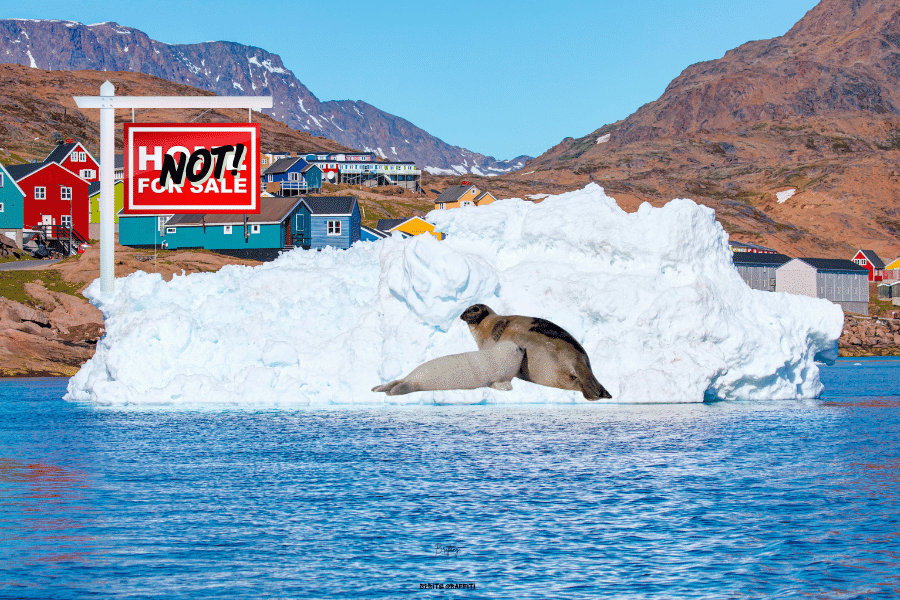
    Greenland is three times the size of the U.S. state of Texas, making it the world’s largest island if you don’t count the continent of Australia.  

    It sits on critical rare earth minerals and fossil fuel reserves. Its retreating ice, due to global warming, is opening up new trade routes and longer shipping seasons

    No wonder U.S. President Donald Trump wants it for the United States. A purchase price would be steep. Based on past purchases of territory and Greenland’s economic potential, it is estimated that the price of Greenland could be anywhere between $12.5 billion and $77 billion. And he only has to convince the 56,000 people who live there that they would prosper under U.S. rule. 

    Greenland is a former Danish colony that still relies heavily upon Denmark for its economy.

    If Trump were able to buy it, he’d have to take it as is, and the country suffers from high rates of suicide, alcoholism and sexual abuse

    Is there art in the deal?

    A Google map of Greenland.

    Trump made an offer in December, called “absurd” by Danish Prime Minister Mette Frederiksen. It was the second time he broached this subject, having first spoken of it during the lead up to his first presidential term. 

    This time, he said he won’t rule out using economic or military force to buy the world’s biggest island based on the logic that Greenland is necessary for “national security and freedom” of the United States. Greenland and the United States are separated by about 2,289 kilometers (1,422 miles) of water between the two closest points — Grand Manan in the U.S. state of Maine and Nanortalik in Greenland.

    Much of the world has been laughing at Trump’s demand but it is no laughing matter for Denmark. This week, Danish Prime Minister Mette Frederiksen visited German Chancellor Olaf Scholz, French President Emmanuel Macron and NATO General Secretary Mark Rutte, to talk about strengthening the EU’s security and defence and to further prioritise the Arctic.

    In the meantime, Greenlanders are feeling their value to Denmark has risen.

    Greenland was a Danish colony until 1953, when it became a self-governing region of Denmark. This means that it has its own local government and two seats in the Danish parliament. The relationship also means that Greenlanders are citizens of the European Union, with the benefits that come with that. 

    A fractured relationship

    The relationship between Greenland and Denmark is still recovering from that colonial past. The majority of Greenlanders support full independence from Denmark despite its deep reliance on the Danish government. 

    Denmark is still responsible for Greenland’s foreign, security and defence policy, and provides Greenland an annual financial aid of DKK 3.9 billion (roughly €522 million), which makes up around 20% of Greenland’s gross domestic product. That’s the value of all the goods and services a country produces and it is used as a measurement of a nation’s economic health. 

    The scars of colonialism are still fresh for many Greenlanders. In 1953 Denmark allowed the forced relocation of an Indigenous population from the Dundas area in Greenland, for a U.S. military base. The Thule tribe had been semi-nomadic catchers in the Dundas area for thousands of years. Their relocation took place over just a few days. 

    Later, in the 1960s and 70s, Danish health authorities fitted thousands of Inuit women and girls the IUD contraceptive device, many without proper notification or consent. An investigation into the procedure suggests that its aim was to curb a growing population — which worked. Many of these women went on to suffer health issues due to the IUD. 

    Now Greenlanders are being told that their future is theirs to decide. 

    There’s green beneath the ice.

    What does Trump want with Greenland? 

    Greenland’s ice sheet covers nearly 80% of the country, which is losing mass at a rate of around 200 gigatonnes per year due to climate change. That seems like an incomprehensible amount. It is the equivalent of 200 billion metric tons or, according to NASA, if you could picture it, two million fully-loaded aircraft carriers. 

    Trump has framed his interest in Greenland as a matter of national security and freedom. By this, he points to the island’s strategic value: its untapped reserves of rare earth minerals and fossil fuels, as well as emerging trade routes enabled by retreating ice. 

    Greenland’s mineral reserves are largely untouched. The island harbors significant deposits of rare earth elements, essential for various high-tech applications, including electronics, renewable energy technologies and defence systems. 

    Owning Greenland would ease U.S. concerns over China’s dominance in the rare earth market, with China currently controlling 70–80% of the world’s critical rare earth minerals. Acquiring access to Greenland’s mineral reserves could serve to diversify and secure the U.S. supply chain, reducing reliance on Chinese exports. 

    Controlling the Arctic

    Exploiting Greenland’s mineral wealth still presents considerable challenges. The island’s harsh climate and limited infrastructure means large start-up costs for mining projects.

    Having control over new trade routes in the Arctic is also appealing, as well as having an expanded military presence in the region to monitor Russian navy vessels and nuclear submarines.  

    Is it possible to buy another country? 

    This isn’t the first time the United States has offered to buy Greenland. In 1946, President Harry Truman offered Denmark $100 million for the island. Denmark rejected the proposal but permitted the construction of the Pituffik Space Base which is responsible for missile warning systems and monitoring of satellites in space. 

    But for an exchange from Greenland to the United States to happen, both Denmark and Greenland would need to agree to the sale, with an Act on Greenland Self-Government stating that the people of Greenland have a right to self-determination.

    And right now, Greenlanders don’t want to be under anyone’s rule but their own

    The international news service Reuters reported 29 January that a poll commissioned by the Danish paper Berlingske, found that 87% of Greenlanders would turn down Trump’s offer and another 9% are undecided.

    But they’re not telling the United States to go away. While Greenland’s Prime Minister Mute Egede said that his country is not for sale, Greenlanders are open to cooperating with the United States on defence and exploration of its minerals

    And then there’s golf. With all that melting ice, maybe Trump is picturing a fabulous par-72 resort. Right now Greenland only has two courses. Just picture those sand traps on the edge of the Arctic. 


    Three questions to consider:

    1. How would the United States benefit from controlling Greenland?
    2. What’s Greenland’s relationship with Denmark?
    3. If you were a Greenlander, would you vote to become part of the United States? Why?


    Source link

  • Slowing Growth and Uncertainty: A Look at IIE’s Open Doors Report 2024 and What the Future Might Hold

    Slowing Growth and Uncertainty: A Look at IIE’s Open Doors Report 2024 and What the Future Might Hold

    Bryce Loo, Associate Director of Higher Education Research

    International students navigate a landscape of uncertainty and opportunity, as the 2024 IIE Open Doors Report highlights shifting trends in U.S. enrollment and global migration.

    The Institute of International Education’s (IIE) annual Open Doors Report on International Education Exchange (Open Doors, for short),[1] along with its companion Fall Enrollment Snapshot Survey (Fall Snapshot Survey, for short),[2] was released only a few weeks after a consequential presidential election in which former president Donald Trump defeated Vice President Kamala Harris. Trump’s win will significantly shift the landscape around international students in the U.S.

    Open Doors is a retrospective report on international enrollment and other student data in the U.S., focused on the previous full academic year—in this case 2023-24.[3] The Fall Snapshot Survey provides insights into the current fall term. But uncertainty abounds in this new environment with the return of Trump, known for his tough stances on immigration, which may affect non-immigrant residents such as international students and temporary workers. This is happening against a backdrop of global uncertainty, in a year with a tremendous number of important elections around the world, many armed conflicts, and growing climate change. At the same time, there are bright spots for the U.S. as a host of international students and for global student migration in general.
    In this article, I also compare results from Open Doors and the Fall Snapshot Survey against recently released data from SEVIS (the Student Exchange and Visitor Information System), maintained by the Department of Homeland Security (DHS), for Fall 2024.[4] This dataset captures all students with a record in SEVIS, the U.S. government database in which all international students are required to be registered by their hosting U.S. institution. Data are organized monthly, with the most recently released is for November 2024, and they vary little month-to-month within a given term, such as a fall semester. For consistency, I compare November 2024 with November 2023. Such data help us to gain a fuller picture of current international enrollment trends this fall.

    What the data tell us: Continued but leveling growth

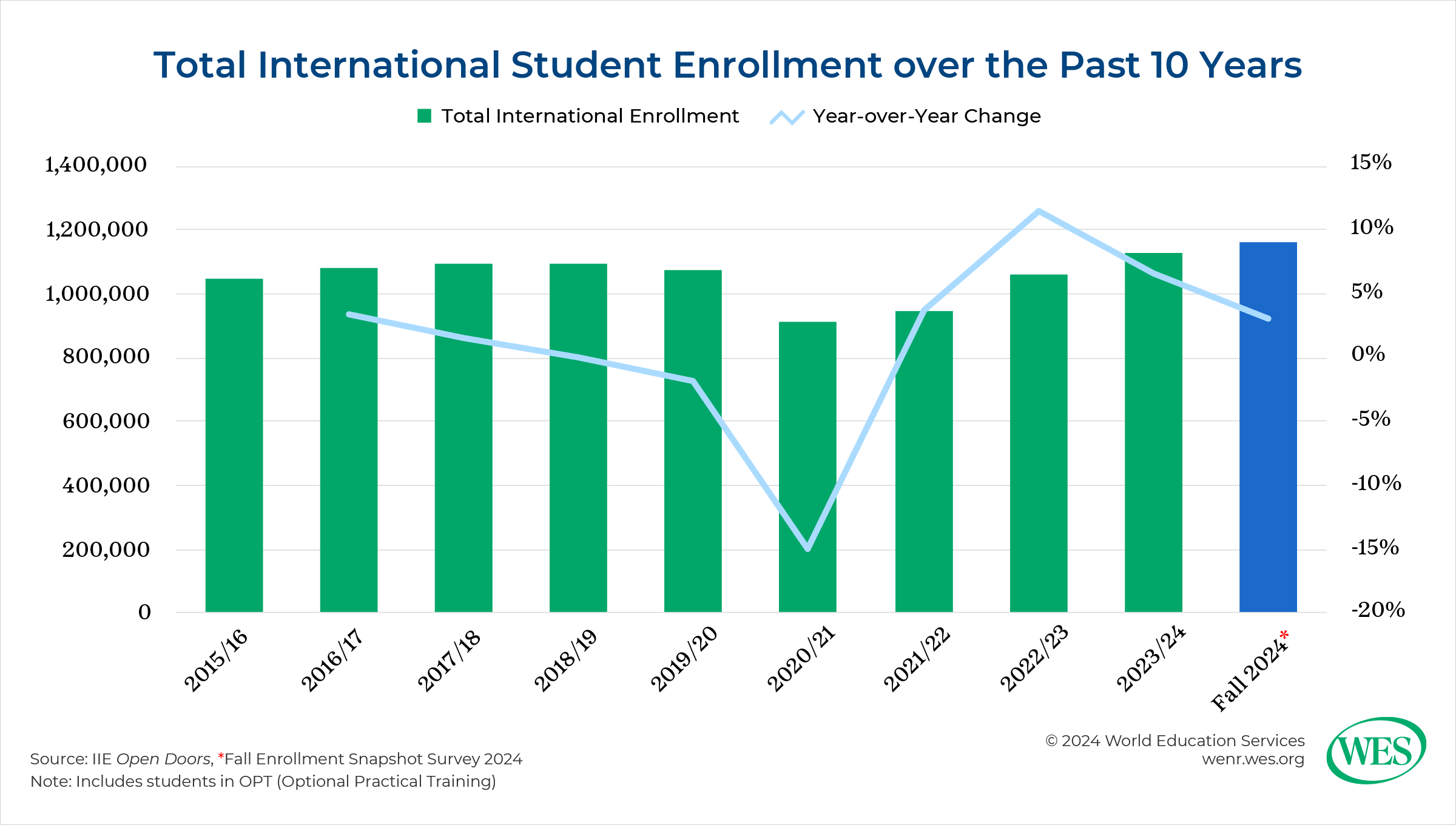
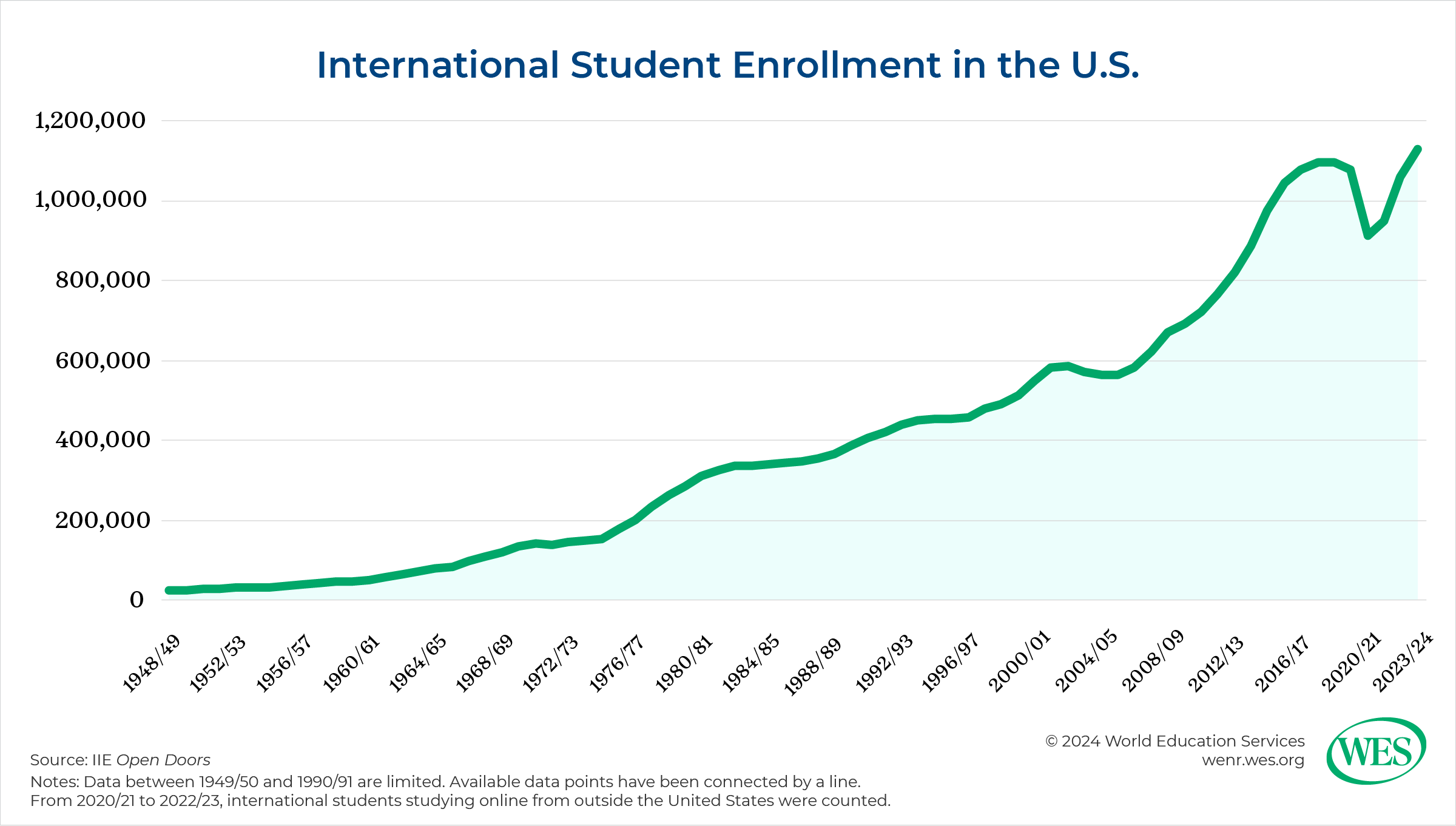
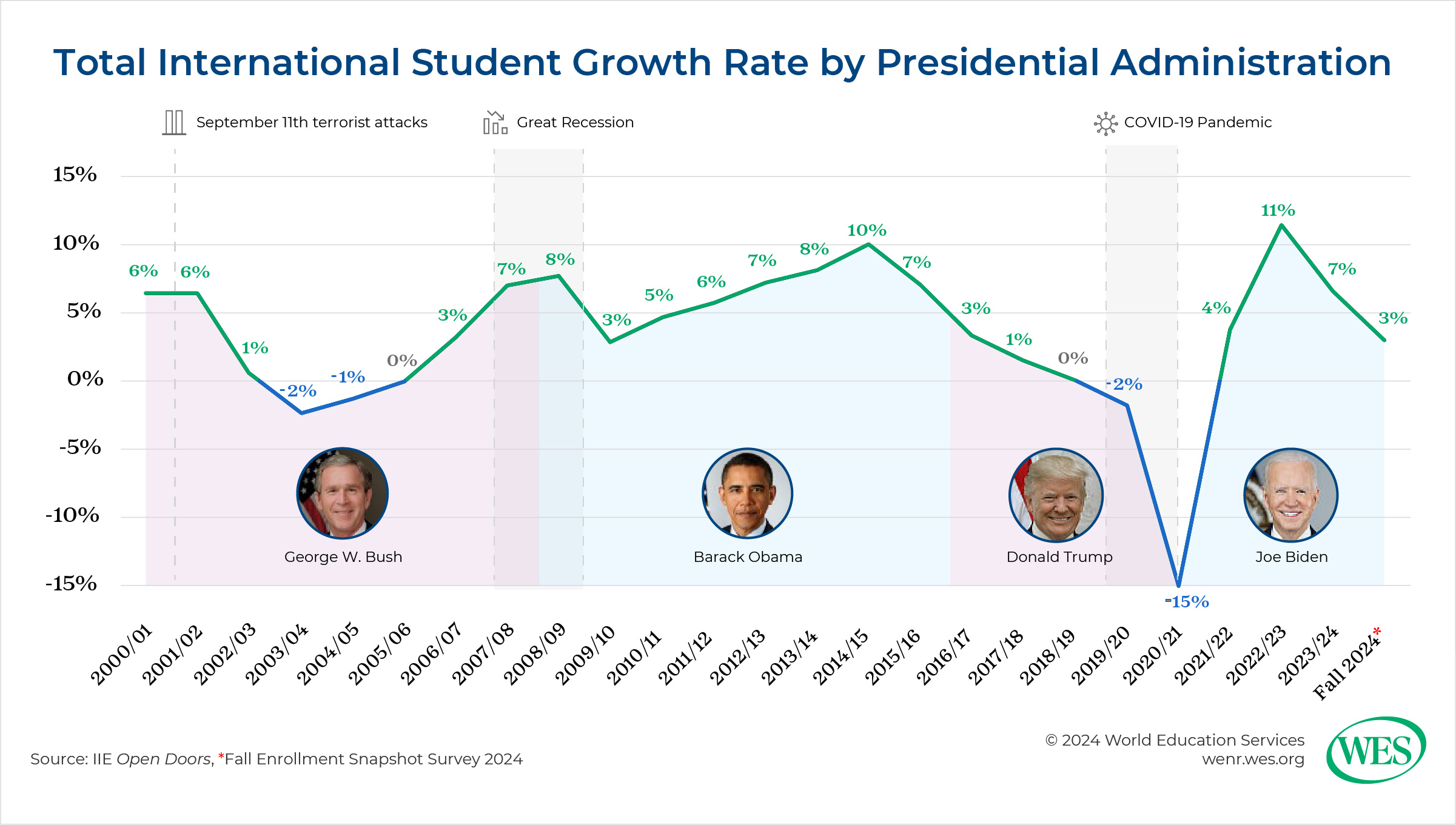
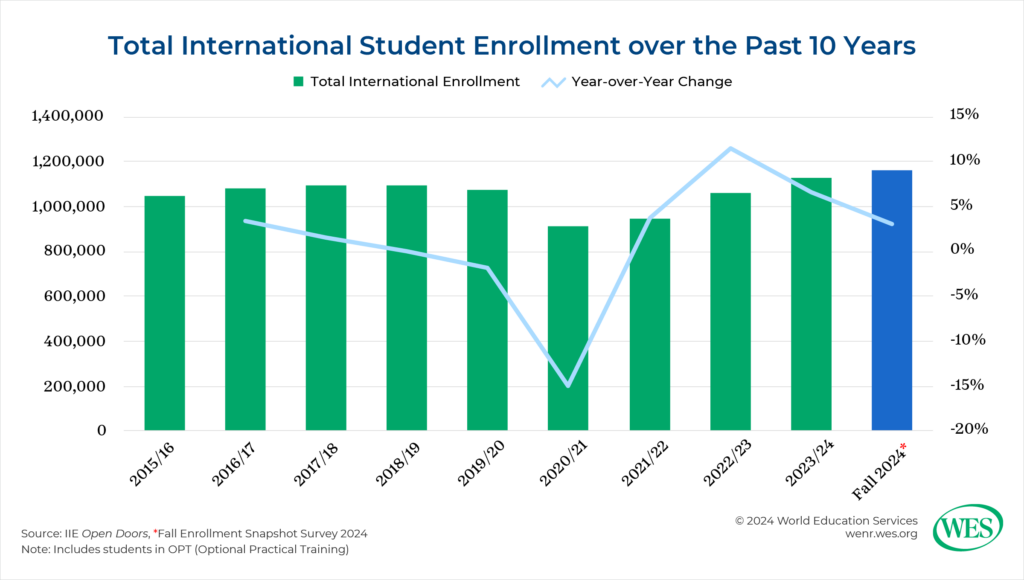
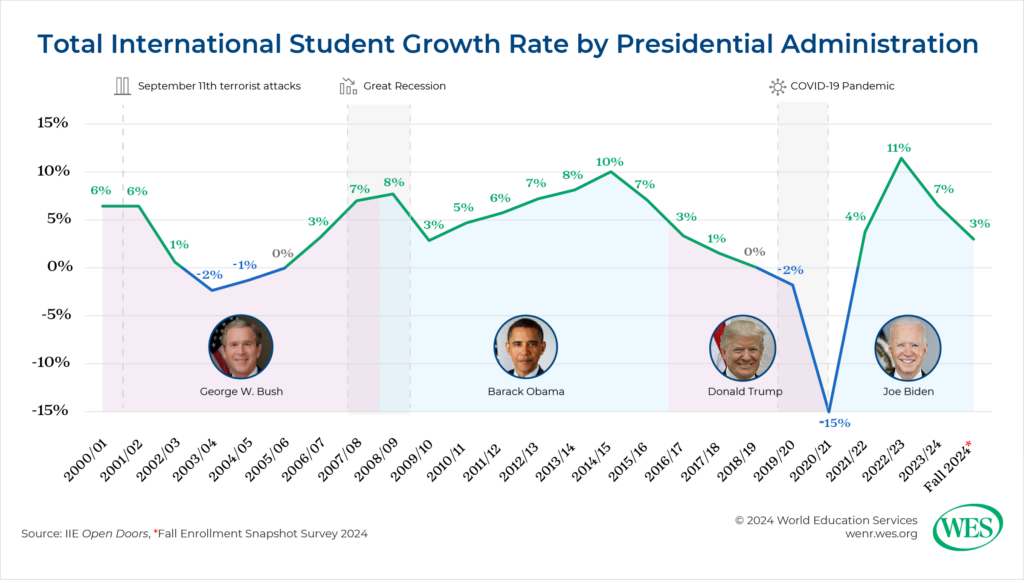
    Total international student enrollment in the U.S. hit an all-time high of 1,126,690 in 2023–24, a growth rate of 6.6 percent from the previous year. This has followed a few years of recovery following the dramatic enrollment decrease during the COVID-19 pandemic. The post-pandemic growth rate peaked in 2022-23 at 11.5 percent.

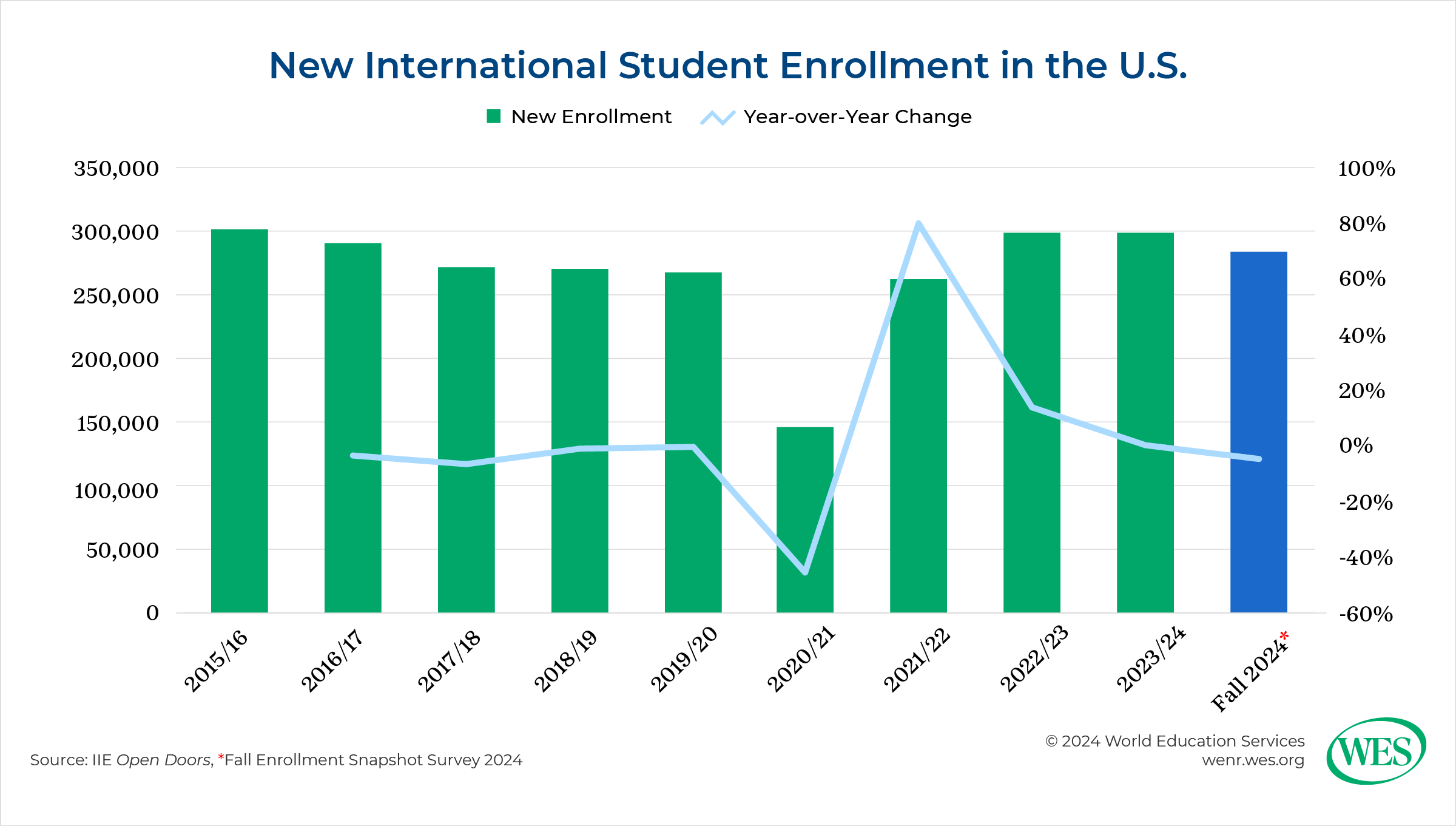
    However, growth is slowing. While this year’s Fall Snapshot Survey indicates a 3 percent growth rate in fall 2024, analysis of the SEVIS data indicates a drop in overall enrollment. International enrollment is down to 1,091,190 students in November 2024, a 10 percent decrease from the previous November, according to SEVIS records.[5] IIE’s data confirms slowing growth, too. New international student enrollment slowed to only 0.1 percent in 2023-24. Additionally, the Fall Snapshot Survey indicates a 5 percent decrease in new students this fall.

    This recent slowdown, which happened prior to the presidential election results, is tricky to diagnose. One likely culprit, though certainly not the only one, is economics: An education in the U.S. has become particularly expensive, due largely to a combination of inflation and a strong U.S. dollar. A more expensive U.S. education particularly impacts many students from South Asia and sub-Saharan Africa, the two regions showing the strongest rise in U.S. international enrollment in recent years, who are particularly price sensitive.
    Changing trends in South Asia and East Asia

    International enrollments in the U.S. from South Asia, driven dominantly by India, continued growing at a rapid rate in 2023–24. In 2023–24, India became the top country of origin among international students in the U.S. and by a substantial margin, at 331, 602 students. There was about a 23 percent increase in Indian students from the previous year, accounting for almost 30 percent of all international students in the U.S.

    In 2023-24, South Asia firmly dominated among regions of origin for U.S. international students and its numbers continue to rise. South and Central Asia (which IIE groups together as one[6]) account for one-third (34.3 percent) of all U.S. international students, just ahead of East Asia. South and Central Asia’s sending numbers grew 22 percent over the last year, more than those of any other region. Beyond India, there continues to be robust enrollment growth from Bangladesh (26 percent), Nepal (11 percent), Sri Lanka (10 percent), and Pakistan (8 percent). Bangladesh and Nepal broke into the top 10 countries of origin in 2023-24.
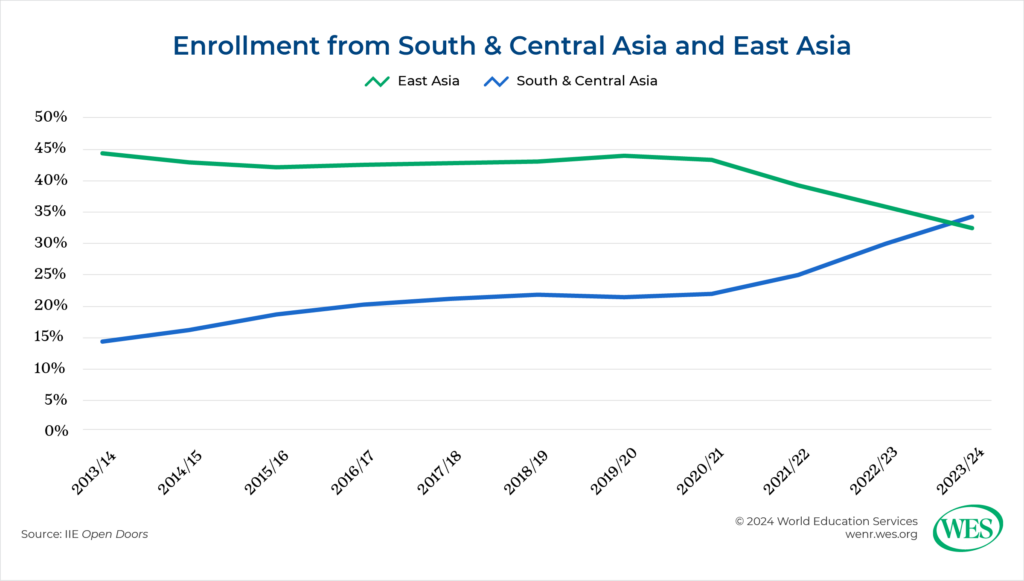
    By contrast, the number of Chinese students in the U.S. declined more than 4 percent to 277,398 during the same period and accounted for less than 25 percent of all U.S. international students. Overall, numbers from East Asia are declining steadily (by nearly 4 percent last academic year). Numbers from South Korea (-2 percent) and Japan (-13 percent) continued to drop. The one bright spot among major East Asian nations was Taiwan, which saw a 6 percent rise from the previous year and was the fifth largest sending country. Students from East Asia have been decreasing in the last few years, and forecasts suggest further steady decline.

    For many East Asian students, the calculus about studying in the U.S. and in Western countries has changed in recent years. Holding a degree from a highly ranked U.S. or Western institution holds less cachet than it once did. In both China and South Korea, local universities have become more prestigious and offer students the opportunity to connect directly with the local job market, putting those studying far afield at a disadvantage. For Chinese students, geopolitical tensions and strict policies against Chinese students and scholars largely enacted by the first Trump Administration, many of which were continued by the Biden Administration, may make studying in the U.S. feel riskier. There has also been growing intra-regional mobility, with many East Asian students choosing to go to another country in the region. According to the British Council, for example, there are more Japanese students in China than in any anglophone country.

    Despite the recent increases in enrollment from South Asia, the SEVIS data show a rapid reversal of trends heading in Fall 2024. Indian enrollment in the U.S. this fall has declined by 24 percent, and overall South Asian enrollment has fallen at a similar rate. Meanwhile, Chinese and overall East Asian enrollment has flatlined, each with a barely perceptible decrease. As a result, however, China has become the top country of origin once again, with 263,523 students in the U.S., followed by India (25,5443), in Fall 2024. Likewise, East Asia has returned to the top spot among region of origin, with modest enrollment increases from Japan and South Korea.

    A slowdown of enrollment growth from South Asia likely is attributable to rising costs in the U.S., particularly given currency exchange rates, as noted earlier. Safety, a frequent concern for Indian students and their families, could also be a factor. Many Indian media outlets, such as The Economic Times and The Indian Express, have recently reported on increasing safety issues for Indian students in the U.S.

    That said, these declines from India and South Asia do not necessarily foretell a long-term trend. Many prominent models, notably that of HolonIQ, predict growth from India into 2030.

    Graduate students continue to dominate. For now.

    International student growth in the U.S. continues to be driven at the graduate level, particularly among master’s degree students. Graduate students made up almost 45 percent of all U.S. international enrollment in 2023-24. Total international student graduate enrollment increased by 7.6 percent in 2023-24, while undergraduate enrollment fell by 1.4 percent and non-degree enrollment fell by 11.5 percent. These trends are somewhat parallel with new international student enrollment. India has driven much of this growth in grad students, as have South and Central Asian students in general. More Chinese students came to study at the graduate level that year, too.

    This growth of international graduate students does not appear to be holding into 2024-25, however. The Fall Snapshot Survey indicates a slight decrease of about 2 percent in international grad students this fall and an increase (6 percent) in international undergrad students. The SEVIS numbers show decreases for both, including a significant decrease of 15 percent among international grad students. (International undergrad enrollment declined by 3 percent.) However, international graduate enrollment is still greater than undergraduate enrollment currently.

    The decrease in international graduate students appears to be driven by Indian students and South Asian students overall. Indian students account for about 40 percent of all U.S. international student graduate students, and 60 percent of Indian students in the U.S. are studying at the graduate level, according to Open Doors. Per the SEVIS data, Indian graduate enrollment in the U.S. declined by almost 26 percent in Fall 2024. Additionally, South and Central Asian and East Asian student together account for nearly three-quarters of all international graduate students. Chinese graduate enrollment in the U.S. decreased about 4 percent this fall, according to the data from SEVIS.

    U.S. universities and colleges continue to focus heavily on India and to a lesser extent China for their international student recruitment, according to the Fall Snapshot Survey. India is the top country of focus for both graduate students (81 percent of respondents) and undergrads (65 percent). China was second top country of focus for grad students and third for undergrads (just after Vietnam). Given the volatility of enrollment from India and steady declines from China, U.S. institutions may wish to ensure diversity of countries from which they recruit.

    What could impact international enrollment in the near future?

    The Trump Administration

    When it comes to potential impacts on international student enrollment in the U.S., a primary factor will be the incoming Trump administration. Donald Trump will take office with a decisive agenda, having campaigned and won with a tough-on-immigration stance. This stance seemed to resonate with many voters, along with concerns about the economy and inflation.

    The first Trump administration may provide a useful look at what could happen in the second one. Trump’s first term brought a decline in international student enrollment, due in part to policies like the 2017 travel ban and a slowdown in visa processing. This trend reversed somewhat during the Biden administration but could resume under the policies of a second Trump term.

    Going forward, much will depend on the incoming administration’s policies as well as rhetoric. Trump’s immigration agenda is mostly focused on asylum, primarily at the U.S.-Mexico border, and on undocumented immigrants, whom he has pledged to deport at unprecedented rates. The extent that he will focus on international students and immigrants with specialty occupations, notably the H1-B visa program under which some international students seek to remain in the U.S., is unclear. In June 2024, Trump, known for making offhand comments, proposed on a podcast hosted by Silicon Valley investors that international students who graduate from U.S. institutions, including community colleges, should receive a green card (permanent residency). He and his team later walked back that remark, and many commentators see such policy as highly unlikely given Trump’s overall immigration stance. In fact, reports suggest the administration is likely to limit pathways to H1-B visas, international students’ primary means of staying in the U.S. beyond Optional Practical Training (OPT), effectively making such visas virtually inaccessible.

    Policy changes under Trump’s second administration could also affect OPT and “duration of status,” the length of time students with visas have been allowed to stay in the U.S. without needing to renew. Such changes were attempted in the first Trump administration but did not succeed. His first administration also tried to eliminate STEM OPT, the 24-month extension of OPT for those graduating with a degree in fields related to science, technology, engineering, or mathematics. Indian students in particular may be concerned about such changes if they are proposed again, as they are often drawn to the U.S. by opportunities to gain work experience. Toward the end of that term the administration also put forward a rule to limit duration of status to a finite period of two or four years, rather than allow the time needed to finish earning a degree, after which a student would be required to pay a fee and renew.

    Still, it is possible to overestimate the attitudinal impact of a presidential administration, and recent survey research by Intead and Studyportals found a majority of prospective international students this fall were “indifferent” to the election outcome and how it might affect their plans to study in the U.S., according to The PIE News. There is certainly no monolithic view of President-elect Trump or U.S. politics among international students. If any declines in numbers happen again under Trump, it will likely be in response to policies that specifically impact international students or rhetoric aimed at individuals from their home country or region of origin. It may also be driven in part by visa delays and denials caused by administration policies.

    Policies and politics in other major host countries

    One other major factor is current policy changes in other major host countries, driven largely by politics and public opinion, which might actually boost the attractiveness of the U.S. The other three Big Four predominantly anglophone destinations—Australia, Canada, and the United Kingdom—have had massive international student enrollment in recent years, particularly as a percentage of total higher education enrollment. According to IIE’s Project Atlas, Canada’s international enrollment rate in 2023 was 30 percent, Australia’s was 24 percent, and the U.K.’s was 22 percent. (By contrast, only 6 percent of U.S. higher education students were international, although overall size of its system makes the U.S. numerically the top enroller of international students.) Canada’s enrollment in particular has seen explosive growth, a rise of nearly 70 percent from 2019 to 2023. Many Canadian locales have struggled to accommodate such an influx, often viewed as a way to fill provincial funding gaps yet sometimes lacking steps to ensure students’ well-being.

    Additionally, international students have been ensnared in broader immigration debates within these three countries, often being unfairly blamed for systemic housing and employment challenges, among other issues. As in the U.S., immigration has been a major political topic in many Western countries and in recent elections in France and the U.K.

    As a result, the other three Big Four countries have begun implementing policies designed to rein in international enrollment growth and limit access to opportunities to work and stay after graduation. Canada, which according to IIE’s recent Open Doors briefing just overtook the U.K. to become the second most popular international student destination, adopted new policies in rapid-fire succession from late 2023 to fall 2024. The most consequential is a cap on the number of study permits (required in Canada for international students) granted per province, particularly meant to limit growth in higher-enrollment provinces, in 2024 and 2025. Other new policies include a significant hike in the financial resources international students are required to demonstrate, restrictions on work permits for spouses, limits on permission to work during study, and stricter requirements for obtaining the popular post-graduation work permit (PGWP), which allows graduated students to work in Canada and often transition to permanent residency.

    The Australian government is strongly considering similar caps on international student enrollment in an attempt to reduce overall migration to the country. Already it has stricter visa regulations for international students, including stronger “tests” to ensure that prospective students are coming with the intention of studying, not working, as well as a significant increase in the visa fee. In the U.K. a new regulation enacted by the Conservative Party prohibits international students at all levels except postgraduate from bringing family members starting in 2024, in order to “slash migration and curb abuse of the immigration system,” according to the U.K, government. The new Labour government has opted not to reverse the policy.

    The effects of these changes are already evident. The three other Big Four countries are all seeing declining applications for relevant visas and permits. Preliminary analysis of Canadian study permit application data shows the number of approved study permits will likely come in below the actual caps for 2024. The U.K. reported a 16 percent drop in student visa applications in summer 2024 compared to the same time period in 2023, and in Australia, the decrease in such applications has been particularly steep, nearly 40 percent from October 2023 to August 2024.

    So far, the prospective beneficiary of these changes has been the U.S., according to both prospective student surveys and media reports. For example, in IDP Education’s Emerging Futures Report for 2024, a prominent series based on prospective student survey data, the U.S. came in second place (at 23 percent) as destination of choice for survey takers, just behind Australia (24 percent). Interest in the U.S. increased four percentage points; Australia’s percentage point declined by one. By contrast, interest in the U.K. and Canada decreased 1 percent and 9 percent respectively, dropping them to third and fourth places. In media coverage of the restrictions, Indian outlets such as Business Standard and The Indian Express note that many Indian students are switching focus to the U.S, although some, including the Express, also report students are looking beyond the Big Four to other study destinations entirely.

    Still, President-elect Trump may introduce cuts or caps of his own, which, depending on their scope, may cause the U.S. to lose its developing enrollment edge. If all Big Four destinations have policies significantly cutting student influx, that could alter the student mobility landscape, shifting enrollments to other countries—notably, smaller anglophone destinations such as Ireland, New Zealand, and Singapore and non-predominantly anglophone countries in continental Europe and Asia—where English-taught programs have increased greatly in recent years.

    Student mobility in an uncertain world

    The incoming Trump administration and policy changes in other countries are only two factors apt to impact movement to the U.S.; internal issues in other countries and regions also come into play. For example, while U.S. policies and tensions with China have affected the number of Chinese students coming to the U.S., factors within China also played a role, as we examined in a recent series in WENR.

    Worldwide, uncertainty and systemic challenges lie ahead. Several major conflicts, notably Russia’s war in Ukraine and escalated fighting in the Middle East, threaten to spiral into bigger geopolitical crises. Authoritarianism is rising around the globe, creating more potential crises, as is the threat of climate change, with 2024 recently declared the hottest year on record. Among its many effects, climate change will likely continue spurring global migration, including, increasingly, the forcibly displaced. In fact, all these factors will likely increase global migration. Luckily, U.S. institutions are well-placed to take in students from affected regions and offer them pathways for academic and professional growth.

    In general terms, there is reason for optimism. Global student migration will continue and most likely rise, increasing economic and social opportunities for many globally mobile young people. International students also benefit their host societies, communities, and institutions, including domestic students, by bringing diverse international perspectives as well as economic benefits. By some estimates, international students will increase worldwide from about 6 million in 2023 to 10 million in 2030. The U.S. could host as many as 2 million, a still significant capacity compared to other destinations.

    Despite domestic and international pressures, U.S. institutions can continue to demonstrate the value of a U.S. education and what unique value they in particular offer. They can continue to make clear, through channels like the #youarewelcomehere campaign, that international students are both accepted and embraced. Institutions can continue to show that international education benefits not only students and institutions but communities and the nation. For example, huge numbers of U.S.-based entrepreneurs and  STEM professionals came to the U.S. as international students and have been an asset for U.S. business and research and development. And international educators can advocate for policies at local, state, and federal levels (for example, via NAFSA: Association of International Educators) that continue to make the U.S. a hospitable place for students from abroad.

    Most important, U.S. institutions can and should take proactive steps to ensure inclusion and integration of their international students. This means initial support in everything from securing good housing to culturally sensitive mental health resources to campus career services that recognize international students’ unique needs. It may mean assisting students with financing in any way possible. It also means more efforts toward academic and social integration, which involves educating faculty, staff, and domestic students as well.

    Looking to the future, U.S. policymakers, educators, and institutions must work together to create an environment that remains welcoming, inclusive, and responsive to the needs of international students. By doing so, the U.S. can maintain its position as a global leader in higher education and continue to benefit from the diverse perspectives and talents that international students bring.


    [1] Open Doors is an annual census of international students (those on a nonimmigrant student visa) enrollment in U.S. higher education institutions, as well as U.S. students who studied abroad two academic years prior.

    [2] The Fall Snapshot Survey is sent to all institutions that report data to IIE for Open Doors. This year, IIE collected 693 valid responses.

    [3] Open Doors always tracks data from the previous full academic year.

    [4] The SEVIS data released by DHS is usually the most up-to-date data available. Open Doors, however, provides more analysis and a greater breakdown of data compared with what is provided by SEVIS.

    [5] Usually, IIE’s Fall Snapshot Survey aligns with current data trends from SEVIS and is a strong predictor of numbers that appear in the following year’s Open Doors Report. This year, however, the data between the Fall Snapshot Survey and SEVIS are quite different, though both indicate slowing growth in international enrollment in the U.S.

    [6] Central Asia, which includes mostly former Soviet republics in Asia (such as Kazakhstan and Uzbekistan), only accounts for about 1 percent of total enrollment from the overall South and Central Asia region, according to my analysis of IIE Open Doors data.

    Source link