Category: Apprenticeships

  • Dialogic assessments are the missing piece in contemporary assessment debates

    Dialogic assessments are the missing piece in contemporary assessment debates

    When I ask apprentices to reflect on their learning in professional discussions, I often hear a similar story:

    It wasn’t just about what I knew – it was how I connected it all. That’s when it clicked.

    That’s the value of dialogic assessment. It surfaces hidden knowledge, creates space for reflection, and validates professional judgement in ways that traditional essays often cannot.

    Dialogic assessment shifts the emphasis from static products – the essay, the exam – to dynamic, real-time engagement. These assessments include structured discussions, viva-style conversations, or portfolio presentations. What unites them is their reliance on interaction, reflection, and responsiveness in the moment.

    Unlike “oral exams” of old, these conversations require learners to explain reasoning, apply knowledge, and reflect on lived experience. They capture the complex but authentic process of thinking – not just the polished outcome.

    In Australia, “interactive orals” have been adopted at scale to promote integrity and authentic learning, with positive feedback from staff and students. Several UK universities have piloted viva-style alternatives to traditional coursework with similar results. What apprenticeships have long taken for granted is now being recognised more widely: dialogue is a powerful form of assessment.

    Lessons from apprenticeships

    In apprenticeships and work-based learning, dialogic assessment is not an add-on – it’s essential. Apprentices regularly take part in professional discussions (PDs) and portfolio presentations as part of both formative and end-point assessment.

    What makes them so powerful? They are inclusive, as they allow different strengths to emerge. Written tasks may favour those fluent in academic conventions, while discussions reveal applied judgement and reflective thinking. They are authentic, in that they mirror real workplace activities such as interviews, stakeholder reviews, and project pitches. And they can be transformative – apprentices often describe PDs as moments when fragmented knowledge comes together through dialogue.

    One apprentice told me:

    It wasn’t until I talked it through that I realised I knew more than I thought – I just couldn’t get it down on paper.

    For international students, dialogic assessment can also level the playing field by valuing applied reasoning over written fluency, reducing the barriers posed by rigid academic writing norms.

    My doctoral research has shown that PDs not only assess knowledge but also co-create it. They push learners to prepare more deeply, reflect more critically, and engage more authentically. Tutors report richer opportunities for feedback in the process itself, while employers highlight their relevance to workplace practice.

    And AI fits into this picture too. When ChatGPT and similar tools emerged in late 2022, many feared the end of traditional written assessment. Universities scrambled for answers – detection software, bans, or a return to the three-hour exam. The risk has been a slide towards high-surveillance, low-trust assessment cultures.

    But dialogic assessment offers another path. Its strength is precisely that it asks students to do what AI cannot:

    • authentic reflection, as learners connect insights to their own lived experience.
    • real-time reasoning – learners respond to questions, defend ideas, and adapt on the spot.
    • professional identity, where the kind of reflective judgement expected in real workplaces is practised.

    Assessment futures

    Scaling dialogic assessment isn’t without hurdles. Large cohorts and workload pressures can make universities hesitant. Online viva formats also raise equity issues for students without stable internet or quiet environments.

    But these challenges can be mitigated: clear rubrics, tutor training, and reliable digital platforms make it possible to mainstream dialogic formats without compromising rigour or inclusivity. Apprenticeships show it can be done at scale – thousands of students sit PDs every year.

    Crucially, dialogic assessment also aligns neatly with regulatory frameworks. The Office for Students requires that assessments be valid, reliable, and representative of authentic learning. The QAA Quality Code emphasises inclusivity and support for learning. Dialogic formats tick all these boxes.

    The AI panic has created a rare opportunity. Universities can either double down on outdated methods – or embrace formats that are more authentic, equitable, and future-oriented.

    This doesn’t mean abandoning essays or projects altogether. But it could mean ensuring every programme includes at least one dialogic assessment – whether a viva, professional discussion, or reflective dialogue.

    Apprenticeships have demonstrated that dialogic assessments are effective. They are rigorous, scalable, and trusted. Now is the time for the wider higher education sector to recognise their value – not as a niche alternative, but as a core element of assessment in the AI era.

    Source link

  • What Ofsted inspections reveal about university leadership and culture

    What Ofsted inspections reveal about university leadership and culture

    The arrival of Ofsted inspections of degree apprenticeships in higher education was never going to be smooth. But what’s become clear is just how underprepared some universities were for the emotional and organisational demands that these inspections bring.

    As part of my doctoral research, I conducted a qualitative study, based on 20 semi-structured interviews with academic and professional services (PS) staff from 19 English universities. What I found reveals more than just overstretched teams or complaints about workload. It tells a story of institutional neglect within a sector where the rhetoric is one of apprenticeships being embraced while quietly sidelining the staff delivering this provision.

    As government policy surrounding apprenticeships, flexible/modular provision, and the growth and skills levy starts to become clearer, the findings act as a warning shot. The issues higher education staff face during Ofsted inspections reflect deeper structural and cultural problems – ones that won’t be solved with another “you’ve got this!” email from the vice chancellor’s office.

    A marginalised provision

    Apprenticeships have always had an awkward status in HE. They’re professionally significant and they can attract noteworthy employer relationships, but they remain institutionally peripheral. As one participant put it, “we’ve never been invited to a senior leader’s meeting to talk about apprenticeships.”

    Almost all academic participants described their apprenticeship work as invisible in workload models and poorly understood by senior leaders. One participant reported that they get “50 hours a year to look after apprenticeships, even though I would consider it to be my full-time role.” Another simply said, “we feel like the poor relation.” PS staff described the work during the Ofsted inspection creating “a permanent status of panic” and detailed 12-hour working days that ran through weekends until they were “running on fumes”. One cancelled a long-planned family holiday. Others reported stress-related illness, insomnia, extended sick leave, and the need for medication.

    The most striking point during many of the interviews wasn’t just the volume of work to support apprenticeship delivery or the Ofsted inspection – it was the sense that senior leaders within their institution didn’t acknowledge it or even care.

    Inspections as emotional events

    There are multiple other accountability mechanisms within HE: the Teaching Excellence Framework, the Office for Students’ conditions of registration, the Quality Assurance Agency, the Department for Education apprenticeship accountability framework, and professional accreditation processes. This results in a complex and multi-agency system of regulation and scrutiny. However, among participants, Ofsted inspections weren’t experienced as just another audit or review. They were felt as emotional, personal, a question of professional competence, and in many cases traumatic.

    The anticipation alone triggered stress symptoms and anxiety. One PS participant said:

    Before the inspection started, I was terrified because I was going to be representing my university. What if I get it wrong? I kept feeling sick.

    Another participant feared that the inspection outcome, if unsuccessful, could undermine years of hard work and this loss of control and emotional volatility left them feeling depleted and unwilling to experience an Ofsted inspection again:

    I cannot be here in five years’ time. I’m not going through that again. I had some stress symptoms which didn’t let up for six to eight months.

    Teaching staff viewed the inspection as a test of professional credibility and the emotional toll was compounded by the expectation to present calm professionalism: “I spent time telling everyone to be careful and not let your guard down” while managing their own fears and “the impending pit of doom” and those of their colleagues. Another said: “I was really worried about my colleague being pulled into an observation with an inspector. Her practice is wonderful, but she would have fallen apart. I wanted to protect her wellbeing.”

    The need to “perform professionalism” while internally unravelling created a specific kind of emotional labour which was often invisible to those in leadership roles. It was obvious that participants weren’t just preparing evidence: they were absorbing institutional risk. In doing so, they became the shock absorbers for their university’s unpreparedness.

    The problem isn’t Ofsted, it’s us

    One might assume the findings are a critique of Ofsted. In fact, most participants described the inspectors as “courteous”, “professional”, “kind”, “amazing” or “approachable”. The frustration wasn’t aimed at the inspectors; it was aimed at the system.

    One problem was the mismatch between Ofsted’s frameworks and the reality of delivering apprenticeships in higher education. Teaching staff spoke of “squeezing your programme, pedagogy, everything into an arbitrary box” that didn’t reflect their practice. Others questioned why Ofsted couldn’t operate more like consultants, “sharing best practice and providing exemplars” rather than simply evaluating.

    While almost all participants described inspectors as courteous and supportive, they also expressed concerns about the disempowering effects of inspection dynamics. One noted

    The power dynamic is… ‘If we don’t think you’re good enough, we’re going to close you down’. There are other regulatory bodies that don’t have the ability to put people out of jobs. It’s crazy.

    That perception of existential risk was heightened because many institutions appeared to have no clear inspection plan. No training. No joined-up strategy. “We only got Ofsted training two days before the inspection,” said one participant. Others had to “design and deliver” their own training from scratch “without any support” from their leadership which meant it was difficult to get people to engage with it.

    Teaching staff shared their views that traditional academic CPD (such as research outputs and pedagogic innovation) continues to be prioritised over compliance-linked work like Ofsted inspections, despite the institutional reputational risks:

    If any of us wanted to go off to London to present a research paper, we would have accommodation paid for us, we’d be able to go to that conference, no problem. But if we ask for £150 worth of CPD on how to improve apprenticeship delivery it wouldn’t be allowed. It’s not a business priority.

    Not malicious, just indifferent

    Overall, my research tells a story about institutional neglect. Unlike toxic leadership or micro-management, this form of harm is quieter. It’s not what leaders do; it’s what they fail to do. It’s the absence of engagement and the unwillingness to fund training. Most importantly, it’s the lack of psychological safety during a high-pressured event like an Ofsted inspection. As one participant said, “when the Ofsted inspectors came in, it was really hard to listen to senior leaders talking about how much they support staff… the reality is very different.”

    This isn’t about bad management, it’s about structural marginalisation. Apprenticeship provision was described as falling outside the strategic priorities of some institutions and their senior leaders were perceived as having “no awareness, no understanding” and that they “don’t particularly care about apprenticeships”. Research, undergraduate teaching, and the TEF occupied the centre of institutional gravity. Apprenticeships did not.

    Some participants said they almost wished for a “requires improvement” judgement just to get leadership to take them seriously. One observed:

    I had hoped that we would get ‘requires improvement’ because it would have made senior leadership pay attention to the changes we need to make. Senior staff have this sense of complacency as if the ‘good’ rating shows that we’re fine.

    The government is watching

    With this government promising a reshaping of apprenticeships and skills, and the growth and skills levy pushing modular/skills learning into new territory, the pressures experienced in apprenticeship provision in HE are likely to spread. Inspection and regulation in this space aren’t going away. Nor should they. But my findings suggest the real threat to quality and staff wellbeing is not external scrutiny, it’s internal culture.

    The risks here are reputational and ethical. Strategic responsibility for inspection readiness and staff wellbeing needs to sit at the top table, not with the most overworked and marginalised staff in the room. Here are five things that universities should do, right now:

    Stop marginalising apprenticeship teams. If universities are serious about their current apprenticeship provision and the imminent skills/flexible learning opportunities coming our way, the teams supporting these activities must be embedded into institutional strategy, not treated as marginalised, compliance-heavy provision.

    Build inspection readiness into annual planning, not panic-mode two days before the inspection starts.

    Invest in meaningful CPD for apprenticeships, including training on inspection frameworks, evidence expectations, managing emotional load during inspection periods, and conference attendance for the skills and apprenticeships agenda.

    Create psychological safety. No one should feel personally responsible for the entire institution’s regulatory fate.

    Use governance structures to ask hard questions. Boards and Senates should demand answers: how are we resourcing our skills and apprenticeship provision? What preparations do we have in place for the new skills/modular provision that will inevitably be inspected? Does leadership in schools/faculties understand their skills and apprenticeships provision fully? Do all colleagues get equal access to relevant CPD to do their job effectively?

    Ofsted didn’t bring stress into higher education; it just exposed a stretched system and the fragility of institutional operations and governance which relies on invisible labour.

    With the introduction of the growth and skills levy and a significant shift toward modular and flexible provision, the emotional and operational burdens seen in apprenticeship delivery and Ofsted inspections risk being replicated at scale unless universities adapt. When senior leaders are thinking about the structures and metrics for expanding into new opportunities such as modular/skills provision, they also need to carefully consider culture, responsibility, support, and compassionate leadership.

    If they replicate the same dynamics – underfunded, misunderstood, marginalised, and shouldered by isolated staff – universities risk institutionalising burnout and anxiety as conditions of participation in apprenticeships and skills.

    Source link

  • Refocusing apprenticeships towards younger learners will require a renewed focus on student support

    Refocusing apprenticeships towards younger learners will require a renewed focus on student support

    A recent announcement from the Department for Education promised “radical skills reforms” and focused the government’s sights on developing the “next generation” of home-grown talent.

    It included eye-catching offerings to sectors in need of rejuvenation such as construction and healthcare – and a refocusing of funding away from older learners on level 7 apprenticeships. This is significant as, although the number of young people not in education, employment or training (NEET) has fallen slightly of late, ONS statistics still record half a million economically inactive young people in the UK.

    The revised strategy points to purposeful investment in the country’s youth, which should encourage further green shoots of economic recovery. For a young generation constrained by coronavirus restrictions and economic stagnation, securing their future will be vital to economic prosperity.

    Given this shift in government narrative, we wanted to explore how age impacts apprentices’ learning experiences.

    Does age make a difference?

    Our research is based on experiences of the Chartered Management Degree Apprenticeship, a cornerstone of skills development in leadership and management, where employed apprentices learn both at work, and with a higher education institution for one day a week. Our data includes interviews with both apprentices and their line managers supporting their learning in the workplace.

    Our findings show very different approaches to ownership of learning depending on prior workplace experience. While apprenticeship alumni acknowledge the benefits of a degree apprenticeship programme and its worth to them and their careers, we found distinct differences in the way that learners connect with their studies and the amount of support they require.

    Weighing up apprenticeships as an alternative option to traditional university study is now well-trodden ground for young people, their families, and careers advisers in schools and colleges. We found, however, that starting an apprenticeship straight out of school presents unique challenges for younger learners.

    Prior research has shown that older workers have also benefited from apprenticeship initiatives and parity of opportunity. These learners – that we term “upskillers” – have typically been mature learners requiring a degree to progress with their existing employers. Our research shows that upskillers, in contrast to younger apprentices, lean into the challenges of degree apprenticeships, bolstered by the personal agency and independence that experience brings.

    Straight from school?

    We found much positivity amongst younger learners undertaking degree apprenticeships as an alternative to enrolling in a traditional degree. For them, having “a job secured” provided a strong rationale for the apprenticeship route, with individuals rating the opportunity to gain experience at such a young age. They noted that it was “very, very, beneficial”, and emphasised that “campus is not the only way to start your career”.

    However, one young alum noted the programme was “not an easy ask”, going on to comment:

    If you put in all the work, and you’re inclined to really work hard at age 18, 19, you’ll reap the rewards… [yet] once you package the entire full picture of a young person’s life and then you’re asking for this on top… it becomes a tough ask.

    Others highlighted downsides and stresses of starting an apprenticeship straight from school, rather than after at least a brief experience of working life:

    You’d need at least a year before doing it… you need that context… you don’t even know what a business is, what it entails, how it runs… you don’t know the real-life workings.

    Employer respondents could also see the benefit of apprentices having at least some work experience and organisational understanding before commencing an apprenticeship. They argued that apprentices needed a “baseline of knowledge” to be able to “give it your all”, in terms of “managing people [and] managing situations”.

    Older dogs, new tricks?

    Young people’s experiences contrasted with work-experienced apprentices who took opportunities with both hands, including evaluating the pros and cons of different universities and the qualification on offer. One older apprentice talked about the freedom to “go and have a look to see what else I could find” when the existing workplace scheme recommended by his employer didn’t meet his needs. The travelling nature of his job meant he was keen to do his degree apprenticeship remotely, rather than having to spend “time on campus every week”.

    Reliance on programme structure and planning was also less important for more mature learners. Two took time to reflect on their ability to be proactive in managing their learning: “I have to negotiate with the team… and plan my own time”. Another spoke of having both organisational understanding and skill available to choose their own final year project, ensuring it was relevant and useful to both him and his organisation. This made the qualification more valuable than having someone else direct their study.

    Wonkhe analysis has noted that older degree apprentices are more likely to complete their studies. This fits with the sentiment of seizing a chance later in life in line with one of our upskillers commenting that “the older you are… you’ll just get it done, whatever.”

    Horses for courses

    If funding switches to younger people, providers will need to call on their expertise to support changing learner demographics if they are to retain high completion rates.

    What works in one situation might not be right for another. If “national renewal” is to be achieved through developing young talent, implementation must account for the unique needs of young apprentices.

    We hope and believe however that – despite the myriad challenges of national economic renewal – continued collaboration between the government, higher education institutions, and business will enable us to find a productive way forward within the degree apprenticeship arena.

    Source link

  • Degree apprenticeships are quietly redesigning how we teach at university

    Degree apprenticeships are quietly redesigning how we teach at university

    The apprentice-student is changing higher education – from curriculum to culture. It’s time we stopped treating them like traditional undergraduates.

    Degree apprenticeships (DAs) are not just reshaping the student experience – they’re redesigning the university itself. As the Office for Students (OfS) emphasises outcomes, progression, and employer engagement, and as Skills England continues to define standards for higher-level technical education, DAs are becoming a proving ground for some of higher education’s most urgent policy challenges.

    Yet they are often marginalised in strategic thinking, treated as vocational bolt-ons or niche offerings rather than core to institutional purpose. That’s a mistake. DAs demand that we think differently about curriculum, assessment, and academic infrastructure. Quietly but decisively, they are exposing the limitations of legacy systems, and pointing the way to a more integrated, future-facing university model.

    Different learners, different accountability

    Degree apprentices are full-time employees and students, legally entitled to spend 20 per cent of their working time on off-the-job learning. This is not simply “study leave” – it encompasses formal teaching, applied projects, reflective practice, and continuous professional development.

    This dual status creates a distinctive learner profile, and a distinctive teaching challenge. In designing a level 6 accounting and finance manager degree apprenticeship, we couldn’t simply repackage existing content. We had to co-develop new modules that satisfied two sets of demands: the academic rigour expected by the university and the occupational standards defined by the Institute for Apprenticeships and Technical Education (IfATE). These must also align with professional accounting syllabi from bodies such as CIMA, ACCA and ICAEW.

    This triple mapping – to university, regulatory, and professional standards – creates what might be called multi-stakeholder accountability. It requires curriculum teams to work in ways that are more agile, responsive, and externally engaged than many traditional degree programmes.

    Rethinking assessment

    If OfS regulation is pushing universities toward more transparent, outcomes-focused assessment practices, DAs offer a blueprint for how that can work in practice. Assessment in degree apprenticeships is not an end-of-module activity; it’s a longitudinal, triangulated process involving the learner, the employer, and the academic team. Learners are required to build portfolios of evidence, reflect on their practice, and complete an end-point assessment, which is externally quality-assured.

    In our programme, this means apprentices must show how they’ve applied ESG frameworks to real reporting challenges or used digital tools to improve efficiency. These are not hypothetical case studies, they’re deliverables with real organisational impact.

    This demands a fundamental shift in how we understand assessment. It moves from a one-directional judgement to a co-produced, real-world demonstration of competence and critical thinking. It also raises practical challenges: how do we ensure equity, consistency, and academic standards in these shared spaces?

    Practice must evolve too. Assessment boards and quality teams need confidence in workplace-verified evidence and dialogic tools like professional discussions. Regulations may need adjusting to formally recognise these approaches as valid and rigorous. Co-created assessment models will only work if they’re institutionally supported, not just permitted.

    Institutional systems still speak undergraduate

    Despite their growth – and repeated nods in policy papers from DfE, OfS, and IfATE (now Skills England) – DAs still struggle to integrate fully into institutional structures designed around traditional undergraduates.

    Timetabling, academic calendars, support services, and digital access systems are still largely predicated on a three-year, 18- to 21-year-old, campus-based model. Degree apprentices, who may study in blocks, access learning from workplaces, and require hybrid delivery modes, often fall through the gaps.

    This institutional lag risks positioning apprenticeships as peripheral rather than core to university provision, and undermines the very work-based, flexible, lifelong learning that national policy increasingly promotes.

    To move beyond legacy assumptions, institutional systems must adapt. Timetabling and delivery planning should treat block teaching as core, not marginal. Learner support must accommodate hybrid work-study lives with flexible pastoral care and digital access. Even workload models and quality assurance processes may need tailoring to reflect co-delivery demands

    If we are serious about the Lifelong Learning Entitlement, future modularity, and widening participation, DAs are not just a test case, they are the early evidence base.

    Who owns the curriculum?

    DAs also reconfigure academic authority. In designing the our degree apprenticeship programme, we co-developed curriculum with employers, professional bodies, and regulators. At its best, this is collaborative innovation. At its most complex, it’s curriculum by committee.

    Some employers overestimate their control over content or underestimate their responsibilities around mentoring and assessment. Professional bodies may be supportive in principle, but slow to recognise apprenticeship pathways in formal qualifications. The university becomes a mediator, balancing academic integrity, regulatory compliance, and employer priorities.

    This is delicate, sometimes frustrating work. But it also shifts the purpose of curriculum design, from academic transmission to negotiated, contextualised learning and demands that academic teams are supported to work across professional and regulatory boundaries without compromising standards

    What universities can learn

    DAs are more than a niche. They’re a stress test, revealing how well universities are equipped to deliver flexible, employer-engaged, outcome-driven learning.

    They challenge traditional pedagogies, reward authentic assessment, and open up new relationships between knowledge and practice. They also model the kinds of teaching and learning the sector is being increasingly nudged toward by policy: modular, flexible, accountable, and co-created with employers.

    This is not an argument for turning every degree into an apprenticeship. But it is a call to stop treating DAs as bolt-ons or exceptions. If we take seriously the structural and pedagogical shifts they demand, we may find in them a pathway to broader institutional transformation.

    In a higher education landscape increasingly shaped by regulation, scrutiny, digital disruption and workforce change, the apprentice-student may not just be part of the future – they may be leading it.

    Source link

  • Making the most of degree apprenticeships requires collaboration across the whole of the UK

    Making the most of degree apprenticeships requires collaboration across the whole of the UK

    Less than a decade after their introduction, degree apprenticeships have become a significant feature of higher education provision across the United Kingdom. Despite this shared initiative, institutions in England, Scotland, Wales, and Northern Ireland continue to operate largely independently, creating a fragmented UK landscape that limits collective learning and improvement.

    This separation has resulted in a fragmented landscape that undermines opportunities for mutual learning and improvement. The absence of sustained dialogue means each nation continues to trial and refine its own approach in relative isolation, an approach that leaves apprentices short-changed.

    If we want better outcomes for everyone involved, we need to stop running four parallel experiments and start talking to one another.

    As a consortium of educational leaders committed to work-based higher education across the UK, we’ve collectively observed a concerning trend during our extensive engagement with employers, universities, and apprentices: the persistent siloing of knowledge and practice between our four nations. While Scotland has established its graduate apprenticeships program, England has developed its degree apprenticeships framework, and both Wales and Northern Ireland have implemented their own distinct approaches. Despite facing remarkably similar implementation challenges, there remains a troubling lack of systematic knowledge-sharing and collaborative learning across these national boundaries.

    Enhanced cross-border collaboration could lead to better outcomes for institutions, apprentices, and employers alike, preventing duplication of efforts and fostering collective improvements based on shared experiences.

    Diverse approaches

    Each UK nation has developed its distinct approach to integrating apprenticeships within higher education, despite common policy objectives and implementation challenges.

    In 2024, the Labour government announced the Institute for Apprenticeships and Technical Education (Transfer of Functions etc) Bill, paving the way for the establishment of Skills England. Previously employers defined apprenticeship standards, with apprentices required to dedicate at least 20 per cent of their training time away from the workplace, concluding with an end-point assessment. The new legislation gives the government powers to bypass employer groups to design and approve standards and apprenticeship assessment plans in a move argued to make the skills system more “agile” to employer needs and allow Skills England to become central to Labour’s five missions.

    In Scotland, graduate apprenticeships managed by Skills Development Scotland similarly prioritise employer involvement. However, Scotland employs a more centrally controlled skills system, directly influencing university offerings through funded apprenticeship places. This approach is further reinforced by the Tertiary Education and Training (Funding and Governance) (Scotland) Bill – introduced in February 2025 – which centralises responsibility for the delivery and funding of apprenticeships within the Scottish Funding Council. By consolidating these responsibilities, the bill aims to enhance system efficiency, transparency, and alignment with the Scottish labour market, thereby facilitating improved outcomes for learners and employers.

    Wales introduced a novel structure by establishing the Commission for Tertiary Education and Research (Medr), a single governing body overseeing the entire tertiary education sector, including apprenticeships. This model represents a significant structural departure from other nations.

    Northern Ireland’s strategy aligns apprenticeships with broader economic ambitions, specifically targeting a transformation to a “10X economy” by 2030. Apprenticeships play a pivotal role in this ambitious economic development strategy, not merely seen as educational pathways, but as strategic instruments for workforce development and sectoral transformation.

    Shared challenges, isolated solutions

    Despite the distinct policy approaches, institutions in each nation encounter remarkably similar operational difficulties. Institutions consistently face challenges integrating workplace experiences within academic curricula, navigating multiple regulatory frameworks, and establishing comprehensive support mechanisms for apprentices. These recurring issues highlight a fundamental inefficiency: duplicated efforts across borders without coordinated learning.

    For instance, Middlesex University’s Sustainable Degree Apprenticeships report identifies common struggles across the UK, particularly with managing supernumerary positions for nursing apprentices and reconciling workplace assessments with academic expectations.

    The widespread nature of these issues emphasises the potential value of a collective, cross-border approach to sharing effective strategies and solutions.

    Exemplifying untapped collaborative potential is the University of the West of Scotland’s (UWS) approach to graduate apprenticeships. UWS’ graduate apprenticeship business management programme has introduced dedicated “link tutors” who act as a consistent point of contact for both apprentices and employers. These tutors navigate the complex relationship between universities and employers, support apprentices in managing the demands of full-time work alongside academic study and help ensure alignment between on-the-job experience and academic outcomes. For apprentices who have struggled in more traditional learning environments, this targeted, consistent support has been especially impactful.

    The UWS example points to a broader truth – that the success of degree apprenticeships depends not just on academic content or employer engagement, but on the quality of the relationships built around the apprentice. UWS link tutors demonstrate what is possible when those relationships are given structure and sustained attention. However, without mechanisms for knowledge-sharing across the UK, such practices risk becoming isolated successes rather than the foundation for a more consistent and effective system.

    Barriers to effective collaboration

    The persistence of fragmentation across the UK is not accidental but reinforced by several systemic barriers. Firstly, the varied regulatory and quality assurance frameworks across each nation create natural divisions. These distinct regulations complicate collaborative efforts and reinforce separation.

    Competition among institutions for apprenticeships and employer partnerships further discourages cooperation. Institutions often perceive cross-border collaboration as potentially undermining competitive advantage, despite potential long-term benefits for shared knowledge. Divergent policy frameworks across the four nations intensifies these tensions. Employers operating across England, Scotland, Wales and Northern Ireland face significant challenges navigating the inconsistent apprenticeship standards, funding mechanisms, and regulatory requirements, thereby limiting the scale and effectiveness of apprenticeship programs and potentially undermining broader national objectives of skills development and economic growth.

    Additionally, frequent policy shifts undermine the stability required for effective collaborative planning. Institutions, wary of unpredictable policy changes, prefer short-term, autonomous strategies rather than investing in potentially unstable cross-border collaborations.

    And the absence of structured platforms for meaningful cross-border exchange remains a significant barrier. Resource constraints, particularly in staff workloads and budgetary limitations frequently hinder the capacity of institutions to engage in sustained, meaningful dialogue with counterparts in other UK regions. This lack of institutional infrastructure and resourcing limits the development of collaborative practices essential for a cohesive UK-wide degree apprenticeship ecosystem.

    The imperative for collaborative platforms

    Addressing these barriers requires deliberate action to create structured, cross-border collaborative forums. Recent informal discussions among apprenticeship providers across the UK indicate widespread acknowledgment of these missed collaborative opportunities. Academics frequently express frustration about facing common challenges without access to shared resources or systematic opportunities to learn from peers in other parts of the UK. This is despite frequent calls from the sector.

    What is lacking is a coordinated infrastructure that supports regular exchange of pedagogical models, assessment strategies, and institutional policies. Cross-nation working groups, joint practitioner networks, and shared digital platforms could help bridge this divide. These would not only allow for the exchange of effective practice but also aid in the development of more consistent approaches that benefit apprentices and employers alike.

    The challenge is not a lack of innovation, but a lack of connection. Many institutions already possess effective, well-tested solutions to the very problems others are still grappling with. Without formal channels to communicate these solutions, valuable knowledge remains isolated and difficult to access. If higher education institutions across the UK are to realise the full potential of degree apprenticeships, they must find ways to turn informal acknowledgement into formal collaboration.

    The benefits of greater cross-border collaboration are substantial. Institutions could significantly improve the quality of apprenticeship programmes by collectively addressing shared challenges. Enhanced efficiency could reduce duplication of effort, allowing institutions to focus resources more strategically and effectively.

    Moreover, apprentices themselves stand to gain significantly. Improved programme coherence, stemming from collective learning, could ensure apprentices receive uniformly high-quality education and training, irrespective of their geographic location.

    Employers – essential stakeholders in apprenticeship programmes – would similarly benefit from improved programme consistency and quality. Collaborative cross-border dialogue could help standardise employer expectations and streamline their participation across multiple jurisdictions.

    A collective future

    Degree apprenticeships represent a substantial collective investment aimed at reshaping higher education and addressing key skills shortages within the UK economy. Apprentices at the heart of this initiative deserve integrated, high-quality experiences informed by the best practices and shared knowledge of institutions across the entire UK.

    Institutions and policymakers must therefore commit to overcoming existing fragmentation by prioritising structured cross-border collaboration. This approach not only maximises the effectiveness of the significant resources already committed but also establishes a more coherent, effective educational framework for future apprentices.

    Ultimately, collaboration among UK higher education institutions represents not only good educational practice but a strategic imperative, ensuring that apprenticeships fully realise their potential as transformative educational opportunities.

    Our apprentices deserve better than four parallel experiments. They deserve the best of what all four nations have learned. It’s time we started talking to each other.


    Source link

  • Higher Education, High Hopes, and Heavy Bureaucracy

    Higher Education, High Hopes, and Heavy Bureaucracy

    by Phil Power-Mason and Helen Charlton

    UK higher education is pulled between its lofty ambitions for transformative learning and the managerialism that sometimes constrains their realisation. This tension defines the contemporary Higher Education workplace, where the mantras of “more with less” and “highly regulated freedom” collide with the desire for rich, personalised student experiences amidst fiscal belt-tightening, quantification, and standardisation. Bubbling through the cracks in any long-term political or economic vision for the sector is a professional identity steeped in ambivalence of purpose and position, one whose contradictions are nowhere rendered more vividly than in England’s higher and degree apprenticeships (HDAs). Conceived to braid university learning with workplace productivity, HDAs promise the best of both worlds yet must be delivered within one of the most prescriptive funding and inspection regimes in UK higher education. This provision also sits amidst a precarious and volatile political landscape, with continuous changes to funding rules, age limits and eligibility of different levels of study, and ‘fit’ within a still poorly defined skills and lifelong learning landscape.  

    At the heart of this ongoing policy experiment stands an until-recently invisible workforce:  Higher Education Tripartite Practitioners (HETP). These quiet actors emerged as a series of pragmatic institution level responses to the Education and Skills Funding Agency (ESFA, now subsumed into the Department of Education) related to progress reviews involving the provider, apprentice, and employer. Yet, as we argued in our paper at the SRHE International Conference in December last year, they have evolved into nuanced, often misunderstood boundary-spanners who simultaneously inhabit academia, industry, and compliance. Part coach, part conduit, part compliance specialist, they facilitate developmental conversations, broker cultural differences, and ensure every clause of the ESFA rulebook is honoured. The quality of this brokerage is decisive; without it even the most carefully designed apprenticeship fractures under audit pressure.

    Consider the core activities of HETPs. Much of their time is spent in close personal engagement with apprentices – fostering professional growth, guiding reflective practice, and offering pastoral support traditionally associated with mentoring. They encourage apprentices to think holistically, integrate theory with workplace reality, and map long-term career aspirations. Almost simultaneously, they must document progress reviews, monitor the evidence of every single hour of learning, and tick every regulatory box along a journey from initial skills analysis through to end point assessment.

    This duality produces a daily oscillation between inspiring conversations and tedious paperwork. The tension is palpable and exhausting, revealing a deeper struggle between two visions of education: one expansive, transformative, and relational; the other restrictive, measurable, and dominated by compliance. Fuller and Unwin’s expansive–restrictive continuum maps neatly onto this predicament, underscoring how universities are urged by policymakers to deliver high-skilled graduates for economic growth while simultaneously squeezed by intensifying regulation and managerial oversight.

    Little wonder, then, that HETPs describe their roles with the language of complexity, ambiguity, and invisibility. They are neither purely academic nor purely administrative. Instead, they occupy a liminal institutional space, mediating competing demands from employers, regulators, apprentices, and colleagues. Esmond captures the resulting “subaltern” status of these practitioners, whose contributions remain undervalued even as they shoulder the brunt of institutional attempts to innovate without overhauling legacy systems.

    Their experiences lay bare the contradictions of contemporary university innovation. Institutions routinely trumpet responsiveness to labour-market need yet bolt new programmes onto structures optimised for conventional classroom delivery, leaving HETPs to reconcile expansive educational ideals with restrictive managerial realities. The role becomes a flashpoint: universities ask boundary-spanners to maintain quality, build relationships, and inspire learners within systems designed for something else entirely.

    Yet amidst these tensions lies opportunity. The very ambiguity of the HETP role highlights the limits of existing support systems and points towards new professional identities and career pathways. Formal recognition of boundary-spanning expertise – relationship-building, negotiation, adaptability – would allow practitioners to progress without abandoning what makes their contribution distinctive. Communities of practice could break the apprenticeship echo-chamber and enrich the wider HE ecosystem, while institutional investment in bespoke professional development would equip practitioners to navigate the inherent tensions of their work.

    Senior leadership must also acknowledge the strategic value of these hidden roles, reframing them not as incidental administrative burdens but as essential catalysts for integrated educational practice. Making such roles visible and valued would help universities reconcile expansive aspirations with regulatory realities and signal genuine commitment to reshaping education for contemporary challenges.

    Policymakers and regulators, too, have lessons to learn. While accountability has its place, overly rigid compliance frameworks risk stifling innovation. Trust-based, proportionate regulation – emphasising quality, transparency, and developmental outcomes – would free practitioners to focus on learning rather than bureaucratic survival. The current neo-liberal distrust that imagines only regulation can safeguard public value inflates compliance costs and undermines the very economic ambitions it seeks to serve.

    Ultimately, the emergence of HETPs challenges HE institutions to decide how serious they are about bridging academic learning and workplace practice. Recognising and empowering these quiet brokers would signal a genuine commitment to integrated, expansive education – an education capable of meeting economic demands without losing sight of deeper human and intellectual aspirations. HETPs are far more than practitioners managing checklists; they are a critical juncture at which universities must choose either to treat boundary-spanning labour as a stop-gap or to embrace the complexity and potential it represents.

    Dr Phil Power-Mason is Head of Department for Strategic Management at Hertfordshire Business School, University of Hertfordshire, where he leads a diverse portfolio spanning executive education, apprenticeships and professional doctorates. A practice-focussed academic with a passion for innovative workforce development, Phil has overseen significant growth in the school’s business apprenticeships, MBA, and generalist provision, while nurturing cross-sector partnerships and embedding work-aligned learning at every level. With a research background in educational governance and strategy, he is a Senior Fellow of Advance HE and co-convenor of national apprenticeship knowledge networks. Phil’s research and sector leadership focus on emerging pedagogic and HE workforce practices, driving collaborative solutions that meet employer, learner and university needs. An invited speaker at national forums and a frequent contributor to sector conferences and publications, he remains committed to transforming vocational and work-ready learning practice for the future. (herts.ac.uk)

    Dr Helen Charlton is Associate Professor of Work Aligned Learning and Head of Executive Education at Newcastle Business School, Northumbria University, where she leads the school’s business apprenticeships, executive CPD and distance-learning programmes. After almost a decade steering apprenticeship design and compliance, she stays keenly attuned to each fresh regulatory tweak – and the learning opportunities it provides. A former senior HR manager in the arts and not-for-profit sectors, Helen holds a Doctorate in Education and an MSc in Human Resource Management, is a Senior Fellow of Advance HE, a Chartered MCIPD, and a Chartered Manager and Fellow of the CMI. Her research examines how learners, employers and universities negotiate the tripartite realities of degree apprenticeships. (northumbria.ac.uk)

    Author: SRHE News Blog

    An international learned society, concerned with supporting research and researchers into Higher Education

    Source link

  • Defunding level 7 apprenticeships in health and care may backfire on lower levels

    Defunding level 7 apprenticeships in health and care may backfire on lower levels

    Well, it finally happened. Level 7 apprenticeship funding will disappear for all but a very limited number of younger people from January 2026.

    The shift in focus from level 7 to funding more training for those aged 21 and under seems laudable – and of course we all want opportunities for young people – but will it solve or create more problems for the health and social care workforce?

    The introduction of foundation apprenticeships, aimed at bringing 16- to 21-year-olds into the workforce, includes health and social care. Offering employer incentives should be a good thing, right?

    Care is not merely a job

    Of course we need to widen opportunities for careers in health and social care, one of the guaranteed growth industries for the foreseeable future regardless of the current funding challenges. But the association of foundation apprenticeships with those not in education, employment or training (NEETs) gives the wrong impression of the importance of high-quality care for the most vulnerable sectors of our society.

    Delivering personal care, being an effective advocate, or dealing with challenging behaviours in high pressured environments requires a level of skill, professionalism and confidence that should not be incentivised as simply a route out of unemployment.

    Employers and education providers invest significant time and energy in crafting a workforce that can deliver values-based care, regardless of the care setting. Care is not merely a job: it’s a vocation that needs to be held in high esteem, otherwise we risk demeaning those that need our care and protection.

    There are already a successful suite of apprenticeships leading to careers in health and social care, which the NHS in particular makes good use of. Social care providers (generally smaller employers) report challenges in funding or managing apprenticeships, but there are excellent examples of where this is working well.

    So, do we need something at foundation level? How does that align with T level or level 2 apprenticeship experiences? If these pathways already exist and numbers are disappointing, why bring another product onto the market? And are we sending the correct message to the wider public about the value of careers in health and social care?

    Career moves

    The removal of funding for level 7 apprenticeships serves as a threat to the existing career development framework – and it may yet backfire on foundation or level 2 apprenticeships. The opportunity to develop practitioners into enhanced or advanced roles in the NHS is not only critical to the delivery of health services in the future, but it also offers a career development and skills escalator mechanism.

    By removing this natural progression, the NHS will see role stagnation – which threatens workforce retention. We know that the opportunity to develop new skills or move into advanced roles is a significant motivator for employees.

    If senior practitioners are not able to move up, out or across into new roles, how will those entering at lower levels advance? Where are the career prospects that the NHS has spent years developing and honing? Although we are still awaiting the outcome of the consultation around the 10-year plan – due for publication this week with revisions to the long-term workforce plan to follow – I feel confident in predicting that we will need new roles or skill sets to successfully deliver care.

    So, if no development is happening through level 7 apprenticeships, where is the money going to come from? The NHS has been suggesting that there will be alternative funding streams for some level 7 qualifications, but this is unlikely to offer employers the flexibility or choice they had through the levy.

    Could level 6 be next?

    Degree apprenticeships at level 6 have also come in for some criticism about the demographics of those securing apprenticeship opportunities and how this has impacted opportunities for younger learners – an extrapolation of the arguments that were made against level 7 courses.

    Recent changes to the apprenticeship funding rules, requirements of off the job training and the anticipated changes to end-point assessment could lead to pre-registration apprenticeships in nursing and allied health being deemed no longer in line with the policy intent because of the regulatory requirements associated with them.

    The workforce plan of 2023 outlined the need for significant growth of the health and social care workforce, an ambition that probably is still true although how and when this will happen may change. Research conducted by the University of Derby and University Alliance demonstrated some of the significant successes associated with apprenticeship schemes in the NHS, but also highlighted some of the challenges. Even with changes to apprenticeship policy, these challenges will not disappear.

    Our research also highlighted challenges associated with the bureaucracy of apprenticeships, the need for stronger relationships between employers and providers, flexibility in how the levy is used to build capacity and how awareness of the apprenticeship “brand” needs to be promoted.

    A core feature of workforce development

    The security of our future health and social care workforce lies in careers being built from the ground up, regardless of whether career development is funded by individuals themselves or via apprenticeships. However, the transformative nature of apprenticeships, the associated social mobility, the organisational benefits and the drive to deliver high quality care in multiple settings means that we should not be quick to walk further away from the apprenticeship model.

    Offering apprenticeships at higher (and all) academic levels is critical to delivering high quality care and encouraging people to remain engaged in the sector.

    So, as Skills England start to roll out change, it is crucial that both the NHS and higher education remain close to policymakers, supporting and challenging decisions being made. While there are challenges, these can be overcome or worked through. The solutions arrived at may not always be easy, but they have to be evidence-based and fully focused on the need to deliver a health and social care workforce of which the UK can be proud.

    Source link

  • Level 7 Apprenticeships: Babies and Bathwater

    Level 7 Apprenticeships: Babies and Bathwater

    Last September, the Prime Minister announced a “rebalancing” of funding from the apprenticeship levy (shortly to become the Growth and Skills Levy). Employers’ ability to use the funds for postgraduate-level apprenticeships would be restricted in the hope of shoring up lower levels.

    A couple of months later, Skills Minister Jacqui Smith followed up by confirming that the axing of Level 7 apprenticeships would be “pretty widespread”. What’s more, she didn’t rule out a blanket defunding.

    The government’s thinking arises from a belief that employers are taking advantage of apprenticeship levy funding to upskill mostly existing, mostly relatively seasoned staff with MBAs and similarly expensive qualifications. At worst, some employers may be using a claw-back of their levy (which is paid by employers at 0.5% of annual wage bills that exceed £3 million) to give training perks to middle managers.

    This activity may not only be offsetting those employers’ own training budgets such that the levy isn’t increasing the overall funding available, but in the process, it is also undermining what the government would prefer, namely that the money is used to address concerns about young people leaving school without more basic levels of employability.

    The Government has a point. In 2021/22, nearly half of all Level 6 and 7 apprenticeships were in ‘Business, Administration & Law’. But the employers concerned (often professional services firms, accountants and legal services) may have a point too. They may feel their commercial interests are better served (and more economic activity is generated) by training up current employees who have high demonstrable potential rather than recruiting low-level apprentices who may be less reliable, loyal or productive in the longer term. After all, they might argue, businesses don’t exist to do the government’s job of workforce planning or social engineering.

    In the second decade of this century many policy papers punningly declared that they were laying out a ‘2020 vision’. One such document in 2015 laid out the Cameron Government’s reform of English apprenticeships which heralded the introduction of the Apprenticeship Levy in 2017.

    This new tax – sorry, ‘levy’ – would, it was envisioned, align skills supply with skill needs and provide a superhighway of progression for apprentices while simultaneously promoting wider access and higher standards. 

    Sadly, the vision was somewhat rose-tinted. At the time over half a million people started apprenticeships, but since then, the number has plummeted to barely a third of a million (339,580). At over 45%, the drop-out rates from apprenticeships are at a level that would make higher education blush and the system is “beset by widespread and deep-rooted quality issues”.

    Meanwhile, apprenticeships have failed to be the hoped-for driver of social mobility for those who don’t pursue university pathways. Just 5% of apprentices were eligible for free school meals.

    Given that employers recruit their apprentices and, unlike universities, they are not subject to any fair access requirements, opportunities have tended to follow traditional patterns of advantage.

    Most of the fall in apprenticeships is accounted for by the 72% collapse of intermediate apprenticeships (equivalent to Level 2, ie. GCSEs), while higher apprenticeships (equivalent to Level 4 and above) have been the only part of the market to see an expansion – by nearly three times, such that they now make up more than a third of the (albeit lower) total.

    There is no reason to suppose that excluding Level 7 apprenticeships from the funding system will suddenly make lower levels more attractive to employers. While it is true that the funding is drawn from the same pool, they are not seen as alternatives by employers: the Business Administration & Law sector is not likely to start offering intermediate apprenticeships to 16-year-old school leavers because they can’t offset their levy by training qualified professionals.

    Rather it is in other sectors, where engagement in apprenticeships has been minimal, that the government wants to see the growth. For those employers, the fact that someone else may have been using their apprenticeship levy to fund an MBA was never stopping them from creating more junior opportunities.

    What’s been stopping them is the red tape involved in setting up and running apprenticeships, the costs and inconvenience (such as the time of other staff to recruit, manage and train apprentices), and the limited perceived benefits.

    Not only is defunding Level 7 apprenticeships not likely to solve the problems in the apprenticeship market, there is also a danger that babies (training that is critical to address skills gaps) might get thrown out with the bathwater (those MBAs which the government thinks should not be publicly subsidised).

    For example, there are widely acknowledged and significant skills shortages (insufficient numbers) and gaps (insufficient skill levels) in the engineering sector, a sector that accounts for £645 billion – more than a third of the UK’s GDP. These deficits run the risk of derailing the government’s mission for economic growth.

    But engineering is also critical to regional development as the spread of jobs and higher wages are not concentrated in any particular parts of the country. Indeed, often the greatest opportunities are in those parts of the country most in need of growth and improvements in productivity. Engineering higher education is also a major driver of social mobility and opportunity: graduate premiums in engineering are both higher and more equal for those from disadvantaged backgrounds than in other disciplines.

    Level 7 apprenticeships in engineering are vital for up-skilling (and re-skilling), which is critical for the challenges outlined in the government’s industrial strategy, such as in defence, advanced manufacturing, clean energy industries, and digital & technologies (particularly AI).

    Engineering is a highly dynamic sector with an ageing population of skilled professionals. Even if we can meet the profound challenges of providing sufficient new engineers into the labour market, keeping them there and maintaining their level of expertise will rely on increasing the availability of – and demand for – a combination of in-work training and education at the highest level. 

    Achieving Level 7 qualifications in engineering (which are often instrumental in professional recognition) is generally too expensive for individuals to embark on at their own cost and, given the competitive demand for skilled labour in the context of shortages, employers are fearful that if they invest heavily in these staff they may be poached by competitors. This is a prime example of where a low-cost intervention by government can have large-scale impact.

    In other words, Level 7 apprenticeships in engineering are strategically critical. My understanding is that they are similarly vital in certain other sectors such as health.

    The government is right to ensure Growth & Skills Levy funds are spent as effectively as possible, but that will require a nuanced appraisal of what is working and what isn’t as well as a recognition that a slash and burn of waste won’t necessarily promote growth where the government wants it.

    Source link

  • Apprenticeships are not an “alternative” to uni, they’re alt-uni

    Apprenticeships are not an “alternative” to uni, they’re alt-uni

    On the first Sunday in July, Ipswich runs a free music festival at Christchurch Park.

    It’s a great experience for Ipswich – it’s one of few times in a year where the town is full and busy.

    Anyone from an Ipswich secondary school will likely have fond memories – meeting their friends on Hippie Hill – seeing multiple people you know all at once, getting into mosh pits, going on the Booster. The list goes on.

    But despite my advocacy for Ipswich, I once found myself anxious to attend. Earlier in my apprenticeship, I had difficult experiences at work with a frequent performer at this festival.

    This is something which, nearly six years after the ordeal ended, I am still coming to terms with.

    Something which has helped me a great deal is the idea of exposure therapy. This is the act of revisiting certain ideas and places from a new reference point.

    The intent is that it neutralises any bad associations with an idea or place by creating new associations. Over time, more neutral or even good experiences will outnumber the bad ones.

    It’s like treating grief as a ball in a jar, where the jar grows around the ball over time. The pain is still there when the ball hits the jar, though the ball is much less likely to hit the expanding insides of the jar.

    Along these lines, I approached the 2024 Ipswich Music Day with a fresh perspective. Seeing the band in the programme made me reflect on the rhetoric around being an apprentice and how it’s positioned alongside other options.

    No alternative

    I would argue that apprenticeships are not an alternative to university, at least not in all cases. Whilst it is a clear-cut alternative in some cases, such as advanced apprenticeships, it is more complex for Higher and Degree apprenticeships.

    In these cases, it is debatable – on the one hand, these apprentices can attain qualifications at the equivalent level of a degree without attending a university.

    In others, such as in my own personal experience, going to university was a core part of my experience – my qualification was a degree accredited by a university.

    Gaining an academic education is what drew me to my degree apprenticeship, along with the opportunity to meet other students and experience (and create) a stimulating academic environment with them.

    The difference in my case was that I wanted to apply what I had learned much more immediately and meaningfully – doing this would allow the knowledge to be retained more easily for me.

    Maybe my experience is not universal – I can’t claim to know what other students’ experience has been like.

    Nevertheless, I did my best to gain a fulfilling student experience, which was easier to achieve when I lived locally.

    Whilst I did attend the university Film Society and meet up with friends, I did not have the “full” experience – I wasn’t living away from home, and I didn’t have as much free time to study and discover my interests. This is because much of the free time was consumed by a full-time job.

    On paper, it does appear to be mostly work with some study release thrown in. This only accounts for the official contact hours, respectively from the employer and the university. To do well as a degree apprentice, you need to be willing to invest time in serious, self-paced academic study outside of the allotted contact hours. From my experience, this was as much as the time I spent at work.

    If people who have chosen these options with the express intention of not going to university realise that they have to go to one, then they’re going to dislike the experience or drop out altogether.

    Therefore, a contradiction presents itself:

    Why is an option promoted as an “alternative to university” when half of it involves going to university?

    The common resolution to this contradiction for policymakers and marketers is to just diminish or hide the role of the university as much as possible.

    Then, the purpose of the apprenticeship is perceived as solely a means of gaining employment, rather than for its educational merit – university, within this paradigm, is viewed as a distraction or an obstacle to be traversed in order to accomplish solely career-focussed success

    But the problem with the approach is disengagement, both socially and academically.

    Making the most of it

    For me, making the most of the educational aspects of the apprenticeship is as important as making the most of the position of employment.

    The goal of an apprenticeship is to start from nothing and to gain experience in a given domain – my own experience shows that the creation of a virtuous cycle of learning is essential in gaining this experience:

    The root of the contradiction is a separation between the experience of studying for a degree and the other aspects of university education. These other aspects are often overlooked, of which I have some first-hand experience.

    When I have made genuine efforts to engage with every aspect of the experience, I am told that I should have gone to university full-time or that I am spending too much time focussed on academics at the expense of my professional work.

    Seeing the band in the Ipswich Music Day programme made me reflect on an approach to resolve the contradiction of promoting degree apprenticeships to people who don’t want to go to university. This solution arguably comes from a change in definitions.

    The band defines itself on their website as being “alt-rock”. Alternative rock is a broad genre of rock defined by the fact it is influenced from a diversity of independent music genres.

    It is defined as an alternative to forms of rock that were becoming mainstream, such as arena rock – it is a different approach to the common genre of rock. Alt rock is not an alternative to rock as a whole – jazz and classical music are not considered “Alt Rock” for this reason.

    We can see that alt-rock doesn’t describe a genre separate from rock. Its approach is different, with alt-rock defining a range of heterophonic subgenres.

    Likewise, it can be argued that we should consider arguing for “alt-uni”. This terminology would reflect the fact that degree apprenticeships are alternative to the mainstream of full-time university education, but are not an alternative to university as a whole.

    It’s still uni

    Arguably, degree apprentices bring a range of learning approaches and knowledge to universities, such as through their professional training.

    When I have previously suggested this idea, some argued that “alt-degree” would be a better term, as it focuses on the approach to the degree rather than the university.

    But I believe the approach to a degree should be the same for all students, and this expectation contributes to the challenges of completing a degree apprenticeship.

    The definition of what this alternative approach would constitute may vary amongst apprentices. Some debate is definitely due, though I would say that the following are important to the definition of alt-uni:

    • Every second of university experience matters – an apprenticeship is finite, and we have less time than full-time students. This means careful evaluation of the experience to get the best outcome, academically and socially
    • We can immediately and meaningfully apply both academic and professional work to improve the world
    • There is the need to establish new precedents over accommodation, socialisation and engagement with university [youth] culture
    • We can provide positive role models for studentship unencumbered by student debt, as a means of encouraging the reduction of student debt to ensure that the best options are available for all types of student
    • We approach university similarly to students on scholarship. We have effectively been given a scholarship that covers our full loans. I would argue that apprenticeships should seek scholars across the university to inspire each other
    • We cannot socialise as much as other students, but socialisation with them is valuable. This is especially true for apprentices of school-leaver age

    Degree apprenticeships are not an alternative to university when a university education is involved.

    Instead, just as alt-rock is not an alternative to rock, they should be conceived as an alternative approach to university (“alt-uni”).

    This approach necessarily requires intentionality, balancing a university life with professional work. Done right, it will create a more inclusive, experience-rich education that values both theory and practice.

    Source link

  • Higher education institutions have invested time, effort and money in level 7 apprenticeships

    Higher education institutions have invested time, effort and money in level 7 apprenticeships

    Many readers might have had an experience along the following lines. You’re on a call, in a meeting, at an event – and someone just happens to let slip that they are doing a postgraduate apprenticeship through their work.

    Questions bubble up: isn’t this person someone in a position to fund their own studies? Or perhaps: don’t they already have a master’s degree? You might even be thinking: your manager really lets you duck out of work for training so often?

    Now this is pure anecdote – and forgive me if it’s not quite as frequent as I’m assuming – but it’s proved to be a pretty powerful one as debates over apprenticeships have percolated in the press and in the back of policymakers’ minds for the last few years. Allied with controversies over supposed “MBA apprenticeships” (or more recently, MBA top-ups and management training for senior executives), it’s led fairly directly to where we are now.

    The government has announced that “a significant number” of level 7 apprenticeships will be removed from levy eligibility in England. The accompanying enjoinder for employers to fund them by other means (if they so choose) is likely the death knell for most of the affected courses, given that without the incentive of levy spending they will largely look like ungainly, over-regulated and rather long bits of exec ed.

    Now we still don’t know exactly what decision the government is going to take. And Labour’s moves here do have other motivations – the policy intention is to stop employers spending their allowances on (older, already qualified) existing staff, and therefore give them a free hand to take on younger apprentices at lower levels, including with so-called “foundation apprenticeships”, though there is zero detail on how this shift in employer training priorities is expected to come about.

    But still – if this was the only priority, money could have come from elsewhere. The fact remains that level 7 apprenticeships have various black marks hanging over them, whether or not justified, which have made them a safe target to go after. Is it really a good use of taxpayers’ money to fund long and expensive courses of what is overwhelmingly in-work training?

    Whose fund is it anyway?

    A big part of the issue, however, is this sense that the levy is really “taxpayers’ money”. It isn’t – it’s half a per cent of an employer’s annual pay bill, assuming said pay bill is £3m or more. Alison Wolf’s recent report for the Social Market Foundation vividly spells out the issue here – employers have become hyper-aware of what they “owe” and are incentivised to spend it as fast as they can, a perverse incentive of the current system which has made level 7 programmes more attractive than policymakers assumed.

    Much of Labour’s current skills policies have their genesis in a period when employers were not successfully deploying their own levy contributions, and there was a question of how better to direct underspends. This is very much not where we are now. And there are many employers who are not well set-up to pivot to entry-level apprenticeships (think solicitors, for example), or who are stressing their own workforce’s need for higher-level upskilling and pursuing productivity gains rather than a larger headcount.

    It could be that the non-apprenticeship part of the growth and skills levy will help square this circle – employers will be able to invest in shorter, possibly more useful workforce training this way, rather than running headlong towards level 7 programmes as the only game in town. The problem is that the government has gone very quiet about this, and we have no sense of what kind of courses will be in scope here.

    And much like with the employer national insurance rise, it doesn’t seem to have been thought through how publicly-funded bodies are meant to respond here – NHS trusts and local councils being big users of the apprenticeship levy, by dint of their size. If the government doesn’t want them spending their levy funds on this type of provision, is it asking them to spend cash from elsewhere in their budgets?

    Caught in the middle

    Stuck between employers’ wishes and government’s aims (or the imagined taxpayer investment) are those education and training providers who have poured resources into making higher-level apprenticeships work. And when we’re talking about level 7 qualifications, it’s universities that have done a lot of the running.

    If you had said a decade ago that many if not most universities would be founding and scaling up teams dedicated to reaching out to employers, thinking about training needs, even coordinating levy transfers across partners and supply chains (as the Edge Foundation’s recent research found) – well, it would have sounded like something dreamed up by a think tank, a laudable ambition unlikely to ever come true. And yet, here we are.

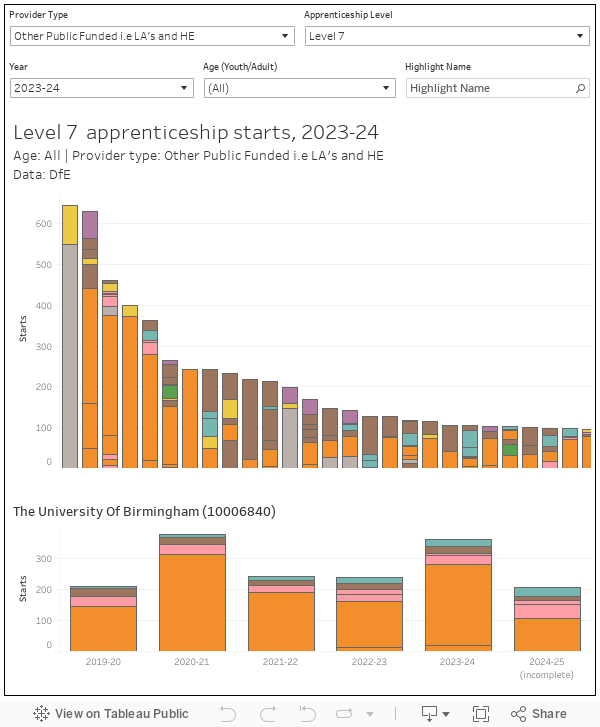
    The Department for Education and Skills England may decide to limit only a couple of standards – as the chart below shows, simply scrapping the Accountancy and Taxation Professional and Senior Leader standards would dramatically change the landscape (though we’d likely be back in the same position in a few years having a similar conversation about the Senior People Professional and Systems Thinking Practitioner ones).

    But once the government starts taking a pick-and-mix approach to standards (as opposed to letting a properly independent arms-length body do so), it opens the door to it happening again and again. If there is a substantial defunding of level 7 apprenticeship standards, expect the next few years to see targets on the back of others, even at level 6 – and an accompanying disincentive for universities to keep pressing ahead seeking out partnerships with employers.

    The removal from levy eligibility of standards that currently have a high uptake will have an immediate impact on those providers invested in them. Below, DK has charted apprenticeship starts by higher education institution (and a few other public bodies as they are lumped together in the DfE data, though as you may have noticed above some for-profit universities appear in the private sector category instead).

    The default view in this chart shows level 7 starts in 2023–24, broken down by standards, so that you can plumb the impact on different providers of different approaches to defunding. And if you’re getting nervous about what else Skills England might fancy doing once it’s finally got the level 7 announcement out of the way, you can look at provision at other levels too.

    Source link